More Related Content

PDF

PPT

PDF
Conditional sentences and wish clauses 
PDF
Conditionals presentation 
DOCX

PPT

PPT
Conditionals 3_types_4th_eso 
PPT
Conditionals PPT fffff.ppt Similar to Formula grammar presentation shkkxueushxhsjs

PPTX
conditionalsentences-150216225851-conversion-gate02.pptx 
PPTX

PPT

PPT
sentance of conditionals example of it.ppt 
PPT

PPT

PPT

PPT
Let us think about conditionals sentences for ebnglish subject.ppt 
PPT
conditionalLMNLKMNGGGGGGGGGGGGGGTTTTTTTs1.ppt 
PPT
CONDITIONAL GRAMMMAR CORREGIR ENERO 2018.ppt 
PPT
conditional sentences. all four types of them 
PPT
conditionals1Zero-Conditional-PowerPoint-Lesson.ppt 
PPT
Conditionals Presentation for English 9.ppt 
PPT
Conditionals.ppt VCVXVCXVVVVVVVVVVVVVVVVVVVVVVVVVVVVV 
PPT

PPTX
conditionalsentences-150216225851-conversion-gate02.pptx 
PPTX
CONDITIONALS FOR ONE AND ALL U CAN ALL ENJOY USING THEM IN YOUR CLASSES ALSO... 
PPT

PDF
Conditionals and Their Advanced Uses.pdf 
PPTX
Recently uploaded

PPTX
GRADE 8_WEEK 2_QUARTER 4_ENGLISH_MATATAG.pptx 
DOCX
Q4_-LE_PEH8_Lesson1_Week1 pls don't docx 
PPTX
How Physician Assistants in the USA Earn CME Credits Online.pptx 
PPTX
G5_ENGLISH_PPT_Q4_W2.pptx week 2 quarter 4 
PDF
Orlando by Virginia Woolf: The Granite and The Rainbow 
PPTX
EYE IRRIGATION AND INSTILLATION....pptx 
PPTX
Math 8 Quarter 4 Week 4-SECONDARY DATA.pptx 
PDF
Nursing care plan for Vomiting /B.Sc nsg 
PDF
MP High Court Stenographer (Grade 3) Previous Year's Question Paper's Compute... 
PDF
Tetracycline Class of Antibiotics: SAR, MOA and Uses 
PPTX
How to Easily Track Appraisal Analysis Report in Odoo 18 Appraisal 
PPTX
Complete Overview of Revamp in Odoo 18 Debug 
PPTX
Saber tooth tiger.pptx (Smilodon presentation ) = Extinct Animals 
PDF
Project Management Unit I SE OE-II SPPU Pune (2024 Pattern) 
PPTX
How to Manage Checkout Policy & Customer Portal in Odoo 18 Website 
PPTX
A detailed notes on Conjugate Vaccine and its mechanism. 
PPTX
How to Track Employee Skill Growth with Skills Evolution Report in Odoo 18 
PDF
RAJAT ARORA SIR PHYSICAL EDUCATION NOTES ALL CHAPTERS .pdf 
PDF
Chapter 05 Drugs Acting on the Central Nervous System: Anti-Depressant Drugs 
PPTX
Guidelines for reporting social networks and personal networks data Formula grammar presentation shkkxueushxhsjs
- 1.
- 2.
What are theconditional structures?
There are many different types. Let’s look at:
1. Basic conditional forms.
2. Mixed conditionals.
3. Alternative forms.
Basic conditional forms
Pearson © 2021 Formula
- 3.
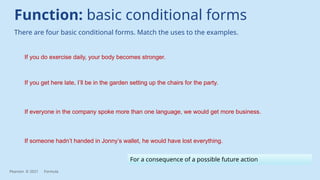
Function: basic conditionalforms
There are four basic conditional forms. Match the uses to the examples.
If you do exercise daily, your body becomes stronger.
If you get here late, I’ll be in the garden setting up the chairs for the party.
If everyone in the company spoke more than one language, we would get more business.
If someone hadn’t handed in Jonny’s wallet, he would have lost everything.
For hypothetical situations in the present
For hypothetical situations in the past
For general truths or consequences
For a consequence of a possible future action
Pearson © 2021 Formula
- 4.
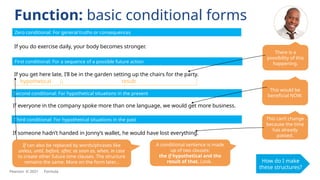
If you doexercise daily, your body becomes stronger.
If you get here late, I’ll be in the garden setting up the chairs for the party.
If someone hadn’t handed in Jonny’s wallet, he would have lost everything.
Zero conditional: For general truths or consequences
First conditional: For a sequence of a possible future action
hypothetical result
Second conditional: For hypothetical situations in the present
Function: basic conditional forms
How do I make
these structures?
There is a
possibility of this
happening.
If can also be replaced by words/phrases like
unless, until, before, after, as soon as, when, in case
to create other future time clauses. The structure
remains the same. More on the form later...
Third conditional: For hypothetical situations in the past
If everyone in the company spoke more than one language, we would get more business.
This would be
beneficial NOW.
This can’t change
because the time
has already
passed.
A conditional sentence is made
up of two clauses:
the if hypothetical and the
result of that. Look.
Pearson © 2021 Formula
- 5.
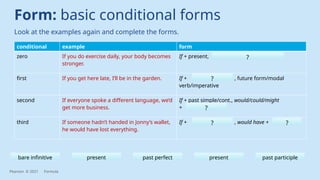
conditional example form
zeroIf you do exercise daily, your body becomes
stronger.
If + present,
first If you get here late, I’ll be in the garden. If + , future form/modal
verb/imperative
second If everyone spoke a different language, we’d
get more business.
If + past simple/cont., would/could/might
+
third If someone hadn’t handed in Jonny’s wallet,
he would have lost everything.
If + , would have +
Form: basic conditional forms
Look at the examples again and complete the forms.
?
?
?
? ?
bare infinitive present past perfect present past participle
Pearson © 2021 Formula
- 6.
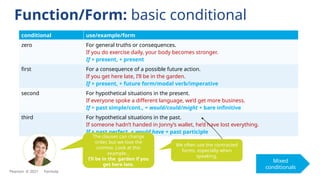
conditional use/example/form
zero Forgeneral truths or consequences.
If you do exercise daily, your body becomes stronger.
If + present, + present
first For a consequence of a possible future action.
If you get here late, I’ll be in the garden.
If + present, + future form/modal verb/imperative
second For hypothetical situations in the present.
If everyone spoke a different language, we’d get more business.
If + past simple/cont., + would/could/might + bare infinitive
third For hypothetical situations in the past.
If someone hadn’t handed in Jonny’s wallet, he’d have lost everything.
If + past perfect, + would have + past participle
Function/Form: basic conditional
The clauses can change
order, but we lose the
comma. Look at this
example…
I’ll be in the garden if you
get here late.
We often use the contracted
forms, especially when
speaking.
Mixed
conditionals
Pearson © 2021 Formula
- 7.
Function: mixed conditionals
Lookat these examples and answer the questions.
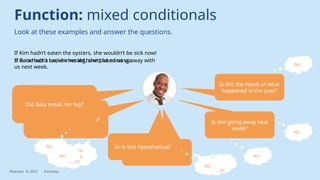
If Kim hadn’t eaten the oysters, she wouldn’t be sick now!
Is there a possibility that Kim
could not eat the oysters or is
it hypothetical?
Hypothetical.
She already
ate them!
Was she sick in the past
or is she sick now?
Now.
Does Anne have a car now?
If Anne had a car, she would have picked us up.
No.
Did she pick them up in
the past?
No.
Why not?
She
doesn’t
have a car.
If Gaia hadn’t broken her leg, she’d be coming away with
us next week.
Did Gaia break her leg?
Yes. So is this hypothetical?
Yes.
Is she going away next
week?
No.
Is this the result of what
happened in the past?
Yes.
Pearson © 2021 Formula
- 8.
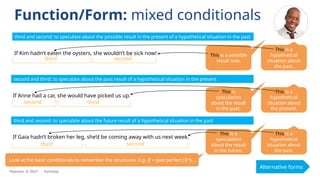
If Kim hadn’teaten the oysters, she wouldn’t be sick now!
If Anne had a car, she would have picked us up.
If Gaia hadn’t broken her leg, she’d be coming away with us next week.
third and second: to speculate about the possible result in the present of a hypothetical situation in the past
third second
second and third: to speculate about the past result of a hypothetical situation in the present
second third
third and second: to speculate about the future result of a hypothetical situation in the past
third second
Function/Form: mixed conditionals
Alternative forms
This is a possible
result now.
This is
speculation
about the result
in the past.
This is a
speculation
about the result
in the future.
This is a
hypothetical
situation about
the past.
This is a
hypothetical
situation about
the present.
This is a
hypothetical
situation about
the past.
Look at the basic conditionals to remember the structures. E.g. If + past perfect (3rd
)…
Pearson © 2021 Formula
- 9.
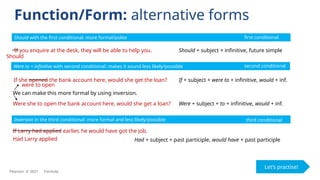
Function/Form: alternative forms
B
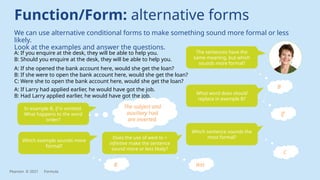
Wecan use alternative conditional forms to make something sound more formal or less
likely.
Look at the examples and answer the questions.
A: If you enquire at the desk, they will be able to help you.
B: Should you enquire at the desk, they will be able to help you.
The sentences have the
same meaning, but which
sounds more formal?
What word does should
replace in example B?
If
A: If she opened the bank account here, would she get the loan?
B: If she were to open the bank account here, would she get the loan?
C: Were she to open the bank account here, would she get the loan?
Which sentence sounds the
most formal?
C
Does the use of were to +
infinitive make the sentence
sound more or less likely?
less
A: If Larry had applied earlier, he would have got the job.
B: Had Larry applied earlier, he would have got the job.
Which example sounds more
formal?
B
In example B, if is omitted.
What happens to the word
order?
The subject and
auxiliary had
are inverted.
Pearson © 2021 Formula
- 10.
If you enquireat the desk, they will be able to help you.
If she opened the bank account here, would she get the loan?
If Larry had applied earlier, he would have got the job.
Should with the first conditional: more formal/polite
Were to + infinitive with second conditional: makes it sound less likely/possible
Inversion in the third conditional: more formal and less likely/possible
Function/Form: alternative forms
Let’s practise!
Should + subject + infinitive, future simple
If + subject + were to + infinitive, would + inf.
Had + subject + past participle, would have + past participle
Had Larry applied
Were she to open the bank account here, would she get a loan? Were + subject + to + infinitive, would + inf.
We can make this more formal by using inversion.
first conditional
second conditional
third conditional
Should
were to open
Pearson © 2021 Formula
- 11.
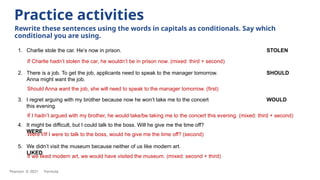
1. Charlie stolethe car. He’s now in prison. STOLEN
If Charlie hadn’t stolen the car, he wouldn’t be in prison now. (mixed: third + second)
Practice activities
Rewrite these sentences using the words in capitals as conditionals. Say which
conditional you are using.
2. There is a job. To get the job, applicants need to speak to the manager tomorrow. SHOULD
Anna might want the job.
3. I regret arguing with my brother because now he won’t take me to the concert WOULD
this evening.
4. It might be difficult, but I could talk to the boss. Will he give me the time off?
WERE
5. We didn’t visit the museum because neither of us like modern art.
LIKED
Should Anna want the job, she will need to speak to the manager tomorrow. (first)
If I hadn’t argued with my brother, he would take/be taking me to the concert this evening. (mixed: third + second)
Were I/If I were to talk to the boss, would he give me the time off? (second)
If we liked modern art, we would have visited the museum. (mixed: second + third)
Pearson © 2021 Formula