CONDITIONAL

 SENTENCES
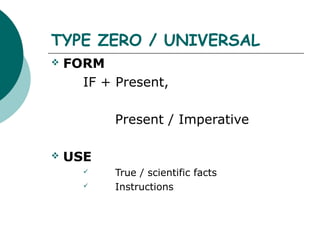
TYPE ZERO / UNIVERSAL
   FORM
      IF + Present,

           Present / Imperative

   USE
          True / scientific facts
          Instructions
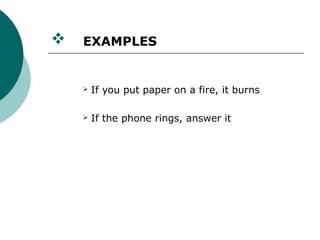
   EXAMPLES


       If you put paper on a fire, it burns

       If the phone rings, answer it
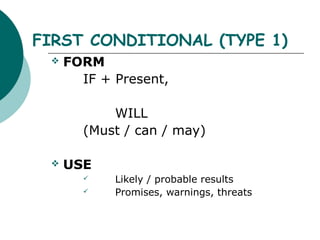
FIRST CONDITIONAL (TYPE 1)
    FORM
       IF + Present,

           WILL
       (Must / can / may)

    USE
           Likely / probable results
           Promises, warnings, threats
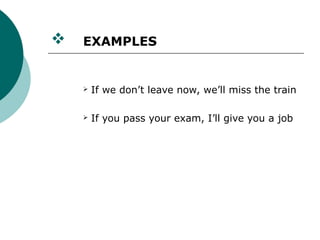
   EXAMPLES


       If we don’t leave now, we’ll miss the train

       If you pass your exam, I’ll give you a job
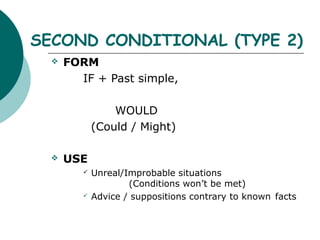
SECOND CONDITIONAL (TYPE 2)
     FORM
        IF + Past simple,

                 WOULD
             (Could / Might)

     USE
            Unreal/Improbable situations
                     (Conditions won’t be met)
            Advice / suppositions contrary to known facts
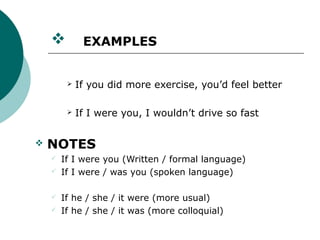
         EXAMPLES


            If you did more exercise, you’d feel better

            If I were you, I wouldn’t drive so fast


   NOTES
       If I were you (Written / formal language)
       If I were / was you (spoken language)

       If he / she / it were (more usual)
       If he / she / it was (more colloquial)
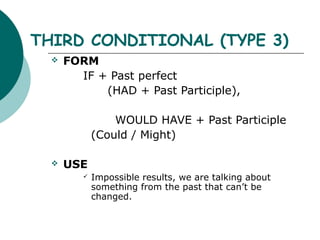
THIRD CONDITIONAL (TYPE 3)
     FORM
        IF + Past perfect
            (HAD + Past Participle),

                 WOULD HAVE + Past Participle
             (Could / Might)

     USE
            Impossible results, we are talking about
             something from the past that can’t be
             changed.
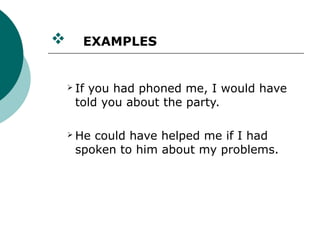
      EXAMPLES


     If
       you had phoned me, I would have
     told you about the party.

     Hecould have helped me if I had
     spoken to him about my problems.
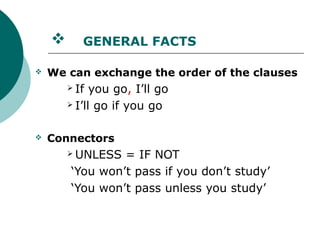
      GENERAL FACTS

   We can exchange the order of the clauses
         If  you go, I’ll go
         I’ll go if you go


   Connectors
         UNLESS = IF NOT
        ‘You won’t pass if you don’t study’
        ‘You won’t pass unless you study’
THE

END

Conditionals 3_types_4th_eso

  • 1.
  • 2.
    TYPE ZERO /UNIVERSAL  FORM IF + Present, Present / Imperative  USE  True / scientific facts  Instructions
  • 3.
    EXAMPLES  If you put paper on a fire, it burns  If the phone rings, answer it
  • 4.
    FIRST CONDITIONAL (TYPE1)  FORM IF + Present, WILL (Must / can / may)  USE  Likely / probable results  Promises, warnings, threats
  • 5.
    EXAMPLES  If we don’t leave now, we’ll miss the train  If you pass your exam, I’ll give you a job
  • 6.
    SECOND CONDITIONAL (TYPE2)  FORM IF + Past simple, WOULD (Could / Might)  USE  Unreal/Improbable situations (Conditions won’t be met)  Advice / suppositions contrary to known facts
  • 7.
    EXAMPLES  If you did more exercise, you’d feel better  If I were you, I wouldn’t drive so fast  NOTES  If I were you (Written / formal language)  If I were / was you (spoken language)  If he / she / it were (more usual)  If he / she / it was (more colloquial)
  • 8.
    THIRD CONDITIONAL (TYPE3)  FORM IF + Past perfect (HAD + Past Participle), WOULD HAVE + Past Participle (Could / Might)  USE  Impossible results, we are talking about something from the past that can’t be changed.
  • 9.
    EXAMPLES  If you had phoned me, I would have told you about the party.  Hecould have helped me if I had spoken to him about my problems.
  • 10.
    GENERAL FACTS  We can exchange the order of the clauses  If you go, I’ll go  I’ll go if you go  Connectors  UNLESS = IF NOT ‘You won’t pass if you don’t study’ ‘You won’t pass unless you study’
  • 11.