Annual Formaldehyde Awareness
Training
Providence VAMC Environmental,
Safety & Health Department
What is Formaldehyde?
• Formaldehyde is a colorless, strong-smelling
gas commonly used as a preservative.
• Although the term “formaldehyde” describes
various mixtures of formaldehyde, water and
alcohol, the term “formalin” describes
aqueous solutions, particularly those
containing 37 to 50% formaldehyde and 6 to
15 % alcohol stabilizer.
Who is at Risk For Potential
Exposure?
• Personnel who work with/utilize formalin
products in their workplace:
– Medical lab technicians
– Health care professionals
– Research personnel
• Personnel who repair lab equipment
• Personnel who transport formalin
• Personnel who pickup and transport formalin
waste
29 CFR 1910.1048 Formaldehyde
• Initial monitoring. The employer shall identify
all employees who may be exposed at or
above the action level or at or above the STEL
and accurately determine the exposure of
each employee so identified.
• The initial monitoring process shall be
repeated each time there is a change in
production, equipment, process, personnel, or
control measures which may result in new or
additional exposure to formaldehyde.
Permissible Exposure Limit (PEL) &
Action Level
• PEL: The employer shall assure that no
employee is exposed to an airborne
concentration of formaldehyde which exceeds
0.75 parts formaldehyde per million parts of
air (0.75 ppm) as an 8-hour TWA.
• "Action level" means a concentration of 0.5
part formaldehyde per million parts of air (0.5
ppm) calculated as an eight (8)-hour time-
weighted average (TWA) concentration.
Short Term Exposure Limit (STEL)
• Short Term Exposure Limit (STEL): The
employer shall assure that no employee is
exposed to an airborne concentration of
formaldehyde which exceeds two parts
formaldehyde per million parts of air (2 ppm)
as a 15-minute STEL.
Medical Surveillance
• The employer shall institute medical
surveillance programs for all employees
exposed to formaldehyde at concentrations at
or exceeding the action level or exceeding the
STEL.
• Medical surveillance is also required for
employees who develop signs and symptoms
of overexposure to formaldehyde and those
who respond to an emergency involving
formaldehyde
How can formaldehyde harm
workers?
• It is a sensitizing agent that can cause an
immune system response upon initial
exposure.
• It is also a suspected carcinogen that is linked
to nasal cancer and lung cancer.
• Ingestion and /or inhalation of high
concentrations may be fatal
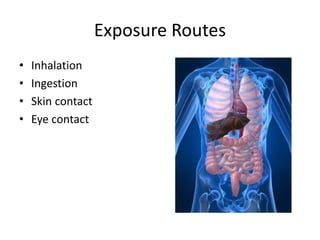
Exposure Routes
• Inhalation
• Ingestion
• Skin contact
• Eye contact
Symptoms of Exposure
• Irritation to eye, nose, throat & respiratory
system
• Allergic reactions of the skin, eyes &
respiratory tract
• Lacrimation (discharge of tears)
• Cough, wheezing
• Dermatitis
• ***Immediately report any symptoms of
exposure to your supervisor!
Safe Work Practices
• Wear appropriate PPE:
– Disposable nitrile gloves for handling containers,
pouring operations (change out if torn and wash
hands thoroughly after use)
– Chemical goggles and chemical resistant apron for
pouring operations (replace if ripped or torn)
• Utilize laboratory chemical hood ventilation
• Keep formalin containers closed tightly
• Keep emergency eyewashes and showers in
chemical labs unobstructed
Spills, Emergencies, Clean-up
Procedures
• For small spills: place leaking container in an
air tight secondary container, take up small
spill with absorbent material and place in
airtight container for disposal
• For large spills (beyond ability of equipment to
handle): leave the area immediately, call
x4999, do not touch spilled materials, shut off
ignition sources if able to do so without risk,
deny access to area other than emergency
personnel
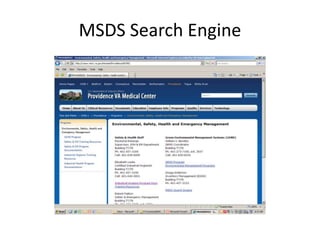
MSDS Search Engine
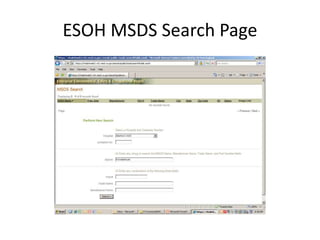
ESOH MSDS Search Page
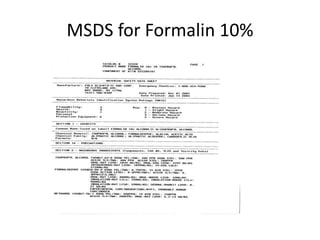
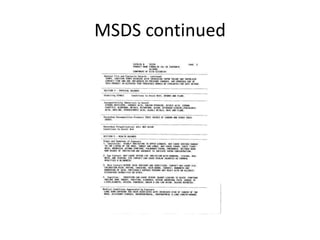
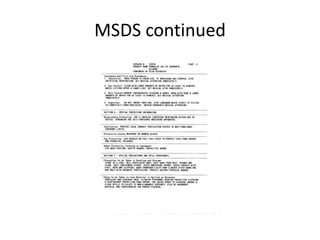
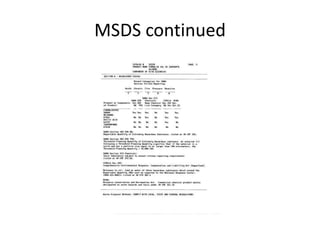
MSDS for Formalin 10%
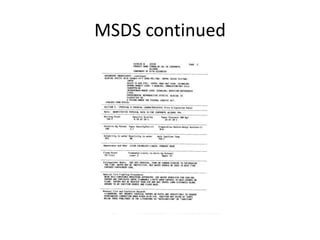
MSDS continued
MSDS continued
MSDS continued
MSDS continued
MSDS continued
References
• 29 CFR 1910.1048 Formaldehyde
• 29 CFR 1910.1200 Hazard Communication
Standard
• 29 CFR 1910.132 PPE
• 29 CFR 1910.133 Eye and face protection
• OSHA Fact Sheet Formaldehyde, USDOL, 2002
• CDC-NIOSH Pocket Guide to Chemical
Hazards-Formalin (as formaldehyde)
CERTIFICATE OF COMPLETION
I certify that I have reviewed and understand
this training presentation on Formaldehyde.
________________________ ____________
Printed name/Signature Date
(Print for the Training Record)

Formaldehyde Awareness Training and process.pptx

  • 1.
    Annual Formaldehyde Awareness Training ProvidenceVAMC Environmental, Safety & Health Department
  • 2.
    What is Formaldehyde? •Formaldehyde is a colorless, strong-smelling gas commonly used as a preservative. • Although the term “formaldehyde” describes various mixtures of formaldehyde, water and alcohol, the term “formalin” describes aqueous solutions, particularly those containing 37 to 50% formaldehyde and 6 to 15 % alcohol stabilizer.
  • 3.
    Who is atRisk For Potential Exposure? • Personnel who work with/utilize formalin products in their workplace: – Medical lab technicians – Health care professionals – Research personnel • Personnel who repair lab equipment • Personnel who transport formalin • Personnel who pickup and transport formalin waste
  • 4.
    29 CFR 1910.1048Formaldehyde • Initial monitoring. The employer shall identify all employees who may be exposed at or above the action level or at or above the STEL and accurately determine the exposure of each employee so identified. • The initial monitoring process shall be repeated each time there is a change in production, equipment, process, personnel, or control measures which may result in new or additional exposure to formaldehyde.
  • 5.
    Permissible Exposure Limit(PEL) & Action Level • PEL: The employer shall assure that no employee is exposed to an airborne concentration of formaldehyde which exceeds 0.75 parts formaldehyde per million parts of air (0.75 ppm) as an 8-hour TWA. • "Action level" means a concentration of 0.5 part formaldehyde per million parts of air (0.5 ppm) calculated as an eight (8)-hour time- weighted average (TWA) concentration.
  • 6.
    Short Term ExposureLimit (STEL) • Short Term Exposure Limit (STEL): The employer shall assure that no employee is exposed to an airborne concentration of formaldehyde which exceeds two parts formaldehyde per million parts of air (2 ppm) as a 15-minute STEL.
  • 7.
    Medical Surveillance • Theemployer shall institute medical surveillance programs for all employees exposed to formaldehyde at concentrations at or exceeding the action level or exceeding the STEL. • Medical surveillance is also required for employees who develop signs and symptoms of overexposure to formaldehyde and those who respond to an emergency involving formaldehyde
  • 8.
    How can formaldehydeharm workers? • It is a sensitizing agent that can cause an immune system response upon initial exposure. • It is also a suspected carcinogen that is linked to nasal cancer and lung cancer. • Ingestion and /or inhalation of high concentrations may be fatal
  • 9.
    Exposure Routes • Inhalation •Ingestion • Skin contact • Eye contact
  • 10.
    Symptoms of Exposure •Irritation to eye, nose, throat & respiratory system • Allergic reactions of the skin, eyes & respiratory tract • Lacrimation (discharge of tears) • Cough, wheezing • Dermatitis • ***Immediately report any symptoms of exposure to your supervisor!
  • 11.
    Safe Work Practices •Wear appropriate PPE: – Disposable nitrile gloves for handling containers, pouring operations (change out if torn and wash hands thoroughly after use) – Chemical goggles and chemical resistant apron for pouring operations (replace if ripped or torn) • Utilize laboratory chemical hood ventilation • Keep formalin containers closed tightly • Keep emergency eyewashes and showers in chemical labs unobstructed
  • 12.
    Spills, Emergencies, Clean-up Procedures •For small spills: place leaking container in an air tight secondary container, take up small spill with absorbent material and place in airtight container for disposal • For large spills (beyond ability of equipment to handle): leave the area immediately, call x4999, do not touch spilled materials, shut off ignition sources if able to do so without risk, deny access to area other than emergency personnel
  • 13.
  • 14.
  • 15.
  • 16.
  • 17.
  • 18.
  • 19.
  • 20.
  • 21.
    References • 29 CFR1910.1048 Formaldehyde • 29 CFR 1910.1200 Hazard Communication Standard • 29 CFR 1910.132 PPE • 29 CFR 1910.133 Eye and face protection • OSHA Fact Sheet Formaldehyde, USDOL, 2002 • CDC-NIOSH Pocket Guide to Chemical Hazards-Formalin (as formaldehyde)
  • 22.
    CERTIFICATE OF COMPLETION Icertify that I have reviewed and understand this training presentation on Formaldehyde. ________________________ ____________ Printed name/Signature Date (Print for the Training Record)