Formal Teaching & Learning: Schemas,
models and practices.
School of Physiotherapy’s
Celebration of Teaching workshop
Russell Butson
Higher Education Development Centre
June 2016
University of Otago
Topics
1. Teaching | Learning Approach - Institution
2. Teaching | Learning Approach - Student
3. Teaching | Learning Ecosystem
4. The Practice of Academic Study
5. Student Use of Technology
1. Teaching | Learning Approach
** The Institutional Perspective **
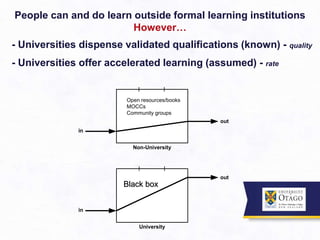
in
out
University
in
out
Non-University
People can and do learn outside formal learning institutions
However…
- Universities dispense validated qualifications (known) - quality
- Universities offer accelerated learning (assumed) - rate
Open resources/books
MOCCs
Community groups
Black box
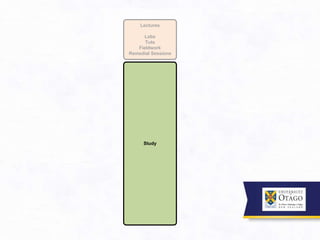
Institutional Approach to Teaching – two parts
1] Teaching Time / Contact time
2] Independent learning Time / Non-contact time
Lectures
Labs
Tuts
Fieldwork
Remedial Sessions
Study
20% of time BUT represents 80% of
the research on Teaching & Learning
+ high investment in institutional resources
80% of time BUT represents less than
20% of the research on Teaching & Learning
+ very low investment in institutional resources
CONTACT-TIME
TEACHING ACTIVITIES
NON-CONTACT-TIME
INDEPENDENT LEARNING
CURRICULUM
TEACHER
Content
Information
contextdeliverylearning
TEACHING
LINE
[optimal state]
PROFESSIONAL
DEVELOPMENT
STUDENT
LEARNING
INSTRUCTIONAL
DESIGN
ObjectivesStructure
ASSESSMENT
ALIGNMENT WITH
OBJECTIVES
A
B STUDENT
TEACHINGMETHOD
Lectures
Labs
Tuts
Fieldwork
Remedial Sessions
Study
From: Butson, R. (2011). Does higher education need deschooling? Industry & Higher Education, 25(3), 153-160. doi: 10.5367/ihe.2011.0042
2. Teaching | Learning Approach
** The Student Perspective **
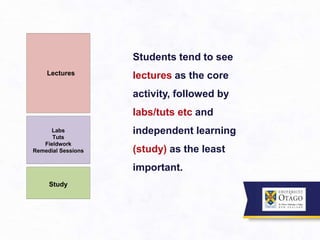
Labs
Tuts
Fieldwork
Remedial Sessions
Lectures
Study
Students tend to see
lectures as the core
activity, followed by
labs/tuts etc and
independent learning
(study) as the least
important.
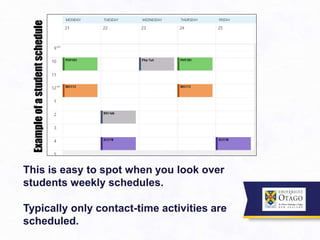
This is easy to spot when you look over
students weekly schedules.
Typically only contact-time activities are
scheduled.
Exampleofastudentschedule
Labs
Tuts
Fieldwork
Remedial Sessions
Lectures
Study
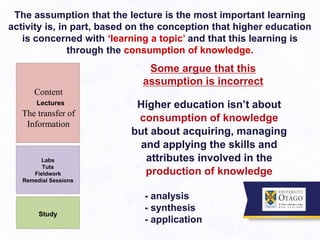
The assumption that the lecture is the most important learning
activity is, in part, based on the conception that higher education
is concerned with ā€˜learning a topic’ and that this learning is
through the consumption of knowledge.
Some argue that this
assumption is incorrect
Higher education isn’t about
consumption of knowledge
but about acquiring, managing
and applying the skills and
attributes involved in the
production of knowledge
- analysis
- synthesis
- application
Content
The transfer of
Information
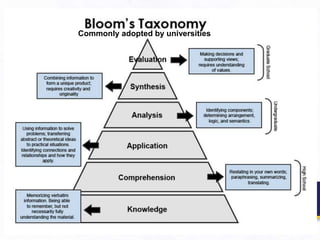
Commonly adopted by universities
3. Teaching/Learning Ecosystem
Can we Can the Lecture
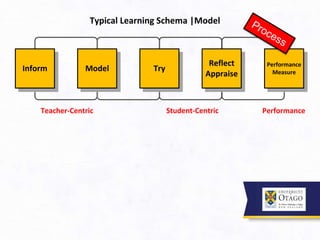
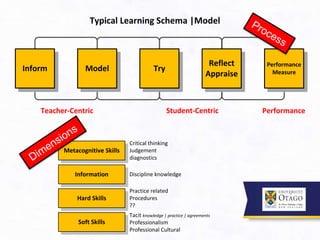
Model TryInform
Typical Learning Schema |Model
Teacher-Centric Student-Centric
Reflect
Appraise
Performance
Measure
Performance
Critical thinking
Judgement
diagnostics
Discipline knowledge
Practice related
Procedures
??
Tacit knowledge | practice | agreements
Professionalism
Professional Cultural
Metacognitive Skills
Information
Hard Skills
Soft Skills
Model TryInform
Typical Learning Schema |Model
Teacher-Centric Student-Centric
Reflect
Appraise
Performance
Measure
Performance
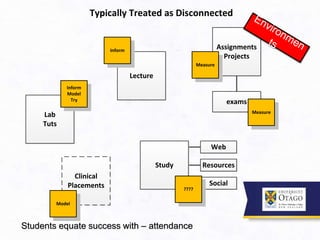
Students equate success with – attendance
Lecture
Assignments
Projects
Lab
Tuts
Study
exams
Web
Resources
Social
Inform
Inform
Model
Try
Measure
????
Measure
Typically Treated as Disconnected
Clinical
Placements
Model
Lecture
Assignments
Projects
Lab
Tuts
Study
exams
Web
Resources
Social
In form
Model
Measure
Try
Clinical
PlacementsAppraise
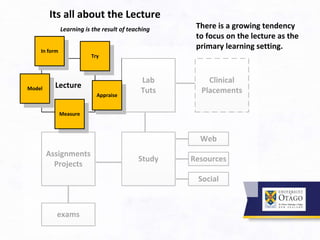
Its all about the Lecture
Learning is the result of teaching There is a growing tendency
to focus on the lecture as the
primary learning setting.
Lecture
Assignments
Projects
Lab
Tuts
Study
exams
Web
Resources
Social
Inform
Model
Inform
Try
Model
Appraise
Try
Appraise
Perform
Try
Appraise
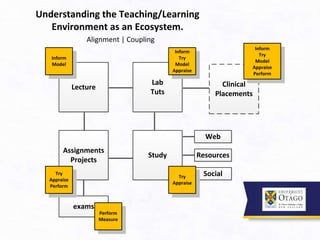
Alignment | Coupling
Understanding the Teaching/Learning
Environment as an Ecosystem.
Perform
Measure
Clinical
Placements
Inform
Try
Model
Appraise
Perform
4. The Practice of
Academic Study
Lectures
Labs
Tuts
Fieldwork
Remedial Sessions
Study
In short…
We have found undergraduate students..
ļ‚§ Lacked awareness of study methods/practices.
ļ‚§ Struggled to know how computers can be used
to help augment study practice.
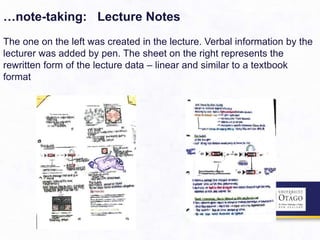
…note-taking: Lecture Notes
The one on the left was created in the lecture. Verbal information by the
lecturer was added by pen. The sheet on the right represents the
rewritten form of the lecture data – linear and similar to a textbook
format
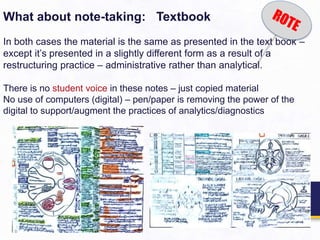
What about note-taking: Textbook
In both cases the material is the same as presented in the text book –
except it’s presented in a slightly different form as a result of a
restructuring practice – administrative rather than analytical.
There is no student voice in these notes – just copied material
No use of computers (digital) – pen/paper is removing the power of the
digital to support/augment the practices of analytics/diagnostics
It is interesting to note that the focus
was on capturing information.
And…
The documenting of this information
replicated the style of a text book –
they repackage to the familiar through
managerial or administrative skills - no
sign of Bloom’s metacognitive skills.
No authorship
ā€œI used to take my own notes, like doing the readings and all
that kind of stuff but then I realised that it takes a lot more
time and lecturers kind of just examine you on the lecture
material anyway so now I just try to memorise the lecture
material.ā€
ā€œUnderstanding didn’t get me the grades I wanted so now I
just put all my effort into memorising instead of actually
bothering to learn it properly.ā€
ā€œWhen revising I’m just going over things again and
again… that’s what gets it into your head.ā€
ā€œIf you know the slides off by-heart you will pretty much do
well in exams.ā€
Comments made by Health Science students (2015) revealing
their reliance on memorization through repetition - rote-learning
Students participating in this study…
ļ‚§ Relied heavily on memorisation as a study
technique.
ļ‚§ Were aware of higher order thinking
approaches, but felt the ā€˜facts-centric’
curriculum forced them to adopt the
repetition based study techniques.
ļ‚§ These students felt the best route to
success was to adopt rote-learning.
5. Student Use of Technology
Findings from studies looking at
undergraduate use of computers
at Otago
Data is not from student self-
reports but from usage logs
captured directly from their
computers over 3-5 months.
Computer literacy was low concerning academic use:
Browser (av. 70%).
…..of this Facebook and YouTube [av.62%]
Word [av. 4.7%]
Adobe Reader [av. 4.3%].
Worth Noting…
ļ‚§ Planning apps – outlook | google calendar
ļ‚§ Word-processing – poor knowledge of functionality
ļ‚§ Referencing apps – x endnote, zotera etc
ļ‚§ Note-taking - Onenote / Evernote
ļ‚§ Markups on website/PDF – unaware of this function
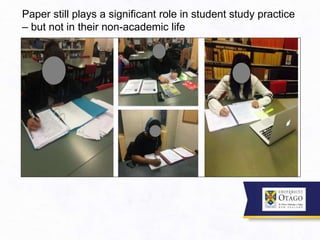
Paper still plays a significant role in student study practice
– but not in their non-academic life
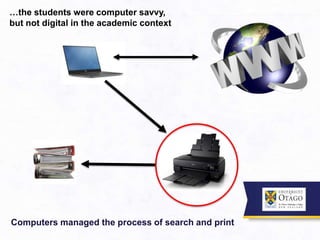
Computers managed the process of search and print
…the students were computer savvy,
but not digital in the academic context
In Conclusion – Potential for Change
• Structure (align-couple) contact teaching time to
reflect holistic teaching/learning (eco)system.
(maybe even include the non-contact time)
• Explore production-centric activities over
consumption of knowledge (rote-learning).
(Consumption of knowledge becomes a by-product of production-centric approaches)
• Explore ways to enhance student ā€˜study’
practices & technology use.
Thank you

Formal teaching & learning: schemas, models and practices

  • 1.
    Formal Teaching &Learning: Schemas, models and practices. School of Physiotherapy’s Celebration of Teaching workshop Russell Butson Higher Education Development Centre June 2016 University of Otago
  • 2.
    Topics 1. Teaching |Learning Approach - Institution 2. Teaching | Learning Approach - Student 3. Teaching | Learning Ecosystem 4. The Practice of Academic Study 5. Student Use of Technology
  • 3.
    1. Teaching |Learning Approach ** The Institutional Perspective **
  • 4.
    in out University in out Non-University People can anddo learn outside formal learning institutions However… - Universities dispense validated qualifications (known) - quality - Universities offer accelerated learning (assumed) - rate Open resources/books MOCCs Community groups Black box
  • 5.
    Institutional Approach toTeaching – two parts 1] Teaching Time / Contact time 2] Independent learning Time / Non-contact time Lectures Labs Tuts Fieldwork Remedial Sessions Study 20% of time BUT represents 80% of the research on Teaching & Learning + high investment in institutional resources 80% of time BUT represents less than 20% of the research on Teaching & Learning + very low investment in institutional resources CONTACT-TIME TEACHING ACTIVITIES NON-CONTACT-TIME INDEPENDENT LEARNING
  • 6.
    CURRICULUM TEACHER Content Information contextdeliverylearning TEACHING LINE [optimal state] PROFESSIONAL DEVELOPMENT STUDENT LEARNING INSTRUCTIONAL DESIGN ObjectivesStructure ASSESSMENT ALIGNMENT WITH OBJECTIVES A BSTUDENT TEACHINGMETHOD Lectures Labs Tuts Fieldwork Remedial Sessions Study From: Butson, R. (2011). Does higher education need deschooling? Industry & Higher Education, 25(3), 153-160. doi: 10.5367/ihe.2011.0042
  • 7.
    2. Teaching |Learning Approach ** The Student Perspective **
  • 8.
    Labs Tuts Fieldwork Remedial Sessions Lectures Study Students tendto see lectures as the core activity, followed by labs/tuts etc and independent learning (study) as the least important.
  • 9.
    This is easyto spot when you look over students weekly schedules. Typically only contact-time activities are scheduled. Exampleofastudentschedule
  • 10.
    Labs Tuts Fieldwork Remedial Sessions Lectures Study The assumptionthat the lecture is the most important learning activity is, in part, based on the conception that higher education is concerned with ā€˜learning a topic’ and that this learning is through the consumption of knowledge. Some argue that this assumption is incorrect Higher education isn’t about consumption of knowledge but about acquiring, managing and applying the skills and attributes involved in the production of knowledge - analysis - synthesis - application Content The transfer of Information
  • 11.
    Commonly adopted byuniversities
  • 12.
  • 13.
    Model TryInform Typical LearningSchema |Model Teacher-Centric Student-Centric Reflect Appraise Performance Measure Performance
  • 14.
    Critical thinking Judgement diagnostics Discipline knowledge Practicerelated Procedures ?? Tacit knowledge | practice | agreements Professionalism Professional Cultural Metacognitive Skills Information Hard Skills Soft Skills Model TryInform Typical Learning Schema |Model Teacher-Centric Student-Centric Reflect Appraise Performance Measure Performance
  • 15.
    Students equate successwith – attendance Lecture Assignments Projects Lab Tuts Study exams Web Resources Social Inform Inform Model Try Measure ???? Measure Typically Treated as Disconnected Clinical Placements Model
  • 16.
    Lecture Assignments Projects Lab Tuts Study exams Web Resources Social In form Model Measure Try Clinical PlacementsAppraise Its allabout the Lecture Learning is the result of teaching There is a growing tendency to focus on the lecture as the primary learning setting.
  • 17.
    Lecture Assignments Projects Lab Tuts Study exams Web Resources Social Inform Model Inform Try Model Appraise Try Appraise Perform Try Appraise Alignment | Coupling Understandingthe Teaching/Learning Environment as an Ecosystem. Perform Measure Clinical Placements Inform Try Model Appraise Perform
  • 18.
    4. The Practiceof Academic Study
  • 19.
  • 20.
    In short… We havefound undergraduate students.. ļ‚§ Lacked awareness of study methods/practices. ļ‚§ Struggled to know how computers can be used to help augment study practice.
  • 21.
    …note-taking: Lecture Notes Theone on the left was created in the lecture. Verbal information by the lecturer was added by pen. The sheet on the right represents the rewritten form of the lecture data – linear and similar to a textbook format
  • 22.
    What about note-taking:Textbook In both cases the material is the same as presented in the text book – except it’s presented in a slightly different form as a result of a restructuring practice – administrative rather than analytical. There is no student voice in these notes – just copied material No use of computers (digital) – pen/paper is removing the power of the digital to support/augment the practices of analytics/diagnostics
  • 23.
    It is interestingto note that the focus was on capturing information. And… The documenting of this information replicated the style of a text book – they repackage to the familiar through managerial or administrative skills - no sign of Bloom’s metacognitive skills. No authorship
  • 24.
    ā€œI used totake my own notes, like doing the readings and all that kind of stuff but then I realised that it takes a lot more time and lecturers kind of just examine you on the lecture material anyway so now I just try to memorise the lecture material.ā€ ā€œUnderstanding didn’t get me the grades I wanted so now I just put all my effort into memorising instead of actually bothering to learn it properly.ā€ ā€œWhen revising I’m just going over things again and again… that’s what gets it into your head.ā€ ā€œIf you know the slides off by-heart you will pretty much do well in exams.ā€ Comments made by Health Science students (2015) revealing their reliance on memorization through repetition - rote-learning
  • 25.
    Students participating inthis study… ļ‚§ Relied heavily on memorisation as a study technique. ļ‚§ Were aware of higher order thinking approaches, but felt the ā€˜facts-centric’ curriculum forced them to adopt the repetition based study techniques. ļ‚§ These students felt the best route to success was to adopt rote-learning.
  • 26.
    5. Student Useof Technology
  • 27.
    Findings from studieslooking at undergraduate use of computers at Otago Data is not from student self- reports but from usage logs captured directly from their computers over 3-5 months.
  • 28.
    Computer literacy waslow concerning academic use: Browser (av. 70%). …..of this Facebook and YouTube [av.62%] Word [av. 4.7%] Adobe Reader [av. 4.3%]. Worth Noting… ļ‚§ Planning apps – outlook | google calendar ļ‚§ Word-processing – poor knowledge of functionality ļ‚§ Referencing apps – x endnote, zotera etc ļ‚§ Note-taking - Onenote / Evernote ļ‚§ Markups on website/PDF – unaware of this function
  • 29.
    Paper still playsa significant role in student study practice – but not in their non-academic life
  • 30.
    Computers managed theprocess of search and print …the students were computer savvy, but not digital in the academic context
  • 31.
    In Conclusion –Potential for Change • Structure (align-couple) contact teaching time to reflect holistic teaching/learning (eco)system. (maybe even include the non-contact time) • Explore production-centric activities over consumption of knowledge (rote-learning). (Consumption of knowledge becomes a by-product of production-centric approaches) • Explore ways to enhance student ā€˜study’ practices & technology use.
  • 32.