FOOD PREPARATION
FOOD PREPARATION
FACTORS TO BE CONSIDERED WHEN
PLANNING A MEAL
PLANNING A MEAL
• Nutrition- balanced meal.
Nutrition- balanced meal.
• Follow healthy eating
Follow healthy eating
guidelines.
guidelines.
• Requirements of age-group
Requirements of age-group
being served.
being served.
• Special diets e.g. coeliac.
Special diets e.g. coeliac.
• Variety- tastes, colour,
Variety- tastes, colour,
texture, cooking methods
texture, cooking methods.
.
• Time available.
Time available.
• Knowledge & skill.
Knowledge & skill.
• Budget.
Budget.
• Availability of ingredients.
Availability of ingredients.
• Availability of equipment.
Availability of equipment.
CHANGES THAT HAPPEN DURING
FOOD PREPARATION
FOOD PREPARATION
Physical Changes
Physical Changes
 Increase in size e.g. soaking
Increase in size e.g. soaking
dried food.
dried food.
 Thickening e.g. whipping
Thickening e.g. whipping
cream.
cream.
 Loss of nutritive value e.g.
Loss of nutritive value e.g.
water - soluble vitamins
dissolve into water.
 Tenderising e.g. meat is
Tenderising e.g. meat is
tenderised by beating,
mincing.
mincing.
Chemical changes
Chemical changes
 Colour change e.g. enzymatic
Colour change e.g. enzymatic
browning.
browning.
 Nutrient loss e.g. enzyme
Nutrient loss e.g. enzyme
oxidase destroys vitamin C.
 Tenderising e.g. proteolytic
Tenderising e.g. proteolytic
enzymes tenderise meat
fibres.
fibres.
 Increase in size e.g. yeast
Increase in size e.g. yeast
dough expands as enzymes
make CO
make CO2
2 .
.
CHANGES THAT HAPPEN DURING
COOKING OF FOOD
COOKING OF FOOD
Physical Changes
Physical Changes
 Texture changes e.g. cell walls
Texture changes e.g. cell walls
soften in vegetables.
 Bacteria killed.
Bacteria killed.
 Nutrient loss e.g. vitamins &
Nutrient loss e.g. vitamins &
minerals dissolve into cooking
liquid.
liquid.
 Food solidifies e.g. egg protein
Food solidifies e.g. egg protein
coagulates.
coagulates.
 Food thickens e.g.
Food thickens e.g.
gelatinisation of starch.
 Shrinkage - protein coagulates
Shrinkage - protein coagulates
& shrinks e.g. meat.
Chemical Changes
Chemical Changes
 Maillard reaction – when amino
Maillard reaction – when amino
acids & carbohydrates are
heated together, the food turns
brown.
brown.
 Caramelisation - sugar heated
Caramelisation - sugar heated
above dissolving point turns
brown e.g. toffee.
brown e.g. toffee.
 Dextrinisation - long starch
Dextrinisation - long starch
chains break into shorter chains
called dextrins & a brown
colour develops e.g. toasting
bread.
bread.
REASONS FOR COOKING FOOD
• To destroy pathogenic bacteria making food safer.
To destroy pathogenic bacteria making food safer.
• To destroy enzymes and prevent food spoilage.
To destroy enzymes and prevent food spoilage.
• To make food palatable & digestible e.g. starchy foods like
To make food palatable & digestible e.g. starchy foods like
potatoes.
potatoes.
• To improve appearance e.g. meat.
To improve appearance e.g. meat.
• To develop flavour e.g. meat extractives released (aroma).
To develop flavour e.g. meat extractives released (aroma).
• To stimulate digestive juices - sight & smells of cooked food.
To stimulate digestive juices - sight & smells of cooked food.
• To destroy natural toxins e.g. red kidney beans.
To destroy natural toxins e.g. red kidney beans.
• To combine ingredients and create new flavours.
To combine ingredients and create new flavours.
UNDERLYING PRINCIPLES OF
COOKING FOOD
COOKING FOOD
 Conduction -
Conduction - Transfer of heat from one
Transfer of heat from one molecule to
molecule to
another by vibration of molecules. E.g. heat passing from
the cooker hob through the base of the saucepan.
 Convection -
Convection - Molecules near heat source become hot, less
Molecules near heat source become hot, less
dense and rise up. This allows cold molecules to take their
place. This sets up convection currents and heat is spread
e.g. simmering stews.
 Radiation -
Radiation - Heat passes in straight rays, from the source,
Heat passes in straight rays, from the source,
to the first solid object they reach, without heating air in
between e.g. grilling burgers.
Most cooking methods involve one or more of these
principles.
principles.
METHODS OF COOKING
METHODS OF COOKING
• Moist Methods:
Moist Methods: Boiling, Simmering, Poaching, Stewing, Braising,
Boiling, Simmering, Poaching, Stewing, Braising,
Steaming, Pressure cooking.
• Dry Methods:
Dry Methods: Baking, Grilling, Roasting, Barbecuing.
Baking, Grilling, Roasting, Barbecuing.
• Frying:
Frying: Dry, Shallow, Deep -fat, Stir.
Dry, Shallow, Deep -fat, Stir.
• Microwave cooking
Microwave cooking.
.
CHOOSING A COOKING
CHOOSING A COOKING
METHOD
METHOD
• Ingredients available e.g. stewing beef or sirloin
Ingredients available e.g. stewing beef or sirloin
steak.
steak.
• Experience of cook.
Experience of cook.
• Time available.
Time available.
• Equipment available.
Equipment available.
• Desired result e.g. crispy, brown, moist.
Desired result e.g. crispy, brown, moist.
• Fuel economy.
Fuel economy.
• Retention of nutrients.
Retention of nutrients.
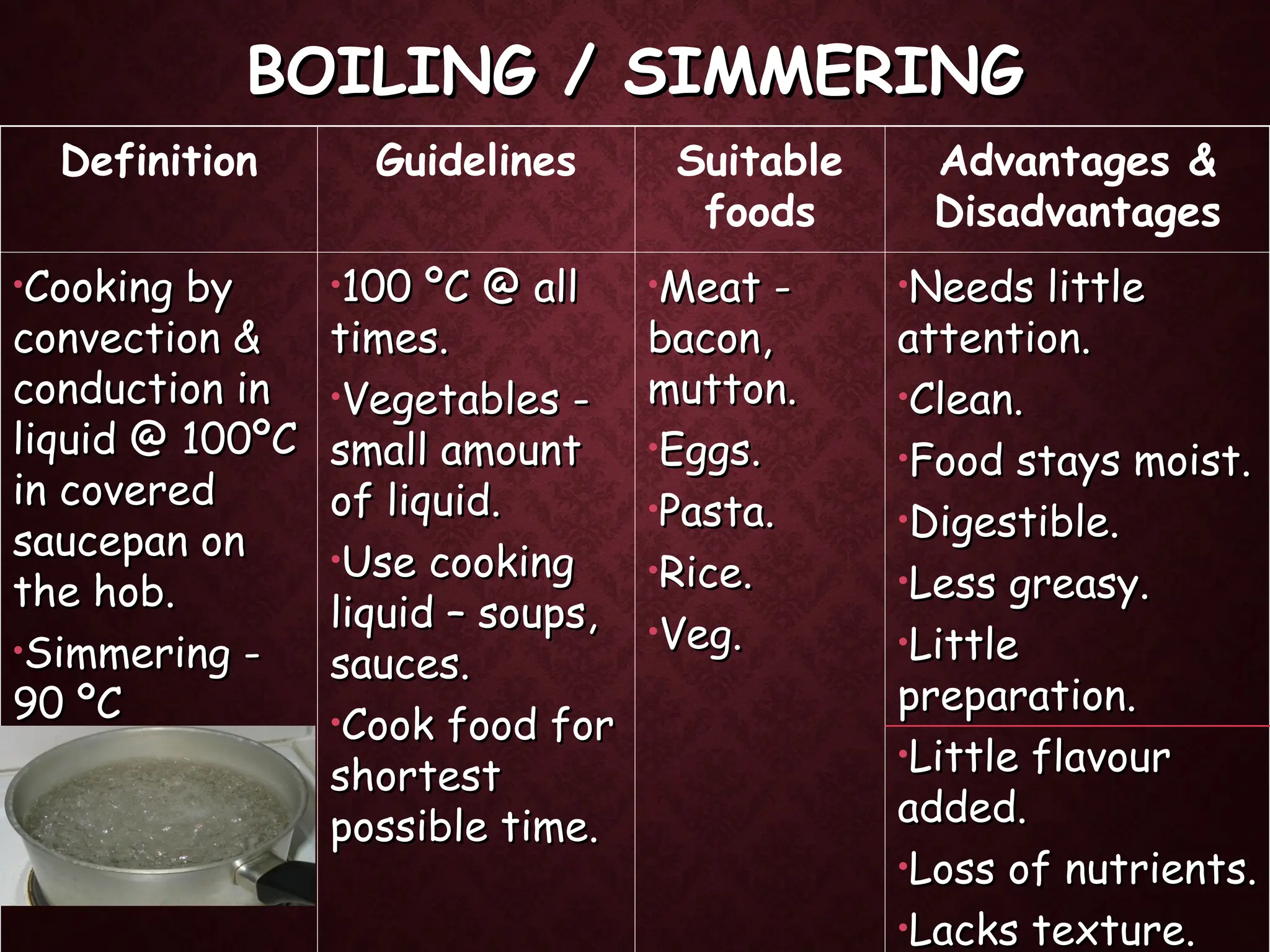
BOILING / SIMMERING
BOILING / SIMMERING
Definition Guidelines Suitable
foods
Advantages &
Disadvantages
•Cooking by
Cooking by
convection &
convection &
conduction in
conduction in
liquid @ 100
liquid @ 100ºC
ºC
in covered
in covered
saucepan on
saucepan on
the hob.
the hob.
•Simmering -
Simmering -
90
90 ºC
ºC
•100
100 ºC @ all
ºC @ all
times.
times.
•Vegetables -
Vegetables -
small amount
small amount
of liquid.
of liquid.
•Use cooking
Use cooking
liquid – soups,
liquid – soups,
sauces.
sauces.
•Cook food for
Cook food for
shortest
shortest
possible time.
possible time.
•Meat -
Meat -
bacon,
bacon,
mutton.
mutton.
•Eggs.
Eggs.
•Pasta.
Pasta.
•Rice.
Rice.
•Veg.
Veg.
•Needs little
Needs little
attention.
attention.
•Clean.
Clean.
•Food stays moist.
Food stays moist.
•Digestible.
Digestible.
•Less greasy.
Less greasy.
•Little
Little
preparation.
preparation.
•Little flavour
Little flavour
added.
added.
•Loss of nutrients.
Loss of nutrients.
•Lacks texture.
Lacks texture.
POACHING
POACHING
Definition Guidelines Suitable
foods
Advantages &
Disadvantages
•Cooking by
Cooking by
convection &
convection &
conduction in
conduction in
liquid @
liquid @
85
85ºC in
ºC in
covered
covered
container on
container on
hob or in
hob or in
oven.
oven.
•85
85 ºC @ all
ºC @ all
times.
times.
• Water
Water
barely
barely
moving, not
moving, not
bubbling.
bubbling.
• Use for
Use for
delicate
delicate
foods that
foods that
need gentle
need gentle
cooking.
cooking.
•Fish.
Fish.
•De-
De-
shelled
shelled
eggs.
eggs.
•Fruit.
Fruit.
•Clean.
Clean.
•Food stays
Food stays
moist.
moist.
•Digestible.
Digestible.
•Less greasy.
Less greasy.
•Little flavour
Little flavour
added.
added.
•Loss of
Loss of
nutrients.
nutrients.
•Lacks texture.
Lacks texture.
•Slow.
Slow.
•Needs
Needs
attention.
attention.
BRAISING
BRAISING
Definition Guidelines Suitable
foods
Advantages &
Disadvantages
•Cooking meat
Cooking meat
in a small
in a small
amount of
amount of
stock, on a
stock, on a
layer of
layer of
vegetables
vegetables
(mirepoix).
(mirepoix).
Meat is in a
Meat is in a
covered
covered
saucepan on
saucepan on
the hob.
the hob.
•Combination
Combination
of steaming
of steaming
and stewing.
and stewing.
•Use only
Use only
enough stock
enough stock
to cover
to cover
vegetables.
vegetables.
•Food can be
Food can be
browned
browned
under grill
under grill
before
before
serving.
serving.
•Root
Root
vegetables
vegetables
•Chicken.
Chicken.
•Offal.
Offal.
•Tougher
Tougher
cuts of
cuts of
meat.
meat.
•Little attention
Little attention
needed.
needed.
•Food stays
Food stays
moist.
moist.
•Complete meal in
Complete meal in
one pot – saves
one pot – saves
fuel & wash-up.
fuel & wash-up.
•Less nutrient
Less nutrient
loss.
loss.
•Digestible.
Digestible.
•A lot of prep.
A lot of prep.
•Slow.
Slow.
•Lacks texture.
Lacks texture.
STEWING
STEWING
Definition Guidelines Suitable
foods
Advantages &
Disadvantages
•Slowly cooking
Slowly cooking
food in a little
food in a little
liquid, by
liquid, by
conduction &
conduction &
convection,
convection,
using gentle
using gentle
heat (80
heat (80 ºC -
ºC -
90 ºC),
90 ºC), in a
in a
covered
covered
container, on
container, on
hob or in oven.
hob or in oven.
•Bring to boil
Bring to boil
& then reduce
& then reduce
heat.
heat.
•Temperature
Temperature
of 80
of 80 ºC -90
ºC -90
ºC.
ºC.
•Keep
Keep
covered.
covered.
•Use pressure
Use pressure
cooker to
cooker to
reduce time.
reduce time.
•Tough
Tough
cuts of
cuts of
meat/fish.
meat/fish.
•Veg.
Veg.
•Fruit
Fruit
•Little attention
Little attention
needed.
needed.
•Food stays
Food stays
moist.
moist.
•Complete meal in
Complete meal in
one pot – saves
one pot – saves
fuel & wash-up.
fuel & wash-up.
•Less nutrient
Less nutrient
loss.
loss.
•Digestible.
Digestible.
•A lot of prep
A lot of prep.
.
•Slow.
Slow.
•Lacks texture
Lacks texture
STEAMING
STEAMING
Definition Guidelines Suitable
foods
Advantages &
Disadvantages
•Cooking food
Cooking food
slowly in steam
slowly in steam
rising from
rising from
boiling water.
boiling water.
•Food can be
Food can be
steamed:
steamed:
•a. Between two
a. Between two
plates.
plates.
•b. In a covered
b. In a covered
bowl in a saucepan
bowl in a saucepan
of boiling water.
of boiling water.
•c. In a steamer
c. In a steamer
over boiling water.
over boiling water.
•d. On a trivet in a
d. On a trivet in a
pressure cooker.
pressure cooker.
• A tightly
A tightly
fitting lid
fitting lid
prevents
prevents
evaporation.
evaporation.
•Water boiling
Water boiling
before & during
before & during
cooking.
cooking.
•Food must not
Food must not
touch liquid.
touch liquid.
•Thin pieces
Thin pieces
of chicken
of chicken
and fish.
and fish.
•Steamed
Steamed
puddings, e.g.
puddings, e.g.
canary,
canary,
Christmas,
Christmas,
chocolate.
chocolate.
•Vegetables.
Vegetables.
•No loss of
No loss of
nutrients.
nutrients.
•Clean.
Clean.
•Food stays
Food stays
moist.
moist.
•Digestible.
Digestible.
•Not greasy.
Not greasy.
•Little flavour
Little flavour
added.
added.
•Lacks texture.
Lacks texture.
•Slow.
Slow.
•Not suitable
Not suitable
for large pieces
for large pieces
of food.
of food.
BAKING
BAKING
Definition Guidelines Suitable
foods
Advantages &
Disadvantages
•Dry
Dry
method of
method of
cooking
cooking
food by
food by
convection
convection
currents
currents
in the
in the
oven.
oven.
•Pre-heat oven.
Pre-heat oven.
•Steam made in
Steam made in
the oven stops
the oven stops
food drying,
food drying,
tinfoil &
tinfoil &
greaseproof
greaseproof
paper also used.
paper also used.
•Avoid opening
Avoid opening
oven door.
oven door.
•Bread. Cakes.
Bread. Cakes.
Biscuits.
Biscuits.
Pastries.
Pastries.
•Vegetables
Vegetables
e.g. potatoes,
e.g. potatoes,
tomatoes,
tomatoes,
peppers.
peppers.
•Fruit e.g.
Fruit e.g.
Apples.
Apples.
•Puddings,
Puddings,
apple crumble.
apple crumble.
•Attractive
Attractive
appearance.
appearance.
•Doesn’t add
Doesn’t add
fat.
fat.
•Little loss of
Little loss of
nutrients.
nutrients.
•Dries food.
Dries food.
GRILLING
GRILLING
Definition Guidelines Suitable
foods
Advantages &
Disadvantages
•Fast method
Fast method
of cooking
of cooking
food by
food by
radiant heat
radiant heat
under a grill.
under a grill.
•Pre-heat grill.
Pre-heat grill.
•Seal surface of
Seal surface of
the food with high
the food with high
heat, preventing
heat, preventing
nutrient loss.
nutrient loss.
•Use tongs to turn
Use tongs to turn
food.
food.
•Thin pieces of
Thin pieces of
food only.
food only.
•Don’t salt food
Don’t salt food
before grilling.
before grilling.
•Oil grill grid to
Oil grill grid to
prevent sticking.
prevent sticking.
•Meat -
Meat -
chops,
chops,
steaks,
steaks,
burgers,
burgers,
rashers.
rashers.
•Vegetables -
Vegetables -
tomatoes.
tomatoes.
•Fish fillets.
Fish fillets.
• Fast.
Fast.
•Little loss of
Little loss of
nutrients.
nutrients.
•Reduces fat
Reduces fat
content.
content.
•Attractive
Attractive
appearance &
appearance &
taste.
taste.
•Constant
Constant
attention needed.
attention needed.
•Dries food.
Dries food.
•Spatters grease.
Spatters grease.
•Unsuitable for
Unsuitable for
tough or thick cuts
tough or thick cuts
of meat.
of meat.
BARBECUING
BARBECUING
Definition Guidelines Suitable
foods
Advantages &
Disadvantages
•Cooking food by
Cooking food by
radiant heat on
radiant heat on
a grid over
a grid over
glowing
glowing
charcoal.
charcoal.
•Pre-heat
Pre-heat
barbecue.
barbecue.
•Seal surface with
Seal surface with
high heat,
high heat,
preventing
preventing
nutrient loss.
nutrient loss.
•Use tongs to turn
Use tongs to turn
food.
food.
•Thin pieces of
Thin pieces of
food only.
food only.
•Don’t salt food
Don’t salt food
before
before
barbecuing.
barbecuing.
•Oil barbecue grid
Oil barbecue grid
to prevent
to prevent
sticking.
sticking.
•Meat,
Meat,
chops,
chops,
steaks,
steaks,
burgers,
burgers,
rashers.
rashers.
•Vegetables
Vegetables
e.g.tomatoes
e.g.tomatoes
•Fish fillets.
Fish fillets.
• Fast
Fast
•Little loss of
Little loss of
nutrients.
nutrients.
•Reduces fat
Reduces fat
content.
content.
•Attractive
Attractive
appearance &
appearance &
taste.
taste.
•Constant
Constant
attention.
attention.
•Dries food.
Dries food.
•Spatters grease.
Spatters grease.
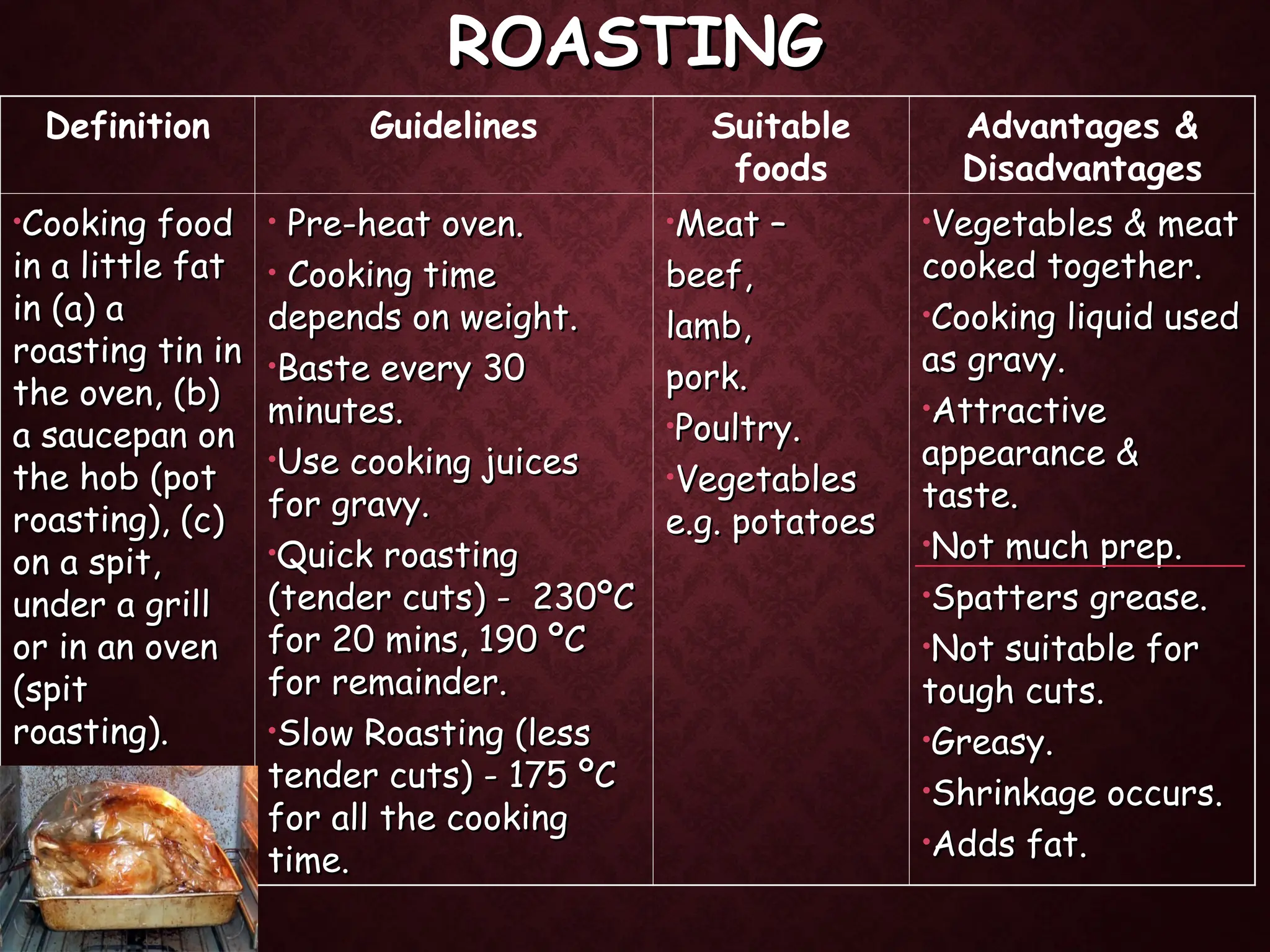
ROASTING
ROASTING
Definition Guidelines Suitable
foods
Advantages &
Disadvantages
•Cooking food
Cooking food
in a little fat
in a little fat
in (a) a
in (a) a
roasting tin in
roasting tin in
the oven, (b)
the oven, (b)
a saucepan on
a saucepan on
the hob (pot
the hob (pot
roasting), (c)
roasting), (c)
on a spit,
on a spit,
under a grill
under a grill
or in an oven
or in an oven
(spit
(spit
roasting).
roasting).
• Pre-heat oven.
Pre-heat oven.
• Cooking time
Cooking time
depends on weight.
depends on weight.
•Baste every 30
Baste every 30
minutes.
minutes.
•Use cooking juices
Use cooking juices
for gravy.
for gravy.
•Quick roasting
Quick roasting
(tender cuts) - 230
(tender cuts) - 230ºC
ºC
for 20 mins, 190 ºC
for 20 mins, 190 ºC
for remainder.
for remainder.
•Slow Roasting (less
Slow Roasting (less
tender cuts) - 175
tender cuts) - 175 ºC
ºC
for all the cooking
for all the cooking
time.
time.
•Meat –
Meat –
beef,
beef,
lamb,
lamb,
pork.
pork.
•Poultry.
Poultry.
•Vegetables
Vegetables
e.g. potatoes
e.g. potatoes
•Vegetables & meat
Vegetables & meat
cooked together.
cooked together.
•Cooking liquid used
Cooking liquid used
as gravy.
as gravy.
•Attractive
Attractive
appearance &
appearance &
taste.
taste.
•Not much prep.
Not much prep.
•Spatters grease.
Spatters grease.
•Not suitable for
Not suitable for
tough cuts.
tough cuts.
•Greasy.
Greasy.
•Shrinkage occurs.
Shrinkage occurs.
•Adds fat.
Adds fat.
FRYING
FRYING
Definition Guidelines Suitable
foods
Advantages &
Disadvantages
• Dry –
cooking food
by
conduction in
frying pan on
the hob.
• Shallow –
cooking food
in hot fat.
• Deep –
cooking food
immersed in
hot fat.
• Pre-heat oil.
Pre-heat oil.
• Use tongs for
Use tongs for
turning.
turning.
•Drain before
Drain before
serving.
serving.
•Coating food:
•Protects
Protects
surface.
surface.
•Texture.
Texture.
•Flavour.
Flavour.
•Appearance.
Appearance.
•Meat - thin
Meat - thin
pieces e.g.
pieces e.g.
rashers,
rashers,
chops,
chops,
burgers,
burgers,
sausages.
sausages.
•Fish - thin
Fish - thin
pieces e.g.
pieces e.g.
steaks,
steaks,
cutlets, fillets.
cutlets, fillets.
•Eggs.
Eggs.
•Vegetables.
Vegetables.
•Doughnuts.
Doughnuts.
•Quick.
Quick.
•Attractive taste
Attractive taste
& appearance.
& appearance.
•Constant
Constant
attention.
attention.
•Spatters grease.
Spatters grease.
•Not suitable for
Not suitable for
tough meats or
tough meats or
large cuts.
large cuts.
•Not suitable when
Not suitable when
cooking for large
cooking for large
numbers.
numbers.
•Greasy.
Greasy.
•Indigestible
Indigestible
PRESSURE COOKING
PRESSURE COOKING
Definition &
principle
Structure Guidelines Suitable foods
•Fast moist method
Fast moist method
of cooking food @
of cooking food @
high temps. in a
high temps. in a
pressure cooker.
pressure cooker.
•Used for boiling,
Used for boiling,
stewing & steaming.
stewing & steaming.
•Water under
Water under
increased pressure
increased pressure
boils @ higher temp.
Pressure increased
Pressure increased
inside pressure
inside pressure
cooker by not letting
steam escape. As a
steam escape. As a
result, water boils @
122
122ºC.
ºC. Food cooks in
Food cooks in
1/3 of normal time.
1/3 of normal time.
•Heavy
Heavy
gauge
gauge
saucepan.
saucepan.
Locking lid.
Locking lid.
•Rubber
Rubber
gasket seals
gasket seals
lid.
lid.
•Trivet.
Trivet.
•Separator
Separator
basket.
basket.
•Vent on lid.
Vent on lid.
•Safety
Safety
valve.
valve.
•Follow
Follow
instructions.
instructions.
•Never overfill.
Never overfill.
•Build up steam
Build up steam
before applying
before applying
weight.
weight.
•Time very
Time very
accurately.
accurately.
•Reduce
Reduce
pressure before
pressure before
opening-
opening-
•(a) Stand for 15
(a) Stand for 15
mins @ room
mins @ room
temp.
temp.
•(b) Under cold
(b) Under cold
running water.
running water.
•Stocks & soups.
Stocks & soups.
•Stews.
Stews.
•Vegetables e.g.
Vegetables e.g.
potatoes.
potatoes.
•Jam.
Jam.
•Christmas
Christmas
pudding.
pudding.
•Bottling
Bottling
MICROWAVE
MICROWAVE
Principle Guidelines Suitable dishes
•Electro-
Electro-
magnetic
magnetic
waves
waves
penetrate the
penetrate the
food to a
food to a
certain depth
certain depth
and cause the
and cause the
molecules to
molecules to
vibrate very
vibrate very
rapidly. This
rapidly. This
causes
causes
intense heat.
intense heat.
The
The
remainder of
remainder of
the food
the food
cooks by
cooks by
conduction.
conduction.
•Time carefully.
Time carefully.
•Timing is affected by:
Timing is affected by:
Composition.
Composition.
Thickness.
Thickness.
Density.
Density.
Temperature at the start.
Amount of food.
Amount of food.
•Cover food, keep moist, cook
Cover food, keep moist, cook
faster.
faster.
•Turn or stir.
Turn or stir.
•Pierce skins.
Pierce skins.
•Arrange in circle, thickest bit
Arrange in circle, thickest bit
outward.
outward.
•No metal or foil.
No metal or foil.
•Allow standing time.
Allow standing time.
•Defrosting.
Defrosting.
•Reheating.
Reheating.
•Cooking.
Cooking.
•Melting
Melting
chocolate.
chocolate.
•Heating liquid.
Heating liquid.
•Unsuitable
Unsuitable
dishes
dishes
•Pastry.
Pastry.
•Meringue.
Meringue.
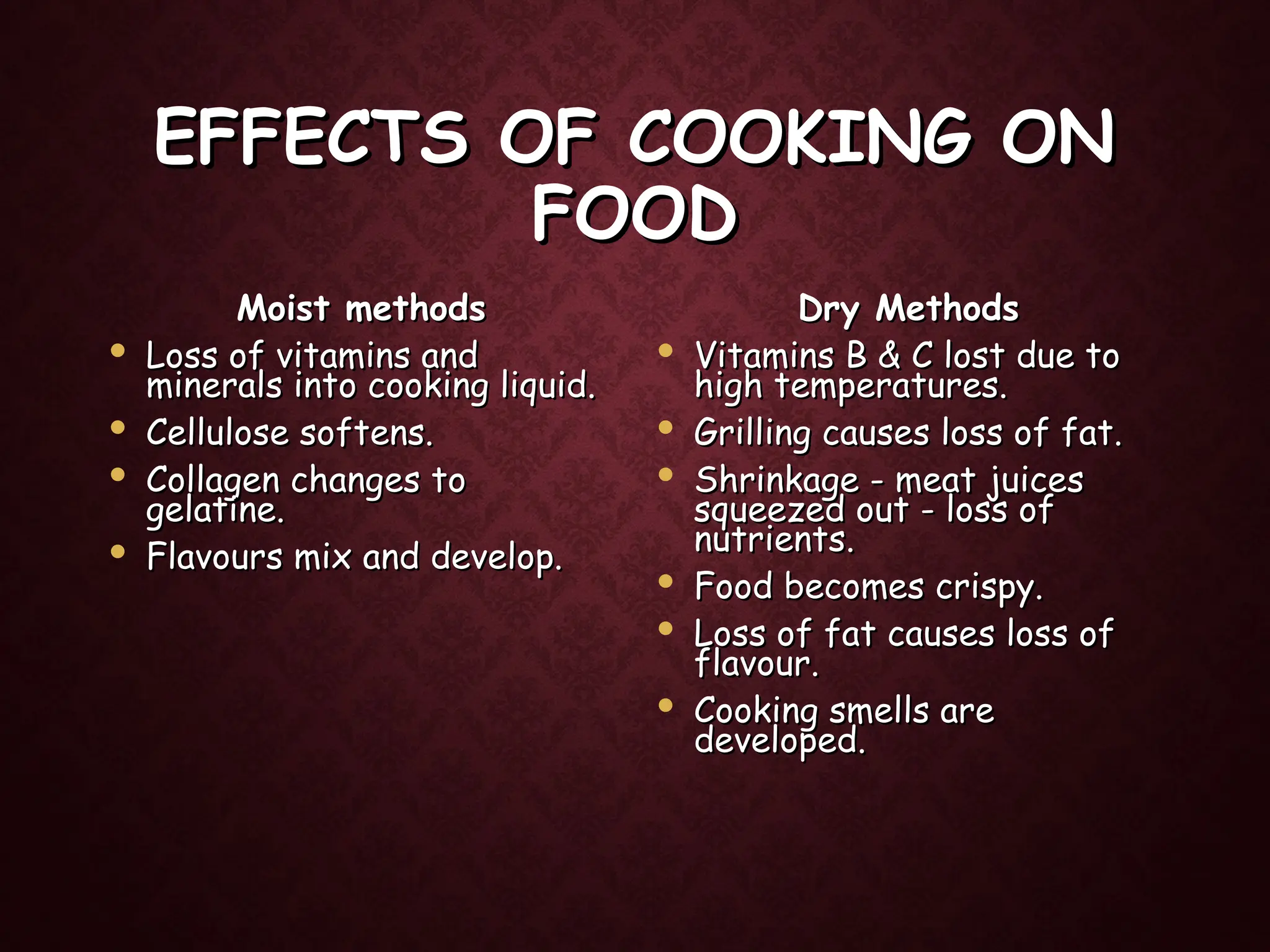
EFFECTS OF COOKING ON
FOOD
FOOD
Moist methods
Moist methods
 Loss of vitamins and
Loss of vitamins and
minerals into cooking liquid.
 Cellulose softens.
Cellulose softens.
 Collagen changes to
Collagen changes to
gelatine.
gelatine.
 Flavours mix and develop.
Flavours mix and develop.
Dry Methods
Dry Methods
 Vitamins B & C lost due to
Vitamins B & C lost due to
high temperatures.
high temperatures.
 Grilling causes loss of fat.
Grilling causes loss of fat.
 Shrinkage - meat juices
Shrinkage - meat juices
squeezed out - loss of
nutrients.
nutrients.
 Food becomes crispy.
Food becomes crispy.
 Loss of fat causes loss of
Loss of fat causes loss of
flavour.
flavour.
 Cooking smells are
Cooking smells are
developed.
developed.
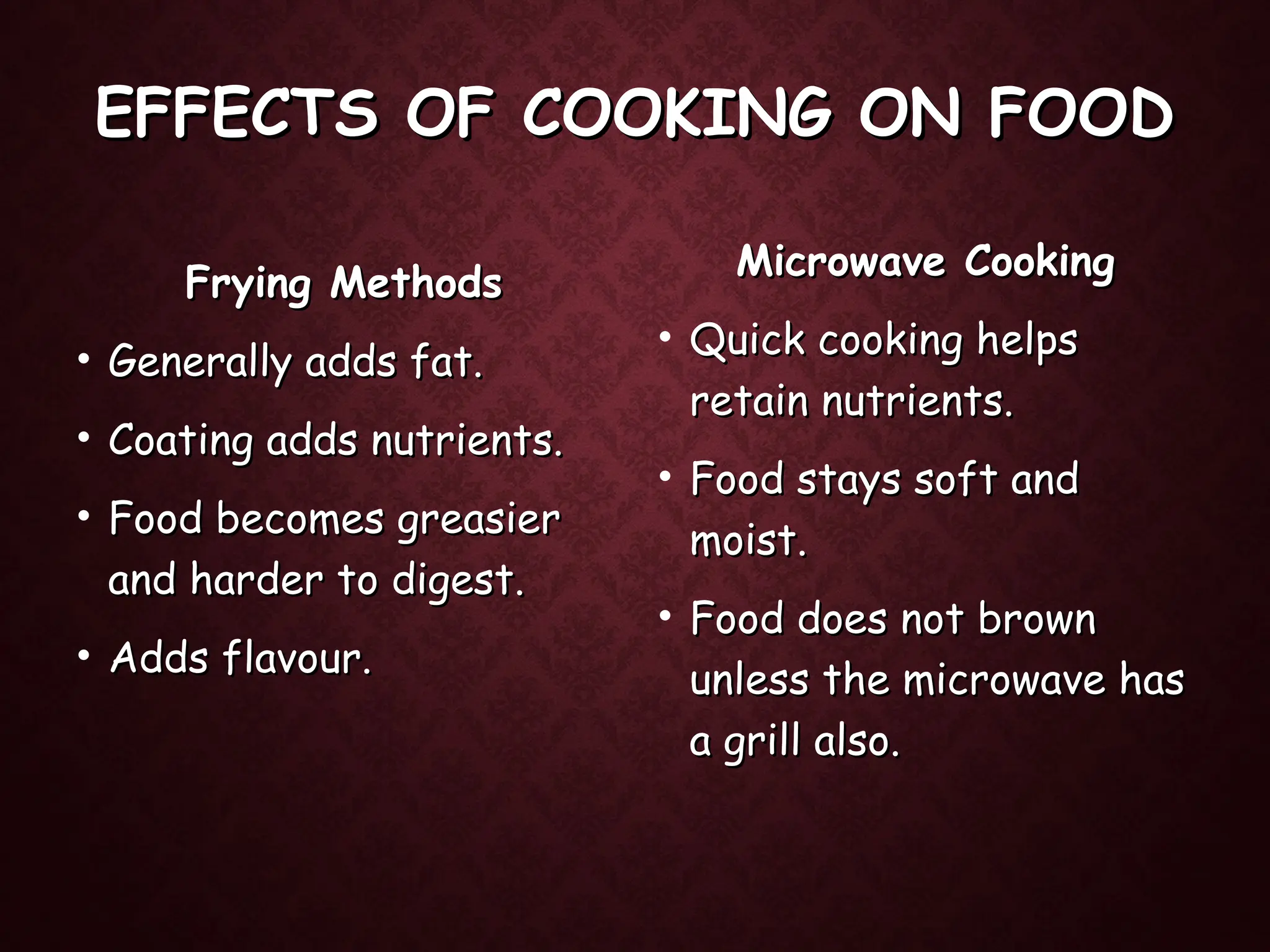
EFFECTS OF COOKING ON FOOD
Frying Methods
Frying Methods
• Generally adds fat.
Generally adds fat.
• Coating adds nutrients.
Coating adds nutrients.
• Food becomes greasier
Food becomes greasier
and harder to digest.
• Adds flavour.
Adds flavour.
Microwave Cooking
Microwave Cooking
• Quick cooking helps
Quick cooking helps
retain nutrients.
retain nutrients.
• Food stays soft and
Food stays soft and
moist.
moist.
• Food does not brown
Food does not brown
unless the microwave has
a grill also.
a grill also.
VIDEO LINKS
VIDEO LINKS
• https://www.youtube.com/watch?v=AgHosaTSZic
• https://www.youtube.com/watch?v=y8xjp6It078

Meal Planning and Preparation 2 for all ppt

  • 1.
  • 2.
    FACTORS TO BECONSIDERED WHEN FACTORS TO BE CONSIDERED WHEN PLANNING A MEAL PLANNING A MEAL • Nutrition- balanced meal. Nutrition- balanced meal. • Follow healthy eating Follow healthy eating guidelines. guidelines. • Requirements of age-group Requirements of age-group being served. being served. • Special diets e.g. coeliac. Special diets e.g. coeliac. • Variety- tastes, colour, Variety- tastes, colour, texture, cooking methods texture, cooking methods. . • Time available. Time available. • Knowledge & skill. Knowledge & skill. • Budget. Budget. • Availability of ingredients. Availability of ingredients. • Availability of equipment. Availability of equipment.
  • 3.
    CHANGES THAT HAPPENDURING CHANGES THAT HAPPEN DURING FOOD PREPARATION FOOD PREPARATION Physical Changes Physical Changes  Increase in size e.g. soaking Increase in size e.g. soaking dried food. dried food.  Thickening e.g. whipping Thickening e.g. whipping cream. cream.  Loss of nutritive value e.g. Loss of nutritive value e.g. water - soluble vitamins water - soluble vitamins dissolve into water. dissolve into water.  Tenderising e.g. meat is Tenderising e.g. meat is tenderised by beating, tenderised by beating, mincing. mincing. Chemical changes Chemical changes  Colour change e.g. enzymatic Colour change e.g. enzymatic browning. browning.  Nutrient loss e.g. enzyme Nutrient loss e.g. enzyme oxidase destroys vitamin C. oxidase destroys vitamin C.  Tenderising e.g. proteolytic Tenderising e.g. proteolytic enzymes tenderise meat enzymes tenderise meat fibres. fibres.  Increase in size e.g. yeast Increase in size e.g. yeast dough expands as enzymes dough expands as enzymes make CO make CO2 2 . .
  • 4.
    CHANGES THAT HAPPENDURING CHANGES THAT HAPPEN DURING COOKING OF FOOD COOKING OF FOOD Physical Changes Physical Changes  Texture changes e.g. cell walls Texture changes e.g. cell walls soften in vegetables. soften in vegetables.  Bacteria killed. Bacteria killed.  Nutrient loss e.g. vitamins & Nutrient loss e.g. vitamins & minerals dissolve into cooking minerals dissolve into cooking liquid. liquid.  Food solidifies e.g. egg protein Food solidifies e.g. egg protein coagulates. coagulates.  Food thickens e.g. Food thickens e.g. gelatinisation of starch. gelatinisation of starch.  Shrinkage - protein coagulates Shrinkage - protein coagulates & shrinks e.g. meat. & shrinks e.g. meat. Chemical Changes Chemical Changes  Maillard reaction – when amino Maillard reaction – when amino acids & carbohydrates are acids & carbohydrates are heated together, the food turns heated together, the food turns brown. brown.  Caramelisation - sugar heated Caramelisation - sugar heated above dissolving point turns above dissolving point turns brown e.g. toffee. brown e.g. toffee.  Dextrinisation - long starch Dextrinisation - long starch chains break into shorter chains chains break into shorter chains called dextrins & a brown called dextrins & a brown colour develops e.g. toasting colour develops e.g. toasting bread. bread.
  • 5.
    REASONS FOR COOKINGFOOD REASONS FOR COOKING FOOD • To destroy pathogenic bacteria making food safer. To destroy pathogenic bacteria making food safer. • To destroy enzymes and prevent food spoilage. To destroy enzymes and prevent food spoilage. • To make food palatable & digestible e.g. starchy foods like To make food palatable & digestible e.g. starchy foods like potatoes. potatoes. • To improve appearance e.g. meat. To improve appearance e.g. meat. • To develop flavour e.g. meat extractives released (aroma). To develop flavour e.g. meat extractives released (aroma). • To stimulate digestive juices - sight & smells of cooked food. To stimulate digestive juices - sight & smells of cooked food. • To destroy natural toxins e.g. red kidney beans. To destroy natural toxins e.g. red kidney beans. • To combine ingredients and create new flavours. To combine ingredients and create new flavours.
  • 6.
    UNDERLYING PRINCIPLES OF UNDERLYINGPRINCIPLES OF COOKING FOOD COOKING FOOD  Conduction - Conduction - Transfer of heat from one Transfer of heat from one molecule to molecule to another by vibration of molecules. E.g. heat passing from another by vibration of molecules. E.g. heat passing from the cooker hob through the base of the saucepan. the cooker hob through the base of the saucepan.  Convection - Convection - Molecules near heat source become hot, less Molecules near heat source become hot, less dense and rise up. This allows cold molecules to take their dense and rise up. This allows cold molecules to take their place. This sets up convection currents and heat is spread place. This sets up convection currents and heat is spread e.g. simmering stews. e.g. simmering stews.  Radiation - Radiation - Heat passes in straight rays, from the source, Heat passes in straight rays, from the source, to the first solid object they reach, without heating air in to the first solid object they reach, without heating air in between e.g. grilling burgers. between e.g. grilling burgers. Most cooking methods involve one or more of these Most cooking methods involve one or more of these principles. principles.
  • 8.
    METHODS OF COOKING METHODSOF COOKING • Moist Methods: Moist Methods: Boiling, Simmering, Poaching, Stewing, Braising, Boiling, Simmering, Poaching, Stewing, Braising, Steaming, Pressure cooking. Steaming, Pressure cooking. • Dry Methods: Dry Methods: Baking, Grilling, Roasting, Barbecuing. Baking, Grilling, Roasting, Barbecuing. • Frying: Frying: Dry, Shallow, Deep -fat, Stir. Dry, Shallow, Deep -fat, Stir. • Microwave cooking Microwave cooking. .
  • 9.
    CHOOSING A COOKING CHOOSINGA COOKING METHOD METHOD • Ingredients available e.g. stewing beef or sirloin Ingredients available e.g. stewing beef or sirloin steak. steak. • Experience of cook. Experience of cook. • Time available. Time available. • Equipment available. Equipment available. • Desired result e.g. crispy, brown, moist. Desired result e.g. crispy, brown, moist. • Fuel economy. Fuel economy. • Retention of nutrients. Retention of nutrients.
  • 10.
    BOILING / SIMMERING BOILING/ SIMMERING Definition Guidelines Suitable foods Advantages & Disadvantages •Cooking by Cooking by convection & convection & conduction in conduction in liquid @ 100 liquid @ 100ºC ºC in covered in covered saucepan on saucepan on the hob. the hob. •Simmering - Simmering - 90 90 ºC ºC •100 100 ºC @ all ºC @ all times. times. •Vegetables - Vegetables - small amount small amount of liquid. of liquid. •Use cooking Use cooking liquid – soups, liquid – soups, sauces. sauces. •Cook food for Cook food for shortest shortest possible time. possible time. •Meat - Meat - bacon, bacon, mutton. mutton. •Eggs. Eggs. •Pasta. Pasta. •Rice. Rice. •Veg. Veg. •Needs little Needs little attention. attention. •Clean. Clean. •Food stays moist. Food stays moist. •Digestible. Digestible. •Less greasy. Less greasy. •Little Little preparation. preparation. •Little flavour Little flavour added. added. •Loss of nutrients. Loss of nutrients. •Lacks texture. Lacks texture.
  • 11.
    POACHING POACHING Definition Guidelines Suitable foods Advantages& Disadvantages •Cooking by Cooking by convection & convection & conduction in conduction in liquid @ liquid @ 85 85ºC in ºC in covered covered container on container on hob or in hob or in oven. oven. •85 85 ºC @ all ºC @ all times. times. • Water Water barely barely moving, not moving, not bubbling. bubbling. • Use for Use for delicate delicate foods that foods that need gentle need gentle cooking. cooking. •Fish. Fish. •De- De- shelled shelled eggs. eggs. •Fruit. Fruit. •Clean. Clean. •Food stays Food stays moist. moist. •Digestible. Digestible. •Less greasy. Less greasy. •Little flavour Little flavour added. added. •Loss of Loss of nutrients. nutrients. •Lacks texture. Lacks texture. •Slow. Slow. •Needs Needs attention. attention.
  • 12.
    BRAISING BRAISING Definition Guidelines Suitable foods Advantages& Disadvantages •Cooking meat Cooking meat in a small in a small amount of amount of stock, on a stock, on a layer of layer of vegetables vegetables (mirepoix). (mirepoix). Meat is in a Meat is in a covered covered saucepan on saucepan on the hob. the hob. •Combination Combination of steaming of steaming and stewing. and stewing. •Use only Use only enough stock enough stock to cover to cover vegetables. vegetables. •Food can be Food can be browned browned under grill under grill before before serving. serving. •Root Root vegetables vegetables •Chicken. Chicken. •Offal. Offal. •Tougher Tougher cuts of cuts of meat. meat. •Little attention Little attention needed. needed. •Food stays Food stays moist. moist. •Complete meal in Complete meal in one pot – saves one pot – saves fuel & wash-up. fuel & wash-up. •Less nutrient Less nutrient loss. loss. •Digestible. Digestible. •A lot of prep. A lot of prep. •Slow. Slow. •Lacks texture. Lacks texture.
  • 13.
    STEWING STEWING Definition Guidelines Suitable foods Advantages& Disadvantages •Slowly cooking Slowly cooking food in a little food in a little liquid, by liquid, by conduction & conduction & convection, convection, using gentle using gentle heat (80 heat (80 ºC - ºC - 90 ºC), 90 ºC), in a in a covered covered container, on container, on hob or in oven. hob or in oven. •Bring to boil Bring to boil & then reduce & then reduce heat. heat. •Temperature Temperature of 80 of 80 ºC -90 ºC -90 ºC. ºC. •Keep Keep covered. covered. •Use pressure Use pressure cooker to cooker to reduce time. reduce time. •Tough Tough cuts of cuts of meat/fish. meat/fish. •Veg. Veg. •Fruit Fruit •Little attention Little attention needed. needed. •Food stays Food stays moist. moist. •Complete meal in Complete meal in one pot – saves one pot – saves fuel & wash-up. fuel & wash-up. •Less nutrient Less nutrient loss. loss. •Digestible. Digestible. •A lot of prep A lot of prep. . •Slow. Slow. •Lacks texture Lacks texture
  • 14.
    STEAMING STEAMING Definition Guidelines Suitable foods Advantages& Disadvantages •Cooking food Cooking food slowly in steam slowly in steam rising from rising from boiling water. boiling water. •Food can be Food can be steamed: steamed: •a. Between two a. Between two plates. plates. •b. In a covered b. In a covered bowl in a saucepan bowl in a saucepan of boiling water. of boiling water. •c. In a steamer c. In a steamer over boiling water. over boiling water. •d. On a trivet in a d. On a trivet in a pressure cooker. pressure cooker. • A tightly A tightly fitting lid fitting lid prevents prevents evaporation. evaporation. •Water boiling Water boiling before & during before & during cooking. cooking. •Food must not Food must not touch liquid. touch liquid. •Thin pieces Thin pieces of chicken of chicken and fish. and fish. •Steamed Steamed puddings, e.g. puddings, e.g. canary, canary, Christmas, Christmas, chocolate. chocolate. •Vegetables. Vegetables. •No loss of No loss of nutrients. nutrients. •Clean. Clean. •Food stays Food stays moist. moist. •Digestible. Digestible. •Not greasy. Not greasy. •Little flavour Little flavour added. added. •Lacks texture. Lacks texture. •Slow. Slow. •Not suitable Not suitable for large pieces for large pieces of food. of food.
  • 15.
    BAKING BAKING Definition Guidelines Suitable foods Advantages& Disadvantages •Dry Dry method of method of cooking cooking food by food by convection convection currents currents in the in the oven. oven. •Pre-heat oven. Pre-heat oven. •Steam made in Steam made in the oven stops the oven stops food drying, food drying, tinfoil & tinfoil & greaseproof greaseproof paper also used. paper also used. •Avoid opening Avoid opening oven door. oven door. •Bread. Cakes. Bread. Cakes. Biscuits. Biscuits. Pastries. Pastries. •Vegetables Vegetables e.g. potatoes, e.g. potatoes, tomatoes, tomatoes, peppers. peppers. •Fruit e.g. Fruit e.g. Apples. Apples. •Puddings, Puddings, apple crumble. apple crumble. •Attractive Attractive appearance. appearance. •Doesn’t add Doesn’t add fat. fat. •Little loss of Little loss of nutrients. nutrients. •Dries food. Dries food.
  • 16.
    GRILLING GRILLING Definition Guidelines Suitable foods Advantages& Disadvantages •Fast method Fast method of cooking of cooking food by food by radiant heat radiant heat under a grill. under a grill. •Pre-heat grill. Pre-heat grill. •Seal surface of Seal surface of the food with high the food with high heat, preventing heat, preventing nutrient loss. nutrient loss. •Use tongs to turn Use tongs to turn food. food. •Thin pieces of Thin pieces of food only. food only. •Don’t salt food Don’t salt food before grilling. before grilling. •Oil grill grid to Oil grill grid to prevent sticking. prevent sticking. •Meat - Meat - chops, chops, steaks, steaks, burgers, burgers, rashers. rashers. •Vegetables - Vegetables - tomatoes. tomatoes. •Fish fillets. Fish fillets. • Fast. Fast. •Little loss of Little loss of nutrients. nutrients. •Reduces fat Reduces fat content. content. •Attractive Attractive appearance & appearance & taste. taste. •Constant Constant attention needed. attention needed. •Dries food. Dries food. •Spatters grease. Spatters grease. •Unsuitable for Unsuitable for tough or thick cuts tough or thick cuts of meat. of meat.
  • 17.
    BARBECUING BARBECUING Definition Guidelines Suitable foods Advantages& Disadvantages •Cooking food by Cooking food by radiant heat on radiant heat on a grid over a grid over glowing glowing charcoal. charcoal. •Pre-heat Pre-heat barbecue. barbecue. •Seal surface with Seal surface with high heat, high heat, preventing preventing nutrient loss. nutrient loss. •Use tongs to turn Use tongs to turn food. food. •Thin pieces of Thin pieces of food only. food only. •Don’t salt food Don’t salt food before before barbecuing. barbecuing. •Oil barbecue grid Oil barbecue grid to prevent to prevent sticking. sticking. •Meat, Meat, chops, chops, steaks, steaks, burgers, burgers, rashers. rashers. •Vegetables Vegetables e.g.tomatoes e.g.tomatoes •Fish fillets. Fish fillets. • Fast Fast •Little loss of Little loss of nutrients. nutrients. •Reduces fat Reduces fat content. content. •Attractive Attractive appearance & appearance & taste. taste. •Constant Constant attention. attention. •Dries food. Dries food. •Spatters grease. Spatters grease.
  • 18.
    ROASTING ROASTING Definition Guidelines Suitable foods Advantages& Disadvantages •Cooking food Cooking food in a little fat in a little fat in (a) a in (a) a roasting tin in roasting tin in the oven, (b) the oven, (b) a saucepan on a saucepan on the hob (pot the hob (pot roasting), (c) roasting), (c) on a spit, on a spit, under a grill under a grill or in an oven or in an oven (spit (spit roasting). roasting). • Pre-heat oven. Pre-heat oven. • Cooking time Cooking time depends on weight. depends on weight. •Baste every 30 Baste every 30 minutes. minutes. •Use cooking juices Use cooking juices for gravy. for gravy. •Quick roasting Quick roasting (tender cuts) - 230 (tender cuts) - 230ºC ºC for 20 mins, 190 ºC for 20 mins, 190 ºC for remainder. for remainder. •Slow Roasting (less Slow Roasting (less tender cuts) - 175 tender cuts) - 175 ºC ºC for all the cooking for all the cooking time. time. •Meat – Meat – beef, beef, lamb, lamb, pork. pork. •Poultry. Poultry. •Vegetables Vegetables e.g. potatoes e.g. potatoes •Vegetables & meat Vegetables & meat cooked together. cooked together. •Cooking liquid used Cooking liquid used as gravy. as gravy. •Attractive Attractive appearance & appearance & taste. taste. •Not much prep. Not much prep. •Spatters grease. Spatters grease. •Not suitable for Not suitable for tough cuts. tough cuts. •Greasy. Greasy. •Shrinkage occurs. Shrinkage occurs. •Adds fat. Adds fat.
  • 19.
    FRYING FRYING Definition Guidelines Suitable foods Advantages& Disadvantages • Dry – cooking food by conduction in frying pan on the hob. • Shallow – cooking food in hot fat. • Deep – cooking food immersed in hot fat. • Pre-heat oil. Pre-heat oil. • Use tongs for Use tongs for turning. turning. •Drain before Drain before serving. serving. •Coating food: •Protects Protects surface. surface. •Texture. Texture. •Flavour. Flavour. •Appearance. Appearance. •Meat - thin Meat - thin pieces e.g. pieces e.g. rashers, rashers, chops, chops, burgers, burgers, sausages. sausages. •Fish - thin Fish - thin pieces e.g. pieces e.g. steaks, steaks, cutlets, fillets. cutlets, fillets. •Eggs. Eggs. •Vegetables. Vegetables. •Doughnuts. Doughnuts. •Quick. Quick. •Attractive taste Attractive taste & appearance. & appearance. •Constant Constant attention. attention. •Spatters grease. Spatters grease. •Not suitable for Not suitable for tough meats or tough meats or large cuts. large cuts. •Not suitable when Not suitable when cooking for large cooking for large numbers. numbers. •Greasy. Greasy. •Indigestible Indigestible
  • 20.
    PRESSURE COOKING PRESSURE COOKING Definition& principle Structure Guidelines Suitable foods •Fast moist method Fast moist method of cooking food @ of cooking food @ high temps. in a high temps. in a pressure cooker. pressure cooker. •Used for boiling, Used for boiling, stewing & steaming. stewing & steaming. •Water under Water under increased pressure increased pressure boils @ higher temp. boils @ higher temp. Pressure increased Pressure increased inside pressure inside pressure cooker by not letting cooker by not letting steam escape. As a steam escape. As a result, water boils @ result, water boils @ 122 122ºC. ºC. Food cooks in Food cooks in 1/3 of normal time. 1/3 of normal time. •Heavy Heavy gauge gauge saucepan. saucepan. Locking lid. Locking lid. •Rubber Rubber gasket seals gasket seals lid. lid. •Trivet. Trivet. •Separator Separator basket. basket. •Vent on lid. Vent on lid. •Safety Safety valve. valve. •Follow Follow instructions. instructions. •Never overfill. Never overfill. •Build up steam Build up steam before applying before applying weight. weight. •Time very Time very accurately. accurately. •Reduce Reduce pressure before pressure before opening- opening- •(a) Stand for 15 (a) Stand for 15 mins @ room mins @ room temp. temp. •(b) Under cold (b) Under cold running water. running water. •Stocks & soups. Stocks & soups. •Stews. Stews. •Vegetables e.g. Vegetables e.g. potatoes. potatoes. •Jam. Jam. •Christmas Christmas pudding. pudding. •Bottling Bottling
  • 21.
    MICROWAVE MICROWAVE Principle Guidelines Suitabledishes •Electro- Electro- magnetic magnetic waves waves penetrate the penetrate the food to a food to a certain depth certain depth and cause the and cause the molecules to molecules to vibrate very vibrate very rapidly. This rapidly. This causes causes intense heat. intense heat. The The remainder of remainder of the food the food cooks by cooks by conduction. conduction. •Time carefully. Time carefully. •Timing is affected by: Timing is affected by: Composition. Composition. Thickness. Thickness. Density. Density. Temperature at the start. Temperature at the start. Amount of food. Amount of food. •Cover food, keep moist, cook Cover food, keep moist, cook faster. faster. •Turn or stir. Turn or stir. •Pierce skins. Pierce skins. •Arrange in circle, thickest bit Arrange in circle, thickest bit outward. outward. •No metal or foil. No metal or foil. •Allow standing time. Allow standing time. •Defrosting. Defrosting. •Reheating. Reheating. •Cooking. Cooking. •Melting Melting chocolate. chocolate. •Heating liquid. Heating liquid. •Unsuitable Unsuitable dishes dishes •Pastry. Pastry. •Meringue. Meringue.
  • 22.
    EFFECTS OF COOKINGON EFFECTS OF COOKING ON FOOD FOOD Moist methods Moist methods  Loss of vitamins and Loss of vitamins and minerals into cooking liquid. minerals into cooking liquid.  Cellulose softens. Cellulose softens.  Collagen changes to Collagen changes to gelatine. gelatine.  Flavours mix and develop. Flavours mix and develop. Dry Methods Dry Methods  Vitamins B & C lost due to Vitamins B & C lost due to high temperatures. high temperatures.  Grilling causes loss of fat. Grilling causes loss of fat.  Shrinkage - meat juices Shrinkage - meat juices squeezed out - loss of squeezed out - loss of nutrients. nutrients.  Food becomes crispy. Food becomes crispy.  Loss of fat causes loss of Loss of fat causes loss of flavour. flavour.  Cooking smells are Cooking smells are developed. developed.
  • 23.
    EFFECTS OF COOKINGON FOOD EFFECTS OF COOKING ON FOOD Frying Methods Frying Methods • Generally adds fat. Generally adds fat. • Coating adds nutrients. Coating adds nutrients. • Food becomes greasier Food becomes greasier and harder to digest. and harder to digest. • Adds flavour. Adds flavour. Microwave Cooking Microwave Cooking • Quick cooking helps Quick cooking helps retain nutrients. retain nutrients. • Food stays soft and Food stays soft and moist. moist. • Food does not brown Food does not brown unless the microwave has unless the microwave has a grill also. a grill also.
  • 24.
    VIDEO LINKS VIDEO LINKS •https://www.youtube.com/watch?v=AgHosaTSZic • https://www.youtube.com/watch?v=y8xjp6It078