Focus groups and Interviewing:
  making data collection work for
                             you

Paul Ilsley
Purposes of Focus Groups

• To assess opinions
• To understand effects of products on
  individuals.
• To improve products
• To collaborate and build upon opinions
• To arrive at consentual awareness
Types of focus groups

•   Commercial
•   Educational
•   Civil
•   Academic
•   Combinations
Formats of focus group

• Structured
• Unstructured
• Semi-structured
Procedures for focus groups
• Select participants. Each one should have a stake
  in the topic.
• Explain the purposes in advance.
• Send material before the session, if warranted.
• Conduct the session(s)
   – Introductions
   – Explanation of purposes
   – Stay on track and encourage free discussion
• Follow up
Interviews…

•   …are used for many purposes
•   …can be conducted in many ways
•   …require lots of skill and practice
•   …are a common feature of modern research
Purposes of interviews

•   Employment
•   Academic
•   Phenomenological
•   Consensus
•   Purposive
Types of Interviews

• Structured
• Unstructured
• Semi-structured
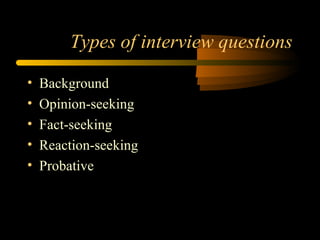
Types of interview questions

•   Background
•   Opinion-seeking
•   Fact-seeking
•   Reaction-seeking
•   Probative
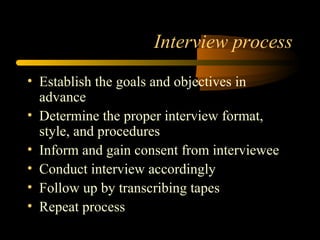
Interview process
• Establish the goals and objectives in
  advance
• Determine the proper interview format,
  style, and procedures
• Inform and gain consent from interviewee
• Conduct interview accordingly
• Follow up by transcribing tapes
• Repeat process
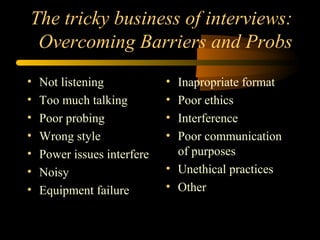
The tricky business of interviews:
 Overcoming Barriers and Probs
•   Not listening            • Inapropriate format
•   Too much talking         • Poor ethics
•   Poor probing             • Interference
•   Wrong style              • Poor communication
•   Power issues interfere     of purposes
•   Noisy                    • Unethical practices
•   Equipment failure        • Other
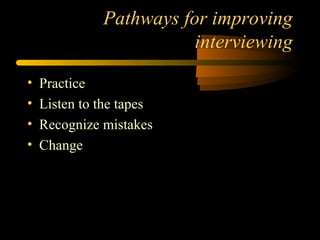
Pathways for improving
                         interviewing

•   Practice
•   Listen to the tapes
•   Recognize mistakes
•   Change

Focus groups and interviewing

  • 1.
    Focus groups andInterviewing: making data collection work for you Paul Ilsley
  • 2.
    Purposes of FocusGroups • To assess opinions • To understand effects of products on individuals. • To improve products • To collaborate and build upon opinions • To arrive at consentual awareness
  • 3.
    Types of focusgroups • Commercial • Educational • Civil • Academic • Combinations
  • 4.
    Formats of focusgroup • Structured • Unstructured • Semi-structured
  • 5.
    Procedures for focusgroups • Select participants. Each one should have a stake in the topic. • Explain the purposes in advance. • Send material before the session, if warranted. • Conduct the session(s) – Introductions – Explanation of purposes – Stay on track and encourage free discussion • Follow up
  • 6.
    Interviews… • …are used for many purposes • …can be conducted in many ways • …require lots of skill and practice • …are a common feature of modern research
  • 7.
    Purposes of interviews • Employment • Academic • Phenomenological • Consensus • Purposive
  • 8.
    Types of Interviews •Structured • Unstructured • Semi-structured
  • 9.
    Types of interviewquestions • Background • Opinion-seeking • Fact-seeking • Reaction-seeking • Probative
  • 10.
    Interview process • Establishthe goals and objectives in advance • Determine the proper interview format, style, and procedures • Inform and gain consent from interviewee • Conduct interview accordingly • Follow up by transcribing tapes • Repeat process
  • 11.
    The tricky businessof interviews: Overcoming Barriers and Probs • Not listening • Inapropriate format • Too much talking • Poor ethics • Poor probing • Interference • Wrong style • Poor communication • Power issues interfere of purposes • Noisy • Unethical practices • Equipment failure • Other
  • 12.
    Pathways for improving interviewing • Practice • Listen to the tapes • Recognize mistakes • Change