Anesthesiology, V 122 • No 5	1103	 May 2015
POSTOPERATIVE pain after hysterectomy is a major
issue contributing to patient discomfort, decreased
patient satisfaction, risk for postoperative morbidity and
mortality, and increasing medical costs due to extended hos-
pital stays.1,2
It has been estimated that there are 433,621
hysterectomies performed each year in the United States,3
of
which 12 to 17% are done for chronic pelvic pain.4,5
With
a large number of cases performed annually and the pos-
sibility of same-day discharge for some patients undergoing
hysterectomy, there are economic and patient-safety implica-
tions in determining ways to avoid postoperative pain and
any factors that lengthen hospital stays. It has been shown
in a multicentered, retrospective study that factors predic-
tive of severe acute postoperative pain include younger age,
female sex, increased body mass index, preoperative surgical
site pain severity, preoperative use of opioids, and general
anesthesia.6
Cognitive factors and pain coping strategies,
such as pain catastrophizing, and mood disorders such as
depression and anxiety have also been shown to influence
acute pain in patients undergoing hysterectomy.2
What We Already Know about This Topic
•	 Higher scores on the survey criteria for fibromyalgia question-
naire have been shown to predict increased opioid consump-
tion after arthroplasty although the generalizability of this has
not been tested
What This Article Tells Us That Is New
•	 In 208 women undergoing hysterectomy, higher scores on a fi-
bromyalgia survey were independently associated with increased
opioid consumption after accounting for known risk factors
•	 This fibromyalgia survey may be useful in identifying individu-
als at high risk for increased opioid consumption after surgery
Copyright Š 2015, the American Society of Anesthesiologists, Inc. Wolters Kluwer Health, Inc. All Rights Reserved. Anesthesiology 2015; 122:1103-11
ABSTRACT
Background: The current study was designed to test the hypothesis that the fibromyalgia survey criteria would be directly
associated with increased opioid consumption after hysterectomy even when accounting for other factors previously described
as being predictive for acute postoperative pain.
Methods: Two hundred eight adult patients undergoing hysterectomy between October 2011 and December 2013 were
phenotyped preoperatively with the use of validated self-reported questionnaires including the 2011 fibromyalgia survey cri-
teria, measures of pain severity and descriptors, psychological measures, preoperative opioid use, and health information. The
primary outcome was the total postoperative opioid consumption converted to oral morphine equivalents.
Results: Higher fibromyalgia survey scores were significantly associated with worse preoperative pain characteristics, including
higher pain severity, more neuropathic pain, greater psychological distress, and more preoperative opioid use. In a multivariate
linear regression model, the fibromyalgia survey score was independently associated with increased postoperative opioid con-
sumption, with an increase of 7-mg oral morphine equivalents for every 1-point increase on the 31-point measure (Estimate,
7.0; Standard Error, 1.7; P < 0.0001). In addition to the fibromyalgia survey score, multivariate analysis showed that more
severe medical comorbidity, catastrophizing, laparotomy surgical approach, and preoperative opioid use were also predictive
of increased postoperative opioid consumption.
Conclusions: As was previously demonstrated in a total knee and hip arthroplasty cohort, this study demonstrated
that increased fibromyalgia survey scores were predictive of postoperative opioid consumption in the posthysterectomy
surgical population during their hospital stay. By demonstrating the generalizability in a second surgical cohort, these
data suggest that patients with fibromyalgia-like characteristics may require a tailored perioperative analgesic regimen.
(Anesthesiology 2015; 122:1103-11)
This article is featured in “This Month in Anesthesiology,” page 1A. Corresponding article on page 967.
Submitted for publication October 29, 2014. Accepted for publication January 30, 2015. From the Department of Anesthesiology, Vander-
bilt University Medical Center, Nashville, Tennessee (A.M.J.); Department of Obstetrics and Gynecology, University of Michigan Health Sys-
tem, Ann Arbor, Michigan (S.A.-S.); Department of Anesthesiology, University of Michigan Health System, Ann Arbor, Michigan (B.R., S.E.M.,
D.J.C., C.M.B.); and Department of Biostatistics, School of Public Health, University of Michigan, Ann Arbor, Michigan (A.T.).
Fibromyalgia Survey Criteria Are Associated with
Increased Postoperative Opioid Consumption in Women
Undergoing Hysterectomy
Allison M. Janda, M.D., Sawsan As-Sanie, M.D., M.P.H., Baskar Rajala, M.D., M.B.B.S., F.R.C.A.,
Alex Tsodikov, Ph.D., Stephanie E. Moser, Ph.D., Daniel J. Clauw, M.D., Chad M. Brummett, M.D.
PAIN MEDICINE
Downloaded From: https://monitor.pubs.asahq.org/ on 05/15/2016
Anesthesiology 2015; 122:1103-11	1104	Janda et al.
Fibromyalgia Score Predicts Acute Opioid Use
Fibromyalgia is a commonly studied pain disorder, which
is associated with aberrant central pain processing.7–9
Fibro-
myalgia is associated with higher levels of central nervous sys-
tem neurotransmitters that facilitate pain and lower levels of
those that down-regulate pain.8,10–12
In addition, fibromyalgia
patients have higher endogenous opioids levels with lower
opioid receptor availability, which could hypothetically make
them less responsive to opioids.13,14
In 2011, the fibromyalgia
survey criteria were described for use in lieu of the 1990 crite-
ria, which included a tender point examination.15,16
Although
not intended to be used for diagnosing fibromyalgia without a
clinical evaluation, it has been suggested that these criteria can
be used in an epidemiological manner.17
Our group previously
demonstrated that the survey criteria for fibromyalgia indepen-
dently predicted increased opioid consumption after total hip
and knee arthroplasty, even when controlling for other predic-
tors such as demographics, preoperative pain intensity, mood,
anxiety, catastrophizing, anesthesia type, and surgery.18
Whereas higher fibromyalgia survey scores were predic-
tive of increased opioid consumption in arthroplasty,18
it is
not known whether a fibromyalgia-like phenotype would
also predict increased opioid consumption in other surgi-
cal cohorts, such as patients undergoing hysterectomy. It is
important to demonstrate the generalizability of this find-
ing among a separate surgical cohort to increase acceptance
of the preoperative fibromyalgia score in clinical decision
making. The objective of this prospective, observational
cohort study was to assess the impact of the fibromyalgia
survey score on acute pain outcomes in subjects undergo-
ing hysterectomy. We hypothesized that higher fibromyal-
gia survey scores would predict higher postoperative opioid
consumption after hysterectomy. Length of stay was studied
as a secondary outcome. These data could help to establish
preoperative algorithms that personalize pain medicine to
the individual patient phenotype rather than using the cur-
rent care patterns that are dictated primarily by the surgical
condition and not tailored based on patient characteristics.
Materials and Methods
Institutional review board (University of Michigan, Ann
Arbor, Michigan) approval was obtained. Adult patients (≥18
yr old) scheduled for hysterectomy for a benign indication
between October 2011 and December 2013 were prospec-
tively recruited on the day of surgery in the preoperative wait-
ing area. No power analysis was performed when the study
was planned. All patients recruited during the period of the
study were considered for inclusion subject to the exclusion
criteria and availability of the measurements required for the
analysis. Exclusion criteria included inability to provide writ-
ten informed consent, non-English speakers, and prisoners.
Written informed consent was obtained from all participants.
Study reporting conforms to the STrengthening the Reporting
of OBservational studies in Epidemiology Statement.19
Phenotyping Battery
Patients completed preoperative phenotyping using vali-
dated self-report measures. The primary measure of interest
was the 2011 fibromyalgia survey criteria.17
The fibromyal-
gia survey is composed of the number of painful body areas
assessed by using the Michigan Body Map (0 to 19) and
comorbid symptoms such as fatigue, trouble thinking, and
headaches assessed by using the Symptom Severity Index (0
to 12). Hence, the total fibromyalgia score ranges from 0 to
31. The measure has demonstrated good reliability, conver-
gent validity, and discriminant validity.20
Previous cut points
have been described to categorize a person as “fibromyal-
gia positive”; however, the continuous score was used for
the analyses in the current study. Additional phenotyping
included pain severity (Brief Pain Inventory; 0 to 10 com-
posite score using the mean of the average, least, worst, and
pain right now; overall body pain and surgical site pain
assessed separately)21,22
; neuropathic pain descriptors (Pain-
DETECT),23
anxiety and depression (Hospital Anxiety and
Depression Scale),24
and catastrophizing (Coping Strategies
Questionnaire).25,26
The medication list from the preopera-
tive records was printed and reviewed with the patient by a
research assistant. All medications administered as needed
were reviewed in detail to ensure the ability to differentiate
the varied patterns of opioid use (e.g., differentiating patient
who uses one hydrocodone per week from the person who
takes three daily). The average daily opioid consumption
was converted to a 24-h oral morphine equivalent (OME)
total.27,28
Opioids administered by the anesthesia team
before and during surgery were also converted to OMEs as
a covariate. Demographics, body mass index, and Ameri-
can Society of Anesthesiologists (ASA) physical status score
were collected from the electronic medical record (Centric-
ity; General Electric Healthcare, USA). Because all patients
received general anesthesia, the anesthetic technique was not
assessed. The surgical approach was recorded as vaginal, lapa-
roscopic, robotic, or open.
Acute Pain Outcomes Assessment
The total postoperative opioid consumption (primary out-
come) was obtained from the institutional electronic order
entry system (Carelink*) and nursing records through-
out time in the postanesthesia care unit and the inpatient
course, as previously described by Brummett et al.18
Opioid
use in the postanesthesia care unit was assessed separately
and included in the total postoperative opioid consumption
(combined with opioids administered after the postanesthe-
sia care unit). All opioid data (preoperative, intraoperative,
and postoperative) were converted to morphine equivalents
(OME) for analyses. The length of stay was included as a
covariate for postoperative opioid consumption to account
for differences in opioids that were merely due to longer
inpatient stays.
The cohort was also prospectively followed longitudi-
nally for 6 months for chronic pain outcomes, which are
* UM-CareLink. Available at: http://www.med.umich.edu/carelink/.
Accessed February 21, 2014.
Downloaded From: https://monitor.pubs.asahq.org/ on 05/15/2016
Anesthesiology 2015; 122:1103-11	 1105	Janda et al.
PAIN MEDICINE
not included in the current article. The opioid consumption
data represent the primary outcome analysis for the acute
pain portion of this prospective, observational cohort study.
Statistical Analysis
Data were entered into the Assessment of Pain Outcomes
Longitudinal Electronic Data Capture system.29
Missing
data for the validated instruments were handled as recom-
mended by instrument authors,23,30,31
and further described
in a previous publication.18
Other missing data were han-
dled as described by the authors of each individual instru-
ment.23,30,31
For the Brief Pain Inventory and PainDETECT
tools, if patients were missing more than one item, the sub-
ject was excluded. For the Hospital Anxiety and Depression
Scale, anxiety and depressive symptom scores, a single value
for the missing item was inferred by imputation of the mean
if six of the seven values were present. For all other tools, one
missing question was allowed. Patients were not excluded for
having one incomplete questionnaire.
Data were analyzed by using R 3.1.1 and SPSS (version
19; SPSS Inc., USA).
The cohort was divided into tertiles based on the esti-
mates of 1/3 and 2/3 percentiles of the distribution of the
fibromyalgia survey score for descriptive data and univariate
outcomes analyses. Mean and SDs are presented for preop-
erative covariates. Between-groups comparisons were based
on univariate models specific to the scale of the variable being
considered (linear regression with continuous data, logistic
with binary data). Histograms and Q–Q plots were examined
to assess normality. Nonparametric analysis of the overall dif-
ferences by group was performed by using the Kruskal–Wallis
test. Bonferroni adjustment for multicomparisons was used
in reporting the statistical significance of test results.
Total postoperative opioid consumption throughout
the entire postoperative course was converted into OMEs
for outcomes analyses. Multivariate linear regression mod-
els were used to analyze postoperative opioid consumption.
All preoperative covariates, as well as intraoperative opioid
administration and length of stay, were included as covariates
in the multivariate modeling. Model-based hypotheses test-
ing and a search for the best parsimonious model (variable
selection) were performed using likelihood ratio tests and the
Bayesian Information Criterion (BIC). BIC is preferred in
the theory-based approach as it provides consistent estimates
of the true model. Furthermore, a 10-fold cross-validation
procedure was conducted to provide an assessment of mod-
el’s performance in future observations and predict shrinkage
effects when the model is applied out-of-sample. The vari-
able selection procedure was included in the cross-validation
loop and was done anew for each training subset of the data.
Models were conducted with missing data on relevant data
excluded. Backward search for the best model was conducted
starting from all variables included in the initial full model
and supervised by medical experts within the limits of uncer-
tainty allowed by the technical procedure. Interactions were
tested by the likelihood ratio tests. Two-sided tests and 0.05
significance levels were used throughout.
Results
Subject Participation and Demographics
A total of 208 patients of the 307 patients approached
agreed to participate (68% participation rate). In analysis
of participants versus nonparticipants, there were significant
differences for age (participants 47.6 yr vs. nonparticipants
50.4 yr; P = 0.033) and race (84.6 vs. 66.7% Caucasian;
P < 0.0001). One patient withdrew on the day of surgery,
one patient was excluded from analysis due to additional
surgeries during the same admission, and three patients were
excluded because they did not undergo the planned hyster-
ectomy and instead underwent a different procedure as out-
lined in the flowchart (fig. 1). Regarding missing data, eight
patients of the 203 analyzed were missing data for the fibro-
myalgia survey score and were not included in the analysis.
Data from 195 patients were analyzed.
Preoperative Phenotype and Outcomes by Tertile of
Fibromyalgia Survey Score
A histogram of fibromyalgia scores is shown in figure 2. The
mean fibromyalgia score for the entire cohort was 6.5 (Âą4.4)
with a range of 0 to 24. A total of 17 patients (8.2%) met the
previously described cut points of being termed “fibromyal-
gia positive.”17
The subjects were divided into tertiles based
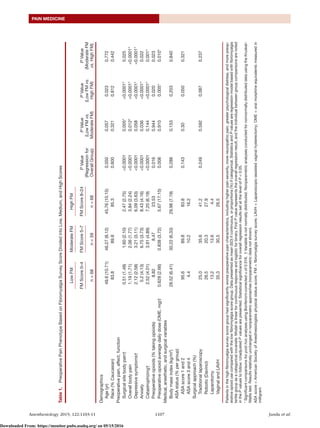
on fibromyalgia survey score (low, 0 to 4, n = 68; moder-
ate, 5 to 7, n = 59; and high, 8 to 24, n = 68). As shown
in table 1, there were no significant differences in age, race,
body mass index, surgical approach, or ASA physical status
score between fibromyalgia score tertiles. In addition, there
were differences in surgical site body pain, overall body pain,
depressive symptoms, anxiety, and catastrophizing between
all groups (P < 0.0001 for all listed). Patients in the high
fibromyalgia group were taking more daily opioids preop-
eratively and were on a higher average opioid dose (OME)
when compared with the low and moderate groups (P < 0.01
for each comparison).
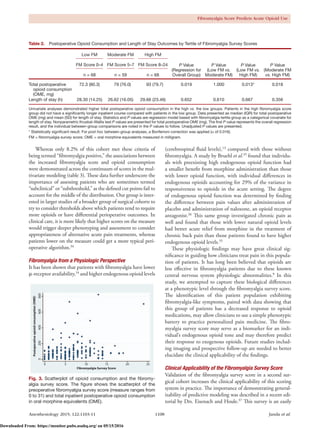
There was an increase in postoperative opioid consump-
tion between low versus high fibromyalgia score groups
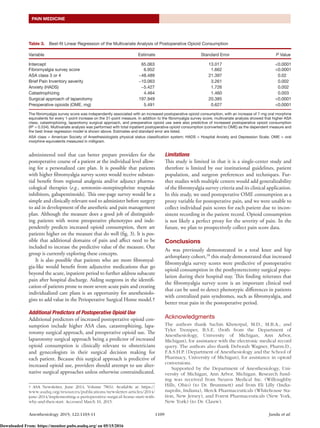
(P = 0.013) as seen in table 2. Figure 3 demonstrates the
scatterplot of total postoperative opioid consumption and
the fibromyalgia survey score. Length of stay was not signifi-
cantly different between groups (table 2).
Fibromyalgia Survey Score Independently Associated with
Postoperative Opioid Consumption
The primary outcome, postoperative opioid consumption,
was positively associated with the continuous fibromyal-
gia survey score in the multivariate linear regression model
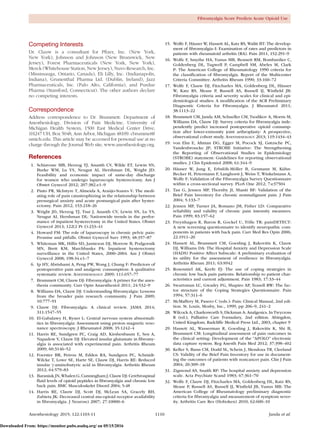
(P < 0.0001). Multivariate analysis also showed that higher
ASA physical status score, catastrophizing, laparotomy sur-
gical approach, and preoperative opioid consumption were
Downloaded From: https://monitor.pubs.asahq.org/ on 05/15/2016
Anesthesiology 2015; 122:1103-11	1106	Janda et al.
Fibromyalgia Score Predicts Acute Opioid Use
all predictive of increased postoperative opioid consumption
(table 3). Backward variable selection using likelihood ratio
tests and the BIC-based model selection procedure resulted
in one and the same best model with BIC = 2,231 presented
in table 3. Over the set of cross-validation runs, the best
variables presented in table 3 were selected 80 to 100% of the
time, whereas selection frequency of other variables did not
exceed 10%. Shrinkage from the raw R2
of 0.53 based on the
best model to the cross-validated R2
of 0.35 was observed.
The linear regressions with the log-transformed response
were also considered. However, there was no improvement
in fit as judged by the plots of residuals. The results of mod-
eling without the transformation were confirmed, and the
fibromyalgia survey score still was statistically significantly
correlated with postoperative opioid use (data not shown).
Discussion
The Fibromyalgia Survey Score Predicts Increased
Postoperative Opioid Use
This study demonstrated that increased fibromyalgia sur-
vey scores are predictive of increased postoperative opioid
use after hysterectomy. These data support the findings by
Brummett et al.,18
which showed this survey score as inde-
pendently associated with increased postoperative opioid
consumption in total hip and knee arthroplasty cohorts,
and support the fact that the fibromyalgia survey score is
more broadly useful in predicting opioid consumption after
surgery. Each 1-point increase on the 31-point fibromyal-
gia survey score was associated with an adjusted increase of
almost 7-mg oral morphine in the postoperative inpatient
period (table 3), which is close to the estimated 9 mg OME
increase in the total knee and hip arthroplasty cohort.
The use of the fibromyalgia survey criteria in a surgical
cohort represents a relatively novel approach to predicting
postoperative pain and opioid consumption. It is important
to stress that this is not a cohort of fibromyalgia patients.
Instead, the current study assessed the spectrum of signs
and symptoms associated with fibromyalgia as a means to
place patients on a continuum of sensitivity. Based on that
which is known about fibromyalgia,9
our group believes that
patients higher on this measure represent a population with
pain that is more “centralized” in nature (e.g., altered central
nervous system pain processing). Not surprisingly, the fibro-
myalgia survey scores in this cohort are much lower than
a pure fibromyalgia cohort. In the 2011 survey criteria for
fibromyalgia, patients were classified as “fibromyalgia posi-
tive” if their scores were widespread body pain 7 or greater
(score ranges 0 to 19, body map assessment) and symptom
severity index 5 or greater (score range 0 to 12) or wide-
spread pain index of 3 to 6 and symptom severity index 9
or greater.17
More simply, a total score of 13 or greater has
also been termed positive for fibromyalgia. The validity of
the survey criteria in a fibromyalgia cohort when compared
with the 1990 American College of Rheumatology criteria
(which included the tender point examination) has been
established.32,33
Preoperative diagnoses of fibromyalgia were
not assessed, as the diagnosis can be influenced by patients’
access to health care and the treating physician. Whether
the strength of these relations would be stronger in a “pure”
fibromyalgia cohort is challenging to estimate.
Fig. 1. Flow diagram of patient recruitment.
Frequency
Fibromyalgia Survey Score
Fig. 2. Fibromyalgia survey scores. The fibromyalgia survey
score comprises a measure of widespread body pain (0–19)
and an assessment of comorbid symptoms (0–12) for a total
possible score of 0–31. The histogram displays the fibromyal-
gia survey scores of the study participants.
Downloaded From: https://monitor.pubs.asahq.org/ on 05/15/2016
Anesthesiology 2015; 122:1103-11	1107	Janda et al.
PAIN MEDICINE
Table1. PreoperativePainPhenotypeBasedonFibromyalgiaSurveyScoreDividedintoLow,Medium,andHighScores
LowFMModerateFMHighFM
PValue
(Regressionfor
OverallGroup)
PValue
(LowFMvs.
ModerateFM)
PValue
(LowFMvs.
HighFM)
PValue
(ModerateFM
vs.HighFM)
FMScore0–4FMScore5–7FMScore8–24
n = 68n = 59n = 68
Demographics
 Age(yr)49.6(10.71)46.27(8.12)45.76(10.15)0.0500.0570.0230.772
 Race(%Caucasian)83.889.885.30.6000.3210.8120.442
Preoperativepain,affect,function
 Surgicalsitebodypain†0.51(1.48)1.60(2.10)2.47(2.75)0.00010.005*0.0001*0.025
 Overallbodypain1.19(1.71)2.06(1.77)3.84(2.24)0.00010.012*0.0001*0.0001*
 Depressivesymptoms†2.12(2.58)3.21(3.11)6.09(3.63)0.00010.0580.0001*0.0001*
 Anxiety5.2(4.13)6.75(3.73)8.43(4.16)0.00010.0360.0001*0.022
 Catastrophizing†2.52(4.01)3.91(4.89)7.20(6.19)0.00010.1440.0001*0.001*
 Preoperativeopioids(%takingopioids)8.828.4723.530.0160.9440.0200.023
 Preoperativeopioidaveragedailydose(OME,mg)†0.628(2.66)0.838(3.72)5.67(17.15)0.0080.9100.005*0.010*
Medical,anesthetic,andsurgicalvariables
 Bodymassindex(kg/m2
)28.52(6.41)30.22(6.33)29.98(7.19)0.2880.1530.2030.840
 ASAstatus(%pergroup)
  ASAscore1and295.689.883.80.1430.300.0500.321
  ASAscore3and44.410.216.2
 Surgicalapproach(%)
  Traditionallaparoscopy25.035.641.20.2490.5920.0870.237
  Robotic(Davinci)26.520.327.9
  Laparotomy13.213.64.4
  VaginalandLAVH35.330.526.5
Patientsinthehighfibromyalgiasurveyscoregrouphadsignificantlyworsepreoperativepaincharacteristics,includinghigherpainseverity,moreneuropathicpain,greaterpsychologicaldistress,andmorepreop-
erativeopioidusecomparedwiththelowfibromyalgiascoregroup.Datapresentedasmean(SD)ifcontinuous,orproportions(%)ifcategorical.StatisticsandPvaluesareregressionmodelbasedwithfibromyalgia
tertilegroupasacategoricalcovariate.Modelislinearforcontinuousresponseandlogisticforbinary.FirstPvaluerepresentstheoverallregressionresult,andtheindividualbetweengroupcomparisonsarenoted
inthePvaluestofollow.UnadjustedPvaluesarepresented.StatisticalsignificanceforoverallregressionresultssetatthelevelofP0.05.
*SignificantcomparisonsforposthocanalysesusingBonferroni-correctedαof0.016.†Variableisnotnormallydistributed.NonparametricanalysesconductedfornonnormallydistributeddatausingtheKruskal–
Wallistest.Resultsrelativelyunchangedinnonparametricapproaches(nonparametricdatanotshown).
ASAscore = AmericanSocietyofAnesthesiologistsphysicalstatusscore;FM = fibromyalgiasurveyscore;LAVH = Laparoscopic-assistedvaginalhysterectomy;OME = oralmorphineequivalentsmeasuredin
milligram.
Downloaded From: https://monitor.pubs.asahq.org/ on 05/15/2016
Anesthesiology 2015; 122:1103-11	1108	Janda et al.
Fibromyalgia Score Predicts Acute Opioid Use
Whereas only 8.2% of this cohort met these criteria of
being termed “fibromyalgia positive,” the associations between
the increased fibromyalgia score and opioid consumption
were demonstrated across the continuum of scores in the mul-
tivariate modeling (table 3). These data further underscore the
importance of assessing patients who are sometimes termed
“subclinical” or “subthreshold,” as the defined cut points fail to
account for the middle of the distribution. Our group is inter-
ested in larger studies of a broader group of surgical cohorts to
try to consider thresholds above which patients tend to require
more opioids or have differential perioperative outcomes. In
clinical care, it is more likely that higher scores on the measure
would trigger deeper phenotyping and assessment to consider
appropriateness of alternative acute pain treatments, whereas
patients lower on the measure could get a more typical peri-
operative algorithm.34
Fibromyalgia from a Physiologic Perspective
It has been shown that patients with fibromyalgia have lower
Îź-receptor availability,14
and higher endogenous opioid levels
(cerebrospinal fluid levels),13
compared with those without
fibromyalgia. A study by Bruehl et al.35
found that individu-
als with preexisting high endogenous opioid function had
a smaller benefit from morphine administration than those
with lower opioid function, with individual differences in
endogenous opioids accounting for 29% of the variance in
responsiveness to opioids in the acute setting. The degree
of endogenous opioid function was determined by finding
the difference between pain values after administration of
placebo and administration of naloxone, an opioid receptor
antagonist.36
This same group investigated chronic pain as
well and found that those with lower natural opioid levels
had better acute relief from morphine in the treatment of
chronic back pain than those patients found to have higher
endogenous opioid levels.35
These physiologic findings may have great clinical sig-
nificance in guiding how clinicians treat pain in this popula-
tion of patients. It has long been believed that opioids are
less effective in fibromyalgia patients due to these known
central nervous system physiologic abnormalities.9
In this
study, we attempted to capture these biological differences
at a phenotypic level through the fibromyalgia survey score.
The identification of this patient population exhibiting
fibromyalgia-like symptoms, paired with data showing that
this group of patients has a decreased response to opioid
medications, may allow clinicians to use a simple phenotypic
battery to practice personalized pain medicine. The fibro-
myalgia survey score may serve as a biomarker for an indi-
vidual’s endogenous opioid tone and may therefore predict
their response to exogenous opioids. Future studies includ-
ing imaging and prospective follow-up are needed to better
elucidate the clinical applicability of the findings.
Clinical Applicability of the Fibromyalgia Survey Score
Validation of the fibromyalgia survey score in a second sur-
gical cohort increases the clinical applicability of this scoring
system in practice. The importance of demonstrating general-
izability of predictive modeling was described in a recent edi-
torial by Drs. Eisenach and Houle.37
This survey is an easily
Table 2.  Postoperative Opioid Consumption and Length of Stay Outcomes by Tertile of Fibromyalgia Survey Scores
Low FM Moderate FM High FM
P Value
(Regression for
Overall Group)
P Value
(Low FM vs.
Moderate FM)
P Value
(Low FM vs.
High FM)
P Value
(Moderate FM
vs. High FM)
FM Score 0–4 FM Score 5–7 FM Score 8–24
n = 68 n = 59 n = 68
Total postoperative
opioid consumption
(OME, mg)
72.3 (80.3) 79 (76.0) 93 (79.7) 0.019 1.000 0.013* 0.018
Length of stay (h) 28.30 (14.25) 26.62 (16.05) 29.66 (23.46) 0.652 0.610 0.667 0.356
Univariate analyses demonstrated higher total postoperative opioid consumption in the high vs. the low groups. Patients in the high fibromyalgia score
group did not have a significantly longer inpatient course compared with patients in the low group. Data presented as median (IQR) for total postoperative
OME (mg) and mean (SD) for length of stay. Statistics and P values are regression model based with fibromyalgia tertile group as a categorical covariate for
length of stay. Nonparametric Kruskal–Wallis test P values are presented for total postoperative OME (mg). The first P value represents the overall regression
result, and the individual between-group comparisons are noted in the P values to follow. Unadjusted P values are presented.
* Statistically significant result. For post hoc between-group analyses, a Bonferroni correction was applied (Îą of 0.016).
FM = fibromyalgia survey score; OME = oral morphine equivalents measured in milligram.
Fibromyalgia Survey Score
0 5 10 15 20 25
Postoperativeopioidconsumption(OME)
0200400600800
Fig. 3. Scatterplot of opioid consumption and the fibromy-
algia survey score. The figure shows the scatterplot of the
preoperative fibromyalgia survey score (measure ranges from
0 to 31) and total inpatient postoperative opioid consumption
in oral morphine equivalents (OME).
Downloaded From: https://monitor.pubs.asahq.org/ on 05/15/2016
Anesthesiology 2015; 122:1103-11	1109	Janda et al.
PAIN MEDICINE
administered tool that can better prepare providers for the
postoperative course of a patient at the individual level allow-
ing for a personalized care plan. It is possible that patients
with higher fibromyalgia survey scores would receive substan-
tial benefit from regional analgesia and/or adjunct pharma-
cological therapies (e.g., serotonin–norepinephrine reuptake
inhibitors, gabapentinoids). This one-page survey would be a
simple and clinically relevant tool to administer before surgery
to aid in development of the anesthetic and pain management
plan. Although the measure does a good job of distinguish-
ing patients with worse preoperative phenotypes and inde-
pendently predicts increased opioid consumption, there are
patients higher on the measure that do well (fig. 3). It is pos-
sible that additional domains of pain and affect need to be
included to increase the predictive value of the measure. Our
group is currently exploring these concepts.
It is also possible that patients who are more fibromyal-
gia-like would benefit from adjunctive medications that go
beyond the acute, inpatient period to further address subacute
pain after hospital discharge. Aiding surgeons in the identifi-
cation of patients prone to more severe acute pain and creating
individualized care plans is an opportunity for anesthesiolo-
gists to add value in the Perioperative Surgical Home model.†
Additional Predictors of Postoperative Opioid Use
Additional predictors of increased postoperative opioid con-
sumption include higher ASA class, catastrophizing, lapa-
rotomy surgical approach, and preoperative opioid use. The
laparotomy surgical approach being a predictor of increased
opioid consumption is clinically relevant to obstetricians
and gynecologists in their surgical decision making for
each patient. Because this surgical approach is predictive of
increased opioid use, providers should attempt to use alter-
native surgical approaches unless otherwise contraindicated.
Limitations
This study is limited in that it is a single-center study and
therefore is limited by our institutional guidelines, patient
population, and surgeon preferences and techniques. Fur-
ther studies with multiple centers would add generalizability
of the fibromyalgia survey criteria and its clinical application.
In this study, we used postoperative OME consumption as a
proxy variable for postoperative pain, and we were unable to
collect individual pain scores for each patient due to incon-
sistent recording in the patient record. Opioid consumption
is not likely a perfect proxy for the severity of pain. In the
future, we plan to prospectively collect pain score data.
Conclusions
As was previously demonstrated in a total knee and hip
arthroplasty cohort,18
this study demonstrated that increased
fibromyalgia survey scores were predictive of postoperative
opioid consumption in the posthysterectomy surgical popu-
lation during their hospital stay. This finding reiterates that
the fibromyalgia survey score is an important clinical tool
that can be used to detect phenotypic differences in patients
with centralized pain syndromes, such as fibromyalgia, and
better treat pain in the postoperative period.
Acknowledgments
The authors thank Sachin Kheterpal, M.D., M.B.A., and
Tyler Tremper, B.S.E. (both from the Department of
­Anesthesiology, University of Michigan, Ann Arbor,
­Michigan), for assistance with the electronic medical record
query. The authors also thank Deborah Wagner, Pharm.D.,
F.A.S.H.P. (Department of Anesthesiology and the School of
Pharmacy, University of Michigan), for assistance in opioid
conversions.
Supported by the Department of Anesthesiology, Uni-
versity of Michigan, Ann Arbor, Michigan. Research fund-
ing was received from Neuros Medical Inc. (Willoughby
Hills, Ohio) (to Dr. Brummett) and from Eli Lilly (India-
napolis, Indiana), Merck Pharmaceuticals (Whitehouse Sta-
tion, New Jersey), and Forest Pharmaceuticals (New York,
New York) (to Dr. Clauw).
Table 3.  Best-fit Linear Regression of the Multivariate Analysis of Postoperative Opioid Consumption
Variable Estimate Standard Error P Value
Intercept 65.063 13.017 0.0001
Fibromyalgia survey score 6.952 1.662 0.0001
ASA class 3 or 4 −48.489 21.397 0.02
Brief Pain Inventory severity −10.063 3.261 0.002
Anxiety (HADS) −5.427 1.726 0.002
Catastrophizing 4.464 1.460 0.003
Surgical approach of laparotomy 197.949 20.385 0.0001
Preoperative opioids (OME, mg) 5.491 0.627 0.0001
The fibromyalgia survey score was independently associated with an increased postoperative opioid consumption, with an increase of 7-mg oral morphine
equivalents for every 1-point increase on the 31-point measure. In addition to the fibromyalgia survey score, multivariate analysis showed that higher ASA
class, catastrophizing, laparotomy surgical approach, and preoperative opioid use were also predictive of increased postoperative opioid consumption
(R2
 = 0.534). Multivariate analysis was performed with total inpatient postoperative opioid consumption (converted to OME) as the dependent measure and
the best linear regression model is shown above. Estimates and standard error are listed.
ASA class = American Society of Anesthesiologists physical status classification system; HADS = Hospital Anxiety and Depression Scale; OME = oral
morphine equivalents measured in milligram.
† ASA Newsletter, June 2014, Volume 78(6). Available at: https://
www.asahq.org/resources/publications/newsletter-articles/2014/
june-2014/implementing-a-perioperative-surgical-home-start-with-
why-and-then-start. Accessed March 10, 2015.
Downloaded From: https://monitor.pubs.asahq.org/ on 05/15/2016
Anesthesiology 2015; 122:1103-11	1110	Janda et al.
Fibromyalgia Score Predicts Acute Opioid Use
Competing Interests
Dr. Clauw is a consultant for Pfizer, Inc. (New York,
New York), Johnson and Johnson (New Brunswick, New
­Jersey), Forest Pharmaceuticals (New York, New York),
­Merck (Whitehouse Station, New Jersey), Nuvo ­Research, Inc.
­(Mississauga, Ontario, Canada), Eli Lilly, Inc. (­Indianapolis,
Indiana), Grunenthal Pharma Ltd. (Dublin, Ireland), Jazz
Pharmaceuticals, Inc. (Palo Alto, California), and Purdue
Pharma (Stamford, Connecticut). The other authors declare
no competing interests.
Correspondence
Address correspondence to Dr. Brummett: Department of
­Anesthesiology, Division of Pain Medicine, University of
­Michigan Health System, 1500 East Medical Center Drive,
1H247 UH, Box 5048, Ann Arbor, Michigan 48109. ­cbrummet@
umich.edu. This article may be accessed for personal use at no
charge through the Journal Web site, www.anesthesiology.org.
References
	 1.	 Schiavone MB, Herzog TJ, Ananth CV, Wilde ET, Lewin SN,
Burke WM, Lu YS, Neugut AI, Hershman DL, Wright JD:
Feasibility and economic impact of same-day discharge
for women who undergo laparoscopic hysterectomy. Am J
Obstet Gynecol 2012; 207:382.e1–9
	 2.	 Pinto PR, McIntyre T, Almeida A, AraĂşjo-Soares V: The medi-
ating role of pain catastrophizing in the relationship between
presurgical anxiety and acute postsurgical pain after hyster-
ectomy. Pain 2012; 153:218–26
	 3.	 Wright JD, Herzog TJ, Tsui J, Ananth CV, Lewin SN, Lu YS,
Neugut AI, Hershman DL: Nationwide trends in the perfor-
mance of inpatient hysterectomy in the United States. Obstet
Gynecol 2013; 122(2 Pt 1):233–41
	 4.	 Howard FM: The role of laparoscopy in chronic pelvic pain:
Promise and pitfalls. Obstet Gynecol Surv 1993; 48:357–87
	 5.	 Whiteman MK, Hillis SD, Jamieson DJ, Morrow B, Podgornik
MN, Brett KM, Marchbanks PA: Inpatient hysterectomy
surveillance in the United States, 2000–2004. Am J Obstet
Gynecol 2008; 198:34.e1–7
	 6.	 Ip HY, Abrishami A, Peng PW, Wong J, Chung F: Predictors of
postoperative pain and analgesic consumption: A qualitative
systematic review. Anesthesiology 2009; 111:657–77
	 7.	 Brummett CM, Clauw DJ: Fibromyalgia: A primer for the anes-
thesia community. Curr Opin Anaesthesiol 2011; 24:532–9
	 8.	 Williams DA, Clauw DJ: Understanding fibromyalgia: Lessons
from the broader pain research community. J Pain 2009;
10:777–91
	 9.	 Clauw DJ: Fibromyalgia: A clinical review. JAMA 2014;
311:1547–55
	10.	 El-Gabalawy H, Ryner L: Central nervous system abnormali-
ties in fibromyalgia: Assessment using proton magnetic reso-
nance spectroscopy. J Rheumatol 2008; 35:1242–4
	11.	 Harris RE, Sundgren PC, Craig AD, Kirshenbaum E, Sen A,
Napadow V, Clauw DJ: Elevated insular glutamate in fibromy-
algia is associated with experimental pain. Arthritis Rheum
2009; 60:3146–52
	12.	 Foerster BR, Petrou M, Edden RA, Sundgren PC, Schmidt-
Wilcke T, Lowe SE, Harte SE, Clauw DJ, Harris RE: Reduced
insular Îł-aminobutyric acid in fibromyalgia. Arthritis Rheum
2012; 64:579–83
	13.	 Baraniuk JN,Whalen G,Cunningham J,Clauw DJ:Cerebrospinal
fluid levels of opioid peptides in fibromyalgia and chronic low
back pain. BMC Musculoskelet Disord 2004; 5:48
	14.	 Harris RE, Clauw DJ, Scott DJ, McLean SA, Gracely RH,
Zubieta JK: Decreased central mu-opioid receptor availability
in fibromyalgia. J Neurosci 2007; 27:10000–6
	15.	 Wolfe F, Häuser W, Hassett AL, Katz RS, Walitt BT: The develop-
ment of fibromyalgia–I: Examination of rates and predictors in
patients with rheumatoid arthritis (RA). Pain 2011; 152:291–9
	16.	 Wolfe F, Smythe HA, Yunus MB, Bennett RM, Bombardier C,
Goldenberg DL, Tugwell P, Campbell SM, Abeles M, Clark
P: The American College of Rheumatology 1990 criteria for
the classification of fibromyalgia. Report of the Multicenter
Criteria Committee. Arthritis Rheum 1990; 33:160–72
	17.	 Wolfe F, Clauw DJ, Fitzcharles MA, Goldenberg DL, Häuser
W, Katz RS, Mease P, Russell AS, Russell IJ, Winfield JB:
Fibromyalgia criteria and severity scales for clinical and epi-
demiological studies: A modification of the ACR Preliminary
Diagnostic Criteria for Fibromyalgia. J Rheumatol 2011;
38:1113–22
	18.	 Brummett CM, Janda AM, Schueller CM, Tsodikov A, Morris M,
Williams DA, Clauw DJ: Survey criteria for fibromyalgia inde-
pendently predict increased postoperative opioid consump-
tion after lower-extremity joint arthroplasty: A prospective,
observational cohort study. Anesthesiology 2013; 119:1434–43
	19.	 von Elm E, Altman DG, Egger M, Pocock SJ, Gøtzsche PC,
Vandenbroucke JP; STROBE Initiative: The Strengthening
the Reporting of Observational Studies in Epidemiology
(STROBE) statement: Guidelines for reporting observational
studies. J Clin Epidemiol 2008; 61:344–9
	20.	 Häuser W, Jung E, ErbslÜh-MÜller B, Gesmann M, Kßhn-
Becker H, Petermann F, Langhorst J, Weiss T, Winkelmann A,
Wolfe F: Validation of the Fibromyalgia Survey Questionnaire
within a cross-sectional survey. PLoS One 2012; 7:e37504
	21.	 Tan G, Jensen MP, Thornby JI, Shanti BF: Validation of the
Brief Pain Inventory for chronic nonmalignant pain. J Pain
2004; 5:133–7
	22.	 Jensen MP, Turner JA, Romano JM, Fisher LD: Comparative
reliability and validity of chronic pain intensity measures.
Pain 1999; 83:157–62
	23.	 Freynhagen R, Baron R, Gockel U, TĂślle TR: painDETECT:
A new screening questionnaire to identify neuropathic com-
ponents in patients with back pain. Curr Med Res Opin 2006;
22:1911–20
	24.	 Hassett AL, Brummett CM, Goesling J, Rakovitis K, Clauw
DJ, Williams DA: The Hospital Anxiety and Depression Scale
(HADS) Positive Affect Subscale: A preliminary evaluation of
its utility for the assessment of resilience in fibromyalgia.
Arthritis Rheum 2011; 63:S942
	25.	 Rosenstiel AK, Keefe FJ: The use of coping strategies in
chronic low back pain patients: Relationship to patient char-
acteristics and current adjustment. Pain 1983; 17:33–44
	26.	 Swartzman LC, Gwadry FG, Shapiro AP, Teasell RW: The fac-
tor structure of the Coping Strategies Questionnaire. Pain
1994; 57:311–6
	27.	 McMaffery M, Pasero C (eds.): Pain: Clinical Manual, 2nd edi-
tion. St. Louis, Mosby, Inc., 1999, pp 206–9, 241–2
	28.	 Wilcock A, Charlesworth S, Dickman A: Analgesics. In Twycross
R (ed.), Palliative Care Formulary, 2nd edition. Abingdon,
United Kingdom, Radcliffe Medical Press Ltd., 2003, chapter 9
	29.	 Hassett AL, Wasserman R, Goesling J, Rakovitis K, Shi B,
Brummett CM: Longitudinal assessment of pain outcomes in
the clinical setting: Development of the “APOLO” electronic
data capture system. Reg Anesth Pain Med 2012; 37:398–402
	30.	 Keller S, Bann CM, Dodd SL, Schein J, Mendoza TR, Cleeland
CS: Validity of the Brief Pain Inventory for use in document-
ing the outcomes of patients with noncancer pain. Clin J Pain
2004; 20:309–18
	31.	 Zigmond AS, Snaith RP: The hospital anxiety and depression
scale. Acta Psychiatr Scand 1983; 67:361–70
	32.	 Wolfe F, Clauw DJ, Fitzcharles MA, Goldenberg DL, Katz RS,
Mease P, Russell AS, Russell IJ, Winfield JB, Yunus MB: The
American College of Rheumatology preliminary diagnostic
criteria for fibromyalgia and measurement of symptom sever-
ity. Arthritis Care Res (Hoboken) 2010; 62:600–10
Downloaded From: https://monitor.pubs.asahq.org/ on 05/15/2016
Anesthesiology 2015; 122:1103-11	1111	Janda et al.
PAIN MEDICINE
	33.	 Vincent A, Brimmer DJ, Whipple MO, Jones JF, Boneva R,
Lahr BD, Maloney E, St Sauver JL, Reeves WC: Prevalence,
incidence, and classification of chronic fatigue syndrome in
Olmsted County, Minnesota, as estimated using the Rochester
Epidemiology Project. Mayo Clin Proc 2012; 87:1145–52
	34.	 Brummett CM, Clauw DJ: Flipping the Paradigm: From sur-
gery-specific to patient-driven perioperative analgesic algo-
rithms. Anesthesiology 2015; (in press)
	35.	 Bruehl S, Burns JW, Gupta R, Buvanendran A, Chont M,
Schuster E, France CR: Endogenous opioid inhibition of
chronic low-back pain influences degree of back pain relief
after morphine administration. Reg Anesth Pain Med 2014;
39:120–5
	36.	Bruehl S, Burns JW, Gupta R, Buvanendran A, Chont M,
Kinner E, Schuster E, Passik S, France CR: Endogenous opi-
oid function mediates the association between laboratory-
evoked pain sensitivity and morphine analgesic responses.
Pain 2013; 154:1856–64
	37.	 Eisenach JC, Houle TT: Replication to advance science:
Changes in Anesthesiology. Anesthesiology 2014; 121:209–11
ANESTHESIOLOGY REFLECTIONS FROM THE WOOD LIBRARY-MUSEUM
John Bonica’s Presentation Copy to Capt. Thomas Robbins
Before chairing the Department of Anesthesiology in 1960 at the University of Washington, Dr. John J. Bonica directed
“Departments of Anesthesia” at Tacoma General Hospital and Pierce County Hospital. For trainees at those facilities,
Dr. Bonica bound (left and middle) typewritten pages into a red volume titled Manual of Anesthesiology for Medical
Students, Interns, and Residents. Anesthesia mentor Bonica presented this manual “with very best wishes” (right)
to a Captain Thomas Robbins. After I won this presentation volume on an internet auction, I decided to donate this
“manual” to the Wood Library-Museum in memory of another Bonica disciple, Richard G. Black, M.D., who mentored
me patiently for 6 months on pain management and regional anesthesia for the elderly, during my Hopkins–National
Institutes of Health fellowship in geriatric anesthesiology. (Copyright Š the American Society of Anesthesiologists, Inc.)
George S. Bause, M.D., M.P.H., Honorary Curator, ASA’s Wood Library-Museum of Anesthesiology, Schaumburg,
Illinois, and Clinical Associate Professor, Case Western Reserve University, Cleveland, Ohio. UJYC@aol.com.
Downloaded From: https://monitor.pubs.asahq.org/ on 05/15/2016

FMSQ Prior to Hysterectomy

  • 1.
    Anesthesiology, V 122• No 5 1103 May 2015 POSTOPERATIVE pain after hysterectomy is a major issue contributing to patient discomfort, decreased patient satisfaction, risk for postoperative morbidity and mortality, and increasing medical costs due to extended hos- pital stays.1,2 It has been estimated that there are 433,621 hysterectomies performed each year in the United States,3 of which 12 to 17% are done for chronic pelvic pain.4,5 With a large number of cases performed annually and the pos- sibility of same-day discharge for some patients undergoing hysterectomy, there are economic and patient-safety implica- tions in determining ways to avoid postoperative pain and any factors that lengthen hospital stays. It has been shown in a multicentered, retrospective study that factors predic- tive of severe acute postoperative pain include younger age, female sex, increased body mass index, preoperative surgical site pain severity, preoperative use of opioids, and general anesthesia.6 Cognitive factors and pain coping strategies, such as pain catastrophizing, and mood disorders such as depression and anxiety have also been shown to influence acute pain in patients undergoing hysterectomy.2 What We Already Know about This Topic • Higher scores on the survey criteria for fibromyalgia question- naire have been shown to predict increased opioid consump- tion after arthroplasty although the generalizability of this has not been tested What This Article Tells Us That Is New • In 208 women undergoing hysterectomy, higher scores on a fi- bromyalgia survey were independently associated with increased opioid consumption after accounting for known risk factors • This fibromyalgia survey may be useful in identifying individu- als at high risk for increased opioid consumption after surgery Copyright © 2015, the American Society of Anesthesiologists, Inc. Wolters Kluwer Health, Inc. All Rights Reserved. Anesthesiology 2015; 122:1103-11 ABSTRACT Background: The current study was designed to test the hypothesis that the fibromyalgia survey criteria would be directly associated with increased opioid consumption after hysterectomy even when accounting for other factors previously described as being predictive for acute postoperative pain. Methods: Two hundred eight adult patients undergoing hysterectomy between October 2011 and December 2013 were phenotyped preoperatively with the use of validated self-reported questionnaires including the 2011 fibromyalgia survey cri- teria, measures of pain severity and descriptors, psychological measures, preoperative opioid use, and health information. The primary outcome was the total postoperative opioid consumption converted to oral morphine equivalents. Results: Higher fibromyalgia survey scores were significantly associated with worse preoperative pain characteristics, including higher pain severity, more neuropathic pain, greater psychological distress, and more preoperative opioid use. In a multivariate linear regression model, the fibromyalgia survey score was independently associated with increased postoperative opioid con- sumption, with an increase of 7-mg oral morphine equivalents for every 1-point increase on the 31-point measure (Estimate, 7.0; Standard Error, 1.7; P < 0.0001). In addition to the fibromyalgia survey score, multivariate analysis showed that more severe medical comorbidity, catastrophizing, laparotomy surgical approach, and preoperative opioid use were also predictive of increased postoperative opioid consumption. Conclusions: As was previously demonstrated in a total knee and hip arthroplasty cohort, this study demonstrated that increased fibromyalgia survey scores were predictive of postoperative opioid consumption in the posthysterectomy surgical population during their hospital stay. By demonstrating the generalizability in a second surgical cohort, these data suggest that patients with fibromyalgia-like characteristics may require a tailored perioperative analgesic regimen. (Anesthesiology 2015; 122:1103-11) This article is featured in “This Month in Anesthesiology,” page 1A. Corresponding article on page 967. Submitted for publication October 29, 2014. Accepted for publication January 30, 2015. From the Department of Anesthesiology, Vander- bilt University Medical Center, Nashville, Tennessee (A.M.J.); Department of Obstetrics and Gynecology, University of Michigan Health Sys- tem, Ann Arbor, Michigan (S.A.-S.); Department of Anesthesiology, University of Michigan Health System, Ann Arbor, Michigan (B.R., S.E.M., D.J.C., C.M.B.); and Department of Biostatistics, School of Public Health, University of Michigan, Ann Arbor, Michigan (A.T.). Fibromyalgia Survey Criteria Are Associated with Increased Postoperative Opioid Consumption in Women Undergoing Hysterectomy Allison M. Janda, M.D., Sawsan As-Sanie, M.D., M.P.H., Baskar Rajala, M.D., M.B.B.S., F.R.C.A., Alex Tsodikov, Ph.D., Stephanie E. Moser, Ph.D., Daniel J. Clauw, M.D., Chad M. Brummett, M.D. PAIN MEDICINE Downloaded From: https://monitor.pubs.asahq.org/ on 05/15/2016
  • 2.
    Anesthesiology 2015; 122:1103-11 1104 Jandaet al. Fibromyalgia Score Predicts Acute Opioid Use Fibromyalgia is a commonly studied pain disorder, which is associated with aberrant central pain processing.7–9 Fibro- myalgia is associated with higher levels of central nervous sys- tem neurotransmitters that facilitate pain and lower levels of those that down-regulate pain.8,10–12 In addition, fibromyalgia patients have higher endogenous opioids levels with lower opioid receptor availability, which could hypothetically make them less responsive to opioids.13,14 In 2011, the fibromyalgia survey criteria were described for use in lieu of the 1990 crite- ria, which included a tender point examination.15,16 Although not intended to be used for diagnosing fibromyalgia without a clinical evaluation, it has been suggested that these criteria can be used in an epidemiological manner.17 Our group previously demonstrated that the survey criteria for fibromyalgia indepen- dently predicted increased opioid consumption after total hip and knee arthroplasty, even when controlling for other predic- tors such as demographics, preoperative pain intensity, mood, anxiety, catastrophizing, anesthesia type, and surgery.18 Whereas higher fibromyalgia survey scores were predic- tive of increased opioid consumption in arthroplasty,18 it is not known whether a fibromyalgia-like phenotype would also predict increased opioid consumption in other surgi- cal cohorts, such as patients undergoing hysterectomy. It is important to demonstrate the generalizability of this find- ing among a separate surgical cohort to increase acceptance of the preoperative fibromyalgia score in clinical decision making. The objective of this prospective, observational cohort study was to assess the impact of the fibromyalgia survey score on acute pain outcomes in subjects undergo- ing hysterectomy. We hypothesized that higher fibromyal- gia survey scores would predict higher postoperative opioid consumption after hysterectomy. Length of stay was studied as a secondary outcome. These data could help to establish preoperative algorithms that personalize pain medicine to the individual patient phenotype rather than using the cur- rent care patterns that are dictated primarily by the surgical condition and not tailored based on patient characteristics. Materials and Methods Institutional review board (University of Michigan, Ann Arbor, Michigan) approval was obtained. Adult patients (≥18 yr old) scheduled for hysterectomy for a benign indication between October 2011 and December 2013 were prospec- tively recruited on the day of surgery in the preoperative wait- ing area. No power analysis was performed when the study was planned. All patients recruited during the period of the study were considered for inclusion subject to the exclusion criteria and availability of the measurements required for the analysis. Exclusion criteria included inability to provide writ- ten informed consent, non-English speakers, and prisoners. Written informed consent was obtained from all participants. Study reporting conforms to the STrengthening the Reporting of OBservational studies in Epidemiology Statement.19 Phenotyping Battery Patients completed preoperative phenotyping using vali- dated self-report measures. The primary measure of interest was the 2011 fibromyalgia survey criteria.17 The fibromyal- gia survey is composed of the number of painful body areas assessed by using the Michigan Body Map (0 to 19) and comorbid symptoms such as fatigue, trouble thinking, and headaches assessed by using the Symptom Severity Index (0 to 12). Hence, the total fibromyalgia score ranges from 0 to 31. The measure has demonstrated good reliability, conver- gent validity, and discriminant validity.20 Previous cut points have been described to categorize a person as “fibromyal- gia positive”; however, the continuous score was used for the analyses in the current study. Additional phenotyping included pain severity (Brief Pain Inventory; 0 to 10 com- posite score using the mean of the average, least, worst, and pain right now; overall body pain and surgical site pain assessed separately)21,22 ; neuropathic pain descriptors (Pain- DETECT),23 anxiety and depression (Hospital Anxiety and Depression Scale),24 and catastrophizing (Coping Strategies Questionnaire).25,26 The medication list from the preopera- tive records was printed and reviewed with the patient by a research assistant. All medications administered as needed were reviewed in detail to ensure the ability to differentiate the varied patterns of opioid use (e.g., differentiating patient who uses one hydrocodone per week from the person who takes three daily). The average daily opioid consumption was converted to a 24-h oral morphine equivalent (OME) total.27,28 Opioids administered by the anesthesia team before and during surgery were also converted to OMEs as a covariate. Demographics, body mass index, and Ameri- can Society of Anesthesiologists (ASA) physical status score were collected from the electronic medical record (Centric- ity; General Electric Healthcare, USA). Because all patients received general anesthesia, the anesthetic technique was not assessed. The surgical approach was recorded as vaginal, lapa- roscopic, robotic, or open. Acute Pain Outcomes Assessment The total postoperative opioid consumption (primary out- come) was obtained from the institutional electronic order entry system (Carelink*) and nursing records through- out time in the postanesthesia care unit and the inpatient course, as previously described by Brummett et al.18 Opioid use in the postanesthesia care unit was assessed separately and included in the total postoperative opioid consumption (combined with opioids administered after the postanesthe- sia care unit). All opioid data (preoperative, intraoperative, and postoperative) were converted to morphine equivalents (OME) for analyses. The length of stay was included as a covariate for postoperative opioid consumption to account for differences in opioids that were merely due to longer inpatient stays. The cohort was also prospectively followed longitudi- nally for 6 months for chronic pain outcomes, which are * UM-CareLink. Available at: http://www.med.umich.edu/carelink/. Accessed February 21, 2014. Downloaded From: https://monitor.pubs.asahq.org/ on 05/15/2016
  • 3.
    Anesthesiology 2015; 122:1103-11 1105 Janda et al. PAIN MEDICINE not included in the current article. The opioid consumption data represent the primary outcome analysis for the acute pain portion of this prospective, observational cohort study. Statistical Analysis Data were entered into the Assessment of Pain Outcomes Longitudinal Electronic Data Capture system.29 Missing data for the validated instruments were handled as recom- mended by instrument authors,23,30,31 and further described in a previous publication.18 Other missing data were han- dled as described by the authors of each individual instru- ment.23,30,31 For the Brief Pain Inventory and PainDETECT tools, if patients were missing more than one item, the sub- ject was excluded. For the Hospital Anxiety and Depression Scale, anxiety and depressive symptom scores, a single value for the missing item was inferred by imputation of the mean if six of the seven values were present. For all other tools, one missing question was allowed. Patients were not excluded for having one incomplete questionnaire. Data were analyzed by using R 3.1.1 and SPSS (version 19; SPSS Inc., USA). The cohort was divided into tertiles based on the esti- mates of 1/3 and 2/3 percentiles of the distribution of the fibromyalgia survey score for descriptive data and univariate outcomes analyses. Mean and SDs are presented for preop- erative covariates. Between-groups comparisons were based on univariate models specific to the scale of the variable being considered (linear regression with continuous data, logistic with binary data). Histograms and Q–Q plots were examined to assess normality. Nonparametric analysis of the overall dif- ferences by group was performed by using the Kruskal–Wallis test. Bonferroni adjustment for multicomparisons was used in reporting the statistical significance of test results. Total postoperative opioid consumption throughout the entire postoperative course was converted into OMEs for outcomes analyses. Multivariate linear regression mod- els were used to analyze postoperative opioid consumption. All preoperative covariates, as well as intraoperative opioid administration and length of stay, were included as covariates in the multivariate modeling. Model-based hypotheses test- ing and a search for the best parsimonious model (variable selection) were performed using likelihood ratio tests and the Bayesian Information Criterion (BIC). BIC is preferred in the theory-based approach as it provides consistent estimates of the true model. Furthermore, a 10-fold cross-validation procedure was conducted to provide an assessment of mod- el’s performance in future observations and predict shrinkage effects when the model is applied out-of-sample. The vari- able selection procedure was included in the cross-validation loop and was done anew for each training subset of the data. Models were conducted with missing data on relevant data excluded. Backward search for the best model was conducted starting from all variables included in the initial full model and supervised by medical experts within the limits of uncer- tainty allowed by the technical procedure. Interactions were tested by the likelihood ratio tests. Two-sided tests and 0.05 significance levels were used throughout. Results Subject Participation and Demographics A total of 208 patients of the 307 patients approached agreed to participate (68% participation rate). In analysis of participants versus nonparticipants, there were significant differences for age (participants 47.6 yr vs. nonparticipants 50.4 yr; P = 0.033) and race (84.6 vs. 66.7% Caucasian; P < 0.0001). One patient withdrew on the day of surgery, one patient was excluded from analysis due to additional surgeries during the same admission, and three patients were excluded because they did not undergo the planned hyster- ectomy and instead underwent a different procedure as out- lined in the flowchart (fig. 1). Regarding missing data, eight patients of the 203 analyzed were missing data for the fibro- myalgia survey score and were not included in the analysis. Data from 195 patients were analyzed. Preoperative Phenotype and Outcomes by Tertile of Fibromyalgia Survey Score A histogram of fibromyalgia scores is shown in figure 2. The mean fibromyalgia score for the entire cohort was 6.5 (±4.4) with a range of 0 to 24. A total of 17 patients (8.2%) met the previously described cut points of being termed “fibromyal- gia positive.”17 The subjects were divided into tertiles based on fibromyalgia survey score (low, 0 to 4, n = 68; moder- ate, 5 to 7, n = 59; and high, 8 to 24, n = 68). As shown in table 1, there were no significant differences in age, race, body mass index, surgical approach, or ASA physical status score between fibromyalgia score tertiles. In addition, there were differences in surgical site body pain, overall body pain, depressive symptoms, anxiety, and catastrophizing between all groups (P < 0.0001 for all listed). Patients in the high fibromyalgia group were taking more daily opioids preop- eratively and were on a higher average opioid dose (OME) when compared with the low and moderate groups (P < 0.01 for each comparison). There was an increase in postoperative opioid consump- tion between low versus high fibromyalgia score groups (P = 0.013) as seen in table 2. Figure 3 demonstrates the scatterplot of total postoperative opioid consumption and the fibromyalgia survey score. Length of stay was not signifi- cantly different between groups (table 2). Fibromyalgia Survey Score Independently Associated with Postoperative Opioid Consumption The primary outcome, postoperative opioid consumption, was positively associated with the continuous fibromyal- gia survey score in the multivariate linear regression model (P < 0.0001). Multivariate analysis also showed that higher ASA physical status score, catastrophizing, laparotomy sur- gical approach, and preoperative opioid consumption were Downloaded From: https://monitor.pubs.asahq.org/ on 05/15/2016
  • 4.
    Anesthesiology 2015; 122:1103-11 1106 Jandaet al. Fibromyalgia Score Predicts Acute Opioid Use all predictive of increased postoperative opioid consumption (table 3). Backward variable selection using likelihood ratio tests and the BIC-based model selection procedure resulted in one and the same best model with BIC = 2,231 presented in table 3. Over the set of cross-validation runs, the best variables presented in table 3 were selected 80 to 100% of the time, whereas selection frequency of other variables did not exceed 10%. Shrinkage from the raw R2 of 0.53 based on the best model to the cross-validated R2 of 0.35 was observed. The linear regressions with the log-transformed response were also considered. However, there was no improvement in fit as judged by the plots of residuals. The results of mod- eling without the transformation were confirmed, and the fibromyalgia survey score still was statistically significantly correlated with postoperative opioid use (data not shown). Discussion The Fibromyalgia Survey Score Predicts Increased Postoperative Opioid Use This study demonstrated that increased fibromyalgia sur- vey scores are predictive of increased postoperative opioid use after hysterectomy. These data support the findings by Brummett et al.,18 which showed this survey score as inde- pendently associated with increased postoperative opioid consumption in total hip and knee arthroplasty cohorts, and support the fact that the fibromyalgia survey score is more broadly useful in predicting opioid consumption after surgery. Each 1-point increase on the 31-point fibromyal- gia survey score was associated with an adjusted increase of almost 7-mg oral morphine in the postoperative inpatient period (table 3), which is close to the estimated 9 mg OME increase in the total knee and hip arthroplasty cohort. The use of the fibromyalgia survey criteria in a surgical cohort represents a relatively novel approach to predicting postoperative pain and opioid consumption. It is important to stress that this is not a cohort of fibromyalgia patients. Instead, the current study assessed the spectrum of signs and symptoms associated with fibromyalgia as a means to place patients on a continuum of sensitivity. Based on that which is known about fibromyalgia,9 our group believes that patients higher on this measure represent a population with pain that is more “centralized” in nature (e.g., altered central nervous system pain processing). Not surprisingly, the fibro- myalgia survey scores in this cohort are much lower than a pure fibromyalgia cohort. In the 2011 survey criteria for fibromyalgia, patients were classified as “fibromyalgia posi- tive” if their scores were widespread body pain 7 or greater (score ranges 0 to 19, body map assessment) and symptom severity index 5 or greater (score range 0 to 12) or wide- spread pain index of 3 to 6 and symptom severity index 9 or greater.17 More simply, a total score of 13 or greater has also been termed positive for fibromyalgia. The validity of the survey criteria in a fibromyalgia cohort when compared with the 1990 American College of Rheumatology criteria (which included the tender point examination) has been established.32,33 Preoperative diagnoses of fibromyalgia were not assessed, as the diagnosis can be influenced by patients’ access to health care and the treating physician. Whether the strength of these relations would be stronger in a “pure” fibromyalgia cohort is challenging to estimate. Fig. 1. Flow diagram of patient recruitment. Frequency Fibromyalgia Survey Score Fig. 2. Fibromyalgia survey scores. The fibromyalgia survey score comprises a measure of widespread body pain (0–19) and an assessment of comorbid symptoms (0–12) for a total possible score of 0–31. The histogram displays the fibromyal- gia survey scores of the study participants. Downloaded From: https://monitor.pubs.asahq.org/ on 05/15/2016
  • 5.
    Anesthesiology 2015; 122:1103-11 1107 Jandaet al. PAIN MEDICINE Table1. PreoperativePainPhenotypeBasedonFibromyalgiaSurveyScoreDividedintoLow,Medium,andHighScores LowFMModerateFMHighFM PValue (Regressionfor OverallGroup) PValue (LowFMvs. ModerateFM) PValue (LowFMvs. HighFM) PValue (ModerateFM vs.HighFM) FMScore0–4FMScore5–7FMScore8–24 n = 68n = 59n = 68 Demographics  Age(yr)49.6(10.71)46.27(8.12)45.76(10.15)0.0500.0570.0230.772  Race(%Caucasian)83.889.885.30.6000.3210.8120.442 Preoperativepain,affect,function  Surgicalsitebodypain†0.51(1.48)1.60(2.10)2.47(2.75)0.00010.005*0.0001*0.025  Overallbodypain1.19(1.71)2.06(1.77)3.84(2.24)0.00010.012*0.0001*0.0001*  Depressivesymptoms†2.12(2.58)3.21(3.11)6.09(3.63)0.00010.0580.0001*0.0001*  Anxiety5.2(4.13)6.75(3.73)8.43(4.16)0.00010.0360.0001*0.022  Catastrophizing†2.52(4.01)3.91(4.89)7.20(6.19)0.00010.1440.0001*0.001*  Preoperativeopioids(%takingopioids)8.828.4723.530.0160.9440.0200.023  Preoperativeopioidaveragedailydose(OME,mg)†0.628(2.66)0.838(3.72)5.67(17.15)0.0080.9100.005*0.010* Medical,anesthetic,andsurgicalvariables  Bodymassindex(kg/m2 )28.52(6.41)30.22(6.33)29.98(7.19)0.2880.1530.2030.840  ASAstatus(%pergroup)   ASAscore1and295.689.883.80.1430.300.0500.321   ASAscore3and44.410.216.2  Surgicalapproach(%)   Traditionallaparoscopy25.035.641.20.2490.5920.0870.237   Robotic(Davinci)26.520.327.9   Laparotomy13.213.64.4   VaginalandLAVH35.330.526.5 Patientsinthehighfibromyalgiasurveyscoregrouphadsignificantlyworsepreoperativepaincharacteristics,includinghigherpainseverity,moreneuropathicpain,greaterpsychologicaldistress,andmorepreop- erativeopioidusecomparedwiththelowfibromyalgiascoregroup.Datapresentedasmean(SD)ifcontinuous,orproportions(%)ifcategorical.StatisticsandPvaluesareregressionmodelbasedwithfibromyalgia tertilegroupasacategoricalcovariate.Modelislinearforcontinuousresponseandlogisticforbinary.FirstPvaluerepresentstheoverallregressionresult,andtheindividualbetweengroupcomparisonsarenoted inthePvaluestofollow.UnadjustedPvaluesarepresented.StatisticalsignificanceforoverallregressionresultssetatthelevelofP0.05. *SignificantcomparisonsforposthocanalysesusingBonferroni-correctedαof0.016.†Variableisnotnormallydistributed.NonparametricanalysesconductedfornonnormallydistributeddatausingtheKruskal– Wallistest.Resultsrelativelyunchangedinnonparametricapproaches(nonparametricdatanotshown). ASAscore = AmericanSocietyofAnesthesiologistsphysicalstatusscore;FM = fibromyalgiasurveyscore;LAVH = Laparoscopic-assistedvaginalhysterectomy;OME = oralmorphineequivalentsmeasuredin milligram. Downloaded From: https://monitor.pubs.asahq.org/ on 05/15/2016
  • 6.
    Anesthesiology 2015; 122:1103-11 1108 Jandaet al. Fibromyalgia Score Predicts Acute Opioid Use Whereas only 8.2% of this cohort met these criteria of being termed “fibromyalgia positive,” the associations between the increased fibromyalgia score and opioid consumption were demonstrated across the continuum of scores in the mul- tivariate modeling (table 3). These data further underscore the importance of assessing patients who are sometimes termed “subclinical” or “subthreshold,” as the defined cut points fail to account for the middle of the distribution. Our group is inter- ested in larger studies of a broader group of surgical cohorts to try to consider thresholds above which patients tend to require more opioids or have differential perioperative outcomes. In clinical care, it is more likely that higher scores on the measure would trigger deeper phenotyping and assessment to consider appropriateness of alternative acute pain treatments, whereas patients lower on the measure could get a more typical peri- operative algorithm.34 Fibromyalgia from a Physiologic Perspective It has been shown that patients with fibromyalgia have lower μ-receptor availability,14 and higher endogenous opioid levels (cerebrospinal fluid levels),13 compared with those without fibromyalgia. A study by Bruehl et al.35 found that individu- als with preexisting high endogenous opioid function had a smaller benefit from morphine administration than those with lower opioid function, with individual differences in endogenous opioids accounting for 29% of the variance in responsiveness to opioids in the acute setting. The degree of endogenous opioid function was determined by finding the difference between pain values after administration of placebo and administration of naloxone, an opioid receptor antagonist.36 This same group investigated chronic pain as well and found that those with lower natural opioid levels had better acute relief from morphine in the treatment of chronic back pain than those patients found to have higher endogenous opioid levels.35 These physiologic findings may have great clinical sig- nificance in guiding how clinicians treat pain in this popula- tion of patients. It has long been believed that opioids are less effective in fibromyalgia patients due to these known central nervous system physiologic abnormalities.9 In this study, we attempted to capture these biological differences at a phenotypic level through the fibromyalgia survey score. The identification of this patient population exhibiting fibromyalgia-like symptoms, paired with data showing that this group of patients has a decreased response to opioid medications, may allow clinicians to use a simple phenotypic battery to practice personalized pain medicine. The fibro- myalgia survey score may serve as a biomarker for an indi- vidual’s endogenous opioid tone and may therefore predict their response to exogenous opioids. Future studies includ- ing imaging and prospective follow-up are needed to better elucidate the clinical applicability of the findings. Clinical Applicability of the Fibromyalgia Survey Score Validation of the fibromyalgia survey score in a second sur- gical cohort increases the clinical applicability of this scoring system in practice. The importance of demonstrating general- izability of predictive modeling was described in a recent edi- torial by Drs. Eisenach and Houle.37 This survey is an easily Table 2.  Postoperative Opioid Consumption and Length of Stay Outcomes by Tertile of Fibromyalgia Survey Scores Low FM Moderate FM High FM P Value (Regression for Overall Group) P Value (Low FM vs. Moderate FM) P Value (Low FM vs. High FM) P Value (Moderate FM vs. High FM) FM Score 0–4 FM Score 5–7 FM Score 8–24 n = 68 n = 59 n = 68 Total postoperative opioid consumption (OME, mg) 72.3 (80.3) 79 (76.0) 93 (79.7) 0.019 1.000 0.013* 0.018 Length of stay (h) 28.30 (14.25) 26.62 (16.05) 29.66 (23.46) 0.652 0.610 0.667 0.356 Univariate analyses demonstrated higher total postoperative opioid consumption in the high vs. the low groups. Patients in the high fibromyalgia score group did not have a significantly longer inpatient course compared with patients in the low group. Data presented as median (IQR) for total postoperative OME (mg) and mean (SD) for length of stay. Statistics and P values are regression model based with fibromyalgia tertile group as a categorical covariate for length of stay. Nonparametric Kruskal–Wallis test P values are presented for total postoperative OME (mg). The first P value represents the overall regression result, and the individual between-group comparisons are noted in the P values to follow. Unadjusted P values are presented. * Statistically significant result. For post hoc between-group analyses, a Bonferroni correction was applied (α of 0.016). FM = fibromyalgia survey score; OME = oral morphine equivalents measured in milligram. Fibromyalgia Survey Score 0 5 10 15 20 25 Postoperativeopioidconsumption(OME) 0200400600800 Fig. 3. Scatterplot of opioid consumption and the fibromy- algia survey score. The figure shows the scatterplot of the preoperative fibromyalgia survey score (measure ranges from 0 to 31) and total inpatient postoperative opioid consumption in oral morphine equivalents (OME). Downloaded From: https://monitor.pubs.asahq.org/ on 05/15/2016
  • 7.
    Anesthesiology 2015; 122:1103-11 1109 Jandaet al. PAIN MEDICINE administered tool that can better prepare providers for the postoperative course of a patient at the individual level allow- ing for a personalized care plan. It is possible that patients with higher fibromyalgia survey scores would receive substan- tial benefit from regional analgesia and/or adjunct pharma- cological therapies (e.g., serotonin–norepinephrine reuptake inhibitors, gabapentinoids). This one-page survey would be a simple and clinically relevant tool to administer before surgery to aid in development of the anesthetic and pain management plan. Although the measure does a good job of distinguish- ing patients with worse preoperative phenotypes and inde- pendently predicts increased opioid consumption, there are patients higher on the measure that do well (fig. 3). It is pos- sible that additional domains of pain and affect need to be included to increase the predictive value of the measure. Our group is currently exploring these concepts. It is also possible that patients who are more fibromyal- gia-like would benefit from adjunctive medications that go beyond the acute, inpatient period to further address subacute pain after hospital discharge. Aiding surgeons in the identifi- cation of patients prone to more severe acute pain and creating individualized care plans is an opportunity for anesthesiolo- gists to add value in the Perioperative Surgical Home model.† Additional Predictors of Postoperative Opioid Use Additional predictors of increased postoperative opioid con- sumption include higher ASA class, catastrophizing, lapa- rotomy surgical approach, and preoperative opioid use. The laparotomy surgical approach being a predictor of increased opioid consumption is clinically relevant to obstetricians and gynecologists in their surgical decision making for each patient. Because this surgical approach is predictive of increased opioid use, providers should attempt to use alter- native surgical approaches unless otherwise contraindicated. Limitations This study is limited in that it is a single-center study and therefore is limited by our institutional guidelines, patient population, and surgeon preferences and techniques. Fur- ther studies with multiple centers would add generalizability of the fibromyalgia survey criteria and its clinical application. In this study, we used postoperative OME consumption as a proxy variable for postoperative pain, and we were unable to collect individual pain scores for each patient due to incon- sistent recording in the patient record. Opioid consumption is not likely a perfect proxy for the severity of pain. In the future, we plan to prospectively collect pain score data. Conclusions As was previously demonstrated in a total knee and hip arthroplasty cohort,18 this study demonstrated that increased fibromyalgia survey scores were predictive of postoperative opioid consumption in the posthysterectomy surgical popu- lation during their hospital stay. This finding reiterates that the fibromyalgia survey score is an important clinical tool that can be used to detect phenotypic differences in patients with centralized pain syndromes, such as fibromyalgia, and better treat pain in the postoperative period. Acknowledgments The authors thank Sachin Kheterpal, M.D., M.B.A., and Tyler Tremper, B.S.E. (both from the Department of ­Anesthesiology, University of Michigan, Ann Arbor, ­Michigan), for assistance with the electronic medical record query. The authors also thank Deborah Wagner, Pharm.D., F.A.S.H.P. (Department of Anesthesiology and the School of Pharmacy, University of Michigan), for assistance in opioid conversions. Supported by the Department of Anesthesiology, Uni- versity of Michigan, Ann Arbor, Michigan. Research fund- ing was received from Neuros Medical Inc. (Willoughby Hills, Ohio) (to Dr. Brummett) and from Eli Lilly (India- napolis, Indiana), Merck Pharmaceuticals (Whitehouse Sta- tion, New Jersey), and Forest Pharmaceuticals (New York, New York) (to Dr. Clauw). Table 3.  Best-fit Linear Regression of the Multivariate Analysis of Postoperative Opioid Consumption Variable Estimate Standard Error P Value Intercept 65.063 13.017 0.0001 Fibromyalgia survey score 6.952 1.662 0.0001 ASA class 3 or 4 −48.489 21.397 0.02 Brief Pain Inventory severity −10.063 3.261 0.002 Anxiety (HADS) −5.427 1.726 0.002 Catastrophizing 4.464 1.460 0.003 Surgical approach of laparotomy 197.949 20.385 0.0001 Preoperative opioids (OME, mg) 5.491 0.627 0.0001 The fibromyalgia survey score was independently associated with an increased postoperative opioid consumption, with an increase of 7-mg oral morphine equivalents for every 1-point increase on the 31-point measure. In addition to the fibromyalgia survey score, multivariate analysis showed that higher ASA class, catastrophizing, laparotomy surgical approach, and preoperative opioid use were also predictive of increased postoperative opioid consumption (R2  = 0.534). Multivariate analysis was performed with total inpatient postoperative opioid consumption (converted to OME) as the dependent measure and the best linear regression model is shown above. Estimates and standard error are listed. ASA class = American Society of Anesthesiologists physical status classification system; HADS = Hospital Anxiety and Depression Scale; OME = oral morphine equivalents measured in milligram. † ASA Newsletter, June 2014, Volume 78(6). Available at: https:// www.asahq.org/resources/publications/newsletter-articles/2014/ june-2014/implementing-a-perioperative-surgical-home-start-with- why-and-then-start. Accessed March 10, 2015. Downloaded From: https://monitor.pubs.asahq.org/ on 05/15/2016
  • 8.
    Anesthesiology 2015; 122:1103-11 1110 Jandaet al. Fibromyalgia Score Predicts Acute Opioid Use Competing Interests Dr. Clauw is a consultant for Pfizer, Inc. (New York, New York), Johnson and Johnson (New Brunswick, New ­Jersey), Forest Pharmaceuticals (New York, New York), ­Merck (Whitehouse Station, New Jersey), Nuvo ­Research, Inc. ­(Mississauga, Ontario, Canada), Eli Lilly, Inc. (­Indianapolis, Indiana), Grunenthal Pharma Ltd. (Dublin, Ireland), Jazz Pharmaceuticals, Inc. (Palo Alto, California), and Purdue Pharma (Stamford, Connecticut). The other authors declare no competing interests. Correspondence Address correspondence to Dr. Brummett: Department of ­Anesthesiology, Division of Pain Medicine, University of ­Michigan Health System, 1500 East Medical Center Drive, 1H247 UH, Box 5048, Ann Arbor, Michigan 48109. ­cbrummet@ umich.edu. This article may be accessed for personal use at no charge through the Journal Web site, www.anesthesiology.org. References 1. Schiavone MB, Herzog TJ, Ananth CV, Wilde ET, Lewin SN, Burke WM, Lu YS, Neugut AI, Hershman DL, Wright JD: Feasibility and economic impact of same-day discharge for women who undergo laparoscopic hysterectomy. Am J Obstet Gynecol 2012; 207:382.e1–9 2. Pinto PR, McIntyre T, Almeida A, Araújo-Soares V: The medi- ating role of pain catastrophizing in the relationship between presurgical anxiety and acute postsurgical pain after hyster- ectomy. Pain 2012; 153:218–26 3. Wright JD, Herzog TJ, Tsui J, Ananth CV, Lewin SN, Lu YS, Neugut AI, Hershman DL: Nationwide trends in the perfor- mance of inpatient hysterectomy in the United States. Obstet Gynecol 2013; 122(2 Pt 1):233–41 4. Howard FM: The role of laparoscopy in chronic pelvic pain: Promise and pitfalls. Obstet Gynecol Surv 1993; 48:357–87 5. Whiteman MK, Hillis SD, Jamieson DJ, Morrow B, Podgornik MN, Brett KM, Marchbanks PA: Inpatient hysterectomy surveillance in the United States, 2000–2004. Am J Obstet Gynecol 2008; 198:34.e1–7 6. Ip HY, Abrishami A, Peng PW, Wong J, Chung F: Predictors of postoperative pain and analgesic consumption: A qualitative systematic review. Anesthesiology 2009; 111:657–77 7. Brummett CM, Clauw DJ: Fibromyalgia: A primer for the anes- thesia community. Curr Opin Anaesthesiol 2011; 24:532–9 8. Williams DA, Clauw DJ: Understanding fibromyalgia: Lessons from the broader pain research community. J Pain 2009; 10:777–91 9. Clauw DJ: Fibromyalgia: A clinical review. JAMA 2014; 311:1547–55 10. El-Gabalawy H, Ryner L: Central nervous system abnormali- ties in fibromyalgia: Assessment using proton magnetic reso- nance spectroscopy. J Rheumatol 2008; 35:1242–4 11. Harris RE, Sundgren PC, Craig AD, Kirshenbaum E, Sen A, Napadow V, Clauw DJ: Elevated insular glutamate in fibromy- algia is associated with experimental pain. Arthritis Rheum 2009; 60:3146–52 12. Foerster BR, Petrou M, Edden RA, Sundgren PC, Schmidt- Wilcke T, Lowe SE, Harte SE, Clauw DJ, Harris RE: Reduced insular γ-aminobutyric acid in fibromyalgia. Arthritis Rheum 2012; 64:579–83 13. Baraniuk JN,Whalen G,Cunningham J,Clauw DJ:Cerebrospinal fluid levels of opioid peptides in fibromyalgia and chronic low back pain. BMC Musculoskelet Disord 2004; 5:48 14. Harris RE, Clauw DJ, Scott DJ, McLean SA, Gracely RH, Zubieta JK: Decreased central mu-opioid receptor availability in fibromyalgia. J Neurosci 2007; 27:10000–6 15. Wolfe F, Häuser W, Hassett AL, Katz RS, Walitt BT: The develop- ment of fibromyalgia–I: Examination of rates and predictors in patients with rheumatoid arthritis (RA). Pain 2011; 152:291–9 16. Wolfe F, Smythe HA, Yunus MB, Bennett RM, Bombardier C, Goldenberg DL, Tugwell P, Campbell SM, Abeles M, Clark P: The American College of Rheumatology 1990 criteria for the classification of fibromyalgia. Report of the Multicenter Criteria Committee. Arthritis Rheum 1990; 33:160–72 17. Wolfe F, Clauw DJ, Fitzcharles MA, Goldenberg DL, Häuser W, Katz RS, Mease P, Russell AS, Russell IJ, Winfield JB: Fibromyalgia criteria and severity scales for clinical and epi- demiological studies: A modification of the ACR Preliminary Diagnostic Criteria for Fibromyalgia. J Rheumatol 2011; 38:1113–22 18. Brummett CM, Janda AM, Schueller CM, Tsodikov A, Morris M, Williams DA, Clauw DJ: Survey criteria for fibromyalgia inde- pendently predict increased postoperative opioid consump- tion after lower-extremity joint arthroplasty: A prospective, observational cohort study. Anesthesiology 2013; 119:1434–43 19. von Elm E, Altman DG, Egger M, Pocock SJ, Gøtzsche PC, Vandenbroucke JP; STROBE Initiative: The Strengthening the Reporting of Observational Studies in Epidemiology (STROBE) statement: Guidelines for reporting observational studies. J Clin Epidemiol 2008; 61:344–9 20. Häuser W, Jung E, Erbslöh-Möller B, Gesmann M, Kühn- Becker H, Petermann F, Langhorst J, Weiss T, Winkelmann A, Wolfe F: Validation of the Fibromyalgia Survey Questionnaire within a cross-sectional survey. PLoS One 2012; 7:e37504 21. Tan G, Jensen MP, Thornby JI, Shanti BF: Validation of the Brief Pain Inventory for chronic nonmalignant pain. J Pain 2004; 5:133–7 22. Jensen MP, Turner JA, Romano JM, Fisher LD: Comparative reliability and validity of chronic pain intensity measures. Pain 1999; 83:157–62 23. Freynhagen R, Baron R, Gockel U, Tölle TR: painDETECT: A new screening questionnaire to identify neuropathic com- ponents in patients with back pain. Curr Med Res Opin 2006; 22:1911–20 24. Hassett AL, Brummett CM, Goesling J, Rakovitis K, Clauw DJ, Williams DA: The Hospital Anxiety and Depression Scale (HADS) Positive Affect Subscale: A preliminary evaluation of its utility for the assessment of resilience in fibromyalgia. Arthritis Rheum 2011; 63:S942 25. Rosenstiel AK, Keefe FJ: The use of coping strategies in chronic low back pain patients: Relationship to patient char- acteristics and current adjustment. Pain 1983; 17:33–44 26. Swartzman LC, Gwadry FG, Shapiro AP, Teasell RW: The fac- tor structure of the Coping Strategies Questionnaire. Pain 1994; 57:311–6 27. McMaffery M, Pasero C (eds.): Pain: Clinical Manual, 2nd edi- tion. St. Louis, Mosby, Inc., 1999, pp 206–9, 241–2 28. Wilcock A, Charlesworth S, Dickman A: Analgesics. In Twycross R (ed.), Palliative Care Formulary, 2nd edition. Abingdon, United Kingdom, Radcliffe Medical Press Ltd., 2003, chapter 9 29. Hassett AL, Wasserman R, Goesling J, Rakovitis K, Shi B, Brummett CM: Longitudinal assessment of pain outcomes in the clinical setting: Development of the “APOLO” electronic data capture system. Reg Anesth Pain Med 2012; 37:398–402 30. Keller S, Bann CM, Dodd SL, Schein J, Mendoza TR, Cleeland CS: Validity of the Brief Pain Inventory for use in document- ing the outcomes of patients with noncancer pain. Clin J Pain 2004; 20:309–18 31. Zigmond AS, Snaith RP: The hospital anxiety and depression scale. Acta Psychiatr Scand 1983; 67:361–70 32. Wolfe F, Clauw DJ, Fitzcharles MA, Goldenberg DL, Katz RS, Mease P, Russell AS, Russell IJ, Winfield JB, Yunus MB: The American College of Rheumatology preliminary diagnostic criteria for fibromyalgia and measurement of symptom sever- ity. Arthritis Care Res (Hoboken) 2010; 62:600–10 Downloaded From: https://monitor.pubs.asahq.org/ on 05/15/2016
  • 9.
    Anesthesiology 2015; 122:1103-11 1111 Jandaet al. PAIN MEDICINE 33. Vincent A, Brimmer DJ, Whipple MO, Jones JF, Boneva R, Lahr BD, Maloney E, St Sauver JL, Reeves WC: Prevalence, incidence, and classification of chronic fatigue syndrome in Olmsted County, Minnesota, as estimated using the Rochester Epidemiology Project. Mayo Clin Proc 2012; 87:1145–52 34. Brummett CM, Clauw DJ: Flipping the Paradigm: From sur- gery-specific to patient-driven perioperative analgesic algo- rithms. Anesthesiology 2015; (in press) 35. Bruehl S, Burns JW, Gupta R, Buvanendran A, Chont M, Schuster E, France CR: Endogenous opioid inhibition of chronic low-back pain influences degree of back pain relief after morphine administration. Reg Anesth Pain Med 2014; 39:120–5 36. Bruehl S, Burns JW, Gupta R, Buvanendran A, Chont M, Kinner E, Schuster E, Passik S, France CR: Endogenous opi- oid function mediates the association between laboratory- evoked pain sensitivity and morphine analgesic responses. Pain 2013; 154:1856–64 37. Eisenach JC, Houle TT: Replication to advance science: Changes in Anesthesiology. Anesthesiology 2014; 121:209–11 ANESTHESIOLOGY REFLECTIONS FROM THE WOOD LIBRARY-MUSEUM John Bonica’s Presentation Copy to Capt. Thomas Robbins Before chairing the Department of Anesthesiology in 1960 at the University of Washington, Dr. John J. Bonica directed “Departments of Anesthesia” at Tacoma General Hospital and Pierce County Hospital. For trainees at those facilities, Dr. Bonica bound (left and middle) typewritten pages into a red volume titled Manual of Anesthesiology for Medical Students, Interns, and Residents. Anesthesia mentor Bonica presented this manual “with very best wishes” (right) to a Captain Thomas Robbins. After I won this presentation volume on an internet auction, I decided to donate this “manual” to the Wood Library-Museum in memory of another Bonica disciple, Richard G. Black, M.D., who mentored me patiently for 6 months on pain management and regional anesthesia for the elderly, during my Hopkins–National Institutes of Health fellowship in geriatric anesthesiology. (Copyright © the American Society of Anesthesiologists, Inc.) George S. Bause, M.D., M.P.H., Honorary Curator, ASA’s Wood Library-Museum of Anesthesiology, Schaumburg, Illinois, and Clinical Associate Professor, Case Western Reserve University, Cleveland, Ohio. UJYC@aol.com. Downloaded From: https://monitor.pubs.asahq.org/ on 05/15/2016