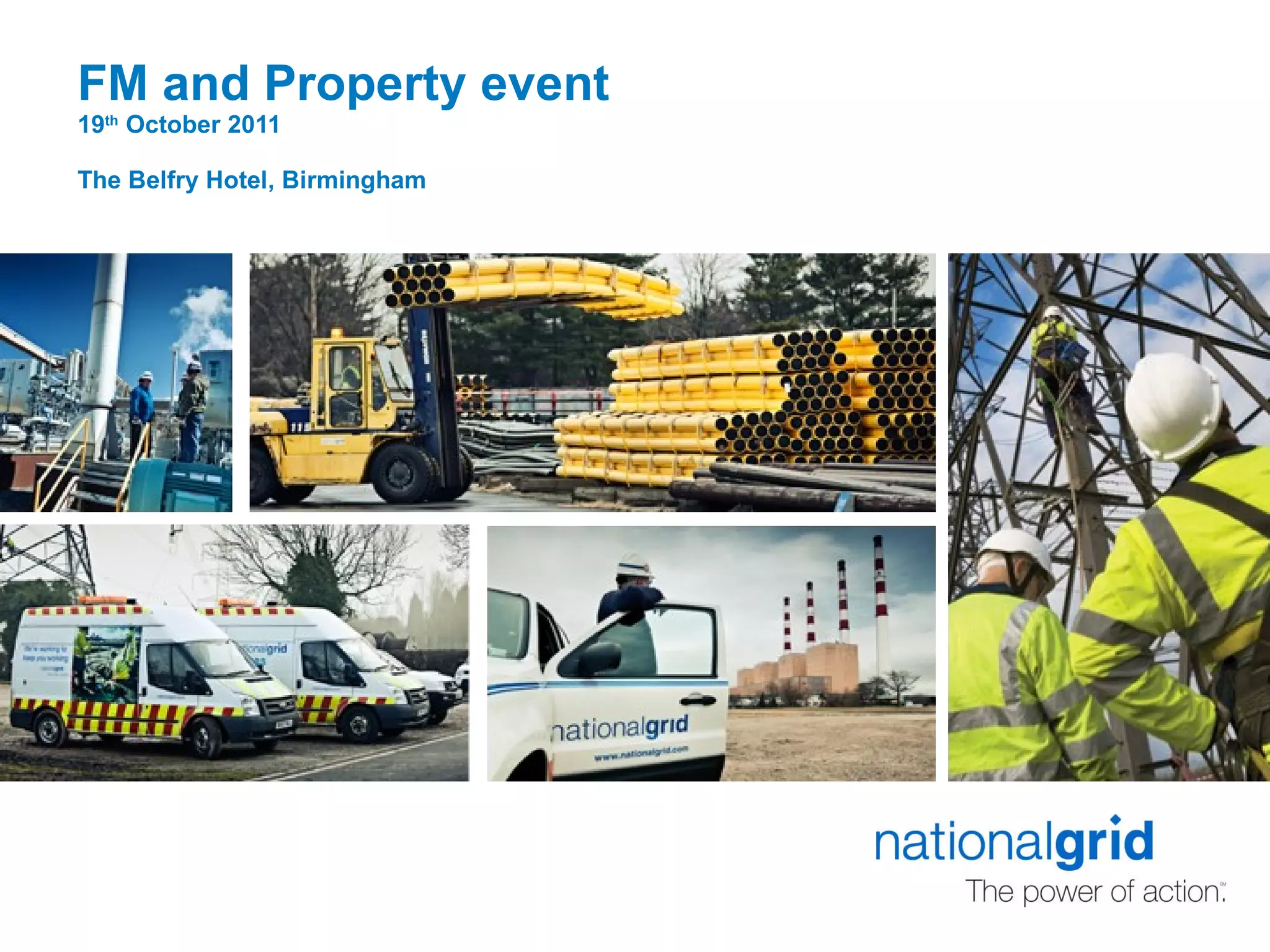
FM and Property event 19 th  October 2011 The Belfry Hotel, Birmingham
Agenda  Overview of National Grid Our workplace challenge  Current situation & project positioning Workplace research Key themes Physical design and people protocols The results Flexibility and utilisation Collaboration, creativity & innovation Sustainability & Cost Effectiveness
National Grid – who are we Originated from the restructuring of the UK gas industry in 1986 and the UK electricity industry in 1990 and entered the US energy delivery market in 2000 A network utility, based in the UK and the US. Our principal interests are: Transmission and distribution of electricity and gas Metering services, liquefied natural gas facilities and property in the UK Electricity interconnectors in the UK and US Our Vision: We at, National Grid, will be the foremost international electricity and gas company, delivering unparalleled safety, reliability and efficiency, vital to the wellbeing of our customers and communities.  We are committed to being an innovative leader in energy management and to safeguarding our global environment and for future generations.
National Grid – what are we Transmission UK and US UK: 9,500 miles of HV electricity network and 4,300 miles of high pressure pipeline  US: Over 10,000 miles of electricity transmission network Gas Distribution UK & Electricity Distribution & Generation US UK: 82,000 miles of distribution pipelines, distributes gas on behalf of gas shippers and suppliers to around 11 million consumers in just over a quarter of the UK  Operates the free national gas emergency number and has over 3.4 million customers    US: 122,000 miles of Distribution network, 4.4 million electricity customers (including Long Island Power Authority customers) and 6,650 MW of generation capacity providing 25 per cent of New York City's capacity needs
Our workplace challenge Where are we today… Engineering and technically based organisation Current workspace density ~ 10 m sq / person Current space works for some but certainly not all So where do we go from here ? The question we were trying to answer had three aspects; Can we change the workplace and improve collaboration and team working ? Can we improve the benchmark performance of the estate and reduce cost ? Can we reduce our climate change impact ? We wanted all three !
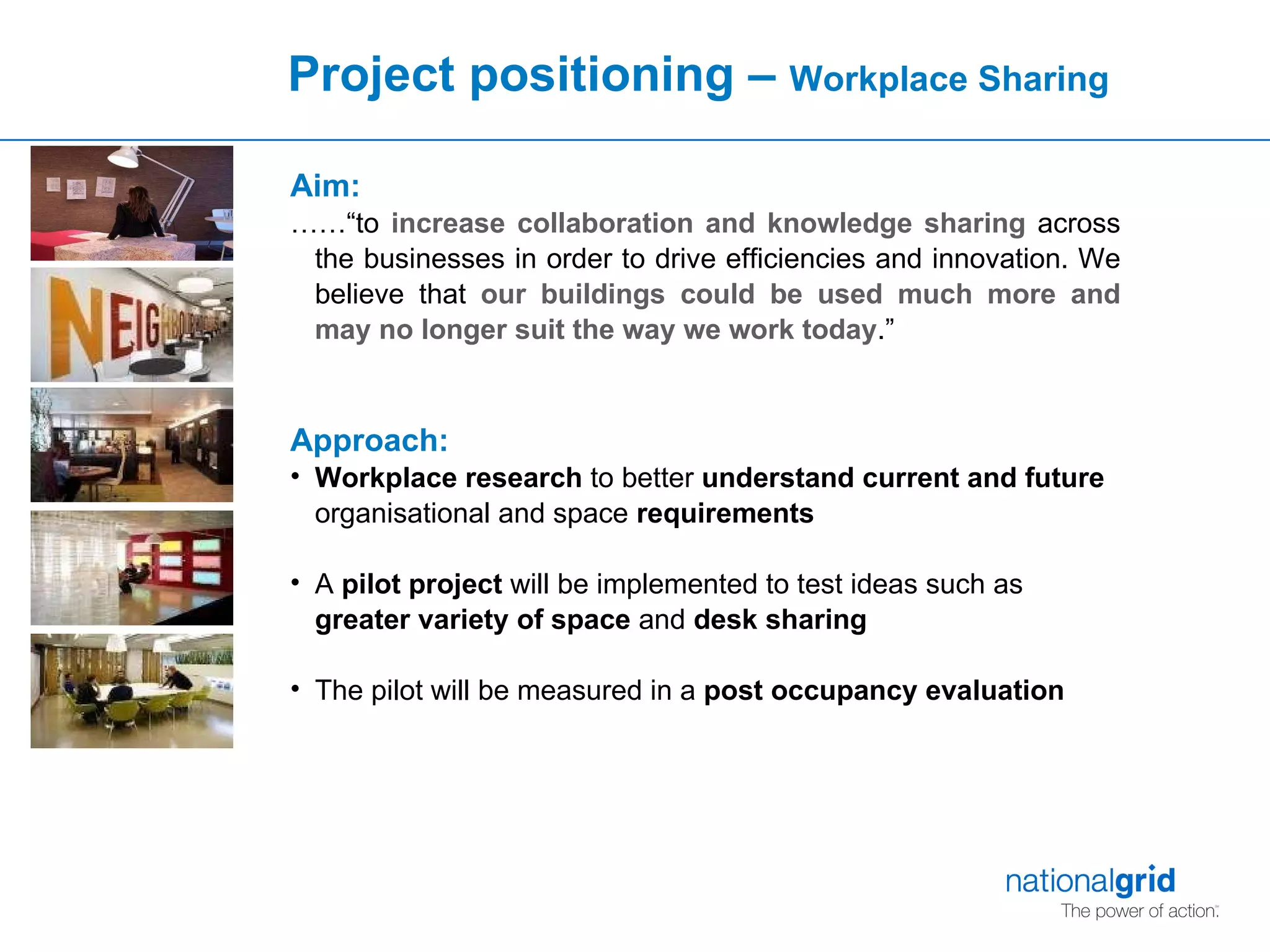
Project positioning –  Workplace Sharing Aim: ……“ to  increase collaboration and knowledge sharing  across the businesses in order to drive efficiencies and innovation. We believe that  our buildings could be used much more   and may no longer suit the way we work today .”  Approach: Workplace research  to better  understand current and future  organisational and space  requirements A  pilot project  will be implemented to test ideas such as  greater variety of space  and  desk sharing The pilot will be measured in a  post occupancy evaluation
The benefits –  Clarity of purpose from the start   More sustainable  use of existing buildings Cost savings Better connected teams and  more knowledge sharing Promote brand and culture  through the work space Potential to  increase productivity  Choice  over where to work Wider  variety of workspaces  to work from including desks, informal meeting, project spaces and quiet rooms New, better quality  work environment More buzz and quiet spaces   Better access to leaders and each other  within and across teams What’s in it for National Grid What’s in it for me?
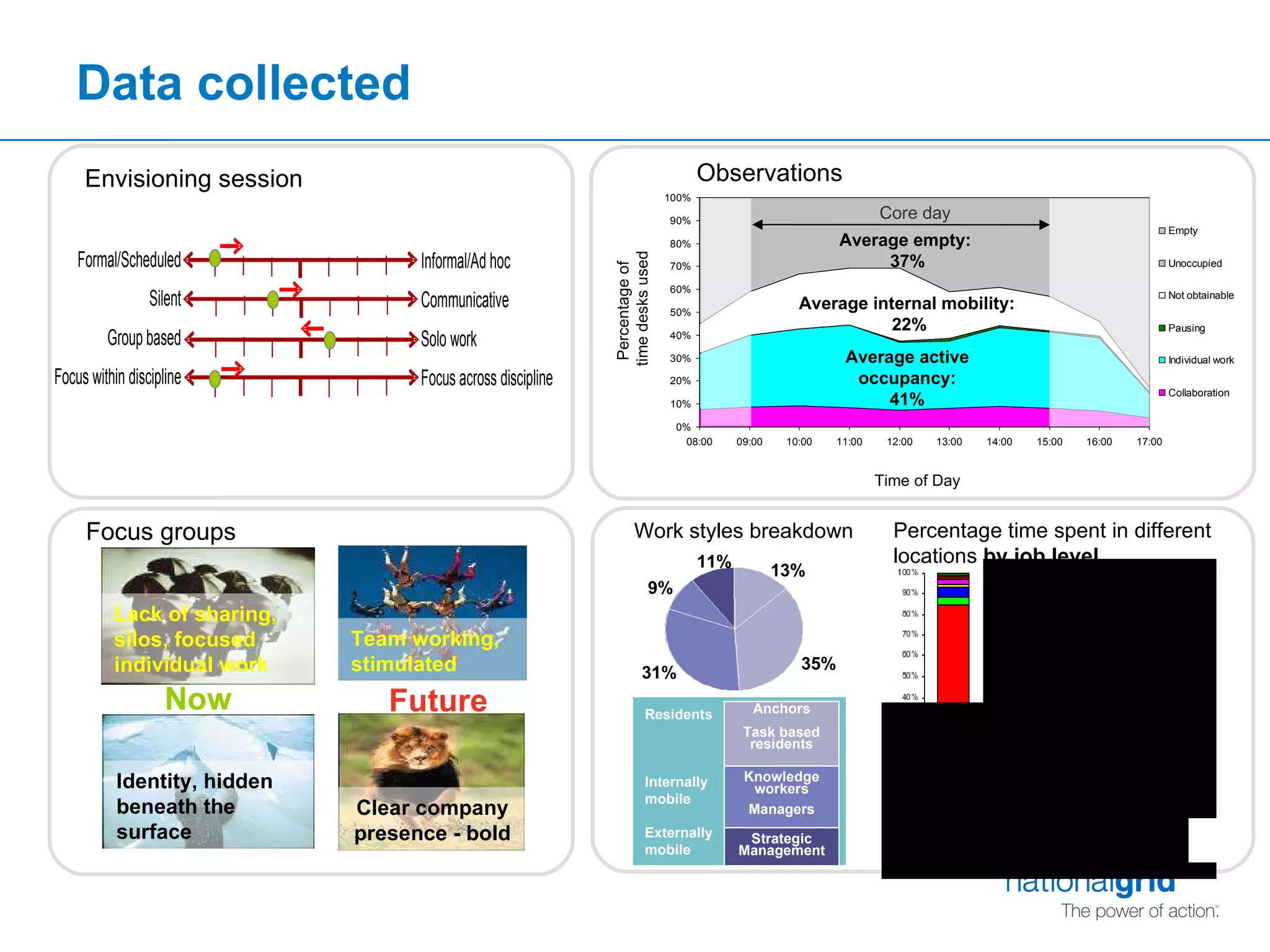
Data collected Work styles breakdown 13% 35% 31% 9% 11% Residents Internally  mobile Externally  mobile Anchors Task based residents Knowledge workers Managers Strategic Management Percentage of  time desks used Core day Time of Day Average active occupancy: 41% Average empty:  37% Average internal mobility:  22% Observations Percentage time spent in different locations  by job level Lack of sharing, silos, focused individual work Team working, stimulated Future Now Identity, hidden beneath the surface Clear company presence - bold Envisioning session Focus groups
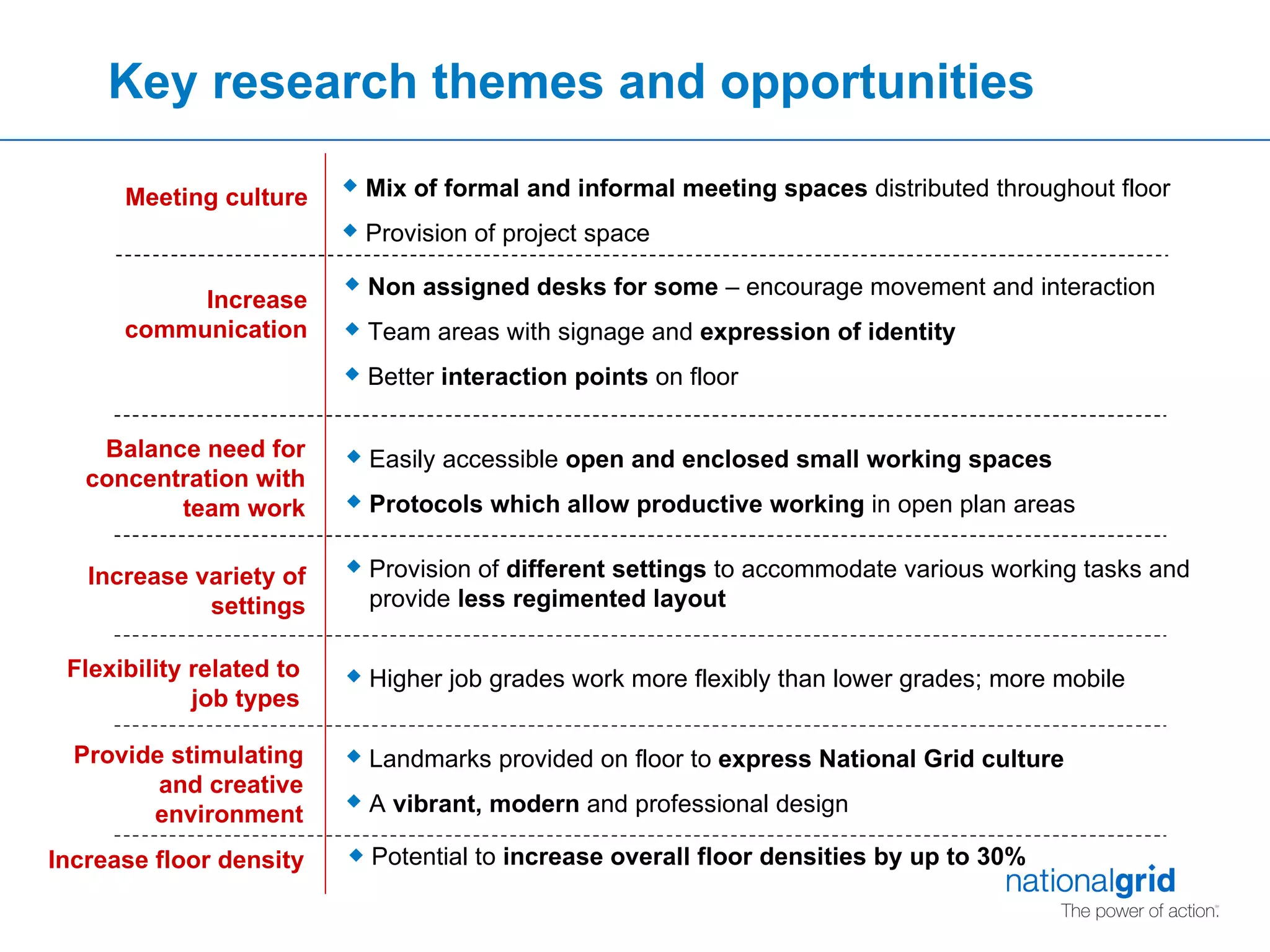
Key research themes and opportunities Potential to  increase overall floor densities by up to 30% Meeting culture Increase communication Balance need for concentration with team work Increase variety of settings Flexibility related to job types Provide stimulating and creative environment Increase floor density Mix of formal and informal meeting spaces  distributed throughout floor  Provision of project space Non assigned desks for some  – encourage movement and interaction Team areas with signage and  expression of identity Better  interaction points  on floor Easily accessible  open and enclosed small working spaces Protocols which allow productive working  in open plan areas Provision of  different settings  to accommodate various working tasks and provide  less regimented layout Higher job grades work more flexibly than lower grades; more mobile Landmarks provided on floor to  express National Grid culture A  vibrant, modern  and professional design
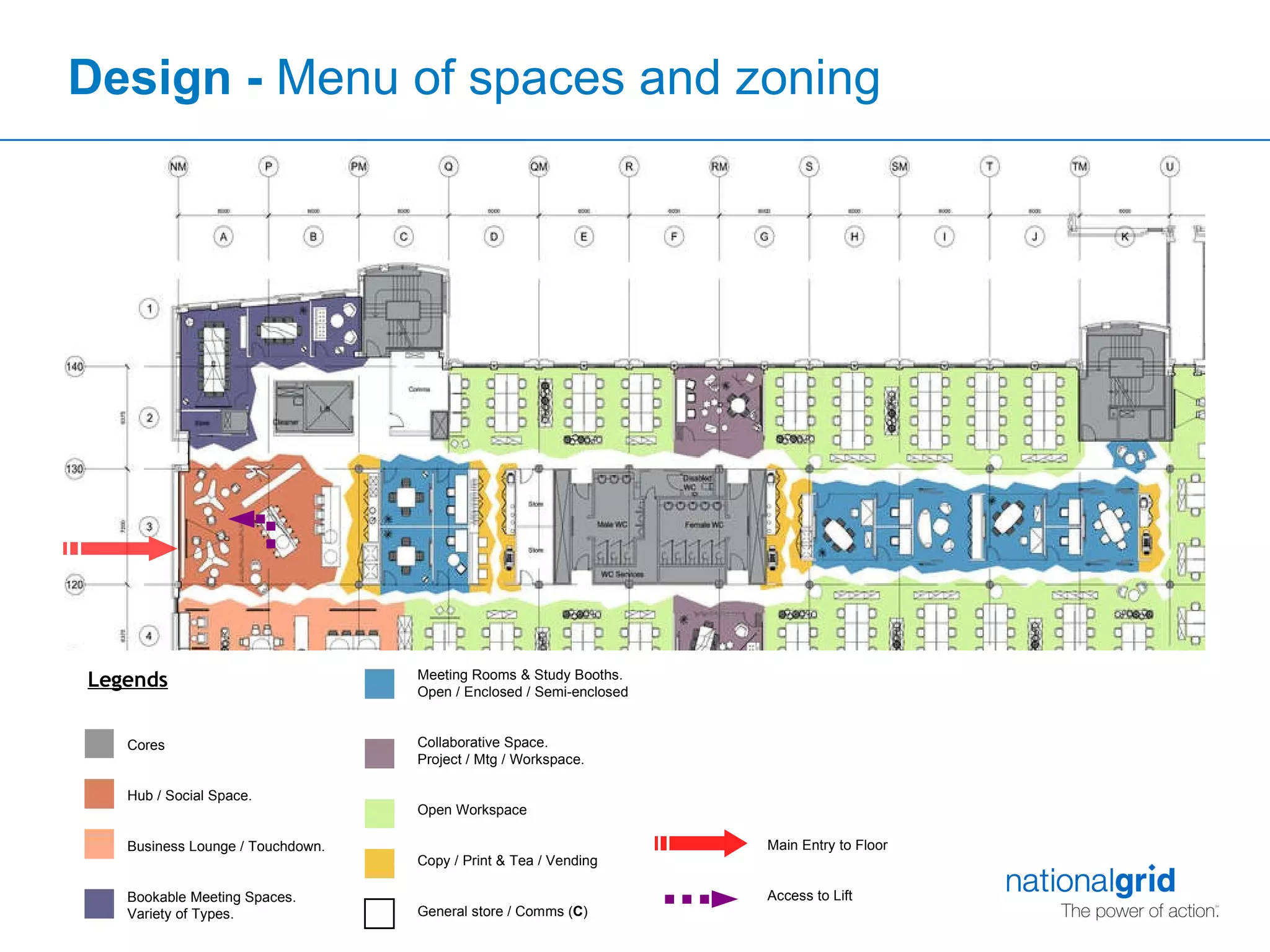
Design -  Menu of spaces and zoning Legends Cores Hub / Social Space. Business Lounge / Touchdown. Bookable Meeting Spaces. Variety of Types. Meeting Rooms & Study Booths. Open / Enclosed / Semi-enclosed Collaborative Space.  Project / Mtg / Workspace. Open Workspace Copy / Print & Tea / Vending General store / Comms ( C ) Main Entry to Floor Access to Lift
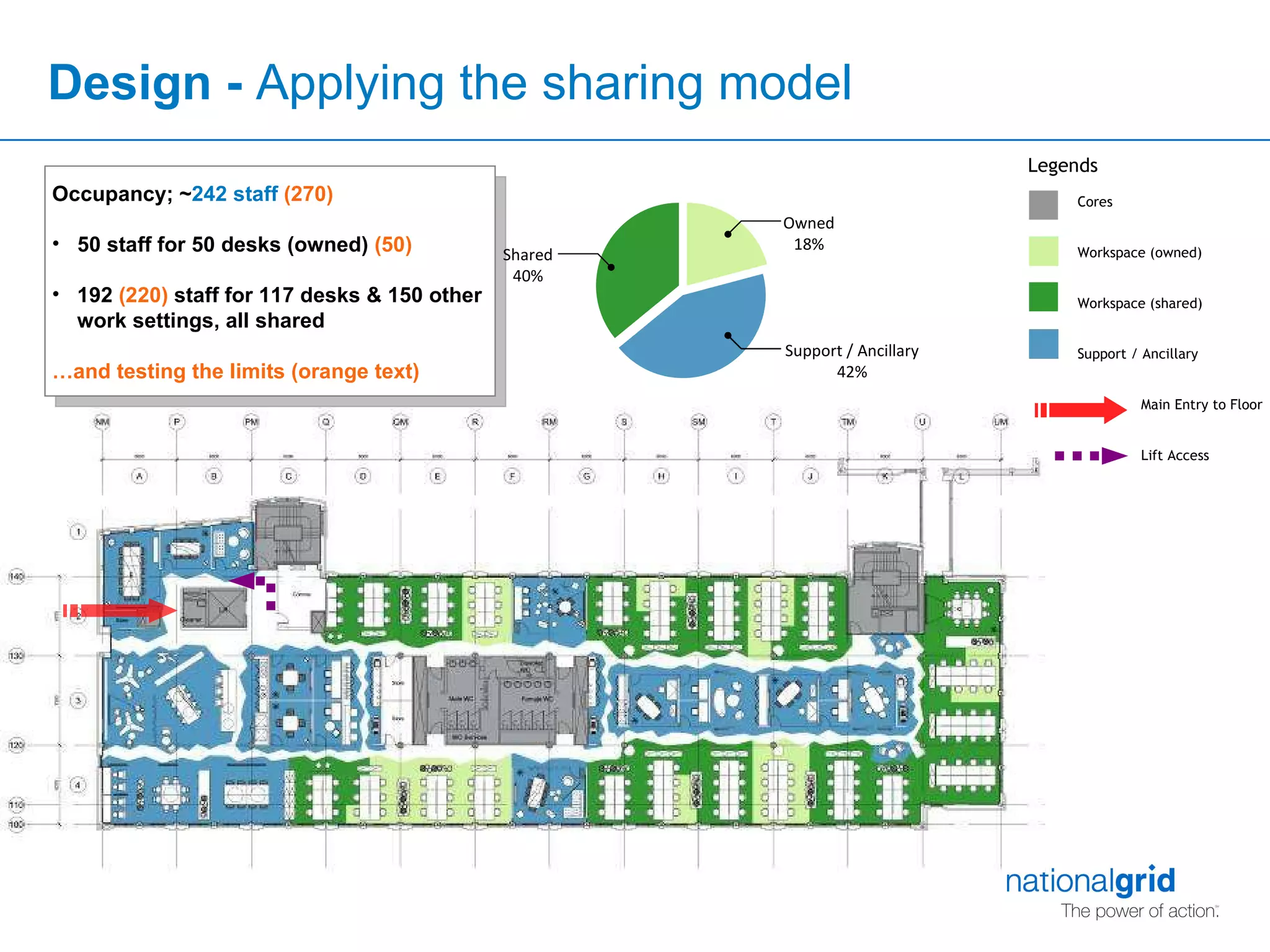
Legends Cores Workspace (owned) Workspace (shared) Support / Ancillary Main Entry to Floor Lift Access  Occupancy; ~ 242 staff  (270) 50 staff for 50 desks (owned)  (50) 192  (220)  staff for 117 desks & 150 other  work settings, all shared … and testing the limits (orange text) Design -  Applying the sharing model Support / Ancillary 42% Shared 40% Owned 18%
General principles: Everyone will work in an open plan environment with access a range of bookable and non-bookable spaces  Protocols apply equally to all regardless of grade Everyone will have a team base to go to every day Team bases do not ‘belong’ to anyone  not hard and fast  shared etiquette and common sense enables workspace to work new desired behaviours ‘ collective’ decision People - Workplace protocols Protocols are..
So, what’s been achieved ? Flexibility and utilisation Collaboration, creativity & innovation Sustainability & Cost Effectiveness “ 85% of staff when asked said they didn’t want to go back to their old working environment” “ 89% of staff said they have been able to find the workplace of their choice since working on A2”
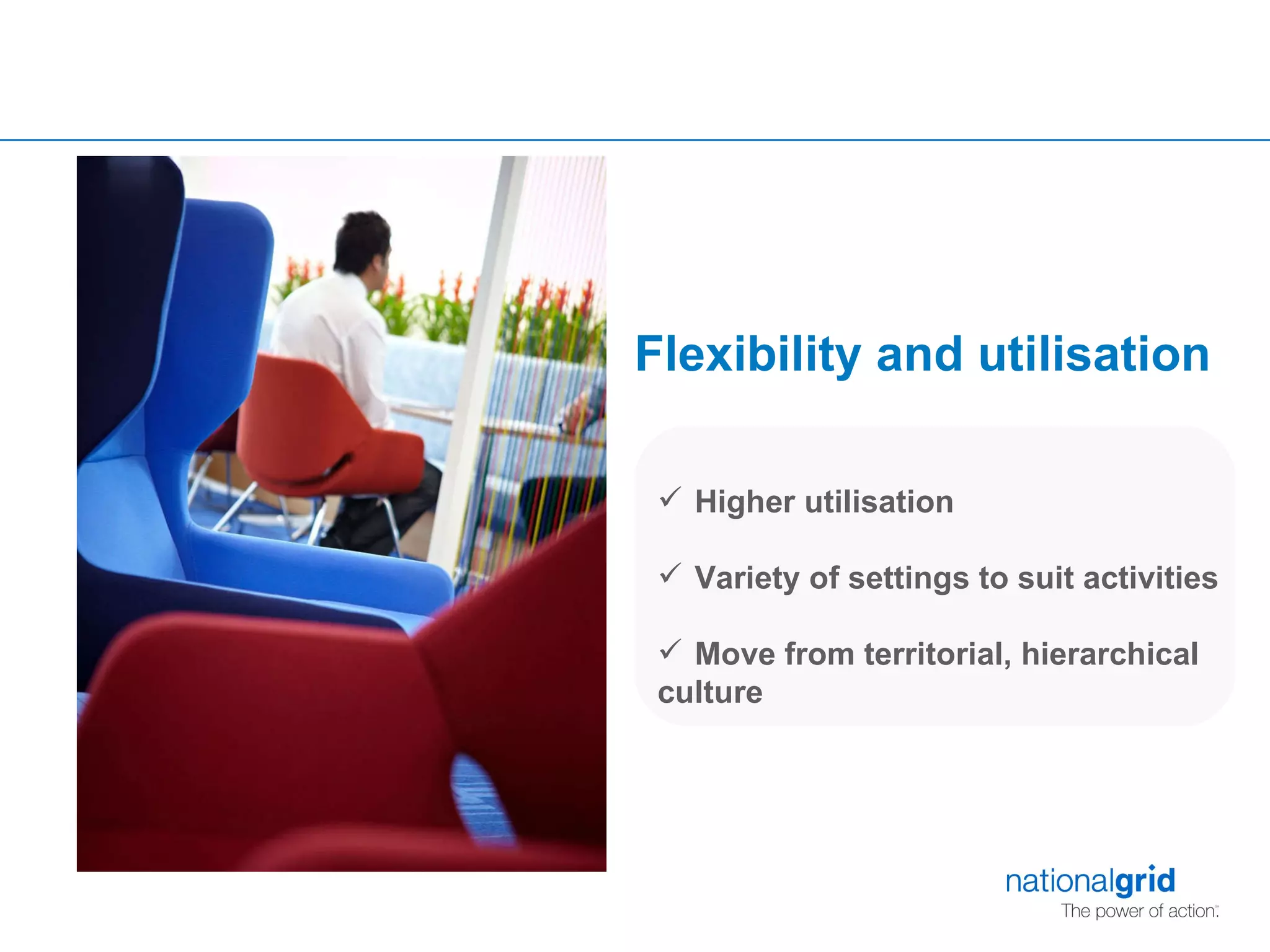
Flexibility and utilisation  Higher utilisation Variety of settings to suit activities Move from territorial, hierarchical  culture
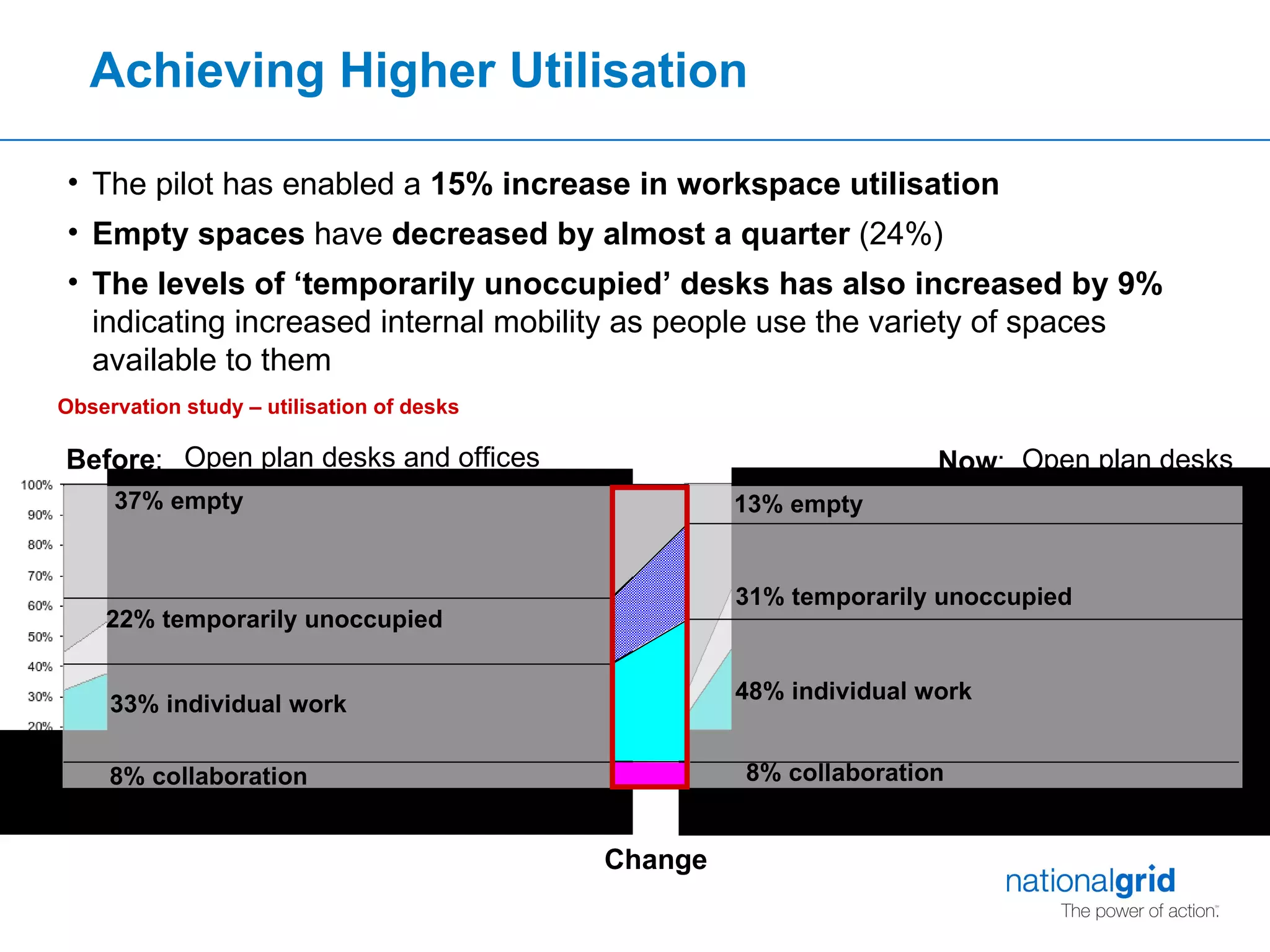
Achieving Higher Utilisation The pilot has enabled a  15% increase in workspace utilisation Empty spaces  have  decreased by almost a quarter  (24%) The levels of ‘temporarily unoccupied’ desks has also increased by 9%  indicating increased internal mobility as people use the variety of spaces available to them  Observation study – utilisation of desks Open plan desks Now : Before : Open plan desks and offices Change 13% empty 31% temporarily unoccupied 48% individual work 8% collaboration 37% empty 22% temporarily unoccupied 33% individual work 8% collaboration
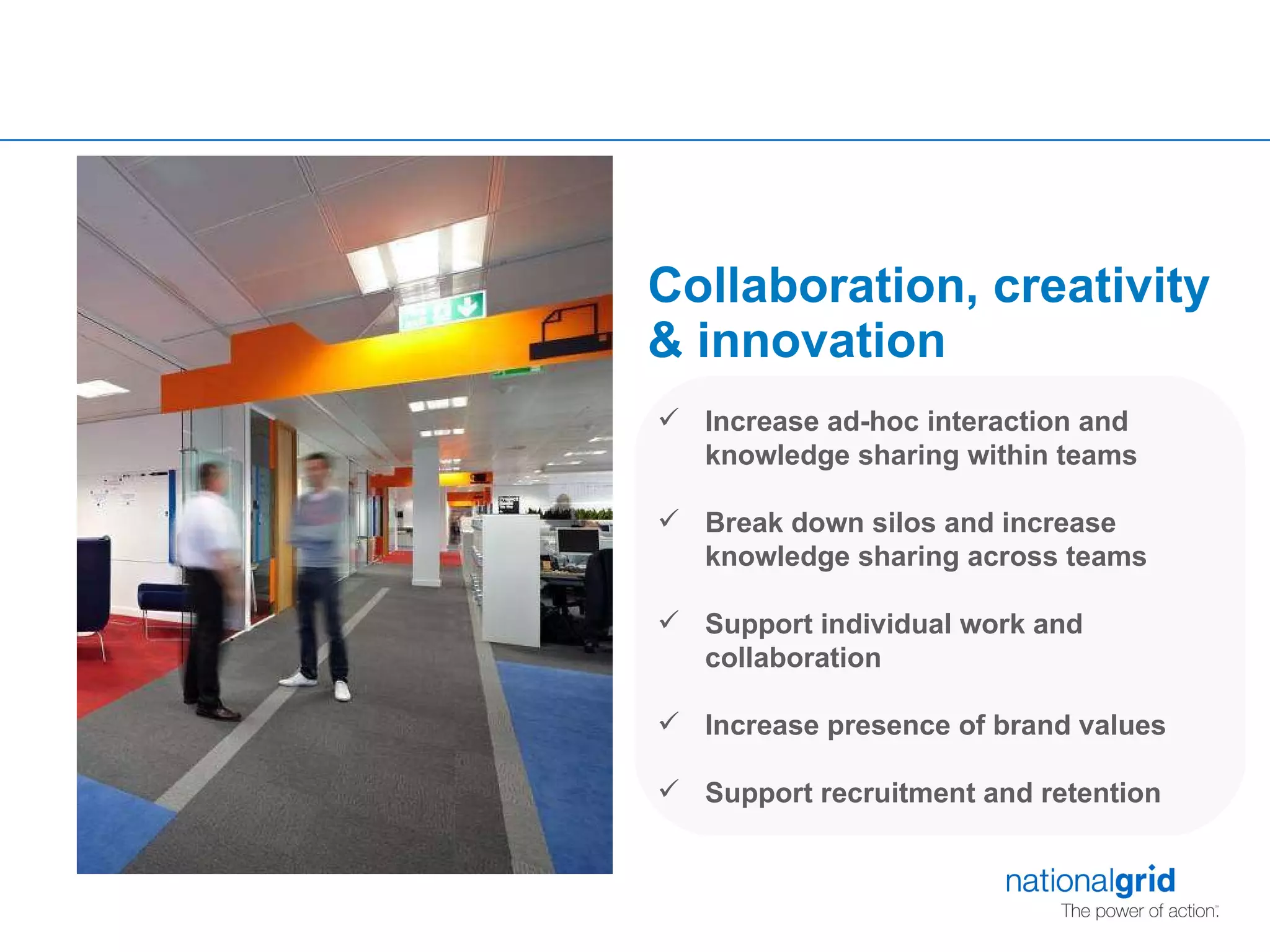
Collaboration, creativity  & innovation   Increase ad-hoc interaction and knowledge sharing within teams Break down silos and increase knowledge sharing across teams Support individual work and collaboration Increase presence of brand values Support recruitment and retention
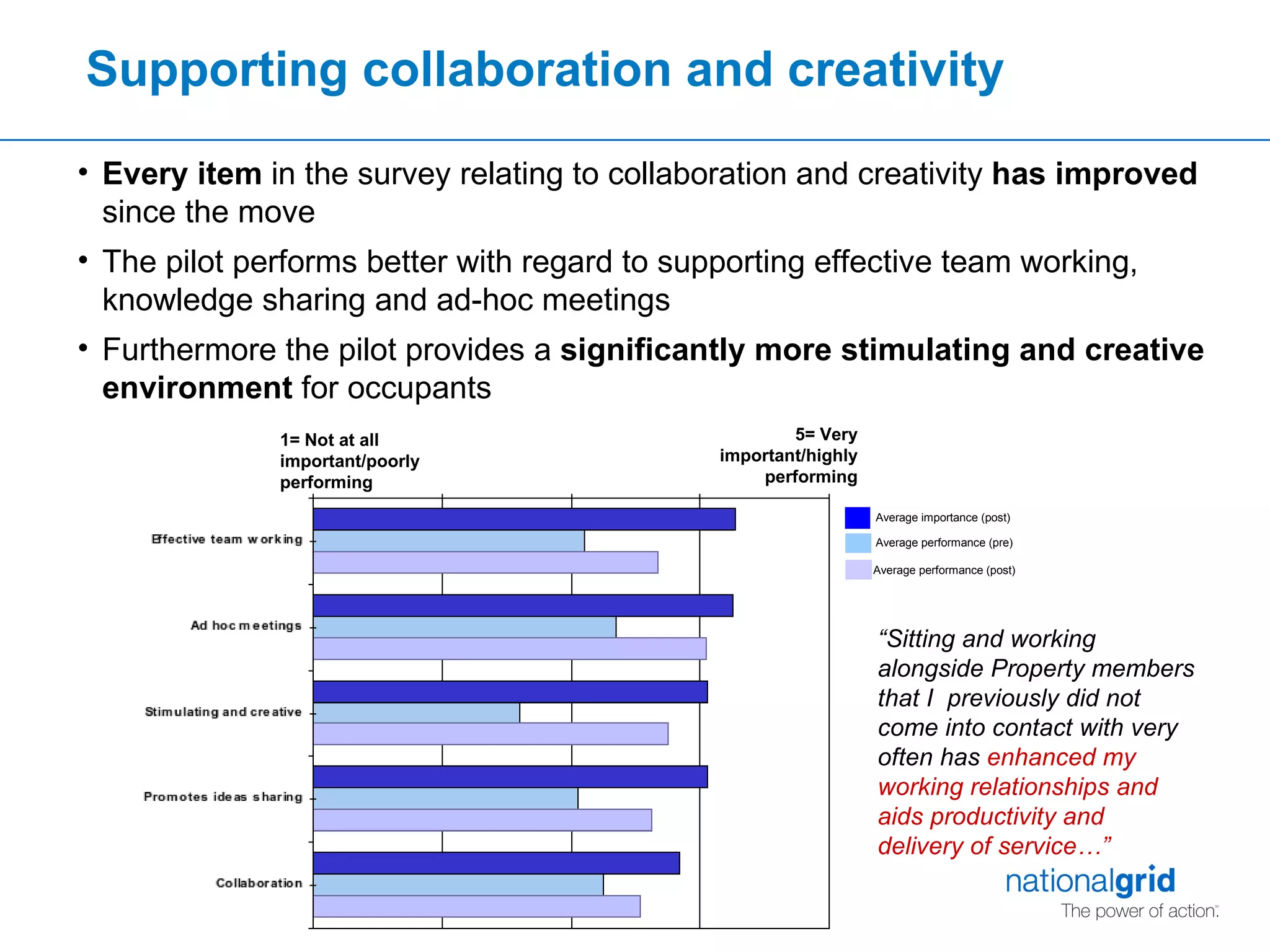
Supporting collaboration and creativity Every item  in the survey relating to collaboration and creativity  has improved  since the move The pilot performs better with regard to supporting effective team working, knowledge sharing and ad-hoc meetings Furthermore the pilot provides a  significantly more stimulating and creative environment  for occupants 5= Very important/highly performing 1= Not at all important/poorly performing “ Sitting and working alongside Property members that I  previously did not come into contact with very often has  enhanced my working relationships and aids productivity and delivery of service…”
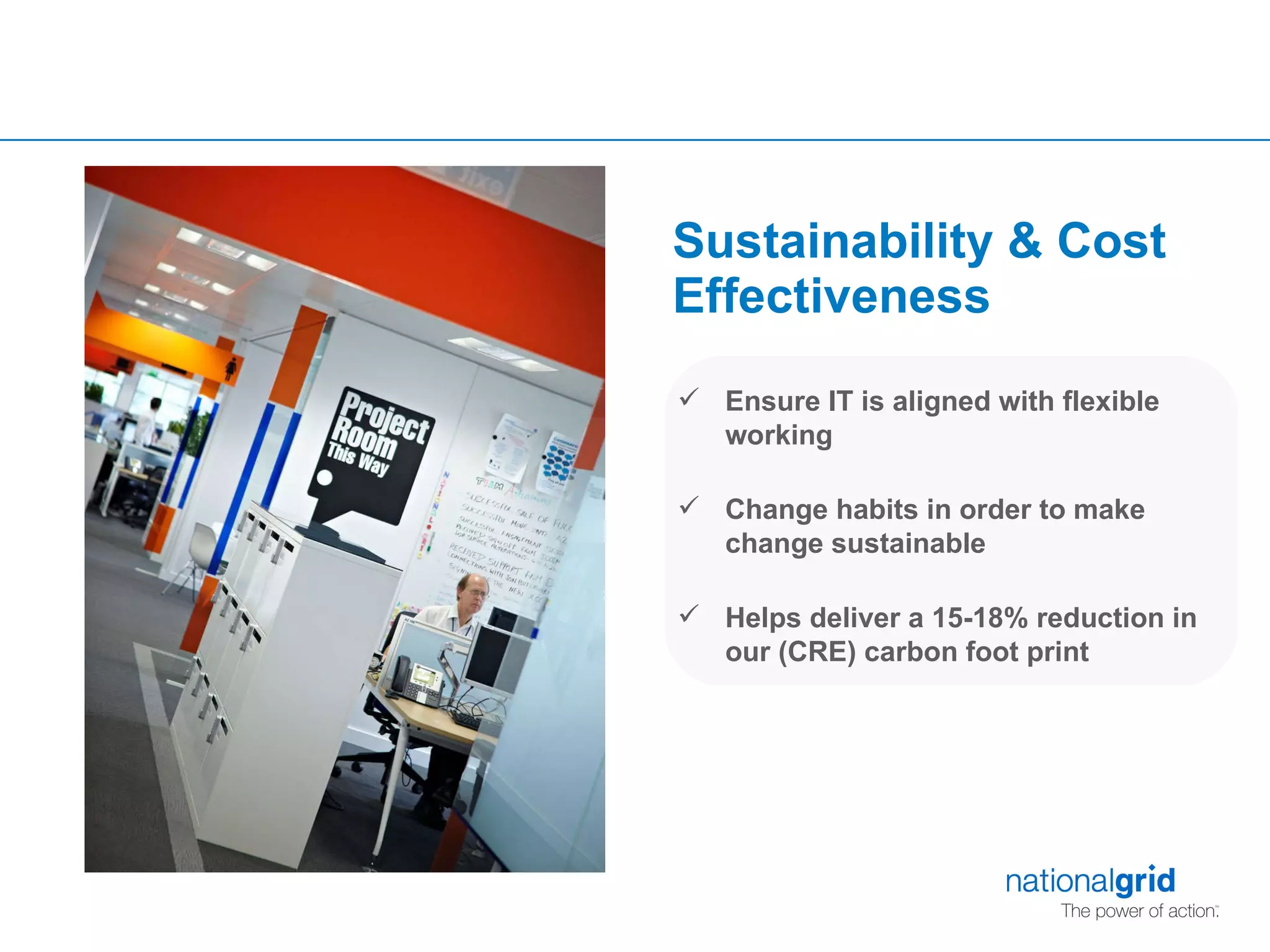
Sustainability & Cost  Effectiveness   Ensure IT is aligned with flexible working Change habits in order to make change sustainable Helps deliver a 15-18% reduction in our (CRE) carbon foot print
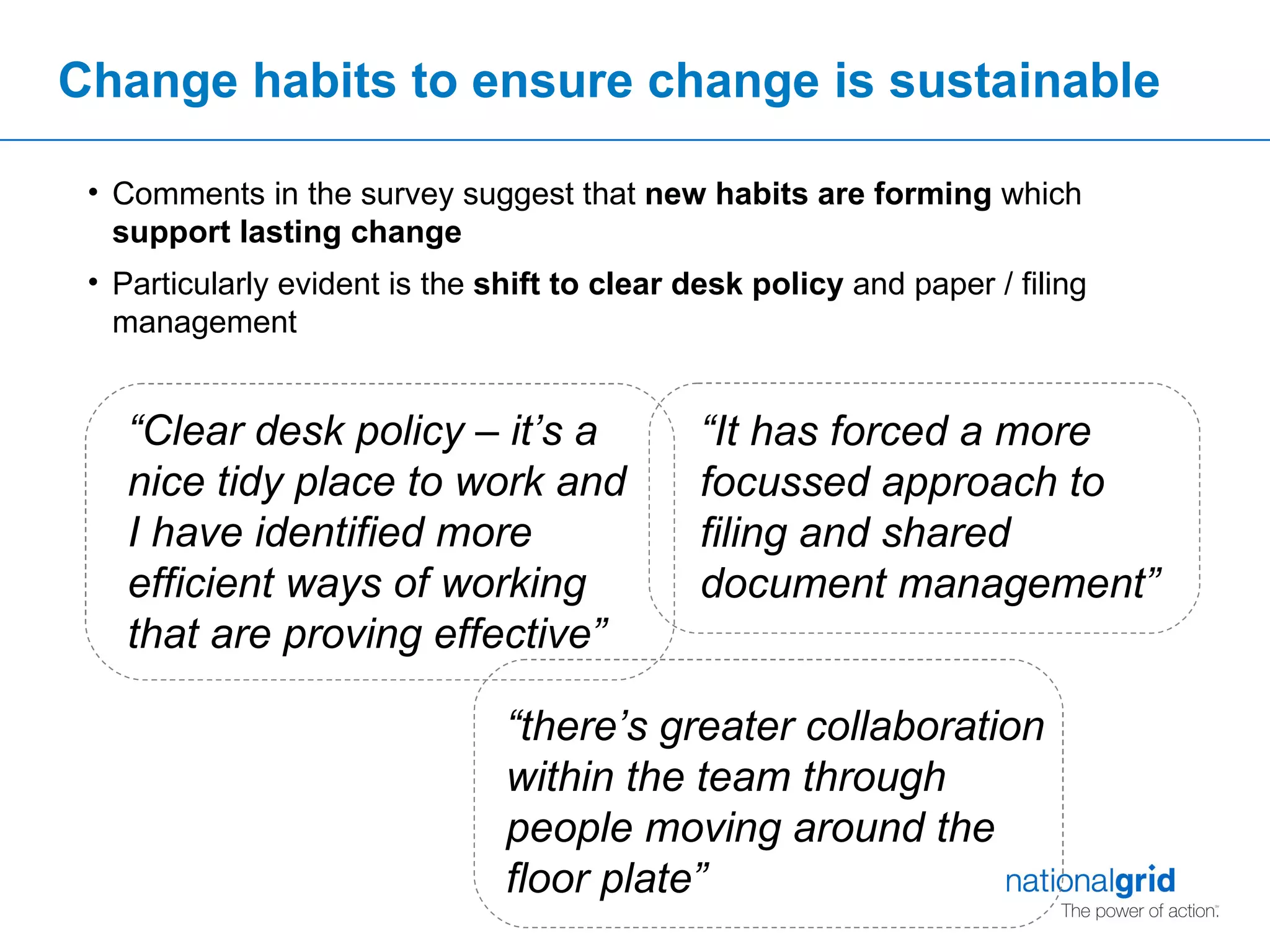
Change habits to ensure change is sustainable  “ there’s greater collaboration within the team through people moving around the floor plate” “ It has forced a more focussed approach to filing and shared document management” “ Clear desk policy – it’s a nice tidy place to work and I have identified more efficient ways of working that are proving effective” Comments in the survey suggest that  new habits are forming  which  support lasting change Particularly evident is the  shift to clear desk policy  and paper / filing management
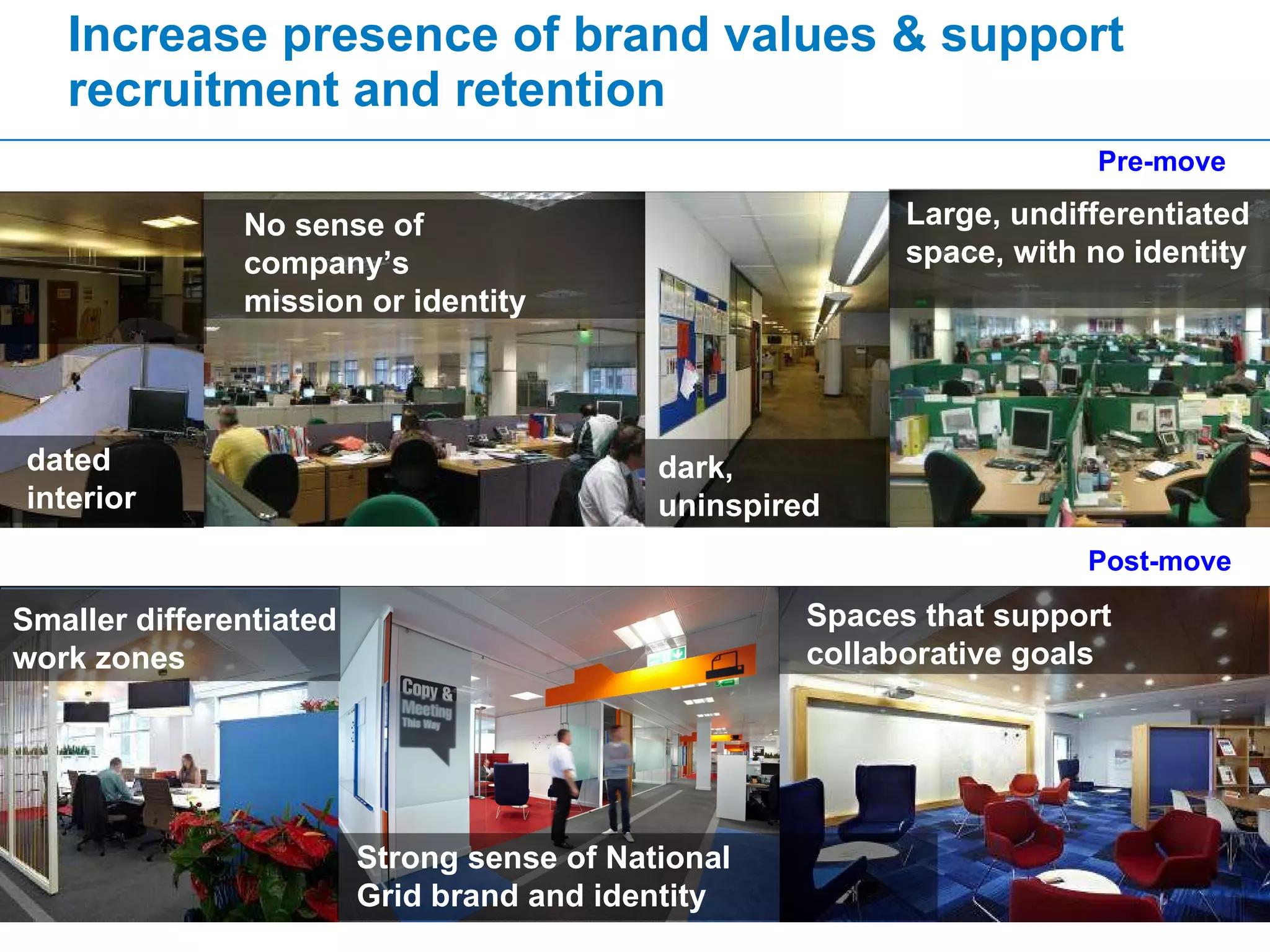
Increase presence of brand values & support recruitment and retention Pre-move Post-move dated  interior No sense of  company’s  mission or identity dark,  uninspired Large, undifferentiated  space, with no identity Smaller differentiated work zones Spaces that support collaborative goals Strong sense of National Grid brand and identity
Next steps New UK standard for National Grid Nearly halved the space allocation per person – benchmark performance Enabling estate consolidation Increasing collaboration and engagement Recruitment Productivity  ~£8 – 10m per annum savings Further opportunities being developed across the estate

FM&P 2011 - National Grid

  • 1.
    FM and Propertyevent 19 th October 2011 The Belfry Hotel, Birmingham
  • 2.
    Agenda Overviewof National Grid Our workplace challenge Current situation & project positioning Workplace research Key themes Physical design and people protocols The results Flexibility and utilisation Collaboration, creativity & innovation Sustainability & Cost Effectiveness
  • 3.
    National Grid –who are we Originated from the restructuring of the UK gas industry in 1986 and the UK electricity industry in 1990 and entered the US energy delivery market in 2000 A network utility, based in the UK and the US. Our principal interests are: Transmission and distribution of electricity and gas Metering services, liquefied natural gas facilities and property in the UK Electricity interconnectors in the UK and US Our Vision: We at, National Grid, will be the foremost international electricity and gas company, delivering unparalleled safety, reliability and efficiency, vital to the wellbeing of our customers and communities.  We are committed to being an innovative leader in energy management and to safeguarding our global environment and for future generations.
  • 4.
    National Grid –what are we Transmission UK and US UK: 9,500 miles of HV electricity network and 4,300 miles of high pressure pipeline US: Over 10,000 miles of electricity transmission network Gas Distribution UK & Electricity Distribution & Generation US UK: 82,000 miles of distribution pipelines, distributes gas on behalf of gas shippers and suppliers to around 11 million consumers in just over a quarter of the UK Operates the free national gas emergency number and has over 3.4 million customers   US: 122,000 miles of Distribution network, 4.4 million electricity customers (including Long Island Power Authority customers) and 6,650 MW of generation capacity providing 25 per cent of New York City's capacity needs
  • 5.
    Our workplace challengeWhere are we today… Engineering and technically based organisation Current workspace density ~ 10 m sq / person Current space works for some but certainly not all So where do we go from here ? The question we were trying to answer had three aspects; Can we change the workplace and improve collaboration and team working ? Can we improve the benchmark performance of the estate and reduce cost ? Can we reduce our climate change impact ? We wanted all three !
  • 6.
    Project positioning – Workplace Sharing Aim: ……“ to increase collaboration and knowledge sharing across the businesses in order to drive efficiencies and innovation. We believe that our buildings could be used much more and may no longer suit the way we work today .” Approach: Workplace research to better understand current and future organisational and space requirements A pilot project will be implemented to test ideas such as greater variety of space and desk sharing The pilot will be measured in a post occupancy evaluation
  • 7.
    The benefits – Clarity of purpose from the start More sustainable use of existing buildings Cost savings Better connected teams and more knowledge sharing Promote brand and culture through the work space Potential to increase productivity Choice over where to work Wider variety of workspaces to work from including desks, informal meeting, project spaces and quiet rooms New, better quality work environment More buzz and quiet spaces Better access to leaders and each other within and across teams What’s in it for National Grid What’s in it for me?
  • 8.
    Data collected Workstyles breakdown 13% 35% 31% 9% 11% Residents Internally mobile Externally mobile Anchors Task based residents Knowledge workers Managers Strategic Management Percentage of time desks used Core day Time of Day Average active occupancy: 41% Average empty: 37% Average internal mobility: 22% Observations Percentage time spent in different locations by job level Lack of sharing, silos, focused individual work Team working, stimulated Future Now Identity, hidden beneath the surface Clear company presence - bold Envisioning session Focus groups
  • 9.
    Key research themesand opportunities Potential to increase overall floor densities by up to 30% Meeting culture Increase communication Balance need for concentration with team work Increase variety of settings Flexibility related to job types Provide stimulating and creative environment Increase floor density Mix of formal and informal meeting spaces distributed throughout floor Provision of project space Non assigned desks for some – encourage movement and interaction Team areas with signage and expression of identity Better interaction points on floor Easily accessible open and enclosed small working spaces Protocols which allow productive working in open plan areas Provision of different settings to accommodate various working tasks and provide less regimented layout Higher job grades work more flexibly than lower grades; more mobile Landmarks provided on floor to express National Grid culture A vibrant, modern and professional design
  • 10.
    Design - Menu of spaces and zoning Legends Cores Hub / Social Space. Business Lounge / Touchdown. Bookable Meeting Spaces. Variety of Types. Meeting Rooms & Study Booths. Open / Enclosed / Semi-enclosed Collaborative Space. Project / Mtg / Workspace. Open Workspace Copy / Print & Tea / Vending General store / Comms ( C ) Main Entry to Floor Access to Lift
  • 11.
    Legends Cores Workspace(owned) Workspace (shared) Support / Ancillary Main Entry to Floor Lift Access Occupancy; ~ 242 staff (270) 50 staff for 50 desks (owned) (50) 192 (220) staff for 117 desks & 150 other work settings, all shared … and testing the limits (orange text) Design - Applying the sharing model Support / Ancillary 42% Shared 40% Owned 18%
  • 12.
    General principles: Everyonewill work in an open plan environment with access a range of bookable and non-bookable spaces Protocols apply equally to all regardless of grade Everyone will have a team base to go to every day Team bases do not ‘belong’ to anyone not hard and fast shared etiquette and common sense enables workspace to work new desired behaviours ‘ collective’ decision People - Workplace protocols Protocols are..
  • 13.
    So, what’s beenachieved ? Flexibility and utilisation Collaboration, creativity & innovation Sustainability & Cost Effectiveness “ 85% of staff when asked said they didn’t want to go back to their old working environment” “ 89% of staff said they have been able to find the workplace of their choice since working on A2”
  • 14.
    Flexibility and utilisation Higher utilisation Variety of settings to suit activities Move from territorial, hierarchical culture
  • 15.
    Achieving Higher UtilisationThe pilot has enabled a 15% increase in workspace utilisation Empty spaces have decreased by almost a quarter (24%) The levels of ‘temporarily unoccupied’ desks has also increased by 9% indicating increased internal mobility as people use the variety of spaces available to them Observation study – utilisation of desks Open plan desks Now : Before : Open plan desks and offices Change 13% empty 31% temporarily unoccupied 48% individual work 8% collaboration 37% empty 22% temporarily unoccupied 33% individual work 8% collaboration
  • 16.
    Collaboration, creativity & innovation Increase ad-hoc interaction and knowledge sharing within teams Break down silos and increase knowledge sharing across teams Support individual work and collaboration Increase presence of brand values Support recruitment and retention
  • 17.
    Supporting collaboration andcreativity Every item in the survey relating to collaboration and creativity has improved since the move The pilot performs better with regard to supporting effective team working, knowledge sharing and ad-hoc meetings Furthermore the pilot provides a significantly more stimulating and creative environment for occupants 5= Very important/highly performing 1= Not at all important/poorly performing “ Sitting and working alongside Property members that I previously did not come into contact with very often has enhanced my working relationships and aids productivity and delivery of service…”
  • 18.
    Sustainability & Cost Effectiveness Ensure IT is aligned with flexible working Change habits in order to make change sustainable Helps deliver a 15-18% reduction in our (CRE) carbon foot print
  • 19.
    Change habits toensure change is sustainable “ there’s greater collaboration within the team through people moving around the floor plate” “ It has forced a more focussed approach to filing and shared document management” “ Clear desk policy – it’s a nice tidy place to work and I have identified more efficient ways of working that are proving effective” Comments in the survey suggest that new habits are forming which support lasting change Particularly evident is the shift to clear desk policy and paper / filing management
  • 20.
    Increase presence ofbrand values & support recruitment and retention Pre-move Post-move dated interior No sense of company’s mission or identity dark, uninspired Large, undifferentiated space, with no identity Smaller differentiated work zones Spaces that support collaborative goals Strong sense of National Grid brand and identity
  • 21.
    Next steps NewUK standard for National Grid Nearly halved the space allocation per person – benchmark performance Enabling estate consolidation Increasing collaboration and engagement Recruitment Productivity ~£8 – 10m per annum savings Further opportunities being developed across the estate