Fluid statics Part - I
• Hydrostatics or Fluid Statics is the study of fluids at
rest.
• It's practical applications are numerous. Some of
which are Fluid Manometers, buoyancy
measurements, density calculations.
Fluid Elements - Definition:
• Fluid element
• - Body Force:
• Surface Force
•
Fluid Elements - Definition:
• Fluid element can be defined as an infinitesimal
region of the fluid continuum in isolation from its
surroundings.
• Two types of forces exist on fluid elements
Body Force: distributed over the entire mass or volume
of the element. It is usually expressed per unit mass of
the element or medium upon which the forces act.
Example: Gravitational Force, Electromagnetic force
fields etc.
Fluid Elements - Definition:
Surface Force: Forces exerted on the fluid element by
its surroundings through direct contact at the surface.
Surface force has two components:
• Normal Force: along the normal to the area
• Shear Force: along the plane of the area.
The ratios of these forces and the elemental area in the
limit of the area tending to zero are called the normal
and shear stresses respectively.
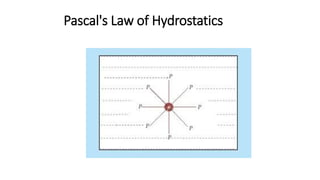
Pascal's Law of Hydrostatics
The states that the normal stresses at any point in a
fluid element at rest are directed towards the point
from all directions and they are of the equal
magnitude.
Pascal's Law of Hydrostatics
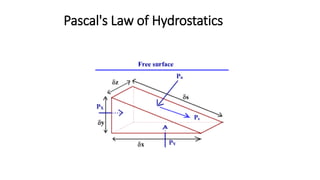
Let us prove this law by considering the equilibrium of
a small fluid element shown in Figure below.
Pascal's Law of Hydrostatics
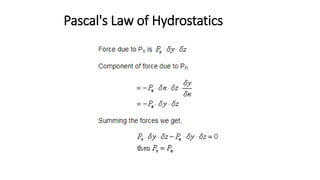
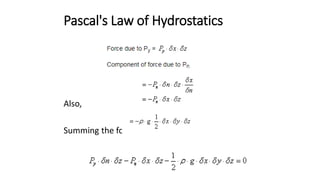
Also,
Summing the forces yields
Pascal's Law of Hydrostatics….
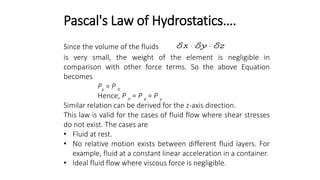
Since the volume of the fluids
is very small, the weight of the element is negligible in
comparison with other force terms. So the above Equation
becomes
Py = P n
Hence, P n = P x = P y
Similar relation can be derived for the z-axis direction.
This law is valid for the cases of fluid flow where shear stresses
do not exist. The cases are
• Fluid at rest.
• No relative motion exists between different fluid layers. For
example, fluid at a constant linear acceleration in a container.
• Ideal fluid flow where viscous force is negligible.
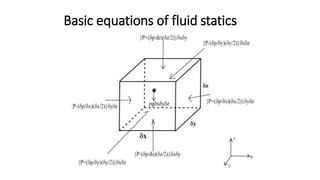
Basic equations of fluid statics
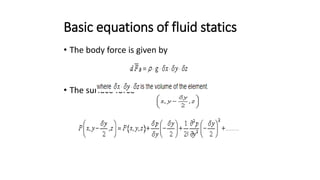
• The body force is given by
• The surface force
Basic equations of fluid statics
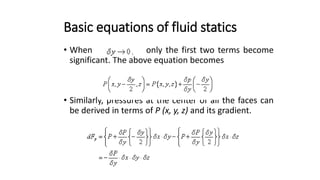
• When only the first two terms become
significant. The above equation becomes
• Similarly, pressures at the center of all the faces can
be derived in terms of P (x, y, z) and its gradient.
Basic equations of fluid statics…
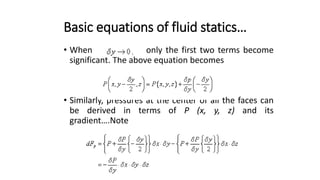
• When only the first two terms become
significant. The above equation becomes
• Similarly, pressures at the center of all the faces can
be derived in terms of P (x, y, z) and its
gradient….Note
Basic equations of fluid statics…
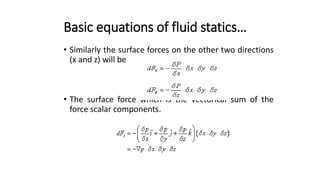
• Similarly the surface forces on the other two directions
(x and z) will be
• The surface force which is the vectorical sum of the
force scalar components.
Basic equations of fluid statics…
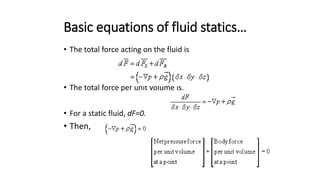
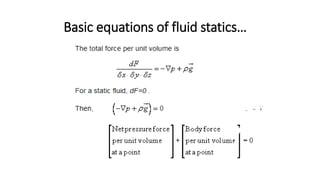
• The total force acting on the fluid is
• The total force per unit volume is.
• For a static fluid, dF=0.
• Then,
Basic equations of fluid statics…
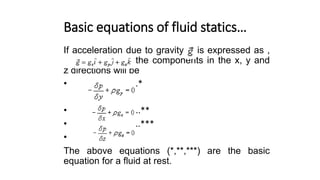
If acceleration due to gravity is expressed as ,
the components in the x, y and
z directions will be
• ….*
• …...**
• …..***
•
The above equations (*,**,***) are the basic
equation for a fluid at rest.
Basic equations of fluid statics…
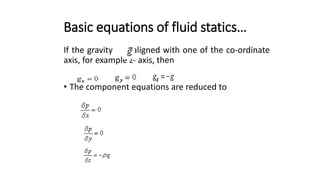
If the gravity is aligned with one of the co-ordinate
axis, for example z- axis, then
• The component equations are reduced to
Basic equations of fluid statics…
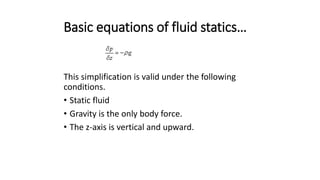
This simplification is valid under the following
conditions.
• Static fluid
• Gravity is the only body force.
• The z-axis is vertical and upward.

Fluid statics Part - I, Basic equations of fluid statics

  • 1.
    Fluid statics Part- I • Hydrostatics or Fluid Statics is the study of fluids at rest. • It's practical applications are numerous. Some of which are Fluid Manometers, buoyancy measurements, density calculations.
  • 2.
    Fluid Elements -Definition: • Fluid element • - Body Force: • Surface Force •
  • 3.
    Fluid Elements -Definition: • Fluid element can be defined as an infinitesimal region of the fluid continuum in isolation from its surroundings. • Two types of forces exist on fluid elements Body Force: distributed over the entire mass or volume of the element. It is usually expressed per unit mass of the element or medium upon which the forces act. Example: Gravitational Force, Electromagnetic force fields etc.
  • 4.
    Fluid Elements -Definition: Surface Force: Forces exerted on the fluid element by its surroundings through direct contact at the surface. Surface force has two components: • Normal Force: along the normal to the area • Shear Force: along the plane of the area. The ratios of these forces and the elemental area in the limit of the area tending to zero are called the normal and shear stresses respectively.
  • 5.
    Pascal's Law ofHydrostatics The states that the normal stresses at any point in a fluid element at rest are directed towards the point from all directions and they are of the equal magnitude.
  • 6.
    Pascal's Law ofHydrostatics Let us prove this law by considering the equilibrium of a small fluid element shown in Figure below.
  • 7.
    Pascal's Law ofHydrostatics
  • 8.
    Pascal's Law ofHydrostatics Also, Summing the forces yields
  • 9.
    Pascal's Law ofHydrostatics…. Since the volume of the fluids is very small, the weight of the element is negligible in comparison with other force terms. So the above Equation becomes Py = P n Hence, P n = P x = P y Similar relation can be derived for the z-axis direction. This law is valid for the cases of fluid flow where shear stresses do not exist. The cases are • Fluid at rest. • No relative motion exists between different fluid layers. For example, fluid at a constant linear acceleration in a container. • Ideal fluid flow where viscous force is negligible.
  • 10.
    Basic equations offluid statics
  • 11.
    Basic equations offluid statics • The body force is given by • The surface force
  • 12.
    Basic equations offluid statics • When only the first two terms become significant. The above equation becomes • Similarly, pressures at the center of all the faces can be derived in terms of P (x, y, z) and its gradient.
  • 13.
    Basic equations offluid statics… • When only the first two terms become significant. The above equation becomes • Similarly, pressures at the center of all the faces can be derived in terms of P (x, y, z) and its gradient….Note
  • 14.
    Basic equations offluid statics… • Similarly the surface forces on the other two directions (x and z) will be • The surface force which is the vectorical sum of the force scalar components.
  • 15.
    Basic equations offluid statics… • The total force acting on the fluid is • The total force per unit volume is. • For a static fluid, dF=0. • Then,
  • 16.
    Basic equations offluid statics…
  • 17.
    Basic equations offluid statics… If acceleration due to gravity is expressed as , the components in the x, y and z directions will be • ….* • …...** • …..*** • The above equations (*,**,***) are the basic equation for a fluid at rest.
  • 18.
    Basic equations offluid statics… If the gravity is aligned with one of the co-ordinate axis, for example z- axis, then • The component equations are reduced to
  • 19.
    Basic equations offluid statics… This simplification is valid under the following conditions. • Static fluid • Gravity is the only body force. • The z-axis is vertical and upward.

Editor's Notes

  • #3 Fluid element can be defined as an infinitesimal region of the fluid continuum in isolation from its surroundings. Fluid element can be defined as an infinitesimal region of the fluid continuum in isolation from its surroundings. Two types of forces exist on fluid elements. Body Force: distributed over the entire mass or volume of the element. It is usually expressed per unit mass of the element or medium upon which the forces act. Two types of forces exist on fluid elements Body Force: distributed over the entire mass or volume of the element. It is usually expressed per unit mass of the element or medium upon which the forces act. Example: Gravitational Force, Electromagnetic force fields etc.  Surface Force: Forces exerted on the fluid element by its surroundings through direct contact at the surface. Surface force has two components: Normal Force: along the normal to the area Shear Force: along the plane of the area. The ratios of these forces and the elemental area in the limit of the area tending to zero are called the normal and shear stresses respectively.
  • #6 Pascal's law states that when there is an increase in pressure at any point in a confined fluid, there is an equal increase at every other point in the container”. The states that the normal stresses at any point in a fluid element at rest are directed towards the point from all directions and they are of the equal magnitude. The Pascal's law states that the pressure at a point in a fluid at rest is the same in all directions 
  • #7 The Pascal's law states that the pressure at a point in a fluid at rest is the same in all directions . Let us prove this law by considering the equilibrium of a small fluid element shown in Fig
  • #8 The equilibrium of the fluid element implies that sum of the forces in any direction must be zero. For the x-direction:
  • #9 Similarly in the y-direction, we can equate the forces as given below. Also, we know that, weight of fluid = specific weight * volume of element. The negative sign indicates that weight of the fluid element acts in opposite direction of the z-direction. Summing the forces yields
  • #10 Similarly in the y-direction, we can equate the forces as given below. Also, we know that, weight of fluid = specific weight * volume of element. The negative sign indicates that weight of the fluid element acts in opposite direction of the z-direction. Summing the forces yields
  • #11 An equation representing pressure field P = P (x, y, z) within fluid at rest is derived in this section. Since the fluid is at rest, we can define the pressure field in terms of space dimensions (x, y and z) only. Consider a fluid element of rectangular parellopiped shape( Fig : L - 7.1) within a large fluid region which is at rest. The forces acting on the element are body and surface forces.
  • #12 The pressure at the center of the element is assumed to be P (x, y, z). Using Taylor series expansion the pressure at point on the surface can be expressed as
  • #13 Note that surface areas of the faces are very small. The center pressure of the face represents the average pressure on that face.  The surface force acting on the element in the y-direction is
  • #14 Note that surface areas of the faces are very small. The center pressure of the face represents the average pressure on that face.  The surface force acting on the element in the y-direction is
  • #16 Note that surface areas of the faces are very small. The center pressure of the face represents the average pressure on that face.  The surface force acting on the element in the y-direction is
  • #17 Note that surface areas of the faces are very small. The center pressure of the face represents the average pressure on that face.  The surface force acting on the element in the y-direction is
  • #18 Note that surface areas of the faces are very small. The center pressure of the face represents the average pressure on that face.  The surface force acting on the element in the y-direction is
  • #19 Under this assumption, the pressure P depends on z only. Therefore, total derivative can be used instead of the partial derivative
  • #20 Under this assumption, the pressure P depends on z only. Therefore, total derivative can be used instead of the partial derivative