Changing Mindsets
Wayne
People, Flow and the Art of Unlearning
Resource Efficiency
what the hell is it and why does it suck?
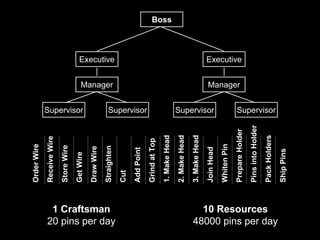
Boss
Executive
Manager
Supervisor Supervisor
Executive
Manager
Supervisor Supervisor
OrderWire
ReceiveWire
StoreWire
GetWire
DrawWire
Straighten
Cut
AddPoint
GrindatTop
1.MakeHead
2.MakeHead
3.MakeHead
JoinHead
WhitenPin
PrepareHolder
PinsintoHolder
PackHolders
ShipPins
1 Craftsman
20 pins per day
10 Resources
48000 pins per day
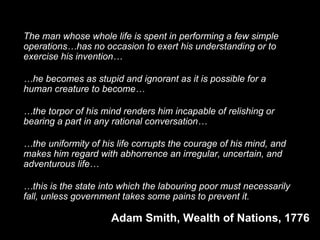
The man whose whole life is spent in performing a few simple
operations…has no occasion to exert his understanding or to
exercise his invention…
…he becomes as stupid and ignorant as it is possible for a
human creature to become…
…the torpor of his mind renders him incapable of relishing or
bearing a part in any rational conversation…
…the uniformity of his life corrupts the courage of his mind, and
makes him regard with abhorrence an irregular, uncertain, and
adventurous life…
…this is the state into which the labouring poor must necessarily
fall, unless government takes some pains to prevent it.
Adam Smith, Wealth of Nations, 1776
Flow Efficiency
my pretty…
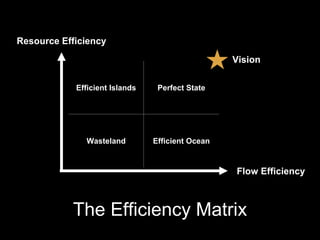
Efficient Islands Perfect State
Wasteland Efficient Ocean
Resource Efficiency
Flow Efficiency
Vision
The Efficiency Matrix
Throw Away Process
and let process emerge
Actual Rocket Science
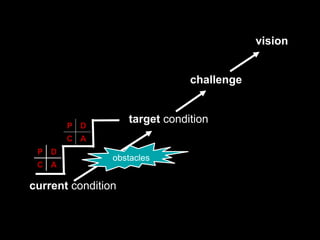
vision
challenge
target condition
current condition
obstacles
P D
C A
P D
C A
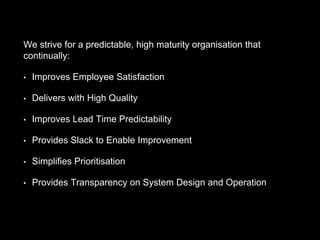
We strive for a predictable, high maturity organisation that
continually:
• Improves Employee Satisfaction
• Delivers with High Quality
• Improves Lead Time Predictability
• Provides Slack to Enable Improvement
• Simplifies Prioritisation
• Provides Transparency on System Design and Operation
People
Losing Faith in Mental Models is HARD
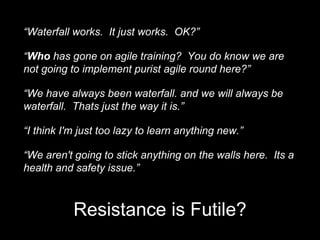
“Waterfall works. It just works. OK?”
“Who has gone on agile training? You do know we are
not going to implement purist agile round here?”
“We have always been waterfall. and we will always be
waterfall. Thats just the way it is.”
“I think I'm just too lazy to learn anything new.”
“We aren't going to stick anything on the walls here. Its a
health and safety issue.”
Resistance is Futile?
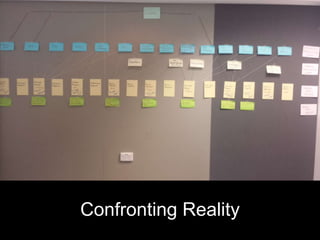
Confronting Reality
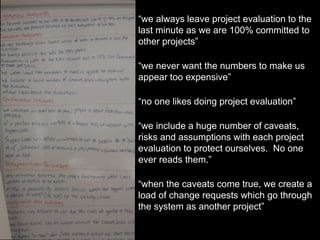
“we always leave project evaluation to the
last minute as we are 100% committed to
other projects”
“we never want the numbers to make us
appear too expensive”
“no one likes doing project evaluation”
“we include a huge number of caveats,
risks and assumptions with each project
evaluation to protect ourselves. No one
ever reads them.”
“when the caveats come true, we create a
load of change requests which go through
the system as another project”
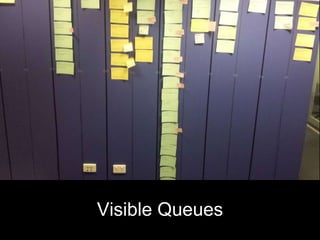
Visible Queues
• How much contradictory evidence is being explained away?
• What comparable cases can we study?
• Who can come in with a fresh perspective?
• Can we manufacture a failure to help degrade the mental
model?
• Can we use analogy and metaphor?
• Can we use a Crystal Ball?
• Can we encourage curiosity?
Unlearning Techniques
Parting Shot
can we save everyone?

Flow Efficiency, People and Unlearning (LAST2014)

Editor's Notes

  • #2 Thank you to all of these lovely people Especially whoever it is sponsoring the free beer.
  • #3 Im going to talk about operating strategies, The effect that those operating strategies has on the people involved, And the difficulties in asking people to adopt a strategy different from the current organisational incumbent. I have a bias…
  • #5 Resource Efficiency Attaches Work Items to People Originated in Scotland, 1776, Deep Fried Mars Bars Describe the work breakdown and procedure Describe org structure & role of management Describe people effects
  • #6 This was how Adam Smith described the effects of the division of labour I have actually left out the really depressing bits. In todays Candy Crush western economy, everyone is a knowledge worker. Resource Efficiency is Economically Fabulous, but Socially and Creatively destructive. OK, it doesn’t suck. If well managed it is still a perfectly valid choice. But there are other choices a company can make.
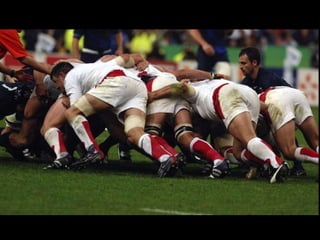
  • #8 Flow Efficiency attaches people to work items A traditional Scrum Team is an incredibly flow efficient organisation The team is attentive to the product owners needs. There are no handoffs to other divisions. The customer and the company work harmoniously. HOWEVER. A Scrum Team can still feel pretty shitty. It can feel like a treadmill, just chasing velocity.
  • #9 Introduce the Efficiency Matrix, highlight that a combination of both is optimal Focus on the Ideal State for an Operating Strategy, and that it is unattainable Describe how the Ideal State can be used as the true north for Continuous Improvement efforts. Describe how you could use lean and agile practices to pull you into the desired state A company chasing flow efficiency can still have disengaged people. It is when you reach for the vision, that magical things happen.
  • #11 Space X made a Choice (describe firm) Orbital Sciences Supply the ISS from the 1960s Simple Catch 22 Rule Creativity and Innovation != Procedures Procedures Level the Talent Field Where has it come from? Space X made a choice. This is actual Rocket Science for heavens sake – surely they would believe in process and procedures? Traditional space companies such as Orbital Sciences supply the ISS. They use rockets that were actually built in the 1960s and have been packaged in Siberia. They had a simple rule – you can only fly something which had already been in space. Catch 22. If you want to be creative, if you want to be innovative in todays Candy Crush economy – you cannot rely on procedure. Its too fragile. Process, best practice is a leveller. It brings your juniiors and experts down to the same level. Where has this division of labour come from?
  • #12 Describe the Improvement Kata People are encouraged to look at the big picture Process is thrown away in pursuit of moving closer to the vision People are engaged to grow, to learn. We want to prevent alienation, and create a spark in our people
  • #13 These properties emerge Properties of a mature organisation Taken directly from Kanban. PLEASE PEOPLE. CARDS STUCK ON A WALL IS NOT A KANBAN BOARD.
  • #15 I have heard all of these statements in the past two months. People are defending their identity. They are defending their existing mental models. People will not come close to adopting a new mental model until they have lost faith with their old one first. There are a few simple steps I have taken in the past two months which are slowly chipping away
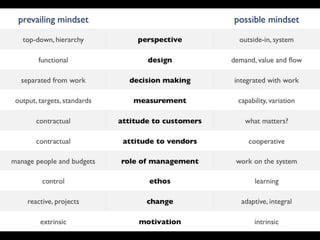
  • #16 We can clearly see how our traditional organisations are structured, under the prevailing mindset. Lets look at left column for a moment. Would something like that help resolve Smiths challenge to government? This is taken from Seddon - the right hand side is Command and Control, the left hand side is attributed to Systems Thinking.
  • #17 Congratulations! You are agile. You do not need your process or procedures anymore! We are all going to continuously improve all of the time! You are all Scrum Masters, or SPCs, or ScrumXP, or LeadingSAFE Certified! We can all focus on the big picture! Thank you! I am outta here!
  • #18 Active Listening. DON’T MENTION AGILE
  • #19 Value Stream Mapping is both a joyful and confronting experience (for managers). While it may have some up front planning, the entire visualisation including interviews should take no more than a day. Tackle the flow of the work items first - and then come back again for the data. Explain Picture. %Complete and Accurate.
  • #20 When conducting the interviews, people will offer up a lot more than just process steps and data. People will think back, and describe the reality of the past interaction. Actively listen, empathise, take time to explore what they are saying above and beyond the value stream. Project Management Infinite Loop.
  • #21 The weirdest sensation I have experienced was receiving plaudits for basically counting the number of projects this organisation was working on. I had actually done nothing, other than listen and play back what they had told me. Presenting their system, letting them see it, and giving them permission to lose faith in it is infinitely rewarding.
  • #22 Unlearning from Gary Klein. We want to encourage our people not to throw away their mental models, but to develop richer ones. Tread carefully and find the tipping point in every individual. Asking the question “What evidence would it take to change your mind” can take people aback, but can work wonders. Look for fixation.