135487 - RUGVED PATIL (2015080005)
135493 - SHAILESH PANCHAL (2015080016)
135495 - DHIRAJ PATIL (2015080018)
GUIDE : PROF.PRIYANKA LAVATE
CONTENTS
01 INTRODUCTION
02 MANUFACTURING OF EPS
03 NEED OF STUDY
04 OBJECTIVES
05 LITERATURE REVIEW
06 METHODOLOGY
07 REFERENCE
08 SCHEDULE
INTRODUCTION
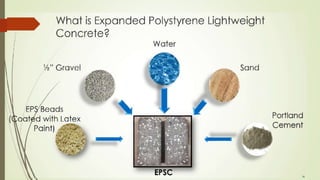
• Lightweight concrete can be defined as a type of concrete
which includes an expanding agent in that it increases the
volume of the mixture while giving additional qualities such as
nailbility and lessened the dead weight. It is lighter than the
conventional concrete.
• The present investigation aims in the study of properties of concrete
in which Styrofoam is used as a partial and full replacement for
natural sand.
• The basic strength properties of concrete were investigated replacing
fine aggregate by EPS.
MANUFACTURING OF EPS
• Raw beads are expanded using steam CURUL in large bags
before being convert in mould.
• Once in the mould the pre-puff beads are again steam to form a
block
• The blocks are then place on the storage floor to aged for the
appropriate length for before being cut it into various shapes and
sizes .
• Blocks are produced of several densities to meet specific project
needs.
EPS BLOCKS
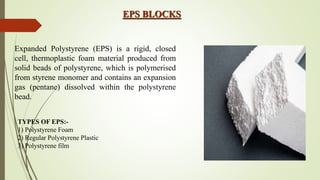
Expanded Polystyrene (EPS) is a rigid, closed
cell, thermoplastic foam material produced from
solid beads of polystyrene, which is polymerised
from styrene monomer and contains an expansion
gas (pentane) dissolved within the polystyrene
bead.
TYPES OF EPS:-
1) Polystyrene Foam
2) Regular Polystyrene Plastic
3) Polystyrene film
NEED OF STUDY
Long-term performance
• The long-term performance is one of the most concerning issues
when introducing EPS beads in concrete materials.
Recycle EPS waste
• Recently, many studies have been developed using the EPS waste
recycled back into concretes with the aim of reducing
environmental impacts
Challenges against current global environmental
concerns
• The performance of the utilizing cement systems containing EPS
beads is extensively studied and reported.
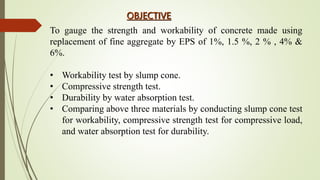
OBJECTIVE
To gauge the strength and workability of concrete made using
replacement of fine aggregate by EPS of 1%, 1.5 %, 2 % , 4% &
6%.
• Workability test by slump cone.
• Compressive strength test.
• Durability by water absorption test.
• Comparing above three materials by conducting slump cone test
for workability, compressive strength test for compressive load,
and water absorption test for durability.
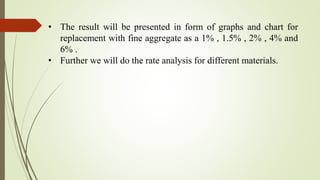
• The result will be presented in form of graphs and chart for
replacement with fine aggregate as a 1% , 1.5% , 2% , 4% and
6% .
• Further we will do the rate analysis for different materials.
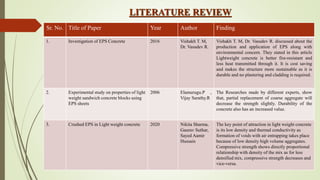
LITERATURE REVIEW
Sr. No. Title of Paper Year Author Finding
1. Investigation of EPS Concrete 2016 Vishakh T. M,
Dr. Vasudev R.
Vishakh T. M, Dr. Vasudev R. discussed about the
production and application of EPS along with
environmental concern. They stated in this article
Lightweight concrete is better fire-resistant and
less heat transmitted through it. It is cost saving
and makes the structure more sustainable as it is
durable and no plastering and cladding is required.
2. Experimental study on properties of light
weight sandwich concrete blocks using
EPS sheets
2006 Elamurugu.P ,
Vijay Sarathy.R
The Researches made by different experts, show
that, partial replacement of coarse aggregate will
decrease the strength slightly. Durability of the
concrete also has an increased value.
3. Crushed EPS in Light weight concrete 2020 Nikita Sharma,
Gaurav Suthar,
Sayed Aamir
Hussain
The key point of attraction in light weight concrete
is its low density and thermal conductivity as
formation of voids with air entrapping takes place
because of low density high volume aggregates.
Compressive strength shows directly proportional
relationship with density of the mix as for less
densified mix, compressive strength decreases and
vice-versa.
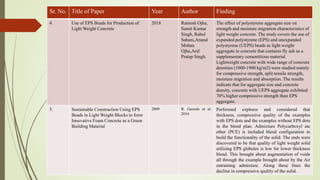
Sr. No. Title of Paper Year Author Finding
4. Use of EPS Beads for Production of
Light Weight Concrete
2018 Ratnesh Ojha,
Sumit Kumar
Singh, Rahul
Sahani,Anand
Mohan
Ojha,Anil
Pratap Singh.
The effect of polystyrene aggregate size on
strength and moisture migration characteristics of
light weight concrete. The study covers the use of
expanded polystyrene (EPS) and unexpanded
polystyrene (UEPS) beads as light weight
aggregate in concrete that contains fly ash as a
supplementary cementitious material.
Lightweight concrete with wide range of concrete
densities (1000-1900 kg/m3) were studied mainly
for compressive strength, split tensile strength,
moisture migration and absorption. The results
indicate that for aggregate size and concrete
density, concrete with UEPS aggregate exhibited
70% higher compressive strength than EPS
aggregate.
5. Sustainable Construction Using EPS
Beads in Light Weight Blocks to form
Innovative Foam Concrete as a Green
Building Material
2009 R. Gawale et al.
2016
Performed explores and considered that
thickness, compressive quality of the examples
with EPS dots and the examples without EPS dots
in the blend plan. Admixture Polycarboxyl ate
ether (PCE) is included blend configuration to
build the functionality of the solid. The ends were
discovered to be that quality of light weight solid
utilizing EPS globules is low for lower thickness
blend. This brought about augmentation of voids
all through the example brought about by the Air
entraining admixture. Along these lines the
decline in compressive quality of the solid.
METHODOLOGY
Stage 1: Theoretical Content
A comprehensive literature review is made to understand the
previous efforts, which include the review of textbooks,
periodicals and academic journals, seminar, conference and
research papers.
Stage 2: Main Research
The methods followed to achieve the objectives are:
Assessment on the existing mix design methods and test results
of concrete produced using crushed EPS will be conducted.
The fine aggregate has been replaced by used Crushed EPS
accordingly in the range of 1%, 1.5%, 2%, 4% & 6% by weight for
M-25 grade concrete.
Total 15 cubes will be casted during the project. Test will be
conducted on this cubes and observation will be taken.
Test Conducted on Concrete are :
 Test conducted on fresh concrete:
1.slump cone test- This test is conducted to check the workability of
concrete.
 Test conducted on hardened concrete:
1.compressive strength test: This test was conducted to check the
compressive strength of concrete at 28 days.
The results will be presented in forms of graphs and charts.
Based on the findings conclusions will be made and
recommendations will be suggested.
REFERENCE
1. Elamurugu P, Vijaya Sarathy R, “A Brief Review on GGBFS and Thermocol Concrete”
International Journal on Engineering and Management Research, Volume-6 Issue-5,
September-October 2016
2. Niyogi, S.K. (1973) Bearing strength of concrete – geometric variations. Journal of
structural Division, ASCE. Vol. 99, No. ST7, pp. 1471-1470.
3. LIGHTWEIGHT AGGREGATE CONCRETE USING EXPANDED POLYSTYRENE
BEADS-A REVIEW. (2018b). International Research Journal of Engineering and Technology,
5(11), 924–927. Retrieved from https://www.irjet.net
4.Dr. P. Asha "Experimental study on light weight polystyrene sandwich block for replacement
of brick"- march 2016: vol.4, ISSUE 3 ISSN 2349- 4476.
5.Miled K,K. Sab and R.Le Roy, 2007, „Particle size effect on EPS light weight concrete
compressive strength‟. Mechanics of materials, 39 :222-240.
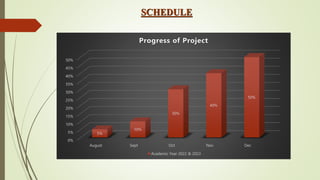
SCHEDULE
0%
5%
10%
15%
20%
25%
30%
35%
40%
45%
50%
August Sept Oct Nov Dec
5%
10%
30%
40%
50%
Progress of Project
Academic Year 2022 & 2023
Thank you!

CPP - Project'22-23 Final.pptx

  • 1.
    135487 - RUGVEDPATIL (2015080005) 135493 - SHAILESH PANCHAL (2015080016) 135495 - DHIRAJ PATIL (2015080018) GUIDE : PROF.PRIYANKA LAVATE
  • 2.
    CONTENTS 01 INTRODUCTION 02 MANUFACTURINGOF EPS 03 NEED OF STUDY 04 OBJECTIVES 05 LITERATURE REVIEW 06 METHODOLOGY 07 REFERENCE 08 SCHEDULE
  • 3.
    INTRODUCTION • Lightweight concretecan be defined as a type of concrete which includes an expanding agent in that it increases the volume of the mixture while giving additional qualities such as nailbility and lessened the dead weight. It is lighter than the conventional concrete. • The present investigation aims in the study of properties of concrete in which Styrofoam is used as a partial and full replacement for natural sand. • The basic strength properties of concrete were investigated replacing fine aggregate by EPS.
  • 4.
    MANUFACTURING OF EPS •Raw beads are expanded using steam CURUL in large bags before being convert in mould. • Once in the mould the pre-puff beads are again steam to form a block • The blocks are then place on the storage floor to aged for the appropriate length for before being cut it into various shapes and sizes . • Blocks are produced of several densities to meet specific project needs.
  • 5.
    EPS BLOCKS Expanded Polystyrene(EPS) is a rigid, closed cell, thermoplastic foam material produced from solid beads of polystyrene, which is polymerised from styrene monomer and contains an expansion gas (pentane) dissolved within the polystyrene bead. TYPES OF EPS:- 1) Polystyrene Foam 2) Regular Polystyrene Plastic 3) Polystyrene film
  • 7.
    NEED OF STUDY Long-termperformance • The long-term performance is one of the most concerning issues when introducing EPS beads in concrete materials. Recycle EPS waste • Recently, many studies have been developed using the EPS waste recycled back into concretes with the aim of reducing environmental impacts Challenges against current global environmental concerns • The performance of the utilizing cement systems containing EPS beads is extensively studied and reported.
  • 8.
    OBJECTIVE To gauge thestrength and workability of concrete made using replacement of fine aggregate by EPS of 1%, 1.5 %, 2 % , 4% & 6%. • Workability test by slump cone. • Compressive strength test. • Durability by water absorption test. • Comparing above three materials by conducting slump cone test for workability, compressive strength test for compressive load, and water absorption test for durability.
  • 9.
    • The resultwill be presented in form of graphs and chart for replacement with fine aggregate as a 1% , 1.5% , 2% , 4% and 6% . • Further we will do the rate analysis for different materials.
  • 10.
    LITERATURE REVIEW Sr. No.Title of Paper Year Author Finding 1. Investigation of EPS Concrete 2016 Vishakh T. M, Dr. Vasudev R. Vishakh T. M, Dr. Vasudev R. discussed about the production and application of EPS along with environmental concern. They stated in this article Lightweight concrete is better fire-resistant and less heat transmitted through it. It is cost saving and makes the structure more sustainable as it is durable and no plastering and cladding is required. 2. Experimental study on properties of light weight sandwich concrete blocks using EPS sheets 2006 Elamurugu.P , Vijay Sarathy.R The Researches made by different experts, show that, partial replacement of coarse aggregate will decrease the strength slightly. Durability of the concrete also has an increased value. 3. Crushed EPS in Light weight concrete 2020 Nikita Sharma, Gaurav Suthar, Sayed Aamir Hussain The key point of attraction in light weight concrete is its low density and thermal conductivity as formation of voids with air entrapping takes place because of low density high volume aggregates. Compressive strength shows directly proportional relationship with density of the mix as for less densified mix, compressive strength decreases and vice-versa.
  • 11.
    Sr. No. Titleof Paper Year Author Finding 4. Use of EPS Beads for Production of Light Weight Concrete 2018 Ratnesh Ojha, Sumit Kumar Singh, Rahul Sahani,Anand Mohan Ojha,Anil Pratap Singh. The effect of polystyrene aggregate size on strength and moisture migration characteristics of light weight concrete. The study covers the use of expanded polystyrene (EPS) and unexpanded polystyrene (UEPS) beads as light weight aggregate in concrete that contains fly ash as a supplementary cementitious material. Lightweight concrete with wide range of concrete densities (1000-1900 kg/m3) were studied mainly for compressive strength, split tensile strength, moisture migration and absorption. The results indicate that for aggregate size and concrete density, concrete with UEPS aggregate exhibited 70% higher compressive strength than EPS aggregate. 5. Sustainable Construction Using EPS Beads in Light Weight Blocks to form Innovative Foam Concrete as a Green Building Material 2009 R. Gawale et al. 2016 Performed explores and considered that thickness, compressive quality of the examples with EPS dots and the examples without EPS dots in the blend plan. Admixture Polycarboxyl ate ether (PCE) is included blend configuration to build the functionality of the solid. The ends were discovered to be that quality of light weight solid utilizing EPS globules is low for lower thickness blend. This brought about augmentation of voids all through the example brought about by the Air entraining admixture. Along these lines the decline in compressive quality of the solid.
  • 12.
    METHODOLOGY Stage 1: TheoreticalContent A comprehensive literature review is made to understand the previous efforts, which include the review of textbooks, periodicals and academic journals, seminar, conference and research papers. Stage 2: Main Research The methods followed to achieve the objectives are: Assessment on the existing mix design methods and test results of concrete produced using crushed EPS will be conducted.
  • 13.
    The fine aggregatehas been replaced by used Crushed EPS accordingly in the range of 1%, 1.5%, 2%, 4% & 6% by weight for M-25 grade concrete. Total 15 cubes will be casted during the project. Test will be conducted on this cubes and observation will be taken. Test Conducted on Concrete are :  Test conducted on fresh concrete: 1.slump cone test- This test is conducted to check the workability of concrete.  Test conducted on hardened concrete: 1.compressive strength test: This test was conducted to check the compressive strength of concrete at 28 days.
  • 14.
    The results willbe presented in forms of graphs and charts. Based on the findings conclusions will be made and recommendations will be suggested.
  • 15.
    REFERENCE 1. Elamurugu P,Vijaya Sarathy R, “A Brief Review on GGBFS and Thermocol Concrete” International Journal on Engineering and Management Research, Volume-6 Issue-5, September-October 2016 2. Niyogi, S.K. (1973) Bearing strength of concrete – geometric variations. Journal of structural Division, ASCE. Vol. 99, No. ST7, pp. 1471-1470. 3. LIGHTWEIGHT AGGREGATE CONCRETE USING EXPANDED POLYSTYRENE BEADS-A REVIEW. (2018b). International Research Journal of Engineering and Technology, 5(11), 924–927. Retrieved from https://www.irjet.net 4.Dr. P. Asha "Experimental study on light weight polystyrene sandwich block for replacement of brick"- march 2016: vol.4, ISSUE 3 ISSN 2349- 4476. 5.Miled K,K. Sab and R.Le Roy, 2007, „Particle size effect on EPS light weight concrete compressive strength‟. Mechanics of materials, 39 :222-240.
  • 16.
    SCHEDULE 0% 5% 10% 15% 20% 25% 30% 35% 40% 45% 50% August Sept OctNov Dec 5% 10% 30% 40% 50% Progress of Project Academic Year 2022 & 2023
  • 17.