Chapter 8 Muscular Flexibility Benefits of Good Flexibility Factors Affecting Flexibility Assessment of Flexibility Evaluating Body Posture Muscular Flexibility Prescription Contraindicated Exercises Preventing and Rehabilitating Low-Back Pain CHAPTER OUTLINE
Key Terms ________________:  The ability of a joint to move freely through its full range of motion ________________:  Moving the joints beyond the accustomed range of motion ________________:  Permanent lengthening of soft tissue ________________:  Temporary lengthening of soft tissue Benefits of Good Flexibility Factors Affecting Flexibility Assessment of Flexibility Evaluating Body Posture Muscular Flexibility Prescription Contraindicated Exercises Preventing and Rehabilitating Low-Back Pain
Benefits of Adequate Flexibility Promotes healthy muscles and joints Improves elasticity of muscles and connective tissue around joints, enhancing freedom of movement Makes activities of daily living (turning, lifting, and bending) easier to perform Helps prevent low-back and other spinal column problems Benefits of Good Flexibility Factors Affecting Flexibility Assessment of Flexibility Evaluating Body Posture Muscular Flexibility Prescription Contraindicated Exercises Preventing and Rehabilitating Low-Back Pain
Benefits of Adequate Flexibility Improves and maintains good postural alignment Promotes proper and graceful body movement Improves personal appearance and self-image Helps develop and maintain motor skills throughout life Benefits of Good Flexibility Factors Affecting Flexibility Assessment of Flexibility Evaluating Body Posture Muscular Flexibility Prescription Contraindicated Exercises Preventing and Rehabilitating Low-Back Pain
Benefits of Adequate Flexibility Flexibility exercises have been prescribed successfully to treat 1. 2. 3. Benefits of Good Flexibility Factors Affecting Flexibility Assessment of Flexibility Evaluating Body Posture Muscular Flexibility Prescription Contraindicated Exercises Preventing and Rehabilitating Low-Back Pain
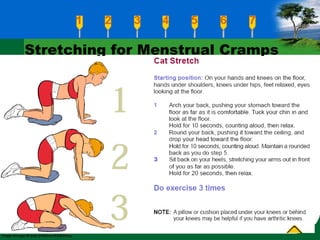
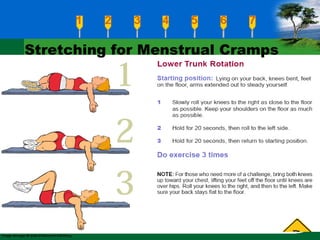
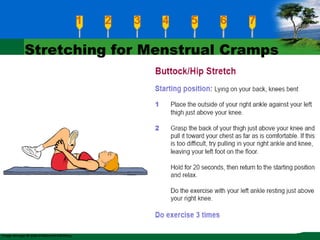
Stretching for Menstrual Cramps
Factors Affecting Flexibility Genetics  P hysical activity Joint structure Ligaments Tendons Muscles Skin Tissue injury Adipose tissue (fat) Body temperature Age Gender Benefits of Good Flexibility Factors Affecting Flexibility Assessment of Flexibility Evaluating Body Posture Muscular Flexibility Prescription Contraindicated Exercises Preventing and Rehabilitating Low-Back Pain
Muscle Flexibility Flexibility is joint specific Women are more flexible than men Decrements are primarily related to physical inactivity Aging decreases joint range of motion Benefits of Good Flexibility Factors Affecting Flexibility Assessment of Flexibility Evaluating Body Posture Muscular Flexibility Prescription Contraindicated Exercises Preventing and Rehabilitating Low-Back Pain
Flexibility Fitness Tests Modified sit-and-reach test Total body rotation test Shoulder rotation test Benefits of Good Flexibility Factors Affecting Flexibility Assessment of Flexibility Evaluating Body Posture Muscular Flexibility Prescription Contraindicated Exercises Preventing and Rehabilitating Low-Back Pain
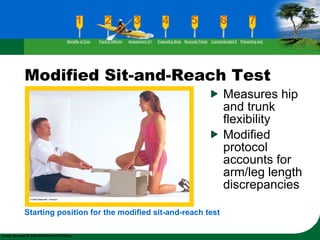
Modified Sit-and-Reach Test Measures hip and trunk flexibility Modified protocol accounts for arm/leg length discrepancies Starting position for the modified sit-and-reach test Benefits of Good Flexibility Factors Affecting Flexibility Assessment of Flexibility Evaluating Body Posture Muscular Flexibility Prescription Contraindicated Exercises Preventing and Rehabilitating Low-Back Pain
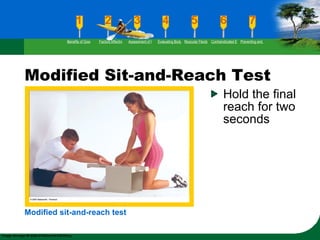
Modified Sit-and-Reach Test Hold the final reach for two seconds Modified sit-and-reach test Benefits of Good Flexibility Factors Affecting Flexibility Assessment of Flexibility Evaluating Body Posture Muscular Flexibility Prescription Contraindicated Exercises Preventing and Rehabilitating Low-Back Pain
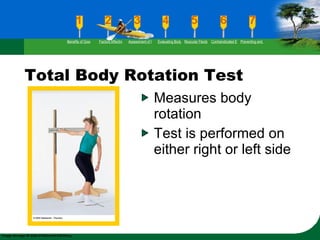
Total Body Rotation Test Measures body rotation Test is performed on either right or left side Benefits of Good Flexibility Factors Affecting Flexibility Assessment of Flexibility Evaluating Body Posture Muscular Flexibility Prescription Contraindicated Exercises Preventing and Rehabilitating Low-Back Pain
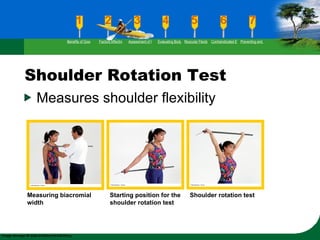
Shoulder Rotation Test Measures shoulder flexibility Measuring biacromial width Starting position for the shoulder rotation test Shoulder rotation test Benefits of Good Flexibility Factors Affecting Flexibility Assessment of Flexibility Evaluating Body Posture Muscular Flexibility Prescription Contraindicated Exercises Preventing and Rehabilitating Low-Back Pain
Critical Thinking Carefully consider the relevance of stretching exercises to your personal fitness program throughout the years. How much importance do you place on these exercises? Have some conditions improved through your stretching program, or have particular exercises contributed to your health and well-being? Benefits of Good Flexibility Factors Affecting Flexibility Assessment of Flexibility Evaluating Body Posture Muscular Flexibility Prescription Contraindicated Exercises Preventing and Rehabilitating Low-Back Pain
Key Terms _____________________________:  Exercises done with jerky, rapid, bouncy movements _____________________________:  Exercises in which the muscles are lengthened gradually through a joint’s complete range of motion _____________________________________:  Stretching technique in which muscles are stretched out sequentially with intermittent isometric contractions Benefits of Good Flexibility Factors Affecting Flexibility Assessment of Flexibility Evaluating Body Posture Muscular Flexibility Prescription Contraindicated Exercises Preventing and Rehabilitating Low-Back Pain
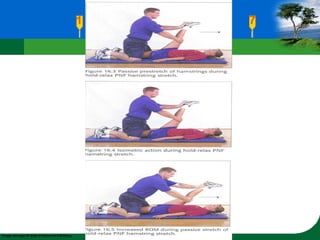
Stretching Techniques Static stretching  Each muscle is gradually stretched and held for 10-*30* seconds  Ballistic stretching  1.  Sudden stretching in a bouncing movement 2. 3.  Could benefit if ____________________________________ Proprioceptive neuromuscular facilitation (PNF)  Muscle is contracted, then stretched Causes soreness, requires partner
 
Guidelines for Developing Flexibility Mode Static or dynamic to include every major joint Intensity To the point of _________________ Repetitions At least 4 times Hold the final stretched position for __________ seconds Frequency  _____ days per week Benefits of Good Flexibility Factors Affecting Flexibility Assessment of Flexibility Evaluating Body Posture Muscular Flexibility Prescription Contraindicated Exercises Preventing and Rehabilitating Low-Back Pain
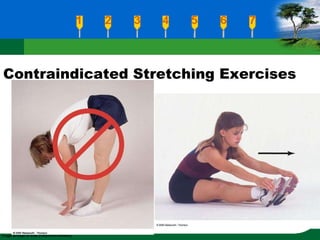
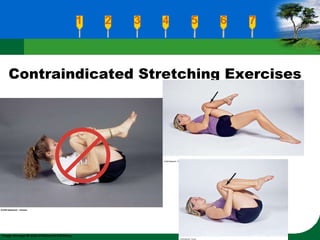
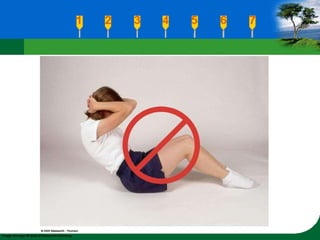
Contraindicated Exercises Most strength and flexibility exercises are relatively safe to perform Some exercises (contraindicated) can be hazardous if performed incorrectly Contraindicated exercises may cause harm because of excessive strain on muscles and joints; in particular the spine, lower back, knees, neck, or shoulders A list of contraindicated exercises are provided in  the textbook Benefits of Good Flexibility Factors Affecting Flexibility Assessment of Flexibility Evaluating Body Posture Muscular Flexibility Prescription Contraindicated Exercises Preventing and Rehabilitating Low-Back Pain
Contraindicated Stretching Exercises
 
Low-Back Pain About 75 million Americans suffer from chronic low-back pain Caused by 1. 2. 3. Benefits of Good Flexibility Factors Affecting Flexibility Assessment of Flexibility Evaluating Body Posture Muscular Flexibility Prescription Contraindicated Exercises Preventing and Rehabilitating Low-Back Pain
Critical Thinking Consider your own low-back health. Have you ever experienced episodes of low-back pain? If so, how long did it take you to recover, and what helped you recover from this condition? Benefits of Good Flexibility Factors Affecting Flexibility Assessment of Flexibility Evaluating Body Posture Muscular Flexibility Prescription Contraindicated Exercises Preventing and Rehabilitating Low-Back Pain
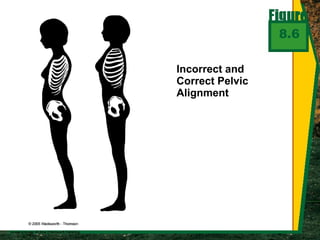
Incorrect and Correct Pelvic Alignment 8.6
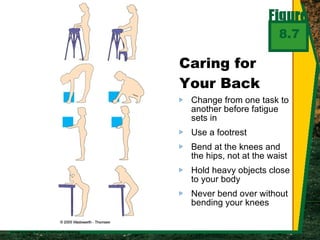
Change from one task to another before fatigue sets in Use a footrest Bend at the knees and the hips, not at the waist Hold heavy objects close to your body Never bend over without bending your knees Caring for Your Back 8.7
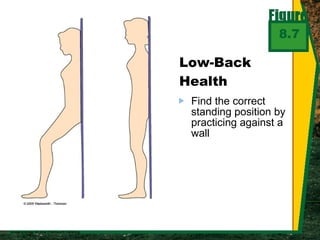
Find the correct standing position by practicing against a wall Low-Back Health 8.7
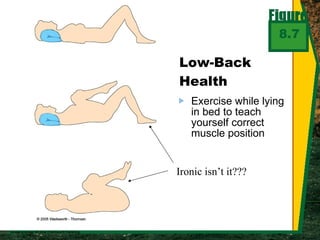
Exercise while lying in bed to teach yourself correct muscle position Low-Back Health 8.7 Ironic isn’t it???
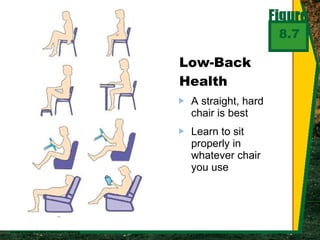
A straight, hard chair is best Learn to sit properly in whatever chair you use Low-Back Health 8.7
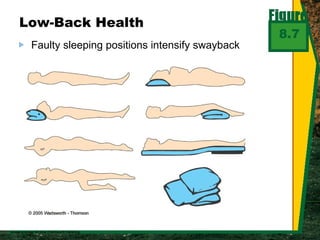
Faulty sleeping positions intensify swayback Low-Back Health 8.7
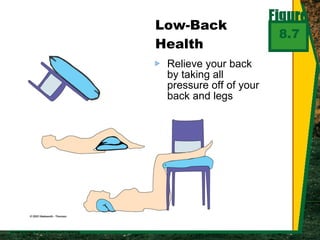
Relieve your back by taking all pressure off of your back and legs Low-Back Health 8.7
Tips to Prevent Low-Back Pain Be physically active Stretch often using spinal exercises through a functional range of motion Regularly strengthen the core of the body  Lift heavy objects by bending at the knees and carrying them close to the body Benefits of Good Flexibility Factors Affecting Flexibility Assessment of Flexibility Evaluating Body Posture Muscular Flexibility Prescription Contraindicated Exercises Preventing and Rehabilitating Low-Back Pain
Tips to Prevent Low-Back Pain Avoid sitting (over 50 minutes) or standing in one position for lengthy periods of time Maintain correct posture Sleep on your back with a pillow under the knees or sideways with the knees drawn up and a small pillow between the knees Benefits of Good Flexibility Factors Affecting Flexibility Assessment of Flexibility Evaluating Body Posture Muscular Flexibility Prescription Contraindicated Exercises Preventing and Rehabilitating Low-Back Pain
Tips to Prevent Low-Back Pain Try out different mattresses of firm consistency before selecting a mattress Sleep Number Bed??? Warm up properly using mild stretches before engaging in physical activity Practice adequate stress management techniques Benefits of Good Flexibility Factors Affecting Flexibility Assessment of Flexibility Evaluating Body Posture Muscular Flexibility Prescription Contraindicated Exercises Preventing and Rehabilitating Low-Back Pain
End of Chapter

Flexibility Exercise

  • 1.
    Chapter 8 MuscularFlexibility Benefits of Good Flexibility Factors Affecting Flexibility Assessment of Flexibility Evaluating Body Posture Muscular Flexibility Prescription Contraindicated Exercises Preventing and Rehabilitating Low-Back Pain CHAPTER OUTLINE
  • 2.
    Key Terms ________________: The ability of a joint to move freely through its full range of motion ________________: Moving the joints beyond the accustomed range of motion ________________: Permanent lengthening of soft tissue ________________: Temporary lengthening of soft tissue Benefits of Good Flexibility Factors Affecting Flexibility Assessment of Flexibility Evaluating Body Posture Muscular Flexibility Prescription Contraindicated Exercises Preventing and Rehabilitating Low-Back Pain
  • 3.
    Benefits of AdequateFlexibility Promotes healthy muscles and joints Improves elasticity of muscles and connective tissue around joints, enhancing freedom of movement Makes activities of daily living (turning, lifting, and bending) easier to perform Helps prevent low-back and other spinal column problems Benefits of Good Flexibility Factors Affecting Flexibility Assessment of Flexibility Evaluating Body Posture Muscular Flexibility Prescription Contraindicated Exercises Preventing and Rehabilitating Low-Back Pain
  • 4.
    Benefits of AdequateFlexibility Improves and maintains good postural alignment Promotes proper and graceful body movement Improves personal appearance and self-image Helps develop and maintain motor skills throughout life Benefits of Good Flexibility Factors Affecting Flexibility Assessment of Flexibility Evaluating Body Posture Muscular Flexibility Prescription Contraindicated Exercises Preventing and Rehabilitating Low-Back Pain
  • 5.
    Benefits of AdequateFlexibility Flexibility exercises have been prescribed successfully to treat 1. 2. 3. Benefits of Good Flexibility Factors Affecting Flexibility Assessment of Flexibility Evaluating Body Posture Muscular Flexibility Prescription Contraindicated Exercises Preventing and Rehabilitating Low-Back Pain
  • 6.
  • 7.
  • 8.
  • 9.
    Factors Affecting FlexibilityGenetics P hysical activity Joint structure Ligaments Tendons Muscles Skin Tissue injury Adipose tissue (fat) Body temperature Age Gender Benefits of Good Flexibility Factors Affecting Flexibility Assessment of Flexibility Evaluating Body Posture Muscular Flexibility Prescription Contraindicated Exercises Preventing and Rehabilitating Low-Back Pain
  • 10.
    Muscle Flexibility Flexibilityis joint specific Women are more flexible than men Decrements are primarily related to physical inactivity Aging decreases joint range of motion Benefits of Good Flexibility Factors Affecting Flexibility Assessment of Flexibility Evaluating Body Posture Muscular Flexibility Prescription Contraindicated Exercises Preventing and Rehabilitating Low-Back Pain
  • 11.
    Flexibility Fitness TestsModified sit-and-reach test Total body rotation test Shoulder rotation test Benefits of Good Flexibility Factors Affecting Flexibility Assessment of Flexibility Evaluating Body Posture Muscular Flexibility Prescription Contraindicated Exercises Preventing and Rehabilitating Low-Back Pain
  • 12.
    Modified Sit-and-Reach TestMeasures hip and trunk flexibility Modified protocol accounts for arm/leg length discrepancies Starting position for the modified sit-and-reach test Benefits of Good Flexibility Factors Affecting Flexibility Assessment of Flexibility Evaluating Body Posture Muscular Flexibility Prescription Contraindicated Exercises Preventing and Rehabilitating Low-Back Pain
  • 13.
    Modified Sit-and-Reach TestHold the final reach for two seconds Modified sit-and-reach test Benefits of Good Flexibility Factors Affecting Flexibility Assessment of Flexibility Evaluating Body Posture Muscular Flexibility Prescription Contraindicated Exercises Preventing and Rehabilitating Low-Back Pain
  • 14.
    Total Body RotationTest Measures body rotation Test is performed on either right or left side Benefits of Good Flexibility Factors Affecting Flexibility Assessment of Flexibility Evaluating Body Posture Muscular Flexibility Prescription Contraindicated Exercises Preventing and Rehabilitating Low-Back Pain
  • 15.
    Shoulder Rotation TestMeasures shoulder flexibility Measuring biacromial width Starting position for the shoulder rotation test Shoulder rotation test Benefits of Good Flexibility Factors Affecting Flexibility Assessment of Flexibility Evaluating Body Posture Muscular Flexibility Prescription Contraindicated Exercises Preventing and Rehabilitating Low-Back Pain
  • 16.
    Critical Thinking Carefullyconsider the relevance of stretching exercises to your personal fitness program throughout the years. How much importance do you place on these exercises? Have some conditions improved through your stretching program, or have particular exercises contributed to your health and well-being? Benefits of Good Flexibility Factors Affecting Flexibility Assessment of Flexibility Evaluating Body Posture Muscular Flexibility Prescription Contraindicated Exercises Preventing and Rehabilitating Low-Back Pain
  • 17.
    Key Terms _____________________________: Exercises done with jerky, rapid, bouncy movements _____________________________: Exercises in which the muscles are lengthened gradually through a joint’s complete range of motion _____________________________________: Stretching technique in which muscles are stretched out sequentially with intermittent isometric contractions Benefits of Good Flexibility Factors Affecting Flexibility Assessment of Flexibility Evaluating Body Posture Muscular Flexibility Prescription Contraindicated Exercises Preventing and Rehabilitating Low-Back Pain
  • 18.
    Stretching Techniques Staticstretching Each muscle is gradually stretched and held for 10-*30* seconds Ballistic stretching 1. Sudden stretching in a bouncing movement 2. 3. Could benefit if ____________________________________ Proprioceptive neuromuscular facilitation (PNF) Muscle is contracted, then stretched Causes soreness, requires partner
  • 19.
  • 20.
    Guidelines for DevelopingFlexibility Mode Static or dynamic to include every major joint Intensity To the point of _________________ Repetitions At least 4 times Hold the final stretched position for __________ seconds Frequency _____ days per week Benefits of Good Flexibility Factors Affecting Flexibility Assessment of Flexibility Evaluating Body Posture Muscular Flexibility Prescription Contraindicated Exercises Preventing and Rehabilitating Low-Back Pain
  • 21.
    Contraindicated Exercises Moststrength and flexibility exercises are relatively safe to perform Some exercises (contraindicated) can be hazardous if performed incorrectly Contraindicated exercises may cause harm because of excessive strain on muscles and joints; in particular the spine, lower back, knees, neck, or shoulders A list of contraindicated exercises are provided in the textbook Benefits of Good Flexibility Factors Affecting Flexibility Assessment of Flexibility Evaluating Body Posture Muscular Flexibility Prescription Contraindicated Exercises Preventing and Rehabilitating Low-Back Pain
  • 22.
  • 23.
  • 24.
  • 25.
    Low-Back Pain About75 million Americans suffer from chronic low-back pain Caused by 1. 2. 3. Benefits of Good Flexibility Factors Affecting Flexibility Assessment of Flexibility Evaluating Body Posture Muscular Flexibility Prescription Contraindicated Exercises Preventing and Rehabilitating Low-Back Pain
  • 26.
    Critical Thinking Consideryour own low-back health. Have you ever experienced episodes of low-back pain? If so, how long did it take you to recover, and what helped you recover from this condition? Benefits of Good Flexibility Factors Affecting Flexibility Assessment of Flexibility Evaluating Body Posture Muscular Flexibility Prescription Contraindicated Exercises Preventing and Rehabilitating Low-Back Pain
  • 27.
    Incorrect and CorrectPelvic Alignment 8.6
  • 28.
    Change from onetask to another before fatigue sets in Use a footrest Bend at the knees and the hips, not at the waist Hold heavy objects close to your body Never bend over without bending your knees Caring for Your Back 8.7
  • 29.
    Find the correctstanding position by practicing against a wall Low-Back Health 8.7
  • 30.
    Exercise while lyingin bed to teach yourself correct muscle position Low-Back Health 8.7 Ironic isn’t it???
  • 31.
    A straight, hardchair is best Learn to sit properly in whatever chair you use Low-Back Health 8.7
  • 32.
    Faulty sleeping positionsintensify swayback Low-Back Health 8.7
  • 33.
    Relieve your backby taking all pressure off of your back and legs Low-Back Health 8.7
  • 34.
    Tips to PreventLow-Back Pain Be physically active Stretch often using spinal exercises through a functional range of motion Regularly strengthen the core of the body Lift heavy objects by bending at the knees and carrying them close to the body Benefits of Good Flexibility Factors Affecting Flexibility Assessment of Flexibility Evaluating Body Posture Muscular Flexibility Prescription Contraindicated Exercises Preventing and Rehabilitating Low-Back Pain
  • 35.
    Tips to PreventLow-Back Pain Avoid sitting (over 50 minutes) or standing in one position for lengthy periods of time Maintain correct posture Sleep on your back with a pillow under the knees or sideways with the knees drawn up and a small pillow between the knees Benefits of Good Flexibility Factors Affecting Flexibility Assessment of Flexibility Evaluating Body Posture Muscular Flexibility Prescription Contraindicated Exercises Preventing and Rehabilitating Low-Back Pain
  • 36.
    Tips to PreventLow-Back Pain Try out different mattresses of firm consistency before selecting a mattress Sleep Number Bed??? Warm up properly using mild stretches before engaging in physical activity Practice adequate stress management techniques Benefits of Good Flexibility Factors Affecting Flexibility Assessment of Flexibility Evaluating Body Posture Muscular Flexibility Prescription Contraindicated Exercises Preventing and Rehabilitating Low-Back Pain
  • 37.