Flatbed scanner
by Igor Dmitrievykh
What is it?

•

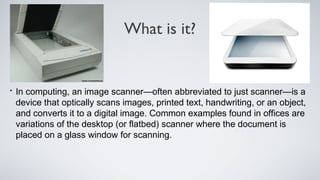
In computing, an image scanner—often abbreviated to just scanner—is a
device that optically scans images, printed text, handwriting, or an object,
and converts it to a digital image. Common examples found in offices are
variations of the desktop (or flatbed) scanner where the document is
placed on a glass window for scanning.
how does it work?
how to judge the quality of a scanner?
•

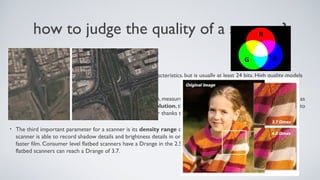
Color depth varies depending on the scanning array characteristics, but is usually at least 24 bits. High quality models
have 36-48 bits of color depth.

•

Another qualifying parameter for a scanner is its resolution, measured in ppi, sometimes more accurately referred to as
Samplespi. Instead of using the scanner's true optical resolution, the only meaningful parameter, manufacturers like to
refer to the interpolated resolution, which is much higher thanks to software interpolation.

•

The third important parameter for a scanner is its density range or Drange. A high density range means that the
scanner is able to record shadow details and brightness details in one scan. Slower film can reach higher density than
faster film. Consumer level flatbed scanners have a Drange in the 2.5-3.0 range, adequate for negative film. High end
flatbed scanners can reach a Drange of 3.7.
are there any problems?

•

Purity can be diminished by scanner noise, optical flare, poor analog to digital conversion, scratches, dust, Newton’s rings, out of focus sensors,
improper scanner operation, and poor software.
so what is out?

•

The scanned result is a non-compressed RGB image, which can be transferred to a computer's memory. Some scanners compress and clean up
the image using embedded firmware. Once on the computer, the image can be processed with a raster graphics program (such as Photoshop or the
GIMP) and saved on a storage device (such as a hard disk).
Thanks for watching,
enjoy your day!
enjoy your day!

Flatbed Scanner

  • 1.
  • 2.
    What is it? • Incomputing, an image scanner—often abbreviated to just scanner—is a device that optically scans images, printed text, handwriting, or an object, and converts it to a digital image. Common examples found in offices are variations of the desktop (or flatbed) scanner where the document is placed on a glass window for scanning.
  • 3.
  • 4.
    how to judgethe quality of a scanner? • Color depth varies depending on the scanning array characteristics, but is usually at least 24 bits. High quality models have 36-48 bits of color depth. • Another qualifying parameter for a scanner is its resolution, measured in ppi, sometimes more accurately referred to as Samplespi. Instead of using the scanner's true optical resolution, the only meaningful parameter, manufacturers like to refer to the interpolated resolution, which is much higher thanks to software interpolation. • The third important parameter for a scanner is its density range or Drange. A high density range means that the scanner is able to record shadow details and brightness details in one scan. Slower film can reach higher density than faster film. Consumer level flatbed scanners have a Drange in the 2.5-3.0 range, adequate for negative film. High end flatbed scanners can reach a Drange of 3.7.
  • 5.
    are there anyproblems? • Purity can be diminished by scanner noise, optical flare, poor analog to digital conversion, scratches, dust, Newton’s rings, out of focus sensors, improper scanner operation, and poor software.
  • 6.
    so what isout? • The scanned result is a non-compressed RGB image, which can be transferred to a computer's memory. Some scanners compress and clean up the image using embedded firmware. Once on the computer, the image can be processed with a raster graphics program (such as Photoshop or the GIMP) and saved on a storage device (such as a hard disk).
  • 7.
    Thanks for watching, enjoyyour day! enjoy your day!

Editor's Notes