Fixed DepositsVs.Fixed Maturity PlansBy:Sri Hasa				SahilMalhotra2010193				2010195
FDsIn an FD, you deposit an amount with the bank for a fixed duration.You earn a fixed rate of interest on this investment. The interest rate is fixed at the time of the investment – even if interest rates change during the tenure of the FD, the interest that you earn on your FD remains fixed. (The interest is not floating)Thus, you invest a fixed amount, for a fixed duration, and earn a fixed interest on it. No wonder, it is called a fixed deposit!A certificate of deposit is a time deposit product
FMPsFixed Maturity Plans are close-ended debt schemes with a maturity horizon varying from one month to five years.Launched with predetermined maturity date; so as the investments are made in such securities which mature at or around the same time as the schemes do. Dividend or growth optionInvestors are not allowed for premature redemption during period and are warranted to stay till maturity.However, premature withdrawals are allowed on the stock exchanges where these units are listed and traded at market prices. However this route is not yet very liquid. The schemes are shut down generally once they get matured.
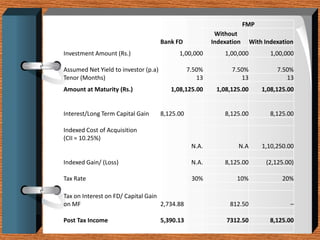
IndexationUnder Indexation, you are allowed by law to inflate thecost of your asset by a government notified inflationfactor.• This factor is called the ‘Cost Inflation Index’, fromwhich the word ‘Indexation’ has been derived.• This inflation index is used to artificially inflate yourasset price.• This helps to counter erosion of value in the price of anasset and brings the value of an asset at par withprevailing market price.• This cost inflation index factor is notified by thegovernment every year. This index gradually increasesevery year due to inflation.
How is cost-inflation indexcomputed? ?• The cost inflation index (CII) is calculated as shown:	Inflation Index for year in which asset is soldCII = --------------------------------------------------------------	Inflation Index for year in which asset was boughtThis index is then multiplied by the cost of the asset toarrive at inflated cost.
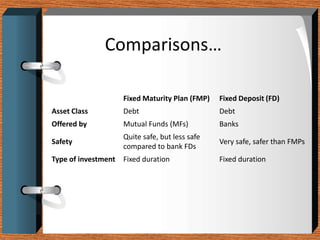
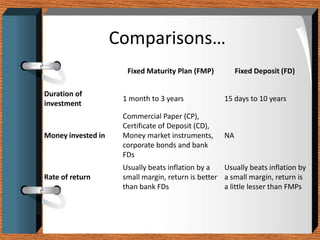
Common featuresThe investors are aware of the returns before hand. Both the instruments carry Credit Risk. However they are been assessed by credit agencies for quality.
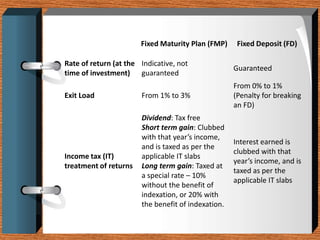
DifferencesFMP highlights Indicative Yield where else FD is assured returns. FMP income, attracts the low rate of Income tax have indexation benefit which makes it more tax efficient.
Comparisons…
Comparisons…
Fixed maturity plans

Fixed maturity plans

  • 1.
    Fixed DepositsVs.Fixed MaturityPlansBy:Sri Hasa SahilMalhotra2010193 2010195
  • 2.
    FDsIn an FD,you deposit an amount with the bank for a fixed duration.You earn a fixed rate of interest on this investment. The interest rate is fixed at the time of the investment – even if interest rates change during the tenure of the FD, the interest that you earn on your FD remains fixed. (The interest is not floating)Thus, you invest a fixed amount, for a fixed duration, and earn a fixed interest on it. No wonder, it is called a fixed deposit!A certificate of deposit is a time deposit product
  • 3.
    FMPsFixed Maturity Plansare close-ended debt schemes with a maturity horizon varying from one month to five years.Launched with predetermined maturity date; so as the investments are made in such securities which mature at or around the same time as the schemes do. Dividend or growth optionInvestors are not allowed for premature redemption during period and are warranted to stay till maturity.However, premature withdrawals are allowed on the stock exchanges where these units are listed and traded at market prices. However this route is not yet very liquid. The schemes are shut down generally once they get matured.
  • 4.
    IndexationUnder Indexation, youare allowed by law to inflate thecost of your asset by a government notified inflationfactor.• This factor is called the ‘Cost Inflation Index’, fromwhich the word ‘Indexation’ has been derived.• This inflation index is used to artificially inflate yourasset price.• This helps to counter erosion of value in the price of anasset and brings the value of an asset at par withprevailing market price.• This cost inflation index factor is notified by thegovernment every year. This index gradually increasesevery year due to inflation.
  • 5.
    How is cost-inflationindexcomputed? ?• The cost inflation index (CII) is calculated as shown: Inflation Index for year in which asset is soldCII = -------------------------------------------------------------- Inflation Index for year in which asset was boughtThis index is then multiplied by the cost of the asset toarrive at inflated cost.
  • 6.
    Common featuresThe investorsare aware of the returns before hand. Both the instruments carry Credit Risk. However they are been assessed by credit agencies for quality.
  • 7.
    DifferencesFMP highlights IndicativeYield where else FD is assured returns. FMP income, attracts the low rate of Income tax have indexation benefit which makes it more tax efficient.
  • 8.
  • 9.

Editor's Notes

  • #8 FMP indicative yield do deviates with less margins and returns on FD is assured, if there is no default by Bank. where else Interest Income on FDs is club to your income and you pay the slab at which your income tax is charges.