Islamic Law and EthicsSlide 1
Five Pillars of Islam
Islamic Law and EthicsSlide 2
Content
• Three dimensions of religion
• The Five Pillars of Islam
1. Shahadah – testifying to creed
2. Salat – offering daily prayers
3. Zakat – paying charity
4. Sawm – fasting in Ramadan
5. Hajj – making pilgrimage
Islamic Law and EthicsSlide 3
Introduction
• The religion of Islam is balanced through three
dimensions – belief, practice and spirituality.
• In Islam, faith is expressed in a diversity of ways to
engage full human faculties.
• The five pillars of Islam provides a Muslim with a
practical framework to cultivate spiritual growth.
• The five pillars range from once in a lifetime action
(pilgrimage) to daily activities (daily ritual prayers)
Islamic Law and EthicsSlide 4
Three Dimensions of Religion
Islamic Law and EthicsSlide 5
Three Dimensions
• Iman – faith dimension
― 6 tenets of Islamic faith
― Mu’min is a believer
• Islam – devotional practice dimension
― 5 pillars of Islam
― Muslim is the one who is on a devotional path to
God
• Ihsan – spiritual excellence dimension
― “Ihsan is to worship God as though you see God;
even if you don’t see God, God sees you”, said
Prophet Muhammad.
― Muhsin is the one who has developed a
personal relationship with God.
Islamic Law and EthicsSlide 6
Expression of Faith
The Five Pillars
Islamic Law and EthicsSlide 7
Expression of Faith
• For a Muslim, it is compulsory to practice the five pillars of
Islam.
• There are important reasons and benefits as to why
Muslims are obliged to practise the five pillars:
― Muslims believe that God has commanded them to practise
the five pillars. They are a symbol of a person’s willing
submission to God.
― The five pillars are acts of worship and have significance for
God and His relationship with humans.
― The five pillars are a spiritual regimen to cultivate spiritual
development.
― They have additional social, mental, spiritual and physical
benefits.
Islamic Law and EthicsSlide 8
Five Pillars in a Snapshot
Pillar in Arabic Pillar in English Fundamental spiritual benefit
1 Shahadah to testify that there is no
deity but God and
Muhammad is the servant
and the messenger of God
Freedom from fear and
incentive based earthly
masters
2 Salat to offer daily ritual prayers Countering distractive
effects of daily affairs
3 Zakat to pay the compulsory
charity
Attachment to possessions
and money
4 Sawm to fast in the month of
Ramadan
Self-restraint against limiting
and destructive inner
impulses
5 Hajj to make pilgrimage to the
House if one is able to do so
Removal of racism and tribal
attitude to religion
Islamic Law and EthicsSlide 9
Shahadah – Testifying to Creed
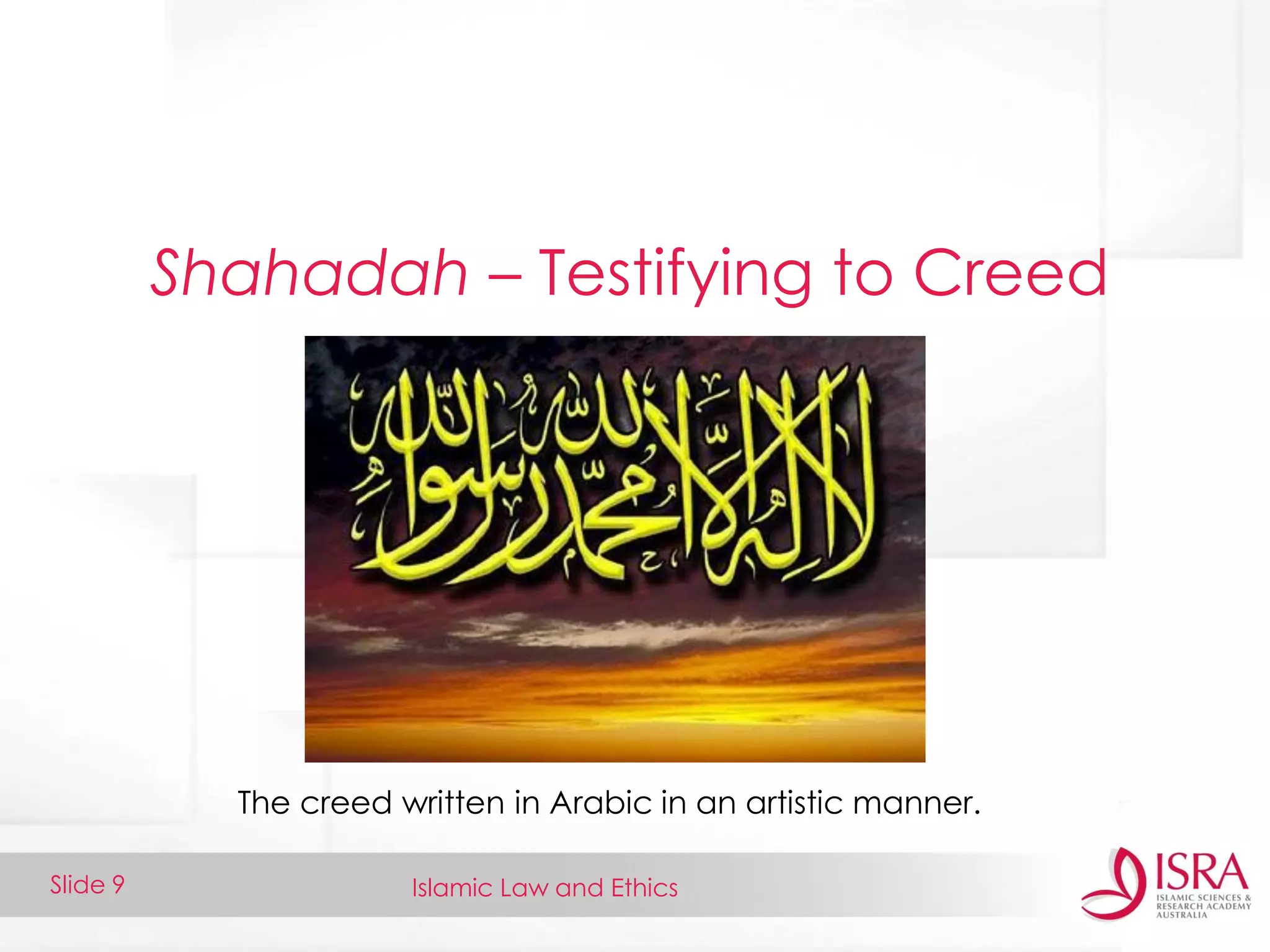
The creed written in Arabic in an artistic manner.
Islamic Law and EthicsSlide 10
Shahadah – Testifying to Creed
• A person becomes a Muslim when he or she utters the
statement of testimony in the presence of witnesses:
― “I bear witness that there is no deity but God and I bear
witness that Muhammad is the messenger and servant of
God”
• This is a public commitment to the path of Islam
― “He is God, there is no deity but He...” (59:23)
― “Muhammad is the messenger of God…” (48:29)
• There is no compulsion is Islam. No one can be forced to
convert to Islam.
― “There is no compulsion in religion…” (2:226)
Islamic Law and EthicsSlide 11
Shahadah – Testifying to Creed
• With the shahadah a person frees himself or herself
from false masters or gods that may exert
disproportionate force upon a person.
― For some their self can be their God
― For others it could be wealth, status or powerful
people,
― For some they may believe that there are more than
one God with supernatural powers
• Islam requires one to reject all such deities and only
submit to one supreme God.
― This gives a person freedom from worldly powers that
may influence him or her with fear or incentive.
Islamic Law and EthicsSlide 12
Salat – Offering Daily Prayers
Islamic Law and EthicsSlide 13
Salat – Daily Prayers
• “Salat is the central pillar of Islam.” – The Prophet
Muhammad
― “Who believe in the Unseen, and perform As-salat
(prayers) and spend out of what We have provided
for them.” (Qur’an, 2:3)
• The word ‘salat’ literally means ‘hot connection’. So,
prayer in Islam is an act of worship that enables the
individual to get close to God through a meditative
state.
• It is a direct and personal communion with God. The
Prophet Muhammad said that a person during prayers is
closest to God at the moment of prostration.
Islamic Law and EthicsSlide 14
Salat – Daily Prayers
• The meaning of worship is:
― “Human, as a servant of God, being aware of his
limitations, weakness and poverty, prostrates himself
in love and wonderment before the perfection of
God’s Compassion, Lordship and Majesty” Said Nursi
(d. 1960)
• The essence of five daily prayers is to glorify, exalt and
praise God with the heart, tongue and body at spaced
intervals throughout the day.
― The prayer is an index involving all forms of worship
― The prayer is an act symbolising submission to God
Islamic Law and EthicsSlide 15
Salat – Daily Prayers
• Salat enables a person to detach from daily affairs and
to remember and connect with God on a daily basis.
• Salat raises human consciousness to an awareness of
being in the presence of God and hence greatly
reduces the chance of committing wrongful acts.
• All enjoined prayers can be performed individually or in
congregation.
― Congregation can be formed anywhere. It does not have
to be in a mosque.
― Rows are formed where shoulders touch each other,
hence building social cohesion and solidarity.
― Hence, men and women form separate rows.
Islamic Law and EthicsSlide 16
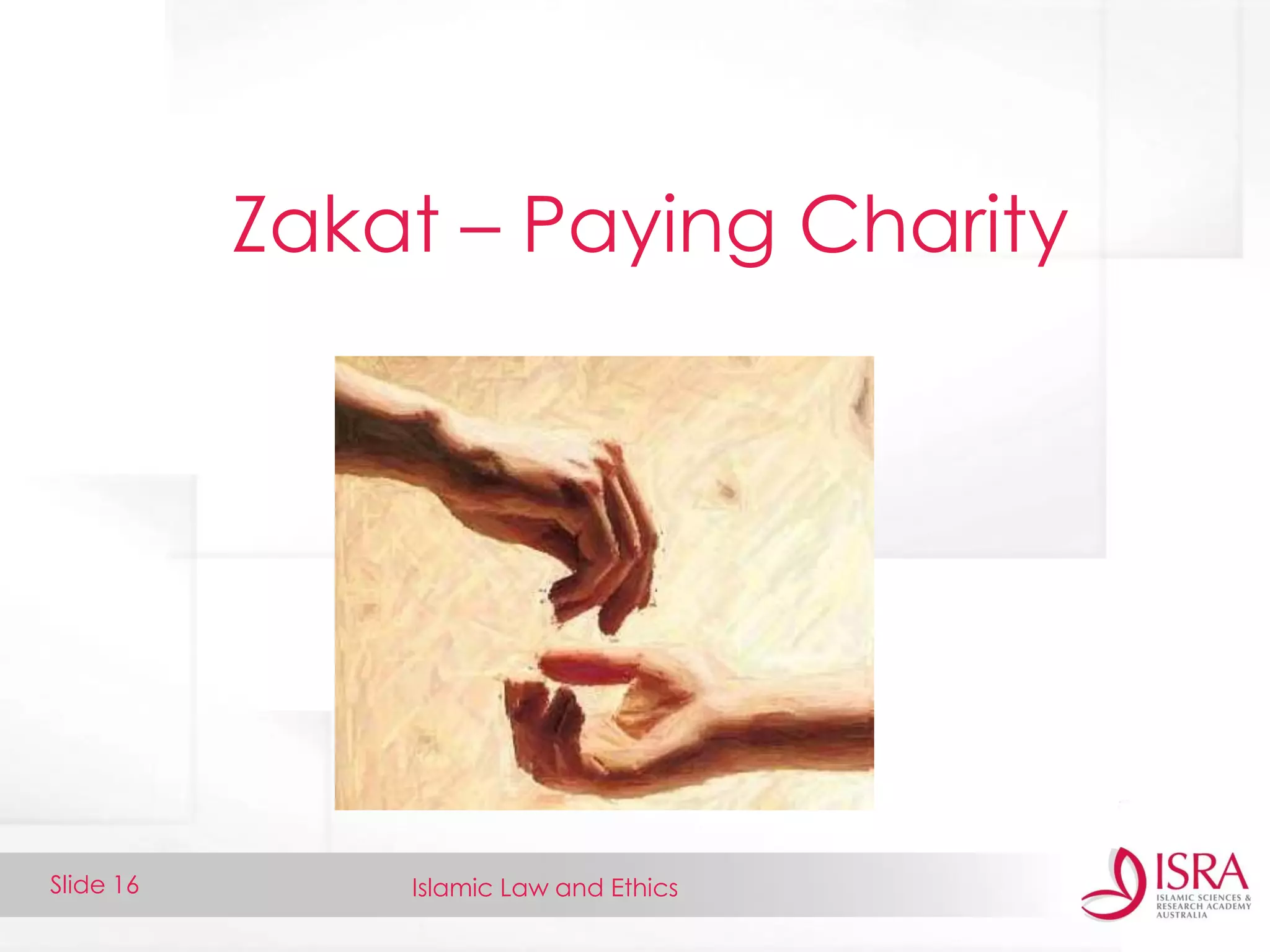
Zakat – Paying Charity
Islamic Law and EthicsSlide 17
Zakat – Paying Charity
• Zakat is the third pillar of Islam.
― “But those among them who are well-grounded
in knowledge, and the believers, believe in what
has been revealed to you and what was
revealed before you: And (especially) those who
establish regular prayer (salat) and practise
regular charity (zakat) and believe in God and
in the Last Day: To them shall We soon give a
great reward. (Qur’an, 4:162)
Islamic Law and EthicsSlide 18
Zakat – Paying Charity
• Muslims are enjoined to give alms, which are called
the purifying alms and considered a right of the
poor rather than being purely charity.
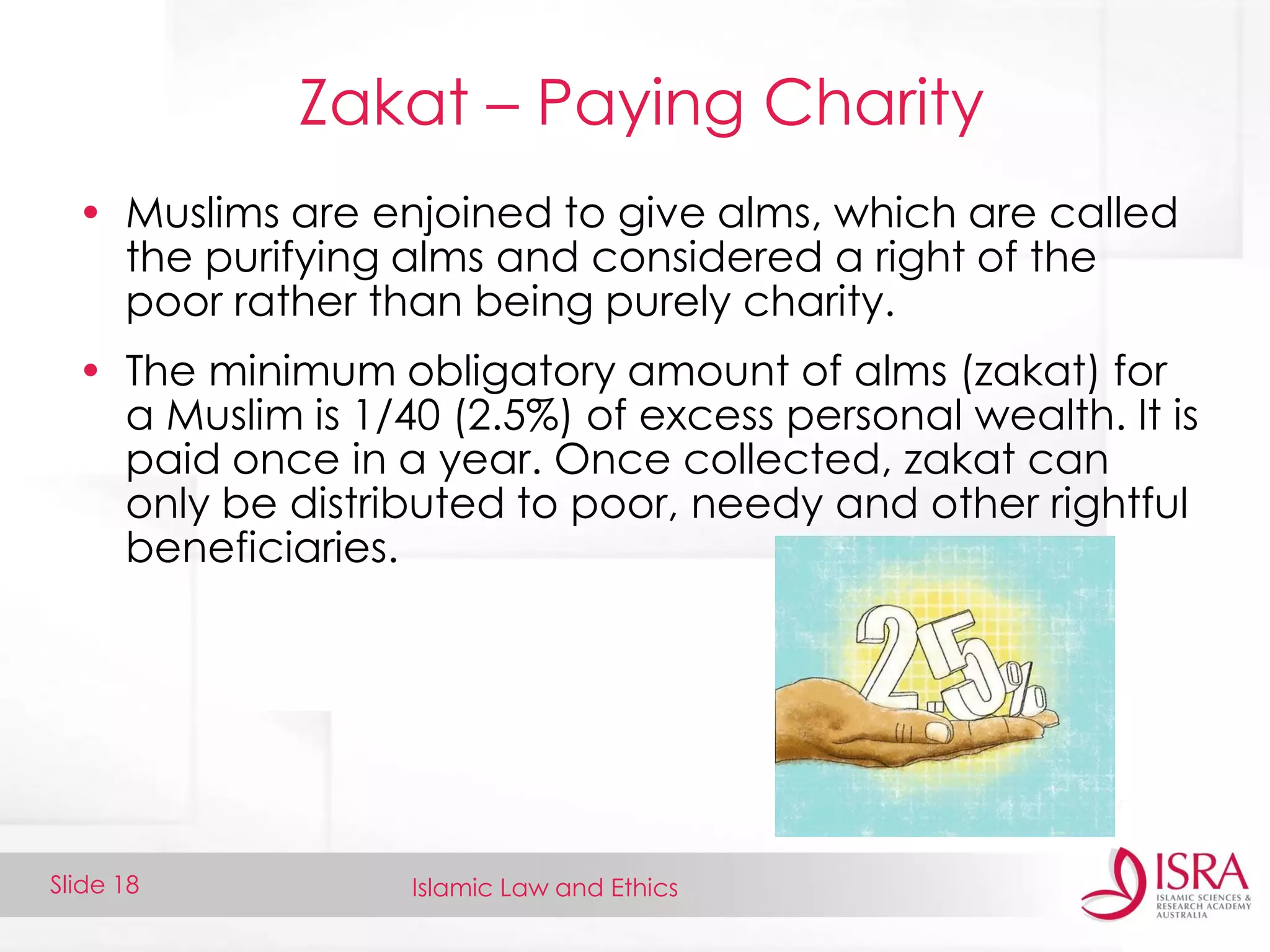
• The minimum obligatory amount of alms (zakat) for
a Muslim is 1/40 (2.5%) of excess personal wealth. It is
paid once in a year. Once collected, zakat can
only be distributed to poor, needy and other rightful
beneficiaries.
Islamic Law and EthicsSlide 19
Zakat – Paying Charity
• By observing the command of God to pay zakat a Muslim
acknowledges that he is not the true owner of the wealth
and that he is only a temporary holder.
• Zakat enables a person to detach from wealth and
possessions removing another impediment in his her
spiritual journey.
• Through zakat a person exhibits her compassion for other
less fortunate people and this in turn develops her sense
of compassion and conscience.
• Zakat deals with the social problem of the ‘don’t care’
attitude of the rich.
• Therefore, zakat bridges the gap between the rich and
the poor.
Islamic Law and EthicsSlide 20
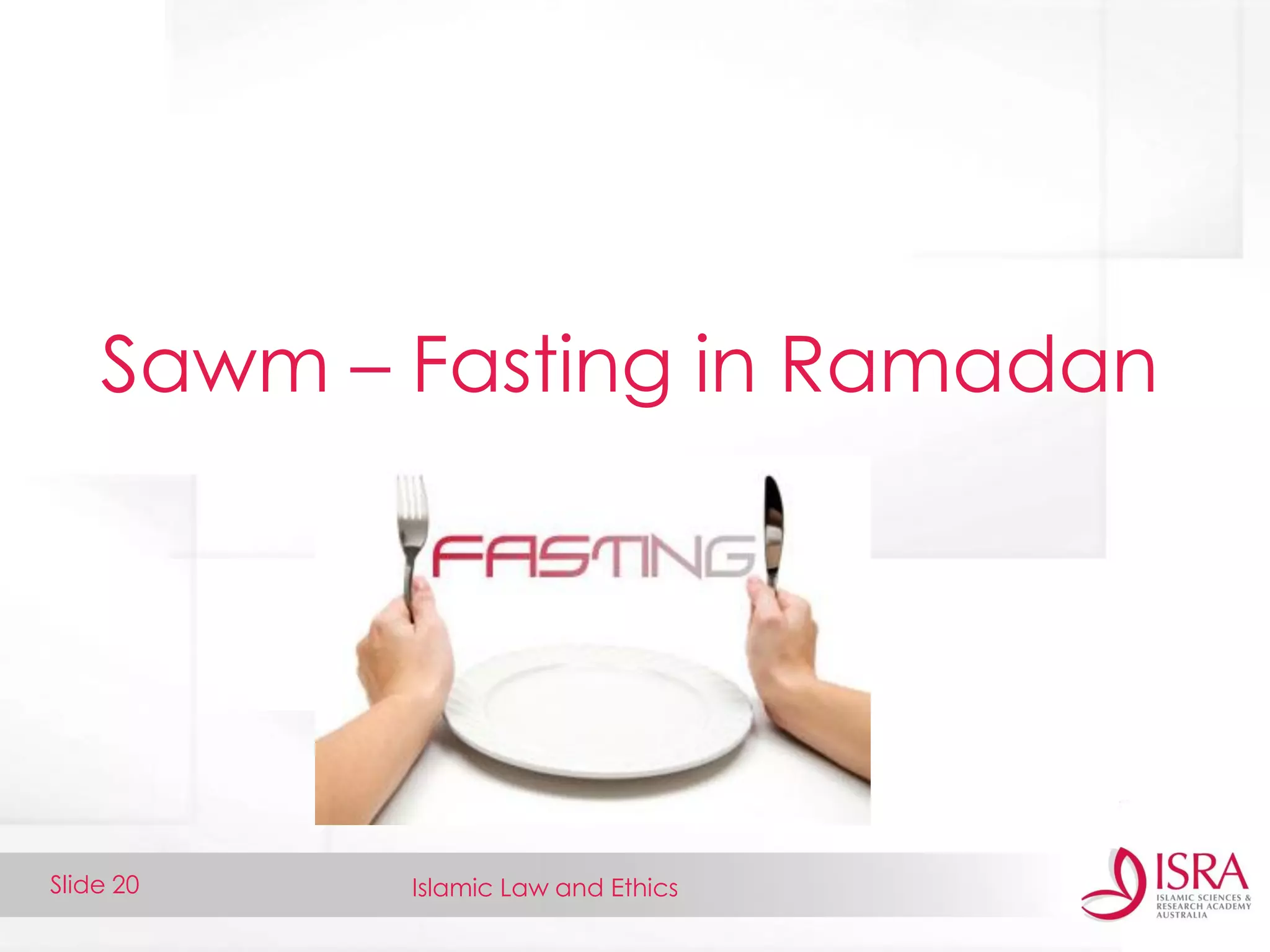
Sawm – Fasting in Ramadan
Islamic Law and EthicsSlide 21
Sawm – Fasting in Ramadan
• Fasting is the fourth pillar of Islam. Muslims are
required to fast for one month is a year over
consecutively days in the lunar month of Ramadan.
― “O you who believe! Fasting is prescribed for you
as it was prescribed for those before you that you
are expected to be truly obedient.” (Qur’an,
2:183)
• From dawn to sunset a practising Muslim abstains
from eating, drinking and sexual relations while
spending time in reflection, doing good deeds and
being careful in one’s conduct.
Islamic Law and EthicsSlide 22
Sawm – Fasting in Ramadan
• At the sunset each day, fasting is broken with a meal
usually with family and friends who compete to invite
one another to break fast with them in groups.
• A fasting Muslim usually wake up before dawn for an
early breakfast.
• Fasting is the best form of true thanksgiving, which is
to know that all sustenance comes directly from God,
to acknowledge its value and to feel our need and
dependence on that sustenance.
Islamic Law and EthicsSlide 23
Sawm – Fasting in Ramadan
• In Ramadan, Muslims usually go to the mosque
every night for a special congregational prayer.
• At the end of the month of Ramadan, there is a
three day festive celebrations (Eid) where Muslims
visit their families and friends.
• By fasting 30 days in a row, one acquires the habit of
controlling one’s inner impulses.
• One month of fasting rests the digestive system and
other related organs, especially the liver.
Islamic Law and EthicsSlide 24
Hajj – Making Pilgrimage
Islamic Law and EthicsSlide 25
Hajj – Pilgrimage
• The fifth pillar of Islam is Hajj (pilgrimage); to visit the
holy lands once in their lifetime. It is obligatory for
all Muslims who are rich and healthy enough to
make the journey.
• Pilgrimage consists of visiting a number of sacred
places, circling the Ka’bah and being present in
the plains of Mt Arafat at a specific time in the
lunar year.
Islamic Law and EthicsSlide 26
Hajj – Pilgrimage
• “Verily, the first house (of worship) appointed for
mankind was that at Bakkah (Mekkah), full of
blessing, and a guidance for His creatures. In it, are
manifest signs, the Station of Abraham; whoever
enters it attains security. And Pilgrimage to the house
(Ka’bah) is a duty mankind owes to God, those who
can afford the journey; but if any deny faith, God
stands not in need of any of His creatures.
(Qur’an, 3:96-97)
Islamic Law and EthicsSlide 27
Hajj – Pilgrimage
• With Pilgrimage, the central aims of worship – exalting,
glorifying and praising God – occur individually and
collectively in large numbers.
• According to Islamic tradition, Mt Arafat is the place
where the first man, Adam and his partner Eve
sincerely repented and received forgiveness for their
mistake.
Islamic Law and EthicsSlide 28
Hajj - Pilgrimage
• Revolving around a central axis is
a universal act of worship Hence
Muslims circle Ka’bah.
― “All that is in the heavens and
on the earth extols and glorifies
God, for He is the Tremendous,
the Wise,” (Qur’an, 57:1)
• Hajj is about connecting to the
monotheistic tradition and to
realise that Islam is not a new
religion but the primordial religion
of God.
Islamic Law and EthicsSlide 29
Hajj – Pilgrimage
• Pilgrimage is a total human experience and has
multiple outcomes for a Muslim.
• A Muslim truly appreciates the universality of belief
in one God (tawhid) and oneness of humanity.
• Therefore it detaches a person from tribalism in
religion and racism. Many people have a significant
leap in their faith and go through a transformation
after Hajj.
• Hajj is one of the most spectacular religious and
social annual events in the world. It brings together
millions of Muslims from all around the world.
Islamic Law and EthicsSlide 30
Conclusion
• Expression of faith in the form of five pillars makes a person
recognisably Muslim. Yet, if not practiced a person does
not cease to be a believer or Muslim.
• The five pillars of Islam are:
1. Shahadah – to testify that there is no deity but God and
that Muhammad is the messenger of God.
2. Salat – to offer daily ritual prayers.
3. Zakat – to pay the compulsory charity.
4. Sawm – to fast in the month of Ramadan.
5. Hajj – to make pilgrimage to Mecca if one is able to do so.
• The five pillars is a regimen for spiritual development. It is
possible to excel spiritually by following these practices.
Islamic Law and EthicsSlide 31
Questions

Five pillars isra

  • 1.
    Islamic Law andEthicsSlide 1 Five Pillars of Islam
  • 2.
    Islamic Law andEthicsSlide 2 Content • Three dimensions of religion • The Five Pillars of Islam 1. Shahadah – testifying to creed 2. Salat – offering daily prayers 3. Zakat – paying charity 4. Sawm – fasting in Ramadan 5. Hajj – making pilgrimage
  • 3.
    Islamic Law andEthicsSlide 3 Introduction • The religion of Islam is balanced through three dimensions – belief, practice and spirituality. • In Islam, faith is expressed in a diversity of ways to engage full human faculties. • The five pillars of Islam provides a Muslim with a practical framework to cultivate spiritual growth. • The five pillars range from once in a lifetime action (pilgrimage) to daily activities (daily ritual prayers)
  • 4.
    Islamic Law andEthicsSlide 4 Three Dimensions of Religion
  • 5.
    Islamic Law andEthicsSlide 5 Three Dimensions • Iman – faith dimension ― 6 tenets of Islamic faith ― Mu’min is a believer • Islam – devotional practice dimension ― 5 pillars of Islam ― Muslim is the one who is on a devotional path to God • Ihsan – spiritual excellence dimension ― “Ihsan is to worship God as though you see God; even if you don’t see God, God sees you”, said Prophet Muhammad. ― Muhsin is the one who has developed a personal relationship with God.
  • 6.
    Islamic Law andEthicsSlide 6 Expression of Faith The Five Pillars
  • 7.
    Islamic Law andEthicsSlide 7 Expression of Faith • For a Muslim, it is compulsory to practice the five pillars of Islam. • There are important reasons and benefits as to why Muslims are obliged to practise the five pillars: ― Muslims believe that God has commanded them to practise the five pillars. They are a symbol of a person’s willing submission to God. ― The five pillars are acts of worship and have significance for God and His relationship with humans. ― The five pillars are a spiritual regimen to cultivate spiritual development. ― They have additional social, mental, spiritual and physical benefits.
  • 8.
    Islamic Law andEthicsSlide 8 Five Pillars in a Snapshot Pillar in Arabic Pillar in English Fundamental spiritual benefit 1 Shahadah to testify that there is no deity but God and Muhammad is the servant and the messenger of God Freedom from fear and incentive based earthly masters 2 Salat to offer daily ritual prayers Countering distractive effects of daily affairs 3 Zakat to pay the compulsory charity Attachment to possessions and money 4 Sawm to fast in the month of Ramadan Self-restraint against limiting and destructive inner impulses 5 Hajj to make pilgrimage to the House if one is able to do so Removal of racism and tribal attitude to religion
  • 9.
    Islamic Law andEthicsSlide 9 Shahadah – Testifying to Creed The creed written in Arabic in an artistic manner.
  • 10.
    Islamic Law andEthicsSlide 10 Shahadah – Testifying to Creed • A person becomes a Muslim when he or she utters the statement of testimony in the presence of witnesses: ― “I bear witness that there is no deity but God and I bear witness that Muhammad is the messenger and servant of God” • This is a public commitment to the path of Islam ― “He is God, there is no deity but He...” (59:23) ― “Muhammad is the messenger of God…” (48:29) • There is no compulsion is Islam. No one can be forced to convert to Islam. ― “There is no compulsion in religion…” (2:226)
  • 11.
    Islamic Law andEthicsSlide 11 Shahadah – Testifying to Creed • With the shahadah a person frees himself or herself from false masters or gods that may exert disproportionate force upon a person. ― For some their self can be their God ― For others it could be wealth, status or powerful people, ― For some they may believe that there are more than one God with supernatural powers • Islam requires one to reject all such deities and only submit to one supreme God. ― This gives a person freedom from worldly powers that may influence him or her with fear or incentive.
  • 12.
    Islamic Law andEthicsSlide 12 Salat – Offering Daily Prayers
  • 13.
    Islamic Law andEthicsSlide 13 Salat – Daily Prayers • “Salat is the central pillar of Islam.” – The Prophet Muhammad ― “Who believe in the Unseen, and perform As-salat (prayers) and spend out of what We have provided for them.” (Qur’an, 2:3) • The word ‘salat’ literally means ‘hot connection’. So, prayer in Islam is an act of worship that enables the individual to get close to God through a meditative state. • It is a direct and personal communion with God. The Prophet Muhammad said that a person during prayers is closest to God at the moment of prostration.
  • 14.
    Islamic Law andEthicsSlide 14 Salat – Daily Prayers • The meaning of worship is: ― “Human, as a servant of God, being aware of his limitations, weakness and poverty, prostrates himself in love and wonderment before the perfection of God’s Compassion, Lordship and Majesty” Said Nursi (d. 1960) • The essence of five daily prayers is to glorify, exalt and praise God with the heart, tongue and body at spaced intervals throughout the day. ― The prayer is an index involving all forms of worship ― The prayer is an act symbolising submission to God
  • 15.
    Islamic Law andEthicsSlide 15 Salat – Daily Prayers • Salat enables a person to detach from daily affairs and to remember and connect with God on a daily basis. • Salat raises human consciousness to an awareness of being in the presence of God and hence greatly reduces the chance of committing wrongful acts. • All enjoined prayers can be performed individually or in congregation. ― Congregation can be formed anywhere. It does not have to be in a mosque. ― Rows are formed where shoulders touch each other, hence building social cohesion and solidarity. ― Hence, men and women form separate rows.
  • 16.
    Islamic Law andEthicsSlide 16 Zakat – Paying Charity
  • 17.
    Islamic Law andEthicsSlide 17 Zakat – Paying Charity • Zakat is the third pillar of Islam. ― “But those among them who are well-grounded in knowledge, and the believers, believe in what has been revealed to you and what was revealed before you: And (especially) those who establish regular prayer (salat) and practise regular charity (zakat) and believe in God and in the Last Day: To them shall We soon give a great reward. (Qur’an, 4:162)
  • 18.
    Islamic Law andEthicsSlide 18 Zakat – Paying Charity • Muslims are enjoined to give alms, which are called the purifying alms and considered a right of the poor rather than being purely charity. • The minimum obligatory amount of alms (zakat) for a Muslim is 1/40 (2.5%) of excess personal wealth. It is paid once in a year. Once collected, zakat can only be distributed to poor, needy and other rightful beneficiaries.
  • 19.
    Islamic Law andEthicsSlide 19 Zakat – Paying Charity • By observing the command of God to pay zakat a Muslim acknowledges that he is not the true owner of the wealth and that he is only a temporary holder. • Zakat enables a person to detach from wealth and possessions removing another impediment in his her spiritual journey. • Through zakat a person exhibits her compassion for other less fortunate people and this in turn develops her sense of compassion and conscience. • Zakat deals with the social problem of the ‘don’t care’ attitude of the rich. • Therefore, zakat bridges the gap between the rich and the poor.
  • 20.
    Islamic Law andEthicsSlide 20 Sawm – Fasting in Ramadan
  • 21.
    Islamic Law andEthicsSlide 21 Sawm – Fasting in Ramadan • Fasting is the fourth pillar of Islam. Muslims are required to fast for one month is a year over consecutively days in the lunar month of Ramadan. ― “O you who believe! Fasting is prescribed for you as it was prescribed for those before you that you are expected to be truly obedient.” (Qur’an, 2:183) • From dawn to sunset a practising Muslim abstains from eating, drinking and sexual relations while spending time in reflection, doing good deeds and being careful in one’s conduct.
  • 22.
    Islamic Law andEthicsSlide 22 Sawm – Fasting in Ramadan • At the sunset each day, fasting is broken with a meal usually with family and friends who compete to invite one another to break fast with them in groups. • A fasting Muslim usually wake up before dawn for an early breakfast. • Fasting is the best form of true thanksgiving, which is to know that all sustenance comes directly from God, to acknowledge its value and to feel our need and dependence on that sustenance.
  • 23.
    Islamic Law andEthicsSlide 23 Sawm – Fasting in Ramadan • In Ramadan, Muslims usually go to the mosque every night for a special congregational prayer. • At the end of the month of Ramadan, there is a three day festive celebrations (Eid) where Muslims visit their families and friends. • By fasting 30 days in a row, one acquires the habit of controlling one’s inner impulses. • One month of fasting rests the digestive system and other related organs, especially the liver.
  • 24.
    Islamic Law andEthicsSlide 24 Hajj – Making Pilgrimage
  • 25.
    Islamic Law andEthicsSlide 25 Hajj – Pilgrimage • The fifth pillar of Islam is Hajj (pilgrimage); to visit the holy lands once in their lifetime. It is obligatory for all Muslims who are rich and healthy enough to make the journey. • Pilgrimage consists of visiting a number of sacred places, circling the Ka’bah and being present in the plains of Mt Arafat at a specific time in the lunar year.
  • 26.
    Islamic Law andEthicsSlide 26 Hajj – Pilgrimage • “Verily, the first house (of worship) appointed for mankind was that at Bakkah (Mekkah), full of blessing, and a guidance for His creatures. In it, are manifest signs, the Station of Abraham; whoever enters it attains security. And Pilgrimage to the house (Ka’bah) is a duty mankind owes to God, those who can afford the journey; but if any deny faith, God stands not in need of any of His creatures. (Qur’an, 3:96-97)
  • 27.
    Islamic Law andEthicsSlide 27 Hajj – Pilgrimage • With Pilgrimage, the central aims of worship – exalting, glorifying and praising God – occur individually and collectively in large numbers. • According to Islamic tradition, Mt Arafat is the place where the first man, Adam and his partner Eve sincerely repented and received forgiveness for their mistake.
  • 28.
    Islamic Law andEthicsSlide 28 Hajj - Pilgrimage • Revolving around a central axis is a universal act of worship Hence Muslims circle Ka’bah. ― “All that is in the heavens and on the earth extols and glorifies God, for He is the Tremendous, the Wise,” (Qur’an, 57:1) • Hajj is about connecting to the monotheistic tradition and to realise that Islam is not a new religion but the primordial religion of God.
  • 29.
    Islamic Law andEthicsSlide 29 Hajj – Pilgrimage • Pilgrimage is a total human experience and has multiple outcomes for a Muslim. • A Muslim truly appreciates the universality of belief in one God (tawhid) and oneness of humanity. • Therefore it detaches a person from tribalism in religion and racism. Many people have a significant leap in their faith and go through a transformation after Hajj. • Hajj is one of the most spectacular religious and social annual events in the world. It brings together millions of Muslims from all around the world.
  • 30.
    Islamic Law andEthicsSlide 30 Conclusion • Expression of faith in the form of five pillars makes a person recognisably Muslim. Yet, if not practiced a person does not cease to be a believer or Muslim. • The five pillars of Islam are: 1. Shahadah – to testify that there is no deity but God and that Muhammad is the messenger of God. 2. Salat – to offer daily ritual prayers. 3. Zakat – to pay the compulsory charity. 4. Sawm – to fast in the month of Ramadan. 5. Hajj – to make pilgrimage to Mecca if one is able to do so. • The five pillars is a regimen for spiritual development. It is possible to excel spiritually by following these practices.
  • 31.
    Islamic Law andEthicsSlide 31 Questions