How to prepare for Ramadan
YOUSUF SULTAN
Deputy Mufti, Jamia Shariyyah Malibag
S E M I N A R A R R A N G E D @ I S L A M I C U N I V E R S I T Y O F T E C H N O L O G Y ( I U T ) , 2 5 T H J U N E , 2 0 1 4
Outline
 What is Ramadan?
 Why is Ramadan special?
 Taqwa
 What is Taqwa
 Taqwa – an example
 Virtues of Fasting and other Ibadahs in Ramadan
 Protection from committing sins
 The Ramadan of Our Pious Predecessors
 Ramadan Checklist – Dos & Don’ts
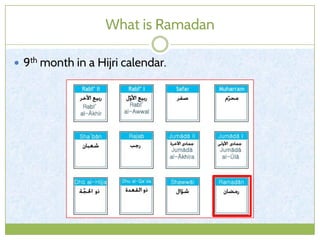
What is Ramadan
 9th month in a Hijri calendar.
Why is Ramadan
special?
Why is Ramadan special?
1. Al-Qur’an has been revealed:
ِ‫َّاس‬‫ن‬‫ل‬ِّ‫ل‬ ‫ى‬ً‫د‬ُ‫ى‬ ُ‫ن‬‫آ‬ْ‫ر‬ُ‫ق‬ْ‫ل‬‫ا‬ ِ‫يو‬ِ‫ف‬ َ‫ل‬ِ‫ز‬‫ُن‬‫أ‬ ‫ي‬ِ‫ذ‬َّ‫ل‬‫ا‬ َ‫ن‬‫ا‬َ‫ض‬َ‫م‬َ‫ر‬ ُ‫ر‬ْ‫ه‬َ‫ش‬‫ات‬َ‫ن‬ِّ‫ي‬َ‫ب‬َ‫و‬ٰ‫ى‬َ‫د‬ُْ‫ْل‬‫ا‬ َ‫ن‬ّ
ِ‫م‬
‫﴿البقرة‬ ِ‫ان‬َ‫ق‬ْ‫ر‬ُ‫ف‬ْ‫ل‬‫ا‬َ‫و‬:١٨٥﴾
 The month of Ramadan is the one in which the Qur'an
was revealed as guidance for mankind, and as clear
signs that show the right way and distinguish
between right and wrong. [2:185]
Why is Ramadan special?
2. Fasting has been made Fardh.
ُ‫و‬ْ‫م‬ُ‫ص‬َ‫ي‬ْ‫ل‬َ‫ف‬ َ‫ر‬ْ‫ه‬َّ‫الش‬ ُ‫م‬ُ‫ك‬‫ن‬ِ‫م‬ َ‫د‬ِ‫ه‬َ‫ش‬ ‫ن‬َ‫م‬َ‫ف‬‫﴿البقرة‬:١٨٥﴾
 So those of you who witness the month must fast in it.
[2:185]
Why is Ramadan special?
2. Fasting has been made Fardh.
 Through fasting, one can learn Taqwa, and be a
Muttaqi.
ْ‫م‬ُ‫ك‬َّ‫ل‬َ‫ع‬َ‫ل‬ ْ‫م‬ُ‫ك‬ِ‫ل‬ْ‫ب‬َ‫ق‬ ‫ن‬ِ‫م‬ َ‫ين‬ِ‫ذ‬َّ‫ل‬‫ا‬ ‫ى‬َ‫ل‬َ‫ع‬ َ‫ب‬ِ‫ت‬ُ‫ك‬‫ا‬َ‫م‬َ‫ك‬ُ‫ام‬َ‫ي‬ِّ‫الص‬ ُ‫م‬ُ‫ك‬ْ‫ي‬َ‫ل‬َ‫ع‬ َ‫ب‬ِ‫ت‬ُ‫ك‬‫وا‬ُ‫ن‬َ‫آم‬ َ‫ين‬ِ‫ذ‬َّ‫ل‬‫ا‬ ‫ا‬َ‫ه‬ُّ‫َي‬‫أ‬ ‫ا‬َ‫ي‬
‫﴿البقرة‬ َ‫ن‬‫و‬ُ‫ق‬َّ‫ت‬َ‫ت‬:١٨٣﴾
 O you who believe, the fasts have been enjoined upon you
as they were enjoined upon those before you, so that you
may be Muttaqun (God-fearing). [2:183]
What is Taqwa?
 In Al-Qur’an the word Taqwa came with several
meanings:
 Tawheed & Eemaan
 Ikhlaas
 Ibaadah
 Khashyah (fear of Allah)
 Leaving sins
 In other words:
 Fearing Allah SWT, obedience to whatever He has ordered,
and avoiding whatever He has forbidden.
What is Taqwa?
 Taqwa teaches us to obey Allah in all his orders and
prohibitions.
 And it is the ultimate purpose of a human life, to do
ibaadah.
﴿ ِ‫ون‬ُ‫د‬ُ‫ب‬ْ‫ع‬َ‫ي‬ِ‫ل‬ َّ‫َّل‬ِ‫إ‬ َ‫نس‬ِْ‫اْل‬َ‫و‬ َّ‫ن‬ِْ‫ْل‬‫ا‬ ُ‫ت‬ْ‫ق‬َ‫ل‬َ‫خ‬ ‫ا‬َ‫م‬َ‫و‬‫يات‬‫ر‬‫الذا‬:٥٦﴾
 I did not create the Jinns and the human beings
except for the purpose that they should worship Me.
[51:56]
Taqwa – an example
 Once, a servant of Abu Bakr [Ra] came to him with some food, and he ate
some of it. Abu Bakr [Ra] used to ask the servant each time about the origin
of the food before eating, but this time he forgot to do so. The servant then
asked him, "Why did you not ask me where this food came from?" Abu
Bakr [Ra] returned, "From where?" The servant responded, "I practiced
fortune telling in the times of Jaahiliyyah (the Period of Ignorance before
Islam) for some people and they paid me for it (today)." On hearing this,
Abu Bakr [Ra] put his finger into his mouth and forced himself to vomit up
the food, until there was nothing left in his stomach. Then, he said, “By
Allah, if getting this piece of bread out of my body meant my death, I
would have got it out.”
Taqwa through fasting
 Allah, the Majestic and the Exalted, said: Every act of
the son of Adam is for him except fasting. It is done for
My sake, and I will give a reward for it. By Allah in
Whose Hand is the life of Muhammad, the breath of
the observer of fast is sweeter to Allah than the
fragrance of musk.
 Sahih Muslim: 1151
 'He has left his food, drink and desires for My sake.'
 Sahih al-Bukhari: 1894
Why is Ramadan special?
3. Laylatul Qadr:
‫﴿القدر‬ ِ‫ر‬ْ‫د‬َ‫ق‬ْ‫ل‬‫ا‬ ِ‫ة‬َ‫ل‬ْ‫ي‬َ‫ل‬ ِ‫ِف‬ ُ‫اه‬َ‫ْن‬‫ل‬َ‫َنز‬‫أ‬ ‫ا‬َّ‫ن‬ِ‫إ‬:١﴾
 We have sent it (the Qur'an) down in the Night of
Qadr. [97:1]
4. Endless opportunities to earn rewards.
 "When the month of Ramadan comes, the gates of
Paradise are opened and the gates of the (Hell) Fire are
closed, and the devils are chained.“
 Sahih al-Bukhari: 3277
Virtues of Fasting &
other Ibaadahs
during Ramadan
Virtues of Fasting
 Allah, the Majestic and the Exalted, said: Every act of the son of
Adam is for him except fasting. It is done for My sake, and I will
give a reward for it. By Allah in Whose Hand is the life of
Muhammad, the breath of the observer of fast is sweeter to
Allah than the fragrance of musk.
 Sahih Muslim: 1151
 There are two pleasures for a fasting person, one at the time of
breaking his fast, and the other when he’ll meet his lord.
 Sahih al-Bukhari 7492
Virtues of Fasting
 In Paradise there is a gate which is called Rayyan through
which only the people who fast would enter on the Day on
Resurrection. None else would enter along with them. It would
be proclaimed: Where are the people who fast that they
should be admitted into it? And when the last of them would
enter, it would be closed and no one would enter it.
 Sahih Muslim 1152
Virtues of Fasting
 Every servant of Allah who observes fast for a day in the way
of Allah, Allah would remove, because of this day, his face
farther from the Fire (of Hell) to the extent of seventy years'
distance.
 Sahih Muslim: 1153
 "Whoever observes fasts during the month of Ramadan out of
sincere faith, and hoping to attain Allah's rewards, then all his
past sins will be forgiven."
 Sahih al-Bukhari: 38
Virtues of other Ibadah during Ramadan
 Suhur:
 "Take Suhur as there is a barakah in it.“
 Sahih al-Bukhari 1923
 Arranging iftaar for someone who is fasting:
 "Whoever provides the food for a fasting person to break his
fast with, then for his is the same reward as his (the fasting
person's), without anything being diminished from the
reward of the fasting person.“
 Jami` at-Tirmidhi 807
Virtues of other Ibadah during Ramadan
 Prayer at night
 "Whoever establishes prayers during the nights of Ramadan
faithfully out of sincere faith and hoping to attain Allah's
rewards (not for showing off), all his past sins will be
forgiven.”
 Sahih al-Bukhari 37
 Umrah:
 "Umrah during Ramadan is equal to Hajj."
 Jami` at-Tirmidhi 939
Virtues of other Ibadah during Ramadan
 Reciting Qur’an and Charity
 The Prophet ( ‫ﷺ‬) was the most generous of all the people,
and he used to become more generous in Ramadan when
Gabriel met him. Gabriel used to meet him every night
during Ramadan to revise the Qur'an with him. Allah's
Messenger ( ‫ﷺ‬) then used to be more generous than the fast
wind
 Sahih al-Bukhari 3554
Virtues of other Ibadah during Ramadan
 Dua
 “There are three whose supplication is not rejected: The
fasting person when he breaks his fast, the just leader, and
the supplication of the oppressed person; Allah raises it up
above the clouds and opens the gates of heaven to it. And
the Lord says: ‘By My might, I shall surely aid you, even if it
should be after a while.’”
 Jami` at-Tirmidhi 3598
Protection from
committing sins
Protection from committing sins
 Fasting is a shield or protection from the
fire and from committing sins. If one of
you is fasting, he should avoid sexual
relation with his wife and quarreling, and
if somebody should fight or quarrel with
him, he should say, 'I am fasting.'
 Sahih al-Bukhari 1904
Protection from committing sins
 "Whoever does not give up false
statements (i.e. telling lies), and evil
deeds, and speaking bad words to others,
Allah is not in need of his (fasting) leaving
his food and drink."
 Sahih al-Bukhari 6057
Protection from committing sins
 “There are people who fast and get
nothing from their fast except hunger,
and there are those who pray and get
nothing from their prayer but a sleepless
night.”
 Ibn Majah 1690
The Ramadan of Our
Pious Predecessors
The Ramadan of Our Pious Predecessors
 The companions of our Prophet used to give special
preference to the Quran during the holy month of Ramadhan.
It is said that Uthman bin Affan used to finish the recitation of
the whole Quran once everyday.
 It is also said that Ibn Umar used to cry very much when he
read the Quran. One day while he was reading Suratul
Mutaffin, it is said that when he reached the verse - “The Day
when (all) mankind will stand before the Lord of the ‘Alamin
(mankind, jinns and all that exists)?” (83:6) – he cried so hard
that he was overwhelmed and could not read the Quran
anymore.
The Ramadan of Our Pious Predecessors
 ‘When Ramadhan started Sufyan Athawri used to
leave all acts of worship and turn to Quran’
 ‘Sa’aid Ibnu Jubeyr used to finish the whole recitation
of Quran in two nights’
 ‘Malik ibn Anas used to run from all circles of
knowledge when Ramadhan started and turned
instead to the recitation of Quran’
 ‘Zahriy used to say when Ramadan started, ‘Indeed
it’s the recitation of Quran and feeding the poor’.
The Ramadan of Our Pious Predecessors
 A typical day of Uthman Ibn Affan in Ramadhan was
fasting during the day time and prayer and prostration at
night ‘(Sunan al-bayhaqi 4/301). And Uthman bin
Affan was also killed while he was fasting. (Al-hilyah 1/55)
 Their day was full of supplications and free from vain
talks. Jabir Bin Abdullah said, ‘When you fast then let your
ears, eyes and your tongue fast from false statement and
bad deeds. And be calm and don’t let the day your fasting
and the day you are not fasting be the same’ (Ibnu abi
sheyba 2/422)
The Ramadan of Our Pious Predecessors
 When the time of iftaar arrived, they used to race in feeding
the poor and the unfortunate. It’s narrated that Ibnu
Umar used to break his fast with the poor people and if a poor
person came to him asking for food while he was eating he
used to give him his portion.’.
Ramadan Checklist
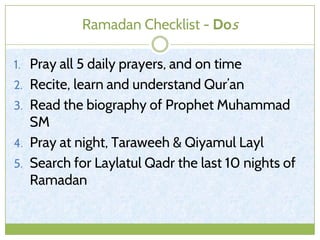
Ramadan Checklist - Dos
1. Pray all 5 daily prayers, and on time
2. Recite, learn and understand Qur’an
3. Read the biography of Prophet Muhammad
SM
4. Pray at night, Taraweeh & Qiyamul Layl
5. Search for Laylatul Qadr the last 10 nights of
Ramadan
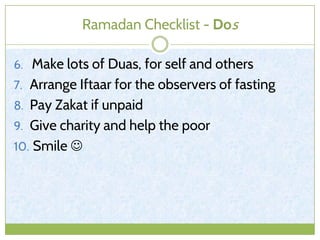
Ramadan Checklist - Dos
6. Make lots of Duas, for self and others
7. Arrange Iftaar for the observers of fasting
8. Pay Zakat if unpaid
9. Give charity and help the poor
10. Smile 
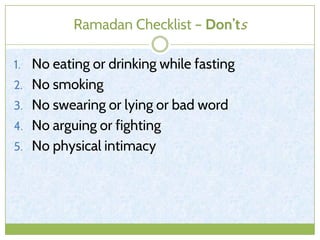
Ramadan Checklist – Don’ts
1. No eating or drinking while fasting
2. No smoking
3. No swearing or lying or bad word
4. No arguing or fighting
5. No physical intimacy
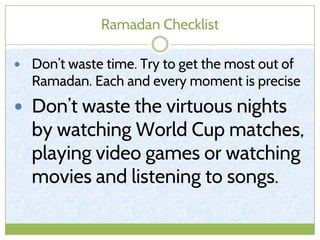
Ramadan Checklist
 Don’t waste time. Try to get the most out of
Ramadan. Each and every moment is precise
 Don’t waste the virtuous nights
by watching World Cup matches,
playing video games or watching
movies and listening to songs.
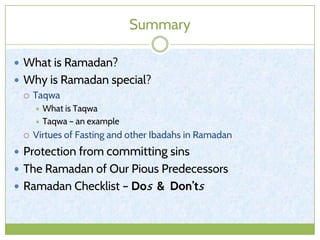
Summary
 What is Ramadan?
 Why is Ramadan special?
 Taqwa
 What is Taqwa
 Taqwa – an example
 Virtues of Fasting and other Ibadahs in Ramadan
 Protection from committing sins
 The Ramadan of Our Pious Predecessors
 Ramadan Checklist – Dos & Don’ts
Questions?
Download/ Share
the presentation
Slideshare:
http://www.slideshare.net/yousufs/how-to-
prepare-for-ramadan
Dropbox:
http://goo.gl/YU3714
Thank you.
Yousuf Sultan
Deputy Mufti, Jamia Shariyyah Malibag
E-mail: myousufs@gmail.com
Web: www.yousufsultan.com

How to prepare for ramadan

  • 1.
    How to preparefor Ramadan YOUSUF SULTAN Deputy Mufti, Jamia Shariyyah Malibag S E M I N A R A R R A N G E D @ I S L A M I C U N I V E R S I T Y O F T E C H N O L O G Y ( I U T ) , 2 5 T H J U N E , 2 0 1 4
  • 2.
    Outline  What isRamadan?  Why is Ramadan special?  Taqwa  What is Taqwa  Taqwa – an example  Virtues of Fasting and other Ibadahs in Ramadan  Protection from committing sins  The Ramadan of Our Pious Predecessors  Ramadan Checklist – Dos & Don’ts
  • 3.
    What is Ramadan 9th month in a Hijri calendar.
  • 4.
  • 5.
    Why is Ramadanspecial? 1. Al-Qur’an has been revealed: ِ‫َّاس‬‫ن‬‫ل‬ِّ‫ل‬ ‫ى‬ً‫د‬ُ‫ى‬ ُ‫ن‬‫آ‬ْ‫ر‬ُ‫ق‬ْ‫ل‬‫ا‬ ِ‫يو‬ِ‫ف‬ َ‫ل‬ِ‫ز‬‫ُن‬‫أ‬ ‫ي‬ِ‫ذ‬َّ‫ل‬‫ا‬ َ‫ن‬‫ا‬َ‫ض‬َ‫م‬َ‫ر‬ ُ‫ر‬ْ‫ه‬َ‫ش‬‫ات‬َ‫ن‬ِّ‫ي‬َ‫ب‬َ‫و‬ٰ‫ى‬َ‫د‬ُْ‫ْل‬‫ا‬ َ‫ن‬ّ ِ‫م‬ ‫﴿البقرة‬ ِ‫ان‬َ‫ق‬ْ‫ر‬ُ‫ف‬ْ‫ل‬‫ا‬َ‫و‬:١٨٥﴾  The month of Ramadan is the one in which the Qur'an was revealed as guidance for mankind, and as clear signs that show the right way and distinguish between right and wrong. [2:185]
  • 6.
    Why is Ramadanspecial? 2. Fasting has been made Fardh. ُ‫و‬ْ‫م‬ُ‫ص‬َ‫ي‬ْ‫ل‬َ‫ف‬ َ‫ر‬ْ‫ه‬َّ‫الش‬ ُ‫م‬ُ‫ك‬‫ن‬ِ‫م‬ َ‫د‬ِ‫ه‬َ‫ش‬ ‫ن‬َ‫م‬َ‫ف‬‫﴿البقرة‬:١٨٥﴾  So those of you who witness the month must fast in it. [2:185]
  • 7.
    Why is Ramadanspecial? 2. Fasting has been made Fardh.  Through fasting, one can learn Taqwa, and be a Muttaqi. ْ‫م‬ُ‫ك‬َّ‫ل‬َ‫ع‬َ‫ل‬ ْ‫م‬ُ‫ك‬ِ‫ل‬ْ‫ب‬َ‫ق‬ ‫ن‬ِ‫م‬ َ‫ين‬ِ‫ذ‬َّ‫ل‬‫ا‬ ‫ى‬َ‫ل‬َ‫ع‬ َ‫ب‬ِ‫ت‬ُ‫ك‬‫ا‬َ‫م‬َ‫ك‬ُ‫ام‬َ‫ي‬ِّ‫الص‬ ُ‫م‬ُ‫ك‬ْ‫ي‬َ‫ل‬َ‫ع‬ َ‫ب‬ِ‫ت‬ُ‫ك‬‫وا‬ُ‫ن‬َ‫آم‬ َ‫ين‬ِ‫ذ‬َّ‫ل‬‫ا‬ ‫ا‬َ‫ه‬ُّ‫َي‬‫أ‬ ‫ا‬َ‫ي‬ ‫﴿البقرة‬ َ‫ن‬‫و‬ُ‫ق‬َّ‫ت‬َ‫ت‬:١٨٣﴾  O you who believe, the fasts have been enjoined upon you as they were enjoined upon those before you, so that you may be Muttaqun (God-fearing). [2:183]
  • 8.
    What is Taqwa? In Al-Qur’an the word Taqwa came with several meanings:  Tawheed & Eemaan  Ikhlaas  Ibaadah  Khashyah (fear of Allah)  Leaving sins  In other words:  Fearing Allah SWT, obedience to whatever He has ordered, and avoiding whatever He has forbidden.
  • 9.
    What is Taqwa? Taqwa teaches us to obey Allah in all his orders and prohibitions.  And it is the ultimate purpose of a human life, to do ibaadah. ﴿ ِ‫ون‬ُ‫د‬ُ‫ب‬ْ‫ع‬َ‫ي‬ِ‫ل‬ َّ‫َّل‬ِ‫إ‬ َ‫نس‬ِْ‫اْل‬َ‫و‬ َّ‫ن‬ِْ‫ْل‬‫ا‬ ُ‫ت‬ْ‫ق‬َ‫ل‬َ‫خ‬ ‫ا‬َ‫م‬َ‫و‬‫يات‬‫ر‬‫الذا‬:٥٦﴾  I did not create the Jinns and the human beings except for the purpose that they should worship Me. [51:56]
  • 10.
    Taqwa – anexample  Once, a servant of Abu Bakr [Ra] came to him with some food, and he ate some of it. Abu Bakr [Ra] used to ask the servant each time about the origin of the food before eating, but this time he forgot to do so. The servant then asked him, "Why did you not ask me where this food came from?" Abu Bakr [Ra] returned, "From where?" The servant responded, "I practiced fortune telling in the times of Jaahiliyyah (the Period of Ignorance before Islam) for some people and they paid me for it (today)." On hearing this, Abu Bakr [Ra] put his finger into his mouth and forced himself to vomit up the food, until there was nothing left in his stomach. Then, he said, “By Allah, if getting this piece of bread out of my body meant my death, I would have got it out.”
  • 11.
    Taqwa through fasting Allah, the Majestic and the Exalted, said: Every act of the son of Adam is for him except fasting. It is done for My sake, and I will give a reward for it. By Allah in Whose Hand is the life of Muhammad, the breath of the observer of fast is sweeter to Allah than the fragrance of musk.  Sahih Muslim: 1151  'He has left his food, drink and desires for My sake.'  Sahih al-Bukhari: 1894
  • 12.
    Why is Ramadanspecial? 3. Laylatul Qadr: ‫﴿القدر‬ ِ‫ر‬ْ‫د‬َ‫ق‬ْ‫ل‬‫ا‬ ِ‫ة‬َ‫ل‬ْ‫ي‬َ‫ل‬ ِ‫ِف‬ ُ‫اه‬َ‫ْن‬‫ل‬َ‫َنز‬‫أ‬ ‫ا‬َّ‫ن‬ِ‫إ‬:١﴾  We have sent it (the Qur'an) down in the Night of Qadr. [97:1] 4. Endless opportunities to earn rewards.  "When the month of Ramadan comes, the gates of Paradise are opened and the gates of the (Hell) Fire are closed, and the devils are chained.“  Sahih al-Bukhari: 3277
  • 13.
    Virtues of Fasting& other Ibaadahs during Ramadan
  • 14.
    Virtues of Fasting Allah, the Majestic and the Exalted, said: Every act of the son of Adam is for him except fasting. It is done for My sake, and I will give a reward for it. By Allah in Whose Hand is the life of Muhammad, the breath of the observer of fast is sweeter to Allah than the fragrance of musk.  Sahih Muslim: 1151  There are two pleasures for a fasting person, one at the time of breaking his fast, and the other when he’ll meet his lord.  Sahih al-Bukhari 7492
  • 15.
    Virtues of Fasting In Paradise there is a gate which is called Rayyan through which only the people who fast would enter on the Day on Resurrection. None else would enter along with them. It would be proclaimed: Where are the people who fast that they should be admitted into it? And when the last of them would enter, it would be closed and no one would enter it.  Sahih Muslim 1152
  • 16.
    Virtues of Fasting Every servant of Allah who observes fast for a day in the way of Allah, Allah would remove, because of this day, his face farther from the Fire (of Hell) to the extent of seventy years' distance.  Sahih Muslim: 1153  "Whoever observes fasts during the month of Ramadan out of sincere faith, and hoping to attain Allah's rewards, then all his past sins will be forgiven."  Sahih al-Bukhari: 38
  • 17.
    Virtues of otherIbadah during Ramadan  Suhur:  "Take Suhur as there is a barakah in it.“  Sahih al-Bukhari 1923  Arranging iftaar for someone who is fasting:  "Whoever provides the food for a fasting person to break his fast with, then for his is the same reward as his (the fasting person's), without anything being diminished from the reward of the fasting person.“  Jami` at-Tirmidhi 807
  • 18.
    Virtues of otherIbadah during Ramadan  Prayer at night  "Whoever establishes prayers during the nights of Ramadan faithfully out of sincere faith and hoping to attain Allah's rewards (not for showing off), all his past sins will be forgiven.”  Sahih al-Bukhari 37  Umrah:  "Umrah during Ramadan is equal to Hajj."  Jami` at-Tirmidhi 939
  • 19.
    Virtues of otherIbadah during Ramadan  Reciting Qur’an and Charity  The Prophet ( ‫ﷺ‬) was the most generous of all the people, and he used to become more generous in Ramadan when Gabriel met him. Gabriel used to meet him every night during Ramadan to revise the Qur'an with him. Allah's Messenger ( ‫ﷺ‬) then used to be more generous than the fast wind  Sahih al-Bukhari 3554
  • 20.
    Virtues of otherIbadah during Ramadan  Dua  “There are three whose supplication is not rejected: The fasting person when he breaks his fast, the just leader, and the supplication of the oppressed person; Allah raises it up above the clouds and opens the gates of heaven to it. And the Lord says: ‘By My might, I shall surely aid you, even if it should be after a while.’”  Jami` at-Tirmidhi 3598
  • 21.
  • 22.
    Protection from committingsins  Fasting is a shield or protection from the fire and from committing sins. If one of you is fasting, he should avoid sexual relation with his wife and quarreling, and if somebody should fight or quarrel with him, he should say, 'I am fasting.'  Sahih al-Bukhari 1904
  • 23.
    Protection from committingsins  "Whoever does not give up false statements (i.e. telling lies), and evil deeds, and speaking bad words to others, Allah is not in need of his (fasting) leaving his food and drink."  Sahih al-Bukhari 6057
  • 24.
    Protection from committingsins  “There are people who fast and get nothing from their fast except hunger, and there are those who pray and get nothing from their prayer but a sleepless night.”  Ibn Majah 1690
  • 25.
    The Ramadan ofOur Pious Predecessors
  • 26.
    The Ramadan ofOur Pious Predecessors  The companions of our Prophet used to give special preference to the Quran during the holy month of Ramadhan. It is said that Uthman bin Affan used to finish the recitation of the whole Quran once everyday.  It is also said that Ibn Umar used to cry very much when he read the Quran. One day while he was reading Suratul Mutaffin, it is said that when he reached the verse - “The Day when (all) mankind will stand before the Lord of the ‘Alamin (mankind, jinns and all that exists)?” (83:6) – he cried so hard that he was overwhelmed and could not read the Quran anymore.
  • 27.
    The Ramadan ofOur Pious Predecessors  ‘When Ramadhan started Sufyan Athawri used to leave all acts of worship and turn to Quran’  ‘Sa’aid Ibnu Jubeyr used to finish the whole recitation of Quran in two nights’  ‘Malik ibn Anas used to run from all circles of knowledge when Ramadhan started and turned instead to the recitation of Quran’  ‘Zahriy used to say when Ramadan started, ‘Indeed it’s the recitation of Quran and feeding the poor’.
  • 28.
    The Ramadan ofOur Pious Predecessors  A typical day of Uthman Ibn Affan in Ramadhan was fasting during the day time and prayer and prostration at night ‘(Sunan al-bayhaqi 4/301). And Uthman bin Affan was also killed while he was fasting. (Al-hilyah 1/55)  Their day was full of supplications and free from vain talks. Jabir Bin Abdullah said, ‘When you fast then let your ears, eyes and your tongue fast from false statement and bad deeds. And be calm and don’t let the day your fasting and the day you are not fasting be the same’ (Ibnu abi sheyba 2/422)
  • 29.
    The Ramadan ofOur Pious Predecessors  When the time of iftaar arrived, they used to race in feeding the poor and the unfortunate. It’s narrated that Ibnu Umar used to break his fast with the poor people and if a poor person came to him asking for food while he was eating he used to give him his portion.’.
  • 30.
  • 31.
    Ramadan Checklist -Dos 1. Pray all 5 daily prayers, and on time 2. Recite, learn and understand Qur’an 3. Read the biography of Prophet Muhammad SM 4. Pray at night, Taraweeh & Qiyamul Layl 5. Search for Laylatul Qadr the last 10 nights of Ramadan
  • 32.
    Ramadan Checklist -Dos 6. Make lots of Duas, for self and others 7. Arrange Iftaar for the observers of fasting 8. Pay Zakat if unpaid 9. Give charity and help the poor 10. Smile 
  • 33.
    Ramadan Checklist –Don’ts 1. No eating or drinking while fasting 2. No smoking 3. No swearing or lying or bad word 4. No arguing or fighting 5. No physical intimacy
  • 34.
    Ramadan Checklist  Don’twaste time. Try to get the most out of Ramadan. Each and every moment is precise  Don’t waste the virtuous nights by watching World Cup matches, playing video games or watching movies and listening to songs.
  • 35.
    Summary  What isRamadan?  Why is Ramadan special?  Taqwa  What is Taqwa  Taqwa – an example  Virtues of Fasting and other Ibadahs in Ramadan  Protection from committing sins  The Ramadan of Our Pious Predecessors  Ramadan Checklist – Dos & Don’ts
  • 36.
  • 37.
  • 38.
    Thank you. Yousuf Sultan DeputyMufti, Jamia Shariyyah Malibag E-mail: myousufs@gmail.com Web: www.yousufsultan.com