
Information Systems,
Ninth Edition
Chapter 1
An Introduction to Information Systems
Principles and Learning Objectives
• The value of information is directly linked to how it
helps decision makers achieve the organization’s
goals
– Discuss why it is important to study and understand
information systems
– Distinguish data from information and describe the
characteristics used to evaluate the value of data
Principles of Information Systems, Ninth Edition 2
Principles and Learning Objectives
(continued)
• Computers and information systems are constantly
making it possible for organizations to improve the
way they conduct business
– Name the components of an information system and
describe several system characteristics
Principles of Information Systems, Ninth Edition 3
Principles and Learning Objectives
(continued)
• Knowing the potential impact of information
systems and having the ability to put this
knowledge to work can result in a successful
personal career and organizations that reach their
goals
– List the components of a computer-based
information system
– Identify the basic types of business information
systems and discuss who uses them, how they are
used, and what kinds of benefits they deliver
Principles of Information Systems, Ninth Edition 4
Principles and Learning Objectives
(continued)
• System users, business managers, and information
systems professionals must work together to build
a successful information system
– Identify the major steps of the systems development
process and state the goal of each
Principles of Information Systems, Ninth Edition 5
Principles and Learning Objectives
(continued)
• Information systems must be applied thoughtfully
and carefully so that society, business, and
industry around the globe can reap their enormous
benefits
– Describe some of the threats to security and privacy
that information systems and the Internet can pose
– Discuss the expanding role and benefits of
information systems in business and industry
Principles of Information Systems, Ninth Edition 6
Why Learn About Information
Systems?
• Information systems used in most professions
– Sales representatives
– Managers
– Financial planners
• Indispensable for achieving career goals
Principles of Information Systems, Ninth Edition 7
Introduction
• Information system (IS)
– A set of interrelated components that
collect, manipulate, and disseminate data and
information, and provide feedback to meet an
objective
– Businesses
• Can use information systems to increase revenues
and reduce costs
Principles of Information Systems, Ninth Edition 8
Information Concepts
• Information
– One of an organization’s most valuable resources
– Often confused with the term data
Principles of Information Systems, Ninth Edition 9
Data, Information, and Knowledge
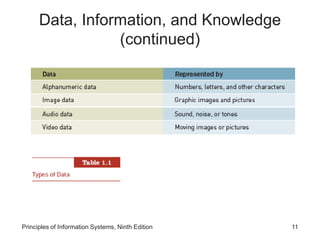
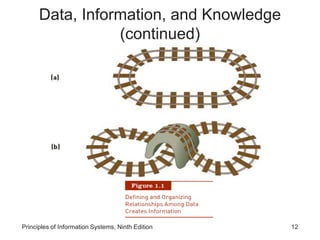
• Data
– Raw facts
• Information
– Collection of facts organized in such a way that they
have value beyond the facts themselves
• Process
– Set of logically related tasks
• Knowledge
– Awareness and understanding of a set of information
Principles of Information Systems, Ninth Edition 10
Principles of Information Systems, Ninth Edition 11
Data, Information, and Knowledge
(continued)
Principles of Information Systems, Ninth Edition 12
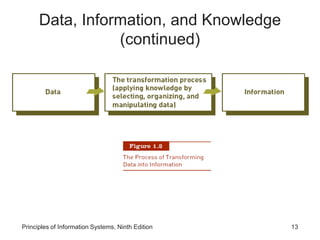
Data, Information, and Knowledge
(continued)
Principles of Information Systems, Ninth Edition 13
Data, Information, and Knowledge
(continued)
The Characteristics of Valuable
Information
• If an organization’s information is not accurate or
complete
– People can make poor decisions, costing
thousands, or even millions, of dollars
• Depending on the type of data you need
– Some characteristics become more valuable than
others
Principles of Information Systems, Ninth Edition 14
The Value of Information
• Directly linked to how it helps decision makers
achieve their organization’s goals
• Valuable information
– Can help people and their organizations perform
tasks more efficiently and effectively
Principles of Information Systems, Ninth Edition 15
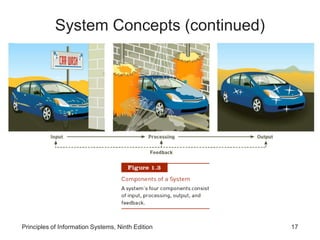
System Concepts
• System
– Set of elements or components that interact to
accomplish goals
• Components of a system
– Inputs
– Processing mechanisms
– Outputs
– Feedback
Principles of Information Systems, Ninth Edition 16
Principles of Information Systems, Ninth Edition 17
System Concepts (continued)
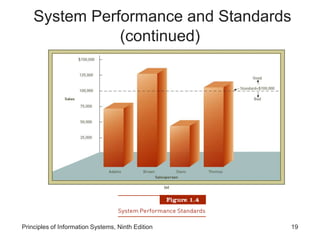
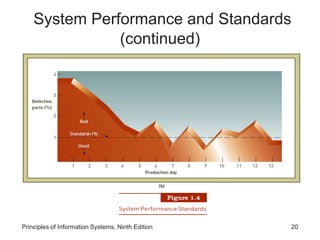
System Performance and Standards
• Efficiency
– Measure of what is produced divided by what is
consumed.
• Effectiveness
– efficiency refers to how well you do something
– effectiveness refers to how useful it is extent to
which system attains its goals.
• System performance standard
– Specific objective of the system
Principles of Information Systems, Ninth Edition 18
Principles of Information Systems, Ninth Edition 19
System Performance and Standards
(continued)
Principles of Information Systems, Ninth Edition 20
System Performance and Standards
(continued)
What is an Information System?
• Information system (IS) is a set of interrelated
elements that
– Collect (input), manipulate (process), store, and
disseminate (output) data and information, and
provide a corrective reaction (feedback mechanism)
to meet an objective
Principles of Information Systems, Ninth Edition 21
Principles of Information Systems, Ninth Edition 22
What is an Information System?
(continued)
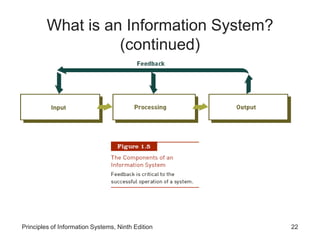
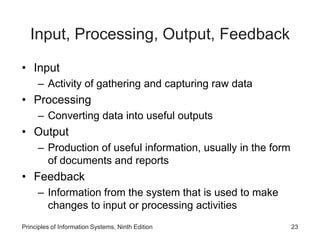
Input, Processing, Output, Feedback
• Input
– Activity of gathering and capturing raw data
• Processing
– Converting data into useful outputs
• Output
– Production of useful information, usually in the form
of documents and reports
• Feedback
– Information from the system that is used to make
changes to input or processing activities
Principles of Information Systems, Ninth Edition 23
Manual and Computerized Information
Systems
• An information system can be:
– Manual
– Computerized
Principles of Information Systems, Ninth Edition 24
Computer-Based Information Systems
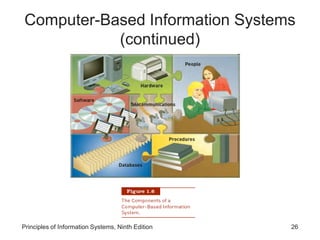
• Technology infrastructure
– Includes all
hardware, software, databases, telecommunications,
people, and procedures
• Configured to collect, manipulate, store, and process
data into information
Principles of Information Systems, Ninth Edition 25
Principles of Information Systems, Ninth Edition 26
Computer-Based Information Systems
(continued)
Computer-Based Information Systems
(continued)
• Hardware
– Consists of computer equipment used to perform
input, processing, and output activities
• Software
– Consists of the computer programs that govern the
operation of the computer
• Database
– Organized collection of facts and information,
typically consisting of two or more related data files
Principles of Information Systems, Ninth Edition 27
Computer-Based Information Systems
(continued)
• Telecommunications, networks, and the Internet
– The electronic transmission of signals for
communications
• Networks
– Connect computers and equipment to enable
electronic communication
• Internet
– World’s largest computer network, consisting of
thousands of interconnected networks, all freely
exchanging information
Principles of Information Systems, Ninth Edition 28
Computer-Based Information Systems
(continued)
• People
– Can be the most important element in most
computer-based information systems
• Procedures
– Include strategies, policies, methods, and rules for
using the CBIS
Principles of Information Systems, Ninth Edition 29
Principles of Information Systems, Ninth Edition 30
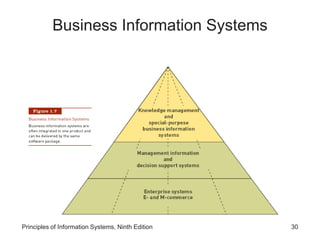
Business Information Systems
Principles of Information Systems, Ninth Edition 31
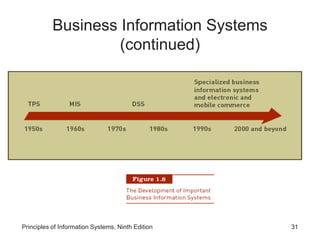
Business Information Systems
(continued)
Break
Principles of Information
Systems, Eighth Edition
32
Electronic and Mobile Commerce
• E-commerce
– Any business transaction executed electronically
between:
• Companies (business-to-business, B2B)
• Companies and consumers (business-to-
consumer, B2C)
• Consumers and other consumers (consumer-to-
consumer, C2C)
• Business and the public sector
• Consumers and the public sector
Principles of Information Systems, Ninth Edition 33
Electronic and Mobile Commerce
(continued)
• Mobile commerce (m-commerce)
– Transactions conducted anywhere, anytime
• E-commerce
– Can enhance a company’s stock prices and market
value
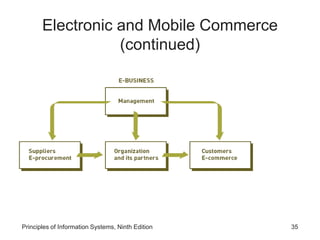
• Electronic business (e-business)
– Uses information systems and the Internet to
perform all business-related tasks and functions
Principles of Information Systems, Ninth Edition 34
Principles of Information Systems, Ninth Edition 35
Electronic and Mobile Commerce
(continued)
Enterprise Systems: Transaction
Processing Systems and Enterprise
Resource Planning
• Transaction
– Any business-related exchange, such as payments
to employees and sales to customers
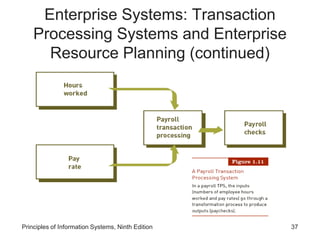
• Transaction processing system (TPS)
– Organized collection of
people, procedures, software, databases, and
devices used to record completed business
transactions
Principles of Information Systems, Ninth Edition 36
Principles of Information Systems, Ninth Edition 37
Enterprise Systems: Transaction
Processing Systems and Enterprise
Resource Planning (continued)
Enterprise Resource Planning
• Set of integrated programs that:
– Manages the vital business operations for an entire
multisite, global organization
• Most systems provide integrated software to
support manufacturing and finance
Principles of Information Systems, Ninth Edition 38
Information and Decision Support
Systems
• TPS
– Can speed business activities and reduce clerical
costs
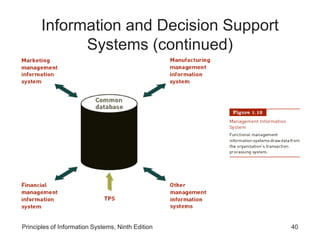
• Management information system (MIS)
– Organized collection of
people, procedures, software, databases, and
devices that
• Provides routine information to managers and
decision makers
Principles of Information Systems, Ninth Edition 39
Principles of Information Systems, Ninth Edition 40
Information and Decision Support
Systems (continued)
Information and Decision Support
Systems (continued)
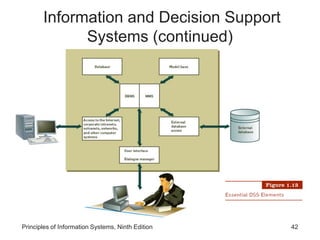
• Decision support system (DSS)
– Organized collection of
people, procedures, software, databases, and
devices that support problem-specific decision
making
– Used when problem is complex and information
needed to determine appropriate action is difficult to
obtain and use
Principles of Information Systems, Ninth Edition 41
Principles of Information Systems, Ninth Edition 42
Information and Decision Support
Systems (continued)
Specialized Business Information
Systems: Knowledge
Management, Artificial
Intelligence, Expert Systems, and
Virtual Reality
• Knowledge management systems (KMSs)
– Organized collection of
people, procedures, software, databases, and
devices to
• Create, store, share, and use the organization’s
knowledge and experience
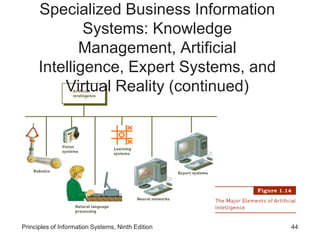
• Artificial intelligence (AI)
– Computer system takes on characteristics of human
intelligence
Principles of Information Systems, Ninth Edition 43
Principles of Information Systems, Ninth Edition 44
Specialized Business Information
Systems: Knowledge
Management, Artificial
Intelligence, Expert Systems, and
Virtual Reality (continued)
Specialized Business Information
Systems: Knowledge
Management, Artificial
Intelligence, Expert Systems, and
Virtual Reality (continued)
• Expert systems
– Give computer ability to make suggestions and
function like an expert in a particular field
• Virtual reality
– Simulation of a real or imagined environment that
can be experienced visually in three dimensions
Principles of Information Systems, Ninth Edition 45
Systems Development
• Systems development
– The activity of creating or modifying existing
business systems
• Outsourcing
– Allows a company to focus on what it does best and
delegate other functions to companies with expertise
in systems development
Principles of Information Systems, Ninth Edition 46
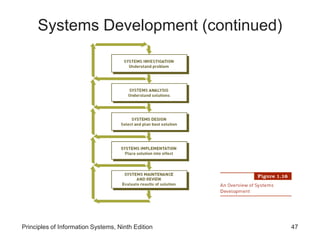
Principles of Information Systems, Ninth Edition 47
Systems Development (continued)
Systems Investigation and Analysis
• Goal of systems investigation
– To gain clear understanding of the problem to be
solved or opportunity to be addressed
• Systems analysis
– Defines the problems and opportunities of the
existing system
Principles of Information Systems, Ninth Edition 48
Systems Design, Implementation, and
Maintenance and Review
• Systems design
– Determines how new system will work to meet
business needs defined during systems analysis
• Systems implementation
– Acquiring various system components defined in
design step, assembling them, and putting the new
system into operation
• Systems maintenance and review
– Checks and modifies the system so that it continues
to meet changing business needs
Principles of Information Systems, Ninth Edition 49
Information Systems in
Society, Business, and Industry
• Information systems
– Have been developed to meet the needs of all types
of organizations and people
– Speed and widespread use opens users to a variety
of threats from unethical people
Principles of Information Systems, Ninth Edition 50
Security, Privacy, and Ethical Issues in
Information Systems and the Internet
• Drawbacks of information systems
– Always being connected at work and to your boss
through the Internet, minimizing free time
• To protect against threats to your privacy and data
– Install security and control measures
• Use of information systems
– Raises work concerns, including job loss through
increased efficiency
Principles of Information Systems, Ninth Edition 51
Computer and Information Systems
Literacy
• Computer literacy
– Knowledge of computer systems and equipment and
the ways they function
• Information systems literacy
– Knowledge of how data and information are used by
individuals, groups, and organizations
Principles of Information Systems, Ninth Edition 52
Information Systems in the Functional
Areas of Business
• Finance and accounting
• Sales and marketing
• Manufacturing
• Human resource management
• Legal information systems
Principles of Information Systems, Ninth Edition 53
Information Systems in Industry
• Airline industry
• Investment firms
• Banks
• Transportation industry
• Publishing companies
Principles of Information Systems, Ninth Edition 54
Information Systems in Industry
(continued)
• Healthcare organizations
• Retail companies
• Power management and utility companies
• Professional services
Principles of Information Systems, Ninth Edition 55
Global Challenges in Information
Systems
• Cultural challenges
• Language challenges
• Time and distance challenges
• Infrastructure challenges
• Currency challenges
Principles of Information Systems, Ninth Edition 56
Global Challenges in Information
Systems (continued)
• Product and service challenges
• Technology transfer issues
• State, regional, and national laws
• Trade agreements
Principles of Information Systems, Ninth Edition 57
Summary
• Data
– Raw facts
• Information
– Collection of facts organized in such a way that they
have value beyond the facts themselves
• System
– Set of elements that interact to accomplish a goal
• Components of an information system
– Input, processing, output, and feedback
Principles of Information Systems, Ninth Edition 58
Summary (continued)
• Computer-based information system (CBIS)
– Single set of
hardware, software, databases, telecommunications,
people, and procedures
• Configured to collect, manipulate, store, and process
data into information
• Transaction processing system (TPS)
– Organized collection of
people, procedures, software, databases, and
devices
• Used to record completed business transactions
Principles of Information Systems, Ninth Edition 59
Summary (continued)
• Management information system (MIS)
– Organized collection of
people, procedures, software, databases, and
devices
• That provides routine information to managers and
decision makers
• Decision support system (DSS)
– Organized collection of
people, procedures, software, databases, and
devices
• Used to support problem-specific decision making
• Systems development
– Creating or modifying existing business systemsPrinciples of Information Systems, Ninth Edition 60

2014 02 bis1513-notes_1394589458_iis_ch01

  • 1.
    Information Systems, Ninth Edition Chapter1 An Introduction to Information Systems
  • 2.
    Principles and LearningObjectives • The value of information is directly linked to how it helps decision makers achieve the organization’s goals – Discuss why it is important to study and understand information systems – Distinguish data from information and describe the characteristics used to evaluate the value of data Principles of Information Systems, Ninth Edition 2
  • 3.
    Principles and LearningObjectives (continued) • Computers and information systems are constantly making it possible for organizations to improve the way they conduct business – Name the components of an information system and describe several system characteristics Principles of Information Systems, Ninth Edition 3
  • 4.
    Principles and LearningObjectives (continued) • Knowing the potential impact of information systems and having the ability to put this knowledge to work can result in a successful personal career and organizations that reach their goals – List the components of a computer-based information system – Identify the basic types of business information systems and discuss who uses them, how they are used, and what kinds of benefits they deliver Principles of Information Systems, Ninth Edition 4
  • 5.
    Principles and LearningObjectives (continued) • System users, business managers, and information systems professionals must work together to build a successful information system – Identify the major steps of the systems development process and state the goal of each Principles of Information Systems, Ninth Edition 5
  • 6.
    Principles and LearningObjectives (continued) • Information systems must be applied thoughtfully and carefully so that society, business, and industry around the globe can reap their enormous benefits – Describe some of the threats to security and privacy that information systems and the Internet can pose – Discuss the expanding role and benefits of information systems in business and industry Principles of Information Systems, Ninth Edition 6
  • 7.
    Why Learn AboutInformation Systems? • Information systems used in most professions – Sales representatives – Managers – Financial planners • Indispensable for achieving career goals Principles of Information Systems, Ninth Edition 7
  • 8.
    Introduction • Information system(IS) – A set of interrelated components that collect, manipulate, and disseminate data and information, and provide feedback to meet an objective – Businesses • Can use information systems to increase revenues and reduce costs Principles of Information Systems, Ninth Edition 8
  • 9.
    Information Concepts • Information –One of an organization’s most valuable resources – Often confused with the term data Principles of Information Systems, Ninth Edition 9
  • 10.
    Data, Information, andKnowledge • Data – Raw facts • Information – Collection of facts organized in such a way that they have value beyond the facts themselves • Process – Set of logically related tasks • Knowledge – Awareness and understanding of a set of information Principles of Information Systems, Ninth Edition 10
  • 11.
    Principles of InformationSystems, Ninth Edition 11 Data, Information, and Knowledge (continued)
  • 12.
    Principles of InformationSystems, Ninth Edition 12 Data, Information, and Knowledge (continued)
  • 13.
    Principles of InformationSystems, Ninth Edition 13 Data, Information, and Knowledge (continued)
  • 14.
    The Characteristics ofValuable Information • If an organization’s information is not accurate or complete – People can make poor decisions, costing thousands, or even millions, of dollars • Depending on the type of data you need – Some characteristics become more valuable than others Principles of Information Systems, Ninth Edition 14
  • 15.
    The Value ofInformation • Directly linked to how it helps decision makers achieve their organization’s goals • Valuable information – Can help people and their organizations perform tasks more efficiently and effectively Principles of Information Systems, Ninth Edition 15
  • 16.
    System Concepts • System –Set of elements or components that interact to accomplish goals • Components of a system – Inputs – Processing mechanisms – Outputs – Feedback Principles of Information Systems, Ninth Edition 16
  • 17.
    Principles of InformationSystems, Ninth Edition 17 System Concepts (continued)
  • 18.
    System Performance andStandards • Efficiency – Measure of what is produced divided by what is consumed. • Effectiveness – efficiency refers to how well you do something – effectiveness refers to how useful it is extent to which system attains its goals. • System performance standard – Specific objective of the system Principles of Information Systems, Ninth Edition 18
  • 19.
    Principles of InformationSystems, Ninth Edition 19 System Performance and Standards (continued)
  • 20.
    Principles of InformationSystems, Ninth Edition 20 System Performance and Standards (continued)
  • 21.
    What is anInformation System? • Information system (IS) is a set of interrelated elements that – Collect (input), manipulate (process), store, and disseminate (output) data and information, and provide a corrective reaction (feedback mechanism) to meet an objective Principles of Information Systems, Ninth Edition 21
  • 22.
    Principles of InformationSystems, Ninth Edition 22 What is an Information System? (continued)
  • 23.
    Input, Processing, Output,Feedback • Input – Activity of gathering and capturing raw data • Processing – Converting data into useful outputs • Output – Production of useful information, usually in the form of documents and reports • Feedback – Information from the system that is used to make changes to input or processing activities Principles of Information Systems, Ninth Edition 23
  • 24.
    Manual and ComputerizedInformation Systems • An information system can be: – Manual – Computerized Principles of Information Systems, Ninth Edition 24
  • 25.
    Computer-Based Information Systems •Technology infrastructure – Includes all hardware, software, databases, telecommunications, people, and procedures • Configured to collect, manipulate, store, and process data into information Principles of Information Systems, Ninth Edition 25
  • 26.
    Principles of InformationSystems, Ninth Edition 26 Computer-Based Information Systems (continued)
  • 27.
    Computer-Based Information Systems (continued) •Hardware – Consists of computer equipment used to perform input, processing, and output activities • Software – Consists of the computer programs that govern the operation of the computer • Database – Organized collection of facts and information, typically consisting of two or more related data files Principles of Information Systems, Ninth Edition 27
  • 28.
    Computer-Based Information Systems (continued) •Telecommunications, networks, and the Internet – The electronic transmission of signals for communications • Networks – Connect computers and equipment to enable electronic communication • Internet – World’s largest computer network, consisting of thousands of interconnected networks, all freely exchanging information Principles of Information Systems, Ninth Edition 28
  • 29.
    Computer-Based Information Systems (continued) •People – Can be the most important element in most computer-based information systems • Procedures – Include strategies, policies, methods, and rules for using the CBIS Principles of Information Systems, Ninth Edition 29
  • 30.
    Principles of InformationSystems, Ninth Edition 30 Business Information Systems
  • 31.
    Principles of InformationSystems, Ninth Edition 31 Business Information Systems (continued)
  • 32.
  • 33.
    Electronic and MobileCommerce • E-commerce – Any business transaction executed electronically between: • Companies (business-to-business, B2B) • Companies and consumers (business-to- consumer, B2C) • Consumers and other consumers (consumer-to- consumer, C2C) • Business and the public sector • Consumers and the public sector Principles of Information Systems, Ninth Edition 33
  • 34.
    Electronic and MobileCommerce (continued) • Mobile commerce (m-commerce) – Transactions conducted anywhere, anytime • E-commerce – Can enhance a company’s stock prices and market value • Electronic business (e-business) – Uses information systems and the Internet to perform all business-related tasks and functions Principles of Information Systems, Ninth Edition 34
  • 35.
    Principles of InformationSystems, Ninth Edition 35 Electronic and Mobile Commerce (continued)
  • 36.
    Enterprise Systems: Transaction ProcessingSystems and Enterprise Resource Planning • Transaction – Any business-related exchange, such as payments to employees and sales to customers • Transaction processing system (TPS) – Organized collection of people, procedures, software, databases, and devices used to record completed business transactions Principles of Information Systems, Ninth Edition 36
  • 37.
    Principles of InformationSystems, Ninth Edition 37 Enterprise Systems: Transaction Processing Systems and Enterprise Resource Planning (continued)
  • 38.
    Enterprise Resource Planning •Set of integrated programs that: – Manages the vital business operations for an entire multisite, global organization • Most systems provide integrated software to support manufacturing and finance Principles of Information Systems, Ninth Edition 38
  • 39.
    Information and DecisionSupport Systems • TPS – Can speed business activities and reduce clerical costs • Management information system (MIS) – Organized collection of people, procedures, software, databases, and devices that • Provides routine information to managers and decision makers Principles of Information Systems, Ninth Edition 39
  • 40.
    Principles of InformationSystems, Ninth Edition 40 Information and Decision Support Systems (continued)
  • 41.
    Information and DecisionSupport Systems (continued) • Decision support system (DSS) – Organized collection of people, procedures, software, databases, and devices that support problem-specific decision making – Used when problem is complex and information needed to determine appropriate action is difficult to obtain and use Principles of Information Systems, Ninth Edition 41
  • 42.
    Principles of InformationSystems, Ninth Edition 42 Information and Decision Support Systems (continued)
  • 43.
    Specialized Business Information Systems:Knowledge Management, Artificial Intelligence, Expert Systems, and Virtual Reality • Knowledge management systems (KMSs) – Organized collection of people, procedures, software, databases, and devices to • Create, store, share, and use the organization’s knowledge and experience • Artificial intelligence (AI) – Computer system takes on characteristics of human intelligence Principles of Information Systems, Ninth Edition 43
  • 44.
    Principles of InformationSystems, Ninth Edition 44 Specialized Business Information Systems: Knowledge Management, Artificial Intelligence, Expert Systems, and Virtual Reality (continued)
  • 45.
    Specialized Business Information Systems:Knowledge Management, Artificial Intelligence, Expert Systems, and Virtual Reality (continued) • Expert systems – Give computer ability to make suggestions and function like an expert in a particular field • Virtual reality – Simulation of a real or imagined environment that can be experienced visually in three dimensions Principles of Information Systems, Ninth Edition 45
  • 46.
    Systems Development • Systemsdevelopment – The activity of creating or modifying existing business systems • Outsourcing – Allows a company to focus on what it does best and delegate other functions to companies with expertise in systems development Principles of Information Systems, Ninth Edition 46
  • 47.
    Principles of InformationSystems, Ninth Edition 47 Systems Development (continued)
  • 48.
    Systems Investigation andAnalysis • Goal of systems investigation – To gain clear understanding of the problem to be solved or opportunity to be addressed • Systems analysis – Defines the problems and opportunities of the existing system Principles of Information Systems, Ninth Edition 48
  • 49.
    Systems Design, Implementation,and Maintenance and Review • Systems design – Determines how new system will work to meet business needs defined during systems analysis • Systems implementation – Acquiring various system components defined in design step, assembling them, and putting the new system into operation • Systems maintenance and review – Checks and modifies the system so that it continues to meet changing business needs Principles of Information Systems, Ninth Edition 49
  • 50.
    Information Systems in Society,Business, and Industry • Information systems – Have been developed to meet the needs of all types of organizations and people – Speed and widespread use opens users to a variety of threats from unethical people Principles of Information Systems, Ninth Edition 50
  • 51.
    Security, Privacy, andEthical Issues in Information Systems and the Internet • Drawbacks of information systems – Always being connected at work and to your boss through the Internet, minimizing free time • To protect against threats to your privacy and data – Install security and control measures • Use of information systems – Raises work concerns, including job loss through increased efficiency Principles of Information Systems, Ninth Edition 51
  • 52.
    Computer and InformationSystems Literacy • Computer literacy – Knowledge of computer systems and equipment and the ways they function • Information systems literacy – Knowledge of how data and information are used by individuals, groups, and organizations Principles of Information Systems, Ninth Edition 52
  • 53.
    Information Systems inthe Functional Areas of Business • Finance and accounting • Sales and marketing • Manufacturing • Human resource management • Legal information systems Principles of Information Systems, Ninth Edition 53
  • 54.
    Information Systems inIndustry • Airline industry • Investment firms • Banks • Transportation industry • Publishing companies Principles of Information Systems, Ninth Edition 54
  • 55.
    Information Systems inIndustry (continued) • Healthcare organizations • Retail companies • Power management and utility companies • Professional services Principles of Information Systems, Ninth Edition 55
  • 56.
    Global Challenges inInformation Systems • Cultural challenges • Language challenges • Time and distance challenges • Infrastructure challenges • Currency challenges Principles of Information Systems, Ninth Edition 56
  • 57.
    Global Challenges inInformation Systems (continued) • Product and service challenges • Technology transfer issues • State, regional, and national laws • Trade agreements Principles of Information Systems, Ninth Edition 57
  • 58.
    Summary • Data – Rawfacts • Information – Collection of facts organized in such a way that they have value beyond the facts themselves • System – Set of elements that interact to accomplish a goal • Components of an information system – Input, processing, output, and feedback Principles of Information Systems, Ninth Edition 58
  • 59.
    Summary (continued) • Computer-basedinformation system (CBIS) – Single set of hardware, software, databases, telecommunications, people, and procedures • Configured to collect, manipulate, store, and process data into information • Transaction processing system (TPS) – Organized collection of people, procedures, software, databases, and devices • Used to record completed business transactions Principles of Information Systems, Ninth Edition 59
  • 60.
    Summary (continued) • Managementinformation system (MIS) – Organized collection of people, procedures, software, databases, and devices • That provides routine information to managers and decision makers • Decision support system (DSS) – Organized collection of people, procedures, software, databases, and devices • Used to support problem-specific decision making • Systems development – Creating or modifying existing business systemsPrinciples of Information Systems, Ninth Edition 60