TAGUM CITY NATIONAL HIGH SCHOOL
First Periodical Examination - ELECTRICITY II
Name: _________________________________________ Section: _________________ Score: __________
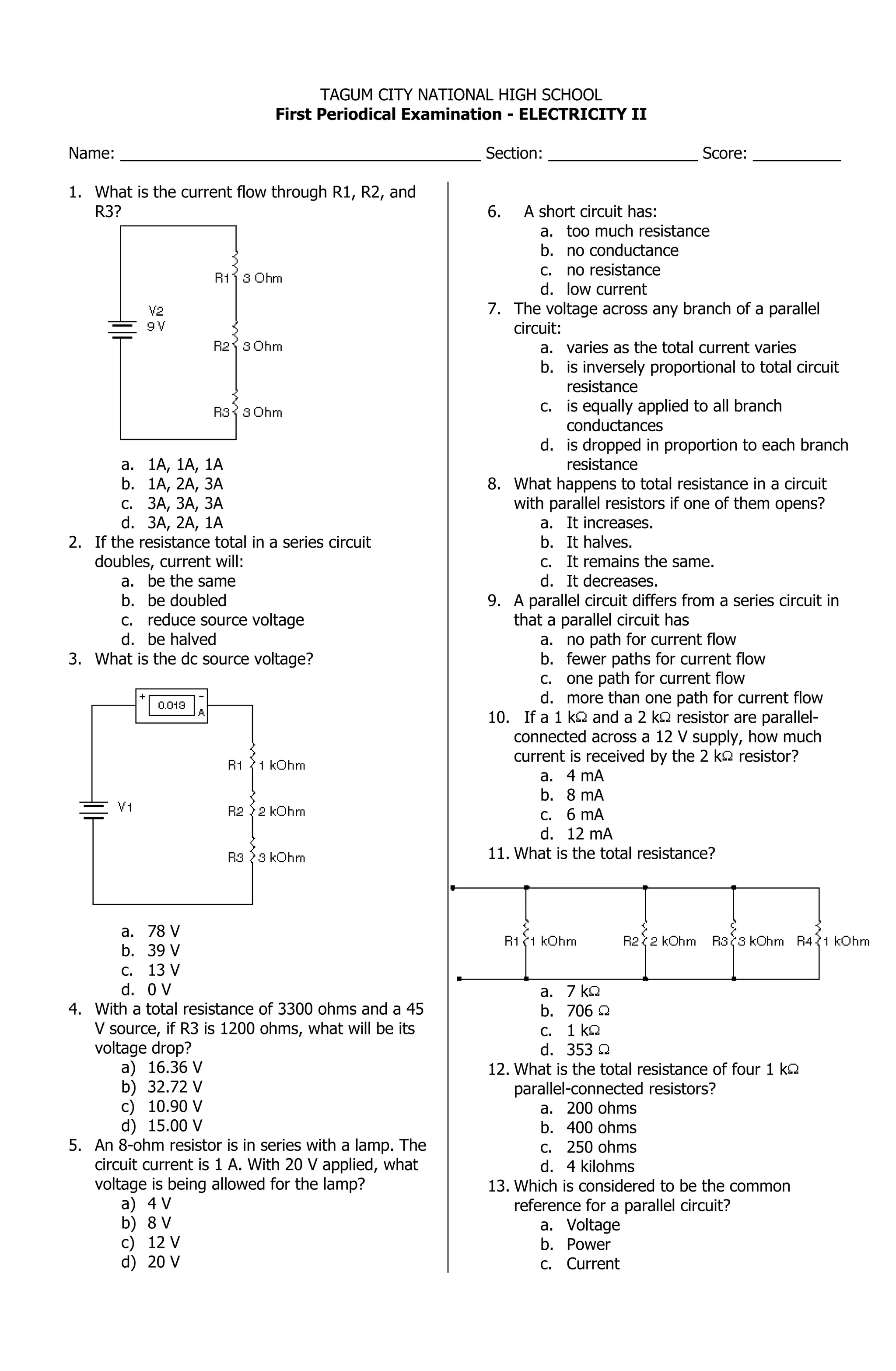
1. What is the current flow through R1, R2, and
R3?
a. 1A, 1A, 1A
b. 1A, 2A, 3A
c. 3A, 3A, 3A
d. 3A, 2A, 1A
2. If the resistance total in a series circuit
doubles, current will:
a. be the same
b. be doubled
c. reduce source voltage
d. be halved
3. What is the dc source voltage?
a. 78 V
b. 39 V
c. 13 V
d. 0 V
4. With a total resistance of 3300 ohms and a 45
V source, if R3 is 1200 ohms, what will be its
voltage drop?
a) 16.36 V
b) 32.72 V
c) 10.90 V
d) 15.00 V
5. An 8-ohm resistor is in series with a lamp. The
circuit current is 1 A. With 20 V applied, what
voltage is being allowed for the lamp?
a) 4 V
b) 8 V
c) 12 V
d) 20 V
6. A short circuit has:
a. too much resistance
b. no conductance
c. no resistance
d. low current
7. The voltage across any branch of a parallel
circuit:
a. varies as the total current varies
b. is inversely proportional to total circuit
resistance
c. is equally applied to all branch
conductances
d. is dropped in proportion to each branch
resistance
8. What happens to total resistance in a circuit
with parallel resistors if one of them opens?
a. It increases.
b. It halves.
c. It remains the same.
d. It decreases.
9. A parallel circuit differs from a series circuit in
that a parallel circuit has
a. no path for current flow
b. fewer paths for current flow
c. one path for current flow
d. more than one path for current flow
10. If a 1 k and a 2 k resistor are parallel-
connected across a 12 V supply, how much
current is received by the 2 k resistor?
a. 4 mA
b. 8 mA
c. 6 mA
d. 12 mA
11. What is the total resistance?
a. 7 k
b. 706
c. 1 k
d. 353
12. What is the total resistance of four 1 k
parallel-connected resistors?
a. 200 ohms
b. 400 ohms
c. 250 ohms
d. 4 kilohms
13. Which is considered to be the common
reference for a parallel circuit?
a. Voltage
b. Power
c. Current
d. Resistance
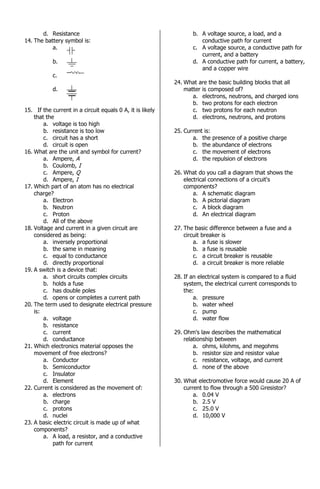
14. The battery symbol is:
a.
b.
c.
d.
15. If the current in a circuit equals 0 A, it is likely
that the
a. voltage is too high
b. resistance is too low
c. circuit has a short
d. circuit is open
16. What are the unit and symbol for current?
a. Ampere, A
b. Coulomb, I
c. Ampere, Q
d. Ampere, I
17. Which part of an atom has no electrical
charge?
a. Electron
b. Neutron
c. Proton
d. All of the above
18. Voltage and current in a given circuit are
considered as being:
a. inversely proportional
b. the same in meaning
c. equal to conductance
d. directly proportional
19. A switch is a device that:
a. short circuits complex circuits
b. holds a fuse
c. has double poles
d. opens or completes a current path
20. The term used to designate electrical pressure
is:
a. voltage
b. resistance
c. current
d. conductance
21. Which electronics material opposes the
movement of free electrons?
a. Conductor
b. Semiconductor
c. Insulator
d. Element
22. Current is considered as the movement of:
a. electrons
b. charge
c. protons
d. nuclei
23. A basic electric circuit is made up of what
components?
a. A load, a resistor, and a conductive
path for current
b. A voltage source, a load, and a
conductive path for current
c. A voltage source, a conductive path for
current, and a battery
d. A conductive path for current, a battery,
and a copper wire
24. What are the basic building blocks that all
matter is composed of?
a. electrons, neutrons, and charged ions
b. two protons for each electron
c. two protons for each neutron
d. electrons, neutrons, and protons
25. Current is:
a. the presence of a positive charge
b. the abundance of electrons
c. the movement of electrons
d. the repulsion of electrons
26. What do you call a diagram that shows the
electrical connections of a circuit's
components?
a. A schematic diagram
b. A pictorial diagram
c. A block diagram
d. An electrical diagram
27. The basic difference between a fuse and a
circuit breaker is
a. a fuse is slower
b. a fuse is reusable
c. a circuit breaker is reusable
d. a circuit breaker is more reliable
28. If an electrical system is compared to a fluid
system, the electrical current corresponds to
the:
a. pressure
b. water wheel
c. pump
d. water flow
29. Ohm's law describes the mathematical
relationship between
a. ohms, kilohms, and megohms
b. resistor size and resistor value
c. resistance, voltage, and current
d. none of the above
30. What electromotive force would cause 20 A of
current to flow through a 500 resistor?
a. 0.04 V
b. 2.5 V
c. 25.0 V
d. 10,000 V
PART II – Draw the schematic symbols of the following:
1. Switch
2. Battery
3. Fuse
4. Bulb
5. lines connected
6. battery
7. resistor
8. lines not connected
9. circuit breaker
10. ground
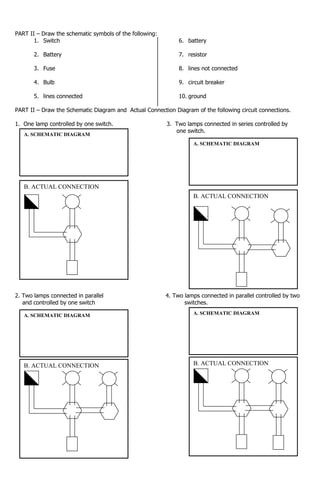
PART II – Draw the Schematic Diagram and Actual Connection Diagram of the following circuit connections.
1. One lamp controlled by one switch. 3. Two lamps connected in series controlled by
one switch.
2. Two lamps connected in parallel 4. Two lamps connected in parallel controlled by two
and controlled by one switch switches.
A. SCHEMATIC DIAGRAM
B. ACTUAL CONNECTION
A. SCHEMATIC DIAGRAM
B. ACTUAL CONNECTIONB. ACTUAL CONNECTION
B. ACTUAL CONNECTION

Fist periodical exam 2011 elec

  • 1.
    TAGUM CITY NATIONALHIGH SCHOOL First Periodical Examination - ELECTRICITY II Name: _________________________________________ Section: _________________ Score: __________ 1. What is the current flow through R1, R2, and R3? a. 1A, 1A, 1A b. 1A, 2A, 3A c. 3A, 3A, 3A d. 3A, 2A, 1A 2. If the resistance total in a series circuit doubles, current will: a. be the same b. be doubled c. reduce source voltage d. be halved 3. What is the dc source voltage? a. 78 V b. 39 V c. 13 V d. 0 V 4. With a total resistance of 3300 ohms and a 45 V source, if R3 is 1200 ohms, what will be its voltage drop? a) 16.36 V b) 32.72 V c) 10.90 V d) 15.00 V 5. An 8-ohm resistor is in series with a lamp. The circuit current is 1 A. With 20 V applied, what voltage is being allowed for the lamp? a) 4 V b) 8 V c) 12 V d) 20 V 6. A short circuit has: a. too much resistance b. no conductance c. no resistance d. low current 7. The voltage across any branch of a parallel circuit: a. varies as the total current varies b. is inversely proportional to total circuit resistance c. is equally applied to all branch conductances d. is dropped in proportion to each branch resistance 8. What happens to total resistance in a circuit with parallel resistors if one of them opens? a. It increases. b. It halves. c. It remains the same. d. It decreases. 9. A parallel circuit differs from a series circuit in that a parallel circuit has a. no path for current flow b. fewer paths for current flow c. one path for current flow d. more than one path for current flow 10. If a 1 k and a 2 k resistor are parallel- connected across a 12 V supply, how much current is received by the 2 k resistor? a. 4 mA b. 8 mA c. 6 mA d. 12 mA 11. What is the total resistance? a. 7 k b. 706 c. 1 k d. 353 12. What is the total resistance of four 1 k parallel-connected resistors? a. 200 ohms b. 400 ohms c. 250 ohms d. 4 kilohms 13. Which is considered to be the common reference for a parallel circuit? a. Voltage b. Power c. Current
  • 2.
    d. Resistance 14. Thebattery symbol is: a. b. c. d. 15. If the current in a circuit equals 0 A, it is likely that the a. voltage is too high b. resistance is too low c. circuit has a short d. circuit is open 16. What are the unit and symbol for current? a. Ampere, A b. Coulomb, I c. Ampere, Q d. Ampere, I 17. Which part of an atom has no electrical charge? a. Electron b. Neutron c. Proton d. All of the above 18. Voltage and current in a given circuit are considered as being: a. inversely proportional b. the same in meaning c. equal to conductance d. directly proportional 19. A switch is a device that: a. short circuits complex circuits b. holds a fuse c. has double poles d. opens or completes a current path 20. The term used to designate electrical pressure is: a. voltage b. resistance c. current d. conductance 21. Which electronics material opposes the movement of free electrons? a. Conductor b. Semiconductor c. Insulator d. Element 22. Current is considered as the movement of: a. electrons b. charge c. protons d. nuclei 23. A basic electric circuit is made up of what components? a. A load, a resistor, and a conductive path for current b. A voltage source, a load, and a conductive path for current c. A voltage source, a conductive path for current, and a battery d. A conductive path for current, a battery, and a copper wire 24. What are the basic building blocks that all matter is composed of? a. electrons, neutrons, and charged ions b. two protons for each electron c. two protons for each neutron d. electrons, neutrons, and protons 25. Current is: a. the presence of a positive charge b. the abundance of electrons c. the movement of electrons d. the repulsion of electrons 26. What do you call a diagram that shows the electrical connections of a circuit's components? a. A schematic diagram b. A pictorial diagram c. A block diagram d. An electrical diagram 27. The basic difference between a fuse and a circuit breaker is a. a fuse is slower b. a fuse is reusable c. a circuit breaker is reusable d. a circuit breaker is more reliable 28. If an electrical system is compared to a fluid system, the electrical current corresponds to the: a. pressure b. water wheel c. pump d. water flow 29. Ohm's law describes the mathematical relationship between a. ohms, kilohms, and megohms b. resistor size and resistor value c. resistance, voltage, and current d. none of the above 30. What electromotive force would cause 20 A of current to flow through a 500 resistor? a. 0.04 V b. 2.5 V c. 25.0 V d. 10,000 V
  • 3.
    PART II –Draw the schematic symbols of the following: 1. Switch 2. Battery 3. Fuse 4. Bulb 5. lines connected 6. battery 7. resistor 8. lines not connected 9. circuit breaker 10. ground PART II – Draw the Schematic Diagram and Actual Connection Diagram of the following circuit connections. 1. One lamp controlled by one switch. 3. Two lamps connected in series controlled by one switch. 2. Two lamps connected in parallel 4. Two lamps connected in parallel controlled by two and controlled by one switch switches. A. SCHEMATIC DIAGRAM A. SCHEMATIC DIAGRAM B. ACTUAL CONNECTION A. SCHEMATIC DIAGRAM A. SCHEMATIC DIAGRAM B. ACTUAL CONNECTIONB. ACTUAL CONNECTION B. ACTUAL CONNECTION