Sino-Japanese Island Dispute
September 20, 2012

Ashley D.


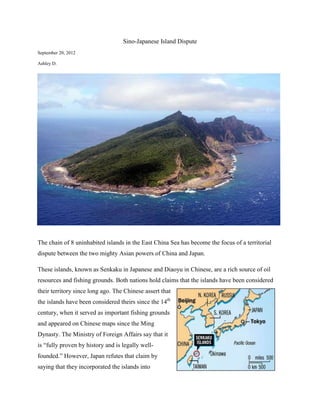
The chain of 8 uninhabited islands in the East China Sea has become the focus of a territorial
dispute between the two mighty Asian powers of China and Japan.

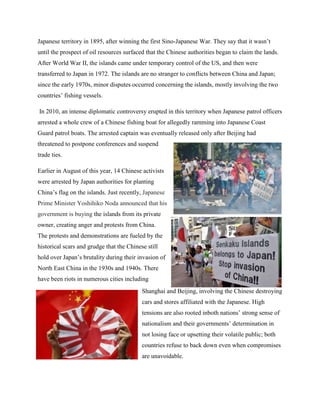
These islands, known as Senkaku in Japanese and Diaoyu in Chinese, are a rich source of oil
resources and fishing grounds. Both nations hold claims that the islands have been considered
their territory since long ago. The Chinese assert that
the islands have been considered theirs since the 14th
century, when it served as important fishing grounds
and appeared on Chinese maps since the Ming
Dynasty. The Ministry of Foreign Affairs say that it
is “fully proven by history and is legally well-
founded.” However, Japan refutes that claim by
saying that they incorporated the islands into
Japanese territory in 1895, after winning the first Sino-Japanese War. They say that it wasn’t
until the prospect of oil resources surfaced that the Chinese authorities began to claim the lands.
After World War II, the islands came under temporary control of the US, and then were
transferred to Japan in 1972. The islands are no stranger to conflicts between China and Japan;
since the early 1970s, minor disputes occurred concerning the islands, mostly involving the two
countries’ fishing vessels.

In 2010, an intense diplomatic controversy erupted in this territory when Japanese patrol officers
arrested a whole crew of a Chinese fishing boat for allegedly ramming into Japanese Coast
Guard patrol boats. The arrested captain was eventually released only after Beijing had
threatened to postpone conferences and suspend
trade ties.

Earlier in August of this year, 14 Chinese activists
were arrested by Japan authorities for planting
China’s flag on the islands. Just recently, Japanese
Prime Minister Yoshihiko Noda announced that his
government is buying the islands from its private
owner, creating anger and protests from China.
The protests and demonstrations are fueled by the
historical scars and grudge that the Chinese still
hold over Japan’s brutality during their invasion of
North East China in the 1930s and 1940s. There
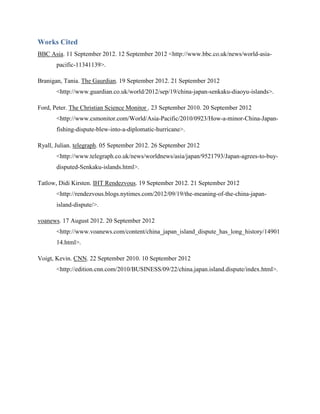
have been riots in numerous cities including
                                           Shanghai and Beijing, involving the Chinese destroying
                                           cars and stores affiliated with the Japanese. High
                                           tensions are also rooted inboth nations’ strong sense of
                                           nationalism and their governments’ determination in
                                           not losing face or upsetting their volatile public; both
                                           countries refuse to back down even when compromises
                                           are unavoidable.
Currently, tension is still high as the dispute has shown no sign of improvement even after the
countries underwent negotiations and high-level meetings to ease tension.
Works Cited
BBC Asia. 11 September 2012. 12 September 2012 <http://www.bbc.co.uk/news/world-asia-
       pacific-11341139>.

Branigan, Tania. The Gaurdian. 19 September 2012. 21 September 2012
       <http://www.guardian.co.uk/world/2012/sep/19/china-japan-senkaku-diaoyu-islands>.

Ford, Peter. The Christian Science Monitor . 23 September 2010. 20 September 2012
       <http://www.csmonitor.com/World/Asia-Pacific/2010/0923/How-a-minor-China-Japan-
       fishing-dispute-blew-into-a-diplomatic-hurricane>.

Ryall, Julian. telegraph. 05 September 2012. 26 September 2012
       <http://www.telegraph.co.uk/news/worldnews/asia/japan/9521793/Japan-agrees-to-buy-
       disputed-Senkaku-islands.html>.

Tatlow, Didi Kirsten. IHT Rendezvous. 19 September 2012. 21 September 2012
       <http://rendezvous.blogs.nytimes.com/2012/09/19/the-meaning-of-the-china-japan-
       island-dispute/>.

voanews. 17 August 2012. 20 September 2012
       <http://www.voanews.com/content/china_japan_island_dispute_has_long_history/14901
       14.html>.

Voigt, Kevin. CNN. 22 September 2010. 10 September 2012
       <http://edition.cnn.com/2010/BUSINESS/09/22/china.japan.island.dispute/index.html>.

Sino-Japanese Island Dispute

  • 1.
    Sino-Japanese Island Dispute September20, 2012 Ashley D. The chain of 8 uninhabited islands in the East China Sea has become the focus of a territorial dispute between the two mighty Asian powers of China and Japan. These islands, known as Senkaku in Japanese and Diaoyu in Chinese, are a rich source of oil resources and fishing grounds. Both nations hold claims that the islands have been considered their territory since long ago. The Chinese assert that the islands have been considered theirs since the 14th century, when it served as important fishing grounds and appeared on Chinese maps since the Ming Dynasty. The Ministry of Foreign Affairs say that it is “fully proven by history and is legally well- founded.” However, Japan refutes that claim by saying that they incorporated the islands into
  • 2.
    Japanese territory in1895, after winning the first Sino-Japanese War. They say that it wasn’t until the prospect of oil resources surfaced that the Chinese authorities began to claim the lands. After World War II, the islands came under temporary control of the US, and then were transferred to Japan in 1972. The islands are no stranger to conflicts between China and Japan; since the early 1970s, minor disputes occurred concerning the islands, mostly involving the two countries’ fishing vessels. In 2010, an intense diplomatic controversy erupted in this territory when Japanese patrol officers arrested a whole crew of a Chinese fishing boat for allegedly ramming into Japanese Coast Guard patrol boats. The arrested captain was eventually released only after Beijing had threatened to postpone conferences and suspend trade ties. Earlier in August of this year, 14 Chinese activists were arrested by Japan authorities for planting China’s flag on the islands. Just recently, Japanese Prime Minister Yoshihiko Noda announced that his government is buying the islands from its private owner, creating anger and protests from China. The protests and demonstrations are fueled by the historical scars and grudge that the Chinese still hold over Japan’s brutality during their invasion of North East China in the 1930s and 1940s. There have been riots in numerous cities including Shanghai and Beijing, involving the Chinese destroying cars and stores affiliated with the Japanese. High tensions are also rooted inboth nations’ strong sense of nationalism and their governments’ determination in not losing face or upsetting their volatile public; both countries refuse to back down even when compromises are unavoidable.
  • 3.
    Currently, tension isstill high as the dispute has shown no sign of improvement even after the countries underwent negotiations and high-level meetings to ease tension.
  • 4.
    Works Cited BBC Asia.11 September 2012. 12 September 2012 <http://www.bbc.co.uk/news/world-asia- pacific-11341139>. Branigan, Tania. The Gaurdian. 19 September 2012. 21 September 2012 <http://www.guardian.co.uk/world/2012/sep/19/china-japan-senkaku-diaoyu-islands>. Ford, Peter. The Christian Science Monitor . 23 September 2010. 20 September 2012 <http://www.csmonitor.com/World/Asia-Pacific/2010/0923/How-a-minor-China-Japan- fishing-dispute-blew-into-a-diplomatic-hurricane>. Ryall, Julian. telegraph. 05 September 2012. 26 September 2012 <http://www.telegraph.co.uk/news/worldnews/asia/japan/9521793/Japan-agrees-to-buy- disputed-Senkaku-islands.html>. Tatlow, Didi Kirsten. IHT Rendezvous. 19 September 2012. 21 September 2012 <http://rendezvous.blogs.nytimes.com/2012/09/19/the-meaning-of-the-china-japan- island-dispute/>. voanews. 17 August 2012. 20 September 2012 <http://www.voanews.com/content/china_japan_island_dispute_has_long_history/14901 14.html>. Voigt, Kevin. CNN. 22 September 2010. 10 September 2012 <http://edition.cnn.com/2010/BUSINESS/09/22/china.japan.island.dispute/index.html>.