Fiscal Policy
Meaning of FP
The purpose of Fiscal Policy
Expansionary (or loose) Fiscal Policy
Deflationary (or tight) Fiscal Policy
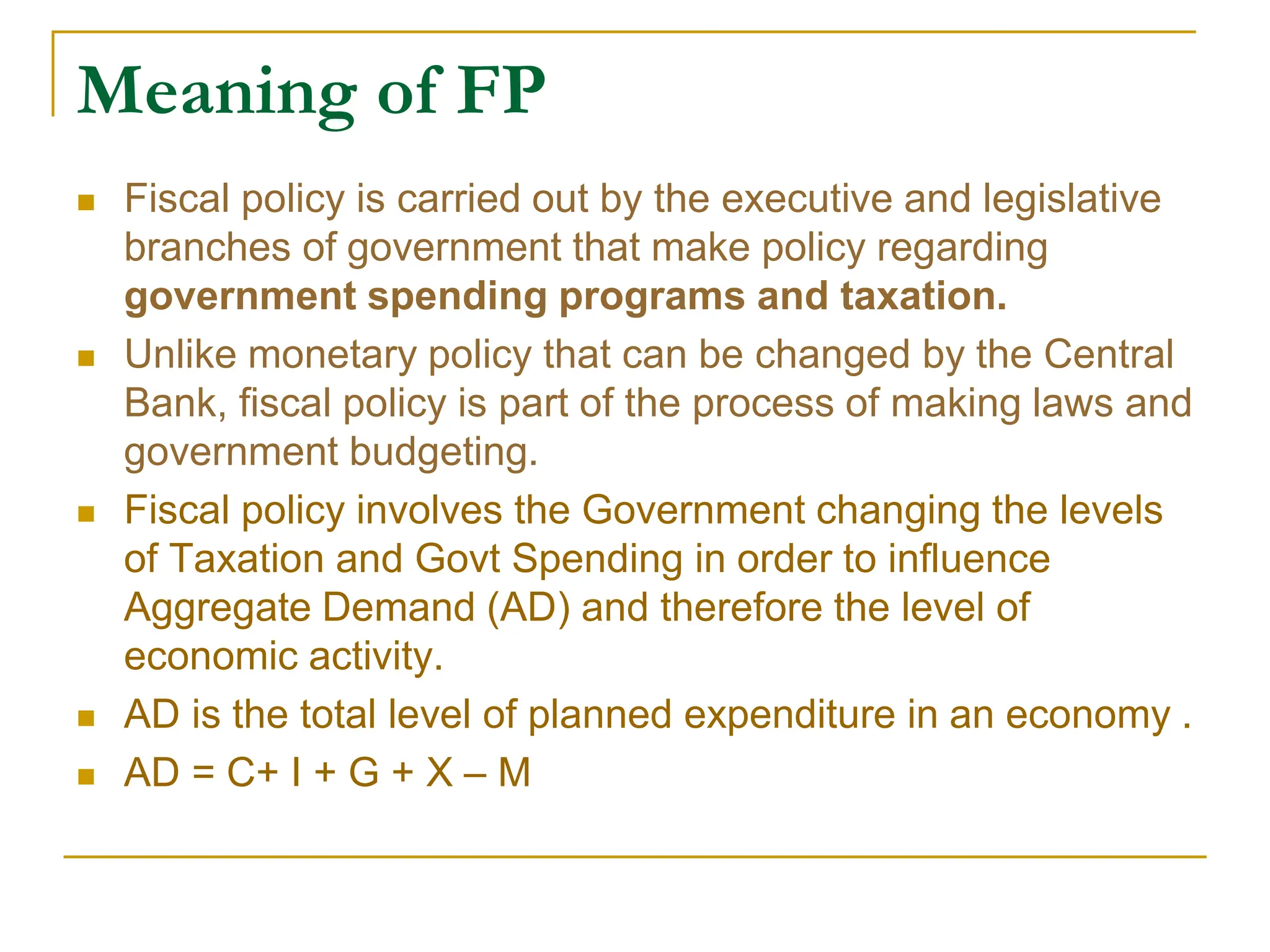
Meaning of FP
 Fiscal policy is carried out by the executive and legislative
branches of government that make policy regarding
government spending programs and taxation.
 Unlike monetary policy that can be changed by the Central
Bank, fiscal policy is part of the process of making laws and
government budgeting.
 Fiscal policy involves the Government changing the levels
of Taxation and Govt Spending in order to influence
Aggregate Demand (AD) and therefore the level of
economic activity.
 AD is the total level of planned expenditure in an economy .
 AD = C+ I + G + X – M
The purpose of Fiscal Policy
 Reduce the rate of inflation
 Stimulate economic growth in a
period of a recession.
 aims to stabilise economic growth,
avoiding the boom and bust of
economic cycle.
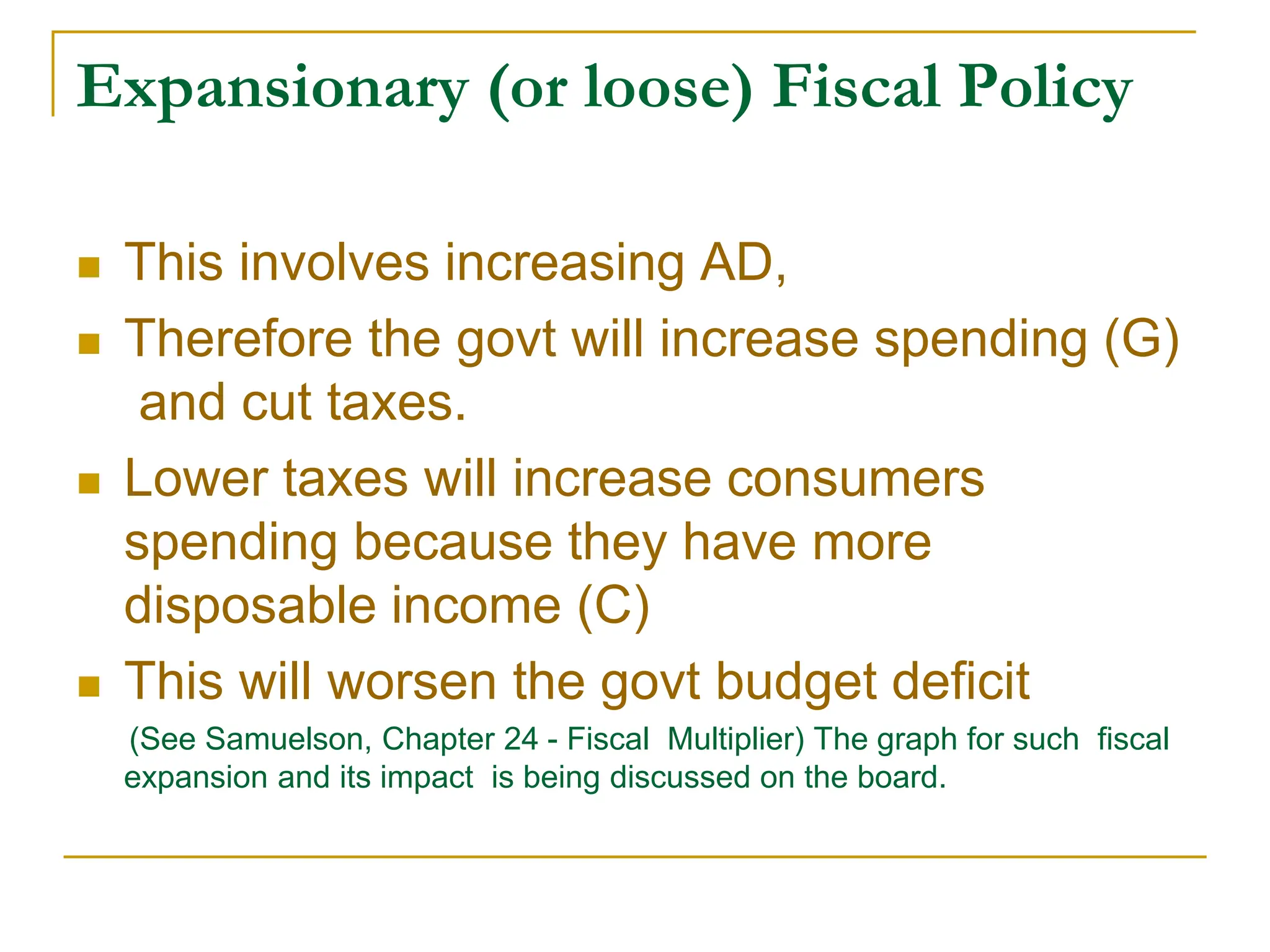
Expansionary (or loose) Fiscal Policy
 This involves increasing AD,
 Therefore the govt will increase spending (G)
and cut taxes.
 Lower taxes will increase consumers
spending because they have more
disposable income (C)
 This will worsen the govt budget deficit
(See Samuelson, Chapter 24 - Fiscal Multiplier) The graph for such fiscal
expansion and its impact is being discussed on the board.
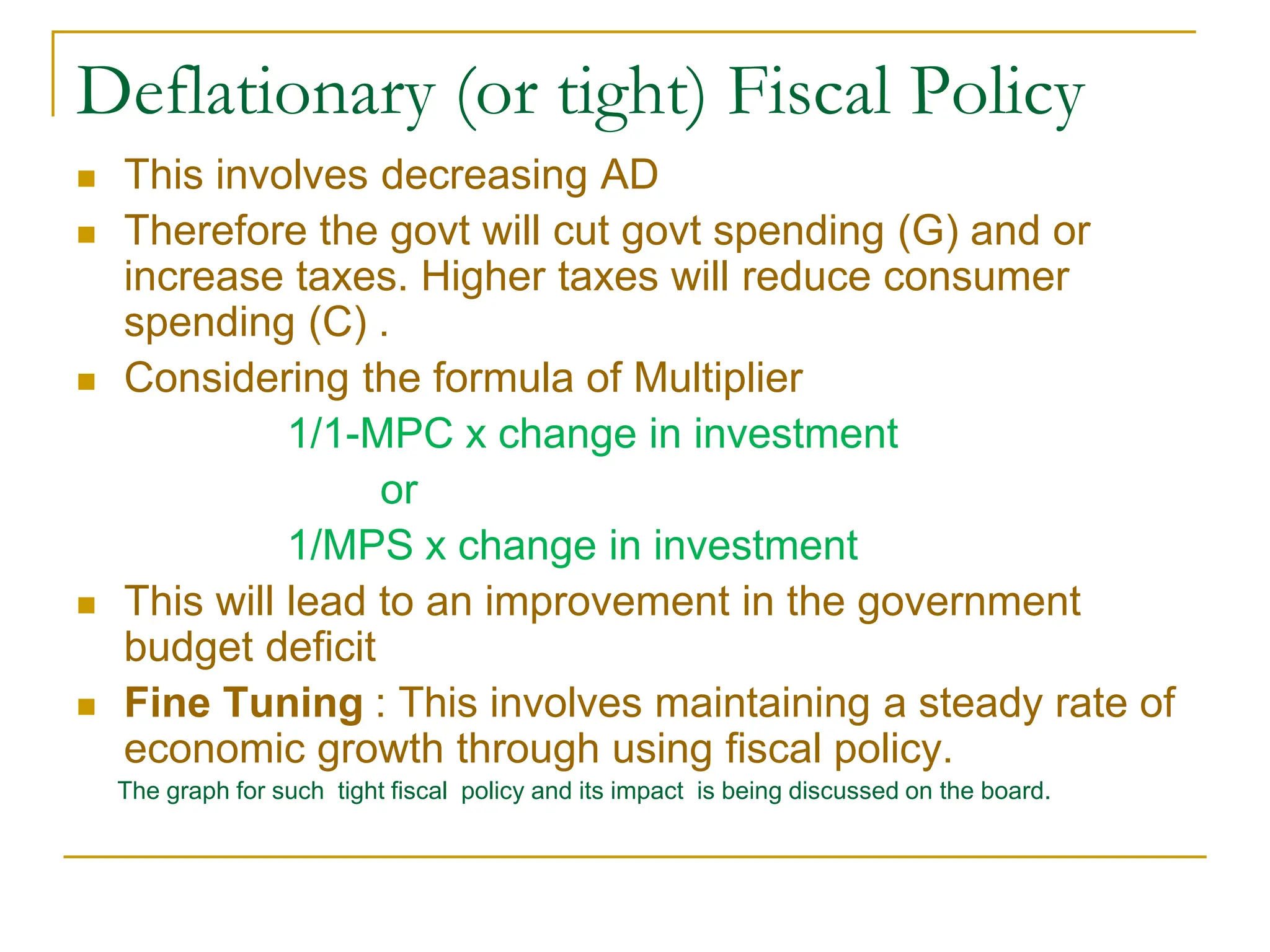
Deflationary (or tight) Fiscal Policy
 This involves decreasing AD
 Therefore the govt will cut govt spending (G) and or
increase taxes. Higher taxes will reduce consumer
spending (C) .
 Considering the formula of Multiplier
1/1-MPC x change in investment
or
1/MPS x change in investment
 This will lead to an improvement in the government
budget deficit
 Fine Tuning : This involves maintaining a steady rate of
economic growth through using fiscal policy.
The graph for such tight fiscal policy and its impact is being discussed on the board.

Fiscal Policy in detail in macroeconomics.ppt

  • 1.
    Fiscal Policy Meaning ofFP The purpose of Fiscal Policy Expansionary (or loose) Fiscal Policy Deflationary (or tight) Fiscal Policy
  • 2.
    Meaning of FP Fiscal policy is carried out by the executive and legislative branches of government that make policy regarding government spending programs and taxation.  Unlike monetary policy that can be changed by the Central Bank, fiscal policy is part of the process of making laws and government budgeting.  Fiscal policy involves the Government changing the levels of Taxation and Govt Spending in order to influence Aggregate Demand (AD) and therefore the level of economic activity.  AD is the total level of planned expenditure in an economy .  AD = C+ I + G + X – M
  • 3.
    The purpose ofFiscal Policy  Reduce the rate of inflation  Stimulate economic growth in a period of a recession.  aims to stabilise economic growth, avoiding the boom and bust of economic cycle.
  • 4.
    Expansionary (or loose)Fiscal Policy  This involves increasing AD,  Therefore the govt will increase spending (G) and cut taxes.  Lower taxes will increase consumers spending because they have more disposable income (C)  This will worsen the govt budget deficit (See Samuelson, Chapter 24 - Fiscal Multiplier) The graph for such fiscal expansion and its impact is being discussed on the board.
  • 5.
    Deflationary (or tight)Fiscal Policy  This involves decreasing AD  Therefore the govt will cut govt spending (G) and or increase taxes. Higher taxes will reduce consumer spending (C) .  Considering the formula of Multiplier 1/1-MPC x change in investment or 1/MPS x change in investment  This will lead to an improvement in the government budget deficit  Fine Tuning : This involves maintaining a steady rate of economic growth through using fiscal policy. The graph for such tight fiscal policy and its impact is being discussed on the board.