Women in Literature
Reading Through The Ages
What this course is about
When I was thinking about designing this course, I
realized the importance that literature has on
socializing us from childhood onward. I realized that
I was introduced concepts of gender identity from
the time I was old enough to be read to and to watch
movies. The first movie that I remember seeing was
Snow White and the Seven Dwarfs. I was fascinated
by it, so much so that as an adult, I started taking and
then teaching courses in children’s literature and and
mythology and folklore.
 That was one of my first experiences with gender cultural
norms that I learned from literature. So I thought I’d start
with folktales. From there, I went on to thinking about my
experiences with reading on my own, through young adult
fiction and then later, through literature about women as they
go through the cycles of children, young women, women,
middle-aged and old women. Men of course are not
excluded from this socialization as they react to what they
read and see and as they learn about cultural expectations for
them. So I decided to continue on with a piece of young adult
fiction.
Then it followed that I would choose pieces about people
according to what we read chronologically and how we
are represented. So this course is called reading through
the ages as that will be exactly what we are doing,
reading through the stages of our lives and we examine
what we read in the various stages of our lives and what
we learn about cultural expectations of people through
representations of them in literature.
Course Readings
 The stories and essays that are required for this course are found in the
course reader. You should bring it to every class as we will be discussing
the essays we are reading for criticism as well as the stories on the days
they are assigned.
Representations of women to children
through folktales
Most of us grow up learning about the roles of girls, young
women, men, parents and children, love and marriage and
expressions of femininity and masculinity through folktales. They
are presented to us through films and stories as well as the toys
we play with and the games we play. Our earliest conceptions of
identity are often influenced by the notions of what is good and
what is evil and what is desirable for girls and boys, men and
women as represented in the folktales we see and hear. They are
universal and exist in so many multiple forms in so many cultures
that they have become serious areas of study in academia. We
will spend the first part of the quarter looking at what they teach
us and what we accept or have to learn to overcome.
Young Adult Fiction
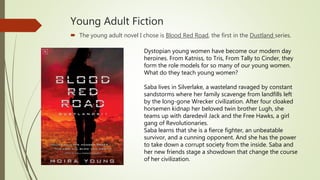
 The young adult novel I chose is Blood Red Road, the first in the Dustland series.
Dystopian young women have become our modern day
heroines. From Katniss, to Tris, From Tally to Cinder, they
form the role models for so many of our young women.
What do they teach young women?
Saba lives in Silverlake, a wasteland ravaged by constant
sandstorms where her family scavenge from landfills left
by the long-gone Wrecker civilization. After four cloaked
horsemen kidnap her beloved twin brother Lugh, she
teams up with daredevil Jack and the Free Hawks, a girl
gang of Revolutionaries.
Saba learns that she is a fierce fighter, an unbeatable
survivor, and a cunning opponent. And she has the power
to take down a corrupt society from the inside. Saba and
her new friends stage a showdown that change the course
of her civilization.
Young and middle-aged women
 One of the texts that I chose for this section Is The Joy Luck Club
Through a series of flashbacks, four young Chinese
women born in America and their respective mothers
born in feudal China, explore their past. This search will
help them understand their difficult mother/daughter
relationship. Through this book and several other short
stories we will examine the importance of the
mother/daughter experience from both perspectives
and how that affects them, as well as their relationships
with the men in their lives. We will also be reading a
number of short stories that reflect women and various
cultural norms and how they influence us.
Women of Color, Lesbians and Gays in fiction.
What do we learn about patriarchy and
feminism in short stories and poems?
 Parturition Mina Loy
 The Moths Helen Maria Viramonte
 The Ruins Patrica Preciado Martin
 Kiswana Browne Gloria Naylor
 Everyday Use Alice Walker
 We Might as Well Be Strangers M.E. Kerr
 The Honorary Shepherds Gregory Maguire
Old Women
 One of my favorite writers is Tillie Olsen, and we will be ending with a novella
called Tell Me a Riddle.
Like many of Olsen's stories, Tell Me a Riddle grapples with a multitude
of voices. Although Eva is ostensibly the main character of the narrative,
the reader also sympathizes with David, largely because we receive such
insight into both of their struggles. Their children are also given voices
from the outset - when they hear of the marital troubles their parents are
undergoing, almost every single child comments on the behavior,
revealing something about their personalities and attitudes. As she often
does, Olsen accomplishes this multiplicity not through a traditional use of
dialogue, but by frequently shifting the perspective, often without any
explicit transition between one character and the next.
However, Eva remains thematically central to this idea, particularly
because she has spent a lifetime sacrificing her voice and identity in order
to be a mother to her seven children
Exercise: In groups of 4 (or so) Please take notes
and learn each other’s names.
 Discuss what we mean by the concept sisterhood. What immediately comes to
mind when you hear the word? What are the definitions of the word for you and
what are the characteristics of a sisterhood. Do we create sisterhood or does it
already exist? Are all women included in the sisterhood? Should they be? Why or
why not?
 Now discuss what we mean by the concept brotherhood. What immediately comes
to mind when you hear the word? What are the definitions of the word for you and
what are the characteristics of brotherhood. Do we create brotherhood or does it
already exist? Are all men included in the sisterhood? Should they be? Why or
why not?
Homework:
 Buy books for the class. You may want to start reading Dustlands: Blood Red Road
sooner than it is assigned. I will be assigning 100 +pages a week and although it’s
a fast read, you might want to get started in advance.
 Read Lois Tyson’s “Feminist Criticism.” Take notes as you read about the important
points she makes about feminist criticism. Highlight points that she makes abut
feminism and patriarchy as well as wny other points that interest you. We will be
using this often in class so make sure you keep your copy.

First class

  • 1.
  • 2.
    What this courseis about When I was thinking about designing this course, I realized the importance that literature has on socializing us from childhood onward. I realized that I was introduced concepts of gender identity from the time I was old enough to be read to and to watch movies. The first movie that I remember seeing was Snow White and the Seven Dwarfs. I was fascinated by it, so much so that as an adult, I started taking and then teaching courses in children’s literature and and mythology and folklore.
  • 3.
     That wasone of my first experiences with gender cultural norms that I learned from literature. So I thought I’d start with folktales. From there, I went on to thinking about my experiences with reading on my own, through young adult fiction and then later, through literature about women as they go through the cycles of children, young women, women, middle-aged and old women. Men of course are not excluded from this socialization as they react to what they read and see and as they learn about cultural expectations for them. So I decided to continue on with a piece of young adult fiction.
  • 4.
    Then it followedthat I would choose pieces about people according to what we read chronologically and how we are represented. So this course is called reading through the ages as that will be exactly what we are doing, reading through the stages of our lives and we examine what we read in the various stages of our lives and what we learn about cultural expectations of people through representations of them in literature.
  • 5.
    Course Readings  Thestories and essays that are required for this course are found in the course reader. You should bring it to every class as we will be discussing the essays we are reading for criticism as well as the stories on the days they are assigned.
  • 6.
    Representations of womento children through folktales Most of us grow up learning about the roles of girls, young women, men, parents and children, love and marriage and expressions of femininity and masculinity through folktales. They are presented to us through films and stories as well as the toys we play with and the games we play. Our earliest conceptions of identity are often influenced by the notions of what is good and what is evil and what is desirable for girls and boys, men and women as represented in the folktales we see and hear. They are universal and exist in so many multiple forms in so many cultures that they have become serious areas of study in academia. We will spend the first part of the quarter looking at what they teach us and what we accept or have to learn to overcome.
  • 7.
    Young Adult Fiction The young adult novel I chose is Blood Red Road, the first in the Dustland series. Dystopian young women have become our modern day heroines. From Katniss, to Tris, From Tally to Cinder, they form the role models for so many of our young women. What do they teach young women? Saba lives in Silverlake, a wasteland ravaged by constant sandstorms where her family scavenge from landfills left by the long-gone Wrecker civilization. After four cloaked horsemen kidnap her beloved twin brother Lugh, she teams up with daredevil Jack and the Free Hawks, a girl gang of Revolutionaries. Saba learns that she is a fierce fighter, an unbeatable survivor, and a cunning opponent. And she has the power to take down a corrupt society from the inside. Saba and her new friends stage a showdown that change the course of her civilization.
  • 8.
    Young and middle-agedwomen  One of the texts that I chose for this section Is The Joy Luck Club Through a series of flashbacks, four young Chinese women born in America and their respective mothers born in feudal China, explore their past. This search will help them understand their difficult mother/daughter relationship. Through this book and several other short stories we will examine the importance of the mother/daughter experience from both perspectives and how that affects them, as well as their relationships with the men in their lives. We will also be reading a number of short stories that reflect women and various cultural norms and how they influence us.
  • 9.
    Women of Color,Lesbians and Gays in fiction. What do we learn about patriarchy and feminism in short stories and poems?  Parturition Mina Loy  The Moths Helen Maria Viramonte  The Ruins Patrica Preciado Martin  Kiswana Browne Gloria Naylor  Everyday Use Alice Walker  We Might as Well Be Strangers M.E. Kerr  The Honorary Shepherds Gregory Maguire
  • 10.
    Old Women  Oneof my favorite writers is Tillie Olsen, and we will be ending with a novella called Tell Me a Riddle. Like many of Olsen's stories, Tell Me a Riddle grapples with a multitude of voices. Although Eva is ostensibly the main character of the narrative, the reader also sympathizes with David, largely because we receive such insight into both of their struggles. Their children are also given voices from the outset - when they hear of the marital troubles their parents are undergoing, almost every single child comments on the behavior, revealing something about their personalities and attitudes. As she often does, Olsen accomplishes this multiplicity not through a traditional use of dialogue, but by frequently shifting the perspective, often without any explicit transition between one character and the next. However, Eva remains thematically central to this idea, particularly because she has spent a lifetime sacrificing her voice and identity in order to be a mother to her seven children
  • 11.
    Exercise: In groupsof 4 (or so) Please take notes and learn each other’s names.  Discuss what we mean by the concept sisterhood. What immediately comes to mind when you hear the word? What are the definitions of the word for you and what are the characteristics of a sisterhood. Do we create sisterhood or does it already exist? Are all women included in the sisterhood? Should they be? Why or why not?  Now discuss what we mean by the concept brotherhood. What immediately comes to mind when you hear the word? What are the definitions of the word for you and what are the characteristics of brotherhood. Do we create brotherhood or does it already exist? Are all men included in the sisterhood? Should they be? Why or why not?
  • 12.
    Homework:  Buy booksfor the class. You may want to start reading Dustlands: Blood Red Road sooner than it is assigned. I will be assigning 100 +pages a week and although it’s a fast read, you might want to get started in advance.  Read Lois Tyson’s “Feminist Criticism.” Take notes as you read about the important points she makes about feminist criticism. Highlight points that she makes abut feminism and patriarchy as well as wny other points that interest you. We will be using this often in class so make sure you keep your copy.