“Do not open these
books”
Women and girls as
readers
Mercedes Arriaga Flórez
University of Seville
marriaga@us.es
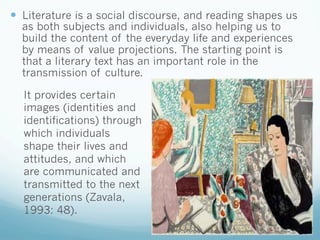
—  Literature is a social discourse, and reading shapes us
as both subjects and individuals, also helping us to
build the content of the everyday life and experiences
by means of value projections. The starting point is
that a literary text has an important role in the
transmission of culture.
It provides certain
images (identities and
identifications) through
which individuals
shape their lives and
attitudes, and which
are communicated and
transmitted to the next
generations (Zavala,
1993: 48).
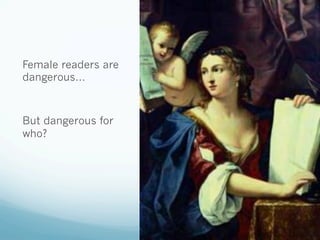
Female readers are
dangerous…
But dangerous for
who?
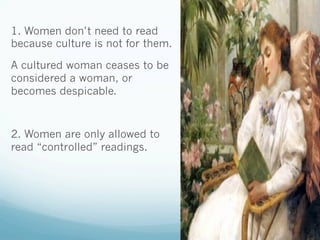
1. Women don’t need to read
because culture is not for them.
A cultured woman ceases to be
considered a woman, or
becomes despicable.
2. Women are only allowed to
read “controlled” readings.
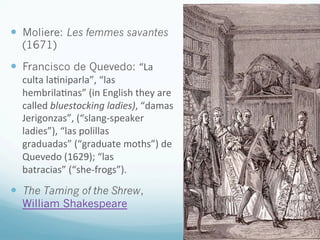
—  Moliere: Les femmes savantes
(1671)
—  Francisco de Quevedo: “La	
  
culta	
  la)niparla”,	
  “las	
  
hembrila)nas”	
  (in	
  English	
  they	
  are	
  
called	
  bluestocking	
  ladies),	
  “damas	
  
Jerigonzas”,	
  (“slang-­‐speaker	
  
ladies”),	
  “las	
  polillas	
  
graduadas”	
  (“graduate	
  moths”)	
  de	
  
Quevedo	
  (1629);	
  “las	
  
batracias”	
  (“she-­‐frogs”).	
  
—  The Taming of the Shrew,
William Shakespeare	
  
—  “A woman who reads is a lost woman”, Spanish and Portuguese saying.
—  “A woman’s wisdom destroys the house”, Russian proverb.
—  “Woman’s wisdom, monkey’s wisdom”, Japanese proverb.
—  “Men finally leaves their childhood, but women do never become adults”,
African proverb.
—  “A wise woman is doubly foolish”, English saying.
—  “Virtuous is the woman without knowledge”, Chinese proverb.
—  “The woman has only half a brain”, Arabic proverb.
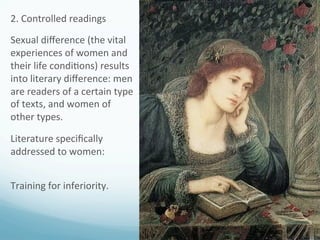
2.	
  Controlled	
  readings	
  
Sexual	
  difference	
  (the	
  vital	
  
experiences	
  of	
  women	
  and	
  
their	
  life	
  condi)ons)	
  results	
  
into	
  literary	
  difference:	
  men	
  
are	
  readers	
  of	
  a	
  certain	
  type	
  
of	
  texts,	
  and	
  women	
  of	
  
other	
  types.	
  
Literature	
  specifically	
  
addressed	
  to	
  women:	


Training	
  for	
  inferiority.	


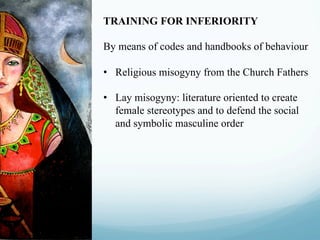
TRAINING FOR INFERIORITY
By means of codes and handbooks of behaviour
•  Religious misogyny from the Church Fathers
•  Lay misogyny: literature oriented to create
female stereotypes and to defend the social
and symbolic masculine order
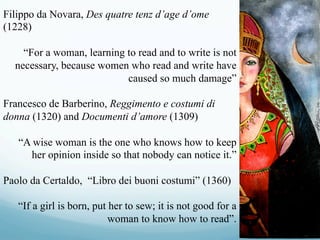
Filippo da Novara, Des quatre tenz d’age d’ome
(1228)
“For a woman, learning to read and to write is not
necessary, because women who read and write have
caused so much damage”
Francesco de Barberino, Reggimento e costumi di
donna (1320) and Documenti d’amore (1309)
“A wise woman is the one who knows how to keep
her opinion inside so that nobody can notice it.”
Paolo da Certaldo, “Libro dei buoni costumi” (1360)
“If a girl is born, put her to sew; it is not good for a
woman to know how to read”.
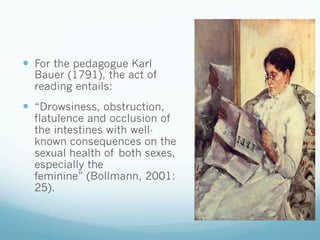
—  For the pedagogue Karl
Bauer (1791), the act of
reading entails:
—  “Drowsiness, obstruction,
flatulence and occlusion of
the intestines with well-
known consequences on the
sexual health of both sexes,
especially the
feminine” (Bollmann, 2001:
25).
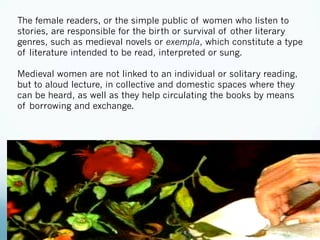
The female readers, or the simple public of women who listen to
stories, are responsible for the birth or survival of other literary
genres, such as medieval novels or exempla, which constitute a type
of literature intended to be read, interpreted or sung.
Medieval women are not linked to an individual or solitary reading,
but to aloud lecture, in collective and domestic spaces where they
can be heard, as well as they help circulating the books by means
of borrowing and exchange.
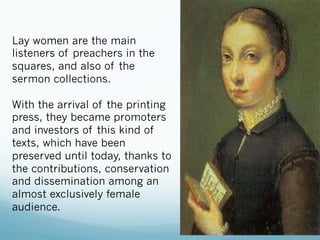
Lay women are the main
listeners of preachers in the
squares, and also of the
sermon collections.
With the arrival of the printing
press, they became promoters
and investors of this kind of
texts, which have been
preserved until today, thanks to
the contributions, conservation
and dissemination among an
almost exclusively female
audience.
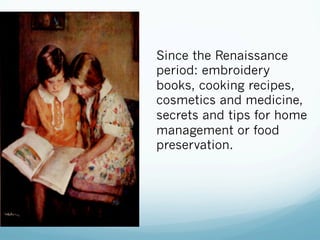
Since the Renaissance
period: embroidery
books, cooking recipes,
cosmetics and medicine,
secrets and tips for home
management or food
preservation.
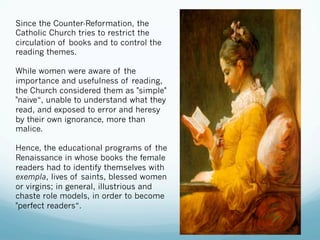
Since the Counter-Reformation, the
Catholic Church tries to restrict the
circulation of books and to control the
reading themes.
While women were aware of the
importance and usefulness of reading,
the Church considered them as "simple"
"naive“, unable to understand what they
read, and exposed to error and heresy
by their own ignorance, more than
malice.
Hence, the educational programs of the
Renaissance in whose books the female
readers had to identify themselves with
exempla, lives of saints, blessed women
or virgins; in general, illustrious and
chaste role models, in order to become
"perfect readers“.
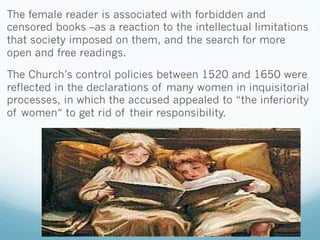
The female reader is associated with forbidden and
censored books –as a reaction to the intellectual limitations
that society imposed on them, and the search for more
open and free readings.
The Church’s control policies between 1520 and 1650 were
reflected in the declarations of many women in inquisitorial
processes, in which the accused appealed to “the inferiority
of women“ to get rid of their responsibility.
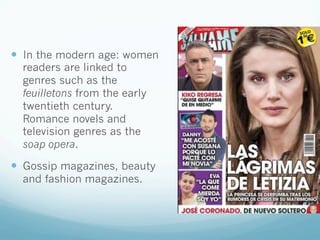
—  In the modern age: women
readers are linked to
genres such as the
feuilletons from the early
twentieth century.
Romance novels and
television genres as the
soap opera.
—  Gossip magazines, beauty
and fashion magazines.
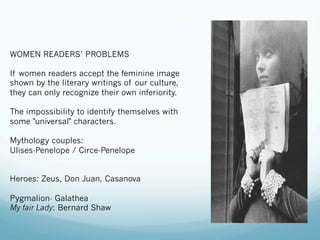
WOMEN READERS’ PROBLEMS
If women readers accept the feminine image
shown by the literary writings of our culture,
they can only recognize their own inferiority.
The impossibility to identify themselves with
some "universal" characters.
Mythology couples:
Ulises-Penelope / Circe-Penelope
Heroes: Zeus, Don Juan, Casanova
Pygmalion- Galathea
My fair Lady: Bernard Shaw
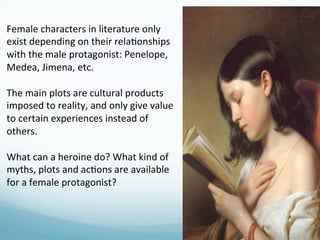
Female	
  characters	
  in	
  literature	
  only	
  
exist	
  depending	
  on	
  their	
  rela)onships	
  
with	
  the	
  male	
  protagonist:	
  Penelope,	
  
Medea,	
  Jimena,	
  etc.	


The	
  main	
  plots	
  are	
  cultural	
  products	
  
imposed	
  to	
  reality,	
  and	
  only	
  give	
  value	
  
to	
  certain	
  experiences	
  instead	
  of	
  
others.	


What	
  can	
  a	
  heroine	
  do?	
  What	
  kind	
  of	
  
myths,	
  plots	
  and	
  ac)ons	
  are	
  available	
  
for	
  a	
  female	
  protagonist?	
  
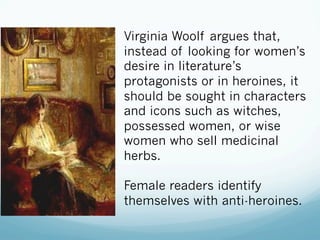
Virginia Woolf argues that,
instead of looking for women’s
desire in literature’s
protagonists or in heroines, it
should be sought in characters
and icons such as witches,
possessed women, or wise
women who sell medicinal
herbs.
Female readers identify
themselves with anti-heroines.
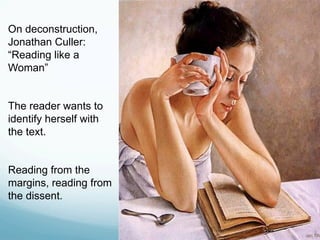
On deconstruction,
Jonathan Culler:
“Reading like a
Woman”
The reader wants to
identify herself with
the text.
Reading from the
margins, reading from
the dissent.
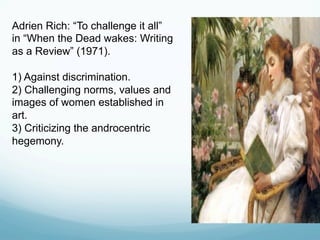
Adrien Rich: “To challenge it all”
in “When the Dead wakes: Writing
as a Review” (1971).
1) Against discrimination.
2) Challenging norms, values and
images of women established in
art.
3) Criticizing the androcentric
hegemony.
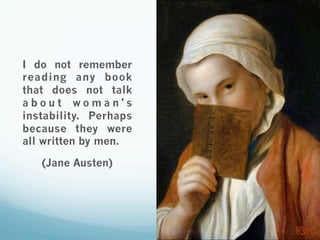
I do not remember
reading any book
that does not talk
a b o u t w o m a n ' s
instability. Perhaps
because they were
all written by men.
(Jane Austen)
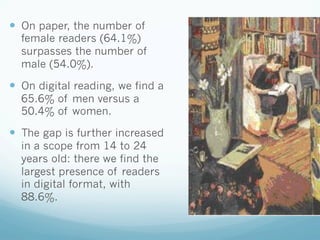
—  On paper, the number of
female readers (64.1%)
surpasses the number of
male (54.0%).
—  On digital reading, we find a
65.6% of men versus a
50.4% of women.
—  The gap is further increased
in a scope from 14 to 24
years old: there we find the
largest presence of readers
in digital format, with
88.6%.
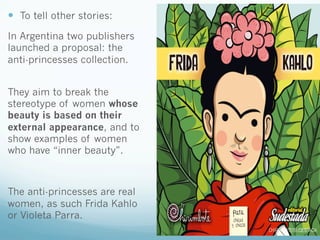
—  To tell other stories:
In Argentina two publishers
launched a proposal: the
anti-princesses collection.
They aim to break the
stereotype of women whose
beauty is based on their
external appearance, and to
show examples of women
who have “inner beauty”.
The anti-princesses are real
women, as such Frida Kahlo
or Violeta Parra.
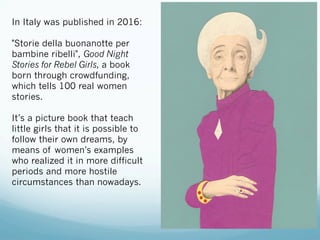
In Italy was published in 2016:
"Storie della buonanotte per
bambine ribelli", Good Night
Stories for Rebel Girls, a book
born through crowdfunding,
which tells 100 real women
stories.
It’s a picture book that teach
little girls that it is possible to
follow their own dreams, by
means of women’s examples
who realized it in more difficult
periods and more hostile
circumstances than nowadays.
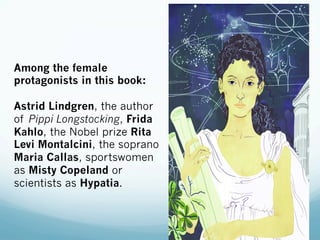
Among the female
protagonists in this book:
Astrid Lindgren, the author
of Pippi Longstocking, Frida
Kahlo, the Nobel prize Rita
Levi Montalcini, the soprano
Maria Callas, sportswomen
as Misty Copeland or
scientists as Hypatia.
BIBLIOGRAPHY
—  BARANDA, Nieves (2003) "Las mujeres lectoras” en
Historia de la edición y la lectura en España 1472-1914,
ed." Víctor Infantes, Madrid, Fundación Sánchez Rupérez.
—  BOLLMANN, S. (2006) Las mujeres que leen son
peligrosas, Madrid, Maeva.
—  CABRE, María Angeles (2013) Leer y escribir en
femenino, Aresta, Barcelona,
—  JACK, Belinda (2012) The Woman Reader, Yale
University Press.
—  LYONS, Martyn (1998) "I nuovi lettori nel XIX secolo:
donne, fanciulli, operai" in Guglielmo Cavallo, Roger
Chartier (a cura di) Storia della lettura nel mondo
occidentale, Roma, Laterza.
—  PLEBANI, T. (1996): Nascita e caratteristiche del
pubblico di lettrici tra Medioevo e prima Età Moderna,
en ZARRI G., Donna, disciplina, creanza cristiana dal XV al
XVII. Roma: Edizioni di storia e letteratura, pp. 24-44.
—  PLEBANI, Tiziana, “All’origine della rappresentazione
della lettrice e della scrittrice: Christine de Pizan”, in
Christine de Pizan. Una città per sé, a cura di P. Caraffi,
Roma 2003, pp. 47-58.
—  PLEBANI, Tiziana, “Scritture di donne nel Rinascimento
italiano”, in Il Rinascimento italiano e l’Europa, vol II:
Umanesimo ed educazione, Verona, 2007, pp. 243-263.
—  PLEBANI, Tiziana, Il “Genere” dei libri. Storie e
rappresentazioni della lettura al femminile e al maschile tra
Medioevo e età moderna, Franco Angeli, Milano, 2001.
—  PIZAN DE, C. (2003): La città delle dame, a cura di
Patrizia Caraffi. Roma: Carocci, XXVII, p.153.

Arriaga do not open these books

  • 1.
    “Do not openthese books” Women and girls as readers Mercedes Arriaga Flórez University of Seville marriaga@us.es
  • 2.
    —  Literature isa social discourse, and reading shapes us as both subjects and individuals, also helping us to build the content of the everyday life and experiences by means of value projections. The starting point is that a literary text has an important role in the transmission of culture. It provides certain images (identities and identifications) through which individuals shape their lives and attitudes, and which are communicated and transmitted to the next generations (Zavala, 1993: 48).
  • 3.
  • 4.
    1. Women don’tneed to read because culture is not for them. A cultured woman ceases to be considered a woman, or becomes despicable. 2. Women are only allowed to read “controlled” readings.
  • 5.
    —  Moliere: Lesfemmes savantes (1671) —  Francisco de Quevedo: “La   culta  la)niparla”,  “las   hembrila)nas”  (in  English  they  are   called  bluestocking  ladies),  “damas   Jerigonzas”,  (“slang-­‐speaker   ladies”),  “las  polillas   graduadas”  (“graduate  moths”)  de   Quevedo  (1629);  “las   batracias”  (“she-­‐frogs”).   —  The Taming of the Shrew, William Shakespeare  
  • 6.
    —  “A womanwho reads is a lost woman”, Spanish and Portuguese saying. —  “A woman’s wisdom destroys the house”, Russian proverb. —  “Woman’s wisdom, monkey’s wisdom”, Japanese proverb. —  “Men finally leaves their childhood, but women do never become adults”, African proverb. —  “A wise woman is doubly foolish”, English saying. —  “Virtuous is the woman without knowledge”, Chinese proverb. —  “The woman has only half a brain”, Arabic proverb.
  • 7.
    2.  Controlled  readings   Sexual  difference  (the  vital   experiences  of  women  and   their  life  condi)ons)  results   into  literary  difference:  men   are  readers  of  a  certain  type   of  texts,  and  women  of   other  types.   Literature  specifically   addressed  to  women:     Training  for  inferiority.    
  • 8.
    TRAINING FOR INFERIORITY Bymeans of codes and handbooks of behaviour •  Religious misogyny from the Church Fathers •  Lay misogyny: literature oriented to create female stereotypes and to defend the social and symbolic masculine order
  • 9.
    Filippo da Novara,Des quatre tenz d’age d’ome (1228) “For a woman, learning to read and to write is not necessary, because women who read and write have caused so much damage” Francesco de Barberino, Reggimento e costumi di donna (1320) and Documenti d’amore (1309) “A wise woman is the one who knows how to keep her opinion inside so that nobody can notice it.” Paolo da Certaldo, “Libro dei buoni costumi” (1360) “If a girl is born, put her to sew; it is not good for a woman to know how to read”.
  • 10.
    —  For thepedagogue Karl Bauer (1791), the act of reading entails: —  “Drowsiness, obstruction, flatulence and occlusion of the intestines with well- known consequences on the sexual health of both sexes, especially the feminine” (Bollmann, 2001: 25).
  • 11.
    The female readers,or the simple public of women who listen to stories, are responsible for the birth or survival of other literary genres, such as medieval novels or exempla, which constitute a type of literature intended to be read, interpreted or sung. Medieval women are not linked to an individual or solitary reading, but to aloud lecture, in collective and domestic spaces where they can be heard, as well as they help circulating the books by means of borrowing and exchange.
  • 12.
    Lay women arethe main listeners of preachers in the squares, and also of the sermon collections. With the arrival of the printing press, they became promoters and investors of this kind of texts, which have been preserved until today, thanks to the contributions, conservation and dissemination among an almost exclusively female audience.
  • 13.
    Since the Renaissance period:embroidery books, cooking recipes, cosmetics and medicine, secrets and tips for home management or food preservation.
  • 14.
    Since the Counter-Reformation,the Catholic Church tries to restrict the circulation of books and to control the reading themes. While women were aware of the importance and usefulness of reading, the Church considered them as "simple" "naive“, unable to understand what they read, and exposed to error and heresy by their own ignorance, more than malice. Hence, the educational programs of the Renaissance in whose books the female readers had to identify themselves with exempla, lives of saints, blessed women or virgins; in general, illustrious and chaste role models, in order to become "perfect readers“.
  • 15.
    The female readeris associated with forbidden and censored books –as a reaction to the intellectual limitations that society imposed on them, and the search for more open and free readings. The Church’s control policies between 1520 and 1650 were reflected in the declarations of many women in inquisitorial processes, in which the accused appealed to “the inferiority of women“ to get rid of their responsibility.
  • 16.
    —  In themodern age: women readers are linked to genres such as the feuilletons from the early twentieth century. Romance novels and television genres as the soap opera. —  Gossip magazines, beauty and fashion magazines.
  • 17.
    WOMEN READERS’ PROBLEMS Ifwomen readers accept the feminine image shown by the literary writings of our culture, they can only recognize their own inferiority. The impossibility to identify themselves with some "universal" characters. Mythology couples: Ulises-Penelope / Circe-Penelope Heroes: Zeus, Don Juan, Casanova Pygmalion- Galathea My fair Lady: Bernard Shaw
  • 18.
    Female  characters  in  literature  only   exist  depending  on  their  rela)onships   with  the  male  protagonist:  Penelope,   Medea,  Jimena,  etc.     The  main  plots  are  cultural  products   imposed  to  reality,  and  only  give  value   to  certain  experiences  instead  of   others.     What  can  a  heroine  do?  What  kind  of   myths,  plots  and  ac)ons  are  available   for  a  female  protagonist?  
  • 19.
    Virginia Woolf arguesthat, instead of looking for women’s desire in literature’s protagonists or in heroines, it should be sought in characters and icons such as witches, possessed women, or wise women who sell medicinal herbs. Female readers identify themselves with anti-heroines.
  • 21.
    On deconstruction, Jonathan Culler: “Readinglike a Woman” The reader wants to identify herself with the text. Reading from the margins, reading from the dissent.
  • 22.
    Adrien Rich: “Tochallenge it all” in “When the Dead wakes: Writing as a Review” (1971). 1) Against discrimination. 2) Challenging norms, values and images of women established in art. 3) Criticizing the androcentric hegemony.
  • 23.
    I do notremember reading any book that does not talk a b o u t w o m a n ' s instability. Perhaps because they were all written by men. (Jane Austen)
  • 24.
    —  On paper,the number of female readers (64.1%) surpasses the number of male (54.0%). —  On digital reading, we find a 65.6% of men versus a 50.4% of women. —  The gap is further increased in a scope from 14 to 24 years old: there we find the largest presence of readers in digital format, with 88.6%.
  • 25.
    —  To tellother stories: In Argentina two publishers launched a proposal: the anti-princesses collection. They aim to break the stereotype of women whose beauty is based on their external appearance, and to show examples of women who have “inner beauty”. The anti-princesses are real women, as such Frida Kahlo or Violeta Parra.
  • 26.
    In Italy waspublished in 2016: "Storie della buonanotte per bambine ribelli", Good Night Stories for Rebel Girls, a book born through crowdfunding, which tells 100 real women stories. It’s a picture book that teach little girls that it is possible to follow their own dreams, by means of women’s examples who realized it in more difficult periods and more hostile circumstances than nowadays.
  • 27.
    Among the female protagonistsin this book: Astrid Lindgren, the author of Pippi Longstocking, Frida Kahlo, the Nobel prize Rita Levi Montalcini, the soprano Maria Callas, sportswomen as Misty Copeland or scientists as Hypatia.
  • 29.
    BIBLIOGRAPHY —  BARANDA, Nieves(2003) "Las mujeres lectoras” en Historia de la edición y la lectura en España 1472-1914, ed." Víctor Infantes, Madrid, Fundación Sánchez Rupérez. —  BOLLMANN, S. (2006) Las mujeres que leen son peligrosas, Madrid, Maeva. —  CABRE, María Angeles (2013) Leer y escribir en femenino, Aresta, Barcelona, —  JACK, Belinda (2012) The Woman Reader, Yale University Press. —  LYONS, Martyn (1998) "I nuovi lettori nel XIX secolo: donne, fanciulli, operai" in Guglielmo Cavallo, Roger Chartier (a cura di) Storia della lettura nel mondo occidentale, Roma, Laterza.
  • 30.
    —  PLEBANI, T.(1996): Nascita e caratteristiche del pubblico di lettrici tra Medioevo e prima Età Moderna, en ZARRI G., Donna, disciplina, creanza cristiana dal XV al XVII. Roma: Edizioni di storia e letteratura, pp. 24-44. —  PLEBANI, Tiziana, “All’origine della rappresentazione della lettrice e della scrittrice: Christine de Pizan”, in Christine de Pizan. Una città per sé, a cura di P. Caraffi, Roma 2003, pp. 47-58. —  PLEBANI, Tiziana, “Scritture di donne nel Rinascimento italiano”, in Il Rinascimento italiano e l’Europa, vol II: Umanesimo ed educazione, Verona, 2007, pp. 243-263. —  PLEBANI, Tiziana, Il “Genere” dei libri. Storie e rappresentazioni della lettura al femminile e al maschile tra Medioevo e età moderna, Franco Angeli, Milano, 2001. —  PIZAN DE, C. (2003): La città delle dame, a cura di Patrizia Caraffi. Roma: Carocci, XXVII, p.153.