1
Emergency Medical Supplies
Mr.Tom Gourley
1
Welcome to your:
Welcome to your:
Emergency First Aid Course
Emergency First Aid Course
Your Instructor is:
3
Areas Covered inthis Session
• Human Anatomy
• What is first aid
• Aims of first aid
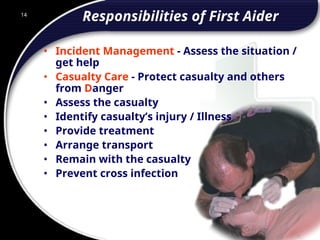
• The Responsibilities of the First Aider
• Delegation / Confidence / Communication
• Incident / Casualty priorities
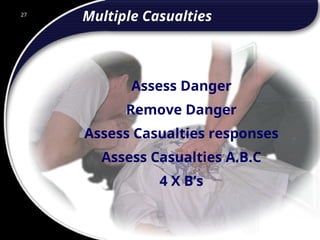
• Multiple casualties
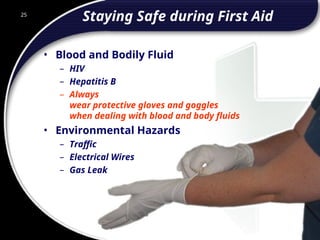
• Staying Safe during First Aid DANGER
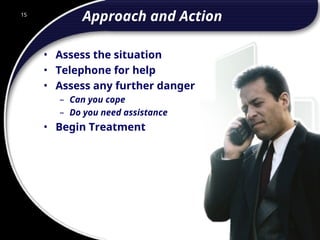
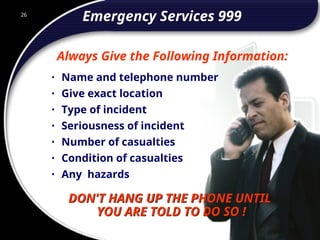
• Telephone the Emergency Services 999
11
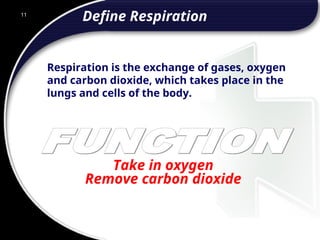
Respiration is theexchange of gases, oxygen
and carbon dioxide, which takes place in the
lungs and cells of the body.
Define Respiration
Take in oxygen
Remove carbon dioxide
19
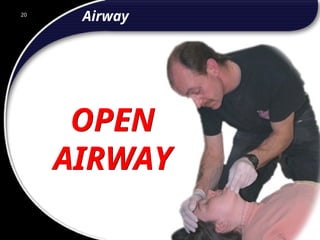
Airway
• Before openingthe airway (check) for any
obstructions and remove (clear) them if
possible
• By tilting the head back and lifting the chin
forward, the tongue is drawn away (open)
from the back of the throat. Suspected Spinal
injuries will differ, majority are conscious.
• In an unconsciousness casualty the tongue
may fall back to block the airway.
31
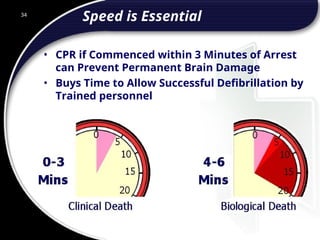
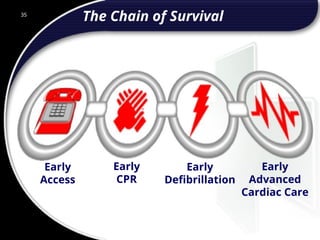
Lay Rescuer CPRGuidelines
• Establish that the casualty is unresponsive
– Dial 112/999 ask for cardiac ambulance
• Open the Airway
– Head tilt/chin lift or, if trauma is suspected, jaw thrust.
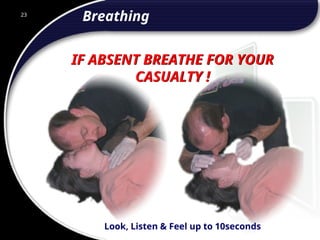
– Check for normal breathing.
– (look, listen, feel)
• If normal breathing is absent
– Give 2 slow breaths (2 seconds per breath)
– Ensure adequate chest rise, and allow exhalation
between breaths.
32.
32
Lay Rescuer CPRGuidelines
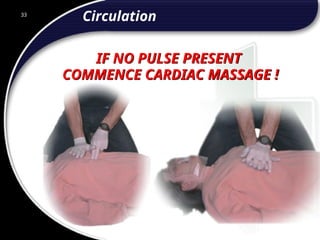
• Check for signs of circulation
– Normal breathing, coughing, or movement in response
to the 2 breaths
– If signs of circulation are present but there is no
normal breathing, provide rescue breathing
– 1 breath every 6 seconds, about 10 breaths per minute
• If no signs of circulation are present,
– Begin cycles of 15 chest compressions (about 100
compressions per minute) followed by 2 slow breaths
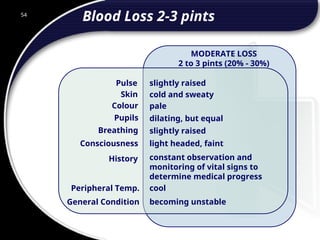
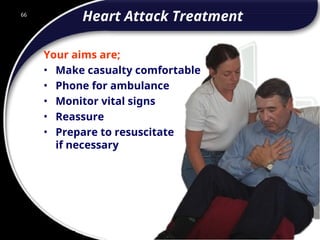
54
MODERATE LOSS
2 to3 pints (20% - 30%)
slightly raised
cold and sweaty
pale
dilating, but equal
slightly raised
light headed, faint
constant observation and
monitoring of vital signs to
determine medical progress
cool
becoming unstable
Pulse
Skin
Colour
Pupils
Breathing
Consciousness
History
Peripheral Temp.
General Condition
Blood Loss 2-3 pints
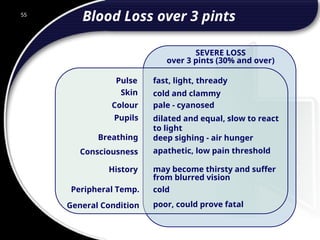
55.
55
SEVERE LOSS
over 3pints (30% and over)
fast, light, thready
cold and clammy
pale - cyanosed
dilated and equal, slow to react
to light
deep sighing - air hunger
apathetic, low pain threshold
may become thirsty and suffer
from blurred vision
cold
poor, could prove fatal
Pulse
Skin
Colour
Pupils
Breathing
Consciousness
History
Peripheral Temp.
General Condition
Blood Loss over 3 pints
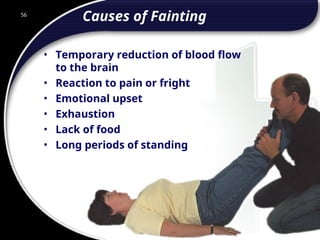
58
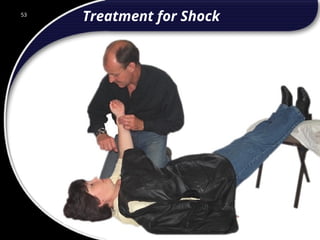
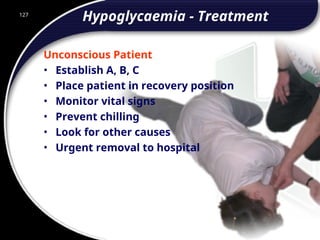
If unconsciousness persists
Callfor the ambulance
Treatment for Fainting
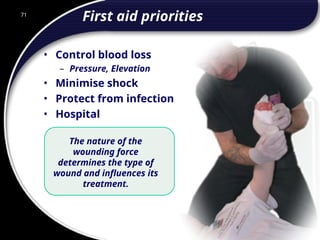
• Raise and support lower limbs
• Fresh air, open window
• As they recover reassure casualty
• Assist casualty to sit up
• Treat any injuries
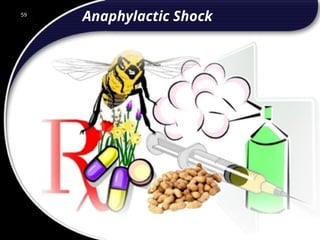
60
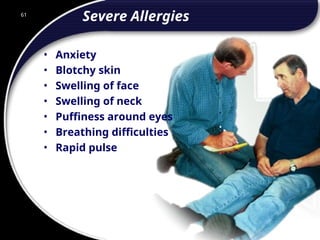
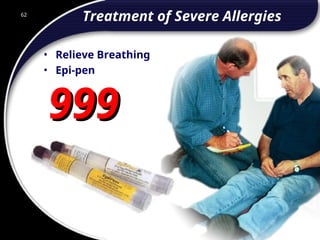
Anaphylactic Shock
The namegiven to a major Allergic reaction
within the body;
Causes:
• Specific drugs
• Stings
• Ingestion of certain foods (peanuts)
• Chemical released into the blood stream
causing the blood vessels to dilate thus
restricting the airway.
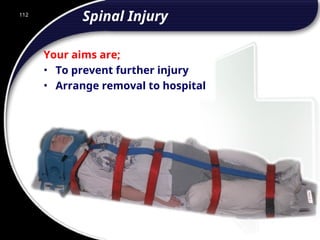
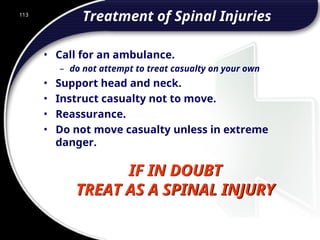
113
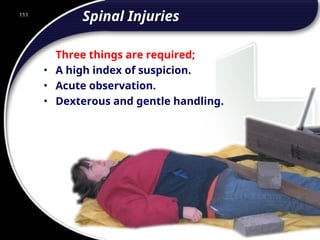
IF IN DOUBT
TREATAS A SPINAL INJURY
Treatment of Spinal Injuries
• Call for an ambulance.
– do not attempt to treat casualty on your own
• Support head and neck.
• Instruct casualty not to move.
• Reassurance.
• Do not move casualty unless in extreme
danger.
107.
114
“LIFT WITH THELEGS”
Principles of Lifting
• Assess the Task - Area - Load
• Bend the knees
• Broad stable base
• Back straight (Not necessarily vertical)
• Firm grip with palm of hand
• Arms in line with trunk
• Weight close to center of gravity
• Turn feet in direction of movement
108.
115
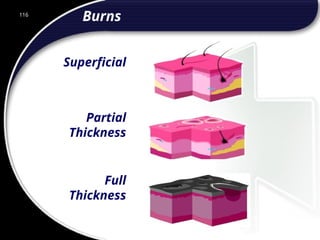
Types and Causesof Burns
• Dry Burn
• Scald
• Electrical Burn
• Chemical Burn
• Radiation
• Friction Burn
• Cold Burn
• Fire- Domestic appliances
• Hot liquids - Steam
• Low and high voltage - Lightning
• Industrial & Domestic chemicals
• Sunburn - Exposure to radiation
• Fast moving belts – Machinery
• Bare skin contacting ice etc.
123
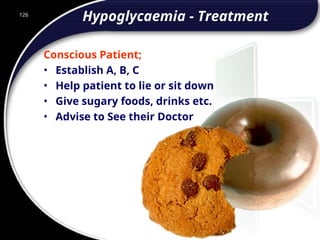
Define Diabetes
• Acondition in which the body fails to regulate
the concentration of sugar in the blood.
• Diabetics are prone to two main problems:
– Hypoglycemia
– Hyperglycemia
117.
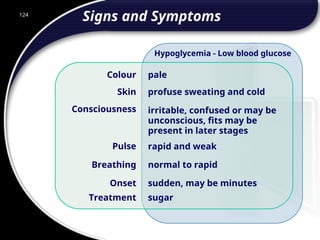
124
Hypoglycemia - Lowblood glucose
pale
profuse sweating and cold
irritable, confused or may be
unconscious, fits may be
present in later stages
rapid and weak
sudden, may be minutes
sugar
normal to rapid
Colour
Skin
Consciousness
Pulse
Onset
Treatment
Breathing
Signs and Symptoms
118.
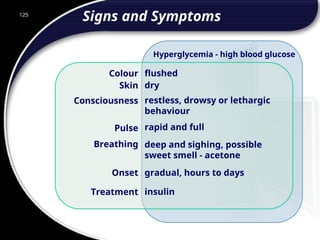
125
Hyperglycemia - highblood glucose
flushed
dry
restless, drowsy or lethargic
behaviour
rapid and full
gradual, hours to days
insulin
deep and sighing, possible
sweet smell - acetone
Colour
Skin
Consciousness
Pulse
Onset
Treatment
Breathing
Signs and Symptoms
130
Forms of Epilepsy
•Absence Seizures
– A minor form of epilepsy
– Resembles daydreaming.
• Seizures
– A major form of epilepsy.
– The patient experiences fits with a period of
unconsciousness.
124.
131
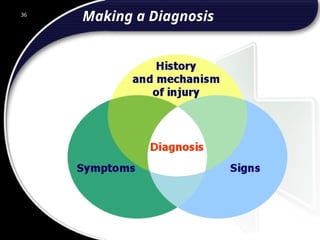
Risk Assessment
• Lookfor Hazards
• Who might be harmed
• Evaluate the risk
• Record your findings
• Review Assessment
Hazard means anything that can cause harm (e.g
chemicals, electricity, working from ladders etc).
Risk is the chance high or low, that somebody will
be harmed by the hazard.
125.
132
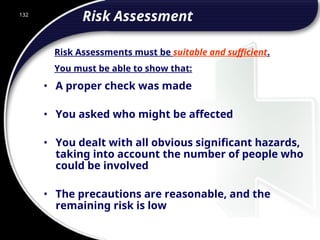
Risk Assessment
• Aproper check was made
• You asked who might be affected
• You dealt with all obvious significant hazards,
taking into account the number of people who
could be involved
• The precautions are reasonable, and the
remaining risk is low
Risk Assessments must be suitable and sufficient.
You must be able to show that:
126.
133
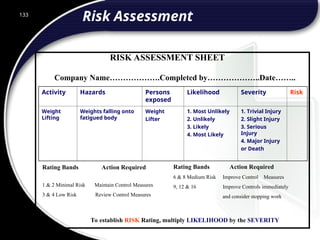
Activity Hazards Persons
exposed
LikelihoodSeverity Risk
Weight
Lifting
Weights falling onto
fatigued body
Weight
Lifter
1. Most Unlikely
2. Unlikely
3. Likely
4. Most Likely
1. Trivial Injury
2. Slight Injury
3. Serious
Injury
4. Major Injury
or Death
Company Name……………….Completed by………………..Date……..
RISK ASSESSMENT SHEET
Risk Assessment
To establish RISK Rating, multiply LIKELIHOOD by the SEVERITY
Rating Bands Action Required
1 & 2 Minimal Risk Maintain Control Measures
3 & 4 Low Risk Review Control Measures
Rating Bands Action Required
6 & 8 Medium Risk Improve Control Measures
9, 12 & 16 Improve Controls immediately
and consider stopping work


![Hypothalamus short notes on location, function and disorders by Dr. Neha [PT]...](https://cdn.slidesharecdn.com/ss_thumbnails/hypothalamusbydr-260124142231-2b48143d-thumbnail.jpg?width=640&height=640&fit=bounds)


