First Aid
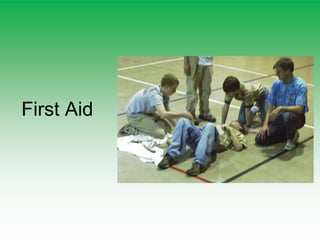
First Aid
• First aid is an emergency medical
treatment for somebody who is ill or
injured,given before more thorough
medical attention can be obtained.
• 60% of Nigerians die at accident/incident
scenes due to lack of an emergency
medical treatment.
Primary Survey
Primary Survey
• The approach to any incident requires a
Common Sense Planning
• The basic priority step of approaching an
incident is called Primary Survey
• It is an easily remembered practice by
using the letters – D R A B C
Primary Survey
•Remember …
»D R A B C
• D = Danger
• R = Response
• A = Airway
• B = Breathing
• C = Circulation
D
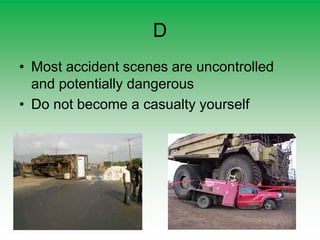
• Most accident scenes are uncontrolled
and potentially dangerous
• Do not become a casualty yourself
Calling for Assistance
• Ask the bystanders to call for assistance
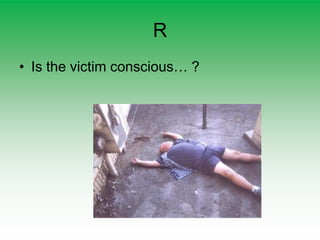
R
• Is the victim conscious… ?
Response
• SHOUT !!! and SHAKE
• No response??
»Give painful stimuli
Airway
• Tongue is the most common of airway
obstruction in an unconscious victim
Airway
• Head tilt chin lift
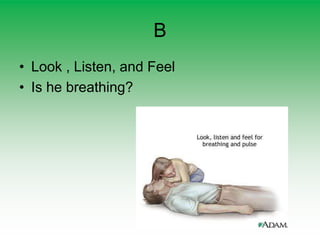
B
• Look , Listen, and Feel
• Is he breathing?
Breathing
• Observe for breathing
• Watch and feel the chest rise and fall
• Check breathing for 5 seconds
Breathing
• If patient is breathing
– Leave the patient on their side with the jaw
supported
Breathing
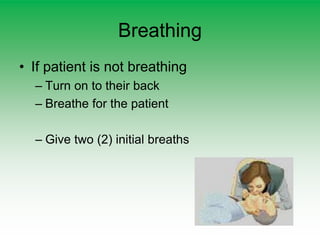
• If patient is not breathing
– Turn on to their back
– Breathe for the patient
– Give two (2) initial breaths
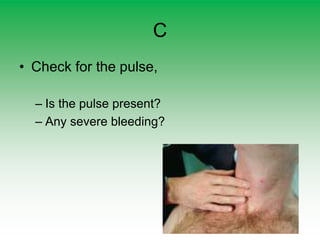
C
• Check for the pulse,
– Is the pulse present?
– Any severe bleeding?
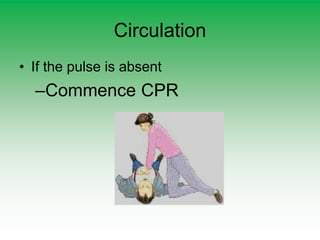
Circulation
• If the pulse is absent
–Commence CPR
Respiratory System
Respiratory System
Frequency of breathing
• Normal healthy adult: 8-20 times/minute
• It will be increased when we run or do
more physical work
Circulatory System
Circulatory System
• Heart
• Blood Vessels
• Blood
Circulatory System
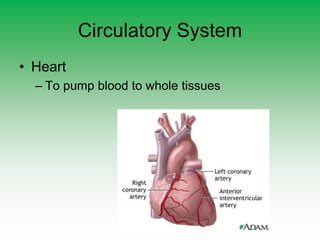
• Heart
– To pump blood to whole tissues
Circulatory System
• Heart
– Heart beats 60-100 / minute
– If the heart stops pumping DEATH results!
Circulatory System
• Cardiac and Respiratory arrest can be
caused by:
– Reduced O² in the atmosphere
– Airway obstruction
– Injury to the chest or head
– Heart attack
– Severe blood loss
Rescue Breathing
Rescue Breathing
• When??
– If
• NO danger
• NO response
• Airway clean and open
• NO breathing
Rescue Breathing
• Procedure
– Place victim on their back
– Maintain an open airway
Rescue Breathing
• Procedure
– Check for breathing
– Occlude the nose
– Take a deep breath
– Seal your mouth over the victim’s mouth
Rescue Breathing
• Procedure
– Breathe into the victim slowly, take 2 seconds
and watch for the chest to rise
– Remove your mouth from the victim’s mouth
– Give 2 initial breaths in 4 seconds before
checking pulse
Cardio Pulmonary Resuscitation
(CPR)
CPR
• When??
– If
• No danger
• No response
• Airway clear and open
• No breathing
• No pulse
CPR
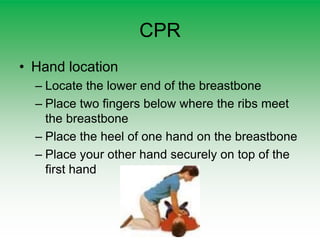
• Hand location
– Locate the lower end of the breastbone
– Place two fingers below where the ribs meet
the breastbone
– Place the heel of one hand on the breastbone
– Place your other hand securely on top of the
first hand
CPR
• Technique
– Compression technique uses the heel of the
hand with the fingers locked and clear of the
chest
– Keep your shoulder vertically over the victim’s
chest
– Depth of compression: 4-5 cm
– Rate 100 compressions / minute
CPR
• Procedure
– One rescuer
• 2:15
• 2 ventilations : 15 compressions
– Rate 100 compressions / minute or 6-7
cycles/ minute
CPR
• Procedure
– Two rescuers
• First use one person CPR whilst the 2nd person
gets help
• Then with 2 persons
– 1:5
– 1 ventilation : 5 compressions
– Rate 100 compressions/ minute or 16-18 cycles/minute
Recognition and Management
of
Bleeding
Bleeding
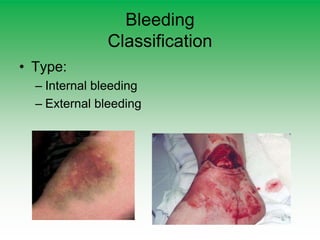
Classification
• Type:
– Internal bleeding
– External bleeding
Bleeding
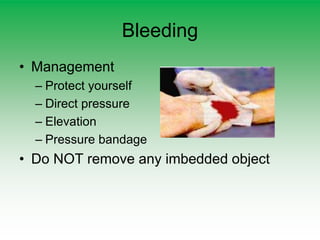
• Management
– Protect yourself
– Direct pressure
– Elevation
– Pressure bandage
• Do NOT remove any imbedded object
Bleeding
• Management
– If bleeding continues, do not remove
bandages, but apply an additional dressing on
top of the old one.
Bleeding
• Management
– Always check pulse
• Check below the bandage to ensure circulation is
not constricted
– Immobilize the part when possible
Managing the Unconscious Victim
• Causes of unconsciousness:
– Lack of oxygen
– Chemical imbalance
– Trauma
Managing the Unconscious Victim
• Maintain a clear and open airway
• Monitor breathing and circulation
• Monitor vital signs
• Secondary survey
• Cover the victim with a blanket
Never leave an unconscious
victim unattended !
Fracture
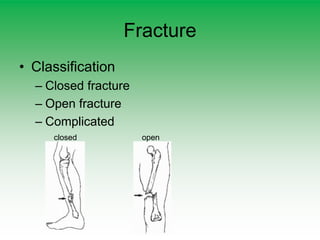
Fracture
• Classification
– Closed fracture
– Open fracture
– Complicated
closed open
Fracture
• Signs and symptoms
– Pain
– Irregularity
– Loss of movement / function
– Swelling
– Discoloration
– Unnatural position of limb
– Tenderness at the site of injury
– Crepitus
Fracture
Management
• Primary survey – DRABC
• Control bleeding if any
• Reassure the victim
• Make the victim comfortable in the position you
found them
• Immobilize
• Seek medical assistance
Splinting is only required when the
patient has to be moved, or medical
aid is longer than an hour away.
Head & Spinal Injury
Head Injury
• Common causes:
– Vehicle crash
– Fall from height
– Direct blow
– Sports injury
Head Injury
Management
• Primary survey
• Keep the airway open and clear
• Control bleeding
• DO NOT remove victim if not in a life-threatening
situation
• Reassure victim
• DO NOT allow victim to eat or drink
• Vital signs survey, monitor the alteration of
consciousness state
• Seek medical services urgently
Spinal Injury
• Causes:
– Vehicle crash
– Fall from heights
– Violence
– Sports
– Others
Spinal Injury
Management
• DO NOT remove the victim if not in life
threatening situation wait for medical
assistance
• DO NOT allow the victim to eat or drink

First aid application