Finite State Machine in Akka can be modeled as:
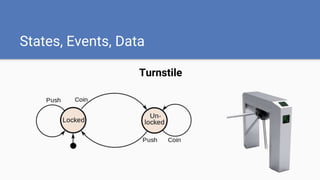
1) A state machine consists of states, events, and actions where an event triggers a state transition and actions.
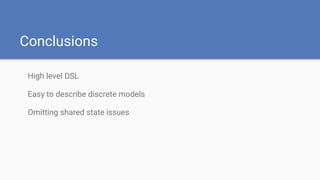
2) In Akka, a FSM actor encapsulates the state in its behavior so that getting the state is not an action.
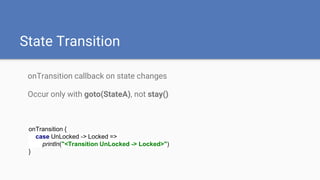
3) States are represented as sealed traits or objects, events are regular messages, and state transitions are triggered through goto or stay functions along with optional state data.




![Event
val turnstile = system.actorOf(Props[Turnstile])
turnstile ! Coin
Just a regular message to FSM Actor](https://image.slidesharecdn.com/jyjczyerriacviwmo2iw-signature-f92210341866eac7c83c38504682ec4e91943d27fa9cd372626fe3f619baa605-poli-170406141552/85/Finite-State-Machine-in-Akka-8-320.jpg)



![5G Explained! A High Level Overview [Introduction]](https://cdn.slidesharecdn.com/ss_thumbnails/5gexplainedahighleveloverview-260119165306-cc137a3e-thumbnail.jpg?width=640&height=640&fit=bounds)


