FiniteElementAnalysisOf Socket
andSpigotTypeCotterJoint
GUIDED BY
RAJNARAYAN SIR
Group No. :- 1
Table of
content
Application
Project
Introduction
Objective
Introduction
Objective
Application
Project
Introduction
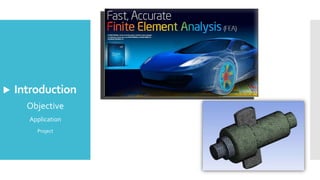
 Finite element analysis (FEA) is a numerical method
for solving problems for mathematical and
engineering physics.
Objective
Application
Project
Introduction
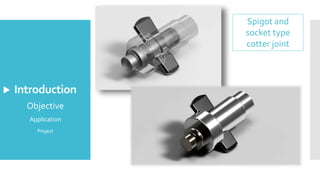
Spigot and
socket type
cotter joint
Objective
Application
Project
Objective
 To learn Geometric and Solid Modeling
 To Design and Optimise
 To learn Finite Element Analysis
 To learn CAD/CAE Software
Introduction
Application
Project
Objective
Introduction
Application
Project
 Provides a general idea and information about
finite element analysis.
 The engineering part will be emphasized.
 The engineering part consist of simulation of a
particular object applied with different kinds of
forces that induce stresses in it.
 Gives an idea of how the object will perform
practically in actual world before
manufacturing it.
 Description of different methods and
procedures that are used and difficulties faced
to perform finite element analysis.
Application
Introduction
Objective
Project
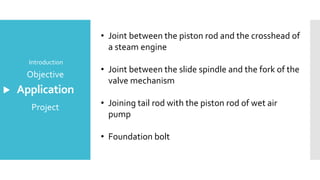
• Joint between the piston rod and the crosshead of
a steam engine
• Joint between the slide spindle and the fork of the
valve mechanism
• Joining tail rod with the piston rod of wet air
pump
• Foundation bolt
Application
Introduction
Objective
Project
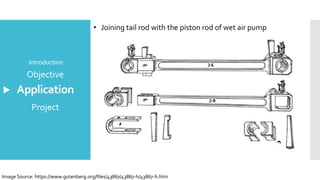
• Joining tail rod with the piston rod of wet air pump
Image Source: https://www.gutenberg.org/files/43867/43867-h/43867-h.htm
Application
Introduction
Objective
Project
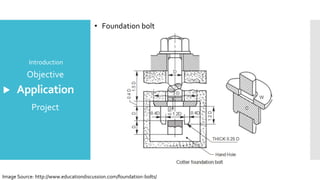
• Foundation bolt
Image Source: http://www.educationdiscussion.com/foundation-bolts/
Project
Aim Method
Application
Objective
Introduction
Project
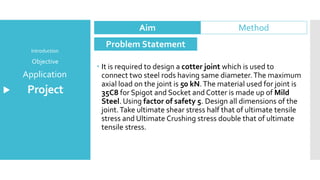
 It is required to design a cotter joint which is used to
connect two steel rods having same diameter.The maximum
axial load on the joint is 50 kN.The material used for joint is
35C8 for Spigot and Socket and Cotter is made up of Mild
Steel. Using factor of safety 5. Design all dimensions of the
joint.Take ultimate shear stress half that of ultimate tensile
stress and Ultimate Crushing stress double that of ultimate
tensile stress.
Application
Objective
Introduction
Aim Method
Problem Statement
Project
Application
Objective
Introduction
Aim Method
Design Modeling Analysis
Project
Application
Objective
Introduction
Aim Method
Design Modeling Analysis
Project
Application
Objective
Introduction
Aim Method
Design Modeling Analysis
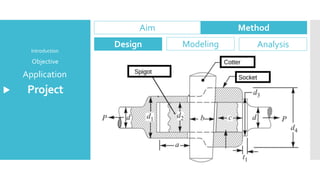
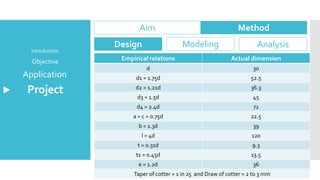
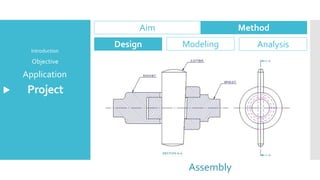
Empirical relations Actual dimension
d 30
d1 = 1.75d 52.5
d2 = 1.21d 36.3
d3 = 1.5d 45
d4 = 2.4d 72
a = c = 0.75d 22.5
b = 1.3d 39
l = 4d 120
t = 0.31d 9.3
t1 = 0.45d 13.5
e = 1.2d 36
Taper of cotter = 1 in 25 and Draw of cotter = 2 to 3 mm
Project
Application
Objective
Introduction
Aim Method
Design Modeling Analysis
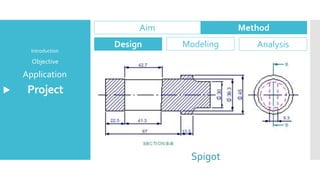
Spigot
Project
Application
Objective
Introduction
Aim Method
Design Modeling Analysis
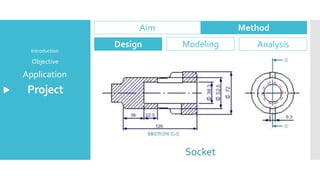
Socket
Project
Application
Objective
Introduction
Schedule
Aim Method
Design Modeling Analysis
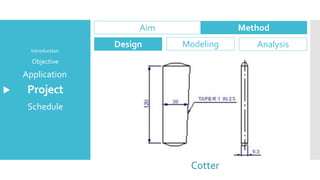
Cotter
Project
Application
Objective
Introduction
Aim Method
Design Modeling Analysis
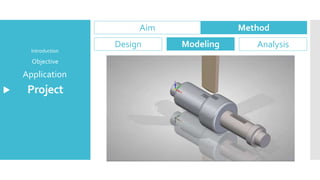
Assembly
Project
Application
Objective
Introduction
Aim Method
Design Modeling Analysis
Project
Application
Objective
Introduction
Aim Method
Design Modeling Analysis
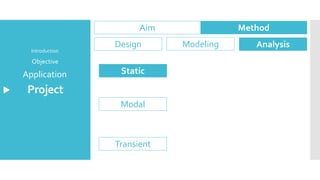
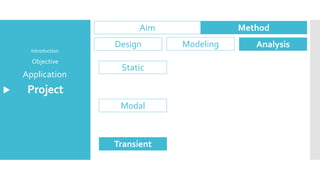
Transient
Modal
Static
Project
Application
Objective
Introduction
Aim Method
Design Modeling Analysis
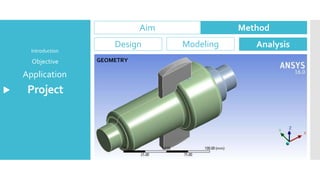
GEOMETRY
Project
Application
Objective
Introduction
Aim Method
Design Modeling Analysis
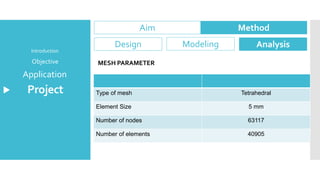
MESH PARAMETER
Type of mesh Tetrahedral
Element Size 5 mm
Number of nodes 63117
Number of elements 40905
Project
Application
Objective
Introduction
Aim Method
Design Modeling Analysis
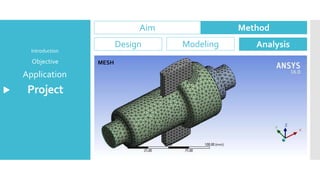
MESH
Project
Application
Objective
Introduction
Aim Method
Design Modeling Analysis
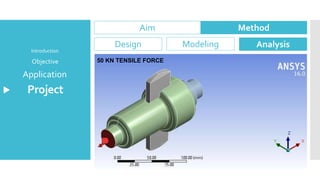
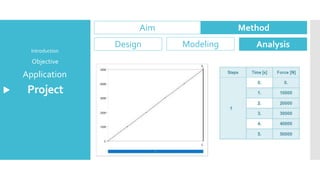
50 KN TENSILE FORCE
Project
Application
Objective
Introduction
Aim Method
Design Modeling Analysis
Project
Application
Objective
Introduction
Aim Method
Design Modeling Analysis
Project
Application
Objective
Introduction
Aim Method
Design Modeling Analysis
Project
Application
Objective
Introduction
Aim Method
Design Modeling Analysis
Project
Application
Objective
Introduction
Aim Method
Design Modeling Analysis
Project
Application
Objective
Introduction
Aim Method
Design Modeling Analysis
Project
Application
Objective
Introduction
Aim Method
Design Modeling Analysis
Project
Application
Objective
Introduction
Aim Method
Design Modeling Analysis
Modal
Static
Transient
Project
Application
Objective
Introduction
Aim Method
Design Modeling Analysis
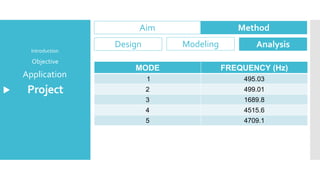
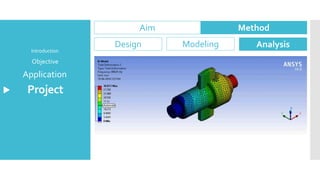
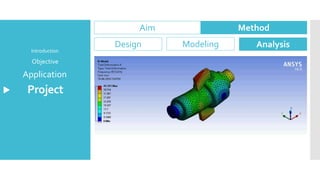
MODE FREQUENCY (Hz)
1 495.03
2 499.01
3 1689.8
4 4515.6
5 4709.1
Project
Application
Objective
Introduction
Aim Method
Design Modeling Analysis
Project
Application
Objective
Introduction
Aim Method
Design Modeling Analysis
Project
Application
Objective
Introduction
Aim Method
Design Modeling Analysis
Project
Application
Objective
Introduction
Aim Method
Design Modeling Analysis
Project
Application
Objective
Introduction
Aim Method
Design Modeling Analysis
Project
Application
Objective
Introduction
Aim Method
Design Modeling Analysis
Static
Transient
Modal
Project
Application
Objective
Introduction
Aim Method
Design Modeling Analysis
Project
Application
Objective
Introduction
Aim Method
Design Modeling Analysis
Project
Application
Objective
Introduction
Aim Method
Design Modeling Analysis
Project
Application
Objective
Introduction
Aim Method
Design Modeling Analysis
Project
Application
Objective
Introduction
Aim Method
Design Modeling Analysis
Project
Application
Objective
Introduction
Aim Method
Design Modeling Analysis
Project
Application
Objective
Introduction
Aim Method
Design Modeling Analysis
Project
Application
Objective
Introduction
Aim Method
Design Modeling Analysis
Project
Application
Objective
Introduction
Aim Method
Design Modeling Analysis
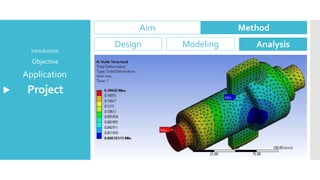
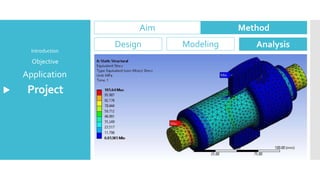
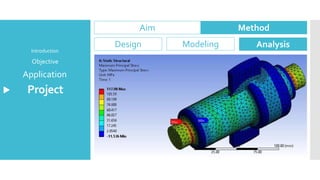
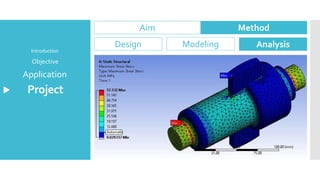
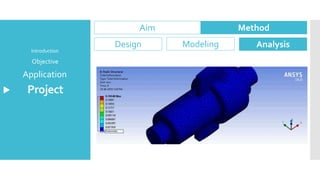
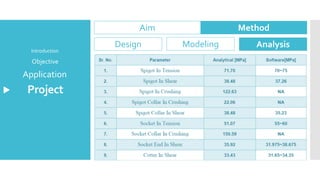
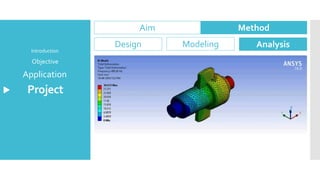
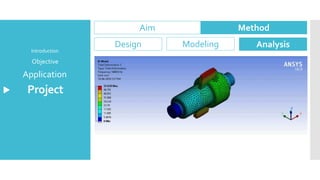
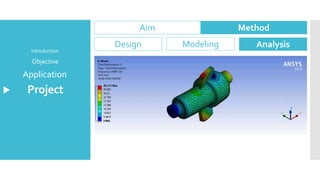
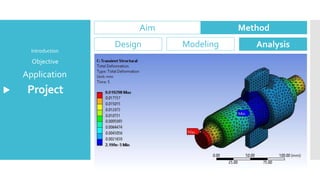
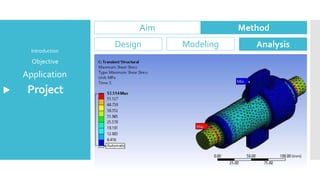
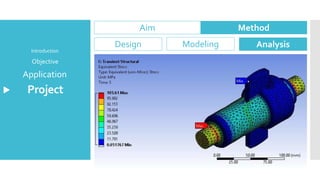
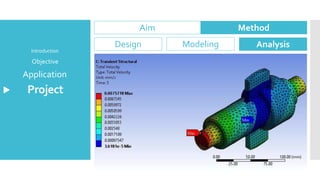
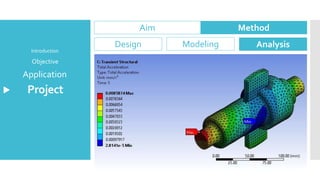
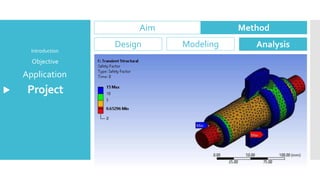
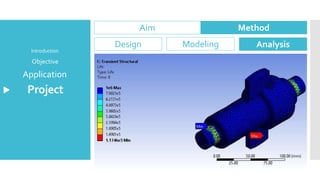
Conclusion :
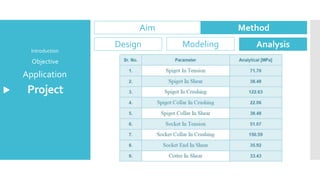
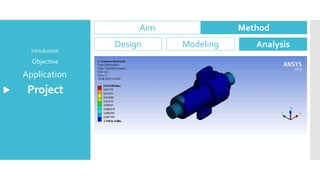
 As the induced stresses occurred on the assembly are
lesser in magnitude than the permissible stresses when a
tensile or compressive load of 50 KN is applied on it, it is
evident through the simulation that the joint will perform
safely when subjected to actual conditions if it is
manufactured according to the design mentioned above.
Thank you....!!
BY
NARENDRA BHANDAVA
(60005168001)
RAHIL MODI
(60005168012)
MITESH PARMAR
(60005168014)
SHAUNAK PILLAI
(60005168017)
FARHAN SAYED
(60005168023)

Finite element analysis 1

Editor's Notes

  • #7 The project work provides a general idea and information about finite element analysis. The Application of finite element analysis is very broad but for this project, only the engineering part will be emphasized. The engineering part consist of simulation of a particular object applied with different kinds of forces that induce stresses in it. It gives an idea of how the object will perform practically in actual world before manufacturing it. The project provides a description of different methods and procedures that are used to perform finite element analysis and the difficulties faced while performing it.
  • #8 The project work provides a general idea and information about finite element analysis. The Application of finite element analysis is very broad but for this project, only the engineering part will be emphasized. The engineering part consist of simulation of a particular object applied with different kinds of forces that induce stresses in it. It gives an idea of how the object will perform practically in actual world before manufacturing it. The project provides a description of different methods and procedures that are used to perform finite element analysis and the difficulties faced while performing it.
  • #9 The project work provides a general idea and information about finite element analysis. The Application of finite element analysis is very broad but for this project, only the engineering part will be emphasized. The engineering part consist of simulation of a particular object applied with different kinds of forces that induce stresses in it. It gives an idea of how the object will perform practically in actual world before manufacturing it. The project provides a description of different methods and procedures that are used to perform finite element analysis and the difficulties faced while performing it.
  • #10 The project work provides a general idea and information about finite element analysis. The Application of finite element analysis is very broad but for this project, only the engineering part will be emphasized. The engineering part consist of simulation of a particular object applied with different kinds of forces that induce stresses in it. It gives an idea of how the object will perform practically in actual world before manufacturing it. The project provides a description of different methods and procedures that are used to perform finite element analysis and the difficulties faced while performing it.
  • #11 The project work provides a general idea and information about finite element analysis. The Application of finite element analysis is very broad but for this project, only the engineering part will be emphasized. The engineering part consist of simulation of a particular object applied with different kinds of forces that induce stresses in it. It gives an idea of how the object will perform practically in actual world before manufacturing it. The project provides a description of different methods and procedures that are used to perform finite element analysis and the difficulties faced while performing it.