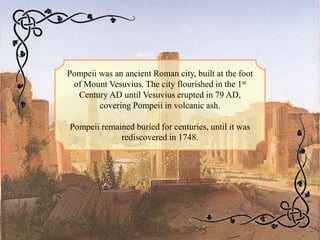
Pompeii was an ancient Roman city, built at the foot
of Mount Vesuvius. The city flourished in the 1st
Century AD until Vesuvius erupted in 79 AD,
covering Pompeii in volcanic ash.
Pompeii remained buried for centuries, until it was
rediscovered in 1748.
It is estimated that about 20% of the city’s population
managed to leave and save themselves after the first
signs of the eruption.
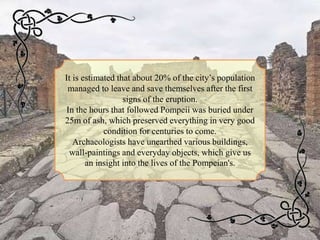
In the hours that followed Pompeii was buried under
25m of ash, which preserved everything in very good
condition for centuries to come.
Archaeologists have unearthed various buildings,
wall-paintings and everyday objects, which give us
an insight into the lives of the Pompeian's.
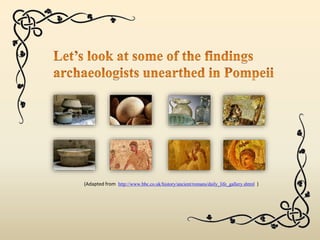
(Adapted from http://www.bbc.co.uk/history/ancient/romans/daily_life_gallery.shtml )
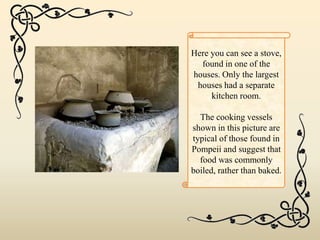
Here you can see a stove,
found in one of the
houses. Only the largest
houses had a separate
kitchen room.
The cooking vessels
shown in this picture are
typical of those found in
Pompeii and suggest that
food was commonly
boiled, rather than baked.
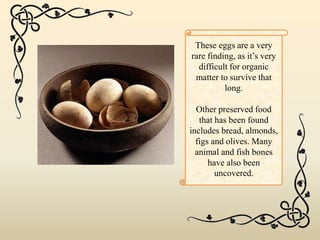
These eggs are a very
rare finding, as it’s very
difficult for organic
matter to survive that
long.
Other preserved food
that has been found
includes bread, almonds,
figs and olives. Many
animal and fish bones
have also been
uncovered.
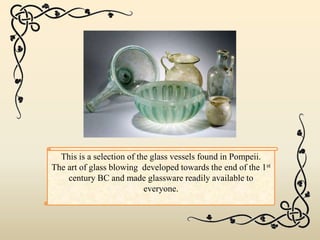
This is a selection of the glass vessels found in Pompeii.
The art of glass blowing developed towards the end of the 1st
century BC and made glassware readily available to
everyone.
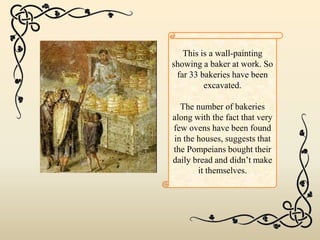
This is a wall-painting
showing a baker at work. So
far 33 bakeries have been
excavated.
The number of bakeries
along with the fact that very
few ovens have been found
in the houses, suggests that
the Pompeians bought their
daily bread and didn’t make
it themselves.
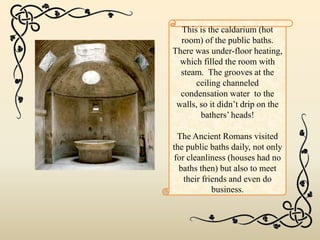
This is the caldarium (hot
room) of the public baths.
There was under-floor heating,
which filled the room with
steam. The grooves at the
ceiling channeled
condensation water to the
walls, so it didn’t drip on the
bathers’ heads!
The Ancient Romans visited
the public baths daily, not only
for cleanliness (houses had no
baths then) but also to meet
their friends and even do
business.
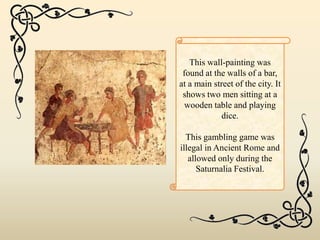
This wall-painting was
found at the walls of a bar,
at a main street of the city. It
shows two men sitting at a
wooden table and playing
dice.
This gambling game was
illegal in Ancient Rome and
allowed only during the
Saturnalia Festival.
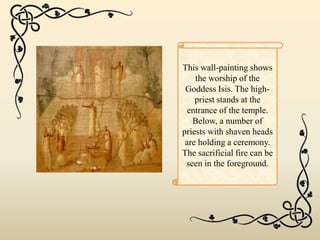
This wall-painting shows
the worship of the
Goddess Isis. The high-
priest stands at the
entrance of the temple.
Below, a number of
priests with shaven heads
are holding a ceremony.
The sacrificial fire can be
seen in the foreground.
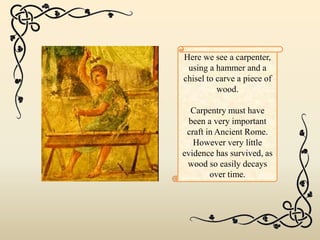
Here we see a carpenter,
using a hammer and a
chisel to carve a piece of
wood.
Carpentry must have
been a very important
craft in Ancient Rome.
However very little
evidence has survived, as
wood so easily decays
over time.
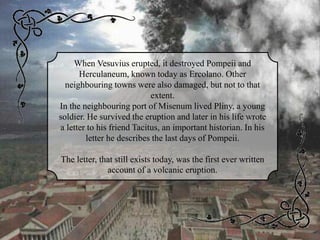
When Vesuvius erupted, it destroyed Pompeii and
Herculaneum, known today as Ercolano. Other
neighbouring towns were also damaged, but not to that
extent.
In the neighbouring port of Misenum lived Pliny, a young
soldier. He survived the eruption and later in his life wrote
a letter to his friend Tacitus, an important historian. In his
letter he describes the last days of Pompeii.
The letter, that still exists today, was the first ever written
account of a volcanic eruption.

Findings in pompeii

  • 2.
    Pompeii was anancient Roman city, built at the foot of Mount Vesuvius. The city flourished in the 1st Century AD until Vesuvius erupted in 79 AD, covering Pompeii in volcanic ash. Pompeii remained buried for centuries, until it was rediscovered in 1748.
  • 3.
    It is estimatedthat about 20% of the city’s population managed to leave and save themselves after the first signs of the eruption. In the hours that followed Pompeii was buried under 25m of ash, which preserved everything in very good condition for centuries to come. Archaeologists have unearthed various buildings, wall-paintings and everyday objects, which give us an insight into the lives of the Pompeian's.
  • 4.
  • 5.
    Here you cansee a stove, found in one of the houses. Only the largest houses had a separate kitchen room. The cooking vessels shown in this picture are typical of those found in Pompeii and suggest that food was commonly boiled, rather than baked.
  • 6.
    These eggs area very rare finding, as it’s very difficult for organic matter to survive that long. Other preserved food that has been found includes bread, almonds, figs and olives. Many animal and fish bones have also been uncovered.
  • 7.
    This is aselection of the glass vessels found in Pompeii. The art of glass blowing developed towards the end of the 1st century BC and made glassware readily available to everyone.
  • 8.
    This is awall-painting showing a baker at work. So far 33 bakeries have been excavated. The number of bakeries along with the fact that very few ovens have been found in the houses, suggests that the Pompeians bought their daily bread and didn’t make it themselves.
  • 9.
    This is thecaldarium (hot room) of the public baths. There was under-floor heating, which filled the room with steam. The grooves at the ceiling channeled condensation water to the walls, so it didn’t drip on the bathers’ heads! The Ancient Romans visited the public baths daily, not only for cleanliness (houses had no baths then) but also to meet their friends and even do business.
  • 10.
    This wall-painting was foundat the walls of a bar, at a main street of the city. It shows two men sitting at a wooden table and playing dice. This gambling game was illegal in Ancient Rome and allowed only during the Saturnalia Festival.
  • 11.
    This wall-painting shows theworship of the Goddess Isis. The high- priest stands at the entrance of the temple. Below, a number of priests with shaven heads are holding a ceremony. The sacrificial fire can be seen in the foreground.
  • 12.
    Here we seea carpenter, using a hammer and a chisel to carve a piece of wood. Carpentry must have been a very important craft in Ancient Rome. However very little evidence has survived, as wood so easily decays over time.
  • 13.
    When Vesuvius erupted,it destroyed Pompeii and Herculaneum, known today as Ercolano. Other neighbouring towns were also damaged, but not to that extent. In the neighbouring port of Misenum lived Pliny, a young soldier. He survived the eruption and later in his life wrote a letter to his friend Tacitus, an important historian. In his letter he describes the last days of Pompeii. The letter, that still exists today, was the first ever written account of a volcanic eruption.