Financial planning
What is Financial Planning?
It’s the process of achieving your life goals by using :-
 Different investment options
 With your current resources
 Through proper and disciplined money management
Financial Planning : CR+IO=FG
Rewards of Sound Financial Planning
 Maintain and improve standard of living
 Control spending in order to live well today and
tomorrow
 Accumulate wealth
Steps for setting Financial Goals
1. Write your goals (Should be specific and realistic)
1. Identify your time-specific goals
 Short Term ( within 2 year)
 Medium Term (within 5 years)
 Long term (after 5 years)
Priorities your goals
Analysis of present financial situation
1. Total Assets
2. Total Liabilities
3. Net Worth : (Assets – Liabilities)
4. Present Cash Flow statement (income and
expenditure)
Budgeting
 Income (from all sources)
 Expenses (Controllable + Uncontrollable)
 Present net saving
 Proposed net saving after reducing controllable
expenses.
Categories your financial goals
 Protection
 Medical
 Emergency Fund
 Investment / Wealth Creation
 Tax Saving
 Retirement
 Estate
Protection / Medical
 Life Insurance
 Critical Illness Insurance
 Hospitalization Insurance
 Personal Accident Insurance
 Disability Insurance
 Non-Life Insurance
How much insurance I need ?
Which policy should I take ?
Emergency Fund
 How much fund I require ?
 At what time I might require the funds ?
 Where to keep my emergency fund ?
Investment Planning
 Where to invest ?
 How to invest ?
 What is my risk appetite ?
 How much risk should I take ?
 Time frame for my investment ?
 Churning of Investment ?
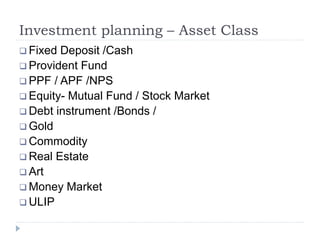
Investment planning – Asset Class
 Fixed Deposit /Cash
 Provident Fund
 PPF / APF /NPS
 Equity- Mutual Fund / Stock Market
 Debt instrument /Bonds /
 Gold
 Commodity
 Real Estate
 Art
 Money Market
 ULIP
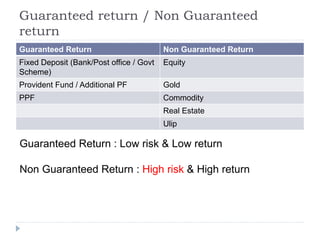
Guaranteed return / Non Guaranteed
return
Guaranteed Return Non Guaranteed Return
Fixed Deposit (Bank/Post office / Govt
Scheme)
Equity
Provident Fund / Additional PF Gold
PPF Commodity
Real Estate
Ulip
Guaranteed Return : Low risk & Low return
Non Guaranteed Return : High risk & High return
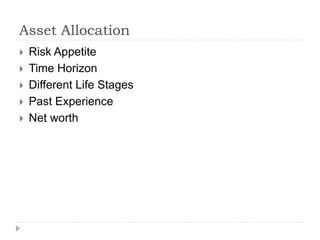
Asset Allocation
 Risk Appetite
 Time Horizon
 Different Life Stages
 Past Experience
 Net worth
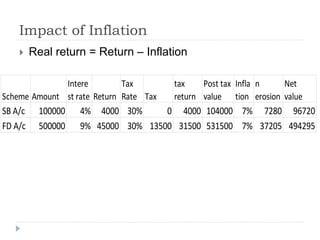
Impact of Inflation
 Real return = Return – Inflation
Scheme Amount
Intere
st rate Return
Tax
Rate Tax
Post
tax
return
Post tax
value
Infla
tion
Inflatio
n
erosion
Net
value
SB A/c 100000 4% 4000 30% 0 4000 104000 7% 7280 96720
FD A/c 500000 9% 45000 30% 13500 31500 531500 7% 37205 494295
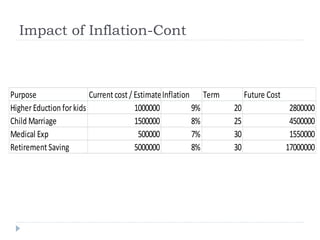
Impact of Inflation-Cont
Purpose Current cost / EstimateInflation Term Future Cost
HigherEduction forkids 1000000 9% 20 2800000
Child Marriage 1500000 8% 25 4500000
Medical Exp 500000 7% 30 1550000
Retirement Saving 5000000 8% 30 17000000
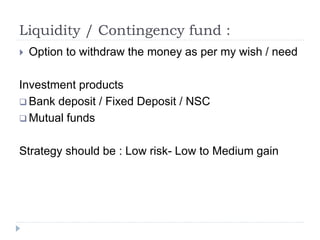
Liquidity / Contingency fund :
 Option to withdraw the money as per my wish / need
Investment products
 Bank deposit / Fixed Deposit / NSC
 Mutual funds
Strategy should be : Low risk- Low to Medium gain
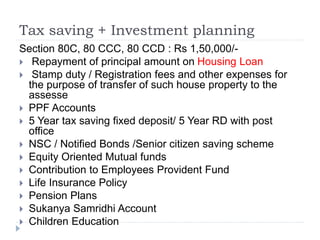
Tax saving + Investment planning
Section 80C, 80 CCC, 80 CCD : Rs 1,50,000/-
 Repayment of principal amount on Housing Loan
 Stamp duty / Registration fees and other expenses for
the purpose of transfer of such house property to the
assesse
 PPF Accounts
 5 Year tax saving fixed deposit/ 5 Year RD with post
office
 NSC / Notified Bonds /Senior citizen saving scheme
 Equity Oriented Mutual funds
 Contribution to Employees Provident Fund
 Life Insurance Policy
 Pension Plans
 Sukanya Samridhi Account
 Children Education
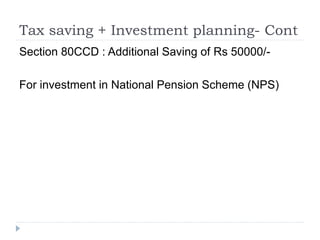
Tax saving + Investment planning- Cont
Section 80CCD : Additional Saving of Rs 50000/-
For investment in National Pension Scheme (NPS)
Tax saving + Investment planning-Cont
Section 80D, 80DD, 80 DDB
 Section 80D : Medical Insurance premium of self or
spouse or children – Rs 25000-30000/-
 Section 80DD : Medical Treatment of Handicapped
Dependents
 Section 80DDB : Treatment of Specified Diseases
Tax saving + Investment planning-Cont
Section 24: Interest on Housing Loan
 Self-occupied property: Rs 2 Lakh
 Not Self-occupied property : No maximum limit (Rental
income to be subtracted)
Condition : The house should be constructed within 5
years.
If not : the eligibility will reduce to Rs 30,000/-
 Rs 30000/- if loan is for repair and maintenance of self
occupied house.
Tax saving + Investment planning-Cont
Section 80EE : Interest on Home Loan (First time
buyers)
Additional deduction of Rs 50,000/- for interest.
Conditions
 Value of property <50lakhs and Loan < 35 lakhs
Tax saving + Investment planning-Cont
Section 80 E : Education Loan
 For higher education of himself or spouse or
children :
 Only allowed for repayment of interest and not for
principal repayment
 No maximum limit
Tax saving + Investment planning-Cont
Section 80CCG : RGESS
 Annual income < Rs 12 Lakhs P.A.
 Investment in specified companies and mutual funds
 Only for first time investors
 Investment upto Rs 50000/-
 50% deduction of the amount invested during the
year.
 Benefit can be availed for 3 consecutive years
Tax saving + Investment planning-Cont
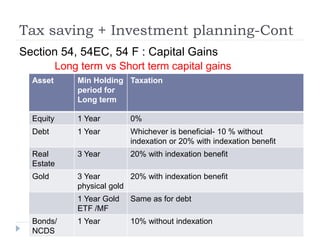
Section 54, 54EC, 54 F : Capital Gains
Asset Min Holding
period for
Long term
Taxation
Equity 1 Year 0%
Debt 1 Year Whichever is beneficial- 10 % without
indexation or 20% with indexation benefit
Real
Estate
3 Year 20% with indexation benefit
Gold 3 Year
physical gold
20% with indexation benefit
1 Year Gold
ETF /MF
Same as for debt
Bonds/
NCDS
1 Year 10% without indexation
Long term vs Short term capital gains
Tax saving + Investment planning-Cont
Section 80 G: Donations
 Contribution to National Relief Fund
 Donation for charity, social purpose.
In some cases 100% of donation can be deducted
while in certain cases the deduction is restricted upto
50%
Cash donation : Rs 10000/-
Retirement Planning
 Corpus required
 Identify the assets for investment
 Diversification
 Risk taking capacity
 Portfolio churning as per the change in age profile /
performance of portfolio etc
 Pension plan
 Annuity scheme
Estate Planning
Whom I would like to give the property after my life:
 Preparation of will
 Amendment of will
 Allocation of resources as per my wish.
Estate Planning -Cont
Will is a legal document in which a person gives
instruction about the distribution of his/her assets and
the legal guardian (if require).
Parties in a will
 Executor
 Beneficiary
 Power of Attorney
https://sbicaptrustee.in : My will services online
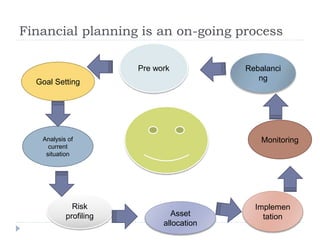
Financial planning is an on-going process
Pre work
Asset
allocation
MonitoringAnalysis of
current
situation
Risk
profiling
Implemen
tation
Goal Setting
Rebalanci
ng
Section 80 D: Medical Insurance
 Insurance of Self, Spouse and dependent children:
Rs 25000
 If senior citizen : Rs30000
 Health insurance premium for parents : Rs 30000
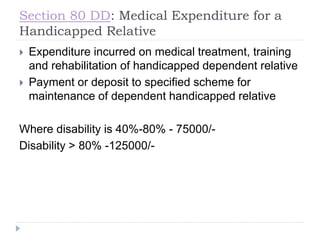
Section 80 DD: Medical Expenditure for a
Handicapped Relative
 Expenditure incurred on medical treatment, training
and rehabilitation of handicapped dependent relative
 Payment or deposit to specified scheme for
maintenance of dependent handicapped relative
Where disability is 40%-80% - 75000/-
Disability > 80% -125000/-
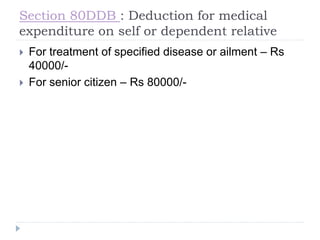
Section 80DDB : Deduction for medical
expenditure on self or dependent relative
 For treatment of specified disease or ailment – Rs
40000/-
 For senior citizen – Rs 80000/-
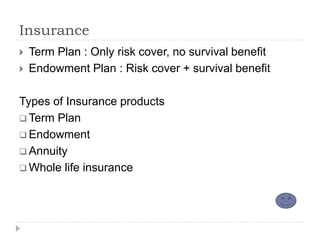
Insurance
 Term Plan : Only risk cover, no survival benefit
 Endowment Plan : Risk cover + survival benefit
Types of Insurance products
 Term Plan
 Endowment
 Annuity
 Whole life insurance
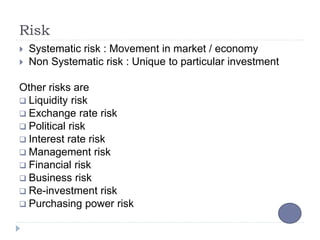
Risk
 Systematic risk : Movement in market / economy
 Non Systematic risk : Unique to particular investment
Other risks are
 Liquidity risk
 Exchange rate risk
 Political risk
 Interest rate risk
 Management risk
 Financial risk
 Business risk
 Re-investment risk
 Purchasing power risk
Risk profile of an individual
 Age
 Income level
 Time horizon of investment
 Dependents
 Market knowledge / investment products
 Capacity to absorb loss

Financial planning raj

  • 1.
  • 2.
    What is FinancialPlanning? It’s the process of achieving your life goals by using :-  Different investment options  With your current resources  Through proper and disciplined money management
  • 3.
  • 4.
    Rewards of SoundFinancial Planning  Maintain and improve standard of living  Control spending in order to live well today and tomorrow  Accumulate wealth
  • 5.
    Steps for settingFinancial Goals 1. Write your goals (Should be specific and realistic) 1. Identify your time-specific goals  Short Term ( within 2 year)  Medium Term (within 5 years)  Long term (after 5 years) Priorities your goals
  • 6.
    Analysis of presentfinancial situation 1. Total Assets 2. Total Liabilities 3. Net Worth : (Assets – Liabilities) 4. Present Cash Flow statement (income and expenditure)
  • 7.
    Budgeting  Income (fromall sources)  Expenses (Controllable + Uncontrollable)  Present net saving  Proposed net saving after reducing controllable expenses.
  • 8.
    Categories your financialgoals  Protection  Medical  Emergency Fund  Investment / Wealth Creation  Tax Saving  Retirement  Estate
  • 9.
    Protection / Medical Life Insurance  Critical Illness Insurance  Hospitalization Insurance  Personal Accident Insurance  Disability Insurance  Non-Life Insurance How much insurance I need ? Which policy should I take ?
  • 10.
    Emergency Fund  Howmuch fund I require ?  At what time I might require the funds ?  Where to keep my emergency fund ?
  • 11.
    Investment Planning  Whereto invest ?  How to invest ?  What is my risk appetite ?  How much risk should I take ?  Time frame for my investment ?  Churning of Investment ?
  • 12.
    Investment planning –Asset Class  Fixed Deposit /Cash  Provident Fund  PPF / APF /NPS  Equity- Mutual Fund / Stock Market  Debt instrument /Bonds /  Gold  Commodity  Real Estate  Art  Money Market  ULIP
  • 13.
    Guaranteed return /Non Guaranteed return Guaranteed Return Non Guaranteed Return Fixed Deposit (Bank/Post office / Govt Scheme) Equity Provident Fund / Additional PF Gold PPF Commodity Real Estate Ulip Guaranteed Return : Low risk & Low return Non Guaranteed Return : High risk & High return
  • 14.
    Asset Allocation  RiskAppetite  Time Horizon  Different Life Stages  Past Experience  Net worth
  • 15.
    Impact of Inflation Real return = Return – Inflation Scheme Amount Intere st rate Return Tax Rate Tax Post tax return Post tax value Infla tion Inflatio n erosion Net value SB A/c 100000 4% 4000 30% 0 4000 104000 7% 7280 96720 FD A/c 500000 9% 45000 30% 13500 31500 531500 7% 37205 494295
  • 16.
    Impact of Inflation-Cont PurposeCurrent cost / EstimateInflation Term Future Cost HigherEduction forkids 1000000 9% 20 2800000 Child Marriage 1500000 8% 25 4500000 Medical Exp 500000 7% 30 1550000 Retirement Saving 5000000 8% 30 17000000
  • 17.
    Liquidity / Contingencyfund :  Option to withdraw the money as per my wish / need Investment products  Bank deposit / Fixed Deposit / NSC  Mutual funds Strategy should be : Low risk- Low to Medium gain
  • 18.
    Tax saving +Investment planning Section 80C, 80 CCC, 80 CCD : Rs 1,50,000/-  Repayment of principal amount on Housing Loan  Stamp duty / Registration fees and other expenses for the purpose of transfer of such house property to the assesse  PPF Accounts  5 Year tax saving fixed deposit/ 5 Year RD with post office  NSC / Notified Bonds /Senior citizen saving scheme  Equity Oriented Mutual funds  Contribution to Employees Provident Fund  Life Insurance Policy  Pension Plans  Sukanya Samridhi Account  Children Education
  • 19.
    Tax saving +Investment planning- Cont Section 80CCD : Additional Saving of Rs 50000/- For investment in National Pension Scheme (NPS)
  • 20.
    Tax saving +Investment planning-Cont Section 80D, 80DD, 80 DDB  Section 80D : Medical Insurance premium of self or spouse or children – Rs 25000-30000/-  Section 80DD : Medical Treatment of Handicapped Dependents  Section 80DDB : Treatment of Specified Diseases
  • 21.
    Tax saving +Investment planning-Cont Section 24: Interest on Housing Loan  Self-occupied property: Rs 2 Lakh  Not Self-occupied property : No maximum limit (Rental income to be subtracted) Condition : The house should be constructed within 5 years. If not : the eligibility will reduce to Rs 30,000/-  Rs 30000/- if loan is for repair and maintenance of self occupied house.
  • 22.
    Tax saving +Investment planning-Cont Section 80EE : Interest on Home Loan (First time buyers) Additional deduction of Rs 50,000/- for interest. Conditions  Value of property <50lakhs and Loan < 35 lakhs
  • 23.
    Tax saving +Investment planning-Cont Section 80 E : Education Loan  For higher education of himself or spouse or children :  Only allowed for repayment of interest and not for principal repayment  No maximum limit
  • 24.
    Tax saving +Investment planning-Cont Section 80CCG : RGESS  Annual income < Rs 12 Lakhs P.A.  Investment in specified companies and mutual funds  Only for first time investors  Investment upto Rs 50000/-  50% deduction of the amount invested during the year.  Benefit can be availed for 3 consecutive years
  • 25.
    Tax saving +Investment planning-Cont Section 54, 54EC, 54 F : Capital Gains Asset Min Holding period for Long term Taxation Equity 1 Year 0% Debt 1 Year Whichever is beneficial- 10 % without indexation or 20% with indexation benefit Real Estate 3 Year 20% with indexation benefit Gold 3 Year physical gold 20% with indexation benefit 1 Year Gold ETF /MF Same as for debt Bonds/ NCDS 1 Year 10% without indexation Long term vs Short term capital gains
  • 26.
    Tax saving +Investment planning-Cont Section 80 G: Donations  Contribution to National Relief Fund  Donation for charity, social purpose. In some cases 100% of donation can be deducted while in certain cases the deduction is restricted upto 50% Cash donation : Rs 10000/-
  • 27.
    Retirement Planning  Corpusrequired  Identify the assets for investment  Diversification  Risk taking capacity  Portfolio churning as per the change in age profile / performance of portfolio etc  Pension plan  Annuity scheme
  • 28.
    Estate Planning Whom Iwould like to give the property after my life:  Preparation of will  Amendment of will  Allocation of resources as per my wish.
  • 29.
    Estate Planning -Cont Willis a legal document in which a person gives instruction about the distribution of his/her assets and the legal guardian (if require). Parties in a will  Executor  Beneficiary  Power of Attorney https://sbicaptrustee.in : My will services online
  • 30.
    Financial planning isan on-going process Pre work Asset allocation MonitoringAnalysis of current situation Risk profiling Implemen tation Goal Setting Rebalanci ng
  • 31.
    Section 80 D:Medical Insurance  Insurance of Self, Spouse and dependent children: Rs 25000  If senior citizen : Rs30000  Health insurance premium for parents : Rs 30000
  • 32.
    Section 80 DD:Medical Expenditure for a Handicapped Relative  Expenditure incurred on medical treatment, training and rehabilitation of handicapped dependent relative  Payment or deposit to specified scheme for maintenance of dependent handicapped relative Where disability is 40%-80% - 75000/- Disability > 80% -125000/-
  • 33.
    Section 80DDB :Deduction for medical expenditure on self or dependent relative  For treatment of specified disease or ailment – Rs 40000/-  For senior citizen – Rs 80000/-
  • 34.
    Insurance  Term Plan: Only risk cover, no survival benefit  Endowment Plan : Risk cover + survival benefit Types of Insurance products  Term Plan  Endowment  Annuity  Whole life insurance
  • 35.
    Risk  Systematic risk: Movement in market / economy  Non Systematic risk : Unique to particular investment Other risks are  Liquidity risk  Exchange rate risk  Political risk  Interest rate risk  Management risk  Financial risk  Business risk  Re-investment risk  Purchasing power risk
  • 36.
    Risk profile ofan individual  Age  Income level  Time horizon of investment  Dependents  Market knowledge / investment products  Capacity to absorb loss