FINANCI
AL
MODELLI
NG
 The integration of technical skills
with business/academic skills to create a user-
friendly decision-making tool
 Here based on the past performance of the
company, we create a detailed financial model
with realistic assumptions.
Technical Skills
Excel Function
Design
Logic
Presentation
Business Skills
Accounting
Finance
Engineering
Statistics
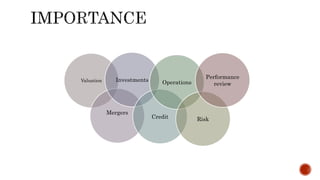
Valuation
Mergers
Investments
Credit
Operations
Risk
Performance
review
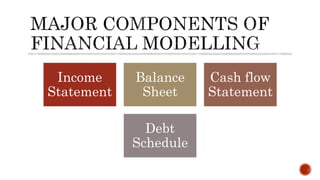
Income
Statement
Balance
Sheet
Cash flow
Statement
Debt
Schedule
Needs to tell the story of the company.
Needs to work electronically: every formula should make sense.
Needs to work well on paper (like a presentation).
Critical to have a strong plan.
Every time we build model, create a planning document.
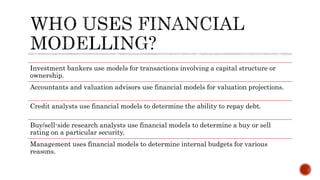
Investment bankers use models for transactions involving a capital structure or
ownership.
Accountants and valuation advisors use financial models for valuation projections.
Credit analysts use financial models to determine the ability to repay debt.
Buy/sell-side research analysts use financial models to determine a buy or sell
rating on a particular security.
Management uses financial models to determine internal budgets for various
reasons.
Gather
•Gather historical data. You'll need at
least the last three years of financial
data for the company
Calculate
•Calculate ratios and metrics. Using
the historical data from the first step,
you'll calculate historical ratios and
metrics, like growth margins and
rates, asset turnover ratios, and
inventory changes.
Make
•Make informed assumptions. Use
assumptions to calculate future
growth margins and rates, assets
that may turnover, and projected
changes in inventory.
Create
•Create a forecast. Use all the above
data and reports to forecast the usual
accounting documents, such as future
income, balance sheets, and cash flow
statements.
Value
•Value the company. After you've
forecasted, you can now value the
company using the DCF,
or Discounted Cash Flow, method.
Review
•Review. Once you have this
information before you, use your
drafted statements to decide how
different scenarios may play out.
IMPORTANC
E OF
ASSUMPTIO
NS
ASSUMPTIONS ARE
THE BASIC MAP FOR
CREATING ANY
MODEL.
THE ASSUMPTION
DECREASES
UNCERTAINTY.
THE FINANCIAL
MODEL IS GOOD AS
THE ASSUMPTIONS
USED TO BUILD ANY
BUSINESS MODEL.
THEY ARE KEY TO
“BUY-IN” FROM
INVESTORS,
PARTNERS, AND
EMPLOYEES.
ASSUMPTIONS HAVE
TO BE WELL
THOUGHT OUT,
RESEARCHED, AND
TESTED.
SOURCE
OF
INFORMAT
ION
 Wikipedia
 https://www.wallstreetprep.com/knowledge/fina
ncial-modeling-techniques/
 https://the-cfo.io/2019/11/06/what-are-the-
different-financial-models/
 https://valuationacademy.com/what-is-financial-
modeling-and-who-uses-financial-models/
 E-Book: The Complete CPA Preference by Nick
Dauber.
THANK
YOU

Financial Modelling.pptx

  • 1.
  • 2.
     The integrationof technical skills with business/academic skills to create a user- friendly decision-making tool  Here based on the past performance of the company, we create a detailed financial model with realistic assumptions. Technical Skills Excel Function Design Logic Presentation Business Skills Accounting Finance Engineering Statistics
  • 3.
  • 4.
  • 5.
    Needs to tellthe story of the company. Needs to work electronically: every formula should make sense. Needs to work well on paper (like a presentation). Critical to have a strong plan. Every time we build model, create a planning document.
  • 6.
    Investment bankers usemodels for transactions involving a capital structure or ownership. Accountants and valuation advisors use financial models for valuation projections. Credit analysts use financial models to determine the ability to repay debt. Buy/sell-side research analysts use financial models to determine a buy or sell rating on a particular security. Management uses financial models to determine internal budgets for various reasons.
  • 7.
    Gather •Gather historical data.You'll need at least the last three years of financial data for the company Calculate •Calculate ratios and metrics. Using the historical data from the first step, you'll calculate historical ratios and metrics, like growth margins and rates, asset turnover ratios, and inventory changes. Make •Make informed assumptions. Use assumptions to calculate future growth margins and rates, assets that may turnover, and projected changes in inventory. Create •Create a forecast. Use all the above data and reports to forecast the usual accounting documents, such as future income, balance sheets, and cash flow statements. Value •Value the company. After you've forecasted, you can now value the company using the DCF, or Discounted Cash Flow, method. Review •Review. Once you have this information before you, use your drafted statements to decide how different scenarios may play out.
  • 9.
    IMPORTANC E OF ASSUMPTIO NS ASSUMPTIONS ARE THEBASIC MAP FOR CREATING ANY MODEL. THE ASSUMPTION DECREASES UNCERTAINTY. THE FINANCIAL MODEL IS GOOD AS THE ASSUMPTIONS USED TO BUILD ANY BUSINESS MODEL. THEY ARE KEY TO “BUY-IN” FROM INVESTORS, PARTNERS, AND EMPLOYEES. ASSUMPTIONS HAVE TO BE WELL THOUGHT OUT, RESEARCHED, AND TESTED.
  • 10.
    SOURCE OF INFORMAT ION  Wikipedia  https://www.wallstreetprep.com/knowledge/fina ncial-modeling-techniques/ https://the-cfo.io/2019/11/06/what-are-the- different-financial-models/  https://valuationacademy.com/what-is-financial- modeling-and-who-uses-financial-models/  E-Book: The Complete CPA Preference by Nick Dauber.
  • 11.