MARKETING OF FINANCIAL
SERVICES
FINANCIAL SERVICES
• Financial services are the professional services
involving the investment, lending and
management of money and assets.
• This term is also used to describe the
organisations that deal with the management
of money.
• Financial services are the largest market
resource within the world, in terms of
earnings.
FINANCIAL SERVICE INSTITUTIONS
• Retail, corporate and private banks
• Mutual funds and investment trusts
• Personal and group pension
• Credit card issuers
• Stock exchanges
• Leasing companies
• Brokers and agents
• Government saving institutions
PRODUCT
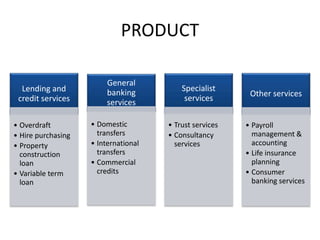
Lending and
credit services
• Overdraft
• Hire purchasing
• Property
construction
loan
• Variable term
loan
General
banking
services
• Domestic
transfers
• International
transfers
• Commercial
credits
Specialist
services
• Trust services
• Consultancy
services
Other services
• Payroll
management &
accounting
• Life insurance
planning
• Consumer
banking services
PRICE
• RBI regulates rate of interest & Indian Banks
Association controls other charges.
• Includes annual charges for the services,
penalties, commissions, charges for payment
of utility bills and differential interest rate.
PROMOTION
• Objective is to make people aware of new services,
to persuade & remind customers, build image of the
enterprise.
• Promotion tools are advertising, personal selling,
direct marketing, sales promotion & public relations.
• Advertising: Television, radio, movies
• Sales promotion: Gifts, discounts & commissions.
• Print media: Newspaper, magazines, hoardings
• Word of mouth is an important promotional tool.
• Personal selling: Personalised services.
PLACE
• Place offers a different side of value (utility) to
the customer.
• Making the service available & accessible to the
customer.
• Closer to the customer means higher probability
of purchase.
• ATMs and credit and debit cards offer
convenience to customers.
• Should have sound availability of electricity,
transportation & other necessary facilities for the
smooth functioning of the branch.
PHYSICAL EVIDENCE
• Physical evidence is classified as:
a) Peripheral evidence: Possessed by consumer, but
has little independent value (eg: cheque book)
b) Essential evidence: Cannot possessed by consumer
and has independent value (eg: bank branch)
• Used for promotion in terms of:
o Imaginative designs of bank brochures, flashy cheque
books.
o Attractive brand names, logos, symbols.
o Ambience, interiors, safety forms, documents.
o Tangibles(watches, calculator) as free gifts.
PEOPLE
• ‘People’ include all who are directly or
indirectly involved in the trade of the product
or service.
• Include both employees and customers.
• Institutions adopt internal marketing in order
to make the whole business customer-
oriented.
• Employee’s behaviour is important as they
takes the centre stage to achieve success.
PROCESS
• Processes are important to deliver a quality
service.
• The features of services; heterogeneity,
inseparability and intangibility makes this
element significant.
• Things to be considered:
• Flow of activities
• Standardization
• Customization
• Number of steps
• Customer involvement
• Eg: Loan application, clearance of cheque.
CHALLENGES FOR FINANCIAL SERVICES
• Life after the financial crisis
• Cross-border merger & acquisition activity
increasing
• Changing role of the bank branch
• Staying close to the customer
• Many customers are neither financially literate
nor very interested in financial services
• Many customers do not trust financial institutions
• The changing consumer
TRENDS IN FINANCIAL MARKETING
• Customisation & Personalisation
• Digital marketing
• Content marketing
• Integration of mobile
• Awareness of customer journey
• Mainstreaming social media
• Continuing battling with ad blocking
• Introduction of new channels

Financial marketing

  • 1.
  • 2.
    FINANCIAL SERVICES • Financialservices are the professional services involving the investment, lending and management of money and assets. • This term is also used to describe the organisations that deal with the management of money. • Financial services are the largest market resource within the world, in terms of earnings.
  • 3.
    FINANCIAL SERVICE INSTITUTIONS •Retail, corporate and private banks • Mutual funds and investment trusts • Personal and group pension • Credit card issuers • Stock exchanges • Leasing companies • Brokers and agents • Government saving institutions
  • 5.
    PRODUCT Lending and credit services •Overdraft • Hire purchasing • Property construction loan • Variable term loan General banking services • Domestic transfers • International transfers • Commercial credits Specialist services • Trust services • Consultancy services Other services • Payroll management & accounting • Life insurance planning • Consumer banking services
  • 6.
    PRICE • RBI regulatesrate of interest & Indian Banks Association controls other charges. • Includes annual charges for the services, penalties, commissions, charges for payment of utility bills and differential interest rate.
  • 7.
    PROMOTION • Objective isto make people aware of new services, to persuade & remind customers, build image of the enterprise. • Promotion tools are advertising, personal selling, direct marketing, sales promotion & public relations. • Advertising: Television, radio, movies • Sales promotion: Gifts, discounts & commissions. • Print media: Newspaper, magazines, hoardings • Word of mouth is an important promotional tool. • Personal selling: Personalised services.
  • 8.
    PLACE • Place offersa different side of value (utility) to the customer. • Making the service available & accessible to the customer. • Closer to the customer means higher probability of purchase. • ATMs and credit and debit cards offer convenience to customers. • Should have sound availability of electricity, transportation & other necessary facilities for the smooth functioning of the branch.
  • 9.
    PHYSICAL EVIDENCE • Physicalevidence is classified as: a) Peripheral evidence: Possessed by consumer, but has little independent value (eg: cheque book) b) Essential evidence: Cannot possessed by consumer and has independent value (eg: bank branch) • Used for promotion in terms of: o Imaginative designs of bank brochures, flashy cheque books. o Attractive brand names, logos, symbols. o Ambience, interiors, safety forms, documents. o Tangibles(watches, calculator) as free gifts.
  • 10.
    PEOPLE • ‘People’ includeall who are directly or indirectly involved in the trade of the product or service. • Include both employees and customers. • Institutions adopt internal marketing in order to make the whole business customer- oriented. • Employee’s behaviour is important as they takes the centre stage to achieve success.
  • 11.
    PROCESS • Processes areimportant to deliver a quality service. • The features of services; heterogeneity, inseparability and intangibility makes this element significant. • Things to be considered: • Flow of activities • Standardization • Customization • Number of steps • Customer involvement • Eg: Loan application, clearance of cheque.
  • 12.
    CHALLENGES FOR FINANCIALSERVICES • Life after the financial crisis • Cross-border merger & acquisition activity increasing • Changing role of the bank branch • Staying close to the customer • Many customers are neither financially literate nor very interested in financial services • Many customers do not trust financial institutions • The changing consumer
  • 13.
    TRENDS IN FINANCIALMARKETING • Customisation & Personalisation • Digital marketing • Content marketing • Integration of mobile • Awareness of customer journey • Mainstreaming social media • Continuing battling with ad blocking • Introduction of new channels