Pricing strategies
FOB Pricing
FOB (Free on Board) origin pricing is a pricing strategy commonly used in
international trade and domestic shipping. Under FOB origin pricing, the buyer
assumes ownership and responsibility for the goods as soon as they leave the seller's
shipping point (e.g., factory, warehouse, or port of origin).
Key Characteristics
∙ Ownership Transfer Point
∙ Responsibility for Freight Cost
∙ Risk allocation
∙ Cost structure
FOB Origin Pricing
A DVA N TAG E S
∙ Cost transparency
∙ Customization
∙ Sellers simplified role
D I SA DVA N TAG E S
∙ Complexity for the buyer
∙ Increased risk
∙ Potential hidden costs
Uniform Delivered Pricing
Uniform Delivered Pricing is a pricing strategy where the seller charges
the same delivery price to all customers, regardless of their location. It
is often used to simplify pricing structures and promote fairness,
especially for widespread markets.
Characteristics
∙ Flat delivery fee
∙ Seller responsibility
∙ No geographical discrimination
Uniform Delivered Pricing
A DVA N TAG E S
∙ Simplifies pricing
∙ Encourages market expansion
∙ Predictable costs
∙ Builds goodwill
D I SA DVA N TAG E S
∙ Higher costs for nearby customers
∙ Increased seller costs
∙ Competitive challenges
Zone Pricing
Zone Pricing is a pricing strategy where the price of a product or service
varies based on the geographical location or "zone" of the customer.
This method is often used to account for differences in shipping costs,
regional demand, and competitive conditions.
Characteristics
∙ Geographical zones
∙ Variable pricing
∙ Cost based
Zone Pricing
A DVA N TAG E S
∙ Cost recovery
∙ Fair pricing
∙ Market competitiveness
∙ Scalability
D I SA DVA N TAG E S
∙ Perceived Inequity
∙ Complexity
∙ Price sensitivity
Basing point pricing
Basing Point Pricing is a pricing strategy in which the seller designates a specific
location (the "basing point") and calculates transportation costs for all buyers as if the
goods were shipped from that location, regardless of where they are actually shipped
from. It is commonly used in industries where transportation costs are a significant
factor, such as construction materials, steel, and chemicals.
Characteristics
∙ Basing point location
∙ Uniform freight calculation
∙ Price components
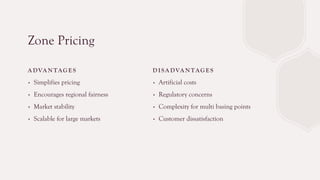
Zone Pricing
A DVA N TAG E S
∙ Simplifies pricing
∙ Encourages regional fairness
∙ Market stability
∙ Scalable for large markets
D I SA DVA N TAG E S
∙ Artificial costs
∙ Regulatory concerns
∙ Complexity for multi basing points
∙ Customer dissatisfaction
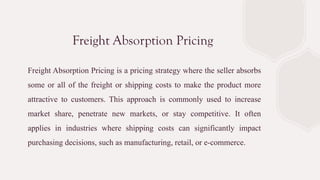
Freight Absorption Pricing
Freight Absorption Pricing is a pricing strategy where the seller absorbs
some or all of the freight or shipping costs to make the product more
attractive to customers. This approach is commonly used to increase
market share, penetrate new markets, or stay competitive. It often
applies in industries where shipping costs can significantly impact
purchasing decisions, such as manufacturing, retail, or e-commerce.
Characteristics
∙ Shared freight costs
∙ Price uniformity
∙ Market competitiveness
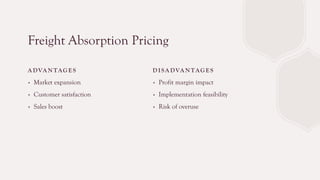
Freight Absorption Pricing
A DVA N TAG E S
∙ Market expansion
∙ Customer satisfaction
∙ Sales boost
D I SA DVA N TAG E S
∙ Profit margin impact
∙ Implementation feasibility
∙ Risk of overuse
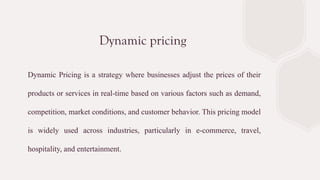
Dynamic pricing
Dynamic Pricing is a strategy where businesses adjust the prices of their
products or services in real-time based on various factors such as demand,
competition, market conditions, and customer behavior. This pricing model
is widely used across industries, particularly in e-commerce, travel,
hospitality, and entertainment.
Characteristics
∙ Real time adjustments
∙ Demand based pricing
∙ Competitive pricing
∙ Customer segmentation
∙ Peak and off peak pricing
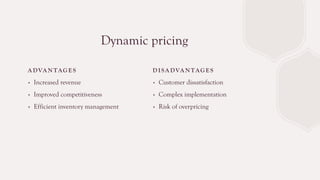
Dynamic pricing
A DVA N TAG E S
∙ Increased revenue
∙ Improved competitiveness
∙ Efficient inventory management
D I SA DVA N TAG E S
∙ Customer dissatisfaction
∙ Complex implementation
∙ Risk of overpricing


Types of Pricing .pptx- various pricing.

  • 1.
  • 2.
    FOB Pricing FOB (Freeon Board) origin pricing is a pricing strategy commonly used in international trade and domestic shipping. Under FOB origin pricing, the buyer assumes ownership and responsibility for the goods as soon as they leave the seller's shipping point (e.g., factory, warehouse, or port of origin).
  • 3.
    Key Characteristics ∙ OwnershipTransfer Point ∙ Responsibility for Freight Cost ∙ Risk allocation ∙ Cost structure
  • 4.
    FOB Origin Pricing ADVA N TAG E S ∙ Cost transparency ∙ Customization ∙ Sellers simplified role D I SA DVA N TAG E S ∙ Complexity for the buyer ∙ Increased risk ∙ Potential hidden costs
  • 5.
    Uniform Delivered Pricing UniformDelivered Pricing is a pricing strategy where the seller charges the same delivery price to all customers, regardless of their location. It is often used to simplify pricing structures and promote fairness, especially for widespread markets.
  • 6.
    Characteristics ∙ Flat deliveryfee ∙ Seller responsibility ∙ No geographical discrimination
  • 7.
    Uniform Delivered Pricing ADVA N TAG E S ∙ Simplifies pricing ∙ Encourages market expansion ∙ Predictable costs ∙ Builds goodwill D I SA DVA N TAG E S ∙ Higher costs for nearby customers ∙ Increased seller costs ∙ Competitive challenges
  • 8.
    Zone Pricing Zone Pricingis a pricing strategy where the price of a product or service varies based on the geographical location or "zone" of the customer. This method is often used to account for differences in shipping costs, regional demand, and competitive conditions.
  • 9.
    Characteristics ∙ Geographical zones ∙Variable pricing ∙ Cost based
  • 10.
    Zone Pricing A DVAN TAG E S ∙ Cost recovery ∙ Fair pricing ∙ Market competitiveness ∙ Scalability D I SA DVA N TAG E S ∙ Perceived Inequity ∙ Complexity ∙ Price sensitivity
  • 11.
    Basing point pricing BasingPoint Pricing is a pricing strategy in which the seller designates a specific location (the "basing point") and calculates transportation costs for all buyers as if the goods were shipped from that location, regardless of where they are actually shipped from. It is commonly used in industries where transportation costs are a significant factor, such as construction materials, steel, and chemicals.
  • 12.
    Characteristics ∙ Basing pointlocation ∙ Uniform freight calculation ∙ Price components
  • 13.
    Zone Pricing A DVAN TAG E S ∙ Simplifies pricing ∙ Encourages regional fairness ∙ Market stability ∙ Scalable for large markets D I SA DVA N TAG E S ∙ Artificial costs ∙ Regulatory concerns ∙ Complexity for multi basing points ∙ Customer dissatisfaction
  • 14.
    Freight Absorption Pricing FreightAbsorption Pricing is a pricing strategy where the seller absorbs some or all of the freight or shipping costs to make the product more attractive to customers. This approach is commonly used to increase market share, penetrate new markets, or stay competitive. It often applies in industries where shipping costs can significantly impact purchasing decisions, such as manufacturing, retail, or e-commerce.
  • 15.
    Characteristics ∙ Shared freightcosts ∙ Price uniformity ∙ Market competitiveness
  • 16.
    Freight Absorption Pricing ADVA N TAG E S ∙ Market expansion ∙ Customer satisfaction ∙ Sales boost D I SA DVA N TAG E S ∙ Profit margin impact ∙ Implementation feasibility ∙ Risk of overuse
  • 17.
    Dynamic pricing Dynamic Pricingis a strategy where businesses adjust the prices of their products or services in real-time based on various factors such as demand, competition, market conditions, and customer behavior. This pricing model is widely used across industries, particularly in e-commerce, travel, hospitality, and entertainment.
  • 18.
    Characteristics ∙ Real timeadjustments ∙ Demand based pricing ∙ Competitive pricing ∙ Customer segmentation ∙ Peak and off peak pricing
  • 19.
    Dynamic pricing A DVAN TAG E S ∙ Increased revenue ∙ Improved competitiveness ∙ Efficient inventory management D I SA DVA N TAG E S ∙ Customer dissatisfaction ∙ Complex implementation ∙ Risk of overpricing