Mrs.T.Dhanalakshmi
Asst.Professor
Dept of Business Administration
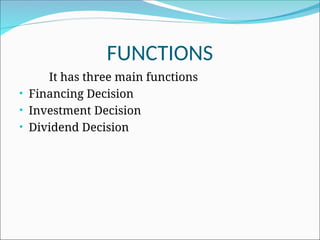
FUNCTIONS
It has three main functions
• Financing Decision
• Investment Decision
• Dividend Decision
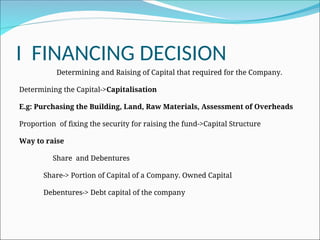
I FINANCING DECISION
Determining and Raising of Capital that required for the Company.
Determining the Capital->Capitalisation
E.g: Purchasing the Building, Land, Raw Materials, Assessment of Overheads
Proportion of fixing the security for raising the fund->Capital Structure
Way to raise
Share and Debentures
Share-> Portion of Capital of a Company. Owned Capital
Debentures-> Debt capital of the company
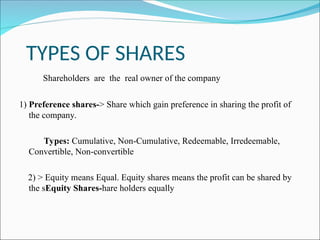
TYPES OF SHARES
Shareholders are the real owner of the company
1) Preference shares-> Share which gain preference in sharing the profit of
the company.
Types: Cumulative, Non-Cumulative, Redeemable, Irredeemable,
Convertible, Non-convertible
2) > Equity means Equal. Equity shares means the profit can be shared by
the sEquity Shares-hare holders equally
DEBENTURES
-Debenture holders are the creditors of the company.
For the Debentures, the company has to pay interest.
Types: Convertible, Non-convertible, Redeemable, Irredeemable
By using these securities, the company has to frame optimum
capital structure (Small portion of capital should be in the form
of Debt)
Optimum Capital Structure-> the EPS of the company
(EPS-Earning Per Share)
II INVESTMENT DECISION
Decision taken by the company about the investment of raised capital
on the assets of the company
Two Decisions
Capital Budgeting-> Decisions taken by the company to make an investment
in Long Terms Assets
Working Capital-> Decisions taken by the company to make an investment
in Current Assets.
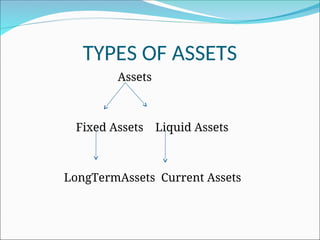
TYPES OF ASSETS
Assets
Fixed Assets Liquid Assets
LongTermAssets Current Assets
Long Term Assets-> Investment made in Long Term Asset will give
return after a particular period of time. Initially it gives less profit but over a
period of time it gives more profit
How
Initial stage->Sales will be less->No optimum utilisation of resources-
Profit/Return will be low
Sales gets increased->Leads to Optimum Utilisation of Resources->
Less cost-> Profit will be high.
Short Term Assets-> Investment made in Short Term Asset will give a
quick return but less return
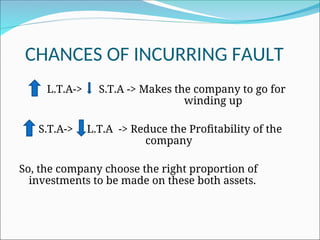
CHANCES OF INCURRING FAULT
L.T.A-> S.T.A -> Makes the company to go for
winding up
S.T.A-> L.T.A -> Reduce the Profitability of the
company
So, the company choose the right proportion of
investments to be made on these both assets.
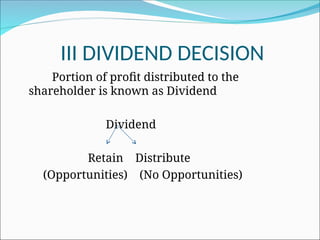
III DIVIDEND DECISION
Portion of profit distributed to the
shareholder is known as Dividend
Dividend
Retain Distribute
(Opportunities) (No Opportunities)
Choose any one Blue Chip Company from the market and
assess pros and cons of its capital structure decision.
1. Why the company should have Debt capital in
its structure?
2. How the capital Structure decision affect EPS?
FINANCIAL  MANAGEMENT -Functions & Scope.ppt

FINANCIAL MANAGEMENT -Functions & Scope.ppt

  • 1.
  • 2.
    FUNCTIONS It has threemain functions • Financing Decision • Investment Decision • Dividend Decision
  • 3.
    I FINANCING DECISION Determiningand Raising of Capital that required for the Company. Determining the Capital->Capitalisation E.g: Purchasing the Building, Land, Raw Materials, Assessment of Overheads Proportion of fixing the security for raising the fund->Capital Structure Way to raise Share and Debentures Share-> Portion of Capital of a Company. Owned Capital Debentures-> Debt capital of the company
  • 4.
    TYPES OF SHARES Shareholdersare the real owner of the company 1) Preference shares-> Share which gain preference in sharing the profit of the company. Types: Cumulative, Non-Cumulative, Redeemable, Irredeemable, Convertible, Non-convertible 2) > Equity means Equal. Equity shares means the profit can be shared by the sEquity Shares-hare holders equally
  • 5.
    DEBENTURES -Debenture holders arethe creditors of the company. For the Debentures, the company has to pay interest. Types: Convertible, Non-convertible, Redeemable, Irredeemable By using these securities, the company has to frame optimum capital structure (Small portion of capital should be in the form of Debt) Optimum Capital Structure-> the EPS of the company (EPS-Earning Per Share)
  • 6.
    II INVESTMENT DECISION Decisiontaken by the company about the investment of raised capital on the assets of the company Two Decisions Capital Budgeting-> Decisions taken by the company to make an investment in Long Terms Assets Working Capital-> Decisions taken by the company to make an investment in Current Assets.
  • 7.
    TYPES OF ASSETS Assets FixedAssets Liquid Assets LongTermAssets Current Assets
  • 8.
    Long Term Assets->Investment made in Long Term Asset will give return after a particular period of time. Initially it gives less profit but over a period of time it gives more profit How Initial stage->Sales will be less->No optimum utilisation of resources- Profit/Return will be low Sales gets increased->Leads to Optimum Utilisation of Resources-> Less cost-> Profit will be high. Short Term Assets-> Investment made in Short Term Asset will give a quick return but less return
  • 9.
    CHANCES OF INCURRINGFAULT L.T.A-> S.T.A -> Makes the company to go for winding up S.T.A-> L.T.A -> Reduce the Profitability of the company So, the company choose the right proportion of investments to be made on these both assets.
  • 10.
    III DIVIDEND DECISION Portionof profit distributed to the shareholder is known as Dividend Dividend Retain Distribute (Opportunities) (No Opportunities)
  • 11.
    Choose any oneBlue Chip Company from the market and assess pros and cons of its capital structure decision.
  • 12.
    1. Why thecompany should have Debt capital in its structure? 2. How the capital Structure decision affect EPS?