Objectives

Upon completion of this discussion forum the participants:

• Will learn about governmental programs and avenues toward accessing
care and their eligibility criteria.

• Will have the tools to reduce and manage their outstanding medical costs.

• Will better understand the real benefits and opportunities of the Health
Care Reform Act relative to cancer care.

• Will become informed of federal laws and provisions that protect their right
to health coverage ensuring continuity of care.

• Will understand more about the approval process for Social Security
Disability.
Financial and
   Insurance                 Brendan Bietry
                   LIVESTRONG Senior Case Manager
Implications for      Patient Advocate Foundation

  the Cancer
    Survivor
Our Mission: To Serve Patients


          • Patient Advocate Foundation seeks to safeguard patients
            through effective mediation assuring access to care,
            maintenance of employment and preservation of their
  Our       financial stability relative to their diagnosis of life threatening
Mission     or debilitating diseases.


          • Since our inception in 1996, PAF has provided direct,
            sustained patient assistance to more than 500,000 patients
            and touched millions more American lives through the PAF
  Our       website, online chats and outreach events.
Impact


                                                                   3
Direct Patient Services offered by PAF

• Brokering resources to supplement the limits of insurance and
  to assure access to care for the uninsured
• Resolving debt crisis relative to a diagnosis
• Negotiating access to pharmaceutical agents, chemotherapy,
  medical devices and surgical procedures
• Resolving insurance issues in the public and private sector
• Negotiating pre-authorization approvals
• Providing assistance in facilitating and expediting the appeals
  process
   • Health insurance denials
   • Social Security Disability
• Negotiating resolutions to coding and billing errors
The UNinsured


     Public Benefits, Safety Nets & Charity Care

     • County Indigent Medical Assistance/Community Hospital
                 Charity/Sliding Scale fee discounts


• Medicaid (SSI linked and Share-of-Cost /Breast & Cervical/Medicare
                   savings programs/Long-term care Medicaid)


    • Pharmaceutical and Durable Medical Equipment and Supply
                    Assistance for the uninsured
                     www.needymeds.org
Utilization of Hospital Support Staff

• If you need help, a good place to start is with the social
  worker, financial counselor or nurse at the hospital where
  you are being treated. (These people are the most knowledgeable
  about community resources who might offer help as well as internal
  programs funds the hospital may have to help cancer patients)

• Remember: Do not ignore the bill. If you receive a hospital
  bill, it is important that you do not ignore it. Hospitals have the
  right to refer your bill to a collections agency if it is not paid.
  Instead, make sure to call your hospital's billing office right away
  to ask about payment plan options and financial discounts.

     Know your rights under the Fair Debt Collections Act!
     www.ftc.gov/bcp/edu/pubs/consumer/credit/cre27.pdf
Medicaid

 Government-sponsored medical insurance
program based on financial need. To receive
Medicaid, your income and assets must be below
a certain level. It covers hospital care, physician’s
fees, prescription drugs, home care and many
other services. In order to qualify, you must be a
US resident. Medicaid is only valid in the state in
which it is issued. You can go to your local county
Department of Social Services for an application.
Work transitions and the Self-employed

COBRA : Group policy extension of 18 months + 11 months
            = 29 months (Medicare eligibility) – for those deemed
            disabled within the initial 2 months of the COBRA extension.


HIPAA portability : Guarantees that certain individuals will have
         access to, and can renew, individual health insurance policies.


Guaranteed Issue : Group insurance in which all members of a
  small group who meet certain conditions automatically receive
  coverage without individual underwriting (in most states groups of 2-50
  employees)
                   www.statehealthfacts.org
Your medical expenses may be tax-deductible.


 Medical costs that are not covered by insurance policies
 sometimes can be deducted from annual income before taxes.
 Currently, they must exceed 7.5% of your adjusted gross
 income to be deductible. So, if your income is $30,000, then
 you could deduct out-of-pocket medical costs that exceed
 $2,250. Medical costs include doctor’s bills, drugs, medical
 supplies and anything related, including transportation and
 lodging. Your local IRS office, tax consultants or certified
 public accountants can help you with the specifics; or see
 www.irs.gov and download Publication 502, Medical and
 Dental Expenses
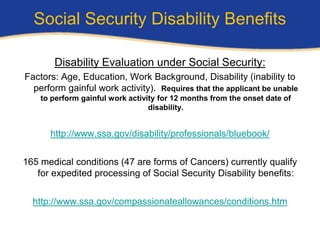
Social Security Disability Benefits

       Disability Evaluation under Social Security:
Factors: Age, Education, Work Background, Disability (inability to
  perform gainful work activity). Requires that the applicant be unable
    to perform gainful work activity for 12 months from the onset date of
                                  disability.


      http://www.ssa.gov/disability/professionals/bluebook/


165 medical conditions (47 are forms of Cancers) currently qualify
   for expedited processing of Social Security Disability benefits:


  http://www.ssa.gov/compassionateallowances/conditions.htm
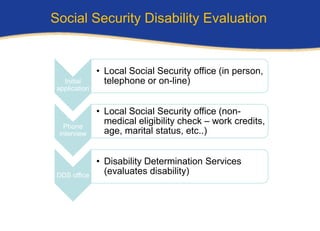
Social Security Disability Evaluation


               • Local Social Security office (in person,
   Initial       telephone or on-line)
 application


               • Local Social Security office (non-
                 medical eligibility check – work credits,
   Phone
 interview       age, marital status, etc..)


               • Disability Determination Services
 DDS office      (evaluates disability)
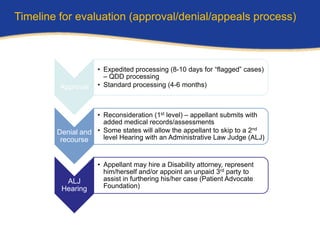
Timeline for evaluation (approval/denial/appeals process)


                     • Expedited processing (8-10 days for “flagged” cases)
                       – QDD processing
         Approval    • Standard processing (4-6 months)


                   • Reconsideration (1st level) – appellant submits with
                     added medical records/assessments
                                                                         nd
        Denial and • Some states will allow the appellant to skip to a 2
         recourse    level Hearing with an Administrative Law Judge (ALJ)


                     • Appellant may hire a Disability attorney, represent
                       him/herself and/or appoint an unpaid 3rd party to
          ALJ          assist in furthering his/her case (Patient Advocate
         Hearing       Foundation)
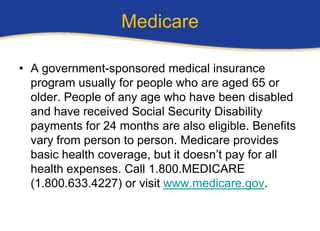
Medicare

• A government-sponsored medical insurance
  program usually for people who are aged 65 or
  older. People of any age who have been disabled
  and have received Social Security Disability
  payments for 24 months are also eligible. Benefits
  vary from person to person. Medicare provides
  basic health coverage, but it doesn’t pay for all
  health expenses. Call 1.800.MEDICARE
  (1.800.633.4227) or visit www.medicare.gov.
The Underinsured & Patient Assistance

 Co-Payment Assistance:
 Non-profit and pharmaceutical funding exists: privately and governmentally
        insured (Medicare); disease specific funds ever-changing

 ***Premium Assistance: www.healthwellfoundation.org www.lls.org ***

 Disease-specific charity:
 Diagnosis specific and usually need-based
 Patients typically must be in active care or limited post-treatment timeframe
 Funding for medical expense assistance and household stabilization
 National charities for families with children or pediatric cancer patients
 Monies for special populations: musicians, artists, flight attendants,
         Registered Nurses, truckdrivers, federal employees, etc…

                                         14
Our Mission: Supplement the limits
                                     of health insurance


          • The PAF Co-Pay Relief Program (CPR)
            exists to provide direct financial
 CPR        assistance to insured patients who
            cannot afford the co-payments and co-
Mission     insurance required to access
            prescribed pharmaceutical therapies.


                   15
How the Program Operates       ram
å CPR provides cash co-           å Professional CPR Call
  payment assistance for            Counselors assist patients in
  insured patients unable to        completing application forms
  use their prescription drug       and securing authorizations
  benefits due to inability to      needed to verify medical and
  pay their co-payments.            financial necessity to qualify
å Patients, physicians, and         patients.
  pharmacies can contact          å Upon Approval, payments are
  CPR™ directly to initiate a       made directly to the doctor,
  request for assistance.           pharmacy or patient.
å A 24 hour secured web           å CPR provides assistance to
  based patient portal to allow     both commercially and
  patients another option to        government insured patients
  enroll.                           including Medicare Part D
                                    beneficiaries.
                                                                      16
CPR Open Disease Funds


    CPR currently offers assistance in 19 disease funds including:
•   Breast Cancer                     •   Myelodysplastic Syndrome
•   Chemotherapy Induced                  (MDS, and other pre-leukemia
    Anemia/Neutropenia                    diseases)
•   Colon Cancer                      •   Non-Muscle Invasive
                                          Bladder Cancer
•   Cutaneous T-Cell Lymphoma
                                      •   Osteoporosis
•   Hepatitis C
                                      •   Pain
•   Hormone Suppression
    Therapy                           •   Prostate Cancer
•   Kidney Cancer                     •   Rheumatoid Arthritis
•   Lung Cancer (Non-small cell       •   Sarcoma
                  Lung Cancers)
•   Multiple Myeloma


                                                                         17
National Underinsured Resource
                                 Directory


http://patientadvocate.org/help4u.php
                 18
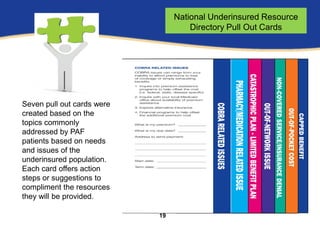
National Underinsured Resource
                                     Directory Pull Out Cards


Seven pull out cards were
created based on the
topics commonly
addressed by PAF
patients based on needs
and issues of the
underinsured population.
Each card offers action
steps or suggestions to
compliment the resources
they will be provided.

                            19
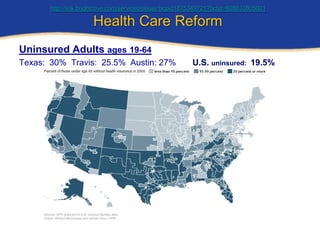
http://link.brightcove.com/services/player/bcpid1875349721?bctid=608833805001

                      Health Care Reform
Uninsured Adults ages 19-64
Texas: 30% Travis: 25.5% Austin: 27%                     U.S. uninsured: 19.5%
The Uninsurable – High Risk Pools

FEDERAL Pre-Existing Condition Insurance Plan (PCIP)
 Qualifying health condition; uninsured 6 mos prior to enrollment
 Comprehensive benefits; capped out-of-pocket costs; plan options
                  https://www.pcip.gov/StatePlans.html
                           www.healthcare.gov


State Issued HIGH RISK INSURANCE POOL
   Viable option when COBRA expires (19th month)
   Comprehensive benefits; plan options
   For the insured with high deductible/catastrophic coverage
‼   COST PROHIBITIVE PREMIUMS
                           www.naship.org
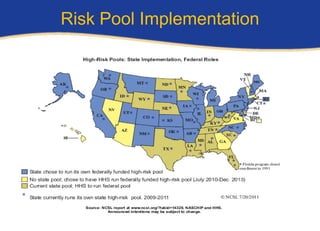
Risk Pool Implementation
¡Cover the Uninsured!


                        Premium rates for Texas
2011 monthly PCIP premium rates by age enrollee, effective 7/1/2011.
Benefits are effective the 1st day of the following month upon enrollment.
                             www.pcip.gov/StatePlans

               Age       Standard Option     Extended       HSA Option
                                              Option
             0 to 18           $133            $179            $138
             19 to 34          $199            $268            $207
             35 to 44          $239            $323            $248
             45 to 54          $306            $412            $318
               55+             $426            $572            $442
Looking forward - ACA

• Health Insurance Exchanges (2014)
  The Healthcare Reform Act requires that health insurance
  exchanges be established in each state. Individuals and
  small employers will be able to enroll into the exchange.
  Small employers are defined as those with no more than
  100 employees. Larger employers will be able to enroll into
  the exchange in 2017.
• Premium Subsidies (2014)
  Premium and cost-sharing subsidies will make health
  insurance more affordable for every family with annual
  incomes between 133% and 200% Federal Poverty Level
  that purchase plans through the exchange.
www.insureustoday.org


contact us at 866-207-8023
             25
Contact Us


421 Butler Farm Road              421 Butler Farm Road
Hampton, VA 23666                 Hampton, VA 23666


Phone: 1-800-532-5274             Phone: 1-866-512-3861
Fax:        (757) 873-8999        Fax:        (757) 952-0118
Internet:                         Internet:           www.copays.org
www.patientadvocate.org           E-Mail: cpr@patientadvocate.org
info@patientadvocate.org


                             26

Financial Concerns Community Education Class

  • 1.
    Objectives Upon completion ofthis discussion forum the participants: • Will learn about governmental programs and avenues toward accessing care and their eligibility criteria. • Will have the tools to reduce and manage their outstanding medical costs. • Will better understand the real benefits and opportunities of the Health Care Reform Act relative to cancer care. • Will become informed of federal laws and provisions that protect their right to health coverage ensuring continuity of care. • Will understand more about the approval process for Social Security Disability.
  • 2.
    Financial and Insurance Brendan Bietry LIVESTRONG Senior Case Manager Implications for Patient Advocate Foundation the Cancer Survivor
  • 3.
    Our Mission: ToServe Patients • Patient Advocate Foundation seeks to safeguard patients through effective mediation assuring access to care, maintenance of employment and preservation of their Our financial stability relative to their diagnosis of life threatening Mission or debilitating diseases. • Since our inception in 1996, PAF has provided direct, sustained patient assistance to more than 500,000 patients and touched millions more American lives through the PAF Our website, online chats and outreach events. Impact 3
  • 4.
    Direct Patient Servicesoffered by PAF • Brokering resources to supplement the limits of insurance and to assure access to care for the uninsured • Resolving debt crisis relative to a diagnosis • Negotiating access to pharmaceutical agents, chemotherapy, medical devices and surgical procedures • Resolving insurance issues in the public and private sector • Negotiating pre-authorization approvals • Providing assistance in facilitating and expediting the appeals process • Health insurance denials • Social Security Disability • Negotiating resolutions to coding and billing errors
  • 5.
    The UNinsured Public Benefits, Safety Nets & Charity Care • County Indigent Medical Assistance/Community Hospital Charity/Sliding Scale fee discounts • Medicaid (SSI linked and Share-of-Cost /Breast & Cervical/Medicare savings programs/Long-term care Medicaid) • Pharmaceutical and Durable Medical Equipment and Supply Assistance for the uninsured www.needymeds.org
  • 6.
    Utilization of HospitalSupport Staff • If you need help, a good place to start is with the social worker, financial counselor or nurse at the hospital where you are being treated. (These people are the most knowledgeable about community resources who might offer help as well as internal programs funds the hospital may have to help cancer patients) • Remember: Do not ignore the bill. If you receive a hospital bill, it is important that you do not ignore it. Hospitals have the right to refer your bill to a collections agency if it is not paid. Instead, make sure to call your hospital's billing office right away to ask about payment plan options and financial discounts. Know your rights under the Fair Debt Collections Act! www.ftc.gov/bcp/edu/pubs/consumer/credit/cre27.pdf
  • 7.
    Medicaid Government-sponsored medicalinsurance program based on financial need. To receive Medicaid, your income and assets must be below a certain level. It covers hospital care, physician’s fees, prescription drugs, home care and many other services. In order to qualify, you must be a US resident. Medicaid is only valid in the state in which it is issued. You can go to your local county Department of Social Services for an application.
  • 8.
    Work transitions andthe Self-employed COBRA : Group policy extension of 18 months + 11 months = 29 months (Medicare eligibility) – for those deemed disabled within the initial 2 months of the COBRA extension. HIPAA portability : Guarantees that certain individuals will have access to, and can renew, individual health insurance policies. Guaranteed Issue : Group insurance in which all members of a small group who meet certain conditions automatically receive coverage without individual underwriting (in most states groups of 2-50 employees) www.statehealthfacts.org
  • 9.
    Your medical expensesmay be tax-deductible. Medical costs that are not covered by insurance policies sometimes can be deducted from annual income before taxes. Currently, they must exceed 7.5% of your adjusted gross income to be deductible. So, if your income is $30,000, then you could deduct out-of-pocket medical costs that exceed $2,250. Medical costs include doctor’s bills, drugs, medical supplies and anything related, including transportation and lodging. Your local IRS office, tax consultants or certified public accountants can help you with the specifics; or see www.irs.gov and download Publication 502, Medical and Dental Expenses
  • 10.
    Social Security DisabilityBenefits Disability Evaluation under Social Security: Factors: Age, Education, Work Background, Disability (inability to perform gainful work activity). Requires that the applicant be unable to perform gainful work activity for 12 months from the onset date of disability. http://www.ssa.gov/disability/professionals/bluebook/ 165 medical conditions (47 are forms of Cancers) currently qualify for expedited processing of Social Security Disability benefits: http://www.ssa.gov/compassionateallowances/conditions.htm
  • 11.
    Social Security DisabilityEvaluation • Local Social Security office (in person, Initial telephone or on-line) application • Local Social Security office (non- medical eligibility check – work credits, Phone interview age, marital status, etc..) • Disability Determination Services DDS office (evaluates disability)
  • 12.
    Timeline for evaluation(approval/denial/appeals process) • Expedited processing (8-10 days for “flagged” cases) – QDD processing Approval • Standard processing (4-6 months) • Reconsideration (1st level) – appellant submits with added medical records/assessments nd Denial and • Some states will allow the appellant to skip to a 2 recourse level Hearing with an Administrative Law Judge (ALJ) • Appellant may hire a Disability attorney, represent him/herself and/or appoint an unpaid 3rd party to ALJ assist in furthering his/her case (Patient Advocate Hearing Foundation)
  • 13.
    Medicare • A government-sponsoredmedical insurance program usually for people who are aged 65 or older. People of any age who have been disabled and have received Social Security Disability payments for 24 months are also eligible. Benefits vary from person to person. Medicare provides basic health coverage, but it doesn’t pay for all health expenses. Call 1.800.MEDICARE (1.800.633.4227) or visit www.medicare.gov.
  • 14.
    The Underinsured &Patient Assistance Co-Payment Assistance: Non-profit and pharmaceutical funding exists: privately and governmentally insured (Medicare); disease specific funds ever-changing ***Premium Assistance: www.healthwellfoundation.org www.lls.org *** Disease-specific charity: Diagnosis specific and usually need-based Patients typically must be in active care or limited post-treatment timeframe Funding for medical expense assistance and household stabilization National charities for families with children or pediatric cancer patients Monies for special populations: musicians, artists, flight attendants, Registered Nurses, truckdrivers, federal employees, etc… 14
  • 15.
    Our Mission: Supplementthe limits of health insurance • The PAF Co-Pay Relief Program (CPR) exists to provide direct financial CPR assistance to insured patients who cannot afford the co-payments and co- Mission insurance required to access prescribed pharmaceutical therapies. 15
  • 16.
    How the ProgramOperates ram å CPR provides cash co- å Professional CPR Call payment assistance for Counselors assist patients in insured patients unable to completing application forms use their prescription drug and securing authorizations benefits due to inability to needed to verify medical and pay their co-payments. financial necessity to qualify å Patients, physicians, and patients. pharmacies can contact å Upon Approval, payments are CPR™ directly to initiate a made directly to the doctor, request for assistance. pharmacy or patient. å A 24 hour secured web å CPR provides assistance to based patient portal to allow both commercially and patients another option to government insured patients enroll. including Medicare Part D beneficiaries. 16
  • 17.
    CPR Open DiseaseFunds CPR currently offers assistance in 19 disease funds including: • Breast Cancer • Myelodysplastic Syndrome • Chemotherapy Induced (MDS, and other pre-leukemia Anemia/Neutropenia diseases) • Colon Cancer • Non-Muscle Invasive Bladder Cancer • Cutaneous T-Cell Lymphoma • Osteoporosis • Hepatitis C • Pain • Hormone Suppression Therapy • Prostate Cancer • Kidney Cancer • Rheumatoid Arthritis • Lung Cancer (Non-small cell • Sarcoma Lung Cancers) • Multiple Myeloma 17
  • 18.
    National Underinsured Resource Directory http://patientadvocate.org/help4u.php 18
  • 19.
    National Underinsured Resource Directory Pull Out Cards Seven pull out cards were created based on the topics commonly addressed by PAF patients based on needs and issues of the underinsured population. Each card offers action steps or suggestions to compliment the resources they will be provided. 19
  • 20.
    http://link.brightcove.com/services/player/bcpid1875349721?bctid=608833805001 Health Care Reform Uninsured Adults ages 19-64 Texas: 30% Travis: 25.5% Austin: 27% U.S. uninsured: 19.5%
  • 21.
    The Uninsurable –High Risk Pools FEDERAL Pre-Existing Condition Insurance Plan (PCIP)  Qualifying health condition; uninsured 6 mos prior to enrollment  Comprehensive benefits; capped out-of-pocket costs; plan options https://www.pcip.gov/StatePlans.html www.healthcare.gov State Issued HIGH RISK INSURANCE POOL  Viable option when COBRA expires (19th month)  Comprehensive benefits; plan options  For the insured with high deductible/catastrophic coverage ‼ COST PROHIBITIVE PREMIUMS www.naship.org
  • 22.
  • 23.
    ¡Cover the Uninsured! Premium rates for Texas 2011 monthly PCIP premium rates by age enrollee, effective 7/1/2011. Benefits are effective the 1st day of the following month upon enrollment. www.pcip.gov/StatePlans Age Standard Option Extended HSA Option Option 0 to 18 $133 $179 $138 19 to 34 $199 $268 $207 35 to 44 $239 $323 $248 45 to 54 $306 $412 $318 55+ $426 $572 $442
  • 24.
    Looking forward -ACA • Health Insurance Exchanges (2014) The Healthcare Reform Act requires that health insurance exchanges be established in each state. Individuals and small employers will be able to enroll into the exchange. Small employers are defined as those with no more than 100 employees. Larger employers will be able to enroll into the exchange in 2017. • Premium Subsidies (2014) Premium and cost-sharing subsidies will make health insurance more affordable for every family with annual incomes between 133% and 200% Federal Poverty Level that purchase plans through the exchange.
  • 25.
  • 26.
    Contact Us 421 ButlerFarm Road 421 Butler Farm Road Hampton, VA 23666 Hampton, VA 23666 Phone: 1-800-532-5274 Phone: 1-866-512-3861 Fax: (757) 873-8999 Fax: (757) 952-0118 Internet: Internet: www.copays.org www.patientadvocate.org E-Mail: cpr@patientadvocate.org info@patientadvocate.org 26