A ROADMAP TO IMPROVING
HEALTH INSURANCE
THE INSURANCE LITERACY INSTITUTE
TONY STEUER, CLU, LA, CPFFE
Why Health Insurance Needs Repairs:
Welcome to a roadmap of simple solutions to the myriad of
issues facing health insurance, medicare, medicaid, long term
care insurance, and the high cost of health expenses in
retirement. Please note that the concepts that follow do simplify
very detailed areas and as such are not complete solutions,
rather this article is to point out some ideas to consider that
take what currently exists and improve upon it.
Finding a solution is challenging since there is a conflict
between costs, access to care, quality of care. It is not possible
to have it all, trade-offs do need to be made. The Insurance Bill
of Rights provides guidance on setting up a successful
Roadmap covering areas of disclosure, clarity and removing
complexity.
Is the Affordable Care Act Working?
More people are insured than ever are insured. The U.S.
uninsured rate was 10.9% in the fourth quarter of 2016. This is
down significantly from 17.1% in the fourth quarter of 2013; a
drop of 6.2 percentage points. This was just before the
implementation of the Affordable Care Act's individual
mandate, which compels Americans to carry health insurance
or incur a fine. The highest uninsured rate that Gallup has
measured since 2008 was 18.0% in the third quarter of 2013,
before the health insurance exchanges opened on Oct. 1 of
that year. These numbers are from gallup.com.
Simplifying Health Insurance
The theory of Occam's razor states "Among competing
hypotheses, the one with the fewest assumptions should be
selected". This is mostly interpreted as the simplest solution
is often the best solution. It's safe to say that we can all
agree that a piecemeal approach to replacement, or a repeal
and delayed replacement approach, is not going to work as it
would result in millions of Americans losing vital health
coverage and further destabilize insurance markets.
This is roadmap of the best ideas incorporating the
thousands of articles and proposals. This is strictly meant as
a macro overview and requires details to be worked out. The
roadmap address the main issues of basic, affordable health
coverage for everyone with no pre-existing conditions.
What Is The Current Health Insurance Breakdown?
The Affordable Care Act is an incredible achievement, however,
it still leaves consumers with a complex mix of health insurance
plans including: individual health insurance, small business
health options program (SHOP), employer/group health
insurance, medicare, medicaid, CHIP, VA insurance and other
smaller plans.
The most recent Health Insurance breakdown by US total
population in 2015 was by: Employer 49%, non-group 7%,
Medicaid 20%, Medicare 14%, Other public: 2%, Uninsured 9%.
Sources: Kaiser Family Foundation estimates based on the
Census Bureau's March 2014, March 2015, and March 2016
Current Population Survey (CPS: Annual Social and Economic
Supplements).
Applying The Basic Principles of Risk Management:
In Warren Buffettโ€™s recently released annual letter, he
summarized: At bottom, a sound insurance operation needs
to adhere to four disciplines. It must:
1) Understand all exposures that might cause a policy to
incur losses;
2) Conservatively assess the likelihood of any exposure
actually causing a loss and the probable cost if it does;
3) Set a premium that, on average, will deliver a profit after
both prospective loss costs and operating expenses are
covered;
4) Be willing to walk away if the appropriate premium canโ€™t
be obtained.
What Is The Simplest Solution?
We already have a plan used by 44 million of Americans (15% of the
population). Enrollment is expected to rise to 79 million by 2030. And
currently only one in 10 beneficiaries rely solely on the Medicare program for
health care coverage. This shows that there is still an important role for
insurance companies and that Medicare is a base rather than a complete
solution.
Medicare expansion is the best outcome as it takes the largest existing U.S.
Health Insurance program and updates it for expanded capacity and todayโ€™s
reality. What follows are factors that would impact how this could be done.
Why re-invent the wheel, when we already have one? Yes, Medicare is not
perfect, however, it gets the job done and has a long history.
At some point, all Americans have to transition to Medicare from whatever
plan they currently have. There are rules about when Medicare has to be
applied for that can have a permanent impact on Medicare premiums.
Depending on the current health insurance plan, many Americans have to
choose new physicians and learn how to use their Medicare plan.
Medicare Part A Expansion: No Cost For All
Medicare Part A is free for most Americans already. This would include basic
emergency health care services (hospitalization) at no cost to cover all. This includes:
Hospital care, skilled nursing facility care, nursing home care, Hospice andHome
health services. Medicare Part A is free. Emergency health care for all has existed in
the U.S. for over 20 years, through the Emergency Medical Treatment and Labor Act
of 1995. Under this act all hospitals are required to treat individuals in need of
emergency care regardless of their insurance. If someone is uninsured, they will go to
a hospital and the hospital will treat them. So, very basic health care is already
provided to all. What is not provided to all is the means to pay for the health care.
Research finds that each additional uninsured person costs local hospitals $900 per
years. Hospitals are therefore acting as "insurers' of last resort. Hospitals do receive
some compensation through Disproportionate Share Hospital (DSH) payments which
are owed under federal law, to any qualified hospital that serves a large number of
Medicaid and uninsured patients. However, these payments are not enough to cover
hospital costs. It is estimated that hospitals absorb about 2/3 of the cost for this
uncompensated care. Therefore, since this minimum level of care is mandated by
Federal Law, then this minimum level of care should be included under a baseline
expanded Medicare plan. The care is already being provided, however, it's not fully
funded.
Medicare Part B - Revised:
Match the benefits offered by Medicare Part B preventative (outpatient services) with the
essential benefits offered by Medicare Part B. This solves the issue of areas where there are
minimal or no choices of insurance for consumers. If insurance companies withdraw, consumers
could purchase Part B from Medicare to cover Essential Benefits. most of Medicareโ€™s preventive
services are available to all Part B beneficiaries for free, with no copays or deductibles, as long
as you meet basic eligibility standards, these are services not covered by Part A. Mammograms;
colonoscopies; shots against flu, pneumonia, and hepatitis B; screenings for diabetes,
depression, and heart conditions; and counseling to combat obesity, alcohol abuse, and smoking
are just some of Medicareโ€™s lengthy list of covered services. (to get these services for free, you
need to go to a doctor who accepts Medicare โ€œon assignment,โ€ which means he or she has
agreed to accept the Medicare approved rate as full payment. Note if you have Medicare
Advantage, your plans are also required to cover the same free preventive service). The ACA
requires plans to provide these essential health benefits: outpatient care, trips to the emergency
room, treatment in the hospital for inpatient care, care before and after your baby is born, mental
health and substance use disorder services (including behavioral health treatment, counseling,
and psychotherapy), prescription drugs, services and devices to help you recover if you are
injured, or have a disability or chronic condition, lab tests, preventive services including
counseling, screenings, and vaccines to keep you healthy and care for managing a chronic
disease and pediatric services: This includes dental care and vision care for kids. Therefore the
main substantive changes would be moving emergency room care to Part A, adding pediatric
care to part B and prescription drugs to Part D.
Medicare Part C - Medicare Advantage Expansion
This allows consumers the choice of having a private
health insurance company for Parts A & B along with the
optional Part D. Gives private insurers a chance to use
Medicare Part A and Part B subsidies to provide an
alternative to traditional Medicare coverage. May
provide additional coverage, such as vision, hearing,
dental and even health and wellness programs.
Medicare Part D - Expansion:
Including current ACA and other health insurance plan
participants into Part D would allow them to continue to
have prescription medications, it would also allow for
coverage of certain over the counter medications as
currently covered by Medicare. Covering these OTC
medications is important as medications oftentimes go
from being prescription to being OTC and are still
necessary for health care consumers.
Medigap Supplement Expansion
This would allow consumers access to the current range
and possibly new versions of coverage to supplement
Parts A, B & D. (replace the ACA metal tiers)
New Medicare: Part LTC
Offer a standard Long Term Care insurance policy
backed by the Federal Government. More details later.
Will There Be Any Underwriting?
Medicare does not require underwriting. This expansion
would allow for the continuation of guaranteed access
for those with pre-existing conditions with no evidence of
insurability (the nonpartisan Kaiser Family Foundation
estimates that 27 percent of adults under age 65 have
health conditions that would likely leave them
uninsurable under practices that existed before the
health care overhaul).
Wait Isnโ€™t Medicare Going Bankrupt?
Before, we move on to potential funding for a basic Medicare Type A plan available to all, let's be
clear: Medicare is not going to go bankrupt. This is a common fallacy. The 2016 report of Medicareโ€™s
trustees finds that Medicareโ€™s Hospital Insurance (HI) trust fund will remain solvent โ€” that is, able to
pay 100 percent of the costs of the hospital insurance coverage that Medicare provides โ€” through
2028. Even in 2028, when the HI trust fund is projected for exhaustion, incoming payroll taxes and
other revenue will still be sufficient to pay 87 percent of Medicare hospital insurance costs. The share
of costs covered by dedicated revenues will decline slowly to 79 percent in 2040 and then rise
gradually to 86 percent in 2090. This shortfall will need to be closed through raising revenues, slowing
the growth in costs, or most likely both. But the Medicare hospital insurance program will not run out of
all financial resources and cease to operate after 2028, as the โ€œbankruptcyโ€ term may suggest.
The 2028 date does not apply to Medicare coverage for physician and outpatient costs or to the
Medicare prescription drug benefit; these parts of Medicare do not face insolvency and cannot run
short of funds. These parts of Medicare are financed through the programโ€™s Supplementary Medical
Insurance (SMI) trust fund, which consists of two separate accounts โ€” one for Medicare Part B, which
pays for physician and other outpatient health services, and one for Part D, which pays for outpatient
prescription drugs. Premiums for Part B and Part D are set each year at levels that cover about 25
percent of costs; general revenues pay the remaining 75 percent of costs. The trusteesโ€™ report does
not project that these parts of Medicare will become insolvent at any point โ€” because they canโ€™t. The
SMI trust fund always has sufficient financing to cover Part B and Part D costs, because the
beneficiary premiums and general revenue contributions are specifically set at levels to assure this is
the case. SMI cannot go โ€œbankrupt.โ€ Read more about why Medicare is not "Bankrupt".
Is The Affordable Care Act Really Affordable?
The US uses a lot of health care, healthcare expenditures were projected to reach $3.2 trillion (yes, trillion) in 2015 - or about
$10,000 per person (Centers for Medicare & Medicaid Services, 2015). Thatโ€™s a lot to pay for and more than most Americans
can pay each year. And whether it can be paid for or not, the cost still remains.
Hereโ€™s how each dollar is spent: Prescription drugs - 22.1 cents, Physician services - 22.0 cents, Outpatient services 19.8
cents, Inpatient services 15.8 cents, Operating costs - 17.8 cents and Net Margin - 2.7 cents.
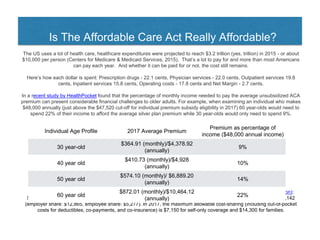
In a recent study by HealthPocket found that the percentage of monthly income needed to pay the average unsubsidized ACA
premium can present considerable financial challenges to older adults. For example, when examining an individual who makes
$48,000 annually (just above the $47,520 cut-off for individual premium subsidy eligibility in 2017) 60 year-olds would need to
spend 22% of their income to afford the average silver plan premium while 30 year-olds would only need to spend 9%.
Average cost for an average annual worker and employer contributions for single and family (Kaiser Family Foundation):
Single coverage, all firms: total $6,445 (employer share: $5,306/employee share $1,129). Family Coverage: total $18,142
(employer share: $12,865, employee share: $5,277). In 2017, the maximum allowable cost-sharing (including out-of-pocket
costs for deductibles, co-payments, and co-insurance) is $7,150 for self-only coverage and $14,300 for families.
Individual Age Profile 2017 Average Premium
Premium as percentage of
income ($48,000 annual income)
30 year-old
$364.91 (monthly)/$4,378.92
(annually)
9%
40 year old
$410.73 (monthly)/$4,928
(annually)
10%
50 year old
$574.10 (monthly)/ $6,889.20
(annually)
14%
60 year old
$872.01 (monthly)/$10,464.12
(annually)
22%
Is The Affordable Care Act Really Affordable?
Most Marketplace consumers have affordable options. More than 7 in 10 (72 percent) of
current Marketplace enrollees can find a plan for $75 or less in premiums per month, after
applicable tax credits in 2017. Nearly 8 in 10 (77 percent) current Marketplace enrollees can
find a plan for $100 or less in premiums per month, after applicable tax credits in 2017.
Two recent Kaiser Health Tracking Polls regarding Americans current experience with and
worries about health care costs, including their ability to afford premiums and deductibles.
For the most part, the majority of the public does not have difficulty paying for care, but
significant minorities do, and even more worry about their ability to afford care in the future.
Four in ten (43 percent) adults with health insurance say they have difficulty affording their
deductible, and roughly a third say they have trouble affording their premiums and other cost
sharing; all shares have increased since 2015. Among people with health insurance, one in
five (20%) working-age Americans report having problems paying medical bills in the past
year that often cause serious financial challenges and changes in employment and lifestyle.
Even for those who may not have had difficulty affording care or paying medical bills, there is
still a widespread worry about being able to afford needed health care services, with half of
the public expressing worry about this. Health care-related worries and problems paying for
care are particularly prevalent among the uninsured, individuals with lower incomes, and
those in poorer health; but women and members of racial minority groups are also more
likely than their peers to report these issues.
Making Health Insurance Affordable Again
Medicare Part A is currently available with no premium if you or your spouses paid
Medicare Taxes. Medicare Part A can continue to be offered for free to those who pay
taxes and for those who qualify for Medicaid.
Medicare part B premiums are subsidized with the government paying a substantial
portion (about 75 percent) of the Part B premium, and the beneficiary paying the
remaining 25 percent. Premiums are subsidized with the gross total monthly premium
being $134. This amount is reduced to $109 on average for those on Social Security.
Depending on your income the premium can increase to $428.60 monthly. View
information on Part B premiums here.
Medicare prescription drug coverage helps pay for your prescription drugs. For most
beneficiaries, the government pays a major portion of the total costs for this coverage, and
the beneficiary pays the rest. Prescription drug plan costs vary depending on the plan, and
whether you get extra help with your portion of the Medicare prescription drug coverage
costs. Higher income earners pay more.
Beneficiaries enrolled in Medicare Advantage typically pay monthly premiums for
additional benefits covered by their plan, in addition to the Part B premium. Kaiser Family
Foundation figures
How Is Medicare Financed?
Medicare Part A is financed primarily through a 2.9% tax on earnings paid by employers and employees (1.45%
each) (accounting for 88% of Part A revenue). Higher-income taxpayers (more than $200,000/individual and
$250,000/couple) pay a higher payroll tax on earnings (2.35%). To pay Part A, taxes will need to go up however the
trade-off is that premiums for the supplemental coverage will be less since it covers less - net impact to the consumer
is zero.
Medicare Part B is financed through general revenues (73%), beneficiary premiums (25%), and interest and other
sources (2%). Beneficiaries with annual incomes over $85,000/individual or $170,000/couple pay a higher, income-
related Part B premium reflecting a larger share of total Part B spending, ranging from 35% to 80%. The ACA froze
the income thresholds through 2019, and beginning in 2020, the income thresholds will once again be indexed to
inflation, based on their levels in 2019 (a provision in the Medicare Access and CHIP Reauthorization Act of 2015). As
a result, the number and share of beneficiaries paying income-related premiums will increase as the number of
people on Medicare continues to grow in future years and as their incomes rise. Premiums would be less than the
under current individual insurance plans since certain essential benefits would be covered by the expanded Medicare
Part A.
Medicare Part D is financed by general revenues (77%), beneficiary premiums (14%), and state payments for dually
eligible beneficiaries (10%). As with Part B, higher-income enrollees pay a larger share of the cost of Part D
coverage.
Medicare Part C (The Medicare Advantage program) is not separately financed. Medicare Advantage plans such as
HMOs and PPOs cover all Part A, Part B, and (typically) Part D benefits. Beneficiaries enrolled in Medicare
Advantage plans typically pay monthly premiums for additional benefits covered by their plan in addition to the Part B
premium.
From Kaiser Foundation: The Facts on Medicare Spending and financing worksheet.
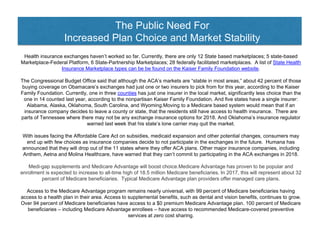
The Public Need For
Increased Plan Choice and Market Stability
Health insurance exchanges havenโ€™t worked so far. Currently, there are only 12 State based marketplaces; 5 state-based
Marketplace-Federal Platform, 6 State-Partnership Marketplaces; 28 federally facilitated marketplaces. A list of State Health
Insurance Marketplace types can be be found on the Kaiser Family Foundation website.
The Congressional Budget Office said that although the ACAโ€™s markets are โ€œstable in most areas,โ€ about 42 percent of those
buying coverage on Obamacareโ€™s exchanges had just one or two insurers to pick from for this year, according to the Kaiser
Family Foundation. Currently, one in three counties has just one insurer in the local market, significantly less choice than the
one in 14 counted last year, according to the nonpartisan Kaiser Family Foundation. And five states have a single insurer:
Alabama, Alaska, Oklahoma, South Carolina, and Wyoming.Moving to a Medicare based system would mean that if an
insurance company decides to leave a county or state, that the residents still have access to health insurance. There are
parts of Tennessee where there may not be any exchange insurance options for 2018. And Oklahomaโ€™s insurance regulator
warned last week that his stateโ€™s lone carrier may quit the market.
With issues facing the Affordable Care Act on subsidies, medicaid expansion and other potential changes, consumers may
end up with few choices as insurance companies decide to not participate in the exchanges in the future. Humana has
announced that they will drop out of the 11 states where they offer ACA plans. Other major insurance companies, including
Anthem, Aetna and Molina Healthcare, have warned that they canโ€™t commit to participating in the ACA exchanges in 2018.
Medi-gap supplements and Medicare Advantage will boost choice.Medicare Advantage has proven to be popular and
enrollment is expected to increase to all-time high of 18.5 million Medicare beneficiaries. In 2017, this will represent about 32
percent of Medicare beneficiaries. Typical Medicare Advantage plan providers offer managed care plans.
Access to the Medicare Advantage program remains nearly universal, with 99 percent of Medicare beneficiaries having
access to a health plan in their area. Access to supplemental benefits, such as dental and vision benefits, continues to grow.
Over 94 percent of Medicare beneficiaries have access to a $0 premium Medicare Advantage plan. 100 percent of Medicare
beneficiaries โ€“ including Medicare Advantage enrollees โ€“ have access to recommended Medicare-covered preventive
services at zero cost sharing.
Balancing the Risk Pool:
The risk pool must be sufficiently large to take advantage of the law of big numbers. Insurance companies
reflect health care costs and their mission is to spread the risk and be balanced. If the risk pool is unbalanced
by covering too many sick people and not enough healthy people, the insurance company will have higher
claims and will need to collect higher premiums. When this happens, healthier individuals are usually the first
to drop coverage which they feel is not needed which leaves a growing proportion of โ€œless healthyโ€ individuals.
At some point, the imbalance becomes unsustainable, and the carriers exit the market entirely.
The only reason healthy people buy health insurance is that they know that if they wait until they get really sick
no insurance company will sell them a policy. The same principal holds true for all insurance products. You
canโ€™t buy auto insurance after you get into an accident. You canโ€™t buy life insurance at a reasonable cost after
your doctor has given you six months to live. The fact that your car is already wrecked, or your arteries already
clogged, are pre-existing conditions that no insurance company would be expected to ignore.
Allowing voters the low-cost option to buy health insurance after they actually need it is very popular. Itโ€™s like
promising motorists they can stop paying their monthly auto insurance premium and just buy a policy after they
have an accident. If the government were to require this, all auto insurance companies would quickly go out of
business (unless they were bailed out by the government).
Contrary to belief, younger people (millennials) do want want health insurance and consider it a top life priority,
according to a study from research firm Benson Strategy Group.Here are seven survey findings. Eighty-six
percent of millennials are insured, and 85 percent said it is "absolutely essential" or "very important" to have
coverage, according to the survey.2. Researchers said most millennials get their insurance through an
employer (39 percent) or Medicaid (20 percent).
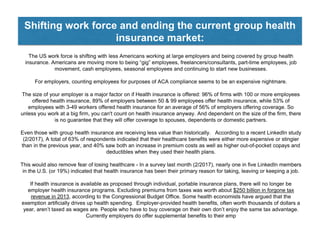
Shifting work force and ending the current group health
insurance market:
The US work force is shifting with less Americans working at large employers and being covered by group health
insurance. Americans are moving more to being โ€œgigโ€ employees, freelancers/consultants, part-time employees, job
movement, cash employees, seasonal employees and continuing to start new businesses.
For employers, counting employees for purposes of ACA compliance seems to be an expensive nightmare.
The size of your employer is a major factor on if Health insurance is offered: 96% of firms with 100 or more employees
offered health insurance, 89% of employers between 50 & 99 employees offer health insurance, while 53% of
employees with 3-49 workers offered health insurance for an average of 56% of employers offering coverage. So
unless you work at a big firm, you can't count on health insurance anyway. And dependent on the size of the firm, there
is no guarantee that they will offer coverage to spouses, dependents or domestic partners.
Even those with group health insurance are receiving less value than historically. According to a recent LinkedIn study
(2/2017), A total of 63% of respondents indicated that their healthcare benefits were either more expensive or stingier
than in the previous year, and 40% saw both an increase in premium costs as well as higher out-of-pocket copays and
deductibles when they used their health plans.
This would also remove fear of losing healthcare - In a survey last month (2/2017), nearly one in five LinkedIn members
in the U.S. (or 19%) indicated that health insurance has been their primary reason for taking, leaving or keeping a job.
If health insurance is available as proposed through individual, portable insurance plans, there will no longer be
employer health insurance programs. Excluding premiums from taxes was worth about $250 billion in forgone tax
revenue in 2013, according to the Congressional Budget Office. Some health economists have argued that the
exemption artificially drives up health spending. Employer-provided health benefits, often worth thousands of dollars a
year, arenโ€™t taxed as wages are. People who have to buy coverage on their own donโ€™t enjoy the same tax advantage.
Currently employers do offer supplemental benefits to their emp
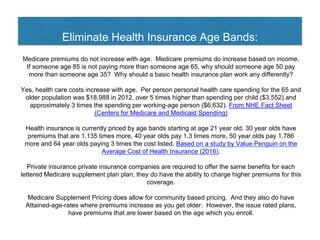
Eliminate Health Insurance Age Bands:
Medicare premiums do not increase with age. Medicare premiums do increase based on income.
If someone age 85 is not paying more than someone age 65, why should someone age 50 pay
more than someone age 35? Why should a basic health insurance plan work any differently?
Yes, health care costs increase with age. Per person personal health care spending for the 65 and
older population was $18,988 in 2012, over 5 times higher than spending per child ($3,552) and
approximately 3 times the spending per working-age person ($6,632). From NHE Fact Sheet
(Centers for Medicare and Medicaid Spending)
Health insurance is currently priced by age bands starting at age 21 year old. 30 year olds have
premiums that are 1.135 times more, 40 year olds pay 1.3 times more, 50 year olds pay 1.786
more and 64 year olds paying 3 times the cost listed. Based on a study by Value Penguin on the
Average Cost of Health Insurance (2016).
Private insurance private insurance companies are required to offer the same benefits for each
lettered Medicare supplement plan plan, they do have the ability to charge higher premiums for this
coverage.
Medicare Supplement Pricing does allow for community based pricing. And they also do have
Attained-age-rates where premiums increase as you get older. However, the issue rated plans,
have premiums that are lower based on the age which you enroll.
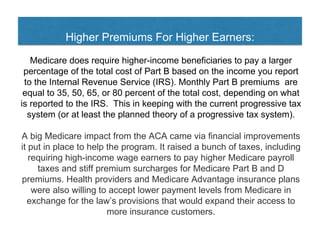
Higher Premiums For Higher Earners:
Medicare does require higher-income beneficiaries to pay a larger
percentage of the total cost of Part B based on the income you report
to the Internal Revenue Service (IRS). Monthly Part B premiums are
equal to 35, 50, 65, or 80 percent of the total cost, depending on what
is reported to the IRS. This in keeping with the current progressive tax
system (or at least the planned theory of a progressive tax system).
A big Medicare impact from the ACA came via financial improvements
it put in place to help the program. It raised a bunch of taxes, including
requiring high-income wage earners to pay higher Medicare payroll
taxes and stiff premium surcharges for Medicare Part B and D
premiums. Health providers and Medicare Advantage insurance plans
were also willing to accept lower payment levels from Medicare in
exchange for the lawโ€™s provisions that would expand their access to
more insurance customers.
Eliminate The Individual Mandate Because Itโ€™s Not Working:
Besides being unpopular, the individual mandate is not working. The economics of the ACA are not sound for the long term as
there is no balanced offset between how insurance companies typically operate from charging high-risk consumers more than
low-risk consumers and providing coverage to all. A planned offset was the penalties on those who didnโ€™t participate. The
Supreme Court recognized this as a flaw and Justice Roberts argued that the relative lightness of the penalties was insufficient to
compel anyone to buy insurance and, as a result, he considered them to be a โ€œtaxโ€ that could be voluntarily avoided rather than a
coercive penalty to force commercial activity.
The individual mandate requires nearly all Americans to have health insurance coverage. The individual mandate is an important
as it met the critical issue of insurance companies guarding against anti-selection; having health people wait until they need
health insurance to sign up. This was meant to be an incentive, however, it is a penalty.
It wonโ€™t ever work as itโ€™s currently set up since the IRS isn't allowed to collect this penalty the same way it collects on other tax
debts. The IRS can deduct penalties you owe from future tax refunds, however, they cannot garnish wages.
The IRS last month quietly reversed a decision to reject tax returns that fail to indicate whether filers had health insurance,
received an exemption or paid the penalty. While this has always been key to enforcing the individual mandate, the IRS had
been processing returns without this information under the Obama administration.
The IRS attributed the reversal to Trump's executive order that directed agencies to reduce the potential financial burden on
Americans.
There are some who feel that since the IRS will accept a tax return without the penalty, that it can be skipped. The IRS has
stated that: "Legislative provisions of the ACA law are still in force until changed by the Congress, and taxpayers remain required
to follow the law and pay what they may owe,". The agency added that "taxpayers may receive follow-up questions and
correspondence at a future date.โ€
This uncertainty and lack of uniformity is not positive for anyone. And you catch more flies with honey than vinegar. Therefore
boosting the benefits is going to work better than a straight out penalty. For insurers, figuring out how to prod younger, healthier
Americans to sign up for coverage is critical. As covered elsewhere in this article, there are other, potentially more effective ways
to accomplish this. Having a base plan like Medicare will shift some burden directly onto the U.S. Government.
Increasing The Burden on
The U.S. Government And The NFIP
Itโ€™s going to take a lot of planning and conservative assumptions and could be set up
along similar lines as the National Flood Insurance Plan (NFIP) created in 1968 by
Congress to help provide a means for property owners to financially protect
themselves. NFIP is administered by the Federal Emergency Management Agency
(FEMA), which works closely with more than 80 private insurance companies to offer
flood insurance to homeowners, renters, and business owners. In order to qualify for
flood insurance, the home or business must be in a community that has joined the
NFIP and agreed to enforce sound floodplain management standards. Coverage can
be purchased through private property and casualty insurance agents. Rates are set
nationally and do not differ from company to company or agent to agent. These rates
depend on many factors, which include the date and type of construction of your
home, along with your building's level of risk. Check out the National Flood
Insurance Plan overview (click here). Read answers to common questions about
NFIP (click here). There are issues with the NFIP and it is scheduled for reform. The
solution to this is to have flexible pricing for private insurance companies such as
with Medicare Supplements and Medicare Advantage.
Revise Tax Credits:
What Are They?
Providing tax credits helps low- and moderate-income patients afford health insurance. Premium tax credits protect
consumers from rate increases. Marketplace tax credits adjust to match changes in each consumerโ€™s benchmark silver
plan premium. Additional consumers are eligible for tax credits. As Marketplace tax credits adjust to match increases in
benchmark premiums, some consumers in areas that had low benchmark premiums in 2016 may be newly eligible for
tax credits in 2017. Of the nearly 1.3 million HealthCare.gov consumers who did not receive tax credits in 2016, 22
percent have benchmark premiums and incomes in the range that may make them eligible for tax credits in 2017. In
addition, an estimated 2.5 million consumers currently paying full price for individual market coverage off-Marketplace
have incomes indicating they could be eligible for tax credits.
The Advance Premium Tax Credit is an ACA mechanism for helping some ACA exchange plan users pay for their
health coverage. The enrollees estimate when they apply for coverage how much they'll earn in the coming calendar
year. The exchange and the IRS use the cost of the coverage and the applicant's income to decide how much the
applicant can get. If the applicant qualifies for APTC and buys an exchange plan, the government sends the APTC help
to the health coverage issuer while the plan year is still under way. The enrollee does not get to touch the APTC cash.
The ACA currently requires consumers to predict in advance what their incoming will be in the coming year. The
majority of consumers apply for individual health insurance during open enrollment for the following year in the
preceding end of the year. So they are guessing what their income will be the following year. Then, they even up with
the IRS the following year (almost a year and a half later). Consumers who predict their income be too low and get too
much tax credit money are supposed to true up with the IRS when the file their taxes the following spring. The IRS has
an easy time getting the money when consumers are supposed to get refunds. It can then deduct the payments from
the refunds. When consumers are not getting refunds, or simply fail to file tax returns, the IRS has no easy way to get
the cash back.
The exchanges and the IRS also face the problem that some people earn too little to qualify for tax credits but too
much to qualify for Medicaid. Those people have an incentive to lie and say their income will be higher than it is likely
to be.
Revise Tax Credits:
Are They Working?
Providing tax credits helps low- and moderate-income patients afford health insurance. Premium tax credits protect
consumers from rate increases. Marketplace tax credits adjust to match changes in each consumerโ€™s benchmark silver
plan premium. Additional consumers are eligible for tax credits. As Marketplace tax credits adjust to match increases in
benchmark premiums, some consumers in areas that had low benchmark premiums in 2016 may be newly eligible for
tax credits in 2017. Of the nearly 1.3 million HealthCare.gov consumers who did not receive tax credits in 2016, 22
percent have benchmark premiums and incomes in the range that may make them eligible for tax credits in 2017. In
addition, an estimated 2.5 million consumers currently paying full price for individual market coverage off-Marketplace
have incomes indicating they could be eligible for tax credits.
The Advance Premium Tax Credit is an ACA mechanism for helping some ACA exchange plan users pay for their
health coverage. The enrollees estimate when they apply for coverage how much they'll earn in the coming calendar
year. The exchange and the IRS use the cost of the coverage and the applicant's income to decide how much the
applicant can get. If the applicant qualifies for APTC and buys an exchange plan, the government sends the APTC help
to the health coverage issuer while the plan year is still under way. The enrollee does not get to touch the APTC cash.
The ACA currently requires consumers to predict in advance what their incoming will be in the coming year. The
majority of consumers apply for individual health insurance during open enrollment for the following year in the
preceding end of the year. So they are guessing what their income will be the following year. Then, they even up with
the IRS the following year (almost a year and a half later). Consumers who predict their income be too low and get too
much tax credit money are supposed to true up with the IRS when the file their taxes the following spring. The IRS has
an easy time getting the money when consumers are supposed to get refunds. It can then deduct the payments from
the refunds. When consumers are not getting refunds, or simply fail to file tax returns, the IRS has no easy way to get
the cash back.
The exchanges and the IRS also face the problem that some people earn too little to qualify for tax credits but too
much to qualify for Medicaid. Those people have an incentive to lie and say their income will be higher than it is likely to
be.
Increase Subsidies:
On the insurer side, risk-based subsidies can help ease the financial pressure posed by enrollees with high health care
costs.
Subsidies under the ACA are available to help qualifying Americans pay for their health insurance premiums. These
subsidies work on a sliding scale, limiting what you are personally required to contribute toward your premiums to a fixed
percentage of your annual income.
The dollar value of your subsidies will depend in part on the cost of the benchmark ACA plan in your area. If the benchmark
plan costs more than a certain percentage of your estimated annual income, you can get a subsidy in the amount of the
difference. You may then use that subsidy when you buy a qualified ACA health insurance plan. The main factor is your
income. You can qualify for a subsidy if you make up to four times the Federal Poverty Level. That's about $47,000 for an
individual and $97,000 for a family of four. If you're an individual who makes about $29,000 or less, or a family of four that
makes about $60,000 or less, you may qualify for both subsidies.
Subsidies would also need to be fair to older enrollees. Current subsidies under the ACA, allow eligible enrollees to obtain a
plan for less than 10% of their income. Having the proper type of subsidy will be crucial. According to the Price-linked
subsidies and health insurance mark-ups study from the National Bureau of Economic Research
Senior House Republicans have stated that they expected the federal government to continue paying billions of dollars in
subsidies to health insurance companies to keep low-income people covered under the Affordable Care Act for the rest of
this year โ€” and perhaps for 2018 as well.The Republican-led House had previously won a lawsuit accusing the Obama
administration of unconstitutionally paying the insurance-company subsidies, since no law formally provided the
money.Although that decision is on appeal, President Trump could accept the ruling and stop the subsidy payments, which
reduce deductibles and co-payments for seven million low-income people. If the payments stopped, insurers โ€” deprived of
billions of dollars โ€” would flee the marketplaces, they say. The implosion that Mr. Trump has repeatedly predicted could be
hastened. The annual cost of these subsidies is estimated at 7 billion dollars. See โ€œHealth Subsidies for Low Earners Will
Continue Through 2017, G.O.P. Saysโ€.
Keep The Cost Sharing Reductions:
People who earn up to $29,000 not only get subsidies to
pay for their health insurance premiums, they also
receive "cost-sharing reduction," or CSR, funds, to make
out-of-pocket costs more affordable. Maintaining the
CSR payments, which amount to $9 billion to insurers
for 2017 is critical. Currently payment of these CSR
funds have been halted by the House.
Wait, Isnโ€™t The ACA Already Costing Too Much?
It turns out that the ACA has turned out to much more
cost effective than originally projected. The
Congressional Budget Office now projects its cost to be
about a third lower than it originally expected, around
0.7 percent of G.D.P. A report from the nonpartisan
Urban Institute argues that the A.C.A. is โ€œessentially
underfunded,โ€ and would work much better โ€” in
particular, it could offer policies with much lower
deductibles โ€” if it provided somewhat more generous
subsidies. The reportโ€™s recommendations would cost
around 0.2 percent of G.D.P.
Use A Value-Added Tax (VAT)
Or Other Sales Tax:
Use the current Medicare Payroll Tax and supplement it with a sales/value added
tax, that way everyone pays for the plan who would use it - underground economy,
cash economy and those donโ€™t file income tax returns This would encourage more
people to file income tax returns to get the proposed (current) credit. This would be
a boost to the US economy and the Federal Budget as this missed income tax
revenue while reducing resources from the IRS in finding those who donโ€™t file income
tax returns.
Trade-offs needs to made and the only way to do so is to ensure that everyone has
a baseline of benefits . Adding a value added tax/sales tax to help finance it would
ensure that that plan is not solely supported by those who pay income, the plan is
supported by anyone who makes a purchase, as let's face it, some people don't
report income. Tax credits would still be available to those who qualify based on
income. This would also encourage more people to file tax returns to make sure they
received the credit if eligible. In fact, give everyone who files a $100 credit for their
health insurance if they file, I'll bet the number of income tax returns would rise
significantly.
Reduce Tax Evasion
If all tax evasion were stopped, this alone could pay for health care. Following are
some stats on tax evasion from The National Tax Research Committee released by
Americans for Fair Taxation: Estimated Future Tax Evasion under the Income Tax
and Prospects for Tax Evasion under the FairTax: New Perspectives
To enable the federal government to raise the same level of revenue it would collect
if all taxpayers were to report their income and pay their taxes in full, the income tax
system, in effect, assesses the average household an annual โ€œsurtaxโ€ that varies
from $4,276 under the most conservative scenario, to $8,526 based on the more
likely to occur historical evasion trends. The IRS estimates that almost 40% of the
public are out of compliance with the present tax system, mostly unintentionally due
to the enormous complexity of the present system. These IRS figures do not include
taxes lost on illegal sources of income with a criminal economy estimated at a trillion
dollars.
Market Stabilization: Risk Sharing Modifications
Diversifying the risk pool and keeping the market stable is a critical factor in maintaining viability for
insurance companies. The ACA included 3 components to help accomplish this goal:
1) Reinsurance provides payment to plans that enroll higher-cost individuals. This protects against
premium increases in the individual market by offsetting the expenses of high-cost individual. It was
expected that this would be profitable for the Government, however, while it has been able to meet itโ€™s
obligations, it has yet to turn a profit. As this has been a positive, the program should be maintained.
Reinsurance must continue to be available for plans selling individual and small group products.
2) Risk adjustment redistributes funds from plans with lower-risk enrollees to plans with higher-risk
enrollees. This is intended to protect against adverse selection and risk selection in the individual and
small-group markets inside and outside the exchanges by spreading financial risk across the markets.
3) Risk corridors limit losses and gains outside of an allowable range. This is designed to stabilize
premiums and protect against inaccurate premiums.Risk corridors protect plans that accumulate
unexpectedly high risks by giving them access to funds collected from insurers that experience
unexpectedly low risks. This has not worked so far and the programs owes more than $8 billion for
2014 and 2015. If 2016 losses are about the same ($7 billion in losses on $90 billion in premium
revenue) the total ACA risk corridors program shortfall will increase to about $15 billion.
It is important to note reinsurance and risk corridors are used without controversy in the Medicare private
drug-insurance market. Risk corridors though have been problematic for Medicare Part D. Several
program modifications may be necessary at the same timeโ€”that is, a package of changesโ€”to balance
concerns about cost control and incentives for selection behavior.See sharing risk in Medicare Part D.
Maintain The Medical Loss Ratio
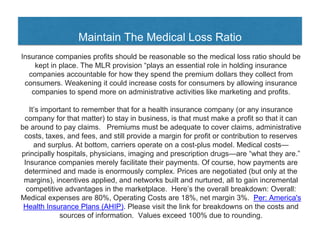
Insurance companies profits should be reasonable so the medical loss ratio should be
kept in place. The MLR provision โ€œplays an essential role in holding insurance
companies accountable for how they spend the premium dollars they collect from
consumers. Weakening it could increase costs for consumers by allowing insurance
companies to spend more on administrative activities like marketing and profits.
Itโ€™s important to remember that for a health insurance company (or any insurance
company for that matter) to stay in business, is that must make a profit so that it can
be around to pay claims. Premiums must be adequate to cover claims, administrative
costs, taxes, and fees, and still provide a margin for profit or contribution to reserves
and surplus. At bottom, carriers operate on a cost-plus model. Medical costsโ€”
principally hospitals, physicians, imaging and prescription drugsโ€”are โ€œwhat they are.โ€
Insurance companies merely facilitate their payments. Of course, how payments are
determined and made is enormously complex. Prices are negotiated (but only at the
margins), incentives applied, and networks built and nurtured, all to gain incremental
competitive advantages in the marketplace. Hereโ€™s the overall breakdown: Overall:
Medical expenses are 80%, Operating Costs are 18%, net margin 3%. Per: America's
Health Insurance Plans (AHIP). Please visit the link for breakdowns on the costs and
sources of information. Values exceed 100% due to rounding.
Adding Incentives To Education and Prevention
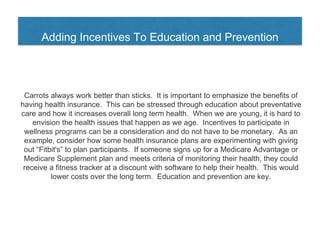
Carrots always work better than sticks. It is important to emphasize the benefits of
having health insurance. This can be stressed through education about preventative
care and how it increases overall long term health. When we are young, it is hard to
envision the health issues that happen as we age. Incentives to participate in
wellness programs can be a consideration and do not have to be monetary. As an
example, consider how some health insurance plans are experimenting with giving
out โ€œFitbit'sโ€ to plan participants. If someone signs up for a Medicare Advantage or
Medicare Supplement plan and meets criteria of monitoring their health, they could
receive a fitness tracker at a discount with software to help their health. This would
lower costs over the long term. Education and prevention are key.
Cost Penalties
For some people carrotโ€™s arenโ€™t enough and in order to ensure fairness, there would
need to be a cost penalty. Overall, there is not much written about dissatisfaction
with Medicare penalties, so why not apply them across the board? For example, if
you donโ€™t purchase Medicare when you are first eligible, your monthly premium may
go up 10%. You'll have to pay the higher premium for twice the number of years you
could have had Part A, but didn't sign up. For example, if you were eligible for Part
A for 2 years but didn't sign up, you'll have to pay the higher premium for 4 years.
There are exceptions to this rule. However, this is fair to all and does create a
penalty for waiting until you need to use care. Or we could go with the Part B penalty
which is more stringent and increases the monthly premium for Part B by up to 10%
for each full 12-month period that you could have had Part B, but didn't sign up for it.
Limited Open-Enrollment Period
Continue the current Medicare open enrollment period. Limit the exceptions.
Shortened enrollment period are necessary to ensure that people apply before they
need coverage. Currently many people sign up for the exchanges during the year
and then drop their plans during the year, this does not allow insurance companies
to have a full year of premiums. Exceptions would have to be verified for reasons
such as birth of a child (adoption, etc), marriage or other major life event. Insurers
have done studies showing that claims costs are higher for those whoโ€™ve enrolled
under the ACA special enrollment periods which means that itโ€™s likely that people are
gaming the system to just have coverage when they need it.
Continuous Coverage Requirement/Premium Penalty
Insurance companies can be more effective in setting reasonable premiums when
they have more consistent data such as continued premium payments. When
someone signs up for insurance companies project that they will continue the policy
for the year. If they drop the coverage mid-year, there is less income to the
insurance company. Consumers should be able to drop coverage at any time.
However, just like with Medicare Part B, they would have to pay a higher premium of
up to 10% for each 12 month period during which they didnโ€™t have coverage
(perhaps to a maximum of 40%) unless they had โ€œgood causeโ€. This would provide
a disincentive to consumers purchasing coverage only when they need it. Just like
itโ€™s okay for homeowners to not be able to purchase coverage while their home is on
fire, they should not be able to purchase health insurance only when they need it.
Coverage would still be available to all.
Overdue Premium Payment Requirement
Payment of any overdue premiums with shorter grace period for supplemental plans
to match Medicare: Enrollees would have to pay overdue premiums before enrolling
with the same insurer the following year. If you donโ€™t pay your Medicare premiums,
you risk losing coverage. But it wonโ€™t happen right away. Youโ€™re billed for Part B in 3-
month increments, and you will have a grace period of 3 months after the due date.
If you have not paid by the end of the grace period, youโ€™ll receive a letter letting you
know that your coverage will be terminated at the 4-month mark, unless you can pay
in full 30 days after termination notice. Consumers would need to wait until the next
open enrollment period, unless they qualified for a special enrollment period or had
โ€œgood causeโ€.
Reduce Fraud and Billing Errors
Fight fraud and billing errors. The exact amount lost to fraud, is of course, unknown.
The National Health Care Anti-Fraud Association estimates conservatively that
health care fraud costs the nation about $68 billion annually with other estimates
ranging as high as 10% of annual health care expenditure, or $320 billion. Visit The
Coalition Against Insurance Fraud for more statistics. Not really pocket change. And
while there are are significant resources aimed at fighting fraud, it's still not
sufficient. Read this article to learn more about the challenges of health care fraud
and why it is not a victimless crime. Insurance companies and the health care
industry pass on the cost to consumers. Medical billing errors further compound the
issue. If you suspect that there has been a fraudulent billing issue, read this FAQ.
Each state insurance department would need to beef up their investigatorโ€™s
department or we would need federal investigators from Medicare.
Increase Insurance Company Oversight
There is a concern about insurance companies โ€œgamingโ€ the Medicare Advantage
payment system by making patients look sicker than they are. This allows the
insurance companies to increase their Medicare billing.
Overspending tied to inflated risk scores has repeatedly been cited by government
auditors, including the Government Accountability Office. A series of articles
published in 2014 by the Center for Public Integrity found that these improper
payments have cost taxpayers tens of billions of dollars.
The Justice Department recently joined a California whistleblowerโ€™s lawsuit that
accuses insurance giant UnitedHealth Group of fraud in its popular Medicare
Advantage health plans. According to the attorney, William K. Hanagami, the
combined cases could prove to be among the โ€œlarger fraudsโ€ ever against Medicare,
with damages that he speculates could top $1 billion.
Health Care Cost Containment
Health care costs are rising faster than inflation. It is not realistic to be able to keep
up with this. Last year, Americans spent an equivalent of about 18% of Gross
Domestic Product (GDP) on health care. Cost pressures will rise with our aging
population. Much of the current spending is inefficient. Technology, discussed
further on could help with these inefficiencies.
Between November 2015 and November 2016, medical care prices increased 4.0
percent. Health insurance prices and prescription drug prices both increased 6.0
percent during this 12-month period. Medical care commodities and services make
up about 8.5 percent of the total Consumer Price Index for All Urban Consumers
(CPI-U) market basket. The CPI-U for all items rose 1.7 percent over the year
ending November 2016.From November 2010 to November 2016, medical care
prices have increased 19.7 percent, driven by increases in the prices of hospital
services (+32.5 percent), health insurance (+27.8 percent), and prescription drugs
(+24.0 percent). Only the prices of nonprescription drugs have fallen over this 6-year
period, declining 2.7 percent. Comparatively, the CPI-U for all items has increased
10.4 percent over the same period. U.S. Bureau of Labor Statistics
Legitimate Pricing/Pricing Transparency
A strategy of requiring healthcare providers to publish their rates and offer the same discounts to all health plans
could result in more competition and options for consumers. Full cost disclosure would include the premium along
with the total maximum annual out-of-pocket costs. Regulating the discounts would make it easier for consumers to
comparison shop accurately so they could take control of their spending and help bring down the cost of care
overall, he adds.
This is part of the ACA, however it has been overlooked. This included holding providers of care accountable for
costs and quality of services through value-based payments that reward clinicians and organizations that provide
better care at lower costs. The price of a service is determined by the cost of the service rather than the insurance
held. This does not meant they cannot set their own rates, however, they cannot charge different rates to different
customers.
Congress must compel medical providers to play by the same rules that apply to all other sellers of consumer goods
and services. They should remain free to set their own prices.
Legitimate pricing of health services will empower patients to be able to shop for fair value. This would make
networks obsolete as there would be no distinction between in-network and out-of-network. Real free market
competition by healthcare providers will reduce health expenditures by a minimum of 33% - overnight (and the USA
would still have approximately the highest cost per person healthcare on earth).
A โ€œPetition to End Predatory Healthcare Pricingโ€ and to require legitimate pricing has garnered more than 100,000
signatures this year. As the petition states: a simple blood test for cholesterol can range from $10 to $400 or more
at the same lab. Hospitalization for chest pain can result in a bill from the same hospital for the same services
ranging anywhere from $3,000 to $25,000 or more. Price transparency initiatives are futile when prices may vary by
a factor of 100 for the exact same service performed by the same provider.
Improve Data Sharing
Bloomberg explained in a report that the pooling of data is important, especially for
small insurers that do not have extensive databases that larger insurers have. The
data is used to determine actuarial rates that reflect the risk attached to coverage
offered by insurers, which helps them accurately assess exposures and price
premiums.โ€œOne of the main benefits of the exemption is that it allows insurers to
share information on insurance losses so that the insurance industry can better
project future losses and charged actuarially based prices for their products,โ€ the
statement also said.
Additionally, the Property Casualty Insurers Association of America said in a
February testimony that, โ€œ(anticompetitive) price fixing, bid rigging, and market
allocations are generally illegal under state anti-trust laws.โ€ This would hold true for
health insurance companies as well. The Bloomberg report noted that measures are
already in place to preclude anti-competitive practices in the industry in each of the
states.
Increase Wellness Incentives and Credits
This can be done by insurance companies, employers and other centers of
influence. Using technology like FitBits and Apple Watches to encourage physical
activity. Surcharge for tobacco cessation. Weight management. Lifestyle changes.
Health Care Saving Account Expansion
The cost of health care starts with the health insurance premium, however, it also includes deductibles,
co-payments, co-insurance and whatever is not covered that are still medical necessities - think aspirin,
allergy medicine, etc. In addition there are expenses such as travel to treatment, child care, special
equipment or home modifications, or lost income caused by time away from work. Health insurance may
really be 50-60% of your total annual health care outlay.
Implementing and allowing health care saving accounts for all would help offset all of these other costs
and provide positive economic benefits. Moving from strictly being a reimbursement plan to being a
reimbursement plan and a retirement plan would help increase Americanโ€™s retirement savings and offset
the guessing required on reimbursement accounts such as flexible spending accounts and dependent
care spending accounts which are currently only available through employers.
Americans need assistance on saving more money and this will work better than FSAโ€™s that can be use it
or lose it. HSAs are now available only to people who have high-deductible health insurance plans.
These plans should be open to everyone. The tax credit for an HSA would be set to a level sufficient to
cover the maximum premiums combined with deductibles, co-pay and maybe an extra 25% for additional
expenses outlined above.
This would also help offset the anticipated high cost of healthcare costs in retirement. According to a
study by Fidelity in 2016, a couple starting retirement today would have estimated total health care costs
$260,000. Thatโ€™s a lot, so saving in advance for it would be beneficial. Currently health savings accounts
have significant tax benefits and can be used an additional retirement account. Withdrawals after age 65
for general retirement purposes have no penalties, you simply withdraw the money and pay ordinary
income taxes just like an IRA, 401(k) or other qualified retirement plan.
Allow States To Take Over Rate Reviews
Under the Obama administration, the CMS determined that all but four states have
adequate rate reviews, and โ€œwe donโ€™t see any reason why the federal government
should be duplicating that reviewโ€. In a market stabilization proposed rule published
Feb. 17 in the Federal Register, the CMS proposed allowing states to set standards
for network adequacy. Deferring to states to take on more authority in implementing
health-care reform has been a major theme of Republicans in Congress.
Under the current regulatory regime, this really should be handled by state insurance
departments which currently oversee premiums for auto insurance, homeowners
insurance, long term care insurance (lines of coverage differ by state)
Maintain Current Rules For Insurance Companies
To Not Sell Across State Lines
Currently there is a mostly effective State based regulatory system centralized
through the National Association of Insurance Commissioner. Overall, the NAIC has
enacted some good model regulations. Under the current regulatory set-up,
insurance companies can set up headquarters in states with weaker requirements
which they already do anyway when they can. In the long run, this is not good for
anyone. Currently, each state sets its own consumer protections and demands for
what insurance must cover, if an insurance company could sell policies in a state
without that stateโ€™s approval, then any state specific requirements would not apply
resulting in fewer consumer protections, less-comprehensive plans and limit states'
ability to regulate insurance companies. Premiums would also not be lower since a
key driver of health insurance premiums is local costs of health care. Another
challenge is that almost all health care is delivered locally. To succeed, insurance
companies need a significant toe-hold with hospitals and other providers in their
local market; an out-of-state insurer would lack that and thus struggle in its
negotiations to form a delivery network. This is why many new entrants to the health
insurance market havenโ€™t succeeded. Read more from the NAIC Center for
Insurance Policy & Research: Interstate Health Insurance Sales: Myth vs. Reality.
Insurance Agent Value and Compensation
Keep professional, trained insurance agents around. For example in Oregon, insurance
agents earn about $400 per year for each Medicare supplement or Medicare Advantage
policy they write, but only about $144 per year in commissions for selling an individual
policy through the ACA public exchange system. This lower compensation level hurts
consumers, by reducing their access to licensed professionals who can help them choose
and understand coverage. Regulators should set and enforce commission payment
standards.Neither the current law nor any reform effort will be successful unless a large
number of healthy Americans decide to sign up for coverage. Agents play a critical role in
the orderly delivery of health insurance.Traditional agents and brokers โ€œdo a much better
jobโ€™โ€™ of helping people get proper coverage than do the insurance counselors โ€” called
โ€œnavigatorsโ€™โ€™ or โ€œassistersโ€™โ€™ โ€” whose positions were created by the ACA.
This would require a shift in the calculation of the Medical Loss Ratio (MLR) Rule.
Currently, if an insurance company spends less than 80 percent (or 85 percent in the
large-group market) of premiums on medical care and efforts to improve the quality of
care, it must refund the portion of the premiums that exceed this limit. Agentโ€™s
commissions are included in the administration category which must remain at 20% or
below. Commissions should be removed from that category or the percentage increased
to allow insurance agent to receive reasonable compensation.
Maintain The Health Insurance CEO Pay Tax Cap
The deduction for any health insurance company executive is sharply limited by the
ACA, which caps at a maximum of $500,000 the amount of an individual executive's
compensation that an insurer could deduct as a business expense. Itโ€™s estimated
that this generates $400 million in tax revenue (according to recent testimony to the
House Ways and Means Committee by Thomas Barthold, chief of staff for the Joint
Committee on Taxation).
Technology Implementation
Technology will be a long term driver in reducing health care costs by streamlining data,
underwriting, dispersing care, reducing fraud, improving wellness and other potential
positive outcomes.
This is somewhere that an InsureTech company using Blockchain technology could make
a difference. Consumers seem readier to accept digital products than just a few years ago.
The field includes mobile apps, telemedicineโ€”health care provided using electronic
communicationsโ€”and predictive analytics (using statistical methods to sift data on
outcomes for patients). Other areas are automated diagnoses and wearable sensors to
measure things like blood pressure.
58% percent of smartphone users in the U.S. have downloaded a health-related app, and
around 41% have more than five health-related apps, generating data that insurance
providers could use to fine-tune their individual premium pricing and encourage low-risk
customer behavior.
Most of the efforts to integrate technology by insurers are simple and mainly designed as
promotions, like awarding credits for a number of steps taken. This is the tip of the
iceberg, big data could be used for adaptive premium pricing based on comprehensive
health data for each customer. The problem is likely a skepticism toward new technology
for which no historical experience is available.
Virtual Health Care
Virtual healthcare includes healthcare services that are technology-enabled and are
provided independently of location, such as video encounters with physicians,
remote biometric tracking, and mobile apps for health management. According to a
study by Accenture, using virtual health care for annual patient visits could save
more than $7 billion worth of primary care physician time each year. For more read:
78% of Americans Support This Revolutionary Healthcare Technology, but Only
21% Have Tried It
Continue Medicaid Expansion
Currently 31 states, in addition to the District of Columbia have expanded Medicaid under the ACA. Kansas and
North Carolina are in the process of expanding Medicaid while most other states are considering it. Find out where
your State stands on Medicaid expansion.
Medicaid is the largest insurer with more than 70 million beneficiaries. Medicaid expansion has accounted for over
10 million of those enrollees. It is the main provider of long-term services for seniors and people with disabilities and
pays for one-fourth of all mental health and substance abuse treatments. Forty percent of children rely on Medicaid
through The Childrenโ€™s Health Insurance Program (CHIP).
Under the ACA, the program has been opened up to more low-income adults with incomes of up to 138% of the
poverty line -- $16,400 for a single person -- in states that opted to expand their Medicaid programs. Under the
program, the federal government paid 100% of the costs of the expansion population for the first three years and is
slowly lowering the reimbursement rate to 90%.
A July 2015 Government Accountability Office report โ€” which relied on GAOโ€™s past reports, documentation from the
Centers for Medicare & Medicaid Services and interviews with CMS officials โ€” also echoed other research:
โ€œMedicaid enrollees report access to care that is generally comparable to that of privately insured individuals and
better than that of uninsured individuals, but may have greater health care needs and greater difficulty accessing
specialty and dental care.โ€ The report mentioned mental health care as a specialty area of concern. However some
doctors do not take new Medicaid (or Medicare) patients do to lower reimbursement rates and additional paperwork.
A study published in JAMA Internal Medicine in 2016, that looked at survey data for three states and found Medicaid
expansion โ€œwas associated with significantly increased access to primary care,โ€ as well as โ€œfewer skipped
medications due to cost,โ€ among other factors.
Adding: Medicare Part X:
Long Term Care Insurance - Background
According to the U.S. Department of Health and Human Services, a person turning 65 today has
almost a 70% chance of needing long-term care services at some point in his lifetime. Long term
care is a growing need with an aging American population. The individual long term care
insurance marketplace has had many struggles with the current marketplace being reduced to
just a few insurance companies offering individual long term care insurance policies (this does
not include hybrid or combination life/annuity & long term care insurance policies or life
insurance with long term care insurance riders).
It is important that long term care insurance be made accessible on a standardized, monitored
basis as set forth in the NAIC model regulations. Since the private insurance marketplace has
mostly not been successful, this is something that should be considered and made an option
under the expanded Balanced Health Insurance Plan.
Medicare does not cover services that include medical and non-medical care provided to people
who are unable to perform basis activities of daily living, like dressing or bathing. Long-term
supports and services can be provided at home, in the community, in assisted living, or in
nursing homes. Individuals may need long-term supports and services at any age. Medicare will
pay for skilled nursing services, but it will only cover a maximum of 100 days in a nursing home,
and it won't pay at all for home aide services (when a person comes to your house to help you
with ADLs and other basic activities). Medicaid will cover such services, but not until you've
exhausted all other resources and are essentially broke.
Adding: Medicare Part X:
Long Term Care Insurance - How It Could Work
Long term care insurance was included in the original Affordable Care Act, as amended by the Health
Care and Education Reconciliation Act of 2010, established a national, voluntary insurance program for
purchasing community living services and supports known as the Community Living Assistance Services
and Supports program (CLASS Act). The CLASS program was designed to expand options for people
who become functionally disabled and require long-term services and supports.
The CLASS plan would have allowed all working adults to enroll directly through voluntary premium
contributions or through payroll deductions through their employer or directly. Benefits would have been
payable to insured had multiple functional limitations, or cognitive impairments. The plan would have
paid a monthly cash benefit that would be used for long term care insurance services (this is an
overview).
The goal was to have the plan financed entirely through premiums of participants, however, at that time,
the Federal Agency tasked with implementing the CLASS Act was not able to come up with a workable
solution that would have had affordable premiums and had a useful benefit structure.
Another goal of the plan was to partially reduce the reliance on Medicaid. CLASS was to be the primary
payer for individuals with Medicaid.
Planning and pre-funding long term care insurance needs is now more important than ever. Given the
issues with the private long term care insurance market and that the CLASS program was not workable,
then it is time for enacting a public-private partnership to make it work. Why canโ€™t a long term care
insurance program be set up with a similar public-private partnership as the NFIP (as discussed earlier)?
The Trump Administration and Congress
Must Support the ACA As It Is
House Speaker Paul Ryan stated after the recent defeat of the GOPโ€™s/Trumpโ€™s
โ€œAmerican Health Care Actโ€ - โ€œObamacare is the law of the land, itโ€™s going to remain
the law of the land until itโ€™s replaced.โ€ Under Article II of the Constitution, the
President is responsible for the execution and enforcement of the laws created by
Congress. Therefore whether Mr. Trump likes or doesnโ€™t like the ACA, which is his
prerogative, he has a responsibility to all American citizens to support it.
The Trump administration therefore needs to act in good faith on the ACA.
Unfortunately, The Trump administration pulled the plug on all ACA outreach and
advertising in the crucial final days of the 2017 enrollment season. Individuals could
still sign up for ACA plans, however, the administration stopped advertising that fact.
This included halting all emails sent out to individuals who visited HealthCare.gov, the
enrollment website, to encourage them to finish signing up. Those emails had proven
highly successful in getting stragglers to complete enrollment before the deadline.
By taking these actions and threatening to take other steps to handicap the ACA, Mr.
Trump is not fulfilling his constitutional duties to support something that is already law.
As people, weโ€™re faced all day in dealing with situations we donโ€™t always like even if
that includes eating our vegetables.
Members of Congress and the Senate
Must Participate In The Same Way As All Americans
Everyone needs to play fair. Documents obtained under the Freedom of Information Act
show that unnamed officials who administer benefits for Congress made clearly false
statements when they originally applied to have the House and Senate participate in
D.C.โ€™s โ€œSHOPโ€ Exchange for 2014. Notably, they claimed the 435-member House had
only 45 members and 45 staffers, while the 100-member Senate had only 45 employees
total.
The Federal Employees Health Benefits Program gives federal employees a choice of
health plans and pays up to $12,000 of the premium. But the ACA kicked members of
Congress and congressional staff out of the FEHBP, and said the only way they can get
health benefits is through an Exchange.
The ACA bars businesses with more than 100 employees from participating in SHOP
Exchanges. Until this year, D.C. barred businesses with more than 50 employees. By
claiming that the House and Senate fit under those limits, they were able to draw money
from the federal Treasuryโ€”i.e., a subsidy of up to $12,000 for each member and staffer.
In addition besides being another perk for the wealthy (which most members of Congress
and the Senate are) is that it potentially violates multiple laws. Read more: On
ObamaCare, is there one set of rules for Congress and another for citizens?
What Is The Bottom Line On The Numbers Discussed?
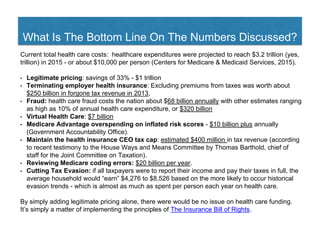
Current total health care costs: healthcare expenditures were projected to reach $3.2 trillion (yes,
trillion) in 2015 - or about $10,000 per person (Centers for Medicare & Medicaid Services, 2015).
โ€ข Legitimate pricing: savings of 33% - $1 trillion
โ€ข Terminating employer health insurance: Excluding premiums from taxes was worth about
$250 billion in forgone tax revenue in 2013,
โ€ข Fraud: health care fraud costs the nation about $68 billion annually with other estimates ranging
as high as 10% of annual health care expenditure, or $320 billion
โ€ข Virtual Health Care: $7 billion
โ€ข Medicare Advantage overspending on inflated risk scores - $10 billion plus annually
(Government Accountability Office).
โ€ข Maintain the health insurance CEO tax cap: estimated $400 million in tax revenue (according
to recent testimony to the House Ways and Means Committee by Thomas Barthold, chief of
staff for the Joint Committee on Taxation).
โ€ข Reviewing Medicare coding errors: $20 billion per year.
โ€ข Cutting Tax Evasion: if all taxpayers were to report their income and pay their taxes in full, the
average household would โ€œearnโ€ $4,276 to $8,526 based on the more likely to occur historical
evasion trends - which is almost as much as spent per person each year on health care.
By simply adding legitimate pricing alone, there were would be no issue on health care funding.
Itโ€™s simply a matter of implementing the principles of The Insurance Bill of Rights.
The Bottom Line
This will work because so much of this is already in place and a lot of the rest would
be quick and easy to implement. As in all areas, knowledge is power. Consumers
can take control of your insurance portfolio by becoming educated about insurance.
Better education and understanding will lead to positive results for consumers and
for the insurance industry. If a consumer purchases the right insurance coverage,
they will meet their needs and the insurance industry will benefit from satisfied
customers. Review The Insurance Bill of Rights and make sure that you understand
how it applies as a consumer and a member of the insurance industry.
Please share your thoughts. And if you like these ideas, please forward to friends,
family and colleagues. Thanks for reading.
Tony Steuer, CLU, LA, CPFFE

A health insurance roadmap

  • 1.
    A ROADMAP TOIMPROVING HEALTH INSURANCE THE INSURANCE LITERACY INSTITUTE TONY STEUER, CLU, LA, CPFFE
  • 2.
    Why Health InsuranceNeeds Repairs: Welcome to a roadmap of simple solutions to the myriad of issues facing health insurance, medicare, medicaid, long term care insurance, and the high cost of health expenses in retirement. Please note that the concepts that follow do simplify very detailed areas and as such are not complete solutions, rather this article is to point out some ideas to consider that take what currently exists and improve upon it. Finding a solution is challenging since there is a conflict between costs, access to care, quality of care. It is not possible to have it all, trade-offs do need to be made. The Insurance Bill of Rights provides guidance on setting up a successful Roadmap covering areas of disclosure, clarity and removing complexity.
  • 3.
    Is the AffordableCare Act Working? More people are insured than ever are insured. The U.S. uninsured rate was 10.9% in the fourth quarter of 2016. This is down significantly from 17.1% in the fourth quarter of 2013; a drop of 6.2 percentage points. This was just before the implementation of the Affordable Care Act's individual mandate, which compels Americans to carry health insurance or incur a fine. The highest uninsured rate that Gallup has measured since 2008 was 18.0% in the third quarter of 2013, before the health insurance exchanges opened on Oct. 1 of that year. These numbers are from gallup.com.
  • 4.
    Simplifying Health Insurance Thetheory of Occam's razor states "Among competing hypotheses, the one with the fewest assumptions should be selected". This is mostly interpreted as the simplest solution is often the best solution. It's safe to say that we can all agree that a piecemeal approach to replacement, or a repeal and delayed replacement approach, is not going to work as it would result in millions of Americans losing vital health coverage and further destabilize insurance markets. This is roadmap of the best ideas incorporating the thousands of articles and proposals. This is strictly meant as a macro overview and requires details to be worked out. The roadmap address the main issues of basic, affordable health coverage for everyone with no pre-existing conditions.
  • 5.
    What Is TheCurrent Health Insurance Breakdown? The Affordable Care Act is an incredible achievement, however, it still leaves consumers with a complex mix of health insurance plans including: individual health insurance, small business health options program (SHOP), employer/group health insurance, medicare, medicaid, CHIP, VA insurance and other smaller plans. The most recent Health Insurance breakdown by US total population in 2015 was by: Employer 49%, non-group 7%, Medicaid 20%, Medicare 14%, Other public: 2%, Uninsured 9%. Sources: Kaiser Family Foundation estimates based on the Census Bureau's March 2014, March 2015, and March 2016 Current Population Survey (CPS: Annual Social and Economic Supplements).
  • 6.
    Applying The BasicPrinciples of Risk Management: In Warren Buffettโ€™s recently released annual letter, he summarized: At bottom, a sound insurance operation needs to adhere to four disciplines. It must: 1) Understand all exposures that might cause a policy to incur losses; 2) Conservatively assess the likelihood of any exposure actually causing a loss and the probable cost if it does; 3) Set a premium that, on average, will deliver a profit after both prospective loss costs and operating expenses are covered; 4) Be willing to walk away if the appropriate premium canโ€™t be obtained.
  • 7.
    What Is TheSimplest Solution? We already have a plan used by 44 million of Americans (15% of the population). Enrollment is expected to rise to 79 million by 2030. And currently only one in 10 beneficiaries rely solely on the Medicare program for health care coverage. This shows that there is still an important role for insurance companies and that Medicare is a base rather than a complete solution. Medicare expansion is the best outcome as it takes the largest existing U.S. Health Insurance program and updates it for expanded capacity and todayโ€™s reality. What follows are factors that would impact how this could be done. Why re-invent the wheel, when we already have one? Yes, Medicare is not perfect, however, it gets the job done and has a long history. At some point, all Americans have to transition to Medicare from whatever plan they currently have. There are rules about when Medicare has to be applied for that can have a permanent impact on Medicare premiums. Depending on the current health insurance plan, many Americans have to choose new physicians and learn how to use their Medicare plan.
  • 8.
    Medicare Part AExpansion: No Cost For All Medicare Part A is free for most Americans already. This would include basic emergency health care services (hospitalization) at no cost to cover all. This includes: Hospital care, skilled nursing facility care, nursing home care, Hospice andHome health services. Medicare Part A is free. Emergency health care for all has existed in the U.S. for over 20 years, through the Emergency Medical Treatment and Labor Act of 1995. Under this act all hospitals are required to treat individuals in need of emergency care regardless of their insurance. If someone is uninsured, they will go to a hospital and the hospital will treat them. So, very basic health care is already provided to all. What is not provided to all is the means to pay for the health care. Research finds that each additional uninsured person costs local hospitals $900 per years. Hospitals are therefore acting as "insurers' of last resort. Hospitals do receive some compensation through Disproportionate Share Hospital (DSH) payments which are owed under federal law, to any qualified hospital that serves a large number of Medicaid and uninsured patients. However, these payments are not enough to cover hospital costs. It is estimated that hospitals absorb about 2/3 of the cost for this uncompensated care. Therefore, since this minimum level of care is mandated by Federal Law, then this minimum level of care should be included under a baseline expanded Medicare plan. The care is already being provided, however, it's not fully funded.
  • 9.
    Medicare Part B- Revised: Match the benefits offered by Medicare Part B preventative (outpatient services) with the essential benefits offered by Medicare Part B. This solves the issue of areas where there are minimal or no choices of insurance for consumers. If insurance companies withdraw, consumers could purchase Part B from Medicare to cover Essential Benefits. most of Medicareโ€™s preventive services are available to all Part B beneficiaries for free, with no copays or deductibles, as long as you meet basic eligibility standards, these are services not covered by Part A. Mammograms; colonoscopies; shots against flu, pneumonia, and hepatitis B; screenings for diabetes, depression, and heart conditions; and counseling to combat obesity, alcohol abuse, and smoking are just some of Medicareโ€™s lengthy list of covered services. (to get these services for free, you need to go to a doctor who accepts Medicare โ€œon assignment,โ€ which means he or she has agreed to accept the Medicare approved rate as full payment. Note if you have Medicare Advantage, your plans are also required to cover the same free preventive service). The ACA requires plans to provide these essential health benefits: outpatient care, trips to the emergency room, treatment in the hospital for inpatient care, care before and after your baby is born, mental health and substance use disorder services (including behavioral health treatment, counseling, and psychotherapy), prescription drugs, services and devices to help you recover if you are injured, or have a disability or chronic condition, lab tests, preventive services including counseling, screenings, and vaccines to keep you healthy and care for managing a chronic disease and pediatric services: This includes dental care and vision care for kids. Therefore the main substantive changes would be moving emergency room care to Part A, adding pediatric care to part B and prescription drugs to Part D.
  • 10.
    Medicare Part C- Medicare Advantage Expansion This allows consumers the choice of having a private health insurance company for Parts A & B along with the optional Part D. Gives private insurers a chance to use Medicare Part A and Part B subsidies to provide an alternative to traditional Medicare coverage. May provide additional coverage, such as vision, hearing, dental and even health and wellness programs.
  • 11.
    Medicare Part D- Expansion: Including current ACA and other health insurance plan participants into Part D would allow them to continue to have prescription medications, it would also allow for coverage of certain over the counter medications as currently covered by Medicare. Covering these OTC medications is important as medications oftentimes go from being prescription to being OTC and are still necessary for health care consumers.
  • 12.
    Medigap Supplement Expansion Thiswould allow consumers access to the current range and possibly new versions of coverage to supplement Parts A, B & D. (replace the ACA metal tiers)
  • 13.
    New Medicare: PartLTC Offer a standard Long Term Care insurance policy backed by the Federal Government. More details later.
  • 14.
    Will There BeAny Underwriting? Medicare does not require underwriting. This expansion would allow for the continuation of guaranteed access for those with pre-existing conditions with no evidence of insurability (the nonpartisan Kaiser Family Foundation estimates that 27 percent of adults under age 65 have health conditions that would likely leave them uninsurable under practices that existed before the health care overhaul).
  • 15.
    Wait Isnโ€™t MedicareGoing Bankrupt? Before, we move on to potential funding for a basic Medicare Type A plan available to all, let's be clear: Medicare is not going to go bankrupt. This is a common fallacy. The 2016 report of Medicareโ€™s trustees finds that Medicareโ€™s Hospital Insurance (HI) trust fund will remain solvent โ€” that is, able to pay 100 percent of the costs of the hospital insurance coverage that Medicare provides โ€” through 2028. Even in 2028, when the HI trust fund is projected for exhaustion, incoming payroll taxes and other revenue will still be sufficient to pay 87 percent of Medicare hospital insurance costs. The share of costs covered by dedicated revenues will decline slowly to 79 percent in 2040 and then rise gradually to 86 percent in 2090. This shortfall will need to be closed through raising revenues, slowing the growth in costs, or most likely both. But the Medicare hospital insurance program will not run out of all financial resources and cease to operate after 2028, as the โ€œbankruptcyโ€ term may suggest. The 2028 date does not apply to Medicare coverage for physician and outpatient costs or to the Medicare prescription drug benefit; these parts of Medicare do not face insolvency and cannot run short of funds. These parts of Medicare are financed through the programโ€™s Supplementary Medical Insurance (SMI) trust fund, which consists of two separate accounts โ€” one for Medicare Part B, which pays for physician and other outpatient health services, and one for Part D, which pays for outpatient prescription drugs. Premiums for Part B and Part D are set each year at levels that cover about 25 percent of costs; general revenues pay the remaining 75 percent of costs. The trusteesโ€™ report does not project that these parts of Medicare will become insolvent at any point โ€” because they canโ€™t. The SMI trust fund always has sufficient financing to cover Part B and Part D costs, because the beneficiary premiums and general revenue contributions are specifically set at levels to assure this is the case. SMI cannot go โ€œbankrupt.โ€ Read more about why Medicare is not "Bankrupt".
  • 16.
    Is The AffordableCare Act Really Affordable? The US uses a lot of health care, healthcare expenditures were projected to reach $3.2 trillion (yes, trillion) in 2015 - or about $10,000 per person (Centers for Medicare & Medicaid Services, 2015). Thatโ€™s a lot to pay for and more than most Americans can pay each year. And whether it can be paid for or not, the cost still remains. Hereโ€™s how each dollar is spent: Prescription drugs - 22.1 cents, Physician services - 22.0 cents, Outpatient services 19.8 cents, Inpatient services 15.8 cents, Operating costs - 17.8 cents and Net Margin - 2.7 cents. In a recent study by HealthPocket found that the percentage of monthly income needed to pay the average unsubsidized ACA premium can present considerable financial challenges to older adults. For example, when examining an individual who makes $48,000 annually (just above the $47,520 cut-off for individual premium subsidy eligibility in 2017) 60 year-olds would need to spend 22% of their income to afford the average silver plan premium while 30 year-olds would only need to spend 9%. Average cost for an average annual worker and employer contributions for single and family (Kaiser Family Foundation): Single coverage, all firms: total $6,445 (employer share: $5,306/employee share $1,129). Family Coverage: total $18,142 (employer share: $12,865, employee share: $5,277). In 2017, the maximum allowable cost-sharing (including out-of-pocket costs for deductibles, co-payments, and co-insurance) is $7,150 for self-only coverage and $14,300 for families. Individual Age Profile 2017 Average Premium Premium as percentage of income ($48,000 annual income) 30 year-old $364.91 (monthly)/$4,378.92 (annually) 9% 40 year old $410.73 (monthly)/$4,928 (annually) 10% 50 year old $574.10 (monthly)/ $6,889.20 (annually) 14% 60 year old $872.01 (monthly)/$10,464.12 (annually) 22%
  • 17.
    Is The AffordableCare Act Really Affordable? Most Marketplace consumers have affordable options. More than 7 in 10 (72 percent) of current Marketplace enrollees can find a plan for $75 or less in premiums per month, after applicable tax credits in 2017. Nearly 8 in 10 (77 percent) current Marketplace enrollees can find a plan for $100 or less in premiums per month, after applicable tax credits in 2017. Two recent Kaiser Health Tracking Polls regarding Americans current experience with and worries about health care costs, including their ability to afford premiums and deductibles. For the most part, the majority of the public does not have difficulty paying for care, but significant minorities do, and even more worry about their ability to afford care in the future. Four in ten (43 percent) adults with health insurance say they have difficulty affording their deductible, and roughly a third say they have trouble affording their premiums and other cost sharing; all shares have increased since 2015. Among people with health insurance, one in five (20%) working-age Americans report having problems paying medical bills in the past year that often cause serious financial challenges and changes in employment and lifestyle. Even for those who may not have had difficulty affording care or paying medical bills, there is still a widespread worry about being able to afford needed health care services, with half of the public expressing worry about this. Health care-related worries and problems paying for care are particularly prevalent among the uninsured, individuals with lower incomes, and those in poorer health; but women and members of racial minority groups are also more likely than their peers to report these issues.
  • 18.
    Making Health InsuranceAffordable Again Medicare Part A is currently available with no premium if you or your spouses paid Medicare Taxes. Medicare Part A can continue to be offered for free to those who pay taxes and for those who qualify for Medicaid. Medicare part B premiums are subsidized with the government paying a substantial portion (about 75 percent) of the Part B premium, and the beneficiary paying the remaining 25 percent. Premiums are subsidized with the gross total monthly premium being $134. This amount is reduced to $109 on average for those on Social Security. Depending on your income the premium can increase to $428.60 monthly. View information on Part B premiums here. Medicare prescription drug coverage helps pay for your prescription drugs. For most beneficiaries, the government pays a major portion of the total costs for this coverage, and the beneficiary pays the rest. Prescription drug plan costs vary depending on the plan, and whether you get extra help with your portion of the Medicare prescription drug coverage costs. Higher income earners pay more. Beneficiaries enrolled in Medicare Advantage typically pay monthly premiums for additional benefits covered by their plan, in addition to the Part B premium. Kaiser Family Foundation figures
  • 19.
    How Is MedicareFinanced? Medicare Part A is financed primarily through a 2.9% tax on earnings paid by employers and employees (1.45% each) (accounting for 88% of Part A revenue). Higher-income taxpayers (more than $200,000/individual and $250,000/couple) pay a higher payroll tax on earnings (2.35%). To pay Part A, taxes will need to go up however the trade-off is that premiums for the supplemental coverage will be less since it covers less - net impact to the consumer is zero. Medicare Part B is financed through general revenues (73%), beneficiary premiums (25%), and interest and other sources (2%). Beneficiaries with annual incomes over $85,000/individual or $170,000/couple pay a higher, income- related Part B premium reflecting a larger share of total Part B spending, ranging from 35% to 80%. The ACA froze the income thresholds through 2019, and beginning in 2020, the income thresholds will once again be indexed to inflation, based on their levels in 2019 (a provision in the Medicare Access and CHIP Reauthorization Act of 2015). As a result, the number and share of beneficiaries paying income-related premiums will increase as the number of people on Medicare continues to grow in future years and as their incomes rise. Premiums would be less than the under current individual insurance plans since certain essential benefits would be covered by the expanded Medicare Part A. Medicare Part D is financed by general revenues (77%), beneficiary premiums (14%), and state payments for dually eligible beneficiaries (10%). As with Part B, higher-income enrollees pay a larger share of the cost of Part D coverage. Medicare Part C (The Medicare Advantage program) is not separately financed. Medicare Advantage plans such as HMOs and PPOs cover all Part A, Part B, and (typically) Part D benefits. Beneficiaries enrolled in Medicare Advantage plans typically pay monthly premiums for additional benefits covered by their plan in addition to the Part B premium. From Kaiser Foundation: The Facts on Medicare Spending and financing worksheet.
  • 20.
    The Public NeedFor Increased Plan Choice and Market Stability Health insurance exchanges havenโ€™t worked so far. Currently, there are only 12 State based marketplaces; 5 state-based Marketplace-Federal Platform, 6 State-Partnership Marketplaces; 28 federally facilitated marketplaces. A list of State Health Insurance Marketplace types can be be found on the Kaiser Family Foundation website. The Congressional Budget Office said that although the ACAโ€™s markets are โ€œstable in most areas,โ€ about 42 percent of those buying coverage on Obamacareโ€™s exchanges had just one or two insurers to pick from for this year, according to the Kaiser Family Foundation. Currently, one in three counties has just one insurer in the local market, significantly less choice than the one in 14 counted last year, according to the nonpartisan Kaiser Family Foundation. And five states have a single insurer: Alabama, Alaska, Oklahoma, South Carolina, and Wyoming.Moving to a Medicare based system would mean that if an insurance company decides to leave a county or state, that the residents still have access to health insurance. There are parts of Tennessee where there may not be any exchange insurance options for 2018. And Oklahomaโ€™s insurance regulator warned last week that his stateโ€™s lone carrier may quit the market. With issues facing the Affordable Care Act on subsidies, medicaid expansion and other potential changes, consumers may end up with few choices as insurance companies decide to not participate in the exchanges in the future. Humana has announced that they will drop out of the 11 states where they offer ACA plans. Other major insurance companies, including Anthem, Aetna and Molina Healthcare, have warned that they canโ€™t commit to participating in the ACA exchanges in 2018. Medi-gap supplements and Medicare Advantage will boost choice.Medicare Advantage has proven to be popular and enrollment is expected to increase to all-time high of 18.5 million Medicare beneficiaries. In 2017, this will represent about 32 percent of Medicare beneficiaries. Typical Medicare Advantage plan providers offer managed care plans. Access to the Medicare Advantage program remains nearly universal, with 99 percent of Medicare beneficiaries having access to a health plan in their area. Access to supplemental benefits, such as dental and vision benefits, continues to grow. Over 94 percent of Medicare beneficiaries have access to a $0 premium Medicare Advantage plan. 100 percent of Medicare beneficiaries โ€“ including Medicare Advantage enrollees โ€“ have access to recommended Medicare-covered preventive services at zero cost sharing.
  • 21.
    Balancing the RiskPool: The risk pool must be sufficiently large to take advantage of the law of big numbers. Insurance companies reflect health care costs and their mission is to spread the risk and be balanced. If the risk pool is unbalanced by covering too many sick people and not enough healthy people, the insurance company will have higher claims and will need to collect higher premiums. When this happens, healthier individuals are usually the first to drop coverage which they feel is not needed which leaves a growing proportion of โ€œless healthyโ€ individuals. At some point, the imbalance becomes unsustainable, and the carriers exit the market entirely. The only reason healthy people buy health insurance is that they know that if they wait until they get really sick no insurance company will sell them a policy. The same principal holds true for all insurance products. You canโ€™t buy auto insurance after you get into an accident. You canโ€™t buy life insurance at a reasonable cost after your doctor has given you six months to live. The fact that your car is already wrecked, or your arteries already clogged, are pre-existing conditions that no insurance company would be expected to ignore. Allowing voters the low-cost option to buy health insurance after they actually need it is very popular. Itโ€™s like promising motorists they can stop paying their monthly auto insurance premium and just buy a policy after they have an accident. If the government were to require this, all auto insurance companies would quickly go out of business (unless they were bailed out by the government). Contrary to belief, younger people (millennials) do want want health insurance and consider it a top life priority, according to a study from research firm Benson Strategy Group.Here are seven survey findings. Eighty-six percent of millennials are insured, and 85 percent said it is "absolutely essential" or "very important" to have coverage, according to the survey.2. Researchers said most millennials get their insurance through an employer (39 percent) or Medicaid (20 percent).
  • 22.
    Shifting work forceand ending the current group health insurance market: The US work force is shifting with less Americans working at large employers and being covered by group health insurance. Americans are moving more to being โ€œgigโ€ employees, freelancers/consultants, part-time employees, job movement, cash employees, seasonal employees and continuing to start new businesses. For employers, counting employees for purposes of ACA compliance seems to be an expensive nightmare. The size of your employer is a major factor on if Health insurance is offered: 96% of firms with 100 or more employees offered health insurance, 89% of employers between 50 & 99 employees offer health insurance, while 53% of employees with 3-49 workers offered health insurance for an average of 56% of employers offering coverage. So unless you work at a big firm, you can't count on health insurance anyway. And dependent on the size of the firm, there is no guarantee that they will offer coverage to spouses, dependents or domestic partners. Even those with group health insurance are receiving less value than historically. According to a recent LinkedIn study (2/2017), A total of 63% of respondents indicated that their healthcare benefits were either more expensive or stingier than in the previous year, and 40% saw both an increase in premium costs as well as higher out-of-pocket copays and deductibles when they used their health plans. This would also remove fear of losing healthcare - In a survey last month (2/2017), nearly one in five LinkedIn members in the U.S. (or 19%) indicated that health insurance has been their primary reason for taking, leaving or keeping a job. If health insurance is available as proposed through individual, portable insurance plans, there will no longer be employer health insurance programs. Excluding premiums from taxes was worth about $250 billion in forgone tax revenue in 2013, according to the Congressional Budget Office. Some health economists have argued that the exemption artificially drives up health spending. Employer-provided health benefits, often worth thousands of dollars a year, arenโ€™t taxed as wages are. People who have to buy coverage on their own donโ€™t enjoy the same tax advantage. Currently employers do offer supplemental benefits to their emp
  • 23.
    Eliminate Health InsuranceAge Bands: Medicare premiums do not increase with age. Medicare premiums do increase based on income. If someone age 85 is not paying more than someone age 65, why should someone age 50 pay more than someone age 35? Why should a basic health insurance plan work any differently? Yes, health care costs increase with age. Per person personal health care spending for the 65 and older population was $18,988 in 2012, over 5 times higher than spending per child ($3,552) and approximately 3 times the spending per working-age person ($6,632). From NHE Fact Sheet (Centers for Medicare and Medicaid Spending) Health insurance is currently priced by age bands starting at age 21 year old. 30 year olds have premiums that are 1.135 times more, 40 year olds pay 1.3 times more, 50 year olds pay 1.786 more and 64 year olds paying 3 times the cost listed. Based on a study by Value Penguin on the Average Cost of Health Insurance (2016). Private insurance private insurance companies are required to offer the same benefits for each lettered Medicare supplement plan plan, they do have the ability to charge higher premiums for this coverage. Medicare Supplement Pricing does allow for community based pricing. And they also do have Attained-age-rates where premiums increase as you get older. However, the issue rated plans, have premiums that are lower based on the age which you enroll.
  • 24.
    Higher Premiums ForHigher Earners: Medicare does require higher-income beneficiaries to pay a larger percentage of the total cost of Part B based on the income you report to the Internal Revenue Service (IRS). Monthly Part B premiums are equal to 35, 50, 65, or 80 percent of the total cost, depending on what is reported to the IRS. This in keeping with the current progressive tax system (or at least the planned theory of a progressive tax system). A big Medicare impact from the ACA came via financial improvements it put in place to help the program. It raised a bunch of taxes, including requiring high-income wage earners to pay higher Medicare payroll taxes and stiff premium surcharges for Medicare Part B and D premiums. Health providers and Medicare Advantage insurance plans were also willing to accept lower payment levels from Medicare in exchange for the lawโ€™s provisions that would expand their access to more insurance customers.
  • 25.
    Eliminate The IndividualMandate Because Itโ€™s Not Working: Besides being unpopular, the individual mandate is not working. The economics of the ACA are not sound for the long term as there is no balanced offset between how insurance companies typically operate from charging high-risk consumers more than low-risk consumers and providing coverage to all. A planned offset was the penalties on those who didnโ€™t participate. The Supreme Court recognized this as a flaw and Justice Roberts argued that the relative lightness of the penalties was insufficient to compel anyone to buy insurance and, as a result, he considered them to be a โ€œtaxโ€ that could be voluntarily avoided rather than a coercive penalty to force commercial activity. The individual mandate requires nearly all Americans to have health insurance coverage. The individual mandate is an important as it met the critical issue of insurance companies guarding against anti-selection; having health people wait until they need health insurance to sign up. This was meant to be an incentive, however, it is a penalty. It wonโ€™t ever work as itโ€™s currently set up since the IRS isn't allowed to collect this penalty the same way it collects on other tax debts. The IRS can deduct penalties you owe from future tax refunds, however, they cannot garnish wages. The IRS last month quietly reversed a decision to reject tax returns that fail to indicate whether filers had health insurance, received an exemption or paid the penalty. While this has always been key to enforcing the individual mandate, the IRS had been processing returns without this information under the Obama administration. The IRS attributed the reversal to Trump's executive order that directed agencies to reduce the potential financial burden on Americans. There are some who feel that since the IRS will accept a tax return without the penalty, that it can be skipped. The IRS has stated that: "Legislative provisions of the ACA law are still in force until changed by the Congress, and taxpayers remain required to follow the law and pay what they may owe,". The agency added that "taxpayers may receive follow-up questions and correspondence at a future date.โ€ This uncertainty and lack of uniformity is not positive for anyone. And you catch more flies with honey than vinegar. Therefore boosting the benefits is going to work better than a straight out penalty. For insurers, figuring out how to prod younger, healthier Americans to sign up for coverage is critical. As covered elsewhere in this article, there are other, potentially more effective ways to accomplish this. Having a base plan like Medicare will shift some burden directly onto the U.S. Government.
  • 26.
    Increasing The Burdenon The U.S. Government And The NFIP Itโ€™s going to take a lot of planning and conservative assumptions and could be set up along similar lines as the National Flood Insurance Plan (NFIP) created in 1968 by Congress to help provide a means for property owners to financially protect themselves. NFIP is administered by the Federal Emergency Management Agency (FEMA), which works closely with more than 80 private insurance companies to offer flood insurance to homeowners, renters, and business owners. In order to qualify for flood insurance, the home or business must be in a community that has joined the NFIP and agreed to enforce sound floodplain management standards. Coverage can be purchased through private property and casualty insurance agents. Rates are set nationally and do not differ from company to company or agent to agent. These rates depend on many factors, which include the date and type of construction of your home, along with your building's level of risk. Check out the National Flood Insurance Plan overview (click here). Read answers to common questions about NFIP (click here). There are issues with the NFIP and it is scheduled for reform. The solution to this is to have flexible pricing for private insurance companies such as with Medicare Supplements and Medicare Advantage.
  • 27.
    Revise Tax Credits: WhatAre They? Providing tax credits helps low- and moderate-income patients afford health insurance. Premium tax credits protect consumers from rate increases. Marketplace tax credits adjust to match changes in each consumerโ€™s benchmark silver plan premium. Additional consumers are eligible for tax credits. As Marketplace tax credits adjust to match increases in benchmark premiums, some consumers in areas that had low benchmark premiums in 2016 may be newly eligible for tax credits in 2017. Of the nearly 1.3 million HealthCare.gov consumers who did not receive tax credits in 2016, 22 percent have benchmark premiums and incomes in the range that may make them eligible for tax credits in 2017. In addition, an estimated 2.5 million consumers currently paying full price for individual market coverage off-Marketplace have incomes indicating they could be eligible for tax credits. The Advance Premium Tax Credit is an ACA mechanism for helping some ACA exchange plan users pay for their health coverage. The enrollees estimate when they apply for coverage how much they'll earn in the coming calendar year. The exchange and the IRS use the cost of the coverage and the applicant's income to decide how much the applicant can get. If the applicant qualifies for APTC and buys an exchange plan, the government sends the APTC help to the health coverage issuer while the plan year is still under way. The enrollee does not get to touch the APTC cash. The ACA currently requires consumers to predict in advance what their incoming will be in the coming year. The majority of consumers apply for individual health insurance during open enrollment for the following year in the preceding end of the year. So they are guessing what their income will be the following year. Then, they even up with the IRS the following year (almost a year and a half later). Consumers who predict their income be too low and get too much tax credit money are supposed to true up with the IRS when the file their taxes the following spring. The IRS has an easy time getting the money when consumers are supposed to get refunds. It can then deduct the payments from the refunds. When consumers are not getting refunds, or simply fail to file tax returns, the IRS has no easy way to get the cash back. The exchanges and the IRS also face the problem that some people earn too little to qualify for tax credits but too much to qualify for Medicaid. Those people have an incentive to lie and say their income will be higher than it is likely to be.
  • 28.
    Revise Tax Credits: AreThey Working? Providing tax credits helps low- and moderate-income patients afford health insurance. Premium tax credits protect consumers from rate increases. Marketplace tax credits adjust to match changes in each consumerโ€™s benchmark silver plan premium. Additional consumers are eligible for tax credits. As Marketplace tax credits adjust to match increases in benchmark premiums, some consumers in areas that had low benchmark premiums in 2016 may be newly eligible for tax credits in 2017. Of the nearly 1.3 million HealthCare.gov consumers who did not receive tax credits in 2016, 22 percent have benchmark premiums and incomes in the range that may make them eligible for tax credits in 2017. In addition, an estimated 2.5 million consumers currently paying full price for individual market coverage off-Marketplace have incomes indicating they could be eligible for tax credits. The Advance Premium Tax Credit is an ACA mechanism for helping some ACA exchange plan users pay for their health coverage. The enrollees estimate when they apply for coverage how much they'll earn in the coming calendar year. The exchange and the IRS use the cost of the coverage and the applicant's income to decide how much the applicant can get. If the applicant qualifies for APTC and buys an exchange plan, the government sends the APTC help to the health coverage issuer while the plan year is still under way. The enrollee does not get to touch the APTC cash. The ACA currently requires consumers to predict in advance what their incoming will be in the coming year. The majority of consumers apply for individual health insurance during open enrollment for the following year in the preceding end of the year. So they are guessing what their income will be the following year. Then, they even up with the IRS the following year (almost a year and a half later). Consumers who predict their income be too low and get too much tax credit money are supposed to true up with the IRS when the file their taxes the following spring. The IRS has an easy time getting the money when consumers are supposed to get refunds. It can then deduct the payments from the refunds. When consumers are not getting refunds, or simply fail to file tax returns, the IRS has no easy way to get the cash back. The exchanges and the IRS also face the problem that some people earn too little to qualify for tax credits but too much to qualify for Medicaid. Those people have an incentive to lie and say their income will be higher than it is likely to be.
  • 29.
    Increase Subsidies: On theinsurer side, risk-based subsidies can help ease the financial pressure posed by enrollees with high health care costs. Subsidies under the ACA are available to help qualifying Americans pay for their health insurance premiums. These subsidies work on a sliding scale, limiting what you are personally required to contribute toward your premiums to a fixed percentage of your annual income. The dollar value of your subsidies will depend in part on the cost of the benchmark ACA plan in your area. If the benchmark plan costs more than a certain percentage of your estimated annual income, you can get a subsidy in the amount of the difference. You may then use that subsidy when you buy a qualified ACA health insurance plan. The main factor is your income. You can qualify for a subsidy if you make up to four times the Federal Poverty Level. That's about $47,000 for an individual and $97,000 for a family of four. If you're an individual who makes about $29,000 or less, or a family of four that makes about $60,000 or less, you may qualify for both subsidies. Subsidies would also need to be fair to older enrollees. Current subsidies under the ACA, allow eligible enrollees to obtain a plan for less than 10% of their income. Having the proper type of subsidy will be crucial. According to the Price-linked subsidies and health insurance mark-ups study from the National Bureau of Economic Research Senior House Republicans have stated that they expected the federal government to continue paying billions of dollars in subsidies to health insurance companies to keep low-income people covered under the Affordable Care Act for the rest of this year โ€” and perhaps for 2018 as well.The Republican-led House had previously won a lawsuit accusing the Obama administration of unconstitutionally paying the insurance-company subsidies, since no law formally provided the money.Although that decision is on appeal, President Trump could accept the ruling and stop the subsidy payments, which reduce deductibles and co-payments for seven million low-income people. If the payments stopped, insurers โ€” deprived of billions of dollars โ€” would flee the marketplaces, they say. The implosion that Mr. Trump has repeatedly predicted could be hastened. The annual cost of these subsidies is estimated at 7 billion dollars. See โ€œHealth Subsidies for Low Earners Will Continue Through 2017, G.O.P. Saysโ€.
  • 30.
    Keep The CostSharing Reductions: People who earn up to $29,000 not only get subsidies to pay for their health insurance premiums, they also receive "cost-sharing reduction," or CSR, funds, to make out-of-pocket costs more affordable. Maintaining the CSR payments, which amount to $9 billion to insurers for 2017 is critical. Currently payment of these CSR funds have been halted by the House.
  • 31.
    Wait, Isnโ€™t TheACA Already Costing Too Much? It turns out that the ACA has turned out to much more cost effective than originally projected. The Congressional Budget Office now projects its cost to be about a third lower than it originally expected, around 0.7 percent of G.D.P. A report from the nonpartisan Urban Institute argues that the A.C.A. is โ€œessentially underfunded,โ€ and would work much better โ€” in particular, it could offer policies with much lower deductibles โ€” if it provided somewhat more generous subsidies. The reportโ€™s recommendations would cost around 0.2 percent of G.D.P.
  • 32.
    Use A Value-AddedTax (VAT) Or Other Sales Tax: Use the current Medicare Payroll Tax and supplement it with a sales/value added tax, that way everyone pays for the plan who would use it - underground economy, cash economy and those donโ€™t file income tax returns This would encourage more people to file income tax returns to get the proposed (current) credit. This would be a boost to the US economy and the Federal Budget as this missed income tax revenue while reducing resources from the IRS in finding those who donโ€™t file income tax returns. Trade-offs needs to made and the only way to do so is to ensure that everyone has a baseline of benefits . Adding a value added tax/sales tax to help finance it would ensure that that plan is not solely supported by those who pay income, the plan is supported by anyone who makes a purchase, as let's face it, some people don't report income. Tax credits would still be available to those who qualify based on income. This would also encourage more people to file tax returns to make sure they received the credit if eligible. In fact, give everyone who files a $100 credit for their health insurance if they file, I'll bet the number of income tax returns would rise significantly.
  • 33.
    Reduce Tax Evasion Ifall tax evasion were stopped, this alone could pay for health care. Following are some stats on tax evasion from The National Tax Research Committee released by Americans for Fair Taxation: Estimated Future Tax Evasion under the Income Tax and Prospects for Tax Evasion under the FairTax: New Perspectives To enable the federal government to raise the same level of revenue it would collect if all taxpayers were to report their income and pay their taxes in full, the income tax system, in effect, assesses the average household an annual โ€œsurtaxโ€ that varies from $4,276 under the most conservative scenario, to $8,526 based on the more likely to occur historical evasion trends. The IRS estimates that almost 40% of the public are out of compliance with the present tax system, mostly unintentionally due to the enormous complexity of the present system. These IRS figures do not include taxes lost on illegal sources of income with a criminal economy estimated at a trillion dollars.
  • 34.
    Market Stabilization: RiskSharing Modifications Diversifying the risk pool and keeping the market stable is a critical factor in maintaining viability for insurance companies. The ACA included 3 components to help accomplish this goal: 1) Reinsurance provides payment to plans that enroll higher-cost individuals. This protects against premium increases in the individual market by offsetting the expenses of high-cost individual. It was expected that this would be profitable for the Government, however, while it has been able to meet itโ€™s obligations, it has yet to turn a profit. As this has been a positive, the program should be maintained. Reinsurance must continue to be available for plans selling individual and small group products. 2) Risk adjustment redistributes funds from plans with lower-risk enrollees to plans with higher-risk enrollees. This is intended to protect against adverse selection and risk selection in the individual and small-group markets inside and outside the exchanges by spreading financial risk across the markets. 3) Risk corridors limit losses and gains outside of an allowable range. This is designed to stabilize premiums and protect against inaccurate premiums.Risk corridors protect plans that accumulate unexpectedly high risks by giving them access to funds collected from insurers that experience unexpectedly low risks. This has not worked so far and the programs owes more than $8 billion for 2014 and 2015. If 2016 losses are about the same ($7 billion in losses on $90 billion in premium revenue) the total ACA risk corridors program shortfall will increase to about $15 billion. It is important to note reinsurance and risk corridors are used without controversy in the Medicare private drug-insurance market. Risk corridors though have been problematic for Medicare Part D. Several program modifications may be necessary at the same timeโ€”that is, a package of changesโ€”to balance concerns about cost control and incentives for selection behavior.See sharing risk in Medicare Part D.
  • 35.
    Maintain The MedicalLoss Ratio Insurance companies profits should be reasonable so the medical loss ratio should be kept in place. The MLR provision โ€œplays an essential role in holding insurance companies accountable for how they spend the premium dollars they collect from consumers. Weakening it could increase costs for consumers by allowing insurance companies to spend more on administrative activities like marketing and profits. Itโ€™s important to remember that for a health insurance company (or any insurance company for that matter) to stay in business, is that must make a profit so that it can be around to pay claims. Premiums must be adequate to cover claims, administrative costs, taxes, and fees, and still provide a margin for profit or contribution to reserves and surplus. At bottom, carriers operate on a cost-plus model. Medical costsโ€” principally hospitals, physicians, imaging and prescription drugsโ€”are โ€œwhat they are.โ€ Insurance companies merely facilitate their payments. Of course, how payments are determined and made is enormously complex. Prices are negotiated (but only at the margins), incentives applied, and networks built and nurtured, all to gain incremental competitive advantages in the marketplace. Hereโ€™s the overall breakdown: Overall: Medical expenses are 80%, Operating Costs are 18%, net margin 3%. Per: America's Health Insurance Plans (AHIP). Please visit the link for breakdowns on the costs and sources of information. Values exceed 100% due to rounding.
  • 36.
    Adding Incentives ToEducation and Prevention Carrots always work better than sticks. It is important to emphasize the benefits of having health insurance. This can be stressed through education about preventative care and how it increases overall long term health. When we are young, it is hard to envision the health issues that happen as we age. Incentives to participate in wellness programs can be a consideration and do not have to be monetary. As an example, consider how some health insurance plans are experimenting with giving out โ€œFitbit'sโ€ to plan participants. If someone signs up for a Medicare Advantage or Medicare Supplement plan and meets criteria of monitoring their health, they could receive a fitness tracker at a discount with software to help their health. This would lower costs over the long term. Education and prevention are key.
  • 37.
    Cost Penalties For somepeople carrotโ€™s arenโ€™t enough and in order to ensure fairness, there would need to be a cost penalty. Overall, there is not much written about dissatisfaction with Medicare penalties, so why not apply them across the board? For example, if you donโ€™t purchase Medicare when you are first eligible, your monthly premium may go up 10%. You'll have to pay the higher premium for twice the number of years you could have had Part A, but didn't sign up. For example, if you were eligible for Part A for 2 years but didn't sign up, you'll have to pay the higher premium for 4 years. There are exceptions to this rule. However, this is fair to all and does create a penalty for waiting until you need to use care. Or we could go with the Part B penalty which is more stringent and increases the monthly premium for Part B by up to 10% for each full 12-month period that you could have had Part B, but didn't sign up for it.
  • 38.
    Limited Open-Enrollment Period Continuethe current Medicare open enrollment period. Limit the exceptions. Shortened enrollment period are necessary to ensure that people apply before they need coverage. Currently many people sign up for the exchanges during the year and then drop their plans during the year, this does not allow insurance companies to have a full year of premiums. Exceptions would have to be verified for reasons such as birth of a child (adoption, etc), marriage or other major life event. Insurers have done studies showing that claims costs are higher for those whoโ€™ve enrolled under the ACA special enrollment periods which means that itโ€™s likely that people are gaming the system to just have coverage when they need it.
  • 39.
    Continuous Coverage Requirement/PremiumPenalty Insurance companies can be more effective in setting reasonable premiums when they have more consistent data such as continued premium payments. When someone signs up for insurance companies project that they will continue the policy for the year. If they drop the coverage mid-year, there is less income to the insurance company. Consumers should be able to drop coverage at any time. However, just like with Medicare Part B, they would have to pay a higher premium of up to 10% for each 12 month period during which they didnโ€™t have coverage (perhaps to a maximum of 40%) unless they had โ€œgood causeโ€. This would provide a disincentive to consumers purchasing coverage only when they need it. Just like itโ€™s okay for homeowners to not be able to purchase coverage while their home is on fire, they should not be able to purchase health insurance only when they need it. Coverage would still be available to all.
  • 40.
    Overdue Premium PaymentRequirement Payment of any overdue premiums with shorter grace period for supplemental plans to match Medicare: Enrollees would have to pay overdue premiums before enrolling with the same insurer the following year. If you donโ€™t pay your Medicare premiums, you risk losing coverage. But it wonโ€™t happen right away. Youโ€™re billed for Part B in 3- month increments, and you will have a grace period of 3 months after the due date. If you have not paid by the end of the grace period, youโ€™ll receive a letter letting you know that your coverage will be terminated at the 4-month mark, unless you can pay in full 30 days after termination notice. Consumers would need to wait until the next open enrollment period, unless they qualified for a special enrollment period or had โ€œgood causeโ€.
  • 41.
    Reduce Fraud andBilling Errors Fight fraud and billing errors. The exact amount lost to fraud, is of course, unknown. The National Health Care Anti-Fraud Association estimates conservatively that health care fraud costs the nation about $68 billion annually with other estimates ranging as high as 10% of annual health care expenditure, or $320 billion. Visit The Coalition Against Insurance Fraud for more statistics. Not really pocket change. And while there are are significant resources aimed at fighting fraud, it's still not sufficient. Read this article to learn more about the challenges of health care fraud and why it is not a victimless crime. Insurance companies and the health care industry pass on the cost to consumers. Medical billing errors further compound the issue. If you suspect that there has been a fraudulent billing issue, read this FAQ. Each state insurance department would need to beef up their investigatorโ€™s department or we would need federal investigators from Medicare.
  • 42.
    Increase Insurance CompanyOversight There is a concern about insurance companies โ€œgamingโ€ the Medicare Advantage payment system by making patients look sicker than they are. This allows the insurance companies to increase their Medicare billing. Overspending tied to inflated risk scores has repeatedly been cited by government auditors, including the Government Accountability Office. A series of articles published in 2014 by the Center for Public Integrity found that these improper payments have cost taxpayers tens of billions of dollars. The Justice Department recently joined a California whistleblowerโ€™s lawsuit that accuses insurance giant UnitedHealth Group of fraud in its popular Medicare Advantage health plans. According to the attorney, William K. Hanagami, the combined cases could prove to be among the โ€œlarger fraudsโ€ ever against Medicare, with damages that he speculates could top $1 billion.
  • 43.
    Health Care CostContainment Health care costs are rising faster than inflation. It is not realistic to be able to keep up with this. Last year, Americans spent an equivalent of about 18% of Gross Domestic Product (GDP) on health care. Cost pressures will rise with our aging population. Much of the current spending is inefficient. Technology, discussed further on could help with these inefficiencies. Between November 2015 and November 2016, medical care prices increased 4.0 percent. Health insurance prices and prescription drug prices both increased 6.0 percent during this 12-month period. Medical care commodities and services make up about 8.5 percent of the total Consumer Price Index for All Urban Consumers (CPI-U) market basket. The CPI-U for all items rose 1.7 percent over the year ending November 2016.From November 2010 to November 2016, medical care prices have increased 19.7 percent, driven by increases in the prices of hospital services (+32.5 percent), health insurance (+27.8 percent), and prescription drugs (+24.0 percent). Only the prices of nonprescription drugs have fallen over this 6-year period, declining 2.7 percent. Comparatively, the CPI-U for all items has increased 10.4 percent over the same period. U.S. Bureau of Labor Statistics
  • 44.
    Legitimate Pricing/Pricing Transparency Astrategy of requiring healthcare providers to publish their rates and offer the same discounts to all health plans could result in more competition and options for consumers. Full cost disclosure would include the premium along with the total maximum annual out-of-pocket costs. Regulating the discounts would make it easier for consumers to comparison shop accurately so they could take control of their spending and help bring down the cost of care overall, he adds. This is part of the ACA, however it has been overlooked. This included holding providers of care accountable for costs and quality of services through value-based payments that reward clinicians and organizations that provide better care at lower costs. The price of a service is determined by the cost of the service rather than the insurance held. This does not meant they cannot set their own rates, however, they cannot charge different rates to different customers. Congress must compel medical providers to play by the same rules that apply to all other sellers of consumer goods and services. They should remain free to set their own prices. Legitimate pricing of health services will empower patients to be able to shop for fair value. This would make networks obsolete as there would be no distinction between in-network and out-of-network. Real free market competition by healthcare providers will reduce health expenditures by a minimum of 33% - overnight (and the USA would still have approximately the highest cost per person healthcare on earth). A โ€œPetition to End Predatory Healthcare Pricingโ€ and to require legitimate pricing has garnered more than 100,000 signatures this year. As the petition states: a simple blood test for cholesterol can range from $10 to $400 or more at the same lab. Hospitalization for chest pain can result in a bill from the same hospital for the same services ranging anywhere from $3,000 to $25,000 or more. Price transparency initiatives are futile when prices may vary by a factor of 100 for the exact same service performed by the same provider.
  • 45.
    Improve Data Sharing Bloombergexplained in a report that the pooling of data is important, especially for small insurers that do not have extensive databases that larger insurers have. The data is used to determine actuarial rates that reflect the risk attached to coverage offered by insurers, which helps them accurately assess exposures and price premiums.โ€œOne of the main benefits of the exemption is that it allows insurers to share information on insurance losses so that the insurance industry can better project future losses and charged actuarially based prices for their products,โ€ the statement also said. Additionally, the Property Casualty Insurers Association of America said in a February testimony that, โ€œ(anticompetitive) price fixing, bid rigging, and market allocations are generally illegal under state anti-trust laws.โ€ This would hold true for health insurance companies as well. The Bloomberg report noted that measures are already in place to preclude anti-competitive practices in the industry in each of the states.
  • 46.
    Increase Wellness Incentivesand Credits This can be done by insurance companies, employers and other centers of influence. Using technology like FitBits and Apple Watches to encourage physical activity. Surcharge for tobacco cessation. Weight management. Lifestyle changes.
  • 47.
    Health Care SavingAccount Expansion The cost of health care starts with the health insurance premium, however, it also includes deductibles, co-payments, co-insurance and whatever is not covered that are still medical necessities - think aspirin, allergy medicine, etc. In addition there are expenses such as travel to treatment, child care, special equipment or home modifications, or lost income caused by time away from work. Health insurance may really be 50-60% of your total annual health care outlay. Implementing and allowing health care saving accounts for all would help offset all of these other costs and provide positive economic benefits. Moving from strictly being a reimbursement plan to being a reimbursement plan and a retirement plan would help increase Americanโ€™s retirement savings and offset the guessing required on reimbursement accounts such as flexible spending accounts and dependent care spending accounts which are currently only available through employers. Americans need assistance on saving more money and this will work better than FSAโ€™s that can be use it or lose it. HSAs are now available only to people who have high-deductible health insurance plans. These plans should be open to everyone. The tax credit for an HSA would be set to a level sufficient to cover the maximum premiums combined with deductibles, co-pay and maybe an extra 25% for additional expenses outlined above. This would also help offset the anticipated high cost of healthcare costs in retirement. According to a study by Fidelity in 2016, a couple starting retirement today would have estimated total health care costs $260,000. Thatโ€™s a lot, so saving in advance for it would be beneficial. Currently health savings accounts have significant tax benefits and can be used an additional retirement account. Withdrawals after age 65 for general retirement purposes have no penalties, you simply withdraw the money and pay ordinary income taxes just like an IRA, 401(k) or other qualified retirement plan.
  • 48.
    Allow States ToTake Over Rate Reviews Under the Obama administration, the CMS determined that all but four states have adequate rate reviews, and โ€œwe donโ€™t see any reason why the federal government should be duplicating that reviewโ€. In a market stabilization proposed rule published Feb. 17 in the Federal Register, the CMS proposed allowing states to set standards for network adequacy. Deferring to states to take on more authority in implementing health-care reform has been a major theme of Republicans in Congress. Under the current regulatory regime, this really should be handled by state insurance departments which currently oversee premiums for auto insurance, homeowners insurance, long term care insurance (lines of coverage differ by state)
  • 49.
    Maintain Current RulesFor Insurance Companies To Not Sell Across State Lines Currently there is a mostly effective State based regulatory system centralized through the National Association of Insurance Commissioner. Overall, the NAIC has enacted some good model regulations. Under the current regulatory set-up, insurance companies can set up headquarters in states with weaker requirements which they already do anyway when they can. In the long run, this is not good for anyone. Currently, each state sets its own consumer protections and demands for what insurance must cover, if an insurance company could sell policies in a state without that stateโ€™s approval, then any state specific requirements would not apply resulting in fewer consumer protections, less-comprehensive plans and limit states' ability to regulate insurance companies. Premiums would also not be lower since a key driver of health insurance premiums is local costs of health care. Another challenge is that almost all health care is delivered locally. To succeed, insurance companies need a significant toe-hold with hospitals and other providers in their local market; an out-of-state insurer would lack that and thus struggle in its negotiations to form a delivery network. This is why many new entrants to the health insurance market havenโ€™t succeeded. Read more from the NAIC Center for Insurance Policy & Research: Interstate Health Insurance Sales: Myth vs. Reality.
  • 50.
    Insurance Agent Valueand Compensation Keep professional, trained insurance agents around. For example in Oregon, insurance agents earn about $400 per year for each Medicare supplement or Medicare Advantage policy they write, but only about $144 per year in commissions for selling an individual policy through the ACA public exchange system. This lower compensation level hurts consumers, by reducing their access to licensed professionals who can help them choose and understand coverage. Regulators should set and enforce commission payment standards.Neither the current law nor any reform effort will be successful unless a large number of healthy Americans decide to sign up for coverage. Agents play a critical role in the orderly delivery of health insurance.Traditional agents and brokers โ€œdo a much better jobโ€™โ€™ of helping people get proper coverage than do the insurance counselors โ€” called โ€œnavigatorsโ€™โ€™ or โ€œassistersโ€™โ€™ โ€” whose positions were created by the ACA. This would require a shift in the calculation of the Medical Loss Ratio (MLR) Rule. Currently, if an insurance company spends less than 80 percent (or 85 percent in the large-group market) of premiums on medical care and efforts to improve the quality of care, it must refund the portion of the premiums that exceed this limit. Agentโ€™s commissions are included in the administration category which must remain at 20% or below. Commissions should be removed from that category or the percentage increased to allow insurance agent to receive reasonable compensation.
  • 51.
    Maintain The HealthInsurance CEO Pay Tax Cap The deduction for any health insurance company executive is sharply limited by the ACA, which caps at a maximum of $500,000 the amount of an individual executive's compensation that an insurer could deduct as a business expense. Itโ€™s estimated that this generates $400 million in tax revenue (according to recent testimony to the House Ways and Means Committee by Thomas Barthold, chief of staff for the Joint Committee on Taxation).
  • 52.
    Technology Implementation Technology willbe a long term driver in reducing health care costs by streamlining data, underwriting, dispersing care, reducing fraud, improving wellness and other potential positive outcomes. This is somewhere that an InsureTech company using Blockchain technology could make a difference. Consumers seem readier to accept digital products than just a few years ago. The field includes mobile apps, telemedicineโ€”health care provided using electronic communicationsโ€”and predictive analytics (using statistical methods to sift data on outcomes for patients). Other areas are automated diagnoses and wearable sensors to measure things like blood pressure. 58% percent of smartphone users in the U.S. have downloaded a health-related app, and around 41% have more than five health-related apps, generating data that insurance providers could use to fine-tune their individual premium pricing and encourage low-risk customer behavior. Most of the efforts to integrate technology by insurers are simple and mainly designed as promotions, like awarding credits for a number of steps taken. This is the tip of the iceberg, big data could be used for adaptive premium pricing based on comprehensive health data for each customer. The problem is likely a skepticism toward new technology for which no historical experience is available.
  • 53.
    Virtual Health Care Virtualhealthcare includes healthcare services that are technology-enabled and are provided independently of location, such as video encounters with physicians, remote biometric tracking, and mobile apps for health management. According to a study by Accenture, using virtual health care for annual patient visits could save more than $7 billion worth of primary care physician time each year. For more read: 78% of Americans Support This Revolutionary Healthcare Technology, but Only 21% Have Tried It
  • 54.
    Continue Medicaid Expansion Currently31 states, in addition to the District of Columbia have expanded Medicaid under the ACA. Kansas and North Carolina are in the process of expanding Medicaid while most other states are considering it. Find out where your State stands on Medicaid expansion. Medicaid is the largest insurer with more than 70 million beneficiaries. Medicaid expansion has accounted for over 10 million of those enrollees. It is the main provider of long-term services for seniors and people with disabilities and pays for one-fourth of all mental health and substance abuse treatments. Forty percent of children rely on Medicaid through The Childrenโ€™s Health Insurance Program (CHIP). Under the ACA, the program has been opened up to more low-income adults with incomes of up to 138% of the poverty line -- $16,400 for a single person -- in states that opted to expand their Medicaid programs. Under the program, the federal government paid 100% of the costs of the expansion population for the first three years and is slowly lowering the reimbursement rate to 90%. A July 2015 Government Accountability Office report โ€” which relied on GAOโ€™s past reports, documentation from the Centers for Medicare & Medicaid Services and interviews with CMS officials โ€” also echoed other research: โ€œMedicaid enrollees report access to care that is generally comparable to that of privately insured individuals and better than that of uninsured individuals, but may have greater health care needs and greater difficulty accessing specialty and dental care.โ€ The report mentioned mental health care as a specialty area of concern. However some doctors do not take new Medicaid (or Medicare) patients do to lower reimbursement rates and additional paperwork. A study published in JAMA Internal Medicine in 2016, that looked at survey data for three states and found Medicaid expansion โ€œwas associated with significantly increased access to primary care,โ€ as well as โ€œfewer skipped medications due to cost,โ€ among other factors.
  • 55.
    Adding: Medicare PartX: Long Term Care Insurance - Background According to the U.S. Department of Health and Human Services, a person turning 65 today has almost a 70% chance of needing long-term care services at some point in his lifetime. Long term care is a growing need with an aging American population. The individual long term care insurance marketplace has had many struggles with the current marketplace being reduced to just a few insurance companies offering individual long term care insurance policies (this does not include hybrid or combination life/annuity & long term care insurance policies or life insurance with long term care insurance riders). It is important that long term care insurance be made accessible on a standardized, monitored basis as set forth in the NAIC model regulations. Since the private insurance marketplace has mostly not been successful, this is something that should be considered and made an option under the expanded Balanced Health Insurance Plan. Medicare does not cover services that include medical and non-medical care provided to people who are unable to perform basis activities of daily living, like dressing or bathing. Long-term supports and services can be provided at home, in the community, in assisted living, or in nursing homes. Individuals may need long-term supports and services at any age. Medicare will pay for skilled nursing services, but it will only cover a maximum of 100 days in a nursing home, and it won't pay at all for home aide services (when a person comes to your house to help you with ADLs and other basic activities). Medicaid will cover such services, but not until you've exhausted all other resources and are essentially broke.
  • 56.
    Adding: Medicare PartX: Long Term Care Insurance - How It Could Work Long term care insurance was included in the original Affordable Care Act, as amended by the Health Care and Education Reconciliation Act of 2010, established a national, voluntary insurance program for purchasing community living services and supports known as the Community Living Assistance Services and Supports program (CLASS Act). The CLASS program was designed to expand options for people who become functionally disabled and require long-term services and supports. The CLASS plan would have allowed all working adults to enroll directly through voluntary premium contributions or through payroll deductions through their employer or directly. Benefits would have been payable to insured had multiple functional limitations, or cognitive impairments. The plan would have paid a monthly cash benefit that would be used for long term care insurance services (this is an overview). The goal was to have the plan financed entirely through premiums of participants, however, at that time, the Federal Agency tasked with implementing the CLASS Act was not able to come up with a workable solution that would have had affordable premiums and had a useful benefit structure. Another goal of the plan was to partially reduce the reliance on Medicaid. CLASS was to be the primary payer for individuals with Medicaid. Planning and pre-funding long term care insurance needs is now more important than ever. Given the issues with the private long term care insurance market and that the CLASS program was not workable, then it is time for enacting a public-private partnership to make it work. Why canโ€™t a long term care insurance program be set up with a similar public-private partnership as the NFIP (as discussed earlier)?
  • 57.
    The Trump Administrationand Congress Must Support the ACA As It Is House Speaker Paul Ryan stated after the recent defeat of the GOPโ€™s/Trumpโ€™s โ€œAmerican Health Care Actโ€ - โ€œObamacare is the law of the land, itโ€™s going to remain the law of the land until itโ€™s replaced.โ€ Under Article II of the Constitution, the President is responsible for the execution and enforcement of the laws created by Congress. Therefore whether Mr. Trump likes or doesnโ€™t like the ACA, which is his prerogative, he has a responsibility to all American citizens to support it. The Trump administration therefore needs to act in good faith on the ACA. Unfortunately, The Trump administration pulled the plug on all ACA outreach and advertising in the crucial final days of the 2017 enrollment season. Individuals could still sign up for ACA plans, however, the administration stopped advertising that fact. This included halting all emails sent out to individuals who visited HealthCare.gov, the enrollment website, to encourage them to finish signing up. Those emails had proven highly successful in getting stragglers to complete enrollment before the deadline. By taking these actions and threatening to take other steps to handicap the ACA, Mr. Trump is not fulfilling his constitutional duties to support something that is already law. As people, weโ€™re faced all day in dealing with situations we donโ€™t always like even if that includes eating our vegetables.
  • 58.
    Members of Congressand the Senate Must Participate In The Same Way As All Americans Everyone needs to play fair. Documents obtained under the Freedom of Information Act show that unnamed officials who administer benefits for Congress made clearly false statements when they originally applied to have the House and Senate participate in D.C.โ€™s โ€œSHOPโ€ Exchange for 2014. Notably, they claimed the 435-member House had only 45 members and 45 staffers, while the 100-member Senate had only 45 employees total. The Federal Employees Health Benefits Program gives federal employees a choice of health plans and pays up to $12,000 of the premium. But the ACA kicked members of Congress and congressional staff out of the FEHBP, and said the only way they can get health benefits is through an Exchange. The ACA bars businesses with more than 100 employees from participating in SHOP Exchanges. Until this year, D.C. barred businesses with more than 50 employees. By claiming that the House and Senate fit under those limits, they were able to draw money from the federal Treasuryโ€”i.e., a subsidy of up to $12,000 for each member and staffer. In addition besides being another perk for the wealthy (which most members of Congress and the Senate are) is that it potentially violates multiple laws. Read more: On ObamaCare, is there one set of rules for Congress and another for citizens?
  • 59.
    What Is TheBottom Line On The Numbers Discussed? Current total health care costs: healthcare expenditures were projected to reach $3.2 trillion (yes, trillion) in 2015 - or about $10,000 per person (Centers for Medicare & Medicaid Services, 2015). โ€ข Legitimate pricing: savings of 33% - $1 trillion โ€ข Terminating employer health insurance: Excluding premiums from taxes was worth about $250 billion in forgone tax revenue in 2013, โ€ข Fraud: health care fraud costs the nation about $68 billion annually with other estimates ranging as high as 10% of annual health care expenditure, or $320 billion โ€ข Virtual Health Care: $7 billion โ€ข Medicare Advantage overspending on inflated risk scores - $10 billion plus annually (Government Accountability Office). โ€ข Maintain the health insurance CEO tax cap: estimated $400 million in tax revenue (according to recent testimony to the House Ways and Means Committee by Thomas Barthold, chief of staff for the Joint Committee on Taxation). โ€ข Reviewing Medicare coding errors: $20 billion per year. โ€ข Cutting Tax Evasion: if all taxpayers were to report their income and pay their taxes in full, the average household would โ€œearnโ€ $4,276 to $8,526 based on the more likely to occur historical evasion trends - which is almost as much as spent per person each year on health care. By simply adding legitimate pricing alone, there were would be no issue on health care funding. Itโ€™s simply a matter of implementing the principles of The Insurance Bill of Rights.
  • 60.
    The Bottom Line Thiswill work because so much of this is already in place and a lot of the rest would be quick and easy to implement. As in all areas, knowledge is power. Consumers can take control of your insurance portfolio by becoming educated about insurance. Better education and understanding will lead to positive results for consumers and for the insurance industry. If a consumer purchases the right insurance coverage, they will meet their needs and the insurance industry will benefit from satisfied customers. Review The Insurance Bill of Rights and make sure that you understand how it applies as a consumer and a member of the insurance industry. Please share your thoughts. And if you like these ideas, please forward to friends, family and colleagues. Thanks for reading. Tony Steuer, CLU, LA, CPFFE