Fundamentals of Accounting
Ch. 12.
Income and
Changes in Retained Earnings
Group 5
Arya Gede
Danny D. Kosasih
Diah Natalin Saragih
Erry Sunarli
Widyarini Utami
Rogaya
Outline
• Result of Operation
• Financial Analysis
• Others factor affecting Retained
Earnings
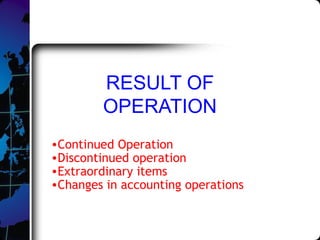
RESULT OF
OPERATION
•Continued Operation
•Discontinued operation
•Extraordinary items
•Changes in accounting operations
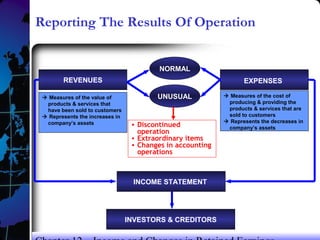
Reporting The Results Of Operation
REVENUES
 Measures of the value of
products & services that
have been sold to customers
 Represents the increases in
company’s assets
EXPENSES
 Measures of the cost of
producing & providing the
products & services that are
sold to customers
 Represents the decreases in
company’s assets
NORMAL
UNUSUAL
INCOME STATEMENT
INVESTORS & CREDITORS
• Discontinued
operation
• Extraordinary items
• Changes in accounting
operations
Reporting Irregular Items: An illustration
Reporting Irregular Items: An illustration – Cont’d
FINANCIAL
ANALYSIS
•Earning Per Share
•Price Earning Ratio
•Basic & Diluted Earning Per Share
Considered if we invest company’s stock at certain price, we
need to know the earnings per share and the annual dividend
per share to decide whether the price is reasonable. Stock
market prices are quoted on a per share basis
Earning Per Share (EPS)
Formula to compute EPS:
EPS = Net income
average number of common share outstanding
or
EPS*= Net income
number of shares outstanding
(*if only common stock and no. of outstanding share has not changed during
the year)
Weighted Average number
of share outstanding must be counted if any outstanding change
during the year.
80.000 shares X 9/12 of a year 60.000
140.000 shares X 3/12 of a year 35.000
Weighted avrg no of common shares outstanding = 95.000
Preferred Dividends in computing EPS
Net Income $ 685.000
Dividends on preferred stock (12.000 shares X $6) 72.000
Earning applicable to common stock 613.000
Weighted average no of common shares outstanding : 200.000
EPS of common stock ($613.000: 200.000 shares) $ 3.07
Earning Per Share (EPS)
Relationship between EPS & Stock Price is expressed by the price-
earning ratio (P/E ratio). P/E ratio based on the earnings over the
past year but can reflects investors expectations of the company’s
future prospects.
Price Earning Ratio (P/E ratio)
Formula to compute P/E ratio:
= Current stock price
earning per share for the year (last four quarters)
Basic and Diluted Earning per Share
• Basic earnings per share
– Based on weighted-average number of common shares
actually outstanding
• Diluted earning per share
– Incorporates the impact that conversion of preferred stock
would have on basic earnings per share.
• Purpose :
– To alert common stockholders to what could have
happened by conversions of preferred stock into shares
of common.
OTHER TRANSACTIONS
AFFECTING RETAINED
EARNINGS
•Dividends
•Prior Period Adjustment
•Comprehensive Income
Type of Dividends
• Cash dividends
• Liquidating dividends
• Stock dividends
Type of Dividends - Cash Dividends
• Return on stock investment :
– The increase in value of the stock
– Cash dividends
• 3 requirements for the payment of cash dividends :
– Retained earnings
– An adequate cash position
– Dividend action by the board of directors
Dividends $ 125.000
Cash $ 125.000
Type of Dividends - Dividend Dates
• 4 dates that involved in dividends distribution
1. Date of Declaration
2. Ex-dividend Date
3. Date of Record
4. Date of Payment
• Entries are made on : declaration date and on
payment date.
Type of Dividends - Stock Dividends
• The dividends is payable in additional shares of stock, not in
cash
• Cash vs Stock dividens :
Cash Dividends Stock Dividends
•Reduce assets & equity
•Distribution of cash
•No assets are distributed
•% of ownership still the same
Retained Earnings $ 250,000
Stock Dividend to be distributed $ 50,000
Add Paid In Cap: Stock Dividend $250,000
Stock Dividend to be distributed $ 50,000
Common Stock $ 50,000
Type of Dividends - Stock Dividends (cont’d)
• Market value of the stock should fall in proportion
to the number of new shares issued.
• Stock splits vs Stock dividends
Stock splits Stock dividends
• To reduce the market price of
the stock
• Number of outstanding shares
is larger
• Reduce the par value of the
stock
• No change in the actual of
stockholder’s equity amount
• To substitute for cash
dividends
• The increases are small
• No change in the par value of
the stock
Type of Dividends - Liquidating Dividends
• Occurs when a corporation pays a dividend that
exceed the balance in the Retained Earnings
account
• Usually are paid only when a corporation is going
out of existence or is making a permanent
reduction in the size of its operations.
Salt Lake Corporation
Statement of Retained Earnings
For the Year Ended December 31, 2005 $
Retained Earnings, Dec 31, 2004
As originally reported 750,000
Less: Prior period adjustment for error in recording 2004
depreciation expense (net of $ 15,000 income taxes) (35,000)
As restated 715,000
Net Income for 2005 280,000
Subtotal 995,000
Less Dividends:
Cash dividends on preferred stocl ($5 per share) (15,000)
Cash dividends on common stock ($2 per share) (59,600)
10% stock dividend (140,000) (214,600)
Retained Earnings, Dec 31, 2005 780,400
Prior Period Adjustment
• Error discovered in Net Income in prior year (I.e material
error to record depreciation on asset in 2004) – should be
corrected
Comprehensive Income
• Changes in financial position : recognized but not realized, I.e
changes in market value of available-for-sale debt and equity
investments
– Does not enter into determination of Net Income
– If value has gone up - adds to the amount of stockholder’s
equity (S/E). If it has gone down – subtract the amount of S/E
• Comprehensive income identifies the total of net income plis or
minus the elements of other comprehensive income
– As a second income statement
– As a single income statement
– As an element in the changes in stockholder’s equity
• This changes stated in element in S/E section of the Balance
Sheet
Stockholder’s Equity Section in Balance
Sheet
Stockholder's Equity
Capital Stock
5% convertible preferred, $100 par value 3,000 shares
authorized and issued
300,000
Common stock, $10 par value, 100,000 shares
authorized, issued 30,8000 (of which 1,000 are held in
treasury) 308,000
608,000
Additional paid-in capital
From issuance of common stock 580,000
From stock dividends 112,000 692,000
Total paid-in capital 1,300,000
Retained earnings 780,400
Subtotal 2,080,400
Less: Treasury stock (1,000 shares at $47 per share) (47,000)
Total stockholder's equity 2,033,400

Financial Accounting Chapter 12

  • 1.
    Fundamentals of Accounting Ch.12. Income and Changes in Retained Earnings Group 5 Arya Gede Danny D. Kosasih Diah Natalin Saragih Erry Sunarli Widyarini Utami Rogaya
  • 2.
    Outline • Result ofOperation • Financial Analysis • Others factor affecting Retained Earnings
  • 3.
    RESULT OF OPERATION •Continued Operation •Discontinuedoperation •Extraordinary items •Changes in accounting operations
  • 4.
    Reporting The ResultsOf Operation REVENUES  Measures of the value of products & services that have been sold to customers  Represents the increases in company’s assets EXPENSES  Measures of the cost of producing & providing the products & services that are sold to customers  Represents the decreases in company’s assets NORMAL UNUSUAL INCOME STATEMENT INVESTORS & CREDITORS • Discontinued operation • Extraordinary items • Changes in accounting operations
  • 5.
  • 6.
    Reporting Irregular Items:An illustration – Cont’d
  • 7.
    FINANCIAL ANALYSIS •Earning Per Share •PriceEarning Ratio •Basic & Diluted Earning Per Share
  • 8.
    Considered if weinvest company’s stock at certain price, we need to know the earnings per share and the annual dividend per share to decide whether the price is reasonable. Stock market prices are quoted on a per share basis Earning Per Share (EPS) Formula to compute EPS: EPS = Net income average number of common share outstanding or EPS*= Net income number of shares outstanding (*if only common stock and no. of outstanding share has not changed during the year)
  • 9.
    Weighted Average number ofshare outstanding must be counted if any outstanding change during the year. 80.000 shares X 9/12 of a year 60.000 140.000 shares X 3/12 of a year 35.000 Weighted avrg no of common shares outstanding = 95.000 Preferred Dividends in computing EPS Net Income $ 685.000 Dividends on preferred stock (12.000 shares X $6) 72.000 Earning applicable to common stock 613.000 Weighted average no of common shares outstanding : 200.000 EPS of common stock ($613.000: 200.000 shares) $ 3.07 Earning Per Share (EPS)
  • 10.
    Relationship between EPS& Stock Price is expressed by the price- earning ratio (P/E ratio). P/E ratio based on the earnings over the past year but can reflects investors expectations of the company’s future prospects. Price Earning Ratio (P/E ratio) Formula to compute P/E ratio: = Current stock price earning per share for the year (last four quarters)
  • 11.
    Basic and DilutedEarning per Share • Basic earnings per share – Based on weighted-average number of common shares actually outstanding • Diluted earning per share – Incorporates the impact that conversion of preferred stock would have on basic earnings per share. • Purpose : – To alert common stockholders to what could have happened by conversions of preferred stock into shares of common.
  • 12.
  • 13.
    Type of Dividends •Cash dividends • Liquidating dividends • Stock dividends
  • 14.
    Type of Dividends- Cash Dividends • Return on stock investment : – The increase in value of the stock – Cash dividends • 3 requirements for the payment of cash dividends : – Retained earnings – An adequate cash position – Dividend action by the board of directors Dividends $ 125.000 Cash $ 125.000
  • 15.
    Type of Dividends- Dividend Dates • 4 dates that involved in dividends distribution 1. Date of Declaration 2. Ex-dividend Date 3. Date of Record 4. Date of Payment • Entries are made on : declaration date and on payment date.
  • 16.
    Type of Dividends- Stock Dividends • The dividends is payable in additional shares of stock, not in cash • Cash vs Stock dividens : Cash Dividends Stock Dividends •Reduce assets & equity •Distribution of cash •No assets are distributed •% of ownership still the same Retained Earnings $ 250,000 Stock Dividend to be distributed $ 50,000 Add Paid In Cap: Stock Dividend $250,000 Stock Dividend to be distributed $ 50,000 Common Stock $ 50,000
  • 17.
    Type of Dividends- Stock Dividends (cont’d) • Market value of the stock should fall in proportion to the number of new shares issued. • Stock splits vs Stock dividends Stock splits Stock dividends • To reduce the market price of the stock • Number of outstanding shares is larger • Reduce the par value of the stock • No change in the actual of stockholder’s equity amount • To substitute for cash dividends • The increases are small • No change in the par value of the stock
  • 18.
    Type of Dividends- Liquidating Dividends • Occurs when a corporation pays a dividend that exceed the balance in the Retained Earnings account • Usually are paid only when a corporation is going out of existence or is making a permanent reduction in the size of its operations.
  • 19.
    Salt Lake Corporation Statementof Retained Earnings For the Year Ended December 31, 2005 $ Retained Earnings, Dec 31, 2004 As originally reported 750,000 Less: Prior period adjustment for error in recording 2004 depreciation expense (net of $ 15,000 income taxes) (35,000) As restated 715,000 Net Income for 2005 280,000 Subtotal 995,000 Less Dividends: Cash dividends on preferred stocl ($5 per share) (15,000) Cash dividends on common stock ($2 per share) (59,600) 10% stock dividend (140,000) (214,600) Retained Earnings, Dec 31, 2005 780,400 Prior Period Adjustment • Error discovered in Net Income in prior year (I.e material error to record depreciation on asset in 2004) – should be corrected
  • 20.
    Comprehensive Income • Changesin financial position : recognized but not realized, I.e changes in market value of available-for-sale debt and equity investments – Does not enter into determination of Net Income – If value has gone up - adds to the amount of stockholder’s equity (S/E). If it has gone down – subtract the amount of S/E • Comprehensive income identifies the total of net income plis or minus the elements of other comprehensive income – As a second income statement – As a single income statement – As an element in the changes in stockholder’s equity • This changes stated in element in S/E section of the Balance Sheet
  • 21.
    Stockholder’s Equity Sectionin Balance Sheet Stockholder's Equity Capital Stock 5% convertible preferred, $100 par value 3,000 shares authorized and issued 300,000 Common stock, $10 par value, 100,000 shares authorized, issued 30,8000 (of which 1,000 are held in treasury) 308,000 608,000 Additional paid-in capital From issuance of common stock 580,000 From stock dividends 112,000 692,000 Total paid-in capital 1,300,000 Retained earnings 780,400 Subtotal 2,080,400 Less: Treasury stock (1,000 shares at $47 per share) (47,000) Total stockholder's equity 2,033,400