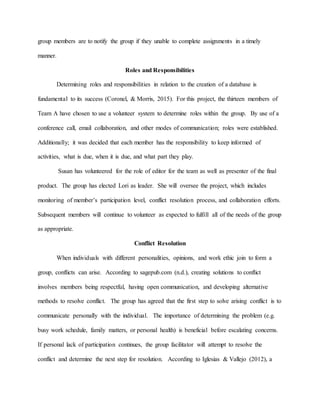
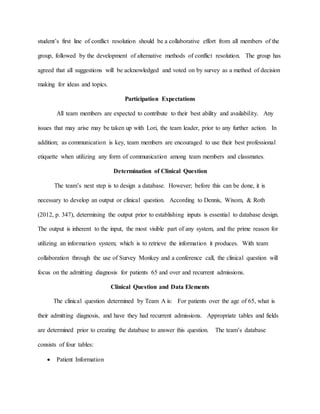
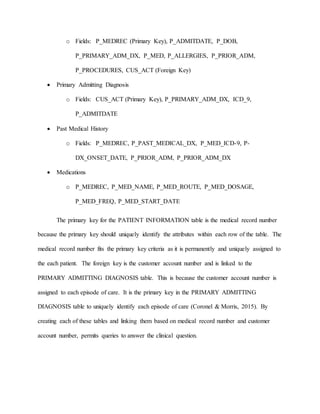
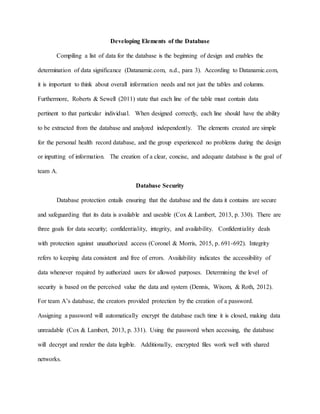
Running head: FINAL PORTFOLIO 1
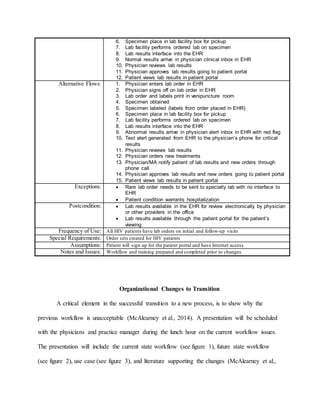
Walden University – School of Nursing
Final Portfolio
NURS 6600C Capstone Synthesis Practicum – Nursing Informatics
November 11, 2015
Lori Dixon
4551 Canebrake Court
Powder Springs, Georgia 30127
678-429-8510
Rnlac38@outlook.com
Clinical Documentation Improvement Manager
Children’s Healthcare of Atlanta
Atlanta, Georgia
Running head: POS and PDP 2
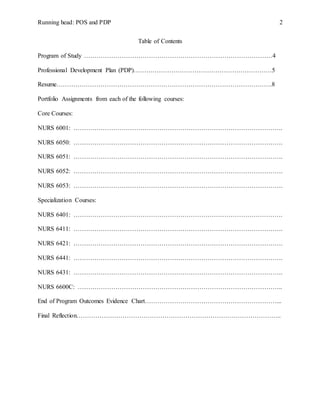
Table of Contents
Program of Study ………………………………………………………………………………4
Professional Development Plan (PDP)…………………………………………………………5
Resume………………………………………………………………………………………….8
Portfolio Assignments from each of the following courses:
Core Courses:
NURS 6001: ……………………………………………………………………………………….
NURS 6050: ……………………………………………………………………………………….
NURS 6051: ……………………………………………………………………………………….
NURS 6052: ……………………………………………………………………………………….
NURS 6053: ……………………………………………………………………………………….
Specialization Courses:
NURS 6401: ……………………………………………………………………………………….
NURS 6411: ……………………………………………………………………………………….
NURS 6421: ……………………………………………………………………………………….
NURS 6441: ……………………………………………………………………………………….
NURS 6431: ……………………………………………………………………………………….
NURS 6600C: ……………………………………………………………………………………..
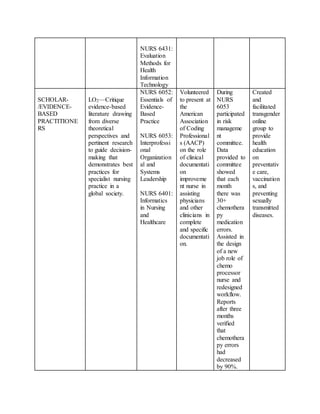
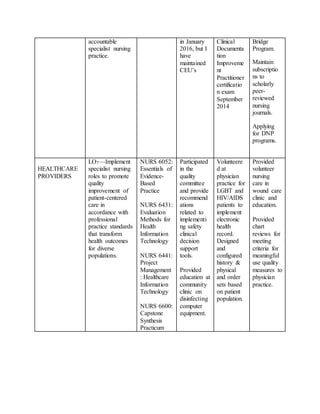
End of Program Outcomes Evidence Chart………………………………………………………...
Final Reflection……………………………………………………………………………………..
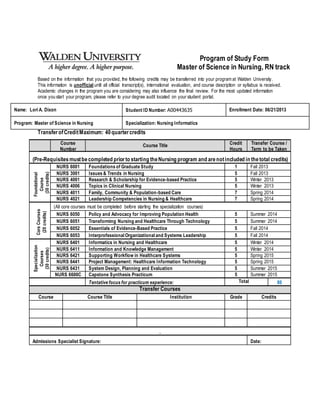
Program of Study Form
Master of Science in Nursing, RN track
Based on the information that you provided, the following credits may be transferred into your program at Walden University.
This information is unofficial until all official transcript(s), international evaluation, and course description or syllabus is received.
Academic changes in the program you are considering may also influence the final review. For the most updated information
once you start your program, please refer to your degree audit located on your student portal.
Name: Lori A. Dixon Student ID Number: A00443635 Enrollment Date: 06/21/2013
Program: Master of Science in Nursing Specialization: Nursing Informatics
Transfer ofCreditMaximum: 40quartercredits
Course
Number
Course Title Credit
Hours
Transfer Course /
Term to be Taken
(Pre-Requisitesmustbecompleted priorto starting theNursing program and arenotincluded in thetotal credits)
Foundational
Course
(30credits)
NURS 6001 Foundations of Graduate Study 1 Fall 2013
NURS 3001 Issues & Trends in Nursing 5 Fall 2013
NURS 4001 Research & Scholarship for Evidence-based Practice 5 Winter 2013
NURS 4006 Topics in Clinical Nursing 5 Winter 2013
NURS 4011 Family, Community & Population-based Care 7 Spring 2014
NURS 4021 Leadership Competencies in Nursing & Healthcare 7 Spring 2014
CoreCourses
(20credits)
(All core courses must be completed before starting the specialization courses)
NURS 6050 Policy and Advocacy for Improving Population Health 5 Summer 2014
NURS 6051 Transforming Nursing and Healthcare Through Technology 5 Summer 2014
NURS 6052 Essentials of Evidence-Based Practice 5 Fall 2014
NURS 6053 Interprofessional Organizational and Systems Leadership 5 Fall 2014
Specialization
Courses
(30credits)
NURS 6401 Informatics in Nursing and Healthcare 5 Winter 2014
NURS 6411 Information and Knowledge Management 5 Winter 2014
NURS 6421 Supporting Workflow in Healthcare Systems 5 Spring 2015
NURS 6441 Project Management: Healthcare Information Technology 5 Spring 2015
NURS 6431 System Design, Planning and Evaluation 5 Summer 2015
NURS 6600C Capstone Synthesis Practicum 5 Summer 2015
Tentative focus for practicum experience: Total
Credits:
80
Transfer Courses
Course
Number
Course Title Institution Grade Credits
.
Admissions Specialist Signature: Date:
Program of Study and the Professional Development Plan
Lori A. Dixon
Walden
NURS 6001: Foundations of Graduate Study
October 13, 2013
5
Program of Study and the Professional Development Plan
The purpose of developing a professional development plan allows me to record my
progress in lifelong learning and record my work as a scholar. My education goal is to receive
my master in nursing with a focus on nursing informatics. My professional accomplishments
and education are recorded in my portfolio, supplying a future employer with a history of my
education and career lifelong learning.
Education and Professional Background
In 1986, I was in a failing marriage, with three toddler children, and I knew that I would
have to be the parent who provided for my children. I lived in Dayton, Ohio and decided to go
back to school for my nursing degree. I attended Sinclair Community College and received my
Associate Degree in Nursing (ADN) in 1989. Within a month, I was a single parent providing
for three small children. My career began at the same hospital that my grandmother had become
a diploma nurse. I worked on a medical oncology floor and loved caring for patients. My
concern for patients led me down many career paths, from medical oncology to hospice, to home
health, and eventually to healthcare software. I was successful in my career and raising three
children; I had not planned on returning to school for my Bachelor of Science in Nursing (BSN).
Nurses are pictured as a woman or man in scrubs, leaning over and comforting a patient, but not
all nurses are on the frontlines physically caring for patients. Some nursing roles are supportive
of the clinical team that is touching patient lives on a daily basis. Do these roles impact the
patient? I believe they do.
Kim had HER2+ breast cancer diagnosed when she was only 36 years old, mother of an 11-year-
old daughter and married to her one and only love. She fought a hard fight, but after four years,
she died leaving her loving family. Her one wish had been to see her daughter become an adult.
I walked 60 miles for Kim, to help raise money for research to give other breast cancer patients a
chance at survival. Kim gave me a silver bracelet with a heart and pink breast cancer ribbon on
it.
As a nurse involved in Informatics for over 20 years, I began to question how do I make a
difference in patient lives? Laptops and systems how do they help the patient? I believe I have
found the answer over the last year as I helped to open a specialty hospital for cancer patients.
Opening a new hospital, can be frustrating and I would rub the heart on my bracelet and
remember Kim. Combining the role of nursing and informatics, allows me to use my clinical
expertise to help make systems usage more than just a database. As I changed positions from an
IT Analyst to a Director of Clinical Informatics, using, this expertise made the difference in
opening the hospital.
As the building began to be under construction, I wore my hard hat and steel-toed boots as I
climbed stairs and reviewed various clinical areas to make sure that technically everything was
ready to facilitate patient care from the clinicians view, not that of a construction team or
technical team. Would placing computers at the bedside work best? Would the rooms still be
comfortable and home like to the patient? What about the nursing staff, did the information
system help them gather data to care for the patient better? It was more than just a building as
we had our Blessing Ceremony, and I wrote Jeremiah 29:11 on the concrete floor. Finally, on
August 15 we opened our doors, and our first patients began to arrive.
Kelly came on the Monday after our opening; she was breast cancer survivor with a new
diagnosis of stage IV anal cancer. She came looking for healing and hope, and what she found
was not just that, but new friends to support her journey. Last Thursday, I heard Kelly give a
patient impact statement. She did not talk about the fancy technology, or the fact that the
hospital was fully digital; she told stories. Her stories were about the clinicians, who found ways
to meet her needs emotionally and physically. Now she is in remission. I became a friend to
Kelly, and I wondered did I make a difference in her care. I believe it did! I trained the
clinicians to use systems that were designed to collect the data for her care and expedite that care
to her.
And yet is there more that I can do? My belief is that the future of healthcare will be more than
just recording the data in a digital record, but what can we do with that information? It is not the
system that is necessary it is the ability to retrieve the data, analyze it and make a difference in
patient lives.
Tomorrow is to today at my hospital. Now, we can do genetic testing to find out precisely the
type of cancer and what is the best treatment. I have a small part to play as an Informatics nurse,
but being able to retrieve the data rapidly and give it to our researchers and medical oncologist
will allow us to come up with treatments that meet the individual patient’s needs. Tomorrow, the
data that we provide today may make the difference between an HER2+ breast cancer patient
living four years or surviving to see her daughter grow to be an adult. It gave me the inspiration
to continue my career.
Course Outcomes
Being out of school for 24 years, the thought of returning to school was daunting. I have
presented at three professional association in my past on informatics and medication bar coding.
When presenting my curriculum vitae, I also felt a little shy with my lack of education.
Currently in my job, I also work with our research department on clinical trials. I use my
clinical and informatics expertise to transform the paper research protocol into a computer
pathway for physicians to follow. The ability to speak in front of others and to interpret clinical
data into software fields are my strengths. My weakness’ that I recognized on returning to
school was the ability to write in American Psychological Association (APA) style of writing.
Through this course, I have been able to learn how to write a paper in APA style and critically
review peer-reviewed articles. The sharing of discussion topics with other nurses has been an
incredible experience to learn about other areas of nursing.
Professional and Learning Goals
At 53 years old, why should I go back to school and earn my Master’s Degree? I have had a
fulfilling career and an excellent position at my hospital. I could work a few more years and
retire quietly, but I remember Kim and Kelly, and what the future holds for precision medicine.
Informatics needs clinician, who understand how designing makes a clinical impact on
information systems. That can use their clinical experience to affect the systems used to be more
than just a recording system for the chart. Today we discuss the sharing of information of health
information across systems, tomorrow we will be discussing how the sharing of that information
has saved patient lives.
A child of the 1960’s I never imagined being a ‘geeky nurse’, but I realize that to make a
difference, I need to return to get my Master of Science in Nursing (MSN). Becoming a scholar
and achieving my goals, will provide support to my career achievements. I hope to write in the
future peer-reviewed articles that will support the work I have done for several years.
Practicum
I am looking forward to the practicum as I complete my studies. It will also be a challenge for
me to find a practicum experience in my area of study. Leaders in my hospital could be my
mentor for the practicum, but I want to find a place that will provide me with a new experience
and training in nursing informatics.
Summary
Online learning is giving me the opportunity to become a scholar-practitioner and meet my
professional goals. I have found that even challenging courses such as statistics, bring me new
information. I can use this knowledge when I do future research. I am looking forward as I
progress through my program of study, nursing informatics, and when I graduate from Walden
University in November of 2015.
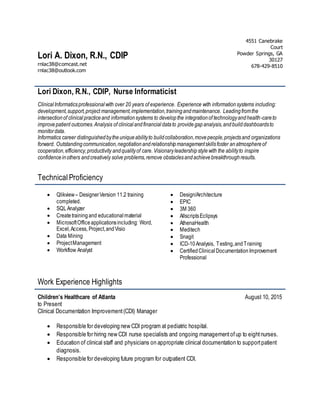
Lori A. Dixon, R.N., CDIP
rnlac38@comcast.net Powder Springs, GA 30127
rnlac38@outlook.com
4551 Canebrake
Court
Powder Springs, GA
30127
678-429-8510
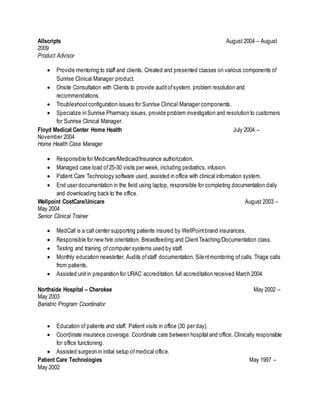
Lori Dixon, R.N., CDIP, Nurse Informaticist
ClinicalInformaticsprofessionalwith over 20 years of experience. Experience with informationsystems including:
development,support,project management,implementation,trainingandmaintenance. Leadingfromthe
intersectionof clinicalpracticeand informationsystems to developthe integrationof technologyandhealth-careto
improvepatient outcomes.Analysis of clinicalandfinancialdatato providegapanalysis,andbuilddashboardsto
monitordata.
Informatics career distinguishedbytheuniqueabilityto buildcollaboration,movepeople,projectsand organizations
forward. Outstandingcommunication,negotiationandrelationshipmanagementskillsfoster anatmosphereof
cooperation,efficiency,productivity andqualityof care. Visionaryleadershipstylewith the abilityto inspire
confidenceinothers andcreatively solve problems,remove obstaclesandachievebreakthroughresults.
TechnicalProficiency
 Qlikview – DesignerVersion 11.2 training
completed.
 SQLAnalyzer
 Createtrainingand educational material
 MicrosoftOfficeapplicationsincluding: Word,
Excel,Access, Project,andVisio
 Data Mining
 ProjectManagement
 Workflow Analyst
 Design/Architecture
 EPIC
 3M 360
 AllscriptsEclipsys
 AthenaHealth
 Meditech
 Snagit
 ICD-10Analysis, Testing,andTraining
 CertifiedClinicalDocumentationImprovement
Professional
Work Experience Highlights
Children’s Healthcare of Atlanta August 10, 2015
to Present
Clinical Documentation Improvement(CDI) Manager
 Responsible for developing new CDI program at pediatric hospital.
 Responsible for hiring new CDI nurse specialists and ongoing managementofup to eightnurses.
 Education of clinical staff and physicians on appropriate clinical documentation to supportpatient
diagnosis.
 Responsible for developing future program for outpatient CDI.
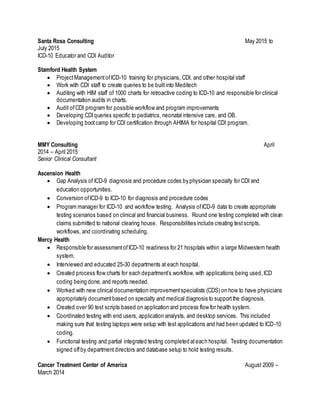
Santa Rosa Consulting May 2015 to
July 2015
ICD-10 Educator and CDI Auditor
Stamford Health System
 ProjectManagementofICD-10 training for physicians, CDI, and other hospital staff
 Work with CDI staff to create queries to be builtinto Meditech
 Auditing with HIM staff of 1000 charts for retroactive coding to ICD-10 and responsible for clinical
documentation audits in charts.
 Audit ofCDI program for possible workflow and program improvements
 Developing CDIqueries specific to pediatrics, neonatal intensive care, and OB.
 Developing bootcamp for CDI certification through AHIMA for hospital CDI program.
MMY Consulting April
2014 – April 2015
Senior Clinical Consultant
Ascension Health
 Gap Analysis of ICD-9 diagnosis and procedure codes by physician specialty for CDI and
education opportunities.
 Conversion ofICD-9 to ICD-10 for diagnosis and procedure codes
 Program manager for ICD-10 and workflow testing. Analysis ofICD-9 data to create appropriate
testing scenarios based on clinical and financial business. Round one testing completed with clean
claims submitted to national clearing house. Responsibilities include creating testscripts,
workflows, and coordinating scheduling.
Mercy Health
 Responsible for assessmentofICD-10 readiness for 21 hospitals within a large Midwestern health
system.
 Interviewed and educated 25-30 departments at each hospital.
 Created process flow charts for each department’s workflow, with applications being used,ICD
coding being done, and reports needed.
 Worked with new clinical documentation improvementspecialists (CDS) on how to have physicians
appropriately documentbased on specialty and medical diagnosis to supportthe diagnosis.
 Created over 90 test scripts based on application and process flow for health system.
 Coordinated testing with end users, application analysts, and desktop services. This included
making sure that testing laptops were setup with test applications and had been updated to ICD-10
coding.
 Functional testing and partial integrated testing completed ateach hospital. Testing documentation
signed offby departmentdirectors and database setup to hold testing results.
Cancer Treatment Center of America August 2009 –
March 2014
Director of Clinical Informatics
 Created dashboards using Qlikview, reporting to executive team and quality.
 Developed and ran queries in SQL to meetdata needs.
 Developed 21 reports to retrieve data for Blue Cross/Blue Shield ofGA contract, resulting in
meeting all quality measures and bonus points.
 Assisted with The JointCommission accreditation with no deficiencies.
 Monthly reporting for CPOE and bar coding percentage. CPOE is over 90% for physicians.
Medication barcoding ofmedications is 95%.
 Worked with research to develop research protocols in clinical applications and to retrieve data to
assistin finding patients meeting research protocols.
 Served on Cancer Accreditation Committee and Breast Cancer Center of Excellence for analyzing
data needs and changes to clinical systems.
 Responsible for ProjectManagementfor the implementation ofAllscripts Sunrise Clinical Manager,
Medication Manager, and Knowledge-Based Medication Managementfor opening ofthe Atlanta
hospitals.
o Developed projectschedules and timelines.
o Managed projectschedules and status reporting efforts. Prepared and presented status
reports to executive management.
o Worked with Information Systems and Director of Informatics from four sister hospitals to
coordinate configuration changes to the systems.
o Created design specifications for changes within the system.
o Performed troubleshooting ofissues to determine ifthey were a defector education issue.
o Consulted with physicians for enhancements needed to clinical applications then
developed
 ProjectManager for ancillary systems: Varian, RIS, SunquestLab, Enterprise Scheduling, Hyland
Record Management, and Quadramed Acuity system.
 Responsible for projectmanagementofupgrade from Allscripts products from 5.5 to 6.1.
o Led upgrade efforts tracking schedules, implementation timelines and roll out.
 ProjectLeader ofimplementation ofmedication reconciliation effort.
 Responsible for education ofover 650 clinical stakeholders, which included physicians, nursing,
and ancillary stakeholders.
 Educated physicians on proper documentation to supportmedical diagnosis, and how to do that
within the clinical applications.
IT Site Liaison
 Facilitated and communicated IT issues between corporate IT and facility.
 Supported hospital executive team during construction offacility.
Senior Clinical Analyst
 Performed configuration and supportofAllscripts Bar Coding and Pointof Care Applications.
Allscripts August 2004 – August
2009
Product Advisor
 Provide mentoring to staff and clients. Created and presented classes on various components of
Sunrise Clinical Manager product.
 Onsite Consultation with Clients to provide auditofsystem, problem resolution and
recommendations.
 Troubleshootconfiguration issues for Sunrise Clinical Manager components.
 Specialize in Sunrise Pharmacy issues, provide problem investigation and resolution to customers
for Sunrise Clinical Manager.
Floyd Medical Center Home Health July 2004 –
November 2004
Home Health Case Manager
 Responsible for Medicare/Medicaid/Insurance authorization.
 Managed case load of25-30 visits per week, including pediatrics, infusion.
 Patient Care Technology software used, assisted in office with clinical information system.
 End user documentation in the field using laptop, responsible for completing documentation daily
and downloading back to the office.
Wellpoint CostCare/Unicare August 2003 –
May 2004
Senior Clinical Trainer
 MedCall is a call center supporting patients insured by WellPointbrand insurances.
 Responsible for new hire orientation, Breastfeeding and ClientTeaching/Documentation class.
 Testing and training of computer systems used by staff.
 Monthly education newsletter. Audits ofstaff documentation. Silentmonitoring ofcalls. Triage calls
from patients.
 Assisted unitin preparation for URAC accreditation, full accreditation received March 2004.
Northside Hospital – Cherokee May 2002 –
May 2003
Bariatric Program Coordinator
 Education of patients and staff. Patient visits in office (30 per day).
 Coordinate insurance coverage. Coordinate care between hospital and office. Clinically responsible
for office functioning.
 Assisted surgeon in initial setup ofmedical office.
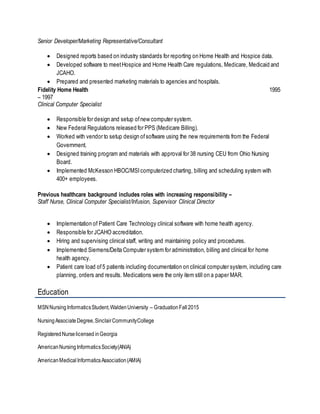
Patient Care Technologies May 1997 –
May 2002
Senior Developer/Marketing Representative/Consultant
 Designed reports based on industry standards for reporting on Home Health and Hospice data.
 Developed software to meetHospice and Home Health Care regulations, Medicare, Medicaid and
JCAHO.
 Prepared and presented marketing materials to agencies and hospitals.
Fidelity Home Health 1995
– 1997
Clinical Computer Specialist
 Responsible for design and setup ofnew computer system.
 New Federal Regulations released for PPS (Medicare Billing).
 Worked with vendor to setup design ofsoftware using the new requirements from the Federal
Government.
 Designed training program and materials with approval for 38 nursing CEU from Ohio Nursing
Board.
 Implemented McKesson HBOC/MSIcomputerized charting, billing and scheduling system with
400+ employees.
Previous healthcare background includes roles with increasing responsibility –
Staff Nurse, Clinical Computer Specialist/Infusion, Supervisor Clinical Director
 Implementation of Patient Care Technology clinical software with home health agency.
 Responsible for JCAHO accreditation.
 Hiring and supervising clinical staff, writing and maintaining policy and procedures.
 Implemented Siemens/Delta Computer system for administration, billing and clinical for home
health agency.
 Patient care load of5 patients including documentation on clinical computer system, including care
planning, orders and results. Medications were the only item still on a paper MAR.
Education
MSNNursingInformaticsStudent,WaldenUniversity – GraduationFall2015
NursingAssociateDegree,SinclairCommunityCollege
RegisteredNurselicensed inGeorgia
AmericanNursingInformaticsSociety(ANIA)
AmericanMedicalInformaticsAssociation(AMIA)
AmericanHealthInformationManagementAssociation(AHIMA)
Associationof ClinicalDocumentationSpecialists(ACDIS)
Presentations:
The UnSummit– Workflow, Design and Technology ofMedication; Administration Technology: Putting the
Pieces Together for Successful Outcomes; Allscripts EUN– Implementation ofBar Coding; Allscripts– Two
Sessions – Configuration and Implementation ofIV Fluids with a EUN multidisciplinary approach and
Troubleshooting Pharmacy Logs. Home Health Care Association – Electronic health records in home
health care.
Developing a Health Advocacy Campaign
Lori Dixon
Walden University
Policy & Advocacy for Population Health
NURS-6050-11
August 10, 2014
Developing a Health Advocacy Campaign
Nurses have an ethical responsibility to be active in advocacy. Nurses should address
issues with populations, and speak out to make changes in disparities or inequities to access to
care (Laureate Education, Inc. [Laureate], 2012). The purpose of this paper is to describe a
population health issue, identify the population it affects, review current health advocacy
programs and develop a health advocacy program.
Population Health Issue
The Affordable Care Act (ACA) is designed to provide healthcare for all Americans.
The emphasis is “all Americans.” To be eligible for care, an immigrant must have legal
immigrant status ("ACA Latinos," 2014). Migrant workers in the United States are a mixture of
legal and illegal workers. There are nearly a million farm workers, and 25-50% are illegal
immigrants (Baragona, 2010). Farm workers have families that travel with them from state to
state.
Patients go to a new provider, and the first thing that happens is the collection of their
health history. The new provider may ask for a release to get medical records from a previous
provider. Illegal or legal migrants move so frequently that they do not have a primary health
care provider. They may seek emergency or urgent care when they become ill, and children may
not receive important check-ups. There are barriers to healthcare such as unable to speak
English, the cost of care, availability of care, and distrust of healthcare workers. Hispanic
workers have health issues such as diabetes, sexually transmitted disease, teenage pregnancy,
and cirrhosis (Peach, 2013). The health issue is a lack of healthcare due to barriers that prevent
migrant workers and their families from receiving consistent healthcare. By traveling from state
to state, there is no history of their medical care for new providers to review.
Population
There are over 400,000 children working on farms in the U.S. Once they reach the age of 12;
children are allowed to work in the fields. But children as young as six, have been found
working in the fields. Mexican-American migrant children are two-three times more often in
poor to fair health (Waldeman, Cannella, & Perlman, 2010). They are exposed to pesticides and
go without having acute illnesses treated.
Health Advocacy Program I
The University of Southern California School of Dentistry (USCSD) has a mobile dental
program to serve migrant children (Mulligan, Seirawan, & Faust, 2010). Dental disease is rated
in the top five health issues for the migrant workers in California. Six communities were visited,
and the prevalence of tooth decay in children was 87.4%. As part of the curriculum for dental
and hygienist students is a community service component. This provides them experience in
their field and educates them on cultural differences. The program has operated for 40 years and
returned annually to up to 70 communities.
The program has five mobile vehicles, and one is set up for supplies and sterilization.
The team shows up with all vehicles at a community site such as a school at least a week in
advance (Mulligan et al., 2010). The Migrant Education Program refers the children, and before
the child can be treated the team must get parental consent. Faculty, residents, and senior
students perform complete exams including x-rays and health histories. The program receives
funding from grants and community sponsorships.
Attributes of USCSD Mobile Dental Program
The program is a safety net for migrant children’s dental health issues. Healthy People 2020
have the objective OH-2 Reduce the proportion of children and adolescents with untreated dental
decay (Healthy People 2020 website, n.d.). There are two attributes that make this program
effective. First, students are used to providing the services to the children. It provides care to
the underserved and gives the students experience in their field. The second attribute is
volunteerism in the communities they visit. The students are there for a limited amount of time,
and many of the children need extensive care beyond what can be done during the visit.
Ongoing care is coordinated with the dentists in the community who have volunteered to help the
children (Mulligan et al., 2010).
Health Advocacy Program II
The Farm Worker Family Health Program’s (FWFHP) is run by Emory University School
of Nursing and Ellenton Clinic, which is a local community clinic (Connor, Layne, & Thomisee,
2010) through a small grant, FWFHP started in 1993 and has grown to 15-year multidisciplinary
academic-community join venture. Local community agencies they work with include summer
education program, businesses, faith communities, childcare centers, the Area Health Education
Center (AHEC), farmers and growers, and others (Connor et al., 2010).
Three urban universities and local college participate every summer. They travel to rural
Georgia where they live and work for two weeks. Approximately 90 students and faculty
members including nursing, physical therapy, dental hygienist, and psychologist care for
patients. Returning students and faculty provide continuity of care each year (Connor et al.,
2010).
Care is provided in a clinic setting, and the team goes to where the patients may be such as
daycare centers. Nurse practitioners perform head to toe exams, and student nursing assess
height, weight, body mass index, vision, hearing, blood pressure, hemoglobin, and glucose.
Dental hygienist clean teeth and provide fluoride treatments. Physical therapy students teach
body mechanics (Connor et al., 2010). FWFHP recognizes the cultural values of the migrant
workers and educates them on chronic illness and preventive care.
Attributes Farm Worker Family Health Program’s (FWFHP)
The program is not dependent on government resources or insurance to run the program. They
use grants and community programs that are in place. Barriers to care are avoided because they
go to where the migrant workers are working or where the children are in an education setting.
They also run a clinic from early in the morning to well after midnight to meet the needs of the
migrant workers who may work 16 hours a day in the fields (Connor et al., 2010). Another
attribute is that they also work within the culture of the patients and recognize the differences.
Finally, they use university students in nursing, dental, psychology, and physical therapy to
donate their time. It provides care to the patients and gives these students real-life experience in
their fields.
Policy Proposal
The National Advisory Council on Migrant Health wrote a letter to then Secretary
Sebelius recommending health care needs of the migrant population (National Center for
Farmworker Health website, 2014). They recommended increasing the funding for primary care,
outreach, chronic care and health care workers. Despite the ACA being enacted, there are
barriers to care, especially for access to the care and illegals being part of the population. There
are over 400,000 migrant children that may be working in the fields and exposed to pesticides
(Waldeman et al., 2010). These children also move from place to place. They may either have
too many immunizations because of a lack of records or not enough immunizations
(Connor et al., 2010). There is currently a pending law called the HEAL Immigrant Women and
Families Act of 2014 and was introduced in March 2014. H. R. 4240 states “To expand access
to health care services, including sexual, reproductive, and maternal health services, for
immigrant women, men, and families by removing legal barriers to health insurance coverage,
and for other purposes” (H.R. H. R. 4240, 2014). I would like to propose additional
items to be added to this bill. First, would be to increase grant funding for academic-
community ventures that would provide care to migrant children regardless of their legal status.
Secondly to provide funding for nursing towards tuition, for those nurses who voluntarily work
in a clinic for a month each summer to provide care. These nurses would receive $5000 grant
money towards tuition the semester after doing their volunteer work.
Advocacy Program
Both the USCSD Mobile Dental Program and the Farm Worker Family Health Program’s
(FWFHP) went to where the population was located. While providing care, they researched the
characteristics of the population and their health needs (Mulligan et al., 2010 and Connor et al.,
2010). When advocating funding data needs to be provided to substantiate the need. My
proposal would include the current statistics for migrant children population and needs. I would
also follow the model provided by these two programs to work with university programs to
provide the volunteers to staff the program. In Powder Springs, there is a significant Hispanic
migrant population. There are also several nursing university programs that student nurses could
help to provide assessments and care. In following the example of going to where the population
is there is a flea market in the area that is attended every weekend by this population. The booths
rent for $12.00 per day. A booth could be rented to provide educational materials on where to
access care throughout the county. In the future with the appropriate organization, they could
offer immunizations to the children of the migrant workers.
Existing Laws Impact on Advocacy Efforts
The ACA is affecting migrant workers currently. Naturalized citizens have the same access as
U.S. born citizens. Lawfully present immigrants will have limited federal access.
Undocumented workers will not receive any access to health insurance or care except in an
emergency (National Immigration Center website, n.d.). There are many migrant workers who
do not understand they have access, or feel they do not have the income to pay for the insurance.
Public health can be affected by care not being given to this population; in GA there have been
outbreaks of tuberculosis at local schools (CBS 46 website, 2014).
How to influence Legislators – Three Legs of Lobbying
To make policy changes, the issue needs to be presented through the Three Legs of Lobbying.
The first leg is getting it represented at the Capitol level through lobbying. Working with other
lobbying organizations, writing one-page policy letters, and meeting with legislators, can do
accomplish working to get it addressed at the Capitol level (Amidei, n.d.). The second leg is the
grassroots activity that includes creating a website with alerts to notify subscribers, getting
legislators to visit your program, and to attend community meetings to talk about your issue. The
third leg is working with the media. It can be done by writing to the editor, creating articles for a
newsletter, and publishing national reports (Amidei, n.d.).
Hurdles in Legislative Process and Overcoming the Hurdles
A bill first needs to be drafted, and then it will be submitted to the House of
Representatives or Senate. Bills are then submitted to a committee, and in committee they can
become stuck or die. There will be competing lobbyist for and against the bill ("Barriers
legislation," 2011). Advocates are making a case attempting to pass a bill providing funding that
will include care to illegal migrants is very controversial. Current legislation is trying to be
created for immigration reform. To get over these barriers, it is important to have support from
other lobbying groups. Farm Workers Justice and United Farm Workers are two groups who
could be accessed to help advocate for these changes.
Ethical Dilemmas
An ethical dilemma is should illegal migrants have the same right as U.S. citizens to health care.
Most Americans feel that human beings have a right to healthcare (Kovner & Knickman, 2011).
I believe it goes beyond if it is a right or not because the health of this population can affect other
U.S. citizens. The Guide to the Code of Ethics Provision Eight provides that a nurse should
promote the health of the community, the nation, and internationally. The migrant population is
part of the community ("ANA Ethics," 2010).
Summary
Nursing has an ethical responsibility to advocate patient’s needs. The migrant population,
especially the children, lack in access to care. A policy change could provide funding to student
nurses towards tuition if they volunteer their time caring for the population. It can be done
through academic-community joint ventures that should also receive additional funding. The
legislative process can be difficult, but by using the three legs of advocacy changes can be made.
References
2014 Clinical Quality Measures (CQMs) Adult Recommended Core Measures. (2014). Retrieved
from http://www.cms.gov/Regulations-and-
Guidance/Legislation/EHRIncentivePrograms/Downloads/2014_CQM_AdultRecommen
d_CoreSetTable.pdf
Amidei, N. (n.d.). The three legs of successful advocacy. Retrieved from
www.childrensalliance.org
Baragona, S. (2010). US farmers depend on illegal immigrants. Retrieved from
http://www.voanews.com/
CBS 46 website. (2014). http://www.cbs46.com/
Code of Ethics for Nurses. (2010). Retrieved July 28, 2014, from http://www.nursingworld.org
Connor, A., Layne, L., & Thomisee, K. (2010, March). Providing care for migrant farm worker
families in their unique sociocultural context and environment. Journal of Transcultural
Nursing, 21(2), 159–166. doi: 10.1177/1043659609357631
EHR incentive programs: What’s new for stage I in 2014. (2014). Retrieved from
http://www.cms.gov/eHealth/downloads/eHealthU_Stage1Changes.pdf
HEAL, H.R. H. R. 4240, 113th Cong. (2014).
Healthy People 2020 website. (n.d.). http://www.healthypeople.gov/2020/
Kovner, A. R., & Knickman, J. R. (Eds.). (2011). Health care delivery in the United States
(Laureate Education, Inc., custom ed.). New York, NY: Springer Publishing.
Laureate Education, Inc. (Producer). (2012,). The needle exchange program [Interview
transcript]. Retrieved from
https://class.waldenu.edu/webapps/portal/frameset.jsp?tab_tab_group_id=_2_1&url=%2
F
webapps%2Fblackboard%2Fexecute%2Flauncher%3Ftype%3DCourse%26id%3D_5100
419_1%26url%3D
Mulligan, R., Seirawan, H., & Faust, S. (2010, February). Oral health care delivery model for
underserved migrant children. Journal of the California Dental Association, 38, 115-121.
Retrieved from http://www.cda.org/
National Center for Farmworker Health website. (2014). http://www.ncfh.org/
National Immigration Center website. (n.d.). http://www.nilc.org/
Peach, H. (2013, May 3). Migrant farm-workers and health. Rural and Remote Health, 13, 1-3.
Retrieved from http://www.rrh.org.au
The Affordable Care Act and Latinos. (2014). Retrieved from
http://www.hhs.gov/healthcare/facts/factsheets/2012/04/aca-and-latinos04102012a.html
The legislative Process. (2011). Retrieved from http://congress.indiana.edu/legislative-process
Waldeman, H. B., Cannella, D., & Perlman, S. P. (2010, November). Migrant farm workers and
their children. Exceptional Parent, 52-53. Retrieved from www.eparent.com
Infusion Center Chemotherapy Process Flow
Lori Dixon
Walden University
Transforming Nursing & Healthcare Through Information Technology
NURS-6051-12
July 27, 2014
27
Infusion Center Chemotherapy Process Flow
The Infusion Center at Cancer Treatment Centers of America (CTCA) Southeastern
administers 153,300-chemotherapy infusions each year, and additionally will administer
thousands of hydrations and blood products. The administration of chemotherapy protocols is
complex and has multiple possibilities for errors to be made (Neuss et al., 2013). Clinical
workflows define each step in a process in the clinical care of patients. It includes a series of
actions, who accomplishes them, and the sequence of the actions (Morgenstern, n.d.). The
purpose of this paper is to flowchart a clinical process and the use of technology, and to analyze
any needs for improvement.
Quality Metric
The hospital opened in August 2012, and one year later after issues with patient wait times,
the workflow was assessed for possible changes. Patient wait times were averaging between two
and three hours. The first tool used was to interview the clinicians involved with the
chemotherapy process, and then the process was flow charted to look for defects (AHRQ Agency
for Healthcare Research and Quality, 2013).
Pre-Infusion Nursing Process
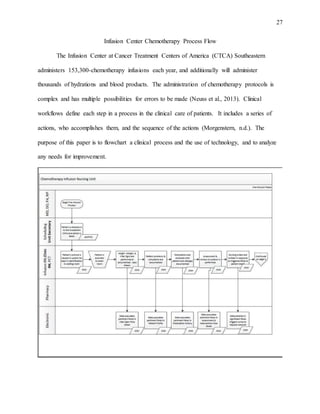
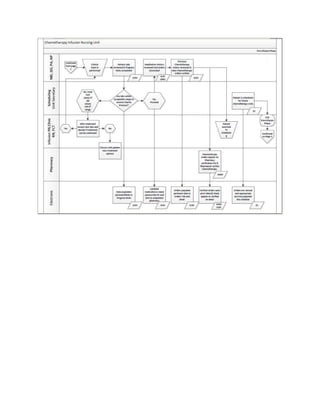
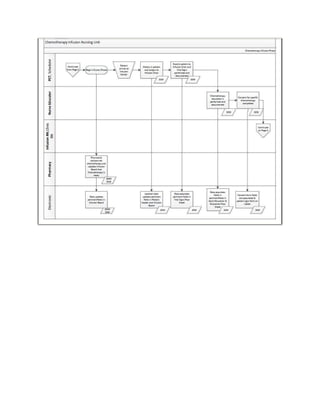
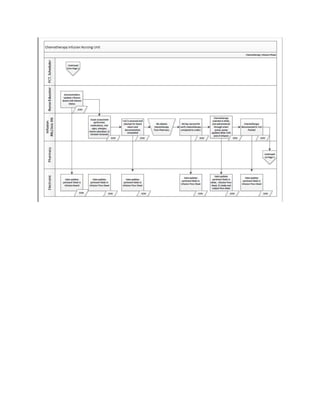
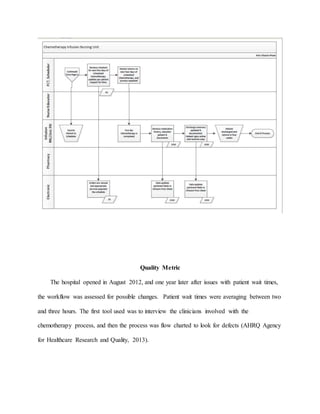
The pre-infusion process is displayed on pages one to two, and the infusion process on
pages three to five. Below is a list of acronyms for each of the Allscripts system abbreviations:
 AMPFM – Access Manager/Patient Financial Manager
 SCM – Sunrise Clinical Manager
 SMM – Sunrise Medication Manager
 ORM – Order Reconciliation Manager
 ES – Enterprise Scheduler
On page one, the patient arrives at the outpatient clinic, and the unit secretary checks the patient
in through AMPFM, and the patient’s picture is taken to help the clinicians identify the patient.
The picture becomes part of the patient’s record in SCM in the Clinical Summary page. The
clinic nurse is notified that the patient is ready, and the clinic nurse escorts the patient to a clinic
exam room. Everything that the patient needs done in the clinic is done from the clinic room.
The patient does not move from the room, the clinicians scheduled to see the patient go to the
clinic room. Height and weight are obtained, to have the correct information for the physician to
base the chemotherapy dosing. Vital signs, assessment and the blood draw are completed. This
information is documented in the nursing outpatient clinic note in SCM. When the blood is
drawn, the patient’s armband is scanned and matched to the physician’s orders. Collection
manager receives this information from SCM and prints off all of the lab labels. These labels are
applied in the room to prevent mislabeling of specimens. The nurse updates the patient’s
medication history in the medication profile in SCM. The updated medications will go into the
ORM module for reconciliation by the physician. The nurse will create any nursing orders that
may be needed. The lab results the specimens in Sunquest lab system, and this interfaces into
the results tab in SCM for the physician’s review. The nurse notifies the physician that the
patient is ready to be seen.
Pre-Infusion Physician Process
Page two in the process flow focuses around the physician’s visit with the patient. Prior to
going into the patient’s room, reviews the patient’s lab results to prepare for discussing treatment
options with the patient. If the patient’s Hemoglobin (Hb) ≤11 g/dL or ≥2 g/dL below baseline,
the patient may need a transfusion prior chemotherapy (NCCN Guidelines Version 2.2015 Panel
Members Cancer- and Chemotherapy-Induced Anemia [NCCN Panel], 2014). The flow chart
shows the decision point for no; and the chemotherapy cannot be given, and treatment for anemia
will begin. Or the decision is yes, because the labs show the patient values are within range, and
they can proceed with chemotherapy. The physician will open the progress note, and pull the
labs into the note and notate they have reviewed the labs with the patient. Next the physician
will open ORM through the progress note and review the medications with the patient. The
physician will reconcile the medications, and make any prescription changes needed ("TJC
Patient Safety," 2014). The physician will review the previous chemotherapy administered to the
patient in the treatment summary in SCM. Patient should receive the same chemotherapy dosing
unless there are changes in the patient’s condition. The physician will now order the
chemotherapy protocol for the patient. The nurse now escorts the patient to scheduling to review
the schedule for the week. Schedulers will review with the patient in ES, and the patient can
come anytime during the next day, and scheduler will make changes based on the patient’s
needs. The patient will now proceed to the infusion center.
Pharmacy Infusion Process
The pharmacy verification work list in SMM is populated with patient chemotherapy orders
in less than ten seconds from orders entered by physician in SCM. During the time that patient
is with the scheduler, pharmacy will be verifying the chemotherapy orders and begin the
compounding. On page three, pharmacy finishes compounding the medications and updates the
infusion board with the information that the medications are ready for the patient’s infusion.
Chemotherapy Nursing Infusion Unit Process
The patient arrives in the waiting area for the infusion center, and the patient care technician
(PCT) checks them in on the infusion board. The PCT escorts the patient to an infusion chair,
and the location is updated in the infusion board. It allows the nurses to know where the patient
is located. The PCT will also perform and document the patient’s vital signs in the Vital Signs
flow sheet in SCM. The PCT then notifies the nurse educator that the patient has arrived.
The nurse educator provides chemo specific education to the patient and updates the Adult
Education and Outcomes flow sheet. After any questions have been answered, the nurse
educator brings up the chemotherapy consent form, and the nurse and patient sign the consent.
By creating the documentation, the infusion board is updated with the education being
completed.
The infusion nurse introduces himself or herself to the patient, and the nursing infusion
assessment is completed (page 4). Vital signs, labs, education, and consent are reviewed in
SCM. The nurse accesses the vascular access device (VAD), and checks for blood return. The
data is documented in the infusion flow sheet. The nurse picks up the chemotherapy from
pharmacy and at the patient chair side has a second registered nurse check the chemotherapy
against the orders. The chemotherapy is setup on a smart pump, and each medication is scanned
into the eMar for SCM. It will document the time the infusion was started for each drug in the
eMar and infusion flow sheet. The chemotherapy infusion will complete, and the smart pump
updates the infusion end times onto the eMar and infusion flow sheet. The infusion nurse will
discontinue the chemotherapy and de-access the VAD.
On page five, the infusion nurse escorts the patient to scheduling to review the schedule for
the week, and schedule the future chemotherapy visits in ES. The patient returns each day for
their scheduled chemotherapy until the current orders are completed. The infusion nurse will
now review medications with the patient and completes a discharge summary in SCM. The
discharge summary is reviewed with the patient, and the patient signs the online discharge
summary. The discharge summary is then printed and given to the patient. Patient will return
home until the next cycle of chemotherapy.
Quality Measure Evaluation
Patient satisfaction was related to how long they had to wait in the waiting room prior to
moving to an infusion chair. The current metric was not clearly defined, and time points within
the electronic health record (EHR) were reviewed to create a more precise time periods. A goal
was created to decrease the wait time to 45 minutes. When reviewing the process flow, it was
discovered that not all the functionality of the infusion board was being used. One area that can
help create a more accurate tracking time is the patient’s location will be tracked in the infusion
board. It will create an objective data, and can be reported from the system. In the flow chart, I
would add an additional task for the scheduler to change the location of the patient to clinic
discharge so that it can create a start time for the wait time. The second-time point would be
when the infusion nurse opens the infusion flow sheet, and the location and time will be updated
in the infusion board. The infusion board can create alerts when changes are made in the board.
By setting an alert when the patient location changes, or education is done, the appropriate
clinician can receive a page making them aware that the patient is ready for their next step in the
process.
Summary
Workflow analysis is important because defects in the process can be viewed in the process
flow. The chemotherapy infusion process is one that defects could cause a decrease in revenue,
but more importantly a patient could be hurt (Morgenstern, n.d.). A review of the chemotherapy
infusion process was completed, and defects in the communication were found. The solution is
to increase the functionality of the infusion board technology to notify clinicians of each step.
The wait times can be reported on monthly to review if the solution is working.
References
AHRQ Agency for Healthcare Research and Quality. (2013). http://healthit.ahrq.gov/health-it-
tools-and-resources/
Morgenstern, D. (n.d.). Clinical workflow analysis - Process defect identification [PowerPoint
slides]. Retrieved from
http://mehi.masstech.org/sites/mehi/files/documents/CPOE_Clinical_Workflow_Analysis
.pdf
NCCN Guidelines Version 2.2015 Panel Members Cancer- and Chemotherapy-Induced Anemia.
(2014). Cancer -and chemotherapy - induced anemia. Retrieved from
http://www.nccn.org/professionals/physician_gls/pdf/anemia.pdf
National Patient Safety Goals Effective January 1, 2014. (2014). Retrieved from
http://www.jointcommission.org/assets/1/6/HAP_NPSG_Chapter_2014.pdf
Neuss, M. N., Polovich, M., McNiff, K., Esper, P., Gilmore, T. R., LeFebvre, K. B., Jacobson, J.
O. (2013, March). 2013 Updated American Society of Clinical Oncology/Oncology
Nursing Society Chemotherapy administration safety standards including standards for
the safe administration and management of oral chemotherapy [Supplemental material to
magazine]. Journal Of Oncology Practice, 5s-13s. doi: 10.1200/JOP.2013.000874
Identifying a Researchable Problem and Translating the Evidence Into Practice
Lori Dixon
Walden University
NURS - 6052 – Section 46
Essentials of Evidence-based Practice
November 9, 2014
39
Identifying a Researchable Problem and Translating the Evidence Into Practice
Taking care of patients is more than just performing a variety of tasks, but should be
based on the most relevant evidence available, and patient preferences (Schaffer, Sandau, &
Diedrick, 2012). Nurses who are conducting research should do a literature review to analyze
the existing knowledge available (Polit & Beck, 2012). On October 1, 2015 the United States
will convert to ICD-CM 10 and it will increase the requirements for documentation in the
electronic health record (EHR). To meet the new requirements, facilities not only will need to
change their coding of patient charts, but physicians will need to be educated on the increased
requirements in the clinical record (Nichols, 2014). The research question to be developed
involves; will clinical documentation quality improve if education is provided by at clinical
documentation improvement practitioner (CDIP), and what is the difference in case mix (CMI)
and Patient Safety Indicator (PSI) (Battelle, 2011) if a concurrent versus retroactive review is
done? A review of the literature for existing evidence will be completed and synthesized for
information related to the PICOT question. The purpose of this paper is to identify a
researchable problem, review the literature for existing evidence, develop the PICOT question,
and develop a strategy to implement an evidence-based practice change.
Summary of Improving Documentation
The Center for Medicare Services (CMS) has created a new regulation to use ICD-10
diagnosis and procedures codes starting October 2015. It will involve increased documentation
on progress notes by physicians to be reimbursed (Nichols, 2014). The premise of this change is
to better document outcomes for patients, be able to benchmark data between hospitals, and
improve care of patients. The reimbursement for care will be based on how well the patient chart
is coded and documented (Kealey & Howie, 2013). The clinical documentation improvement
practitioner (CDIP) nurse will monitor the documentation, and educate the physician on their
clinical documentation so that it accurately demonstrates the intensity of service and level of care
provided for the patient (Brown, 2013).
Identification and Significance of the Problem
Poor clinical documentation by physicians will result in less reimbursement and a
decrease in quality care. The physician documenting a diagnosis such as heart failure must be
specific to the type of heart failure. Is it systolic or diastolic? The documentation within the
chart must be supportive of the diagnosis. The physician also must document any comorbidity
that is affecting the length of stay. The difference between poor, incomplete documentation can
be as much as $4000.00 less per patient visit (Hines & Yu, 2009). If the data is not accurate, it
also will effect the reporting on core measures. The issue is insufficient documentation will
result in poor quality measures reporting and decreased financial reimbursement.
Analysis of Five Questions
It is important to define well-worded questions for research to be able to answer the
clinical question (Polit & Beck, 2012). Questions can be quantitative where the data will be
calculable or qualitative that compares the meaning of an issue. The PICOT acronym is five
factors that can be used to form a research question (Polit & Beck, 2012). When brainstorming
possible questions it is necessary to figure out background questions from foreground questions.
Background questions may addresses parts of the issue, but research can answer foreground
questions. Below are five questions that I brainstormed to identify my PICOT question.
1. Why has the case mix index decreased over the last six months?
2. Would a concurrent review versus retrospective review improve the documentation?
3. Is it the physician or coders’ responsibility to assign an appropriate diagnosis code?
4. Does the documentation in the patient chart provide the data necessary for quality
indicators?
5. Do the physicians need education on documentation in the patient’s chart? What is
the definition of appropriate documentation?
The issue is that the documentation is not supporting the quality indicators or financial
reimbursement. Each of the questions above is background questions, they each look at a piece
of the issue but would not be complete enough to answer the clinical question.
Feasibility
Once the problem is identified for research, the researcher must decide if it is feasible to
research the problem. The following areas must be reviewed, although they may not be
necessary for every research study; time, participant availability, cooperation of others,
equipment, facilities, money, and ability of the researcher (Polit & Beck, 2012). Facilities and
providers will be forced into the ICD-10 changes on October 1, 2015. To provide evidence-
based change in the facility, it is necessary to create a research plan that would take place over
six months. The facility is willing to cooperate with the research plan, and minimal funding will
be needed. Two units will be identified to be part of the study, one will be a control group that
will not have a CDIP assigned to the unit, and the other unit will have a CDIP to educate the
physicians. The participants will be the hospitalists that are assigned to each unit, and the units
selected each uses a different group of hospitalist (Polit & Beck, 2012). The researcher is a
certified CDIP, who has passed their certification exam through the American Health
Information Management Association (AHIMA) (American Health Information Management
Association [AHIMA], n.d.). The current electronic health record (EHR) will be used for the
chart reviews, and the facility will grant the researcher access to the EHR.
PICOT Question
The five variables for PICOT questions are population, intervention or issue, comparison,
outcome, and time (Riva, Malik, Burnie, Endicott, & Busse, 2012). The five variables for the
PICOT question are:
 P – The population that will be studied is the hospital inpatients. CMS has
defined this as the population that core measures will be reported, and payment is
based on DRGS.
 I – The issue of insufficient documentation will cause a decrease in
reimbursement, accurate quality reporting, and decline in patient care. When
documentation is vague, incomplete, or unreadable it prevents accurate
communication between the physician and nurse (Russo, 2012).
 C – The comparison of concurrent reviews versus retrospective reviews to prove
that by providing reviews during the patient’s hospitalization will improve the
patient’s care.
 O – These indicators; an increase in case mix index, increased complex
comorbidity, and patient safety indicator expected decrease versus observed,
measure the quality of documentation through these outcomes.
 T – The data for the outcomes will be reviewed after six months to measure if the
improvement through education has improved the outcomes.
The construction of the PICOT question provides a framework for the researchers as they
develop their plan for researching the issue. It is important to take time to develop the question
so that researchers and future readers of the findings will be able to understand the issue. The
selection of a specific population, issue, outcomes, and time frame will assist the researcher in
making sure the PICOT question, is an answerable question (Carman et al., 2013). The PICOT
question is: Education provided by a clinical documentation improvement practitioner (CDIP)
will improve clinical documentation quality as evidenced by an increase in case mix (CMI) and
Patient Safety Indicator (PSI) (Battelle, 2011) if a concurrent versus retroactive review is done.
Keywords
The evidence hierarchy has seven levels with the top level being the best evidence
available. The purpose of keywords is to find the best evidence research articles (Polit & Beck,
2012). The keywords selected to use for this search are patient safety indicator, CMS core
measures, clinical documentation, outcomes, patient outcomes, electronic health record, case mix
index, CDIP or CDIS, concurrent review, retrospective review. Each of these keywords, when
searched in the database, can map to subject headings that can expand the number of hits when
searching (Polit & Beck, 2012). Some of these words are also within the PICOT question and
are the significant ideas that will be searched.
Synthesis
The writer completed a review of five studies that were done related to quality of
documentation, clinical improvement documentation specialist, and case mix. The first study
reviewed is Patient safety strategies targets at diagnostic errors (McDonald, Matesic,
Contopoulos-loannidis, Lonhart, & Schmidt, 2013). The study is a systematic review, and the
authors identified 109 articles that met their criteria. The purpose of the study was to review
charts to see if the patient safety indicator (PSI) could be used to identify interventions that could
be used to correct missed or incorrect diagnosis. Through the review of the literature, they found
eleven interventions that could be used to diagnosis the patient more appropriately. A synthesis
of the data was difficult because of the various study designs in the literature. It was found that
this was a good basis to do further research on specific interventions (McDonald et al., 2013). It
is important to have an accurate diagnosis on the chart to provide care appropriate to the
diagnosis, and an incorrect diagnosis can be used in malpractice suits. The article applies to the
PICOT question the writer developed.
Michalak, (2011) conducted a review of medical records charting by physicians and
statistical forms to see if the International Classification of Disease (ICD) 10 were the same, and
if the documentation supported the diagnosis. He found there were a high level of being
complete, accuracy, and validity (Michalak, 2011). The study is important to verify that the
diagnosis is correct based on the documentation reviewed by a physician reviewer, but unlike the
previous study it does not directly support the writer’s PICOT question. It does speak to the
ability of the physicians to correctly document the patient diagnosis.
The next study, Validity of AHRQ patient safety indicators derived from ICD-10 hospital
discharge abstract data (chart review study) (Quan et al., 2013), combines the review of the PSI
and the quality of the documentation in the chart. The purpose of the study is to verify that the
PSI on the discharge abstract matches to the documentation in the record. It is the first study to
be done to validate the ICD-10 data. They were able to validate 5 out of 20 PSI, and the chart
documentation was used to validate. If the information was missing from the chart, the PSI was
not validated (Quan et al., 2013). The information in the study is important to the writer’s
PICOT question; because it shows improved documentation does validate the observed PSI to
the expected decrease in the PSI.
Stacy, Washington, Vuckovich, & Bhatia, (2014) created a study to review the effects of
implementing a new electronic health system (EHR), and clinical documentation improvement
specialist educating physician would improve the documentation. The improvement was
measured by an increase in the case mix index (CMI) (Stacy, et al, 2014). The writer’s PICOT
question is directly related to information in this study. The findings from the study showed an
insignificant increase in the CMI, but there is a dependence on the type of services that the
hospital provides to patients. The increase was from 1.65 to 1.68, which seems insignificant, but
makes a big difference in the amount of reimbursement (Stacy et al., 2014).
The last study, Improving and measuring inpatient documentation of medical care within
the MS_DRG system: Education, monitoring, and normalized case mix index (Rosenbaum et al.,
2014), reviewed the neurology service to see if by educating the physicians could they show an
improvement in documentation based on the case mix index (CMI). The physicians showed an
improvement in the documentation by working directly with the clinical documentation
improvement specialist (Rosenbaum et al., 2014). It directly supports the writer’s PICOT
question.
Additional research uncovered a recently published study, Improving physician clinical
documentation quality: Evaluating two self-efficacy-based training programs (Russo,
Fitzgerald, Fuchs, & Redmon, 2013) was reviewed. An education program was provided to
residents at an academic medical center. The results of the study showed that residents who
completed a structured education program had an increase in the quality of their documentation.
A video presentation, ICD-10 and Clinical Documentation (Nichols, 2014), developed by
Medscape with support from the Centers for Medicare & Medicaid Services reviews the
requirements of documentation once ICD-10 is implemented on October 1, 2015.
Review of Literature Finding and PICOT Question
The first three studies have findings that can be supportive to the writer’s research
question. They each speak to the quality of the medical record documentation. The last two
studies both have an experiment to review the quality of the record based on improved case mix
index (CMI). They review the CMI on charts prior to education of the physicians. Then they
use the clinical documentation improvement specialist to educate the physician on
documentation in the record that supports the diagnosis. Both of these studies can be used to
support the writer’s PICOT question. The video by Dr. Nichols provides the basis for the
facility to make the changes for ICD-10. Russo et al. (2014) recently published an article that
provides the educational content based on their research that can be used by the CDIP during the
research study.
Nursing Practice Supported By Evidence
Nurses are leaders in quality departments of hospitals and assist in education of quality
initiatives to all clinical staff. They have a role in the multidisciplinary team to influence quality
and safety issues (Richardson & Storr, 2010). Nurses have been involved as a case manager, and
physicians are accustomed to their review and questions. Rice Memorial Hospital published a
case study of the transition of case manager nurses to clinical documentation improvement
specialist (CDIS). The CDIS “reviewing an average house census of approximately 42 charts
each. Including six to ten admissions per day. Taking on the expanded role meant reviewing
every chart for present-on-admission (POA) conditions, admission and ongoing medical
necessity, and adherence to core measures for quality while also looking for documentation
improvement opportunities” (Hinderks, Vagle, & Wolf, 2014, p. 102).
The role of the clinical documentation improvement practitioner (CDIP) involves the use
of their clinical knowledge to review charts for the lack of documentation about the patient. The
CDIP reviews the chart concurrently to educate the patient, and make immediate changes. These
changes can make a difference in the case mix index (Stacy et al., 2014). The increase in the
case mix index creates better reimbursement for the facility to provide the appropriate amount of
care. The addition of a chronic diagnosis can increase the length of stay for a patient, the
appropriate documentation of that diagnosis will increase the reimbursement, and the hospital
has the resources for that patient to stay the additional days (Nichols, 2014). The CDIP
reviewing the chart will focus based on the diagnosis of the patient and check to see if all clinical
tests appropriate to facilitating the care are ordered on the chart. It also supports the medical
diagnosis of the patient (McDonald et al., 2013).
Clinical Documentation Improvement Affect On Outcomes
Quality documentation involves being specific about what is going on with the patient. It
means to specify where a wound is located, how does it appear, and does it have drainage. The
communication of this information to a multidisciplinary team allows that to treat a patient with
the interventions that will increase healing (Nichols, 2014). McDonald et al., (2013) found
eleven interventions that could be used by a CDIP to review the chart and assure a correct
medical diagnosis. The reviews of the interventions are related to patient safety indicators, and
the documentation could provide an increase in patient safety (McDonald et al., 2013). The
reverse is true when there is a lack of quality documentation. The CDIP role educates the
physician on specific issues on current patient’s charts, and the additional documentation
prevents a patient from being discharged too soon, or not getting treatment for any diagnosis that
are not charted. The case mix index and patient safety indicators can be tracked for each
physician, allowing the hospital to look for trends for physician education (Rosenbaum et al.,
2014). These can be tracked in the quality improvement program to make changes to care
practices.
Strategy For Implementing Clinical Documentation Improvement
The goal for healthcare organizations is to improve patient outcomes, and maximize
reimbursement for the care provided. The purpose of the researching the use of clinical
documentation improvement practitioners (CDIP) on one unit and having a control unit, is to be
able to demonstrate to the executive team, physicians, and nursing teams the effectiveness of the
CDIP program. A presentation of the evidence-based practice would be presented to key leaders
in the facility; the executive team, chief medical officers, and nursing leadership to receive
executive backing of the plan. It is important to have support from the top when implementing a
new quality improvement program (Larkin, 2012).
The next step would be to provide lunch and learns on each of the units in the hospital, and
invite the multidisciplinary team working on the unit to attend. An overview of the new
program, and the impact on patient outcomes would be presented. It is important during this
presentation to explain how this would change any current processes on the unit and answer any
questions from the staff. It is important to create a common vision between nursing and
physicians on complete and accurate charting on the front end will make a positive impact
patient care and reimbursement (Hinderks et al., 2014). Education will need to provide to all
physician groups that practice within the hospital. To help with gaining their support, education
can be provided at the hospital and at each physician practice. If the physicians understand that
this is to assist them in their practice, not take away from their time with patients, and be allowed
to provide feedback, they will participate in the program (Byrnes & Fifer, 2010). Most
opposition to change comes from not understanding the positive impact for the patient outcomes,
and feeling it is one more regulatory requirement. Byrnes and Fifer (2010) state, “projects that
improve quality, decrease complications, decrease mortality, and improve patient functional
status. Goals such as these will motivate physicians” (Byrnes & Fifer, 2010, p. 87). The clinical
documentation improvement program would work hand in hand with the financial department to
use predictive modeling further to create a case for making the change. ICD-9 data and claims
from the previous year can be used to show the level of impact that the CDIP can have on the
reimbursement. A review of the documentation associated with the claims would show the
deficiencies in the documentation further to support the case for implementation (Hinderks et al.,
2014).
The education of physicians and clinical staff communicates to them the change and
begins the process of implementation. During this time, the new CDIP will receive education
from the certified CDIP directing the program, and receive a boot camp on taking the
certification exam through AHIMA (Hinderks et al., 2014). The new department will work
together to create physician queries to address the most common medical diagnosis. Process
flows will be created to guide everyone though the new work processes. Physicians will be
reviewed for the most common diagnosis’s used by the physician, and for their baseline case mix
index. A monthly education program will be offered for the physicians at the medical executive
team meeting. The education will be modeled after the research done by Russo et al., (2014)
using physician champion examples of quality documentation by diagnosis (Russo et al., 2013).
The CDIP will report to their assigned units the first week of July 2015, and allow for the CDIP
and physicians to work collaboratively prior to the October 1, 2015 implementation of ICD-10.
Summary
The formation of an answerable research question will be effectual in finding an answer
to a clinical issue. The development of the research plan will depend on formatting a PICOT
question to provide a structure for searching for evidence-based practice articles (Riva et al.,
2012). A literature review was completed with a compilation of the information for data that
would support the writer’s PICOT question. Two of the five studies give direct support to the
question. Additional research resulted in finding an article on providing evidence-based
education, and it showed an increase in the quality of the documentation (Russo et al., 2013).
Based on this information, a research plan was created based on the PICOT question: Education
provided by a clinical documentation improvement practitioner (CDIP) will improve clinical
documentation quality as evidenced by an increase in case mix (CMI) and Patient Safety
Indicator (PSI) (Battelle, 2011) if a concurrent versus retroactive review is done. The research
plan will be implemented over a six-month-time period by the certified CDIP to test the
hypothesis. Based on the results, the facility can move on with the implementation of the CDIP
program, or make adjustments to increase the success of preparation for ICD-10 on October 1,
2015.
References
American Health Information Management Association. (n.d.). Certified documentation
improvement practitioner (CDIP®). Retrieved from http://www.ahima.org/
Battelle. (2011). Quality indicator user guide: Patient safety indicators (PSI) composite
measures V4.3. Retrieved from
http://qualityindicators.ahrq.gov/downloads/modules/psi/v43/composite_user_technical_s
pecification_psi_4.3.pdf
Brown, L. R. (2013). The secret life of a clinical documentation improvement specialist
[Supplemental material]. Nursing, 10-12. doi: 10.1097/01.NURSE.
0000426541.97687.87.
Byrnes, J., & Fifer, J. (2010). A guide to highly effective quality programs. Healthcare financial
Management, 81-87. Retrieved from hfma.org
Carman, M. J., Wolf, L. A., Henderson, D., Kamienski, M., Koziol-McLain, J., Manton, A., &
Moon, M. D. (2013). Developing your clinical question: The key to successful research.
Journal of Emergency Nursing, 39, 299-301. doi: 10.1016/j.jen.2013.01.011
Hinderks, J., Vagle, J., & Wolf, J. (2014). Preparing for the true risks of ICD-10. Healthcare
Financial Management, 98-102. Retrieved from hfm.org
Hines, P. A., & Yu, K. M. (2009). The changing reimbursement landscape: Nurses’ role in
quality and operational excellence. Nursing Economic$, 27, 7-14. Retrieved from
https://www.nursingeconomics.net/
Kealey, B., & Howie, A. (2013, November). ICD-10 is coming: An update on medical diagnosis
and inpatient procedure coding. Minnesota Medicine, 48-50. Retrieved from
www.minnesotamedicine.com/_
Larkin, H. (2012, November). Focus on the c-suite: listener-in-chief. Hospitals & Health
Networks, 32-36. Retrieved from www.hhnmag.com
McDonald, K. M., Matesic, B., Contopoulos-loannidis, D. G., Lonhart, J., & Schmidt, E. (2013).
Patient safety strategies targets at diagnostic errors [Supplemental material]. Annals of
Internal Medicine, 158(5), 381-389. doi: 10.7326/0003-4819-158-5-201303051-00004
Michalak, J. (2011). The quality of patients’ data in medical documentation and statistical forms.
Studies in logic, grammar and rhetoric, 25(38), 143–158. Retrieved from
http://journals.indexcopernicus.com
Nichols, J. C. (2014, November 15). ICD-10 and clinical documentation [Video file]. Retrieved
from http://www.medscape.org/
Polit, D. F., & Beck, C. T. (2012). Nursing Research Generating and assessing evidence for
nursing practice (9th ed.). Philadelphia, PA: Wolters Kluwer Lippincott Williams &
Wilkins.
Quan, H., Eastwood, C., Cunningham, C., Liu, M., Flemons, W., De Coster, C., & Ghali, W. A.
(2013). Validity of AHRQ patient safety indicators derived from ICD-10 hospital
discharge abstract data (chart review study). British Medical Journal Open, 3, 1-7. doi:
10.1136/bmjopen-2013-003716
Richardson, A., & Storr, J. (2010). Patient safety: a literature review on the impact of nursing
empowerment, leadership and collaboration. International Nursing Review, 57, 12-21.
Retrieved from http://www.icn.ch/
Riva, J. J., Malik, K. M., Burnie, S. J., Endicott, A. R., & Busse, J. W. (2012). What is your
research question? An introduction to the PICOT format for clinicians. Journal of the
Canadian Chiropractic Association, 56, 167-171. Retrieved from http://www.jcca-
online.org
Rosenbaum, B. P., Lorenz, R. R., Luther, R. B., Knowles-Ward, L., Kelly, D. L., & Weil, R. J.
(2014). Improving and measuring inpatient documentation of medical care within the
MS_DRG system: Education, monitoring, and normalized case mix index. Perspectives
in Health Information Management, 11, 1-11. doi: 10.1038/ncomms6006
Russo, R. (2012). Applying the principles of change management to documentation
improvement. Retrieved from http://higherhealthcare.com/
Russo, R., Fitzgerald, S. P., Fuchs, B. D., & Redmon, D. P. (2013). Improving physician clinical
documentation quality: Evaluating two elf-efficacy-based training programs. Health
Care Management Review, 38(1), 29-39. doi: 10.1097/HMR.0b013e31824c4c61
Schaffer, M. A., Sandau, K. E., & Diedrick, L. (2012). Evidence-based practice models for
organizational change: overview and practical applications. Journal of Advanced
Nursing, 69, 1197–1209. doi: 10.1111/j.1365-2648.2012.06122.x
Stacy, T. J., Washington, G., Vuckovich, P. K., & Bhatia, S. (2014). Impact of electronic health
record documentation and clinical documentation specialists on Case Mix Index: A
retrospective study for quality improvement. Journal Health & Medical Informatics,
5(2), 1-7. doi: 10.4172/2157.-7420.1000154
Planned Change in a Department
Lori Dixon
Walden University
Interprofessional Organization and Systems Leadership
NURS - 6053 - 18
October 5, 2014
55
Planned Change in a Department
To Err is Human: Building a safer health system reports that medication errors are
occurring frequently, even with technology in place to make medication administration safer
(Committee on quality of health care in America [IOM Committee], 1999). Nursing leaders
have a responsibility to lead changes within a department or across departments. The purpose of
this paper is to review the issue in a department, describe how to change practice to meet facility
mission, vision, values, and professional standards. Describe how to facilitate the change using a
change model, and the stakeholders who should be involved.
Problem in the Department
The patient had stopped the nurse before the chemotherapy was administered, to let the
nurse know that this was not the chemotherapy she should receive. A review was done based on
this episode for the number of chemotherapy errors in the last six months. Chemotherapy
administration involves intricate protocols with high-risk medications. The size of the error can
determine how harmful it could be to the patient. Even a small error could cause renal damage
(Vioral & Kennihan, 2012). The risk management department completed the review, and they
found an average of 30 chemotherapy errors per month. The errors were primarily wrong drug
and wrong dose.
Specific Change to Practice
The policy at the hospital stated that two nurses had to verify the “Five Rights” of
medication administration at the patient bedside. The American Society of Clinical Oncology
(ASCO) and Oncology Nurse Society (ONS) standards state “A practitioner who is
administering the chemotherapy confirms with the patient his/her planned treatment prior to each
cycle and at least two practitioners or personnel approved by the practice/institution to prepare or
administer chemotherapy, verify the accuracy of: drug name, drug dose, drug volume, rate of
administration, Expiration dates/times, if applicable; expiration date/time is not required if for
immediate use (Immediate use must be defined by intuitional policy, state, federal regulations,
eg, use within 2 h), and appearance and physical integrity of the drugs”(Neuss et al., 2013, p.
11s).
A review of the workflow showed that many times the nurses were busy, and they were not
physically reviewing the chemotherapy with another nurse against the orders. In passing they
would verbalize what chemotherapy they were going to administer or check it prior to the patient
arrival, and they were not verifying with the patient. All of the chemotherapies were delivered
by pharmacy in the “chemotherapy bucket” with all the protocol medications in the bucket. The
change that was implemented was the establishment of a new role for nursing, the chemotherapy
processor. To meet the standards for chemotherapy administration, it was decided one nurse
would be dedicate to verifying the chemotherapy with all other infusion nurses.
Two outcome measures were identified and put into place in December 2013. Because the
chemotherapy processor was a new role, it was decided that the number of near misses would be
recorded that were caught by the chemotherapy processor. This data would support the creation
of the new role. The second outcome was the number of chemotherapy errors per month, and the
objective would be to decrease to zero errors over a three-month-time frame.
Alignment with Mission, Vision, Values, and Professional Standards
The mission, vision, and values are summarized in the statement that the facility provides
“The Mother Standard of Care” (Cancer Treatment Centers of America website, n.d.). The
chemotherapy nurse understands that you would verify and administer the chemotherapy as if it
was your mother sitting in the infusion care. The ASCO/ONS chemotherapy standards will be
met by having the chemotherapy processor nurse be the second verifier with each nurse
administering the chemotherapy, and with the patient at the bedside (Neuss et al., 2013). Finally
the Nursing Code of Ethics Provision 3 states, “the nurse promotes, advocates for, and strives to
protect the health, safety, and rights of the patient” ("ANA Ethics," 2010, provision 3). The
chemotherapy processor nurse and infusion nurse by following the standards will be protecting
the health and safety of the patient.
Change Model and the Steps to Facilitate Change in the Department
The hospital decided a change was needed, and a project team was assembled. The team
followed the Stages of Change Model, which is an adaptation of the Lewin's three-step change
process. There are five steps in the change model; precontemplation, contemplation, preparation,
action, and maintenance (Marquis & Huston, 2012). Precontemplation is the stage when there is
no current intention to make a change, until the patient identified the error about to be made in
administering the chemotherapy; there was no change contemplated. In the next stage project
team decided to review the errors and contemplated if there was a practice change needed, or
was it a discipline issue. Even if individual nurses were disciplined, the team decided there still
could be issues because of the busy unit they were on. The third stage is the preparation, and the
team developed a plan for making a change. It included creating the new role of the
chemotherapy processor. Education was given to the current nursing staff on how the new role
of the chemotherapy processor would work with them. The nurse manager got approval to a
chemotherapy nurse for the role of the chemotherapy processor, and nurse was hired. It
completed the action stage. The maintenance stage is the actions taken to prevent a relapse into
having chemotherapy errors.
The project team set up two outcomes to measure the change. First were the number of
near misses caught by the chemotherapy processor and the number of errors each month. This
change model was chosen, because it breaks the process of change into manageable steps. It also
gives time to make a planned change, and for the stakeholders to get used to the idea of change
(Marquis & Huston, 2012).
Stakeholders Needed for Initiating and Managing Change
The project team was made up of a multidisciplinary team. The process of chemotherapy
treatment involves the following disciplines; medical oncologist, pharmacist, infusion nurse, and
education nurse. In the ASCO/ONS chemotherapy standards each of these disciplines has a
specific responsibility to perform (Neuss et al., 2013), and the decision was made to include a
representative from each area. The director of clinical informatics had reported the data to
administration and was made the facilitator of the group. The director of quality and risk
management rounded out the team since they are responsible for quality and safety standards.
The facilitator leading this effort needed to be able to work with all of the stakeholders
from each department and to be objective about each departments input into the project.
Communication skills are critical to the success of the group. The leader must be able to
communicate the mission, vision, and values to the team members so they understand how the
goals of the project will meet each of them. The leader also needs to communicate the progress
of the team and the results throughout the organization (Marquis & Huston, 2012). The leader
uses their communication skills to facilitate the participation of all team members.
Summary
A patient knowledgeable about their chemotherapy protocol stopped the nurse from
making a medication error that could have created harm to the patient. It instigated a review of
the chemotherapy errors made over the last six months, which average 30 errors per month. The
hospital initiated a project team using the model, Stages of Change, to acknowledge the need to
change, plan for the change, take action to make the change, and to audit to maintain the change
(Marquis & Huston, 2012). The result was the creation of a new nursing role, chemotherapy
processor, and the decrease of chemotherapy errors to zero in three months.
References
Committee on quality of health care in America. (1999). To err is human: Building a safer health
system [Issue brief]. Retrieved from Institute of Medicine website: http://www.iom.edu
Cancer Treatment Centers of America website. (n.d.). http://www.cancercenter.com
Code of Ethics for Nurses. (2010). Retrieved September 21, 2014, from
http://www.nursingworld.org
Marquis, B. I., & Huston, C. J. (2012). Leadership Roles and Management Functions in Nursing
(7th ed.). Philadelphia, PA: Wolters Kluwer Lippincott Williams & Wilkins.
Neuss, M. N., Polovich, M., McNiff, K., Espir, P., Gilmore, T. R., LeFebvre, K. B., ... Jacobson,
J. O. (2013, March). 2013 Updated American Society of Clinical Oncology/Oncology
Nursing Society Chemotherapy Administration Safety Standards including standards for
the safe administration and management of oral chemotherapy. JOURNAL OF
ONCOLOGY PRACTICE, 9(2s), 5s-13s. doi: 10.1200/JOP.2013.000874
Vioral, A. N., & Kennihan, H. K. (2012, December). Implementation of the American Society of
Clinical Oncology and Oncology Nursing Society Chemotherapy Safety Standards: A
multidisciplinary approach. Clinical Journal of Oncology Nursing, 16, E226-E230. doi:
10.1188/12.CJON.E226-E230
Design Considerations and Workarounds
Lori Dixon
Walden University
Informatics in Nursing and Healthcare
NURS - 6401 - 3
January 11, 2015
62
Design Considerations and Workarounds
In 1999, the Institute of Medicine (IOM) released recommendations for patient safety and
estimating that there are over 7000 patient deaths per year from medication errors (Richardson,
Bromirski, & Hayden, 2012). One response to preventing these errors is the use of bar-coding
medication administration. The ordering, filling, and administration of medications are a
complex multi-disciplinary process, and the process can result in medication errors. The use of
technology could add extra complexity if not implemented correctly. Burke-Bebee, Wilson and
Buckley (2012) asked the question “They May Come But Will They Use It” (Burke-Bebee,
Wilson, & Buckley, 2012, p. 547). Implementing the use of new technology such as bar-coding
medication administration could also be affected by the use of clinicians. The study was done on
implementing technology to assure patients took their patients at home, but the issue became the
clinical staff did not adopt the new technology. Lessons from this study show that engaging staff
and ongoing education of imperative to the implementation of new technology (Burke-Bebee et
al., 2012). It is the same issue that can happen with bar-coding medication administration
(BCMA) design and implementation. The purpose of this paper is to review design
considerations to improve patient safety, what workarounds may be used by staff and should
those workarounds be mitigated.
Part I: Design Considerations
It is important for the nurse informaticist (NI) when considering a new system, to
consider if the design meets the business needs of the end user (Coronel, Morris, & Rob, 2013).
There should be a balance between hardware, software, and human factors during the design and
the implementation of a BCMA system to be successful. One of the ways to assure a correct
choice of systems is to have a demonstration to the clinical end users as part of the selection
process (Laureate Education, 2012h). Clinical end users need to understand the IOM report and
why BCMA is important. The nurse informaticist educates the clinical end users to the benefits
of using a bar-coding medication administration system and how it can impact patient safety.
Clinical end users, who understand the rationale behind implementing a new technology such as
BCMA, will have a better understanding when making decision about design and
implementation.
Hardware Factors
The appropriate hardware can make or break an implementation of bar-coding medication
administration (BCMA). The nurse informaticist (NI) should work with the clinical staff and
do an analysis of the workflow and how various hardware devices will work in the environment
(Richardson et al., 2012). For example, a previous facility the information system department
chose a bar code scanner that had a cord on it without any input gathered from the end users. It
was tethered to the computer that had the software application on it. The problem with this was
that the nurse had difficulty reaching the patient to scan the armband due to all of the equipment
in the room and around the patient. The tethered scanners were replaced with a Bluetooth
scanner that provided the nurse freedom to move around the room and reach the patient.
Another factor contributing to the success of the implementation is the armband with the barcode
displayed on it. Testing by the NI and the end users needs to take place prior to implementation.
Because it will assure that the printer used to print the armbands, prints the barcode correctly and
the scanner can scan it without any issues (Richardson et al., 2012). Additionally the armband
printer should be unavailable to nursing, or they may print an extra armband. Each of these
hardware factors can impact patient safety. Because staff bypass scanning of the armband or
even the medication and potentially causes a patient medication error. Nurses become frustrated
trying to follow the guidelines, when the hardware issues make it awkward to follow the process.
Software Factors
The Joint Commission National Patient Safety Goals (JCNPSG) were published
originally in 2010, and updated in 2014 (The Joint Commission, 2014). Nursing informaticist
should explicitly use these goals when evaluating BCMA software. The first objective is to
improve the accuracy of patient identification, and prevent wrong patient errors in all areas of
treatment. “Acceptable identifiers may be the individual’s name, an assigned identification
number, telephone number, or other person-specific identifier” (The Joint Commission, 2014, p.
1). The second goal is to reduce harm associated with clinical decision support alerts. “Clinical
alarm systems are intended to alert caregivers of potential patient problems, but if they are not
properly managed, they can compromise patient safety” (The Joint Commission, 2014, p. 7).
The NI should work with clinical staff to determine selection criteria for selecting the software.
One criterion should be that the patient armband is scanned and that it will include at least two
patient identifiers to meet the JCNPSG Goal 1. A second criterion is that the alerts generated
when scanning the medication orders should be configurable based on JCNPSG Goal 6.
Otherwise, this configuration, can lead to workarounds that will have to be addressed (The Joint
Commission, 2014). Software applications may have two types of medication administration
records. Education of the staff is necessary to know when to use the electronic medication
administration record (eMAR) and a BCMA medication administration record (BCMA MAR).
The BCMA MAR should be configurable to view drugs based on the shifts worked by the
nursing staff, allowing the ability to look back or forward for medications on the schedule
(Grissinger & Mandrack, 2011). The inability of staff, to view the drugs that were administered
or are due in the future could result in missed doses of medications.
Human Factors
For a successful implementation, clinical staff using the new system should be involved in
all phases of the process from selection of a system to the testing of the system (Saba &
McCormick, 2011). The NI should have good change management skills to work with the
clinical staff and to increase the adoption rate of the new system. The NI can use
transformational leadership skills to focus staff on the vision and to assist the staff in ownership
of the new process (Glenn, 2010). Process flows of the current and future state created by the
NI, are used by the staff to follow during the implementation (Richardson et al., 2012).
Informatics Response to Insure Patient Safety and Quality
The implementation of a new software system should the System Life Cycle which
includes; initiate, analyze, design, implement, support continuous improvement (Saba &
McCormick, 2011). During the implementation phase, the NI must focus on two areas to insure
patient safety and quality. The first area, the NI focuses on is testing of the system prior to the
go live date for the system. During unit testing, the NI uses their clinical expertise to write test
scripts with the end users. During testing, the end users follow normal workflow process to
validate the utilization of the system for a typical day. Issues found during testing can be logged
and corrected prior to implementation. The facility should setup a testing area, could be a
training room, which has the same hardware laptop and scanner that the nurse will use at the
bedside. The use of a virtual environment will allow the NI to find software and hardware issues
that could impact patient safety and have them corrected (Saba & McCormick, 2011).
Pharmacist, physicians, and nursing should be involved to evaluate the use of alerts in the
system. To follow the Joint Commission National Safety Goal 6, each of these disciplines
should be involved in the implementation committee. During the implementation, the committee
evaluates the alerts to assure they are appropriate, and not causing any clinician to bypass alerts
(The Joint Commission, 2014).
The second area which the NI can make a difference is in the education of clinical staff
prior to implementation (Richardson et al., 2012). Support from senior nursing leadership should
allow the nursing staff to have adequate time for training. Training can be setup in a training
room with a virtual environment, training patient armbands, and medications with bar codes
available for the nurse to practice. They can be given time to walk through BCMA as many
often as necessary to obtain a comfort level. The NI that will understand the process, and
functionality of using the new system should train super users. A quality evaluation matrix
should be created to identify improvement to the medication administration by using BCMA. It
also should identify defects for the design team to correct in the system (Richardson et al., 2012).
Each of these measures can prevent patient safety issues, and measure quality based on using the
system.
Part II: Employee Workarounds
Employees create workarounds in every area of business including healthcare. Even
when the NI addresses hardware, software, and human factors during the design stage, humans
seem to find a way to use information systems or not use them by finding workarounds.
Benefits and Consequences of Workarounds
The advantages of workarounds are that it’s hard to foresee every situation that a nurse
may encounter administrating medications. For example, the patient is coding on the floor and
saving the patient’s life drugs are administered under a physician’s direct order in the room.
There is not time for the order to be placed in the system, verified by pharmacy, and then
scanned by the nurse. Nurses remove the medications from a crash cart during a code. It should
be the exception and not the rule because workarounds can cause inefficiencies and patient safety
issues. For example, nurses may pour medications ahead of time, and print a patient armband to
keep near the automated dispensing device. They will scan the medication, and it appears as if it
was given on time. The nurse following this situation, may not be aware that the drug was given
two hours late, and administering the patient’s next dose may create an overdose situation (Saba
& McCormick, 2011). The scanning of the patient’s armband is to assure that the right patient is
receiving the right dose. When a nurse types in the patient’s identification number into the
system to bypass scanning the patient’s armband is in violation of the Joint Commission National
Patient Safety goal I (The Joint Commission, 2014).
Mitigating Workarounds or Not
The norm should be to not mitigate workarounds. The NI should make regular rounds on
the nursing floors to review for possible workarounds. It is not always the nurse who creates the
workaround out of laziness; there are times when scanners break, and it is not reported causing
the nurse to find a workaround. Or it may be there is a patient situation, such as a code that
forces the nurse to create a workaround. But overall using BCMA correctly has been found to
decrease medication errors by 54%. Creating workarounds causes medication administration
errors by overriding of alerts (Saba & McCormick, 2011). The PACU nurse was waiting the
patient to return from a late surgery, she anticipated that the patient would come back and
prepared the epidural pain medication order. She pulled the medicine from the automated
dispensing unit and hung the drug. When the patient arrived, she connected the medication to
the patient; the only thing not done was starting the drug. The patient was moved quickly to the
surgical floor, and the floor nurse asked if the PACU nurse had scanned the epidural prior to
hanging the drug, and the response was “no”. The floor nurse scanned the medication and found
that intravenous patient control analgesia bag was attached instead of an epidural bag. The
scanning of the medication prevented a medication error for the patient.
Summary
The use of BCMA will assist nursing in the prevention of medication errors and to meet
the Joint Commission National Patient Safety Goals. The NI functions to help in the selection of
the appropriate hardware, software, and foresees any human factors during the implementation.
To assure patient safety and quality, the NI can setup quality evaluations to show improvement
in medication administration errors and to also find areas that the system may need refining. The
use of BCMA should involve continuous quality initiatives to review for workarounds, and
prevent medication risks to the patient.
References
Burke-Bebee, S., Wilson, M., & Buckley, K. M. (2012). Building health information technology
capacity: They May Come But Will They Use It? Computers, Informatics, Nursing,
30(10), 547-553. doi: 10.1097/NXN.0b013e318261fc3a
Coronel, C., Morris, S., & Rob, P. (2013). Database systems: design, implementation, and
management Entity Relationship (ER) Modeling (pp. 114-160). Boston, MA: Course
Technology/Cengage Learning.
Glenn, L. (2010). Implementing change. Journal of Community Nursing, 24(5), 10-14.
Grissinger, M. C., & Mandrack, M. (2011). In G. Latimer (Ed.), Essentials of nursing
informatics (5th ed., pp. 341-372). New York, NY: McGraw-Hill Professional.
Laureate Education, I. (Producer). (2012h). Selecting New Technologies.
Richardson, B., Bromirski, B., & Hayden, A. (2012). Implementing a Safe and Reliable Process
for Medication Administration. Clinical Nurse Specialist, 169-176. doi:
10.1097/NUR.0b013e3182503fbe
Saba, V. K., & McCormick, K. A. (2011) Essentials of Nursing Informatics (5th ed., pp. 341-
372). New York, NY: McGraw-Hill Professional.
The Joint Commission. (2014). National Patient Safety Goals Effective January 1, 2014 (pp. 1-
17). Online: The Joint Commission.
Team A
Walden University
NURS 6411, Section 3, Information & Knowledge Management
February 8, 2015
Team A Database Project
The customer’s needs, wants, and desires must be carefully balanced to provide a product
that functions optimally for the end user. According to Slavin (2014); the group is the sum of its
members, and individual achievements should result in the accomplishment of the group goal.
Individuals working as a team, a database was created to answer the clinical question: For
patients over the age of 65, what is the admitting diagnosis and have there been recurrent
admissions. The purpose of this paper is to outline the members of the team, describe the team’s
collaboration plans, explain the inputs and outputs of the database, and depict the process of
constructing a database using Microsoft Access to answer the team’s clinical question.
Team A Identification
Team A members include; Ashley Allen, Johnette Amado, Candace Austin, Sasha
Boateng, Cris Carpenter, Raquel Collimore-Fenton, Crystal Cooper, Sha Toya Derrickson, Lori
Dixon, Stephina Fearon, Nancy Ferrell, Susan Hadaway, and Brittney Hampton.
Team Vision
Our vision as a team is to maximize our full potential to achieve our targeted goals and
to prove our success by attaining 95% or higher on all projects.
Communication: Processes and Expectations
The accuracy and interpretation of a message are affected by the mode of communication
(Marquis & Huston, 2012). Our team’s initial communication was facilitated through email, the
Blackboard forum, and conference calling. During our first conference call, members mentioned
the difficulty of using the Blackboard forums. For this reason, a consensus to use email was
reached and finished documents are to be uploaded to the Blackboard file exchange. Conference
calls and the use of Survey Monkey are scheduled as deemed appropriate by our facilitator. All
group members are to notify the group if they unable to complete assignments in a timely
manner.
Roles and Responsibilities
Determining roles and responsibilities in relation to the creation of a database is
fundamental to its success (Coronel, & Morris, 2015). For this project, the thirteen members of
Team A have chosen to use a volunteer system to determine roles within the group. By use of a
conference call, email collaboration, and other modes of communication; roles were established.
Additionally; it was decided that each member has the responsibility to keep informed of
activities, what is due, when it is due, and what part they play.
Susan has volunteered for the role of editor for the team as well as presenter of the final
product. The group has elected Lori as leader. She will oversee the project, which includes
monitoring of member’s participation level, conflict resolution process, and collaboration efforts.
Subsequent members will continue to volunteer as expected to fulfill all of the needs of the group
as appropriate.
Conflict Resolution
When individuals with different personalities, opinions, and work ethic join to form a
group, conflicts can arise. According to sagepub.com (n.d.), creating solutions to conflict
involves members being respectful, having open communication, and developing alternative
methods to resolve conflict. The group has agreed that the first step to solve arising conflict is to
communicate personally with the individual. The importance of determining the problem (e.g.
busy work schedule, family matters, or personal health) is beneficial before escalating concerns.
If personal lack of participation continues, the group facilitator will attempt to resolve the
conflict and determine the next step for resolution. According to Iglesias & Vallejo (2012), a
student’s first line of conflict resolution should be a collaborative effort from all members of the
group, followed by the development of alternative methods of conflict resolution. The group has
agreed that all suggestions will be acknowledged and voted on by survey as a method of decision
making for ideas and topics.
Participation Expectations
All team members are expected to contribute to their best ability and availability. Any
issues that may arise may be taken up with Lori, the team leader, prior to any further action. In
addition; as communication is key, team members are encouraged to use their best professional
etiquette when utilizing any form of communication among team members and classmates.
Determination of Clinical Question
The team’s next step is to design a database. However; before this can be done, it is
necessary to develop an output or clinical question. According to Dennis, Wixom, & Roth
(2012, p. 347), determining the output prior to establishing inputs is essential to database design.
The output is inherent to the input, the most visible part of any system, and the prime reason for
utilizing an information system; which is to retrieve the information it produces. With team
collaboration through the use of Survey Monkey and a conference call, the clinical question will
focus on the admitting diagnosis for patients 65 and over and recurrent admissions.
Clinical Question and Data Elements
The clinical question determined by Team A is: For patients over the age of 65, what is
their admitting diagnosis, and have they had recurrent admissions. Appropriate tables and fields
are determined prior to creating the database to answer this question. The team’s database
consists of four tables:
 Patient Information
o Fields: P_MEDREC (Primary Key), P_ADMITDATE, P_DOB,
P_PRIMARY_ADM_DX, P_MED, P_ALLERGIES, P_PRIOR_ADM,
P_PROCEDURES, CUS_ACT (Foreign Key)
 Primary Admitting Diagnosis
o Fields: CUS_ACT (Primary Key), P_PRIMARY_ADM_DX, ICD_9,
P_ADMITDATE
 Past Medical History
o Fields: P_MEDREC, P_PAST_MEDICAL_DX, P_MED_ICD-9, P-
DX_ONSET_DATE, P_PRIOR_ADM, P_PRIOR_ADM_DX
 Medications
o P_MEDREC, P_MED_NAME, P_MED_ROUTE, P_MED_DOSAGE,
P_MED_FREQ, P_MED_START_DATE
The primary key for the PATIENT INFORMATION table is the medical record number
because the primary key should uniquely identify the attributes within each row of the table. The
medical record number fits the primary key criteria as it is permanently and uniquely assigned to
the each patient. The foreign key is the customer account number and is linked to the
PRIMARY ADMITTING DIAGNOSIS table. This is because the customer account number is
assigned to each episode of care. It is the primary key in the PRIMARY ADMITTING
DIAGNOSIS table to uniquely identify each episode of care (Coronel & Morris, 2015). By
creating each of these tables and linking them based on medical record number and customer
account number, permits queries to answer the clinical question.
Developing Elements of the Database
Compiling a list of data for the database is the beginning of design and enables the
determination of data significance (Datanamic.com, n.d., para 3). According to Datanamic.com,
it is important to think about overall information needs and not just the tables and columns.
Furthermore, Roberts & Sewell (2011) state that each line of the table must contain data
pertinent to that particular individual. When designed correctly, each line should have the ability
to be extracted from the database and analyzed independently. The elements created are simple
for the personal health record database, and the group experienced no problems during the design
or inputting of information. The creation of a clear, concise, and adequate database is the goal of
team A.
Database Security
Database protection entails ensuring that the database and the data it contains are secure
and safeguarding that its data is available and useable (Cox & Lambert, 2013, p. 330). There are
three goals for data security; confidentiality, integrity, and availability. Confidentiality deals
with protection against unauthorized access (Coronel & Morris, 2015, p. 691-692). Integrity
refers to keeping data consistent and free of errors. Availability indicates the accessibility of
data whenever required by authorized users for allowed purposes. Determining the level of
security is based on the perceived value the data and system (Dennis, Wixom, & Roth, 2012).
For team A’s database, the creators provided protection by the creation of a password.
Assigning a password will automatically encrypt the database each time it is closed, making data
unreadable (Cox & Lambert, 2013, p. 331). Using the password when accessing, the database
will decrypt and render the data legible. Additionally, encrypted files work well with shared
networks.
A symmetric encryption algorithm uses the same key or password to encrypt, as well as,
decrypt a message (Dennis, Wixom, & Roth, 2012). Database protection is continually
improving; however, security is an increasing problem requiring constant diligence and
management.
Desired Outputs of the Database
The next step, to creating the team’s database, is to determine the desired outputs. The
outputs must provide some correlation between the age group of patients over the age of 65,
along with their diagnosis and recurrent admission. Upon running queries, forms, and reports in
the database between Patient’s Admission Diagnosis and Admission Dates; it was discovered
that many patients are readmitted for the same chronic conditions. According to Xian-Ming &
Qing-Long (2014, p. 226), desired dynamic output feedback controllers (DOFCs) are challenging
to design. However; DOFCs are presumed to be a known priority, limiting the application’s
range of obtained results. It is just as important to recognize the inputs to receive the desired
outputs of a database. Deciding the primary and candidate keys in this database directly relate to
the desired output of the database. The relationship between the common diagnosis and
recurrent admissions offers information for an organization to utilize in creating a plan of action
to evaluate for this population. Organization of data is necessary to find relationships to create
effects and solutions of principal records.
Inputs Needed to Reach Outputs
In order for data to be processed, there must be consistent input and output. Input refers
to the mechanism by which the entry of data is placed into a system. While outputs are the
reports generated by the system. According to Dennis, Wixom, & Roth (2012, p. 347), outputs
are possibly the most noticeable part of any system, as the primary reason for using an
information system is the information it produces. In order to generate meaningful information,
inputs include patient information; such as patients’ name, age, medical record number,
admission date, readmission date, and admission diagnosis. Once data is seeded into fields, and
primary keys are assigned, the desired outputs can then be created.
Integrity of Data and Data Output
Data integrity is the most significant part of determining the success of a database
(Hallman, Stahl, & Ahmadoy, 2011). The primary goal, when creating a database, is to decrease
the risk of redundancy. Key integrity is an important factor to the accuracy of the data and
reduction of repeating groups (Coronel & Morris, 2015). Each table in the database has a
primary key and is void of null values. No redundancies and no null values are design rules to
follow for the successful creation of databases. Team A’s database will determine admissions
and readmissions of individual patients by their medical record number, a primary key. A well
designed and maintained database (Hallman, Stahl, & Ahmadoy, 2011. p. 24) are the two most
significant components needed to ensure the integrity of the database and the output of data.
Successes and Failures
Virtual teams working on projects face numerous challenges. However; with careful
planning and clear goal setting, virtual projects can be successful (Marquis & Houston, 2012).
One of the most common challenges of virtual teams is building and cultivating trust amongst
the team members (Marquis & Houston, 2012). Communication is a key factor in virtual work
groups (Marquis & Houston, 2012). The use of conference calls, web meetings, and email was
found to be both a challenge and success. Finding a meeting time that was agreeable to all was a
challenge. However, the use of conference calls in conjunction with web session meetings
proved to be remarkably successful. Email was found to be popular, as group communication
was enhanced, and assignments were completed in a timely manner.
The group quickly agreed upon a clinical question. The largest challenge noted while
designing the database was going beyond the requirements of the assignment. Member’s clinical
knowledge of the anticipated database functionality desired by end users and the construction of
realistic patient information, slightly impeded the group’s concentration on basic database
design. Design techniques such as relationships, primary and foreign keys, and queries.
Eventually, the database was successfully placed in the Blackboard file exchange. The exchange
allowed group members to download and test the database and run queries, and then deliver
feedback to the group. Overall this virtual group project encountered minor challenges and was
a positive learning experience for all participants.
What Would We Do Differently
If given the opportunity to create a database to answer an agreed upon clinical question
within a group setting was presented in the future, Team A has a few suggested changes. First, a
smaller group size would diminish issues associated with communication and time coordination
across many different time zones. Second, the breaking up of the paper’s sections into smaller
portions would make assignments more manageable. In particular, the sections for part three of
the assignment were substantial. For students who have not been exposed to queries, primary
keys, and foreign keys; smaller individual tasks would allow database design concepts to be
easily understood by all.
Another element of the group dynamics that could be changed is to incorporation
additional conference calls and Webex calls. This type of conferencing grants team members the
ability to simultaneously visualize the database and its corresponding attributes, allowing hands-
on participation.
Conclusion
Team A’s vision to use collaborative efforts to complete the assigned project successfully
has lead members to agree on communication strategies, responsibilities, conflict solutions, and
contribution expectations. As the project has unfolded, Team A has joined forces through
emails, texts, the file exchange, conference calls, and the discussion forum to determine the
clinical question, define fields, stipulate the type of fields, and form tables. The importance of
determining the expected output before building the database was established. A password was
agreed upon to assure data protection. Each team member participated, provided input into the
design, and delivered data to be entered into the database.
Team A consists of eleven valuable members. According to omp.gov (2014), building a
collaborative team environment is essential for delivering successful results. The team
environment was created through careful and considerate technology assisted communication.
Through Google and Microsoft tools; team members formed database table relationships,
established necessary security requirements, and ran queries to check the validity of data. While
cooperating in these endeavors, the clinical question was continually in members forethoughts.
This paper finalizes the concepts developed over the last ten weeks of Information and
Knowledge Management coursework.
References
Coronel, C., & Morris, S. (2015). Database systems: Design, implementation, and management.
Stamford, CT: Cengage Learning.
Cox, J., & Lambert, J. (2013). Step by step: Microsoft Access 2013. Richland, WA: Microsoft
Press.
Datanamic. (n.d.). Introduction to database design. Retrieved from
http://www.datanamic.com/support/lt-dez005-introduction-db-modeling.html.
Dennis, A., Wixom, B. H., & Roth, R. M. (2012). Systems analysis and design (5th ed.).
Hoboken, NJ: Wiley.
Hallman, S., Stahl, A., & Ahmadoy, V. (2011). The causes, security issues, and preventive
actions associated with data integrity. Communications of the International Information
Management Association, 11(2), 17-26.
http://scholarworks.lib.csusb.edu/ciima/vol11/iss1/2.
Iglesias, M., & Vallejo, R. (2012). Conflict resolution styles in the nursing profession.
Contemporary Nursing, 43(1), 73-80. doi: 10.5172/conu.2012.43.1.73.
Marquis, B. L., & Huston, C. J. (2012). Leadership roles and management functions in nursing:
Theory and application (custom ed.). Philadelphia, PA: Lippincott, Williams & Wilkins.
Roberts, A. L., & Sewell, J. P. (2011). Data aggregation: A case study. CIN: Computers,
Informatics, Nursing, 29(1), 3–7. doi:10.1097/NCN.0b013e3181fb5c0c.
Sagepub.com. (n.d.). Managing Conflict. Retrieved from http://www.sagepub.com/upm-
data/54195_Chapter_7.pdf.
Slavin, R. E. (2014). Cooperative Learning and Academic Achievement: Why Does Groupwork
Work? Retrieved from http://www.redalyc.org/pdf/167/16731690002.pdf.
U.S. Office of Personal Management (opm.gov). (2014). Diversity & inclusion. Retrieved from
http://www.opm.gov/policy-data-oversight/diversity-and-inclusion/
Xian-Ming, Z. &.-L. (2014). Event-triggered dynamic output feedback control for networked
control system. Institution of Engineering and Technology (IET) Control Theory &
Applications, 8(4), 226-234. doi: 10.1049/iet-cta.2013.0253.
Part I Gap Analysis Plan and Visio Draft
Lori Dixon
Walden University
Supporting Workflow in Healthcare Systems
NURS 6421
April 5, 2015
83
Part I Gap Analysis Plan and Visio Draft
Technology implemented with suitable workflows has the potential to improve patient care and
enhance patient safety. The American Recovery and Reinvestment Act (ARRA) provides
financial incentives for implementing electronic health records (EHR) based on the level of
meaningful use attained (Hammel-Jones, 2012). The physician practice’s specialty is infectious
disease. There were 906 encounters between January 1, 2015 to March 28, 2015 and 369
patients had a SnoMed diagnosis of 86406008: Human immunodeficiency virus infection (HIV)
or 41% of the patients (Patient Count By Diagnosis, 2015). The bi-directional interface between
the EHR and laboratory systems in improves the timeliness of treatment response for HIV
patients (Bell et al., 2012). The purpose of this discussion is to analyze a workflow issue related
to a meaningful use measure, develop a gap analysis plan, and describe a plan to establish
baseline data.
Workflow Issue and Meaningful Use
EHR’s that are implemented without an assessment of workflow practices can create an
increase in patient safety issues (Hammel-Jones, 2012). The physician practice started the
implementation of AthenaHealth electronic medical record (EMR) in September 2014 and went
live on December 31, 2014. There was no review of current workflow, and minimal training
provided to the staff. Meaningful Use Core Measure Ten requires that 55% of ordered lab tests
result as a positive or negative, or a numeric value are reported as structured data (Department of
Health and Human Services, 2012a). The practice has achieved a result in 46% of lab results
reported as structured data, which meets the measure by 96%. Initially, the physicians were not
entering the lab orders correctly and the results were not being interfaced. These results are
misleading because only one physician is achieving these results. Meaningful Use Measure
Seven states that 50% of patients be able to access their health information online, and it includes
lab results (Department of Health and Human Services, 2012b). The physicians must review and
approve the lab results in the EMR prior to the results being available through the patient portal
for review. There are 1400 lab results in the Clinical Inbox waiting for approval, and over 100
messages from patients through the portal asking for their results. There is an interruption in the
workflow for some clinical stakeholders in the practice.
Gap Analysis Goals
The use of an EMR is linked to improved care practices, but more than 50% of
ambulatory physician practices use the EMR functionality to its full potential. Barriers to use
and implications include the need to revise clinical workflows (McAlearney, Hefner, Sieck,
Rizer, & Huerta, 2015). The workflow being reviewed is the resulting of lab results and the
notification to patients. My goals for the gap analysis include; comparing the workflows
between physicians to find a difference in practice, analyzing patient requests for information,
and analyzing baseline metrics for improvement from lab result date to patient notification date.
Data Collection Methods and Minimizing Disruptions
The collection of data allows for the creation of a gap analysis to find inadequacies, and to
create a plan to resolve them ("Gap analysis helps nurses become better leaders," 2008). My
plan includes interviewing the office staff, lab technician and physicians in the office. I
volunteer in the office on a bi-weekly basis and am familiar to the staff. To minimize
disruptions, my interviews will take place between patient encounters and through observation.
The providers and staff are asking for assistance to optimize the system, and are open to recorded
interviews and following the physicians to observe their use of the EMR. A checklist will be
created to record observations of the physician usage based on functionality in the system. A
review of peer-reviewed articles will be performed to establish best practice of implementation
of an ambulatory EMR.
Record, Quantify, and Analysis of Data
The information will be recorded electronically by voice recorder, and by handwritten
notes to be converted to a current state Visio workflow. The Athenahealth EMR has report
builder functionality, and I can run reports on baseline data for results data and notification to
patients. The data can then be compared to the peer review articles that report similar data. The
Meaningful Use Measure Seven requires that patients have access electronically to their health
information within four days of their visit (Department of Health and Human Services, 2012b).
Summary
The implementation of an EMR may be poorly utilized initially, but providing a gap
analysis can assist in the optimization of the system (Hammel-Jones, 2012). The creation of the
gap analysis can be accomplished by various methods and the data recorded for analysis against
best practice ("Gap Analysis," n.d.). The goal is to use technology and update workflows to
improve patient care processes.
References
AthenaHealth Clinical Report Builder. (2015). EHR Report. Piedmont Avenue Health and
Wellness.
Bell, D. S., Cima, L., Seiden, D. S., Nakazono, T. T., Alcouloumre, M. S., & Cunningham, W. E.
(2012). Effects of laboratory data exchange in the care of patients with HIV.
International Journal of Medical Informatics, 81(10), e74-e82. doi:
http://dx.doi.org/10.1016/j.ijmedinf.2012.07.012
Department of Health and Human Services. (2012a). Stage 2 Meaningful Use Core Measures.
Measure Ten, § 170.314(b)(5) Retrieved from Centers for Medicare and Medicaid
Services website website: http://www.cms.gov/Regulations-and-
Guidance/Legislation/EHRIncentivePrograms/downloads/Stage2_EPCore_10_ClinicalLa
bTestResults.pdf
Department of Health and Human Services. (2012b). Stage 2 Meaningful Use Core Measures.
Measure Seven, §170.314(e)(1). Retrieved from Centers for Medicare and Medicaid
Services website website: http://www.cms.gov/Regulations-and-
Guidance/Legislation/EHRIncentivePrograms/downloads/Stage2_EPCore_7_PatientElect
ronicAccess.pdf
Gap Analysis. (n.d.). 5. Retrieved from Agency for Healthcare Research and Quality website:
www.ahrq.gov/professionals/systems/hospital/qitoolkit/d5-gapanalysis.pdf
Gap analysis helps nurses become better leaders. (2008). http://www.hfma.org/Leadership/E-
Bulletins/2008/October/Gap_Analysis_Helps_Nurses_Become_Better_Leaders/
Hammel-Jones, D. (2012). Nursing informatics: Improving workflow and meaningful use. In D.
McGonigle & K. Mastrian (Eds.), Nursing informatics and the foundation of knowledge
(2nd ed., pp. 263-279). Burlington, MA: Jones & Bartlett Learning.
McAlearney, A. S., Hefner, J. L., Sieck, C., Rizer, M., & Huerta, T. R. (2015). Fundamental
Issues in Implementing an Ambulatory Care Electronic Health Record. The Journal of
the American Board of Family Medicine, 28(1), 55-64. doi:
10.3122/jabfm.2015.01.140078
Part 2 Current-State Workflow
Lori Dixon
Walden University
Supporting Workflow in Healthcare Systems
NURS 6421
April 19, 2015
89
Part 2 Current-State Workflow
Workflow issues after the implementation of an electronic health record (EHR) can
impair patient care workflow. The nurse informaticist (NI) can perform a gap analysis exposing
issues in the process that can be optimized to improve the workflow (Hammel-Jones, 2012). The
purpose of this paper is to describe the gap analysis results related to meaningful use objectives,
explain changes in the initial Visio model, and describe the current-state Visio model.
Gap Analysis Results
An outcome analysis spotlights the results the customer considers worth obtaining from
the process performed (Dennis, Wixom, & Roth, 2012). The customer in healthcare is the
patient receiving the care. The goals of my gap analysis were; “comparing the workflows
between physicians to find differences in practice, analyzing patient requests for information,
and analyzing baseline metrics for improvement from lab result date to patient notification date”
(Dixon, 2015, p. 3).
One gap in the process is that the lab results are interfacing inconsistently back into the
EHR. I observed both physicians as they performed their patient encounters to find any
differences in the process. Both physicians used the laptop in the room with the patient.
Physician A enters all documentation and orders in the room with the patient, and signs off on
the orders in the room. It generates a paper order that is taken to the lab technician, but because
the order is signed in the system for two out of three lab systems the results interface back into
the EHR. Physician B enters some of the documentation in the room and the lab orders.
Because the encounter is not finished the physician does not complete the sign off in the system.
The medical assistant manually prints the orders out of the system to give to the lab technician.
The orders cannot result back into the system without being signed off. Currently, Physician B
has 146 encounters back to January 2015 waiting for sign off. Physician A has four encounters
from today to sign off. Exemplary primary care practices recognize that implementation of the
EHR requires work process redesign that transforms the practice. Crosson et al., states, “It’s not
doing the same thing you’ve always done but now doing it electronically. It’s different. It’s a ton
of workflow changes” (Crosson et al., 2011, p. 393).
The second goal is to address patient’s requests for lab results information. A large
percentage of patients in the practice are HIV+ or AIDS diagnosis. The bidirectional interface of
laboratory orders and results increases the timeliness in changes to treatment. Patient satisfaction
is increased with receiving the laboratory results and changes to treatment in a shorter time frame
(Bell et al., 2012). A second gap is how and when the laboratory results are recorded in the
EHR. There is no current policy for how the results are placed on the chart, and they could be
interfaced, scanned, or never placed on the chart. The recording of the laboratory results on the
chart is also related to the metric for improving the time from result date to patient notification
date. The baseline is 45 days from date resulted to the patient notification.
Relation to Meaningful Use Objectives
Patient safety can be endangered by ineffective communication. The meaningful use
standards encourage providers to use technology to communicate more efficiently (Effken A &
Carrington, 2011). The lab results are being entered in as structured data 46% of the time into
the record. The missing results are sitting on physician desks or waiting to be scanned.
Meaningful use core measure ten requires that 55% of the ordered lab tests be entered as
structured data (Department of Health and Human Services, 2012a). The second meaningful use
measure is seven requiring patient have access to their health information online (Department of
Health and Human Services, 2012b). Patient lab results are not reviewed in a timely manner to
allow for notification of necessary treatment changes, and it could affect patient safety.
Current-State Workflow Visio Model
The creation of a current-state workflow diagram visually presents gaps in the process of
patient care, and the analysis provides an opportunity for optimization (Hammel-Jones, 2012). It
was difficult to capture the current-state as it depends on the end user how a process is
completed. The Visio diagram begins with an oval with the text “start”. There are four
horizontal swim lanes from top to bottom: Patient, Office Staff/MA, Lab Technician, and
Provider. There are also four vertical swim lines: Ordering, Performing, Resulting, and
Notification. The Patient-Ordering swim line square contains start and arrival at the office. It
proceeds to the Office Staff/MA, and the lab results from previous visits are placed on a paper
chart. The Physician-Ordering swim line square is where the first gap begins. One physician
enters the orders into the EHR and signs the orders. The second physician enters the orders into
the EHR but does not sign the orders. The result is the order prints automatically for Physician
A, but for Physician B the order is manually printed. It causes the system to not recognize a
interfaced lab results as being ordered in the system if not signed. The next section the Lab
Technician collects the specimen, the lab specimen is performed and resulted by the lab, and the
results are sent back by interface, faxed to office, faxed to Athena or printed by the Lab
Technician. Abnormal lab results are given to the physician for review, and new orders may be
placed. In this case, the patient is notified by a phone call of the results and new orders. Normal
results may or may not be reviewed by the physician until the next visit. The next gap is the
results are not entered into the chart in a timely manner. Notification of the lab results if there
are no new orders, does not occur until the patient returns for a visit or calls the office. The
process ends after the notification of the patient, although some patients may not be notified of
labs if they do not return to the office.
Changes to Initial Visio Model
The peer review of the draft Visio diagram provided clarity to the workflow process. The
diagram includes a rectangle process that had multiple steps for resulting of the labs. Because of
the multiple ways it may occur, I changed the model to include four subprocess shapes to
identify the various methods for lab results to return to the office. An arrow to the rest of the
process flow did not connect the original diagram the patient notification, and it was confusing to
follow the flow of the process. I revised the area to connect the notification to the rest of the
diagram by adding a decision shape for notification. Another suggestion was to include a label
over each arrow coming from a decision shape stating “yes” or “no” to more easily understand
the sequence of events.
Summary
The collection of the data provided information to create the draft of the current state
Visio diagram. The review of the steps with the office staff showed me where I had missed or
made mistakes in the process. The peer review reinforced the gaps I had identified, and the
meaningful use measures related to the gaps. A final revision was created for submission that
includes the recommended changes from my peers. It has pointed out the “unintended workflow
consequences” from an EHR implementation and the areas that optimization can be realized
(Hammel-Jones, 2012)
References
Bell, D. S., Cima, L., Seiden, D. S., Nakazono, T. T., Alcouloumre, M. S., & Cunningham, W. E.
(2012). Effects of laboratory data exchange in the care of patients with HIV.
International Journal of Medical Informatics, 81(10), e74-e82. doi:
http://dx.doi.org/10.1016/j.ijmedinf.2012.07.012
Crosson, J. C., Etz, R. S., Wu, S., Straus, S. G., Eisenman, D., & Bell, D. S. (2011). Meaningful
use of electronic prescribing in 5 exemplar primary care practices. Annals Of Family
Medicine, 9(5), 392-397. doi: 10.1370/afm.1261
Dennis, A., Wixom, B. H., & Roth, R. M. (2012). Requirements determination Systems Analysis
& Design (5th ed., pp. 101-144). Hoboken, NJ John Wiley & Sons, Inc.
Department of Health and Human Services. (2012a). Stage 2 Meaningful Use Core Measures.
Measure Ten, § 170.314(b)(5) Retrieved from Centers for Medicare and Medicaid
Services website: http://www.cms.gov/Regulations-and-
Guidance/Legislation/EHRIncentivePrograms/downloads/Stage2_EPCore_10_ClinicalLa
bTestResults.pdf
Department of Health and Human Services. (2012b). Stage 2 Meaningful Use Core Measures.
Measure Seven, §170.314(e)(1). Retrieved from Centers for Medicare and Medicaid
Services website: http://www.cms.gov/Regulations-and-
Guidance/Legislation/EHRIncentivePrograms/downloads/Stage2_EPCore_7_PatientElect
ronicAccess.pdf
Dixon, L. A. (2015). Part I gap analysis plan and Visio draft. Graduate Paper.
Effken A, J., & Carrington, J. (2011). Communication and the electronic health record:
challenges to achieving the meaningful use standard. Online Journal of Nursing
Informatics, 15(2), 4p.
Hammel-Jones, D. (2012). Nursing informatics: Improving workflow and meaningful use. In D.
McGonigle & K. Mastrian (Eds.), Nursing informatics and the foundation of knowledge
(2nd ed., pp. 263-279). Burlington, MA: Jones & Bartlett Learning.
Part Three Workflow Redesign
Lori Dixon
Walden University
Supporting Workflow in Healthcare Systems
NURS 6421
May 3, 2015
96
Part Three Workflow Redesign
The current-state workflow (see figure 1) and gap analysis identified an issue of lab
results. The lab results were not resulting in the electronic health record (EHR) and as a
consequence, the patient could not view their lab results in the patient portal. Meaningful use
measure ten requires that 55% of all lab results are resulted into the EHR as a positive, negative,
or numeric value (Department of Health and Human Services, 2012a). It has a domino effect on
the patient portal; if the lab results are not in a structured format in the EHR, then the patient
cannot view them in the patient portal. Meaningful use measure seven requires that over 50% of
patients are provided timely online access to their health records (Department of Health and
Human Services, 2012b). Empowering HIV patients with their health information allows them
to play a role in their healthcare and improve their health outcomes (Luque et al., 2013). There
are two gaps identified; the incorrect use of the EHR ordering causing the lab results to not
interface back into the system and the lack of notification to the patient. The purpose of this
paper is to discuss a solution to the workflow gap, outline a use case, review necessary
organizational changes, and outline a strategy for implementation.
Proposed Solution
Six best practice sites, based on Davies Award winners, were studied to identify issues
with implementation of an ambulatory EHR. The primary barrier was the physician not
changing their practice patterns (McAlearney, Hefner, Sieck, Rizer, & Huerta, 2015). The
problem found during the gap analysis is the attempt to use the new EHR using the current
workflow (see figure 1), rather than creating a new future state workflow during the
implementation. McAlearney, Hefner, Sieck, Rizer, and Heurta (2014) studied best practice
ambulatory EHR implementation at six healthcare organizations. They found the Plan-Do-
Study-Act (PSDA) quality improvement (QI) model can be used to guide the implementation
(McAlearney, Hefner, Sieck, Rizer, & Huerta, 2014). The proposed solution for the physician
practice is to focus on changes to workflow, re-education of providers and staff, and the clean up
of the clinical inbox prior to the implementation of the new workflow. PDSA is used to plan the
new workflow and training, do the workflow changes and train, study the process to learn from
history, and act by using feedback to improve the future (McAlearney et al., 2015). The future
state workflow (see figure 2) has been created, and the next phase will include creating the
education tools to teach the providers and staff. Next, the clinical inbox will be cleaned up of
over 8000 outstanding tasks, and finishing with the re-education of staff.
Use Case Future-State Workflow
Use case modeling can be used to describe the functional requirements for the future state
workflow (see figure 2). Organizations should follow best practice and develop a use case
template to create their models for changes (Tao, Briand, & Labiche, 2013). Use case can also
be developed using a use case diagram (see figure 3). The actors are identified and each step in
the process (El-Attar & Miller, 2012).
Use Case ID: UC1
Use Case Name: Meaningful Use Measure Ten and Seven
Created By: Lori Dixon Last Updated By: Lori Dixon
Date Created: April 26, 2015 Last Revision Date: April 26, 2015
Actors: Physician (Primary)
Objectives: Lab results will be integrated as structure data in the EHR and patients will be
notified in a timely manner of the lab results
Description: The physician needs to order labs and according to meaningful use measures ten and
seven,the lab results will be integrated into the EHR, and the patient notified through
the patient portal.
Triggers: The physician creates lab order.
Precondition:  Patient arrives for visit
 Patient condition warrants diagnostic labs
 Physician has access to system
Normal Flows: 1. Physician enters lab order in EHR
2. Physician signs off on lab order in EHR
3. Lab order and labels print in venipuncture room
4. Specimen obtained
5. Specimen labeled (labels from order placed in EHR)
6. Specimen place in lab facility box for pickup
7. Lab facility performs ordered lab on specimen
8. Lab results interface into the EHR
9. Normal results arrive in physician clinical inbox in EHR
10. Physician reviews lab results
11. Physician approves lab results going to patient portal
12. Patient views lab results in patient portal
Alternative Flows: 1. Physician enters lab order in EHR
2. Physician signs off on lab order in EHR
3. Lab order and labels print in venipuncture room
4. Specimen obtained
5. Specimen labeled (labels from order placed in EHR)
6. Specimen place in lab facility box for pickup
7. Lab facility performs ordered lab on specimen
8. Lab results interface into the EHR
9. Abnormal results arrive in physician alert inbox in EHR with red flag
10. Text alert generated from EHR to the physician’s phone for critical
results
11. Physician reviews lab results
12. Physician orders new treatments
13. Physician/MA notify patient of lab results and new orders through
phone call
14. Physician approves lab results and new orders going to patient portal
15. Patient views lab results in patient portal
Exceptions:  Rare lab order needs to be sent to specialty lab with no interface to
EHR
 Patient condition warrants hospitalization
Postcondition:  Lab results available in the EHR for review electronically by physician
or other providers in the office
 Lab results available through the patient portal for the patient’s
viewing
Frequency of Use: All HIV patients have lab orders on initial and follow-up visits
Special Requirements: Order sets created for HIV patients
Assumptions: Patient will sign up for the patient portal and have Internet access
Notes and Issues: Workflow and training prepared and completed prior to changes
Organizational Changes to Transition
A critical element in the successful transition to a new process, is to show why the
previous workflow is unacceptable (McAlearney et al., 2014). A presentation will be scheduled
with the physicians and practice manager during the lunch hour on the current workflow issues.
The presentation will include the current state workflow (see figure 1), future state workflow
(see figure 2), use case (see figure 3), and literature supporting the changes (McAlearney et al.,
2015). Prior to educating the providers and staff, new policy and procedures and job
descriptions will be created with the practice manager (Dennis, Wixom, & Roth, 2012). The
education of the staff will take place on a Saturday when the office is closed, to allow them to
concentrate on learning the new workflow and EHR usage. During the training, a walk through
of the new workflow will be performed using a test patient.
Implementation Strategy
The optimization of the EHR and the conversion to the future state workflow (see figure
2) will take detailed planning prior to the training (McAlearney, Sieck, Hefner, Robbins, &
Huerta, 2013). The implementation will be a direct conversion with a transition to the new
process and usage of the EHR on a Monday after the training is completed. After the
presentation of the optimization to the physicians and practice manager, a date will be set to on
the new workflow and changes. The completion of the new policy and procedures, job roles,
education materials, and education must be completed prior to the go-live date. During the
implementation process, the outstanding tasks in the clinical inbox will be cleaned up, allowing
the staff to start with no backlog impairing the adoption to the new workflow. The direct
conversion would prevent the providers and staff from converting back to the old process
(Dennis et al., 2012).
Outcome measures
Outcome measures for the workflow transformation have been created with the providers
and staff in the physician office. The main complaint by the office staff is the number of phone
calls per day. Currently, they are receiving an average of 176 phone calls per day. Two weeks
prior to the transition, the office staff will track all phone calls for one week, and find the average
number of calls per day. After the conversion to the new workflow, the fourth week of each
month the office staff will track their phone calls for one week. The average will be recorded in
a spreadsheet by the staff to see if the phone calls decrease over time. The second outcome
measure will be a patient satisfaction survey. Currently, the office does not have a survey tool
they use, and their overall assessment is based on many patient complaints. A patient
satisfaction survey was created using a combination of questions from two prior studies. The
first study reviewed the use of the Big Blue Button by the Veterans Administration.
Demographic questions were used from the study:
 Age
 Gender
 Self –rated health status – Poor, Fair, Good, Excellent
 Number of illnesses – Numeric Value
 Self-rated computer skills – Beginner, intermediate, advanced
 Value having a record of health – Not important, somewhat important, important, very
important
The response to these questions will allow us to characterize the patients and review the need to
provide further patient education for using a computer to access the portal (Turvey et al., 2014).
The second half of the survey contains questions specific to using the patient portal. These
questions were adapted from a survey to measure portal use and satisfaction by a specialty
practice. The study was initiated because of concerns for meeting meaningful use measure seven
for online patient information. The survey uses a four-point Likert scale (Neuner, Fedders,
Caravella, Bradford, & Schapira, 2015).
Patient portal satisfaction questions:
 Overall I am satisfied with how easy the patient portal is to use
 It was easy to review my lab results in the patient portal
 My lab results were viewable in the patient portal within four days of my visit
 I can request to renew my prescriptions in the patient portal
 My prescription renewals were responded to in a timely manner
 It was easy to request an appointment or change scheduled appointment in the portal
 Requested schedule changes were responded to in the patient portal in a timely manner
 I can send secure messages to the care team.
 Secure messages were responded to in a timely manner by the care team
The survey will be sent to patients who have signed up for the portal, and their email addresses
are on file prior to the implementation of the new workflow. It will take a period of time to see
changes to the satisfaction, and the survey will be sent out 60 days post implementation. From
that point forward, the survey will be sent out on a quarterly basis. It will allow us to monitor
the satisfaction of the patients, and any changes in satisfaction can be reviewed for possible
workflow changes.
Summary
Many healthcare organizations experience a poorly implemented electronic health record,
such as the physician’s office. Despite a poor implementation and no workflow changes, the
nurse informaticist can review the current workflow and with end user input create a new
workflow. The new workflow can optimize the use of the electronic health record, and provide
improved care to patients (Hammel-Jones, 2012). Post implementation evaluations should be
performed on the project process, and then ongoing the outcomes should be measured for the
desired change in the workflow (Dennis et al., 2012).
Reference
Dennis, A., Wixom, B. H., & Roth, R. M. (2012). Transition to the new system Systems Analysis
& Design (5th ed., pp. 471-501). Hoboken, NJ: John Wiley & Sons, Inc.
Department of Health and Human Services. (2012a). Stage 2 Meaningful Use Core Measures.
Measure Ten, § 170.314(b)(5) Retrieved from Centers for Medicare and Medicaid
Services website: http://www.cms.gov/Regulations-and-
Guidance/Legislation/EHRIncentivePrograms/downloads/Stage2_EPCore_10_ClinicalLa
bTestResults.pdf
Department of Health and Human Services. (2012b). Stage 2 Meaningful Use Core Measures.
Measure Seven, §170.314(e)(1). Retrieved from Centers for Medicare and Medicaid
Services website: http://www.cms.gov/Regulations-and-
Guidance/Legislation/EHRIncentivePrograms/downloads/Stage2_EPCore_7_PatientElect
ronicAccess.pdf
El-Attar, M., & Miller, J. (2012). Constructing high quality use case models: a systematic review
of current practices. Requirements Engineering, 17(3), 187-201. doi: 10.1007/s00766-
011-0135-y
Hammel-Jones, D. (2012). Nursing informatics: Improving workflow and meaningful use. In D.
McGonigle & K. Mastrian (Eds.), Nursing informatics and the foundation of knowledge
(2nd ed., pp. 263-279). Burlington, MA: Jones & Bartlett Learning.
Luque, A. E., Corales, R., Fowler, R. J., DiMarco, J., van Keken, A., Winters, P., Fiscella, K.
(2013). Bridging the Digital Divide in HIV Care: A Pilot Study of an iPod Personal
Health Record. Journal of the International Association of Providers of AIDS Care
(JIAPAC), 12(2), 117-121. doi: 10.1177/1545109712457712
McAlearney, A. S., Hefner, J. L., Sieck, C., Rizer, M., & Huerta, T. R. (2014). Evidence-based
management of ambulatory electronic health record system implementation: An
assessment of conceptual support and qualitative evidence. International Journal of
Medical Informatics, 83(7), 484-494. doi:
http://dx.doi.org/10.1016/j.ijmedinf.2014.04.002
McAlearney, A. S., Hefner, J. L., Sieck, C., Rizer, M., & Huerta, T. R. (2015). Fundamental
Issues in Implementing an Ambulatory Care Electronic Health Record. The Journal of
the American Board of Family Medicine, 28(1), 55-64. doi:
10.3122/jabfm.2015.01.140078
McAlearney, A. S., Sieck, C., Hefner, J., Robbins, J., & Huerta, T. R. (2013). Facilitating
ambulatory electronic health record system implementation: evidence from a qualitative
study. Biomed Research International, 2013, 629574-629574. doi: 10.1155/2013/629574
Neuner, J., Fedders, M., Caravella, M., Bradford, L., & Schapira, M. (2015). Meaningful Use
and the Patient Portal: Patient Enrollment, Use, and Satisfaction With Patient Portals at a
Later-Adopting Center. American Journal of Medical Quality, 30(2), 105-113. doi:
10.1177/1062860614523488
Tao, Y. U. E., Briand, L. C., & Labiche, Y. (2013). Facilitating the Transition from Use Case
Models to Analysis Models: Approach and Experiments. ACM Transactions on Software
Engineering & Methodology, 22(1), 5:1-5:38. doi: 10.1145/2430536.2430539
Turvey, C., Klein, D., Fix, G., Hogan, T. P., Woods, S., Simon, S. R., Nazi, K. (2014). Blue
Button use by patients to access and share health record information using the
Department of Veterans Affairs' online patient portal (Vol. 21).
Figure 1 – Current State
Figure 2 – Future State
Figure 3: Use Case
Team B Complete Project
Team B- Martyn Deady, Joyce Wedler, Lori Dixon, Pat Duncan, and Cynthia Foskett
Walden University
NURS 6441, Section-1: Project Management: Healthcare Information Technology
May 15, 2015
117
Team B Complete Project
Healthcare technology projects exist to solve a business problem facing an organization.
Team B collaborated to create a project plan for the Medication Administration System (MAS)
for Casino Medical Center (CMC).). The purpose of this paper is to present the complete project
to include the project charter, plan for Team B collaboration, work breakdown structure (WBS),
project work plan, team contributions, lessons learned, and project signoff.
Project Charter for Casino Medical Center Medication Administration System
Project Mission: The mission of the MAS project is to provide safe and efficient medication
administration for all patients at CMC.
Problem Statement: Through quality reviews, CMC found a medication error rate of 20% along
with redundant tasks. In addition, required federal reporting has increased the time needed for
completing medication administration in the current system.
Project Objectives:
 Provide an electronic medication administration record (eMAR) and barcode medication
administration (BCMA)
 Improve the medication administration process by allowing clinicians to provide the five
rights of medication administration through BCMA
 Reduce medication administration errors and the time needed to deliver medication safely
to patients
 Provide accurate system data through BCMA that meets federal reporting requirements
Scope of the Project: Implement the final phase of the Topmost electronic health record system,
the MAS. The MAS includes an eMAR, BCMA, and physical administration of medication.
TEAM B COMPLETE PROJECT 118
Scope Inclusions:
 Define and approve business, system and technology requirements
 Define and design patient armbands using barcodes to identify the patient
 Procurement of resources
 Review of and redesign of necessary policy requirements to align with new processes
 Review of current state and creation of future state of business processes, clinical and
pharmacy processes
 Define the roll out plan for implementing the solution
Scope Exclusions: other requirements not explicitly defined in Scope Inclusions.
Summary Milestones within the Project:
 Design and configuration of the BCMA and eMAR
 Completion of the current state and future state workflows
 Completion of testing of the BCMA and eMAR
 Functional, integrated, and end-user testing
 Completion of the training plan
 Completion of the go-live plan and support
 Completion of training for pharmacy, nursing, and an overview for all other clinical
stakeholders
 Go-live implementation completed
Deliverables: The deliverables for the MAS are the BCMA, the eMAR, communication plan,
project meeting schedule, workflow analysis, software configuration, testing and training,
implementation support, conversion plan, and project closeout.
TEAM B COMPLETE PROJECT 119
Assumptions:
 CMC administration will fully support the training and implementation of this project
 CMC frontline leadership will support and manage the mandatory training of all end-
users and subsequent use of the new system
 All hardware has been ordered, and it is assumed that CMC will ensure that it is delivered
prior to the execution of the project plan
 Availability of skilled resources
 Current project budget
Key Stakeholders:
 CMC chief information officer (CIO)
 CMC vice president of patient care services (VP-PCS)
 CMC chief medical information officer (CMIO)
 Topmost MAS project team
 Pharmacists at CMC
 Nurse managers of the units using the MAS
 Super-users trained in the MAS
 End-users trained in the MAS
 Patients being cared for in units using the MAS
Project Risks: Post-implementation, CMC may experience a temporary increase in medication
administration errors due to the adoption of the new system. The project management team will
monitor these error rates daily with a goal of identifying and eliminating root causes within the
new workflow. There is also the risk of resistance by end-users, which will impact project
TEAM B COMPLETE PROJECT 120
completion. A combination of administrative and the super-user support along with education
and open practice labs will be in place to increase acceptance by end-users.
List of Team Members, Roles and Plan for Collaboration: The project management team will
meet weekly to review the project plan and milestones. Subcommittees will be formed and come
together to complete tasks to meet the deliverables. The team will utilize email to send out
weekly status reports.
Team Member Roles
David Jones Project Manager
Bob Wright CIO
Mary Blake CMIO
Sue Evans VP-PCS
June Holiday Nurse – staff representative
Michael Donahue Director of Pharmacy – Pharmacy representative
Andrew Maxey Pharmacist – Pharmacy staff representative
Jeanine Hall IS Application Manager–coordinate configuration
Holly Cahill BCMA Analyst – configuration of BCMA
Jim Petty Pharmacy Analyst – configuration of pharmacy system
Project Group Team B Members and Roles
Team B includes Lori Dixon; organizer, Cynthia Foskett; editor, Martyn Deady, Joyce
Wedler, and Pat Duncan; minutes and contributing team members. The team determined that it
was most efficient to have the editor submit the final work once approved by the group. The
editor will send the team a copy of the Turn-It-In receipt. Team B is comfortable with
interchanging roles if the need arises.
TEAM B COMPLETE PROJECT 121
Team B Vision
Our vision for the project is to work collaboratively to expand our knowledge of project
management methodologies and the use of Microsoft Project. Team B intends to leverage
technology and our individual strengths to support the project and learn from each other. We
anticipate the development of a particular charter document, a cogent work breakdown structure
(WBS), and functional project schedule that will support the hypothetical implementation of a
MAS at CMS on time and budget.
Team B Communication
Team B will employ both synchronous and asynchronous means of communication
(Ashley, 2003) for the duration of the course. We will meet weekly to bi-weekly via online
meeting, and utilize cell phones to communicate in real time for the duration of the project as
needed. The team will use Project to document and divide the work among the team. Team
members will post draft work and references in the File Exchange of Blackboard Learn for
review and editing at least 7 days prior to each assignment due date. Team B will utilize
Blackboard Learn discussion board for planning and analysis and to document individual
participation. The team will employ Google email to communicate with team members for the
duration of the project as needed. Team B has exchanged cell phone numbers and alternative
email to support team communication.
Team B Conflict Resolution Strategies
Team B is rapidly moving through Tuckman’s phases of group dynamics; (a) forming,
(b) storming, (c) norming, and (d) performing (MindTools, 2014). Should a conflict arise, we
have agreed to open communication and active listening to different viewpoints. If a conflict
cannot be resolved, one or more of the team may act as mediator to attempt conflict resolution.
TEAM B COMPLETE PROJECT 122
We will expect consensus decisions even in the presence of dissenting opinions. A potential
downside of this approach may be settling for a mediocre solution. Team B does not anticipate
this consequence. To guard against settling, if disagreements appear to be an unresolved
knowledge gap for the team, we will seek Dr. Smith’s input within 5 days prior to a due date to
help guide our resolution.
Team B Expectations of Participation
Team B expects a high level of commitment from our members and active participation
throughout our project. The group has identified a set meeting schedule that fits each person’s
work and life demands. If an emergency arises impacting participation, the team member will
notify all Team B members within 1 day so that we may redistribute the workload. In the
unlikely event that performance issues persist, Team B will attempt to re-engage our teammate.
If this effort is unsuccessful, the remaining team will reassign and complete the work. Team
evaluations will reflect individual performance.
Summary of Charter and Collaboration Plan
Team B has defined the collaboration plan, group vision, conflict resolution, work
division, and an evaluation process at project closure (McPhail, 2007). The project charter
announces the MAS project and outlines how the project will achieve its goals. The project
charter aligns with the mission of CMC and solves the business problem of increased medication
error and redundant tasks.
Define the Work Breakdown Structure
After a project charter and scope are defined, the planning process of the project begins.
The project manager (PM) begins identifying the needed process changes, the tasks to be
completed, the materials that need to be gathered and the training that needs to be completed
TEAM B COMPLETE PROJECT 123
(Overgaard, 2010). The planning process needs to be detailed and transparent so that everyone
on the project team knows what their role is when completing tasks (Overgaard, 2010). One way
of delineating this course is by creating a work breakdown structure (WBS). The WBS identifies
the deliverables for the project and further decomposes the deliverables into work packages
(Schifalacqua, Costello, & Denman, 2009).
Summary of the Group’s Work
In designing the WBS for this project, Team B began by discussing the benefits of the
tabular, hierarchal, and tree formats for the WBS. The group came to a consensus and chose to
use the tabular format, largely due to the enhanced information it will provide, such as start
dates, end dates, and the owner for each deliverable. With the tabular format chosen, the next
step was to determine the high-level deliverables that would be necessary to complete the
project. The scope of a project and the parameters that are set by the project are broken down by
the PM into deliverables and then into tasks (Coplan & Masuda, 2011). The scope of this project
is to implement the MAS at CMC; this includes the electronic medication administration record
(eMAR), Barcode Medication Administration (BCMA), and physical administration of the
medication.
The deliverables chosen for the MAS project are the BCMA, the eMAR, communication
plan, project meeting schedule, workflow analysis, software configuration, testing and training,
implementation support, conversion plan, and project closeout. Each member of the group
selected a deliverable to decompose into its relevant tasks and subtasks. A project timeline is
established with a start date of June 1, 2015 and an end date of December 1, 2015.
The project documents will be initiated at the start of the project with duration of five
days. The communication plan and meeting schedule will occur over the entire six months of the
TEAM B COMPLETE PROJECT 124
project in order for the PM to clarify progress and keep tasks on track (Biafore, 2010). The
workflow analysis duration is 45 days beginning the second week of the project. The software
configuration deliverable has a two-month timeframe. The testing, training, and implementation
deliverables are all dependent on a successful load of the software (Coplan & Masuda, 2011).
Establishing a testing plan and a training plan will begin at the onset of the project. The actual
testing and training will not begin until the software configuration is complete and will finish just
prior to go-live. Implementation support planning will begin in the third month and will receive
sign off just prior to go-live. The implementation conversion plan will begin formation six weeks
before go-live, communicated and finalized two weeks prior to go-live.
The entire Team B provided suggestions and edits for each deliverable in the WBS prior
to a final draft. The team provided a final review and edit of the compiled WBS. The team WBS
is located in Appendix A.
Summary of WBS
The project team works together to create the project scope, and the team outlines what
will be done or not done in the project (Coplan & Masuda, 2011). The WBS decomposes the
work into manageable work packages. Team B reviewed the project scope and collaborated to
create the WBS for the CMC MAS project. The PM utilizes the WBS to schedule the work
performed, assign resources, and assist in keeping the project on track (Biafore, 2010).
Team Contributions and Kudos
Team B met to discuss project closure. During this time, Team B reviewed
individual contributions and special kudos. We were grateful to Lori for her skill at facilitation,
and for her use of freeconferencecall.com as a means for the group to chat in real time, and
review files and information together. The team also wanted to thank Cynthia for her patience
TEAM B COMPLETE PROJECT 125
and great editing skill. She was able to blend the work of five very different minds to create
papers that held together as one. Martyn was always our calm voice of reason, and contributed
many ideas that supported our success. The team is grateful for Joyce, who inevitably asked
purposeful and very insightful questions that raised the level of our discussion. The team
expressed thanks to Pat whose attention to detail allowed us to identify and correct issues that
improved our work. Each member of the team extended themselves to provide additional
resources and references that informed the work. Team B identified that while we had
differences, these differences reconciled made us a strong and successful group.
Martyn Deady’s Lessons Learned
There are a number of lessons that I have learned in working on this project with my
colleagues in Group B. This assignment truly drove home the importance of communication and
being in constant contact with members of your project team (Coplan & Masuda, 2011).
Although a project of this magnitude could conceivably be completed using only electronic
communication, our ability to conduct weekly conference calls and communicate with each other
in real time was invaluable in the execution of this project; real time updates and real time
conversations have made all the difference. Establishing a project manager was also critical to
the success of the group. Seeing as this is a course in project management that statement seems
obvious, but the fact remains that having an organizer to coordinate activities and facilitate our
online meetings and conference calls allowed our collective contributions to the project to be
channeled towards our goals every step of the way. The only area where a majority of the group
struggles was with using the Microsoft (MS) Project software. Although we were able to obtain
a fair amount of aptitude at using the program, for future projects it would be prudent to be more
familiar with the software that will be integral to completing the project. In this case, we were
TEAM B COMPLETE PROJECT 126
simultaneously learning both MS Project and the concepts of project management. One strategy
that we did utilize was writing out our ideas and plans on paper prior to inputting them into the
system. I think this strategy would be beneficial even with a thorough knowledge of the
software being utilized, as it allows every member of the team to be able to see and understand
what is being compiled without the need for specific software knowledge.
All in all, Group B worked very well together; we were effective, efficient, and
successful in completing the project.
Joyce Wedler's Lessons Learned
I have been told in the past that if mistakes are not made, then nothing is learned. Project
management is a complex and challenging undertaking that provides moments of both success
and failure. These challenges have implications on the value of lessons learned for future
projects (Jugdev, 2012).
In our group project I learned that a cohesive project team gets things accomplished and
is less likely to encounter complications. For the medication administration project (MAS),
collaboration was essential to its overall implementation success. Bi-weekly project team
meetings quickly turned into weekly meetings providing a better understanding of the project.
From the initiation stage to closeout, I learned that communication is essential. The transferring
of knowledge requires team members to interact frequently which can maintain a friendly
cooperation and enhance communication (Zhao, Zuo, & Deng, 2015).
I also learned that the work breakdown schedule (WBS) can provide a template for
building the project plan in project management software. Although, I found the software
confusing I was grateful for others on the team had the software knowledge, and were able to
TEAM B COMPLETE PROJECT 127
answer my questions. I also learned that there were many resources on the internet that could
answer my questions as well.
During the course of the project, team members become task oriented rather than passing
on knowledge, which can lead to a loss of an opportunity to gather lessons learned (Zhao et al.,
2015). If knowledge and valuable lessons are not passed on, there is no opportunity to learn
from past experiences (Zhao et al., 2015). As a group we did not formally collect lessons learned
throughout the project, which was a mistake. If we had, writing this piece would have been
easier.
Lori Dixon’s Lessons Learned
The group project enabled a small group of students to experience working together as a
project team. The team members completed assignments simulating various parts of a project
for an implementation scenario. Group B also worked together as a team to organize and plan
the completion of each assignment as a team. The group has experienced initiating, planning,
execution, controlling, and now we are closing our team project (Coplan & Masuda, 2011).
The PMBOK Guide defines lessons learned as “the knowledge gained during a project
which shows how project events were addressed or should be addressed in the future with the
purpose of improving future performance” ("PMBOK GUIDE," 2013, p. 544). I hope the
lesson-learned document for our group; will be shared with future students participating in this
class. An improvement in the future would provide more instruction on the use of Microsoft
Project during the class. The group struggled at times understanding the concepts of project
management and the use of the software. The group met several times during the quarter
through conference calls and screen sharing to facilitate completing each assignment. We also
created a project plan to assign tasks and set deadlines to submit projects on time. Another
TEAM B COMPLETE PROJECT 128
lesson learned is to complete a project journal throughout the process ("Lessons learned
template," n.d.). In future projects or classes, it would be helpful to complete a journal
throughout the process to not miss opportunities or success to share in the closure of the project.
The team did create minutes for each conference call and posted them to the group discussion
board, and this allowed each person to refer to our group decisions while working on individual
tasks. Overall as a group, we were able to complete our assignments on time, with our assigned
resources and stayed within our scope.
Pat Duncan’s Lessons Learned
We used basic features of Microsoft Project in our group project, yet I gained a deeper
knowledge for, and appreciation of this application and its complexity. I realized the great skill
required to use Project to its full capabilities. I also gained appreciation for the patience,
resilience, and broad view that project managers must have in order to run a large project. I have
gained understanding regarding the Project Charter and high-level scope statement and its
importance in defining business needs, defining the work, and setting the stage for the project
plan (Project Management Institute, 2013). Identified business needs drive project deliverables.
By creating a work breakdown structure (WBS), I learned that a deliverable is something that
needs to be produced and delivered to the customer, and is supported by tasks and subtasks of
work to be completed in order to meet that deliverable (Piscopo, 2012). The exercise of creating
an individual project schedule for our team project gave me a better understanding of the many
options to structure a schedule, and I found my preference is to use the Project Management
Process Groups (Project Management Institute) as rollup tasks for the project schedule. I learned
about technical and functional dependencies (Derby, 2013), and the need to make sure that a true
TEAM B COMPLETE PROJECT 129
dependency exists. I learned that logical dependencies can help shorten a project timeline, but
can also quickly extend that timeline if associated poorly (Coplan & Masuda, 2011).
It was a great experience to work as a project team. In terms of our project collaboration,
I learned that our team charter was very useful in structuring our team expectations, ground
rules, and work plan (Olejnikova & dePerio Wittman, 2008). I appreciated each of the team for
the strengths they brought to the table that contributed to our success. McPhail (2007) called this
the partnership of “distributed minds” (p. 568) that adds value in long-distance collaborative
efforts. Team B accomplished our work very well.
Cynthia Foskett’s Lessons Learned
Team B worked together to create our team project plan for the Casino Medical Center.
Communication between team members was facilitated by weekly conference calls that included
the ability to view Lori’s desktop. Information from the weekly conference calls was posted for
team reference to the group discussion board. Being able to view simultaneously our documents
and offer opinions helped the team to work efficiently. The team’s communication was regular
and supportive of each team member and facilitated our project success (Coplan & Masuda,
2011).
Team B included members that completed work on time or ahead of time, there was
never an issue of a lagging team member and each team member presented thorough work.
Having responsive and responsible team members enabled the project to stay on track. The team
members each had a different skill set, and that created a balanced group to work together.
Groups need to have a mix of members to be a productive group (Marquis & Huston, 2012).
The originality of work was necessary to maintain when compiling completed work.
Coming to agreement on completed work required communication and respect for all.
TEAM B COMPLETE PROJECT 130
Conclusion
Project management is used in many organizations to implement HIT projects to address
patient safety, outcomes and Meaningful Use objectives. Group B worked with CMC to
implement a MAS project that would provide deliverables to improve patient safety and
outcomes. Using formal project management, the group strived to reach the required objectives
in order to implement a successful project. Group B worked collaboratively to keep the project in
scope, on budget and on schedule while implementing a quality deliverable. By using a formal
project management, these objectives can be reached, and a successful project outcome can be
achieved.
Team B Casino Medical Center MAS Project Signoff
Project Name: BCMA MAS Project
Customer Name: Casino Medical Center
Summary: Casino Medical Center BCMA MAS Project was a successful endeavor. The
project addressed increased medication error rates and redundant work. The team completed
project objectives and key deliverables of BCMA and a functional eMAR. The project schedule
reflected implementation and integration of the BCMA MAS system with existing technology
within the required six-month period. Some resource over-allocation was required to meet the
deadline established by the sponsor.
 Deliverables Hand Off To Customer
 Success Criteria Met
o Project Scope and Charter completed
o WBS developed
o Project Plan created
TEAM B COMPLETE PROJECT 131
o Lessons Learned and Sign off completed
 Project Accepted
 Resources Released
 Project Data Archived
 Transfer of Learning Accomplished
 Accountability Transfer To Operations
Approved By:
Martyn Deady
Lori Dixon
Pat Duncan
Cynthia Foskett
Joyce Wedler
Date: May 15, 2015
TEAM B COMPLETE PROJECT 132
References
Biafore, B. (2010). Microsoft Project 2010: The missing manual. Sebastopol, CA: O’Reilly.
Coplan, S., & Masuda, D. (2011). Project management for healthcare information technology.
New York, NY: McGraw-Hill.
Derby, E. (2013, February 28). Bedeviled by dependencies. Retrieved from
http://www.projectmanagement.com/articles/277355/Bedeviled-by-Dependencies
Glossary. (2013) A guide to the project management book of knowledge (5th ed., pp. 523-567).
Newton Square, PA: Project Management Institute, Inc.
Jugdev, K. (2012). Learning from lessons learned: project management research program.
American Journal of Economics and Business Administration, 4(1), 13-22. Retrieved
from Document URLhttp://search.proquest.com/docview/1324964649?accountid=11752
Lessons learned template. (n.d.). 2015, from http://www.projectmanagementdocs.com/project-
closing-templates/lessons-learned.html
Marquis, B. L., & Huston, C. J. (2012). Leadership roles and management functions in nursing:
Theory and application (Laureate Education, Inc., custom ed.). Philadelphia, PA:
Lippincott, Williams & Wilkins.
McPhail, J. (2007). Virtual teams: Secrets of a successful long-distance research relationship. A
Canadian perspective. Annals of Family Medicine, 5(6), 568-569. doi: 10.1370/afm.784
MindTools (2014). Forming, storming, norming, and performing: Understanding the stages of
team formation. Retrieved from
http://www.mindtools.com/pages/article/newLDR_86.htm
Olejnikova, L. & de Perio Wittman, J. (2008, December). The case for collaborative tools. AALL
Spectrum, 8-11. Retrieved from
TEAM B COMPLETE PROJECT 133
http://www.aallnet.org/mm/Publications/spectrum/Archives/Vol-13/pub_sp0812/pub-
sp0812-pll.pdf
Overgaard, P. M. (2010). Get the keys to successful project management. Nursing Management,
41(6), 53-54. http://dx.doi.org/10.1097/01.NUMA.0000381744.25529.e8
Piscopo, M. (2012). Creating a work breakdown structure with Microsoft Project. Retrieved from
http://cdn.projectsmart.co.uk/pdf/creating-a-work-breakdown-structure-with-microsoft-
project.pdf
Project Management Institute (PMI) (2013). A guide to the project management body of
knowledge (PMBOK guide) (5th ed.). Newtown Square, PA: Project Management
Institute Inc.
Schifalacqua, M., Costello, C., & Denman, W. (2009). Roadmap for planned change, part 2: Bar-
coded medication administration. Nurse Leader, 7(2), 32-35.
http://dx.doi.org/10.1016/j.mnl.2009.01.005
Zhao, D., Zuo, M., & Deng, X. (2015). Examining the factors influencing cross-project
knowledge transfer: an empirical study of IT services firms in China. International
Journal of Project Management, 33, 325-340.
http://dx.doi.org/10.1016/j.ijproman.2014.005.003
134
Appendix A: Work Breakdown Structure
Work Breakdown Structure: Casino Medical Center Medication Administration System (MAS)
Level 1 Level 2 Level 3 Level 4 Start
Date
End
Date
Owner
1 Medication
Administration
System (MAS)
1.1
Communication
/Project
Meetings
1.1.1 Status report
created
1.1.1.1 Recipients
identified
6.1.15 12.1.15 Project Manager
1.1.1.2 Accomplishments
identified
1.1.1.3 Current status
identified
1.1.1.4 What needs to
happen identified
1.1.2 Team
meetings planned
1.1.2.1 Participants
identified
1.1.2.2 Meeting venue
determined
1.1.2.3 Meetings
scheduled
1.1.2.4 Conference room
and remote venue
reserved
1.1.2.5 Media and telecom
needs determined
1.2 Workflow
Analysis
1.2.1 Current
state workflow
analysis and
documentation
6.8.15 7.3.15 Linus Crown
Maggie Price
1.2.2 Future state
workflow
analysis and
documentation
7.6.15 8.7.15 Jordan Monarch
Mark Davis
TEAM B COMPLETE PROJECT 135
Appendix A: Work Breakdown Structure
Work Breakdown Structure: Casino Medical Center Medication Administration System (MAS)
Level 1 Level 2 Level 3 Level 4 Start
Date
End
Date
Owner
1.3 Software
Configuration
1.3.1 eMAR
software
received/loaded
1.3.1.1 eMAR medication
database uploaded &
configured
6.1.15 8.1.15 Jeanine Hall-IS App Mgr
Holly Cahill- BCMA
Analyst
Jim Petty-Pharm Analyst1.3.1.2 eMAR CPOE
linkage established &
configured
1.3.1.3 eMAR
allergy/adverse
reaction/interaction
database and tracking
system configured
1.3.1.4 eMAR Pharmacist
interface configured
1.3.2 BCMA
software
received/loaded
1.3.2.1 BCMA patient
identification system
configured
1.3.2.2 BCMA medication
identification system
configured
1.3.2.3 BCMA medication
administration &
documentation system
configured
1.4 Testing 1.4.1 Testing
strategy
established
6.1.15 11.30.15 Project Team
BCMA Analyst
Pharmacy Analyst
Pharmacist
Nurse
1.4.2
Testing exit
TEAM B COMPLETE PROJECT 136
Appendix A: Work Breakdown Structure
Work Breakdown Structure: Casino Medical Center Medication Administration System (MAS)
Level 1 Level 2 Level 3 Level 4 Start
Date
End
Date
Owner
criteria
established
Informatics
1.4.3 Testing
scenarios with
workflow created
1.4.4 Testing
scripts completed
1.4.4.1 Test script
developed
1.4.4.2 Test script
reviewed by end users
1.4.4.3 Test script
approval
1.4.5 Computer
lab scheduled
1.4.6 Software
installed on
computer lab
workstations
1.4.7 Barcode
scanners installed
and configured
for each
workstation
1.4.8 Functional
testing performed
1.4.8.1 Test script
executed
1.4.8.2 Defect tracking
1.4.8.3 Defects resolved
1.4.8.4 Testing signoff
TEAM B COMPLETE PROJECT 137
Appendix A: Work Breakdown Structure
Work Breakdown Structure: Casino Medical Center Medication Administration System (MAS)
Level 1 Level 2 Level 3 Level 4 Start
Date
End
Date
Owner
1.4.9 Integrated
testing performed
1.4.9.1 Test script
executed
1.4.9.2 Defect tracking
1.4.9.3 Defects resolved
1.4.9.4 Testing signoff
1.4.10 End user
acceptance testing
scheduled
1.4.11 User
acceptance testing
completed
1.4.11.1 Test script
executed
1.4.11.2 Defect tracking
1.4.11.3 Defects resolved
1.4.11.4 Testing signoff
1.4.12 Testing
exit approval and
signoff obtained
1.5 Training 1.5.1 Training
needs assessment
6.1.15 11.27.15 Training Manager
1.5.2 Training
plan
1.5.3 Training
documentation
1.5.4 Super Users
identified
1.5.5 Super User
training
1.5.5.1 Super user
logistical training
TEAM B COMPLETE PROJECT 138
Appendix A: Work Breakdown Structure
Work Breakdown Structure: Casino Medical Center Medication Administration System (MAS)
Level 1 Level 2 Level 3 Level 4 Start
Date
End
Date
Owner
1.5.5.2 Open labs with
practice scenarios
available
1.5.6 End user
training
1.5.8 Control
training
1.6
Implementation
Support
1.6.1 Team
directory
evaluated and
updated
9.1.15 11.30.15 PM
Informatics
Frontline Leadership
IT
1.6.2 Super user
support levels
evaluated and
confirmed
1.6.2.1 Confirm funding
and availability
Informatics
Frontline Leadership
1.6.2.2 Secure dedicated
go live resources
Informatics
Frontline Leadership
1.6.3 Go live
daily status calls
scheduled
PM
1.6.4 Support
schedules
completed and
shared
Informatics
IT
1.6.5 Super user
support schedule
set and assigned
Informatics
Frontline Leadership
1.6.6 Command
Center planned
1.6.6.1 Space secured Informatics
IT1.6.6.2 Adequate
hardware secured
TEAM B COMPLETE PROJECT 139
Appendix A: Work Breakdown Structure
Work Breakdown Structure: Casino Medical Center Medication Administration System (MAS)
Level 1 Level 2 Level 3 Level 4 Start
Date
End
Date
Owner
1.6.6.3 Adequate Telecom
support secured
1.6.6.3 Support supplies
secured
1.6.7 Support
plan
communicated to
stakeholders and
sponsor
Informatics
1.6.8 Sign off for
support plan
Sponsor
1.7
Implementation
Conversion
1.7.1 Conversion
plan created
10.15.15 11.15.15 IT
Informatics
1.7.2 Conversion
plan
communicated to
stakeholders and
sponsor
Informatics
1.7.3 Sign off for
conversion plan
received
Sponsor
Milestone:
Go/No-Go
Decision
TEAM B COMPLETE PROJECT 140
Appendix A: Work Breakdown Structure
Work Breakdown Structure: Casino Medical Center Medication Administration System (MAS)
Level 1 Level 2 Level 3 Level 4 Start
Date
End
Date
Owner
1.8 Project
Closure
1.8.1
Team/Stakeholder
meeting
12/15/15 1/8/16 Project Manager
1.8.2 Lessons
learned document
1.8.3 Project
documentation
completed and
handoff
completed
Running head: EVALUATION PLAN 141
Appendix B: MAS Work Schedule
Wk11Assgn1TeamB.
mpp
Evaluation Project Part 6: Evaluation Plan
Lori Dixon
Walden University
System Design, Planning & Eval
NURS-6431M-2/NURS-6431-2
August 9, 2015
Running head: FINAL REFLECT 143
Evaluation Project Part 6: Evaluation Plan
The implementation of health information technology (HIT) is recommended by the
Institute of Medicine (IOM) to prevent medication errors (To Err Is Human: Building a Safer
Health System, 2000). Fifteen years since the report organizations have implemented systems
such as computer provider order entry (CPOE), clinical decision support (CDS), and bar code
medication administration. Subsequent to these implementations, facilities should evaluate the
usage of the systems for unintended consequences (Laurie L Novak, Anders, Gadd, & Lorenzi,
2012). The purpose of this paper is to create an evaluation plan for electronic medication
administration record (eMAR) and bar code medication administration (BCMA); including
criteria to appraise the success of the plan, limitations and opportunities that may arise.
Health Information Technology System
The health information technology (HIT) system selected is electronic medication
administration record (eMAR) and bar code medication administration (BCMA). From 2004 to
2009, I worked for Allscripts as a product advisor supporting the implementation of CPOE,
Pharmacy, eMAR, and BCMA. Because of my work and knowledge of the system, I presented
at Allscripts user conference on eMAR and BCMA in 2009, and at the UnSummit in 2011. I had
assisted many clients with their implementation, but I have not seen any of those sites use a
formal model to evaluate the systems. I selected this topic for my project evaluation because the
adoption of the eMAR and BCMA and usage by the nursing staff is essential to preventing
patient safety errors (Laurie L Novak et al., 2012).
Research Findings Summary
BCMA has been in use for twenty years and was first implemented by the Veterans
Administration (VA) Medical Center in Topeka, Kansas. It was rolled out nationwide to VA
medical centers in 2000 (Wideman, Whittler, & Anderson, 2005). The first implementation
reviewed was at the University of Utah Healthcare system (UUHS). UUHS implemented an
electronic health record (EHR), and it included an electronic medication administration record
(eMAR), but did not proceed to implement BCMA. Before implementing BCMA, UUHS
decided to do a heuristic evaluation of a major vendors BCMA system (Guo, Iribarren,
Kapsandoy, Perri, & Staggers, 2011). The heuristic evaluation is similar to a subjectivist
professional review approach. In the approach, a panel of experts is brought onsite to interview
stakeholders using the system (Friedman & Wyatt, 2006b). At UUHS, the evaluators were four
doctoral nursing informaticist students trained in the heuristic evaluation. During the study, they
were trained on the system and then interviewed nursing stakeholders for their view on the
usability of the system. They found 60 usability issues and the implications of the study was a
call for the redesign of the system (Guo et al., 2011).
The next implementation was at a tertiary hospital in Hong Kong with a standalone BCMA
system. The study was conducted through interviews and direct observation. The study was
conducted based on user perceptions. They found that a standalone BCMA system slowed down
the process and added additional dispensing steps, but was able to increase patient safety
(Samaranayake et al., 2014). A third implementation study took place in the emergency
department of a tertiary hospital in Ohio. The reviewers used an observational methodology, and
the focus was on comparing before and after implementation medication errors. Their findings
showed a decrease in medication errors after implementation. The study did not focus on
usability or perception of the users (Bonkowski et al., 2013). The fourth study was conducted at
a children’s hospital on two pediatric units and neonatal intensive care unit. The study was done
as a process improvement study and was done through direct observation. The focus was on
medication administration error rates (Hardmeier, Tsourounis, Moore, Abbott, & Guglielmo,
2014). The last study was at two Washington, D.C. hospitals using the Technology Acceptance
Model. They found that medication error rate was affected by the nurse’s intentions to use the
system (Song, Park, & Oh, 2015).
Evaluation Goals and Rationale
The recommendations of the IOM’s report indicate that using an eMAR and BCMA
system can reduce medication errors (To Err Is Human: Building a Safer Health System, 2000).
Implementation of eMAR and BCMA are focused on reduction in the medication errors, and
historical studies were done to prove the reduction in these errors. My evaluation goal is to
assess the impact on medication safety based on the nurses’ perceptions and the usability of the
BCMA. The method will use a responsive/illuminative approach to soliciting the perceptions
of the nursing stakeholders. I am choosing this approach because it is not judgmental and would
allow the nursing stakeholders to respond honestly to their perceptions of using the system
(Friedman & Wyatt, 2006b).
The evaluation of health information technology (HIT) may slow progress but is necessary
to improve the technology (Cork, Detmer, & Friedman, 1998). Nurse informaticist are trained
on the nursing process with patients, which includes evaluation and should be a natural part of
their functional roles (American Nurses Association., 2008). By performing an evaluation of
HIT implementations, the nurse informaticist can assist in improving these systems. To
complete an effective evaluation, the first step is the development of the PICO question. The
PICO question for the evaluation plan is: Among nurses administering medications (P) do their
perceptions during the transition from paper to electronic (I) compared to before the transition
affect the safety of medication administration (O)?
Literature Review
The evaluation plan is supported by a critical examination of the literature. The articles
reviewed should be relevant to the subject of the PICO question. The purpose of the review is to
learn from studies previously done and to assess the methods used for use in the evaluation plan
(Aveyard, 2007). Barcode medication administration (BCMA) systems are one solution to
medication errors. In 2011, a case-control study was done to examine the relationship between
nurses’ perception of using a BCMA and the effect on medication errors. A questionnaire with
seven questions on a five-point Likert scale was used to assess the nurses’ perceptions. The
results concluded that BCMA could impact the nurses’ perceptions negatively and make the
work process more difficult (Gooder, 2011). The Agency for Healthcare Research and Quality
(AHRQ) have stressed the usability of technology for clinicians. The first usability study for
BCMA was done in 2011, and four evaluators used a heuristic process to evaluate seven tasks
used for medication administration. Their findings included 60 usability issues that can impact
the nurses’ effectiveness in medication administration and cause patient safety issues (Guo et al.,
2011). The Veteran’s Administration study evaluated how usability of BCMA may affect the
nurses’ situational awareness, and as a result, the nurses’ productivity and patient safety. The
study raised awareness of sociotechnical issues related to BCMA (Staggers, Iribarren, Guo, &
Weir, 2015).
The usability of a BCMA system is related to the design of the software application
screens, and the hardware selected to run the BCMA system, such as laptops versus desktop
computers. Time studies were completed to assess the work processes using tethered and
wireless scanners and laptops versus desktop computers. The difference in the time studies was
related to the physical layout of the units. In addition to the time study, a survey was completed
by the nursing staff and concluded that nursing staff had a higher level of satisfaction using a
wireless scanner and computer in the patient’s room (Ludwig-Beymer, Williams, & Stimac,
2012). A sociotechnical framework study was completed to understand the impact between
system frames and practice frames. It has been proposed that new technology can enhance
patient safety, especially through BCMA. The new technology changes workflow and a balance
must be found between the designers view and the nurses perspective for administrating
medications (Laurie Lovett Novak, Holden, Anders, Hong, & Karsh, 2013).
Synthesis of Literature Review
The evaluation plan PICO question states, Among nurses administering medications (P) do
their perceptions during the transition from paper to electronic (I) compared to before the
transition affect the safety of medication administration (O)? The literature review supports
future evaluation of BCMA systems based on usability and perception of the nursing staff.
Evaluation Methodology Plan
The development of an evaluation plan requires a three-stage process. The first stage
defines the problem to be evaluated. The second step is selecting the particular design
methodology, and the third step includes selecting the subjects and the schedule for the
evaluation (Friedman & Wyatt, 2006d). To complete the first step, the problem is defined as a
PICO question. The PICO question states; Among nurses administering medications (P) do their
perceptions during the transition from paper to electronic (I) compared to before the transition
affect the safety of medication administration (O)? The next stage is to define the specific design
study, information sources, and data collection methods. In the final steps, the schedule will be
determined, and the evaluation completed.
Research Design and Data Collection
The research design selected is the Sociotechnical Model. The one purpose of using
health information technology (HIT) includes increasing the level of patient safety through
proper documentation of orders and administration of medications. The integration of new
technology and clinicians creates new workflows to provide care (Meeks, Takian, Sittig, Singh,
& Barber, 2014). Novak, Holden, Anders, Hong, and Karsh (2013) describe the collision of
practice frames and system frames. Practice frames include the clinical users perceptions, and
the system frames the developers’ focus when creating the system. The perceptions of the
clinical staff using the BCMA may be different than the developers’ design of the system (Laurie
Lovett Novak et al., 2013). Data collection methods include questionnaires, observation, and
BCMA system reports; and the data sources include the BCMA system, recorded observation
checklist, and responses from the subjects. The evaluation plan should assess the impact of new
technology using a sociotechnical plan to evaluate the viewpoint of the nurse by observation,
time studies, survey questions that include structured and open-ended questions.
Evaluation Detail
The evaluation will also use the Responsive/Illuminative approach because the goal of
the evaluation is to understand the perceptions of the staff using the BCMA system. It is about
learning more about the usability of the system based on the nursing staffs’ view of the BCMAs
effect on patient safety and workflow (Friedman & Wyatt, 2006b). The healthcare system
includes five specialty hospitals, and four have implemented BCMA with the nursing staff on all
nursing inpatient units. One hospital is using an electronic medication administration record
(eMAR) but has not implemented BCMA at this point. Hospital W is post implementation for
two years, and Hospital M, Hospital E, and Hospital S are six months post implementation.
Hospital A is using the eMAR. The timeframe for six months post implementation provides time
for the nursing staff to integrate the BCMA system into their work processes (Gooder, 2011).
Each hospital averages 200 nurses working in the inpatient units, and the nurse informaticist (NI)
at each hospital, will conduct the evaluation with 20 nurses in their study over a four-week time
span. The larger the sample can increase the reliability of the evaluation tool (Friedman &
Wyatt, 2006c). The NI will use an evaluation tool for specific BCMA tasks to observe for
usability and a questionnaire to assess the nursing staffs’ perceptions.
Data Analysis and Measuring Success
The evaluation is being conducted with a subjectivist approach, and the goal is to learn
about the perceptions of the end user for using the system. The responses from the questionnaire
will be logged into a spreadsheet to look for trends that can lead to improvements (Friedman &
Wyatt, 2006e). In addition, prior to the implementation, a new workflow process was created
using BCMA. The NI will use a list of tasks created from the new workflow process to observe
if the nursing staff are following the new workflow. The observations will be collated to review
for usability issues (Staggers et al., 2015). To verify the accuracy of the evaluation and measure
the success, triangulation will be used to review all evaluation tools and workflow to determine if
a consistent picture emerges from the data (Friedman & Wyatt, 2006e).
The NI at each hospital will use the evaluation tools to assess the perceptions of the
nursing staff and usability of the system through observation. The evaluation will be conducted
six months post implementation and take place over a four-week period. The hospital currently
using the eMAR, but not BCMA will be used as a control for the evaluation study.
Selected Evaluation Tool and Rationale
The evaluation tool is the method used to collect data to answer the PICO question.
Criteria and standards must also be defined to measure the success of the evaluation plan. The
criteria for success should be determined prior collecting data using the evaluation tool ("Frame
the boundaries for an evaluation," 2013). The selection criteria for an evaluation tool include
thoroughness, validity, and reliability. Effectiveness can be defined as a combination of
thoroughness and validity (Hartson, Andre, & Williges, 2001). The evaluation will use a tool for
observation and one for a questionnaire. The first tool is the Medication Administration System
Survey – Nurses’ Assessment Survey (MAS-NAS) (Hurley, Lancaster, Hayes, Bane, & Wilson
Chase, 2005). The tool was developed at Brigham and Women's Hospital, Center for Excellence
in Nursing Practice to evaluate the use of bar code medication administration (BCMA). The
items are very specific and follow a logical format. They use a seven-point scale to minimize the
halo effect. By allowing positive and negative responses, the respondent is more likely to read
thoroughly each item (Friedman & Wyatt, 2006a). The second tool is a list of usability criteria
developed for the observation of the BCMA. Harrington, Clyne, Fuchs, Hardison, and Johnson
2013 developed a tool after a literature review of 18 articles detailing 32 interventions when
using BCMA. The interventions were developed a list of criteria for observation of the nurses
using BCMA to check for compliance (Harrington, Clyne, Fuchs, Hardison, & Johnson, 2013).
A gap analysis of the observation tasks creates a list of usability issues. The rationale for using
the tools is because each is created based on standards from previous studies ("Frame the
boundaries for an evaluation," 2013).
Criteria for Defining a Successful Evaluation
To determine if the evaluation is a success, the PICO question and goal of the evaluation
study must be reviewed. The goal is to assess the impact on medication safety based on the
nurses’ perceptions and the usability of the BCMA. One criterion of success is measuring by
using a tool that demonstrates criterion-related validity. The tools results can be measured by an
external standard (Friedman & Wyatt, 2006c). Additional measures of success are obtaining at
least a minimum of 20 nurses response to the questionnaire from each site over a four-week
period (Friedman & Wyatt, 2006c). A successful evaluation will provide the data to answer the
PICO question.
Plan for Utilizing Evaluation Tool
The method used to elicit a response to the questionnaire will affect the sample size
response rate. The questionnaire can be sent out through regular mail, email, web-based, or face-
to-face. Each has its set of benefits and challenges. To facilitate a larger sample response, the
nurse manager on each unit has agreed to host the survey during their staff meetings. For those
nurses not attending, the survey will be mailed back with a self-addressed stamped return
envelope (Keough & Tanabe, 2011). The NI team at each hospital will do the observations using
the evidence-based checklist. Each nursing shift and the weekend will need coverage to observe
the staff working during those time periods. The NI will rotate their schedules to cover each
shift during the month of evaluation observations. The goal will be to observe a minimum of 20
nurses on various shifts at each hospital. The data will be abstracted and analyzed for trends in
responses and observations (Friedman & Wyatt, 2006a). The results of the evaluation will be
presented to the nursing leadership, quality, and information systems departments in separate
meetings using a PowerPoint presentation.
Ethical Considerations, Limitations, and Opportunities
An evaluation of the BCMA system can result in intended and unintended findings that need to
be addressed ("Frame the boundaries for an evaluation," 2013). Hofman, Oortwijn, Lysdahl,
Refolo, Sacchin, Jan van der Wilt, and Gerhardus (2015) state that ethics should be built into
HIT evaluation methodology. The Constructive Technology Assessment includes interaction
with the end users in the ethical decision-making on how the system decisions are made
(Hofmann et al., 2015). During the observation of BCMA, the nurse may make a medication
error during the process. The adverse effect on the patient must be taken into consideration. For
example, if the nurse attempts to hang a peripheral intravenous pain medication to an epidural
site, the NI will stop the administration and speak with the nurse privately. The patient’s safety
and maintaining a standard of care will override the evaluator only observing the BCMA tasks
(Berner, 2008). Limitations of an evaluation plan can affect the results to the evaluation tools.
The responses to survey tools or interviews can be influenced by the responders desire to give
what they think are the desired answer. Observing end users as they use technology, may cause
them to change their normal workflow because of being watched (Mutale, Balabanova, Chintu,
Mwanamwenge, & Ayles, 2014). Limitations of the study include user competency of the
BCMA system may be at different levels based on the timeframe for the evaluation. The
opportunities include being able to make adjustments to the implementation at the remaining
hospital. The technology use mediation (TUM) theoretical framework can be used to mitigate
negative outcomes of an implementation. For example during an implementation the evaluator
may find that patient identification bands on an infant are too large and can cut into the skin.
The evaluator can have the bands cut down to fit, and protect the babies’ skin. The new
opportunity would be to find new bands specifically for infants and order them for future use
(Laurie L Novak et al., 2012). Any limitation or unintended consequence can be used to create
future opportunity.
Summary
The evaluation plan includes the PICO question, the goal, the intended recipients and the
criteria to measure success ("Frame the boundaries for an evaluation," 2013). The content of the
tools and the plan are developed to answer the PICO question and goal of the evaluation. Using
a sociotechnical approach will provide a comparison of the clinical users perceptions and the
developers’ design. Any gaps identified can be used to make adjustments to improve the BCMA
system.
References
American Nurses Association. (2008). Nursing informatics : scope and standards of practice.
Silver Spring, Md.: American Nurses Association.
Aveyard, H. (2007). Doing a literature review in health and social care: A practical guide:
McGraw-Hill International [UK] Limited.
Berner, E. S. (2008). Ethical and legal issues in the use of health information technology to
improve patient safety. HEC Forum: An Interdisciplinary Journal On Hospitals' Ethical
And Legal Issues, 20(3), 243-258. doi: 10.1007/s10730-008-9074-5
Bonkowski, J., Carnes, C., Melucci, J., Mirtallo, J., Prier, B., Reichert, E., . . . Weber, R. (2013).
Effect of Barcode-assisted Medication Administration on Emergency Department
Medication Errors. Academic Emergency Medicine, 20(8), 801-806. doi:
10.1111/acem.12189
Cork, R. D., Detmer, W. M., & Friedman, C. P. (1998). Development and Initial Validation of an
Instrument to Measure Physicians' Use of, Knowledge about, and Attitudes Toward
Computers (Vol. 5).
Frame the boundaries for an evaluation. (2013). Retrieved July 20, 2015, from
http://betterevaluation.org/plan/engage_frame/criteria_and_standards
Friedman, C. P., & Wyatt, J. C. (2006a). Developing and improving measurement methods
Evaluation Methods in Biomedical Informatics (pp. 145-187). New York, NY: Springer,
NY.
Friedman, C. P., & Wyatt, J. C. (2006b). Evaluation as a field Evaluation Methods in Biomedical
Informatic (pp. 21-47). New York, NY: Springer New York.
Friedman, C. P., & Wyatt, J. C. (2006c). Measurement fundamentals Evaluation Methods in
Biomedical Informatics (pp. 113-144). New York, NY: Springer NY.
Friedman, C. P., & Wyatt, J. C. (2006d). The structure of objectivist studies Evaluation Methods
in Biomedical Informatics (pp. 85-112). New York, NY: Springer New York.
Friedman, C. P., & Wyatt, J. C. (2006e). Subjectivist approaches to evaluation Evaluation
Methods in Biomedical Informatics (pp. 248-266). New York, NY: Springer New York.
Gooder, V. J. (2011). Nurses' perceptions of a (BCMA) bar-coded medication administration
system. Online Journal of Nursing Informatics, 15(2), 11p.
Guo, J., Iribarren, S., Kapsandoy, S., Perri, S., & Staggers, N. (2011). Usability Evaluation of An
Electronic Medication Administration Record (eMAR) Application. Applied Clinical
Informatics, 2(2), 202-224. doi: 10.4338/ACI-2011-01-RA-0004
Hardmeier, A., Tsourounis, C., Moore, M., Abbott, W. E., & Guglielmo, B. J. (2014). Pediatric
Medication Administration Errors and Workflow Following Implementation of a Bar
Code Medication Administration System. Journal for Healthcare Quality: Promoting
Excellence in Healthcare, 36(4), 54-63. doi: 10.1111/jhq.12071
Harrington, L., Clyne, K., Fuchs, M. A., Hardison, V., & Johnson, C. (2013). Evaluation of the
Use of Bar-Code Medication Administration in Nursing Practice Using an Evidence-
Based Checklist. Journal of Nursing Administration, 43(11), 611-617. doi:
10.1097/01.NNA.0000434504.69428.a2
Hartson, H. R., Andre, T. S., & Williges, R. C. (2001). Criteria for Evaluating Usability
Evaluation Methods. International Journal of Human-Computer Interaction, 13, 373--
410.
Hofmann, B., Oortwijn, W., Bakke Lysdahl, K., Refolo, P., Sacchini, D., van der Wilt, G. J., &
Gerhardus, A. (2015). Integrating ethics in health technology assessment: Many ways to
Rome. International Journal Of Technology Assessment In Health Care, 1-7.
Hurley, A. C., Lancaster, D. R., Hayes, J., Bane, A., & Wilson Chase, C. (2005). Medication
Adminstration System - Nurses' Assessment Survey. 6. http://healthit.ahrq.gov/health-it-
tools-and-resources/health-it-survey-compendium/medication-administration-system-
nurses
Keough, V. A., & Tanabe, P. (2011). Survey research: an effective design for conducting nursing
research. Journal of Nursing Regulation, 1(4), 37-44.
Ludwig-Beymer, P., Williams, P., & Stimac, E. (2012). Comparing portable computers with
bedside computers when administering medications using bedside medication
verification. Journal of Nursing Care Quality, 27(4), 288-298. doi:
10.1097/NCQ.0b013e31825a8db3
Meeks, D. W., Takian, A., Sittig, D. F., Singh, H., & Barber, N. (2014). Exploring the
sociotechnical intersection of patient safety and electronic health record implementation
(Vol. 21).
Mutale, W., Balabanova, D., Chintu, N., Mwanamwenge, M. T., & Ayles, H. (2014).
Application of system thinking concepts in health system strengthening in low-income
settings: a proposed conceptual framework for the evaluation of a complex health system
intervention: the case of the BHOMA intervention in Zambia. Journal of Evaluation in
Clinical Practice, n/a-n/a. doi: 10.1111/jep.12160
Novak, L. L., Anders, S., Gadd, C. S., & Lorenzi, N. M. (2012). Mediation of adoption and use:
a key strategy for mitigating unintended consequences of health IT implementation (Vol.
19).
Novak, L. L., Holden, R. J., Anders, S. H., Hong, J. Y., & Karsh, B.-T. (2013). Using a
sociotechnical framework to understand adaptations in health IT implementation.
International Journal of Medical Informatics, 82(12), e331-e344. doi:
http://dx.doi.org/10.1016/j.ijmedinf.2013.01.009
Samaranayake, N. R., Cheung, S. T. D., Cheng, K., Lai, K., Chui, W. C. M., & Cheung, B. M. Y.
(2014). Implementing a bar-code assisted medication administration system: Effects on
the dispensing process and user perceptions. International Journal of Medical
Informatics, 83(6), 450-458. doi: http://dx.doi.org/10.1016/j.ijmedinf.2014.03.001
Song, L., Park, B., & Oh, K. M. (2015). Analysis of the technology acceptance model in
examining hospital nurses' behavioral intentions toward the use of bar code medication
administration. Computers, Informatics, Nursing: CIN, 33(4), 157-165. doi:
10.1097/CIN.0000000000000143
Staggers, N., Iribarren, S., Guo, J.-W., & Weir, C. (2015). Evaluation of a BCMA's Electronic
Medication Administration Record. Western Journal Of Nursing Research, 37(7), 899-
921. doi: 10.1177/0193945914566641
To Err Is Human: Building a Safer Health System. (2000). Washington, DC: The National
Academies Press.
Wideman, M. V., Whittler, M. E., & Anderson, T. M. (2005). Barcode medication
administration: Lessons learned from an intensive care unit implementation. Advances in
Patient Safety: From Research to Implementation, 3, 437-451.
NURS 6431 Literature Review Turnitin.docx
End of Program Outcomes Evidence Chart
MSN Graduate
Characteristics
Individual
Student Learning
Outcomes
(ISLOs)
Course #;
Learner
Assessments
(Evidence
according to
alignment of
learner
outcomes
from
Syllabus
chart)
Student
Outcome:
Service
(Communit
y/
Professional
)
Student
Outcome:
Scholar-
Practitione
r
(Scholarshi
p/ Practice)
Student
Outcome:
Social
Change
LEADERS/CHA
NGE AGENTS
LO1—Synthesize
organizational/sys
tems leadership
for cost-effective
specialist nursing
practice that
contributes to
high-quality
healthcare
delivery,
advancement of
the nursing
profession, and
social change.
NURS 6050:
Policy and
Advocacy
for
Improving
Population
Health
NURS 6051:
Transformin
g Nursing
and
Healthcare
Through
Information
Technology
NURS 6401:
Informatics
in Nursing
and
Healthcare
NURS 6411:
Information
and
Knowledge
Management
NURS 6421:
Supporting
Workflow in
Healthcare
Systems
Organized
consultants
to collect
hotel
toiletries for
three
months and
collected
dog food for
women and
children’s
homeless
shelter.
Shelter
allows
homeless
women to
bring their
dogs with
them.
Led design
of nursing
admission
assessment
screens to
collect
vaccination
s on
admission
of patients.
Provided
training to
staff nurses
on using
the new
screens.
Provided
education
and
advocacy
information
to nurses,
coders, and
other
healthcare
workers to
contact
their
senators
and
representati
ves to not
delay the
ICD-10
implementa
tion on
October 1,
2015.
NURS 6431:
Evaluation
Methods for
Health
Information
Technology
SCHOLAR-
/EVIDENCE-
BASED
PRACTITIONE
RS
LO2—Critique
evidence-based
literature drawing
from diverse
theoretical
perspectives and
pertinent research
to guide decision-
making that
demonstrates best
practices for
specialist nursing
practice in a
global society.
NURS 6052:
Essentials of
Evidence-
Based
Practice
NURS 6053:
Interprofessi
onal
Organization
al and
Systems
Leadership
NURS 6401:
Informatics
in Nursing
and
Healthcare
Volunteered
to present at
the
American
Association
of Coding
Professional
s (AACP)
on the role
of clinical
documentati
on
improveme
nt nurse in
assisting
physicians
and other
clinicians in
complete
and specific
documentati
on.
During
NURS
6053
participated
in risk
manageme
nt
committee.
Data
provided to
committee
showed
that each
month
there was
30+
chemothera
py
medication
errors.
Assisted in
the design
of a new
job role of
chemo
processor
nurse and
redesigned
workflow.
Reports
after three
months
verified
that
chemothera
py errors
had
decreased
by 90%.
Created
and
facilitated
transgender
online
group to
provide
health
education
on
preventativ
e care,
vaccination
s, and
preventing
sexually
transmitted
diseases.
PROFESSIONA
LS/
COLLABORAT
ORS
LO3—
Integratively
assess, diagnose,
plan, implement,
and evaluate cost-
effective
healthcare
strategies that
reduce health
disparities by
patient/population
advocacy for
access to
specialist nursing
care.
NURS 6053:
Interprofessi
onal
Organization
al and
Systems
Leadership
NURS 6411:
Information
and
Knowledge
Management
NURS 6441:
Project
Management
: Healthcare
Information
Technology
Participate
in the
Pharmacy
and
Therapeutic
s committee
Maintain
membership
in AHIMA
Maintain
membership
in ACDIS
Maintain
membership
in AMIA
Maintain
membership
in ANIA
I adhere to
the ANA
Nursing
Standards.
I adhere to
the ANA
Nursing
Informatics
Scope &
Standard of
Practice
Collaborate
with
research
department
to analyze
research
protocols
from drug
companies
for research
chemothera
py
protocols.
Design
research
order set
protocols
for
physicians.
EFFECTIVE
COMMUNICAT
ORS
LO4—
Demonstrate the
ability to
effectively
communicate
using audience-
specific oral,
written, and
information
technology for
professional
delivery of
specialist nursing
care.
NURS 6050:
Policy and
Advocacy
for
Improving
Population
Health
NURS 6051:
Transformin
g Nursing
and
Healthcare
Through
Information
Technology
NURS 6401:
Informatics
in Nursing
and
Healthcare
NURS 6600:
Led strategy
meetings
for
education of
providers in
outpatient
practice
settings.
Led
initiative to
implement
medication
reconciliatio
n to
advocate for
physician’s
response to
current
paper
system.
Governance
committee
responded
Presented
PowerPoint
presentatio
n on
successful
bar coded
medication
administrati
on
implementa
tion at a
national
conference.
I voice my
views and
opinions
regarding
nursing as a
profession
and health
care to my
local, state,
and federal
representati
ves in the
Georgia
Capitol and
on Capitol
Hill.
Capstone
Synthesis
Practicum
by setting
an
implementat
ion date
within six
months.
EDUCATORS/
CONSULTANT
S
LO5—Evaluate
health needs of
diverse
populations for
necessary
teaching/coaching
functions based
on specialist
nursing
knowledge to
restore/promote
health and
prevent
illness/injury.
NURS 6050:
Policy and
Advocacy
for
Improving
Population
Health
NURS 6051:
Transformin
g Nursing
and
Healthcare
Through
Information
Technology
NURS 6053:
Interprofessi
onal
Organization
al and
Systems
Leadership
Promoted
breast
cancer
education
by
participatin
g in Susan
G. Komen
Three Day
60 Mile
Walk.
Developed
and
implemente
d workflow
changes for
meaningful
use related
to the
patient
portal at
local
physician
practice as
a volunteer.
Support
cultural
diversity in
the
workplace.
LIFELONG
LEARNERS
LO6—Exhibit
ongoing
commitment to
professional
development and
value of nursing
theories/ethical
principles
(altruism,
autonomy, human
dignity, integrity,
social justice) in
accordance with
ethically
responsible,
legally
NURS 6401:
Informatics
in Nursing
and
Healthcare
NURS 6600:
Capstone
Synthesis
Practicum
Provided
education
through my
church on
social
justice.
Participated
in cooking
and serving
at homeless
shelter.
CEU’s will
be required
in Georgia
I abide by
the Nursing
Code of
Ethics.
Educated
on clinical
documentat
ion
improveme
nt by taking
online
courses and
reading.
I passed the
Maintain
my
membershi
p through
the
AHIMA,
ACDIS,
AMIA, and
ANIA
I continued
my nursing
education
through the
RN to
MSN
accountable
specialist nursing
practice.
in January
2016, but I
have
maintained
CEU’s
Clinical
Documenta
tion
Improveme
nt
Practitioner
certificatio
n exam
September
2014
Bridge
Program.
Maintain
subscriptio
ns to
scholarly
peer-
reviewed
nursing
journals.
Applying
for DNP
programs.
HEALTHCARE
PROVIDERS
LO7—Implement
specialist nursing
roles to promote
quality
improvement of
patient-centered
care in
accordance with
professional
practice standards
that transform
health outcomes
for diverse
populations.
NURS 6052:
Essentials of
Evidence-
Based
Practice
NURS 6431:
Evaluation
Methods for
Health
Information
Technology
NURS 6441:
Project
Management
: Healthcare
Information
Technology
NURS 6600:
Capstone
Synthesis
Practicum
Participated
in the
quality
committee
and provide
recommend
ations
related to
implementi
ng safety
clinical
decision
support
tools.
Provided
education at
community
clinic on
disinfecting
computer
equipment.
Volunteere
d at
physician
practice for
LGBT and
HIV/AIDS
patients to
implement
electronic
health
record.
Designed
and
configured
history &
physical
and order
sets based
on patient
population.
Provided
volunteer
nursing
care in
wound care
clinic and
education.
Provided
chart
reviews for
meeting
criteria for
meaningful
use quality
measures to
physician
practice.
Final Reflection
Lori A. Dixon
Walden University
Capstone Synthesis Practicum
NURS-6600C
November 11, 2015
FINAL PORTFOLIO 176
Final Reflection
Nursing graduate programs provide a clinical and academic basis to produce advanced
nurse specialist. The Final Portfolio documents the nurses growth and showcases the
individual’s achievements they have gained (Moriber et al., 2014). This entire document serves
as an objective description of my professional growth as I experienced acquisition of my Master
in the Science of Nursing.
Professional Growth
In 1989, I achieved my Associate of Science in Nursing and began my career in medical
oncology nursing. Early in my career, I became involved in nursing informatics and through the
years I worked in many functions of the nurse informaticist. After 23 years of nursing, I returned
to Walden to obtain my graduate degree through the RN to MSN-Nursing Informatics program.
Each course contributed to my growth professionally in nursing. The core nursing courses
provided me a foundation in nursing theory, research, and evidence-based practice. Healthcare
has changed, and today technology is being used to improve the care and safety of the patient.
Through the nursing informatics specialty courses, I was able to put into practice evaluating
workflows, designing, implementing, and evaluating systems. The U.S. is mandating the
meaningful use of health information technology, and through the knowledge achieved in my
courses; I can assist healthcare systems to achieve meaningful use. Today, the data we are
collecting will allow the nurse informaticist to work with all disciplines to transform care by the
knowledge gained (Parker, 2014). Through a new understanding of information and knowledge,
I can analyze data in the healthcare environment and promote health through my service,
scholarship, and social change initiatives.
FINAL PORTFOLIO 177
Summary
The professional growth I have achieved through my studies will allow me to be a change
agent and to understand where healthcare is going in the future. As a graduate nurse, I can use
my nursing voice to make a difference in patient lives through the use of healthcare technology
(Pope, 2013). My experience in achieving my Master’s in the Science of Nursing has grown a
desire within me to pursue my Doctor of Nursing Practice or Ph.D. Then I will continue in a new
informatics role in teaching nurses competencies in nursing informatics and research.
FINAL PORTFOLIO 178
References
Moriber, N. A., Wallace-Kazer, M., Shea, J., Grossman, S., Wheeler, K., & Conelius, J. (2014).
Transforming Doctoral Education Through the Clinical Electronic Portfolio. Nurse
Educator, 39(5), 221-226. doi:10.1097/NNE.0000000000000053
Parker, C. D. (2014). Nursing informatics leadership: Helping craft the profession's future.
Nursing, 44(12), 23-24. doi:10.1097/01.NURSE.0000456384.48273.a7
Pope, K. R. (2013). Data Czars: Meaningful Use and the Role of the Nurse Informaticist. ANIA-
CARING Newsletter, 28(1), 11-13. Retrieved from
http://ezp.waldenulibrary.org/login?url=http://search.ebscohost.com/login.aspx?direct=tr
ue&db=rzh&AN=2012123063&site=ehost-live

FinalPortfolioDraft September 1 2015

  • 1.
    Running head: FINALPORTFOLIO 1 Walden University – School of Nursing Final Portfolio NURS 6600C Capstone Synthesis Practicum – Nursing Informatics November 11, 2015 Lori Dixon 4551 Canebrake Court Powder Springs, Georgia 30127 678-429-8510 Rnlac38@outlook.com Clinical Documentation Improvement Manager Children’s Healthcare of Atlanta Atlanta, Georgia
  • 2.
    Running head: POSand PDP 2 Table of Contents Program of Study ………………………………………………………………………………4 Professional Development Plan (PDP)…………………………………………………………5 Resume………………………………………………………………………………………….8 Portfolio Assignments from each of the following courses: Core Courses: NURS 6001: ………………………………………………………………………………………. NURS 6050: ………………………………………………………………………………………. NURS 6051: ………………………………………………………………………………………. NURS 6052: ………………………………………………………………………………………. NURS 6053: ………………………………………………………………………………………. Specialization Courses: NURS 6401: ………………………………………………………………………………………. NURS 6411: ………………………………………………………………………………………. NURS 6421: ………………………………………………………………………………………. NURS 6441: ………………………………………………………………………………………. NURS 6431: ………………………………………………………………………………………. NURS 6600C: …………………………………………………………………………………….. End of Program Outcomes Evidence Chart………………………………………………………... Final Reflection……………………………………………………………………………………..
  • 3.
    Program of StudyForm Master of Science in Nursing, RN track Based on the information that you provided, the following credits may be transferred into your program at Walden University. This information is unofficial until all official transcript(s), international evaluation, and course description or syllabus is received. Academic changes in the program you are considering may also influence the final review. For the most updated information once you start your program, please refer to your degree audit located on your student portal. Name: Lori A. Dixon Student ID Number: A00443635 Enrollment Date: 06/21/2013 Program: Master of Science in Nursing Specialization: Nursing Informatics Transfer ofCreditMaximum: 40quartercredits Course Number Course Title Credit Hours Transfer Course / Term to be Taken (Pre-Requisitesmustbecompleted priorto starting theNursing program and arenotincluded in thetotal credits) Foundational Course (30credits) NURS 6001 Foundations of Graduate Study 1 Fall 2013 NURS 3001 Issues & Trends in Nursing 5 Fall 2013 NURS 4001 Research & Scholarship for Evidence-based Practice 5 Winter 2013 NURS 4006 Topics in Clinical Nursing 5 Winter 2013 NURS 4011 Family, Community & Population-based Care 7 Spring 2014 NURS 4021 Leadership Competencies in Nursing & Healthcare 7 Spring 2014 CoreCourses (20credits) (All core courses must be completed before starting the specialization courses) NURS 6050 Policy and Advocacy for Improving Population Health 5 Summer 2014 NURS 6051 Transforming Nursing and Healthcare Through Technology 5 Summer 2014 NURS 6052 Essentials of Evidence-Based Practice 5 Fall 2014 NURS 6053 Interprofessional Organizational and Systems Leadership 5 Fall 2014 Specialization Courses (30credits) NURS 6401 Informatics in Nursing and Healthcare 5 Winter 2014 NURS 6411 Information and Knowledge Management 5 Winter 2014 NURS 6421 Supporting Workflow in Healthcare Systems 5 Spring 2015 NURS 6441 Project Management: Healthcare Information Technology 5 Spring 2015 NURS 6431 System Design, Planning and Evaluation 5 Summer 2015 NURS 6600C Capstone Synthesis Practicum 5 Summer 2015 Tentative focus for practicum experience: Total Credits: 80 Transfer Courses Course Number Course Title Institution Grade Credits . Admissions Specialist Signature: Date:
  • 4.
    Program of Studyand the Professional Development Plan Lori A. Dixon Walden NURS 6001: Foundations of Graduate Study October 13, 2013
  • 5.
    5 Program of Studyand the Professional Development Plan The purpose of developing a professional development plan allows me to record my progress in lifelong learning and record my work as a scholar. My education goal is to receive my master in nursing with a focus on nursing informatics. My professional accomplishments and education are recorded in my portfolio, supplying a future employer with a history of my education and career lifelong learning. Education and Professional Background In 1986, I was in a failing marriage, with three toddler children, and I knew that I would have to be the parent who provided for my children. I lived in Dayton, Ohio and decided to go back to school for my nursing degree. I attended Sinclair Community College and received my Associate Degree in Nursing (ADN) in 1989. Within a month, I was a single parent providing for three small children. My career began at the same hospital that my grandmother had become a diploma nurse. I worked on a medical oncology floor and loved caring for patients. My concern for patients led me down many career paths, from medical oncology to hospice, to home health, and eventually to healthcare software. I was successful in my career and raising three children; I had not planned on returning to school for my Bachelor of Science in Nursing (BSN). Nurses are pictured as a woman or man in scrubs, leaning over and comforting a patient, but not all nurses are on the frontlines physically caring for patients. Some nursing roles are supportive of the clinical team that is touching patient lives on a daily basis. Do these roles impact the patient? I believe they do. Kim had HER2+ breast cancer diagnosed when she was only 36 years old, mother of an 11-year- old daughter and married to her one and only love. She fought a hard fight, but after four years, she died leaving her loving family. Her one wish had been to see her daughter become an adult.
  • 6.
    I walked 60miles for Kim, to help raise money for research to give other breast cancer patients a chance at survival. Kim gave me a silver bracelet with a heart and pink breast cancer ribbon on it. As a nurse involved in Informatics for over 20 years, I began to question how do I make a difference in patient lives? Laptops and systems how do they help the patient? I believe I have found the answer over the last year as I helped to open a specialty hospital for cancer patients. Opening a new hospital, can be frustrating and I would rub the heart on my bracelet and remember Kim. Combining the role of nursing and informatics, allows me to use my clinical expertise to help make systems usage more than just a database. As I changed positions from an IT Analyst to a Director of Clinical Informatics, using, this expertise made the difference in opening the hospital. As the building began to be under construction, I wore my hard hat and steel-toed boots as I climbed stairs and reviewed various clinical areas to make sure that technically everything was ready to facilitate patient care from the clinicians view, not that of a construction team or technical team. Would placing computers at the bedside work best? Would the rooms still be comfortable and home like to the patient? What about the nursing staff, did the information system help them gather data to care for the patient better? It was more than just a building as we had our Blessing Ceremony, and I wrote Jeremiah 29:11 on the concrete floor. Finally, on August 15 we opened our doors, and our first patients began to arrive. Kelly came on the Monday after our opening; she was breast cancer survivor with a new diagnosis of stage IV anal cancer. She came looking for healing and hope, and what she found was not just that, but new friends to support her journey. Last Thursday, I heard Kelly give a patient impact statement. She did not talk about the fancy technology, or the fact that the
  • 7.
    hospital was fullydigital; she told stories. Her stories were about the clinicians, who found ways to meet her needs emotionally and physically. Now she is in remission. I became a friend to Kelly, and I wondered did I make a difference in her care. I believe it did! I trained the clinicians to use systems that were designed to collect the data for her care and expedite that care to her. And yet is there more that I can do? My belief is that the future of healthcare will be more than just recording the data in a digital record, but what can we do with that information? It is not the system that is necessary it is the ability to retrieve the data, analyze it and make a difference in patient lives. Tomorrow is to today at my hospital. Now, we can do genetic testing to find out precisely the type of cancer and what is the best treatment. I have a small part to play as an Informatics nurse, but being able to retrieve the data rapidly and give it to our researchers and medical oncologist will allow us to come up with treatments that meet the individual patient’s needs. Tomorrow, the data that we provide today may make the difference between an HER2+ breast cancer patient living four years or surviving to see her daughter grow to be an adult. It gave me the inspiration to continue my career. Course Outcomes Being out of school for 24 years, the thought of returning to school was daunting. I have presented at three professional association in my past on informatics and medication bar coding. When presenting my curriculum vitae, I also felt a little shy with my lack of education. Currently in my job, I also work with our research department on clinical trials. I use my clinical and informatics expertise to transform the paper research protocol into a computer pathway for physicians to follow. The ability to speak in front of others and to interpret clinical
  • 8.
    data into softwarefields are my strengths. My weakness’ that I recognized on returning to school was the ability to write in American Psychological Association (APA) style of writing. Through this course, I have been able to learn how to write a paper in APA style and critically review peer-reviewed articles. The sharing of discussion topics with other nurses has been an incredible experience to learn about other areas of nursing. Professional and Learning Goals At 53 years old, why should I go back to school and earn my Master’s Degree? I have had a fulfilling career and an excellent position at my hospital. I could work a few more years and retire quietly, but I remember Kim and Kelly, and what the future holds for precision medicine. Informatics needs clinician, who understand how designing makes a clinical impact on information systems. That can use their clinical experience to affect the systems used to be more than just a recording system for the chart. Today we discuss the sharing of information of health information across systems, tomorrow we will be discussing how the sharing of that information has saved patient lives. A child of the 1960’s I never imagined being a ‘geeky nurse’, but I realize that to make a difference, I need to return to get my Master of Science in Nursing (MSN). Becoming a scholar and achieving my goals, will provide support to my career achievements. I hope to write in the future peer-reviewed articles that will support the work I have done for several years. Practicum I am looking forward to the practicum as I complete my studies. It will also be a challenge for me to find a practicum experience in my area of study. Leaders in my hospital could be my mentor for the practicum, but I want to find a place that will provide me with a new experience and training in nursing informatics.
  • 9.
    Summary Online learning isgiving me the opportunity to become a scholar-practitioner and meet my professional goals. I have found that even challenging courses such as statistics, bring me new information. I can use this knowledge when I do future research. I am looking forward as I progress through my program of study, nursing informatics, and when I graduate from Walden University in November of 2015.
  • 10.
    Lori A. Dixon,R.N., CDIP rnlac38@comcast.net Powder Springs, GA 30127 rnlac38@outlook.com 4551 Canebrake Court Powder Springs, GA 30127 678-429-8510 Lori Dixon, R.N., CDIP, Nurse Informaticist ClinicalInformaticsprofessionalwith over 20 years of experience. Experience with informationsystems including: development,support,project management,implementation,trainingandmaintenance. Leadingfromthe intersectionof clinicalpracticeand informationsystems to developthe integrationof technologyandhealth-careto improvepatient outcomes.Analysis of clinicalandfinancialdatato providegapanalysis,andbuilddashboardsto monitordata. Informatics career distinguishedbytheuniqueabilityto buildcollaboration,movepeople,projectsand organizations forward. Outstandingcommunication,negotiationandrelationshipmanagementskillsfoster anatmosphereof cooperation,efficiency,productivity andqualityof care. Visionaryleadershipstylewith the abilityto inspire confidenceinothers andcreatively solve problems,remove obstaclesandachievebreakthroughresults. TechnicalProficiency  Qlikview – DesignerVersion 11.2 training completed.  SQLAnalyzer  Createtrainingand educational material  MicrosoftOfficeapplicationsincluding: Word, Excel,Access, Project,andVisio  Data Mining  ProjectManagement  Workflow Analyst  Design/Architecture  EPIC  3M 360  AllscriptsEclipsys  AthenaHealth  Meditech  Snagit  ICD-10Analysis, Testing,andTraining  CertifiedClinicalDocumentationImprovement Professional Work Experience Highlights Children’s Healthcare of Atlanta August 10, 2015 to Present Clinical Documentation Improvement(CDI) Manager  Responsible for developing new CDI program at pediatric hospital.  Responsible for hiring new CDI nurse specialists and ongoing managementofup to eightnurses.  Education of clinical staff and physicians on appropriate clinical documentation to supportpatient diagnosis.  Responsible for developing future program for outpatient CDI.
  • 11.
    Santa Rosa ConsultingMay 2015 to July 2015 ICD-10 Educator and CDI Auditor Stamford Health System  ProjectManagementofICD-10 training for physicians, CDI, and other hospital staff  Work with CDI staff to create queries to be builtinto Meditech  Auditing with HIM staff of 1000 charts for retroactive coding to ICD-10 and responsible for clinical documentation audits in charts.  Audit ofCDI program for possible workflow and program improvements  Developing CDIqueries specific to pediatrics, neonatal intensive care, and OB.  Developing bootcamp for CDI certification through AHIMA for hospital CDI program. MMY Consulting April 2014 – April 2015 Senior Clinical Consultant Ascension Health  Gap Analysis of ICD-9 diagnosis and procedure codes by physician specialty for CDI and education opportunities.  Conversion ofICD-9 to ICD-10 for diagnosis and procedure codes  Program manager for ICD-10 and workflow testing. Analysis ofICD-9 data to create appropriate testing scenarios based on clinical and financial business. Round one testing completed with clean claims submitted to national clearing house. Responsibilities include creating testscripts, workflows, and coordinating scheduling. Mercy Health  Responsible for assessmentofICD-10 readiness for 21 hospitals within a large Midwestern health system.  Interviewed and educated 25-30 departments at each hospital.  Created process flow charts for each department’s workflow, with applications being used,ICD coding being done, and reports needed.  Worked with new clinical documentation improvementspecialists (CDS) on how to have physicians appropriately documentbased on specialty and medical diagnosis to supportthe diagnosis.  Created over 90 test scripts based on application and process flow for health system.  Coordinated testing with end users, application analysts, and desktop services. This included making sure that testing laptops were setup with test applications and had been updated to ICD-10 coding.  Functional testing and partial integrated testing completed ateach hospital. Testing documentation signed offby departmentdirectors and database setup to hold testing results. Cancer Treatment Center of America August 2009 – March 2014
  • 12.
    Director of ClinicalInformatics  Created dashboards using Qlikview, reporting to executive team and quality.  Developed and ran queries in SQL to meetdata needs.  Developed 21 reports to retrieve data for Blue Cross/Blue Shield ofGA contract, resulting in meeting all quality measures and bonus points.  Assisted with The JointCommission accreditation with no deficiencies.  Monthly reporting for CPOE and bar coding percentage. CPOE is over 90% for physicians. Medication barcoding ofmedications is 95%.  Worked with research to develop research protocols in clinical applications and to retrieve data to assistin finding patients meeting research protocols.  Served on Cancer Accreditation Committee and Breast Cancer Center of Excellence for analyzing data needs and changes to clinical systems.  Responsible for ProjectManagementfor the implementation ofAllscripts Sunrise Clinical Manager, Medication Manager, and Knowledge-Based Medication Managementfor opening ofthe Atlanta hospitals. o Developed projectschedules and timelines. o Managed projectschedules and status reporting efforts. Prepared and presented status reports to executive management. o Worked with Information Systems and Director of Informatics from four sister hospitals to coordinate configuration changes to the systems. o Created design specifications for changes within the system. o Performed troubleshooting ofissues to determine ifthey were a defector education issue. o Consulted with physicians for enhancements needed to clinical applications then developed  ProjectManager for ancillary systems: Varian, RIS, SunquestLab, Enterprise Scheduling, Hyland Record Management, and Quadramed Acuity system.  Responsible for projectmanagementofupgrade from Allscripts products from 5.5 to 6.1. o Led upgrade efforts tracking schedules, implementation timelines and roll out.  ProjectLeader ofimplementation ofmedication reconciliation effort.  Responsible for education ofover 650 clinical stakeholders, which included physicians, nursing, and ancillary stakeholders.  Educated physicians on proper documentation to supportmedical diagnosis, and how to do that within the clinical applications. IT Site Liaison  Facilitated and communicated IT issues between corporate IT and facility.  Supported hospital executive team during construction offacility. Senior Clinical Analyst  Performed configuration and supportofAllscripts Bar Coding and Pointof Care Applications.
  • 13.
    Allscripts August 2004– August 2009 Product Advisor  Provide mentoring to staff and clients. Created and presented classes on various components of Sunrise Clinical Manager product.  Onsite Consultation with Clients to provide auditofsystem, problem resolution and recommendations.  Troubleshootconfiguration issues for Sunrise Clinical Manager components.  Specialize in Sunrise Pharmacy issues, provide problem investigation and resolution to customers for Sunrise Clinical Manager. Floyd Medical Center Home Health July 2004 – November 2004 Home Health Case Manager  Responsible for Medicare/Medicaid/Insurance authorization.  Managed case load of25-30 visits per week, including pediatrics, infusion.  Patient Care Technology software used, assisted in office with clinical information system.  End user documentation in the field using laptop, responsible for completing documentation daily and downloading back to the office. Wellpoint CostCare/Unicare August 2003 – May 2004 Senior Clinical Trainer  MedCall is a call center supporting patients insured by WellPointbrand insurances.  Responsible for new hire orientation, Breastfeeding and ClientTeaching/Documentation class.  Testing and training of computer systems used by staff.  Monthly education newsletter. Audits ofstaff documentation. Silentmonitoring ofcalls. Triage calls from patients.  Assisted unitin preparation for URAC accreditation, full accreditation received March 2004. Northside Hospital – Cherokee May 2002 – May 2003 Bariatric Program Coordinator  Education of patients and staff. Patient visits in office (30 per day).  Coordinate insurance coverage. Coordinate care between hospital and office. Clinically responsible for office functioning.  Assisted surgeon in initial setup ofmedical office. Patient Care Technologies May 1997 – May 2002
  • 14.
    Senior Developer/Marketing Representative/Consultant Designed reports based on industry standards for reporting on Home Health and Hospice data.  Developed software to meetHospice and Home Health Care regulations, Medicare, Medicaid and JCAHO.  Prepared and presented marketing materials to agencies and hospitals. Fidelity Home Health 1995 – 1997 Clinical Computer Specialist  Responsible for design and setup ofnew computer system.  New Federal Regulations released for PPS (Medicare Billing).  Worked with vendor to setup design ofsoftware using the new requirements from the Federal Government.  Designed training program and materials with approval for 38 nursing CEU from Ohio Nursing Board.  Implemented McKesson HBOC/MSIcomputerized charting, billing and scheduling system with 400+ employees. Previous healthcare background includes roles with increasing responsibility – Staff Nurse, Clinical Computer Specialist/Infusion, Supervisor Clinical Director  Implementation of Patient Care Technology clinical software with home health agency.  Responsible for JCAHO accreditation.  Hiring and supervising clinical staff, writing and maintaining policy and procedures.  Implemented Siemens/Delta Computer system for administration, billing and clinical for home health agency.  Patient care load of5 patients including documentation on clinical computer system, including care planning, orders and results. Medications were the only item still on a paper MAR. Education MSNNursingInformaticsStudent,WaldenUniversity – GraduationFall2015 NursingAssociateDegree,SinclairCommunityCollege RegisteredNurselicensed inGeorgia AmericanNursingInformaticsSociety(ANIA) AmericanMedicalInformaticsAssociation(AMIA)
  • 15.
    AmericanHealthInformationManagementAssociation(AHIMA) Associationof ClinicalDocumentationSpecialists(ACDIS) Presentations: The UnSummit–Workflow, Design and Technology ofMedication; Administration Technology: Putting the Pieces Together for Successful Outcomes; Allscripts EUN– Implementation ofBar Coding; Allscripts– Two Sessions – Configuration and Implementation ofIV Fluids with a EUN multidisciplinary approach and Troubleshooting Pharmacy Logs. Home Health Care Association – Electronic health records in home health care.
  • 16.
    Developing a HealthAdvocacy Campaign Lori Dixon Walden University Policy & Advocacy for Population Health NURS-6050-11 August 10, 2014
  • 17.
    Developing a HealthAdvocacy Campaign Nurses have an ethical responsibility to be active in advocacy. Nurses should address issues with populations, and speak out to make changes in disparities or inequities to access to care (Laureate Education, Inc. [Laureate], 2012). The purpose of this paper is to describe a population health issue, identify the population it affects, review current health advocacy programs and develop a health advocacy program. Population Health Issue The Affordable Care Act (ACA) is designed to provide healthcare for all Americans. The emphasis is “all Americans.” To be eligible for care, an immigrant must have legal immigrant status ("ACA Latinos," 2014). Migrant workers in the United States are a mixture of legal and illegal workers. There are nearly a million farm workers, and 25-50% are illegal immigrants (Baragona, 2010). Farm workers have families that travel with them from state to state. Patients go to a new provider, and the first thing that happens is the collection of their health history. The new provider may ask for a release to get medical records from a previous provider. Illegal or legal migrants move so frequently that they do not have a primary health care provider. They may seek emergency or urgent care when they become ill, and children may not receive important check-ups. There are barriers to healthcare such as unable to speak English, the cost of care, availability of care, and distrust of healthcare workers. Hispanic workers have health issues such as diabetes, sexually transmitted disease, teenage pregnancy, and cirrhosis (Peach, 2013). The health issue is a lack of healthcare due to barriers that prevent migrant workers and their families from receiving consistent healthcare. By traveling from state to state, there is no history of their medical care for new providers to review.
  • 18.
    Population There are over400,000 children working on farms in the U.S. Once they reach the age of 12; children are allowed to work in the fields. But children as young as six, have been found working in the fields. Mexican-American migrant children are two-three times more often in poor to fair health (Waldeman, Cannella, & Perlman, 2010). They are exposed to pesticides and go without having acute illnesses treated. Health Advocacy Program I The University of Southern California School of Dentistry (USCSD) has a mobile dental program to serve migrant children (Mulligan, Seirawan, & Faust, 2010). Dental disease is rated in the top five health issues for the migrant workers in California. Six communities were visited, and the prevalence of tooth decay in children was 87.4%. As part of the curriculum for dental and hygienist students is a community service component. This provides them experience in their field and educates them on cultural differences. The program has operated for 40 years and returned annually to up to 70 communities. The program has five mobile vehicles, and one is set up for supplies and sterilization. The team shows up with all vehicles at a community site such as a school at least a week in advance (Mulligan et al., 2010). The Migrant Education Program refers the children, and before the child can be treated the team must get parental consent. Faculty, residents, and senior students perform complete exams including x-rays and health histories. The program receives funding from grants and community sponsorships. Attributes of USCSD Mobile Dental Program
  • 19.
    The program isa safety net for migrant children’s dental health issues. Healthy People 2020 have the objective OH-2 Reduce the proportion of children and adolescents with untreated dental decay (Healthy People 2020 website, n.d.). There are two attributes that make this program effective. First, students are used to providing the services to the children. It provides care to the underserved and gives the students experience in their field. The second attribute is volunteerism in the communities they visit. The students are there for a limited amount of time, and many of the children need extensive care beyond what can be done during the visit. Ongoing care is coordinated with the dentists in the community who have volunteered to help the children (Mulligan et al., 2010). Health Advocacy Program II The Farm Worker Family Health Program’s (FWFHP) is run by Emory University School of Nursing and Ellenton Clinic, which is a local community clinic (Connor, Layne, & Thomisee, 2010) through a small grant, FWFHP started in 1993 and has grown to 15-year multidisciplinary academic-community join venture. Local community agencies they work with include summer education program, businesses, faith communities, childcare centers, the Area Health Education Center (AHEC), farmers and growers, and others (Connor et al., 2010). Three urban universities and local college participate every summer. They travel to rural Georgia where they live and work for two weeks. Approximately 90 students and faculty members including nursing, physical therapy, dental hygienist, and psychologist care for patients. Returning students and faculty provide continuity of care each year (Connor et al., 2010). Care is provided in a clinic setting, and the team goes to where the patients may be such as daycare centers. Nurse practitioners perform head to toe exams, and student nursing assess
  • 20.
    height, weight, bodymass index, vision, hearing, blood pressure, hemoglobin, and glucose. Dental hygienist clean teeth and provide fluoride treatments. Physical therapy students teach body mechanics (Connor et al., 2010). FWFHP recognizes the cultural values of the migrant workers and educates them on chronic illness and preventive care. Attributes Farm Worker Family Health Program’s (FWFHP) The program is not dependent on government resources or insurance to run the program. They use grants and community programs that are in place. Barriers to care are avoided because they go to where the migrant workers are working or where the children are in an education setting. They also run a clinic from early in the morning to well after midnight to meet the needs of the migrant workers who may work 16 hours a day in the fields (Connor et al., 2010). Another attribute is that they also work within the culture of the patients and recognize the differences. Finally, they use university students in nursing, dental, psychology, and physical therapy to donate their time. It provides care to the patients and gives these students real-life experience in their fields. Policy Proposal The National Advisory Council on Migrant Health wrote a letter to then Secretary Sebelius recommending health care needs of the migrant population (National Center for Farmworker Health website, 2014). They recommended increasing the funding for primary care, outreach, chronic care and health care workers. Despite the ACA being enacted, there are barriers to care, especially for access to the care and illegals being part of the population. There are over 400,000 migrant children that may be working in the fields and exposed to pesticides (Waldeman et al., 2010). These children also move from place to place. They may either have too many immunizations because of a lack of records or not enough immunizations
  • 21.
    (Connor et al.,2010). There is currently a pending law called the HEAL Immigrant Women and Families Act of 2014 and was introduced in March 2014. H. R. 4240 states “To expand access to health care services, including sexual, reproductive, and maternal health services, for immigrant women, men, and families by removing legal barriers to health insurance coverage, and for other purposes” (H.R. H. R. 4240, 2014). I would like to propose additional items to be added to this bill. First, would be to increase grant funding for academic- community ventures that would provide care to migrant children regardless of their legal status. Secondly to provide funding for nursing towards tuition, for those nurses who voluntarily work in a clinic for a month each summer to provide care. These nurses would receive $5000 grant money towards tuition the semester after doing their volunteer work. Advocacy Program Both the USCSD Mobile Dental Program and the Farm Worker Family Health Program’s (FWFHP) went to where the population was located. While providing care, they researched the characteristics of the population and their health needs (Mulligan et al., 2010 and Connor et al., 2010). When advocating funding data needs to be provided to substantiate the need. My proposal would include the current statistics for migrant children population and needs. I would also follow the model provided by these two programs to work with university programs to provide the volunteers to staff the program. In Powder Springs, there is a significant Hispanic migrant population. There are also several nursing university programs that student nurses could help to provide assessments and care. In following the example of going to where the population is there is a flea market in the area that is attended every weekend by this population. The booths rent for $12.00 per day. A booth could be rented to provide educational materials on where to
  • 22.
    access care throughoutthe county. In the future with the appropriate organization, they could offer immunizations to the children of the migrant workers. Existing Laws Impact on Advocacy Efforts The ACA is affecting migrant workers currently. Naturalized citizens have the same access as U.S. born citizens. Lawfully present immigrants will have limited federal access. Undocumented workers will not receive any access to health insurance or care except in an emergency (National Immigration Center website, n.d.). There are many migrant workers who do not understand they have access, or feel they do not have the income to pay for the insurance. Public health can be affected by care not being given to this population; in GA there have been outbreaks of tuberculosis at local schools (CBS 46 website, 2014). How to influence Legislators – Three Legs of Lobbying To make policy changes, the issue needs to be presented through the Three Legs of Lobbying. The first leg is getting it represented at the Capitol level through lobbying. Working with other lobbying organizations, writing one-page policy letters, and meeting with legislators, can do accomplish working to get it addressed at the Capitol level (Amidei, n.d.). The second leg is the grassroots activity that includes creating a website with alerts to notify subscribers, getting legislators to visit your program, and to attend community meetings to talk about your issue. The third leg is working with the media. It can be done by writing to the editor, creating articles for a newsletter, and publishing national reports (Amidei, n.d.). Hurdles in Legislative Process and Overcoming the Hurdles A bill first needs to be drafted, and then it will be submitted to the House of Representatives or Senate. Bills are then submitted to a committee, and in committee they can become stuck or die. There will be competing lobbyist for and against the bill ("Barriers
  • 23.
    legislation," 2011). Advocatesare making a case attempting to pass a bill providing funding that will include care to illegal migrants is very controversial. Current legislation is trying to be created for immigration reform. To get over these barriers, it is important to have support from other lobbying groups. Farm Workers Justice and United Farm Workers are two groups who could be accessed to help advocate for these changes. Ethical Dilemmas An ethical dilemma is should illegal migrants have the same right as U.S. citizens to health care. Most Americans feel that human beings have a right to healthcare (Kovner & Knickman, 2011). I believe it goes beyond if it is a right or not because the health of this population can affect other U.S. citizens. The Guide to the Code of Ethics Provision Eight provides that a nurse should promote the health of the community, the nation, and internationally. The migrant population is part of the community ("ANA Ethics," 2010). Summary Nursing has an ethical responsibility to advocate patient’s needs. The migrant population, especially the children, lack in access to care. A policy change could provide funding to student nurses towards tuition if they volunteer their time caring for the population. It can be done through academic-community joint ventures that should also receive additional funding. The legislative process can be difficult, but by using the three legs of advocacy changes can be made. References
  • 24.
    2014 Clinical QualityMeasures (CQMs) Adult Recommended Core Measures. (2014). Retrieved from http://www.cms.gov/Regulations-and- Guidance/Legislation/EHRIncentivePrograms/Downloads/2014_CQM_AdultRecommen d_CoreSetTable.pdf Amidei, N. (n.d.). The three legs of successful advocacy. Retrieved from www.childrensalliance.org Baragona, S. (2010). US farmers depend on illegal immigrants. Retrieved from http://www.voanews.com/ CBS 46 website. (2014). http://www.cbs46.com/ Code of Ethics for Nurses. (2010). Retrieved July 28, 2014, from http://www.nursingworld.org Connor, A., Layne, L., & Thomisee, K. (2010, March). Providing care for migrant farm worker families in their unique sociocultural context and environment. Journal of Transcultural Nursing, 21(2), 159–166. doi: 10.1177/1043659609357631 EHR incentive programs: What’s new for stage I in 2014. (2014). Retrieved from http://www.cms.gov/eHealth/downloads/eHealthU_Stage1Changes.pdf HEAL, H.R. H. R. 4240, 113th Cong. (2014). Healthy People 2020 website. (n.d.). http://www.healthypeople.gov/2020/ Kovner, A. R., & Knickman, J. R. (Eds.). (2011). Health care delivery in the United States (Laureate Education, Inc., custom ed.). New York, NY: Springer Publishing.
  • 25.
    Laureate Education, Inc.(Producer). (2012,). The needle exchange program [Interview transcript]. Retrieved from https://class.waldenu.edu/webapps/portal/frameset.jsp?tab_tab_group_id=_2_1&url=%2 F webapps%2Fblackboard%2Fexecute%2Flauncher%3Ftype%3DCourse%26id%3D_5100 419_1%26url%3D Mulligan, R., Seirawan, H., & Faust, S. (2010, February). Oral health care delivery model for underserved migrant children. Journal of the California Dental Association, 38, 115-121. Retrieved from http://www.cda.org/ National Center for Farmworker Health website. (2014). http://www.ncfh.org/ National Immigration Center website. (n.d.). http://www.nilc.org/ Peach, H. (2013, May 3). Migrant farm-workers and health. Rural and Remote Health, 13, 1-3. Retrieved from http://www.rrh.org.au The Affordable Care Act and Latinos. (2014). Retrieved from http://www.hhs.gov/healthcare/facts/factsheets/2012/04/aca-and-latinos04102012a.html The legislative Process. (2011). Retrieved from http://congress.indiana.edu/legislative-process Waldeman, H. B., Cannella, D., & Perlman, S. P. (2010, November). Migrant farm workers and their children. Exceptional Parent, 52-53. Retrieved from www.eparent.com
  • 26.
    Infusion Center ChemotherapyProcess Flow Lori Dixon Walden University Transforming Nursing & Healthcare Through Information Technology NURS-6051-12 July 27, 2014
  • 27.
    27 Infusion Center ChemotherapyProcess Flow The Infusion Center at Cancer Treatment Centers of America (CTCA) Southeastern administers 153,300-chemotherapy infusions each year, and additionally will administer thousands of hydrations and blood products. The administration of chemotherapy protocols is complex and has multiple possibilities for errors to be made (Neuss et al., 2013). Clinical workflows define each step in a process in the clinical care of patients. It includes a series of actions, who accomplishes them, and the sequence of the actions (Morgenstern, n.d.). The purpose of this paper is to flowchart a clinical process and the use of technology, and to analyze any needs for improvement.
  • 31.
    Quality Metric The hospitalopened in August 2012, and one year later after issues with patient wait times, the workflow was assessed for possible changes. Patient wait times were averaging between two and three hours. The first tool used was to interview the clinicians involved with the chemotherapy process, and then the process was flow charted to look for defects (AHRQ Agency for Healthcare Research and Quality, 2013).
  • 32.
    Pre-Infusion Nursing Process Thepre-infusion process is displayed on pages one to two, and the infusion process on pages three to five. Below is a list of acronyms for each of the Allscripts system abbreviations:  AMPFM – Access Manager/Patient Financial Manager  SCM – Sunrise Clinical Manager  SMM – Sunrise Medication Manager  ORM – Order Reconciliation Manager  ES – Enterprise Scheduler On page one, the patient arrives at the outpatient clinic, and the unit secretary checks the patient in through AMPFM, and the patient’s picture is taken to help the clinicians identify the patient. The picture becomes part of the patient’s record in SCM in the Clinical Summary page. The clinic nurse is notified that the patient is ready, and the clinic nurse escorts the patient to a clinic exam room. Everything that the patient needs done in the clinic is done from the clinic room. The patient does not move from the room, the clinicians scheduled to see the patient go to the clinic room. Height and weight are obtained, to have the correct information for the physician to base the chemotherapy dosing. Vital signs, assessment and the blood draw are completed. This information is documented in the nursing outpatient clinic note in SCM. When the blood is drawn, the patient’s armband is scanned and matched to the physician’s orders. Collection manager receives this information from SCM and prints off all of the lab labels. These labels are applied in the room to prevent mislabeling of specimens. The nurse updates the patient’s medication history in the medication profile in SCM. The updated medications will go into the ORM module for reconciliation by the physician. The nurse will create any nursing orders that may be needed. The lab results the specimens in Sunquest lab system, and this interfaces into
  • 33.
    the results tabin SCM for the physician’s review. The nurse notifies the physician that the patient is ready to be seen. Pre-Infusion Physician Process Page two in the process flow focuses around the physician’s visit with the patient. Prior to going into the patient’s room, reviews the patient’s lab results to prepare for discussing treatment options with the patient. If the patient’s Hemoglobin (Hb) ≤11 g/dL or ≥2 g/dL below baseline, the patient may need a transfusion prior chemotherapy (NCCN Guidelines Version 2.2015 Panel Members Cancer- and Chemotherapy-Induced Anemia [NCCN Panel], 2014). The flow chart shows the decision point for no; and the chemotherapy cannot be given, and treatment for anemia will begin. Or the decision is yes, because the labs show the patient values are within range, and they can proceed with chemotherapy. The physician will open the progress note, and pull the labs into the note and notate they have reviewed the labs with the patient. Next the physician will open ORM through the progress note and review the medications with the patient. The physician will reconcile the medications, and make any prescription changes needed ("TJC Patient Safety," 2014). The physician will review the previous chemotherapy administered to the patient in the treatment summary in SCM. Patient should receive the same chemotherapy dosing unless there are changes in the patient’s condition. The physician will now order the chemotherapy protocol for the patient. The nurse now escorts the patient to scheduling to review the schedule for the week. Schedulers will review with the patient in ES, and the patient can come anytime during the next day, and scheduler will make changes based on the patient’s needs. The patient will now proceed to the infusion center.
  • 34.
    Pharmacy Infusion Process Thepharmacy verification work list in SMM is populated with patient chemotherapy orders in less than ten seconds from orders entered by physician in SCM. During the time that patient is with the scheduler, pharmacy will be verifying the chemotherapy orders and begin the compounding. On page three, pharmacy finishes compounding the medications and updates the infusion board with the information that the medications are ready for the patient’s infusion. Chemotherapy Nursing Infusion Unit Process The patient arrives in the waiting area for the infusion center, and the patient care technician (PCT) checks them in on the infusion board. The PCT escorts the patient to an infusion chair, and the location is updated in the infusion board. It allows the nurses to know where the patient is located. The PCT will also perform and document the patient’s vital signs in the Vital Signs flow sheet in SCM. The PCT then notifies the nurse educator that the patient has arrived. The nurse educator provides chemo specific education to the patient and updates the Adult Education and Outcomes flow sheet. After any questions have been answered, the nurse educator brings up the chemotherapy consent form, and the nurse and patient sign the consent. By creating the documentation, the infusion board is updated with the education being completed. The infusion nurse introduces himself or herself to the patient, and the nursing infusion assessment is completed (page 4). Vital signs, labs, education, and consent are reviewed in SCM. The nurse accesses the vascular access device (VAD), and checks for blood return. The data is documented in the infusion flow sheet. The nurse picks up the chemotherapy from pharmacy and at the patient chair side has a second registered nurse check the chemotherapy against the orders. The chemotherapy is setup on a smart pump, and each medication is scanned
  • 35.
    into the eMarfor SCM. It will document the time the infusion was started for each drug in the eMar and infusion flow sheet. The chemotherapy infusion will complete, and the smart pump updates the infusion end times onto the eMar and infusion flow sheet. The infusion nurse will discontinue the chemotherapy and de-access the VAD. On page five, the infusion nurse escorts the patient to scheduling to review the schedule for the week, and schedule the future chemotherapy visits in ES. The patient returns each day for their scheduled chemotherapy until the current orders are completed. The infusion nurse will now review medications with the patient and completes a discharge summary in SCM. The discharge summary is reviewed with the patient, and the patient signs the online discharge summary. The discharge summary is then printed and given to the patient. Patient will return home until the next cycle of chemotherapy. Quality Measure Evaluation Patient satisfaction was related to how long they had to wait in the waiting room prior to moving to an infusion chair. The current metric was not clearly defined, and time points within the electronic health record (EHR) were reviewed to create a more precise time periods. A goal was created to decrease the wait time to 45 minutes. When reviewing the process flow, it was discovered that not all the functionality of the infusion board was being used. One area that can help create a more accurate tracking time is the patient’s location will be tracked in the infusion board. It will create an objective data, and can be reported from the system. In the flow chart, I would add an additional task for the scheduler to change the location of the patient to clinic discharge so that it can create a start time for the wait time. The second-time point would be when the infusion nurse opens the infusion flow sheet, and the location and time will be updated in the infusion board. The infusion board can create alerts when changes are made in the board.
  • 36.
    By setting analert when the patient location changes, or education is done, the appropriate clinician can receive a page making them aware that the patient is ready for their next step in the process. Summary Workflow analysis is important because defects in the process can be viewed in the process flow. The chemotherapy infusion process is one that defects could cause a decrease in revenue, but more importantly a patient could be hurt (Morgenstern, n.d.). A review of the chemotherapy infusion process was completed, and defects in the communication were found. The solution is to increase the functionality of the infusion board technology to notify clinicians of each step. The wait times can be reported on monthly to review if the solution is working.
  • 37.
    References AHRQ Agency forHealthcare Research and Quality. (2013). http://healthit.ahrq.gov/health-it- tools-and-resources/ Morgenstern, D. (n.d.). Clinical workflow analysis - Process defect identification [PowerPoint slides]. Retrieved from http://mehi.masstech.org/sites/mehi/files/documents/CPOE_Clinical_Workflow_Analysis .pdf NCCN Guidelines Version 2.2015 Panel Members Cancer- and Chemotherapy-Induced Anemia. (2014). Cancer -and chemotherapy - induced anemia. Retrieved from http://www.nccn.org/professionals/physician_gls/pdf/anemia.pdf National Patient Safety Goals Effective January 1, 2014. (2014). Retrieved from http://www.jointcommission.org/assets/1/6/HAP_NPSG_Chapter_2014.pdf Neuss, M. N., Polovich, M., McNiff, K., Esper, P., Gilmore, T. R., LeFebvre, K. B., Jacobson, J. O. (2013, March). 2013 Updated American Society of Clinical Oncology/Oncology Nursing Society Chemotherapy administration safety standards including standards for the safe administration and management of oral chemotherapy [Supplemental material to magazine]. Journal Of Oncology Practice, 5s-13s. doi: 10.1200/JOP.2013.000874
  • 38.
    Identifying a ResearchableProblem and Translating the Evidence Into Practice Lori Dixon Walden University NURS - 6052 – Section 46 Essentials of Evidence-based Practice November 9, 2014
  • 39.
    39 Identifying a ResearchableProblem and Translating the Evidence Into Practice Taking care of patients is more than just performing a variety of tasks, but should be based on the most relevant evidence available, and patient preferences (Schaffer, Sandau, & Diedrick, 2012). Nurses who are conducting research should do a literature review to analyze the existing knowledge available (Polit & Beck, 2012). On October 1, 2015 the United States will convert to ICD-CM 10 and it will increase the requirements for documentation in the electronic health record (EHR). To meet the new requirements, facilities not only will need to change their coding of patient charts, but physicians will need to be educated on the increased requirements in the clinical record (Nichols, 2014). The research question to be developed involves; will clinical documentation quality improve if education is provided by at clinical documentation improvement practitioner (CDIP), and what is the difference in case mix (CMI) and Patient Safety Indicator (PSI) (Battelle, 2011) if a concurrent versus retroactive review is done? A review of the literature for existing evidence will be completed and synthesized for information related to the PICOT question. The purpose of this paper is to identify a researchable problem, review the literature for existing evidence, develop the PICOT question, and develop a strategy to implement an evidence-based practice change. Summary of Improving Documentation The Center for Medicare Services (CMS) has created a new regulation to use ICD-10 diagnosis and procedures codes starting October 2015. It will involve increased documentation on progress notes by physicians to be reimbursed (Nichols, 2014). The premise of this change is to better document outcomes for patients, be able to benchmark data between hospitals, and improve care of patients. The reimbursement for care will be based on how well the patient chart is coded and documented (Kealey & Howie, 2013). The clinical documentation improvement
  • 40.
    practitioner (CDIP) nursewill monitor the documentation, and educate the physician on their clinical documentation so that it accurately demonstrates the intensity of service and level of care provided for the patient (Brown, 2013). Identification and Significance of the Problem Poor clinical documentation by physicians will result in less reimbursement and a decrease in quality care. The physician documenting a diagnosis such as heart failure must be specific to the type of heart failure. Is it systolic or diastolic? The documentation within the chart must be supportive of the diagnosis. The physician also must document any comorbidity that is affecting the length of stay. The difference between poor, incomplete documentation can be as much as $4000.00 less per patient visit (Hines & Yu, 2009). If the data is not accurate, it also will effect the reporting on core measures. The issue is insufficient documentation will result in poor quality measures reporting and decreased financial reimbursement. Analysis of Five Questions It is important to define well-worded questions for research to be able to answer the clinical question (Polit & Beck, 2012). Questions can be quantitative where the data will be calculable or qualitative that compares the meaning of an issue. The PICOT acronym is five factors that can be used to form a research question (Polit & Beck, 2012). When brainstorming possible questions it is necessary to figure out background questions from foreground questions. Background questions may addresses parts of the issue, but research can answer foreground questions. Below are five questions that I brainstormed to identify my PICOT question. 1. Why has the case mix index decreased over the last six months? 2. Would a concurrent review versus retrospective review improve the documentation? 3. Is it the physician or coders’ responsibility to assign an appropriate diagnosis code?
  • 41.
    4. Does thedocumentation in the patient chart provide the data necessary for quality indicators? 5. Do the physicians need education on documentation in the patient’s chart? What is the definition of appropriate documentation? The issue is that the documentation is not supporting the quality indicators or financial reimbursement. Each of the questions above is background questions, they each look at a piece of the issue but would not be complete enough to answer the clinical question. Feasibility Once the problem is identified for research, the researcher must decide if it is feasible to research the problem. The following areas must be reviewed, although they may not be necessary for every research study; time, participant availability, cooperation of others, equipment, facilities, money, and ability of the researcher (Polit & Beck, 2012). Facilities and providers will be forced into the ICD-10 changes on October 1, 2015. To provide evidence- based change in the facility, it is necessary to create a research plan that would take place over six months. The facility is willing to cooperate with the research plan, and minimal funding will be needed. Two units will be identified to be part of the study, one will be a control group that will not have a CDIP assigned to the unit, and the other unit will have a CDIP to educate the physicians. The participants will be the hospitalists that are assigned to each unit, and the units selected each uses a different group of hospitalist (Polit & Beck, 2012). The researcher is a certified CDIP, who has passed their certification exam through the American Health Information Management Association (AHIMA) (American Health Information Management Association [AHIMA], n.d.). The current electronic health record (EHR) will be used for the chart reviews, and the facility will grant the researcher access to the EHR.
  • 42.
    PICOT Question The fivevariables for PICOT questions are population, intervention or issue, comparison, outcome, and time (Riva, Malik, Burnie, Endicott, & Busse, 2012). The five variables for the PICOT question are:  P – The population that will be studied is the hospital inpatients. CMS has defined this as the population that core measures will be reported, and payment is based on DRGS.  I – The issue of insufficient documentation will cause a decrease in reimbursement, accurate quality reporting, and decline in patient care. When documentation is vague, incomplete, or unreadable it prevents accurate communication between the physician and nurse (Russo, 2012).  C – The comparison of concurrent reviews versus retrospective reviews to prove that by providing reviews during the patient’s hospitalization will improve the patient’s care.  O – These indicators; an increase in case mix index, increased complex comorbidity, and patient safety indicator expected decrease versus observed, measure the quality of documentation through these outcomes.  T – The data for the outcomes will be reviewed after six months to measure if the improvement through education has improved the outcomes. The construction of the PICOT question provides a framework for the researchers as they develop their plan for researching the issue. It is important to take time to develop the question so that researchers and future readers of the findings will be able to understand the issue. The selection of a specific population, issue, outcomes, and time frame will assist the researcher in
  • 43.
    making sure thePICOT question, is an answerable question (Carman et al., 2013). The PICOT question is: Education provided by a clinical documentation improvement practitioner (CDIP) will improve clinical documentation quality as evidenced by an increase in case mix (CMI) and Patient Safety Indicator (PSI) (Battelle, 2011) if a concurrent versus retroactive review is done. Keywords The evidence hierarchy has seven levels with the top level being the best evidence available. The purpose of keywords is to find the best evidence research articles (Polit & Beck, 2012). The keywords selected to use for this search are patient safety indicator, CMS core measures, clinical documentation, outcomes, patient outcomes, electronic health record, case mix index, CDIP or CDIS, concurrent review, retrospective review. Each of these keywords, when searched in the database, can map to subject headings that can expand the number of hits when searching (Polit & Beck, 2012). Some of these words are also within the PICOT question and are the significant ideas that will be searched. Synthesis The writer completed a review of five studies that were done related to quality of documentation, clinical improvement documentation specialist, and case mix. The first study reviewed is Patient safety strategies targets at diagnostic errors (McDonald, Matesic, Contopoulos-loannidis, Lonhart, & Schmidt, 2013). The study is a systematic review, and the authors identified 109 articles that met their criteria. The purpose of the study was to review charts to see if the patient safety indicator (PSI) could be used to identify interventions that could be used to correct missed or incorrect diagnosis. Through the review of the literature, they found eleven interventions that could be used to diagnosis the patient more appropriately. A synthesis of the data was difficult because of the various study designs in the literature. It was found that
  • 44.
    this was agood basis to do further research on specific interventions (McDonald et al., 2013). It is important to have an accurate diagnosis on the chart to provide care appropriate to the diagnosis, and an incorrect diagnosis can be used in malpractice suits. The article applies to the PICOT question the writer developed. Michalak, (2011) conducted a review of medical records charting by physicians and statistical forms to see if the International Classification of Disease (ICD) 10 were the same, and if the documentation supported the diagnosis. He found there were a high level of being complete, accuracy, and validity (Michalak, 2011). The study is important to verify that the diagnosis is correct based on the documentation reviewed by a physician reviewer, but unlike the previous study it does not directly support the writer’s PICOT question. It does speak to the ability of the physicians to correctly document the patient diagnosis. The next study, Validity of AHRQ patient safety indicators derived from ICD-10 hospital discharge abstract data (chart review study) (Quan et al., 2013), combines the review of the PSI and the quality of the documentation in the chart. The purpose of the study is to verify that the PSI on the discharge abstract matches to the documentation in the record. It is the first study to be done to validate the ICD-10 data. They were able to validate 5 out of 20 PSI, and the chart documentation was used to validate. If the information was missing from the chart, the PSI was not validated (Quan et al., 2013). The information in the study is important to the writer’s PICOT question; because it shows improved documentation does validate the observed PSI to the expected decrease in the PSI. Stacy, Washington, Vuckovich, & Bhatia, (2014) created a study to review the effects of implementing a new electronic health system (EHR), and clinical documentation improvement specialist educating physician would improve the documentation. The improvement was
  • 45.
    measured by anincrease in the case mix index (CMI) (Stacy, et al, 2014). The writer’s PICOT question is directly related to information in this study. The findings from the study showed an insignificant increase in the CMI, but there is a dependence on the type of services that the hospital provides to patients. The increase was from 1.65 to 1.68, which seems insignificant, but makes a big difference in the amount of reimbursement (Stacy et al., 2014). The last study, Improving and measuring inpatient documentation of medical care within the MS_DRG system: Education, monitoring, and normalized case mix index (Rosenbaum et al., 2014), reviewed the neurology service to see if by educating the physicians could they show an improvement in documentation based on the case mix index (CMI). The physicians showed an improvement in the documentation by working directly with the clinical documentation improvement specialist (Rosenbaum et al., 2014). It directly supports the writer’s PICOT question. Additional research uncovered a recently published study, Improving physician clinical documentation quality: Evaluating two self-efficacy-based training programs (Russo, Fitzgerald, Fuchs, & Redmon, 2013) was reviewed. An education program was provided to residents at an academic medical center. The results of the study showed that residents who completed a structured education program had an increase in the quality of their documentation. A video presentation, ICD-10 and Clinical Documentation (Nichols, 2014), developed by Medscape with support from the Centers for Medicare & Medicaid Services reviews the requirements of documentation once ICD-10 is implemented on October 1, 2015. Review of Literature Finding and PICOT Question The first three studies have findings that can be supportive to the writer’s research question. They each speak to the quality of the medical record documentation. The last two
  • 46.
    studies both havean experiment to review the quality of the record based on improved case mix index (CMI). They review the CMI on charts prior to education of the physicians. Then they use the clinical documentation improvement specialist to educate the physician on documentation in the record that supports the diagnosis. Both of these studies can be used to support the writer’s PICOT question. The video by Dr. Nichols provides the basis for the facility to make the changes for ICD-10. Russo et al. (2014) recently published an article that provides the educational content based on their research that can be used by the CDIP during the research study. Nursing Practice Supported By Evidence Nurses are leaders in quality departments of hospitals and assist in education of quality initiatives to all clinical staff. They have a role in the multidisciplinary team to influence quality and safety issues (Richardson & Storr, 2010). Nurses have been involved as a case manager, and physicians are accustomed to their review and questions. Rice Memorial Hospital published a case study of the transition of case manager nurses to clinical documentation improvement specialist (CDIS). The CDIS “reviewing an average house census of approximately 42 charts each. Including six to ten admissions per day. Taking on the expanded role meant reviewing every chart for present-on-admission (POA) conditions, admission and ongoing medical necessity, and adherence to core measures for quality while also looking for documentation improvement opportunities” (Hinderks, Vagle, & Wolf, 2014, p. 102). The role of the clinical documentation improvement practitioner (CDIP) involves the use of their clinical knowledge to review charts for the lack of documentation about the patient. The CDIP reviews the chart concurrently to educate the patient, and make immediate changes. These changes can make a difference in the case mix index (Stacy et al., 2014). The increase in the
  • 47.
    case mix indexcreates better reimbursement for the facility to provide the appropriate amount of care. The addition of a chronic diagnosis can increase the length of stay for a patient, the appropriate documentation of that diagnosis will increase the reimbursement, and the hospital has the resources for that patient to stay the additional days (Nichols, 2014). The CDIP reviewing the chart will focus based on the diagnosis of the patient and check to see if all clinical tests appropriate to facilitating the care are ordered on the chart. It also supports the medical diagnosis of the patient (McDonald et al., 2013). Clinical Documentation Improvement Affect On Outcomes Quality documentation involves being specific about what is going on with the patient. It means to specify where a wound is located, how does it appear, and does it have drainage. The communication of this information to a multidisciplinary team allows that to treat a patient with the interventions that will increase healing (Nichols, 2014). McDonald et al., (2013) found eleven interventions that could be used by a CDIP to review the chart and assure a correct medical diagnosis. The reviews of the interventions are related to patient safety indicators, and the documentation could provide an increase in patient safety (McDonald et al., 2013). The reverse is true when there is a lack of quality documentation. The CDIP role educates the physician on specific issues on current patient’s charts, and the additional documentation prevents a patient from being discharged too soon, or not getting treatment for any diagnosis that are not charted. The case mix index and patient safety indicators can be tracked for each physician, allowing the hospital to look for trends for physician education (Rosenbaum et al., 2014). These can be tracked in the quality improvement program to make changes to care practices.
  • 48.
    Strategy For ImplementingClinical Documentation Improvement The goal for healthcare organizations is to improve patient outcomes, and maximize reimbursement for the care provided. The purpose of the researching the use of clinical documentation improvement practitioners (CDIP) on one unit and having a control unit, is to be able to demonstrate to the executive team, physicians, and nursing teams the effectiveness of the CDIP program. A presentation of the evidence-based practice would be presented to key leaders in the facility; the executive team, chief medical officers, and nursing leadership to receive executive backing of the plan. It is important to have support from the top when implementing a new quality improvement program (Larkin, 2012). The next step would be to provide lunch and learns on each of the units in the hospital, and invite the multidisciplinary team working on the unit to attend. An overview of the new program, and the impact on patient outcomes would be presented. It is important during this presentation to explain how this would change any current processes on the unit and answer any questions from the staff. It is important to create a common vision between nursing and physicians on complete and accurate charting on the front end will make a positive impact patient care and reimbursement (Hinderks et al., 2014). Education will need to provide to all physician groups that practice within the hospital. To help with gaining their support, education can be provided at the hospital and at each physician practice. If the physicians understand that this is to assist them in their practice, not take away from their time with patients, and be allowed to provide feedback, they will participate in the program (Byrnes & Fifer, 2010). Most opposition to change comes from not understanding the positive impact for the patient outcomes, and feeling it is one more regulatory requirement. Byrnes and Fifer (2010) state, “projects that improve quality, decrease complications, decrease mortality, and improve patient functional
  • 49.
    status. Goals suchas these will motivate physicians” (Byrnes & Fifer, 2010, p. 87). The clinical documentation improvement program would work hand in hand with the financial department to use predictive modeling further to create a case for making the change. ICD-9 data and claims from the previous year can be used to show the level of impact that the CDIP can have on the reimbursement. A review of the documentation associated with the claims would show the deficiencies in the documentation further to support the case for implementation (Hinderks et al., 2014). The education of physicians and clinical staff communicates to them the change and begins the process of implementation. During this time, the new CDIP will receive education from the certified CDIP directing the program, and receive a boot camp on taking the certification exam through AHIMA (Hinderks et al., 2014). The new department will work together to create physician queries to address the most common medical diagnosis. Process flows will be created to guide everyone though the new work processes. Physicians will be reviewed for the most common diagnosis’s used by the physician, and for their baseline case mix index. A monthly education program will be offered for the physicians at the medical executive team meeting. The education will be modeled after the research done by Russo et al., (2014) using physician champion examples of quality documentation by diagnosis (Russo et al., 2013). The CDIP will report to their assigned units the first week of July 2015, and allow for the CDIP and physicians to work collaboratively prior to the October 1, 2015 implementation of ICD-10. Summary The formation of an answerable research question will be effectual in finding an answer to a clinical issue. The development of the research plan will depend on formatting a PICOT question to provide a structure for searching for evidence-based practice articles (Riva et al.,
  • 50.
    2012). A literaturereview was completed with a compilation of the information for data that would support the writer’s PICOT question. Two of the five studies give direct support to the question. Additional research resulted in finding an article on providing evidence-based education, and it showed an increase in the quality of the documentation (Russo et al., 2013). Based on this information, a research plan was created based on the PICOT question: Education provided by a clinical documentation improvement practitioner (CDIP) will improve clinical documentation quality as evidenced by an increase in case mix (CMI) and Patient Safety Indicator (PSI) (Battelle, 2011) if a concurrent versus retroactive review is done. The research plan will be implemented over a six-month-time period by the certified CDIP to test the hypothesis. Based on the results, the facility can move on with the implementation of the CDIP program, or make adjustments to increase the success of preparation for ICD-10 on October 1, 2015.
  • 51.
    References American Health InformationManagement Association. (n.d.). Certified documentation improvement practitioner (CDIP®). Retrieved from http://www.ahima.org/ Battelle. (2011). Quality indicator user guide: Patient safety indicators (PSI) composite measures V4.3. Retrieved from http://qualityindicators.ahrq.gov/downloads/modules/psi/v43/composite_user_technical_s pecification_psi_4.3.pdf Brown, L. R. (2013). The secret life of a clinical documentation improvement specialist [Supplemental material]. Nursing, 10-12. doi: 10.1097/01.NURSE. 0000426541.97687.87. Byrnes, J., & Fifer, J. (2010). A guide to highly effective quality programs. Healthcare financial Management, 81-87. Retrieved from hfma.org Carman, M. J., Wolf, L. A., Henderson, D., Kamienski, M., Koziol-McLain, J., Manton, A., & Moon, M. D. (2013). Developing your clinical question: The key to successful research. Journal of Emergency Nursing, 39, 299-301. doi: 10.1016/j.jen.2013.01.011 Hinderks, J., Vagle, J., & Wolf, J. (2014). Preparing for the true risks of ICD-10. Healthcare Financial Management, 98-102. Retrieved from hfm.org Hines, P. A., & Yu, K. M. (2009). The changing reimbursement landscape: Nurses’ role in quality and operational excellence. Nursing Economic$, 27, 7-14. Retrieved from https://www.nursingeconomics.net/ Kealey, B., & Howie, A. (2013, November). ICD-10 is coming: An update on medical diagnosis and inpatient procedure coding. Minnesota Medicine, 48-50. Retrieved from www.minnesotamedicine.com/_
  • 52.
    Larkin, H. (2012,November). Focus on the c-suite: listener-in-chief. Hospitals & Health Networks, 32-36. Retrieved from www.hhnmag.com McDonald, K. M., Matesic, B., Contopoulos-loannidis, D. G., Lonhart, J., & Schmidt, E. (2013). Patient safety strategies targets at diagnostic errors [Supplemental material]. Annals of Internal Medicine, 158(5), 381-389. doi: 10.7326/0003-4819-158-5-201303051-00004 Michalak, J. (2011). The quality of patients’ data in medical documentation and statistical forms. Studies in logic, grammar and rhetoric, 25(38), 143–158. Retrieved from http://journals.indexcopernicus.com Nichols, J. C. (2014, November 15). ICD-10 and clinical documentation [Video file]. Retrieved from http://www.medscape.org/ Polit, D. F., & Beck, C. T. (2012). Nursing Research Generating and assessing evidence for nursing practice (9th ed.). Philadelphia, PA: Wolters Kluwer Lippincott Williams & Wilkins. Quan, H., Eastwood, C., Cunningham, C., Liu, M., Flemons, W., De Coster, C., & Ghali, W. A. (2013). Validity of AHRQ patient safety indicators derived from ICD-10 hospital discharge abstract data (chart review study). British Medical Journal Open, 3, 1-7. doi: 10.1136/bmjopen-2013-003716 Richardson, A., & Storr, J. (2010). Patient safety: a literature review on the impact of nursing empowerment, leadership and collaboration. International Nursing Review, 57, 12-21. Retrieved from http://www.icn.ch/ Riva, J. J., Malik, K. M., Burnie, S. J., Endicott, A. R., & Busse, J. W. (2012). What is your research question? An introduction to the PICOT format for clinicians. Journal of the
  • 53.
    Canadian Chiropractic Association,56, 167-171. Retrieved from http://www.jcca- online.org Rosenbaum, B. P., Lorenz, R. R., Luther, R. B., Knowles-Ward, L., Kelly, D. L., & Weil, R. J. (2014). Improving and measuring inpatient documentation of medical care within the MS_DRG system: Education, monitoring, and normalized case mix index. Perspectives in Health Information Management, 11, 1-11. doi: 10.1038/ncomms6006 Russo, R. (2012). Applying the principles of change management to documentation improvement. Retrieved from http://higherhealthcare.com/ Russo, R., Fitzgerald, S. P., Fuchs, B. D., & Redmon, D. P. (2013). Improving physician clinical documentation quality: Evaluating two elf-efficacy-based training programs. Health Care Management Review, 38(1), 29-39. doi: 10.1097/HMR.0b013e31824c4c61 Schaffer, M. A., Sandau, K. E., & Diedrick, L. (2012). Evidence-based practice models for organizational change: overview and practical applications. Journal of Advanced Nursing, 69, 1197–1209. doi: 10.1111/j.1365-2648.2012.06122.x Stacy, T. J., Washington, G., Vuckovich, P. K., & Bhatia, S. (2014). Impact of electronic health record documentation and clinical documentation specialists on Case Mix Index: A retrospective study for quality improvement. Journal Health & Medical Informatics, 5(2), 1-7. doi: 10.4172/2157.-7420.1000154
  • 54.
    Planned Change ina Department Lori Dixon Walden University Interprofessional Organization and Systems Leadership NURS - 6053 - 18 October 5, 2014
  • 55.
    55 Planned Change ina Department To Err is Human: Building a safer health system reports that medication errors are occurring frequently, even with technology in place to make medication administration safer (Committee on quality of health care in America [IOM Committee], 1999). Nursing leaders have a responsibility to lead changes within a department or across departments. The purpose of this paper is to review the issue in a department, describe how to change practice to meet facility mission, vision, values, and professional standards. Describe how to facilitate the change using a change model, and the stakeholders who should be involved. Problem in the Department The patient had stopped the nurse before the chemotherapy was administered, to let the nurse know that this was not the chemotherapy she should receive. A review was done based on this episode for the number of chemotherapy errors in the last six months. Chemotherapy administration involves intricate protocols with high-risk medications. The size of the error can determine how harmful it could be to the patient. Even a small error could cause renal damage (Vioral & Kennihan, 2012). The risk management department completed the review, and they found an average of 30 chemotherapy errors per month. The errors were primarily wrong drug and wrong dose. Specific Change to Practice The policy at the hospital stated that two nurses had to verify the “Five Rights” of medication administration at the patient bedside. The American Society of Clinical Oncology (ASCO) and Oncology Nurse Society (ONS) standards state “A practitioner who is administering the chemotherapy confirms with the patient his/her planned treatment prior to each
  • 56.
    cycle and atleast two practitioners or personnel approved by the practice/institution to prepare or administer chemotherapy, verify the accuracy of: drug name, drug dose, drug volume, rate of administration, Expiration dates/times, if applicable; expiration date/time is not required if for immediate use (Immediate use must be defined by intuitional policy, state, federal regulations, eg, use within 2 h), and appearance and physical integrity of the drugs”(Neuss et al., 2013, p. 11s). A review of the workflow showed that many times the nurses were busy, and they were not physically reviewing the chemotherapy with another nurse against the orders. In passing they would verbalize what chemotherapy they were going to administer or check it prior to the patient arrival, and they were not verifying with the patient. All of the chemotherapies were delivered by pharmacy in the “chemotherapy bucket” with all the protocol medications in the bucket. The change that was implemented was the establishment of a new role for nursing, the chemotherapy processor. To meet the standards for chemotherapy administration, it was decided one nurse would be dedicate to verifying the chemotherapy with all other infusion nurses. Two outcome measures were identified and put into place in December 2013. Because the chemotherapy processor was a new role, it was decided that the number of near misses would be recorded that were caught by the chemotherapy processor. This data would support the creation of the new role. The second outcome was the number of chemotherapy errors per month, and the objective would be to decrease to zero errors over a three-month-time frame. Alignment with Mission, Vision, Values, and Professional Standards The mission, vision, and values are summarized in the statement that the facility provides “The Mother Standard of Care” (Cancer Treatment Centers of America website, n.d.). The
  • 57.
    chemotherapy nurse understandsthat you would verify and administer the chemotherapy as if it was your mother sitting in the infusion care. The ASCO/ONS chemotherapy standards will be met by having the chemotherapy processor nurse be the second verifier with each nurse administering the chemotherapy, and with the patient at the bedside (Neuss et al., 2013). Finally the Nursing Code of Ethics Provision 3 states, “the nurse promotes, advocates for, and strives to protect the health, safety, and rights of the patient” ("ANA Ethics," 2010, provision 3). The chemotherapy processor nurse and infusion nurse by following the standards will be protecting the health and safety of the patient. Change Model and the Steps to Facilitate Change in the Department The hospital decided a change was needed, and a project team was assembled. The team followed the Stages of Change Model, which is an adaptation of the Lewin's three-step change process. There are five steps in the change model; precontemplation, contemplation, preparation, action, and maintenance (Marquis & Huston, 2012). Precontemplation is the stage when there is no current intention to make a change, until the patient identified the error about to be made in administering the chemotherapy; there was no change contemplated. In the next stage project team decided to review the errors and contemplated if there was a practice change needed, or was it a discipline issue. Even if individual nurses were disciplined, the team decided there still could be issues because of the busy unit they were on. The third stage is the preparation, and the team developed a plan for making a change. It included creating the new role of the chemotherapy processor. Education was given to the current nursing staff on how the new role of the chemotherapy processor would work with them. The nurse manager got approval to a chemotherapy nurse for the role of the chemotherapy processor, and nurse was hired. It
  • 58.
    completed the actionstage. The maintenance stage is the actions taken to prevent a relapse into having chemotherapy errors. The project team set up two outcomes to measure the change. First were the number of near misses caught by the chemotherapy processor and the number of errors each month. This change model was chosen, because it breaks the process of change into manageable steps. It also gives time to make a planned change, and for the stakeholders to get used to the idea of change (Marquis & Huston, 2012). Stakeholders Needed for Initiating and Managing Change The project team was made up of a multidisciplinary team. The process of chemotherapy treatment involves the following disciplines; medical oncologist, pharmacist, infusion nurse, and education nurse. In the ASCO/ONS chemotherapy standards each of these disciplines has a specific responsibility to perform (Neuss et al., 2013), and the decision was made to include a representative from each area. The director of clinical informatics had reported the data to administration and was made the facilitator of the group. The director of quality and risk management rounded out the team since they are responsible for quality and safety standards. The facilitator leading this effort needed to be able to work with all of the stakeholders from each department and to be objective about each departments input into the project. Communication skills are critical to the success of the group. The leader must be able to communicate the mission, vision, and values to the team members so they understand how the goals of the project will meet each of them. The leader also needs to communicate the progress of the team and the results throughout the organization (Marquis & Huston, 2012). The leader uses their communication skills to facilitate the participation of all team members.
  • 59.
    Summary A patient knowledgeableabout their chemotherapy protocol stopped the nurse from making a medication error that could have created harm to the patient. It instigated a review of the chemotherapy errors made over the last six months, which average 30 errors per month. The hospital initiated a project team using the model, Stages of Change, to acknowledge the need to change, plan for the change, take action to make the change, and to audit to maintain the change (Marquis & Huston, 2012). The result was the creation of a new nursing role, chemotherapy processor, and the decrease of chemotherapy errors to zero in three months.
  • 60.
    References Committee on qualityof health care in America. (1999). To err is human: Building a safer health system [Issue brief]. Retrieved from Institute of Medicine website: http://www.iom.edu Cancer Treatment Centers of America website. (n.d.). http://www.cancercenter.com Code of Ethics for Nurses. (2010). Retrieved September 21, 2014, from http://www.nursingworld.org Marquis, B. I., & Huston, C. J. (2012). Leadership Roles and Management Functions in Nursing (7th ed.). Philadelphia, PA: Wolters Kluwer Lippincott Williams & Wilkins. Neuss, M. N., Polovich, M., McNiff, K., Espir, P., Gilmore, T. R., LeFebvre, K. B., ... Jacobson, J. O. (2013, March). 2013 Updated American Society of Clinical Oncology/Oncology Nursing Society Chemotherapy Administration Safety Standards including standards for the safe administration and management of oral chemotherapy. JOURNAL OF ONCOLOGY PRACTICE, 9(2s), 5s-13s. doi: 10.1200/JOP.2013.000874 Vioral, A. N., & Kennihan, H. K. (2012, December). Implementation of the American Society of Clinical Oncology and Oncology Nursing Society Chemotherapy Safety Standards: A multidisciplinary approach. Clinical Journal of Oncology Nursing, 16, E226-E230. doi: 10.1188/12.CJON.E226-E230
  • 61.
    Design Considerations andWorkarounds Lori Dixon Walden University Informatics in Nursing and Healthcare NURS - 6401 - 3 January 11, 2015
  • 62.
    62 Design Considerations andWorkarounds In 1999, the Institute of Medicine (IOM) released recommendations for patient safety and estimating that there are over 7000 patient deaths per year from medication errors (Richardson, Bromirski, & Hayden, 2012). One response to preventing these errors is the use of bar-coding medication administration. The ordering, filling, and administration of medications are a complex multi-disciplinary process, and the process can result in medication errors. The use of technology could add extra complexity if not implemented correctly. Burke-Bebee, Wilson and Buckley (2012) asked the question “They May Come But Will They Use It” (Burke-Bebee, Wilson, & Buckley, 2012, p. 547). Implementing the use of new technology such as bar-coding medication administration could also be affected by the use of clinicians. The study was done on implementing technology to assure patients took their patients at home, but the issue became the clinical staff did not adopt the new technology. Lessons from this study show that engaging staff and ongoing education of imperative to the implementation of new technology (Burke-Bebee et al., 2012). It is the same issue that can happen with bar-coding medication administration (BCMA) design and implementation. The purpose of this paper is to review design considerations to improve patient safety, what workarounds may be used by staff and should those workarounds be mitigated. Part I: Design Considerations It is important for the nurse informaticist (NI) when considering a new system, to consider if the design meets the business needs of the end user (Coronel, Morris, & Rob, 2013). There should be a balance between hardware, software, and human factors during the design and the implementation of a BCMA system to be successful. One of the ways to assure a correct choice of systems is to have a demonstration to the clinical end users as part of the selection
  • 63.
    process (Laureate Education,2012h). Clinical end users need to understand the IOM report and why BCMA is important. The nurse informaticist educates the clinical end users to the benefits of using a bar-coding medication administration system and how it can impact patient safety. Clinical end users, who understand the rationale behind implementing a new technology such as BCMA, will have a better understanding when making decision about design and implementation. Hardware Factors The appropriate hardware can make or break an implementation of bar-coding medication administration (BCMA). The nurse informaticist (NI) should work with the clinical staff and do an analysis of the workflow and how various hardware devices will work in the environment (Richardson et al., 2012). For example, a previous facility the information system department chose a bar code scanner that had a cord on it without any input gathered from the end users. It was tethered to the computer that had the software application on it. The problem with this was that the nurse had difficulty reaching the patient to scan the armband due to all of the equipment in the room and around the patient. The tethered scanners were replaced with a Bluetooth scanner that provided the nurse freedom to move around the room and reach the patient. Another factor contributing to the success of the implementation is the armband with the barcode displayed on it. Testing by the NI and the end users needs to take place prior to implementation. Because it will assure that the printer used to print the armbands, prints the barcode correctly and the scanner can scan it without any issues (Richardson et al., 2012). Additionally the armband printer should be unavailable to nursing, or they may print an extra armband. Each of these hardware factors can impact patient safety. Because staff bypass scanning of the armband or
  • 64.
    even the medicationand potentially causes a patient medication error. Nurses become frustrated trying to follow the guidelines, when the hardware issues make it awkward to follow the process. Software Factors The Joint Commission National Patient Safety Goals (JCNPSG) were published originally in 2010, and updated in 2014 (The Joint Commission, 2014). Nursing informaticist should explicitly use these goals when evaluating BCMA software. The first objective is to improve the accuracy of patient identification, and prevent wrong patient errors in all areas of treatment. “Acceptable identifiers may be the individual’s name, an assigned identification number, telephone number, or other person-specific identifier” (The Joint Commission, 2014, p. 1). The second goal is to reduce harm associated with clinical decision support alerts. “Clinical alarm systems are intended to alert caregivers of potential patient problems, but if they are not properly managed, they can compromise patient safety” (The Joint Commission, 2014, p. 7). The NI should work with clinical staff to determine selection criteria for selecting the software. One criterion should be that the patient armband is scanned and that it will include at least two patient identifiers to meet the JCNPSG Goal 1. A second criterion is that the alerts generated when scanning the medication orders should be configurable based on JCNPSG Goal 6. Otherwise, this configuration, can lead to workarounds that will have to be addressed (The Joint Commission, 2014). Software applications may have two types of medication administration records. Education of the staff is necessary to know when to use the electronic medication administration record (eMAR) and a BCMA medication administration record (BCMA MAR). The BCMA MAR should be configurable to view drugs based on the shifts worked by the nursing staff, allowing the ability to look back or forward for medications on the schedule
  • 65.
    (Grissinger & Mandrack,2011). The inability of staff, to view the drugs that were administered or are due in the future could result in missed doses of medications. Human Factors For a successful implementation, clinical staff using the new system should be involved in all phases of the process from selection of a system to the testing of the system (Saba & McCormick, 2011). The NI should have good change management skills to work with the clinical staff and to increase the adoption rate of the new system. The NI can use transformational leadership skills to focus staff on the vision and to assist the staff in ownership of the new process (Glenn, 2010). Process flows of the current and future state created by the NI, are used by the staff to follow during the implementation (Richardson et al., 2012). Informatics Response to Insure Patient Safety and Quality The implementation of a new software system should the System Life Cycle which includes; initiate, analyze, design, implement, support continuous improvement (Saba & McCormick, 2011). During the implementation phase, the NI must focus on two areas to insure patient safety and quality. The first area, the NI focuses on is testing of the system prior to the go live date for the system. During unit testing, the NI uses their clinical expertise to write test scripts with the end users. During testing, the end users follow normal workflow process to validate the utilization of the system for a typical day. Issues found during testing can be logged and corrected prior to implementation. The facility should setup a testing area, could be a training room, which has the same hardware laptop and scanner that the nurse will use at the bedside. The use of a virtual environment will allow the NI to find software and hardware issues that could impact patient safety and have them corrected (Saba & McCormick, 2011). Pharmacist, physicians, and nursing should be involved to evaluate the use of alerts in the
  • 66.
    system. To followthe Joint Commission National Safety Goal 6, each of these disciplines should be involved in the implementation committee. During the implementation, the committee evaluates the alerts to assure they are appropriate, and not causing any clinician to bypass alerts (The Joint Commission, 2014). The second area which the NI can make a difference is in the education of clinical staff prior to implementation (Richardson et al., 2012). Support from senior nursing leadership should allow the nursing staff to have adequate time for training. Training can be setup in a training room with a virtual environment, training patient armbands, and medications with bar codes available for the nurse to practice. They can be given time to walk through BCMA as many often as necessary to obtain a comfort level. The NI that will understand the process, and functionality of using the new system should train super users. A quality evaluation matrix should be created to identify improvement to the medication administration by using BCMA. It also should identify defects for the design team to correct in the system (Richardson et al., 2012). Each of these measures can prevent patient safety issues, and measure quality based on using the system. Part II: Employee Workarounds Employees create workarounds in every area of business including healthcare. Even when the NI addresses hardware, software, and human factors during the design stage, humans seem to find a way to use information systems or not use them by finding workarounds. Benefits and Consequences of Workarounds The advantages of workarounds are that it’s hard to foresee every situation that a nurse may encounter administrating medications. For example, the patient is coding on the floor and saving the patient’s life drugs are administered under a physician’s direct order in the room.
  • 67.
    There is nottime for the order to be placed in the system, verified by pharmacy, and then scanned by the nurse. Nurses remove the medications from a crash cart during a code. It should be the exception and not the rule because workarounds can cause inefficiencies and patient safety issues. For example, nurses may pour medications ahead of time, and print a patient armband to keep near the automated dispensing device. They will scan the medication, and it appears as if it was given on time. The nurse following this situation, may not be aware that the drug was given two hours late, and administering the patient’s next dose may create an overdose situation (Saba & McCormick, 2011). The scanning of the patient’s armband is to assure that the right patient is receiving the right dose. When a nurse types in the patient’s identification number into the system to bypass scanning the patient’s armband is in violation of the Joint Commission National Patient Safety goal I (The Joint Commission, 2014). Mitigating Workarounds or Not The norm should be to not mitigate workarounds. The NI should make regular rounds on the nursing floors to review for possible workarounds. It is not always the nurse who creates the workaround out of laziness; there are times when scanners break, and it is not reported causing the nurse to find a workaround. Or it may be there is a patient situation, such as a code that forces the nurse to create a workaround. But overall using BCMA correctly has been found to decrease medication errors by 54%. Creating workarounds causes medication administration errors by overriding of alerts (Saba & McCormick, 2011). The PACU nurse was waiting the patient to return from a late surgery, she anticipated that the patient would come back and prepared the epidural pain medication order. She pulled the medicine from the automated dispensing unit and hung the drug. When the patient arrived, she connected the medication to the patient; the only thing not done was starting the drug. The patient was moved quickly to the
  • 68.
    surgical floor, andthe floor nurse asked if the PACU nurse had scanned the epidural prior to hanging the drug, and the response was “no”. The floor nurse scanned the medication and found that intravenous patient control analgesia bag was attached instead of an epidural bag. The scanning of the medication prevented a medication error for the patient. Summary The use of BCMA will assist nursing in the prevention of medication errors and to meet the Joint Commission National Patient Safety Goals. The NI functions to help in the selection of the appropriate hardware, software, and foresees any human factors during the implementation. To assure patient safety and quality, the NI can setup quality evaluations to show improvement in medication administration errors and to also find areas that the system may need refining. The use of BCMA should involve continuous quality initiatives to review for workarounds, and prevent medication risks to the patient.
  • 69.
    References Burke-Bebee, S., Wilson,M., & Buckley, K. M. (2012). Building health information technology capacity: They May Come But Will They Use It? Computers, Informatics, Nursing, 30(10), 547-553. doi: 10.1097/NXN.0b013e318261fc3a Coronel, C., Morris, S., & Rob, P. (2013). Database systems: design, implementation, and management Entity Relationship (ER) Modeling (pp. 114-160). Boston, MA: Course Technology/Cengage Learning. Glenn, L. (2010). Implementing change. Journal of Community Nursing, 24(5), 10-14. Grissinger, M. C., & Mandrack, M. (2011). In G. Latimer (Ed.), Essentials of nursing informatics (5th ed., pp. 341-372). New York, NY: McGraw-Hill Professional. Laureate Education, I. (Producer). (2012h). Selecting New Technologies. Richardson, B., Bromirski, B., & Hayden, A. (2012). Implementing a Safe and Reliable Process for Medication Administration. Clinical Nurse Specialist, 169-176. doi: 10.1097/NUR.0b013e3182503fbe Saba, V. K., & McCormick, K. A. (2011) Essentials of Nursing Informatics (5th ed., pp. 341- 372). New York, NY: McGraw-Hill Professional. The Joint Commission. (2014). National Patient Safety Goals Effective January 1, 2014 (pp. 1- 17). Online: The Joint Commission.
  • 70.
    Team A Walden University NURS6411, Section 3, Information & Knowledge Management February 8, 2015
  • 71.
    Team A DatabaseProject The customer’s needs, wants, and desires must be carefully balanced to provide a product that functions optimally for the end user. According to Slavin (2014); the group is the sum of its members, and individual achievements should result in the accomplishment of the group goal. Individuals working as a team, a database was created to answer the clinical question: For patients over the age of 65, what is the admitting diagnosis and have there been recurrent admissions. The purpose of this paper is to outline the members of the team, describe the team’s collaboration plans, explain the inputs and outputs of the database, and depict the process of constructing a database using Microsoft Access to answer the team’s clinical question. Team A Identification Team A members include; Ashley Allen, Johnette Amado, Candace Austin, Sasha Boateng, Cris Carpenter, Raquel Collimore-Fenton, Crystal Cooper, Sha Toya Derrickson, Lori Dixon, Stephina Fearon, Nancy Ferrell, Susan Hadaway, and Brittney Hampton. Team Vision Our vision as a team is to maximize our full potential to achieve our targeted goals and to prove our success by attaining 95% or higher on all projects. Communication: Processes and Expectations The accuracy and interpretation of a message are affected by the mode of communication (Marquis & Huston, 2012). Our team’s initial communication was facilitated through email, the Blackboard forum, and conference calling. During our first conference call, members mentioned the difficulty of using the Blackboard forums. For this reason, a consensus to use email was reached and finished documents are to be uploaded to the Blackboard file exchange. Conference calls and the use of Survey Monkey are scheduled as deemed appropriate by our facilitator. All
  • 72.
    group members areto notify the group if they unable to complete assignments in a timely manner. Roles and Responsibilities Determining roles and responsibilities in relation to the creation of a database is fundamental to its success (Coronel, & Morris, 2015). For this project, the thirteen members of Team A have chosen to use a volunteer system to determine roles within the group. By use of a conference call, email collaboration, and other modes of communication; roles were established. Additionally; it was decided that each member has the responsibility to keep informed of activities, what is due, when it is due, and what part they play. Susan has volunteered for the role of editor for the team as well as presenter of the final product. The group has elected Lori as leader. She will oversee the project, which includes monitoring of member’s participation level, conflict resolution process, and collaboration efforts. Subsequent members will continue to volunteer as expected to fulfill all of the needs of the group as appropriate. Conflict Resolution When individuals with different personalities, opinions, and work ethic join to form a group, conflicts can arise. According to sagepub.com (n.d.), creating solutions to conflict involves members being respectful, having open communication, and developing alternative methods to resolve conflict. The group has agreed that the first step to solve arising conflict is to communicate personally with the individual. The importance of determining the problem (e.g. busy work schedule, family matters, or personal health) is beneficial before escalating concerns. If personal lack of participation continues, the group facilitator will attempt to resolve the conflict and determine the next step for resolution. According to Iglesias & Vallejo (2012), a
  • 73.
    student’s first lineof conflict resolution should be a collaborative effort from all members of the group, followed by the development of alternative methods of conflict resolution. The group has agreed that all suggestions will be acknowledged and voted on by survey as a method of decision making for ideas and topics. Participation Expectations All team members are expected to contribute to their best ability and availability. Any issues that may arise may be taken up with Lori, the team leader, prior to any further action. In addition; as communication is key, team members are encouraged to use their best professional etiquette when utilizing any form of communication among team members and classmates. Determination of Clinical Question The team’s next step is to design a database. However; before this can be done, it is necessary to develop an output or clinical question. According to Dennis, Wixom, & Roth (2012, p. 347), determining the output prior to establishing inputs is essential to database design. The output is inherent to the input, the most visible part of any system, and the prime reason for utilizing an information system; which is to retrieve the information it produces. With team collaboration through the use of Survey Monkey and a conference call, the clinical question will focus on the admitting diagnosis for patients 65 and over and recurrent admissions. Clinical Question and Data Elements The clinical question determined by Team A is: For patients over the age of 65, what is their admitting diagnosis, and have they had recurrent admissions. Appropriate tables and fields are determined prior to creating the database to answer this question. The team’s database consists of four tables:  Patient Information
  • 74.
    o Fields: P_MEDREC(Primary Key), P_ADMITDATE, P_DOB, P_PRIMARY_ADM_DX, P_MED, P_ALLERGIES, P_PRIOR_ADM, P_PROCEDURES, CUS_ACT (Foreign Key)  Primary Admitting Diagnosis o Fields: CUS_ACT (Primary Key), P_PRIMARY_ADM_DX, ICD_9, P_ADMITDATE  Past Medical History o Fields: P_MEDREC, P_PAST_MEDICAL_DX, P_MED_ICD-9, P- DX_ONSET_DATE, P_PRIOR_ADM, P_PRIOR_ADM_DX  Medications o P_MEDREC, P_MED_NAME, P_MED_ROUTE, P_MED_DOSAGE, P_MED_FREQ, P_MED_START_DATE The primary key for the PATIENT INFORMATION table is the medical record number because the primary key should uniquely identify the attributes within each row of the table. The medical record number fits the primary key criteria as it is permanently and uniquely assigned to the each patient. The foreign key is the customer account number and is linked to the PRIMARY ADMITTING DIAGNOSIS table. This is because the customer account number is assigned to each episode of care. It is the primary key in the PRIMARY ADMITTING DIAGNOSIS table to uniquely identify each episode of care (Coronel & Morris, 2015). By creating each of these tables and linking them based on medical record number and customer account number, permits queries to answer the clinical question.
  • 75.
    Developing Elements ofthe Database Compiling a list of data for the database is the beginning of design and enables the determination of data significance (Datanamic.com, n.d., para 3). According to Datanamic.com, it is important to think about overall information needs and not just the tables and columns. Furthermore, Roberts & Sewell (2011) state that each line of the table must contain data pertinent to that particular individual. When designed correctly, each line should have the ability to be extracted from the database and analyzed independently. The elements created are simple for the personal health record database, and the group experienced no problems during the design or inputting of information. The creation of a clear, concise, and adequate database is the goal of team A. Database Security Database protection entails ensuring that the database and the data it contains are secure and safeguarding that its data is available and useable (Cox & Lambert, 2013, p. 330). There are three goals for data security; confidentiality, integrity, and availability. Confidentiality deals with protection against unauthorized access (Coronel & Morris, 2015, p. 691-692). Integrity refers to keeping data consistent and free of errors. Availability indicates the accessibility of data whenever required by authorized users for allowed purposes. Determining the level of security is based on the perceived value the data and system (Dennis, Wixom, & Roth, 2012). For team A’s database, the creators provided protection by the creation of a password. Assigning a password will automatically encrypt the database each time it is closed, making data unreadable (Cox & Lambert, 2013, p. 331). Using the password when accessing, the database will decrypt and render the data legible. Additionally, encrypted files work well with shared networks.
  • 76.
    A symmetric encryptionalgorithm uses the same key or password to encrypt, as well as, decrypt a message (Dennis, Wixom, & Roth, 2012). Database protection is continually improving; however, security is an increasing problem requiring constant diligence and management. Desired Outputs of the Database The next step, to creating the team’s database, is to determine the desired outputs. The outputs must provide some correlation between the age group of patients over the age of 65, along with their diagnosis and recurrent admission. Upon running queries, forms, and reports in the database between Patient’s Admission Diagnosis and Admission Dates; it was discovered that many patients are readmitted for the same chronic conditions. According to Xian-Ming & Qing-Long (2014, p. 226), desired dynamic output feedback controllers (DOFCs) are challenging to design. However; DOFCs are presumed to be a known priority, limiting the application’s range of obtained results. It is just as important to recognize the inputs to receive the desired outputs of a database. Deciding the primary and candidate keys in this database directly relate to the desired output of the database. The relationship between the common diagnosis and recurrent admissions offers information for an organization to utilize in creating a plan of action to evaluate for this population. Organization of data is necessary to find relationships to create effects and solutions of principal records. Inputs Needed to Reach Outputs In order for data to be processed, there must be consistent input and output. Input refers to the mechanism by which the entry of data is placed into a system. While outputs are the reports generated by the system. According to Dennis, Wixom, & Roth (2012, p. 347), outputs are possibly the most noticeable part of any system, as the primary reason for using an
  • 77.
    information system isthe information it produces. In order to generate meaningful information, inputs include patient information; such as patients’ name, age, medical record number, admission date, readmission date, and admission diagnosis. Once data is seeded into fields, and primary keys are assigned, the desired outputs can then be created. Integrity of Data and Data Output Data integrity is the most significant part of determining the success of a database (Hallman, Stahl, & Ahmadoy, 2011). The primary goal, when creating a database, is to decrease the risk of redundancy. Key integrity is an important factor to the accuracy of the data and reduction of repeating groups (Coronel & Morris, 2015). Each table in the database has a primary key and is void of null values. No redundancies and no null values are design rules to follow for the successful creation of databases. Team A’s database will determine admissions and readmissions of individual patients by their medical record number, a primary key. A well designed and maintained database (Hallman, Stahl, & Ahmadoy, 2011. p. 24) are the two most significant components needed to ensure the integrity of the database and the output of data. Successes and Failures Virtual teams working on projects face numerous challenges. However; with careful planning and clear goal setting, virtual projects can be successful (Marquis & Houston, 2012). One of the most common challenges of virtual teams is building and cultivating trust amongst the team members (Marquis & Houston, 2012). Communication is a key factor in virtual work groups (Marquis & Houston, 2012). The use of conference calls, web meetings, and email was found to be both a challenge and success. Finding a meeting time that was agreeable to all was a challenge. However, the use of conference calls in conjunction with web session meetings
  • 78.
    proved to beremarkably successful. Email was found to be popular, as group communication was enhanced, and assignments were completed in a timely manner. The group quickly agreed upon a clinical question. The largest challenge noted while designing the database was going beyond the requirements of the assignment. Member’s clinical knowledge of the anticipated database functionality desired by end users and the construction of realistic patient information, slightly impeded the group’s concentration on basic database design. Design techniques such as relationships, primary and foreign keys, and queries. Eventually, the database was successfully placed in the Blackboard file exchange. The exchange allowed group members to download and test the database and run queries, and then deliver feedback to the group. Overall this virtual group project encountered minor challenges and was a positive learning experience for all participants. What Would We Do Differently If given the opportunity to create a database to answer an agreed upon clinical question within a group setting was presented in the future, Team A has a few suggested changes. First, a smaller group size would diminish issues associated with communication and time coordination across many different time zones. Second, the breaking up of the paper’s sections into smaller portions would make assignments more manageable. In particular, the sections for part three of the assignment were substantial. For students who have not been exposed to queries, primary keys, and foreign keys; smaller individual tasks would allow database design concepts to be easily understood by all. Another element of the group dynamics that could be changed is to incorporation additional conference calls and Webex calls. This type of conferencing grants team members the
  • 79.
    ability to simultaneouslyvisualize the database and its corresponding attributes, allowing hands- on participation. Conclusion Team A’s vision to use collaborative efforts to complete the assigned project successfully has lead members to agree on communication strategies, responsibilities, conflict solutions, and contribution expectations. As the project has unfolded, Team A has joined forces through emails, texts, the file exchange, conference calls, and the discussion forum to determine the clinical question, define fields, stipulate the type of fields, and form tables. The importance of determining the expected output before building the database was established. A password was agreed upon to assure data protection. Each team member participated, provided input into the design, and delivered data to be entered into the database. Team A consists of eleven valuable members. According to omp.gov (2014), building a collaborative team environment is essential for delivering successful results. The team environment was created through careful and considerate technology assisted communication. Through Google and Microsoft tools; team members formed database table relationships, established necessary security requirements, and ran queries to check the validity of data. While cooperating in these endeavors, the clinical question was continually in members forethoughts. This paper finalizes the concepts developed over the last ten weeks of Information and Knowledge Management coursework.
  • 80.
    References Coronel, C., &Morris, S. (2015). Database systems: Design, implementation, and management. Stamford, CT: Cengage Learning. Cox, J., & Lambert, J. (2013). Step by step: Microsoft Access 2013. Richland, WA: Microsoft Press. Datanamic. (n.d.). Introduction to database design. Retrieved from http://www.datanamic.com/support/lt-dez005-introduction-db-modeling.html. Dennis, A., Wixom, B. H., & Roth, R. M. (2012). Systems analysis and design (5th ed.). Hoboken, NJ: Wiley. Hallman, S., Stahl, A., & Ahmadoy, V. (2011). The causes, security issues, and preventive actions associated with data integrity. Communications of the International Information Management Association, 11(2), 17-26. http://scholarworks.lib.csusb.edu/ciima/vol11/iss1/2. Iglesias, M., & Vallejo, R. (2012). Conflict resolution styles in the nursing profession. Contemporary Nursing, 43(1), 73-80. doi: 10.5172/conu.2012.43.1.73. Marquis, B. L., & Huston, C. J. (2012). Leadership roles and management functions in nursing: Theory and application (custom ed.). Philadelphia, PA: Lippincott, Williams & Wilkins. Roberts, A. L., & Sewell, J. P. (2011). Data aggregation: A case study. CIN: Computers, Informatics, Nursing, 29(1), 3–7. doi:10.1097/NCN.0b013e3181fb5c0c. Sagepub.com. (n.d.). Managing Conflict. Retrieved from http://www.sagepub.com/upm- data/54195_Chapter_7.pdf.
  • 81.
    Slavin, R. E.(2014). Cooperative Learning and Academic Achievement: Why Does Groupwork Work? Retrieved from http://www.redalyc.org/pdf/167/16731690002.pdf. U.S. Office of Personal Management (opm.gov). (2014). Diversity & inclusion. Retrieved from http://www.opm.gov/policy-data-oversight/diversity-and-inclusion/ Xian-Ming, Z. &.-L. (2014). Event-triggered dynamic output feedback control for networked control system. Institution of Engineering and Technology (IET) Control Theory & Applications, 8(4), 226-234. doi: 10.1049/iet-cta.2013.0253.
  • 82.
    Part I GapAnalysis Plan and Visio Draft Lori Dixon Walden University Supporting Workflow in Healthcare Systems NURS 6421 April 5, 2015
  • 83.
    83 Part I GapAnalysis Plan and Visio Draft Technology implemented with suitable workflows has the potential to improve patient care and enhance patient safety. The American Recovery and Reinvestment Act (ARRA) provides financial incentives for implementing electronic health records (EHR) based on the level of meaningful use attained (Hammel-Jones, 2012). The physician practice’s specialty is infectious disease. There were 906 encounters between January 1, 2015 to March 28, 2015 and 369 patients had a SnoMed diagnosis of 86406008: Human immunodeficiency virus infection (HIV) or 41% of the patients (Patient Count By Diagnosis, 2015). The bi-directional interface between the EHR and laboratory systems in improves the timeliness of treatment response for HIV patients (Bell et al., 2012). The purpose of this discussion is to analyze a workflow issue related to a meaningful use measure, develop a gap analysis plan, and describe a plan to establish baseline data. Workflow Issue and Meaningful Use EHR’s that are implemented without an assessment of workflow practices can create an increase in patient safety issues (Hammel-Jones, 2012). The physician practice started the implementation of AthenaHealth electronic medical record (EMR) in September 2014 and went live on December 31, 2014. There was no review of current workflow, and minimal training provided to the staff. Meaningful Use Core Measure Ten requires that 55% of ordered lab tests result as a positive or negative, or a numeric value are reported as structured data (Department of Health and Human Services, 2012a). The practice has achieved a result in 46% of lab results reported as structured data, which meets the measure by 96%. Initially, the physicians were not entering the lab orders correctly and the results were not being interfaced. These results are misleading because only one physician is achieving these results. Meaningful Use Measure
  • 84.
    Seven states that50% of patients be able to access their health information online, and it includes lab results (Department of Health and Human Services, 2012b). The physicians must review and approve the lab results in the EMR prior to the results being available through the patient portal for review. There are 1400 lab results in the Clinical Inbox waiting for approval, and over 100 messages from patients through the portal asking for their results. There is an interruption in the workflow for some clinical stakeholders in the practice. Gap Analysis Goals The use of an EMR is linked to improved care practices, but more than 50% of ambulatory physician practices use the EMR functionality to its full potential. Barriers to use and implications include the need to revise clinical workflows (McAlearney, Hefner, Sieck, Rizer, & Huerta, 2015). The workflow being reviewed is the resulting of lab results and the notification to patients. My goals for the gap analysis include; comparing the workflows between physicians to find a difference in practice, analyzing patient requests for information, and analyzing baseline metrics for improvement from lab result date to patient notification date. Data Collection Methods and Minimizing Disruptions The collection of data allows for the creation of a gap analysis to find inadequacies, and to create a plan to resolve them ("Gap analysis helps nurses become better leaders," 2008). My plan includes interviewing the office staff, lab technician and physicians in the office. I volunteer in the office on a bi-weekly basis and am familiar to the staff. To minimize disruptions, my interviews will take place between patient encounters and through observation. The providers and staff are asking for assistance to optimize the system, and are open to recorded interviews and following the physicians to observe their use of the EMR. A checklist will be created to record observations of the physician usage based on functionality in the system. A
  • 85.
    review of peer-reviewedarticles will be performed to establish best practice of implementation of an ambulatory EMR. Record, Quantify, and Analysis of Data The information will be recorded electronically by voice recorder, and by handwritten notes to be converted to a current state Visio workflow. The Athenahealth EMR has report builder functionality, and I can run reports on baseline data for results data and notification to patients. The data can then be compared to the peer review articles that report similar data. The Meaningful Use Measure Seven requires that patients have access electronically to their health information within four days of their visit (Department of Health and Human Services, 2012b). Summary The implementation of an EMR may be poorly utilized initially, but providing a gap analysis can assist in the optimization of the system (Hammel-Jones, 2012). The creation of the gap analysis can be accomplished by various methods and the data recorded for analysis against best practice ("Gap Analysis," n.d.). The goal is to use technology and update workflows to improve patient care processes.
  • 86.
    References AthenaHealth Clinical ReportBuilder. (2015). EHR Report. Piedmont Avenue Health and Wellness. Bell, D. S., Cima, L., Seiden, D. S., Nakazono, T. T., Alcouloumre, M. S., & Cunningham, W. E. (2012). Effects of laboratory data exchange in the care of patients with HIV. International Journal of Medical Informatics, 81(10), e74-e82. doi: http://dx.doi.org/10.1016/j.ijmedinf.2012.07.012 Department of Health and Human Services. (2012a). Stage 2 Meaningful Use Core Measures. Measure Ten, § 170.314(b)(5) Retrieved from Centers for Medicare and Medicaid Services website website: http://www.cms.gov/Regulations-and- Guidance/Legislation/EHRIncentivePrograms/downloads/Stage2_EPCore_10_ClinicalLa bTestResults.pdf Department of Health and Human Services. (2012b). Stage 2 Meaningful Use Core Measures. Measure Seven, §170.314(e)(1). Retrieved from Centers for Medicare and Medicaid Services website website: http://www.cms.gov/Regulations-and- Guidance/Legislation/EHRIncentivePrograms/downloads/Stage2_EPCore_7_PatientElect ronicAccess.pdf Gap Analysis. (n.d.). 5. Retrieved from Agency for Healthcare Research and Quality website: www.ahrq.gov/professionals/systems/hospital/qitoolkit/d5-gapanalysis.pdf Gap analysis helps nurses become better leaders. (2008). http://www.hfma.org/Leadership/E- Bulletins/2008/October/Gap_Analysis_Helps_Nurses_Become_Better_Leaders/
  • 87.
    Hammel-Jones, D. (2012).Nursing informatics: Improving workflow and meaningful use. In D. McGonigle & K. Mastrian (Eds.), Nursing informatics and the foundation of knowledge (2nd ed., pp. 263-279). Burlington, MA: Jones & Bartlett Learning. McAlearney, A. S., Hefner, J. L., Sieck, C., Rizer, M., & Huerta, T. R. (2015). Fundamental Issues in Implementing an Ambulatory Care Electronic Health Record. The Journal of the American Board of Family Medicine, 28(1), 55-64. doi: 10.3122/jabfm.2015.01.140078
  • 88.
    Part 2 Current-StateWorkflow Lori Dixon Walden University Supporting Workflow in Healthcare Systems NURS 6421 April 19, 2015
  • 89.
    89 Part 2 Current-StateWorkflow Workflow issues after the implementation of an electronic health record (EHR) can impair patient care workflow. The nurse informaticist (NI) can perform a gap analysis exposing issues in the process that can be optimized to improve the workflow (Hammel-Jones, 2012). The purpose of this paper is to describe the gap analysis results related to meaningful use objectives, explain changes in the initial Visio model, and describe the current-state Visio model. Gap Analysis Results An outcome analysis spotlights the results the customer considers worth obtaining from the process performed (Dennis, Wixom, & Roth, 2012). The customer in healthcare is the patient receiving the care. The goals of my gap analysis were; “comparing the workflows between physicians to find differences in practice, analyzing patient requests for information, and analyzing baseline metrics for improvement from lab result date to patient notification date” (Dixon, 2015, p. 3). One gap in the process is that the lab results are interfacing inconsistently back into the EHR. I observed both physicians as they performed their patient encounters to find any differences in the process. Both physicians used the laptop in the room with the patient. Physician A enters all documentation and orders in the room with the patient, and signs off on the orders in the room. It generates a paper order that is taken to the lab technician, but because the order is signed in the system for two out of three lab systems the results interface back into the EHR. Physician B enters some of the documentation in the room and the lab orders. Because the encounter is not finished the physician does not complete the sign off in the system. The medical assistant manually prints the orders out of the system to give to the lab technician. The orders cannot result back into the system without being signed off. Currently, Physician B
  • 90.
    has 146 encountersback to January 2015 waiting for sign off. Physician A has four encounters from today to sign off. Exemplary primary care practices recognize that implementation of the EHR requires work process redesign that transforms the practice. Crosson et al., states, “It’s not doing the same thing you’ve always done but now doing it electronically. It’s different. It’s a ton of workflow changes” (Crosson et al., 2011, p. 393). The second goal is to address patient’s requests for lab results information. A large percentage of patients in the practice are HIV+ or AIDS diagnosis. The bidirectional interface of laboratory orders and results increases the timeliness in changes to treatment. Patient satisfaction is increased with receiving the laboratory results and changes to treatment in a shorter time frame (Bell et al., 2012). A second gap is how and when the laboratory results are recorded in the EHR. There is no current policy for how the results are placed on the chart, and they could be interfaced, scanned, or never placed on the chart. The recording of the laboratory results on the chart is also related to the metric for improving the time from result date to patient notification date. The baseline is 45 days from date resulted to the patient notification. Relation to Meaningful Use Objectives Patient safety can be endangered by ineffective communication. The meaningful use standards encourage providers to use technology to communicate more efficiently (Effken A & Carrington, 2011). The lab results are being entered in as structured data 46% of the time into the record. The missing results are sitting on physician desks or waiting to be scanned. Meaningful use core measure ten requires that 55% of the ordered lab tests be entered as structured data (Department of Health and Human Services, 2012a). The second meaningful use measure is seven requiring patient have access to their health information online (Department of
  • 91.
    Health and HumanServices, 2012b). Patient lab results are not reviewed in a timely manner to allow for notification of necessary treatment changes, and it could affect patient safety. Current-State Workflow Visio Model The creation of a current-state workflow diagram visually presents gaps in the process of patient care, and the analysis provides an opportunity for optimization (Hammel-Jones, 2012). It was difficult to capture the current-state as it depends on the end user how a process is completed. The Visio diagram begins with an oval with the text “start”. There are four horizontal swim lanes from top to bottom: Patient, Office Staff/MA, Lab Technician, and Provider. There are also four vertical swim lines: Ordering, Performing, Resulting, and Notification. The Patient-Ordering swim line square contains start and arrival at the office. It proceeds to the Office Staff/MA, and the lab results from previous visits are placed on a paper chart. The Physician-Ordering swim line square is where the first gap begins. One physician enters the orders into the EHR and signs the orders. The second physician enters the orders into the EHR but does not sign the orders. The result is the order prints automatically for Physician A, but for Physician B the order is manually printed. It causes the system to not recognize a interfaced lab results as being ordered in the system if not signed. The next section the Lab Technician collects the specimen, the lab specimen is performed and resulted by the lab, and the results are sent back by interface, faxed to office, faxed to Athena or printed by the Lab Technician. Abnormal lab results are given to the physician for review, and new orders may be placed. In this case, the patient is notified by a phone call of the results and new orders. Normal results may or may not be reviewed by the physician until the next visit. The next gap is the results are not entered into the chart in a timely manner. Notification of the lab results if there are no new orders, does not occur until the patient returns for a visit or calls the office. The
  • 92.
    process ends afterthe notification of the patient, although some patients may not be notified of labs if they do not return to the office. Changes to Initial Visio Model The peer review of the draft Visio diagram provided clarity to the workflow process. The diagram includes a rectangle process that had multiple steps for resulting of the labs. Because of the multiple ways it may occur, I changed the model to include four subprocess shapes to identify the various methods for lab results to return to the office. An arrow to the rest of the process flow did not connect the original diagram the patient notification, and it was confusing to follow the flow of the process. I revised the area to connect the notification to the rest of the diagram by adding a decision shape for notification. Another suggestion was to include a label over each arrow coming from a decision shape stating “yes” or “no” to more easily understand the sequence of events. Summary The collection of the data provided information to create the draft of the current state Visio diagram. The review of the steps with the office staff showed me where I had missed or made mistakes in the process. The peer review reinforced the gaps I had identified, and the meaningful use measures related to the gaps. A final revision was created for submission that includes the recommended changes from my peers. It has pointed out the “unintended workflow consequences” from an EHR implementation and the areas that optimization can be realized (Hammel-Jones, 2012)
  • 93.
    References Bell, D. S.,Cima, L., Seiden, D. S., Nakazono, T. T., Alcouloumre, M. S., & Cunningham, W. E. (2012). Effects of laboratory data exchange in the care of patients with HIV. International Journal of Medical Informatics, 81(10), e74-e82. doi: http://dx.doi.org/10.1016/j.ijmedinf.2012.07.012 Crosson, J. C., Etz, R. S., Wu, S., Straus, S. G., Eisenman, D., & Bell, D. S. (2011). Meaningful use of electronic prescribing in 5 exemplar primary care practices. Annals Of Family Medicine, 9(5), 392-397. doi: 10.1370/afm.1261 Dennis, A., Wixom, B. H., & Roth, R. M. (2012). Requirements determination Systems Analysis & Design (5th ed., pp. 101-144). Hoboken, NJ John Wiley & Sons, Inc. Department of Health and Human Services. (2012a). Stage 2 Meaningful Use Core Measures. Measure Ten, § 170.314(b)(5) Retrieved from Centers for Medicare and Medicaid Services website: http://www.cms.gov/Regulations-and- Guidance/Legislation/EHRIncentivePrograms/downloads/Stage2_EPCore_10_ClinicalLa bTestResults.pdf Department of Health and Human Services. (2012b). Stage 2 Meaningful Use Core Measures. Measure Seven, §170.314(e)(1). Retrieved from Centers for Medicare and Medicaid Services website: http://www.cms.gov/Regulations-and- Guidance/Legislation/EHRIncentivePrograms/downloads/Stage2_EPCore_7_PatientElect ronicAccess.pdf Dixon, L. A. (2015). Part I gap analysis plan and Visio draft. Graduate Paper.
  • 94.
    Effken A, J.,& Carrington, J. (2011). Communication and the electronic health record: challenges to achieving the meaningful use standard. Online Journal of Nursing Informatics, 15(2), 4p. Hammel-Jones, D. (2012). Nursing informatics: Improving workflow and meaningful use. In D. McGonigle & K. Mastrian (Eds.), Nursing informatics and the foundation of knowledge (2nd ed., pp. 263-279). Burlington, MA: Jones & Bartlett Learning.
  • 95.
    Part Three WorkflowRedesign Lori Dixon Walden University Supporting Workflow in Healthcare Systems NURS 6421 May 3, 2015
  • 96.
    96 Part Three WorkflowRedesign The current-state workflow (see figure 1) and gap analysis identified an issue of lab results. The lab results were not resulting in the electronic health record (EHR) and as a consequence, the patient could not view their lab results in the patient portal. Meaningful use measure ten requires that 55% of all lab results are resulted into the EHR as a positive, negative, or numeric value (Department of Health and Human Services, 2012a). It has a domino effect on the patient portal; if the lab results are not in a structured format in the EHR, then the patient cannot view them in the patient portal. Meaningful use measure seven requires that over 50% of patients are provided timely online access to their health records (Department of Health and Human Services, 2012b). Empowering HIV patients with their health information allows them to play a role in their healthcare and improve their health outcomes (Luque et al., 2013). There are two gaps identified; the incorrect use of the EHR ordering causing the lab results to not interface back into the system and the lack of notification to the patient. The purpose of this paper is to discuss a solution to the workflow gap, outline a use case, review necessary organizational changes, and outline a strategy for implementation. Proposed Solution Six best practice sites, based on Davies Award winners, were studied to identify issues with implementation of an ambulatory EHR. The primary barrier was the physician not changing their practice patterns (McAlearney, Hefner, Sieck, Rizer, & Huerta, 2015). The problem found during the gap analysis is the attempt to use the new EHR using the current workflow (see figure 1), rather than creating a new future state workflow during the implementation. McAlearney, Hefner, Sieck, Rizer, and Heurta (2014) studied best practice ambulatory EHR implementation at six healthcare organizations. They found the Plan-Do-
  • 97.
    Study-Act (PSDA) qualityimprovement (QI) model can be used to guide the implementation (McAlearney, Hefner, Sieck, Rizer, & Huerta, 2014). The proposed solution for the physician practice is to focus on changes to workflow, re-education of providers and staff, and the clean up of the clinical inbox prior to the implementation of the new workflow. PDSA is used to plan the new workflow and training, do the workflow changes and train, study the process to learn from history, and act by using feedback to improve the future (McAlearney et al., 2015). The future state workflow (see figure 2) has been created, and the next phase will include creating the education tools to teach the providers and staff. Next, the clinical inbox will be cleaned up of over 8000 outstanding tasks, and finishing with the re-education of staff. Use Case Future-State Workflow Use case modeling can be used to describe the functional requirements for the future state workflow (see figure 2). Organizations should follow best practice and develop a use case template to create their models for changes (Tao, Briand, & Labiche, 2013). Use case can also be developed using a use case diagram (see figure 3). The actors are identified and each step in the process (El-Attar & Miller, 2012). Use Case ID: UC1 Use Case Name: Meaningful Use Measure Ten and Seven Created By: Lori Dixon Last Updated By: Lori Dixon Date Created: April 26, 2015 Last Revision Date: April 26, 2015 Actors: Physician (Primary) Objectives: Lab results will be integrated as structure data in the EHR and patients will be notified in a timely manner of the lab results Description: The physician needs to order labs and according to meaningful use measures ten and seven,the lab results will be integrated into the EHR, and the patient notified through the patient portal. Triggers: The physician creates lab order. Precondition:  Patient arrives for visit  Patient condition warrants diagnostic labs  Physician has access to system Normal Flows: 1. Physician enters lab order in EHR 2. Physician signs off on lab order in EHR 3. Lab order and labels print in venipuncture room 4. Specimen obtained 5. Specimen labeled (labels from order placed in EHR)
  • 98.
    6. Specimen placein lab facility box for pickup 7. Lab facility performs ordered lab on specimen 8. Lab results interface into the EHR 9. Normal results arrive in physician clinical inbox in EHR 10. Physician reviews lab results 11. Physician approves lab results going to patient portal 12. Patient views lab results in patient portal Alternative Flows: 1. Physician enters lab order in EHR 2. Physician signs off on lab order in EHR 3. Lab order and labels print in venipuncture room 4. Specimen obtained 5. Specimen labeled (labels from order placed in EHR) 6. Specimen place in lab facility box for pickup 7. Lab facility performs ordered lab on specimen 8. Lab results interface into the EHR 9. Abnormal results arrive in physician alert inbox in EHR with red flag 10. Text alert generated from EHR to the physician’s phone for critical results 11. Physician reviews lab results 12. Physician orders new treatments 13. Physician/MA notify patient of lab results and new orders through phone call 14. Physician approves lab results and new orders going to patient portal 15. Patient views lab results in patient portal Exceptions:  Rare lab order needs to be sent to specialty lab with no interface to EHR  Patient condition warrants hospitalization Postcondition:  Lab results available in the EHR for review electronically by physician or other providers in the office  Lab results available through the patient portal for the patient’s viewing Frequency of Use: All HIV patients have lab orders on initial and follow-up visits Special Requirements: Order sets created for HIV patients Assumptions: Patient will sign up for the patient portal and have Internet access Notes and Issues: Workflow and training prepared and completed prior to changes Organizational Changes to Transition A critical element in the successful transition to a new process, is to show why the previous workflow is unacceptable (McAlearney et al., 2014). A presentation will be scheduled with the physicians and practice manager during the lunch hour on the current workflow issues. The presentation will include the current state workflow (see figure 1), future state workflow (see figure 2), use case (see figure 3), and literature supporting the changes (McAlearney et al.,
  • 99.
    2015). Prior toeducating the providers and staff, new policy and procedures and job descriptions will be created with the practice manager (Dennis, Wixom, & Roth, 2012). The education of the staff will take place on a Saturday when the office is closed, to allow them to concentrate on learning the new workflow and EHR usage. During the training, a walk through of the new workflow will be performed using a test patient. Implementation Strategy The optimization of the EHR and the conversion to the future state workflow (see figure 2) will take detailed planning prior to the training (McAlearney, Sieck, Hefner, Robbins, & Huerta, 2013). The implementation will be a direct conversion with a transition to the new process and usage of the EHR on a Monday after the training is completed. After the presentation of the optimization to the physicians and practice manager, a date will be set to on the new workflow and changes. The completion of the new policy and procedures, job roles, education materials, and education must be completed prior to the go-live date. During the implementation process, the outstanding tasks in the clinical inbox will be cleaned up, allowing the staff to start with no backlog impairing the adoption to the new workflow. The direct conversion would prevent the providers and staff from converting back to the old process (Dennis et al., 2012). Outcome measures Outcome measures for the workflow transformation have been created with the providers and staff in the physician office. The main complaint by the office staff is the number of phone calls per day. Currently, they are receiving an average of 176 phone calls per day. Two weeks prior to the transition, the office staff will track all phone calls for one week, and find the average number of calls per day. After the conversion to the new workflow, the fourth week of each
  • 100.
    month the officestaff will track their phone calls for one week. The average will be recorded in a spreadsheet by the staff to see if the phone calls decrease over time. The second outcome measure will be a patient satisfaction survey. Currently, the office does not have a survey tool they use, and their overall assessment is based on many patient complaints. A patient satisfaction survey was created using a combination of questions from two prior studies. The first study reviewed the use of the Big Blue Button by the Veterans Administration. Demographic questions were used from the study:  Age  Gender  Self –rated health status – Poor, Fair, Good, Excellent  Number of illnesses – Numeric Value  Self-rated computer skills – Beginner, intermediate, advanced  Value having a record of health – Not important, somewhat important, important, very important The response to these questions will allow us to characterize the patients and review the need to provide further patient education for using a computer to access the portal (Turvey et al., 2014). The second half of the survey contains questions specific to using the patient portal. These questions were adapted from a survey to measure portal use and satisfaction by a specialty practice. The study was initiated because of concerns for meeting meaningful use measure seven for online patient information. The survey uses a four-point Likert scale (Neuner, Fedders, Caravella, Bradford, & Schapira, 2015). Patient portal satisfaction questions:  Overall I am satisfied with how easy the patient portal is to use  It was easy to review my lab results in the patient portal  My lab results were viewable in the patient portal within four days of my visit  I can request to renew my prescriptions in the patient portal  My prescription renewals were responded to in a timely manner  It was easy to request an appointment or change scheduled appointment in the portal  Requested schedule changes were responded to in the patient portal in a timely manner  I can send secure messages to the care team.
  • 101.
     Secure messageswere responded to in a timely manner by the care team The survey will be sent to patients who have signed up for the portal, and their email addresses are on file prior to the implementation of the new workflow. It will take a period of time to see changes to the satisfaction, and the survey will be sent out 60 days post implementation. From that point forward, the survey will be sent out on a quarterly basis. It will allow us to monitor the satisfaction of the patients, and any changes in satisfaction can be reviewed for possible workflow changes. Summary Many healthcare organizations experience a poorly implemented electronic health record, such as the physician’s office. Despite a poor implementation and no workflow changes, the nurse informaticist can review the current workflow and with end user input create a new workflow. The new workflow can optimize the use of the electronic health record, and provide improved care to patients (Hammel-Jones, 2012). Post implementation evaluations should be performed on the project process, and then ongoing the outcomes should be measured for the desired change in the workflow (Dennis et al., 2012).
  • 102.
    Reference Dennis, A., Wixom,B. H., & Roth, R. M. (2012). Transition to the new system Systems Analysis & Design (5th ed., pp. 471-501). Hoboken, NJ: John Wiley & Sons, Inc. Department of Health and Human Services. (2012a). Stage 2 Meaningful Use Core Measures. Measure Ten, § 170.314(b)(5) Retrieved from Centers for Medicare and Medicaid Services website: http://www.cms.gov/Regulations-and- Guidance/Legislation/EHRIncentivePrograms/downloads/Stage2_EPCore_10_ClinicalLa bTestResults.pdf Department of Health and Human Services. (2012b). Stage 2 Meaningful Use Core Measures. Measure Seven, §170.314(e)(1). Retrieved from Centers for Medicare and Medicaid Services website: http://www.cms.gov/Regulations-and- Guidance/Legislation/EHRIncentivePrograms/downloads/Stage2_EPCore_7_PatientElect ronicAccess.pdf El-Attar, M., & Miller, J. (2012). Constructing high quality use case models: a systematic review of current practices. Requirements Engineering, 17(3), 187-201. doi: 10.1007/s00766- 011-0135-y Hammel-Jones, D. (2012). Nursing informatics: Improving workflow and meaningful use. In D. McGonigle & K. Mastrian (Eds.), Nursing informatics and the foundation of knowledge (2nd ed., pp. 263-279). Burlington, MA: Jones & Bartlett Learning. Luque, A. E., Corales, R., Fowler, R. J., DiMarco, J., van Keken, A., Winters, P., Fiscella, K. (2013). Bridging the Digital Divide in HIV Care: A Pilot Study of an iPod Personal Health Record. Journal of the International Association of Providers of AIDS Care (JIAPAC), 12(2), 117-121. doi: 10.1177/1545109712457712
  • 103.
    McAlearney, A. S.,Hefner, J. L., Sieck, C., Rizer, M., & Huerta, T. R. (2014). Evidence-based management of ambulatory electronic health record system implementation: An assessment of conceptual support and qualitative evidence. International Journal of Medical Informatics, 83(7), 484-494. doi: http://dx.doi.org/10.1016/j.ijmedinf.2014.04.002 McAlearney, A. S., Hefner, J. L., Sieck, C., Rizer, M., & Huerta, T. R. (2015). Fundamental Issues in Implementing an Ambulatory Care Electronic Health Record. The Journal of the American Board of Family Medicine, 28(1), 55-64. doi: 10.3122/jabfm.2015.01.140078 McAlearney, A. S., Sieck, C., Hefner, J., Robbins, J., & Huerta, T. R. (2013). Facilitating ambulatory electronic health record system implementation: evidence from a qualitative study. Biomed Research International, 2013, 629574-629574. doi: 10.1155/2013/629574 Neuner, J., Fedders, M., Caravella, M., Bradford, L., & Schapira, M. (2015). Meaningful Use and the Patient Portal: Patient Enrollment, Use, and Satisfaction With Patient Portals at a Later-Adopting Center. American Journal of Medical Quality, 30(2), 105-113. doi: 10.1177/1062860614523488 Tao, Y. U. E., Briand, L. C., & Labiche, Y. (2013). Facilitating the Transition from Use Case Models to Analysis Models: Approach and Experiments. ACM Transactions on Software Engineering & Methodology, 22(1), 5:1-5:38. doi: 10.1145/2430536.2430539 Turvey, C., Klein, D., Fix, G., Hogan, T. P., Woods, S., Simon, S. R., Nazi, K. (2014). Blue Button use by patients to access and share health record information using the Department of Veterans Affairs' online patient portal (Vol. 21).
  • 104.
    Figure 1 –Current State
  • 105.
    Figure 2 –Future State
  • 106.
  • 116.
    Team B CompleteProject Team B- Martyn Deady, Joyce Wedler, Lori Dixon, Pat Duncan, and Cynthia Foskett Walden University NURS 6441, Section-1: Project Management: Healthcare Information Technology May 15, 2015
  • 117.
    117 Team B CompleteProject Healthcare technology projects exist to solve a business problem facing an organization. Team B collaborated to create a project plan for the Medication Administration System (MAS) for Casino Medical Center (CMC).). The purpose of this paper is to present the complete project to include the project charter, plan for Team B collaboration, work breakdown structure (WBS), project work plan, team contributions, lessons learned, and project signoff. Project Charter for Casino Medical Center Medication Administration System Project Mission: The mission of the MAS project is to provide safe and efficient medication administration for all patients at CMC. Problem Statement: Through quality reviews, CMC found a medication error rate of 20% along with redundant tasks. In addition, required federal reporting has increased the time needed for completing medication administration in the current system. Project Objectives:  Provide an electronic medication administration record (eMAR) and barcode medication administration (BCMA)  Improve the medication administration process by allowing clinicians to provide the five rights of medication administration through BCMA  Reduce medication administration errors and the time needed to deliver medication safely to patients  Provide accurate system data through BCMA that meets federal reporting requirements Scope of the Project: Implement the final phase of the Topmost electronic health record system, the MAS. The MAS includes an eMAR, BCMA, and physical administration of medication.
  • 118.
    TEAM B COMPLETEPROJECT 118 Scope Inclusions:  Define and approve business, system and technology requirements  Define and design patient armbands using barcodes to identify the patient  Procurement of resources  Review of and redesign of necessary policy requirements to align with new processes  Review of current state and creation of future state of business processes, clinical and pharmacy processes  Define the roll out plan for implementing the solution Scope Exclusions: other requirements not explicitly defined in Scope Inclusions. Summary Milestones within the Project:  Design and configuration of the BCMA and eMAR  Completion of the current state and future state workflows  Completion of testing of the BCMA and eMAR  Functional, integrated, and end-user testing  Completion of the training plan  Completion of the go-live plan and support  Completion of training for pharmacy, nursing, and an overview for all other clinical stakeholders  Go-live implementation completed Deliverables: The deliverables for the MAS are the BCMA, the eMAR, communication plan, project meeting schedule, workflow analysis, software configuration, testing and training, implementation support, conversion plan, and project closeout.
  • 119.
    TEAM B COMPLETEPROJECT 119 Assumptions:  CMC administration will fully support the training and implementation of this project  CMC frontline leadership will support and manage the mandatory training of all end- users and subsequent use of the new system  All hardware has been ordered, and it is assumed that CMC will ensure that it is delivered prior to the execution of the project plan  Availability of skilled resources  Current project budget Key Stakeholders:  CMC chief information officer (CIO)  CMC vice president of patient care services (VP-PCS)  CMC chief medical information officer (CMIO)  Topmost MAS project team  Pharmacists at CMC  Nurse managers of the units using the MAS  Super-users trained in the MAS  End-users trained in the MAS  Patients being cared for in units using the MAS Project Risks: Post-implementation, CMC may experience a temporary increase in medication administration errors due to the adoption of the new system. The project management team will monitor these error rates daily with a goal of identifying and eliminating root causes within the new workflow. There is also the risk of resistance by end-users, which will impact project
  • 120.
    TEAM B COMPLETEPROJECT 120 completion. A combination of administrative and the super-user support along with education and open practice labs will be in place to increase acceptance by end-users. List of Team Members, Roles and Plan for Collaboration: The project management team will meet weekly to review the project plan and milestones. Subcommittees will be formed and come together to complete tasks to meet the deliverables. The team will utilize email to send out weekly status reports. Team Member Roles David Jones Project Manager Bob Wright CIO Mary Blake CMIO Sue Evans VP-PCS June Holiday Nurse – staff representative Michael Donahue Director of Pharmacy – Pharmacy representative Andrew Maxey Pharmacist – Pharmacy staff representative Jeanine Hall IS Application Manager–coordinate configuration Holly Cahill BCMA Analyst – configuration of BCMA Jim Petty Pharmacy Analyst – configuration of pharmacy system Project Group Team B Members and Roles Team B includes Lori Dixon; organizer, Cynthia Foskett; editor, Martyn Deady, Joyce Wedler, and Pat Duncan; minutes and contributing team members. The team determined that it was most efficient to have the editor submit the final work once approved by the group. The editor will send the team a copy of the Turn-It-In receipt. Team B is comfortable with interchanging roles if the need arises.
  • 121.
    TEAM B COMPLETEPROJECT 121 Team B Vision Our vision for the project is to work collaboratively to expand our knowledge of project management methodologies and the use of Microsoft Project. Team B intends to leverage technology and our individual strengths to support the project and learn from each other. We anticipate the development of a particular charter document, a cogent work breakdown structure (WBS), and functional project schedule that will support the hypothetical implementation of a MAS at CMS on time and budget. Team B Communication Team B will employ both synchronous and asynchronous means of communication (Ashley, 2003) for the duration of the course. We will meet weekly to bi-weekly via online meeting, and utilize cell phones to communicate in real time for the duration of the project as needed. The team will use Project to document and divide the work among the team. Team members will post draft work and references in the File Exchange of Blackboard Learn for review and editing at least 7 days prior to each assignment due date. Team B will utilize Blackboard Learn discussion board for planning and analysis and to document individual participation. The team will employ Google email to communicate with team members for the duration of the project as needed. Team B has exchanged cell phone numbers and alternative email to support team communication. Team B Conflict Resolution Strategies Team B is rapidly moving through Tuckman’s phases of group dynamics; (a) forming, (b) storming, (c) norming, and (d) performing (MindTools, 2014). Should a conflict arise, we have agreed to open communication and active listening to different viewpoints. If a conflict cannot be resolved, one or more of the team may act as mediator to attempt conflict resolution.
  • 122.
    TEAM B COMPLETEPROJECT 122 We will expect consensus decisions even in the presence of dissenting opinions. A potential downside of this approach may be settling for a mediocre solution. Team B does not anticipate this consequence. To guard against settling, if disagreements appear to be an unresolved knowledge gap for the team, we will seek Dr. Smith’s input within 5 days prior to a due date to help guide our resolution. Team B Expectations of Participation Team B expects a high level of commitment from our members and active participation throughout our project. The group has identified a set meeting schedule that fits each person’s work and life demands. If an emergency arises impacting participation, the team member will notify all Team B members within 1 day so that we may redistribute the workload. In the unlikely event that performance issues persist, Team B will attempt to re-engage our teammate. If this effort is unsuccessful, the remaining team will reassign and complete the work. Team evaluations will reflect individual performance. Summary of Charter and Collaboration Plan Team B has defined the collaboration plan, group vision, conflict resolution, work division, and an evaluation process at project closure (McPhail, 2007). The project charter announces the MAS project and outlines how the project will achieve its goals. The project charter aligns with the mission of CMC and solves the business problem of increased medication error and redundant tasks. Define the Work Breakdown Structure After a project charter and scope are defined, the planning process of the project begins. The project manager (PM) begins identifying the needed process changes, the tasks to be completed, the materials that need to be gathered and the training that needs to be completed
  • 123.
    TEAM B COMPLETEPROJECT 123 (Overgaard, 2010). The planning process needs to be detailed and transparent so that everyone on the project team knows what their role is when completing tasks (Overgaard, 2010). One way of delineating this course is by creating a work breakdown structure (WBS). The WBS identifies the deliverables for the project and further decomposes the deliverables into work packages (Schifalacqua, Costello, & Denman, 2009). Summary of the Group’s Work In designing the WBS for this project, Team B began by discussing the benefits of the tabular, hierarchal, and tree formats for the WBS. The group came to a consensus and chose to use the tabular format, largely due to the enhanced information it will provide, such as start dates, end dates, and the owner for each deliverable. With the tabular format chosen, the next step was to determine the high-level deliverables that would be necessary to complete the project. The scope of a project and the parameters that are set by the project are broken down by the PM into deliverables and then into tasks (Coplan & Masuda, 2011). The scope of this project is to implement the MAS at CMC; this includes the electronic medication administration record (eMAR), Barcode Medication Administration (BCMA), and physical administration of the medication. The deliverables chosen for the MAS project are the BCMA, the eMAR, communication plan, project meeting schedule, workflow analysis, software configuration, testing and training, implementation support, conversion plan, and project closeout. Each member of the group selected a deliverable to decompose into its relevant tasks and subtasks. A project timeline is established with a start date of June 1, 2015 and an end date of December 1, 2015. The project documents will be initiated at the start of the project with duration of five days. The communication plan and meeting schedule will occur over the entire six months of the
  • 124.
    TEAM B COMPLETEPROJECT 124 project in order for the PM to clarify progress and keep tasks on track (Biafore, 2010). The workflow analysis duration is 45 days beginning the second week of the project. The software configuration deliverable has a two-month timeframe. The testing, training, and implementation deliverables are all dependent on a successful load of the software (Coplan & Masuda, 2011). Establishing a testing plan and a training plan will begin at the onset of the project. The actual testing and training will not begin until the software configuration is complete and will finish just prior to go-live. Implementation support planning will begin in the third month and will receive sign off just prior to go-live. The implementation conversion plan will begin formation six weeks before go-live, communicated and finalized two weeks prior to go-live. The entire Team B provided suggestions and edits for each deliverable in the WBS prior to a final draft. The team provided a final review and edit of the compiled WBS. The team WBS is located in Appendix A. Summary of WBS The project team works together to create the project scope, and the team outlines what will be done or not done in the project (Coplan & Masuda, 2011). The WBS decomposes the work into manageable work packages. Team B reviewed the project scope and collaborated to create the WBS for the CMC MAS project. The PM utilizes the WBS to schedule the work performed, assign resources, and assist in keeping the project on track (Biafore, 2010). Team Contributions and Kudos Team B met to discuss project closure. During this time, Team B reviewed individual contributions and special kudos. We were grateful to Lori for her skill at facilitation, and for her use of freeconferencecall.com as a means for the group to chat in real time, and review files and information together. The team also wanted to thank Cynthia for her patience
  • 125.
    TEAM B COMPLETEPROJECT 125 and great editing skill. She was able to blend the work of five very different minds to create papers that held together as one. Martyn was always our calm voice of reason, and contributed many ideas that supported our success. The team is grateful for Joyce, who inevitably asked purposeful and very insightful questions that raised the level of our discussion. The team expressed thanks to Pat whose attention to detail allowed us to identify and correct issues that improved our work. Each member of the team extended themselves to provide additional resources and references that informed the work. Team B identified that while we had differences, these differences reconciled made us a strong and successful group. Martyn Deady’s Lessons Learned There are a number of lessons that I have learned in working on this project with my colleagues in Group B. This assignment truly drove home the importance of communication and being in constant contact with members of your project team (Coplan & Masuda, 2011). Although a project of this magnitude could conceivably be completed using only electronic communication, our ability to conduct weekly conference calls and communicate with each other in real time was invaluable in the execution of this project; real time updates and real time conversations have made all the difference. Establishing a project manager was also critical to the success of the group. Seeing as this is a course in project management that statement seems obvious, but the fact remains that having an organizer to coordinate activities and facilitate our online meetings and conference calls allowed our collective contributions to the project to be channeled towards our goals every step of the way. The only area where a majority of the group struggles was with using the Microsoft (MS) Project software. Although we were able to obtain a fair amount of aptitude at using the program, for future projects it would be prudent to be more familiar with the software that will be integral to completing the project. In this case, we were
  • 126.
    TEAM B COMPLETEPROJECT 126 simultaneously learning both MS Project and the concepts of project management. One strategy that we did utilize was writing out our ideas and plans on paper prior to inputting them into the system. I think this strategy would be beneficial even with a thorough knowledge of the software being utilized, as it allows every member of the team to be able to see and understand what is being compiled without the need for specific software knowledge. All in all, Group B worked very well together; we were effective, efficient, and successful in completing the project. Joyce Wedler's Lessons Learned I have been told in the past that if mistakes are not made, then nothing is learned. Project management is a complex and challenging undertaking that provides moments of both success and failure. These challenges have implications on the value of lessons learned for future projects (Jugdev, 2012). In our group project I learned that a cohesive project team gets things accomplished and is less likely to encounter complications. For the medication administration project (MAS), collaboration was essential to its overall implementation success. Bi-weekly project team meetings quickly turned into weekly meetings providing a better understanding of the project. From the initiation stage to closeout, I learned that communication is essential. The transferring of knowledge requires team members to interact frequently which can maintain a friendly cooperation and enhance communication (Zhao, Zuo, & Deng, 2015). I also learned that the work breakdown schedule (WBS) can provide a template for building the project plan in project management software. Although, I found the software confusing I was grateful for others on the team had the software knowledge, and were able to
  • 127.
    TEAM B COMPLETEPROJECT 127 answer my questions. I also learned that there were many resources on the internet that could answer my questions as well. During the course of the project, team members become task oriented rather than passing on knowledge, which can lead to a loss of an opportunity to gather lessons learned (Zhao et al., 2015). If knowledge and valuable lessons are not passed on, there is no opportunity to learn from past experiences (Zhao et al., 2015). As a group we did not formally collect lessons learned throughout the project, which was a mistake. If we had, writing this piece would have been easier. Lori Dixon’s Lessons Learned The group project enabled a small group of students to experience working together as a project team. The team members completed assignments simulating various parts of a project for an implementation scenario. Group B also worked together as a team to organize and plan the completion of each assignment as a team. The group has experienced initiating, planning, execution, controlling, and now we are closing our team project (Coplan & Masuda, 2011). The PMBOK Guide defines lessons learned as “the knowledge gained during a project which shows how project events were addressed or should be addressed in the future with the purpose of improving future performance” ("PMBOK GUIDE," 2013, p. 544). I hope the lesson-learned document for our group; will be shared with future students participating in this class. An improvement in the future would provide more instruction on the use of Microsoft Project during the class. The group struggled at times understanding the concepts of project management and the use of the software. The group met several times during the quarter through conference calls and screen sharing to facilitate completing each assignment. We also created a project plan to assign tasks and set deadlines to submit projects on time. Another
  • 128.
    TEAM B COMPLETEPROJECT 128 lesson learned is to complete a project journal throughout the process ("Lessons learned template," n.d.). In future projects or classes, it would be helpful to complete a journal throughout the process to not miss opportunities or success to share in the closure of the project. The team did create minutes for each conference call and posted them to the group discussion board, and this allowed each person to refer to our group decisions while working on individual tasks. Overall as a group, we were able to complete our assignments on time, with our assigned resources and stayed within our scope. Pat Duncan’s Lessons Learned We used basic features of Microsoft Project in our group project, yet I gained a deeper knowledge for, and appreciation of this application and its complexity. I realized the great skill required to use Project to its full capabilities. I also gained appreciation for the patience, resilience, and broad view that project managers must have in order to run a large project. I have gained understanding regarding the Project Charter and high-level scope statement and its importance in defining business needs, defining the work, and setting the stage for the project plan (Project Management Institute, 2013). Identified business needs drive project deliverables. By creating a work breakdown structure (WBS), I learned that a deliverable is something that needs to be produced and delivered to the customer, and is supported by tasks and subtasks of work to be completed in order to meet that deliverable (Piscopo, 2012). The exercise of creating an individual project schedule for our team project gave me a better understanding of the many options to structure a schedule, and I found my preference is to use the Project Management Process Groups (Project Management Institute) as rollup tasks for the project schedule. I learned about technical and functional dependencies (Derby, 2013), and the need to make sure that a true
  • 129.
    TEAM B COMPLETEPROJECT 129 dependency exists. I learned that logical dependencies can help shorten a project timeline, but can also quickly extend that timeline if associated poorly (Coplan & Masuda, 2011). It was a great experience to work as a project team. In terms of our project collaboration, I learned that our team charter was very useful in structuring our team expectations, ground rules, and work plan (Olejnikova & dePerio Wittman, 2008). I appreciated each of the team for the strengths they brought to the table that contributed to our success. McPhail (2007) called this the partnership of “distributed minds” (p. 568) that adds value in long-distance collaborative efforts. Team B accomplished our work very well. Cynthia Foskett’s Lessons Learned Team B worked together to create our team project plan for the Casino Medical Center. Communication between team members was facilitated by weekly conference calls that included the ability to view Lori’s desktop. Information from the weekly conference calls was posted for team reference to the group discussion board. Being able to view simultaneously our documents and offer opinions helped the team to work efficiently. The team’s communication was regular and supportive of each team member and facilitated our project success (Coplan & Masuda, 2011). Team B included members that completed work on time or ahead of time, there was never an issue of a lagging team member and each team member presented thorough work. Having responsive and responsible team members enabled the project to stay on track. The team members each had a different skill set, and that created a balanced group to work together. Groups need to have a mix of members to be a productive group (Marquis & Huston, 2012). The originality of work was necessary to maintain when compiling completed work. Coming to agreement on completed work required communication and respect for all.
  • 130.
    TEAM B COMPLETEPROJECT 130 Conclusion Project management is used in many organizations to implement HIT projects to address patient safety, outcomes and Meaningful Use objectives. Group B worked with CMC to implement a MAS project that would provide deliverables to improve patient safety and outcomes. Using formal project management, the group strived to reach the required objectives in order to implement a successful project. Group B worked collaboratively to keep the project in scope, on budget and on schedule while implementing a quality deliverable. By using a formal project management, these objectives can be reached, and a successful project outcome can be achieved. Team B Casino Medical Center MAS Project Signoff Project Name: BCMA MAS Project Customer Name: Casino Medical Center Summary: Casino Medical Center BCMA MAS Project was a successful endeavor. The project addressed increased medication error rates and redundant work. The team completed project objectives and key deliverables of BCMA and a functional eMAR. The project schedule reflected implementation and integration of the BCMA MAS system with existing technology within the required six-month period. Some resource over-allocation was required to meet the deadline established by the sponsor.  Deliverables Hand Off To Customer  Success Criteria Met o Project Scope and Charter completed o WBS developed o Project Plan created
  • 131.
    TEAM B COMPLETEPROJECT 131 o Lessons Learned and Sign off completed  Project Accepted  Resources Released  Project Data Archived  Transfer of Learning Accomplished  Accountability Transfer To Operations Approved By: Martyn Deady Lori Dixon Pat Duncan Cynthia Foskett Joyce Wedler Date: May 15, 2015
  • 132.
    TEAM B COMPLETEPROJECT 132 References Biafore, B. (2010). Microsoft Project 2010: The missing manual. Sebastopol, CA: O’Reilly. Coplan, S., & Masuda, D. (2011). Project management for healthcare information technology. New York, NY: McGraw-Hill. Derby, E. (2013, February 28). Bedeviled by dependencies. Retrieved from http://www.projectmanagement.com/articles/277355/Bedeviled-by-Dependencies Glossary. (2013) A guide to the project management book of knowledge (5th ed., pp. 523-567). Newton Square, PA: Project Management Institute, Inc. Jugdev, K. (2012). Learning from lessons learned: project management research program. American Journal of Economics and Business Administration, 4(1), 13-22. Retrieved from Document URLhttp://search.proquest.com/docview/1324964649?accountid=11752 Lessons learned template. (n.d.). 2015, from http://www.projectmanagementdocs.com/project- closing-templates/lessons-learned.html Marquis, B. L., & Huston, C. J. (2012). Leadership roles and management functions in nursing: Theory and application (Laureate Education, Inc., custom ed.). Philadelphia, PA: Lippincott, Williams & Wilkins. McPhail, J. (2007). Virtual teams: Secrets of a successful long-distance research relationship. A Canadian perspective. Annals of Family Medicine, 5(6), 568-569. doi: 10.1370/afm.784 MindTools (2014). Forming, storming, norming, and performing: Understanding the stages of team formation. Retrieved from http://www.mindtools.com/pages/article/newLDR_86.htm Olejnikova, L. & de Perio Wittman, J. (2008, December). The case for collaborative tools. AALL Spectrum, 8-11. Retrieved from
  • 133.
    TEAM B COMPLETEPROJECT 133 http://www.aallnet.org/mm/Publications/spectrum/Archives/Vol-13/pub_sp0812/pub- sp0812-pll.pdf Overgaard, P. M. (2010). Get the keys to successful project management. Nursing Management, 41(6), 53-54. http://dx.doi.org/10.1097/01.NUMA.0000381744.25529.e8 Piscopo, M. (2012). Creating a work breakdown structure with Microsoft Project. Retrieved from http://cdn.projectsmart.co.uk/pdf/creating-a-work-breakdown-structure-with-microsoft- project.pdf Project Management Institute (PMI) (2013). A guide to the project management body of knowledge (PMBOK guide) (5th ed.). Newtown Square, PA: Project Management Institute Inc. Schifalacqua, M., Costello, C., & Denman, W. (2009). Roadmap for planned change, part 2: Bar- coded medication administration. Nurse Leader, 7(2), 32-35. http://dx.doi.org/10.1016/j.mnl.2009.01.005 Zhao, D., Zuo, M., & Deng, X. (2015). Examining the factors influencing cross-project knowledge transfer: an empirical study of IT services firms in China. International Journal of Project Management, 33, 325-340. http://dx.doi.org/10.1016/j.ijproman.2014.005.003
  • 134.
    134 Appendix A: WorkBreakdown Structure Work Breakdown Structure: Casino Medical Center Medication Administration System (MAS) Level 1 Level 2 Level 3 Level 4 Start Date End Date Owner 1 Medication Administration System (MAS) 1.1 Communication /Project Meetings 1.1.1 Status report created 1.1.1.1 Recipients identified 6.1.15 12.1.15 Project Manager 1.1.1.2 Accomplishments identified 1.1.1.3 Current status identified 1.1.1.4 What needs to happen identified 1.1.2 Team meetings planned 1.1.2.1 Participants identified 1.1.2.2 Meeting venue determined 1.1.2.3 Meetings scheduled 1.1.2.4 Conference room and remote venue reserved 1.1.2.5 Media and telecom needs determined 1.2 Workflow Analysis 1.2.1 Current state workflow analysis and documentation 6.8.15 7.3.15 Linus Crown Maggie Price 1.2.2 Future state workflow analysis and documentation 7.6.15 8.7.15 Jordan Monarch Mark Davis
  • 135.
    TEAM B COMPLETEPROJECT 135 Appendix A: Work Breakdown Structure Work Breakdown Structure: Casino Medical Center Medication Administration System (MAS) Level 1 Level 2 Level 3 Level 4 Start Date End Date Owner 1.3 Software Configuration 1.3.1 eMAR software received/loaded 1.3.1.1 eMAR medication database uploaded & configured 6.1.15 8.1.15 Jeanine Hall-IS App Mgr Holly Cahill- BCMA Analyst Jim Petty-Pharm Analyst1.3.1.2 eMAR CPOE linkage established & configured 1.3.1.3 eMAR allergy/adverse reaction/interaction database and tracking system configured 1.3.1.4 eMAR Pharmacist interface configured 1.3.2 BCMA software received/loaded 1.3.2.1 BCMA patient identification system configured 1.3.2.2 BCMA medication identification system configured 1.3.2.3 BCMA medication administration & documentation system configured 1.4 Testing 1.4.1 Testing strategy established 6.1.15 11.30.15 Project Team BCMA Analyst Pharmacy Analyst Pharmacist Nurse 1.4.2 Testing exit
  • 136.
    TEAM B COMPLETEPROJECT 136 Appendix A: Work Breakdown Structure Work Breakdown Structure: Casino Medical Center Medication Administration System (MAS) Level 1 Level 2 Level 3 Level 4 Start Date End Date Owner criteria established Informatics 1.4.3 Testing scenarios with workflow created 1.4.4 Testing scripts completed 1.4.4.1 Test script developed 1.4.4.2 Test script reviewed by end users 1.4.4.3 Test script approval 1.4.5 Computer lab scheduled 1.4.6 Software installed on computer lab workstations 1.4.7 Barcode scanners installed and configured for each workstation 1.4.8 Functional testing performed 1.4.8.1 Test script executed 1.4.8.2 Defect tracking 1.4.8.3 Defects resolved 1.4.8.4 Testing signoff
  • 137.
    TEAM B COMPLETEPROJECT 137 Appendix A: Work Breakdown Structure Work Breakdown Structure: Casino Medical Center Medication Administration System (MAS) Level 1 Level 2 Level 3 Level 4 Start Date End Date Owner 1.4.9 Integrated testing performed 1.4.9.1 Test script executed 1.4.9.2 Defect tracking 1.4.9.3 Defects resolved 1.4.9.4 Testing signoff 1.4.10 End user acceptance testing scheduled 1.4.11 User acceptance testing completed 1.4.11.1 Test script executed 1.4.11.2 Defect tracking 1.4.11.3 Defects resolved 1.4.11.4 Testing signoff 1.4.12 Testing exit approval and signoff obtained 1.5 Training 1.5.1 Training needs assessment 6.1.15 11.27.15 Training Manager 1.5.2 Training plan 1.5.3 Training documentation 1.5.4 Super Users identified 1.5.5 Super User training 1.5.5.1 Super user logistical training
  • 138.
    TEAM B COMPLETEPROJECT 138 Appendix A: Work Breakdown Structure Work Breakdown Structure: Casino Medical Center Medication Administration System (MAS) Level 1 Level 2 Level 3 Level 4 Start Date End Date Owner 1.5.5.2 Open labs with practice scenarios available 1.5.6 End user training 1.5.8 Control training 1.6 Implementation Support 1.6.1 Team directory evaluated and updated 9.1.15 11.30.15 PM Informatics Frontline Leadership IT 1.6.2 Super user support levels evaluated and confirmed 1.6.2.1 Confirm funding and availability Informatics Frontline Leadership 1.6.2.2 Secure dedicated go live resources Informatics Frontline Leadership 1.6.3 Go live daily status calls scheduled PM 1.6.4 Support schedules completed and shared Informatics IT 1.6.5 Super user support schedule set and assigned Informatics Frontline Leadership 1.6.6 Command Center planned 1.6.6.1 Space secured Informatics IT1.6.6.2 Adequate hardware secured
  • 139.
    TEAM B COMPLETEPROJECT 139 Appendix A: Work Breakdown Structure Work Breakdown Structure: Casino Medical Center Medication Administration System (MAS) Level 1 Level 2 Level 3 Level 4 Start Date End Date Owner 1.6.6.3 Adequate Telecom support secured 1.6.6.3 Support supplies secured 1.6.7 Support plan communicated to stakeholders and sponsor Informatics 1.6.8 Sign off for support plan Sponsor 1.7 Implementation Conversion 1.7.1 Conversion plan created 10.15.15 11.15.15 IT Informatics 1.7.2 Conversion plan communicated to stakeholders and sponsor Informatics 1.7.3 Sign off for conversion plan received Sponsor Milestone: Go/No-Go Decision
  • 140.
    TEAM B COMPLETEPROJECT 140 Appendix A: Work Breakdown Structure Work Breakdown Structure: Casino Medical Center Medication Administration System (MAS) Level 1 Level 2 Level 3 Level 4 Start Date End Date Owner 1.8 Project Closure 1.8.1 Team/Stakeholder meeting 12/15/15 1/8/16 Project Manager 1.8.2 Lessons learned document 1.8.3 Project documentation completed and handoff completed
  • 141.
    Running head: EVALUATIONPLAN 141 Appendix B: MAS Work Schedule Wk11Assgn1TeamB. mpp
  • 142.
    Evaluation Project Part6: Evaluation Plan Lori Dixon Walden University System Design, Planning & Eval NURS-6431M-2/NURS-6431-2 August 9, 2015
  • 143.
    Running head: FINALREFLECT 143 Evaluation Project Part 6: Evaluation Plan The implementation of health information technology (HIT) is recommended by the Institute of Medicine (IOM) to prevent medication errors (To Err Is Human: Building a Safer Health System, 2000). Fifteen years since the report organizations have implemented systems such as computer provider order entry (CPOE), clinical decision support (CDS), and bar code medication administration. Subsequent to these implementations, facilities should evaluate the usage of the systems for unintended consequences (Laurie L Novak, Anders, Gadd, & Lorenzi, 2012). The purpose of this paper is to create an evaluation plan for electronic medication administration record (eMAR) and bar code medication administration (BCMA); including criteria to appraise the success of the plan, limitations and opportunities that may arise. Health Information Technology System The health information technology (HIT) system selected is electronic medication administration record (eMAR) and bar code medication administration (BCMA). From 2004 to 2009, I worked for Allscripts as a product advisor supporting the implementation of CPOE, Pharmacy, eMAR, and BCMA. Because of my work and knowledge of the system, I presented at Allscripts user conference on eMAR and BCMA in 2009, and at the UnSummit in 2011. I had assisted many clients with their implementation, but I have not seen any of those sites use a formal model to evaluate the systems. I selected this topic for my project evaluation because the adoption of the eMAR and BCMA and usage by the nursing staff is essential to preventing patient safety errors (Laurie L Novak et al., 2012). Research Findings Summary BCMA has been in use for twenty years and was first implemented by the Veterans Administration (VA) Medical Center in Topeka, Kansas. It was rolled out nationwide to VA
  • 144.
    medical centers in2000 (Wideman, Whittler, & Anderson, 2005). The first implementation reviewed was at the University of Utah Healthcare system (UUHS). UUHS implemented an electronic health record (EHR), and it included an electronic medication administration record (eMAR), but did not proceed to implement BCMA. Before implementing BCMA, UUHS decided to do a heuristic evaluation of a major vendors BCMA system (Guo, Iribarren, Kapsandoy, Perri, & Staggers, 2011). The heuristic evaluation is similar to a subjectivist professional review approach. In the approach, a panel of experts is brought onsite to interview stakeholders using the system (Friedman & Wyatt, 2006b). At UUHS, the evaluators were four doctoral nursing informaticist students trained in the heuristic evaluation. During the study, they were trained on the system and then interviewed nursing stakeholders for their view on the usability of the system. They found 60 usability issues and the implications of the study was a call for the redesign of the system (Guo et al., 2011). The next implementation was at a tertiary hospital in Hong Kong with a standalone BCMA system. The study was conducted through interviews and direct observation. The study was conducted based on user perceptions. They found that a standalone BCMA system slowed down the process and added additional dispensing steps, but was able to increase patient safety (Samaranayake et al., 2014). A third implementation study took place in the emergency department of a tertiary hospital in Ohio. The reviewers used an observational methodology, and the focus was on comparing before and after implementation medication errors. Their findings showed a decrease in medication errors after implementation. The study did not focus on usability or perception of the users (Bonkowski et al., 2013). The fourth study was conducted at a children’s hospital on two pediatric units and neonatal intensive care unit. The study was done as a process improvement study and was done through direct observation. The focus was on
  • 145.
    medication administration errorrates (Hardmeier, Tsourounis, Moore, Abbott, & Guglielmo, 2014). The last study was at two Washington, D.C. hospitals using the Technology Acceptance Model. They found that medication error rate was affected by the nurse’s intentions to use the system (Song, Park, & Oh, 2015). Evaluation Goals and Rationale The recommendations of the IOM’s report indicate that using an eMAR and BCMA system can reduce medication errors (To Err Is Human: Building a Safer Health System, 2000). Implementation of eMAR and BCMA are focused on reduction in the medication errors, and historical studies were done to prove the reduction in these errors. My evaluation goal is to assess the impact on medication safety based on the nurses’ perceptions and the usability of the BCMA. The method will use a responsive/illuminative approach to soliciting the perceptions of the nursing stakeholders. I am choosing this approach because it is not judgmental and would allow the nursing stakeholders to respond honestly to their perceptions of using the system (Friedman & Wyatt, 2006b). The evaluation of health information technology (HIT) may slow progress but is necessary to improve the technology (Cork, Detmer, & Friedman, 1998). Nurse informaticist are trained on the nursing process with patients, which includes evaluation and should be a natural part of their functional roles (American Nurses Association., 2008). By performing an evaluation of HIT implementations, the nurse informaticist can assist in improving these systems. To complete an effective evaluation, the first step is the development of the PICO question. The PICO question for the evaluation plan is: Among nurses administering medications (P) do their perceptions during the transition from paper to electronic (I) compared to before the transition affect the safety of medication administration (O)?
  • 146.
    Literature Review The evaluationplan is supported by a critical examination of the literature. The articles reviewed should be relevant to the subject of the PICO question. The purpose of the review is to learn from studies previously done and to assess the methods used for use in the evaluation plan (Aveyard, 2007). Barcode medication administration (BCMA) systems are one solution to medication errors. In 2011, a case-control study was done to examine the relationship between nurses’ perception of using a BCMA and the effect on medication errors. A questionnaire with seven questions on a five-point Likert scale was used to assess the nurses’ perceptions. The results concluded that BCMA could impact the nurses’ perceptions negatively and make the work process more difficult (Gooder, 2011). The Agency for Healthcare Research and Quality (AHRQ) have stressed the usability of technology for clinicians. The first usability study for BCMA was done in 2011, and four evaluators used a heuristic process to evaluate seven tasks used for medication administration. Their findings included 60 usability issues that can impact the nurses’ effectiveness in medication administration and cause patient safety issues (Guo et al., 2011). The Veteran’s Administration study evaluated how usability of BCMA may affect the nurses’ situational awareness, and as a result, the nurses’ productivity and patient safety. The study raised awareness of sociotechnical issues related to BCMA (Staggers, Iribarren, Guo, & Weir, 2015). The usability of a BCMA system is related to the design of the software application screens, and the hardware selected to run the BCMA system, such as laptops versus desktop computers. Time studies were completed to assess the work processes using tethered and wireless scanners and laptops versus desktop computers. The difference in the time studies was related to the physical layout of the units. In addition to the time study, a survey was completed
  • 147.
    by the nursingstaff and concluded that nursing staff had a higher level of satisfaction using a wireless scanner and computer in the patient’s room (Ludwig-Beymer, Williams, & Stimac, 2012). A sociotechnical framework study was completed to understand the impact between system frames and practice frames. It has been proposed that new technology can enhance patient safety, especially through BCMA. The new technology changes workflow and a balance must be found between the designers view and the nurses perspective for administrating medications (Laurie Lovett Novak, Holden, Anders, Hong, & Karsh, 2013). Synthesis of Literature Review The evaluation plan PICO question states, Among nurses administering medications (P) do their perceptions during the transition from paper to electronic (I) compared to before the transition affect the safety of medication administration (O)? The literature review supports future evaluation of BCMA systems based on usability and perception of the nursing staff. Evaluation Methodology Plan The development of an evaluation plan requires a three-stage process. The first stage defines the problem to be evaluated. The second step is selecting the particular design methodology, and the third step includes selecting the subjects and the schedule for the evaluation (Friedman & Wyatt, 2006d). To complete the first step, the problem is defined as a PICO question. The PICO question states; Among nurses administering medications (P) do their perceptions during the transition from paper to electronic (I) compared to before the transition affect the safety of medication administration (O)? The next stage is to define the specific design study, information sources, and data collection methods. In the final steps, the schedule will be determined, and the evaluation completed.
  • 148.
    Research Design andData Collection The research design selected is the Sociotechnical Model. The one purpose of using health information technology (HIT) includes increasing the level of patient safety through proper documentation of orders and administration of medications. The integration of new technology and clinicians creates new workflows to provide care (Meeks, Takian, Sittig, Singh, & Barber, 2014). Novak, Holden, Anders, Hong, and Karsh (2013) describe the collision of practice frames and system frames. Practice frames include the clinical users perceptions, and the system frames the developers’ focus when creating the system. The perceptions of the clinical staff using the BCMA may be different than the developers’ design of the system (Laurie Lovett Novak et al., 2013). Data collection methods include questionnaires, observation, and BCMA system reports; and the data sources include the BCMA system, recorded observation checklist, and responses from the subjects. The evaluation plan should assess the impact of new technology using a sociotechnical plan to evaluate the viewpoint of the nurse by observation, time studies, survey questions that include structured and open-ended questions. Evaluation Detail The evaluation will also use the Responsive/Illuminative approach because the goal of the evaluation is to understand the perceptions of the staff using the BCMA system. It is about learning more about the usability of the system based on the nursing staffs’ view of the BCMAs effect on patient safety and workflow (Friedman & Wyatt, 2006b). The healthcare system includes five specialty hospitals, and four have implemented BCMA with the nursing staff on all nursing inpatient units. One hospital is using an electronic medication administration record (eMAR) but has not implemented BCMA at this point. Hospital W is post implementation for two years, and Hospital M, Hospital E, and Hospital S are six months post implementation.
  • 149.
    Hospital A isusing the eMAR. The timeframe for six months post implementation provides time for the nursing staff to integrate the BCMA system into their work processes (Gooder, 2011). Each hospital averages 200 nurses working in the inpatient units, and the nurse informaticist (NI) at each hospital, will conduct the evaluation with 20 nurses in their study over a four-week time span. The larger the sample can increase the reliability of the evaluation tool (Friedman & Wyatt, 2006c). The NI will use an evaluation tool for specific BCMA tasks to observe for usability and a questionnaire to assess the nursing staffs’ perceptions. Data Analysis and Measuring Success The evaluation is being conducted with a subjectivist approach, and the goal is to learn about the perceptions of the end user for using the system. The responses from the questionnaire will be logged into a spreadsheet to look for trends that can lead to improvements (Friedman & Wyatt, 2006e). In addition, prior to the implementation, a new workflow process was created using BCMA. The NI will use a list of tasks created from the new workflow process to observe if the nursing staff are following the new workflow. The observations will be collated to review for usability issues (Staggers et al., 2015). To verify the accuracy of the evaluation and measure the success, triangulation will be used to review all evaluation tools and workflow to determine if a consistent picture emerges from the data (Friedman & Wyatt, 2006e). The NI at each hospital will use the evaluation tools to assess the perceptions of the nursing staff and usability of the system through observation. The evaluation will be conducted six months post implementation and take place over a four-week period. The hospital currently using the eMAR, but not BCMA will be used as a control for the evaluation study. Selected Evaluation Tool and Rationale
  • 150.
    The evaluation toolis the method used to collect data to answer the PICO question. Criteria and standards must also be defined to measure the success of the evaluation plan. The criteria for success should be determined prior collecting data using the evaluation tool ("Frame the boundaries for an evaluation," 2013). The selection criteria for an evaluation tool include thoroughness, validity, and reliability. Effectiveness can be defined as a combination of thoroughness and validity (Hartson, Andre, & Williges, 2001). The evaluation will use a tool for observation and one for a questionnaire. The first tool is the Medication Administration System Survey – Nurses’ Assessment Survey (MAS-NAS) (Hurley, Lancaster, Hayes, Bane, & Wilson Chase, 2005). The tool was developed at Brigham and Women's Hospital, Center for Excellence in Nursing Practice to evaluate the use of bar code medication administration (BCMA). The items are very specific and follow a logical format. They use a seven-point scale to minimize the halo effect. By allowing positive and negative responses, the respondent is more likely to read thoroughly each item (Friedman & Wyatt, 2006a). The second tool is a list of usability criteria developed for the observation of the BCMA. Harrington, Clyne, Fuchs, Hardison, and Johnson 2013 developed a tool after a literature review of 18 articles detailing 32 interventions when using BCMA. The interventions were developed a list of criteria for observation of the nurses using BCMA to check for compliance (Harrington, Clyne, Fuchs, Hardison, & Johnson, 2013). A gap analysis of the observation tasks creates a list of usability issues. The rationale for using the tools is because each is created based on standards from previous studies ("Frame the boundaries for an evaluation," 2013). Criteria for Defining a Successful Evaluation To determine if the evaluation is a success, the PICO question and goal of the evaluation study must be reviewed. The goal is to assess the impact on medication safety based on the
  • 151.
    nurses’ perceptions andthe usability of the BCMA. One criterion of success is measuring by using a tool that demonstrates criterion-related validity. The tools results can be measured by an external standard (Friedman & Wyatt, 2006c). Additional measures of success are obtaining at least a minimum of 20 nurses response to the questionnaire from each site over a four-week period (Friedman & Wyatt, 2006c). A successful evaluation will provide the data to answer the PICO question. Plan for Utilizing Evaluation Tool The method used to elicit a response to the questionnaire will affect the sample size response rate. The questionnaire can be sent out through regular mail, email, web-based, or face- to-face. Each has its set of benefits and challenges. To facilitate a larger sample response, the nurse manager on each unit has agreed to host the survey during their staff meetings. For those nurses not attending, the survey will be mailed back with a self-addressed stamped return envelope (Keough & Tanabe, 2011). The NI team at each hospital will do the observations using the evidence-based checklist. Each nursing shift and the weekend will need coverage to observe the staff working during those time periods. The NI will rotate their schedules to cover each shift during the month of evaluation observations. The goal will be to observe a minimum of 20 nurses on various shifts at each hospital. The data will be abstracted and analyzed for trends in responses and observations (Friedman & Wyatt, 2006a). The results of the evaluation will be presented to the nursing leadership, quality, and information systems departments in separate meetings using a PowerPoint presentation. Ethical Considerations, Limitations, and Opportunities An evaluation of the BCMA system can result in intended and unintended findings that need to be addressed ("Frame the boundaries for an evaluation," 2013). Hofman, Oortwijn, Lysdahl,
  • 152.
    Refolo, Sacchin, Janvan der Wilt, and Gerhardus (2015) state that ethics should be built into HIT evaluation methodology. The Constructive Technology Assessment includes interaction with the end users in the ethical decision-making on how the system decisions are made (Hofmann et al., 2015). During the observation of BCMA, the nurse may make a medication error during the process. The adverse effect on the patient must be taken into consideration. For example, if the nurse attempts to hang a peripheral intravenous pain medication to an epidural site, the NI will stop the administration and speak with the nurse privately. The patient’s safety and maintaining a standard of care will override the evaluator only observing the BCMA tasks (Berner, 2008). Limitations of an evaluation plan can affect the results to the evaluation tools. The responses to survey tools or interviews can be influenced by the responders desire to give what they think are the desired answer. Observing end users as they use technology, may cause them to change their normal workflow because of being watched (Mutale, Balabanova, Chintu, Mwanamwenge, & Ayles, 2014). Limitations of the study include user competency of the BCMA system may be at different levels based on the timeframe for the evaluation. The opportunities include being able to make adjustments to the implementation at the remaining hospital. The technology use mediation (TUM) theoretical framework can be used to mitigate negative outcomes of an implementation. For example during an implementation the evaluator may find that patient identification bands on an infant are too large and can cut into the skin. The evaluator can have the bands cut down to fit, and protect the babies’ skin. The new opportunity would be to find new bands specifically for infants and order them for future use (Laurie L Novak et al., 2012). Any limitation or unintended consequence can be used to create future opportunity. Summary
  • 153.
    The evaluation planincludes the PICO question, the goal, the intended recipients and the criteria to measure success ("Frame the boundaries for an evaluation," 2013). The content of the tools and the plan are developed to answer the PICO question and goal of the evaluation. Using a sociotechnical approach will provide a comparison of the clinical users perceptions and the developers’ design. Any gaps identified can be used to make adjustments to improve the BCMA system.
  • 154.
    References American Nurses Association.(2008). Nursing informatics : scope and standards of practice. Silver Spring, Md.: American Nurses Association. Aveyard, H. (2007). Doing a literature review in health and social care: A practical guide: McGraw-Hill International [UK] Limited. Berner, E. S. (2008). Ethical and legal issues in the use of health information technology to improve patient safety. HEC Forum: An Interdisciplinary Journal On Hospitals' Ethical And Legal Issues, 20(3), 243-258. doi: 10.1007/s10730-008-9074-5 Bonkowski, J., Carnes, C., Melucci, J., Mirtallo, J., Prier, B., Reichert, E., . . . Weber, R. (2013). Effect of Barcode-assisted Medication Administration on Emergency Department Medication Errors. Academic Emergency Medicine, 20(8), 801-806. doi: 10.1111/acem.12189 Cork, R. D., Detmer, W. M., & Friedman, C. P. (1998). Development and Initial Validation of an Instrument to Measure Physicians' Use of, Knowledge about, and Attitudes Toward Computers (Vol. 5). Frame the boundaries for an evaluation. (2013). Retrieved July 20, 2015, from http://betterevaluation.org/plan/engage_frame/criteria_and_standards Friedman, C. P., & Wyatt, J. C. (2006a). Developing and improving measurement methods Evaluation Methods in Biomedical Informatics (pp. 145-187). New York, NY: Springer, NY. Friedman, C. P., & Wyatt, J. C. (2006b). Evaluation as a field Evaluation Methods in Biomedical Informatic (pp. 21-47). New York, NY: Springer New York.
  • 155.
    Friedman, C. P.,& Wyatt, J. C. (2006c). Measurement fundamentals Evaluation Methods in Biomedical Informatics (pp. 113-144). New York, NY: Springer NY. Friedman, C. P., & Wyatt, J. C. (2006d). The structure of objectivist studies Evaluation Methods in Biomedical Informatics (pp. 85-112). New York, NY: Springer New York. Friedman, C. P., & Wyatt, J. C. (2006e). Subjectivist approaches to evaluation Evaluation Methods in Biomedical Informatics (pp. 248-266). New York, NY: Springer New York. Gooder, V. J. (2011). Nurses' perceptions of a (BCMA) bar-coded medication administration system. Online Journal of Nursing Informatics, 15(2), 11p. Guo, J., Iribarren, S., Kapsandoy, S., Perri, S., & Staggers, N. (2011). Usability Evaluation of An Electronic Medication Administration Record (eMAR) Application. Applied Clinical Informatics, 2(2), 202-224. doi: 10.4338/ACI-2011-01-RA-0004 Hardmeier, A., Tsourounis, C., Moore, M., Abbott, W. E., & Guglielmo, B. J. (2014). Pediatric Medication Administration Errors and Workflow Following Implementation of a Bar Code Medication Administration System. Journal for Healthcare Quality: Promoting Excellence in Healthcare, 36(4), 54-63. doi: 10.1111/jhq.12071 Harrington, L., Clyne, K., Fuchs, M. A., Hardison, V., & Johnson, C. (2013). Evaluation of the Use of Bar-Code Medication Administration in Nursing Practice Using an Evidence- Based Checklist. Journal of Nursing Administration, 43(11), 611-617. doi: 10.1097/01.NNA.0000434504.69428.a2 Hartson, H. R., Andre, T. S., & Williges, R. C. (2001). Criteria for Evaluating Usability Evaluation Methods. International Journal of Human-Computer Interaction, 13, 373-- 410.
  • 156.
    Hofmann, B., Oortwijn,W., Bakke Lysdahl, K., Refolo, P., Sacchini, D., van der Wilt, G. J., & Gerhardus, A. (2015). Integrating ethics in health technology assessment: Many ways to Rome. International Journal Of Technology Assessment In Health Care, 1-7. Hurley, A. C., Lancaster, D. R., Hayes, J., Bane, A., & Wilson Chase, C. (2005). Medication Adminstration System - Nurses' Assessment Survey. 6. http://healthit.ahrq.gov/health-it- tools-and-resources/health-it-survey-compendium/medication-administration-system- nurses Keough, V. A., & Tanabe, P. (2011). Survey research: an effective design for conducting nursing research. Journal of Nursing Regulation, 1(4), 37-44. Ludwig-Beymer, P., Williams, P., & Stimac, E. (2012). Comparing portable computers with bedside computers when administering medications using bedside medication verification. Journal of Nursing Care Quality, 27(4), 288-298. doi: 10.1097/NCQ.0b013e31825a8db3 Meeks, D. W., Takian, A., Sittig, D. F., Singh, H., & Barber, N. (2014). Exploring the sociotechnical intersection of patient safety and electronic health record implementation (Vol. 21). Mutale, W., Balabanova, D., Chintu, N., Mwanamwenge, M. T., & Ayles, H. (2014). Application of system thinking concepts in health system strengthening in low-income settings: a proposed conceptual framework for the evaluation of a complex health system intervention: the case of the BHOMA intervention in Zambia. Journal of Evaluation in Clinical Practice, n/a-n/a. doi: 10.1111/jep.12160
  • 157.
    Novak, L. L.,Anders, S., Gadd, C. S., & Lorenzi, N. M. (2012). Mediation of adoption and use: a key strategy for mitigating unintended consequences of health IT implementation (Vol. 19). Novak, L. L., Holden, R. J., Anders, S. H., Hong, J. Y., & Karsh, B.-T. (2013). Using a sociotechnical framework to understand adaptations in health IT implementation. International Journal of Medical Informatics, 82(12), e331-e344. doi: http://dx.doi.org/10.1016/j.ijmedinf.2013.01.009 Samaranayake, N. R., Cheung, S. T. D., Cheng, K., Lai, K., Chui, W. C. M., & Cheung, B. M. Y. (2014). Implementing a bar-code assisted medication administration system: Effects on the dispensing process and user perceptions. International Journal of Medical Informatics, 83(6), 450-458. doi: http://dx.doi.org/10.1016/j.ijmedinf.2014.03.001 Song, L., Park, B., & Oh, K. M. (2015). Analysis of the technology acceptance model in examining hospital nurses' behavioral intentions toward the use of bar code medication administration. Computers, Informatics, Nursing: CIN, 33(4), 157-165. doi: 10.1097/CIN.0000000000000143 Staggers, N., Iribarren, S., Guo, J.-W., & Weir, C. (2015). Evaluation of a BCMA's Electronic Medication Administration Record. Western Journal Of Nursing Research, 37(7), 899- 921. doi: 10.1177/0193945914566641 To Err Is Human: Building a Safer Health System. (2000). Washington, DC: The National Academies Press. Wideman, M. V., Whittler, M. E., & Anderson, T. M. (2005). Barcode medication administration: Lessons learned from an intensive care unit implementation. Advances in Patient Safety: From Research to Implementation, 3, 437-451.
  • 158.
    NURS 6431 LiteratureReview Turnitin.docx
  • 170.
    End of ProgramOutcomes Evidence Chart MSN Graduate Characteristics Individual Student Learning Outcomes (ISLOs) Course #; Learner Assessments (Evidence according to alignment of learner outcomes from Syllabus chart) Student Outcome: Service (Communit y/ Professional ) Student Outcome: Scholar- Practitione r (Scholarshi p/ Practice) Student Outcome: Social Change LEADERS/CHA NGE AGENTS LO1—Synthesize organizational/sys tems leadership for cost-effective specialist nursing practice that contributes to high-quality healthcare delivery, advancement of the nursing profession, and social change. NURS 6050: Policy and Advocacy for Improving Population Health NURS 6051: Transformin g Nursing and Healthcare Through Information Technology NURS 6401: Informatics in Nursing and Healthcare NURS 6411: Information and Knowledge Management NURS 6421: Supporting Workflow in Healthcare Systems Organized consultants to collect hotel toiletries for three months and collected dog food for women and children’s homeless shelter. Shelter allows homeless women to bring their dogs with them. Led design of nursing admission assessment screens to collect vaccination s on admission of patients. Provided training to staff nurses on using the new screens. Provided education and advocacy information to nurses, coders, and other healthcare workers to contact their senators and representati ves to not delay the ICD-10 implementa tion on October 1, 2015.
  • 171.
    NURS 6431: Evaluation Methods for Health Information Technology SCHOLAR- /EVIDENCE- BASED PRACTITIONE RS LO2—Critique evidence-based literaturedrawing from diverse theoretical perspectives and pertinent research to guide decision- making that demonstrates best practices for specialist nursing practice in a global society. NURS 6052: Essentials of Evidence- Based Practice NURS 6053: Interprofessi onal Organization al and Systems Leadership NURS 6401: Informatics in Nursing and Healthcare Volunteered to present at the American Association of Coding Professional s (AACP) on the role of clinical documentati on improveme nt nurse in assisting physicians and other clinicians in complete and specific documentati on. During NURS 6053 participated in risk manageme nt committee. Data provided to committee showed that each month there was 30+ chemothera py medication errors. Assisted in the design of a new job role of chemo processor nurse and redesigned workflow. Reports after three months verified that chemothera py errors had decreased by 90%. Created and facilitated transgender online group to provide health education on preventativ e care, vaccination s, and preventing sexually transmitted diseases.
  • 172.
    PROFESSIONA LS/ COLLABORAT ORS LO3— Integratively assess, diagnose, plan, implement, andevaluate cost- effective healthcare strategies that reduce health disparities by patient/population advocacy for access to specialist nursing care. NURS 6053: Interprofessi onal Organization al and Systems Leadership NURS 6411: Information and Knowledge Management NURS 6441: Project Management : Healthcare Information Technology Participate in the Pharmacy and Therapeutic s committee Maintain membership in AHIMA Maintain membership in ACDIS Maintain membership in AMIA Maintain membership in ANIA I adhere to the ANA Nursing Standards. I adhere to the ANA Nursing Informatics Scope & Standard of Practice Collaborate with research department to analyze research protocols from drug companies for research chemothera py protocols. Design research order set protocols for physicians. EFFECTIVE COMMUNICAT ORS LO4— Demonstrate the ability to effectively communicate using audience- specific oral, written, and information technology for professional delivery of specialist nursing care. NURS 6050: Policy and Advocacy for Improving Population Health NURS 6051: Transformin g Nursing and Healthcare Through Information Technology NURS 6401: Informatics in Nursing and Healthcare NURS 6600: Led strategy meetings for education of providers in outpatient practice settings. Led initiative to implement medication reconciliatio n to advocate for physician’s response to current paper system. Governance committee responded Presented PowerPoint presentatio n on successful bar coded medication administrati on implementa tion at a national conference. I voice my views and opinions regarding nursing as a profession and health care to my local, state, and federal representati ves in the Georgia Capitol and on Capitol Hill.
  • 173.
    Capstone Synthesis Practicum by setting an implementat ion date withinsix months. EDUCATORS/ CONSULTANT S LO5—Evaluate health needs of diverse populations for necessary teaching/coaching functions based on specialist nursing knowledge to restore/promote health and prevent illness/injury. NURS 6050: Policy and Advocacy for Improving Population Health NURS 6051: Transformin g Nursing and Healthcare Through Information Technology NURS 6053: Interprofessi onal Organization al and Systems Leadership Promoted breast cancer education by participatin g in Susan G. Komen Three Day 60 Mile Walk. Developed and implemente d workflow changes for meaningful use related to the patient portal at local physician practice as a volunteer. Support cultural diversity in the workplace. LIFELONG LEARNERS LO6—Exhibit ongoing commitment to professional development and value of nursing theories/ethical principles (altruism, autonomy, human dignity, integrity, social justice) in accordance with ethically responsible, legally NURS 6401: Informatics in Nursing and Healthcare NURS 6600: Capstone Synthesis Practicum Provided education through my church on social justice. Participated in cooking and serving at homeless shelter. CEU’s will be required in Georgia I abide by the Nursing Code of Ethics. Educated on clinical documentat ion improveme nt by taking online courses and reading. I passed the Maintain my membershi p through the AHIMA, ACDIS, AMIA, and ANIA I continued my nursing education through the RN to MSN
  • 174.
    accountable specialist nursing practice. in January 2016,but I have maintained CEU’s Clinical Documenta tion Improveme nt Practitioner certificatio n exam September 2014 Bridge Program. Maintain subscriptio ns to scholarly peer- reviewed nursing journals. Applying for DNP programs. HEALTHCARE PROVIDERS LO7—Implement specialist nursing roles to promote quality improvement of patient-centered care in accordance with professional practice standards that transform health outcomes for diverse populations. NURS 6052: Essentials of Evidence- Based Practice NURS 6431: Evaluation Methods for Health Information Technology NURS 6441: Project Management : Healthcare Information Technology NURS 6600: Capstone Synthesis Practicum Participated in the quality committee and provide recommend ations related to implementi ng safety clinical decision support tools. Provided education at community clinic on disinfecting computer equipment. Volunteere d at physician practice for LGBT and HIV/AIDS patients to implement electronic health record. Designed and configured history & physical and order sets based on patient population. Provided volunteer nursing care in wound care clinic and education. Provided chart reviews for meeting criteria for meaningful use quality measures to physician practice.
  • 175.
    Final Reflection Lori A.Dixon Walden University Capstone Synthesis Practicum NURS-6600C November 11, 2015
  • 176.
    FINAL PORTFOLIO 176 FinalReflection Nursing graduate programs provide a clinical and academic basis to produce advanced nurse specialist. The Final Portfolio documents the nurses growth and showcases the individual’s achievements they have gained (Moriber et al., 2014). This entire document serves as an objective description of my professional growth as I experienced acquisition of my Master in the Science of Nursing. Professional Growth In 1989, I achieved my Associate of Science in Nursing and began my career in medical oncology nursing. Early in my career, I became involved in nursing informatics and through the years I worked in many functions of the nurse informaticist. After 23 years of nursing, I returned to Walden to obtain my graduate degree through the RN to MSN-Nursing Informatics program. Each course contributed to my growth professionally in nursing. The core nursing courses provided me a foundation in nursing theory, research, and evidence-based practice. Healthcare has changed, and today technology is being used to improve the care and safety of the patient. Through the nursing informatics specialty courses, I was able to put into practice evaluating workflows, designing, implementing, and evaluating systems. The U.S. is mandating the meaningful use of health information technology, and through the knowledge achieved in my courses; I can assist healthcare systems to achieve meaningful use. Today, the data we are collecting will allow the nurse informaticist to work with all disciplines to transform care by the knowledge gained (Parker, 2014). Through a new understanding of information and knowledge, I can analyze data in the healthcare environment and promote health through my service, scholarship, and social change initiatives.
  • 177.
    FINAL PORTFOLIO 177 Summary Theprofessional growth I have achieved through my studies will allow me to be a change agent and to understand where healthcare is going in the future. As a graduate nurse, I can use my nursing voice to make a difference in patient lives through the use of healthcare technology (Pope, 2013). My experience in achieving my Master’s in the Science of Nursing has grown a desire within me to pursue my Doctor of Nursing Practice or Ph.D. Then I will continue in a new informatics role in teaching nurses competencies in nursing informatics and research.
  • 178.
    FINAL PORTFOLIO 178 References Moriber,N. A., Wallace-Kazer, M., Shea, J., Grossman, S., Wheeler, K., & Conelius, J. (2014). Transforming Doctoral Education Through the Clinical Electronic Portfolio. Nurse Educator, 39(5), 221-226. doi:10.1097/NNE.0000000000000053 Parker, C. D. (2014). Nursing informatics leadership: Helping craft the profession's future. Nursing, 44(12), 23-24. doi:10.1097/01.NURSE.0000456384.48273.a7 Pope, K. R. (2013). Data Czars: Meaningful Use and the Role of the Nurse Informaticist. ANIA- CARING Newsletter, 28(1), 11-13. Retrieved from http://ezp.waldenulibrary.org/login?url=http://search.ebscohost.com/login.aspx?direct=tr ue&db=rzh&AN=2012123063&site=ehost-live