NAME STUDENT ID
1) MUHAMMAD ADAM AIMAN BIN MOHD ANUAR 53211222017
2) MOHAMMAD ADHA BIN NURDIN 53211121365
3) SAIT HASAN 53211222062
4) AHMED REZQ AHMED MAQSHAR 53211222068
5) SAUDAGAR VALI MOHAMED ISHAQ 53211222060
Introduction
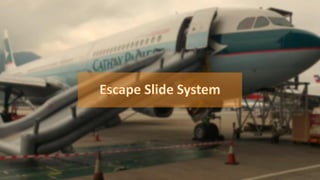
Escape slide is an inflatable slide used to
evacuate an aircraft quickly.
Escape slides are packed and kept within the
door structure
Escape slide had helped a lot in aviation industry
over the past couple of years in terms of safety
and passenger lives.
Objectives
o To discover how aircraft escape slide was made
and the requirements need to fulfill in
accordance with Federal Aviation Authority
(FAA).
o To dive deeper into aircraft escape slide
inflation system including how it could save a
lot of people’s lives from disaster.
o To ascertain the maintenance process of aircraft
escape slide including testing and overhaul to
make sure it is serviceable.
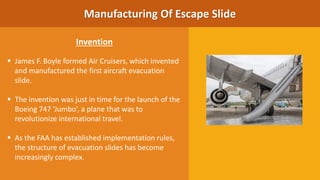
▪ James F. Boyle formed Air Cruisers, which invented
and manufactured the first aircraft evacuation
slide.
▪ The invention was just in time for the launch of the
Boeing 747 ‘Jumbo’, a plane that was to
revolutionize international travel.
▪ As the FAA has established implementation rules,
the structure of evacuation slides has become
increasingly complex.
Manufacturing Of Escape Slide
Invention
Materials
❑ What the slides consist of
- Composed of urethane-coated nylon that has
been painted with grey aluminized
❑ Trelleborg
❑ Safe evacuation
Manufacturing
❑ What is the role of making cylinders
- Quick emergency slide deployment
❑ The small size of the cylinders
- The small size of the cylinders allows for rapid
inflation without adding bulk or bulkn Weight
Design
❑ The airline offers additional challenges
- It must be light and compact enough
❑ Where is the escape chip
- inside a carbon fiber pressure cover
General System
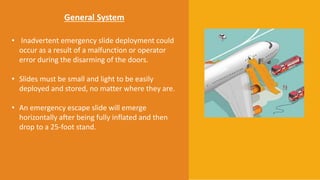
• Inadvertent emergency slide deployment could
occur as a result of a malfunction or operator
error during the disarming of the doors.
• Slides must be small and light to be easily
deployed and stored, no matter where they are.
• An emergency escape slide will emerge
horizontally after being fully inflated and then
drop to a 25-foot stand.
Operation
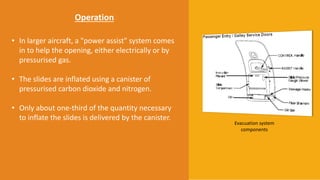
• In larger aircraft, a "power assist" system comes
in to help the opening, either electrically or by
pressurised gas.
• The slides are inflated using a canister of
pressurised carbon dioxide and nitrogen.
• Only about one-third of the quantity necessary
to inflate the slides is delivered by the canister.
Evacuation system
components
Inflation System
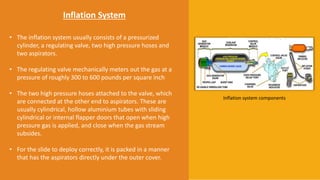
• The inflation system usually consists of a pressurized
cylinder, a regulating valve, two high pressure hoses and
two aspirators.
• The regulating valve mechanically meters out the gas at a
pressure of roughly 300 to 600 pounds per square inch
• The two high pressure hoses attached to the valve, which
are connected at the other end to aspirators. These are
usually cylindrical, hollow aluminium tubes with sliding
cylindrical or internal flapper doors that open when high
pressure gas is applied, and close when the gas stream
subsides.
• For the slide to deploy correctly, it is packed in a manner
that has the aspirators directly under the outer cover.
Inflation system components
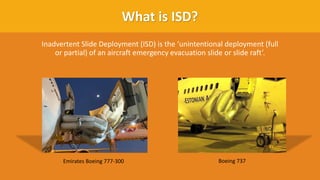
What is ISD?
Inadvertent Slide Deployment (ISD) is the ‘unintentional deployment (full
or partial) of an aircraft emergency evacuation slide or slide raft’.
Emirates Boeing 777-300 Boeing 737
Occurrence & Consequences
• Occurs when the operator attempts to open the door under normal
operational circumstances such as at aircraft turnaround, when the slide is
in the armed condition.
• It may cause serious injury of operatives inside the cabin or outside the
aircraft. It also have economic impacts and cause operational disruptions.
• The minimum cost of an event involving a 90-minute ground delay is
estimated at around 11,000 USD.
• If the ISD leads to a flight cancellation and a requirement to accommodate
passengers in hotels, the cost can rise as high as 200,000 USD.
▪ Investigation on Airbus fleets in 2016 shows that the
majority occur at the forward left door and the rear
right door, due to the more frequent usage for
boarding and loading operations.
▪ An IATA survey of 47 airlines conducted between
2014 & 2015, found that the occupational group
most frequently identified in reported ISDs was
cabin crew. Ground staff, maintenance, flight crew
and passengers were all less frequently identified in
ISD reports.
Results of a study into factors contributing to ISDs.
Source: IATA Cabin Operations Safety Conference
2014.
Causes
Prevention
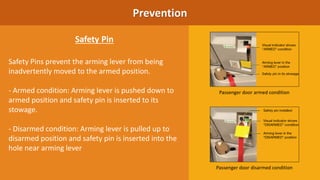
Safety Pin
Safety Pins prevent the arming lever from being
inadvertently moved to the armed position.
- Armed condition: Arming lever is pushed down to
armed position and safety pin is inserted to its
stowage.
- Disarmed condition: Arming lever is pulled up to
disarmed position and safety pin is inserted into the
hole near arming lever
Passenger door armed condition
Passenger door disarmed condition
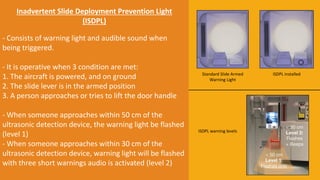
Inadvertent Slide Deployment Prevention Light
(ISDPL)
- Consists of warning light and audible sound when
being triggered.
- It is operative when 3 condition are met:
1. The aircraft is powered, and on ground
2. The slide lever is in the armed position
3. A person approaches or tries to lift the door handle
- When someone approaches within 50 cm of the
ultrasonic detection device, the warning light be flashed
(level 1)
- When someone approaches within 30 cm of the
ultrasonic detection device, warning light will be flashed
with three short warnings audio is activated (level 2)
Standard Slide Armed
Warning Light
ISDPL installed
ISDPL warning levels
Inadvertent Slide Deployment Prevention Light (ISDPL) demonstration video
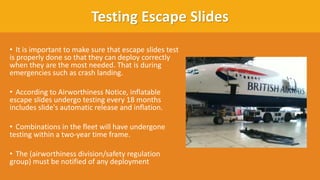
Testing Escape Slides
• It is important to make sure that escape slides test
is properly done so that they can deploy correctly
when they are the most needed. That is during
emergencies such as crash landing.
• According to Airworthiness Notice, inflatable
escape slides undergo testing every 18 months
includes slide's automatic release and inflation.​
• Combinations in the fleet will have undergone
testing within a two-year time frame.​
• The (airworthiness division/safety regulation
group) must be notified of any deployment
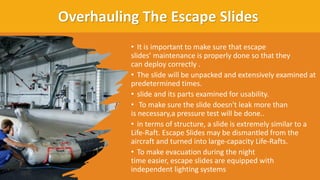
Overhauling The Escape Slides
• It is important to make sure that escape
slides’ maintenance is properly done so that they
can deploy correctly .​
• The slide will be unpacked and extensively examined at
predetermined times.
• slide and its parts examined for usability.​
• To make sure the slide doesn't leak more than
is necessary,a pressure test will be done..​
• in terms of structure, a slide is extremely similar to a
Life-Raft. Escape Slides may be dismantled from the
aircraft and turned into large-capacity Life-Rafts.
• To make evacuation during the night
time easier, escape slides are equipped with
independent lighting systems
✓ Last but not least, appropriate maintenance of escape slides is critical for passenger
safety and avoiding escape slide malfunction.
✓ The escape slide must be maintained in compliance with the Aircraft Maintenance
Manual. i.e, only way to ensure good maintenance in the aviation industry.
✓ Tests on the escape slide by automated release and inflation of the slide must be
performed at intervals of no more than 18 months
✓ All maintenance and testing on the escape slide guarantee that the system
functionality and slide inflation are always operational which lead to a safe flight
journey for passangers.
Conclusion

FINALIZED PRESENTATION SLIDES.pdf

  • 1.
    NAME STUDENT ID 1)MUHAMMAD ADAM AIMAN BIN MOHD ANUAR 53211222017 2) MOHAMMAD ADHA BIN NURDIN 53211121365 3) SAIT HASAN 53211222062 4) AHMED REZQ AHMED MAQSHAR 53211222068 5) SAUDAGAR VALI MOHAMED ISHAQ 53211222060
  • 2.
    Introduction Escape slide isan inflatable slide used to evacuate an aircraft quickly. Escape slides are packed and kept within the door structure Escape slide had helped a lot in aviation industry over the past couple of years in terms of safety and passenger lives.
  • 3.
    Objectives o To discoverhow aircraft escape slide was made and the requirements need to fulfill in accordance with Federal Aviation Authority (FAA). o To dive deeper into aircraft escape slide inflation system including how it could save a lot of people’s lives from disaster. o To ascertain the maintenance process of aircraft escape slide including testing and overhaul to make sure it is serviceable.
  • 4.
    ▪ James F.Boyle formed Air Cruisers, which invented and manufactured the first aircraft evacuation slide. ▪ The invention was just in time for the launch of the Boeing 747 ‘Jumbo’, a plane that was to revolutionize international travel. ▪ As the FAA has established implementation rules, the structure of evacuation slides has become increasingly complex. Manufacturing Of Escape Slide Invention
  • 5.
    Materials ❑ What theslides consist of - Composed of urethane-coated nylon that has been painted with grey aluminized ❑ Trelleborg ❑ Safe evacuation
  • 6.
    Manufacturing ❑ What isthe role of making cylinders - Quick emergency slide deployment ❑ The small size of the cylinders - The small size of the cylinders allows for rapid inflation without adding bulk or bulkn Weight
  • 7.
    Design ❑ The airlineoffers additional challenges - It must be light and compact enough ❑ Where is the escape chip - inside a carbon fiber pressure cover
  • 9.
    General System • Inadvertentemergency slide deployment could occur as a result of a malfunction or operator error during the disarming of the doors. • Slides must be small and light to be easily deployed and stored, no matter where they are. • An emergency escape slide will emerge horizontally after being fully inflated and then drop to a 25-foot stand.
  • 10.
    Operation • In largeraircraft, a "power assist" system comes in to help the opening, either electrically or by pressurised gas. • The slides are inflated using a canister of pressurised carbon dioxide and nitrogen. • Only about one-third of the quantity necessary to inflate the slides is delivered by the canister. Evacuation system components
  • 11.
    Inflation System • Theinflation system usually consists of a pressurized cylinder, a regulating valve, two high pressure hoses and two aspirators. • The regulating valve mechanically meters out the gas at a pressure of roughly 300 to 600 pounds per square inch • The two high pressure hoses attached to the valve, which are connected at the other end to aspirators. These are usually cylindrical, hollow aluminium tubes with sliding cylindrical or internal flapper doors that open when high pressure gas is applied, and close when the gas stream subsides. • For the slide to deploy correctly, it is packed in a manner that has the aspirators directly under the outer cover. Inflation system components
  • 13.
    What is ISD? InadvertentSlide Deployment (ISD) is the ‘unintentional deployment (full or partial) of an aircraft emergency evacuation slide or slide raft’. Emirates Boeing 777-300 Boeing 737
  • 14.
    Occurrence & Consequences •Occurs when the operator attempts to open the door under normal operational circumstances such as at aircraft turnaround, when the slide is in the armed condition. • It may cause serious injury of operatives inside the cabin or outside the aircraft. It also have economic impacts and cause operational disruptions. • The minimum cost of an event involving a 90-minute ground delay is estimated at around 11,000 USD. • If the ISD leads to a flight cancellation and a requirement to accommodate passengers in hotels, the cost can rise as high as 200,000 USD.
  • 15.
    ▪ Investigation onAirbus fleets in 2016 shows that the majority occur at the forward left door and the rear right door, due to the more frequent usage for boarding and loading operations. ▪ An IATA survey of 47 airlines conducted between 2014 & 2015, found that the occupational group most frequently identified in reported ISDs was cabin crew. Ground staff, maintenance, flight crew and passengers were all less frequently identified in ISD reports. Results of a study into factors contributing to ISDs. Source: IATA Cabin Operations Safety Conference 2014. Causes
  • 16.
    Prevention Safety Pin Safety Pinsprevent the arming lever from being inadvertently moved to the armed position. - Armed condition: Arming lever is pushed down to armed position and safety pin is inserted to its stowage. - Disarmed condition: Arming lever is pulled up to disarmed position and safety pin is inserted into the hole near arming lever Passenger door armed condition Passenger door disarmed condition
  • 17.
    Inadvertent Slide DeploymentPrevention Light (ISDPL) - Consists of warning light and audible sound when being triggered. - It is operative when 3 condition are met: 1. The aircraft is powered, and on ground 2. The slide lever is in the armed position 3. A person approaches or tries to lift the door handle - When someone approaches within 50 cm of the ultrasonic detection device, the warning light be flashed (level 1) - When someone approaches within 30 cm of the ultrasonic detection device, warning light will be flashed with three short warnings audio is activated (level 2) Standard Slide Armed Warning Light ISDPL installed ISDPL warning levels
  • 18.
    Inadvertent Slide DeploymentPrevention Light (ISDPL) demonstration video
  • 20.
    Testing Escape Slides •It is important to make sure that escape slides test is properly done so that they can deploy correctly when they are the most needed. That is during emergencies such as crash landing. • According to Airworthiness Notice, inflatable escape slides undergo testing every 18 months includes slide's automatic release and inflation.​ • Combinations in the fleet will have undergone testing within a two-year time frame.​ • The (airworthiness division/safety regulation group) must be notified of any deployment
  • 21.
    Overhauling The EscapeSlides • It is important to make sure that escape slides’ maintenance is properly done so that they can deploy correctly .​ • The slide will be unpacked and extensively examined at predetermined times. • slide and its parts examined for usability.​ • To make sure the slide doesn't leak more than is necessary,a pressure test will be done..​ • in terms of structure, a slide is extremely similar to a Life-Raft. Escape Slides may be dismantled from the aircraft and turned into large-capacity Life-Rafts. • To make evacuation during the night time easier, escape slides are equipped with independent lighting systems
  • 22.
    ✓ Last butnot least, appropriate maintenance of escape slides is critical for passenger safety and avoiding escape slide malfunction. ✓ The escape slide must be maintained in compliance with the Aircraft Maintenance Manual. i.e, only way to ensure good maintenance in the aviation industry. ✓ Tests on the escape slide by automated release and inflation of the slide must be performed at intervals of no more than 18 months ✓ All maintenance and testing on the escape slide guarantee that the system functionality and slide inflation are always operational which lead to a safe flight journey for passangers. Conclusion