SUPERMILEAGE	VEHICLE	WITH	ITS	STRUCTURAL	ANALYSIS	
Dept. Of Mechanical Engineering, GIT, Belgaum	 1	
CHAPTER: 1
INTRODUCTION
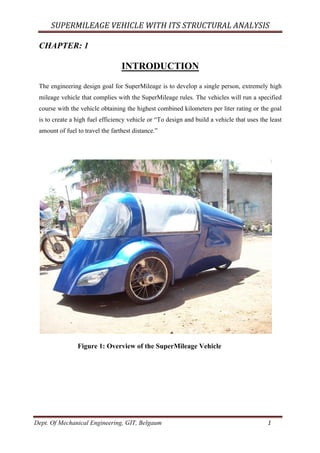
The engineering design goal for SuperMileage is to develop a single person, extremely high
mileage vehicle that complies with the SuperMileage rules. The vehicles will run a specified
course with the vehicle obtaining the highest combined kilometers per liter rating or the goal
is to create a high fuel efficiency vehicle or “To design and build a vehicle that uses the least
amount of fuel to travel the farthest distance.”
Figure 1: Overview of the SuperMileage Vehicle
SUPERMILEAGE	VEHICLE	WITH	ITS	STRUCTURAL	ANALYSIS	
Dept. Of Mechanical Engineering, GIT, Belgaum	 2	
CHAPTER: 2
PROJECT DESCRIPTION
2.1 Engine and Power train:
The engine to be used is Honda GK 100 97 cc. The engine is 4 strokes, Air Cooled, Single
Cylinder, and Horizontal Shaft, with a 1.3 kW @ 4,200 rpm.
2. 2 Transmission: CVT [Pulley Based CVT]
Unlike traditional automatic transmissions, continuously variable transmissions don't have a
gearbox with a set number of gears, which means they don't have interlocking toothed
wheels. The most common type of CVT operates on an ingenious pulley system that allows
an infinite variability between highest and lowest gears with no discrete steps or shifts
2.3 Steering:
The vehicle will feature “twin tie rod” mechanism, which takes a radius of 17 feet.
2.4 Chassis:
Chassis design is space frame, fabricated using 20 mm square & round MS Pipe of thickness
1.5mm.
2.5 Tyres:
The tires are of size 15inch diameter, puncture resistant, lightweight, low rolling friction and
will feature silica energy rubber mix to ensure excellent grip and will feature more tread to
maximize the propulsion and minimize the slip.
2.6 Hub:
Hub is made of casted Aluminium with dimensions:
Outer Diameter – 80mm
Inner Diameter – 58mm
Length – 74mm
.
SUPERMILEAGE	VEHICLE	WITH	ITS	STRUCTURAL	ANALYSIS	
Dept. Of Mechanical Engineering, GIT, Belgaum	 3	
2.7 Brake System:
Due to the fact that the vehicle is set to have an average speed of 45 kmph, the bicycle breaks
capable of bring the vehicle to a complete stop in 5.2 meters, traveling at a speed of 45 kmph.
2.8 Electrical Systems:
Batteries will be used to power; the starting system, ignition, instrumentation and lights
2.9 Exhaust System:
Engine exhaust will be directed to exit the body of the vehicle by the way of an insulated
exhaust pipe.
SUPERMILEAGE	VEHICLE	WITH	ITS	STRUCTURAL	ANALYSIS	
Dept. Of Mechanical Engineering, GIT, Belgaum	 4	
CHAPTER: 3
LITERATURE SURVEY
ü We attended a workshop on “AUTOMOTIVE INNOVATIONS”, conducted by
METAWING at BITS, GOA, from where we understood the concept of
SuperMileage vehicle.
ü Referring to various SAE SuperMileage competitions we understood about the
competitions and the various concepts to build SuperMileage vehicle.
ü The SAE SuperMileage Competition is a yearly fuel efficiency competition held near
Detroit, Michigan. The Society of Automotive Engineers is the primary sponsor.
Around 30 teams compete to build the vehicle that uses the least amount of gas to go
a specified distance. Teams are required to use a one cylinder lawnmower engine
provided by Briggs & Stratton, but significant modification is allowed.
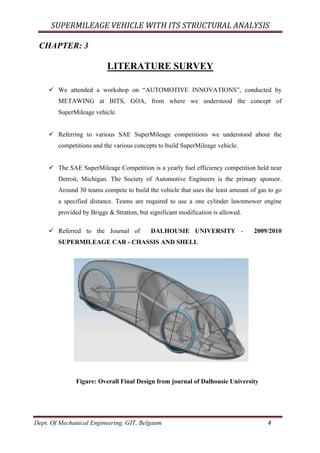
ü Referred to the Journal of DALHOUSIE UNIVERSITY - 2009/2010
SUPERMILEAGE CAR - CHASSIS AND SHELL
Figure: Overall Final Design from journal of Dalhousie University
SUPERMILEAGE	VEHICLE	WITH	ITS	STRUCTURAL	ANALYSIS	
Dept. Of Mechanical Engineering, GIT, Belgaum	 5	
The goal of the team was to achieve the highest fuel efficiency possible by
designing a totally new body and frame with less rolling and aerodynamic resistance
than previous designs. The main focuses are weight and air drag reduction. Depending
on the final budget, some components of vehicle will be reused, such as wheels,
bearings, and safety components.
FINITE ELEMENT ANALYSIS
FEA was done with theoretical calculations and also then compared result
which was done in the software NX 5.0.4.1
DESIGN ANALYSIS
The decision was made to model the shell shape after a streamlined body, and
modify the shape to conform to the chassis design. It was first decided to have a
closed wheel design, to eliminate the complex front end dimensions, as well as
prevent the steering mechanism from protruding outside the shell. During the
construction of the shell, group 15 will be consulted on the locations of the air intake
and exhaust outlet Once the shell was fabricated, driver fitting and testing will be
done to determine the most effective locations for side and front windows. These will
be made from polycarbonate plastic, 1/16” thick, and formed by hand with a heat gun.
It was possible to form the polycarbonate with a heat gun with thin material
THE CHASSIS REQUIREMENTS INCLUDE:
A newly designed chassis that will meet or exceed the safety standards as
Determined by Shell, and contain all structural support components needed for
theengine, steering, wheels, and other crucial components. The chassis was designed
with the ability to withstand loads predetermined by Shell. This was to ensure driver
safety in the event of an impact or rollover. Additionally, the chassis was designed in
combination with the body to produce significant gains in driver visibility. Driver
visibility required to be at least 180˚.
The chassis	 will	 include a mandatory firewall; its design will be selected from
apredetermined specification put forward by Shell. The chassis was made of either a
light weight composite such as carbon fiber, or a high strength aluminum alloy. This
depends on the final budget of the project and design considerations. A combination
of materials may be used to maximize the strength to weight ratio of the car.
SUPERMILEAGE	VEHICLE	WITH	ITS	STRUCTURAL	ANALYSIS	
Dept. Of Mechanical Engineering, GIT, Belgaum	 6	
THE BODY REQUIREMENTS INCLUDE:
A newly designed body which will encase the chassis and corresponding
components.
Maximum dimensions as specified by Shell
• Maximum height = 1 meter, or 1.25 times the track width for stability.
• Maximum length = 3 meters.
• Maximum width = 1.3 meters.
The drag coefficient for the body must be minimized. Our goal was to design a
body which has a smaller drag coefficient than 0.15, The length of the body and
vehicle in general, will be decreased, therefore reducing weight. With weight
reduction being a priority, aerodynamics may be greatly improved. The body will be
designed with a lightweight composite and will be for aerodynamics and aesthetics
only. To minimize weight, the body will not carry any load other than wind, and
external components such as mirrors and tail lights.
THE STEERING REQUIREMENTS INCLUDE:
The steering system must allow for a minimum turning radius which will be
specifiedby the Shell Eco Marathon Regulations. This system will also be precise and robust
for stability and driver safety during the competition.
THE OVERALL PROJECT GOALS INCLUDE:
A 15% reduction in weight affects reduction in rolling resistance in the SuperMileage
car. If budget requires the use of previously used rolling components, the rolling resistance
will be reduced by reducing the weight. Improved driver visibility while obtaining
aerodynamics .
CONCLUSION :
The design is much shorter than the 2008/2009 car, with a wheelbase of
approximately 55.5”,The overall weight of the vehicle was estimated to be a total of 58 lbs.
This is a conservative estimate, taking into account the maximum weight of the body, wheels,
and miscellaneous components. This results in a weight reduction and should translate into a
direct reduction in rolling resistance.
SUPERMILEAGE	VEHICLE	WITH	ITS	STRUCTURAL	ANALYSIS	
Dept. Of Mechanical Engineering, GIT, Belgaum	 7	
Budget
The overall cost of the vehicle was approximately $1560 CAD.
Also detailed Finite Element Analysis report was attached
F.E.A. Report
Simulation Report
Author: labuser
Company: UGS
Date: 12/6/2009
Software Used: NX 5.0.4.1
Solution Summary
Environment
Solution: Solution 1
Solver: NX NASTRAN
SUPERMILEAGE	VEHICLE	WITH	ITS	STRUCTURAL	ANALYSIS	
Dept. Of Mechanical Engineering, GIT, Belgaum	 8	
CHAPTER: 4
FABRICATION METHODOLOGY
4.1 AERODYNAMICS
A simple definition of aerodynamics is the study of the flow of air around and through a
vehicle, primarily if it is in motion. Energy is required to move a car through the air; this
energy is also used to overcome a force called drag.
Drag is determined by vehicle speed, frontal area, air density, and shape. Figure 1 shows how
the shape affects drag.
Figure 4.1.1: Change in Drag and Friction with Changing Shape
The aerodynamic drag on cars are caused by following; pressures that act on the front area of
the car, suction at the rear of the car, underbody regions and roughness of the vehicle surface
such as protrusions and projections. Figure 4.2 and Figure 4.3 illustrate the frontal vacuum
and the rear suction respectively.
SUPERMILEAGE	VEHICLE	WITH	ITS	STRUCTURAL	ANALYSIS	
Dept. Of Mechanical Engineering, GIT, Belgaum	 9	
Figure 4.1.2: Frontal
Pressure caused by Flowing
Air
Figure 4.1.3: Rear Vacuum Caused By Flowing Air.
ü Drag on automobiles is calculated using the following equation
Equation 1
Dr = Cd * S * ½ * ρ*U^2
Where,
Dr – Drag force in Newton
Cd – Drag coefficient
S – Cross sectional area metered squared
ρ–Air density kilograms per meter cubed
U – Speed meters per second
ü In order to overcome drag the car must exert a certain power, which is given by the
formula :
Equation 2
Pd = ½ * p * v^3 *A *Cd
SUPERMILEAGE	VEHICLE	WITH	ITS	STRUCTURAL	ANALYSIS	
Dept. Of Mechanical Engineering, GIT, Belgaum	 10	
By reducing the drag coefficient of a car it results in better fuel economy. A typical car
burns 50% of its fuel overcoming air resistance at speed of 45 kmph making aerodynamic
design very important when attempting to hit high mileage.
ü The amount of work from drag can be found from Equation 3:
Equation 3
W= Fd * d
Where,
W is the work,
Fd is the drag force
D is the distance traveled by the car while drag is acting on it.
Using a wind tunnel and/or using computer simulations can achieve testing the aerodynamic
features of a car design. The wind tunnel is the proving ground for the vehicle's form and
allows engineers to obtain considerable amounts of advanced information within a controlled
environment. A car in a wind tunnel can be seen in fig 4.4
Figure 4.1.4: Car in a Wind Tunnel
With the reference to Journal of DALHOUSIEUNIVERSITY–2009/2010 SUPERMILEAGE
CAR and also since our chassis structure is as same as that from the journal, as the above
calculations shows that lesser the drag co-efficient, larger is the Drag Force, which also helps
in improving the efficiency.
Hence this indicates our Chassis is of Aerodynamic design.
SUPERMILEAGE	VEHICLE	WITH	ITS	STRUCTURAL	ANALYSIS	
Dept. Of Mechanical Engineering, GIT, Belgaum	 11	
4.2 CHASSIS DESIGN
Initial Concept Selection
Initial chassis considerations led to the selection of a space frame for the chassis. The space
frame concept would allow maximum stability, safety and minimum weight.
To reduce material volume it was decided that a compact driver orientation was most
suitable. A totally prone driver position results in a car that must be very long, and as a result
requires a stronger chassis material to withstand chassis bending. Another identified area for
potential size and weight savings was the orientation of the firewall.
In an attempt to maximize compactness of the vehicle, the team decided that the
firewall should be slanted rearward over the drive train, thus giving the driver a backrest and
minimizing wasted space.
Material Selection
	
The decision to utilize lightweight tubing led to the direct comparison of three readily
available materials: Aluminum, Mild Steel and Stainless steel tubing. The tubing was
compared on the basis of strength, weight per unit length and cost per unit weight.
	
Figure 4.2.1: Weight/Unit Length Comparison
SUPERMILEAGE	VEHICLE	WITH	ITS	STRUCTURAL	ANALYSIS	
Dept. Of Mechanical Engineering, GIT, Belgaum	 12	
	
Figure4.2.2: Yield Strength Comparison
As seen from the figure, Mild Steel is much stronger but little heavier than Aluminum.From
this consideration, the Aluminum tubing was selected for the chassis, but was later revised to
Mild Steel tubing because of budget considerations. Figure 7 compares the costs between the
materials.
	
	
Figure 4.2.3: Cost Comparison	
	
The Aluminum tubing is approximately 5 times more expensive per unit weight than the Mild
Steel pipe. There were also several factors involved in the decision such as construction
SUPERMILEAGE	VEHICLE	WITH	ITS	STRUCTURAL	ANALYSIS	
Dept. Of Mechanical Engineering, GIT, Belgaum	 13	
The largest consideration was due to the actual construction requirements of the
material.Aluminum cannot be welded in any configuration, whereas the Mild steel pipe
supports any type of welding. The Aluminum& Stainless Steel tubing may also have been
simply unnecessary, as the chassis for this vehicle is not exceedingly demanding of
performance, and will experience minimal loads. Simplicity and cost deemed the aluminum
tubing the most appropriate material for this application.
	
Considering availability, cost of materials, corrosion, weight and strength etc. we
decided to use MILD STEEL PIPE of thickness 1.5mm and diameter 20mm (after theoretical
calculations, as attached below)
SUPERMILEAGE	VEHICLE	WITH	ITS	STRUCTURAL	ANALYSIS	
Dept. Of Mechanical Engineering, GIT, Belgaum	 14	
4.3 DESIGN ANALYSIS AND REFINEMENT
	
4.3.1 Initial calculations
The frame was initially modeled as a two dimensional frame with beams undergoing bending
and axial loading. Figure 4.8 and 4.9 shows the initial 3-D and 2-D view of the chassis
respectively.
Figure 4.3.1(1): 3 D View of Chassis in CATIA V5
SUPERMILEAGE	VEHICLE	WITH	ITS	STRUCTURAL	ANALYSIS	
Dept. Of Mechanical Engineering, GIT, Belgaum	 15	
Figure 4.3.1(2): 2 D View of Chassis
SUPERMILEAGE	VEHICLE	WITH	ITS	STRUCTURAL	ANALYSIS	
Dept. Of Mechanical Engineering, GIT, Belgaum	 16	
FORCE CALCULATIONS
• Mass of car = 65 kg
Mass of person = 75 kg.
Total weight of car = 140kg.
• Top speed (0-45Kph) ( velocity = 45*1000/3600 = 12.5m/s)
• After impact car will move distance of 1.3 -2 meter ( nearly considered for this speed
we will consider 1.5)
Front Impact:
• E = 0.5mv^2
0.5 * 140 * 12.5 ^ 2 = 10,937.5
Hence front impact force will be = 10,937.5 / 1.5 = 7291.66 N
• While applying load during analysis fix rear part of vehicle (x-0, y-0, Z-0)
and apply load on font part (7291.66N/no of nodes)
Side Impact:
• For side impact same calculation and take speed of other car is 45 kmph
and distance 2.5 -3.m.and loading during analysis same concept as front.
Hence Side impact force will be = 10,937.5 / 2.5 = 4375 N
• While applying load during analysis fix rear part of vehicle (x-0, y-0, Z-0)
and apply load on font part ( 4375 N/no of nodes)
SUPERMILEAGE	VEHICLE	WITH	ITS	STRUCTURAL	ANALYSIS	
Dept. Of Mechanical Engineering, GIT, Belgaum	 17	
4.3.2 ANALYSIS
The analysis of chassis is consists of front impact test,side impact test. these was very
important to know that whether selected material Mild Steel of c/s 20*1.5 is able to with
stand both these test. the material and dimension we selected 1st is depending upon
availability, by keeping total weight of car, type of welding which we are easily accessible
etc. and then further we decided to know whether this dimension material is able to with
stand loads by considering FOS 3.
Figure 4.3.2(1): Chassis Constraint and Loading Condition
SUPERMILEAGE	VEHICLE	WITH	ITS	STRUCTURAL	ANALYSIS	
Dept. Of Mechanical Engineering, GIT, Belgaum	 18	
Again using the convergence method, we were able to converge onto approximate results.
Figure 4.3.2(2): Chassis Stressed
Figure 4.11 shows deflection, but this is not the actual deflection of the member. This isthe
deflection of the elements compressing. It does give an idea of the relativedeflection of the
various members.
SUPERMILEAGE	VEHICLE	WITH	ITS	STRUCTURAL	ANALYSIS	
Dept. Of Mechanical Engineering, GIT, Belgaum	 19	
Figure 4.3.2(3): Chassis is subjected to Static Loads.
We applied the static loads i.e. engine weight and driver’s weight on the chassis. After the
static loading from the analysis we observed maximum deflection of 6.812 mm in the chassis
as shown in fig. 4.12.
SUPERMILEAGE	VEHICLE	WITH	ITS	STRUCTURAL	ANALYSIS	
Dept. Of Mechanical Engineering, GIT, Belgaum	 20	
Figure 4.3.2(4): Chassis is subjected to Side Impacts.
We carried out side impact test on same chassis by applying load at one side and fixing other
wheel side. And we got deflection 13.683mm and stress 292MPa for FOS of 3. Hence we
assumed that the stress is within the yield stress of MS and design is same hence no need to
increase thickness of material for more strength and deflection can be incorporate by
providing triangulation at sides.
Considering FACTOR OF SAFETY (FOS) = 3, the maximum stresses (red color in fig.
4.13indicates Maximum stress acting) are at the joints, which is lesser than the Yield Strength
of Mild Steel i.e. 310MPa.
Hence this Indicates our Design is safe
SUPERMILEAGE	VEHICLE	WITH	ITS	STRUCTURAL	ANALYSIS	
Dept. Of Mechanical Engineering, GIT, Belgaum	 21	
Figure 4.3.2(5): Chassis is subjected to Front Impacts.
The test was carried on chassis for 1st assumed dimension, by applying the force on front end
of chassis and fixing the rear engine side or wheel side (ALL DOF =0).We assumed that its
worst condition that rear wheel gets locked and it was not moved during front impact and all
loads is transferred to other part of chassis.And we got the maximum defection of 6mm and
maximum Von misses stress is 240mpa. For Factor of Safety of 3 which is well within the
yield stress of material and to avoid the deflection we incorporated triangulation in our
chassis for more strength.
Considering Factor of safety as 3, we conclude from the above results the design of the
structure of Chassis is safe.
SUPERMILEAGE	VEHICLE	WITH	ITS	STRUCTURAL	ANALYSIS	
Dept. Of Mechanical Engineering, GIT, Belgaum	 22	
Final Design


Figure 4.3.2(6): The Final Design for the Chassis
Hence from the above results we conclude that,by considering FOS = 3, the design is safe for
this structure of:
Type of material: Mild Steel Pipe
Thickness: 1.5mm
Diameter: 20mm
SUPERMILEAGE	VEHICLE	WITH	ITS	STRUCTURAL	ANALYSIS	
Dept. Of Mechanical Engineering, GIT, Belgaum	 23	
4.4 THEORETICAL CALCULATIONS
1) CALCULATION OF CG:
To find the center of gravity (CG) of the vehicle and locate the engine in the vehicle:
The location of the CG of the vehicle is one of the most fundamental determinations of
performance, because the cornering force capability is very dependent on the vertical load
applied on the tyre.
A) First step to find CG –
To calculate individual wheel load
WF = Wl + Wr
= (45+45) kg
WR = 50kg
Hence W = WF + WR= 140 kg
Track Width = 1m
Wheel base =1.456m
B) Total Wheel Horizontal Location of CG (X & Y) –
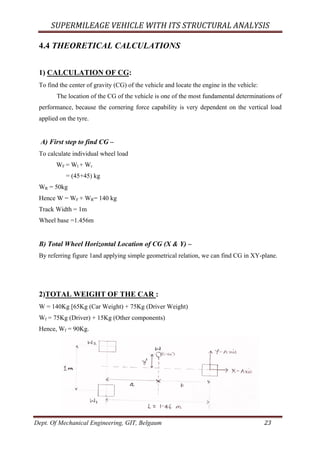
By referring figure 1and applying simple geometrical relation, we can find CG in XY-plane.
2)TOTAL WEIGHT OF THE CAR :
W = 140Kg [65Kg (Car Weight) + 75Kg (Driver Weight)
Wf = 75Kg (Driver) + 15Kg (Other components)
Hence, Wf = 90Kg.
SUPERMILEAGE	VEHICLE	WITH	ITS	STRUCTURAL	ANALYSIS	
Dept. Of Mechanical Engineering, GIT, Belgaum	 24	
Figure 4.4.(1): Horizontal Location of CG
By geometry,
ð W * b = Wf * L
b = Wf * L / W
b = 90 * 1.46 / 140
b = 0.94m.
Hence, a = 0.52m (Because L = a + b)
By geometry,
= >y’ = [W2 / W * (Tf – d)] – [W1/W * (d)]
d = 1m/2
d =0.5m
Hence,
y’ = [45(Kg) / 140(Kg)] * 0.5m - [45(Kg) / 140(Kg)]
y’ = 0
Normally in three wheel y’ = 0. i.e. its center line.
Figure 4.4.(2): Location of CG
3) Total Vehicle Vertical Location of CG can be practically determined:
Jack the rare axle up so that it forms some angle (450
) with the horizontal as shown:By basic
geometry, we can apply the geometry relation to find out the CG as shown in fig 4.4.3.
SUPERMILEAGE	VEHICLE	WITH	ITS	STRUCTURAL	ANALYSIS	
Dept. Of Mechanical Engineering, GIT, Belgaum	 25	
Figure 4.4.(3): Vertical Location of CG
ð L1 = Lcosθ
L1 = 1.46 cos450
[Maximum Angle Raised for CG]
L1 = 1.032m
Taking moment about ‘O’
WfL1 = Wb1
ð b1 = WfL1 / W
b1 = 90 * 1.032 / 140
b1 = 0.66m.
By geometry,
W tanθ * h1 = Wf*L – W * b
• h1 = [Wf*L – W * b] / W tanθ
= [90 * 1.46 – 140 * 0.94] / 140 tan 450
= 0.2 / 140
h1 = 1.428 * 10-3
m
h1 = 1.428 mm
Let,
h = Loaded radius of wheel + h1
= [7”
= 175mm] from ground
= 175 + 1.428
h = 176.428 mm from ground
SUPERMILEAGE	VEHICLE	WITH	ITS	STRUCTURAL	ANALYSIS	
Dept. Of Mechanical Engineering, GIT, Belgaum	 26	
CHASSIS CALCULATION
To begin the chassis pipe calculation, we should know the maximum force that is cornering
on the member by considering FOS=3. This can be done by calculating Lateral Force,
Longitudinal Force, Dynamic Force etc.
1) Lateral Load Transfer:
When the vehicle is at constant speed, an internal reaction force called Centrifugal Force is
developed which opposes the lateral acceleration produced by tyre cornering force.
WL = Left Wheel
Wr= Right wheel
Where, t =1.46m
Fig 4.4.(4): Lateral Load Transfer
Figure 4.4.(5): Ay Graph
SUPERMILEAGE	VEHICLE	WITH	ITS	STRUCTURAL	ANALYSIS	
Dept. Of Mechanical Engineering, GIT, Belgaum	 27	
Weight transfer due to cornering force is given by the relation,
ΔW = WL- Wt / 2
= WAy h / t
Ay = A / B
= 50 (lbs) / 45 (lbs)
Ay = 1.11
ΔWL = 140(kg) * 1.11* 357.42(mm) / 1460(mm)
ΔWL = 38.61
This extra force on the wheel while cornering [i.e. inner wheel].
2) Longitudinal Weight Transfer:
During Acceleration or Braking, Inertial Force is developed that is similar to the Centrifugal
Force.
Fig 4.4.(6): Longitudinal Weight Transfer
Taking moment about pt ‘O’.
ΔWLo= (h / l) * W * Ay
= (357.42 / 1460) * 140 * 1.11 [same procedure]
= 38.61 kg
ΔWLo= 380N (Because 38.61* 9.81)
SUPERMILEAGE	VEHICLE	WITH	ITS	STRUCTURAL	ANALYSIS	
Dept. Of Mechanical Engineering, GIT, Belgaum	 28	
3) Static Force:
Since total weight, W = Wf + WR
= 90(kg) + 50(kg)
W = 140(kg)
The calculation is same as done to find out the C.G.
4) Dynamic Force:
Dynamic force is 0.6 to 0.8 times the static force for more FOS. Hence we take double the
static force.
Therefore maximum load on each wheel is = Sum of [static load (w) + dynamic load (Wd) +
lateral load due to lateral load transfer (ΔWL) + Longitudinal load due to long loading
transfer (ΔWLo)]
Therefore load on front perpendicular wheel can be calculated as,
Weight Ratio taken as,
= 60:40 (F: R) (because of loading)
• Wf = 0.6 * 140
= 84 N, on each Wheel
1. For single wheel= 420N
2. Dynamic = 420N (same as it)
3. Lateral = 370N
4. Longitudinal = 380N
Hence, Wt= 1590N
SUPERMILEAGE	VEHICLE	WITH	ITS	STRUCTURAL	ANALYSIS	
Dept. Of Mechanical Engineering, GIT, Belgaum	 29	
Fig 4.4.(7): Forces Acting on Square Pipe
Then,
• F’
* 0.3= 1590*0.5
• F’
= 2650N [maximum force produced at element ‘E’]
If we design for that maximum load on this (round) pipe, and we can keep the same
dimension for the other (square) pipe too.
Now if we analyze this vertical (square) pipe it acts like column with both ends fixed.
SUPERMILEAGE	VEHICLE	WITH	ITS	STRUCTURAL	ANALYSIS	
Dept. Of Mechanical Engineering, GIT, Belgaum	 30	
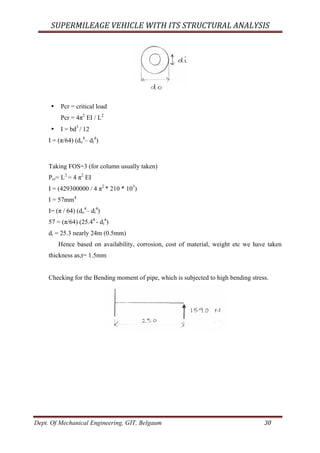
• Pcr = critical load
Pcr = 4π2
EI / L2
• I = bd3
/ 12
I = (π/64) (do
4
– di
4
)
Taking FOS=3 (for column usually taken)
Pcr= L2
= 4 π2
EI
I = (429300000 / 4 π2
* 210 * 103
)
I = 57mm4
I= (π / 64) (do
4
– di
4
)
57 = (π/64) (25.44
- di
4
)
di = 25.3 nearly 24m (0.5mm)
Hence based on availability, corrosion, cost of material, weight etc we have taken
thickness as,t= 1.5mm
Checking for the Bending moment of pipe, which is subjected to high bending stress.
SUPERMILEAGE	VEHICLE	WITH	ITS	STRUCTURAL	ANALYSIS	
Dept. Of Mechanical Engineering, GIT, Belgaum	 31	
(If not full force transfer, it part of 1590N we take 1590N for safety)
σb = (MI) / Y [for mild steel σb = 310MPa]
310 (MPa) = M/Z (also Z= (π / 64) (do
4
– di
4
) / (d / 2)
Z= (π / 32) [(do
4
– di
4
) / do])
Z= M / 310
= (1590 * 250) /310
= 1204.5mm3
Z = (1204.5 * 32) / π= (do
4
– di
4
) / do
= 12269.3 = (do
4
– di
4
) / do
do = 20mm (taken)
And also is sufficient based on availability, cost, weight etc.
Not any part of chassis is going to subject stresses more than σy = 310MPa
For FOS = 3
Hence we fix t =1.5mm
do= 20mm.
SUPERMILEAGE	VEHICLE	WITH	ITS	STRUCTURAL	ANALYSIS	
Dept. Of Mechanical Engineering, GIT, Belgaum	 32	
4.5 THE ENGINE
An Engine-generator is the combination of an electrical generator and an engine (prime
mover) mounted together to form a single piece of equipment. This combination is also called
an engine-generator set or a gen-set. In many contexts, the engine is taken for granted and the
combined unit is simply called a generator.
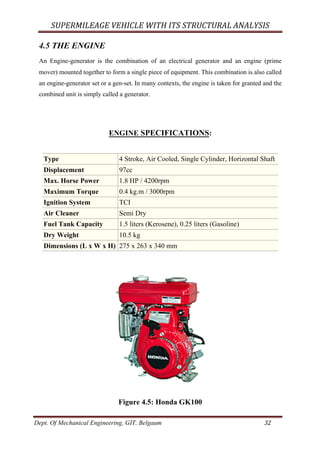
ENGINE SPECIFICATIONS:
Type 4 Stroke, Air Cooled, Single Cylinder, Horizontal Shaft
Displacement 97cc
Max. Horse Power 1.8 HP / 4200rpm
Maximum Torque 0.4 kg.m / 3000rpm
Ignition System TCI
Air Cleaner Semi Dry
Fuel Tank Capacity 1.5 liters (Kerosene), 0.25 liters (Gasoline)
Dry Weight 10.5 kg
Dimensions (L x W x H) 275 x 263 x 340 mm
	
Figure 4.5: Honda GK100
SUPERMILEAGE	VEHICLE	WITH	ITS	STRUCTURAL	ANALYSIS	
Dept. Of Mechanical Engineering, GIT, Belgaum	 33	
4.5.1 Drive Train and Transmission
Achieving maximum efficiency out of the drive train takes careful thought. Internal
combustion engines are most efficient at a particular engine speed. Therefore, we want to run
the engine at or around this speed as much as possible. The drive train must be geared to
allow the engine to run at said speed for most of the acceleration period. Since the engine
won’t constantly be at the specified RPM, the best we can do is to accelerate and “hit” the
RPM on the way up to our final speed. This is the function that the drive train must perform.
Figure 4.5.1: Continuous variable transmission (CVT)
SUPERMILEAGE	VEHICLE	WITH	ITS	STRUCTURAL	ANALYSIS	
Dept. Of Mechanical Engineering, GIT, Belgaum	 34	
The actual construction is based on knowledge of various power transmission systems. A
Continuous Variable Transmission (CVT) was considered as it wouldallow accelerationwhile
maintaining a constant engine RPM, therefore staying in that optimal range during
acceleration. However, belt and pulley driven systems have more losses in them in
comparison to gears or chains due to internal friction of the rubber belts. Therefore a sprocket
and chain system was decided upon.
In normal vehicles, there are many gears to allow a wide range of speeds. A multiple
speed system will be implemented as one speed will not be sufficient to drive the vehicle over
its desired velocity range due to the low power of the engine. The design is to use a back
wheel hub gear with 3 gear ratios to achieve this. This will allow enough flexibility for
acceleration from rest with ease and drive at the maximum speed at a regular engine speed.
SUPERMILEAGE	VEHICLE	WITH	ITS	STRUCTURAL	ANALYSIS	
Dept. Of Mechanical Engineering, GIT, Belgaum	 35	
4.6 HUB
A hub is the center part of a bicycle wheel. It consists of an axle, bearings and a hub shell.
The hub shell typically has 2 machined metal flanges to which spokes can be attached. Hub
shells can be one-piece with press-in cartridge or free bearings or, in the case of older
designs; the flanges may be affixed to a separate hub shell
Hub shell
The hub shell is the part of the hub to which the spokes (or disc structure) attach. The hub
shell of a spoked wheel generally has two flanges extending radially outward from the axle.
Each flange has holes or slots to which spokes are affixed. Some wheels (like the Full Speed
Ahead RD-800) have an additional flange in the center of the hub.
Figure 4.6: HUB
SUPERMILEAGE	VEHICLE	WITH	ITS	STRUCTURAL	ANALYSIS	
Dept. Of Mechanical Engineering, GIT, Belgaum	 36	
4.7 STEERING MECHANISM
There are many different options for the steering design. We have looked at three different
systems which include a simple four link, rack and pinion and the Ackerman style setup.
	
Simple Four Links
The four-link as seen in Figure 28 is a simple mechanism, consisting of a cross bar which acts
to pivot the wheels evenly. There are only a few parts which help to reduce weight. It also
leaves space between the wheelsfor the driver’s legs.
Figure 4.7.1: Simple Four Link Mechanism
SUPERMILEAGE	VEHICLE	WITH	ITS	STRUCTURAL	ANALYSIS	
Dept. Of Mechanical Engineering, GIT, Belgaum	 37	
Rack and Pinion
The rack and pinion system in figure 4.26 utilizes a rack andpinion gear combination to turn
the wheels. This may be a little more difficult tobuild where the rack would need a solid
surface to slide across. The benefit ofthis system is that it requires a relatively small space.
The disadvantage is thatthese devices are relatively expensive and heavy since most are made
out ofsteel.
Figure 4.7.2: Rack and Pinion Steering Mechanism
1. Steering
2. Steering rod
3. Rack &Pinion
4. Linkage with universal joints
5. Wheel Hub
SUPERMILEAGE	VEHICLE	WITH	ITS	STRUCTURAL	ANALYSIS	
Dept. Of Mechanical Engineering, GIT, Belgaum	 38	
Ackerman Steering Mechanism
This mechanism utilizes a central pivot with linkage rodsconnected to the front spindles to
turn the wheels. The setup causes the wheelsto turn at slightly different angle which
decreases rolling resistance.
But as these all steering mechanisms consists more number of linkages, which
increases the weight of the steering mechanism, which in turn increases the overall weight of
the vehicle.
Figure 4.7.3: Ackerman Steering Mechanism
Since Twin Tie rod steering mechanism is light weight steering mechanism compared
to the above steering mechanism, we decided to incorporate the Twin Tie Rod mechanism…
SUPERMILEAGE	VEHICLE	WITH	ITS	STRUCTURAL	ANALYSIS	
Dept. Of Mechanical Engineering, GIT, Belgaum	 39	
TWIN TIE ROD STEERINGMECHANISM
Tie rods transfer and control motion between components in machines and motor vehicles.
Each front wheel on most automobiles has its own tie rod to connect it to the power steering
unit. Six or more tie rods may also control the motion of each of the four wheels in
sophisticated automotive suspension systems to deliver high-performance handling along
with a smooth ride. Tie rods usually have pivoting or ball joint ends that allow the parts they
connect to swivel, rock, or turn in whatever positional orientation is necessary to accomplish
their function.
These bars are also used as connecting rods to resolve linear motion into rotating
motion with crankshafts and crank wheels on machines and appliances. They allow one
motor or transmission output to actuate a number of functional levers, arms, or shafts
connected to it. A tie rod usually has a threaded length adjustment section that allows the rod
to be tailored to the exact needs of a mechanical application. Since they can transmit large
forces, they are usually made of high-strength tempered steel and plated to protect against
corrosion.
Tie rods are extensively used for steering control on many modes of transportation
besides cars and trucks. On boats and ships, they move outboard motors, stern drives, and
rudders. Airplanes of all types use tie rods to connect mechanical and hydraulic actuators to
flight control surfaces on wings and stabilizers. They also help raise and lower landing gear,
open and close doors and hatches, and control the motion of seats and seat backs.
Riding lawn mowers, snow throwers, and many other powered implements, including
farm tractors and harvesters, use the tie rod mechanism extensively to control the motion of
their functioning parts. This can include height adjustments and horizontal and vertical
orientation. In the living room, the tie rod allows the recliner to tilt to that just-right position
for a nap. It would be practically impossible to create those exciting amusement park rides
without tie rods securely connecting major components.
Tie rods play a key role in automotive performance and safety, and should be
carefully inspected during periodic maintenance. While they are designed to perform reliably
for many years, driving too hard over obstacles such as curbs and potholes can bend a tie rod,
SUPERMILEAGE	VEHICLE	WITH	ITS	STRUCTURAL	ANALYSIS	
Dept. Of Mechanical Engineering, GIT, Belgaum	 40	
or pound its ends loose. While some car makers use maintenance-free tie rods, some do
recommend lubrication each time the oil is changed.
Figure 4.7.4: Twin tie rod Steering Mechanism
The steering assembly must provide the car with the ability to navigate a maneuverability
course as part of the SuperMileage competition. The car make an untimed 50 foot turn around
a set of cones and then turn through 4 cones spaced 25 feet apart in less than 15 seconds.
Figure 4.7.5: Steering Wheel
SUPERMILEAGE	VEHICLE	WITH	ITS	STRUCTURAL	ANALYSIS	
Dept. Of Mechanical Engineering, GIT, Belgaum	 41	
The steering must be through a “natural” steering system meaning that the driver will turn the
steering wheel to the left and the car will steer left and the driver will turn the wheel right and
the car will steer right.
The steering system must provide the car with a reliable way to safely steer the car
through the maneuverability course, as well as along the rest of the course. In case of
emergency, it is important that the steering assembly not interfere with the
Driver’s ability to remove himself from the vehicle in less than 15 seconds in case of
an emergency and a maximum of two support personnel must be able to remove the driver
from the vehicle in less than 20 seconds. It is also critical that the steering column assembly
not interfere with the driver’s ability to see in compliance with the forward field of vision
requirements.
TURNING RADIUS OF THE VEHICLE:
The turning radius or turning circle of a vehicle is the size of the smallest circular turn (i.e. U-
turn) that the vehicle is capable of making. The term turning radius is a misnomer, since the
size of a circle is actually its diameter, not its radius.
Figure 4.7.6: At wheel angle of 450
. The turning radius of the vehicle is 3.6m.
SUPERMILEAGE	VEHICLE	WITH	ITS	STRUCTURAL	ANALYSIS	
Dept. Of Mechanical Engineering, GIT, Belgaum	 42	
4.8 BRAKING
When it comes to the braking system for the SuperMileage car, there are several technical
requirements that the vehicle must pass. These include a prescribed braking distance, the
location of brake actuator, and specifications on the braking test to be performed.
One of the tests to be performed during the evaluation day of the competition is the
braking test. The breaking test consists of three sections: an acceleration zone that is a
minimum of 90 m, a zone that the vehicle must coast through in less than 1.5 seconds with a
length of 7.5 m, and finally the braking zone, which is 5.2 m long. While in the acceleration
zone, the vehicle must accelerate to a minimum speed of 45kmph and then come to a
complete stop within the braking zone. The figure below is from the SAE SuperMileage
Rulebook and is a diagram showing the three zones:
Figure 4.8.1: Braking Zone Specifications
We will be using hydraulic disc brakes for our vehicle. The most common forms of
brakes are disc brakes, rim brakes (commonly found on bicycle wheels), and drum
brakes. Both drum and rim brakes are much simpler and cheaper than 15disc brakes,
but do not offer comparable braking power. Disc brakes are much more powerful for
the same size. Therefore, the objective now is to find one powerful enough to stop the
vehicle within the 4 m space. By mounting the disc brakes in the front of the vehicle,
we will be able to get the maximum braking power out of them.
Figure 4.8.2: Disc Brake Systems
SUPERMILEAGE	VEHICLE	WITH	ITS	STRUCTURAL	ANALYSIS	
Dept. Of Mechanical Engineering, GIT, Belgaum	 43	
4.9 TYRES
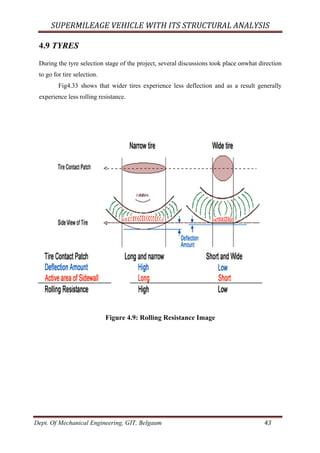
During the tyre selection stage of the project, several discussions took place onwhat direction
to go for tire selection.
Fig4.33 shows that wider tires experience less deflection and as a result generally
experience less rolling resistance.
	
Figure 4.9: Rolling Resistance Image
SUPERMILEAGE	VEHICLE	WITH	ITS	STRUCTURAL	ANALYSIS	
Dept. Of Mechanical Engineering, GIT, Belgaum	 44	
4.10 WHEELS
We are utilizing a “reverse tricycle” design for our vehicle. We will have two wheels in the
front and one wheel in the back. This three-wheel design offers more simplicity and less
rolling resistance than the four-wheel design, but is able to stand on its own as opposed to the
two-wheel design.
The size of all three wheels is 15in. There are numerous reasons for using different
sized wheels. Smaller wheels offer less rolling resistance, and therefore greater fuel economy.
The advantage of having the larger wheel is that it acts as a larger gear ratio. The engine can
operate at a lower rpm, meaning less fuel is being consumed.
Another added advantage of having the small wheels up front is that, because the brakes will
be there as well, the front axle will undergo more revolutions during the braking test. More
revolutions means the brake pads will have a much longer contact distance than if the wheels
were larger.
Figure 4.10: Wheels
SUPERMILEAGE	VEHICLE	WITH	ITS	STRUCTURAL	ANALYSIS	
Dept. Of Mechanical Engineering, GIT, Belgaum	 45	
4.11 FINAL DESIGN
Overall Design
	
Figure 4.11.1: CHASSIS
SUPERMILEAGE	VEHICLE	WITH	ITS	STRUCTURAL	ANALYSIS	
Dept. Of Mechanical Engineering, GIT, Belgaum	 46	
	
Figure 4.11.2: Solid Model of the Overall Design.
SUPERMILEAGE	VEHICLE	WITH	ITS	STRUCTURAL	ANALYSIS	
Dept. Of Mechanical Engineering, GIT, Belgaum	 47	
Figure 4.11.3: Complete Chassis with Steering and Engine Assembly
SUPERMILEAGE	VEHICLE	WITH	ITS	STRUCTURAL	ANALYSIS	
Dept. Of Mechanical Engineering, GIT, Belgaum	 48	
4.12 DRIVER ERGONOMICS
We have studied vehicle occupant posture and position to develop new models for use in
vehicle interior design. The overall goal of this research is to provide vehicle designers with
tools that will allow them to accurately predict how occupants, particularly drivers, will be
positioned in the vehicles. The models address key aspects of occupant posture, including
driver-selected seat position, driver eye location, and headroom.
These can be termed "functional anthropometry" because they involve measuring and
modeling particular task-oriented aspects of human posture. Traditional anthropometry is
focused on quantifying human size and shape. Our vehicle accommodation projects rely on
traditional anthropometric measures, particularly stature, to quantify the design populations,
but the models predict functional outcomes.
Posture Prediction for Automobile Drivers
An important component of driver ergonomics is the development of posture-prediction
models for vehicle occupants. The objective is to predict the postures that people will choose
as a function of occupant descriptors (gender, stature, weight...) and vehicle geometry
(steering wheel position, seat height, seat back angle...).
1. Driver’s Eye Position
2.Driver’s Head Position
3.Glass
4. Steering
5. Seat ( back angle of 1200
)
Fig 4.12.1: Posture for Driver
SUPERMILEAGE	VEHICLE	WITH	ITS	STRUCTURAL	ANALYSIS	
Dept. Of Mechanical Engineering, GIT, Belgaum	 49	
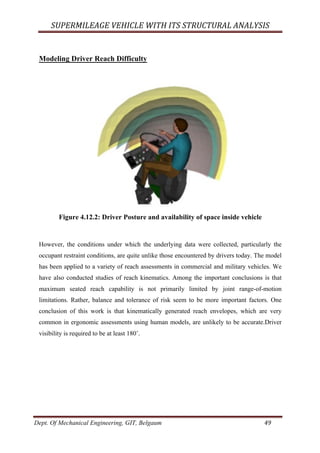
Modeling Driver Reach Difficulty
Figure 4.12.2: Driver Posture and availability of space inside vehicle
However, the conditions under which the underlying data were collected, particularly the
occupant restraint conditions, are quite unlike those encountered by drivers today. The model
has been applied to a variety of reach assessments in commercial and military vehicles. We
have also conducted studies of reach kinematics. Among the important conclusions is that
maximum seated reach capability is not primarily limited by joint range-of-motion
limitations. Rather, balance and tolerance of risk seem to be more important factors. One
conclusion of this work is that kinematically generated reach envelopes, which are very
common in ergonomic assessments using human models, are unlikely to be accurate.Driver
visibility is required to be at least 180˚.
SUPERMILEAGE	VEHICLE	WITH	ITS	STRUCTURAL	ANALYSIS	
Dept. Of Mechanical Engineering, GIT, Belgaum	 50	
4.13 FUEL TANK
A petrol fuel tank is a safe container for flammable fluids. Though any storage tank for fuel
may be so called, the term is typically applied to part of an engine system in which the fuel is
stored and propelled (fuel pump) or released (pressurized gas) into an engine.
Typically, a fuel tank must allow or provide the following:
• Storage of fuel: the system must contain a given quantity of fuel and must avoid
leakage and limit evaporative emissions
• Filling: the fuel tank must be filled in a secure way, without sparks
• Provide a method for determining level of fuel in tank, Gauging (the remaining
quantity of fuel in the tank must be measured or evaluated)
• Venting (if over-pressure is not allowed, the fuel vapors must be managed through
valves)
• Feeding of the engine (through a pump)
• Anticipate potentials for damage and provide safe survival potential.
Plastic (high-density polyethylene HDPE) as a fuel tank material of construction, while
functionally viable in the short term, has a long term potential to become saturated as fuels
such as diesel and gasoline permeate the HDPE material.
SUPERMILEAGE	VEHICLE	WITH	ITS	STRUCTURAL	ANALYSIS	
Dept. Of Mechanical Engineering, GIT, Belgaum	 51	
4.14 PAINTING
Like most types of metal surfaces, sheet aluminum is hard, slick and nonporous. This makes
it highly resistant to paint adhesion. Sheet aluminum must be pre-treated through abrasion to
help encourage it to accept paint. Unfortunately, we can't abrade aluminum by sanding it
because the surface is too hard. If you want to paint sheet aluminum, you'll need to use a
special kind of primer to rough up the surface or you will end up with a finish that will flake
and peel rather quickly.
PAINTING PROCESS:
ü Aluminium sheets have smooth surface, hence it is first roughened up with polish
paper.
ü Applied PU (brand name of paint) Surfacer, all over the body of vehicle.
ü Applied Car Patch with 400 no paper to all uneven surfaces and corners.
ü Applied HD PU paint, (MARINE BLUE COLOR), with thinner ( at ratio of 1:1) at
pressure of 60psi (Spray Painting).
ü Applied Dixon LACQUER coating with hardener (at the ratio of 2:1)at pressure of
60psi (Spray Painting) to get glazing surface.
SUPERMILEAGE	VEHICLE	WITH	ITS	STRUCTURAL	ANALYSIS	
Dept. Of Mechanical Engineering, GIT, Belgaum	 52	
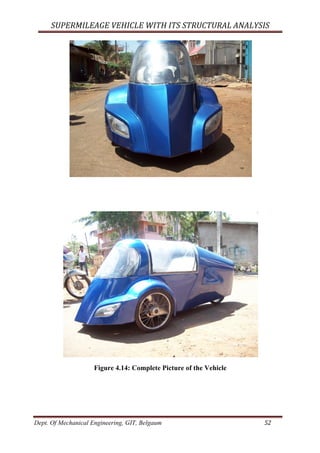
Figure 4.14: Complete Picture of the Vehicle
SUPERMILEAGE	VEHICLE	WITH	ITS	STRUCTURAL	ANALYSIS	
Dept. Of Mechanical Engineering, GIT, Belgaum	 53	
CHAPTER 5
INNOVATIONS & USEFULLNESS
The following are some of the features in our SuperMileage vehicle:-
ü Simple, effective design and construction.
ü Very economical.
ü Light weight vehicle
ü Easy to operate.
ü Very fuel efficient.
ü Compact size, easy for parking.
ü Since the vehicle is a three wheeler.
ü Exhaust gases are very less hence the vehicle is ecofriendly.
ü Smaller wheels offer less rolling resistance, and therefore greater fuel economy.
ü Aerodynamic chassis design, since the vehicle is shaped almost like a teardrop -- wide
and round up front and tapering off in the rear.
ü Since Generator engine is used, kerosene can also be used as an alternative.
ü Since three-wheelers handle extremely well they tend to have a low center of gravity.
ü Three-wheeler setup is called the Tadpole concept. Tadpole designs are much more stable
than any other setup because the back wheel drives the vehicle while the two wheels up
front are responsible for steering.
SUPERMILEAGE	VEHICLE	WITH	ITS	STRUCTURAL	ANALYSIS	
Dept. Of Mechanical Engineering, GIT, Belgaum	 54	
CHAPTER 6
TESTING
Testing for Speed,Load and Mileage without body:
The vehicle was made to run on a road with its maximum speed.
Vehicle weight with driver: 115kg.
Max Speed: 50kmph.
Mileage: 160kmpl.
Testing for speed, load and mileage with body:
Vehicle weight with driver: 140 kg.
Max Speed: 45 kmph.
Mileage: 130 kmpl.
Turning Radius:
Assuming wheel angle at 45deg, turning radius is 3.6m.
Braking:
At a speed of 45kmph, complete stop of vehicle in 5.2m.
SUPERMILEAGE	VEHICLE	WITH	ITS	STRUCTURAL	ANALYSIS	
Dept. Of Mechanical Engineering, GIT, Belgaum	 55	
CHAPTER 7
RESULTS
ü Successful fabrication and analysis of the chassis done.
ü Road testing yielded positive results. The vehicle could move successfully on road
with a maximum speed of 45 kmph.
ü The vehicle, in regular conditions, gave a very good mileage of around 130km for
every litre of fuel.
ü The vehicle gave a good stability control at its maximum speed.
ü The vehicle gave a good traction control.
SUPERMILEAGE	VEHICLE	WITH	ITS	STRUCTURAL	ANALYSIS	
Dept. Of Mechanical Engineering, GIT, Belgaum	 56	
CHAPTER 8
CONCLUSION
The apogee of this project is to design a vehicle that is extremely fuel efficient, and there are
numerous amounts of aspect that are to be considering in increasing the fuel efficiency of any
vehicle. Hence we conclusively decided to focus on the aerodynamics, propulsive and
weight-related attributes that contribute to the depletion of fuel efficiency and design and
manufacture a vehicle that is optimized around these key elements.
With respect to aerodynamics, the goal is to reduce the aerodynamic drag induced by
the vehicles outer shape during subsonic travel.
Just as the aerodynamic drag influences the amount of work the engine must perform,
so does the weight of the vehicle, with this into consideration, the main goal was to seek out
materials that would prove relatively strong and that are lightweight.
Hence the optimum mileage the team achieved is 130kmpl at the maximum speed of
45kmph with good stability and good traction control.
SUPERMILEAGE	VEHICLE	WITH	ITS	STRUCTURAL	ANALYSIS	
Dept. Of Mechanical Engineering, GIT, Belgaum	 57	
CHAPTER 9
SCOPE FOR FUTURE WORK
Since the Vehicle is the first of its kind and built for multipurpose use it’ll not have any direct
competitors in the market. The major advantage is its fuel efficiency and economy which will
attract people the most. Being the first to offer such a product, future competitors may not be
a major problem due to longer presence of our product.
In future, if this project is implemented and produced on a large scale, then there will
not be much problem of finance for middle class people of urban and rural society as instead
of opting for commercial vehicle or car they can opt for this product which satisfies both the
needs. Further, if this product is put into mass production its cost can be further reduced	
	
Aerodynamics	Refinement	
	
The current body shape is based of an approximated streamline body shape. However, no
formal fluid dynamics have been performed to refine the shape for minimum air drag. This is
a major goal to be accomplished over the break, and early into the build term.
Due to budget constraints and available resources,
a) CHASSIS: We have used Mild Steel for fabrication of chassis, which can be
replaced by Aluminum or Carbon Fiber, etc. which reduces the overall weight of the vehicle
considerably and improves the efficiency of the vehicle.
b) BODY OF THE VEHICLE: Replacement of Aluminium sheet with
carbon fiber or fiber glass improves the efficiency.
Hence overall, in future by conducting more research this project can be implemented
and produced on a larger scale.
SUPERMILEAGE	VEHICLE	WITH	ITS	STRUCTURAL	ANALYSIS	
Dept. Of Mechanical Engineering, GIT, Belgaum	 58	
CHAPTER 10
MARKET POTENTIAL AND COMPETITIVE
ADVANTAGE
Ø Since Fossil fuels reserves are decreasing day by day. In addition, pollution is also
other major concern. As more and more automobiles are launched every year the
space for parking has also become a problem. So the goal is to create a high fuel
efficiency vehicle, “to design and build a vehicle that uses the least amount of fuel to
travel the farthest distance.”
Ø As we know INDIA is the second largest country with highest population where
majority of the people are middle class. Since this is highly economical, many will be
able to afford this. A person who can’t afford a car or a commercial vehicle worth 4 to
5lacs can go for this Vehicle, which will cost them around 40k can be used as a car.
Ø Looking on the other side if people purchase this product also then another aspect
which comes into picture is whether they can afford the fuel because of petrol prices
rising day by day and becoming uneconomical for a common man. So the main
objective of this vehicle was fuel economy. Since the vehicle gives a mileage of 130
to 160 kmpl, it is considered as the best fuel economy which can be easily affordable
to common man.
SUPERMILEAGE	VEHICLE	WITH	ITS	STRUCTURAL	ANALYSIS	
Dept. Of Mechanical Engineering, GIT, Belgaum	 59	
CHAPTER 11
BILL OF MATERIALS
Item # Item Group Subgroup Cost (`)
1 Honda GK100
Generator Engine
Engine Components 11,500
2 20mm Round and
Square MS Pipes
Frame Raw Material 1,300
3 Wheel Hub Wheel Components 1,000
4 Tyres Wheel Components 1,400
5 Steering with Linkage 800
6 Disc Brake Wheel Components 1,200
7 Speedometer 1,000
8 Battery and Electrical
Components
Electrical Components 2,000
9 Aluminium Sheet Body Raw Material 6,000
10 Lights Electrical Components 1,800
11 Polycarbonate Sheet Body Raw Material 6,000
12 Foam Ergonomics Components 1,000
13 Paint Body - 3,000
14 Others - - 2,000
Total 40,000
SUPERMILEAGE	VEHICLE	WITH	ITS	STRUCTURAL	ANALYSIS	
Dept. Of Mechanical Engineering, GIT, Belgaum	 60	
CHAPTER 12
PROJECT TIMELINE
SUPERMILEAGE	VEHICLE	WITH	ITS	STRUCTURAL	ANALYSIS	
Dept. Of Mechanical Engineering, GIT, Belgaum	 61	
CHAPTER 13
REFERENCES
• Anderson Jr, J. D. (2001). Fundamentals of Aerodynamics, 3rd ed. New York, NY:
mcgraw-Hill.
• Anderson Jr., J. D. (1990). Modern Compressible Flow: With Historical Perspectives,
2 ed. New York: mccraw-Hill Publishing Company.
• Budynas-Nisbett. (11/08/2008). Mechanical Engineering: Shigley's Mechanical
Engineering Design, 8th ed. Columbus, OH: mcgraw-Hill.
• R.B.gupta. Automotive engineering 9th edition. 2010
• Krupal Singh , Automobile engineering vol1 and vol 2, 2009
• S. Srinivasan, Automotive mechanics ,TataMcgraw hill 2003.
• Joseph Heitner. Automotive Engineering : mechanics , principles and practices, , d
van nostrandcompany,inc
• Supermileage, S. (2010, 09 02). SAE Collegiate Design Series. Retrieved 01 29, 2010,
from Rules and Important Documents:
http://students.sae.org/competitions/supermileage/rules/
• Wikipedia. (2010 йил 13-11). Chassis. Retrieved 2010 йил 13-10 from Wikipedia:
http://en.wikipedia.org/wiki/Chassis
• DALHOUSIEUNIVERSITY–FACULTY OF ENGINEERING2009/2010
SUPERMILEAGE CAR – CHASSIS & SHELL MECH 4010 December Report

Final report SMV

  • 1.
    SUPERMILEAGE VEHICLE WITH ITS STRUCTURAL ANALYSIS Dept. Of MechanicalEngineering, GIT, Belgaum 1 CHAPTER: 1 INTRODUCTION The engineering design goal for SuperMileage is to develop a single person, extremely high mileage vehicle that complies with the SuperMileage rules. The vehicles will run a specified course with the vehicle obtaining the highest combined kilometers per liter rating or the goal is to create a high fuel efficiency vehicle or “To design and build a vehicle that uses the least amount of fuel to travel the farthest distance.” Figure 1: Overview of the SuperMileage Vehicle
  • 2.
    SUPERMILEAGE VEHICLE WITH ITS STRUCTURAL ANALYSIS Dept. Of MechanicalEngineering, GIT, Belgaum 2 CHAPTER: 2 PROJECT DESCRIPTION 2.1 Engine and Power train: The engine to be used is Honda GK 100 97 cc. The engine is 4 strokes, Air Cooled, Single Cylinder, and Horizontal Shaft, with a 1.3 kW @ 4,200 rpm. 2. 2 Transmission: CVT [Pulley Based CVT] Unlike traditional automatic transmissions, continuously variable transmissions don't have a gearbox with a set number of gears, which means they don't have interlocking toothed wheels. The most common type of CVT operates on an ingenious pulley system that allows an infinite variability between highest and lowest gears with no discrete steps or shifts 2.3 Steering: The vehicle will feature “twin tie rod” mechanism, which takes a radius of 17 feet. 2.4 Chassis: Chassis design is space frame, fabricated using 20 mm square & round MS Pipe of thickness 1.5mm. 2.5 Tyres: The tires are of size 15inch diameter, puncture resistant, lightweight, low rolling friction and will feature silica energy rubber mix to ensure excellent grip and will feature more tread to maximize the propulsion and minimize the slip. 2.6 Hub: Hub is made of casted Aluminium with dimensions: Outer Diameter – 80mm Inner Diameter – 58mm Length – 74mm .
  • 3.
    SUPERMILEAGE VEHICLE WITH ITS STRUCTURAL ANALYSIS Dept. Of MechanicalEngineering, GIT, Belgaum 3 2.7 Brake System: Due to the fact that the vehicle is set to have an average speed of 45 kmph, the bicycle breaks capable of bring the vehicle to a complete stop in 5.2 meters, traveling at a speed of 45 kmph. 2.8 Electrical Systems: Batteries will be used to power; the starting system, ignition, instrumentation and lights 2.9 Exhaust System: Engine exhaust will be directed to exit the body of the vehicle by the way of an insulated exhaust pipe.
  • 4.
    SUPERMILEAGE VEHICLE WITH ITS STRUCTURAL ANALYSIS Dept. Of MechanicalEngineering, GIT, Belgaum 4 CHAPTER: 3 LITERATURE SURVEY ü We attended a workshop on “AUTOMOTIVE INNOVATIONS”, conducted by METAWING at BITS, GOA, from where we understood the concept of SuperMileage vehicle. ü Referring to various SAE SuperMileage competitions we understood about the competitions and the various concepts to build SuperMileage vehicle. ü The SAE SuperMileage Competition is a yearly fuel efficiency competition held near Detroit, Michigan. The Society of Automotive Engineers is the primary sponsor. Around 30 teams compete to build the vehicle that uses the least amount of gas to go a specified distance. Teams are required to use a one cylinder lawnmower engine provided by Briggs & Stratton, but significant modification is allowed. ü Referred to the Journal of DALHOUSIE UNIVERSITY - 2009/2010 SUPERMILEAGE CAR - CHASSIS AND SHELL Figure: Overall Final Design from journal of Dalhousie University
  • 5.
    SUPERMILEAGE VEHICLE WITH ITS STRUCTURAL ANALYSIS Dept. Of MechanicalEngineering, GIT, Belgaum 5 The goal of the team was to achieve the highest fuel efficiency possible by designing a totally new body and frame with less rolling and aerodynamic resistance than previous designs. The main focuses are weight and air drag reduction. Depending on the final budget, some components of vehicle will be reused, such as wheels, bearings, and safety components. FINITE ELEMENT ANALYSIS FEA was done with theoretical calculations and also then compared result which was done in the software NX 5.0.4.1 DESIGN ANALYSIS The decision was made to model the shell shape after a streamlined body, and modify the shape to conform to the chassis design. It was first decided to have a closed wheel design, to eliminate the complex front end dimensions, as well as prevent the steering mechanism from protruding outside the shell. During the construction of the shell, group 15 will be consulted on the locations of the air intake and exhaust outlet Once the shell was fabricated, driver fitting and testing will be done to determine the most effective locations for side and front windows. These will be made from polycarbonate plastic, 1/16” thick, and formed by hand with a heat gun. It was possible to form the polycarbonate with a heat gun with thin material THE CHASSIS REQUIREMENTS INCLUDE: A newly designed chassis that will meet or exceed the safety standards as Determined by Shell, and contain all structural support components needed for theengine, steering, wheels, and other crucial components. The chassis was designed with the ability to withstand loads predetermined by Shell. This was to ensure driver safety in the event of an impact or rollover. Additionally, the chassis was designed in combination with the body to produce significant gains in driver visibility. Driver visibility required to be at least 180˚. The chassis will include a mandatory firewall; its design will be selected from apredetermined specification put forward by Shell. The chassis was made of either a light weight composite such as carbon fiber, or a high strength aluminum alloy. This depends on the final budget of the project and design considerations. A combination of materials may be used to maximize the strength to weight ratio of the car.
  • 6.
    SUPERMILEAGE VEHICLE WITH ITS STRUCTURAL ANALYSIS Dept. Of MechanicalEngineering, GIT, Belgaum 6 THE BODY REQUIREMENTS INCLUDE: A newly designed body which will encase the chassis and corresponding components. Maximum dimensions as specified by Shell • Maximum height = 1 meter, or 1.25 times the track width for stability. • Maximum length = 3 meters. • Maximum width = 1.3 meters. The drag coefficient for the body must be minimized. Our goal was to design a body which has a smaller drag coefficient than 0.15, The length of the body and vehicle in general, will be decreased, therefore reducing weight. With weight reduction being a priority, aerodynamics may be greatly improved. The body will be designed with a lightweight composite and will be for aerodynamics and aesthetics only. To minimize weight, the body will not carry any load other than wind, and external components such as mirrors and tail lights. THE STEERING REQUIREMENTS INCLUDE: The steering system must allow for a minimum turning radius which will be specifiedby the Shell Eco Marathon Regulations. This system will also be precise and robust for stability and driver safety during the competition. THE OVERALL PROJECT GOALS INCLUDE: A 15% reduction in weight affects reduction in rolling resistance in the SuperMileage car. If budget requires the use of previously used rolling components, the rolling resistance will be reduced by reducing the weight. Improved driver visibility while obtaining aerodynamics . CONCLUSION : The design is much shorter than the 2008/2009 car, with a wheelbase of approximately 55.5”,The overall weight of the vehicle was estimated to be a total of 58 lbs. This is a conservative estimate, taking into account the maximum weight of the body, wheels, and miscellaneous components. This results in a weight reduction and should translate into a direct reduction in rolling resistance.
  • 7.
    SUPERMILEAGE VEHICLE WITH ITS STRUCTURAL ANALYSIS Dept. Of MechanicalEngineering, GIT, Belgaum 7 Budget The overall cost of the vehicle was approximately $1560 CAD. Also detailed Finite Element Analysis report was attached F.E.A. Report Simulation Report Author: labuser Company: UGS Date: 12/6/2009 Software Used: NX 5.0.4.1 Solution Summary Environment Solution: Solution 1 Solver: NX NASTRAN
  • 8.
    SUPERMILEAGE VEHICLE WITH ITS STRUCTURAL ANALYSIS Dept. Of MechanicalEngineering, GIT, Belgaum 8 CHAPTER: 4 FABRICATION METHODOLOGY 4.1 AERODYNAMICS A simple definition of aerodynamics is the study of the flow of air around and through a vehicle, primarily if it is in motion. Energy is required to move a car through the air; this energy is also used to overcome a force called drag. Drag is determined by vehicle speed, frontal area, air density, and shape. Figure 1 shows how the shape affects drag. Figure 4.1.1: Change in Drag and Friction with Changing Shape The aerodynamic drag on cars are caused by following; pressures that act on the front area of the car, suction at the rear of the car, underbody regions and roughness of the vehicle surface such as protrusions and projections. Figure 4.2 and Figure 4.3 illustrate the frontal vacuum and the rear suction respectively.
  • 9.
    SUPERMILEAGE VEHICLE WITH ITS STRUCTURAL ANALYSIS Dept. Of MechanicalEngineering, GIT, Belgaum 9 Figure 4.1.2: Frontal Pressure caused by Flowing Air Figure 4.1.3: Rear Vacuum Caused By Flowing Air. ü Drag on automobiles is calculated using the following equation Equation 1 Dr = Cd * S * ½ * ρ*U^2 Where, Dr – Drag force in Newton Cd – Drag coefficient S – Cross sectional area metered squared ρ–Air density kilograms per meter cubed U – Speed meters per second ü In order to overcome drag the car must exert a certain power, which is given by the formula : Equation 2 Pd = ½ * p * v^3 *A *Cd
  • 10.
    SUPERMILEAGE VEHICLE WITH ITS STRUCTURAL ANALYSIS Dept. Of MechanicalEngineering, GIT, Belgaum 10 By reducing the drag coefficient of a car it results in better fuel economy. A typical car burns 50% of its fuel overcoming air resistance at speed of 45 kmph making aerodynamic design very important when attempting to hit high mileage. ü The amount of work from drag can be found from Equation 3: Equation 3 W= Fd * d Where, W is the work, Fd is the drag force D is the distance traveled by the car while drag is acting on it. Using a wind tunnel and/or using computer simulations can achieve testing the aerodynamic features of a car design. The wind tunnel is the proving ground for the vehicle's form and allows engineers to obtain considerable amounts of advanced information within a controlled environment. A car in a wind tunnel can be seen in fig 4.4 Figure 4.1.4: Car in a Wind Tunnel With the reference to Journal of DALHOUSIEUNIVERSITY–2009/2010 SUPERMILEAGE CAR and also since our chassis structure is as same as that from the journal, as the above calculations shows that lesser the drag co-efficient, larger is the Drag Force, which also helps in improving the efficiency. Hence this indicates our Chassis is of Aerodynamic design.
  • 11.
    SUPERMILEAGE VEHICLE WITH ITS STRUCTURAL ANALYSIS Dept. Of MechanicalEngineering, GIT, Belgaum 11 4.2 CHASSIS DESIGN Initial Concept Selection Initial chassis considerations led to the selection of a space frame for the chassis. The space frame concept would allow maximum stability, safety and minimum weight. To reduce material volume it was decided that a compact driver orientation was most suitable. A totally prone driver position results in a car that must be very long, and as a result requires a stronger chassis material to withstand chassis bending. Another identified area for potential size and weight savings was the orientation of the firewall. In an attempt to maximize compactness of the vehicle, the team decided that the firewall should be slanted rearward over the drive train, thus giving the driver a backrest and minimizing wasted space. Material Selection The decision to utilize lightweight tubing led to the direct comparison of three readily available materials: Aluminum, Mild Steel and Stainless steel tubing. The tubing was compared on the basis of strength, weight per unit length and cost per unit weight. Figure 4.2.1: Weight/Unit Length Comparison
  • 12.
    SUPERMILEAGE VEHICLE WITH ITS STRUCTURAL ANALYSIS Dept. Of MechanicalEngineering, GIT, Belgaum 12 Figure4.2.2: Yield Strength Comparison As seen from the figure, Mild Steel is much stronger but little heavier than Aluminum.From this consideration, the Aluminum tubing was selected for the chassis, but was later revised to Mild Steel tubing because of budget considerations. Figure 7 compares the costs between the materials. Figure 4.2.3: Cost Comparison The Aluminum tubing is approximately 5 times more expensive per unit weight than the Mild Steel pipe. There were also several factors involved in the decision such as construction
  • 13.
    SUPERMILEAGE VEHICLE WITH ITS STRUCTURAL ANALYSIS Dept. Of MechanicalEngineering, GIT, Belgaum 13 The largest consideration was due to the actual construction requirements of the material.Aluminum cannot be welded in any configuration, whereas the Mild steel pipe supports any type of welding. The Aluminum& Stainless Steel tubing may also have been simply unnecessary, as the chassis for this vehicle is not exceedingly demanding of performance, and will experience minimal loads. Simplicity and cost deemed the aluminum tubing the most appropriate material for this application. Considering availability, cost of materials, corrosion, weight and strength etc. we decided to use MILD STEEL PIPE of thickness 1.5mm and diameter 20mm (after theoretical calculations, as attached below)
  • 14.
    SUPERMILEAGE VEHICLE WITH ITS STRUCTURAL ANALYSIS Dept. Of MechanicalEngineering, GIT, Belgaum 14 4.3 DESIGN ANALYSIS AND REFINEMENT 4.3.1 Initial calculations The frame was initially modeled as a two dimensional frame with beams undergoing bending and axial loading. Figure 4.8 and 4.9 shows the initial 3-D and 2-D view of the chassis respectively. Figure 4.3.1(1): 3 D View of Chassis in CATIA V5
  • 15.
    SUPERMILEAGE VEHICLE WITH ITS STRUCTURAL ANALYSIS Dept. Of MechanicalEngineering, GIT, Belgaum 15 Figure 4.3.1(2): 2 D View of Chassis
  • 16.
    SUPERMILEAGE VEHICLE WITH ITS STRUCTURAL ANALYSIS Dept. Of MechanicalEngineering, GIT, Belgaum 16 FORCE CALCULATIONS • Mass of car = 65 kg Mass of person = 75 kg. Total weight of car = 140kg. • Top speed (0-45Kph) ( velocity = 45*1000/3600 = 12.5m/s) • After impact car will move distance of 1.3 -2 meter ( nearly considered for this speed we will consider 1.5) Front Impact: • E = 0.5mv^2 0.5 * 140 * 12.5 ^ 2 = 10,937.5 Hence front impact force will be = 10,937.5 / 1.5 = 7291.66 N • While applying load during analysis fix rear part of vehicle (x-0, y-0, Z-0) and apply load on font part (7291.66N/no of nodes) Side Impact: • For side impact same calculation and take speed of other car is 45 kmph and distance 2.5 -3.m.and loading during analysis same concept as front. Hence Side impact force will be = 10,937.5 / 2.5 = 4375 N • While applying load during analysis fix rear part of vehicle (x-0, y-0, Z-0) and apply load on font part ( 4375 N/no of nodes)
  • 17.
    SUPERMILEAGE VEHICLE WITH ITS STRUCTURAL ANALYSIS Dept. Of MechanicalEngineering, GIT, Belgaum 17 4.3.2 ANALYSIS The analysis of chassis is consists of front impact test,side impact test. these was very important to know that whether selected material Mild Steel of c/s 20*1.5 is able to with stand both these test. the material and dimension we selected 1st is depending upon availability, by keeping total weight of car, type of welding which we are easily accessible etc. and then further we decided to know whether this dimension material is able to with stand loads by considering FOS 3. Figure 4.3.2(1): Chassis Constraint and Loading Condition
  • 18.
    SUPERMILEAGE VEHICLE WITH ITS STRUCTURAL ANALYSIS Dept. Of MechanicalEngineering, GIT, Belgaum 18 Again using the convergence method, we were able to converge onto approximate results. Figure 4.3.2(2): Chassis Stressed Figure 4.11 shows deflection, but this is not the actual deflection of the member. This isthe deflection of the elements compressing. It does give an idea of the relativedeflection of the various members.
  • 19.
    SUPERMILEAGE VEHICLE WITH ITS STRUCTURAL ANALYSIS Dept. Of MechanicalEngineering, GIT, Belgaum 19 Figure 4.3.2(3): Chassis is subjected to Static Loads. We applied the static loads i.e. engine weight and driver’s weight on the chassis. After the static loading from the analysis we observed maximum deflection of 6.812 mm in the chassis as shown in fig. 4.12.
  • 20.
    SUPERMILEAGE VEHICLE WITH ITS STRUCTURAL ANALYSIS Dept. Of MechanicalEngineering, GIT, Belgaum 20 Figure 4.3.2(4): Chassis is subjected to Side Impacts. We carried out side impact test on same chassis by applying load at one side and fixing other wheel side. And we got deflection 13.683mm and stress 292MPa for FOS of 3. Hence we assumed that the stress is within the yield stress of MS and design is same hence no need to increase thickness of material for more strength and deflection can be incorporate by providing triangulation at sides. Considering FACTOR OF SAFETY (FOS) = 3, the maximum stresses (red color in fig. 4.13indicates Maximum stress acting) are at the joints, which is lesser than the Yield Strength of Mild Steel i.e. 310MPa. Hence this Indicates our Design is safe
  • 21.
    SUPERMILEAGE VEHICLE WITH ITS STRUCTURAL ANALYSIS Dept. Of MechanicalEngineering, GIT, Belgaum 21 Figure 4.3.2(5): Chassis is subjected to Front Impacts. The test was carried on chassis for 1st assumed dimension, by applying the force on front end of chassis and fixing the rear engine side or wheel side (ALL DOF =0).We assumed that its worst condition that rear wheel gets locked and it was not moved during front impact and all loads is transferred to other part of chassis.And we got the maximum defection of 6mm and maximum Von misses stress is 240mpa. For Factor of Safety of 3 which is well within the yield stress of material and to avoid the deflection we incorporated triangulation in our chassis for more strength. Considering Factor of safety as 3, we conclude from the above results the design of the structure of Chassis is safe.
  • 22.
    SUPERMILEAGE VEHICLE WITH ITS STRUCTURAL ANALYSIS Dept. Of MechanicalEngineering, GIT, Belgaum 22 Final Design Figure 4.3.2(6): The Final Design for the Chassis Hence from the above results we conclude that,by considering FOS = 3, the design is safe for this structure of: Type of material: Mild Steel Pipe Thickness: 1.5mm Diameter: 20mm
  • 23.
    SUPERMILEAGE VEHICLE WITH ITS STRUCTURAL ANALYSIS Dept. Of MechanicalEngineering, GIT, Belgaum 23 4.4 THEORETICAL CALCULATIONS 1) CALCULATION OF CG: To find the center of gravity (CG) of the vehicle and locate the engine in the vehicle: The location of the CG of the vehicle is one of the most fundamental determinations of performance, because the cornering force capability is very dependent on the vertical load applied on the tyre. A) First step to find CG – To calculate individual wheel load WF = Wl + Wr = (45+45) kg WR = 50kg Hence W = WF + WR= 140 kg Track Width = 1m Wheel base =1.456m B) Total Wheel Horizontal Location of CG (X & Y) – By referring figure 1and applying simple geometrical relation, we can find CG in XY-plane. 2)TOTAL WEIGHT OF THE CAR : W = 140Kg [65Kg (Car Weight) + 75Kg (Driver Weight) Wf = 75Kg (Driver) + 15Kg (Other components) Hence, Wf = 90Kg.
  • 24.
    SUPERMILEAGE VEHICLE WITH ITS STRUCTURAL ANALYSIS Dept. Of MechanicalEngineering, GIT, Belgaum 24 Figure 4.4.(1): Horizontal Location of CG By geometry, ð W * b = Wf * L b = Wf * L / W b = 90 * 1.46 / 140 b = 0.94m. Hence, a = 0.52m (Because L = a + b) By geometry, = >y’ = [W2 / W * (Tf – d)] – [W1/W * (d)] d = 1m/2 d =0.5m Hence, y’ = [45(Kg) / 140(Kg)] * 0.5m - [45(Kg) / 140(Kg)] y’ = 0 Normally in three wheel y’ = 0. i.e. its center line. Figure 4.4.(2): Location of CG 3) Total Vehicle Vertical Location of CG can be practically determined: Jack the rare axle up so that it forms some angle (450 ) with the horizontal as shown:By basic geometry, we can apply the geometry relation to find out the CG as shown in fig 4.4.3.
  • 25.
    SUPERMILEAGE VEHICLE WITH ITS STRUCTURAL ANALYSIS Dept. Of MechanicalEngineering, GIT, Belgaum 25 Figure 4.4.(3): Vertical Location of CG ð L1 = Lcosθ L1 = 1.46 cos450 [Maximum Angle Raised for CG] L1 = 1.032m Taking moment about ‘O’ WfL1 = Wb1 ð b1 = WfL1 / W b1 = 90 * 1.032 / 140 b1 = 0.66m. By geometry, W tanθ * h1 = Wf*L – W * b • h1 = [Wf*L – W * b] / W tanθ = [90 * 1.46 – 140 * 0.94] / 140 tan 450 = 0.2 / 140 h1 = 1.428 * 10-3 m h1 = 1.428 mm Let, h = Loaded radius of wheel + h1 = [7” = 175mm] from ground = 175 + 1.428 h = 176.428 mm from ground
  • 26.
    SUPERMILEAGE VEHICLE WITH ITS STRUCTURAL ANALYSIS Dept. Of MechanicalEngineering, GIT, Belgaum 26 CHASSIS CALCULATION To begin the chassis pipe calculation, we should know the maximum force that is cornering on the member by considering FOS=3. This can be done by calculating Lateral Force, Longitudinal Force, Dynamic Force etc. 1) Lateral Load Transfer: When the vehicle is at constant speed, an internal reaction force called Centrifugal Force is developed which opposes the lateral acceleration produced by tyre cornering force. WL = Left Wheel Wr= Right wheel Where, t =1.46m Fig 4.4.(4): Lateral Load Transfer Figure 4.4.(5): Ay Graph
  • 27.
    SUPERMILEAGE VEHICLE WITH ITS STRUCTURAL ANALYSIS Dept. Of MechanicalEngineering, GIT, Belgaum 27 Weight transfer due to cornering force is given by the relation, ΔW = WL- Wt / 2 = WAy h / t Ay = A / B = 50 (lbs) / 45 (lbs) Ay = 1.11 ΔWL = 140(kg) * 1.11* 357.42(mm) / 1460(mm) ΔWL = 38.61 This extra force on the wheel while cornering [i.e. inner wheel]. 2) Longitudinal Weight Transfer: During Acceleration or Braking, Inertial Force is developed that is similar to the Centrifugal Force. Fig 4.4.(6): Longitudinal Weight Transfer Taking moment about pt ‘O’. ΔWLo= (h / l) * W * Ay = (357.42 / 1460) * 140 * 1.11 [same procedure] = 38.61 kg ΔWLo= 380N (Because 38.61* 9.81)
  • 28.
    SUPERMILEAGE VEHICLE WITH ITS STRUCTURAL ANALYSIS Dept. Of MechanicalEngineering, GIT, Belgaum 28 3) Static Force: Since total weight, W = Wf + WR = 90(kg) + 50(kg) W = 140(kg) The calculation is same as done to find out the C.G. 4) Dynamic Force: Dynamic force is 0.6 to 0.8 times the static force for more FOS. Hence we take double the static force. Therefore maximum load on each wheel is = Sum of [static load (w) + dynamic load (Wd) + lateral load due to lateral load transfer (ΔWL) + Longitudinal load due to long loading transfer (ΔWLo)] Therefore load on front perpendicular wheel can be calculated as, Weight Ratio taken as, = 60:40 (F: R) (because of loading) • Wf = 0.6 * 140 = 84 N, on each Wheel 1. For single wheel= 420N 2. Dynamic = 420N (same as it) 3. Lateral = 370N 4. Longitudinal = 380N Hence, Wt= 1590N
  • 29.
    SUPERMILEAGE VEHICLE WITH ITS STRUCTURAL ANALYSIS Dept. Of MechanicalEngineering, GIT, Belgaum 29 Fig 4.4.(7): Forces Acting on Square Pipe Then, • F’ * 0.3= 1590*0.5 • F’ = 2650N [maximum force produced at element ‘E’] If we design for that maximum load on this (round) pipe, and we can keep the same dimension for the other (square) pipe too. Now if we analyze this vertical (square) pipe it acts like column with both ends fixed.
  • 30.
    SUPERMILEAGE VEHICLE WITH ITS STRUCTURAL ANALYSIS Dept. Of MechanicalEngineering, GIT, Belgaum 30 • Pcr = critical load Pcr = 4π2 EI / L2 • I = bd3 / 12 I = (π/64) (do 4 – di 4 ) Taking FOS=3 (for column usually taken) Pcr= L2 = 4 π2 EI I = (429300000 / 4 π2 * 210 * 103 ) I = 57mm4 I= (π / 64) (do 4 – di 4 ) 57 = (π/64) (25.44 - di 4 ) di = 25.3 nearly 24m (0.5mm) Hence based on availability, corrosion, cost of material, weight etc we have taken thickness as,t= 1.5mm Checking for the Bending moment of pipe, which is subjected to high bending stress.
  • 31.
    SUPERMILEAGE VEHICLE WITH ITS STRUCTURAL ANALYSIS Dept. Of MechanicalEngineering, GIT, Belgaum 31 (If not full force transfer, it part of 1590N we take 1590N for safety) σb = (MI) / Y [for mild steel σb = 310MPa] 310 (MPa) = M/Z (also Z= (π / 64) (do 4 – di 4 ) / (d / 2) Z= (π / 32) [(do 4 – di 4 ) / do]) Z= M / 310 = (1590 * 250) /310 = 1204.5mm3 Z = (1204.5 * 32) / π= (do 4 – di 4 ) / do = 12269.3 = (do 4 – di 4 ) / do do = 20mm (taken) And also is sufficient based on availability, cost, weight etc. Not any part of chassis is going to subject stresses more than σy = 310MPa For FOS = 3 Hence we fix t =1.5mm do= 20mm.
  • 32.
    SUPERMILEAGE VEHICLE WITH ITS STRUCTURAL ANALYSIS Dept. Of MechanicalEngineering, GIT, Belgaum 32 4.5 THE ENGINE An Engine-generator is the combination of an electrical generator and an engine (prime mover) mounted together to form a single piece of equipment. This combination is also called an engine-generator set or a gen-set. In many contexts, the engine is taken for granted and the combined unit is simply called a generator. ENGINE SPECIFICATIONS: Type 4 Stroke, Air Cooled, Single Cylinder, Horizontal Shaft Displacement 97cc Max. Horse Power 1.8 HP / 4200rpm Maximum Torque 0.4 kg.m / 3000rpm Ignition System TCI Air Cleaner Semi Dry Fuel Tank Capacity 1.5 liters (Kerosene), 0.25 liters (Gasoline) Dry Weight 10.5 kg Dimensions (L x W x H) 275 x 263 x 340 mm Figure 4.5: Honda GK100
  • 33.
    SUPERMILEAGE VEHICLE WITH ITS STRUCTURAL ANALYSIS Dept. Of MechanicalEngineering, GIT, Belgaum 33 4.5.1 Drive Train and Transmission Achieving maximum efficiency out of the drive train takes careful thought. Internal combustion engines are most efficient at a particular engine speed. Therefore, we want to run the engine at or around this speed as much as possible. The drive train must be geared to allow the engine to run at said speed for most of the acceleration period. Since the engine won’t constantly be at the specified RPM, the best we can do is to accelerate and “hit” the RPM on the way up to our final speed. This is the function that the drive train must perform. Figure 4.5.1: Continuous variable transmission (CVT)
  • 34.
    SUPERMILEAGE VEHICLE WITH ITS STRUCTURAL ANALYSIS Dept. Of MechanicalEngineering, GIT, Belgaum 34 The actual construction is based on knowledge of various power transmission systems. A Continuous Variable Transmission (CVT) was considered as it wouldallow accelerationwhile maintaining a constant engine RPM, therefore staying in that optimal range during acceleration. However, belt and pulley driven systems have more losses in them in comparison to gears or chains due to internal friction of the rubber belts. Therefore a sprocket and chain system was decided upon. In normal vehicles, there are many gears to allow a wide range of speeds. A multiple speed system will be implemented as one speed will not be sufficient to drive the vehicle over its desired velocity range due to the low power of the engine. The design is to use a back wheel hub gear with 3 gear ratios to achieve this. This will allow enough flexibility for acceleration from rest with ease and drive at the maximum speed at a regular engine speed.
  • 35.
    SUPERMILEAGE VEHICLE WITH ITS STRUCTURAL ANALYSIS Dept. Of MechanicalEngineering, GIT, Belgaum 35 4.6 HUB A hub is the center part of a bicycle wheel. It consists of an axle, bearings and a hub shell. The hub shell typically has 2 machined metal flanges to which spokes can be attached. Hub shells can be one-piece with press-in cartridge or free bearings or, in the case of older designs; the flanges may be affixed to a separate hub shell Hub shell The hub shell is the part of the hub to which the spokes (or disc structure) attach. The hub shell of a spoked wheel generally has two flanges extending radially outward from the axle. Each flange has holes or slots to which spokes are affixed. Some wheels (like the Full Speed Ahead RD-800) have an additional flange in the center of the hub. Figure 4.6: HUB
  • 36.
    SUPERMILEAGE VEHICLE WITH ITS STRUCTURAL ANALYSIS Dept. Of MechanicalEngineering, GIT, Belgaum 36 4.7 STEERING MECHANISM There are many different options for the steering design. We have looked at three different systems which include a simple four link, rack and pinion and the Ackerman style setup. Simple Four Links The four-link as seen in Figure 28 is a simple mechanism, consisting of a cross bar which acts to pivot the wheels evenly. There are only a few parts which help to reduce weight. It also leaves space between the wheelsfor the driver’s legs. Figure 4.7.1: Simple Four Link Mechanism
  • 37.
    SUPERMILEAGE VEHICLE WITH ITS STRUCTURAL ANALYSIS Dept. Of MechanicalEngineering, GIT, Belgaum 37 Rack and Pinion The rack and pinion system in figure 4.26 utilizes a rack andpinion gear combination to turn the wheels. This may be a little more difficult tobuild where the rack would need a solid surface to slide across. The benefit ofthis system is that it requires a relatively small space. The disadvantage is thatthese devices are relatively expensive and heavy since most are made out ofsteel. Figure 4.7.2: Rack and Pinion Steering Mechanism 1. Steering 2. Steering rod 3. Rack &Pinion 4. Linkage with universal joints 5. Wheel Hub
  • 38.
    SUPERMILEAGE VEHICLE WITH ITS STRUCTURAL ANALYSIS Dept. Of MechanicalEngineering, GIT, Belgaum 38 Ackerman Steering Mechanism This mechanism utilizes a central pivot with linkage rodsconnected to the front spindles to turn the wheels. The setup causes the wheelsto turn at slightly different angle which decreases rolling resistance. But as these all steering mechanisms consists more number of linkages, which increases the weight of the steering mechanism, which in turn increases the overall weight of the vehicle. Figure 4.7.3: Ackerman Steering Mechanism Since Twin Tie rod steering mechanism is light weight steering mechanism compared to the above steering mechanism, we decided to incorporate the Twin Tie Rod mechanism…
  • 39.
    SUPERMILEAGE VEHICLE WITH ITS STRUCTURAL ANALYSIS Dept. Of MechanicalEngineering, GIT, Belgaum 39 TWIN TIE ROD STEERINGMECHANISM Tie rods transfer and control motion between components in machines and motor vehicles. Each front wheel on most automobiles has its own tie rod to connect it to the power steering unit. Six or more tie rods may also control the motion of each of the four wheels in sophisticated automotive suspension systems to deliver high-performance handling along with a smooth ride. Tie rods usually have pivoting or ball joint ends that allow the parts they connect to swivel, rock, or turn in whatever positional orientation is necessary to accomplish their function. These bars are also used as connecting rods to resolve linear motion into rotating motion with crankshafts and crank wheels on machines and appliances. They allow one motor or transmission output to actuate a number of functional levers, arms, or shafts connected to it. A tie rod usually has a threaded length adjustment section that allows the rod to be tailored to the exact needs of a mechanical application. Since they can transmit large forces, they are usually made of high-strength tempered steel and plated to protect against corrosion. Tie rods are extensively used for steering control on many modes of transportation besides cars and trucks. On boats and ships, they move outboard motors, stern drives, and rudders. Airplanes of all types use tie rods to connect mechanical and hydraulic actuators to flight control surfaces on wings and stabilizers. They also help raise and lower landing gear, open and close doors and hatches, and control the motion of seats and seat backs. Riding lawn mowers, snow throwers, and many other powered implements, including farm tractors and harvesters, use the tie rod mechanism extensively to control the motion of their functioning parts. This can include height adjustments and horizontal and vertical orientation. In the living room, the tie rod allows the recliner to tilt to that just-right position for a nap. It would be practically impossible to create those exciting amusement park rides without tie rods securely connecting major components. Tie rods play a key role in automotive performance and safety, and should be carefully inspected during periodic maintenance. While they are designed to perform reliably for many years, driving too hard over obstacles such as curbs and potholes can bend a tie rod,
  • 40.
    SUPERMILEAGE VEHICLE WITH ITS STRUCTURAL ANALYSIS Dept. Of MechanicalEngineering, GIT, Belgaum 40 or pound its ends loose. While some car makers use maintenance-free tie rods, some do recommend lubrication each time the oil is changed. Figure 4.7.4: Twin tie rod Steering Mechanism The steering assembly must provide the car with the ability to navigate a maneuverability course as part of the SuperMileage competition. The car make an untimed 50 foot turn around a set of cones and then turn through 4 cones spaced 25 feet apart in less than 15 seconds. Figure 4.7.5: Steering Wheel
  • 41.
    SUPERMILEAGE VEHICLE WITH ITS STRUCTURAL ANALYSIS Dept. Of MechanicalEngineering, GIT, Belgaum 41 The steering must be through a “natural” steering system meaning that the driver will turn the steering wheel to the left and the car will steer left and the driver will turn the wheel right and the car will steer right. The steering system must provide the car with a reliable way to safely steer the car through the maneuverability course, as well as along the rest of the course. In case of emergency, it is important that the steering assembly not interfere with the Driver’s ability to remove himself from the vehicle in less than 15 seconds in case of an emergency and a maximum of two support personnel must be able to remove the driver from the vehicle in less than 20 seconds. It is also critical that the steering column assembly not interfere with the driver’s ability to see in compliance with the forward field of vision requirements. TURNING RADIUS OF THE VEHICLE: The turning radius or turning circle of a vehicle is the size of the smallest circular turn (i.e. U- turn) that the vehicle is capable of making. The term turning radius is a misnomer, since the size of a circle is actually its diameter, not its radius. Figure 4.7.6: At wheel angle of 450 . The turning radius of the vehicle is 3.6m.
  • 42.
    SUPERMILEAGE VEHICLE WITH ITS STRUCTURAL ANALYSIS Dept. Of MechanicalEngineering, GIT, Belgaum 42 4.8 BRAKING When it comes to the braking system for the SuperMileage car, there are several technical requirements that the vehicle must pass. These include a prescribed braking distance, the location of brake actuator, and specifications on the braking test to be performed. One of the tests to be performed during the evaluation day of the competition is the braking test. The breaking test consists of three sections: an acceleration zone that is a minimum of 90 m, a zone that the vehicle must coast through in less than 1.5 seconds with a length of 7.5 m, and finally the braking zone, which is 5.2 m long. While in the acceleration zone, the vehicle must accelerate to a minimum speed of 45kmph and then come to a complete stop within the braking zone. The figure below is from the SAE SuperMileage Rulebook and is a diagram showing the three zones: Figure 4.8.1: Braking Zone Specifications We will be using hydraulic disc brakes for our vehicle. The most common forms of brakes are disc brakes, rim brakes (commonly found on bicycle wheels), and drum brakes. Both drum and rim brakes are much simpler and cheaper than 15disc brakes, but do not offer comparable braking power. Disc brakes are much more powerful for the same size. Therefore, the objective now is to find one powerful enough to stop the vehicle within the 4 m space. By mounting the disc brakes in the front of the vehicle, we will be able to get the maximum braking power out of them. Figure 4.8.2: Disc Brake Systems
  • 43.
    SUPERMILEAGE VEHICLE WITH ITS STRUCTURAL ANALYSIS Dept. Of MechanicalEngineering, GIT, Belgaum 43 4.9 TYRES During the tyre selection stage of the project, several discussions took place onwhat direction to go for tire selection. Fig4.33 shows that wider tires experience less deflection and as a result generally experience less rolling resistance. Figure 4.9: Rolling Resistance Image
  • 44.
    SUPERMILEAGE VEHICLE WITH ITS STRUCTURAL ANALYSIS Dept. Of MechanicalEngineering, GIT, Belgaum 44 4.10 WHEELS We are utilizing a “reverse tricycle” design for our vehicle. We will have two wheels in the front and one wheel in the back. This three-wheel design offers more simplicity and less rolling resistance than the four-wheel design, but is able to stand on its own as opposed to the two-wheel design. The size of all three wheels is 15in. There are numerous reasons for using different sized wheels. Smaller wheels offer less rolling resistance, and therefore greater fuel economy. The advantage of having the larger wheel is that it acts as a larger gear ratio. The engine can operate at a lower rpm, meaning less fuel is being consumed. Another added advantage of having the small wheels up front is that, because the brakes will be there as well, the front axle will undergo more revolutions during the braking test. More revolutions means the brake pads will have a much longer contact distance than if the wheels were larger. Figure 4.10: Wheels
  • 45.
    SUPERMILEAGE VEHICLE WITH ITS STRUCTURAL ANALYSIS Dept. Of MechanicalEngineering, GIT, Belgaum 45 4.11 FINAL DESIGN Overall Design Figure 4.11.1: CHASSIS
  • 46.
    SUPERMILEAGE VEHICLE WITH ITS STRUCTURAL ANALYSIS Dept. Of MechanicalEngineering, GIT, Belgaum 46 Figure 4.11.2: Solid Model of the Overall Design.
  • 47.
    SUPERMILEAGE VEHICLE WITH ITS STRUCTURAL ANALYSIS Dept. Of MechanicalEngineering, GIT, Belgaum 47 Figure 4.11.3: Complete Chassis with Steering and Engine Assembly
  • 48.
    SUPERMILEAGE VEHICLE WITH ITS STRUCTURAL ANALYSIS Dept. Of MechanicalEngineering, GIT, Belgaum 48 4.12 DRIVER ERGONOMICS We have studied vehicle occupant posture and position to develop new models for use in vehicle interior design. The overall goal of this research is to provide vehicle designers with tools that will allow them to accurately predict how occupants, particularly drivers, will be positioned in the vehicles. The models address key aspects of occupant posture, including driver-selected seat position, driver eye location, and headroom. These can be termed "functional anthropometry" because they involve measuring and modeling particular task-oriented aspects of human posture. Traditional anthropometry is focused on quantifying human size and shape. Our vehicle accommodation projects rely on traditional anthropometric measures, particularly stature, to quantify the design populations, but the models predict functional outcomes. Posture Prediction for Automobile Drivers An important component of driver ergonomics is the development of posture-prediction models for vehicle occupants. The objective is to predict the postures that people will choose as a function of occupant descriptors (gender, stature, weight...) and vehicle geometry (steering wheel position, seat height, seat back angle...). 1. Driver’s Eye Position 2.Driver’s Head Position 3.Glass 4. Steering 5. Seat ( back angle of 1200 ) Fig 4.12.1: Posture for Driver
  • 49.
    SUPERMILEAGE VEHICLE WITH ITS STRUCTURAL ANALYSIS Dept. Of MechanicalEngineering, GIT, Belgaum 49 Modeling Driver Reach Difficulty Figure 4.12.2: Driver Posture and availability of space inside vehicle However, the conditions under which the underlying data were collected, particularly the occupant restraint conditions, are quite unlike those encountered by drivers today. The model has been applied to a variety of reach assessments in commercial and military vehicles. We have also conducted studies of reach kinematics. Among the important conclusions is that maximum seated reach capability is not primarily limited by joint range-of-motion limitations. Rather, balance and tolerance of risk seem to be more important factors. One conclusion of this work is that kinematically generated reach envelopes, which are very common in ergonomic assessments using human models, are unlikely to be accurate.Driver visibility is required to be at least 180˚.
  • 50.
    SUPERMILEAGE VEHICLE WITH ITS STRUCTURAL ANALYSIS Dept. Of MechanicalEngineering, GIT, Belgaum 50 4.13 FUEL TANK A petrol fuel tank is a safe container for flammable fluids. Though any storage tank for fuel may be so called, the term is typically applied to part of an engine system in which the fuel is stored and propelled (fuel pump) or released (pressurized gas) into an engine. Typically, a fuel tank must allow or provide the following: • Storage of fuel: the system must contain a given quantity of fuel and must avoid leakage and limit evaporative emissions • Filling: the fuel tank must be filled in a secure way, without sparks • Provide a method for determining level of fuel in tank, Gauging (the remaining quantity of fuel in the tank must be measured or evaluated) • Venting (if over-pressure is not allowed, the fuel vapors must be managed through valves) • Feeding of the engine (through a pump) • Anticipate potentials for damage and provide safe survival potential. Plastic (high-density polyethylene HDPE) as a fuel tank material of construction, while functionally viable in the short term, has a long term potential to become saturated as fuels such as diesel and gasoline permeate the HDPE material.
  • 51.
    SUPERMILEAGE VEHICLE WITH ITS STRUCTURAL ANALYSIS Dept. Of MechanicalEngineering, GIT, Belgaum 51 4.14 PAINTING Like most types of metal surfaces, sheet aluminum is hard, slick and nonporous. This makes it highly resistant to paint adhesion. Sheet aluminum must be pre-treated through abrasion to help encourage it to accept paint. Unfortunately, we can't abrade aluminum by sanding it because the surface is too hard. If you want to paint sheet aluminum, you'll need to use a special kind of primer to rough up the surface or you will end up with a finish that will flake and peel rather quickly. PAINTING PROCESS: ü Aluminium sheets have smooth surface, hence it is first roughened up with polish paper. ü Applied PU (brand name of paint) Surfacer, all over the body of vehicle. ü Applied Car Patch with 400 no paper to all uneven surfaces and corners. ü Applied HD PU paint, (MARINE BLUE COLOR), with thinner ( at ratio of 1:1) at pressure of 60psi (Spray Painting). ü Applied Dixon LACQUER coating with hardener (at the ratio of 2:1)at pressure of 60psi (Spray Painting) to get glazing surface.
  • 52.
    SUPERMILEAGE VEHICLE WITH ITS STRUCTURAL ANALYSIS Dept. Of MechanicalEngineering, GIT, Belgaum 52 Figure 4.14: Complete Picture of the Vehicle
  • 53.
    SUPERMILEAGE VEHICLE WITH ITS STRUCTURAL ANALYSIS Dept. Of MechanicalEngineering, GIT, Belgaum 53 CHAPTER 5 INNOVATIONS & USEFULLNESS The following are some of the features in our SuperMileage vehicle:- ü Simple, effective design and construction. ü Very economical. ü Light weight vehicle ü Easy to operate. ü Very fuel efficient. ü Compact size, easy for parking. ü Since the vehicle is a three wheeler. ü Exhaust gases are very less hence the vehicle is ecofriendly. ü Smaller wheels offer less rolling resistance, and therefore greater fuel economy. ü Aerodynamic chassis design, since the vehicle is shaped almost like a teardrop -- wide and round up front and tapering off in the rear. ü Since Generator engine is used, kerosene can also be used as an alternative. ü Since three-wheelers handle extremely well they tend to have a low center of gravity. ü Three-wheeler setup is called the Tadpole concept. Tadpole designs are much more stable than any other setup because the back wheel drives the vehicle while the two wheels up front are responsible for steering.
  • 54.
    SUPERMILEAGE VEHICLE WITH ITS STRUCTURAL ANALYSIS Dept. Of MechanicalEngineering, GIT, Belgaum 54 CHAPTER 6 TESTING Testing for Speed,Load and Mileage without body: The vehicle was made to run on a road with its maximum speed. Vehicle weight with driver: 115kg. Max Speed: 50kmph. Mileage: 160kmpl. Testing for speed, load and mileage with body: Vehicle weight with driver: 140 kg. Max Speed: 45 kmph. Mileage: 130 kmpl. Turning Radius: Assuming wheel angle at 45deg, turning radius is 3.6m. Braking: At a speed of 45kmph, complete stop of vehicle in 5.2m.
  • 55.
    SUPERMILEAGE VEHICLE WITH ITS STRUCTURAL ANALYSIS Dept. Of MechanicalEngineering, GIT, Belgaum 55 CHAPTER 7 RESULTS ü Successful fabrication and analysis of the chassis done. ü Road testing yielded positive results. The vehicle could move successfully on road with a maximum speed of 45 kmph. ü The vehicle, in regular conditions, gave a very good mileage of around 130km for every litre of fuel. ü The vehicle gave a good stability control at its maximum speed. ü The vehicle gave a good traction control.
  • 56.
    SUPERMILEAGE VEHICLE WITH ITS STRUCTURAL ANALYSIS Dept. Of MechanicalEngineering, GIT, Belgaum 56 CHAPTER 8 CONCLUSION The apogee of this project is to design a vehicle that is extremely fuel efficient, and there are numerous amounts of aspect that are to be considering in increasing the fuel efficiency of any vehicle. Hence we conclusively decided to focus on the aerodynamics, propulsive and weight-related attributes that contribute to the depletion of fuel efficiency and design and manufacture a vehicle that is optimized around these key elements. With respect to aerodynamics, the goal is to reduce the aerodynamic drag induced by the vehicles outer shape during subsonic travel. Just as the aerodynamic drag influences the amount of work the engine must perform, so does the weight of the vehicle, with this into consideration, the main goal was to seek out materials that would prove relatively strong and that are lightweight. Hence the optimum mileage the team achieved is 130kmpl at the maximum speed of 45kmph with good stability and good traction control.
  • 57.
    SUPERMILEAGE VEHICLE WITH ITS STRUCTURAL ANALYSIS Dept. Of MechanicalEngineering, GIT, Belgaum 57 CHAPTER 9 SCOPE FOR FUTURE WORK Since the Vehicle is the first of its kind and built for multipurpose use it’ll not have any direct competitors in the market. The major advantage is its fuel efficiency and economy which will attract people the most. Being the first to offer such a product, future competitors may not be a major problem due to longer presence of our product. In future, if this project is implemented and produced on a large scale, then there will not be much problem of finance for middle class people of urban and rural society as instead of opting for commercial vehicle or car they can opt for this product which satisfies both the needs. Further, if this product is put into mass production its cost can be further reduced Aerodynamics Refinement The current body shape is based of an approximated streamline body shape. However, no formal fluid dynamics have been performed to refine the shape for minimum air drag. This is a major goal to be accomplished over the break, and early into the build term. Due to budget constraints and available resources, a) CHASSIS: We have used Mild Steel for fabrication of chassis, which can be replaced by Aluminum or Carbon Fiber, etc. which reduces the overall weight of the vehicle considerably and improves the efficiency of the vehicle. b) BODY OF THE VEHICLE: Replacement of Aluminium sheet with carbon fiber or fiber glass improves the efficiency. Hence overall, in future by conducting more research this project can be implemented and produced on a larger scale.
  • 58.
    SUPERMILEAGE VEHICLE WITH ITS STRUCTURAL ANALYSIS Dept. Of MechanicalEngineering, GIT, Belgaum 58 CHAPTER 10 MARKET POTENTIAL AND COMPETITIVE ADVANTAGE Ø Since Fossil fuels reserves are decreasing day by day. In addition, pollution is also other major concern. As more and more automobiles are launched every year the space for parking has also become a problem. So the goal is to create a high fuel efficiency vehicle, “to design and build a vehicle that uses the least amount of fuel to travel the farthest distance.” Ø As we know INDIA is the second largest country with highest population where majority of the people are middle class. Since this is highly economical, many will be able to afford this. A person who can’t afford a car or a commercial vehicle worth 4 to 5lacs can go for this Vehicle, which will cost them around 40k can be used as a car. Ø Looking on the other side if people purchase this product also then another aspect which comes into picture is whether they can afford the fuel because of petrol prices rising day by day and becoming uneconomical for a common man. So the main objective of this vehicle was fuel economy. Since the vehicle gives a mileage of 130 to 160 kmpl, it is considered as the best fuel economy which can be easily affordable to common man.
  • 59.
    SUPERMILEAGE VEHICLE WITH ITS STRUCTURAL ANALYSIS Dept. Of MechanicalEngineering, GIT, Belgaum 59 CHAPTER 11 BILL OF MATERIALS Item # Item Group Subgroup Cost (`) 1 Honda GK100 Generator Engine Engine Components 11,500 2 20mm Round and Square MS Pipes Frame Raw Material 1,300 3 Wheel Hub Wheel Components 1,000 4 Tyres Wheel Components 1,400 5 Steering with Linkage 800 6 Disc Brake Wheel Components 1,200 7 Speedometer 1,000 8 Battery and Electrical Components Electrical Components 2,000 9 Aluminium Sheet Body Raw Material 6,000 10 Lights Electrical Components 1,800 11 Polycarbonate Sheet Body Raw Material 6,000 12 Foam Ergonomics Components 1,000 13 Paint Body - 3,000 14 Others - - 2,000 Total 40,000
  • 60.
    SUPERMILEAGE VEHICLE WITH ITS STRUCTURAL ANALYSIS Dept. Of MechanicalEngineering, GIT, Belgaum 60 CHAPTER 12 PROJECT TIMELINE
  • 61.
    SUPERMILEAGE VEHICLE WITH ITS STRUCTURAL ANALYSIS Dept. Of MechanicalEngineering, GIT, Belgaum 61 CHAPTER 13 REFERENCES • Anderson Jr, J. D. (2001). Fundamentals of Aerodynamics, 3rd ed. New York, NY: mcgraw-Hill. • Anderson Jr., J. D. (1990). Modern Compressible Flow: With Historical Perspectives, 2 ed. New York: mccraw-Hill Publishing Company. • Budynas-Nisbett. (11/08/2008). Mechanical Engineering: Shigley's Mechanical Engineering Design, 8th ed. Columbus, OH: mcgraw-Hill. • R.B.gupta. Automotive engineering 9th edition. 2010 • Krupal Singh , Automobile engineering vol1 and vol 2, 2009 • S. Srinivasan, Automotive mechanics ,TataMcgraw hill 2003. • Joseph Heitner. Automotive Engineering : mechanics , principles and practices, , d van nostrandcompany,inc • Supermileage, S. (2010, 09 02). SAE Collegiate Design Series. Retrieved 01 29, 2010, from Rules and Important Documents: http://students.sae.org/competitions/supermileage/rules/ • Wikipedia. (2010 йил 13-11). Chassis. Retrieved 2010 йил 13-10 from Wikipedia: http://en.wikipedia.org/wiki/Chassis • DALHOUSIEUNIVERSITY–FACULTY OF ENGINEERING2009/2010 SUPERMILEAGE CAR – CHASSIS & SHELL MECH 4010 December Report