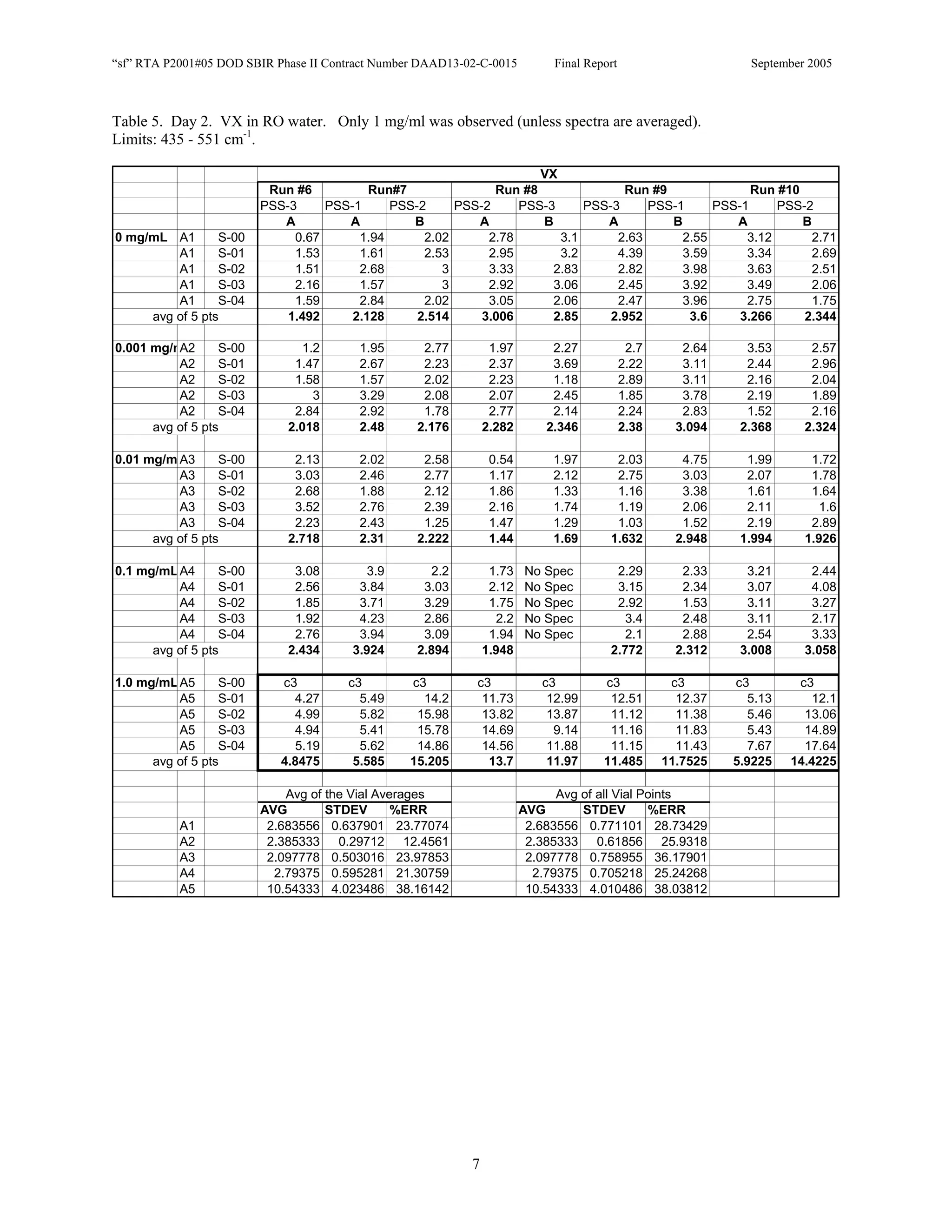
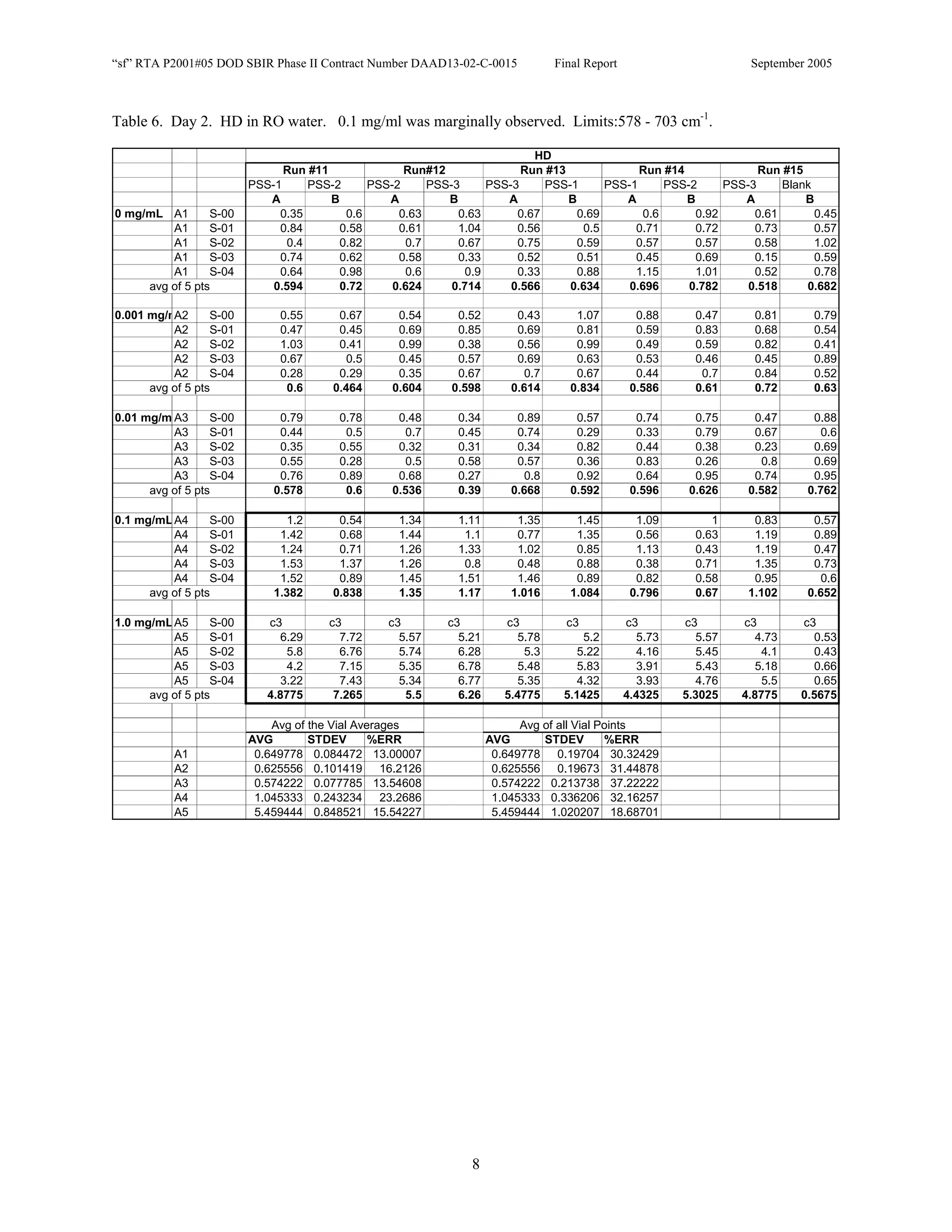
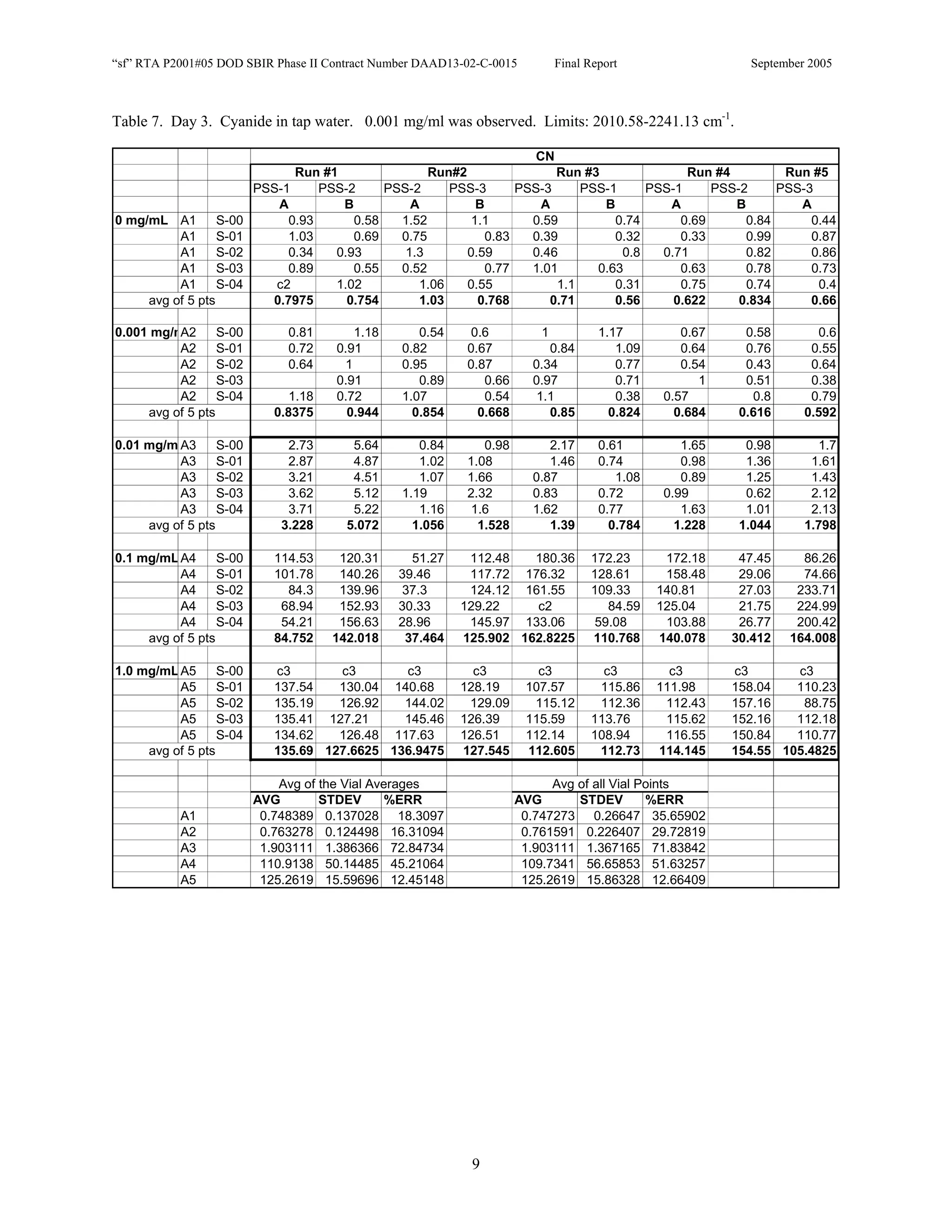
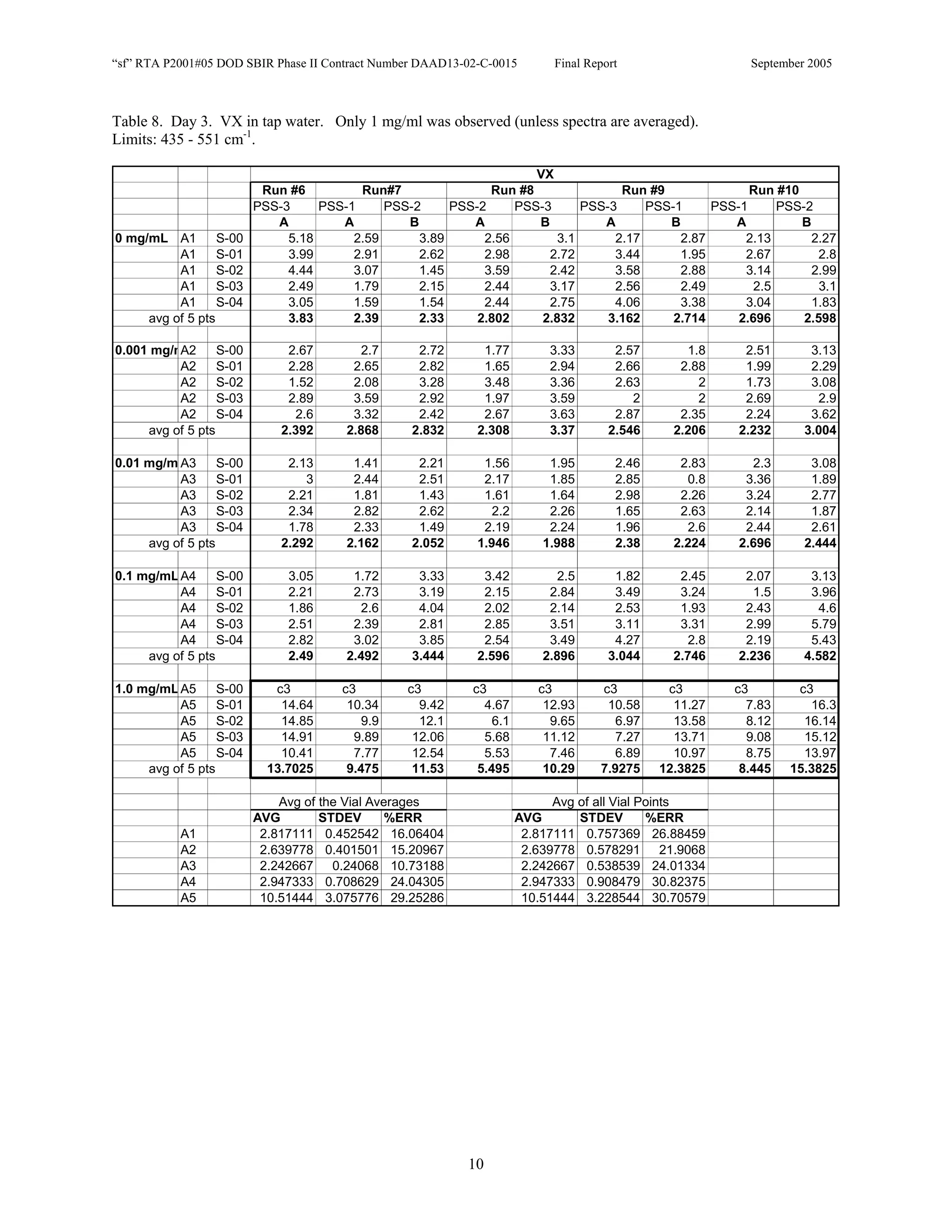
CRC Book Chapter 5                                          Draft
                                                                      Appendix L

           Surface-enhanced Raman detection of chemical agents in water
                             Steven Christesen, Kevin Spencer, Stuart Farquharson,
                             Frank Inscore, Kristina Gonser, and Jason Guicheteau

                                               I.    INTRODUCTION
     In 1994 and 1995, sarin gas was released in the Japanese cities of Matsumoto and Tokyo,1 respectively by
members of the AUM Shinrikyo religious cult. Later in 1995, the same group attempted to poison commuters in
Tokyo with cyanide.1,2 Fortunately, the cyanide producing devices were discovered before they could be used.
Although unsophisticated by military standards, the two sarin attacks resulted in 19 deaths and almost 6000 people
injured. More than 30 deliberate chemical releases were reported in Japan in 1998 alone causing more deaths and
injuries.
     The agent used in the Tokyo and Matsumoto attacks (sarin or GB) is one of a class of toxic organophosphorus
nerve agents that include soman (GD), tabun (GA), cyclo-sarin GF and VX (no common name). These nerve agents
are particularly toxic and have LD50’s ranging from 24 milligrams per kilogram of body weight for sarin to 0.07
mg/kg for VX, where the LD50 is defined as the lethal dose of a liquid agent causing death in 50% of a given
population via percutaneous liquid exposure on bare skin.3 Organophosphorus nerve agents are toxic because they
bind to acetylcholinesterase enzymes (AChE) thereby inactivating them and allowing the neurotransmitter
acetylcholine to accumulate at synapses. Symptoms of nerve agent poisoning include twitching, pinpointed pupils,
convulsions, coma, and eventually death if the level of exposure is high enough.
     The threat of terrorism within the United States became a reality in 2001 with the attacks on the Pentagon
building and the World Trade Center towers. The mailing of anthrax, shortly thereafter, and the salmonella
poisonings of salad bars in Oregon by the followers of Bhagwan Shree Rajneesh are just two examples of biological
terrorism in the US. The variety of terrorist attacks and the widespread use of GA, GB, and GF in the Iraq/Iran war
suggest that chemical warfare agents must be considered as a potential weapon against the US. Although the
majority of these incidents have involved vapor or aerosol dispersal of the agent, the threat to water supplies is
obvious and techniques for quickly and accurately identifying the threat are needed.
     The Army’s water quality standards for allowable chemical agent contamination levels in drinking water are
published in the Department of the Army’s Technical Bulletin TB MED 577 Sanitary Control and Surveillance of
Field Water Supplies.4 This document is in the process of being updated to include new standards for chemical agent
contamination. The new standards are expected to conform generally to the recommendations of the National
Academy of Sciences (NAS) Subcommittee on Guidelines for Military Field Drinking-Water Quality,5 which are
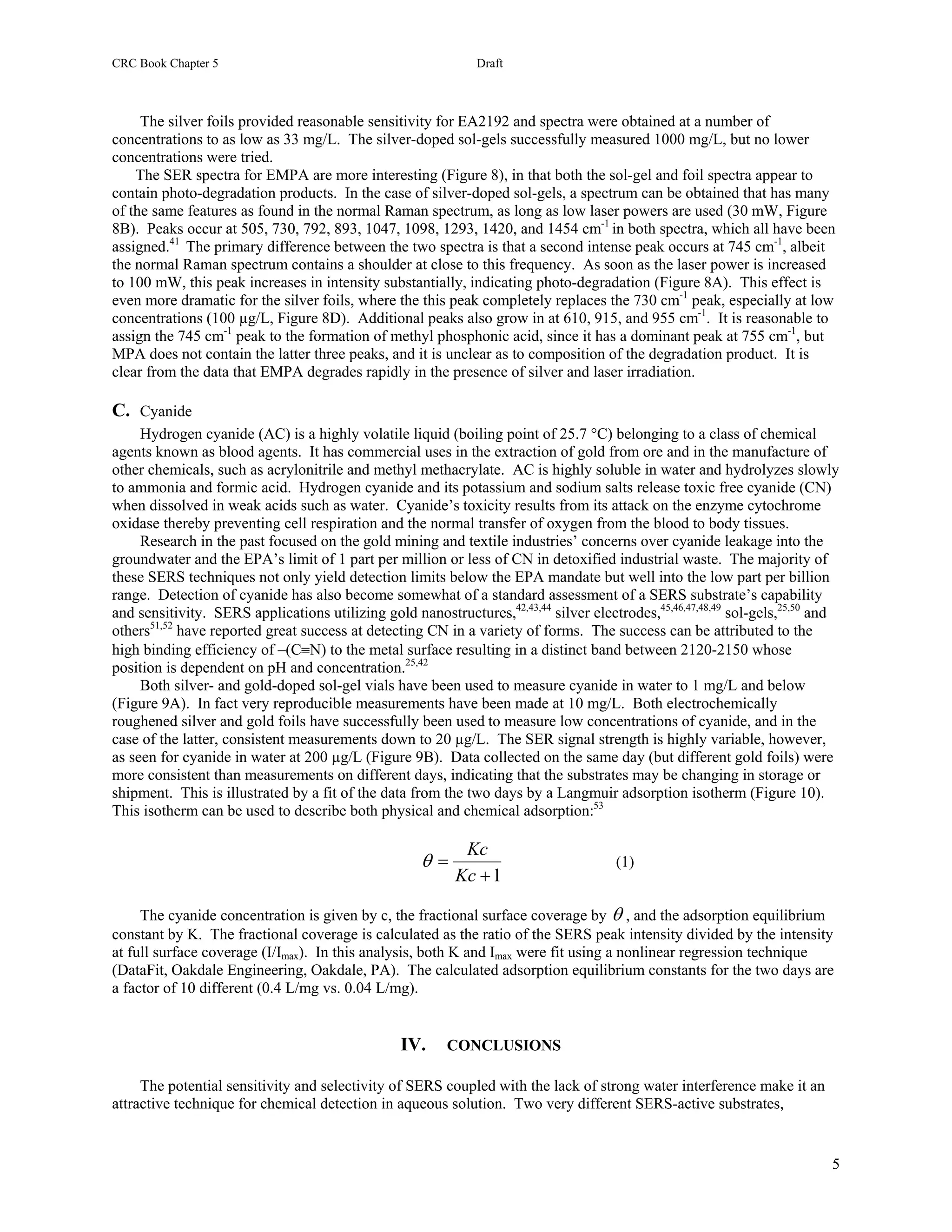
shown in Table 1. In the case of nerve agents, these limits are based on a modeled 25% inhibition of AChE, and
represent a “no observed adverse effect level” (NOAEL).
      Another class of chemical agents is the vesicants that include sulfur mustard (HD), three variations of nitrogen
mustard (HN-1, HN-2, and HN-3), and lewisite (L). The ingestion of low concentrations of HD in water is expected
to result in gastrointestinal irritation. Based on toxicity studies on rats, the military guideline limits were set at 47
µg/L and 140 µg/L for water consumption rates of 15 and 5 liters/day, respectively. Although used in World War I,
and by the Aum Shinrikyo terroists, hydrogen cyanide is not considered a militarily significant agent due to its high
volatility and rapid detoxification by humans. Environmental cyanide contamination of water, however, can occur
as the result of industrial processes such as electroplating and metal polishing. Cyanide is not nearly as toxic as the
nerve agents or mustard, but its ready availability lends itself to possible use by terrorists to poison water supplies.
     The military’s M272 water testing kit, first fielded in 1984, is currently used to detect and identify chemical
agents in treated and source water. Agents are detected via color changing reactions with sensitivities of 0.02 mg/L
for nerve agents, 2 mg/L for mustard and lewisite, and 20 mg/L for cyanide.6 In general, the M272 is very sensitive
and meets the current requirements listed in TB MED 577, but it is not sufficiently sensitive to ensure that water
meets the recommended water quality standards shown in Table 1. In addition, the vials and chemicals used in the
kit are not easily manipulated when wearing a protective suit, mask, and gloves.
          In an effort to meet military and national security needs for detecting chemical agents in water,
sophisticated laboratory methods have been investigated with reasonable success. More than a decade ago, Black et
al. demonstrated the ability of combining gas chromatography with mass spectrometry detection (GC/MS) to
measure sarin and mustard.7 Sega at al. used GC with a phosphorous-selective flame ionization detector to analyze
nerve agent hydrolysis products in groundwater,8 while several researchers used capillary electrophoresis (CE) to
measure chemical warfare agents and their hydrolysis products.9, 10, 11 The sensitivity of these techniques has
improved by two orders of magnitude from 1 mg/L to 0.01 mg/L in 10 years. A comprehensive development of


                                                                                                                       1
CRC Book Chapter 5                                           Draft


these techniques was undertaken by Creasy et al. in analyzing chemical weapon decontamination waste from the
Johnston Atoll.12,13 These researchers used GC/MS for nerve agents, GC coupled atomic emission detection for
arsenic compounds, LC/MS for mustard compounds, and CE with ultraviolet absorption detection for alkyl
phosphonic acids. Detection limits of 0.02 and 0.140 mg/L were reported for nerve agents and mustard,
respectively. Detection of the alkyl phosphonic acids have proven more difficult, and Liu, Hu and Xie recently used
GC/MS to detect mg/L concentrations of these degradation products.14 However, they concede that all of these
separation methods require extraction, derivatization, and repeated column calibration, making them labor intensive,
time consuming (typically 30 to 60 minutes), and less than desirable for field use. Another variant of these
separation/mass detection technologies is ion mobility spectrometry (IMS).15 This technology has been successfully
developed to measure explosives in air samples, and commercial products can be found at most airports.16 Eiceman
et al. have investigated the ability of IMS to measure organophosphorous compounds in air,17 while Steiner et al.
have investigated IMS to measure chemical agent simulants in water.18 In the latter case, electrospray ionization
was coupled to the sample entry point of an IMS, and a time-of-flight MS was added as an orthogonal detector.
Water samples spiked with 10 mg/L diisopropylmethylphosponate and thiodiglycol could be measured in 1-min,
once sample pretreatment was accomplished. It is worth noting that with proper care these MS-based technologies
are likely to detect chemical agents with virtually no false-positives, but detection limits are still insufficient by 1 to
2 orders of magnitude in the case of nerve agents and their hydrolysis products.
     Raman spectroscopy, using both NIR19 and UV20 laser excitation, has found military application for the
detection and identification of chemical agents. The highly selective nature of the Raman spectrum makes this
technology ideal for non-intrusive and/or short range remote detection of highly concentrated samples. But the trace
level detection sensitivity required for chemical agents in water is beyond the capabilities of normal Raman
spectroscopy. Improved sensitivity, however, can be achieved with surface-enhanced Raman spectroscopy (SERS).
Work by Vo-Dinh on the SERS detection of organophosphorus insecticides21 and organophosphonate vapors22 using
silver coated spheres and oxidized silver foils, respectively, demonstrated the potential efficacy of SERS for nerve
agent detection. More recently, two different SERS substrates, one produced by electrochemical roughening of
silver or gold foils23 and one produced by gold- or silver-doped sol-gels24,25 were used to measure the primary
hydrolysis of nerve agents, methyl phosphonic acid, with detection limits of 50 to 100 µg/L, respectively. In order
to develop a SERS sensor for detecting chemical agents in water, however, sensitivity and reproducibility need to be
demonstrated for actual chemical agents in all classes. To this end, results on the detection of VX, HD, CN, and
their hydrolysis products using SERS these substrates are presented.


                                                II.    EXPERIMENTAL

A. SERS Substrates
     1. Electrochemically Roughened Silver Foils
     The electrochemically roughened silver substrate foils (EIC Laboratories, Inc., Norwood, MA) were prepared as
described in Reference 26 from silver foil coupons (Surepure) cut to a size of ¼” x ½” on a dedicated jeweler’s saw.
The cut edges and faces were smoothed to mirror flatness using 0.3 µm Al2O3 polish then washed and stored in 0.1
M KOH solution prior to electrochemical roughening in 0.1 M KCl using a platinum gauze counter electrode.
Roughening was accomplished by cycling 20 times at a sweep rate of 10 mV/s with upper and lower limits of 0.25
and -0.6V versus silver/silver chloride, respectively. The silver substrate foils were electrochemically cleaned at
cathodic potential to remove chemical impurities and then soaked overnight in water to remove excess chloride ion.
These foils were then electrochemically cycled in sodium hydroxide to create a thick hydroxide layer, which
stabilizes the silver chemistry and reduces its propensity for oxidation. The gold and silver foils were shipped to US
Army Chemical Biological Center (ECBC) for agent testing and generally used within a week of manufacture. All
measurements were made by either dipping the foil directly into the solution or by spotting the foil with less than 10
µL of the analyte in water. In both cases, the sample was allowed to dry on the substrate foil before recording the
SER spectrum.

     2. Silver- or Gold-Doped Sol-Gels
     The sol-gel coated vials were prepared by Real-Time Analyzers, Inc. (RTA, Middletown, CT) using procedures
previously published by Farquharson et al.27 Silver-doped sol-gels were formed by adding ammonium hydroxide to
a solution of silver nitrate, tetramethyl orthosilicate (TMOS), and methanol. Gold-doped sol-gels were coated by


                                                                                                                         2
CRC Book Chapter 5                                          Draft


adding nitric acid to a solution of gold tetrachloride, TMOS and methanol. The two precursor solutions were
prepared, mixed, and transferred to 2-ml glass vials, dried and heated. After sol-gel formation, the incorporated
metal ions were reduced with dilute sodium borohydride (1 mg/ml), followed by a water wash to remove residual
reducing agent. The sol-gel vials were produced at RTA and shipped to ECBC for testing. In all cases, the vials
were filled with the desired agent in solution, capped, and then the SER spectrum was recorded.

B. Sample Preparation
     Stock solutions of HD, VX, and EA2192 were prepared at the ECBC by using Chemical Agent Analytical
Reference Material (CASARM)-Grade neat agent (95+ % purity). Cyanide solutions were made by dissolving KCN
(Aldrich) in DI water. For the measurements using the roughened metal foils, the samples were prepared by
dissolving the neat agent in distilled, deionized (DI) water at approximately 1 mg/ml and making serial,
volumetrically dilutions to achieve the lower concentrations. For the measurements using silver- and gold-doped
sol-gel coated vials the neat agents were dissolved in 2-propanol prior to the addition of DI water. In this case,
samples of several concentrations were prepared just prior to the start of each test. The percentage of 2-propanol
was kept constant throughout the volumetric dilution series. Typically, the HD and VX samples contained 1.1 %
and 2.0 % 2-propanol, respectively.

C. Instrumentation
     Tests were preformed using two different Raman instruments. For the measurements with roughened silver
foils, a dispersive Raman spectrometer, comprised of a 785 nm diode laser (300 mW), an echelle spectrograph, and
a TE cooled CCD camera operating at approximately 45°C below ambient (model RS2000, InPhotonics, Norwood,
MA), was used to acquire 1 cm-1 resolution spectra.19 The laser was fiber optically coupled to a sample chamber
box using a RamanProbeTM (InPhotonics). The probe both conveyed the laser light to the sample and served as an
optical filtering device to remove background signals arising in the fiber optic cable.
     For measurements using sol-gel coated vials, a Fourier transform Raman spectrometer (model IRA-785, Real-
Time Analyzers) equipped with a silicon photo-avalanche detector (Perkin Elmer model C30902S, Stamford, CT)
was used to acquire spectra at a resolution of 8 cm-1. A 785 nm diode laser (model 785-600, Process Instruments,
Salt Lake City, UT) delivered approximately100 mW of power to the sample through a 30 foot fiber optic cable,
such that the instrument could be located outside the lab for added safety. The sample system consisted of an XY
positioning stage (Conix Research, Springfield, OR) on which the vials were mounted horizontally just inside the
focal point of an f/0.7 aspheric lens. This lens and the other optics within the fiber optic probe have been previously
described.27

                                       III.    RESULTS AND DISCUSSION

A. HD and TDG
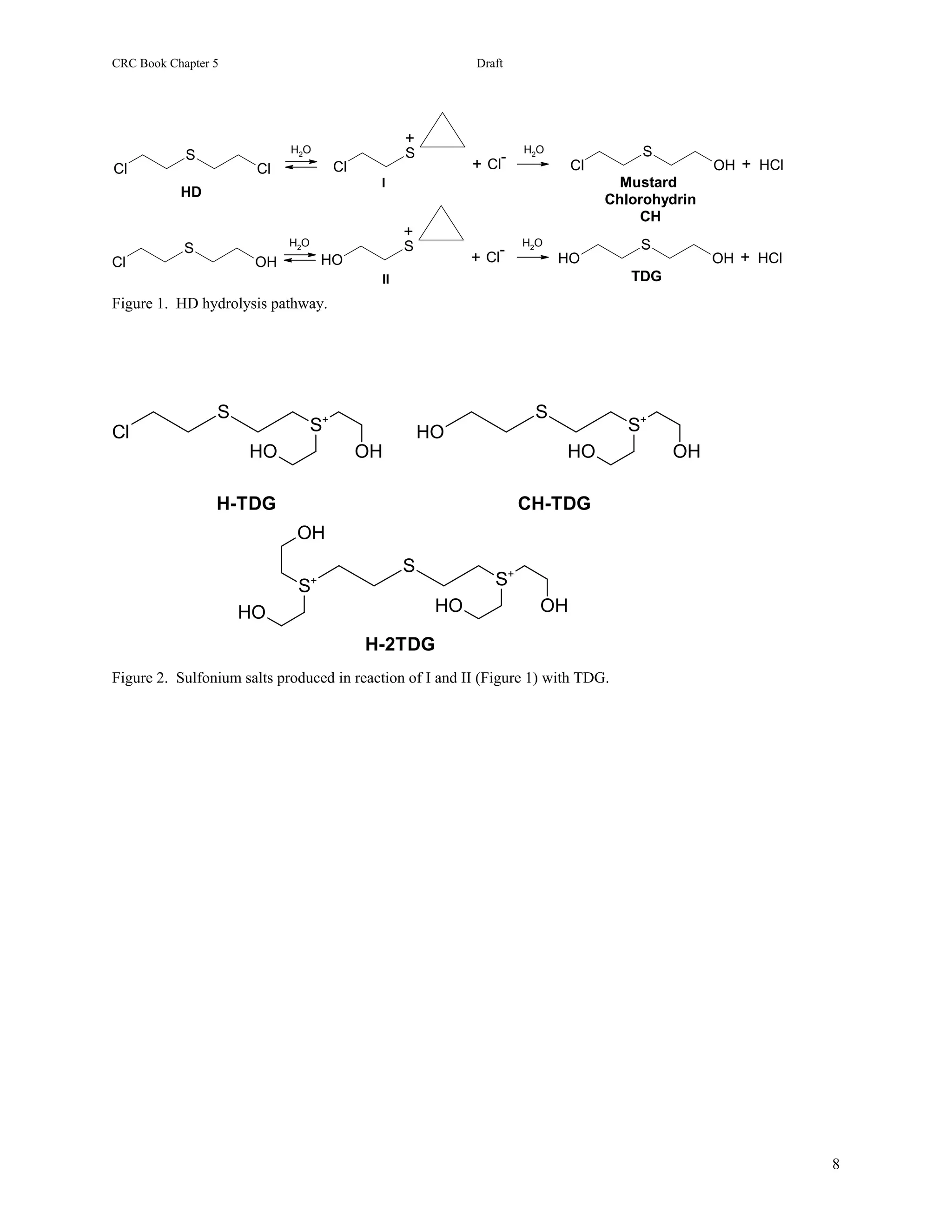
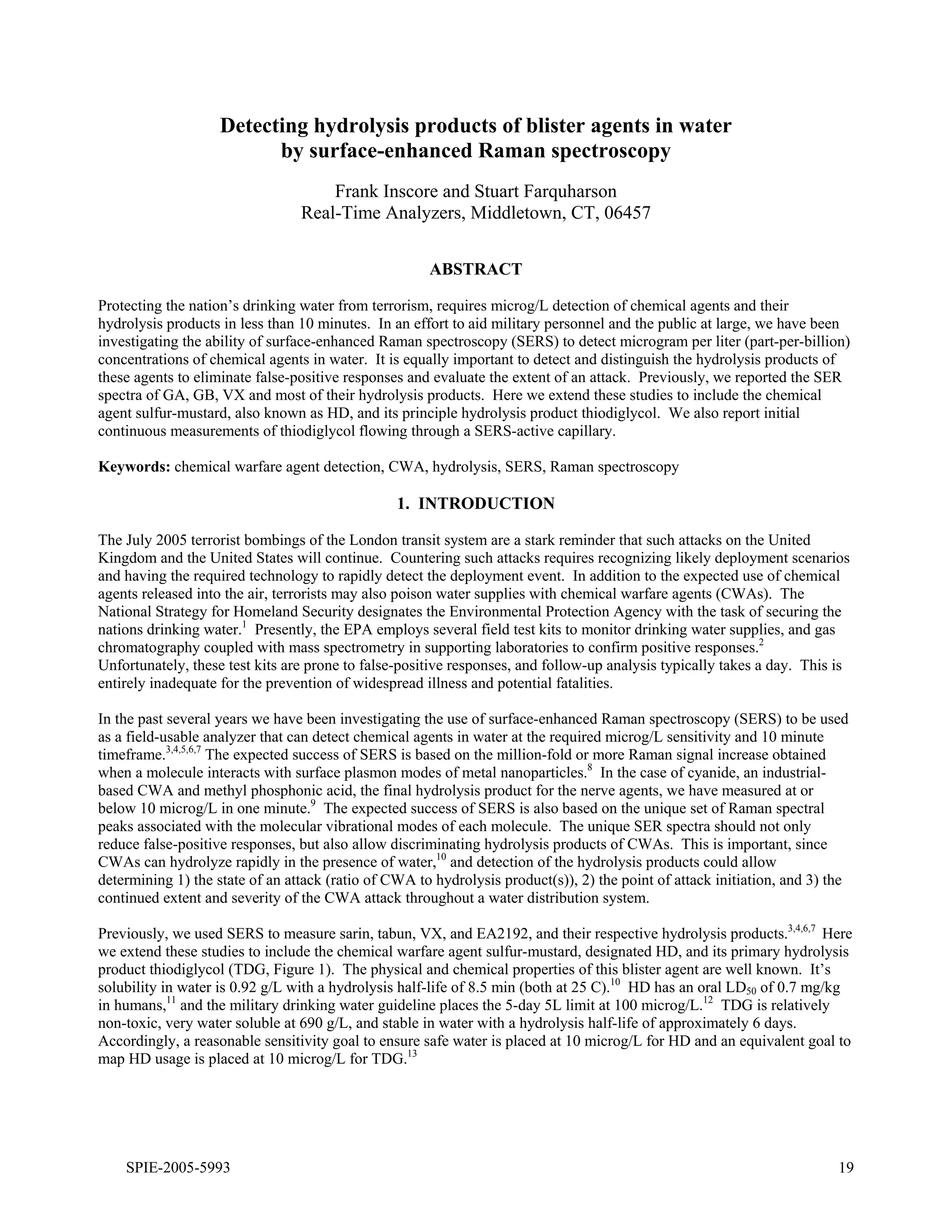
Sulfur mustard (bis(2-chloroethyl) sulfide) hydrolyzes to form mustard chlorohydrin (2-chloroethyl 2-hydroxyethyl
sulfide), which then hydrolyses to thiodiglycol (TDG). These reactions progress through cyclic sulfonium ion
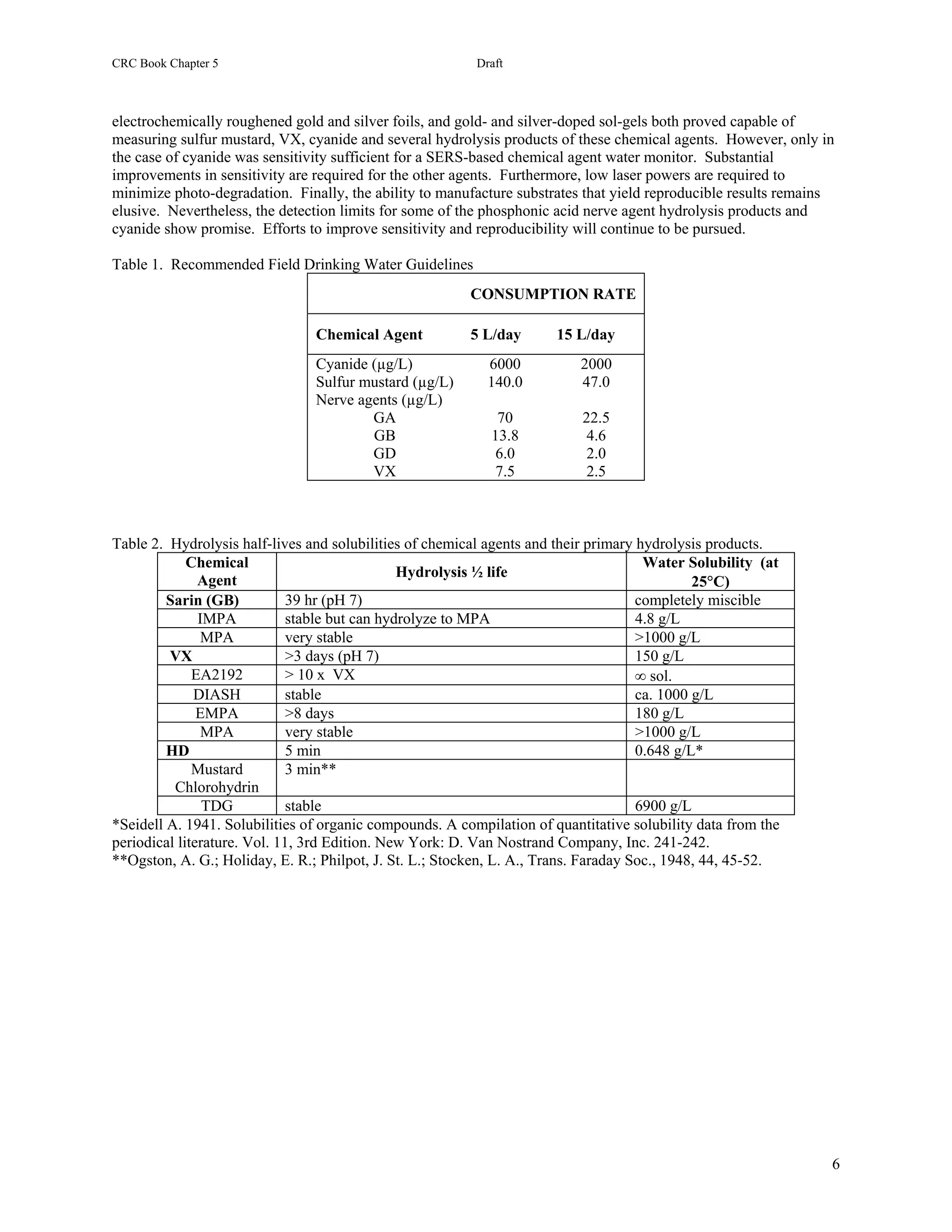
intermediates as shown in Figure 1. Although HD rapidly hydrolyzes to TDG (Table 2), the rate is limited by its
low solubility and solvation rate.28 HD hydrolysis approaches an SN1 mechanism via the pathway shown in Figure 1
only when predissolved in organic solvent and at low concentrations (less than 0.001 M or 160 mg/L).29 At the
interface of the HD droplet with water, the sulfonium ions can also interact with TDG to form stable sulfonium salts,
such as HD-TDG, CH-TDG, and H-2TDG (Figure 2). The presence of multiple stable HD conformers and the
formation of the sulfonium salts complicate the analysis of the SER spectra of sulfur mustard in treated water.
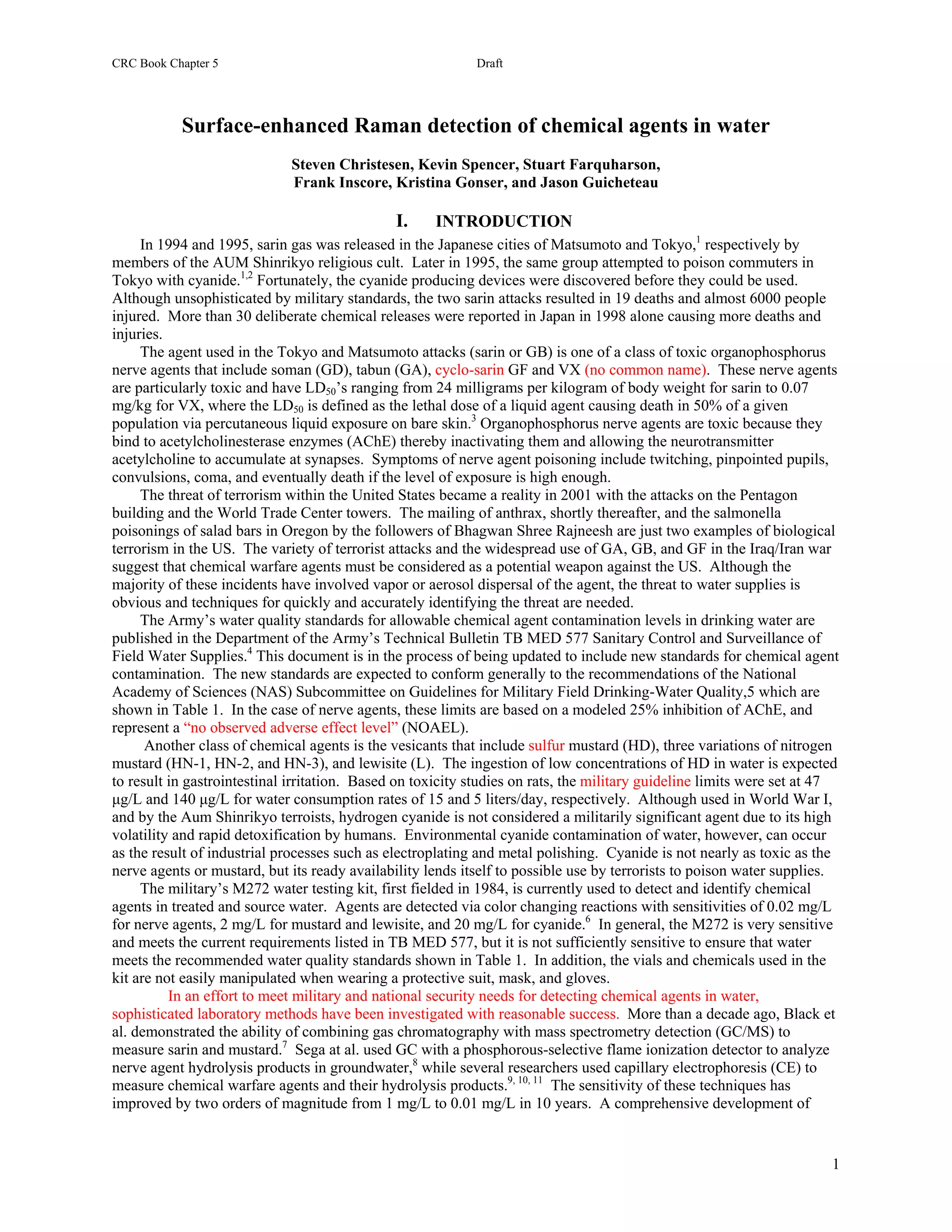
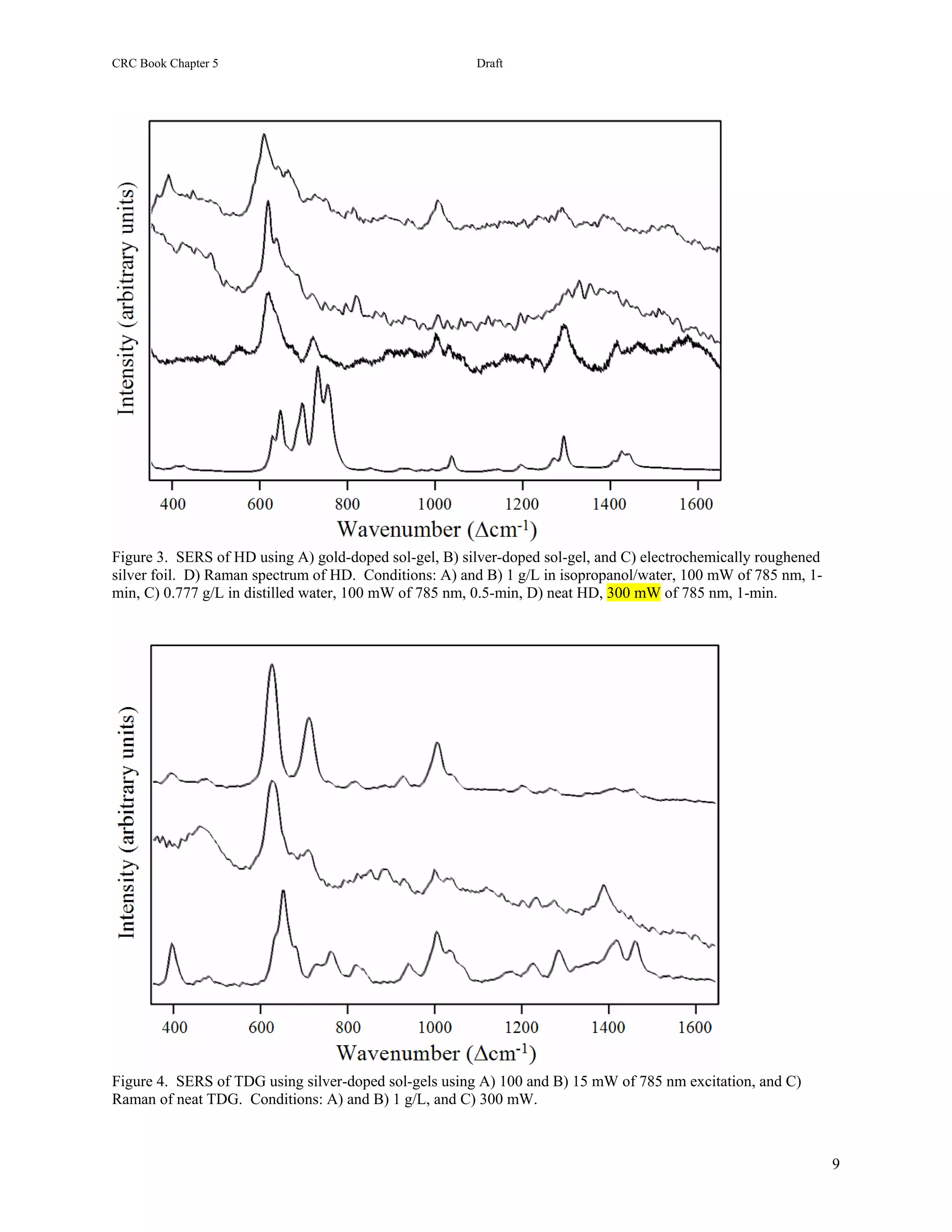
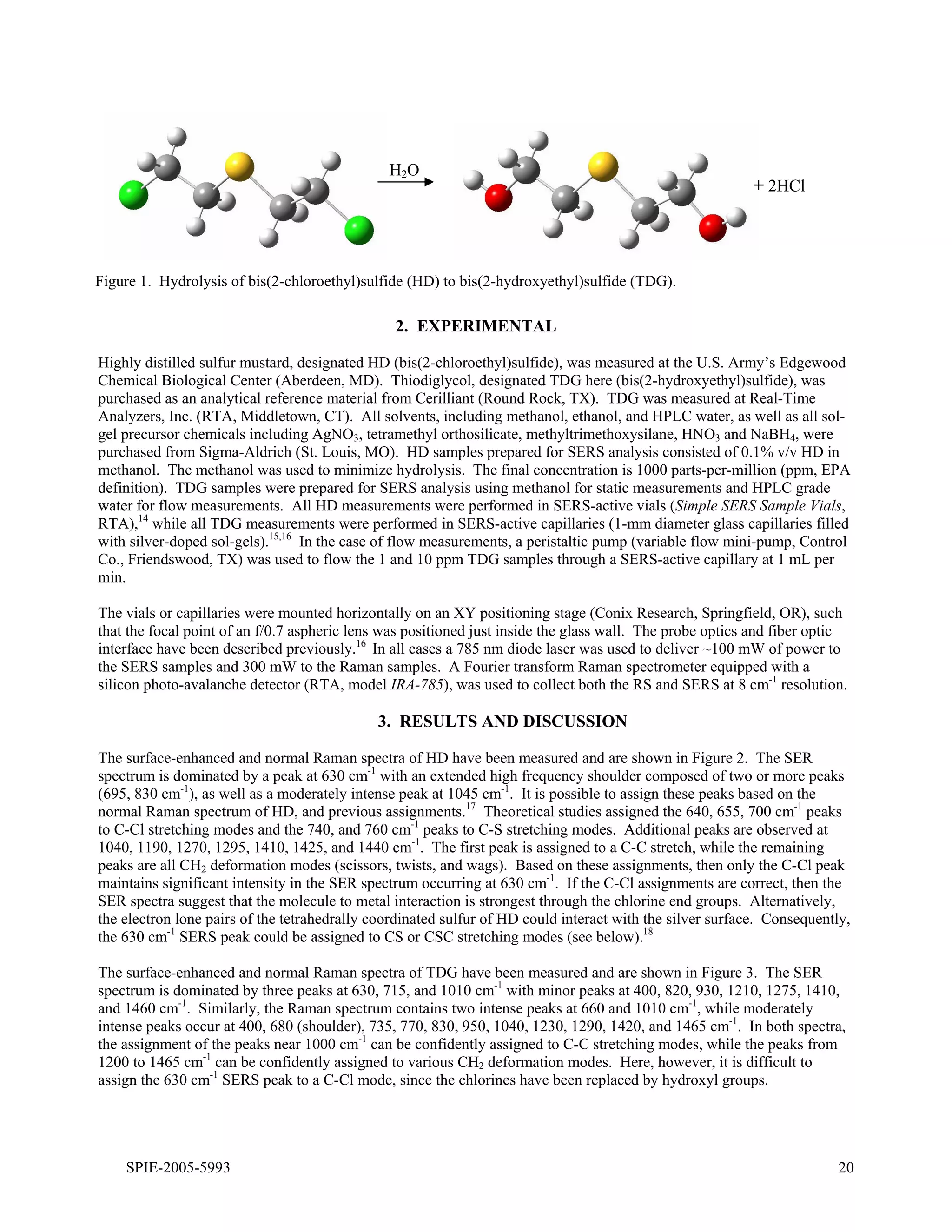
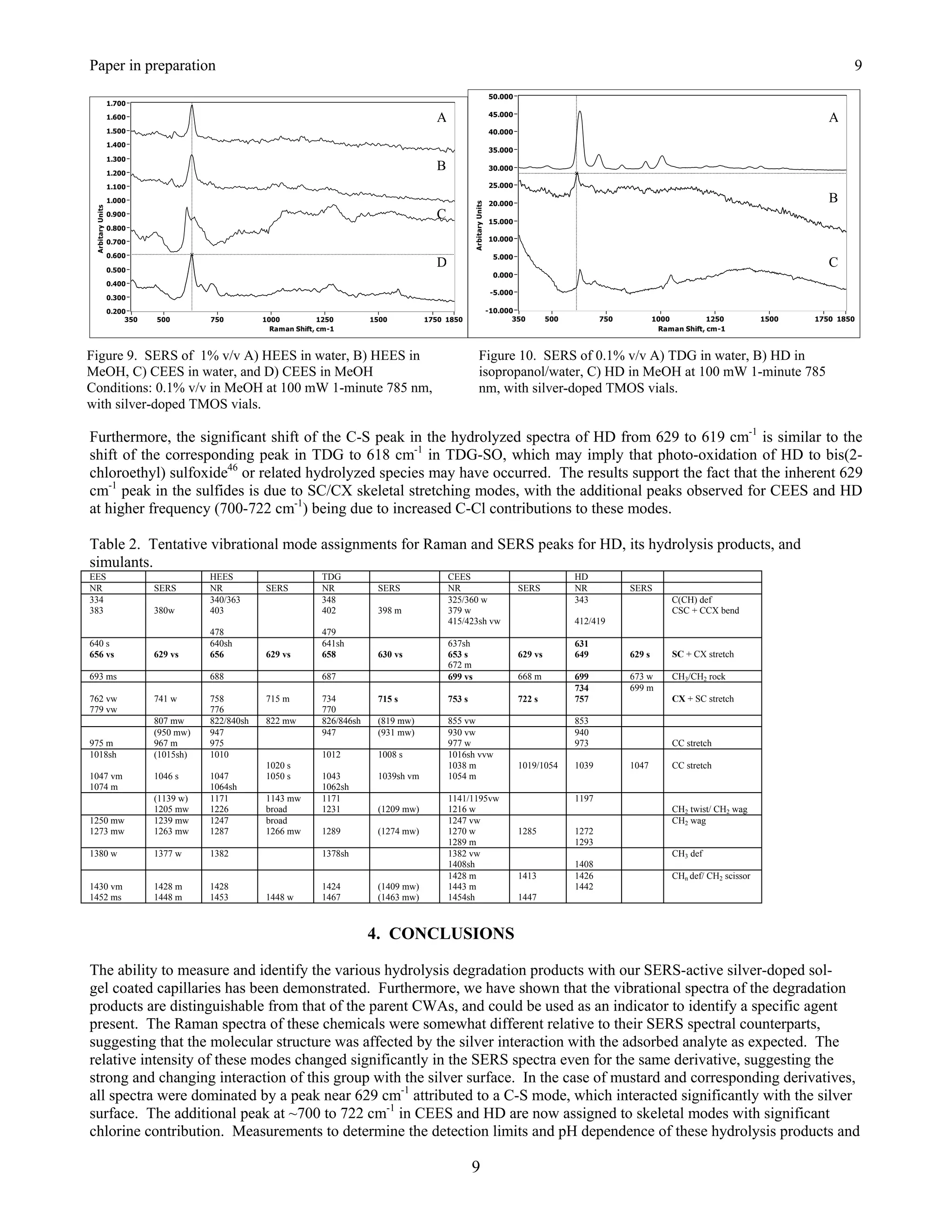
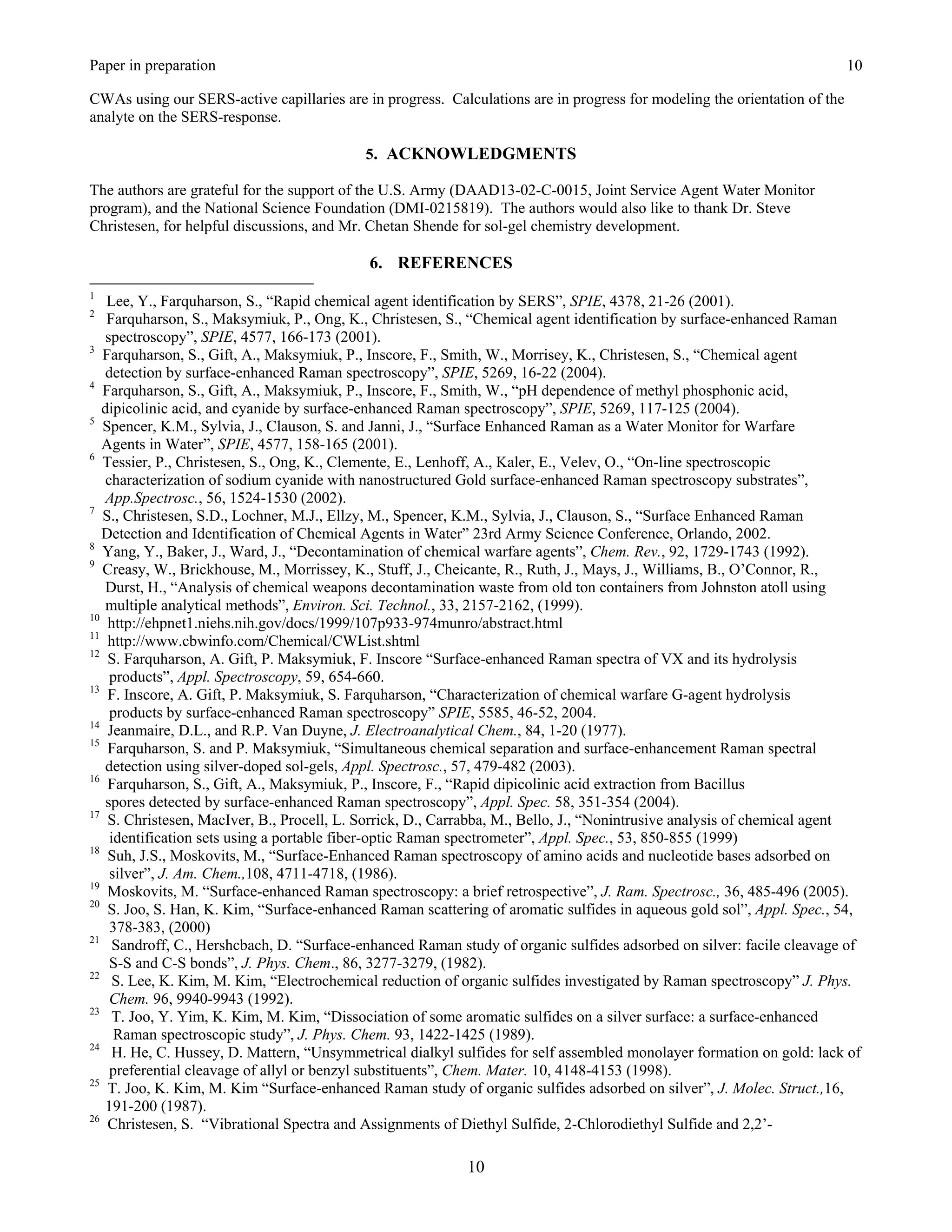
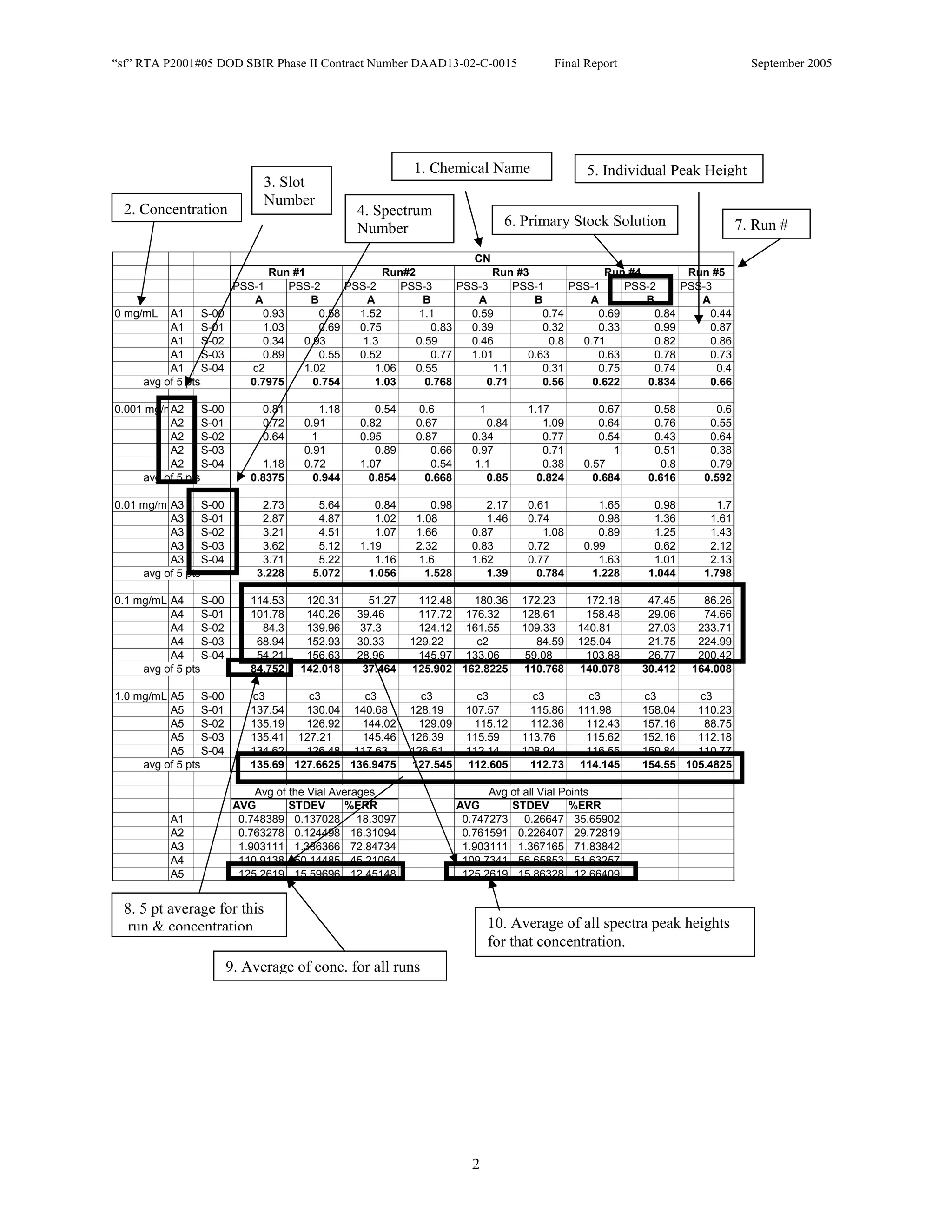
    The SER spectra of HD in water are dominated by a broad peak with a maximum intensity at 620 cm-1, for both
electrochemically roughened silver foils and silver-doped sol-gel coated vials, and at 610 cm-1 for gold-doped sol-
gel vials. This broad peak aligns with the series of peaks observed between 600 and 800 cm-1 in the normal Raman
spectrum of HD and can be ascribed to the C-S and C-Cl stretching modes (Figure 3).30,31,32 At least two additional
peaks appear in the spectra at 1003 and 1292 cm-1 for the silver foils, and at 1007 and 1290 cm-1 for the gold-doped
sol-gels. Based on the Raman peaks at 1038 and 1292 cm-1, these peaks are assigned to a C-C stretching mode and a
CH2 bend.33
     The shift in the C-C stretch is also observed in the C-S or C-Cl stretch. These shifts are consistent with those
reported in the literature by Joo et al.34 for diethyl sulfide (DES) on silver. They report an approximate 20 cm-1 shift
of the C-S stretching modes of the different conformers, and suggest that this is due to DES binding to the surface


                                                                                                                      3
CRC Book Chapter 5                                          Draft


via the sulfur atom. The general shift here suggests that it is likely that HD also binds via the sulfur atom. The
silver foil spectra also contain a peak at 722 cm-1, which is absent or at least weak in both sol-gel spectra. There are
at least four possible explanations as to the source of this peak. 1) In the case of the silver foils, the samples were
measured dried, while the sol-gels were measured in solution, and the 722 cm-1 may represent a different conformer
on the surface. 2) The HD was dissolved in water for the foils, and in a combination water and organic solvent for
the sol-gel vials. The latter co-solvent should dramatically increase solvation, expedite hydrolysis and the removal
of the terminal chlorines. If so, then the 722 cm-1 peak may be assigned to a C-Cl stretching mode. This is
supported by the fact that thiodiglycol does not have this peak, at least under some measurement conditions. 3) The
722 cm-1 peak could be due to the formation of one of the sulfonium salts (Figure 2), but these salts are more likely
to contribute new peaks to the sol-gel spectra, not the foil spectra. 4) It was also noted that this peak was more
intense than the 620 cm-1 peak in some foil measurements, and it may alternatively be assigned to a photo-
degradation product. This is supported by the generation of a peak at the same frequency in photo-degraded TDG.35
Furthermore, at high laser powers and long exposures (several minutes) additional peaks (e.g. 668 cm-1) also
appeared in HD SER spectra using the gold-doped vials, supporting the assignment of the 722 cm-1 peak to photo-
degradation.
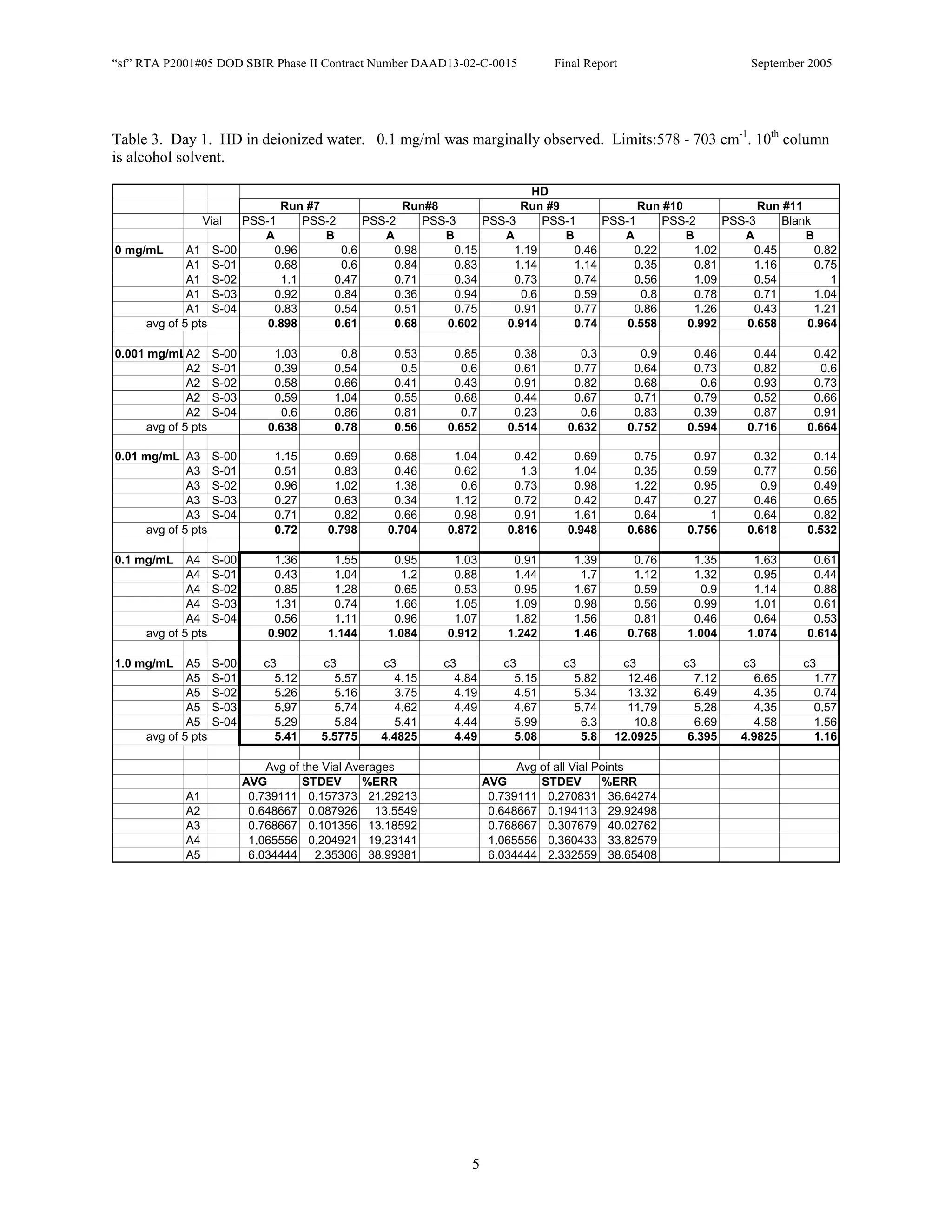
       HD was consistently measured at approximately 50 mg/L using the silver foils (e.g. Figure 3C), and
occasionally at 100 mg/L for the silver-doped sol-gels. Both substrates provided repeatable measurements of 1 g/L
for HD (e.g. Figure 3B). However, the reproducibility of the SER signal intensity for HD was highly variable at 777
mg/L using the silver foils, but considerably better at 1000 mg/L using the silver-doped sol-gels.36 It is not clear,
however, how much of the variability in the former is the result of non-reproducibility in the substrate or the drying
process, or how much might be explained by the complex and changing mixture of mustard hydrolysis products.
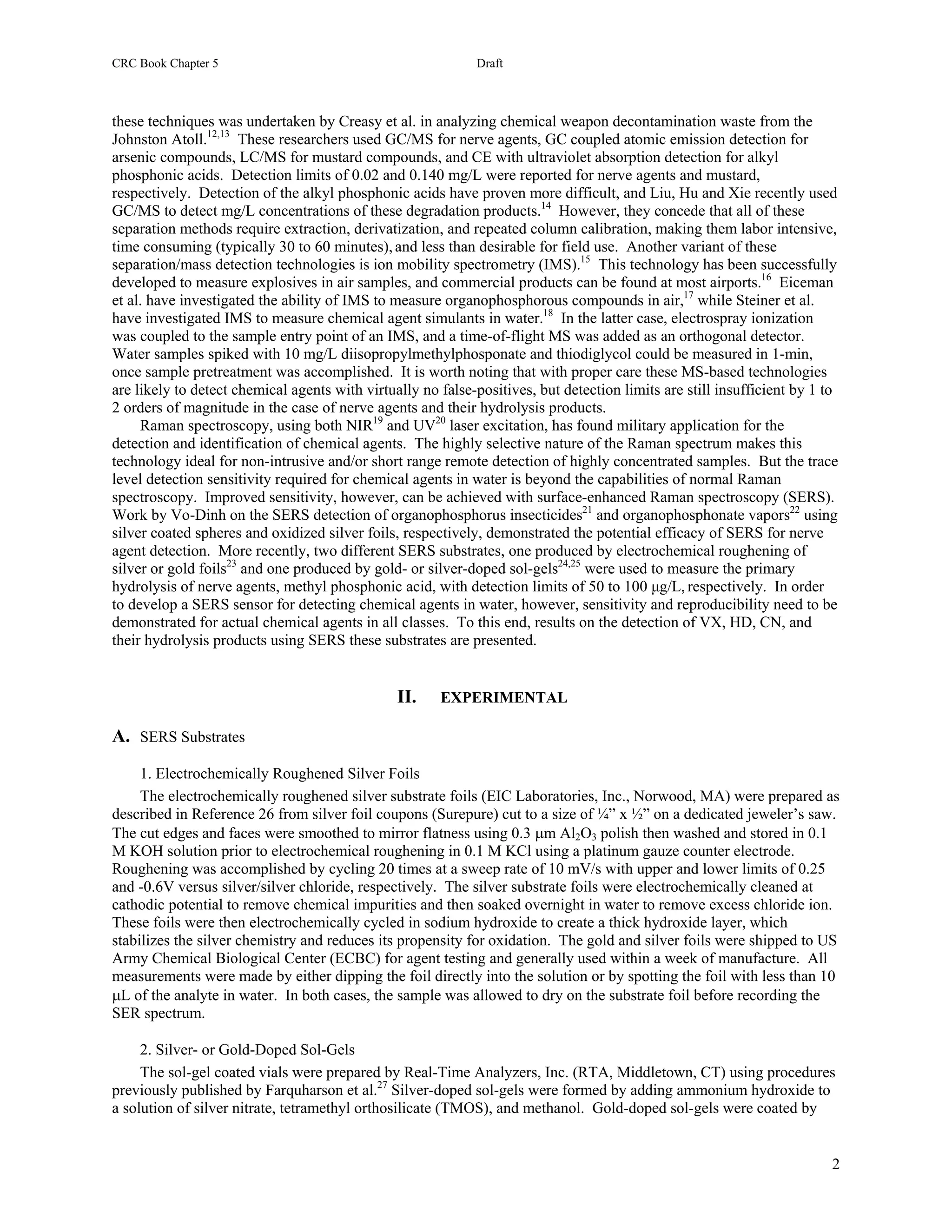
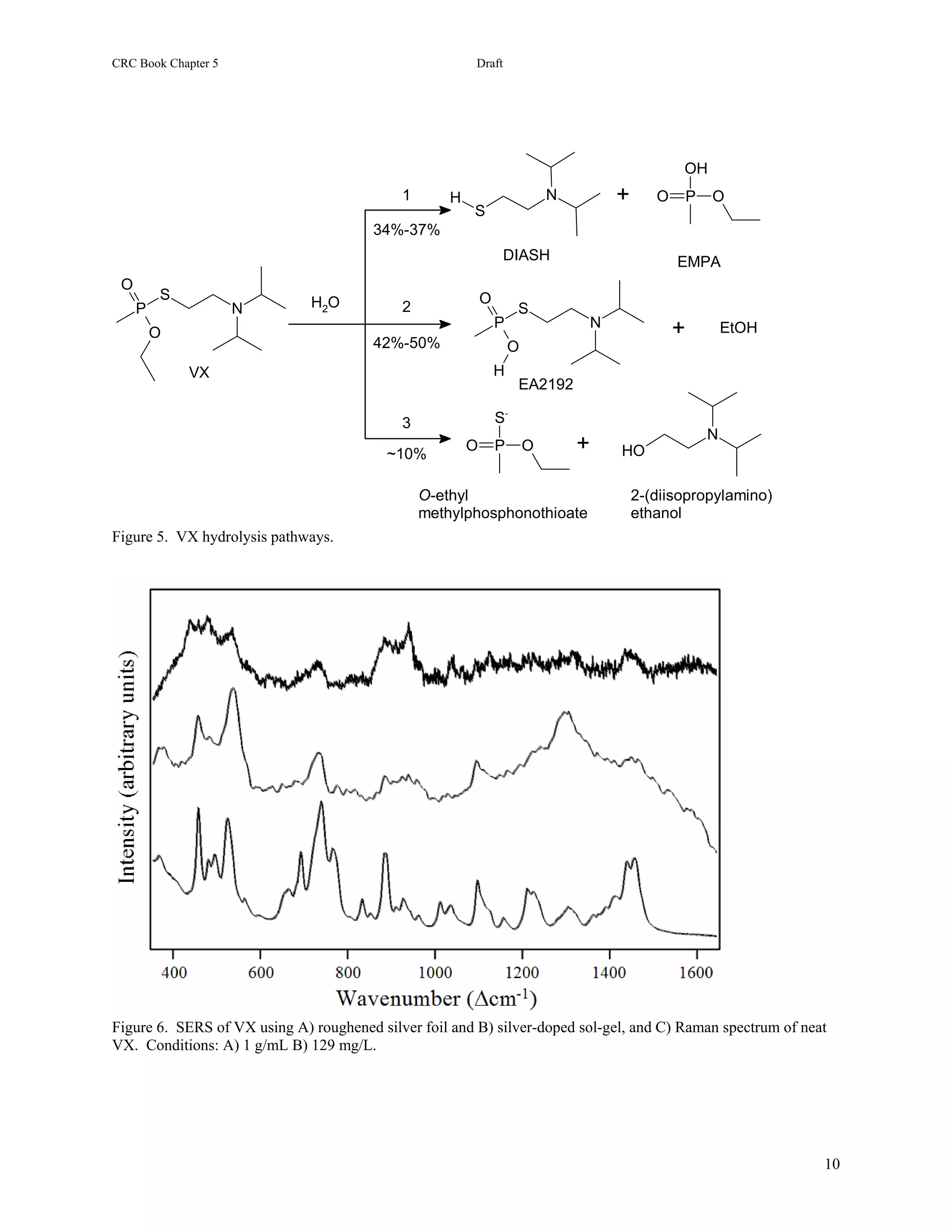
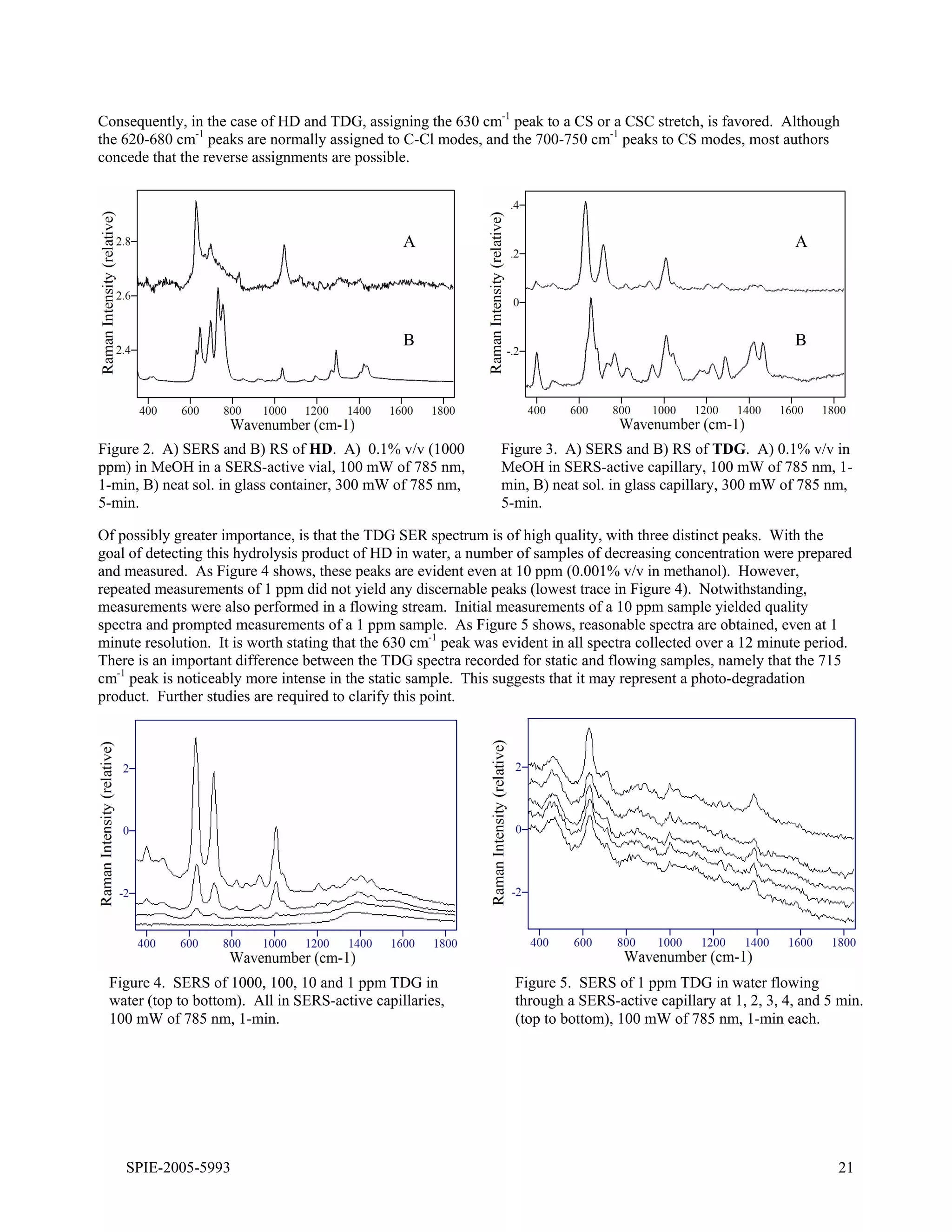
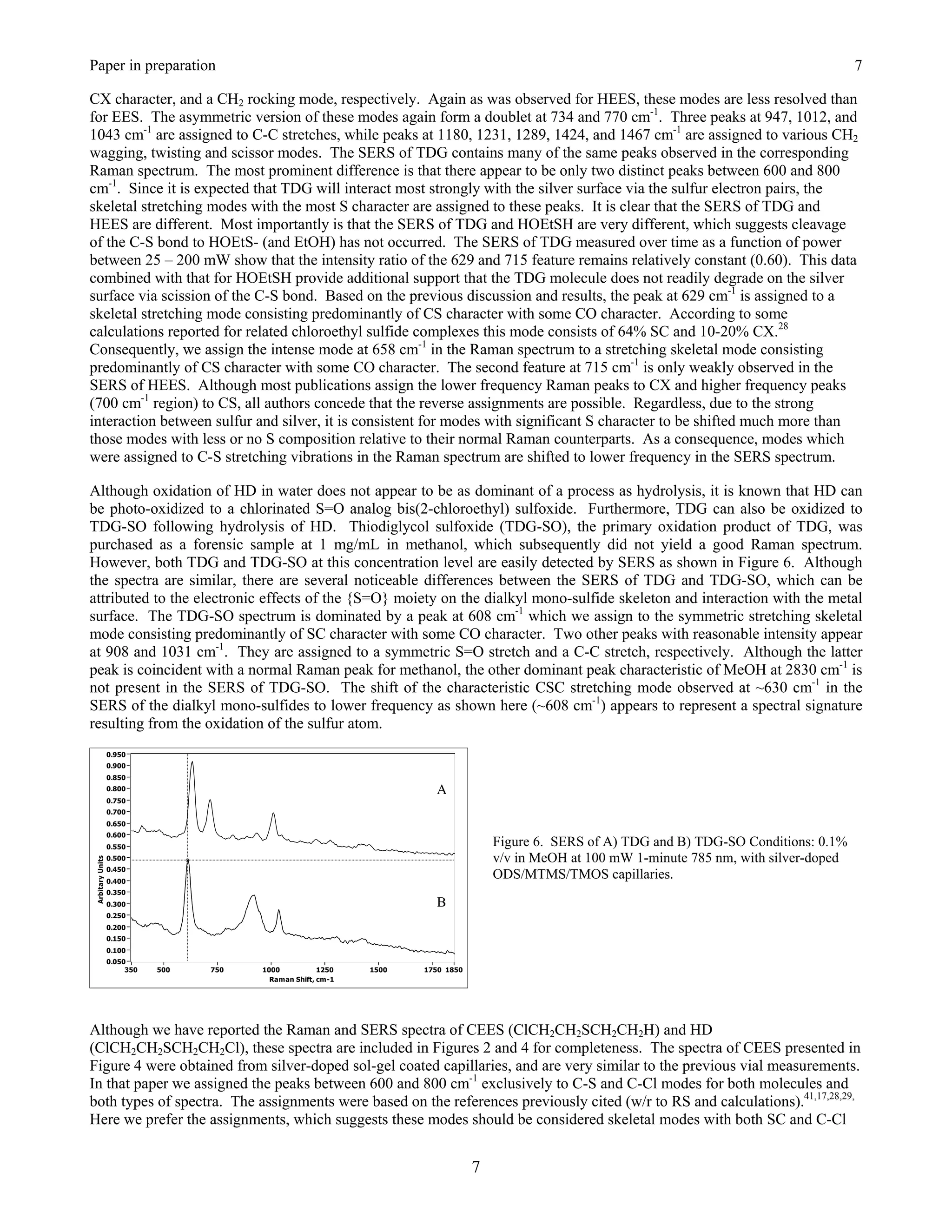
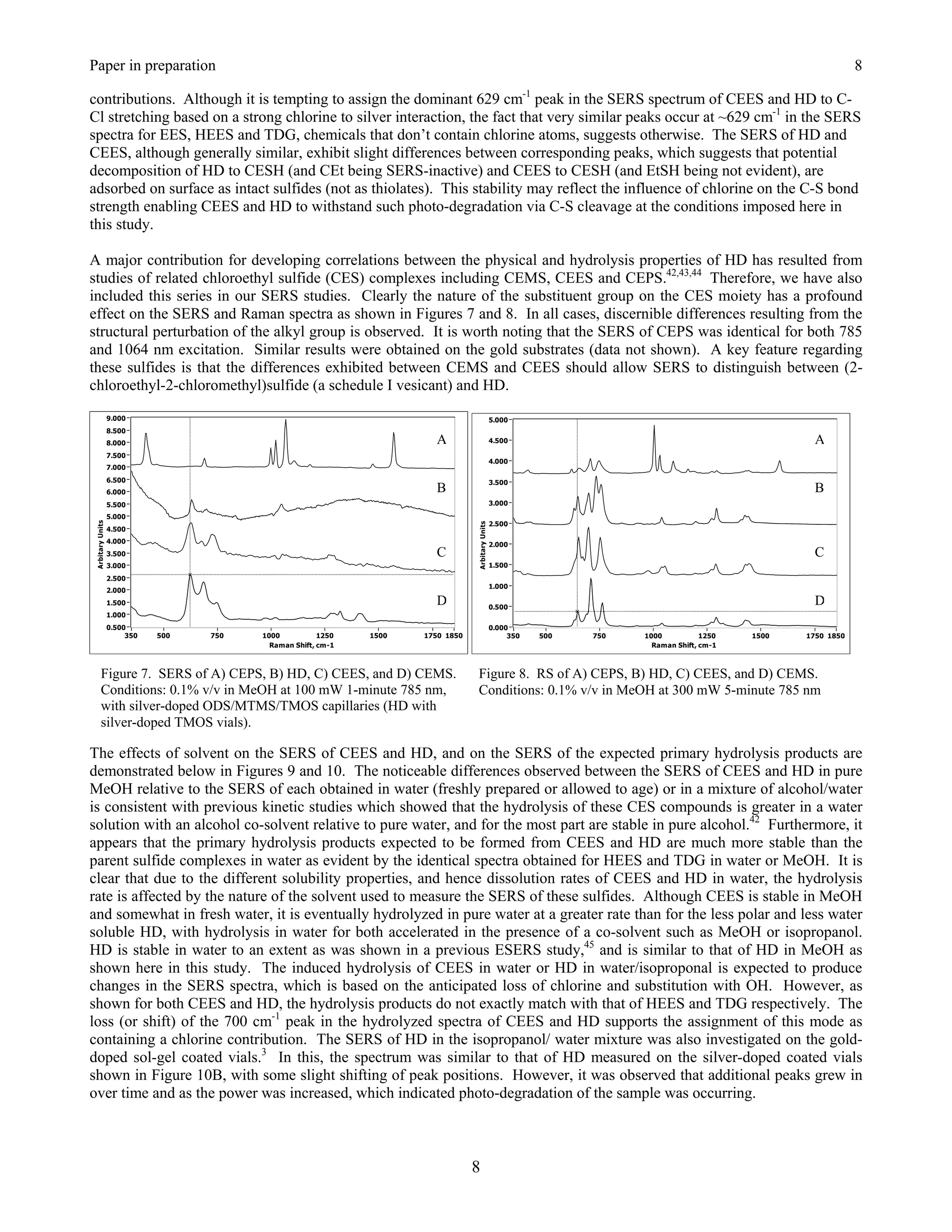
     The SER spectrum of thiodiglycol was only measured using silver-doped sol-gels. Initial measurements at 1000
mg/mL yielded a high quality spectrum that was consistent with SERS of HD and the Raman spectrum of TDG
(Figure 4). The SER spectrum is dominated by three peaks at 627, 715, and 1008 cm-1, while the Raman spectrum is
dominated by peaks at 652 and 1005 cm-1, which can be assigned to S-C and C-C stretching modes, respectively.
Although the 715 cm-1 peak could correspond to either of two weak Raman peaks at 680 and 728 cm-1, it was absent
in recent SER measurements of TDG in a flowing stream.35 Here, measurements at low laser powers (15 mW,
Figure 4B) confirm that this peak, as well as the 1008 cm-1 peak, are likely due to photo-degradation. This
conclusion also supports the assignment of the 722 cm-1 peak in the HD SER spectra to a TDG photo-degradation
product.


B. VX, EA2192, and EMPA
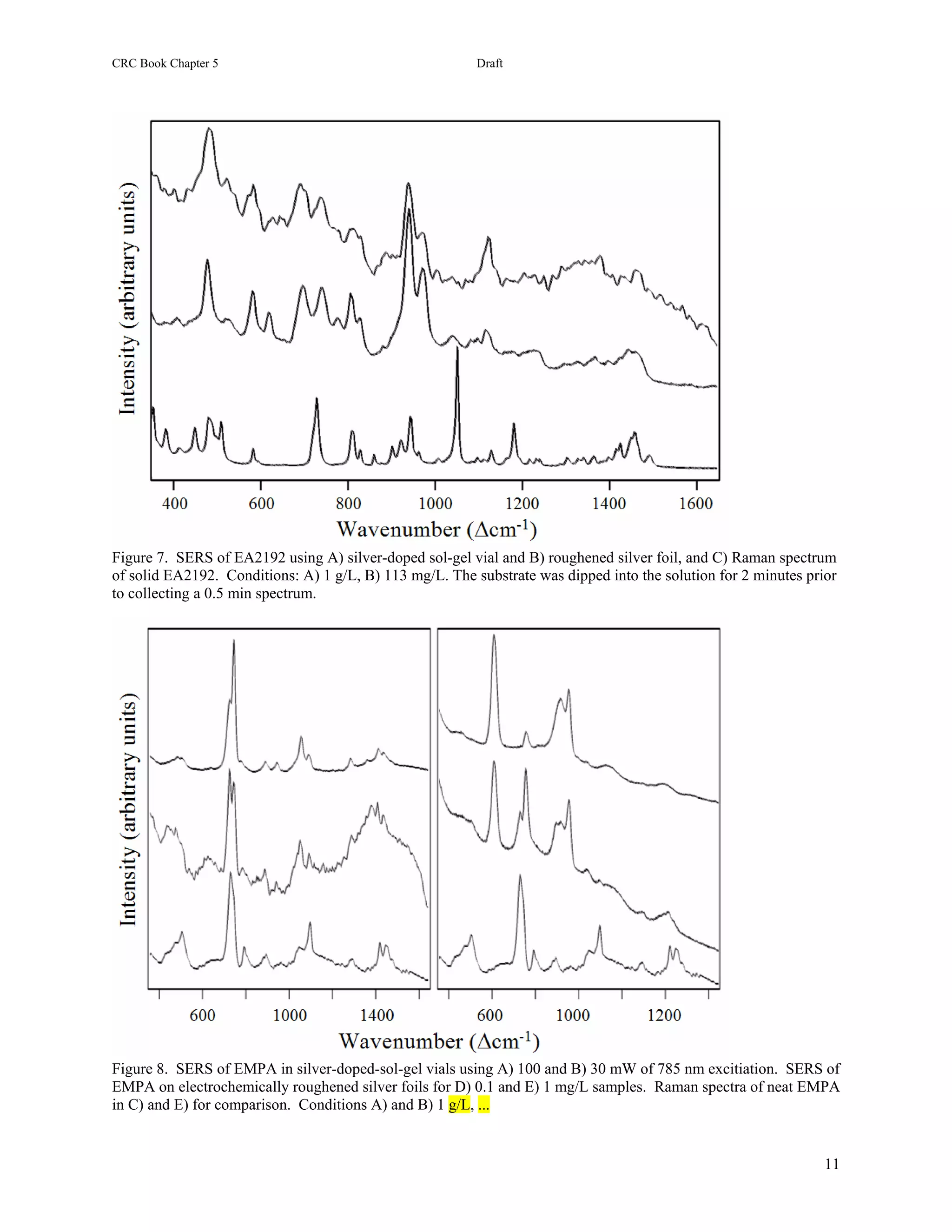
     VX (ethyl S-2-diisopropylamino ethyl methylphosphonothioate) hydrolyzes in distilled water via the pathways
shown in Figure 537,38,39 with a half-life of greater than 3 days.40 The hydrolysis product EA2192 is itself highly
toxic and much more stable in water, although it will eventually hydrolyze to 2-(diisopropylamino) ethanethiol
(DIASH). The ethyl methylphosphonic acid (EMPA) product of Reaction Pathway 1 can also undergo further
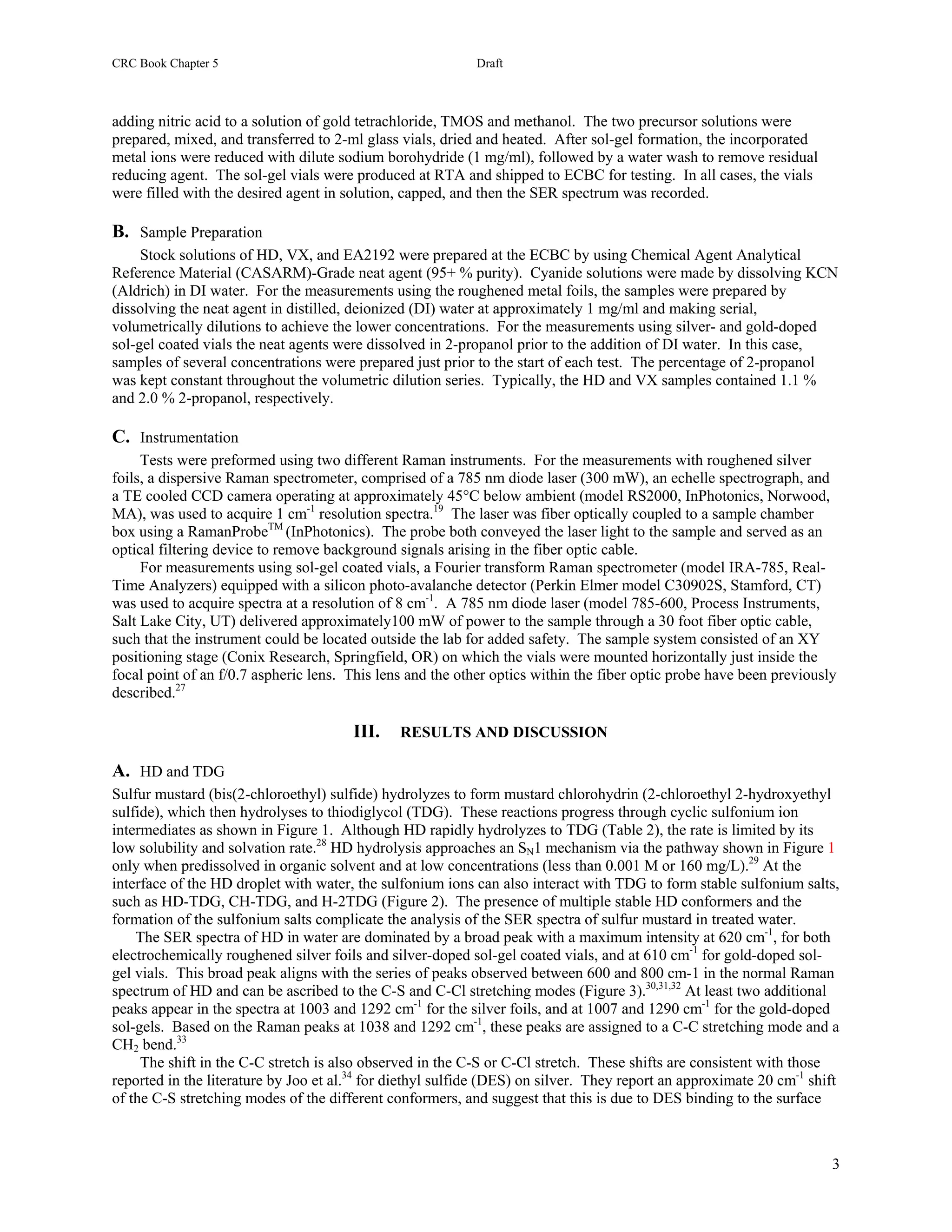
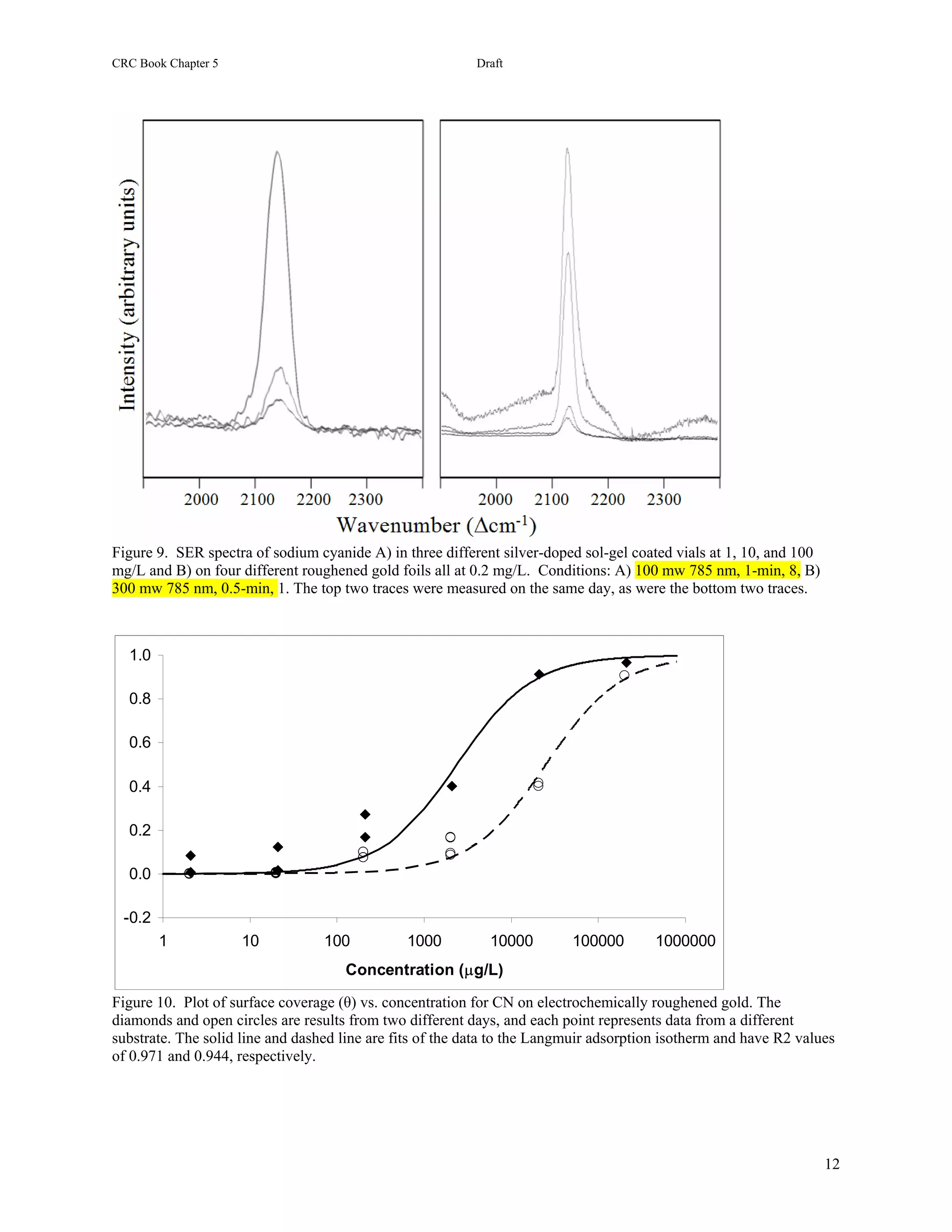
hydrolysis to methylphosphonic acid (MPA). Both the silver foils and sol-gels produced SER spectra that had many
spectra features in common with each other and the normal Raman spectrum (Figure 6). In particular, at least three
overlapping peaks are seen in all three spectra between 425 and 575 cm-1. Farquharson et al. have assigned the
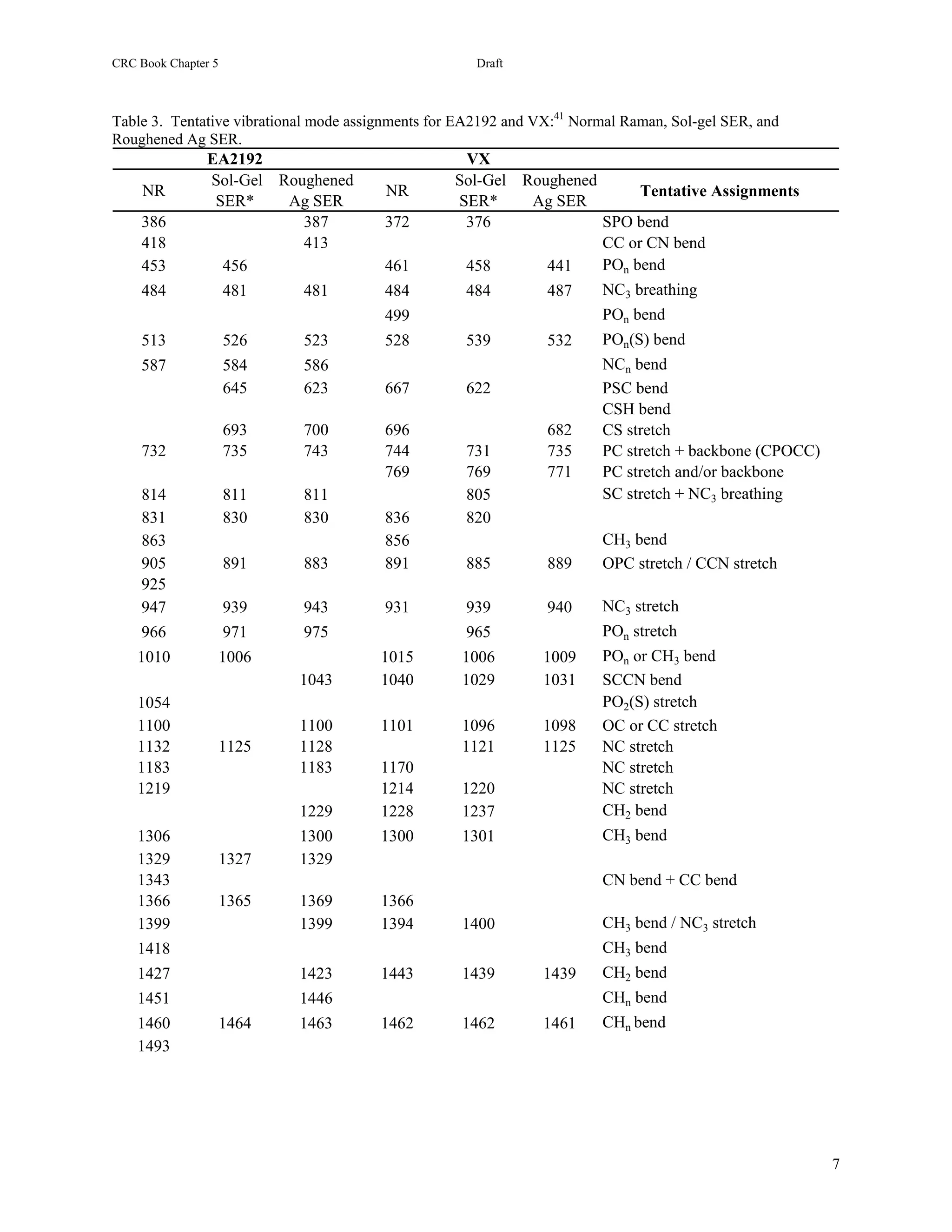
peaks at 460, 485, and ~530 cm-1 to a POn bending mode, an NC3 stretching mode, and a POnS bending mode,
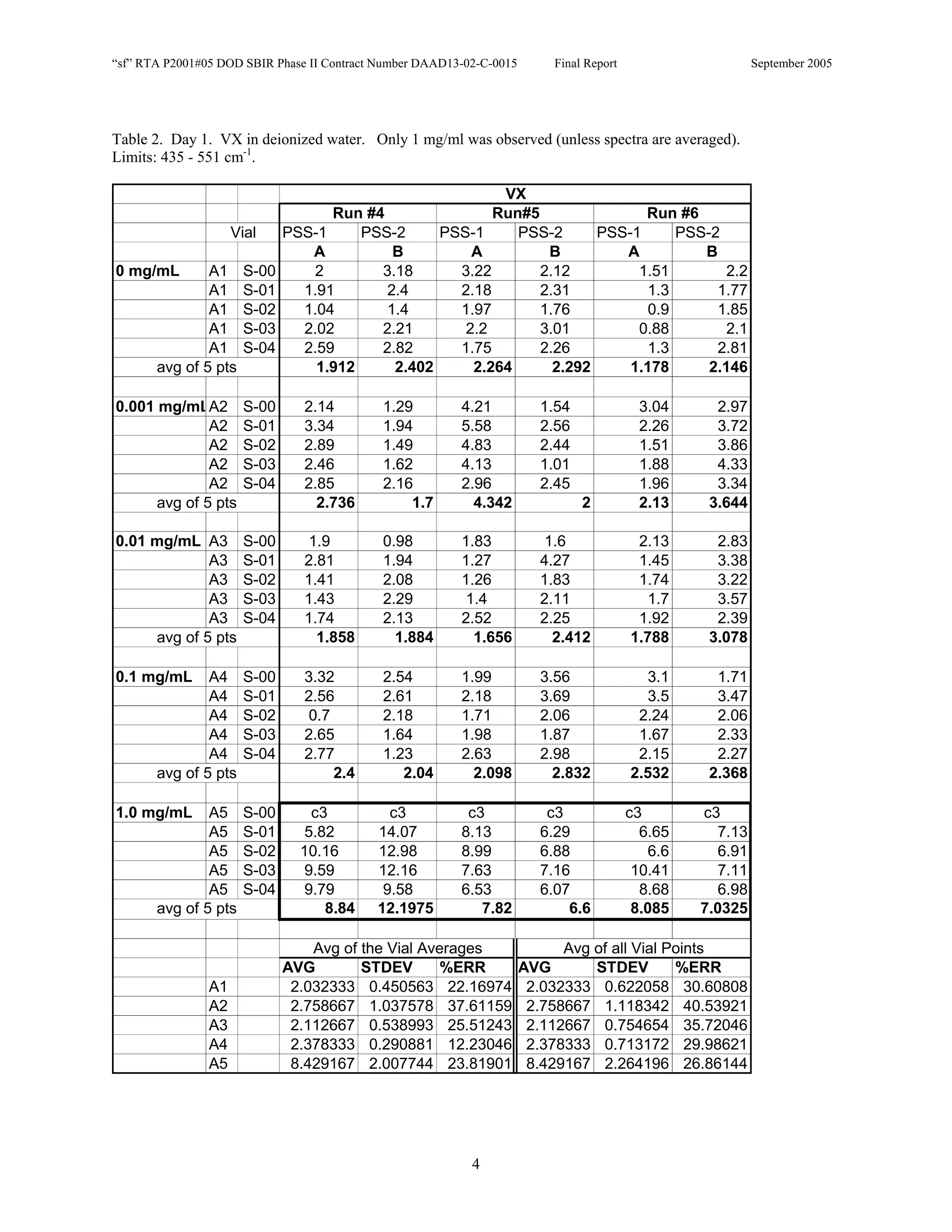
respectively (Table 3).41 Neither substrate provided good sensitivity for VX. The sol-gels provided good
reproducibility at 1000 mg/L (Figure 6B), but only occasionally was a spectrum observed at 100 mg/L, whereas the
foils produced spectra at 100 mg/L on most attempts (Figure 6A). In the case of the latter, a large background
contribution above 800 cm-1, was removed by baseline correction.
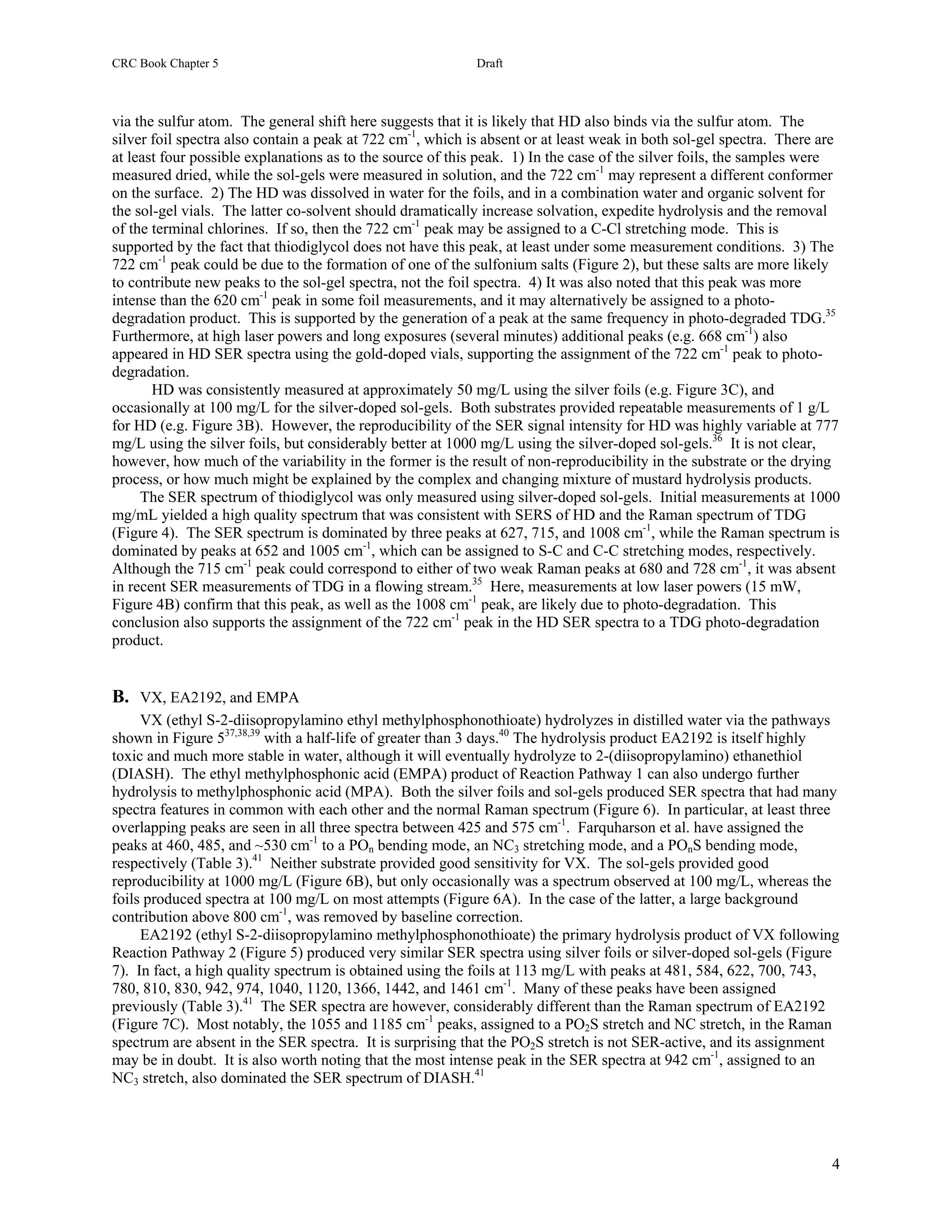
     EA2192 (ethyl S-2-diisopropylamino methylphosphonothioate) the primary hydrolysis product of VX following
Reaction Pathway 2 (Figure 5) produced very similar SER spectra using silver foils or silver-doped sol-gels (Figure
7). In fact, a high quality spectrum is obtained using the foils at 113 mg/L with peaks at 481, 584, 622, 700, 743,
780, 810, 830, 942, 974, 1040, 1120, 1366, 1442, and 1461 cm-1. Many of these peaks have been assigned
previously (Table 3).41 The SER spectra are however, considerably different than the Raman spectrum of EA2192
(Figure 7C). Most notably, the 1055 and 1185 cm-1 peaks, assigned to a PO2S stretch and NC stretch, in the Raman
spectrum are absent in the SER spectra. It is surprising that the PO2S stretch is not SER-active, and its assignment
may be in doubt. It is also worth noting that the most intense peak in the SER spectra at 942 cm-1, assigned to an
NC3 stretch, also dominated the SER spectrum of DIASH.41


                                                                                                                      4
CRC Book Chapter 5                                            Draft


     The silver foils provided reasonable sensitivity for EA2192 and spectra were obtained at a number of
concentrations to as low as 33 mg/L. The silver-doped sol-gels successfully measured 1000 mg/L, but no lower
concentrations were tried.
    The SER spectra for EMPA are more interesting (Figure 8), in that both the sol-gel and foil spectra appear to
contain photo-degradation products. In the case of silver-doped sol-gels, a spectrum can be obtained that has many
of the same features as found in the normal Raman spectrum, as long as low laser powers are used (30 mW, Figure
8B). Peaks occur at 505, 730, 792, 893, 1047, 1098, 1293, 1420, and 1454 cm-1 in both spectra, which all have been
assigned.41 The primary difference between the two spectra is that a second intense peak occurs at 745 cm-1, albeit
the normal Raman spectrum contains a shoulder at close to this frequency. As soon as the laser power is increased
to 100 mW, this peak increases in intensity substantially, indicating photo-degradation (Figure 8A). This effect is
even more dramatic for the silver foils, where the this peak completely replaces the 730 cm-1 peak, especially at low
concentrations (100 µg/L, Figure 8D). Additional peaks also grow in at 610, 915, and 955 cm-1. It is reasonable to
assign the 745 cm-1 peak to the formation of methyl phosphonic acid, since it has a dominant peak at 755 cm-1, but
MPA does not contain the latter three peaks, and it is unclear as to composition of the degradation product. It is
clear from the data that EMPA degrades rapidly in the presence of silver and laser irradiation.

C. Cyanide
     Hydrogen cyanide (AC) is a highly volatile liquid (boiling point of 25.7 °C) belonging to a class of chemical
agents known as blood agents. It has commercial uses in the extraction of gold from ore and in the manufacture of
other chemicals, such as acrylonitrile and methyl methacrylate. AC is highly soluble in water and hydrolyzes slowly
to ammonia and formic acid. Hydrogen cyanide and its potassium and sodium salts release toxic free cyanide (CN)
when dissolved in weak acids such as water. Cyanide’s toxicity results from its attack on the enzyme cytochrome
oxidase thereby preventing cell respiration and the normal transfer of oxygen from the blood to body tissues.
     Research in the past focused on the gold mining and textile industries’ concerns over cyanide leakage into the
groundwater and the EPA’s limit of 1 part per million or less of CN in detoxified industrial waste. The majority of
these SERS techniques not only yield detection limits below the EPA mandate but well into the low part per billion
range. Detection of cyanide has also become somewhat of a standard assessment of a SERS substrate’s capability
and sensitivity. SERS applications utilizing gold nanostructures,42,43,44 silver electrodes,45,46,47,48,49 sol-gels,25,50 and
others51,52 have reported great success at detecting CN in a variety of forms. The success can be attributed to the
high binding efficiency of –(C≡N) to the metal surface resulting in a distinct band between 2120-2150 whose
position is dependent on pH and concentration.25,42
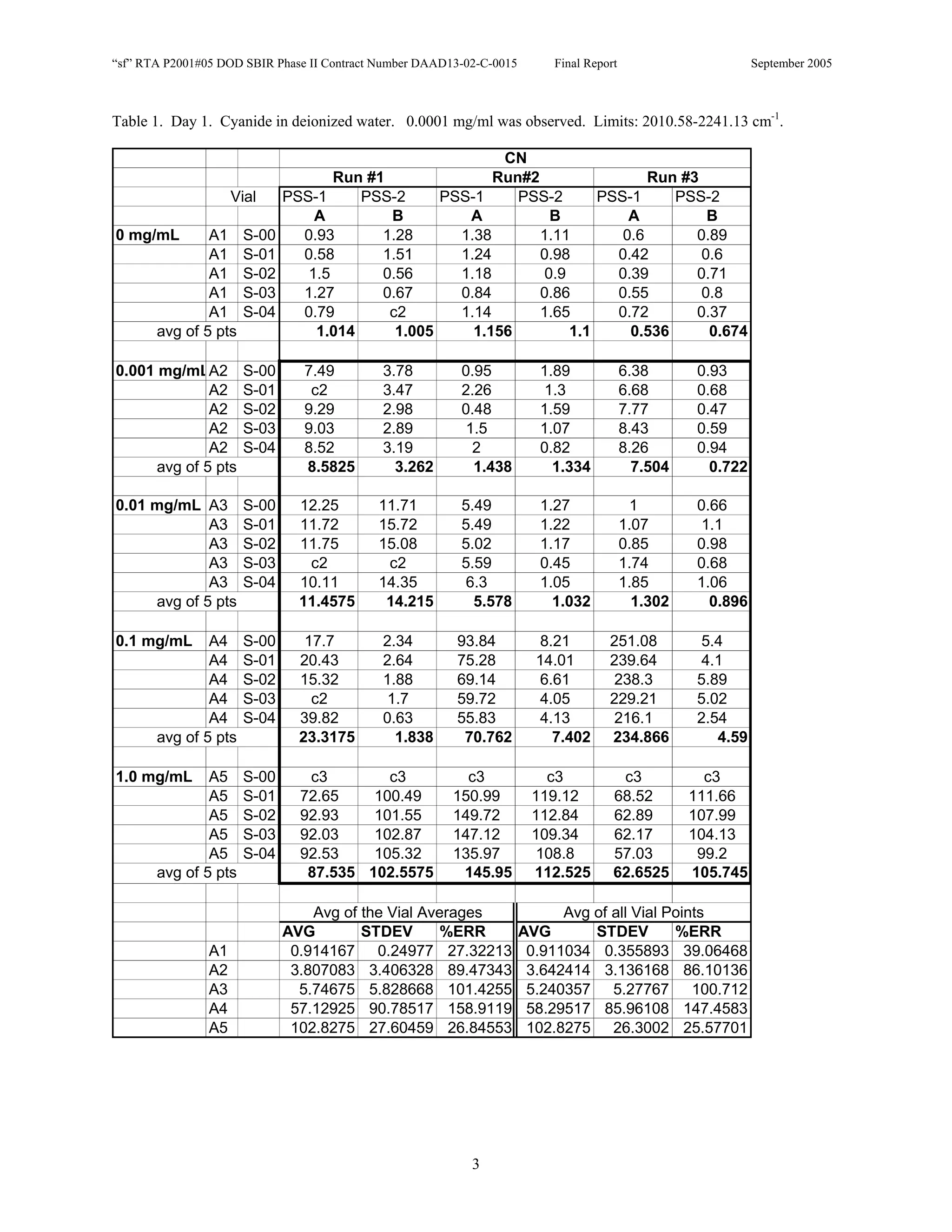
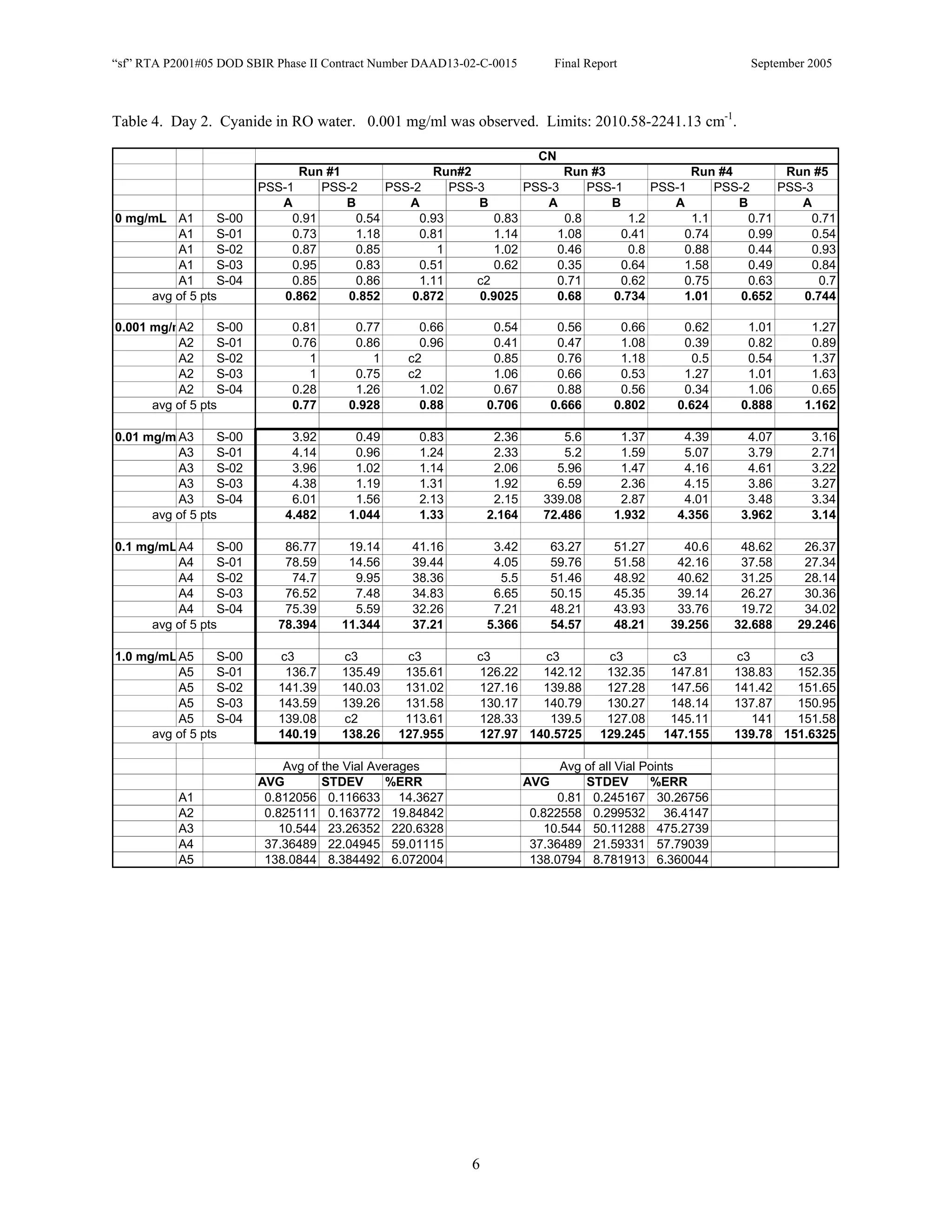
     Both silver- and gold-doped sol-gel vials have been used to measure cyanide in water to 1 mg/L and below
(Figure 9A). In fact very reproducible measurements have been made at 10 mg/L. Both electrochemically
roughened silver and gold foils have successfully been used to measure low concentrations of cyanide, and in the
case of the latter, consistent measurements down to 20 µg/L. The SER signal strength is highly variable, however,
as seen for cyanide in water at 200 µg/L (Figure 9B). Data collected on the same day (but different gold foils) were
more consistent than measurements on different days, indicating that the substrates may be changing in storage or
shipment. This is illustrated by a fit of the data from the two days by a Langmuir adsorption isotherm (Figure 10).
This isotherm can be used to describe both physical and chemical adsorption:53

                                                            Kc
                                                     θ=                               (1)
                                                           Kc + 1

     The cyanide concentration is given by c, the fractional surface coverage by θ , and the adsorption equilibrium
constant by K. The fractional coverage is calculated as the ratio of the SERS peak intensity divided by the intensity
at full surface coverage (I/Imax). In this analysis, both K and Imax were fit using a nonlinear regression technique
(DataFit, Oakdale Engineering, Oakdale, PA). The calculated adsorption equilibrium constants for the two days are
a factor of 10 different (0.4 L/mg vs. 0.04 L/mg).


                                                 IV.     CONCLUSIONS

     The potential sensitivity and selectivity of SERS coupled with the lack of strong water interference make it an
attractive technique for chemical detection in aqueous solution. Two very different SERS-active substrates,


                                                                                                                           5
CRC Book Chapter 5                                        Draft


electrochemically roughened gold and silver foils, and gold- and silver-doped sol-gels both proved capable of
measuring sulfur mustard, VX, cyanide and several hydrolysis products of these chemical agents. However, only in
the case of cyanide was sensitivity sufficient for a SERS-based chemical agent water monitor. Substantial
improvements in sensitivity are required for the other agents. Furthermore, low laser powers are required to
minimize photo-degradation. Finally, the ability to manufacture substrates that yield reproducible results remains
elusive. Nevertheless, the detection limits for some of the phosphonic acid nerve agent hydrolysis products and
cyanide show promise. Efforts to improve sensitivity and reproducibility will continue to be pursued.

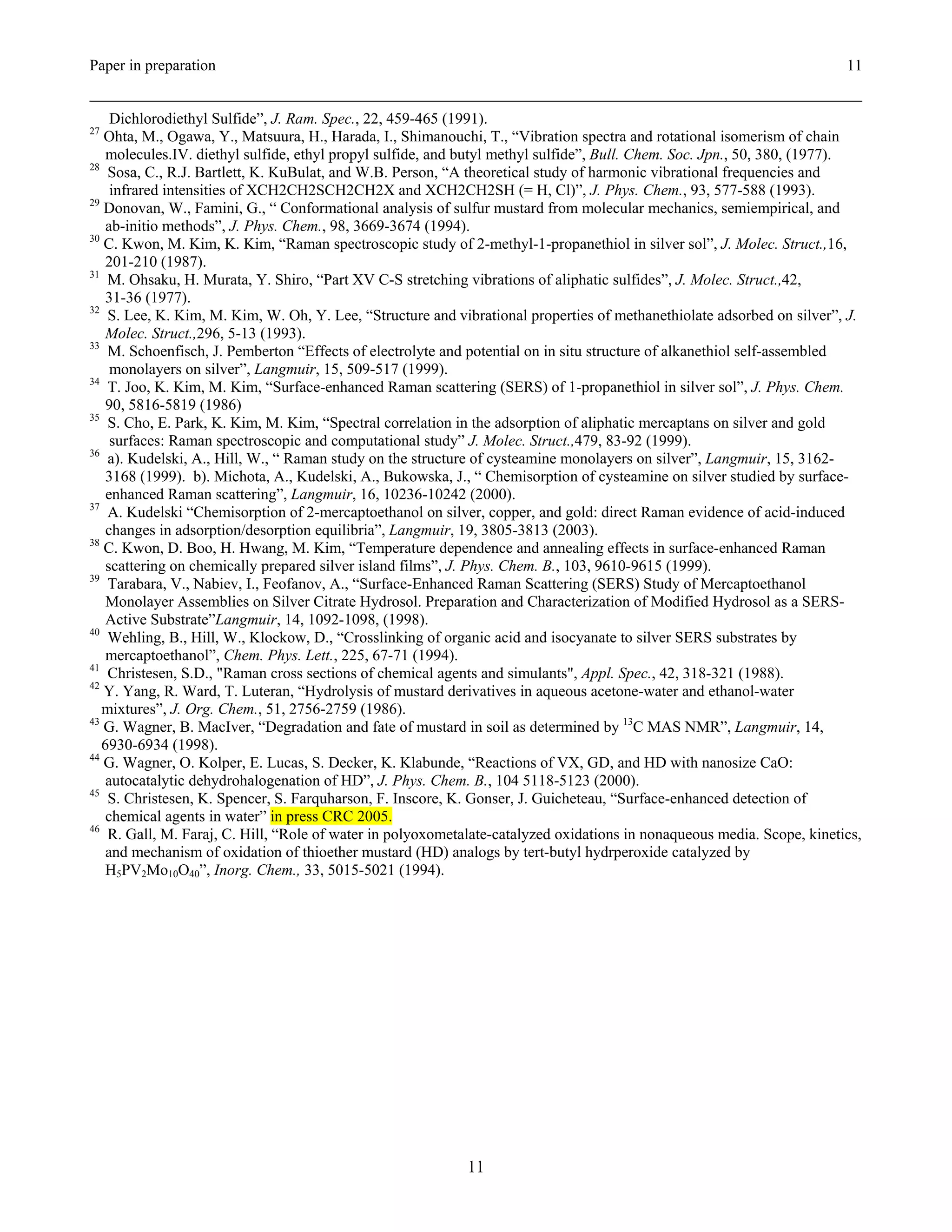
Table 1. Recommended Field Drinking Water Guidelines
                                                         CONSUMPTION RATE

                                Chemical Agent           5 L/day       15 L/day
                                Cyanide (µg/L)              6000           2000
                                Sulfur mustard (µg/L)       140.0          47.0
                                Nerve agents (µg/L)
                                        GA                   70            22.5
                                        GB                  13.8            4.6
                                        GD                   6.0           2.0
                                        VX                   7.5           2.5


Table 2. Hydrolysis half-lives and solubilities of chemical agents and their primary hydrolysis products.
             Chemical                                                                 Water Solubility (at
                                                Hydrolysis ½ life
               Agent                                                                          25°C)
         Sarin (GB)           39 hr (pH 7)                                           completely miscible
               IMPA           stable but can hydrolyze to MPA                        4.8 g/L
                MPA           very stable                                            >1000 g/L
         VX                   >3 days (pH 7)                                         150 g/L
              EA2192          > 10 x VX                                              ∞ sol.
              DIASH          stable                                                  ca. 1000 g/L
               EMPA           >8 days                                                180 g/L
                MPA           very stable                                            >1000 g/L
         HD                   5 min                                                  0.648 g/L*
              Mustard         3 min**
          Chlorohydrin
                TDG           stable                                                 6900 g/L
*Seidell A. 1941. Solubilities of organic compounds. A compilation of quantitative solubility data from the
periodical literature. Vol. 11, 3rd Edition. New York: D. Van Nostrand Company, Inc. 241-242.
**Ogston, A. G.; Holiday, E. R.; Philpot, J. St. L.; Stocken, L. A., Trans. Faraday Soc., 1948, 44, 45-52.


                                                                                                                 6
CRC Book Chapter 5                                    Draft


Table 3. Tentative vibrational mode assignments for EA2192 and VX:41 Normal Raman, Sol-gel SER, and
Roughened Ag SER.
                EA2192                             VX
                Sol-Gel Roughened                 Sol-Gel Roughened
     NR                                 NR                               Tentative Assignments
                 SER*    Ag SER                   SER*     Ag SER
    386                    387          372        376              SPO bend
    418                    413                                      CC or CN bend
    453           456                   461        458       441    POn bend
    484              481    481         484         484         487     NC3 breathing
                                        499                             POn bend
    513              526    523         528         539         532     POn(S) bend
    587              584    586                                         NCn bend
                     645    623         667         622                 PSC bend
                                                                        CSH bend
                     693    700         696                     682     CS stretch
    732              735    743         744         731         735     PC stretch + backbone (CPOCC)
                                        769         769         771     PC stretch and/or backbone
    814              811    811                     805                 SC stretch + NC3 breathing
    831              830    830         836         820
    863                                 856                             CH3 bend
    905              891    883         891         885         889     OPC stretch / CCN stretch
    925
    947              939    943         931         939         940     NC3 stretch
    966              971    975                     965                 POn stretch
    1010         1006                  1015        1006         1009    POn or CH3 bend
                           1043        1040        1029         1031    SCCN bend
    1054                                                                PO2(S) stretch
    1100                   1100        1101        1096         1098    OC or CC stretch
    1132         1125      1128                    1121         1125    NC stretch
    1183                   1183        1170                             NC stretch
    1219                               1214        1220                 NC stretch
                           1229        1228        1237                 CH2 bend
    1306                   1300        1300        1301                 CH3 bend
    1329         1327      1329
    1343                                                                CN bend + CC bend
    1366         1365      1369        1366
    1399                   1399        1394        1400                 CH3 bend / NC3 stretch
    1418                                                                CH3 bend
    1427                   1423        1443        1439         1439    CH2 bend
    1451                   1446                                         CHn bend
    1460         1464      1463        1462        1462         1461    CHn bend
    1493


                                                                                                        7
CRC Book Chapter 5                                           Draft


                                                  +
            S               H2O                   S                  H2O             S
Cl                     Cl              Cl                   + Cl-           Cl                  OH + HCl
                                             I                                     Mustard
           HD                                                                    Chlorohydrin
                                                                                     CH
                                                  +
            S               H2O                   S              -
                                                                     H2O             S
Cl                    OH              HO                    + Cl           HO                   OH + HCl
                                             II                                     TDG
Figure 1. HD hydrolysis pathway.


                 S                                                    S
Cl                                S+                  HO                            S+
                     HO                     OH                             HO             OH

                 H-TDG                                               CH-TDG
                             OH
                                                  S
                             S    +                             S+
                     HO                                HO              OH

                                            H-2TDG
Figure 2. Sulfonium salts produced in reaction of I and II (Figure 1) with TDG.


                                                                                                           8
CRC Book Chapter 5                                     Draft


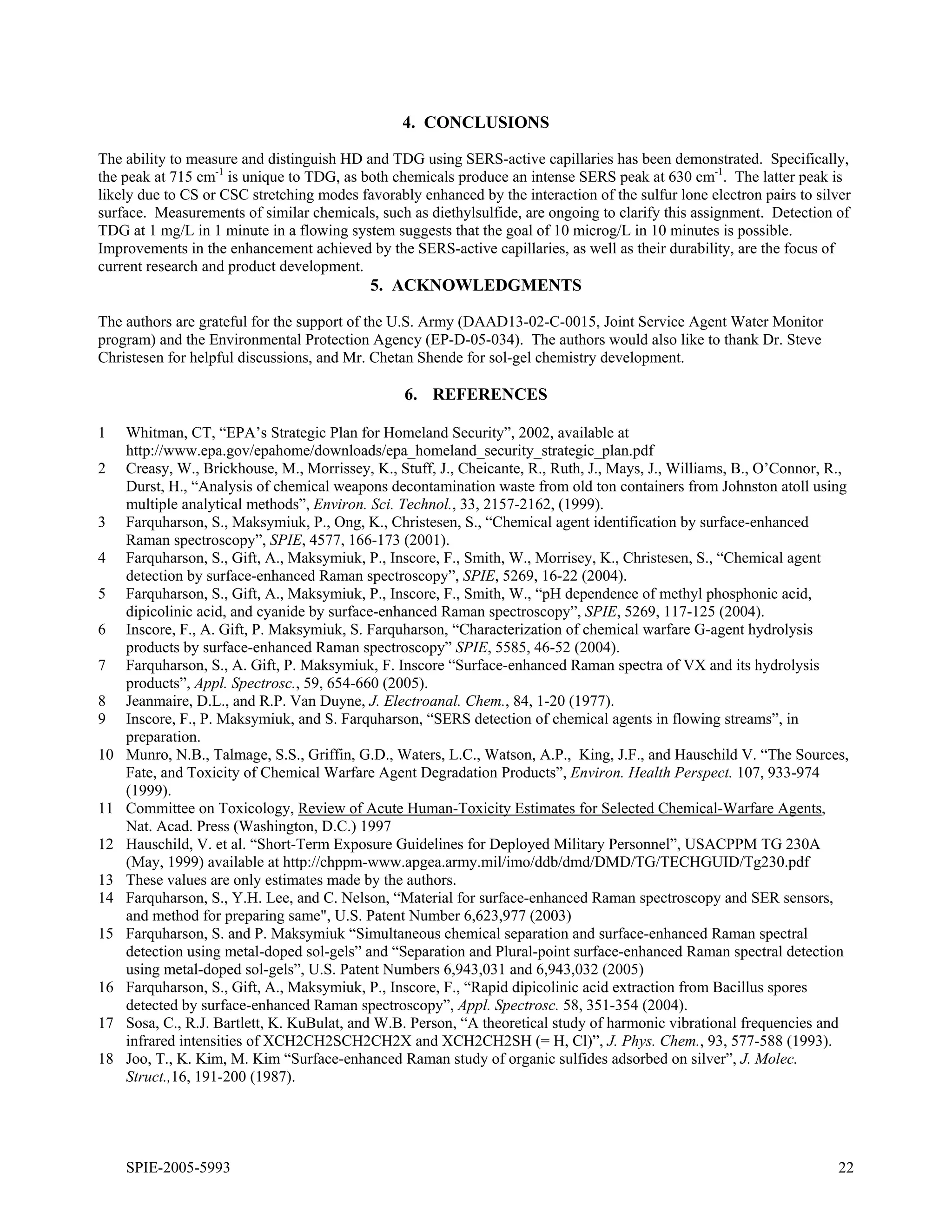
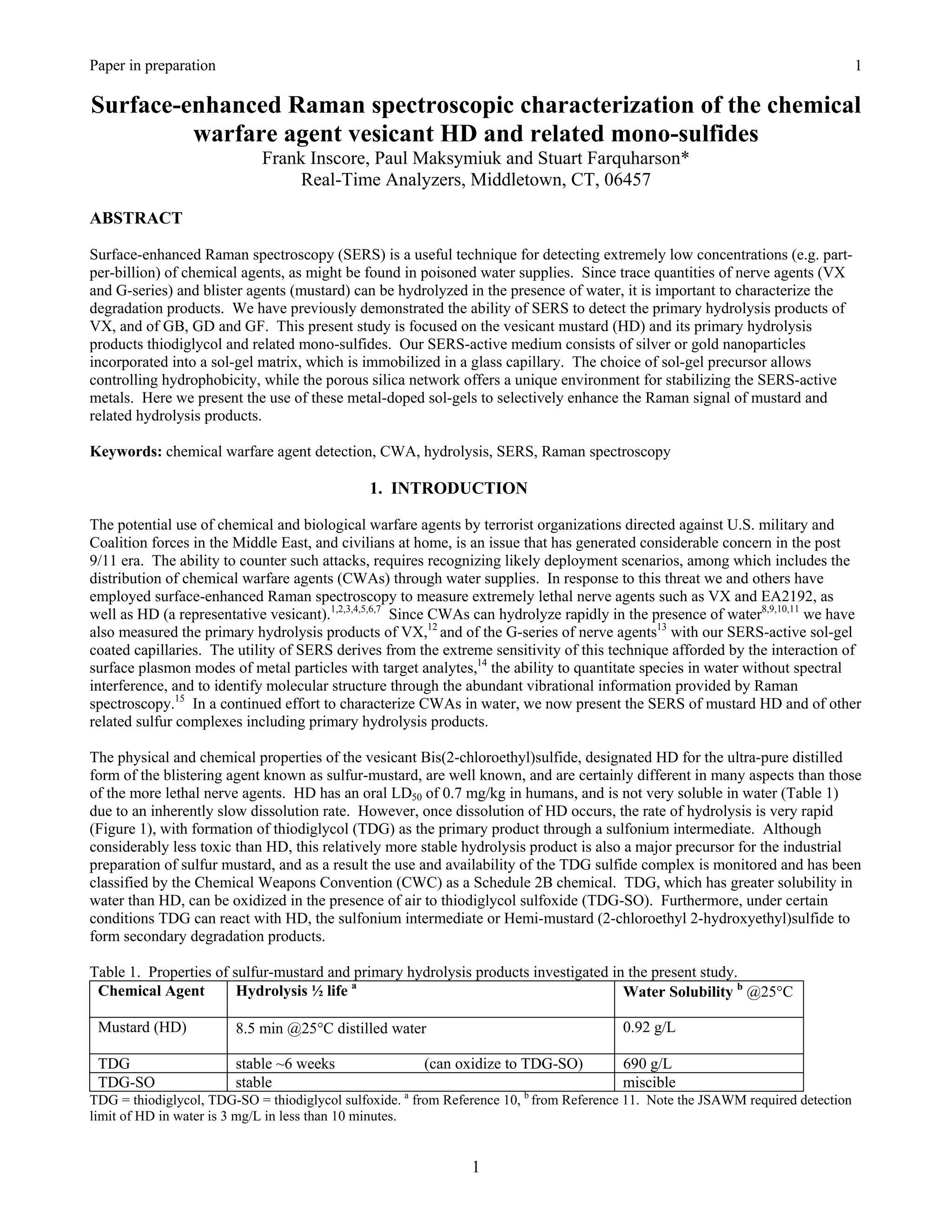
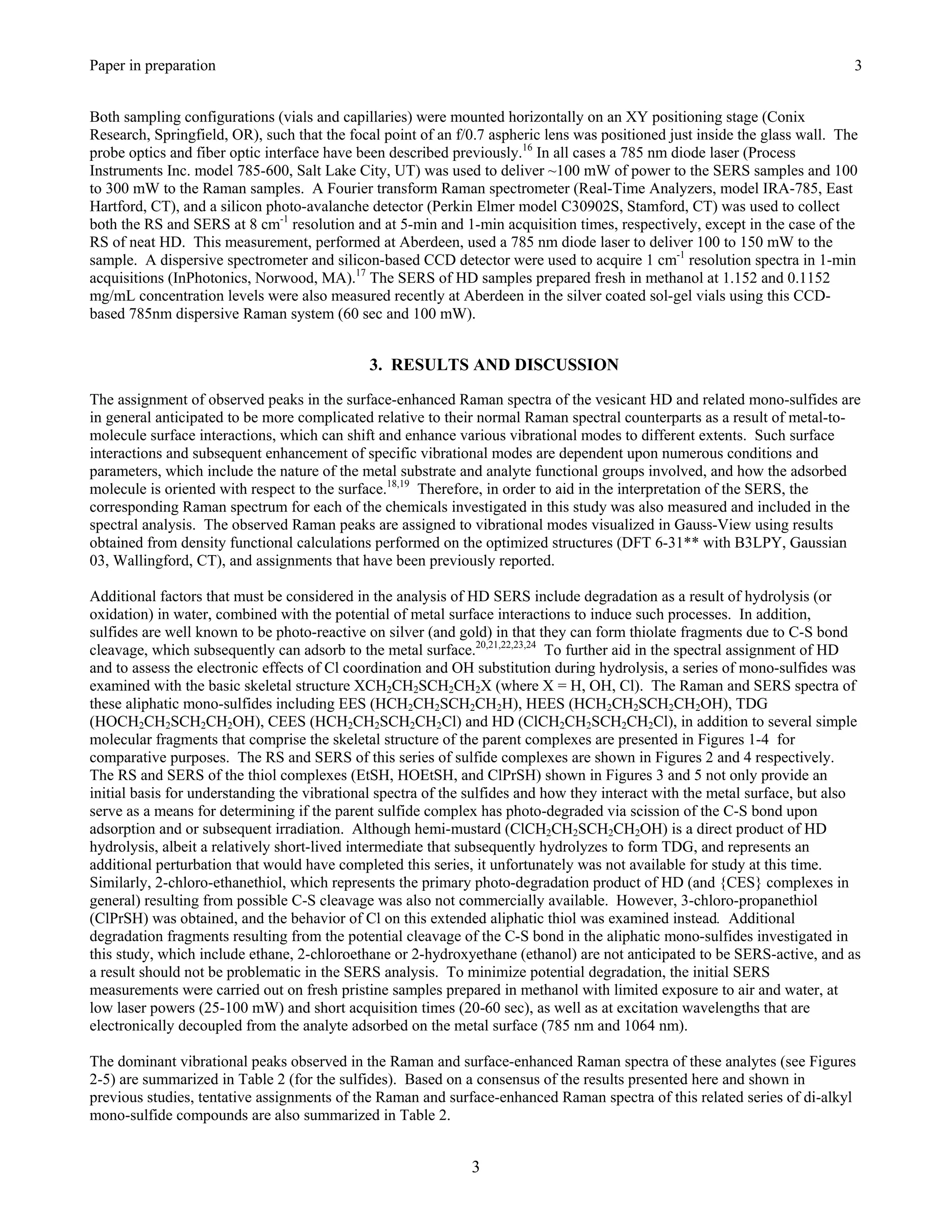
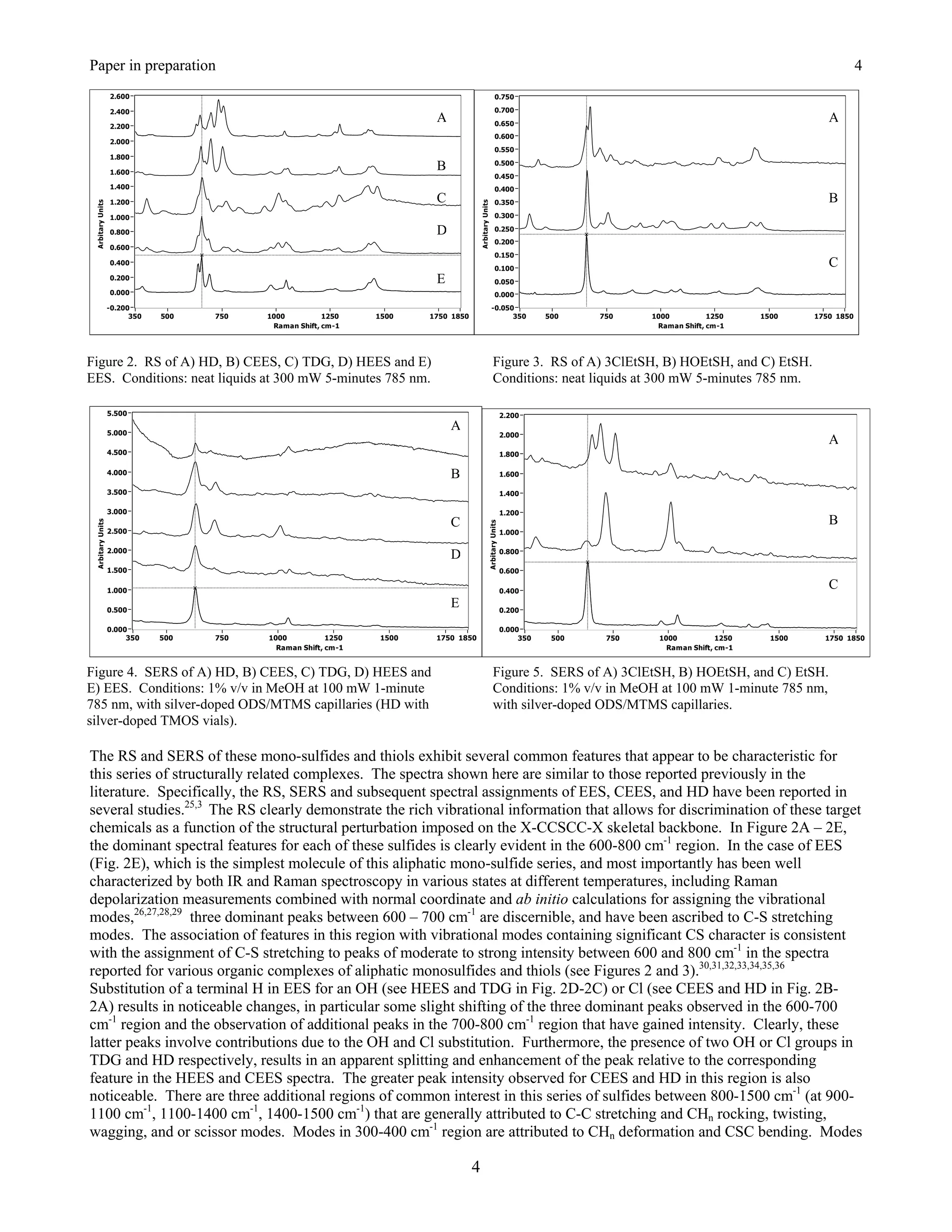
Figure 3. SERS of HD using A) gold-doped sol-gel, B) silver-doped sol-gel, and C) electrochemically roughened
silver foil. D) Raman spectrum of HD. Conditions: A) and B) 1 g/L in isopropanol/water, 100 mW of 785 nm, 1-
min, C) 0.777 g/L in distilled water, 100 mW of 785 nm, 0.5-min, D) neat HD, 300 mW of 785 nm, 1-min.


Figure 4. SERS of TDG using silver-doped sol-gels using A) 100 and B) 15 mW of 785 nm excitation, and C)
Raman of neat TDG. Conditions: A) and B) 1 g/L, and C) 300 mW.


                                                                                                                9
CRC Book Chapter 5                                      Draft


                                                                                                   OH
                                            1       H                       N           +      O       P   O
                                                        S
                                        34%-37%
                                                                 DIASH                             EMPA
 O
         S                                                  O
     P               N        H2O           2                        S
                                                                P                   N
         O                                                                                         +           EtOH
                                        42%-50%                     O
             VX                                                 H
                                                                     EA2192

                                            3                   S-
                                                                                                           N
                                          ~10%
                                                        O       P       O       +       HO

                                                O-ethyl                                     2-(diisopropylamino)
                                                methylphosphonothioate                      ethanol
Figure 5. VX hydrolysis pathways.


Figure 6. SERS of VX using A) roughened silver foil and B) silver-doped sol-gel, and C) Raman spectrum of neat
VX. Conditions: A) 1 g/mL B) 129 mg/L.


                                                                                                                      10
CRC Book Chapter 5                                       Draft


Figure 7. SERS of EA2192 using A) silver-doped sol-gel vial and B) roughened silver foil, and C) Raman spectrum
of solid EA2192. Conditions: A) 1 g/L, B) 113 mg/L. The substrate was dipped into the solution for 2 minutes prior
to collecting a 0.5 min spectrum.


Figure 8. SERS of EMPA in silver-doped-sol-gel vials using A) 100 and B) 30 mW of 785 nm excitiation. SERS of
EMPA on electrochemically roughened silver foils for D) 0.1 and E) 1 mg/L samples. Raman spectra of neat EMPA
in C) and E) for comparison. Conditions A) and B) 1 g/L, ...


                                                                                                                11
CRC Book Chapter 5                                         Draft


Figure 9. SER spectra of sodium cyanide A) in three different silver-doped sol-gel coated vials at 1, 10, and 100
mg/L and B) on four different roughened gold foils all at 0.2 mg/L. Conditions: A) 100 mw 785 nm, 1-min, 8, B)
300 mw 785 nm, 0.5-min, 1. The top two traces were measured on the same day, as were the bottom two traces.


  1.0

  0.8

  0.6

  0.4

  0.2

  0.0

 -0.2
        1            10           100          1000          10000        100000       1000000
                                     Concentration (µg/L)

Figure 10. Plot of surface coverage (θ) vs. concentration for CN on electrochemically roughened gold. The
diamonds and open circles are results from two different days, and each point represents data from a different
substrate. The solid line and dashed line are fits of the data to the Langmuir adsorption isotherm and have R2 values
of 0.971 and 0.944, respectively.


                                                                                                                    12
CRC Book Chapter 5                                        Draft


                                                     References

1     Global Proliferation of Weapons of Mass Destruction: A Case Study on the Aum Shinrikyo, The Senate
      Government Affairs Permanent Subcommittee on Investigations, October 31, 1995 Staff Statement,
      http://www.fas.org/irp/congress/1995_rpt/aum/index.html,
2 The Japan Times Online Tuesday July 18, 2000. http://www.japantimes.co.jp/cgi-
      bin/getarticle.pl5?nn20000718a1.htm.
3 Committee on Toxicology. Review of Acute Human-Toxicity Estimates for Selected Chemical-Warfare
      Agents, Nat. Acad. Press (Washington, D.C.) 1997.
4 http://chppm-www.apgea.army.mil/documents/TBMEDS/TBMED577.pdf
5 Committee on Toxicology. Guidelines for Chemical Warfare Agents in Military Field Drinking Water, Nat.
      Acad. Press (Washington, D.C.) 1995
6 McKone, T.E., Huey, B.M., Downing, E., and Duffy, L.M., Strategies to Protect the Health of Deployed U.S.
      Forces: Detecting, Characterizing, and Documenting Exposures, Division of Military Science and Technology
      and Board on Environmental Studies and Toxicology, National Research Council, NATIONAL ACADEMY
      PRESS, Washington, D.C.,207, 2000. http://www.nap.edu/books/0309068754/html.
7
  . R.M. Black, R.J. Clarke, R.W. Read, M.T. Reid: J. Chromat. 662, 301 (1994)
8
  . G.A. Sega, B.A. Tomkins, W.H. Griest: J Chromat. A 790, 143 (1997)
9
  . S.A. Oehrle, P.C. Bossle: J. Chromat. A 692, 247 (1995)
10
   . J.E. Melanson, B.L-Y. Wong, C.A. Boulet, C.A. Lucy: J. Chromat. A 920, 359 (2001)
11
   . J. Wang, M. Pumera, G.E. Collins, A. Mulchandani: Anal. Chem. 74, 6121 (2002)
12
   . W. Creasy, M. Brickhouse, K. Morrissey, J. Stuff, R. Cheicante, J. Ruth, J. Mays, B. Williams, R. O’Connor,
      H. Durst: Environ. Sci. Technol. 33, 2157 (1999)
13
   . W.R. Creasy: Am. Soc. Mass. Spectrom. 10, 440 (1999)
14
   . Q. Liu, X. Hu, J. Xie: Anal. Chim. Acta 512, 93 (2004)
15
   . G.A. Eiceman, Z. Caras: Ion Mobility Spectrometry. (CRC Press, 1994)
16
   . See products from Smiths Detection, Bruker Daltronics, etc.
17
   . N. Krylova, E. Krylov, G.A. Eiceman: J. Phys. Chem. 107, 3648 (2003)
18
   . W.E. Steiner, B.H. Clowers, L.M. Matz,W.F. Siems, H.H. Hill Jr.: Anal. Chem. 74, 4343 (2002)
19 Christesen, S., MacIver, B., Procell, L., Sorrick, D., Carrabba, M., and Bello, J., Non-intrusive analysis of
      chemical agent identification sets (CAIS) using a portable fiber-optic Raman spectrometer, Appl. Spectr., 53,
      850, 1999.
20 Sedlacek III, A.J., Christesen, S.D., Chyba, T., and Ponsardin, P., Application of UV-Raman spectroscopy to
      the detection of chemical and biological threats, in Proc. SPIE Vol. 5269, Sedlacek III, A.J, Christesen, S.D.,
      Colton, R. and Vo-Dinh, T., Eds., SPIE, Bellingham, Washington, 2004, 23.
21 Alak, A.M. and Vo-Dinh, T., Surface-enhanced Raman spectrometry of organophosphorus chemical agents,
      Anal. Chem., 59, 2149, 1987.
22 Taranenko, N., Alarie, J-P., Stokes, D.L., VoDinh, T., Surface-enhanced Raman detection of nerve agent
      simulant (DMMP and DIMP) vapor on electrochemically prepared silver oxide substrates, J. Raman Spectrosc.,
      27, 379, 1996.
23 Spencer, K., Sylvia, J., Clauson, S. Janni, J., Surface-enhanced Raman as a water monitor for warfare agents, in
      Proc. SPIE Vol. 4577, Christesen, S.D. and Sedlacek III, A.J, Eds., SPIE, Bellingham, Washington, 2002, 158
24 Farquharson, S., P. Maksymiuk, K. Ong, and S. Christesen, Chemical agent identification by surface-enhanced
      Raman spectroscopy, in Proc. SPIE Vol. 4577, Christesen, S.D. and Sedlacek III, A.J, Eds., SPIE, Bellingham,
      Washington, 2002, 166.
25 Farquharson, S., Gift, A., Maksymiuk, P., Inscore, F. E., and Smith, W. W., pH dependence of methyl
      phosphonic acid, dipicolinic acid, and cyanide by surface-enhanced Raman spectroscopy, in Proc. SPIE Vol.
      5269, Sedlacek III, A.J, Christesen, S.D., Colton, R. and Vo-Dinh, T., Eds., SPIE, Bellingham, Washington,
      2004, 117.
26 Spencer, K.M., Sylvia, J.M., Marren, P.J., Bertone, J.F., and Christesen, S.D., Surface-enhanced Raman
      spectroscopy for homeland defense, in Proc. SPIE Vol. 5269, Sedlacek III, A.J, Christesen, S.D., Colton, R. and
      Vo-Dinh, T., Eds., SPIE, Bellingham, Washington, 2004, 1.
27 Farquharson, S, Gift, A., Maksymiuk, P. and Inscore, F., Appl. Spectrosc. 58, 351 (2004).
28 Ogsten, A.G.; Holiday, E.R.; Philpot, J. St. L.; Stocken, L. A., The replacement reactions of b,b'-dichlorodiethyl
      sulphide and of some analogues in aqueous solution: the isolation of b-chloro-b'-hydroxydiethyl disulphide,
      Trans. Faraday Soc., 44, 45, 1948.


                                                                                                                  13
CRC Book Chapter 5                                       Draft


29 Yang, Y-C., Szafraniec, L.L, Beaudry, W.T., and Ward, J.R., Kinetics and mechanism of the hydrolysis of 2-
   chloroethyl sulfides, J. Org. Chem., 53, 3293, 1988.
30 Sosa, C., Bartlett, R.J., KuBulat, K. and Person, W.B., A theoretical study of the harmonic vibrational
   frequencies and infrared intensities of XCH2CH2SCH2CH2X and XCH2CH2SH (X=H, Cl), J. Phys. Chem.,
   93, 577, 1989.
31 Donovan, W.H. and Famini, G.R., Conformational analysis of sulfur mustard from molecular mechanics,
   semiempirical, and ab initio methods, J. Phys. Chem., 98, 3669, 1994.
32 Christesen, S.D., Vibrational spectra and assignments of diethyl sulfide, 2-chlorodiethyl sulfide and 2,2’-
   dichlorodiethyl sulfide, J. Raman Spectrosc., 22, 459, 1991.
33 Donovan, W.H. and Famini, G.R., Jensen, J.O., and Hameka, H.F., Phosphorus, Sulfur, and Silicon, 80, 47,
   1993.
34 Joo, T.H., Kim, K. and Kim, M.S., Surface-enhanced Raman study of organic sulfides adsorbed on silver, J.
   Mol. Struct., 162, 191, 1987.
35 Inscore, F., and Farquharson, S., Detecting hydrolysis products of blister agents in water by surface-enhanced
   Raman spectroscopy, in Proc. SPIE Vol. 5993, Vo-Dinh, T., Lieberman, R.A., and Gauglitz, G., Eds., SPIE,
   Bellingham, Washington, 2005, 19.
36 Farquharson, S., A. Gift, P. Maksymiuk, F. Inscore, W. Smith, K. Morrisey, and S.D. Christesen, Chemical
   agent detection by surface-enhanced Raman spectroscopy, in Proc. SPIE Vol. 5269, Sedlacek III, A.J,
   Christesen, S.D., Colton, R. and Vo-Dinh, T., Eds., SPIE, Bellingham, Washington, 2004, 16.
37 www.mitretek.org/home.nsf/homelandsecurity/VX
38 Szafraniec, L. J.; Szafraniec, L. L.; Beaudry, W. T.; Ward, J. R., On the Stoichiometry of Phosphonothiolate
   Ester Hydrolysis, CRDEC-TR-212, July 1990, AD-A250773
39 Epstein, J.; Callahan, J. J.; Bauer, V. E., The kinetics and mechanisms of hydrolysis of phophonothiolates in
   dilute aqueous solution, Phosphorus, 1974, 4, 157-163.
40 Yang, Y-C., Chemical detoxification of nerve agent VX, Acc. Chem. Res., 1999, 32, 109-115
41 Farquharson, S, Gift, A., Maksymiuk, P. and Inscore, F., Surface-Enhanced Raman Spectra of VX and its
   Hydrolysis Products, Appl. Spectrosc., 59, 654, 2005.
42 Tessier, P. M., Christesen, S. D., Ong, K. K., Clemente, E. M., Lenhoff, A. M., Kaler, E. W., and Velev, O. D.,
   On-line spectroscopic characterization of sodium cyanide with nanostructured gold surface-enhanced Raman
   spectroscopy substrates, Applied Spectroscopy, 56, 1524, 2002.
43 Kuncicky, D. M., Christesen, S. D., and Velev, O. D., Role of the micro- and nanostructure in the performance
   of SERS substrates assembled from gold nanoparticles, Appl. Spectrosc., 59, 401, 2005.
44 Tessier, P. M., Christesen, S. D., Ong, K. K., Clemente, E. M., Lenhoff, A. M., Kaler, E. W., and Velev, O. D.,
   Assembly of gold nanostructured films templated b colloidal crystals and used in surface-enhanced Raman
   spectroscopy, in Proc. SPIE Vol. 4577, Christesen, S.D. and Sedlacek III, A.J, Eds., SPIE, Bellingham,
   Washington, 2002, 53.
45 Shelton, R. D., Hass, J. W., and Wachter, E. A., Surface-enhanced Raman detection of aqueous cyanide, Appl.
   Spectrosc., 48, 1007, 1994.
46 Mahoney, M. R., and Cooney, R. P., The evidence for stoichiometric silver oxide-cyanide phase in cyanide in
   cyanide SERS from silver electrodes, Chem. Phys. Lett., 117, 71, 1985.
47 Benner, R. E., Dornhaus, R., Chang, R. K., and Laube, B. L., Correlations in the Raman spectra of cyanide
   complexes adsorbed on silver electrodes with voltammograms, Surf. Sci., 101, 341, 1980.
48 Kellogg, D. S. and Pemberton, J. E., Effects of solution conditions on the surface-enhanced Raman scattering of
   cyanide species at Ag electrodes, J. Phys. Chem., 91, 1120, 1987.
49 Billmann, J., Kovacs, G., and Otto, A., Enhanced Raman effect from cyanide adsorbed on a silver electrode,
   Surf. Sci., 92, 153, 1980.
50 Premasiri, W. R., Clarke, R. H., Londhe, S., and Womble, M. E., Determination of cyanide in waste water by
   low-resolution surface enhanced Raman spectroscopy on sol-gel substrates, J. Raman Spetrosc. 30, 827, 1999.
51 Vo-Dinh, T., Surface-enhanced Raman spectroscopy using metallic nanostructures, Trends Anal. Chem., 17,
   557, 1998.
52 Wachter, E. A., Storey, J. M. E., Sharp, S. L., Carron, K. T., and Jiang, Y., Hybrid substrates for real-time
   SERS-based chemical sensors, Appl. Spectrosc., 48, 193, 1995.
53 Adamson, A.W. and Gast, A.P., Physical Chemistry of Surfaces (Wiley Interscience, New York, 1997), 6th ed.,
   p. 599.


                                                                                                               14
Springer Book Kneipp Editor                           Appendix M                        Draft                            1


25. Detecting chemical agents and their hydrolysis products in water
                        Stuart Farquharson, Frank E. Inscore and Steve Christesen
                              Real-Time Analyzers, Middletown, CT, 06457

25.1 INTRODUCTION

The use of chemicals as weapons was introduced during World War I. It is estimated that chlorine, phosgene and
sulfur-mustard (HD) resulted in an estimated death of 100,000 soldiers and 1 million injuries [1]. Over the next 20
years, chemicals designed specifically for warfare were developed; this included the substantially more toxic nerve
agents, tabun, sarin, and soman (GA, GB, and GD, respectively). Fortunately, these abhorrent chemicals were not
used in WWII, as world leaders feared reprisal attacks on their cities. During the Iran-Iraq war in the 1980s, the
Iraqis used HD, GA, GB, and GF (cyclo-sarin), and in 1988, Saddam Hussein used mustard and possibly nerve
agents in killing several thousand Kurds [1].

In more recent years, chemical agents have been used by terrorists. In Japan, the Aum Shinrikyo religious cult
released GB within the Tokyo subway system in 1995 [2]. The release of GB in this confined space had devastating
effects resulting in 12 fatalities and hospitalization of thousands. This event and the mailing of anthrax causing
spores through the US Postal System in 2001 demonstrated that deployment of chemical and biological agents do
not require sophisticated delivery systems, and a wide range of attack scenarios must be considered. Among these
scenarios is the deliberate poisoning of drinking water. This includes water supplies used in military operations and
water delivered to major cities from reservoirs and through distribution systems. Countering such an attack requires
detecting poisons in water rapidly, and at very low concentrations.

The required detection sensitivity for each agent depends on several factors, such as toxicity and hydrolysis (Table
25.1). In the case of cyanide (AC) it known that 4 milligrams per liter of water produces detectable changes in
human blood chemistry and 8 mg L-1 causes severe, but reversible symptoms [3]. The military has used this and
other toxilogical data to set a field drinking water standard (FDWS) for cyanide at 2 mg L-1 [4]. The FDWS
represents the maximum allowable concentration that is assumed safe when 15 L of water per day is consumed over
5 days (expected soldier intake in arid climates). Human toxicity data for the other chemical warfare agents in water
have, in general, not been determined. The normal route of exposure for chemical warfare agents is inhalation, and
most of the toxicity data is given as the LCt50s [1], the concentration that is lethal to 50% of an exposed population
as a function of exposure time. In the case of mustard, animal studies along with the inhalation LCt50, the oral lethal
dosage of 0.7 mg per kg of body mass (LD50), and modeling studies [5], have been used to set the FDWS at 0.047
mg L-1. Similar analyses of LCt50s and LD50s for GB and VX have been used to set their FDWS at 0.0046 and
0.0025 mg L-1, respectively. The FDWS concentrations have also been used by the military to set the minimum
detection requirement for poisons in water.

Table 25.1. Military field drinking water standard [4], lethal exposures and dosages [1,3,5], and water properties for
selected chemical warfare agents.
 Chemical            FDWS             LCt50         LD50             Water        Hydrolysis         Hydrolysis
                   5-day/15L       inhalation        oral          Solubility      Half-Life*          Product
                    (mg L-1) (mg-min m-3)          (mg kg-1)        at 25°C
 HCN (AC)               2             2000             -                                -                CN
 NaCN                                                              480 g L-1
 Mustard (HD)         0.047            900            0.7          0.92 g L-1     2-30 hours            TDG
 Sarin (GB)          0.0046            70              2          completely      20-40 hours       IMPA, MPA
                                                                    miscible
 VX                  0.0025            35            0.07          150 g L-1        82 hours       DIASH, EMPA,
                                                                                                   EA2192, MPA

In order to detect these poisons in water, their properties in water must also be considered, i.e. the solubility, rate of
hydrolysis, and hydrolysis products formed. In the case of cyanide, as HCN, KCN, or NaCN, all of these chemicals
are extremely soluble in water (completely miscible, 716, and 480 g L-1, respectively) [6]. In solution the cyanide
Springer Book Kneipp Editor                                                          Draft                          2


ion is formed in equilibrium with the conjugate acid, HCN (Figure 25.1A), according to the Ka of 6.15x10⁻¹⁰ [7 ]. In
the case of cyanide then it is important to know the pH, if one form of the chemical is to be detected versus the
other. For example, if 2 mg L-1 of NaCN is added to water (the FDWS), then 1.25 mg L-1 of CN- and 0.75 mg L-1 of
HCN will be present.


        A


        B


        C


        D


Figure 25.1. Hydrolysis reaction pathways for A) CN, B) HD, C) GB, and D) VX.

In the case of sulfur-mustard, the situation is somewhat more complex. It is marginally soluble in water tending to
form droplets, and hydrolysis occurs at the droplet surface. This property has made measuring the hydrolysis rate
constant difficult, and half-lives anywhere from 2 to 30 hours are reported [8]. Chemically, the hydrolysis of HD
involves the sequential replacement of the chlorine atoms by hydroxyl groups through cyclic sulfonium ion
intermediates to form thiodiglycol (TDG, Figure 25.1B) [9]. If a median hydrolysis rate is assumed, then early
detection of poisoned water will require measuring HD, while post-attack or downstream monitoring will require
measuring TDG. For sarin, the analysis is more straightforward, since it dissolves readily into water and it is stable
for a day or more. In this case, detecting poisoned water will largely require measuring sarin, while monitoring the
attack will require detecting its sequential hydrolysis products, isopropyl methylphosphonic acid (IMPA) and methyl
phosphonic acid (IMPA, MPA, respectively, Figure 25.1C) [8,10,11]. The other hydrolysis products, hydrofluoric
acid and 2-propanol, are too common to provide definitive evidence of water poisoning and their measurement
would be of limited value. VX is reasonably soluble, and like sarin, is fairly persistent with a hydrolysis half-life
greater than 3 days [12]. Unfortunately, one of its hydrolysis products, known as EA2192, is considered just as
toxic as VX, more soluble and more persistent in water [13]. Consequently, detecting the early stages of poisoning
water should focus on measuring VX, while longer term monitoring should focus on EA2192.

The earliest technologies developed for CWA detection were based on electrochemical, ionization, or colorimetric
analysis. Examples of the latter include phosgene, M8 and M9 tape, which change color when in contact with a
sample like pH paper. Although these tapes are easy to use, they are not generally agent specific and suffer from a
high percentage of false-positives [14]. For example, M8 changes color when in contact with common solvents such
as acetonitrile, ethanol, methanol, or common petroleum products such as brake fluid, lighter fluid, or WD-40 [15].
More rigorous laboratory methods have been successfully developed to detect chemical agents with minimum false-
positive responses. More than a decade ago, Black et al. demonstrated the ability of combining gas chromatography
Springer Book Kneipp Editor                                                             Draft                           3


with mass spectrometry detection (GC/MS) to measure sarin and mustard [16]. Sega at al. used GC with a
phosphorous-selective flame ionization detector to analyze nerve agent hydrolysis products in groundwater [17],
while several researchers used capillary electrophoresis (CE) to measure chemical warfare agents and their
hydrolysis products [18,19,20]. The sensitivity of these techniques has improved by two orders of magnitude from 1
mg L-1 to 0.01 mg L-1 in 10 years. A comprehensive development of these techniques was undertaken by Creasy et
al. in analyzing chemical weapon decontamination waste from the Johnston Atoll [11,21]. These researchers used
GC/MS for nerve agents, GC coupled atomic emission detection for arsenic compounds, LC/MS for mustard
compounds, and CE with ultraviolet absorption detection for alkyl phosphonic acids. Detection limits of 0.02 and
0.140 mg L-1 were reported for nerve agents and mustard, respectively. Detection of the alkyl phosphonic acids
have proven more difficult, and Liu, Hu and Xie recently used GC/MS to detect mg L-1 concentrations of these
degradation products [22]. However, they concede that all of these separation methods require extraction,
derivatization, and repeated column calibration, making them labor intensive, time consuming (typically 30 to 60
minutes), and less than desirable for field use. Another variant of these separation/mass detection technologies is ion
mobility spectrometry (IMS) [23]. This technology has been successfully developed to measure explosives in air
samples, and commercial products can be found at most airports [24]. Eiceman et al. have investigated the ability of
IMS to measure organophosphorous compounds in air [25], while Steiner et al. have investigated IMS to measure
chemical agent simulants in water [26]. In the latter case, electrospray ionization was coupled to the sample entry
point of an IMS, and a time-of-flight MS was added as an orthogonal detector. Water samples spiked with 10 mg
L-1 diisopropylmethylphosponate and thiodiglycol could be measured in 1-min, once sample pretreatment was
accomplished. It is worth noting that with proper care these MS-based technologies are likely to detect chemical
agents with virtually no false-positives, but detection limits are still insufficient by 1 to 2 orders of magnitude in the
case of nerve agents and their hydrolysis products.

More rapid analysis of agents in the solid, liquid and gas phase has been demonstrated by vibrational spectroscopy
[27-31]. Hoffland et al. reported infrared absorbance spectra and absolute Raman cross sections for several
chemical agents [27], while Christesen measured Raman cross sections for sarin, tabun, mustard gas, and VX [28].
Again, however these technologies also have limitations. Raman spectroscopy is simply not a very sensitive
technique, and detection limits are typically 0.1% (1000 ppm). And infrared spectroscopy would have limited value
in analyzing poisoned water, since the very strong infrared absorption of water would obscure most other chemicals
present. Nevertheless, efforts to overcome these limitations have been demonstrated. Braue and Pannella quantified
the G-series nerve agents (tabun, sarin, and soman) in terms of infrared attenuated total reflectance using a circle-
cell [29].

Enormous improvements in sensitivity for Raman spectroscopy can be achieved through surface-enhancement [32].
The interaction of surface plasmon modes of metal particles with target analytes can increase scattering efficiency
by as much 14-orders of magnitude, although 6-orders of magnitude are more common. The details of surface-
enhanced Raman spectroscopy (SERS) can be found in the beginning of this book. The utility of SERS to measure
chemical agents was first demonstrated by Alak and Vo-Dinh by measuring several organophosphonates as
simulants of nerve agents on a silver-coated microsphere substrate [33]. Spencer, et al. used SERS to measure
cyanide, MPA, HD and EA2192 on electrochemically roughed gold or silver foils [34,35,36]. However, in all of
these measurements, the sample needed to be dried on the substrates to obtain the best sensitivity (e.g. 0.05 mg L-1
for MPA). More recently, Tessier et al. obtained SERS of 0.04 mg L-1 cyanide in a stream flowing over a substrate
formed by a templated self-assembly of gold nanoparticles [37]. However, optimum sensitivity required
introduction of an acid wash and the measurements were irreversible.

In the past few years, we have also been investigating the ability of SERS to measure chemical agents at 0.001 mg
L-1 in water and with sufficient spectral uniqueness to distinguish the agent and its hydrolysis products [38-43]. In
our work, we have developed silver-doped sol-gels as the SERS-active medium. These sol-gels can be coated on the
inside walls of glass vials, such that water samples can be added to perform point-analysis, or they can be
incorporated into glass capillaries, such that flowing measurements can be performed [44]. Here, both sampling
devices were used to measure and compare SER spectra of AC, HD, VX and several of their hydrolysis products,
TDG, EA2192, EMPA, and MPA. In addition, a field-usable Raman analyzer was used to measure 0.01 mg L-1
cyanide flowing in water with a detection time of less than 1-min.
Springer Book Kneipp Editor                                                           Draft                           4


25.2 EXPERIMENTAL
Sodium cyanide, 2-hydroxyethylethyl sulfide (HEES), 2-chloroethylethyl sulfide (CEES) and methylphosphonic
acid (MPA) were purchased from Sigma-Aldrich (St. Louis, MO) and used as received. Ethyl methylphosphonic
acid (EMPA), isopropyl methylphosphonic acid (IMPA), 2-(diisopropylamino) ethanethiol (DIASH), and
thiodiglycol (TDG, bis(2-hydroxyethyl)sulfide) were purchased from Cerilliant (Round Rock, TX). Highly distilled
sulfur mustard (HD, bis(2-chloroethyl)sulfide), isopropyl methylphosphonofluoridate (GB), ethyl S-2-
diisopropylamino ethyl methylphosphonothioate (VX), and ethyl S-2-diisopropylamino methylphosphonothioate
(EA2192) were obtained at the U.S. Army’s Edgewood Chemical Biological Center (Aberdeen, MD) and measured
on-site. All samples were initially prepared in a chemical hood as 1000 parts-per-million (1 g L-1 or 0.1% by
volume, Environmental Protection Agency definition) in HPLC grade water (Fischer Scientific, Fair Lawn, NJ) or in
some cases methanol or ethanol (Sigma-Aldrich) to minimize hydrolysis.

Once prepared, the samples were transferred into 2-ml glass vials internally coated with a silver-doped sol-gel
(Simple SERS Sample Vials, Real-Time Analyzers, Middletown, CT) or drawn by syringe or pump into 1-mm
diameter glass capillaries filled with the same SERS-active material [45,46,47]. In the case of flow measurements, a
peristaltic pump (variable flow mini-pump, Control Co., Friendswood, TX) was used to flow the various cyanide
solutions through a SERS-active capillary at 1 mL min-1. The vials or capillaries were placed on aluminum plates
machined to hold the vials or capillaries on a standard XY positioning stage (Conix Research, Springfield, OR),
such that the focal point of an f/0.7 aspheric lens was positioned just inside the glass wall. The probe optics and
fiber optic interface have been described previously [40]. SER spectra were collected using a Fourier transform
Raman spectrometer equipped with a 785 nm diode laser and a silicon photo-avalanche detector (IRA-785, Real-
Time Analyzers). All spectra were nominally collected using 100 mW, 8 cm-1 resolution, and 1-min acquisition
time, unless otherwise noted. Complete experimental details can be found in Reference 48. For added safety, all
samples were measured in a chemical hood. In the case of actual agents measured at Edgewood, the FT-Raman
instrument was placed outside the laboratory and 30 foot fiber optic and electrical cables were used to allow remote
SERS measurements and plate manipulation.

25.3 RESULTS AND DISCUSSION

25.3.1 Cyanide. Sodium cyanide completely dissolves in water forming the ions in equilibrium with the conjugate
acid, HCN as described above. Concentrations of 1.0, 0.1, and 0.01 mg L-1 result in CN- concentrations of 0.52,
0.016, and 0.00021 mg L-1 as the corresponding pH decreases from just above the pKa of 9.21 at 9.24 to 8.48 and
7.54. This is significant in that only CN- appears to interact sufficiently with silver to produce a SER spectrum, and
no spectral signal is observed below pH 7 (except on electrodes at specific potential conditions [49]). The SER
spectra of cyanide are dominated by an intense, broad peak at 2100 cm-1 attributed to the C≡N stretch (Figure 25.2).
This mode occurs at 2080 cm-1 in Raman spectra of solutions, and the frequency shift in SER spectra is attributed to
a strong surface interaction, which is supported by the appearance of a low frequency peak at 135 cm-1 due to a Ag-
CN stretch (not shown). It is also observed that as the concentration decreases, the CN peak shifts to 2140 cm-1.
This shift has been attribute to the formation of a tetrahedral Ag(CN)32- surface structure [50], as well as to CN
adsorbed to two different surface sites [51]. Alternatively, it has also been suggested that at concentrations near and
above monolayer coverage, the CN- species is forced to adsorb end-on due to crowding, and at lower concentrations
the molecule can reorient to lie flat. This suggests that the 2100 and 2140 cm-1 peaks correspond to the end-on and
flat orientations, respectively. However, a previous concentration study of cyanide on a silver electrode observed
the reverse trend, i.e. greater intensity was observed for the 2100 cm-1 peak at low concentration [49].

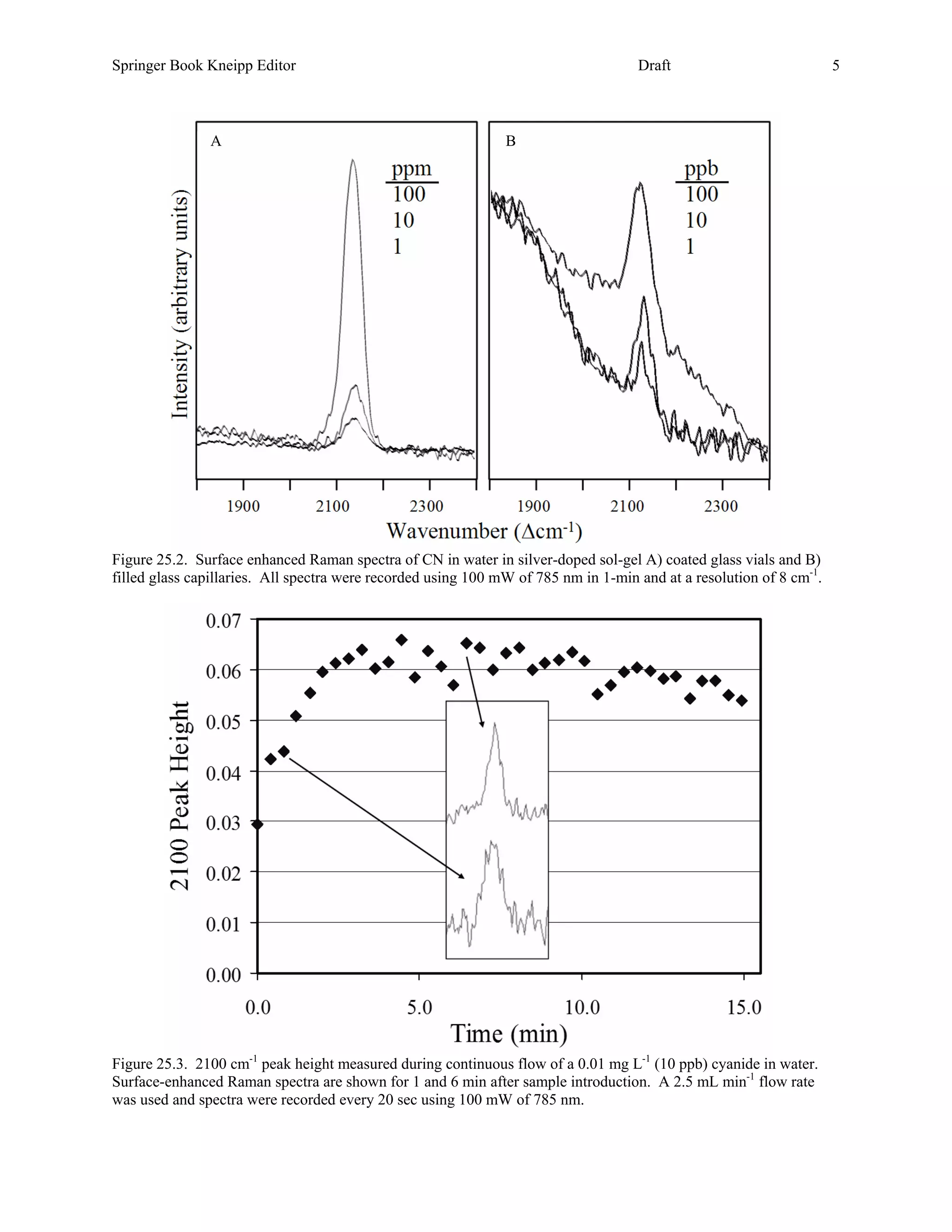
Repeated measurements of cyanide in the SERS-active vials consistently allowed measuring 1 mg L-1 (1 ppm), but
rarely below this concentration (Figure 25.2A). Nevertheless, this sensitivity is in general sufficient for point
sampling of water supplies. In the case of continuous monitoring of water, the capillaries are a more appropriate
sampling format, and they also allowed routine measurements at 0.01 mg L-1 and repeatable measurements at 0.001
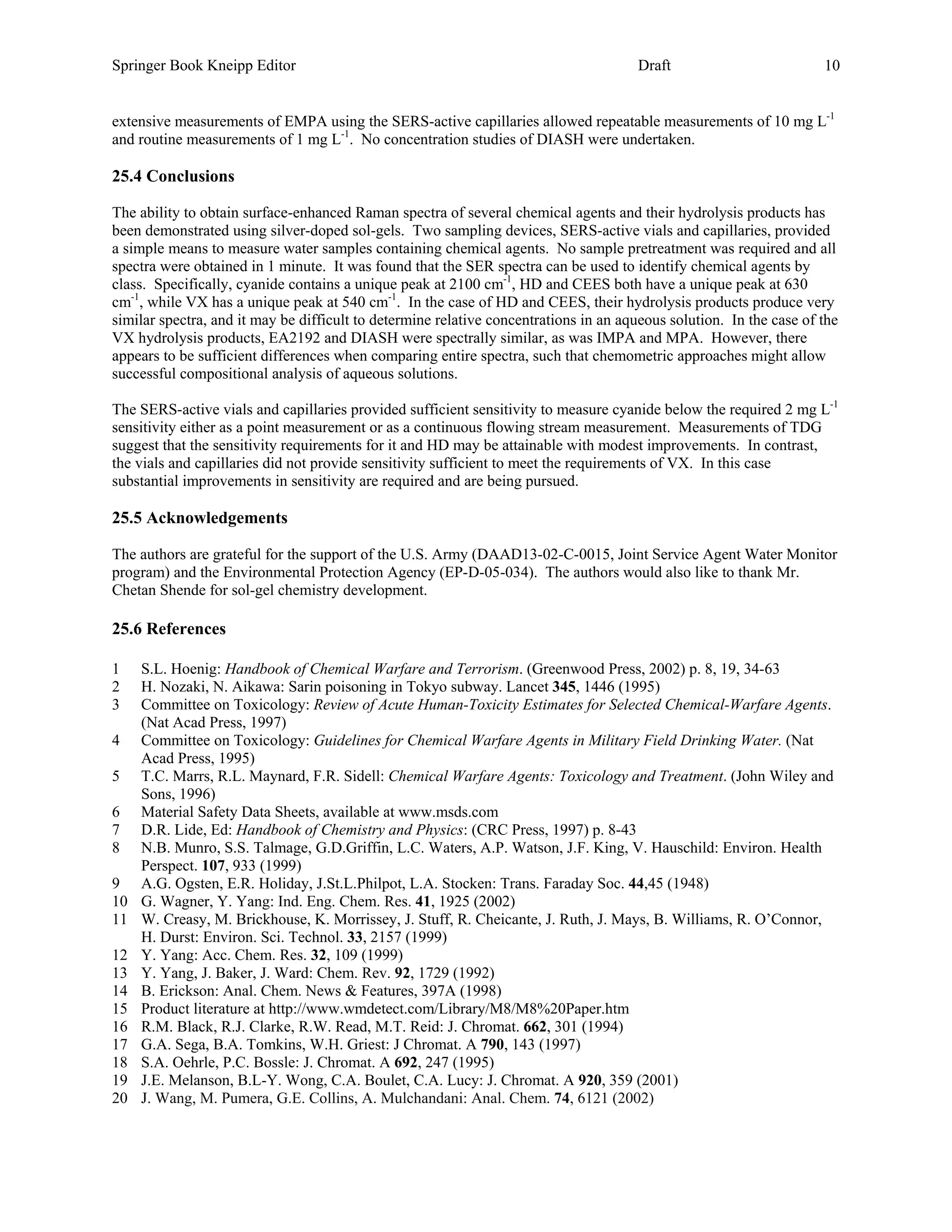
mg L-1 (1 ppb, Figure 25.2B). Employing this format, a 50 mL volume of 0.01 mg L-1 cyanide solution was flowed
at 2.5 mL min-1 through a SERS-active capillary, and spectra were recorded every 20 seconds. As Figure 25.3
shows, the cyanide peak was easily discerned as soon as the solution entered the capillary and remained relatively
stable over the course of the experiment. It is worth noting, as indicated above, that the SERS peak in Figure 25.3 is
in fact due to 210 ng L-1!
Springer Book Kneipp Editor                                                         Draft                            5


               A                                               B


Figure 25.2. Surface enhanced Raman spectra of CN in water in silver-doped sol-gel A) coated glass vials and B)
filled glass capillaries. All spectra were recorded using 100 mW of 785 nm in 1-min and at a resolution of 8 cm-1.


Figure 25.3. 2100 cm-1 peak height measured during continuous flow of a 0.01 mg L-1 (10 ppb) cyanide in water.
Surface-enhanced Raman spectra are shown for 1 and 6 min after sample introduction. A 2.5 mL min-1 flow rate
was used and spectra were recorded every 20 sec using 100 mW of 785 nm.
Springer Book Kneipp Editor                                                          Draft                          6


25.3.2 HD and CEES. The surface-enhanced Raman spectrum of HD is dominated by a peak at 630 cm-1 with an
extended high frequency shoulder composed of at least two peaks evident at 695 and 830 cm-1, as well as a
moderately intense peak at 1045 cm-1 (Figure 25.4A). The latter peak is assigned to a CC stretching mode, based on
the assignment for a peak at 1040 cm-1 in the Raman spectrum of HD [52]. The assignment of the 630 cm-1 peak is
less straightforward, since the Raman spectrum of HD contains five peaks in this region at 640, 655, 700, 740, and
760 cm-1 [40,52]. Theoretical calculations for the Raman spectrum of HD indicate that the first three peaks are due
to CCl stretching modes, and the latter two peaks to CS stretching modes [53]. Based on these calculations, and the
expected interaction between the chlorine atoms and the silver surface, it is reasonable to assign the 630 cm-1 SERS
peak to a CCl mode [40]. However, recent SERS measurements of diethyl sulfide produced a very simple spectrum
with an intense peak at 630 cm-1 [54,55], strongly suggesting CS or CSC stretching modes as the appropriate
assignment for this peak [56]. The authors of the theoretical treatment concede that the CCl and CS assignments
could be reversed [53]. The CS assignment also indicates that HD interacts with the silver surface through the sulfur
electron lone pairs. But, interaction between chlorine and silver is still possible and may be responsible for the 695
cm-1 peak. The 830 cm-1 peak is left unassigned.


                  A


                  B


Figure 25.4. Surface-enhanced Raman spectra of A) HD in methanol and B) TDG in water. Spectral conditions as
in Fig. 25.2, samples were 1 g L-1.

The surface-enhanced Raman spectrum of TDG is also dominated by a peak at 630 cm-1 with minor peaks at 820,
930, 1210, and 1275 cm-1 (Figure 25.4B). Again, the 630 cm-1 peak is preferably assigned to a CSC stretching mode
versus a CCl mode, especially since the chlorines have been replaced by hydroxyl groups. Furthermore, the lack of
a 695 cm-1 peak in the TDG spectrum supports the assignment of this peak in the HD spectrum to a CCl mode. The
930, 1210 and 1275 cm-1 SERS peaks are assigned to a CC stretch with CO contribution, and two CH2 deformation
modes (twist, scissors, or wag) based on the assignments for the corresponding peaks at 940, 1230 and 1290 cm-1 in
the Raman spectrum of TDG [52,54 ]. It is worth noting that irradiation at high laser powers or for extended periods
produces peaks at 715 and 1010 cm-1, which are attributed to a degradation product, such as 2-hydroxy ethanethiol
[54].

The SERS of CEES is very similar to HD, dominated by a peak at 630 cm-1 that is accordingly assigned to a CS or
CSC stretching mode (Figure 25.5A). This peak also has a high frequency shoulder centered at 690 cm-1, and a third
peak appears at 720 cm-1 in this region. Again, these can be assigned to CCl or CS modes. The quality of this
spectrum also reveals weak peaks at 1035, 1285, 1410, and 1445 cm-1. Peaks at 1035, 1285, 1425, and 1440 cm-1
Springer Book Kneipp Editor                                                         Draft                            7


appear in the Raman spectrum of CEES, and the previous peak assignments are used here [52], i.e. the first peak is
assigned to a CC stretch, while the remaining peaks are assigned to various CH2 deformation modes.


                  A


                  B


Figure 25.5. Surface-enhanced Raman spectra of A) CEES and B) HEES. Spectral conditions as in Fig. 25.2,
samples were 1 g L-1 in methanol.

Replacing the chlorine atom of CEES by a hydroxyl group in forming HEES produces SER spectral changes
analogous to those cited above for HD and TDG. Again, the SER spectrum is dominated by an intense peak at 630
cm-1 attributed to a CS or CSC stretching mode, and the other CEES peaks in this region, specifically the 720 cm-1
peak, disappear (Figure 25.5B). Peaks with modest intensity at 1050 and 1145 cm-1 are assigned to a CC stretching
mode and CH2 deformation, respectively. A new peak at 550 cm-1 is likely due to a skeletal bending mode, such as
CSC, SCC, or CCO. Finally, it is worth stating that HD, TDG, CEES, and HEES all produce moderately intense
peaks at 2865 and 2925 cm-1 (not shown), that can be assigned to symmetric and asymmetric CH2 stretching modes.

Only a limited number of measurements of HD were performed to evaluate sensitivity, due to the safety
requirements. HD was repeatedly observed at 1 g L-1 and usually observed at 0.1 g L-1 (100 ppm) in the SERS-
active vials [40] But even at the latter concentration, substantial improvements in sensitivity are required to
approach the required 0.05 mg L-1 (50 ppb) sensitivity. More extensive experiments were performed on HD’s
hydrolysis product, TDG since this chemical is safely handled in a regular chemical lab. Flowing TDG through
SERS-active capillaries allowed repeatable measurements at 10 mg L-1, and routine measurements at 1 mg L-1 (1
ppm) [55]. These SERS measurements of TDG suggest that the required HD sensitivity may be achievable using
this technique. Similar flowing measurements in capillaries for HD, CEES, and HEES have not been performed.

25.3.3 Sarin. SERS measurements of GB have not been made, but its primary hydrolysis products, IMPA and
MPA, have been measured using the SERS-active vials. The SERS of IMPA is very similar to its Raman spectrum
[42], which in turn is very similar to the Raman spectrum of sarin [28]. The SER spectrum is dominated by a peak
at 715 cm-1 (Figure 25.6A), which is assigned to a PC or PO plus skeletal stretching mode, as is a weak peak at 770
cm-1. These assignments are also consistent with a theoretical treatment of the Raman spectrum for sarin [57].
Similarly, a modest peak at 510 cm-1 can be assigned to a PC or PO plus skeletal bending mode. Other SERS peaks
of modest intensity occur at 875, 1055, 1415, and 1450 cm-1, and based on the spectral analysis of sarin and the
Raman spectrum of IMPA with peaks at 880, 1420, and 1455 cm-1, are assigned to a CCC bend, a PO3 stretch, a CH3
bend, and a CH2 rock, respectively.
Springer Book Kneipp Editor                                                         Draft                             8


               A


               B


               C


Figure 25.6. Surface-enhanced Raman spectra of A) IMPA, B) MPA, and C) EMPA. Spectral conditions as in Fig.
25.2, samples were 1 g L-1 in water.

MPA has been well characterized by infrared and Raman spectroscopy [58,59], as well as normal coordinate
analysis [60], and the literature assignments are used here for the SERS of MPA. The SER spectrum is dominated
by a peak at 755 cm-1, which is assigned to the PC symmetric stretch (Figure 25.6B). In comparison to IMPA, it is
clear that removing the isopropyl group shifts this frequency substantially (40 cm-1), as the mode becomes a purer
PC stretch. Additional peaks with comparatively little intensity occur at 470, 520, 960, 1040, 1300, and 1420 cm-1,
and are assigned to a PO3 bending mode, a C-PO3 bending mode, a PO3 stretching mode, another PO3 bending
mode, and two CH3 deformation modes (twisting and rocking).

SERS-active vials allowed repeatable measurements of MPA at 10 mg L-1 and routine measurements at 1 mg L-1,
and repeatable measurements of IMPA at 100 mg L-1 and routine measurements at 10 mg L-1. Again, however,
substantial improvements in sensitivity are required to achieve the minimum requirement of 0.004 mg L-1.

25.3.4 VX. The hydrolysis of VX can occur along two pathways (Figure 25.1D) [11,22], either being converted to
DIASH and EMPA or EA2192 and ethanol with the former pathway favored four to one. These products also
hydrolyze, and EMPA forms MPA and ethanol, while EA2192 forms DIASH and MPA. Here the SER spectra of
VX, EA2192 and DIASH are compared, while EMPA is compared to IMPA and MPA.

The SER spectrum of VX is similar to its Raman spectrum with corresponding peaks at 375, 460, 540, 730, 1095,
1300, 1440, and 1460 cm-1 (Figure 25.7A). Since a computer predicted Raman spectrum contains most of the
measured Raman spectral peaks [43,61], it is used to assign the above SERS peaks respectively to an SPO bend, a
CH3-P=O bend, a PO2CS wag, an OPC stretch, a CC stretch, and three CHn bends. As previously described for
CEES and HD, the 730 cm-1 peak could alternatively be assigned to a CS stretch, but the SER spectra of these
chemicals suggest otherwise.

The SER spectrum of EA2192 is somewhat different than VX with the PO modes having limited intensity and the
NC3 modes having significant intensity (Figure 25.7B). Specifically, the EA2192 spectrum has moderately intense
peaks at 480, 585, 940, and 1125 cm-1 that can be assigned to an NC3 breathing mode, an NCC bending mode,
another NC3 stretching mode, and a NCC stretching mode. Two additional peaks with significant intensity at 695
Springer Book Kneipp Editor                                                          Draft                           9


and 735 cm-1 are assigned to a CS stretching mode and an OPC stretching mode, respectively. Two peaks of modest
intensity at 525 and 970 cm-1 are attributed to a PO2S bending mode and a PO2 stretching mode.


                  A


                  B


                  C


Figure 25.7. Surface-enhanced Raman spectra of A) VX, B) EA2192, and C) DIASH. Spectral conditions as in Fig.
25.2, samples were 1 g L-1 in water.

The SER spectrum of DIASH contains most of the NC3 modes cited previously for EA2192 (Figure 25.7C),
specifically peaks appear at 480, 585, 940, and 1120 cm-1, and can be assigned as above. Additional peaks at 740,
810, and 1030 cm-1, are assigned to CH bending, a combination of SC stretching and NC3 bending, and SCCN
bending modes, based on the Raman spectrum of DIASH [43]. A broad peak centered at 695 cm-1 also occurs that
has previously been assigned to an SC stretch, but the frequency and intensity of this mode in the HD and CEES
spectra above, makes this assignment less certain.

It is worth noting the similarity between the EA2192 and DIASH SER spectra, the principle difference being the
addition of the SCCN bending mode at 1030 cm-1 for the latter. This may simply be due to the fact that both
molecules interact through the sulfur with the metal surface to similar extents resulting in similar spectra. However,
it is also possible that the EA2192 spectrum is of DIASH formed either by hydrolysis or photo-degradation. Since
the sample was measured within one hour of preparation, and the hydrolysis half-life is on the order of weeks [12],
the former explanation seems unlikely. Since the peak intensities did not change during these measurements, photo-
degradation catalyzed by silver also seems unlikely. Further experiments are required to clarify this point.

The SER spectrum of the other hydrolysis product formed from VX, EMPA, is shown in Figure 25.6. It is included
with MPA and IMPA, the hydrolysis products of GB, for convenient spectral comparison of these structurally
similar chemicals. The spectrum is dominated by a peak at 745 cm-1 with a substantial low frequency shoulder at
725 cm-1. Both are assigned, similarly to IMPA, to PC or PO plus skeletal stretching modes. In fact, virtually all of
the peaks in the SER spectrum correspond to peaks of similar frequency in the SER spectrum of IMPA, and are
assigned as follows: the peaks at 480 and 500 cm-1 to PC or PO plus skeletal bends; 890, 1415, and 1440 cm-1 to
CHn deformations; 945 and 1060 cm-1 to POn stretches; and 1095 to a CO or CC stretch. A peak at 1285 cm-1 is
assigned to a CHn deformation based on the MPA spectral assignment for a peak at 1300 cm-1.

In this series of chemicals VX and EA2192 were routinely measured at 100 mg L-1, and on occasion at 10 mg L-1
using the SERS-active vials. Again, however, only a limited number of measurements were attempted. More
Springer Book Kneipp Editor                                                           Draft                          10


extensive measurements of EMPA using the SERS-active capillaries allowed repeatable measurements of 10 mg L-1
and routine measurements of 1 mg L-1. No concentration studies of DIASH were undertaken.

25.4 Conclusions

The ability to obtain surface-enhanced Raman spectra of several chemical agents and their hydrolysis products has
been demonstrated using silver-doped sol-gels. Two sampling devices, SERS-active vials and capillaries, provided
a simple means to measure water samples containing chemical agents. No sample pretreatment was required and all
spectra were obtained in 1 minute. It was found that the SER spectra can be used to identify chemical agents by
class. Specifically, cyanide contains a unique peak at 2100 cm-1, HD and CEES both have a unique peak at 630
cm-1, while VX has a unique peak at 540 cm-1. In the case of HD and CEES, their hydrolysis products produce very
similar spectra, and it may be difficult to determine relative concentrations in an aqueous solution. In the case of the
VX hydrolysis products, EA2192 and DIASH were spectrally similar, as was IMPA and MPA. However, there
appears to be sufficient differences when comparing entire spectra, such that chemometric approaches might allow
successful compositional analysis of aqueous solutions.

The SERS-active vials and capillaries provided sufficient sensitivity to measure cyanide below the required 2 mg L-1
sensitivity either as a point measurement or as a continuous flowing stream measurement. Measurements of TDG
suggest that the sensitivity requirements for it and HD may be attainable with modest improvements. In contrast,
the vials and capillaries did not provide sensitivity sufficient to meet the requirements of VX. In this case
substantial improvements in sensitivity are required and are being pursued.

25.5 Acknowledgements

The authors are grateful for the support of the U.S. Army (DAAD13-02-C-0015, Joint Service Agent Water Monitor
program) and the Environmental Protection Agency (EP-D-05-034). The authors would also like to thank Mr.
Chetan Shende for sol-gel chemistry development.

25.6 References

1    S.L. Hoenig: Handbook of Chemical Warfare and Terrorism. (Greenwood Press, 2002) p. 8, 19, 34-63
2    H. Nozaki, N. Aikawa: Sarin poisoning in Tokyo subway. Lancet 345, 1446 (1995)
3    Committee on Toxicology: Review of Acute Human-Toxicity Estimates for Selected Chemical-Warfare Agents.
     (Nat Acad Press, 1997)
4    Committee on Toxicology: Guidelines for Chemical Warfare Agents in Military Field Drinking Water. (Nat
     Acad Press, 1995)
5    T.C. Marrs, R.L. Maynard, F.R. Sidell: Chemical Warfare Agents: Toxicology and Treatment. (John Wiley and
     Sons, 1996)
6    Material Safety Data Sheets, available at www.msds.com
7    D.R. Lide, Ed: Handbook of Chemistry and Physics: (CRC Press, 1997) p. 8-43
8    N.B. Munro, S.S. Talmage, G.D.Griffin, L.C. Waters, A.P. Watson, J.F. King, V. Hauschild: Environ. Health
     Perspect. 107, 933 (1999)
9    A.G. Ogsten, E.R. Holiday, J.St.L.Philpot, L.A. Stocken: Trans. Faraday Soc. 44,45 (1948)
10   G. Wagner, Y. Yang: Ind. Eng. Chem. Res. 41, 1925 (2002)
11   W. Creasy, M. Brickhouse, K. Morrissey, J. Stuff, R. Cheicante, J. Ruth, J. Mays, B. Williams, R. O’Connor,
     H. Durst: Environ. Sci. Technol. 33, 2157 (1999)
12   Y. Yang: Acc. Chem. Res. 32, 109 (1999)
13   Y. Yang, J. Baker, J. Ward: Chem. Rev. 92, 1729 (1992)
14   B. Erickson: Anal. Chem. News & Features, 397A (1998)
15   Product literature at http://www.wmdetect.com/Library/M8/M8%20Paper.htm
16   R.M. Black, R.J. Clarke, R.W. Read, M.T. Reid: J. Chromat. 662, 301 (1994)
17   G.A. Sega, B.A. Tomkins, W.H. Griest: J Chromat. A 790, 143 (1997)
18   S.A. Oehrle, P.C. Bossle: J. Chromat. A 692, 247 (1995)
19   J.E. Melanson, B.L-Y. Wong, C.A. Boulet, C.A. Lucy: J. Chromat. A 920, 359 (2001)
20   J. Wang, M. Pumera, G.E. Collins, A. Mulchandani: Anal. Chem. 74, 6121 (2002)
Springer Book Kneipp Editor                                                        Draft                         11


21   W.R. Creasy: Am. Soc. Mass. Spectrom. 10, 440 (1999)
22   Q. Liu, X. Hu, J. Xie: Anal. Chim. Acta 512, 93 (2004)
23   G.A. Eiceman, Z. Caras: Ion Mobility Spectrometry. (CRC Press, 1994)
24   See products from Smiths Detection, Bruker Daltronics, etc.
25   N. Krylova, E. Krylov, G.A. Eiceman: J. Phys. Chem. 107, 3648 (2003)
26   W.E. Steiner, B.H. Clowers, L.M. Matz,W.F. Siems, H.H. Hill Jr.: Anal. Chem. 74, 4343 (2002)
27   L.D. Hoffland, R.J. Piffath, J.B. Bouck: Opt. Eng. 24, 982 (1985)
28   S.D. Christesen: Appl. Spectrosc. 42, 318 (1988)
29   E.H.J. Braue, M.G. Pannella: Appl. Spectrosc. 44, 1513 (1990)
30   C-H. Tseng, C.K. Mann, T.J. Vickers: Appl. Spectrosc. 47, 1767 (1993)
31   S. Kanan, C. Tripp: Langmuir 17: 2213 (2001)
32   D.L. Jeanmaire, R.P. Van Duyne: J. Electroanal. Chem. 84, 1 (1977)
33   A.M. Alak, T. Vo-Dinh: Anal. Chem. 59, 2149 (1987)
34   K.M. Spencer, J. Sylvia, S. Clauson, J. Janni: Proc. SPIE 4577,158 (2001)
35   S.D. Christesen, M.J. Lochner, M. Ellzy, K.M. Spencer, J. Sylvia, S. Clauson: 23rd Army Sci. Conf. (2002)
36   S.D. Christesen, K.M. Spencer, S. Farquharson, F.E. Inscore, K. Gosner, J. Guicheteau: In: S. Farquharson, Ed.
     Applications of Surface-Enhanced Raman Spectroscopy. (CRC Press, in preparation)
37   P. Tessier, S. Christesen, K. Ong, E. Clemente, A. Lenhoff, E. Kaler, O. Velev: Appl. Spectrosc. 56, 1524
     (2002)
38   Y. Lee, S. Farquharson: Proc. SPIE 4378, 21 (2001)
39   S. Farquharson, P. Maksymiuk, K. Ong, S. Christesen: Proc. SPIE 4577, 166 (2001)
40   S. Farquharson, A. Gift, P. Maksymiuk, F. Inscore, W. Smith, K. Morrisey, S. Christesen: Proc. SPIE 5269, 16
     (2004)
41   S. Farquharson, A. Gift, P. Maksymiuk, F. Inscore, W. Smith: Proc. SPIE 5269, 117 (2004)
42   F. Inscore, A. Gift, P. Maksymiuk, S. Farquharson: Proc. SPIE 5585, 46 (2004)
43   S. Farquharson, A. Gift, P. Maksymiuk, F. Inscore: Appl. Spectrosc. 59, 654 (2005)
44   S. Farquharson, P. Maksymiuk: Appl. Spectrosc. 57, 479 (2003)
45   S. Farquharson, Y.H. Lee, C. Nelson: U.S. Patent Number 6,623,977 (2003)
46   S. Farquharson, P. Maksymiuk: U.S. Patent Numbers 6,943,031 and 6,943,032 (2005)
47   S. Farquharson, A. Gift, P. Maksymiuk, F. Inscore: Appl. Spectrosc. 58, 351 (2004)
48   F. Inscore, A. Gift, P. Maksymiuk, J. Sperry, S. Farquharson: In: S. Farquharson, Ed. Applications of Surface-
     Enhanced Raman Spectroscopy. (CRC press, in preparation)
49   D. Kellogg, J. Pemberton: J. Phys. Chem. 91, 1120 (1987)
50   J. Billmann, G. Kovacs, A. Otto: Surf. Sci. 92,153 (1980)
51   C.A. Murray, S. Bodoff: Phys. Rev. B 32,671 (1985)
52   S.D. Christesen: J. Raman Spectrosc. 22, 459 (1991)
53   C. Sosa, R.J. Bartlett, K. KuBulat, W.B. Person: J. Phys. Chem. 93, 577 (1993)
54   F. Inscore, S. Farquharson: J. Raman Spectrosc. (submitted)
55   F. Inscore, S. Farquharson: Proc. SPIE 5993, accepted (2005)
56   T. Joo, K. Kim, M. Kim: J. Molec. Struct. 16, 191 (1987)
57   H. Hameka, J. Jensen: CRDEC-TR-326 (1992)
58   R. Nyquist: J. Molec. Struct. 2:123 (1968)
59   B.J. Van der Veken, M.A. Herman: J. Molec. Struct. 15, 225 (1973)
60   B.J. Van der Veken, M.A. Herman: J. Molec. Struct. 15, 237 (1973)
61   H. Hameka, J. Jensen: ERDEC-TR-065 (1993)
Appendix N

                    Detecting hydrolysis products of blister agents in water
                          by surface-enhanced Raman spectroscopy
                                     Frank Inscore and Stuart Farquharson
                                 Real-Time Analyzers, Middletown, CT, 06457


                                                      ABSTRACT

Protecting the nation’s drinking water from terrorism, requires microg/L detection of chemical agents and their
hydrolysis products in less than 10 minutes. In an effort to aid military personnel and the public at large, we have been
investigating the ability of surface-enhanced Raman spectroscopy (SERS) to detect microgram per liter (part-per-billion)
concentrations of chemical agents in water. It is equally important to detect and distinguish the hydrolysis products of
these agents to eliminate false-positive responses and evaluate the extent of an attack. Previously, we reported the SER
spectra of GA, GB, VX and most of their hydrolysis products. Here we extend these studies to include the chemical
agent sulfur-mustard, also known as HD, and its principle hydrolysis product thiodiglycol. We also report initial
continuous measurements of thiodiglycol flowing through a SERS-active capillary.

Keywords: chemical warfare agent detection, CWA, hydrolysis, SERS, Raman spectroscopy

                                                 1. INTRODUCTION

The July 2005 terrorist bombings of the London transit system are a stark reminder that such attacks on the United
Kingdom and the United States will continue. Countering such attacks requires recognizing likely deployment scenarios
and having the required technology to rapidly detect the deployment event. In addition to the expected use of chemical
agents released into the air, terrorists may also poison water supplies with chemical warfare agents (CWAs). The
National Strategy for Homeland Security designates the Environmental Protection Agency with the task of securing the
nations drinking water.1 Presently, the EPA employs several field test kits to monitor drinking water supplies, and gas
chromatography coupled with mass spectrometry in supporting laboratories to confirm positive responses.2
Unfortunately, these test kits are prone to false-positive responses, and follow-up analysis typically takes a day. This is
entirely inadequate for the prevention of widespread illness and potential fatalities.

In the past several years we have been investigating the use of surface-enhanced Raman spectroscopy (SERS) to be used
as a field-usable analyzer that can detect chemical agents in water at the required microg/L sensitivity and 10 minute
timeframe.3,4,5,6,7 The expected success of SERS is based on the million-fold or more Raman signal increase obtained
when a molecule interacts with surface plasmon modes of metal nanoparticles.8 In the case of cyanide, an industrial-
based CWA and methyl phosphonic acid, the final hydrolysis product for the nerve agents, we have measured at or
below 10 microg/L in one minute.9 The expected success of SERS is also based on the unique set of Raman spectral
peaks associated with the molecular vibrational modes of each molecule. The unique SER spectra should not only
reduce false-positive responses, but also allow discriminating hydrolysis products of CWAs. This is important, since
CWAs can hydrolyze rapidly in the presence of water,10 and detection of the hydrolysis products could allow
determining 1) the state of an attack (ratio of CWA to hydrolysis product(s)), 2) the point of attack initiation, and 3) the
continued extent and severity of the CWA attack throughout a water distribution system.

Previously, we used SERS to measure sarin, tabun, VX, and EA2192, and their respective hydrolysis products.3,4,6,7 Here
we extend these studies to include the chemical warfare agent sulfur-mustard, designated HD, and its primary hydrolysis
product thiodiglycol (TDG, Figure 1). The physical and chemical properties of this blister agent are well known. It’s
solubility in water is 0.92 g/L with a hydrolysis half-life of 8.5 min (both at 25 C).10 HD has an oral LD50 of 0.7 mg/kg
in humans,11 and the military drinking water guideline places the 5-day 5L limit at 100 microg/L.12 TDG is relatively
non-toxic, very water soluble at 690 g/L, and stable in water with a hydrolysis half-life of approximately 6 days.
Accordingly, a reasonable sensitivity goal to ensure safe water is placed at 10 microg/L for HD and an equivalent goal to
map HD usage is placed at 10 microg/L for TDG.13


    SPIE-2005-5993                                                                                                        19
H2O
                                                                                                           + 2HCl


Figure 1. Hydrolysis of bis(2-chloroethyl)sulfide (HD) to bis(2-hydroxyethyl)sulfide (TDG).

                                                2. EXPERIMENTAL

Highly distilled sulfur mustard, designated HD (bis(2-chloroethyl)sulfide), was measured at the U.S. Army’s Edgewood
Chemical Biological Center (Aberdeen, MD). Thiodiglycol, designated TDG here (bis(2-hydroxyethyl)sulfide), was
purchased as an analytical reference material from Cerilliant (Round Rock, TX). TDG was measured at Real-Time
Analyzers, Inc. (RTA, Middletown, CT). All solvents, including methanol, ethanol, and HPLC water, as well as all sol-
gel precursor chemicals including AgNO3, tetramethyl orthosilicate, methyltrimethoxysilane, HNO3 and NaBH4, were
purchased from Sigma-Aldrich (St. Louis, MO). HD samples prepared for SERS analysis consisted of 0.1% v/v HD in
methanol. The methanol was used to minimize hydrolysis. The final concentration is 1000 parts-per-million (ppm, EPA
definition). TDG samples were prepared for SERS analysis using methanol for static measurements and HPLC grade
water for flow measurements. All HD measurements were performed in SERS-active vials (Simple SERS Sample Vials,
RTA),14 while all TDG measurements were performed in SERS-active capillaries (1-mm diameter glass capillaries filled
with silver-doped sol-gels).15,16 In the case of flow measurements, a peristaltic pump (variable flow mini-pump, Control
Co., Friendswood, TX) was used to flow the 1 and 10 ppm TDG samples through a SERS-active capillary at 1 mL per
min.

The vials or capillaries were mounted horizontally on an XY positioning stage (Conix Research, Springfield, OR), such
that the focal point of an f/0.7 aspheric lens was positioned just inside the glass wall. The probe optics and fiber optic
interface have been described previously.16 In all cases a 785 nm diode laser was used to deliver ~100 mW of power to
the SERS samples and 300 mW to the Raman samples. A Fourier transform Raman spectrometer equipped with a
silicon photo-avalanche detector (RTA, model IRA-785), was used to collect both the RS and SERS at 8 cm-1 resolution.

                                             3. RESULTS AND DISCUSSION

The surface-enhanced and normal Raman spectra of HD have been measured and are shown in Figure 2. The SER
spectrum is dominated by a peak at 630 cm-1 with an extended high frequency shoulder composed of two or more peaks
(695, 830 cm-1), as well as a moderately intense peak at 1045 cm-1. It is possible to assign these peaks based on the
normal Raman spectrum of HD, and previous assignments.17 Theoretical studies assigned the 640, 655, 700 cm-1 peaks
to C-Cl stretching modes and the 740, and 760 cm-1 peaks to C-S stretching modes. Additional peaks are observed at
1040, 1190, 1270, 1295, 1410, 1425, and 1440 cm-1. The first peak is assigned to a C-C stretch, while the remaining
peaks are all CH2 deformation modes (scissors, twists, and wags). Based on these assignments, then only the C-Cl peak
maintains significant intensity in the SER spectrum occurring at 630 cm-1. If the C-Cl assignments are correct, then the
SER spectra suggest that the molecule to metal interaction is strongest through the chlorine end groups. Alternatively,
the electron lone pairs of the tetrahedrally coordinated sulfur of HD could interact with the silver surface. Consequently,
the 630 cm-1 SERS peak could be assigned to CS or CSC stretching modes (see below).18

The surface-enhanced and normal Raman spectra of TDG have been measured and are shown in Figure 3. The SER
spectrum is dominated by three peaks at 630, 715, and 1010 cm-1 with minor peaks at 400, 820, 930, 1210, 1275, 1410,
and 1460 cm-1. Similarly, the Raman spectrum contains two intense peaks at 660 and 1010 cm-1, while moderately
intense peaks occur at 400, 680 (shoulder), 735, 770, 830, 950, 1040, 1230, 1290, 1420, and 1465 cm-1. In both spectra,
the assignment of the peaks near 1000 cm-1 can be confidently assigned to C-C stretching modes, while the peaks from
1200 to 1465 cm-1 can be confidently assigned to various CH2 deformation modes. Here, however, it is difficult to
assign the 630 cm-1 SERS peak to a C-Cl mode, since the chlorines have been replaced by hydroxyl groups.


    SPIE-2005-5993                                                                                                       20
Consequently, in the case of HD and TDG, assigning the 630 cm-1 peak to a CS or a CSC stretch, is favored. Although
the 620-680 cm-1 peaks are normally assigned to C-Cl modes, and the 700-750 cm-1 peaks to CS modes, most authors
concede that the reverse assignments are possible.


                                                 A                                                               A


                                                 B                                                               B


Figure 2. A) SERS and B) RS of HD. A) 0.1% v/v (1000             Figure 3. A) SERS and B) RS of TDG. A) 0.1% v/v in
ppm) in MeOH in a SERS-active vial, 100 mW of 785 nm,            MeOH in SERS-active capillary, 100 mW of 785 nm, 1-
1-min, B) neat sol. in glass container, 300 mW of 785 nm,        min, B) neat sol. in glass capillary, 300 mW of 785 nm,
5-min.                                                           5-min.

Of possibly greater importance, is that the TDG SER spectrum is of high quality, with three distinct peaks. With the
goal of detecting this hydrolysis product of HD in water, a number of samples of decreasing concentration were prepared
and measured. As Figure 4 shows, these peaks are evident even at 10 ppm (0.001% v/v in methanol). However,
repeated measurements of 1 ppm did not yield any discernable peaks (lowest trace in Figure 4). Notwithstanding,
measurements were also performed in a flowing stream. Initial measurements of a 10 ppm sample yielded quality
spectra and prompted measurements of a 1 ppm sample. As Figure 5 shows, reasonable spectra are obtained, even at 1
minute resolution. It is worth stating that the 630 cm-1 peak was evident in all spectra collected over a 12 minute period.
There is an important difference between the TDG spectra recorded for static and flowing samples, namely that the 715
cm-1 peak is noticeably more intense in the static sample. This suggests that it may represent a photo-degradation
product. Further studies are required to clarify this point.


 Figure 4. SERS of 1000, 100, 10 and 1 ppm TDG in                   Figure 5. SERS of 1 ppm TDG in water flowing
 water (top to bottom). All in SERS-active capillaries,             through a SERS-active capillary at 1, 2, 3, 4, and 5 min.
 100 mW of 785 nm, 1-min.                                           (top to bottom), 100 mW of 785 nm, 1-min each.


    SPIE-2005-5993                                                                                                      21
4. CONCLUSIONS

The ability to measure and distinguish HD and TDG using SERS-active capillaries has been demonstrated. Specifically,
the peak at 715 cm-1 is unique to TDG, as both chemicals produce an intense SERS peak at 630 cm-1. The latter peak is
likely due to CS or CSC stretching modes favorably enhanced by the interaction of the sulfur lone electron pairs to silver
surface. Measurements of similar chemicals, such as diethylsulfide, are ongoing to clarify this assignment. Detection of
TDG at 1 mg/L in 1 minute in a flowing system suggests that the goal of 10 microg/L in 10 minutes is possible.
Improvements in the enhancement achieved by the SERS-active capillaries, as well as their durability, are the focus of
current research and product development.
                                            5. ACKNOWLEDGMENTS

The authors are grateful for the support of the U.S. Army (DAAD13-02-C-0015, Joint Service Agent Water Monitor
program) and the Environmental Protection Agency (EP-D-05-034). The authors would also like to thank Dr. Steve
Christesen for helpful discussions, and Mr. Chetan Shende for sol-gel chemistry development.

                                                 6. REFERENCES

1    Whitman, CT, “EPA’s Strategic Plan for Homeland Security”, 2002, available at
     http://www.epa.gov/epahome/downloads/epa_homeland_security_strategic_plan.pdf
2    Creasy, W., Brickhouse, M., Morrissey, K., Stuff, J., Cheicante, R., Ruth, J., Mays, J., Williams, B., O’Connor, R.,
     Durst, H., “Analysis of chemical weapons decontamination waste from old ton containers from Johnston atoll using
     multiple analytical methods”, Environ. Sci. Technol., 33, 2157-2162, (1999).
3    Farquharson, S., Maksymiuk, P., Ong, K., Christesen, S., “Chemical agent identification by surface-enhanced
     Raman spectroscopy”, SPIE, 4577, 166-173 (2001).
4    Farquharson, S., Gift, A., Maksymiuk, P., Inscore, F., Smith, W., Morrisey, K., Christesen, S., “Chemical agent
     detection by surface-enhanced Raman spectroscopy”, SPIE, 5269, 16-22 (2004).
5    Farquharson, S., Gift, A., Maksymiuk, P., Inscore, F., Smith, W., “pH dependence of methyl phosphonic acid,
     dipicolinic acid, and cyanide by surface-enhanced Raman spectroscopy”, SPIE, 5269, 117-125 (2004).
6    Inscore, F., A. Gift, P. Maksymiuk, S. Farquharson, “Characterization of chemical warfare G-agent hydrolysis
     products by surface-enhanced Raman spectroscopy” SPIE, 5585, 46-52 (2004).
7    Farquharson, S., A. Gift, P. Maksymiuk, F. Inscore “Surface-enhanced Raman spectra of VX and its hydrolysis
     products”, Appl. Spectrosc., 59, 654-660 (2005).
8    Jeanmaire, D.L., and R.P. Van Duyne, J. Electroanal. Chem., 84, 1-20 (1977).
9    Inscore, F., P. Maksymiuk, and S. Farquharson, “SERS detection of chemical agents in flowing streams”, in
     preparation.
10   Munro, N.B., Talmage, S.S., Griffin, G.D., Waters, L.C., Watson, A.P., King, J.F., and Hauschild V. “The Sources,
     Fate, and Toxicity of Chemical Warfare Agent Degradation Products”, Environ. Health Perspect. 107, 933-974
     (1999).
11   Committee on Toxicology, Review of Acute Human-Toxicity Estimates for Selected Chemical-Warfare Agents,
     Nat. Acad. Press (Washington, D.C.) 1997
12   Hauschild, V. et al. “Short-Term Exposure Guidelines for Deployed Military Personnel”, USACPPM TG 230A
     (May, 1999) available at http://chppm-www.apgea.army.mil/imo/ddb/dmd/DMD/TG/TECHGUID/Tg230.pdf
13   These values are only estimates made by the authors.
14   Farquharson, S., Y.H. Lee, and C. Nelson, “Material for surface-enhanced Raman spectroscopy and SER sensors,
     and method for preparing same", U.S. Patent Number 6,623,977 (2003)
15   Farquharson, S. and P. Maksymiuk “Simultaneous chemical separation and surface-enhanced Raman spectral
     detection using metal-doped sol-gels” and “Separation and Plural-point surface-enhanced Raman spectral detection
     using metal-doped sol-gels”, U.S. Patent Numbers 6,943,031 and 6,943,032 (2005)
16   Farquharson, S., Gift, A., Maksymiuk, P., Inscore, F., “Rapid dipicolinic acid extraction from Bacillus spores
     detected by surface-enhanced Raman spectroscopy”, Appl. Spectrosc. 58, 351-354 (2004).
17   Sosa, C., R.J. Bartlett, K. KuBulat, and W.B. Person, “A theoretical study of harmonic vibrational frequencies and
     infrared intensities of XCH2CH2SCH2CH2X and XCH2CH2SH (= H, Cl)”, J. Phys. Chem., 93, 577-588 (1993).
18   Joo, T., K. Kim, M. Kim “Surface-enhanced Raman study of organic sulfides adsorbed on silver”, J. Molec.
     Struct.,16, 191-200 (1987).


     SPIE-2005-5993                                                                                                     22
Paper in preparation                                    Appendix O                                                                 1

Surface-enhanced Raman spectroscopic characterization of the chemical
         warfare agent vesicant HD and related mono-sulfides
                            Frank Inscore, Paul Maksymiuk and Stuart Farquharson*
                                 Real-Time Analyzers, Middletown, CT, 06457

ABSTRACT

Surface-enhanced Raman spectroscopy (SERS) is a useful technique for detecting extremely low concentrations (e.g. part-
per-billion) of chemical agents, as might be found in poisoned water supplies. Since trace quantities of nerve agents (VX
and G-series) and blister agents (mustard) can be hydrolyzed in the presence of water, it is important to characterize the
degradation products. We have previously demonstrated the ability of SERS to detect the primary hydrolysis products of
VX, and of GB, GD and GF. This present study is focused on the vesicant mustard (HD) and its primary hydrolysis
products thiodiglycol and related mono-sulfides. Our SERS-active medium consists of silver or gold nanoparticles
incorporated into a sol-gel matrix, which is immobilized in a glass capillary. The choice of sol-gel precursor allows
controlling hydrophobicity, while the porous silica network offers a unique environment for stabilizing the SERS-active
metals. Here we present the use of these metal-doped sol-gels to selectively enhance the Raman signal of mustard and
related hydrolysis products.

Keywords: chemical warfare agent detection, CWA, hydrolysis, SERS, Raman spectroscopy

                                               1. INTRODUCTION

The potential use of chemical and biological warfare agents by terrorist organizations directed against U.S. military and
Coalition forces in the Middle East, and civilians at home, is an issue that has generated considerable concern in the post
9/11 era. The ability to counter such attacks, requires recognizing likely deployment scenarios, among which includes the
distribution of chemical warfare agents (CWAs) through water supplies. In response to this threat we and others have
employed surface-enhanced Raman spectroscopy to measure extremely lethal nerve agents such as VX and EA2192, as
well as HD (a representative vesicant).1,2,3,4,5,6,7 Since CWAs can hydrolyze rapidly in the presence of water8,9,10,11 we have
also measured the primary hydrolysis products of VX,12 and of the G-series of nerve agents13 with our SERS-active sol-gel
coated capillaries. The utility of SERS derives from the extreme sensitivity of this technique afforded by the interaction of
surface plasmon modes of metal particles with target analytes,14 the ability to quantitate species in water without spectral
interference, and to identify molecular structure through the abundant vibrational information provided by Raman
spectroscopy.15 In a continued effort to characterize CWAs in water, we now present the SERS of mustard HD and of other
related sulfur complexes including primary hydrolysis products.

The physical and chemical properties of the vesicant Bis(2-chloroethyl)sulfide, designated HD for the ultra-pure distilled
form of the blistering agent known as sulfur-mustard, are well known, and are certainly different in many aspects than those
of the more lethal nerve agents. HD has an oral LD50 of 0.7 mg/kg in humans, and is not very soluble in water (Table 1)
due to an inherently slow dissolution rate. However, once dissolution of HD occurs, the rate of hydrolysis is very rapid
(Figure 1), with formation of thiodiglycol (TDG) as the primary product through a sulfonium intermediate. Although
considerably less toxic than HD, this relatively more stable hydrolysis product is also a major precursor for the industrial
preparation of sulfur mustard, and as a result the use and availability of the TDG sulfide complex is monitored and has been
classified by the Chemical Weapons Convention (CWC) as a Schedule 2B chemical. TDG, which has greater solubility in
water than HD, can be oxidized in the presence of air to thiodiglycol sulfoxide (TDG-SO). Furthermore, under certain
conditions TDG can react with HD, the sulfonium intermediate or Hemi-mustard (2-chloroethyl 2-hydroxyethyl)sulfide to
form secondary degradation products.

Table 1. Properties of sulfur-mustard and primary hydrolysis products investigated in the present study.
 Chemical Agent         Hydrolysis ½ life a                                          Water Solubility b @25°C

 Mustard (HD)           8.5 min @25°C distilled water                                    0.92 g/L

 TDG                    stable ~6 weeks                 (can oxidize to TDG-SO)          690 g/L
 TDG-SO                 stable                                                           miscible
TDG = thiodiglycol, TDG-SO = thiodiglycol sulfoxide. a from Reference 10, b from Reference 11. Note the JSAWM required detection
limit of HD in water is 3 mg/L in less than 10 minutes.


                                                                1
Paper in preparation                                                                                                     2

                                                                                                    O
                            H 2O                                                    [Ox]                TDG-SO
                                                                      TDG
HD                                    2 HCl   +                                                     S
              S                                               S
                                                  HO                     OH                HO               OH
 Cl                       Cl
Figure 1. Primary Hydrolysis pathway of HD: degradation products shown in their protonated forms.

The ability to detect and characterize the more persistent hydrolysis products of HD such as TDG is important for a number
of reasons: 1) they are indicators for identifying the parent CWA present (or provide strong supporting evidence for prior
use of), 2) for assessing if degradation of the CWA has occurred, and 3) they provide a means for predicting when the water
supply was poisoned.

                                                  2. EXPERIMENTAL

The CWA vesicant Bis(2-chloroethyl)sulfide (designated HD or distilled sulfur mustard) was supplied as a neat liquid by
the U.S. Army at the Edgewood Chemical Biological Center (Aberdeen, MD). All Raman and SERS measurements
involving HD were acquired at this facility, while the other chemicals presented here were measured at Real-Time
Analyzers (RTA, Middletown, CT). The primary HD hydrolysis product Bis(2-hydroxyethyl)sulfide (designated TDG or
thiodiglycol) and subsequent oxidation product Bis(2-hydroxyethyl)sulfoxide (designated TDG-SO or thiodiglycol
sulfoxide) were purchased as analytical reference materials from Cerilliant (Round Rock, TX). TDG was purchased as a
neat liquid. Although the pure liquid form of TDG-SO was available, it was purchased here in forensic quantities (1
mg/mL in MeOH). The additional mono-sulfides studied, which included dimethyl sulfide (MMS), diethyl sulfide (EES),
2-hydroxyethyl ethylsulfide (HEES), 2-chloroethyl ethylsulfide (CEES), 2-chloroethyl methylsulfide (CEMS), and 2-
chloroethyl phenylsulfide (CEPS), were obtained as neat liquids at the highest purity available from Sigma-Aldrich (St.
Louis, MO) and used here without further purification. The other chemicals purchased, which include the additional test
analytes ethanethiol (EtSH), 2-hydroxy ethanethiol (HOEtSH) and 3-chloro propanethiol (ClPrSH) as neat liquids, and
those chemical reagents and solvents used to prepare the silver-doped and gold-doped sol-gels, were also acquired from
Sigma-Aldrich (St. Louis, MO) and used as received. All solvents, including those used for sample preparation were of
HPLC grade. For safety purposes, all samples were prepared and manipulated in a chemical hood, where they were
introduced to the sampling device and sealed before being measured. Prior to the SERS studies, Raman spectra (RS) of the
di-alkyl- and alkyl-aromatic-sulfides, and the other relevant structural fragments (including thiols and alcohols) were
measured in capillaries as pure liquids with the exception of TDG-SO (1 mg purchased in a 1mL methanol solution). The
Raman spectrum of ethane thiolate (deprotonated form of EtSH in 1N KOH) was also measured. In the case of surface-
enhanced Raman spectral measurements, the sulfides MMS, EES, HEES, CEES, CEMS, CEPS, and TDG were prepared
initially as 1% v/v solutions in methanol (10 mg/mL), as were the thiols EtSH, HOEtSH, and ClPrSH. Samples at lower
concentrations were prepared by sequential serial dilution of the stock analyte solution using the appropriate solvent. The
1mg/mL forensic sample of TDG-SO (0.1% v/v in methanol) was tested as received. In some cases, the test analyte was
directly prepared in water at the desired concentration level. All solutions were immediately measured following their
preparation in order to obtain a base-line spectral reference, with subsequent measurements made over time to determine
whether or not the integrity of the sample had been compromised by potential degradation processes. Samples of HD were
tested initially in a water/isopropanol mixture (pre-dissolved in the alcohol and volumetrically brought to the desired
concentration with water prior to measurements). The SERS-response of HD was also measured in pure methanol. In both
cases the SERS of HD was measured at Aberdeen in 2-mL glass vials internally coated with a layer of silver-doped or gold-
doped sol-gel (Simple SERS Sample Vials, Real-Time Analyzers, East Hartford, CT), while the other chemicals were
measured at RTA in a series of 1-mm diameter glass capillaries filled with a pre-defined library subset of chemically
selective silver and gold doped sol-gels. CEMS, CEES, CEPS, and TDG were also measured at RTA in vials spin-coated
with the standard silver-doped sol-gel chemistry that were similar to those used in the previous HD SERS studies.3 The
capillaries were prepared according to previously published methods, where the silver doped sol-gel chemistry used a
silver-amine intermediate formed from the addition of excess ammonium hydroxide to AgNO3.16 However, a combination
of different Si-alkoxides including tetramethyl orthosilicate (TMOS), methyltrimethoxysilane (MTMS), and
octadecyltrimethoxysilane (ODS) were employed instead of plain TMOS. The following four chemically selective silver-
doped sol-gel libraries for coating capillaries designated TMOS/MTMS (1:6 v/v), MTMS, MTMS/ODS/TMOS (5:1:1
v/v/v) and MTMS/ODS (10:1 v/v) with analyte selectivity ranging from polar-negative to non-polar-negative were used
here in this study to screen the chemicals for SERS-activity. The gold-doped sol-gel chemistry employed HAuCl4 in nitric
acid with pure TMOS or a mixture of TMOS/MTMS. For both the silver and gold chemistries, fresh dilute NaBH4
(0.1g/100ml HPLC water, pH=9.65 @23°C) was used to reduce the sol-gels after an appropriate curing period (generally
24 hrs), followed by a water wash to remove residual reducing agent. Additional treatment of the sol-gels with various acid
washes using HNO3 and or HCl at different concentrations provided a means to affect analyte selectivity and or increase
sensitivity.


                                                                  2
Paper in preparation                                                                                                         3


Both sampling configurations (vials and capillaries) were mounted horizontally on an XY positioning stage (Conix
Research, Springfield, OR), such that the focal point of an f/0.7 aspheric lens was positioned just inside the glass wall. The
probe optics and fiber optic interface have been described previously.16 In all cases a 785 nm diode laser (Process
Instruments Inc. model 785-600, Salt Lake City, UT) was used to deliver ~100 mW of power to the SERS samples and 100
to 300 mW to the Raman samples. A Fourier transform Raman spectrometer (Real-Time Analyzers, model IRA-785, East
Hartford, CT), and a silicon photo-avalanche detector (Perkin Elmer model C30902S, Stamford, CT) was used to collect
both the RS and SERS at 8 cm-1 resolution and at 5-min and 1-min acquisition times, respectively, except in the case of the
RS of neat HD. This measurement, performed at Aberdeen, used a 785 nm diode laser to deliver 100 to 150 mW to the
sample. A dispersive spectrometer and silicon-based CCD detector were used to acquire 1 cm-1 resolution spectra in 1-min
acquisitions (InPhotonics, Norwood, MA).17 The SERS of HD samples prepared fresh in methanol at 1.152 and 0.1152
mg/mL concentration levels were also measured recently at Aberdeen in the silver coated sol-gel vials using this CCD-
based 785nm dispersive Raman system (60 sec and 100 mW).


                                             3. RESULTS AND DISCUSSION

The assignment of observed peaks in the surface-enhanced Raman spectra of the vesicant HD and related mono-sulfides are
in general anticipated to be more complicated relative to their normal Raman spectral counterparts as a result of metal-to-
molecule surface interactions, which can shift and enhance various vibrational modes to different extents. Such surface
interactions and subsequent enhancement of specific vibrational modes are dependent upon numerous conditions and
parameters, which include the nature of the metal substrate and analyte functional groups involved, and how the adsorbed
molecule is oriented with respect to the surface.18,19 Therefore, in order to aid in the interpretation of the SERS, the
corresponding Raman spectrum for each of the chemicals investigated in this study was also measured and included in the
spectral analysis. The observed Raman peaks are assigned to vibrational modes visualized in Gauss-View using results
obtained from density functional calculations performed on the optimized structures (DFT 6-31** with B3LPY, Gaussian
03, Wallingford, CT), and assignments that have been previously reported.

Additional factors that must be considered in the analysis of HD SERS include degradation as a result of hydrolysis (or
oxidation) in water, combined with the potential of metal surface interactions to induce such processes. In addition,
sulfides are well known to be photo-reactive on silver (and gold) in that they can form thiolate fragments due to C-S bond
cleavage, which subsequently can adsorb to the metal surface.20,21,22,23,24 To further aid in the spectral assignment of HD
and to assess the electronic effects of Cl coordination and OH substitution during hydrolysis, a series of mono-sulfides was
examined with the basic skeletal structure XCH2CH2SCH2CH2X (where X = H, OH, Cl). The Raman and SERS spectra of
these aliphatic mono-sulfides including EES (HCH2CH2SCH2CH2H), HEES (HCH2CH2SCH2CH2OH), TDG
(HOCH2CH2SCH2CH2OH), CEES (HCH2CH2SCH2CH2Cl) and HD (ClCH2CH2SCH2CH2Cl), in addition to several simple
molecular fragments that comprise the skeletal structure of the parent complexes are presented in Figures 1-4 for
comparative purposes. The RS and SERS of this series of sulfide complexes are shown in Figures 2 and 4 respectively.
The RS and SERS of the thiol complexes (EtSH, HOEtSH, and ClPrSH) shown in Figures 3 and 5 not only provide an
initial basis for understanding the vibrational spectra of the sulfides and how they interact with the metal surface, but also
serve as a means for determining if the parent sulfide complex has photo-degraded via scission of the C-S bond upon
adsorption and or subsequent irradiation. Although hemi-mustard (ClCH2CH2SCH2CH2OH) is a direct product of HD
hydrolysis, albeit a relatively short-lived intermediate that subsequently hydrolyzes to form TDG, and represents an
additional perturbation that would have completed this series, it unfortunately was not available for study at this time.
Similarly, 2-chloro-ethanethiol, which represents the primary photo-degradation product of HD (and {CES} complexes in
general) resulting from possible C-S cleavage was also not commercially available. However, 3-chloro-propanethiol
(ClPrSH) was obtained, and the behavior of Cl on this extended aliphatic thiol was examined instead. Additional
degradation fragments resulting from the potential cleavage of the C-S bond in the aliphatic mono-sulfides investigated in
this study, which include ethane, 2-chloroethane or 2-hydroxyethane (ethanol) are not anticipated to be SERS-active, and as
a result should not be problematic in the SERS analysis. To minimize potential degradation, the initial SERS
measurements were carried out on fresh pristine samples prepared in methanol with limited exposure to air and water, at
low laser powers (25-100 mW) and short acquisition times (20-60 sec), as well as at excitation wavelengths that are
electronically decoupled from the analyte adsorbed on the metal surface (785 nm and 1064 nm).

The dominant vibrational peaks observed in the Raman and surface-enhanced Raman spectra of these analytes (see Figures
2-5) are summarized in Table 2 (for the sulfides). Based on a consensus of the results presented here and shown in
previous studies, tentative assignments of the Raman and surface-enhanced Raman spectra of this related series of di-alkyl
mono-sulfide compounds are also summarized in Table 2.


                                                              3
Paper in preparation                                                                                                                               4
   2.600                                                                    0.750

   2.400                                                                    0.700
                                                             A              0.650
                                                                                                                                          A
   2.200
                                                                            0.600
   2.000
                                                                            0.550
   1.800

   1.600
                                                             B              0.500
                                                                            0.450
   1.400                                                                    0.400
   1.200                                                     C              0.350                                                         B
   1.000                                                                    0.300

   0.800                                                     D              0.250
                                                                            0.200
   0.600
                                                                            0.150
   0.400
                                                                            0.100
                                                                                                                                          C
   0.200                                                     E              0.050
   0.000                                                                    0.000
   -0.200                                                                   -0.050
         350   500   750     1000          1250     1500    1750 1850             350    500    750    1000          1250     1500     1750 1850
                              Raman Shift, cm-1                                                         Raman Shift, cm-1


Figure 2. RS of A) HD, B) CEES, C) TDG, D) HEES and E)                      Figure 3. RS of A) 3ClEtSH, B) HOEtSH, and C) EtSH.
EES. Conditions: neat liquids at 300 mW 5-minutes 785 nm.                   Conditions: neat liquids at 300 mW 5-minutes 785 nm.

   5.500                                                                      2.200

   5.000
                                                                 A
                                                                              2.000
                                                                                                                                          A
   4.500                                                                      1.800

   4.000                                                         B            1.600

   3.500                                                                      1.400

   3.000                                                                      1.200
                                                                 C                                                                        B
   2.500                                                                      1.000

   2.000
                                                                 D            0.800

   1.500                                                                      0.600

   1.000                                                                      0.400
                                                                                                                                          C
   0.500
                                                                 E            0.200

   0.000                                                                      0.000
        350    500   750      1000           1250    1500    1750 1850             350    500    750    1000           1250     1500     1750 1850
                                Raman Shift, cm-1                                                         Raman Shift, cm-1


Figure 4. SERS of A) HD, B) CEES, C) TDG, D) HEES and                       Figure 5. SERS of A) 3ClEtSH, B) HOEtSH, and C) EtSH.
E) EES. Conditions: 1% v/v in MeOH at 100 mW 1-minute                       Conditions: 1% v/v in MeOH at 100 mW 1-minute 785 nm,
785 nm, with silver-doped ODS/MTMS capillaries (HD with                     with silver-doped ODS/MTMS capillaries.
silver-doped TMOS vials).

The RS and SERS of these mono-sulfides and thiols exhibit several common features that appear to be characteristic for
this series of structurally related complexes. The spectra shown here are similar to those reported previously in the
literature. Specifically, the RS, SERS and subsequent spectral assignments of EES, CEES, and HD have been reported in
several studies.25,3 The RS clearly demonstrate the rich vibrational information that allows for discrimination of these target
chemicals as a function of the structural perturbation imposed on the X-CCSCC-X skeletal backbone. In Figure 2A – 2E,
the dominant spectral features for each of these sulfides is clearly evident in the 600-800 cm-1 region. In the case of EES
(Fig. 2E), which is the simplest molecule of this aliphatic mono-sulfide series, and most importantly has been well
characterized by both IR and Raman spectroscopy in various states at different temperatures, including Raman
depolarization measurements combined with normal coordinate and ab initio calculations for assigning the vibrational
modes,26,27,28,29 three dominant peaks between 600 – 700 cm-1 are discernible, and have been ascribed to C-S stretching
modes. The association of features in this region with vibrational modes containing significant CS character is consistent
with the assignment of C-S stretching to peaks of moderate to strong intensity between 600 and 800 cm-1 in the spectra
reported for various organic complexes of aliphatic monosulfides and thiols (see Figures 2 and 3).30,31,32,33,34,35,36
Substitution of a terminal H in EES for an OH (see HEES and TDG in Fig. 2D-2C) or Cl (see CEES and HD in Fig. 2B-
2A) results in noticeable changes, in particular some slight shifting of the three dominant peaks observed in the 600-700
cm-1 region and the observation of additional peaks in the 700-800 cm-1 region that have gained intensity. Clearly, these
latter peaks involve contributions due to the OH and Cl substitution. Furthermore, the presence of two OH or Cl groups in
TDG and HD respectively, results in an apparent splitting and enhancement of the peak relative to the corresponding
feature in the HEES and CEES spectra. The greater peak intensity observed for CEES and HD in this region is also
noticeable. There are three additional regions of common interest in this series of sulfides between 800-1500 cm-1 (at 900-
1100 cm-1, 1100-1400 cm-1, 1400-1500 cm-1) that are generally attributed to C-C stretching and CHn rocking, twisting,
wagging, and or scissor modes. Modes in 300-400 cm-1 region are attributed to CHn deformation and CSC bending. Modes

                                                                        4
Paper in preparation                                                                                                            5

between 2800 cm-1 and 3100 cm-1 are generally associated with CHn stretching vibrations. The observed Raman spectral
features are summarized in Table 2. The spectral assignments of the sulfide series of compounds are based initially on the
previous studies of EES.26,27 Assignment of the peaks in the Raman of HEES, TDG, CEES and HD follow from these
initial EES mode assignments and from direct comparison of the subsequent changes that occur following substitution of
the terminal H with OH and Cl. The SERS of each of these sulfides (Figure 4) is clearly dominated by a common spectral
feature at ~629 cm-1 with additional peaks observed exhibiting little enhancement. In general, the SERS features appear to
correspond to those peaks observed in the Raman spectrum, but due to interactions with the metal surface, these modes
exhibit shifts in frequency and changes in relative intensity. The SERS spectra for the sulfides discussed below have been
assigned based on a comparison to the normal Raman spectrum, the SERS spectra of each sulfide, and theoretical
calculations.

The room temperature Raman spectrum of a neat liquid sample of EES shown in Figure 3 contains sixteen discernible
peaks between 350 and 1650 cm-1, and is consistent with previously reported data. The most intense spectral peaks occur in
the 600-700 cm-1 region at 640, 656, and 693 cm-1, which have been attributed to C-S stretching modes.27 Theoretical
calculations performed on the all-trans (TT) C2v structure for EES here and in previous studies28 predict only two
vibrational modes with CS character in this spectral region, which can be described primarily as an in-phase CSC stretch
and a lower frequency out-of-phase CSC stretching counterpart. Based on previous vibrational and theoretical studies
reported, the additional number of peaks which complicate this spectral region of EES has been attributed to the
conformational properties associated with various dialkyl sulfides.26 Preferential assignment of the higher frequency C-S
modes at 689 cm-1 (see Reference 27, but not observed here) and 693 cm-1 to the TT isomer, or in fact any other modes
exclusively to a specific conformer is still a matter of debate. Based on the results presented here in this study for the series
of related sulfide complexes, an alternative assignment that we prefer is that the peak at 693 cm-1 may involve a CH3
rocking mode contribution. The peak positions and assignments for EES are provided in Table 2. The SERS spectrum of
EES measured as a 1% (v/v) methanolic solution is shown in Figure 4, and taking into account the observed frequency
shifts upon interaction with the silver surface, the overall appearance is similar to the Raman spectrum of the neat liquid.
However, there are noticeable differences in the general pattern within the 600 to 800 cm-1 region. In particular, only a
single peak at 629 cm-1 is distinctly observed between 600 and 700 cm-1, and as shown is significantly enhanced relative to
all other peaks. Since it is anticipated that EES will interact with the electropositive silver surface exclusively through the
S atom (via the sulfur electron lone-pairs) as reported,25 the very intense peak at 629 cm-1 is similarly ascribed to a C-S
stretching mode consistent with previous vibrational assignments in this region of the Raman spectrum.37 It is believed that
this interaction shifts the C-S mode from 656 to 629 cm-1. A similar shift of 26 cm-1 has also been observed between the
Raman and SERS spectra for CH3CH2SH (ethanethiol), and in other simple alkanethiols as well.38 It should be noted that
the adsorption of thiols occurs through the S of the thiolate anion formed upon scission of the S-H bond, which is clearly
evident in the NR spectrum of the neat thiol as an intense peak at 2570 cm-1 but absent in the corresponding thiol SERS (see
Figure 5). This was supported by our measurement of the NR of the thiolate (deprotonated thiol in 1N KOH), which
confirmed the absence of an S-H stretch consistent with previous NR and SERS studies of thiolates such as EtS-.38 This
significant shifting of C-S modes to lower wavenumbers in the SERS of thiolates and sulfides has been attributed to the
electron donor properties of sulfur and subsequent redistribution of electron density in the C-S bond upon adsorption of the
molecule (via S) to the electropositive silver surface, and to a lesser extent to a relative increase in the effective mass of the
sulfur atom as a result of this interaction.39,40 With the exception of the 1074 cm-1 Raman peak that has disappeared and the
appearance of a peak in the SERS at 1139 cm-1 that has gained intensity, all other Raman features appear to exhibit
corresponding SERS features, albeit at shifted frequencies. Peaks of modest intensity at 967 and 1046 cm-1 are shifted
slightly relative to their Raman counterparts, and are assigned as a C-C stretch and CH3 rocking modes respectively. The
additional peak associated with these modes in the Raman spectrum at 1074 cm-1 has lost intensity and shifted such that it is
not clearly observed in the SERS. A peak at 1139 cm-1 is weakly observed, that may correspond to an extremely weak
1158 cm-1 Raman peak. The remaining SERS spectral peaks at 1205, 1239, 1246, 1263, 1282, 1369, 1428 and 1448 cm-1
are also considerably less intense, and with the exception of the 1205 and 1282 cm-1 peak, appear to correspond to
vibrational modes observed at similar frequencies in the Raman spectrum (see Table 2). In addition, peaks of weak
intensity at 2863, 2917 and 2960 cm-1 are shifted relative to the corresponding modes assigned as CH stretches in the
Raman spectrum. A peak between 300 - 400 cm-1 at 380 cm-1 is also observed, and associated with CSC bending. The
assignment of the Raman and SERS spectra of EES are summarized in Table 2.

It is also worth pointing out that the SERS of EES is somewhat similar to that of EtSH (1.0% and 0.1% v/v in MeOH)
measured under identical conditions (see Figure 5). The slight frequency shifts of corresponding features and unique
differences between 300 – 3000 cm-1 (such as the C-S stretch at 633 cm-1 and the absence of a CSC bend at 385 cm-1) in the
SERS of EtSH indicate that the adsorbed species of the EES sample measured on silver is not ethane thiolate (EtS-), but is
instead more than likely intact sulfide (EES) as was reported.25 The SERS spectra of MMS (data not shown) is also
reported to be that of the intact sulfide, which suggests photo-degradation via C-S scission does not occur spontaneously


                                                                5
Paper in preparation                                                                                                           6

upon adsorption, and under the appropriate conditions does not degrade to MeSH upon irradiation.22 These previous
studies provide confidence in the stability of the aliphatic mono-sulfide on the metal surface following adsorption. The
simplest mechanism to consider regarding the absence of photodegradation in these dialkyl sulfides can be attributed to the
fact that their absorption bands are below 260 nm (e.g. HD), far from resonance with the 785 nm laser employed here.
However, it must be considered that the absorption features of the analyte will change upon adsorption, and this change
(broadening of band and energy shift) depends on the strength of the surface interaction, and thus the electronic nature of
the analyte and metal substrate, and subsequent orientation.20 A final point to consider regarding the similar SERS spectra
in the absence of degradation of EES to EtS- (and ethane) is the molecular orientation of the adsorbed parent sulfide. It is
known that modes which gain appreciable intensity relative to the other peaks suggest an orientation normal to the surface.
Such modes are coupled to the plasmon field more effectively than for modes interacting with the surface in a parallel
fashion.18 The relative frequency and intensity of the 629 cm-1 mode in the SERS spectrum implies that EES is oriented
such that the sulfur atom is interacting with the silver surface and the CH2 group(s) directed away from the surface.
Although, there appears to be no degradation of the sulfide to the thiolate, the similarity between the SERS of EES and
EtSH may reflect that the sulfide orients on the surface such that one arm is parallel to the surface and the other arm is tilted
away from the surface. The previous SERS study of EES and MMS suggested that the C2 conformation is preferentially
adsorbed on the silver surface.25 Additional calculations are in progress to explore the affects of different conformations
and subsequent geometric and electronic structure relationships on the observed vibrational properties and SERS-response
within this series of sulfides.

The next simplest chemical studied in this series of structurally related mono-sulfide compounds is HEES, which contains a
single hydroxyl group in contrast to TDG (and TDG-SO) discussed below with two such terminal groups. In addition,
HEES is reported to be the primary hydrolysis product of CEES (a less toxic vesicant that also serves as a simulant of HD).
The analysis of the Raman and SERS spectra of HEES follows from that previously described above for EES, and is also
summarized in Table 2. The Raman spectrum of HEES presented in Figure 2 is very similar to that of EES. However,
subtle spectral differences regarding relative peak positions and intensities as well as the appearance of new features are
evident, which result from substitution of the heavier OH group for a terminal methyl H, and subsequent reduction in the
molecular symmetry of EES (e.g. from idealized all-trans C2v to CS). Again the most intense peaks are observed in the 600-
700 cm-1 region, specifically at ~640 (sh), 656 and 688 cm-1, that appear to be a characteristic feature of this dialkyl-
monosulfide series. Calculations initiated here in this study on the all-trans structure predict two vibrational modes with
significant CS character in this region, an C-S stretch of the SCCH3 moiety and a higher frequency C-S stretch involving
primarily the HOCCS arm of the sulfide. Furthermore, the calculations suggest that this higher frequency C-S stretching
mode has some XC (OC) character mixed in. The 640 cm-1 feature and dominant 656 cm-1 peak are assigned to these
respective C-S stretching modes that could alternatively be described as skeletal stretching modes with SC and CO
character, while the 688 cm-1 peak is tentatively assigned to a CH3 rock. The two peaks at 758 and 776 cm-1 could represent
the CX + SC asymmetric counterparts of the previous modes with significant CO contribution (or alternatively assigned as
CH2 wags). A comparison of relative peak intensities suggests that these two modes in HEES are enhanced with respect to
the corresponding peak(s) in EES. A distinct peak is also discernible in the 800 – 900 cm-1 region at 822 cm-1. The spectral
region of HEES between 900 and 1100 cm-1 is similar to that of EES, exhibiting common features at 975 and 1047 cm-1.
Spectral differences between EES and HEES in this region are revealed by a weak peak resolved at 947 cm-1, the apparent
shift of the 1074 cm-1 peak to 1064 cm-1 (sh), and a peak now appearing at 1010 cm-1 that has comparable intensity relative
to that at 1047 cm-1. C-C stretching modes are typically assigned to peaks in this region. The peaks in the 1171 to 1453
cm-1 region are attributed to CH2 wags, twist and scissor modes respectively (see Table 2). The spectrum of HEES above
2700 cm-1 is similar to EES, and exhibits a feature at 2732 cm-1, with intense peaks at 2874, 2926, and 2980 (sh) cm-1
assigned to CH stretching. The SERS of HEES (Figure 4) appears to exhibit many of the same features observed in the
Raman spectrum. However, only two distinct peaks are revealed in the 600 – 800 cm-1 region. A dominant 629 cm-1 peak
is significantly enhanced relative to the weak 714 cm-1 peak in this region, and all other peaks as well. With the exception
of the peaks at 1020 to 1050 cm-1 and at 1143 cm-1 that are slightly enhanced and correspond to the peaks at similar
frequencies in the Raman spectrum, all other SERS features have very weak intensity. The main difference here between
the SERS of EES and HEES is the disappearance of the 975 cm-1 peak in EES and subsequent enhancement of a 1020 cm-1
peak in HEES relative to the common 1050 cm-1 peak. To evaluate the possibility of C-S cleavage in HEES (and TDG),
the Raman and SERS of HOEtSH were measured in addition to EtSH (see Figures 3 and 5). The SERS of HOEtSH shown
here and previously reported,37 is noticeably different to that of HEES, and supports that this sulfide remains intact.

The Raman spectrum of TDG has numerous peaks in the fingerprint region (Figure 2). The spectrum is very similar to the
Raman of HEES. Calculations performed on the all-trans (TT) C2v structure for TDG here predict that many of the peaks
below 900 cm-1 consist of skeletal or backbone modes and contain both SC and CO character. A peak with moderate
intensity occurs at 402 cm-1 that is assigned to a skeletal bend consisting of a CSC scissor mode and the CCO bending
modes. A peak with little intensity occurs at 479 cm-1 and could be the asymmetric counterpart of the previous mode.
Overlapping peaks occur at 641, 658, and 687 cm-1, which are assigned to two skeletal stretching modes with both SC and

                                                               6
Paper in preparation                                                                                                                7

CX character, and a CH2 rocking mode, respectively. Again as was observed for HEES, these modes are less resolved than
for EES. The asymmetric version of these modes again form a doublet at 734 and 770 cm-1. Three peaks at 947, 1012, and
1043 cm-1 are assigned to C-C stretches, while peaks at 1180, 1231, 1289, 1424, and 1467 cm-1 are assigned to various CH2
wagging, twisting and scissor modes. The SERS of TDG contains many of the same peaks observed in the corresponding
Raman spectrum. The most prominent difference is that there appear to be only two distinct peaks between 600 and 800
cm-1. Since it is expected that TDG will interact most strongly with the silver surface via the sulfur electron pairs, the
skeletal stretching modes with the most S character are assigned to these peaks. It is clear that the SERS of TDG and
HEES are different. Most importantly is that the SERS of TDG and HOEtSH are very different, which suggests cleavage
of the C-S bond to HOEtS- (and EtOH) has not occurred. The SERS of TDG measured over time as a function of power
between 25 – 200 mW show that the intensity ratio of the 629 and 715 feature remains relatively constant (0.60). This data
combined with that for HOEtSH provide additional support that the TDG molecule does not readily degrade on the silver
surface via scission of the C-S bond. Based on the previous discussion and results, the peak at 629 cm-1 is assigned to a
skeletal stretching mode consisting predominantly of CS character with some CO character. According to some
calculations reported for related chloroethyl sulfide complexes this mode consists of 64% SC and 10-20% CX.28
Consequently, we assign the intense mode at 658 cm-1 in the Raman spectrum to a stretching skeletal mode consisting
predominantly of CS character with some CO character. The second feature at 715 cm-1 is only weakly observed in the
SERS of HEES. Although most publications assign the lower frequency Raman peaks to CX and higher frequency peaks
(700 cm-1 region) to CS, all authors concede that the reverse assignments are possible. Regardless, due to the strong
interaction between sulfur and silver, it is consistent for modes with significant S character to be shifted much more than
those modes with less or no S composition relative to their normal Raman counterparts. As a consequence, modes which
were assigned to C-S stretching vibrations in the Raman spectrum are shifted to lower frequency in the SERS spectrum.

Although oxidation of HD in water does not appear to be as dominant of a process as hydrolysis, it is known that HD can
be photo-oxidized to a chlorinated S=O analog bis(2-chloroethyl) sulfoxide. Furthermore, TDG can also be oxidized to
TDG-SO following hydrolysis of HD. Thiodiglycol sulfoxide (TDG-SO), the primary oxidation product of TDG, was
purchased as a forensic sample at 1 mg/mL in methanol, which subsequently did not yield a good Raman spectrum.
However, both TDG and TDG-SO at this concentration level are easily detected by SERS as shown in Figure 6. Although
the spectra are similar, there are several noticeable differences between the SERS of TDG and TDG-SO, which can be
attributed to the electronic effects of the {S=O} moiety on the dialkyl mono-sulfide skeleton and interaction with the metal
surface. The TDG-SO spectrum is dominated by a peak at 608 cm-1 which we assign to the symmetric stretching skeletal
mode consisting predominantly of SC character with some CO character. Two other peaks with reasonable intensity appear
at 908 and 1031 cm-1. They are assigned to a symmetric S=O stretch and a C-C stretch, respectively. Although the latter
peak is coincident with a normal Raman peak for methanol, the other dominant peak characteristic of MeOH at 2830 cm-1 is
not present in the SERS of TDG-SO. The shift of the characteristic CSC stretching mode observed at ~630 cm-1 in the
SERS of the dialkyl mono-sulfides to lower frequency as shown here (~608 cm-1) appears to represent a spectral signature
resulting from the oxidation of the sulfur atom.
  0.950
  0.900
  0.850
  0.800                                                    A
  0.750
  0.700
  0.650
  0.600
  0.550                                                                  Figure 6. SERS of A) TDG and B) TDG-SO Conditions: 0.1%
  0.500                                                                  v/v in MeOH at 100 mW 1-minute 785 nm, with silver-doped
  0.450
  0.400
                                                                         ODS/MTMS/TMOS capillaries.
  0.350
  0.300                                                    B
  0.250
  0.200
  0.150
  0.100
  0.050
       350   500   750      1000           1250   1500   1750 1850
                              Raman Shift, cm-1


Although we have reported the Raman and SERS spectra of CEES (ClCH2CH2SCH2CH2H) and HD
(ClCH2CH2SCH2CH2Cl), these spectra are included in Figures 2 and 4 for completeness. The spectra of CEES presented in
Figure 4 were obtained from silver-doped sol-gel coated capillaries, and are very similar to the previous vial measurements.
In that paper we assigned the peaks between 600 and 800 cm-1 exclusively to C-S and C-Cl modes for both molecules and
both types of spectra. The assignments were based on the references previously cited (w/r to RS and calculations).41,17,28,29,
Here we prefer the assignments, which suggests these modes should be considered skeletal modes with both SC and C-Cl


                                                                     7
Paper in preparation                                                                                                                     8

contributions. Although it is tempting to assign the dominant 629 cm-1 peak in the SERS spectrum of CEES and HD to C-
Cl stretching based on a strong chlorine to silver interaction, the fact that very similar peaks occur at ~629 cm-1 in the SERS
spectra for EES, HEES and TDG, chemicals that don’t contain chlorine atoms, suggests otherwise. The SERS of HD and
CEES, although generally similar, exhibit slight differences between corresponding peaks, which suggests that potential
decomposition of HD to CESH (and CEt being SERS-inactive) and CEES to CESH (and EtSH being not evident), are
adsorbed on surface as intact sulfides (not as thiolates). This stability may reflect the influence of chlorine on the C-S bond
strength enabling CEES and HD to withstand such photo-degradation via C-S cleavage at the conditions imposed here in
this study.

A major contribution for developing correlations between the physical and hydrolysis properties of HD has resulted from
studies of related chloroethyl sulfide (CES) complexes including CEMS, CEES and CEPS.42,43,44 Therefore, we have also
included this series in our SERS studies. Clearly the nature of the substituent group on the CES moiety has a profound
effect on the SERS and Raman spectra as shown in Figures 7 and 8. In all cases, discernible differences resulting from the
structural perturbation of the alkyl group is observed. It is worth noting that the SERS of CEPS was identical for both 785
and 1064 nm excitation. Similar results were obtained on the gold substrates (data not shown). A key feature regarding
these sulfides is that the differences exhibited between CEMS and CEES should allow SERS to distinguish between (2-
chloroethyl-2-chloromethyl)sulfide (a schedule I vesicant) and HD.
  9.000                                                                  5.000
  8.500
  8.000                                                    A             4.500                                                A
  7.500
                                                                         4.000
  7.000
  6.500                                                                  3.500
  6.000                                                    B                                                                  B
  5.500                                                                  3.000
  5.000
                                                                         2.500
  4.500
  4.000                                                                  2.000
  3.500                                                    C                                                                  C
  3.000                                                                  1.500
  2.500
                                                                         1.000
  2.000
  1.500                                                    D             0.500
                                                                                                                              D
  1.000
  0.500                                                                  0.000
       350   500   750      1000           1250   1500   1750 1850            350   500   750   1000           1250   1500   1750 1850
                              Raman Shift, cm-1                                                   Raman Shift, cm-1


 Figure 7. SERS of A) CEPS, B) HD, C) CEES, and D) CEMS.             Figure 8. RS of A) CEPS, B) HD, C) CEES, and D) CEMS.
 Conditions: 0.1% v/v in MeOH at 100 mW 1-minute 785 nm,             Conditions: 0.1% v/v in MeOH at 300 mW 5-minute 785 nm
 with silver-doped ODS/MTMS/TMOS capillaries (HD with
 silver-doped TMOS vials).

The effects of solvent on the SERS of CEES and HD, and on the SERS of the expected primary hydrolysis products are
demonstrated below in Figures 9 and 10. The noticeable differences observed between the SERS of CEES and HD in pure
MeOH relative to the SERS of each obtained in water (freshly prepared or allowed to age) or in a mixture of alcohol/water
is consistent with previous kinetic studies which showed that the hydrolysis of these CES compounds is greater in a water
solution with an alcohol co-solvent relative to pure water, and for the most part are stable in pure alcohol.42 Furthermore, it
appears that the primary hydrolysis products expected to be formed from CEES and HD are much more stable than the
parent sulfide complexes in water as evident by the identical spectra obtained for HEES and TDG in water or MeOH. It is
clear that due to the different solubility properties, and hence dissolution rates of CEES and HD in water, the hydrolysis
rate is affected by the nature of the solvent used to measure the SERS of these sulfides. Although CEES is stable in MeOH
and somewhat in fresh water, it is eventually hydrolyzed in pure water at a greater rate than for the less polar and less water
soluble HD, with hydrolysis in water for both accelerated in the presence of a co-solvent such as MeOH or isopropanol.
HD is stable in water to an extent as was shown in a previous ESERS study,45 and is similar to that of HD in MeOH as
shown here in this study. The induced hydrolysis of CEES in water or HD in water/isoproponal is expected to produce
changes in the SERS spectra, which is based on the anticipated loss of chlorine and substitution with OH. However, as
shown for both CEES and HD, the hydrolysis products do not exactly match with that of HEES and TDG respectively. The
loss (or shift) of the 700 cm-1 peak in the hydrolyzed spectra of CEES and HD supports the assignment of this mode as
containing a chlorine contribution. The SERS of HD in the isopropanol/ water mixture was also investigated on the gold-
doped sol-gel coated vials.3 In this, the spectrum was similar to that of HD measured on the silver-doped coated vials
shown in Figure 10B, with some slight shifting of peak positions. However, it was observed that additional peaks grew in
over time and as the power was increased, which indicated photo-degradation of the sample was occurring.


                                                                     8
Paper in preparation                                                                                                                                                                      9
                                                                                                  50.000
      1.700

      1.600                                                                       A               45.000
                                                                                                                                                                                     A
      1.500                                                                                       40.000
      1.400
                                                                                                  35.000
      1.300

      1.200
                                                                                  B               30.000

      1.100                                                                                       25.000

      1.000                                                                                       20.000
                                                                                                                                                                                     B
      0.900                                                                       C               15.000
      0.800

      0.700                                                                                       10.000

      0.600                                                                                        5.000
      0.500
                                                                                  D                                                                                                  C
                                                                                                   0.000
      0.400
                                                                                                   -5.000
      0.300

      0.200                                                                                       -10.000
           350   500        750         1000           1250        1500         1750 1850                350         500          750           1000          1250         1500   1750 1850
                                          Raman Shift, cm-1                                                                                      Raman Shift, cm-1


Figure 9. SERS of 1% v/v A) HEES in water, B) HEES in                                          Figure 10. SERS of 0.1% v/v A) TDG in water, B) HD in
MeOH, C) CEES in water, and D) CEES in MeOH                                                    isopropanol/water, C) HD in MeOH at 100 mW 1-minute 785
Conditions: 0.1% v/v in MeOH at 100 mW 1-minute 785 nm,                                        nm, with silver-doped TMOS vials.
with silver-doped TMOS vials.

Furthermore, the significant shift of the C-S peak in the hydrolyzed spectra of HD from 629 to 619 cm-1 is similar to the
shift of the corresponding peak in TDG to 618 cm-1 in TDG-SO, which may imply that photo-oxidation of HD to bis(2-
chloroethyl) sulfoxide46 or related hydrolyzed species may have occurred. The results support the fact that the inherent 629
cm-1 peak in the sulfides is due to SC/CX skeletal stretching modes, with the additional peaks observed for CEES and HD
at higher frequency (700-722 cm-1) being due to increased C-Cl contributions to these modes.

Table 2. Tentative vibrational mode assignments for Raman and SERS peaks for HD, its hydrolysis products, and
simulants.
EES                         HEES                       TDG                            CEES                                 HD
NR               SERS       NR          SERS           NR           SERS              NR                    SERS           NR           SERS
334                         340/363                    348                            325/360 w                            343                      C(CH) def
383              380w       403                        402          398 m             379 w                                                         CSC + CCX bend
                                                                                      415/423sh vw                         412/419
                            478                        479
640 s                       640sh                      641sh                          637sh                                631
656 vs           629 vs     656         629 vs         658          630 vs            653 s                 629 vs         649          629 s       SC + CX stretch
                                                                                      672 m
693 ms                      688                        687                            699 vs                668 m          699          673 w       CH3/CH2 rock
                                                                                                                           734          699 m
762 vw           741 w      758         715 m          734          715 s             753 s                 722 s          757                      CX + SC stretch
779 vw                      776                        770
                 807 mw     822/840sh   822 mw         826/846sh    (819 mw)          855 vw                               853
                 (950 mw)   947                        947          (931 mw)          930 vw                               940
975 m            967 m      975                                                       977 w                                973                      CC stretch
1018sh           (1015sh)   1010                       1012         1008 s            1016sh vvw
                                        1020 s                                        1038 m                1019/1054      1039         1047        CC stretch
1047 vm          1046 s     1047        1050 s         1043         1039sh vm         1054 m
1074 m                      1064sh                     1062sh
                 (1139 w)   1171        1143 mw        1171                           1141/1195vw                          1197
                 1205 mw    1226        broad          1231         (1209 mw)         1216 w                                                        CH2 twist/ CH2 wag
1250 mw          1239 mw    1247        broad                                         1247 vw                                                       CH2 wag
1273 mw          1263 mw    1287        1266 mw        1289         (1274 mw)         1270 w                1285           1272
                                                                                      1289 m                               1293
1380 w           1377 w     1382                       1378sh                         1382 vw                                                       CH3 def
                                                                                      1408sh                               1408
                                                                                      1428 m                1413           1426                     CHn def/ CH2 scissor
1430 vm          1428 m     1428                       1424         (1409 mw)         1443 m                               1442
1452 ms          1448 m     1453        1448 w         1467         (1463 mw)         1454sh                1447


                                                                   4. CONCLUSIONS

The ability to measure and identify the various hydrolysis degradation products with our SERS-active silver-doped sol-
gel coated capillaries has been demonstrated. Furthermore, we have shown that the vibrational spectra of the degradation
products are distinguishable from that of the parent CWAs, and could be used as an indicator to identify a specific agent
present. The Raman spectra of these chemicals were somewhat different relative to their SERS spectral counterparts,
suggesting that the molecular structure was affected by the silver interaction with the adsorbed analyte as expected. The
relative intensity of these modes changed significantly in the SERS spectra even for the same derivative, suggesting the
strong and changing interaction of this group with the silver surface. In the case of mustard and corresponding derivatives,
all spectra were dominated by a peak near 629 cm-1 attributed to a C-S mode, which interacted significantly with the silver
surface. The additional peak at ~700 to 722 cm-1 in CEES and HD are now assigned to skeletal modes with significant
chlorine contribution. Measurements to determine the detection limits and pH dependence of these hydrolysis products and

                                                                                              9
Paper in preparation                                                                                                       10

CWAs using our SERS-active capillaries are in progress. Calculations are in progress for modeling the orientation of the
analyte on the SERS-response.

                                            5. ACKNOWLEDGMENTS

The authors are grateful for the support of the U.S. Army (DAAD13-02-C-0015, Joint Service Agent Water Monitor
program), and the National Science Foundation (DMI-0215819). The authors would also like to thank Dr. Steve
Christesen, for helpful discussions, and Mr. Chetan Shende for sol-gel chemistry development.

                                            6. REFERENCES
1
    Lee, Y., Farquharson, S., “Rapid chemical agent identification by SERS”, SPIE, 4378, 21-26 (2001).
2
    Farquharson, S., Maksymiuk, P., Ong, K., Christesen, S., “Chemical agent identification by surface-enhanced Raman
    spectroscopy”, SPIE, 4577, 166-173 (2001).
3
   Farquharson, S., Gift, A., Maksymiuk, P., Inscore, F., Smith, W., Morrisey, K., Christesen, S., “Chemical agent
    detection by surface-enhanced Raman spectroscopy”, SPIE, 5269, 16-22 (2004).
4
   Farquharson, S., Gift, A., Maksymiuk, P., Inscore, F., Smith, W., “pH dependence of methyl phosphonic acid,
   dipicolinic acid, and cyanide by surface-enhanced Raman spectroscopy”, SPIE, 5269, 117-125 (2004).
5
   Spencer, K.M., Sylvia, J., Clauson, S. and Janni, J., “Surface Enhanced Raman as a Water Monitor for Warfare
   Agents in Water”, SPIE, 4577, 158-165 (2001).
6
   Tessier, P., Christesen, S., Ong, K., Clemente, E., Lenhoff, A., Kaler, E., Velev, O., “On-line spectroscopic
    characterization of sodium cyanide with nanostructured Gold surface-enhanced Raman spectroscopy substrates”,
    App.Spectrosc., 56, 1524-1530 (2002).
7
   S., Christesen, S.D., Lochner, M.J., Ellzy, M., Spencer, K.M., Sylvia, J., Clauson, S., “Surface Enhanced Raman
   Detection and Identification of Chemical Agents in Water” 23rd Army Science Conference, Orlando, 2002.
8
   Yang, Y., Baker, J., Ward, J., “Decontamination of chemical warfare agents”, Chem. Rev., 92, 1729-1743 (1992).
9
   Creasy, W., Brickhouse, M., Morrissey, K., Stuff, J., Cheicante, R., Ruth, J., Mays, J., Williams, B., O’Connor, R.,
    Durst, H., “Analysis of chemical weapons decontamination waste from old ton containers from Johnston atoll using
    multiple analytical methods”, Environ. Sci. Technol., 33, 2157-2162, (1999).
10
    http://ehpnet1.niehs.nih.gov/docs/1999/107p933-974munro/abstract.html
11
    http://www.cbwinfo.com/Chemical/CWList.shtml
12
    S. Farquharson, A. Gift, P. Maksymiuk, F. Inscore “Surface-enhanced Raman spectra of VX and its hydrolysis
     products”, Appl. Spectroscopy, 59, 654-660.
13
    F. Inscore, A. Gift, P. Maksymiuk, S. Farquharson, “Characterization of chemical warfare G-agent hydrolysis
     products by surface-enhanced Raman spectroscopy” SPIE, 5585, 46-52, 2004.
14
    Jeanmaire, D.L., and R.P. Van Duyne, J. Electroanalytical Chem., 84, 1-20 (1977).
15
    Farquharson, S. and P. Maksymiuk, “Simultaneous chemical separation and surface-enhancement Raman spectral
    detection using silver-doped sol-gels, Appl. Spectrosc., 57, 479-482 (2003).
16
    Farquharson, S., Gift, A., Maksymiuk, P., Inscore, F., “Rapid dipicolinic acid extraction from Bacillus
    spores detected by surface-enhanced Raman spectroscopy”, Appl. Spec. 58, 351-354 (2004).
17
    S. Christesen, MacIver, B., Procell, L. Sorrick, D., Carrabba, M., Bello, J., “Nonintrusive analysis of chemical agent
     identification sets using a portable fiber-optic Raman spectrometer”, Appl. Spec., 53, 850-855 (1999)
18
    Suh, J.S., Moskovits, M., “Surface-Enhanced Raman spectroscopy of amino acids and nucleotide bases adsorbed on
     silver”, J. Am. Chem.,108, 4711-4718, (1986).
19
    Moskovits, M. “Surface-enhanced Raman spectroscopy: a brief retrospective”, J. Ram. Spectrosc., 36, 485-496 (2005).
20
    S. Joo, S. Han, K. Kim, “Surface-enhanced Raman scattering of aromatic sulfides in aqueous gold sol”, Appl. Spec., 54,
     378-383, (2000)
21
      Sandroff, C., Hershcbach, D. “Surface-enhanced Raman study of organic sulfides adsorbed on silver: facile cleavage of
     S-S and C-S bonds”, J. Phys. Chem., 86, 3277-3279, (1982).
22
      S. Lee, K. Kim, M. Kim, “Electrochemical reduction of organic sulfides investigated by Raman spectroscopy” J. Phys.
     Chem. 96, 9940-9943 (1992).
23
      T. Joo, Y. Yim, K. Kim, M. Kim, “Dissociation of some aromatic sulfides on a silver surface: a surface-enhanced
      Raman spectroscopic study”, J. Phys. Chem. 93, 1422-1425 (1989).
24
      H. He, C. Hussey, D. Mattern, “Unsymmetrical dialkyl sulfides for self assembled monolayer formation on gold: lack of
     preferential cleavage of allyl or benzyl substituents”, Chem. Mater. 10, 4148-4153 (1998).
25
    T. Joo, K. Kim, M. Kim “Surface-enhanced Raman study of organic sulfides adsorbed on silver”, J. Molec. Struct.,16,
    191-200 (1987).
26
    Christesen, S. “Vibrational Spectra and Assignments of Diethyl Sulfide, 2-Chlorodiethyl Sulfide and 2,2’-

                                                            10
Paper in preparation                                                                                                     11


     Dichlorodiethyl Sulfide”, J. Ram. Spec., 22, 459-465 (1991).
27
   Ohta, M., Ogawa, Y., Matsuura, H., Harada, I., Shimanouchi, T., “Vibration spectra and rotational isomerism of chain
    molecules.IV. diethyl sulfide, ethyl propyl sulfide, and butyl methyl sulfide”, Bull. Chem. Soc. Jpn., 50, 380, (1977).
28
    Sosa, C., R.J. Bartlett, K. KuBulat, and W.B. Person, “A theoretical study of harmonic vibrational frequencies and
     infrared intensities of XCH2CH2SCH2CH2X and XCH2CH2SH (= H, Cl)”, J. Phys. Chem., 93, 577-588 (1993).
29
   Donovan, W., Famini, G., “ Conformational analysis of sulfur mustard from molecular mechanics, semiempirical, and
    ab-initio methods”, J. Phys. Chem., 98, 3669-3674 (1994).
30
   C. Kwon, M. Kim, K. Kim, “Raman spectroscopic study of 2-methyl-1-propanethiol in silver sol”, J. Molec. Struct.,16,
    201-210 (1987).
31
    M. Ohsaku, H. Murata, Y. Shiro, “Part XV C-S stretching vibrations of aliphatic sulfides”, J. Molec. Struct.,42,
    31-36 (1977).
32
    S. Lee, K. Kim, M. Kim, W. Oh, Y. Lee, “Structure and vibrational properties of methanethiolate adsorbed on silver”, J.
    Molec. Struct.,296, 5-13 (1993).
33
    M. Schoenfisch, J. Pemberton “Effects of electrolyte and potential on in situ structure of alkanethiol self-assembled
     monolayers on silver”, Langmuir, 15, 509-517 (1999).
34
    T. Joo, K. Kim, M. Kim, “Surface-enhanced Raman scattering (SERS) of 1-propanethiol in silver sol”, J. Phys. Chem.
    90, 5816-5819 (1986)
35
    S. Cho, E. Park, K. Kim, M. Kim, “Spectral correlation in the adsorption of aliphatic mercaptans on silver and gold
     surfaces: Raman spectroscopic and computational study” J. Molec. Struct.,479, 83-92 (1999).
36
    a). Kudelski, A., Hill, W., “ Raman study on the structure of cysteamine monolayers on silver”, Langmuir, 15, 3162-
    3168 (1999). b). Michota, A., Kudelski, A., Bukowska, J., “ Chemisorption of cysteamine on silver studied by surface-
    enhanced Raman scattering”, Langmuir, 16, 10236-10242 (2000).
37
    A. Kudelski “Chemisorption of 2-mercaptoethanol on silver, copper, and gold: direct Raman evidence of acid-induced
    changes in adsorption/desorption equilibria”, Langmuir, 19, 3805-3813 (2003).
38
   C. Kwon, D. Boo, H. Hwang, M. Kim, “Temperature dependence and annealing effects in surface-enhanced Raman
    scattering on chemically prepared silver island films”, J. Phys. Chem. B., 103, 9610-9615 (1999).
39
    Tarabara, V., Nabiev, I., Feofanov, A., “Surface-Enhanced Raman Scattering (SERS) Study of Mercaptoethanol
    Monolayer Assemblies on Silver Citrate Hydrosol. Preparation and Characterization of Modified Hydrosol as a SERS-
    Active Substrate”Langmuir, 14, 1092-1098, (1998).
40
    Wehling, B., Hill, W., Klockow, D., “Crosslinking of organic acid and isocyanate to silver SERS substrates by
    mercaptoethanol”, Chem. Phys. Lett., 225, 67-71 (1994).
41
    Christesen, S.D., "Raman cross sections of chemical agents and simulants", Appl. Spec., 42, 318-321 (1988).
42
   Y. Yang, R. Ward, T. Luteran, “Hydrolysis of mustard derivatives in aqueous acetone-water and ethanol-water
   mixtures”, J. Org. Chem., 51, 2756-2759 (1986).
43
   G. Wagner, B. MacIver, “Degradation and fate of mustard in soil as determined by 13C MAS NMR”, Langmuir, 14,
   6930-6934 (1998).
44
   G. Wagner, O. Kolper, E. Lucas, S. Decker, K. Klabunde, “Reactions of VX, GD, and HD with nanosize CaO:
    autocatalytic dehydrohalogenation of HD”, J. Phys. Chem. B., 104 5118-5123 (2000).
45
    S. Christesen, K. Spencer, S. Farquharson, F. Inscore, K. Gonser, J. Guicheteau, “Surface-enhanced detection of
    chemical agents in water” in press CRC 2005.
46
    R. Gall, M. Faraj, C. Hill, “Role of water in polyoxometalate-catalyzed oxidations in nonaqueous media. Scope, kinetics,
    and mechanism of oxidation of thioether mustard (HD) analogs by tert-butyl hydrperoxide catalyzed by
    H5PV2Mo10O40”, Inorg. Chem., 33, 5015-5021 (1994).


                                                            11
Appendix P
                                               EDGEWOOD DATA

Tables of SERS data collected during tests of CN, HD, and VX in water collected at Aberdeen (9/10-12/2002).

An example table is shown below with sections numbered and described to guide analysis.

    1.   Chemical Name gives the chemical agent being tested.
    2.   The Concentration column gives the concentration of the chemical agent (A1-A5 for 5 conc.).
    3.   The Slot Number column gives the slot on the instrument where the vial was placed. Only the A slots (5)
         were used. B slots were inverted, and the software positioning program did not account for vial caps,
         which would have offset vial measurements. B slots were not used.
    4.   The Spectrum Number column labels each of the five spectra that were acquired for each vial. Five
         positions (pts) were measured 1 mm apart along the length of the vials. A glitch in the software program
         dropped the data for the first position of the 1 mg/ml data for every run (note c3 in table).
    5.   The remaining columns give the Peak Heights for the spectra that were collected. Peak Areas Tables are
         also supplied.
    6.   Each of the Peak Height columns is labeled with the primary stock solution from which they were created.
    7.   Run numbers represent the 9 repeats in pairs of A and B (3 for each stock solution). HD included a B pair
         for run #5 that included ethanol (isopropyl alcohol?) in the water.
    8.   At the bottom of each concentration is the average of peak heights for the 5 spectra for that vial. These
         rows are labeled “avg of 5 pts”. Except 1mg/ml are 4 pts.

At the bottom of each table a preliminary analysis is performed for each concentration.

    9.  The average, standard deviation, and % error ([(Std/AVG)*100]) of each 5 pt average for each
        concentration.
    10. The average, standard deviation, and % error for each pt for each concentration.

The Tables are arranged by Day (1-3) and according to when the samples were measured (CN, VX, HD). Due to a
limited supply of vials (350) only 2 DI stock solution repeats were performed for CN and VX. All others used 3
repeats.
“sf” RTA P2001#05 DOD SBIR Phase II Contract Number DAAD13-02-C-0015                   Final Report                          September 2005


                                                          1. Chemical Name                   5. Individual Peak Height
                               3. Slot
                               Number
 2. Concentration                               4. Spectrum
                                                Number                        6. Primary Stock Solution                    7. Run #

                                                                      CN
                                Run #1               Run#2               Run #3              Run #4         Run #5
                          PSS-1     PSS-2     PSS-2     PSS-3      PSS-3     PSS-1     PSS-1     PSS-2     PSS-3
                             A         B          A         B          A        B         A         B         A
0 mg/mL   A1      S-00         0.93      0.58   1.52       1.1       0.59         0.74      0.69      0.84      0.44
          A1      S-01         1.03      0.69   0.75          0.83   0.39         0.32      0.33      0.99      0.87
          A1      S-02         0.34   0.93       1.3       0.59      0.46          0.8   0.71         0.82      0.86
          A1      S-03         0.89      0.55   0.52          0.77   1.01      0.63         0.63      0.78      0.73
          A1      S-04       c2       1.02         1.06    0.55          1.1      0.31      0.75      0.74       0.4
     avg of 5 pts           0.7975      0.754      1.03      0.768      0.71      0.56     0.622     0.834      0.66

0.001 mg/mA2      S-00         0.81      1.18      0.54    0.6          1         1.17          0.67     0.58        0.6
          A2      S-01         0.72   0.91      0.82       0.67           0.84       1.09       0.64     0.76       0.55
          A2      S-02         0.64    1        0.95       0.87        0.34          0.77       0.54     0.43       0.64
          A2      S-03                0.91         0.89       0.66     0.97          0.71          1     0.51       0.38
          A2      S-04         1.18   0.72      1.07          0.54      1.1          0.38    0.57          0.8      0.79
     avg of 5 pts            0.8375     0.944     0.854      0.668        0.85      0.824      0.684    0.616      0.592

0.01 mg/m A3      S-00         2.73      5.64      0.84       0.98        2.17    0.61          1.65     0.98        1.7
          A3      S-01         2.87      4.87      1.02    1.08           1.46    0.74          0.98     1.36       1.61
          A3      S-02         3.21      4.51      1.07    1.66        0.87          1.08       0.89     1.25       1.43
          A3      S-03         3.62      5.12   1.19       2.32        0.83       0.72       0.99        0.62       2.12
          A3      S-04         3.71      5.22      1.16    1.6         1.62       0.77          1.63     1.01       2.13
     avg of 5 pts             3.228     5.072     1.056      1.528        1.39      0.784      1.228    1.044      1.798

0.1 mg/mL A4      S-00       114.53    120.31     51.27    112.48   180.36       172.23      172.18     47.45      86.26
          A4      S-01       101.78    140.26   39.46      117.72 176.32         128.61      158.48     29.06      74.66
          A4      S-02         84.3    139.96   37.3       124.12 161.55         109.33     140.81      27.03     233.71
          A4      S-03        68.94    152.93   30.33     129.22    c2              84.59   125.04      21.75     224.99
          A4      S-04        54.21    156.63   28.96      145.97 133.06          59.08      103.88     26.77     200.42
     avg of 5 pts            84.752   142.018    37.464   125.902 162.8225       110.768    140.078    30.412    164.008

1.0 mg/mL A5      S-00       c3       c3       c3           c3          c3         c3         c3       c3       c3
          A5      S-01       137.54   130.04 140.68       128.19      107.57      115.86    111.98     158.04   110.23
          A5      S-02       135.19   126.92   144.02      129.09      115.12     112.36     112.43    157.16    88.75
          A5      S-03       135.41 127.21     145.46     126.39      115.59     113.76      115.62    152.16   112.18
          A5      S-04       134.62   126.48 117.63       126.51      112.14     108.94      116.55    150.84   110.77
     avg of 5 pts            135.69 127.6625 136.9475     127.545     112.605     112.73    114.145    154.55 105.4825

                              Avg of the Vial Averages                     Avg of all Vial Points
                          AVG        STDEV       %ERR                AVG       STDEV        %ERR
           A1              0.748389 0.137028 18.3097                  0.747273 0.26647 35.65902
           A2              0.763278 0.124498 16.31094                 0.761591 0.226407 29.72819
           A3              1.903111 1.386366 72.84734                 1.903111 1.367165 71.83842
           A4              110.9138 50.14485 45.21064                 109.7341 56.65853 51.63257
           A5              125.2619 15.59696 12.45148                 125.2619 15.86328 12.66409


 8. 5 pt average for this
  run & concentration                                                       10. Average of all spectra peak heights
                                                                            for that concentration.
                         9. Average of conc. for all runs


                                                                       2
“sf” RTA P2001#05 DOD SBIR Phase II Contract Number DAAD13-02-C-0015       Final Report                        September 2005


Table 1. Day 1. Cyanide in deionized water. 0.0001 mg/ml was observed. Limits: 2010.58-2241.13 cm-1.

                                                          CN
                                    Run #1               Run#2                 Run #3
                     Vial    PSS-1     PSS-2      PSS-1     PSS-2       PSS-1     PSS-2
                                 A         B         A           B          A          B
0 mg/mL        A1     S-00     0.93       1.28      1.38       1.11        0.6       0.89
               A1     S-01     0.58       1.51      1.24       0.98       0.42        0.6
               A1     S-02      1.5       0.56      1.18        0.9       0.39       0.71
               A1     S-03     1.27       0.67      0.84       0.86       0.55        0.8
               A1     S-04     0.79        c2       1.14       1.65       0.72       0.37
       avg of 5 pts              1.014      1.005     1.156         1.1     0.536      0.674

0.001 mg/mLA2         S-00      7.49         3.78         0.95           1.89             6.38       0.93
              A2      S-01       c2          3.47         2.26            1.3             6.68       0.68
              A2      S-02      9.29         2.98         0.48           1.59             7.77       0.47
              A2      S-03      9.03         2.89          1.5           1.07             8.43       0.59
              A2      S-04      8.52         3.19           2            0.82             8.26       0.94
      avg of 5 pts              8.5825         3.262        1.438          1.334            7.504      0.722

0.01 mg/mL A3         S-00     12.25        11.71         5.49           1.27              1         0.66
             A3       S-01     11.72        15.72         5.49           1.22             1.07        1.1
             A3       S-02     11.75        15.08         5.02           1.17             0.85       0.98
             A3       S-03      c2           c2           5.59           0.45             1.74       0.68
             A3       S-04     10.11        14.35          6.3           1.05             1.85       1.06
     avg of 5 pts              11.4575       14.215         5.578          1.032            1.302      0.896

0.1 mg/mL      A4     S-00      17.7         2.34        93.84            8.21       251.08           5.4
               A4     S-01     20.43         2.64        75.28           14.01       239.64          4.1
               A4     S-02     15.32         1.88        69.14            6.61        238.3          5.89
               A4     S-03       c2           1.7        59.72            4.05       229.21          5.02
               A4     S-04     39.82         0.63        55.83            4.13        216.1          2.54
       avg of 5 pts            23.3175         1.838      70.762            7.402    234.866            4.59

1.0 mg/mL      A5     S-00      c3        c3               c3             c3           c3             c3
               A5     S-01     72.65    100.49           150.99         119.12        68.52         111.66
               A5     S-02     92.93    101.55           149.72         112.84        62.89         107.99
               A5     S-03     92.03    102.87           147.12         109.34        62.17         104.13
               A5     S-04     92.53    105.32           135.97          108.8        57.03          99.2
       avg of 5 pts             87.535 102.5575           145.95        112.525       62.6525       105.745

                                 Avg of the Vial Averages                    Avg of all Vial Points
                             AVG        STDEV       %ERR               AVG       STDEV        %ERR
                A1            0.914167 0.24977 27.32213                 0.911034 0.355893 39.06468
                A2            3.807083 3.406328 89.47343                3.642414 3.136168 86.10136
                A3             5.74675 5.828668 101.4255                5.240357 5.27767 100.712
                A4            57.12925 90.78517 158.9119                58.29517 85.96108 147.4583
                A5            102.8275 27.60459 26.84553                102.8275 26.3002 25.57701


                                                            3
“sf” RTA P2001#05 DOD SBIR Phase II Contract Number DAAD13-02-C-0015       Final Report                       September 2005


Table 2. Day 1. VX in deionized water. Only 1 mg/ml was observed (unless spectra are averaged).
Limits: 435 - 551 cm-1.

                                                         VX
                                   Run #4               Run#5               Run #6
                     Vial    PSS-1     PSS-2     PSS-1     PSS-2      PSS-1      PSS-2
                                A          B         A         B         A          B
0 mg/mL        A1     S-00      2        3.18      3.22       2.12         1.51         2.2
               A1     S-01     1.91       2.4      2.18       2.31           1.3      1.77
               A1     S-02     1.04       1.4      1.97       1.76           0.9      1.85
               A1     S-03     2.02      2.21       2.2       3.01         0.88         2.1
               A1     S-04     2.59      2.82      1.75       2.26           1.3      2.81
       avg of 5 pts              1.912     2.402     2.264      2.292     1.178      2.146

0.001 mg/mLA2         S-00      2.14         1.29         4.21           1.54               3.04      2.97
              A2      S-01      3.34         1.94         5.58           2.56               2.26      3.72
              A2      S-02      2.89         1.49         4.83           2.44               1.51      3.86
              A2      S-03      2.46         1.62         4.13           1.01               1.88      4.33
              A2      S-04      2.85         2.16         2.96           2.45               1.96      3.34
      avg of 5 pts                2.736          1.7        4.342               2           2.13     3.644

0.01 mg/mL A3         S-00       1.9         0.98         1.83            1.6              2.13       2.83
             A3       S-01      2.81         1.94         1.27           4.27              1.45       3.38
             A3       S-02      1.41         2.08         1.26           1.83              1.74       3.22
             A3       S-03      1.43         2.29          1.4           2.11                1.7      3.57
             A3       S-04      1.74         2.13         2.52           2.25              1.92       2.39
     avg of 5 pts                 1.858        1.884        1.656          2.412          1.788      3.078

0.1 mg/mL      A4     S-00      3.32         2.54         1.99           3.56                3.1      1.71
               A4     S-01      2.56         2.61         2.18           3.69                3.5      3.47
               A4     S-02      0.7          2.18         1.71           2.06              2.24       2.06
               A4     S-03      2.65         1.64         1.98           1.87              1.67       2.33
               A4     S-04      2.77         1.23         2.63           2.98              2.15       2.27
       avg of 5 pts                 2.4         2.04        2.098          2.832          2.532      2.368

1.0 mg/mL      A5     S-00       c3           c3           c3             c3              c3        c3
               A5     S-01      5.82        14.07         8.13           6.29               6.65      7.13
               A5     S-02     10.16        12.98         8.99           6.88                 6.6     6.91
               A5     S-03      9.59        12.16         7.63           7.16              10.41      7.11
               A5     S-04      9.79         9.58         6.53           6.07               8.68       6.98
       avg of 5 pts                8.84     12.1975          7.82            6.6           8.085    7.0325

                                 Avg of the Vial Averages                    Avg of all Vial Points
                             AVG        STDEV       %ERR               AVG       STDEV        %ERR
                A1            2.032333 0.450563 22.16974                2.032333 0.622058 30.60808
                A2            2.758667 1.037578 37.61159                2.758667 1.118342 40.53921
                A3            2.112667 0.538993 25.51243                2.112667 0.754654 35.72046
                A4            2.378333 0.290881 12.23046                2.378333 0.713172 29.98621
                A5            8.429167 2.007744 23.81901                8.429167 2.264196 26.86144


                                                            4
“sf” RTA P2001#05 DOD SBIR Phase II Contract Number DAAD13-02-C-0015                 Final Report                     September 2005


Table 3. Day 1. HD in deionized water. 0.1 mg/ml was marginally observed. Limits:578 - 703 cm-1. 10th column
is alcohol solvent.

                                                                              HD
                                  Run #7               Run#8               Run #9               Run #10              Run #11
                  Vial      PSS-1      PSS-2     PSS-2     PSS-3     PSS-3      PSS-1     PSS-1     PSS-2      PSS-3     Blank
                               A          B         A         B         A          B         A          B         A          B
0 mg/mL       A1     S-00        0.96        0.6      0.98      0.15      1.19       0.46      0.22       1.02      0.45       0.82
              A1     S-01        0.68        0.6      0.84      0.83      1.14       1.14      0.35       0.81      1.16       0.75
              A1     S-02          1.1      0.47      0.71      0.34      0.73       0.74      0.56       1.09      0.54          1
              A1     S-03        0.92       0.84      0.36      0.94        0.6      0.59       0.8      0.78       0.71       1.04
              A1     S-04        0.83       0.54      0.51      0.75      0.91       0.77      0.86      1.26       0.43       1.21
      avg of 5 pts              0.898       0.61      0.68     0.602     0.914       0.74     0.558     0.992      0.658     0.964

0.001 mg/mLA2        S-00        1.03       0.8       0.53      0.85         0.38         0.3         0.9    0.46      0.44     0.42
              A2     S-01        0.39      0.54        0.5        0.6        0.61       0.77         0.64    0.73      0.82       0.6
              A2     S-02        0.58      0.66       0.41      0.43         0.91       0.82         0.68      0.6     0.93     0.73
              A2     S-03        0.59      1.04       0.55      0.68         0.44       0.67         0.71    0.79      0.52     0.66
              A2     S-04          0.6     0.86       0.81        0.7        0.23         0.6        0.83    0.39      0.87     0.91
      avg of 5 pts              0.638      0.78       0.56     0.652        0.514      0.632        0.752   0.594     0.716    0.664

0.01 mg/mL A3        S-00        1.15      0.69       0.68      1.04         0.42       0.69         0.75    0.97      0.32     0.14
             A3      S-01        0.51      0.83       0.46      0.62           1.3      1.04         0.35    0.59      0.77     0.56
             A3      S-02        0.96      1.02       1.38        0.6        0.73       0.98         1.22    0.95        0.9    0.49
             A3      S-03        0.27      0.63       0.34      1.12         0.72       0.42         0.47    0.27      0.46     0.65
             A3      S-04        0.71      0.82       0.66      0.98         0.91       1.61         0.64       1      0.64     0.82
     avg of 5 pts                0.72     0.798      0.704     0.872        0.816      0.948        0.686   0.756     0.618    0.532

0.1 mg/mL     A4     S-00        1.36      1.55       0.95      1.03         0.91       1.39         0.76    1.35      1.63     0.61
              A4     S-01        0.43      1.04         1.2     0.88         1.44        1.7         1.12    1.32      0.95     0.44
              A4     S-02        0.85      1.28       0.65      0.53         0.95       1.67         0.59      0.9     1.14     0.88
              A4     S-03        1.31      0.74       1.66      1.05         1.09       0.98         0.56    0.99      1.01     0.61
              A4     S-04        0.56      1.11       0.96      1.07         1.82       1.56         0.81    0.46      0.64     0.53
      avg of 5 pts              0.902     1.144      1.084     0.912        1.242       1.46        0.768   1.004     1.074    0.614

1.0 mg/mL     A5     S-00      c3        c3         c3        c3           c3         c3         c3         c3       c3        c3
              A5     S-01        5.12       5.57       4.15     4.84         5.15       5.82      12.46       7.12      6.65     1.77
              A5     S-02        5.26       5.16       3.75     4.19         4.51       5.34      13.32       6.49      4.35     0.74
              A5     S-03        5.97       5.74       4.62     4.49         4.67       5.74      11.79       5.28      4.35     0.57
              A5     S-04        5.29       5.84       5.41     4.44         5.99        6.3        10.8      6.69      4.58     1.56
      avg of 5 pts               5.41    5.5775     4.4825      4.49         5.08        5.8    12.0925      6.395   4.9825      1.16

                                Avg of the Vial Averages                      Avg of all Vial Points
                            AVG        STDEV       %ERR                 AVG       STDEV        %ERR
             A1              0.739111 0.157373 21.29213                  0.739111 0.270831 36.64274
             A2              0.648667 0.087926 13.5549                   0.648667 0.194113 29.92498
             A3              0.768667 0.101356 13.18592                  0.768667 0.307679 40.02762
             A4              1.065556 0.204921 19.23141                  1.065556 0.360433 33.82579
             A5              6.034444 2.35306 38.99381                   6.034444 2.332559 38.65408


                                                                   5
“sf” RTA P2001#05 DOD SBIR Phase II Contract Number DAAD13-02-C-0015           Final Report                    September 2005


Table 4. Day 2. Cyanide in RO water. 0.001 mg/ml was observed. Limits: 2010.58-2241.13 cm-1.

                                                                     CN
                               Run #1               Run#2                Run #3               Run #4         Run #5
                         PSS-1     PSS-2     PSS-2     PSS-3       PSS-3     PSS-1      PSS-1     PSS-2     PSS-3
                            A         B         A          B          A         B          A         B         A
0 mg/mL A1       S-00         0.91      0.54      0.93        0.83       0.8        1.2       1.1      0.71      0.71
         A1      S-01         0.73      1.18      0.81        1.14      1.08      0.41       0.74      0.99      0.54
         A1      S-02         0.87      0.85         1        1.02      0.46        0.8      0.88      0.44      0.93
         A1      S-03         0.95      0.83      0.51        0.62      0.35      0.64       1.58      0.49      0.84
         A1      S-04         0.85      0.86      1.11     c2           0.71      0.62       0.75      0.63        0.7
     avg of 5 pts            0.862     0.852     0.872     0.9025       0.68     0.734       1.01     0.652     0.744

0.001 mg/mA2      S-00        0.81      0.77       0.66          0.54           0.56       0.66      0.62      1.01      1.27
          A2      S-01        0.76      0.86       0.96          0.41           0.47       1.08      0.39      0.82      0.89
          A2      S-02           1         1     c2              0.85           0.76       1.18        0.5     0.54      1.37
          A2      S-03           1      0.75     c2              1.06           0.66       0.53      1.27      1.01      1.63
          A2      S-04        0.28      1.26       1.02          0.67           0.88       0.56      0.34      1.06      0.65
      avg of 5 pts            0.77     0.928       0.88         0.706          0.666      0.802     0.624     0.888     1.162

0.01 mg/m A3      S-00        3.92      0.49       0.83          2.36          5.6         1.37      4.39      4.07      3.16
          A3      S-01        4.14      0.96       1.24          2.33          5.2         1.59      5.07      3.79      2.71
          A3      S-02        3.96      1.02       1.14          2.06        5.96          1.47      4.16      4.61      3.22
          A3      S-03        4.38      1.19       1.31          1.92        6.59          2.36      4.15      3.86      3.27
          A3      S-04        6.01      1.56       2.13          2.15      339.08          2.87      4.01      3.48      3.34
      avg of 5 pts           4.482     1.044       1.33         2.164      72.486         1.932     4.356     3.962      3.14

0.1 mg/mL A4      S-00       86.77     19.14      41.16          3.42          63.27      51.27      40.6     48.62     26.37
          A4      S-01       78.59     14.56      39.44          4.05          59.76      51.58     42.16     37.58     27.34
          A4      S-02        74.7      9.95      38.36            5.5         51.46      48.92     40.62     31.25     28.14
          A4      S-03       76.52      7.48      34.83          6.65          50.15      45.35     39.14     26.27     30.36
          A4      S-04       75.39      5.59      32.26          7.21          48.21      43.93     33.76     19.72     34.02
      avg of 5 pts          78.394    11.344      37.21         5.366          54.57      48.21    39.256    32.688    29.246

1.0 mg/mL A5      S-00      c3        c3         c3          c3       c3                c3         c3        c3       c3
          A5      S-01       136.7    135.49     135.61      126.22   142.12            132.35     147.81    138.83   152.35
          A5      S-02      141.39    140.03     131.02      127.16   139.88            127.28     147.56    141.42   151.65
          A5      S-03      143.59    139.26     131.58      130.17   140.79            130.27     148.14    137.87   150.95
          A5      S-04      139.08    c2         113.61      128.33    139.5            127.08     145.11       141   151.58
      avg of 5 pts          140.19    138.26    127.955      127.97 140.5725           129.245    147.155    139.78 151.6325

                             Avg of the Vial Averages                          Avg of all Vial Points
                         AVG        STDEV       %ERR                     AVG       STDEV        %ERR
           A1             0.812056 0.116633 14.3627                           0.81 0.245167 30.26756
           A2             0.825111 0.163772 19.84842                     0.822558 0.299532 36.4147
           A3               10.544 23.26352 220.6328                        10.544 50.11288 475.2739
           A4             37.36489 22.04945 59.01115                     37.36489 21.59331 57.79039
           A5             138.0844 8.384492 6.072004                     138.0794 8.781913 6.360044


                                                            6
“sf” RTA P2001#05 DOD SBIR Phase II Contract Number DAAD13-02-C-0015         Final Report                      September 2005


Table 5. Day 2. VX in RO water. Only 1 mg/ml was observed (unless spectra are averaged).
Limits: 435 - 551 cm-1.

                                                                    VX
                          Run #6          Run#7              Run #8              Run #9              Run #10
                         PSS-3     PSS-1     PSS-2     PSS-2     PSS-3     PSS-3     PSS-1     PSS-1     PSS-2
                            A         A         B         A         B         A         B         A          B
0 mg/mL A1       S-00         0.67      1.94      2.02      2.78       3.1      2.63      2.55      3.12      2.71
         A1      S-01         1.53      1.61      2.53      2.95       3.2      4.39      3.59      3.34      2.69
         A1      S-02         1.51      2.68         3      3.33      2.83      2.82      3.98      3.63       2.51
         A1      S-03         2.16      1.57         3      2.92      3.06      2.45      3.92      3.49       2.06
         A1      S-04         1.59      2.84      2.02      3.05      2.06      2.47      3.96      2.75       1.75
     avg of 5 pts            1.492     2.128     2.514     3.006      2.85     2.952       3.6     3.266     2.344

0.001 mg/mA2      S-00         1.2       1.95       2.77         1.97        2.27            2.7      2.64     3.53      2.57
          A2      S-01        1.47       2.67       2.23         2.37        3.69           2.22      3.11     2.44      2.96
          A2      S-02        1.58       1.57       2.02         2.23        1.18           2.89      3.11     2.16      2.04
          A2      S-03           3       3.29       2.08         2.07        2.45           1.85      3.78     2.19      1.89
          A2      S-04        2.84       2.92       1.78         2.77        2.14           2.24      2.83     1.52      2.16
      avg of 5 pts           2.018       2.48      2.176        2.282       2.346           2.38     3.094    2.368     2.324

0.01 mg/m A3      S-00        2.13       2.02       2.58         0.54        1.97       2.03          4.75     1.99      1.72
          A3      S-01        3.03       2.46       2.77         1.17        2.12       2.75          3.03     2.07      1.78
          A3      S-02        2.68       1.88       2.12         1.86        1.33       1.16          3.38     1.61      1.64
          A3      S-03        3.52       2.76       2.39         2.16        1.74       1.19          2.06     2.11        1.6
          A3      S-04        2.23       2.43       1.25         1.47        1.29       1.03          1.52     2.19      2.89
      avg of 5 pts           2.718       2.31      2.222         1.44        1.69      1.632         2.948    1.994     1.926

0.1 mg/mL A4      S-00        3.08        3.9        2.2         1.73   No Spec         2.29          2.33     3.21      2.44
          A4      S-01        2.56       3.84       3.03         2.12   No Spec         3.15          2.34     3.07      4.08
          A4      S-02        1.85       3.71       3.29         1.75   No Spec         2.92          1.53     3.11      3.27
          A4      S-03        1.92       4.23       2.86          2.2   No Spec           3.4         2.48     3.11      2.17
          A4      S-04        2.76       3.94       3.09         1.94   No Spec           2.1         2.88     2.54      3.33
      avg of 5 pts           2.434      3.924      2.894        1.948                  2.772         2.312    3.008     3.058

1.0 mg/mL A5      S-00      c3         c3         c3         c3            c3         c3            c3       c3        c3
          A5      S-01        4.27       5.49       14.2      11.73         12.99      12.51         12.37     5.13      12.1
          A5      S-02        4.99       5.82      15.98      13.82         13.87      11.12         11.38     5.46     13.06
          A5      S-03        4.94       5.41      15.78      14.69          9.14      11.16         11.83     5.43     14.89
          A5      S-04        5.19       5.62      14.86      14.56         11.88      11.15         11.43     7.67     17.64
      avg of 5 pts          4.8475      5.585     15.205       13.7         11.97     11.485       11.7525   5.9225   14.4225

                             Avg of the Vial Averages                         Avg of all Vial Points
                         AVG        STDEV       %ERR                    AVG       STDEV        %ERR
           A1             2.683556 0.637901 23.77074                     2.683556 0.771101 28.73429
           A2             2.385333 0.29712 12.4561                       2.385333 0.61856 25.9318
           A3             2.097778 0.503016 23.97853                     2.097778 0.758955 36.17901
           A4              2.79375 0.595281 21.30759                      2.79375 0.705218 25.24268
           A5             10.54333 4.023486 38.16142                     10.54333 4.010486 38.03812


                                                            7
“sf” RTA P2001#05 DOD SBIR Phase II Contract Number DAAD13-02-C-0015             Final Report                       September 2005


Table 6. Day 2. HD in RO water. 0.1 mg/ml was marginally observed. Limits:578 - 703 cm-1.

                                                                         HD
                               Run #11             Run#12              Run #13              Run #14              Run #15
                         PSS-1     PSS-2     PSS-2     PSS-3     PSS-3     PSS-1      PSS-1      PSS-2     PSS-3     Blank
                            A          B        A         B         A          B         A          B         A          B
0 mg/mL A1       S-00         0.35       0.6      0.63      0.63      0.67       0.69        0.6      0.92      0.61       0.45
         A1      S-01         0.84      0.58      0.61      1.04      0.56        0.5      0.71       0.72      0.73       0.57
         A1      S-02          0.4      0.82       0.7      0.67      0.75      0.59       0.57       0.57      0.58       1.02
         A1      S-03         0.74      0.62      0.58      0.33      0.52       0.51      0.45       0.69      0.15       0.59
         A1      S-04         0.64      0.98       0.6       0.9      0.33      0.88       1.15       1.01      0.52       0.78
     avg of 5 pts            0.594      0.72     0.624     0.714     0.566     0.634      0.696      0.782     0.518     0.682

0.001 mg/mA2      S-00        0.55      0.67      0.54       0.52        0.43        1.07         0.88     0.47      0.81      0.79
          A2      S-01        0.47      0.45      0.69       0.85        0.69        0.81         0.59     0.83      0.68      0.54
          A2      S-02        1.03      0.41      0.99       0.38        0.56        0.99         0.49     0.59      0.82      0.41
          A2      S-03        0.67        0.5     0.45       0.57        0.69        0.63         0.53     0.46      0.45      0.89
          A2      S-04        0.28      0.29      0.35       0.67          0.7       0.67         0.44      0.7      0.84      0.52
      avg of 5 pts             0.6     0.464     0.604      0.598       0.614       0.834        0.586     0.61      0.72      0.63

0.01 mg/m A3      S-00        0.79      0.78      0.48       0.34        0.89        0.57         0.74     0.75      0.47      0.88
          A3      S-01        0.44       0.5       0.7       0.45        0.74        0.29         0.33     0.79      0.67        0.6
          A3      S-02        0.35      0.55      0.32       0.31        0.34        0.82         0.44     0.38      0.23      0.69
          A3      S-03        0.55      0.28       0.5       0.58        0.57        0.36         0.83     0.26       0.8      0.69
          A3      S-04        0.76      0.89      0.68       0.27          0.8       0.92         0.64     0.95      0.74      0.95
      avg of 5 pts           0.578       0.6     0.536       0.39       0.668       0.592        0.596    0.626     0.582     0.762

0.1 mg/mL A4      S-00         1.2      0.54       1.34      1.11        1.35        1.45         1.09        1      0.83      0.57
          A4      S-01        1.42      0.68       1.44       1.1        0.77        1.35         0.56     0.63      1.19      0.89
          A4      S-02        1.24      0.71       1.26      1.33        1.02        0.85         1.13     0.43      1.19      0.47
          A4      S-03        1.53      1.37       1.26       0.8        0.48        0.88         0.38     0.71      1.35      0.73
          A4      S-04        1.52      0.89       1.45      1.51        1.46        0.89         0.82     0.58      0.95        0.6
      avg of 5 pts           1.382     0.838       1.35      1.17       1.016       1.084        0.796     0.67     1.102     0.652

1.0 mg/mL A5      S-00      c3         c3        c3        c3          c3          c3           c3       c3        c3        c3
          A5      S-01         6.29      7.72      5.57      5.21        5.78         5.2         5.73     5.57       4.73     0.53
          A5      S-02          5.8      6.76      5.74      6.28          5.3       5.22         4.16      5.45       4.1     0.43
          A5      S-03          4.2      7.15      5.35      6.78         5.48       5.83         3.91      5.43      5.18     0.66
          A5      S-04         3.22      7.43      5.34      6.77        5.35       4.32          3.93     4.76        5.5     0.65
      avg of 5 pts          4.8775      7.265       5.5      6.26      5.4775     5.1425        4.4325   5.3025    4.8775    0.5675

                             Avg of the Vial Averages                     Avg of all Vial Points
                         AVG        STDEV       %ERR                AVG       STDEV        %ERR
          A1              0.649778 0.084472 13.00007                 0.649778 0.19704 30.32429
          A2              0.625556 0.101419 16.2126                  0.625556 0.19673 31.44878
          A3              0.574222 0.077785 13.54608                 0.574222 0.213738 37.22222
          A4              1.045333 0.243234 23.2686                  1.045333 0.336206 32.16257
          A5              5.459444 0.848521 15.54227                 5.459444 1.020207 18.68701


                                                               8
“sf” RTA P2001#05 DOD SBIR Phase II Contract Number DAAD13-02-C-0015         Final Report                   September 2005


Table 7. Day 3. Cyanide in tap water. 0.001 mg/ml was observed. Limits: 2010.58-2241.13 cm-1.

                                                                      CN
                               Run #1               Run#2                Run #3              Run #4         Run #5
                         PSS-1     PSS-2     PSS-2     PSS-3       PSS-3     PSS-1     PSS-1     PSS-2     PSS-3
                            A         B          A          B          A        B         A         B         A
0 mg/mL A1        S-00        0.93      0.58   1.52        1.1       0.59         0.74      0.69      0.84      0.44
          A1      S-01        1.03      0.69   0.75           0.83   0.39         0.32      0.33      0.99      0.87
          A1      S-02        0.34   0.93       1.3       0.59       0.46          0.8   0.71         0.82      0.86
          A1      S-03        0.89      0.55   0.52           0.77   1.01      0.63         0.63      0.78      0.73
          A1      S-04      c2       1.02         1.06    0.55           1.1      0.31      0.75      0.74       0.4
     avg of 5 pts          0.7975      0.754      1.03      0.768       0.71      0.56     0.622     0.834      0.66

0.001 mg/mA2      S-00        0.81       1.18      0.54    0.6           1           1.17          0.67     0.58       0.6
          A2      S-01        0.72    0.91      0.82       0.67            0.84         1.09       0.64     0.76      0.55
          A2      S-02        0.64     1        0.95       0.87         0.34            0.77       0.54     0.43      0.64
          A2      S-03                0.91         0.89       0.66      0.97            0.71          1     0.51      0.38
          A2      S-04         1.18   0.72      1.07          0.54       1.1            0.38    0.57         0.8      0.79
     avg of 5 pts           0.8375      0.944     0.854      0.668         0.85        0.824      0.684    0.616     0.592

0.01 mg/m A3      S-00        2.73       5.64      0.84       0.98         2.17      0.61          1.65     0.98       1.7
          A3      S-01        2.87       4.87      1.02    1.08            1.46      0.74          0.98     1.36      1.61
          A3      S-02        3.21       4.51      1.07    1.66         0.87            1.08       0.89     1.25      1.43
          A3      S-03        3.62       5.12   1.19       2.32         0.83         0.72       0.99        0.62      2.12
          A3      S-04        3.71       5.22      1.16     1.6         1.62         0.77          1.63     1.01      2.13
     avg of 5 pts            3.228      5.072     1.056      1.528         1.39        0.784      1.228    1.044     1.798

0.1 mg/mL A4      S-00      114.53     120.31     51.27    112.48   180.36          172.23      172.18     47.45     86.26
          A4      S-01      101.78     140.26   39.46      117.72 176.32            128.61      158.48     29.06     74.66
          A4      S-02        84.3     139.96    37.3      124.12 161.55            109.33     140.81      27.03    233.71
          A4      S-03       68.94     152.93   30.33     129.22    c2                 84.59   125.04      21.75    224.99
          A4      S-04       54.21     156.63   28.96      145.97 133.06             59.08      103.88     26.77    200.42
     avg of 5 pts           84.752    142.018    37.464   125.902 162.8225          110.768    140.078    30.412   164.008

1.0 mg/mL A5      S-00      c3       c3       c3            c3           c3           c3         c3       c3       c3
          A5      S-01      137.54   130.04 140.68        128.19       107.57        115.86    111.98     158.04   110.23
          A5      S-02      135.19   126.92   144.02       129.09       115.12       112.36     112.43    157.16    88.75
          A5      S-03      135.41 127.21     145.46      126.39       115.59       113.76      115.62    152.16   112.18
          A5      S-04      134.62   126.48 117.63        126.51       112.14       108.94      116.55    150.84   110.77
     avg of 5 pts           135.69 127.6625 136.9475      127.545      112.605       112.73    114.145    154.55 105.4825

                             Avg of the Vial Averages                      Avg of all Vial Points
                         AVG        STDEV       %ERR                 AVG       STDEV        %ERR
           A1             0.748389 0.137028 18.3097                   0.747273 0.26647 35.65902
           A2             0.763278 0.124498 16.31094                  0.761591 0.226407 29.72819
           A3             1.903111 1.386366 72.84734                  1.903111 1.367165 71.83842
           A4             110.9138 50.14485 45.21064                  109.7341 56.65853 51.63257
           A5             125.2619 15.59696 12.45148                  125.2619 15.86328 12.66409


                                                            9
“sf” RTA P2001#05 DOD SBIR Phase II Contract Number DAAD13-02-C-0015        Final Report                   September 2005


Table 8. Day 3. VX in tap water. Only 1 mg/ml was observed (unless spectra are averaged).
Limits: 435 - 551 cm-1.

                                                                    VX
                          Run #6         Run#7               Run #8               Run #9              Run #10
                         PSS-3     PSS-1     PSS-2     PSS-2     PSS-3      PSS-3     PSS-1     PSS-1      PSS-2
                            A         A         B         A         B          A         B         A          B
0 mg/mL A1        S-00        5.18      2.59      3.89      2.56        3.1      2.17      2.87      2.13       2.27
          A1      S-01        3.99      2.91      2.62      2.98      2.72       3.44      1.95      2.67        2.8
          A1      S-02        4.44      3.07      1.45      3.59      2.42       3.58      2.88      3.14       2.99
          A1      S-03        2.49      1.79      2.15      2.44      3.17       2.56      2.49        2.5        3.1
          A1      S-04        3.05      1.59      1.54      2.44      2.75       4.06      3.38      3.04       1.83
     avg of 5 pts             3.83      2.39      2.33     2.802     2.832      3.162     2.714     2.696      2.598

0.001 mg/mA2      S-00        2.67        2.7      2.72       1.77         3.33        2.57       1.8     2.51       3.13
          A2      S-01        2.28      2.65       2.82       1.65         2.94        2.66      2.88     1.99       2.29
          A2      S-02        1.52      2.08       3.28       3.48         3.36        2.63         2     1.73       3.08
          A2      S-03        2.89      3.59       2.92       1.97         3.59           2         2     2.69        2.9
          A2      S-04         2.6      3.32       2.42       2.67         3.63        2.87      2.35     2.24       3.62
     avg of 5 pts            2.392     2.868      2.832      2.308         3.37       2.546     2.206    2.232      3.004

0.01 mg/m A3      S-00        2.13      1.41       2.21       1.56         1.95        2.46      2.83      2.3       3.08
          A3      S-01           3      2.44       2.51       2.17         1.85        2.85       0.8     3.36       1.89
          A3      S-02        2.21      1.81       1.43       1.61         1.64        2.98      2.26     3.24       2.77
          A3      S-03        2.34      2.82       2.62         2.2        2.26        1.65      2.63     2.14       1.87
          A3      S-04        1.78      2.33       1.49       2.19         2.24        1.96       2.6     2.44       2.61
     avg of 5 pts            2.292     2.162      2.052      1.946        1.988        2.38     2.224    2.696      2.444

0.1 mg/mL A4      S-00        3.05      1.72       3.33       3.42           2.5       1.82      2.45     2.07       3.13
          A4      S-01        2.21      2.73       3.19       2.15         2.84        3.49      3.24       1.5      3.96
          A4      S-02        1.86       2.6       4.04       2.02         2.14        2.53      1.93     2.43         4.6
          A4      S-03        2.51      2.39       2.81       2.85         3.51        3.11      3.31     2.99       5.79
          A4      S-04        2.82      3.02       3.85       2.54         3.49        4.27        2.8    2.19       5.43
     avg of 5 pts             2.49     2.492      3.444      2.596        2.896       3.044     2.746    2.236      4.582

1.0 mg/mL A5      S-00      c3         c3        c3         c3           c3         c3         c3        c3        c3
          A5      S-01       14.64      10.34      9.42       4.67        12.93      10.58      11.27      7.83      16.3
          A5      S-02       14.85         9.9     12.1         6.1        9.65        6.97     13.58      8.12     16.14
          A5      S-03       14.91       9.89     12.06       5.68        11.12        7.27     13.71      9.08     15.12
          A5      S-04       10.41       7.77     12.54       5.53         7.46        6.89     10.97      8.75     13.97
     avg of 5 pts          13.7025      9.475     11.53      5.495        10.29     7.9275    12.3825     8.445   15.3825

                             Avg of the Vial Averages                       Avg of all Vial Points
                         AVG        STDEV       %ERR                  AVG       STDEV        %ERR
           A1             2.817111 0.452542 16.06404                   2.817111 0.757369 26.88459
           A2             2.639778 0.401501 15.20967                   2.639778 0.578291 21.9068
           A3             2.242667 0.24068 10.73188                    2.242667 0.538539 24.01334
           A4             2.947333 0.708629 24.04305                   2.947333 0.908479 30.82375
           A5             10.51444 3.075776 29.25286                   10.51444 3.228544 30.70579


                                                           10
“sf” RTA P2001#05 DOD SBIR Phase II Contract Number DAAD13-02-C-0015              Final Report                         September 2005


Table 9. Day 3. HD in tap water. 0.1 mg/ml was marginally observed. Limits:578 - 703 cm-1.

                                                                          HD
                               Run #11              Run#12              Run #13              Run #14              Run #15
                         PSS-1     PSS-2      PSS-2     PSS-3     PSS-3     PSS-1      PSS-1     PSS-2      PSS-3     Blank
                            A          B         A         B         A          B         A          B         A          B
0 mg/mL A1        S-00        0.56       0.62      0.57      0.67      0.73       0.63      0.64     c2          0.69       0.63
          A1      S-01         0.5       0.86      0.49      0.71      0.49        0.6      1.46       1.15      0.38        0.6
          A1      S-02        0.34       0.75      0.17      0.66      0.76       0.74       0.9       0.84      0.56       0.36
          A1      S-03        0.58       0.39      0.26      0.42      0.85       0.42      0.47       0.53      0.32       0.57
          A1      S-04        0.56       0.66      0.71      0.61      0.55       0.98      0.28       0.52      0.21       0.38
     avg of 5 pts            0.508     0.656       0.44     0.614     0.676     0.674       0.75       0.76     0.432     0.508

0.001 mg/mA2      S-00        0.41      1.14       0.75      0.89           0.7      0.79          0.53      0.83        0.9      0.55
          A2      S-01        0.32      1.03       0.78      0.61         1.12       0.86          0.38      0.58      0.27      0.74
          A2      S-02        0.18      0.97       0.53      0.65         1.01       0.52            0.3     1.06      0.79    c2
          A2      S-03        0.41      0.57        0.9      0.59         0.54       0.37            0.5     0.83        0.6      1.06
          A2      S-04        0.53      0.86       0.59      0.58         0.74       0.46          0.27      0.46      0.58      0.44
     avg of 5 pts             0.37     0.914       0.71     0.664        0.822        0.6         0.396     0.752     0.628    0.6975

0.01 mg/m A3      S-00        0.62      0.85       0.21      1.34          0.69      0.21           0.72     0.28      1.01        0.6
          A3      S-01        0.62      0.41       0.59        0.6      c2           0.85        c2            0.5     0.52      0.53
          A3      S-02        0.65      0.43       0.47      0.51          0.49      0.58           0.46     0.41      0.57      0.71
          A3      S-03         0.4      0.61       0.31      0.59          0.36      0.69           0.69     0.27      0.39      0.31
          A3      S-04        0.49      0.82       0.43        0.4         0.79      0.68           0.82     0.76      0.69      0.82
     avg of 5 pts            0.556     0.624      0.402     0.688       0.5825      0.602        0.6725     0.444     0.636     0.594

0.1 mg/mL A4      S-00        1.14      2.79       0.66      0.96         1.22       2.21          0.38      1.63      1.05      0.47
          A4      S-01        1.35      3.73       0.93      1.32         1.46       1.25          0.83      0.99      0.52      0.79
          A4      S-02        0.93      5.08       0.77      1.17         1.58       1.36            0.7     1.01      0.12      0.95
          A4      S-03        1.49      3.68       0.43      1.05         1.78       1.38          1.48      1.36      0.79      0.63
          A4      S-04        0.47      2.91       0.54      1.12         3.85       1.64          0.77      0.46      0.94      0.65
     avg of 5 pts            1.076     3.638      0.666     1.124        1.978      1.568         0.832      1.09     0.684     0.698

1.0 mg/mL A5      S-00      c3        c3         c3        c3           c3         c3            c3        c3        c3        c3
          A5      S-01         5.25      6.09      5.74      4.68         5.75        5.21         4.57       5.89     4.13      0.51
          A5      S-02          4.5      6.75        5.3     4.84         4.49        5.36         5.83       4.97      4.27      0.48
          A5      S-03         5.27      6.44      5.08      5.09         4.51        5.09         5.44       5.05         4      0.32
          A5      S-04         5.59      8.07      5.94      6.69         3.79        5.65         5.28          5      5.09       0.3
     avg of 5 pts           5.1525    6.8375      5.515     5.325        4.635     5.3275          5.28    5.2275    4.3725    0.4025

                             Avg of the Vial Averages                      Avg of all Vial Points
                         AVG        STDEV       %ERR                 AVG       STDEV        %ERR
           A1             0.612222 0.124312 20.30503                  0.608864 0.242182 39.77608
           A2             0.650667 0.180061 27.67332                  0.650667 0.244237 37.53646
           A3             0.578556 0.097801 16.90428                  0.576279 0.219827 38.14593
           A4             1.406222 0.936876 66.6236                   1.406222 1.027279 73.05237
           A5             5.296944 0.683861 12.91047                  5.296944 0.848501 16.01868


                                                                11

Final Report Daad13 02 C 0015 Part5 App L P

  • 1.
    CRC Book Chapter5 Draft Appendix L Surface-enhanced Raman detection of chemical agents in water Steven Christesen, Kevin Spencer, Stuart Farquharson, Frank Inscore, Kristina Gonser, and Jason Guicheteau I. INTRODUCTION In 1994 and 1995, sarin gas was released in the Japanese cities of Matsumoto and Tokyo,1 respectively by members of the AUM Shinrikyo religious cult. Later in 1995, the same group attempted to poison commuters in Tokyo with cyanide.1,2 Fortunately, the cyanide producing devices were discovered before they could be used. Although unsophisticated by military standards, the two sarin attacks resulted in 19 deaths and almost 6000 people injured. More than 30 deliberate chemical releases were reported in Japan in 1998 alone causing more deaths and injuries. The agent used in the Tokyo and Matsumoto attacks (sarin or GB) is one of a class of toxic organophosphorus nerve agents that include soman (GD), tabun (GA), cyclo-sarin GF and VX (no common name). These nerve agents are particularly toxic and have LD50’s ranging from 24 milligrams per kilogram of body weight for sarin to 0.07 mg/kg for VX, where the LD50 is defined as the lethal dose of a liquid agent causing death in 50% of a given population via percutaneous liquid exposure on bare skin.3 Organophosphorus nerve agents are toxic because they bind to acetylcholinesterase enzymes (AChE) thereby inactivating them and allowing the neurotransmitter acetylcholine to accumulate at synapses. Symptoms of nerve agent poisoning include twitching, pinpointed pupils, convulsions, coma, and eventually death if the level of exposure is high enough. The threat of terrorism within the United States became a reality in 2001 with the attacks on the Pentagon building and the World Trade Center towers. The mailing of anthrax, shortly thereafter, and the salmonella poisonings of salad bars in Oregon by the followers of Bhagwan Shree Rajneesh are just two examples of biological terrorism in the US. The variety of terrorist attacks and the widespread use of GA, GB, and GF in the Iraq/Iran war suggest that chemical warfare agents must be considered as a potential weapon against the US. Although the majority of these incidents have involved vapor or aerosol dispersal of the agent, the threat to water supplies is obvious and techniques for quickly and accurately identifying the threat are needed. The Army’s water quality standards for allowable chemical agent contamination levels in drinking water are published in the Department of the Army’s Technical Bulletin TB MED 577 Sanitary Control and Surveillance of Field Water Supplies.4 This document is in the process of being updated to include new standards for chemical agent contamination. The new standards are expected to conform generally to the recommendations of the National Academy of Sciences (NAS) Subcommittee on Guidelines for Military Field Drinking-Water Quality,5 which are shown in Table 1. In the case of nerve agents, these limits are based on a modeled 25% inhibition of AChE, and represent a “no observed adverse effect level” (NOAEL). Another class of chemical agents is the vesicants that include sulfur mustard (HD), three variations of nitrogen mustard (HN-1, HN-2, and HN-3), and lewisite (L). The ingestion of low concentrations of HD in water is expected to result in gastrointestinal irritation. Based on toxicity studies on rats, the military guideline limits were set at 47 µg/L and 140 µg/L for water consumption rates of 15 and 5 liters/day, respectively. Although used in World War I, and by the Aum Shinrikyo terroists, hydrogen cyanide is not considered a militarily significant agent due to its high volatility and rapid detoxification by humans. Environmental cyanide contamination of water, however, can occur as the result of industrial processes such as electroplating and metal polishing. Cyanide is not nearly as toxic as the nerve agents or mustard, but its ready availability lends itself to possible use by terrorists to poison water supplies. The military’s M272 water testing kit, first fielded in 1984, is currently used to detect and identify chemical agents in treated and source water. Agents are detected via color changing reactions with sensitivities of 0.02 mg/L for nerve agents, 2 mg/L for mustard and lewisite, and 20 mg/L for cyanide.6 In general, the M272 is very sensitive and meets the current requirements listed in TB MED 577, but it is not sufficiently sensitive to ensure that water meets the recommended water quality standards shown in Table 1. In addition, the vials and chemicals used in the kit are not easily manipulated when wearing a protective suit, mask, and gloves. In an effort to meet military and national security needs for detecting chemical agents in water, sophisticated laboratory methods have been investigated with reasonable success. More than a decade ago, Black et al. demonstrated the ability of combining gas chromatography with mass spectrometry detection (GC/MS) to measure sarin and mustard.7 Sega at al. used GC with a phosphorous-selective flame ionization detector to analyze nerve agent hydrolysis products in groundwater,8 while several researchers used capillary electrophoresis (CE) to measure chemical warfare agents and their hydrolysis products.9, 10, 11 The sensitivity of these techniques has improved by two orders of magnitude from 1 mg/L to 0.01 mg/L in 10 years. A comprehensive development of 1
  • 2.
    CRC Book Chapter5 Draft these techniques was undertaken by Creasy et al. in analyzing chemical weapon decontamination waste from the Johnston Atoll.12,13 These researchers used GC/MS for nerve agents, GC coupled atomic emission detection for arsenic compounds, LC/MS for mustard compounds, and CE with ultraviolet absorption detection for alkyl phosphonic acids. Detection limits of 0.02 and 0.140 mg/L were reported for nerve agents and mustard, respectively. Detection of the alkyl phosphonic acids have proven more difficult, and Liu, Hu and Xie recently used GC/MS to detect mg/L concentrations of these degradation products.14 However, they concede that all of these separation methods require extraction, derivatization, and repeated column calibration, making them labor intensive, time consuming (typically 30 to 60 minutes), and less than desirable for field use. Another variant of these separation/mass detection technologies is ion mobility spectrometry (IMS).15 This technology has been successfully developed to measure explosives in air samples, and commercial products can be found at most airports.16 Eiceman et al. have investigated the ability of IMS to measure organophosphorous compounds in air,17 while Steiner et al. have investigated IMS to measure chemical agent simulants in water.18 In the latter case, electrospray ionization was coupled to the sample entry point of an IMS, and a time-of-flight MS was added as an orthogonal detector. Water samples spiked with 10 mg/L diisopropylmethylphosponate and thiodiglycol could be measured in 1-min, once sample pretreatment was accomplished. It is worth noting that with proper care these MS-based technologies are likely to detect chemical agents with virtually no false-positives, but detection limits are still insufficient by 1 to 2 orders of magnitude in the case of nerve agents and their hydrolysis products. Raman spectroscopy, using both NIR19 and UV20 laser excitation, has found military application for the detection and identification of chemical agents. The highly selective nature of the Raman spectrum makes this technology ideal for non-intrusive and/or short range remote detection of highly concentrated samples. But the trace level detection sensitivity required for chemical agents in water is beyond the capabilities of normal Raman spectroscopy. Improved sensitivity, however, can be achieved with surface-enhanced Raman spectroscopy (SERS). Work by Vo-Dinh on the SERS detection of organophosphorus insecticides21 and organophosphonate vapors22 using silver coated spheres and oxidized silver foils, respectively, demonstrated the potential efficacy of SERS for nerve agent detection. More recently, two different SERS substrates, one produced by electrochemical roughening of silver or gold foils23 and one produced by gold- or silver-doped sol-gels24,25 were used to measure the primary hydrolysis of nerve agents, methyl phosphonic acid, with detection limits of 50 to 100 µg/L, respectively. In order to develop a SERS sensor for detecting chemical agents in water, however, sensitivity and reproducibility need to be demonstrated for actual chemical agents in all classes. To this end, results on the detection of VX, HD, CN, and their hydrolysis products using SERS these substrates are presented. II. EXPERIMENTAL A. SERS Substrates 1. Electrochemically Roughened Silver Foils The electrochemically roughened silver substrate foils (EIC Laboratories, Inc., Norwood, MA) were prepared as described in Reference 26 from silver foil coupons (Surepure) cut to a size of ¼” x ½” on a dedicated jeweler’s saw. The cut edges and faces were smoothed to mirror flatness using 0.3 µm Al2O3 polish then washed and stored in 0.1 M KOH solution prior to electrochemical roughening in 0.1 M KCl using a platinum gauze counter electrode. Roughening was accomplished by cycling 20 times at a sweep rate of 10 mV/s with upper and lower limits of 0.25 and -0.6V versus silver/silver chloride, respectively. The silver substrate foils were electrochemically cleaned at cathodic potential to remove chemical impurities and then soaked overnight in water to remove excess chloride ion. These foils were then electrochemically cycled in sodium hydroxide to create a thick hydroxide layer, which stabilizes the silver chemistry and reduces its propensity for oxidation. The gold and silver foils were shipped to US Army Chemical Biological Center (ECBC) for agent testing and generally used within a week of manufacture. All measurements were made by either dipping the foil directly into the solution or by spotting the foil with less than 10 µL of the analyte in water. In both cases, the sample was allowed to dry on the substrate foil before recording the SER spectrum. 2. Silver- or Gold-Doped Sol-Gels The sol-gel coated vials were prepared by Real-Time Analyzers, Inc. (RTA, Middletown, CT) using procedures previously published by Farquharson et al.27 Silver-doped sol-gels were formed by adding ammonium hydroxide to a solution of silver nitrate, tetramethyl orthosilicate (TMOS), and methanol. Gold-doped sol-gels were coated by 2
  • 3.
    CRC Book Chapter5 Draft adding nitric acid to a solution of gold tetrachloride, TMOS and methanol. The two precursor solutions were prepared, mixed, and transferred to 2-ml glass vials, dried and heated. After sol-gel formation, the incorporated metal ions were reduced with dilute sodium borohydride (1 mg/ml), followed by a water wash to remove residual reducing agent. The sol-gel vials were produced at RTA and shipped to ECBC for testing. In all cases, the vials were filled with the desired agent in solution, capped, and then the SER spectrum was recorded. B. Sample Preparation Stock solutions of HD, VX, and EA2192 were prepared at the ECBC by using Chemical Agent Analytical Reference Material (CASARM)-Grade neat agent (95+ % purity). Cyanide solutions were made by dissolving KCN (Aldrich) in DI water. For the measurements using the roughened metal foils, the samples were prepared by dissolving the neat agent in distilled, deionized (DI) water at approximately 1 mg/ml and making serial, volumetrically dilutions to achieve the lower concentrations. For the measurements using silver- and gold-doped sol-gel coated vials the neat agents were dissolved in 2-propanol prior to the addition of DI water. In this case, samples of several concentrations were prepared just prior to the start of each test. The percentage of 2-propanol was kept constant throughout the volumetric dilution series. Typically, the HD and VX samples contained 1.1 % and 2.0 % 2-propanol, respectively. C. Instrumentation Tests were preformed using two different Raman instruments. For the measurements with roughened silver foils, a dispersive Raman spectrometer, comprised of a 785 nm diode laser (300 mW), an echelle spectrograph, and a TE cooled CCD camera operating at approximately 45°C below ambient (model RS2000, InPhotonics, Norwood, MA), was used to acquire 1 cm-1 resolution spectra.19 The laser was fiber optically coupled to a sample chamber box using a RamanProbeTM (InPhotonics). The probe both conveyed the laser light to the sample and served as an optical filtering device to remove background signals arising in the fiber optic cable. For measurements using sol-gel coated vials, a Fourier transform Raman spectrometer (model IRA-785, Real- Time Analyzers) equipped with a silicon photo-avalanche detector (Perkin Elmer model C30902S, Stamford, CT) was used to acquire spectra at a resolution of 8 cm-1. A 785 nm diode laser (model 785-600, Process Instruments, Salt Lake City, UT) delivered approximately100 mW of power to the sample through a 30 foot fiber optic cable, such that the instrument could be located outside the lab for added safety. The sample system consisted of an XY positioning stage (Conix Research, Springfield, OR) on which the vials were mounted horizontally just inside the focal point of an f/0.7 aspheric lens. This lens and the other optics within the fiber optic probe have been previously described.27 III. RESULTS AND DISCUSSION A. HD and TDG Sulfur mustard (bis(2-chloroethyl) sulfide) hydrolyzes to form mustard chlorohydrin (2-chloroethyl 2-hydroxyethyl sulfide), which then hydrolyses to thiodiglycol (TDG). These reactions progress through cyclic sulfonium ion intermediates as shown in Figure 1. Although HD rapidly hydrolyzes to TDG (Table 2), the rate is limited by its low solubility and solvation rate.28 HD hydrolysis approaches an SN1 mechanism via the pathway shown in Figure 1 only when predissolved in organic solvent and at low concentrations (less than 0.001 M or 160 mg/L).29 At the interface of the HD droplet with water, the sulfonium ions can also interact with TDG to form stable sulfonium salts, such as HD-TDG, CH-TDG, and H-2TDG (Figure 2). The presence of multiple stable HD conformers and the formation of the sulfonium salts complicate the analysis of the SER spectra of sulfur mustard in treated water. The SER spectra of HD in water are dominated by a broad peak with a maximum intensity at 620 cm-1, for both electrochemically roughened silver foils and silver-doped sol-gel coated vials, and at 610 cm-1 for gold-doped sol- gel vials. This broad peak aligns with the series of peaks observed between 600 and 800 cm-1 in the normal Raman spectrum of HD and can be ascribed to the C-S and C-Cl stretching modes (Figure 3).30,31,32 At least two additional peaks appear in the spectra at 1003 and 1292 cm-1 for the silver foils, and at 1007 and 1290 cm-1 for the gold-doped sol-gels. Based on the Raman peaks at 1038 and 1292 cm-1, these peaks are assigned to a C-C stretching mode and a CH2 bend.33 The shift in the C-C stretch is also observed in the C-S or C-Cl stretch. These shifts are consistent with those reported in the literature by Joo et al.34 for diethyl sulfide (DES) on silver. They report an approximate 20 cm-1 shift of the C-S stretching modes of the different conformers, and suggest that this is due to DES binding to the surface 3
  • 4.
    CRC Book Chapter5 Draft via the sulfur atom. The general shift here suggests that it is likely that HD also binds via the sulfur atom. The silver foil spectra also contain a peak at 722 cm-1, which is absent or at least weak in both sol-gel spectra. There are at least four possible explanations as to the source of this peak. 1) In the case of the silver foils, the samples were measured dried, while the sol-gels were measured in solution, and the 722 cm-1 may represent a different conformer on the surface. 2) The HD was dissolved in water for the foils, and in a combination water and organic solvent for the sol-gel vials. The latter co-solvent should dramatically increase solvation, expedite hydrolysis and the removal of the terminal chlorines. If so, then the 722 cm-1 peak may be assigned to a C-Cl stretching mode. This is supported by the fact that thiodiglycol does not have this peak, at least under some measurement conditions. 3) The 722 cm-1 peak could be due to the formation of one of the sulfonium salts (Figure 2), but these salts are more likely to contribute new peaks to the sol-gel spectra, not the foil spectra. 4) It was also noted that this peak was more intense than the 620 cm-1 peak in some foil measurements, and it may alternatively be assigned to a photo- degradation product. This is supported by the generation of a peak at the same frequency in photo-degraded TDG.35 Furthermore, at high laser powers and long exposures (several minutes) additional peaks (e.g. 668 cm-1) also appeared in HD SER spectra using the gold-doped vials, supporting the assignment of the 722 cm-1 peak to photo- degradation. HD was consistently measured at approximately 50 mg/L using the silver foils (e.g. Figure 3C), and occasionally at 100 mg/L for the silver-doped sol-gels. Both substrates provided repeatable measurements of 1 g/L for HD (e.g. Figure 3B). However, the reproducibility of the SER signal intensity for HD was highly variable at 777 mg/L using the silver foils, but considerably better at 1000 mg/L using the silver-doped sol-gels.36 It is not clear, however, how much of the variability in the former is the result of non-reproducibility in the substrate or the drying process, or how much might be explained by the complex and changing mixture of mustard hydrolysis products. The SER spectrum of thiodiglycol was only measured using silver-doped sol-gels. Initial measurements at 1000 mg/mL yielded a high quality spectrum that was consistent with SERS of HD and the Raman spectrum of TDG (Figure 4). The SER spectrum is dominated by three peaks at 627, 715, and 1008 cm-1, while the Raman spectrum is dominated by peaks at 652 and 1005 cm-1, which can be assigned to S-C and C-C stretching modes, respectively. Although the 715 cm-1 peak could correspond to either of two weak Raman peaks at 680 and 728 cm-1, it was absent in recent SER measurements of TDG in a flowing stream.35 Here, measurements at low laser powers (15 mW, Figure 4B) confirm that this peak, as well as the 1008 cm-1 peak, are likely due to photo-degradation. This conclusion also supports the assignment of the 722 cm-1 peak in the HD SER spectra to a TDG photo-degradation product. B. VX, EA2192, and EMPA VX (ethyl S-2-diisopropylamino ethyl methylphosphonothioate) hydrolyzes in distilled water via the pathways shown in Figure 537,38,39 with a half-life of greater than 3 days.40 The hydrolysis product EA2192 is itself highly toxic and much more stable in water, although it will eventually hydrolyze to 2-(diisopropylamino) ethanethiol (DIASH). The ethyl methylphosphonic acid (EMPA) product of Reaction Pathway 1 can also undergo further hydrolysis to methylphosphonic acid (MPA). Both the silver foils and sol-gels produced SER spectra that had many spectra features in common with each other and the normal Raman spectrum (Figure 6). In particular, at least three overlapping peaks are seen in all three spectra between 425 and 575 cm-1. Farquharson et al. have assigned the peaks at 460, 485, and ~530 cm-1 to a POn bending mode, an NC3 stretching mode, and a POnS bending mode, respectively (Table 3).41 Neither substrate provided good sensitivity for VX. The sol-gels provided good reproducibility at 1000 mg/L (Figure 6B), but only occasionally was a spectrum observed at 100 mg/L, whereas the foils produced spectra at 100 mg/L on most attempts (Figure 6A). In the case of the latter, a large background contribution above 800 cm-1, was removed by baseline correction. EA2192 (ethyl S-2-diisopropylamino methylphosphonothioate) the primary hydrolysis product of VX following Reaction Pathway 2 (Figure 5) produced very similar SER spectra using silver foils or silver-doped sol-gels (Figure 7). In fact, a high quality spectrum is obtained using the foils at 113 mg/L with peaks at 481, 584, 622, 700, 743, 780, 810, 830, 942, 974, 1040, 1120, 1366, 1442, and 1461 cm-1. Many of these peaks have been assigned previously (Table 3).41 The SER spectra are however, considerably different than the Raman spectrum of EA2192 (Figure 7C). Most notably, the 1055 and 1185 cm-1 peaks, assigned to a PO2S stretch and NC stretch, in the Raman spectrum are absent in the SER spectra. It is surprising that the PO2S stretch is not SER-active, and its assignment may be in doubt. It is also worth noting that the most intense peak in the SER spectra at 942 cm-1, assigned to an NC3 stretch, also dominated the SER spectrum of DIASH.41 4
  • 5.
    CRC Book Chapter5 Draft The silver foils provided reasonable sensitivity for EA2192 and spectra were obtained at a number of concentrations to as low as 33 mg/L. The silver-doped sol-gels successfully measured 1000 mg/L, but no lower concentrations were tried. The SER spectra for EMPA are more interesting (Figure 8), in that both the sol-gel and foil spectra appear to contain photo-degradation products. In the case of silver-doped sol-gels, a spectrum can be obtained that has many of the same features as found in the normal Raman spectrum, as long as low laser powers are used (30 mW, Figure 8B). Peaks occur at 505, 730, 792, 893, 1047, 1098, 1293, 1420, and 1454 cm-1 in both spectra, which all have been assigned.41 The primary difference between the two spectra is that a second intense peak occurs at 745 cm-1, albeit the normal Raman spectrum contains a shoulder at close to this frequency. As soon as the laser power is increased to 100 mW, this peak increases in intensity substantially, indicating photo-degradation (Figure 8A). This effect is even more dramatic for the silver foils, where the this peak completely replaces the 730 cm-1 peak, especially at low concentrations (100 µg/L, Figure 8D). Additional peaks also grow in at 610, 915, and 955 cm-1. It is reasonable to assign the 745 cm-1 peak to the formation of methyl phosphonic acid, since it has a dominant peak at 755 cm-1, but MPA does not contain the latter three peaks, and it is unclear as to composition of the degradation product. It is clear from the data that EMPA degrades rapidly in the presence of silver and laser irradiation. C. Cyanide Hydrogen cyanide (AC) is a highly volatile liquid (boiling point of 25.7 °C) belonging to a class of chemical agents known as blood agents. It has commercial uses in the extraction of gold from ore and in the manufacture of other chemicals, such as acrylonitrile and methyl methacrylate. AC is highly soluble in water and hydrolyzes slowly to ammonia and formic acid. Hydrogen cyanide and its potassium and sodium salts release toxic free cyanide (CN) when dissolved in weak acids such as water. Cyanide’s toxicity results from its attack on the enzyme cytochrome oxidase thereby preventing cell respiration and the normal transfer of oxygen from the blood to body tissues. Research in the past focused on the gold mining and textile industries’ concerns over cyanide leakage into the groundwater and the EPA’s limit of 1 part per million or less of CN in detoxified industrial waste. The majority of these SERS techniques not only yield detection limits below the EPA mandate but well into the low part per billion range. Detection of cyanide has also become somewhat of a standard assessment of a SERS substrate’s capability and sensitivity. SERS applications utilizing gold nanostructures,42,43,44 silver electrodes,45,46,47,48,49 sol-gels,25,50 and others51,52 have reported great success at detecting CN in a variety of forms. The success can be attributed to the high binding efficiency of –(C≡N) to the metal surface resulting in a distinct band between 2120-2150 whose position is dependent on pH and concentration.25,42 Both silver- and gold-doped sol-gel vials have been used to measure cyanide in water to 1 mg/L and below (Figure 9A). In fact very reproducible measurements have been made at 10 mg/L. Both electrochemically roughened silver and gold foils have successfully been used to measure low concentrations of cyanide, and in the case of the latter, consistent measurements down to 20 µg/L. The SER signal strength is highly variable, however, as seen for cyanide in water at 200 µg/L (Figure 9B). Data collected on the same day (but different gold foils) were more consistent than measurements on different days, indicating that the substrates may be changing in storage or shipment. This is illustrated by a fit of the data from the two days by a Langmuir adsorption isotherm (Figure 10). This isotherm can be used to describe both physical and chemical adsorption:53 Kc θ= (1) Kc + 1 The cyanide concentration is given by c, the fractional surface coverage by θ , and the adsorption equilibrium constant by K. The fractional coverage is calculated as the ratio of the SERS peak intensity divided by the intensity at full surface coverage (I/Imax). In this analysis, both K and Imax were fit using a nonlinear regression technique (DataFit, Oakdale Engineering, Oakdale, PA). The calculated adsorption equilibrium constants for the two days are a factor of 10 different (0.4 L/mg vs. 0.04 L/mg). IV. CONCLUSIONS The potential sensitivity and selectivity of SERS coupled with the lack of strong water interference make it an attractive technique for chemical detection in aqueous solution. Two very different SERS-active substrates, 5
  • 6.
    CRC Book Chapter5 Draft electrochemically roughened gold and silver foils, and gold- and silver-doped sol-gels both proved capable of measuring sulfur mustard, VX, cyanide and several hydrolysis products of these chemical agents. However, only in the case of cyanide was sensitivity sufficient for a SERS-based chemical agent water monitor. Substantial improvements in sensitivity are required for the other agents. Furthermore, low laser powers are required to minimize photo-degradation. Finally, the ability to manufacture substrates that yield reproducible results remains elusive. Nevertheless, the detection limits for some of the phosphonic acid nerve agent hydrolysis products and cyanide show promise. Efforts to improve sensitivity and reproducibility will continue to be pursued. Table 1. Recommended Field Drinking Water Guidelines CONSUMPTION RATE Chemical Agent 5 L/day 15 L/day Cyanide (µg/L) 6000 2000 Sulfur mustard (µg/L) 140.0 47.0 Nerve agents (µg/L) GA 70 22.5 GB 13.8 4.6 GD 6.0 2.0 VX 7.5 2.5 Table 2. Hydrolysis half-lives and solubilities of chemical agents and their primary hydrolysis products. Chemical Water Solubility (at Hydrolysis ½ life Agent 25°C) Sarin (GB) 39 hr (pH 7) completely miscible IMPA stable but can hydrolyze to MPA 4.8 g/L MPA very stable >1000 g/L VX >3 days (pH 7) 150 g/L EA2192 > 10 x VX ∞ sol. DIASH stable ca. 1000 g/L EMPA >8 days 180 g/L MPA very stable >1000 g/L HD 5 min 0.648 g/L* Mustard 3 min** Chlorohydrin TDG stable 6900 g/L *Seidell A. 1941. Solubilities of organic compounds. A compilation of quantitative solubility data from the periodical literature. Vol. 11, 3rd Edition. New York: D. Van Nostrand Company, Inc. 241-242. **Ogston, A. G.; Holiday, E. R.; Philpot, J. St. L.; Stocken, L. A., Trans. Faraday Soc., 1948, 44, 45-52. 6
  • 7.
    CRC Book Chapter5 Draft Table 3. Tentative vibrational mode assignments for EA2192 and VX:41 Normal Raman, Sol-gel SER, and Roughened Ag SER. EA2192 VX Sol-Gel Roughened Sol-Gel Roughened NR NR Tentative Assignments SER* Ag SER SER* Ag SER 386 387 372 376 SPO bend 418 413 CC or CN bend 453 456 461 458 441 POn bend 484 481 481 484 484 487 NC3 breathing 499 POn bend 513 526 523 528 539 532 POn(S) bend 587 584 586 NCn bend 645 623 667 622 PSC bend CSH bend 693 700 696 682 CS stretch 732 735 743 744 731 735 PC stretch + backbone (CPOCC) 769 769 771 PC stretch and/or backbone 814 811 811 805 SC stretch + NC3 breathing 831 830 830 836 820 863 856 CH3 bend 905 891 883 891 885 889 OPC stretch / CCN stretch 925 947 939 943 931 939 940 NC3 stretch 966 971 975 965 POn stretch 1010 1006 1015 1006 1009 POn or CH3 bend 1043 1040 1029 1031 SCCN bend 1054 PO2(S) stretch 1100 1100 1101 1096 1098 OC or CC stretch 1132 1125 1128 1121 1125 NC stretch 1183 1183 1170 NC stretch 1219 1214 1220 NC stretch 1229 1228 1237 CH2 bend 1306 1300 1300 1301 CH3 bend 1329 1327 1329 1343 CN bend + CC bend 1366 1365 1369 1366 1399 1399 1394 1400 CH3 bend / NC3 stretch 1418 CH3 bend 1427 1423 1443 1439 1439 CH2 bend 1451 1446 CHn bend 1460 1464 1463 1462 1462 1461 CHn bend 1493 7
  • 8.
    CRC Book Chapter5 Draft + S H2O S H2O S Cl Cl Cl + Cl- Cl OH + HCl I Mustard HD Chlorohydrin CH + S H2O S - H2O S Cl OH HO + Cl HO OH + HCl II TDG Figure 1. HD hydrolysis pathway. S S Cl S+ HO S+ HO OH HO OH H-TDG CH-TDG OH S S + S+ HO HO OH H-2TDG Figure 2. Sulfonium salts produced in reaction of I and II (Figure 1) with TDG. 8
  • 9.
    CRC Book Chapter5 Draft Figure 3. SERS of HD using A) gold-doped sol-gel, B) silver-doped sol-gel, and C) electrochemically roughened silver foil. D) Raman spectrum of HD. Conditions: A) and B) 1 g/L in isopropanol/water, 100 mW of 785 nm, 1- min, C) 0.777 g/L in distilled water, 100 mW of 785 nm, 0.5-min, D) neat HD, 300 mW of 785 nm, 1-min. Figure 4. SERS of TDG using silver-doped sol-gels using A) 100 and B) 15 mW of 785 nm excitation, and C) Raman of neat TDG. Conditions: A) and B) 1 g/L, and C) 300 mW. 9
  • 10.
    CRC Book Chapter5 Draft OH 1 H N + O P O S 34%-37% DIASH EMPA O S O P N H2O 2 S P N O + EtOH 42%-50% O VX H EA2192 3 S- N ~10% O P O + HO O-ethyl 2-(diisopropylamino) methylphosphonothioate ethanol Figure 5. VX hydrolysis pathways. Figure 6. SERS of VX using A) roughened silver foil and B) silver-doped sol-gel, and C) Raman spectrum of neat VX. Conditions: A) 1 g/mL B) 129 mg/L. 10
  • 11.
    CRC Book Chapter5 Draft Figure 7. SERS of EA2192 using A) silver-doped sol-gel vial and B) roughened silver foil, and C) Raman spectrum of solid EA2192. Conditions: A) 1 g/L, B) 113 mg/L. The substrate was dipped into the solution for 2 minutes prior to collecting a 0.5 min spectrum. Figure 8. SERS of EMPA in silver-doped-sol-gel vials using A) 100 and B) 30 mW of 785 nm excitiation. SERS of EMPA on electrochemically roughened silver foils for D) 0.1 and E) 1 mg/L samples. Raman spectra of neat EMPA in C) and E) for comparison. Conditions A) and B) 1 g/L, ... 11
  • 12.
    CRC Book Chapter5 Draft Figure 9. SER spectra of sodium cyanide A) in three different silver-doped sol-gel coated vials at 1, 10, and 100 mg/L and B) on four different roughened gold foils all at 0.2 mg/L. Conditions: A) 100 mw 785 nm, 1-min, 8, B) 300 mw 785 nm, 0.5-min, 1. The top two traces were measured on the same day, as were the bottom two traces. 1.0 0.8 0.6 0.4 0.2 0.0 -0.2 1 10 100 1000 10000 100000 1000000 Concentration (µg/L) Figure 10. Plot of surface coverage (θ) vs. concentration for CN on electrochemically roughened gold. The diamonds and open circles are results from two different days, and each point represents data from a different substrate. The solid line and dashed line are fits of the data to the Langmuir adsorption isotherm and have R2 values of 0.971 and 0.944, respectively. 12
  • 13.
    CRC Book Chapter5 Draft References 1 Global Proliferation of Weapons of Mass Destruction: A Case Study on the Aum Shinrikyo, The Senate Government Affairs Permanent Subcommittee on Investigations, October 31, 1995 Staff Statement, http://www.fas.org/irp/congress/1995_rpt/aum/index.html, 2 The Japan Times Online Tuesday July 18, 2000. http://www.japantimes.co.jp/cgi- bin/getarticle.pl5?nn20000718a1.htm. 3 Committee on Toxicology. Review of Acute Human-Toxicity Estimates for Selected Chemical-Warfare Agents, Nat. Acad. Press (Washington, D.C.) 1997. 4 http://chppm-www.apgea.army.mil/documents/TBMEDS/TBMED577.pdf 5 Committee on Toxicology. Guidelines for Chemical Warfare Agents in Military Field Drinking Water, Nat. Acad. Press (Washington, D.C.) 1995 6 McKone, T.E., Huey, B.M., Downing, E., and Duffy, L.M., Strategies to Protect the Health of Deployed U.S. Forces: Detecting, Characterizing, and Documenting Exposures, Division of Military Science and Technology and Board on Environmental Studies and Toxicology, National Research Council, NATIONAL ACADEMY PRESS, Washington, D.C.,207, 2000. http://www.nap.edu/books/0309068754/html. 7 . R.M. Black, R.J. Clarke, R.W. Read, M.T. Reid: J. Chromat. 662, 301 (1994) 8 . G.A. Sega, B.A. Tomkins, W.H. Griest: J Chromat. A 790, 143 (1997) 9 . S.A. Oehrle, P.C. Bossle: J. Chromat. A 692, 247 (1995) 10 . J.E. Melanson, B.L-Y. Wong, C.A. Boulet, C.A. Lucy: J. Chromat. A 920, 359 (2001) 11 . J. Wang, M. Pumera, G.E. Collins, A. Mulchandani: Anal. Chem. 74, 6121 (2002) 12 . W. Creasy, M. Brickhouse, K. Morrissey, J. Stuff, R. Cheicante, J. Ruth, J. Mays, B. Williams, R. O’Connor, H. Durst: Environ. Sci. Technol. 33, 2157 (1999) 13 . W.R. Creasy: Am. Soc. Mass. Spectrom. 10, 440 (1999) 14 . Q. Liu, X. Hu, J. Xie: Anal. Chim. Acta 512, 93 (2004) 15 . G.A. Eiceman, Z. Caras: Ion Mobility Spectrometry. (CRC Press, 1994) 16 . See products from Smiths Detection, Bruker Daltronics, etc. 17 . N. Krylova, E. Krylov, G.A. Eiceman: J. Phys. Chem. 107, 3648 (2003) 18 . W.E. Steiner, B.H. Clowers, L.M. Matz,W.F. Siems, H.H. Hill Jr.: Anal. Chem. 74, 4343 (2002) 19 Christesen, S., MacIver, B., Procell, L., Sorrick, D., Carrabba, M., and Bello, J., Non-intrusive analysis of chemical agent identification sets (CAIS) using a portable fiber-optic Raman spectrometer, Appl. Spectr., 53, 850, 1999. 20 Sedlacek III, A.J., Christesen, S.D., Chyba, T., and Ponsardin, P., Application of UV-Raman spectroscopy to the detection of chemical and biological threats, in Proc. SPIE Vol. 5269, Sedlacek III, A.J, Christesen, S.D., Colton, R. and Vo-Dinh, T., Eds., SPIE, Bellingham, Washington, 2004, 23. 21 Alak, A.M. and Vo-Dinh, T., Surface-enhanced Raman spectrometry of organophosphorus chemical agents, Anal. Chem., 59, 2149, 1987. 22 Taranenko, N., Alarie, J-P., Stokes, D.L., VoDinh, T., Surface-enhanced Raman detection of nerve agent simulant (DMMP and DIMP) vapor on electrochemically prepared silver oxide substrates, J. Raman Spectrosc., 27, 379, 1996. 23 Spencer, K., Sylvia, J., Clauson, S. Janni, J., Surface-enhanced Raman as a water monitor for warfare agents, in Proc. SPIE Vol. 4577, Christesen, S.D. and Sedlacek III, A.J, Eds., SPIE, Bellingham, Washington, 2002, 158 24 Farquharson, S., P. Maksymiuk, K. Ong, and S. Christesen, Chemical agent identification by surface-enhanced Raman spectroscopy, in Proc. SPIE Vol. 4577, Christesen, S.D. and Sedlacek III, A.J, Eds., SPIE, Bellingham, Washington, 2002, 166. 25 Farquharson, S., Gift, A., Maksymiuk, P., Inscore, F. E., and Smith, W. W., pH dependence of methyl phosphonic acid, dipicolinic acid, and cyanide by surface-enhanced Raman spectroscopy, in Proc. SPIE Vol. 5269, Sedlacek III, A.J, Christesen, S.D., Colton, R. and Vo-Dinh, T., Eds., SPIE, Bellingham, Washington, 2004, 117. 26 Spencer, K.M., Sylvia, J.M., Marren, P.J., Bertone, J.F., and Christesen, S.D., Surface-enhanced Raman spectroscopy for homeland defense, in Proc. SPIE Vol. 5269, Sedlacek III, A.J, Christesen, S.D., Colton, R. and Vo-Dinh, T., Eds., SPIE, Bellingham, Washington, 2004, 1. 27 Farquharson, S, Gift, A., Maksymiuk, P. and Inscore, F., Appl. Spectrosc. 58, 351 (2004). 28 Ogsten, A.G.; Holiday, E.R.; Philpot, J. St. L.; Stocken, L. A., The replacement reactions of b,b'-dichlorodiethyl sulphide and of some analogues in aqueous solution: the isolation of b-chloro-b'-hydroxydiethyl disulphide, Trans. Faraday Soc., 44, 45, 1948. 13
  • 14.
    CRC Book Chapter5 Draft 29 Yang, Y-C., Szafraniec, L.L, Beaudry, W.T., and Ward, J.R., Kinetics and mechanism of the hydrolysis of 2- chloroethyl sulfides, J. Org. Chem., 53, 3293, 1988. 30 Sosa, C., Bartlett, R.J., KuBulat, K. and Person, W.B., A theoretical study of the harmonic vibrational frequencies and infrared intensities of XCH2CH2SCH2CH2X and XCH2CH2SH (X=H, Cl), J. Phys. Chem., 93, 577, 1989. 31 Donovan, W.H. and Famini, G.R., Conformational analysis of sulfur mustard from molecular mechanics, semiempirical, and ab initio methods, J. Phys. Chem., 98, 3669, 1994. 32 Christesen, S.D., Vibrational spectra and assignments of diethyl sulfide, 2-chlorodiethyl sulfide and 2,2’- dichlorodiethyl sulfide, J. Raman Spectrosc., 22, 459, 1991. 33 Donovan, W.H. and Famini, G.R., Jensen, J.O., and Hameka, H.F., Phosphorus, Sulfur, and Silicon, 80, 47, 1993. 34 Joo, T.H., Kim, K. and Kim, M.S., Surface-enhanced Raman study of organic sulfides adsorbed on silver, J. Mol. Struct., 162, 191, 1987. 35 Inscore, F., and Farquharson, S., Detecting hydrolysis products of blister agents in water by surface-enhanced Raman spectroscopy, in Proc. SPIE Vol. 5993, Vo-Dinh, T., Lieberman, R.A., and Gauglitz, G., Eds., SPIE, Bellingham, Washington, 2005, 19. 36 Farquharson, S., A. Gift, P. Maksymiuk, F. Inscore, W. Smith, K. Morrisey, and S.D. Christesen, Chemical agent detection by surface-enhanced Raman spectroscopy, in Proc. SPIE Vol. 5269, Sedlacek III, A.J, Christesen, S.D., Colton, R. and Vo-Dinh, T., Eds., SPIE, Bellingham, Washington, 2004, 16. 37 www.mitretek.org/home.nsf/homelandsecurity/VX 38 Szafraniec, L. J.; Szafraniec, L. L.; Beaudry, W. T.; Ward, J. R., On the Stoichiometry of Phosphonothiolate Ester Hydrolysis, CRDEC-TR-212, July 1990, AD-A250773 39 Epstein, J.; Callahan, J. J.; Bauer, V. E., The kinetics and mechanisms of hydrolysis of phophonothiolates in dilute aqueous solution, Phosphorus, 1974, 4, 157-163. 40 Yang, Y-C., Chemical detoxification of nerve agent VX, Acc. Chem. Res., 1999, 32, 109-115 41 Farquharson, S, Gift, A., Maksymiuk, P. and Inscore, F., Surface-Enhanced Raman Spectra of VX and its Hydrolysis Products, Appl. Spectrosc., 59, 654, 2005. 42 Tessier, P. M., Christesen, S. D., Ong, K. K., Clemente, E. M., Lenhoff, A. M., Kaler, E. W., and Velev, O. D., On-line spectroscopic characterization of sodium cyanide with nanostructured gold surface-enhanced Raman spectroscopy substrates, Applied Spectroscopy, 56, 1524, 2002. 43 Kuncicky, D. M., Christesen, S. D., and Velev, O. D., Role of the micro- and nanostructure in the performance of SERS substrates assembled from gold nanoparticles, Appl. Spectrosc., 59, 401, 2005. 44 Tessier, P. M., Christesen, S. D., Ong, K. K., Clemente, E. M., Lenhoff, A. M., Kaler, E. W., and Velev, O. D., Assembly of gold nanostructured films templated b colloidal crystals and used in surface-enhanced Raman spectroscopy, in Proc. SPIE Vol. 4577, Christesen, S.D. and Sedlacek III, A.J, Eds., SPIE, Bellingham, Washington, 2002, 53. 45 Shelton, R. D., Hass, J. W., and Wachter, E. A., Surface-enhanced Raman detection of aqueous cyanide, Appl. Spectrosc., 48, 1007, 1994. 46 Mahoney, M. R., and Cooney, R. P., The evidence for stoichiometric silver oxide-cyanide phase in cyanide in cyanide SERS from silver electrodes, Chem. Phys. Lett., 117, 71, 1985. 47 Benner, R. E., Dornhaus, R., Chang, R. K., and Laube, B. L., Correlations in the Raman spectra of cyanide complexes adsorbed on silver electrodes with voltammograms, Surf. Sci., 101, 341, 1980. 48 Kellogg, D. S. and Pemberton, J. E., Effects of solution conditions on the surface-enhanced Raman scattering of cyanide species at Ag electrodes, J. Phys. Chem., 91, 1120, 1987. 49 Billmann, J., Kovacs, G., and Otto, A., Enhanced Raman effect from cyanide adsorbed on a silver electrode, Surf. Sci., 92, 153, 1980. 50 Premasiri, W. R., Clarke, R. H., Londhe, S., and Womble, M. E., Determination of cyanide in waste water by low-resolution surface enhanced Raman spectroscopy on sol-gel substrates, J. Raman Spetrosc. 30, 827, 1999. 51 Vo-Dinh, T., Surface-enhanced Raman spectroscopy using metallic nanostructures, Trends Anal. Chem., 17, 557, 1998. 52 Wachter, E. A., Storey, J. M. E., Sharp, S. L., Carron, K. T., and Jiang, Y., Hybrid substrates for real-time SERS-based chemical sensors, Appl. Spectrosc., 48, 193, 1995. 53 Adamson, A.W. and Gast, A.P., Physical Chemistry of Surfaces (Wiley Interscience, New York, 1997), 6th ed., p. 599. 14
  • 15.
    Springer Book KneippEditor Appendix M Draft 1 25. Detecting chemical agents and their hydrolysis products in water Stuart Farquharson, Frank E. Inscore and Steve Christesen Real-Time Analyzers, Middletown, CT, 06457 25.1 INTRODUCTION The use of chemicals as weapons was introduced during World War I. It is estimated that chlorine, phosgene and sulfur-mustard (HD) resulted in an estimated death of 100,000 soldiers and 1 million injuries [1]. Over the next 20 years, chemicals designed specifically for warfare were developed; this included the substantially more toxic nerve agents, tabun, sarin, and soman (GA, GB, and GD, respectively). Fortunately, these abhorrent chemicals were not used in WWII, as world leaders feared reprisal attacks on their cities. During the Iran-Iraq war in the 1980s, the Iraqis used HD, GA, GB, and GF (cyclo-sarin), and in 1988, Saddam Hussein used mustard and possibly nerve agents in killing several thousand Kurds [1]. In more recent years, chemical agents have been used by terrorists. In Japan, the Aum Shinrikyo religious cult released GB within the Tokyo subway system in 1995 [2]. The release of GB in this confined space had devastating effects resulting in 12 fatalities and hospitalization of thousands. This event and the mailing of anthrax causing spores through the US Postal System in 2001 demonstrated that deployment of chemical and biological agents do not require sophisticated delivery systems, and a wide range of attack scenarios must be considered. Among these scenarios is the deliberate poisoning of drinking water. This includes water supplies used in military operations and water delivered to major cities from reservoirs and through distribution systems. Countering such an attack requires detecting poisons in water rapidly, and at very low concentrations. The required detection sensitivity for each agent depends on several factors, such as toxicity and hydrolysis (Table 25.1). In the case of cyanide (AC) it known that 4 milligrams per liter of water produces detectable changes in human blood chemistry and 8 mg L-1 causes severe, but reversible symptoms [3]. The military has used this and other toxilogical data to set a field drinking water standard (FDWS) for cyanide at 2 mg L-1 [4]. The FDWS represents the maximum allowable concentration that is assumed safe when 15 L of water per day is consumed over 5 days (expected soldier intake in arid climates). Human toxicity data for the other chemical warfare agents in water have, in general, not been determined. The normal route of exposure for chemical warfare agents is inhalation, and most of the toxicity data is given as the LCt50s [1], the concentration that is lethal to 50% of an exposed population as a function of exposure time. In the case of mustard, animal studies along with the inhalation LCt50, the oral lethal dosage of 0.7 mg per kg of body mass (LD50), and modeling studies [5], have been used to set the FDWS at 0.047 mg L-1. Similar analyses of LCt50s and LD50s for GB and VX have been used to set their FDWS at 0.0046 and 0.0025 mg L-1, respectively. The FDWS concentrations have also been used by the military to set the minimum detection requirement for poisons in water. Table 25.1. Military field drinking water standard [4], lethal exposures and dosages [1,3,5], and water properties for selected chemical warfare agents. Chemical FDWS LCt50 LD50 Water Hydrolysis Hydrolysis 5-day/15L inhalation oral Solubility Half-Life* Product (mg L-1) (mg-min m-3) (mg kg-1) at 25°C HCN (AC) 2 2000 - - CN NaCN 480 g L-1 Mustard (HD) 0.047 900 0.7 0.92 g L-1 2-30 hours TDG Sarin (GB) 0.0046 70 2 completely 20-40 hours IMPA, MPA miscible VX 0.0025 35 0.07 150 g L-1 82 hours DIASH, EMPA, EA2192, MPA In order to detect these poisons in water, their properties in water must also be considered, i.e. the solubility, rate of hydrolysis, and hydrolysis products formed. In the case of cyanide, as HCN, KCN, or NaCN, all of these chemicals are extremely soluble in water (completely miscible, 716, and 480 g L-1, respectively) [6]. In solution the cyanide
  • 16.
    Springer Book KneippEditor Draft 2 ion is formed in equilibrium with the conjugate acid, HCN (Figure 25.1A), according to the Ka of 6.15x10⁻¹⁰ [7 ]. In the case of cyanide then it is important to know the pH, if one form of the chemical is to be detected versus the other. For example, if 2 mg L-1 of NaCN is added to water (the FDWS), then 1.25 mg L-1 of CN- and 0.75 mg L-1 of HCN will be present. A B C D Figure 25.1. Hydrolysis reaction pathways for A) CN, B) HD, C) GB, and D) VX. In the case of sulfur-mustard, the situation is somewhat more complex. It is marginally soluble in water tending to form droplets, and hydrolysis occurs at the droplet surface. This property has made measuring the hydrolysis rate constant difficult, and half-lives anywhere from 2 to 30 hours are reported [8]. Chemically, the hydrolysis of HD involves the sequential replacement of the chlorine atoms by hydroxyl groups through cyclic sulfonium ion intermediates to form thiodiglycol (TDG, Figure 25.1B) [9]. If a median hydrolysis rate is assumed, then early detection of poisoned water will require measuring HD, while post-attack or downstream monitoring will require measuring TDG. For sarin, the analysis is more straightforward, since it dissolves readily into water and it is stable for a day or more. In this case, detecting poisoned water will largely require measuring sarin, while monitoring the attack will require detecting its sequential hydrolysis products, isopropyl methylphosphonic acid (IMPA) and methyl phosphonic acid (IMPA, MPA, respectively, Figure 25.1C) [8,10,11]. The other hydrolysis products, hydrofluoric acid and 2-propanol, are too common to provide definitive evidence of water poisoning and their measurement would be of limited value. VX is reasonably soluble, and like sarin, is fairly persistent with a hydrolysis half-life greater than 3 days [12]. Unfortunately, one of its hydrolysis products, known as EA2192, is considered just as toxic as VX, more soluble and more persistent in water [13]. Consequently, detecting the early stages of poisoning water should focus on measuring VX, while longer term monitoring should focus on EA2192. The earliest technologies developed for CWA detection were based on electrochemical, ionization, or colorimetric analysis. Examples of the latter include phosgene, M8 and M9 tape, which change color when in contact with a sample like pH paper. Although these tapes are easy to use, they are not generally agent specific and suffer from a high percentage of false-positives [14]. For example, M8 changes color when in contact with common solvents such as acetonitrile, ethanol, methanol, or common petroleum products such as brake fluid, lighter fluid, or WD-40 [15]. More rigorous laboratory methods have been successfully developed to detect chemical agents with minimum false- positive responses. More than a decade ago, Black et al. demonstrated the ability of combining gas chromatography
  • 17.
    Springer Book KneippEditor Draft 3 with mass spectrometry detection (GC/MS) to measure sarin and mustard [16]. Sega at al. used GC with a phosphorous-selective flame ionization detector to analyze nerve agent hydrolysis products in groundwater [17], while several researchers used capillary electrophoresis (CE) to measure chemical warfare agents and their hydrolysis products [18,19,20]. The sensitivity of these techniques has improved by two orders of magnitude from 1 mg L-1 to 0.01 mg L-1 in 10 years. A comprehensive development of these techniques was undertaken by Creasy et al. in analyzing chemical weapon decontamination waste from the Johnston Atoll [11,21]. These researchers used GC/MS for nerve agents, GC coupled atomic emission detection for arsenic compounds, LC/MS for mustard compounds, and CE with ultraviolet absorption detection for alkyl phosphonic acids. Detection limits of 0.02 and 0.140 mg L-1 were reported for nerve agents and mustard, respectively. Detection of the alkyl phosphonic acids have proven more difficult, and Liu, Hu and Xie recently used GC/MS to detect mg L-1 concentrations of these degradation products [22]. However, they concede that all of these separation methods require extraction, derivatization, and repeated column calibration, making them labor intensive, time consuming (typically 30 to 60 minutes), and less than desirable for field use. Another variant of these separation/mass detection technologies is ion mobility spectrometry (IMS) [23]. This technology has been successfully developed to measure explosives in air samples, and commercial products can be found at most airports [24]. Eiceman et al. have investigated the ability of IMS to measure organophosphorous compounds in air [25], while Steiner et al. have investigated IMS to measure chemical agent simulants in water [26]. In the latter case, electrospray ionization was coupled to the sample entry point of an IMS, and a time-of-flight MS was added as an orthogonal detector. Water samples spiked with 10 mg L-1 diisopropylmethylphosponate and thiodiglycol could be measured in 1-min, once sample pretreatment was accomplished. It is worth noting that with proper care these MS-based technologies are likely to detect chemical agents with virtually no false-positives, but detection limits are still insufficient by 1 to 2 orders of magnitude in the case of nerve agents and their hydrolysis products. More rapid analysis of agents in the solid, liquid and gas phase has been demonstrated by vibrational spectroscopy [27-31]. Hoffland et al. reported infrared absorbance spectra and absolute Raman cross sections for several chemical agents [27], while Christesen measured Raman cross sections for sarin, tabun, mustard gas, and VX [28]. Again, however these technologies also have limitations. Raman spectroscopy is simply not a very sensitive technique, and detection limits are typically 0.1% (1000 ppm). And infrared spectroscopy would have limited value in analyzing poisoned water, since the very strong infrared absorption of water would obscure most other chemicals present. Nevertheless, efforts to overcome these limitations have been demonstrated. Braue and Pannella quantified the G-series nerve agents (tabun, sarin, and soman) in terms of infrared attenuated total reflectance using a circle- cell [29]. Enormous improvements in sensitivity for Raman spectroscopy can be achieved through surface-enhancement [32]. The interaction of surface plasmon modes of metal particles with target analytes can increase scattering efficiency by as much 14-orders of magnitude, although 6-orders of magnitude are more common. The details of surface- enhanced Raman spectroscopy (SERS) can be found in the beginning of this book. The utility of SERS to measure chemical agents was first demonstrated by Alak and Vo-Dinh by measuring several organophosphonates as simulants of nerve agents on a silver-coated microsphere substrate [33]. Spencer, et al. used SERS to measure cyanide, MPA, HD and EA2192 on electrochemically roughed gold or silver foils [34,35,36]. However, in all of these measurements, the sample needed to be dried on the substrates to obtain the best sensitivity (e.g. 0.05 mg L-1 for MPA). More recently, Tessier et al. obtained SERS of 0.04 mg L-1 cyanide in a stream flowing over a substrate formed by a templated self-assembly of gold nanoparticles [37]. However, optimum sensitivity required introduction of an acid wash and the measurements were irreversible. In the past few years, we have also been investigating the ability of SERS to measure chemical agents at 0.001 mg L-1 in water and with sufficient spectral uniqueness to distinguish the agent and its hydrolysis products [38-43]. In our work, we have developed silver-doped sol-gels as the SERS-active medium. These sol-gels can be coated on the inside walls of glass vials, such that water samples can be added to perform point-analysis, or they can be incorporated into glass capillaries, such that flowing measurements can be performed [44]. Here, both sampling devices were used to measure and compare SER spectra of AC, HD, VX and several of their hydrolysis products, TDG, EA2192, EMPA, and MPA. In addition, a field-usable Raman analyzer was used to measure 0.01 mg L-1 cyanide flowing in water with a detection time of less than 1-min.
  • 18.
    Springer Book KneippEditor Draft 4 25.2 EXPERIMENTAL Sodium cyanide, 2-hydroxyethylethyl sulfide (HEES), 2-chloroethylethyl sulfide (CEES) and methylphosphonic acid (MPA) were purchased from Sigma-Aldrich (St. Louis, MO) and used as received. Ethyl methylphosphonic acid (EMPA), isopropyl methylphosphonic acid (IMPA), 2-(diisopropylamino) ethanethiol (DIASH), and thiodiglycol (TDG, bis(2-hydroxyethyl)sulfide) were purchased from Cerilliant (Round Rock, TX). Highly distilled sulfur mustard (HD, bis(2-chloroethyl)sulfide), isopropyl methylphosphonofluoridate (GB), ethyl S-2- diisopropylamino ethyl methylphosphonothioate (VX), and ethyl S-2-diisopropylamino methylphosphonothioate (EA2192) were obtained at the U.S. Army’s Edgewood Chemical Biological Center (Aberdeen, MD) and measured on-site. All samples were initially prepared in a chemical hood as 1000 parts-per-million (1 g L-1 or 0.1% by volume, Environmental Protection Agency definition) in HPLC grade water (Fischer Scientific, Fair Lawn, NJ) or in some cases methanol or ethanol (Sigma-Aldrich) to minimize hydrolysis. Once prepared, the samples were transferred into 2-ml glass vials internally coated with a silver-doped sol-gel (Simple SERS Sample Vials, Real-Time Analyzers, Middletown, CT) or drawn by syringe or pump into 1-mm diameter glass capillaries filled with the same SERS-active material [45,46,47]. In the case of flow measurements, a peristaltic pump (variable flow mini-pump, Control Co., Friendswood, TX) was used to flow the various cyanide solutions through a SERS-active capillary at 1 mL min-1. The vials or capillaries were placed on aluminum plates machined to hold the vials or capillaries on a standard XY positioning stage (Conix Research, Springfield, OR), such that the focal point of an f/0.7 aspheric lens was positioned just inside the glass wall. The probe optics and fiber optic interface have been described previously [40]. SER spectra were collected using a Fourier transform Raman spectrometer equipped with a 785 nm diode laser and a silicon photo-avalanche detector (IRA-785, Real- Time Analyzers). All spectra were nominally collected using 100 mW, 8 cm-1 resolution, and 1-min acquisition time, unless otherwise noted. Complete experimental details can be found in Reference 48. For added safety, all samples were measured in a chemical hood. In the case of actual agents measured at Edgewood, the FT-Raman instrument was placed outside the laboratory and 30 foot fiber optic and electrical cables were used to allow remote SERS measurements and plate manipulation. 25.3 RESULTS AND DISCUSSION 25.3.1 Cyanide. Sodium cyanide completely dissolves in water forming the ions in equilibrium with the conjugate acid, HCN as described above. Concentrations of 1.0, 0.1, and 0.01 mg L-1 result in CN- concentrations of 0.52, 0.016, and 0.00021 mg L-1 as the corresponding pH decreases from just above the pKa of 9.21 at 9.24 to 8.48 and 7.54. This is significant in that only CN- appears to interact sufficiently with silver to produce a SER spectrum, and no spectral signal is observed below pH 7 (except on electrodes at specific potential conditions [49]). The SER spectra of cyanide are dominated by an intense, broad peak at 2100 cm-1 attributed to the C≡N stretch (Figure 25.2). This mode occurs at 2080 cm-1 in Raman spectra of solutions, and the frequency shift in SER spectra is attributed to a strong surface interaction, which is supported by the appearance of a low frequency peak at 135 cm-1 due to a Ag- CN stretch (not shown). It is also observed that as the concentration decreases, the CN peak shifts to 2140 cm-1. This shift has been attribute to the formation of a tetrahedral Ag(CN)32- surface structure [50], as well as to CN adsorbed to two different surface sites [51]. Alternatively, it has also been suggested that at concentrations near and above monolayer coverage, the CN- species is forced to adsorb end-on due to crowding, and at lower concentrations the molecule can reorient to lie flat. This suggests that the 2100 and 2140 cm-1 peaks correspond to the end-on and flat orientations, respectively. However, a previous concentration study of cyanide on a silver electrode observed the reverse trend, i.e. greater intensity was observed for the 2100 cm-1 peak at low concentration [49]. Repeated measurements of cyanide in the SERS-active vials consistently allowed measuring 1 mg L-1 (1 ppm), but rarely below this concentration (Figure 25.2A). Nevertheless, this sensitivity is in general sufficient for point sampling of water supplies. In the case of continuous monitoring of water, the capillaries are a more appropriate sampling format, and they also allowed routine measurements at 0.01 mg L-1 and repeatable measurements at 0.001 mg L-1 (1 ppb, Figure 25.2B). Employing this format, a 50 mL volume of 0.01 mg L-1 cyanide solution was flowed at 2.5 mL min-1 through a SERS-active capillary, and spectra were recorded every 20 seconds. As Figure 25.3 shows, the cyanide peak was easily discerned as soon as the solution entered the capillary and remained relatively stable over the course of the experiment. It is worth noting, as indicated above, that the SERS peak in Figure 25.3 is in fact due to 210 ng L-1!
  • 19.
    Springer Book KneippEditor Draft 5 A B Figure 25.2. Surface enhanced Raman spectra of CN in water in silver-doped sol-gel A) coated glass vials and B) filled glass capillaries. All spectra were recorded using 100 mW of 785 nm in 1-min and at a resolution of 8 cm-1. Figure 25.3. 2100 cm-1 peak height measured during continuous flow of a 0.01 mg L-1 (10 ppb) cyanide in water. Surface-enhanced Raman spectra are shown for 1 and 6 min after sample introduction. A 2.5 mL min-1 flow rate was used and spectra were recorded every 20 sec using 100 mW of 785 nm.
  • 20.
    Springer Book KneippEditor Draft 6 25.3.2 HD and CEES. The surface-enhanced Raman spectrum of HD is dominated by a peak at 630 cm-1 with an extended high frequency shoulder composed of at least two peaks evident at 695 and 830 cm-1, as well as a moderately intense peak at 1045 cm-1 (Figure 25.4A). The latter peak is assigned to a CC stretching mode, based on the assignment for a peak at 1040 cm-1 in the Raman spectrum of HD [52]. The assignment of the 630 cm-1 peak is less straightforward, since the Raman spectrum of HD contains five peaks in this region at 640, 655, 700, 740, and 760 cm-1 [40,52]. Theoretical calculations for the Raman spectrum of HD indicate that the first three peaks are due to CCl stretching modes, and the latter two peaks to CS stretching modes [53]. Based on these calculations, and the expected interaction between the chlorine atoms and the silver surface, it is reasonable to assign the 630 cm-1 SERS peak to a CCl mode [40]. However, recent SERS measurements of diethyl sulfide produced a very simple spectrum with an intense peak at 630 cm-1 [54,55], strongly suggesting CS or CSC stretching modes as the appropriate assignment for this peak [56]. The authors of the theoretical treatment concede that the CCl and CS assignments could be reversed [53]. The CS assignment also indicates that HD interacts with the silver surface through the sulfur electron lone pairs. But, interaction between chlorine and silver is still possible and may be responsible for the 695 cm-1 peak. The 830 cm-1 peak is left unassigned. A B Figure 25.4. Surface-enhanced Raman spectra of A) HD in methanol and B) TDG in water. Spectral conditions as in Fig. 25.2, samples were 1 g L-1. The surface-enhanced Raman spectrum of TDG is also dominated by a peak at 630 cm-1 with minor peaks at 820, 930, 1210, and 1275 cm-1 (Figure 25.4B). Again, the 630 cm-1 peak is preferably assigned to a CSC stretching mode versus a CCl mode, especially since the chlorines have been replaced by hydroxyl groups. Furthermore, the lack of a 695 cm-1 peak in the TDG spectrum supports the assignment of this peak in the HD spectrum to a CCl mode. The 930, 1210 and 1275 cm-1 SERS peaks are assigned to a CC stretch with CO contribution, and two CH2 deformation modes (twist, scissors, or wag) based on the assignments for the corresponding peaks at 940, 1230 and 1290 cm-1 in the Raman spectrum of TDG [52,54 ]. It is worth noting that irradiation at high laser powers or for extended periods produces peaks at 715 and 1010 cm-1, which are attributed to a degradation product, such as 2-hydroxy ethanethiol [54]. The SERS of CEES is very similar to HD, dominated by a peak at 630 cm-1 that is accordingly assigned to a CS or CSC stretching mode (Figure 25.5A). This peak also has a high frequency shoulder centered at 690 cm-1, and a third peak appears at 720 cm-1 in this region. Again, these can be assigned to CCl or CS modes. The quality of this spectrum also reveals weak peaks at 1035, 1285, 1410, and 1445 cm-1. Peaks at 1035, 1285, 1425, and 1440 cm-1
  • 21.
    Springer Book KneippEditor Draft 7 appear in the Raman spectrum of CEES, and the previous peak assignments are used here [52], i.e. the first peak is assigned to a CC stretch, while the remaining peaks are assigned to various CH2 deformation modes. A B Figure 25.5. Surface-enhanced Raman spectra of A) CEES and B) HEES. Spectral conditions as in Fig. 25.2, samples were 1 g L-1 in methanol. Replacing the chlorine atom of CEES by a hydroxyl group in forming HEES produces SER spectral changes analogous to those cited above for HD and TDG. Again, the SER spectrum is dominated by an intense peak at 630 cm-1 attributed to a CS or CSC stretching mode, and the other CEES peaks in this region, specifically the 720 cm-1 peak, disappear (Figure 25.5B). Peaks with modest intensity at 1050 and 1145 cm-1 are assigned to a CC stretching mode and CH2 deformation, respectively. A new peak at 550 cm-1 is likely due to a skeletal bending mode, such as CSC, SCC, or CCO. Finally, it is worth stating that HD, TDG, CEES, and HEES all produce moderately intense peaks at 2865 and 2925 cm-1 (not shown), that can be assigned to symmetric and asymmetric CH2 stretching modes. Only a limited number of measurements of HD were performed to evaluate sensitivity, due to the safety requirements. HD was repeatedly observed at 1 g L-1 and usually observed at 0.1 g L-1 (100 ppm) in the SERS- active vials [40] But even at the latter concentration, substantial improvements in sensitivity are required to approach the required 0.05 mg L-1 (50 ppb) sensitivity. More extensive experiments were performed on HD’s hydrolysis product, TDG since this chemical is safely handled in a regular chemical lab. Flowing TDG through SERS-active capillaries allowed repeatable measurements at 10 mg L-1, and routine measurements at 1 mg L-1 (1 ppm) [55]. These SERS measurements of TDG suggest that the required HD sensitivity may be achievable using this technique. Similar flowing measurements in capillaries for HD, CEES, and HEES have not been performed. 25.3.3 Sarin. SERS measurements of GB have not been made, but its primary hydrolysis products, IMPA and MPA, have been measured using the SERS-active vials. The SERS of IMPA is very similar to its Raman spectrum [42], which in turn is very similar to the Raman spectrum of sarin [28]. The SER spectrum is dominated by a peak at 715 cm-1 (Figure 25.6A), which is assigned to a PC or PO plus skeletal stretching mode, as is a weak peak at 770 cm-1. These assignments are also consistent with a theoretical treatment of the Raman spectrum for sarin [57]. Similarly, a modest peak at 510 cm-1 can be assigned to a PC or PO plus skeletal bending mode. Other SERS peaks of modest intensity occur at 875, 1055, 1415, and 1450 cm-1, and based on the spectral analysis of sarin and the Raman spectrum of IMPA with peaks at 880, 1420, and 1455 cm-1, are assigned to a CCC bend, a PO3 stretch, a CH3 bend, and a CH2 rock, respectively.
  • 22.
    Springer Book KneippEditor Draft 8 A B C Figure 25.6. Surface-enhanced Raman spectra of A) IMPA, B) MPA, and C) EMPA. Spectral conditions as in Fig. 25.2, samples were 1 g L-1 in water. MPA has been well characterized by infrared and Raman spectroscopy [58,59], as well as normal coordinate analysis [60], and the literature assignments are used here for the SERS of MPA. The SER spectrum is dominated by a peak at 755 cm-1, which is assigned to the PC symmetric stretch (Figure 25.6B). In comparison to IMPA, it is clear that removing the isopropyl group shifts this frequency substantially (40 cm-1), as the mode becomes a purer PC stretch. Additional peaks with comparatively little intensity occur at 470, 520, 960, 1040, 1300, and 1420 cm-1, and are assigned to a PO3 bending mode, a C-PO3 bending mode, a PO3 stretching mode, another PO3 bending mode, and two CH3 deformation modes (twisting and rocking). SERS-active vials allowed repeatable measurements of MPA at 10 mg L-1 and routine measurements at 1 mg L-1, and repeatable measurements of IMPA at 100 mg L-1 and routine measurements at 10 mg L-1. Again, however, substantial improvements in sensitivity are required to achieve the minimum requirement of 0.004 mg L-1. 25.3.4 VX. The hydrolysis of VX can occur along two pathways (Figure 25.1D) [11,22], either being converted to DIASH and EMPA or EA2192 and ethanol with the former pathway favored four to one. These products also hydrolyze, and EMPA forms MPA and ethanol, while EA2192 forms DIASH and MPA. Here the SER spectra of VX, EA2192 and DIASH are compared, while EMPA is compared to IMPA and MPA. The SER spectrum of VX is similar to its Raman spectrum with corresponding peaks at 375, 460, 540, 730, 1095, 1300, 1440, and 1460 cm-1 (Figure 25.7A). Since a computer predicted Raman spectrum contains most of the measured Raman spectral peaks [43,61], it is used to assign the above SERS peaks respectively to an SPO bend, a CH3-P=O bend, a PO2CS wag, an OPC stretch, a CC stretch, and three CHn bends. As previously described for CEES and HD, the 730 cm-1 peak could alternatively be assigned to a CS stretch, but the SER spectra of these chemicals suggest otherwise. The SER spectrum of EA2192 is somewhat different than VX with the PO modes having limited intensity and the NC3 modes having significant intensity (Figure 25.7B). Specifically, the EA2192 spectrum has moderately intense peaks at 480, 585, 940, and 1125 cm-1 that can be assigned to an NC3 breathing mode, an NCC bending mode, another NC3 stretching mode, and a NCC stretching mode. Two additional peaks with significant intensity at 695
  • 23.
    Springer Book KneippEditor Draft 9 and 735 cm-1 are assigned to a CS stretching mode and an OPC stretching mode, respectively. Two peaks of modest intensity at 525 and 970 cm-1 are attributed to a PO2S bending mode and a PO2 stretching mode. A B C Figure 25.7. Surface-enhanced Raman spectra of A) VX, B) EA2192, and C) DIASH. Spectral conditions as in Fig. 25.2, samples were 1 g L-1 in water. The SER spectrum of DIASH contains most of the NC3 modes cited previously for EA2192 (Figure 25.7C), specifically peaks appear at 480, 585, 940, and 1120 cm-1, and can be assigned as above. Additional peaks at 740, 810, and 1030 cm-1, are assigned to CH bending, a combination of SC stretching and NC3 bending, and SCCN bending modes, based on the Raman spectrum of DIASH [43]. A broad peak centered at 695 cm-1 also occurs that has previously been assigned to an SC stretch, but the frequency and intensity of this mode in the HD and CEES spectra above, makes this assignment less certain. It is worth noting the similarity between the EA2192 and DIASH SER spectra, the principle difference being the addition of the SCCN bending mode at 1030 cm-1 for the latter. This may simply be due to the fact that both molecules interact through the sulfur with the metal surface to similar extents resulting in similar spectra. However, it is also possible that the EA2192 spectrum is of DIASH formed either by hydrolysis or photo-degradation. Since the sample was measured within one hour of preparation, and the hydrolysis half-life is on the order of weeks [12], the former explanation seems unlikely. Since the peak intensities did not change during these measurements, photo- degradation catalyzed by silver also seems unlikely. Further experiments are required to clarify this point. The SER spectrum of the other hydrolysis product formed from VX, EMPA, is shown in Figure 25.6. It is included with MPA and IMPA, the hydrolysis products of GB, for convenient spectral comparison of these structurally similar chemicals. The spectrum is dominated by a peak at 745 cm-1 with a substantial low frequency shoulder at 725 cm-1. Both are assigned, similarly to IMPA, to PC or PO plus skeletal stretching modes. In fact, virtually all of the peaks in the SER spectrum correspond to peaks of similar frequency in the SER spectrum of IMPA, and are assigned as follows: the peaks at 480 and 500 cm-1 to PC or PO plus skeletal bends; 890, 1415, and 1440 cm-1 to CHn deformations; 945 and 1060 cm-1 to POn stretches; and 1095 to a CO or CC stretch. A peak at 1285 cm-1 is assigned to a CHn deformation based on the MPA spectral assignment for a peak at 1300 cm-1. In this series of chemicals VX and EA2192 were routinely measured at 100 mg L-1, and on occasion at 10 mg L-1 using the SERS-active vials. Again, however, only a limited number of measurements were attempted. More
  • 24.
    Springer Book KneippEditor Draft 10 extensive measurements of EMPA using the SERS-active capillaries allowed repeatable measurements of 10 mg L-1 and routine measurements of 1 mg L-1. No concentration studies of DIASH were undertaken. 25.4 Conclusions The ability to obtain surface-enhanced Raman spectra of several chemical agents and their hydrolysis products has been demonstrated using silver-doped sol-gels. Two sampling devices, SERS-active vials and capillaries, provided a simple means to measure water samples containing chemical agents. No sample pretreatment was required and all spectra were obtained in 1 minute. It was found that the SER spectra can be used to identify chemical agents by class. Specifically, cyanide contains a unique peak at 2100 cm-1, HD and CEES both have a unique peak at 630 cm-1, while VX has a unique peak at 540 cm-1. In the case of HD and CEES, their hydrolysis products produce very similar spectra, and it may be difficult to determine relative concentrations in an aqueous solution. In the case of the VX hydrolysis products, EA2192 and DIASH were spectrally similar, as was IMPA and MPA. However, there appears to be sufficient differences when comparing entire spectra, such that chemometric approaches might allow successful compositional analysis of aqueous solutions. The SERS-active vials and capillaries provided sufficient sensitivity to measure cyanide below the required 2 mg L-1 sensitivity either as a point measurement or as a continuous flowing stream measurement. Measurements of TDG suggest that the sensitivity requirements for it and HD may be attainable with modest improvements. In contrast, the vials and capillaries did not provide sensitivity sufficient to meet the requirements of VX. In this case substantial improvements in sensitivity are required and are being pursued. 25.5 Acknowledgements The authors are grateful for the support of the U.S. Army (DAAD13-02-C-0015, Joint Service Agent Water Monitor program) and the Environmental Protection Agency (EP-D-05-034). The authors would also like to thank Mr. Chetan Shende for sol-gel chemistry development. 25.6 References 1 S.L. Hoenig: Handbook of Chemical Warfare and Terrorism. (Greenwood Press, 2002) p. 8, 19, 34-63 2 H. Nozaki, N. Aikawa: Sarin poisoning in Tokyo subway. Lancet 345, 1446 (1995) 3 Committee on Toxicology: Review of Acute Human-Toxicity Estimates for Selected Chemical-Warfare Agents. (Nat Acad Press, 1997) 4 Committee on Toxicology: Guidelines for Chemical Warfare Agents in Military Field Drinking Water. (Nat Acad Press, 1995) 5 T.C. Marrs, R.L. Maynard, F.R. Sidell: Chemical Warfare Agents: Toxicology and Treatment. (John Wiley and Sons, 1996) 6 Material Safety Data Sheets, available at www.msds.com 7 D.R. Lide, Ed: Handbook of Chemistry and Physics: (CRC Press, 1997) p. 8-43 8 N.B. Munro, S.S. Talmage, G.D.Griffin, L.C. Waters, A.P. Watson, J.F. King, V. Hauschild: Environ. Health Perspect. 107, 933 (1999) 9 A.G. Ogsten, E.R. Holiday, J.St.L.Philpot, L.A. Stocken: Trans. Faraday Soc. 44,45 (1948) 10 G. Wagner, Y. Yang: Ind. Eng. Chem. Res. 41, 1925 (2002) 11 W. Creasy, M. Brickhouse, K. Morrissey, J. Stuff, R. Cheicante, J. Ruth, J. Mays, B. Williams, R. O’Connor, H. Durst: Environ. Sci. Technol. 33, 2157 (1999) 12 Y. Yang: Acc. Chem. Res. 32, 109 (1999) 13 Y. Yang, J. Baker, J. Ward: Chem. Rev. 92, 1729 (1992) 14 B. Erickson: Anal. Chem. News & Features, 397A (1998) 15 Product literature at http://www.wmdetect.com/Library/M8/M8%20Paper.htm 16 R.M. Black, R.J. Clarke, R.W. Read, M.T. Reid: J. Chromat. 662, 301 (1994) 17 G.A. Sega, B.A. Tomkins, W.H. Griest: J Chromat. A 790, 143 (1997) 18 S.A. Oehrle, P.C. Bossle: J. Chromat. A 692, 247 (1995) 19 J.E. Melanson, B.L-Y. Wong, C.A. Boulet, C.A. Lucy: J. Chromat. A 920, 359 (2001) 20 J. Wang, M. Pumera, G.E. Collins, A. Mulchandani: Anal. Chem. 74, 6121 (2002)
  • 25.
    Springer Book KneippEditor Draft 11 21 W.R. Creasy: Am. Soc. Mass. Spectrom. 10, 440 (1999) 22 Q. Liu, X. Hu, J. Xie: Anal. Chim. Acta 512, 93 (2004) 23 G.A. Eiceman, Z. Caras: Ion Mobility Spectrometry. (CRC Press, 1994) 24 See products from Smiths Detection, Bruker Daltronics, etc. 25 N. Krylova, E. Krylov, G.A. Eiceman: J. Phys. Chem. 107, 3648 (2003) 26 W.E. Steiner, B.H. Clowers, L.M. Matz,W.F. Siems, H.H. Hill Jr.: Anal. Chem. 74, 4343 (2002) 27 L.D. Hoffland, R.J. Piffath, J.B. Bouck: Opt. Eng. 24, 982 (1985) 28 S.D. Christesen: Appl. Spectrosc. 42, 318 (1988) 29 E.H.J. Braue, M.G. Pannella: Appl. Spectrosc. 44, 1513 (1990) 30 C-H. Tseng, C.K. Mann, T.J. Vickers: Appl. Spectrosc. 47, 1767 (1993) 31 S. Kanan, C. Tripp: Langmuir 17: 2213 (2001) 32 D.L. Jeanmaire, R.P. Van Duyne: J. Electroanal. Chem. 84, 1 (1977) 33 A.M. Alak, T. Vo-Dinh: Anal. Chem. 59, 2149 (1987) 34 K.M. Spencer, J. Sylvia, S. Clauson, J. Janni: Proc. SPIE 4577,158 (2001) 35 S.D. Christesen, M.J. Lochner, M. Ellzy, K.M. Spencer, J. Sylvia, S. Clauson: 23rd Army Sci. Conf. (2002) 36 S.D. Christesen, K.M. Spencer, S. Farquharson, F.E. Inscore, K. Gosner, J. Guicheteau: In: S. Farquharson, Ed. Applications of Surface-Enhanced Raman Spectroscopy. (CRC Press, in preparation) 37 P. Tessier, S. Christesen, K. Ong, E. Clemente, A. Lenhoff, E. Kaler, O. Velev: Appl. Spectrosc. 56, 1524 (2002) 38 Y. Lee, S. Farquharson: Proc. SPIE 4378, 21 (2001) 39 S. Farquharson, P. Maksymiuk, K. Ong, S. Christesen: Proc. SPIE 4577, 166 (2001) 40 S. Farquharson, A. Gift, P. Maksymiuk, F. Inscore, W. Smith, K. Morrisey, S. Christesen: Proc. SPIE 5269, 16 (2004) 41 S. Farquharson, A. Gift, P. Maksymiuk, F. Inscore, W. Smith: Proc. SPIE 5269, 117 (2004) 42 F. Inscore, A. Gift, P. Maksymiuk, S. Farquharson: Proc. SPIE 5585, 46 (2004) 43 S. Farquharson, A. Gift, P. Maksymiuk, F. Inscore: Appl. Spectrosc. 59, 654 (2005) 44 S. Farquharson, P. Maksymiuk: Appl. Spectrosc. 57, 479 (2003) 45 S. Farquharson, Y.H. Lee, C. Nelson: U.S. Patent Number 6,623,977 (2003) 46 S. Farquharson, P. Maksymiuk: U.S. Patent Numbers 6,943,031 and 6,943,032 (2005) 47 S. Farquharson, A. Gift, P. Maksymiuk, F. Inscore: Appl. Spectrosc. 58, 351 (2004) 48 F. Inscore, A. Gift, P. Maksymiuk, J. Sperry, S. Farquharson: In: S. Farquharson, Ed. Applications of Surface- Enhanced Raman Spectroscopy. (CRC press, in preparation) 49 D. Kellogg, J. Pemberton: J. Phys. Chem. 91, 1120 (1987) 50 J. Billmann, G. Kovacs, A. Otto: Surf. Sci. 92,153 (1980) 51 C.A. Murray, S. Bodoff: Phys. Rev. B 32,671 (1985) 52 S.D. Christesen: J. Raman Spectrosc. 22, 459 (1991) 53 C. Sosa, R.J. Bartlett, K. KuBulat, W.B. Person: J. Phys. Chem. 93, 577 (1993) 54 F. Inscore, S. Farquharson: J. Raman Spectrosc. (submitted) 55 F. Inscore, S. Farquharson: Proc. SPIE 5993, accepted (2005) 56 T. Joo, K. Kim, M. Kim: J. Molec. Struct. 16, 191 (1987) 57 H. Hameka, J. Jensen: CRDEC-TR-326 (1992) 58 R. Nyquist: J. Molec. Struct. 2:123 (1968) 59 B.J. Van der Veken, M.A. Herman: J. Molec. Struct. 15, 225 (1973) 60 B.J. Van der Veken, M.A. Herman: J. Molec. Struct. 15, 237 (1973) 61 H. Hameka, J. Jensen: ERDEC-TR-065 (1993)
  • 26.
    Appendix N Detecting hydrolysis products of blister agents in water by surface-enhanced Raman spectroscopy Frank Inscore and Stuart Farquharson Real-Time Analyzers, Middletown, CT, 06457 ABSTRACT Protecting the nation’s drinking water from terrorism, requires microg/L detection of chemical agents and their hydrolysis products in less than 10 minutes. In an effort to aid military personnel and the public at large, we have been investigating the ability of surface-enhanced Raman spectroscopy (SERS) to detect microgram per liter (part-per-billion) concentrations of chemical agents in water. It is equally important to detect and distinguish the hydrolysis products of these agents to eliminate false-positive responses and evaluate the extent of an attack. Previously, we reported the SER spectra of GA, GB, VX and most of their hydrolysis products. Here we extend these studies to include the chemical agent sulfur-mustard, also known as HD, and its principle hydrolysis product thiodiglycol. We also report initial continuous measurements of thiodiglycol flowing through a SERS-active capillary. Keywords: chemical warfare agent detection, CWA, hydrolysis, SERS, Raman spectroscopy 1. INTRODUCTION The July 2005 terrorist bombings of the London transit system are a stark reminder that such attacks on the United Kingdom and the United States will continue. Countering such attacks requires recognizing likely deployment scenarios and having the required technology to rapidly detect the deployment event. In addition to the expected use of chemical agents released into the air, terrorists may also poison water supplies with chemical warfare agents (CWAs). The National Strategy for Homeland Security designates the Environmental Protection Agency with the task of securing the nations drinking water.1 Presently, the EPA employs several field test kits to monitor drinking water supplies, and gas chromatography coupled with mass spectrometry in supporting laboratories to confirm positive responses.2 Unfortunately, these test kits are prone to false-positive responses, and follow-up analysis typically takes a day. This is entirely inadequate for the prevention of widespread illness and potential fatalities. In the past several years we have been investigating the use of surface-enhanced Raman spectroscopy (SERS) to be used as a field-usable analyzer that can detect chemical agents in water at the required microg/L sensitivity and 10 minute timeframe.3,4,5,6,7 The expected success of SERS is based on the million-fold or more Raman signal increase obtained when a molecule interacts with surface plasmon modes of metal nanoparticles.8 In the case of cyanide, an industrial- based CWA and methyl phosphonic acid, the final hydrolysis product for the nerve agents, we have measured at or below 10 microg/L in one minute.9 The expected success of SERS is also based on the unique set of Raman spectral peaks associated with the molecular vibrational modes of each molecule. The unique SER spectra should not only reduce false-positive responses, but also allow discriminating hydrolysis products of CWAs. This is important, since CWAs can hydrolyze rapidly in the presence of water,10 and detection of the hydrolysis products could allow determining 1) the state of an attack (ratio of CWA to hydrolysis product(s)), 2) the point of attack initiation, and 3) the continued extent and severity of the CWA attack throughout a water distribution system. Previously, we used SERS to measure sarin, tabun, VX, and EA2192, and their respective hydrolysis products.3,4,6,7 Here we extend these studies to include the chemical warfare agent sulfur-mustard, designated HD, and its primary hydrolysis product thiodiglycol (TDG, Figure 1). The physical and chemical properties of this blister agent are well known. It’s solubility in water is 0.92 g/L with a hydrolysis half-life of 8.5 min (both at 25 C).10 HD has an oral LD50 of 0.7 mg/kg in humans,11 and the military drinking water guideline places the 5-day 5L limit at 100 microg/L.12 TDG is relatively non-toxic, very water soluble at 690 g/L, and stable in water with a hydrolysis half-life of approximately 6 days. Accordingly, a reasonable sensitivity goal to ensure safe water is placed at 10 microg/L for HD and an equivalent goal to map HD usage is placed at 10 microg/L for TDG.13 SPIE-2005-5993 19
  • 27.
    H2O + 2HCl Figure 1. Hydrolysis of bis(2-chloroethyl)sulfide (HD) to bis(2-hydroxyethyl)sulfide (TDG). 2. EXPERIMENTAL Highly distilled sulfur mustard, designated HD (bis(2-chloroethyl)sulfide), was measured at the U.S. Army’s Edgewood Chemical Biological Center (Aberdeen, MD). Thiodiglycol, designated TDG here (bis(2-hydroxyethyl)sulfide), was purchased as an analytical reference material from Cerilliant (Round Rock, TX). TDG was measured at Real-Time Analyzers, Inc. (RTA, Middletown, CT). All solvents, including methanol, ethanol, and HPLC water, as well as all sol- gel precursor chemicals including AgNO3, tetramethyl orthosilicate, methyltrimethoxysilane, HNO3 and NaBH4, were purchased from Sigma-Aldrich (St. Louis, MO). HD samples prepared for SERS analysis consisted of 0.1% v/v HD in methanol. The methanol was used to minimize hydrolysis. The final concentration is 1000 parts-per-million (ppm, EPA definition). TDG samples were prepared for SERS analysis using methanol for static measurements and HPLC grade water for flow measurements. All HD measurements were performed in SERS-active vials (Simple SERS Sample Vials, RTA),14 while all TDG measurements were performed in SERS-active capillaries (1-mm diameter glass capillaries filled with silver-doped sol-gels).15,16 In the case of flow measurements, a peristaltic pump (variable flow mini-pump, Control Co., Friendswood, TX) was used to flow the 1 and 10 ppm TDG samples through a SERS-active capillary at 1 mL per min. The vials or capillaries were mounted horizontally on an XY positioning stage (Conix Research, Springfield, OR), such that the focal point of an f/0.7 aspheric lens was positioned just inside the glass wall. The probe optics and fiber optic interface have been described previously.16 In all cases a 785 nm diode laser was used to deliver ~100 mW of power to the SERS samples and 300 mW to the Raman samples. A Fourier transform Raman spectrometer equipped with a silicon photo-avalanche detector (RTA, model IRA-785), was used to collect both the RS and SERS at 8 cm-1 resolution. 3. RESULTS AND DISCUSSION The surface-enhanced and normal Raman spectra of HD have been measured and are shown in Figure 2. The SER spectrum is dominated by a peak at 630 cm-1 with an extended high frequency shoulder composed of two or more peaks (695, 830 cm-1), as well as a moderately intense peak at 1045 cm-1. It is possible to assign these peaks based on the normal Raman spectrum of HD, and previous assignments.17 Theoretical studies assigned the 640, 655, 700 cm-1 peaks to C-Cl stretching modes and the 740, and 760 cm-1 peaks to C-S stretching modes. Additional peaks are observed at 1040, 1190, 1270, 1295, 1410, 1425, and 1440 cm-1. The first peak is assigned to a C-C stretch, while the remaining peaks are all CH2 deformation modes (scissors, twists, and wags). Based on these assignments, then only the C-Cl peak maintains significant intensity in the SER spectrum occurring at 630 cm-1. If the C-Cl assignments are correct, then the SER spectra suggest that the molecule to metal interaction is strongest through the chlorine end groups. Alternatively, the electron lone pairs of the tetrahedrally coordinated sulfur of HD could interact with the silver surface. Consequently, the 630 cm-1 SERS peak could be assigned to CS or CSC stretching modes (see below).18 The surface-enhanced and normal Raman spectra of TDG have been measured and are shown in Figure 3. The SER spectrum is dominated by three peaks at 630, 715, and 1010 cm-1 with minor peaks at 400, 820, 930, 1210, 1275, 1410, and 1460 cm-1. Similarly, the Raman spectrum contains two intense peaks at 660 and 1010 cm-1, while moderately intense peaks occur at 400, 680 (shoulder), 735, 770, 830, 950, 1040, 1230, 1290, 1420, and 1465 cm-1. In both spectra, the assignment of the peaks near 1000 cm-1 can be confidently assigned to C-C stretching modes, while the peaks from 1200 to 1465 cm-1 can be confidently assigned to various CH2 deformation modes. Here, however, it is difficult to assign the 630 cm-1 SERS peak to a C-Cl mode, since the chlorines have been replaced by hydroxyl groups. SPIE-2005-5993 20
  • 28.
    Consequently, in thecase of HD and TDG, assigning the 630 cm-1 peak to a CS or a CSC stretch, is favored. Although the 620-680 cm-1 peaks are normally assigned to C-Cl modes, and the 700-750 cm-1 peaks to CS modes, most authors concede that the reverse assignments are possible. A A B B Figure 2. A) SERS and B) RS of HD. A) 0.1% v/v (1000 Figure 3. A) SERS and B) RS of TDG. A) 0.1% v/v in ppm) in MeOH in a SERS-active vial, 100 mW of 785 nm, MeOH in SERS-active capillary, 100 mW of 785 nm, 1- 1-min, B) neat sol. in glass container, 300 mW of 785 nm, min, B) neat sol. in glass capillary, 300 mW of 785 nm, 5-min. 5-min. Of possibly greater importance, is that the TDG SER spectrum is of high quality, with three distinct peaks. With the goal of detecting this hydrolysis product of HD in water, a number of samples of decreasing concentration were prepared and measured. As Figure 4 shows, these peaks are evident even at 10 ppm (0.001% v/v in methanol). However, repeated measurements of 1 ppm did not yield any discernable peaks (lowest trace in Figure 4). Notwithstanding, measurements were also performed in a flowing stream. Initial measurements of a 10 ppm sample yielded quality spectra and prompted measurements of a 1 ppm sample. As Figure 5 shows, reasonable spectra are obtained, even at 1 minute resolution. It is worth stating that the 630 cm-1 peak was evident in all spectra collected over a 12 minute period. There is an important difference between the TDG spectra recorded for static and flowing samples, namely that the 715 cm-1 peak is noticeably more intense in the static sample. This suggests that it may represent a photo-degradation product. Further studies are required to clarify this point. Figure 4. SERS of 1000, 100, 10 and 1 ppm TDG in Figure 5. SERS of 1 ppm TDG in water flowing water (top to bottom). All in SERS-active capillaries, through a SERS-active capillary at 1, 2, 3, 4, and 5 min. 100 mW of 785 nm, 1-min. (top to bottom), 100 mW of 785 nm, 1-min each. SPIE-2005-5993 21
  • 29.
    4. CONCLUSIONS The abilityto measure and distinguish HD and TDG using SERS-active capillaries has been demonstrated. Specifically, the peak at 715 cm-1 is unique to TDG, as both chemicals produce an intense SERS peak at 630 cm-1. The latter peak is likely due to CS or CSC stretching modes favorably enhanced by the interaction of the sulfur lone electron pairs to silver surface. Measurements of similar chemicals, such as diethylsulfide, are ongoing to clarify this assignment. Detection of TDG at 1 mg/L in 1 minute in a flowing system suggests that the goal of 10 microg/L in 10 minutes is possible. Improvements in the enhancement achieved by the SERS-active capillaries, as well as their durability, are the focus of current research and product development. 5. ACKNOWLEDGMENTS The authors are grateful for the support of the U.S. Army (DAAD13-02-C-0015, Joint Service Agent Water Monitor program) and the Environmental Protection Agency (EP-D-05-034). The authors would also like to thank Dr. Steve Christesen for helpful discussions, and Mr. Chetan Shende for sol-gel chemistry development. 6. REFERENCES 1 Whitman, CT, “EPA’s Strategic Plan for Homeland Security”, 2002, available at http://www.epa.gov/epahome/downloads/epa_homeland_security_strategic_plan.pdf 2 Creasy, W., Brickhouse, M., Morrissey, K., Stuff, J., Cheicante, R., Ruth, J., Mays, J., Williams, B., O’Connor, R., Durst, H., “Analysis of chemical weapons decontamination waste from old ton containers from Johnston atoll using multiple analytical methods”, Environ. Sci. Technol., 33, 2157-2162, (1999). 3 Farquharson, S., Maksymiuk, P., Ong, K., Christesen, S., “Chemical agent identification by surface-enhanced Raman spectroscopy”, SPIE, 4577, 166-173 (2001). 4 Farquharson, S., Gift, A., Maksymiuk, P., Inscore, F., Smith, W., Morrisey, K., Christesen, S., “Chemical agent detection by surface-enhanced Raman spectroscopy”, SPIE, 5269, 16-22 (2004). 5 Farquharson, S., Gift, A., Maksymiuk, P., Inscore, F., Smith, W., “pH dependence of methyl phosphonic acid, dipicolinic acid, and cyanide by surface-enhanced Raman spectroscopy”, SPIE, 5269, 117-125 (2004). 6 Inscore, F., A. Gift, P. Maksymiuk, S. Farquharson, “Characterization of chemical warfare G-agent hydrolysis products by surface-enhanced Raman spectroscopy” SPIE, 5585, 46-52 (2004). 7 Farquharson, S., A. Gift, P. Maksymiuk, F. Inscore “Surface-enhanced Raman spectra of VX and its hydrolysis products”, Appl. Spectrosc., 59, 654-660 (2005). 8 Jeanmaire, D.L., and R.P. Van Duyne, J. Electroanal. Chem., 84, 1-20 (1977). 9 Inscore, F., P. Maksymiuk, and S. Farquharson, “SERS detection of chemical agents in flowing streams”, in preparation. 10 Munro, N.B., Talmage, S.S., Griffin, G.D., Waters, L.C., Watson, A.P., King, J.F., and Hauschild V. “The Sources, Fate, and Toxicity of Chemical Warfare Agent Degradation Products”, Environ. Health Perspect. 107, 933-974 (1999). 11 Committee on Toxicology, Review of Acute Human-Toxicity Estimates for Selected Chemical-Warfare Agents, Nat. Acad. Press (Washington, D.C.) 1997 12 Hauschild, V. et al. “Short-Term Exposure Guidelines for Deployed Military Personnel”, USACPPM TG 230A (May, 1999) available at http://chppm-www.apgea.army.mil/imo/ddb/dmd/DMD/TG/TECHGUID/Tg230.pdf 13 These values are only estimates made by the authors. 14 Farquharson, S., Y.H. Lee, and C. Nelson, “Material for surface-enhanced Raman spectroscopy and SER sensors, and method for preparing same", U.S. Patent Number 6,623,977 (2003) 15 Farquharson, S. and P. Maksymiuk “Simultaneous chemical separation and surface-enhanced Raman spectral detection using metal-doped sol-gels” and “Separation and Plural-point surface-enhanced Raman spectral detection using metal-doped sol-gels”, U.S. Patent Numbers 6,943,031 and 6,943,032 (2005) 16 Farquharson, S., Gift, A., Maksymiuk, P., Inscore, F., “Rapid dipicolinic acid extraction from Bacillus spores detected by surface-enhanced Raman spectroscopy”, Appl. Spectrosc. 58, 351-354 (2004). 17 Sosa, C., R.J. Bartlett, K. KuBulat, and W.B. Person, “A theoretical study of harmonic vibrational frequencies and infrared intensities of XCH2CH2SCH2CH2X and XCH2CH2SH (= H, Cl)”, J. Phys. Chem., 93, 577-588 (1993). 18 Joo, T., K. Kim, M. Kim “Surface-enhanced Raman study of organic sulfides adsorbed on silver”, J. Molec. Struct.,16, 191-200 (1987). SPIE-2005-5993 22
  • 30.
    Paper in preparation Appendix O 1 Surface-enhanced Raman spectroscopic characterization of the chemical warfare agent vesicant HD and related mono-sulfides Frank Inscore, Paul Maksymiuk and Stuart Farquharson* Real-Time Analyzers, Middletown, CT, 06457 ABSTRACT Surface-enhanced Raman spectroscopy (SERS) is a useful technique for detecting extremely low concentrations (e.g. part- per-billion) of chemical agents, as might be found in poisoned water supplies. Since trace quantities of nerve agents (VX and G-series) and blister agents (mustard) can be hydrolyzed in the presence of water, it is important to characterize the degradation products. We have previously demonstrated the ability of SERS to detect the primary hydrolysis products of VX, and of GB, GD and GF. This present study is focused on the vesicant mustard (HD) and its primary hydrolysis products thiodiglycol and related mono-sulfides. Our SERS-active medium consists of silver or gold nanoparticles incorporated into a sol-gel matrix, which is immobilized in a glass capillary. The choice of sol-gel precursor allows controlling hydrophobicity, while the porous silica network offers a unique environment for stabilizing the SERS-active metals. Here we present the use of these metal-doped sol-gels to selectively enhance the Raman signal of mustard and related hydrolysis products. Keywords: chemical warfare agent detection, CWA, hydrolysis, SERS, Raman spectroscopy 1. INTRODUCTION The potential use of chemical and biological warfare agents by terrorist organizations directed against U.S. military and Coalition forces in the Middle East, and civilians at home, is an issue that has generated considerable concern in the post 9/11 era. The ability to counter such attacks, requires recognizing likely deployment scenarios, among which includes the distribution of chemical warfare agents (CWAs) through water supplies. In response to this threat we and others have employed surface-enhanced Raman spectroscopy to measure extremely lethal nerve agents such as VX and EA2192, as well as HD (a representative vesicant).1,2,3,4,5,6,7 Since CWAs can hydrolyze rapidly in the presence of water8,9,10,11 we have also measured the primary hydrolysis products of VX,12 and of the G-series of nerve agents13 with our SERS-active sol-gel coated capillaries. The utility of SERS derives from the extreme sensitivity of this technique afforded by the interaction of surface plasmon modes of metal particles with target analytes,14 the ability to quantitate species in water without spectral interference, and to identify molecular structure through the abundant vibrational information provided by Raman spectroscopy.15 In a continued effort to characterize CWAs in water, we now present the SERS of mustard HD and of other related sulfur complexes including primary hydrolysis products. The physical and chemical properties of the vesicant Bis(2-chloroethyl)sulfide, designated HD for the ultra-pure distilled form of the blistering agent known as sulfur-mustard, are well known, and are certainly different in many aspects than those of the more lethal nerve agents. HD has an oral LD50 of 0.7 mg/kg in humans, and is not very soluble in water (Table 1) due to an inherently slow dissolution rate. However, once dissolution of HD occurs, the rate of hydrolysis is very rapid (Figure 1), with formation of thiodiglycol (TDG) as the primary product through a sulfonium intermediate. Although considerably less toxic than HD, this relatively more stable hydrolysis product is also a major precursor for the industrial preparation of sulfur mustard, and as a result the use and availability of the TDG sulfide complex is monitored and has been classified by the Chemical Weapons Convention (CWC) as a Schedule 2B chemical. TDG, which has greater solubility in water than HD, can be oxidized in the presence of air to thiodiglycol sulfoxide (TDG-SO). Furthermore, under certain conditions TDG can react with HD, the sulfonium intermediate or Hemi-mustard (2-chloroethyl 2-hydroxyethyl)sulfide to form secondary degradation products. Table 1. Properties of sulfur-mustard and primary hydrolysis products investigated in the present study. Chemical Agent Hydrolysis ½ life a Water Solubility b @25°C Mustard (HD) 8.5 min @25°C distilled water 0.92 g/L TDG stable ~6 weeks (can oxidize to TDG-SO) 690 g/L TDG-SO stable miscible TDG = thiodiglycol, TDG-SO = thiodiglycol sulfoxide. a from Reference 10, b from Reference 11. Note the JSAWM required detection limit of HD in water is 3 mg/L in less than 10 minutes. 1
  • 31.
    Paper in preparation 2 O H 2O [Ox] TDG-SO TDG HD 2 HCl + S S S HO OH HO OH Cl Cl Figure 1. Primary Hydrolysis pathway of HD: degradation products shown in their protonated forms. The ability to detect and characterize the more persistent hydrolysis products of HD such as TDG is important for a number of reasons: 1) they are indicators for identifying the parent CWA present (or provide strong supporting evidence for prior use of), 2) for assessing if degradation of the CWA has occurred, and 3) they provide a means for predicting when the water supply was poisoned. 2. EXPERIMENTAL The CWA vesicant Bis(2-chloroethyl)sulfide (designated HD or distilled sulfur mustard) was supplied as a neat liquid by the U.S. Army at the Edgewood Chemical Biological Center (Aberdeen, MD). All Raman and SERS measurements involving HD were acquired at this facility, while the other chemicals presented here were measured at Real-Time Analyzers (RTA, Middletown, CT). The primary HD hydrolysis product Bis(2-hydroxyethyl)sulfide (designated TDG or thiodiglycol) and subsequent oxidation product Bis(2-hydroxyethyl)sulfoxide (designated TDG-SO or thiodiglycol sulfoxide) were purchased as analytical reference materials from Cerilliant (Round Rock, TX). TDG was purchased as a neat liquid. Although the pure liquid form of TDG-SO was available, it was purchased here in forensic quantities (1 mg/mL in MeOH). The additional mono-sulfides studied, which included dimethyl sulfide (MMS), diethyl sulfide (EES), 2-hydroxyethyl ethylsulfide (HEES), 2-chloroethyl ethylsulfide (CEES), 2-chloroethyl methylsulfide (CEMS), and 2- chloroethyl phenylsulfide (CEPS), were obtained as neat liquids at the highest purity available from Sigma-Aldrich (St. Louis, MO) and used here without further purification. The other chemicals purchased, which include the additional test analytes ethanethiol (EtSH), 2-hydroxy ethanethiol (HOEtSH) and 3-chloro propanethiol (ClPrSH) as neat liquids, and those chemical reagents and solvents used to prepare the silver-doped and gold-doped sol-gels, were also acquired from Sigma-Aldrich (St. Louis, MO) and used as received. All solvents, including those used for sample preparation were of HPLC grade. For safety purposes, all samples were prepared and manipulated in a chemical hood, where they were introduced to the sampling device and sealed before being measured. Prior to the SERS studies, Raman spectra (RS) of the di-alkyl- and alkyl-aromatic-sulfides, and the other relevant structural fragments (including thiols and alcohols) were measured in capillaries as pure liquids with the exception of TDG-SO (1 mg purchased in a 1mL methanol solution). The Raman spectrum of ethane thiolate (deprotonated form of EtSH in 1N KOH) was also measured. In the case of surface- enhanced Raman spectral measurements, the sulfides MMS, EES, HEES, CEES, CEMS, CEPS, and TDG were prepared initially as 1% v/v solutions in methanol (10 mg/mL), as were the thiols EtSH, HOEtSH, and ClPrSH. Samples at lower concentrations were prepared by sequential serial dilution of the stock analyte solution using the appropriate solvent. The 1mg/mL forensic sample of TDG-SO (0.1% v/v in methanol) was tested as received. In some cases, the test analyte was directly prepared in water at the desired concentration level. All solutions were immediately measured following their preparation in order to obtain a base-line spectral reference, with subsequent measurements made over time to determine whether or not the integrity of the sample had been compromised by potential degradation processes. Samples of HD were tested initially in a water/isopropanol mixture (pre-dissolved in the alcohol and volumetrically brought to the desired concentration with water prior to measurements). The SERS-response of HD was also measured in pure methanol. In both cases the SERS of HD was measured at Aberdeen in 2-mL glass vials internally coated with a layer of silver-doped or gold- doped sol-gel (Simple SERS Sample Vials, Real-Time Analyzers, East Hartford, CT), while the other chemicals were measured at RTA in a series of 1-mm diameter glass capillaries filled with a pre-defined library subset of chemically selective silver and gold doped sol-gels. CEMS, CEES, CEPS, and TDG were also measured at RTA in vials spin-coated with the standard silver-doped sol-gel chemistry that were similar to those used in the previous HD SERS studies.3 The capillaries were prepared according to previously published methods, where the silver doped sol-gel chemistry used a silver-amine intermediate formed from the addition of excess ammonium hydroxide to AgNO3.16 However, a combination of different Si-alkoxides including tetramethyl orthosilicate (TMOS), methyltrimethoxysilane (MTMS), and octadecyltrimethoxysilane (ODS) were employed instead of plain TMOS. The following four chemically selective silver- doped sol-gel libraries for coating capillaries designated TMOS/MTMS (1:6 v/v), MTMS, MTMS/ODS/TMOS (5:1:1 v/v/v) and MTMS/ODS (10:1 v/v) with analyte selectivity ranging from polar-negative to non-polar-negative were used here in this study to screen the chemicals for SERS-activity. The gold-doped sol-gel chemistry employed HAuCl4 in nitric acid with pure TMOS or a mixture of TMOS/MTMS. For both the silver and gold chemistries, fresh dilute NaBH4 (0.1g/100ml HPLC water, pH=9.65 @23°C) was used to reduce the sol-gels after an appropriate curing period (generally 24 hrs), followed by a water wash to remove residual reducing agent. Additional treatment of the sol-gels with various acid washes using HNO3 and or HCl at different concentrations provided a means to affect analyte selectivity and or increase sensitivity. 2
  • 32.
    Paper in preparation 3 Both sampling configurations (vials and capillaries) were mounted horizontally on an XY positioning stage (Conix Research, Springfield, OR), such that the focal point of an f/0.7 aspheric lens was positioned just inside the glass wall. The probe optics and fiber optic interface have been described previously.16 In all cases a 785 nm diode laser (Process Instruments Inc. model 785-600, Salt Lake City, UT) was used to deliver ~100 mW of power to the SERS samples and 100 to 300 mW to the Raman samples. A Fourier transform Raman spectrometer (Real-Time Analyzers, model IRA-785, East Hartford, CT), and a silicon photo-avalanche detector (Perkin Elmer model C30902S, Stamford, CT) was used to collect both the RS and SERS at 8 cm-1 resolution and at 5-min and 1-min acquisition times, respectively, except in the case of the RS of neat HD. This measurement, performed at Aberdeen, used a 785 nm diode laser to deliver 100 to 150 mW to the sample. A dispersive spectrometer and silicon-based CCD detector were used to acquire 1 cm-1 resolution spectra in 1-min acquisitions (InPhotonics, Norwood, MA).17 The SERS of HD samples prepared fresh in methanol at 1.152 and 0.1152 mg/mL concentration levels were also measured recently at Aberdeen in the silver coated sol-gel vials using this CCD- based 785nm dispersive Raman system (60 sec and 100 mW). 3. RESULTS AND DISCUSSION The assignment of observed peaks in the surface-enhanced Raman spectra of the vesicant HD and related mono-sulfides are in general anticipated to be more complicated relative to their normal Raman spectral counterparts as a result of metal-to- molecule surface interactions, which can shift and enhance various vibrational modes to different extents. Such surface interactions and subsequent enhancement of specific vibrational modes are dependent upon numerous conditions and parameters, which include the nature of the metal substrate and analyte functional groups involved, and how the adsorbed molecule is oriented with respect to the surface.18,19 Therefore, in order to aid in the interpretation of the SERS, the corresponding Raman spectrum for each of the chemicals investigated in this study was also measured and included in the spectral analysis. The observed Raman peaks are assigned to vibrational modes visualized in Gauss-View using results obtained from density functional calculations performed on the optimized structures (DFT 6-31** with B3LPY, Gaussian 03, Wallingford, CT), and assignments that have been previously reported. Additional factors that must be considered in the analysis of HD SERS include degradation as a result of hydrolysis (or oxidation) in water, combined with the potential of metal surface interactions to induce such processes. In addition, sulfides are well known to be photo-reactive on silver (and gold) in that they can form thiolate fragments due to C-S bond cleavage, which subsequently can adsorb to the metal surface.20,21,22,23,24 To further aid in the spectral assignment of HD and to assess the electronic effects of Cl coordination and OH substitution during hydrolysis, a series of mono-sulfides was examined with the basic skeletal structure XCH2CH2SCH2CH2X (where X = H, OH, Cl). The Raman and SERS spectra of these aliphatic mono-sulfides including EES (HCH2CH2SCH2CH2H), HEES (HCH2CH2SCH2CH2OH), TDG (HOCH2CH2SCH2CH2OH), CEES (HCH2CH2SCH2CH2Cl) and HD (ClCH2CH2SCH2CH2Cl), in addition to several simple molecular fragments that comprise the skeletal structure of the parent complexes are presented in Figures 1-4 for comparative purposes. The RS and SERS of this series of sulfide complexes are shown in Figures 2 and 4 respectively. The RS and SERS of the thiol complexes (EtSH, HOEtSH, and ClPrSH) shown in Figures 3 and 5 not only provide an initial basis for understanding the vibrational spectra of the sulfides and how they interact with the metal surface, but also serve as a means for determining if the parent sulfide complex has photo-degraded via scission of the C-S bond upon adsorption and or subsequent irradiation. Although hemi-mustard (ClCH2CH2SCH2CH2OH) is a direct product of HD hydrolysis, albeit a relatively short-lived intermediate that subsequently hydrolyzes to form TDG, and represents an additional perturbation that would have completed this series, it unfortunately was not available for study at this time. Similarly, 2-chloro-ethanethiol, which represents the primary photo-degradation product of HD (and {CES} complexes in general) resulting from possible C-S cleavage was also not commercially available. However, 3-chloro-propanethiol (ClPrSH) was obtained, and the behavior of Cl on this extended aliphatic thiol was examined instead. Additional degradation fragments resulting from the potential cleavage of the C-S bond in the aliphatic mono-sulfides investigated in this study, which include ethane, 2-chloroethane or 2-hydroxyethane (ethanol) are not anticipated to be SERS-active, and as a result should not be problematic in the SERS analysis. To minimize potential degradation, the initial SERS measurements were carried out on fresh pristine samples prepared in methanol with limited exposure to air and water, at low laser powers (25-100 mW) and short acquisition times (20-60 sec), as well as at excitation wavelengths that are electronically decoupled from the analyte adsorbed on the metal surface (785 nm and 1064 nm). The dominant vibrational peaks observed in the Raman and surface-enhanced Raman spectra of these analytes (see Figures 2-5) are summarized in Table 2 (for the sulfides). Based on a consensus of the results presented here and shown in previous studies, tentative assignments of the Raman and surface-enhanced Raman spectra of this related series of di-alkyl mono-sulfide compounds are also summarized in Table 2. 3
  • 33.
    Paper in preparation 4 2.600 0.750 2.400 0.700 A 0.650 A 2.200 0.600 2.000 0.550 1.800 1.600 B 0.500 0.450 1.400 0.400 1.200 C 0.350 B 1.000 0.300 0.800 D 0.250 0.200 0.600 0.150 0.400 0.100 C 0.200 E 0.050 0.000 0.000 -0.200 -0.050 350 500 750 1000 1250 1500 1750 1850 350 500 750 1000 1250 1500 1750 1850 Raman Shift, cm-1 Raman Shift, cm-1 Figure 2. RS of A) HD, B) CEES, C) TDG, D) HEES and E) Figure 3. RS of A) 3ClEtSH, B) HOEtSH, and C) EtSH. EES. Conditions: neat liquids at 300 mW 5-minutes 785 nm. Conditions: neat liquids at 300 mW 5-minutes 785 nm. 5.500 2.200 5.000 A 2.000 A 4.500 1.800 4.000 B 1.600 3.500 1.400 3.000 1.200 C B 2.500 1.000 2.000 D 0.800 1.500 0.600 1.000 0.400 C 0.500 E 0.200 0.000 0.000 350 500 750 1000 1250 1500 1750 1850 350 500 750 1000 1250 1500 1750 1850 Raman Shift, cm-1 Raman Shift, cm-1 Figure 4. SERS of A) HD, B) CEES, C) TDG, D) HEES and Figure 5. SERS of A) 3ClEtSH, B) HOEtSH, and C) EtSH. E) EES. Conditions: 1% v/v in MeOH at 100 mW 1-minute Conditions: 1% v/v in MeOH at 100 mW 1-minute 785 nm, 785 nm, with silver-doped ODS/MTMS capillaries (HD with with silver-doped ODS/MTMS capillaries. silver-doped TMOS vials). The RS and SERS of these mono-sulfides and thiols exhibit several common features that appear to be characteristic for this series of structurally related complexes. The spectra shown here are similar to those reported previously in the literature. Specifically, the RS, SERS and subsequent spectral assignments of EES, CEES, and HD have been reported in several studies.25,3 The RS clearly demonstrate the rich vibrational information that allows for discrimination of these target chemicals as a function of the structural perturbation imposed on the X-CCSCC-X skeletal backbone. In Figure 2A – 2E, the dominant spectral features for each of these sulfides is clearly evident in the 600-800 cm-1 region. In the case of EES (Fig. 2E), which is the simplest molecule of this aliphatic mono-sulfide series, and most importantly has been well characterized by both IR and Raman spectroscopy in various states at different temperatures, including Raman depolarization measurements combined with normal coordinate and ab initio calculations for assigning the vibrational modes,26,27,28,29 three dominant peaks between 600 – 700 cm-1 are discernible, and have been ascribed to C-S stretching modes. The association of features in this region with vibrational modes containing significant CS character is consistent with the assignment of C-S stretching to peaks of moderate to strong intensity between 600 and 800 cm-1 in the spectra reported for various organic complexes of aliphatic monosulfides and thiols (see Figures 2 and 3).30,31,32,33,34,35,36 Substitution of a terminal H in EES for an OH (see HEES and TDG in Fig. 2D-2C) or Cl (see CEES and HD in Fig. 2B- 2A) results in noticeable changes, in particular some slight shifting of the three dominant peaks observed in the 600-700 cm-1 region and the observation of additional peaks in the 700-800 cm-1 region that have gained intensity. Clearly, these latter peaks involve contributions due to the OH and Cl substitution. Furthermore, the presence of two OH or Cl groups in TDG and HD respectively, results in an apparent splitting and enhancement of the peak relative to the corresponding feature in the HEES and CEES spectra. The greater peak intensity observed for CEES and HD in this region is also noticeable. There are three additional regions of common interest in this series of sulfides between 800-1500 cm-1 (at 900- 1100 cm-1, 1100-1400 cm-1, 1400-1500 cm-1) that are generally attributed to C-C stretching and CHn rocking, twisting, wagging, and or scissor modes. Modes in 300-400 cm-1 region are attributed to CHn deformation and CSC bending. Modes 4
  • 34.
    Paper in preparation 5 between 2800 cm-1 and 3100 cm-1 are generally associated with CHn stretching vibrations. The observed Raman spectral features are summarized in Table 2. The spectral assignments of the sulfide series of compounds are based initially on the previous studies of EES.26,27 Assignment of the peaks in the Raman of HEES, TDG, CEES and HD follow from these initial EES mode assignments and from direct comparison of the subsequent changes that occur following substitution of the terminal H with OH and Cl. The SERS of each of these sulfides (Figure 4) is clearly dominated by a common spectral feature at ~629 cm-1 with additional peaks observed exhibiting little enhancement. In general, the SERS features appear to correspond to those peaks observed in the Raman spectrum, but due to interactions with the metal surface, these modes exhibit shifts in frequency and changes in relative intensity. The SERS spectra for the sulfides discussed below have been assigned based on a comparison to the normal Raman spectrum, the SERS spectra of each sulfide, and theoretical calculations. The room temperature Raman spectrum of a neat liquid sample of EES shown in Figure 3 contains sixteen discernible peaks between 350 and 1650 cm-1, and is consistent with previously reported data. The most intense spectral peaks occur in the 600-700 cm-1 region at 640, 656, and 693 cm-1, which have been attributed to C-S stretching modes.27 Theoretical calculations performed on the all-trans (TT) C2v structure for EES here and in previous studies28 predict only two vibrational modes with CS character in this spectral region, which can be described primarily as an in-phase CSC stretch and a lower frequency out-of-phase CSC stretching counterpart. Based on previous vibrational and theoretical studies reported, the additional number of peaks which complicate this spectral region of EES has been attributed to the conformational properties associated with various dialkyl sulfides.26 Preferential assignment of the higher frequency C-S modes at 689 cm-1 (see Reference 27, but not observed here) and 693 cm-1 to the TT isomer, or in fact any other modes exclusively to a specific conformer is still a matter of debate. Based on the results presented here in this study for the series of related sulfide complexes, an alternative assignment that we prefer is that the peak at 693 cm-1 may involve a CH3 rocking mode contribution. The peak positions and assignments for EES are provided in Table 2. The SERS spectrum of EES measured as a 1% (v/v) methanolic solution is shown in Figure 4, and taking into account the observed frequency shifts upon interaction with the silver surface, the overall appearance is similar to the Raman spectrum of the neat liquid. However, there are noticeable differences in the general pattern within the 600 to 800 cm-1 region. In particular, only a single peak at 629 cm-1 is distinctly observed between 600 and 700 cm-1, and as shown is significantly enhanced relative to all other peaks. Since it is anticipated that EES will interact with the electropositive silver surface exclusively through the S atom (via the sulfur electron lone-pairs) as reported,25 the very intense peak at 629 cm-1 is similarly ascribed to a C-S stretching mode consistent with previous vibrational assignments in this region of the Raman spectrum.37 It is believed that this interaction shifts the C-S mode from 656 to 629 cm-1. A similar shift of 26 cm-1 has also been observed between the Raman and SERS spectra for CH3CH2SH (ethanethiol), and in other simple alkanethiols as well.38 It should be noted that the adsorption of thiols occurs through the S of the thiolate anion formed upon scission of the S-H bond, which is clearly evident in the NR spectrum of the neat thiol as an intense peak at 2570 cm-1 but absent in the corresponding thiol SERS (see Figure 5). This was supported by our measurement of the NR of the thiolate (deprotonated thiol in 1N KOH), which confirmed the absence of an S-H stretch consistent with previous NR and SERS studies of thiolates such as EtS-.38 This significant shifting of C-S modes to lower wavenumbers in the SERS of thiolates and sulfides has been attributed to the electron donor properties of sulfur and subsequent redistribution of electron density in the C-S bond upon adsorption of the molecule (via S) to the electropositive silver surface, and to a lesser extent to a relative increase in the effective mass of the sulfur atom as a result of this interaction.39,40 With the exception of the 1074 cm-1 Raman peak that has disappeared and the appearance of a peak in the SERS at 1139 cm-1 that has gained intensity, all other Raman features appear to exhibit corresponding SERS features, albeit at shifted frequencies. Peaks of modest intensity at 967 and 1046 cm-1 are shifted slightly relative to their Raman counterparts, and are assigned as a C-C stretch and CH3 rocking modes respectively. The additional peak associated with these modes in the Raman spectrum at 1074 cm-1 has lost intensity and shifted such that it is not clearly observed in the SERS. A peak at 1139 cm-1 is weakly observed, that may correspond to an extremely weak 1158 cm-1 Raman peak. The remaining SERS spectral peaks at 1205, 1239, 1246, 1263, 1282, 1369, 1428 and 1448 cm-1 are also considerably less intense, and with the exception of the 1205 and 1282 cm-1 peak, appear to correspond to vibrational modes observed at similar frequencies in the Raman spectrum (see Table 2). In addition, peaks of weak intensity at 2863, 2917 and 2960 cm-1 are shifted relative to the corresponding modes assigned as CH stretches in the Raman spectrum. A peak between 300 - 400 cm-1 at 380 cm-1 is also observed, and associated with CSC bending. The assignment of the Raman and SERS spectra of EES are summarized in Table 2. It is also worth pointing out that the SERS of EES is somewhat similar to that of EtSH (1.0% and 0.1% v/v in MeOH) measured under identical conditions (see Figure 5). The slight frequency shifts of corresponding features and unique differences between 300 – 3000 cm-1 (such as the C-S stretch at 633 cm-1 and the absence of a CSC bend at 385 cm-1) in the SERS of EtSH indicate that the adsorbed species of the EES sample measured on silver is not ethane thiolate (EtS-), but is instead more than likely intact sulfide (EES) as was reported.25 The SERS spectra of MMS (data not shown) is also reported to be that of the intact sulfide, which suggests photo-degradation via C-S scission does not occur spontaneously 5
  • 35.
    Paper in preparation 6 upon adsorption, and under the appropriate conditions does not degrade to MeSH upon irradiation.22 These previous studies provide confidence in the stability of the aliphatic mono-sulfide on the metal surface following adsorption. The simplest mechanism to consider regarding the absence of photodegradation in these dialkyl sulfides can be attributed to the fact that their absorption bands are below 260 nm (e.g. HD), far from resonance with the 785 nm laser employed here. However, it must be considered that the absorption features of the analyte will change upon adsorption, and this change (broadening of band and energy shift) depends on the strength of the surface interaction, and thus the electronic nature of the analyte and metal substrate, and subsequent orientation.20 A final point to consider regarding the similar SERS spectra in the absence of degradation of EES to EtS- (and ethane) is the molecular orientation of the adsorbed parent sulfide. It is known that modes which gain appreciable intensity relative to the other peaks suggest an orientation normal to the surface. Such modes are coupled to the plasmon field more effectively than for modes interacting with the surface in a parallel fashion.18 The relative frequency and intensity of the 629 cm-1 mode in the SERS spectrum implies that EES is oriented such that the sulfur atom is interacting with the silver surface and the CH2 group(s) directed away from the surface. Although, there appears to be no degradation of the sulfide to the thiolate, the similarity between the SERS of EES and EtSH may reflect that the sulfide orients on the surface such that one arm is parallel to the surface and the other arm is tilted away from the surface. The previous SERS study of EES and MMS suggested that the C2 conformation is preferentially adsorbed on the silver surface.25 Additional calculations are in progress to explore the affects of different conformations and subsequent geometric and electronic structure relationships on the observed vibrational properties and SERS-response within this series of sulfides. The next simplest chemical studied in this series of structurally related mono-sulfide compounds is HEES, which contains a single hydroxyl group in contrast to TDG (and TDG-SO) discussed below with two such terminal groups. In addition, HEES is reported to be the primary hydrolysis product of CEES (a less toxic vesicant that also serves as a simulant of HD). The analysis of the Raman and SERS spectra of HEES follows from that previously described above for EES, and is also summarized in Table 2. The Raman spectrum of HEES presented in Figure 2 is very similar to that of EES. However, subtle spectral differences regarding relative peak positions and intensities as well as the appearance of new features are evident, which result from substitution of the heavier OH group for a terminal methyl H, and subsequent reduction in the molecular symmetry of EES (e.g. from idealized all-trans C2v to CS). Again the most intense peaks are observed in the 600- 700 cm-1 region, specifically at ~640 (sh), 656 and 688 cm-1, that appear to be a characteristic feature of this dialkyl- monosulfide series. Calculations initiated here in this study on the all-trans structure predict two vibrational modes with significant CS character in this region, an C-S stretch of the SCCH3 moiety and a higher frequency C-S stretch involving primarily the HOCCS arm of the sulfide. Furthermore, the calculations suggest that this higher frequency C-S stretching mode has some XC (OC) character mixed in. The 640 cm-1 feature and dominant 656 cm-1 peak are assigned to these respective C-S stretching modes that could alternatively be described as skeletal stretching modes with SC and CO character, while the 688 cm-1 peak is tentatively assigned to a CH3 rock. The two peaks at 758 and 776 cm-1 could represent the CX + SC asymmetric counterparts of the previous modes with significant CO contribution (or alternatively assigned as CH2 wags). A comparison of relative peak intensities suggests that these two modes in HEES are enhanced with respect to the corresponding peak(s) in EES. A distinct peak is also discernible in the 800 – 900 cm-1 region at 822 cm-1. The spectral region of HEES between 900 and 1100 cm-1 is similar to that of EES, exhibiting common features at 975 and 1047 cm-1. Spectral differences between EES and HEES in this region are revealed by a weak peak resolved at 947 cm-1, the apparent shift of the 1074 cm-1 peak to 1064 cm-1 (sh), and a peak now appearing at 1010 cm-1 that has comparable intensity relative to that at 1047 cm-1. C-C stretching modes are typically assigned to peaks in this region. The peaks in the 1171 to 1453 cm-1 region are attributed to CH2 wags, twist and scissor modes respectively (see Table 2). The spectrum of HEES above 2700 cm-1 is similar to EES, and exhibits a feature at 2732 cm-1, with intense peaks at 2874, 2926, and 2980 (sh) cm-1 assigned to CH stretching. The SERS of HEES (Figure 4) appears to exhibit many of the same features observed in the Raman spectrum. However, only two distinct peaks are revealed in the 600 – 800 cm-1 region. A dominant 629 cm-1 peak is significantly enhanced relative to the weak 714 cm-1 peak in this region, and all other peaks as well. With the exception of the peaks at 1020 to 1050 cm-1 and at 1143 cm-1 that are slightly enhanced and correspond to the peaks at similar frequencies in the Raman spectrum, all other SERS features have very weak intensity. The main difference here between the SERS of EES and HEES is the disappearance of the 975 cm-1 peak in EES and subsequent enhancement of a 1020 cm-1 peak in HEES relative to the common 1050 cm-1 peak. To evaluate the possibility of C-S cleavage in HEES (and TDG), the Raman and SERS of HOEtSH were measured in addition to EtSH (see Figures 3 and 5). The SERS of HOEtSH shown here and previously reported,37 is noticeably different to that of HEES, and supports that this sulfide remains intact. The Raman spectrum of TDG has numerous peaks in the fingerprint region (Figure 2). The spectrum is very similar to the Raman of HEES. Calculations performed on the all-trans (TT) C2v structure for TDG here predict that many of the peaks below 900 cm-1 consist of skeletal or backbone modes and contain both SC and CO character. A peak with moderate intensity occurs at 402 cm-1 that is assigned to a skeletal bend consisting of a CSC scissor mode and the CCO bending modes. A peak with little intensity occurs at 479 cm-1 and could be the asymmetric counterpart of the previous mode. Overlapping peaks occur at 641, 658, and 687 cm-1, which are assigned to two skeletal stretching modes with both SC and 6
  • 36.
    Paper in preparation 7 CX character, and a CH2 rocking mode, respectively. Again as was observed for HEES, these modes are less resolved than for EES. The asymmetric version of these modes again form a doublet at 734 and 770 cm-1. Three peaks at 947, 1012, and 1043 cm-1 are assigned to C-C stretches, while peaks at 1180, 1231, 1289, 1424, and 1467 cm-1 are assigned to various CH2 wagging, twisting and scissor modes. The SERS of TDG contains many of the same peaks observed in the corresponding Raman spectrum. The most prominent difference is that there appear to be only two distinct peaks between 600 and 800 cm-1. Since it is expected that TDG will interact most strongly with the silver surface via the sulfur electron pairs, the skeletal stretching modes with the most S character are assigned to these peaks. It is clear that the SERS of TDG and HEES are different. Most importantly is that the SERS of TDG and HOEtSH are very different, which suggests cleavage of the C-S bond to HOEtS- (and EtOH) has not occurred. The SERS of TDG measured over time as a function of power between 25 – 200 mW show that the intensity ratio of the 629 and 715 feature remains relatively constant (0.60). This data combined with that for HOEtSH provide additional support that the TDG molecule does not readily degrade on the silver surface via scission of the C-S bond. Based on the previous discussion and results, the peak at 629 cm-1 is assigned to a skeletal stretching mode consisting predominantly of CS character with some CO character. According to some calculations reported for related chloroethyl sulfide complexes this mode consists of 64% SC and 10-20% CX.28 Consequently, we assign the intense mode at 658 cm-1 in the Raman spectrum to a stretching skeletal mode consisting predominantly of CS character with some CO character. The second feature at 715 cm-1 is only weakly observed in the SERS of HEES. Although most publications assign the lower frequency Raman peaks to CX and higher frequency peaks (700 cm-1 region) to CS, all authors concede that the reverse assignments are possible. Regardless, due to the strong interaction between sulfur and silver, it is consistent for modes with significant S character to be shifted much more than those modes with less or no S composition relative to their normal Raman counterparts. As a consequence, modes which were assigned to C-S stretching vibrations in the Raman spectrum are shifted to lower frequency in the SERS spectrum. Although oxidation of HD in water does not appear to be as dominant of a process as hydrolysis, it is known that HD can be photo-oxidized to a chlorinated S=O analog bis(2-chloroethyl) sulfoxide. Furthermore, TDG can also be oxidized to TDG-SO following hydrolysis of HD. Thiodiglycol sulfoxide (TDG-SO), the primary oxidation product of TDG, was purchased as a forensic sample at 1 mg/mL in methanol, which subsequently did not yield a good Raman spectrum. However, both TDG and TDG-SO at this concentration level are easily detected by SERS as shown in Figure 6. Although the spectra are similar, there are several noticeable differences between the SERS of TDG and TDG-SO, which can be attributed to the electronic effects of the {S=O} moiety on the dialkyl mono-sulfide skeleton and interaction with the metal surface. The TDG-SO spectrum is dominated by a peak at 608 cm-1 which we assign to the symmetric stretching skeletal mode consisting predominantly of SC character with some CO character. Two other peaks with reasonable intensity appear at 908 and 1031 cm-1. They are assigned to a symmetric S=O stretch and a C-C stretch, respectively. Although the latter peak is coincident with a normal Raman peak for methanol, the other dominant peak characteristic of MeOH at 2830 cm-1 is not present in the SERS of TDG-SO. The shift of the characteristic CSC stretching mode observed at ~630 cm-1 in the SERS of the dialkyl mono-sulfides to lower frequency as shown here (~608 cm-1) appears to represent a spectral signature resulting from the oxidation of the sulfur atom. 0.950 0.900 0.850 0.800 A 0.750 0.700 0.650 0.600 0.550 Figure 6. SERS of A) TDG and B) TDG-SO Conditions: 0.1% 0.500 v/v in MeOH at 100 mW 1-minute 785 nm, with silver-doped 0.450 0.400 ODS/MTMS/TMOS capillaries. 0.350 0.300 B 0.250 0.200 0.150 0.100 0.050 350 500 750 1000 1250 1500 1750 1850 Raman Shift, cm-1 Although we have reported the Raman and SERS spectra of CEES (ClCH2CH2SCH2CH2H) and HD (ClCH2CH2SCH2CH2Cl), these spectra are included in Figures 2 and 4 for completeness. The spectra of CEES presented in Figure 4 were obtained from silver-doped sol-gel coated capillaries, and are very similar to the previous vial measurements. In that paper we assigned the peaks between 600 and 800 cm-1 exclusively to C-S and C-Cl modes for both molecules and both types of spectra. The assignments were based on the references previously cited (w/r to RS and calculations).41,17,28,29, Here we prefer the assignments, which suggests these modes should be considered skeletal modes with both SC and C-Cl 7
  • 37.
    Paper in preparation 8 contributions. Although it is tempting to assign the dominant 629 cm-1 peak in the SERS spectrum of CEES and HD to C- Cl stretching based on a strong chlorine to silver interaction, the fact that very similar peaks occur at ~629 cm-1 in the SERS spectra for EES, HEES and TDG, chemicals that don’t contain chlorine atoms, suggests otherwise. The SERS of HD and CEES, although generally similar, exhibit slight differences between corresponding peaks, which suggests that potential decomposition of HD to CESH (and CEt being SERS-inactive) and CEES to CESH (and EtSH being not evident), are adsorbed on surface as intact sulfides (not as thiolates). This stability may reflect the influence of chlorine on the C-S bond strength enabling CEES and HD to withstand such photo-degradation via C-S cleavage at the conditions imposed here in this study. A major contribution for developing correlations between the physical and hydrolysis properties of HD has resulted from studies of related chloroethyl sulfide (CES) complexes including CEMS, CEES and CEPS.42,43,44 Therefore, we have also included this series in our SERS studies. Clearly the nature of the substituent group on the CES moiety has a profound effect on the SERS and Raman spectra as shown in Figures 7 and 8. In all cases, discernible differences resulting from the structural perturbation of the alkyl group is observed. It is worth noting that the SERS of CEPS was identical for both 785 and 1064 nm excitation. Similar results were obtained on the gold substrates (data not shown). A key feature regarding these sulfides is that the differences exhibited between CEMS and CEES should allow SERS to distinguish between (2- chloroethyl-2-chloromethyl)sulfide (a schedule I vesicant) and HD. 9.000 5.000 8.500 8.000 A 4.500 A 7.500 4.000 7.000 6.500 3.500 6.000 B B 5.500 3.000 5.000 2.500 4.500 4.000 2.000 3.500 C C 3.000 1.500 2.500 1.000 2.000 1.500 D 0.500 D 1.000 0.500 0.000 350 500 750 1000 1250 1500 1750 1850 350 500 750 1000 1250 1500 1750 1850 Raman Shift, cm-1 Raman Shift, cm-1 Figure 7. SERS of A) CEPS, B) HD, C) CEES, and D) CEMS. Figure 8. RS of A) CEPS, B) HD, C) CEES, and D) CEMS. Conditions: 0.1% v/v in MeOH at 100 mW 1-minute 785 nm, Conditions: 0.1% v/v in MeOH at 300 mW 5-minute 785 nm with silver-doped ODS/MTMS/TMOS capillaries (HD with silver-doped TMOS vials). The effects of solvent on the SERS of CEES and HD, and on the SERS of the expected primary hydrolysis products are demonstrated below in Figures 9 and 10. The noticeable differences observed between the SERS of CEES and HD in pure MeOH relative to the SERS of each obtained in water (freshly prepared or allowed to age) or in a mixture of alcohol/water is consistent with previous kinetic studies which showed that the hydrolysis of these CES compounds is greater in a water solution with an alcohol co-solvent relative to pure water, and for the most part are stable in pure alcohol.42 Furthermore, it appears that the primary hydrolysis products expected to be formed from CEES and HD are much more stable than the parent sulfide complexes in water as evident by the identical spectra obtained for HEES and TDG in water or MeOH. It is clear that due to the different solubility properties, and hence dissolution rates of CEES and HD in water, the hydrolysis rate is affected by the nature of the solvent used to measure the SERS of these sulfides. Although CEES is stable in MeOH and somewhat in fresh water, it is eventually hydrolyzed in pure water at a greater rate than for the less polar and less water soluble HD, with hydrolysis in water for both accelerated in the presence of a co-solvent such as MeOH or isopropanol. HD is stable in water to an extent as was shown in a previous ESERS study,45 and is similar to that of HD in MeOH as shown here in this study. The induced hydrolysis of CEES in water or HD in water/isoproponal is expected to produce changes in the SERS spectra, which is based on the anticipated loss of chlorine and substitution with OH. However, as shown for both CEES and HD, the hydrolysis products do not exactly match with that of HEES and TDG respectively. The loss (or shift) of the 700 cm-1 peak in the hydrolyzed spectra of CEES and HD supports the assignment of this mode as containing a chlorine contribution. The SERS of HD in the isopropanol/ water mixture was also investigated on the gold- doped sol-gel coated vials.3 In this, the spectrum was similar to that of HD measured on the silver-doped coated vials shown in Figure 10B, with some slight shifting of peak positions. However, it was observed that additional peaks grew in over time and as the power was increased, which indicated photo-degradation of the sample was occurring. 8
  • 38.
    Paper in preparation 9 50.000 1.700 1.600 A 45.000 A 1.500 40.000 1.400 35.000 1.300 1.200 B 30.000 1.100 25.000 1.000 20.000 B 0.900 C 15.000 0.800 0.700 10.000 0.600 5.000 0.500 D C 0.000 0.400 -5.000 0.300 0.200 -10.000 350 500 750 1000 1250 1500 1750 1850 350 500 750 1000 1250 1500 1750 1850 Raman Shift, cm-1 Raman Shift, cm-1 Figure 9. SERS of 1% v/v A) HEES in water, B) HEES in Figure 10. SERS of 0.1% v/v A) TDG in water, B) HD in MeOH, C) CEES in water, and D) CEES in MeOH isopropanol/water, C) HD in MeOH at 100 mW 1-minute 785 Conditions: 0.1% v/v in MeOH at 100 mW 1-minute 785 nm, nm, with silver-doped TMOS vials. with silver-doped TMOS vials. Furthermore, the significant shift of the C-S peak in the hydrolyzed spectra of HD from 629 to 619 cm-1 is similar to the shift of the corresponding peak in TDG to 618 cm-1 in TDG-SO, which may imply that photo-oxidation of HD to bis(2- chloroethyl) sulfoxide46 or related hydrolyzed species may have occurred. The results support the fact that the inherent 629 cm-1 peak in the sulfides is due to SC/CX skeletal stretching modes, with the additional peaks observed for CEES and HD at higher frequency (700-722 cm-1) being due to increased C-Cl contributions to these modes. Table 2. Tentative vibrational mode assignments for Raman and SERS peaks for HD, its hydrolysis products, and simulants. EES HEES TDG CEES HD NR SERS NR SERS NR SERS NR SERS NR SERS 334 340/363 348 325/360 w 343 C(CH) def 383 380w 403 402 398 m 379 w CSC + CCX bend 415/423sh vw 412/419 478 479 640 s 640sh 641sh 637sh 631 656 vs 629 vs 656 629 vs 658 630 vs 653 s 629 vs 649 629 s SC + CX stretch 672 m 693 ms 688 687 699 vs 668 m 699 673 w CH3/CH2 rock 734 699 m 762 vw 741 w 758 715 m 734 715 s 753 s 722 s 757 CX + SC stretch 779 vw 776 770 807 mw 822/840sh 822 mw 826/846sh (819 mw) 855 vw 853 (950 mw) 947 947 (931 mw) 930 vw 940 975 m 967 m 975 977 w 973 CC stretch 1018sh (1015sh) 1010 1012 1008 s 1016sh vvw 1020 s 1038 m 1019/1054 1039 1047 CC stretch 1047 vm 1046 s 1047 1050 s 1043 1039sh vm 1054 m 1074 m 1064sh 1062sh (1139 w) 1171 1143 mw 1171 1141/1195vw 1197 1205 mw 1226 broad 1231 (1209 mw) 1216 w CH2 twist/ CH2 wag 1250 mw 1239 mw 1247 broad 1247 vw CH2 wag 1273 mw 1263 mw 1287 1266 mw 1289 (1274 mw) 1270 w 1285 1272 1289 m 1293 1380 w 1377 w 1382 1378sh 1382 vw CH3 def 1408sh 1408 1428 m 1413 1426 CHn def/ CH2 scissor 1430 vm 1428 m 1428 1424 (1409 mw) 1443 m 1442 1452 ms 1448 m 1453 1448 w 1467 (1463 mw) 1454sh 1447 4. CONCLUSIONS The ability to measure and identify the various hydrolysis degradation products with our SERS-active silver-doped sol- gel coated capillaries has been demonstrated. Furthermore, we have shown that the vibrational spectra of the degradation products are distinguishable from that of the parent CWAs, and could be used as an indicator to identify a specific agent present. The Raman spectra of these chemicals were somewhat different relative to their SERS spectral counterparts, suggesting that the molecular structure was affected by the silver interaction with the adsorbed analyte as expected. The relative intensity of these modes changed significantly in the SERS spectra even for the same derivative, suggesting the strong and changing interaction of this group with the silver surface. In the case of mustard and corresponding derivatives, all spectra were dominated by a peak near 629 cm-1 attributed to a C-S mode, which interacted significantly with the silver surface. The additional peak at ~700 to 722 cm-1 in CEES and HD are now assigned to skeletal modes with significant chlorine contribution. Measurements to determine the detection limits and pH dependence of these hydrolysis products and 9
  • 39.
    Paper in preparation 10 CWAs using our SERS-active capillaries are in progress. Calculations are in progress for modeling the orientation of the analyte on the SERS-response. 5. ACKNOWLEDGMENTS The authors are grateful for the support of the U.S. Army (DAAD13-02-C-0015, Joint Service Agent Water Monitor program), and the National Science Foundation (DMI-0215819). The authors would also like to thank Dr. Steve Christesen, for helpful discussions, and Mr. Chetan Shende for sol-gel chemistry development. 6. REFERENCES 1 Lee, Y., Farquharson, S., “Rapid chemical agent identification by SERS”, SPIE, 4378, 21-26 (2001). 2 Farquharson, S., Maksymiuk, P., Ong, K., Christesen, S., “Chemical agent identification by surface-enhanced Raman spectroscopy”, SPIE, 4577, 166-173 (2001). 3 Farquharson, S., Gift, A., Maksymiuk, P., Inscore, F., Smith, W., Morrisey, K., Christesen, S., “Chemical agent detection by surface-enhanced Raman spectroscopy”, SPIE, 5269, 16-22 (2004). 4 Farquharson, S., Gift, A., Maksymiuk, P., Inscore, F., Smith, W., “pH dependence of methyl phosphonic acid, dipicolinic acid, and cyanide by surface-enhanced Raman spectroscopy”, SPIE, 5269, 117-125 (2004). 5 Spencer, K.M., Sylvia, J., Clauson, S. and Janni, J., “Surface Enhanced Raman as a Water Monitor for Warfare Agents in Water”, SPIE, 4577, 158-165 (2001). 6 Tessier, P., Christesen, S., Ong, K., Clemente, E., Lenhoff, A., Kaler, E., Velev, O., “On-line spectroscopic characterization of sodium cyanide with nanostructured Gold surface-enhanced Raman spectroscopy substrates”, App.Spectrosc., 56, 1524-1530 (2002). 7 S., Christesen, S.D., Lochner, M.J., Ellzy, M., Spencer, K.M., Sylvia, J., Clauson, S., “Surface Enhanced Raman Detection and Identification of Chemical Agents in Water” 23rd Army Science Conference, Orlando, 2002. 8 Yang, Y., Baker, J., Ward, J., “Decontamination of chemical warfare agents”, Chem. Rev., 92, 1729-1743 (1992). 9 Creasy, W., Brickhouse, M., Morrissey, K., Stuff, J., Cheicante, R., Ruth, J., Mays, J., Williams, B., O’Connor, R., Durst, H., “Analysis of chemical weapons decontamination waste from old ton containers from Johnston atoll using multiple analytical methods”, Environ. Sci. Technol., 33, 2157-2162, (1999). 10 http://ehpnet1.niehs.nih.gov/docs/1999/107p933-974munro/abstract.html 11 http://www.cbwinfo.com/Chemical/CWList.shtml 12 S. Farquharson, A. Gift, P. Maksymiuk, F. Inscore “Surface-enhanced Raman spectra of VX and its hydrolysis products”, Appl. Spectroscopy, 59, 654-660. 13 F. Inscore, A. Gift, P. Maksymiuk, S. Farquharson, “Characterization of chemical warfare G-agent hydrolysis products by surface-enhanced Raman spectroscopy” SPIE, 5585, 46-52, 2004. 14 Jeanmaire, D.L., and R.P. Van Duyne, J. Electroanalytical Chem., 84, 1-20 (1977). 15 Farquharson, S. and P. Maksymiuk, “Simultaneous chemical separation and surface-enhancement Raman spectral detection using silver-doped sol-gels, Appl. Spectrosc., 57, 479-482 (2003). 16 Farquharson, S., Gift, A., Maksymiuk, P., Inscore, F., “Rapid dipicolinic acid extraction from Bacillus spores detected by surface-enhanced Raman spectroscopy”, Appl. Spec. 58, 351-354 (2004). 17 S. Christesen, MacIver, B., Procell, L. Sorrick, D., Carrabba, M., Bello, J., “Nonintrusive analysis of chemical agent identification sets using a portable fiber-optic Raman spectrometer”, Appl. Spec., 53, 850-855 (1999) 18 Suh, J.S., Moskovits, M., “Surface-Enhanced Raman spectroscopy of amino acids and nucleotide bases adsorbed on silver”, J. Am. Chem.,108, 4711-4718, (1986). 19 Moskovits, M. “Surface-enhanced Raman spectroscopy: a brief retrospective”, J. Ram. Spectrosc., 36, 485-496 (2005). 20 S. Joo, S. Han, K. Kim, “Surface-enhanced Raman scattering of aromatic sulfides in aqueous gold sol”, Appl. Spec., 54, 378-383, (2000) 21 Sandroff, C., Hershcbach, D. “Surface-enhanced Raman study of organic sulfides adsorbed on silver: facile cleavage of S-S and C-S bonds”, J. Phys. Chem., 86, 3277-3279, (1982). 22 S. Lee, K. Kim, M. Kim, “Electrochemical reduction of organic sulfides investigated by Raman spectroscopy” J. Phys. Chem. 96, 9940-9943 (1992). 23 T. Joo, Y. Yim, K. Kim, M. Kim, “Dissociation of some aromatic sulfides on a silver surface: a surface-enhanced Raman spectroscopic study”, J. Phys. Chem. 93, 1422-1425 (1989). 24 H. He, C. Hussey, D. Mattern, “Unsymmetrical dialkyl sulfides for self assembled monolayer formation on gold: lack of preferential cleavage of allyl or benzyl substituents”, Chem. Mater. 10, 4148-4153 (1998). 25 T. Joo, K. Kim, M. Kim “Surface-enhanced Raman study of organic sulfides adsorbed on silver”, J. Molec. Struct.,16, 191-200 (1987). 26 Christesen, S. “Vibrational Spectra and Assignments of Diethyl Sulfide, 2-Chlorodiethyl Sulfide and 2,2’- 10
  • 40.
    Paper in preparation 11 Dichlorodiethyl Sulfide”, J. Ram. Spec., 22, 459-465 (1991). 27 Ohta, M., Ogawa, Y., Matsuura, H., Harada, I., Shimanouchi, T., “Vibration spectra and rotational isomerism of chain molecules.IV. diethyl sulfide, ethyl propyl sulfide, and butyl methyl sulfide”, Bull. Chem. Soc. Jpn., 50, 380, (1977). 28 Sosa, C., R.J. Bartlett, K. KuBulat, and W.B. Person, “A theoretical study of harmonic vibrational frequencies and infrared intensities of XCH2CH2SCH2CH2X and XCH2CH2SH (= H, Cl)”, J. Phys. Chem., 93, 577-588 (1993). 29 Donovan, W., Famini, G., “ Conformational analysis of sulfur mustard from molecular mechanics, semiempirical, and ab-initio methods”, J. Phys. Chem., 98, 3669-3674 (1994). 30 C. Kwon, M. Kim, K. Kim, “Raman spectroscopic study of 2-methyl-1-propanethiol in silver sol”, J. Molec. Struct.,16, 201-210 (1987). 31 M. Ohsaku, H. Murata, Y. Shiro, “Part XV C-S stretching vibrations of aliphatic sulfides”, J. Molec. Struct.,42, 31-36 (1977). 32 S. Lee, K. Kim, M. Kim, W. Oh, Y. Lee, “Structure and vibrational properties of methanethiolate adsorbed on silver”, J. Molec. Struct.,296, 5-13 (1993). 33 M. Schoenfisch, J. Pemberton “Effects of electrolyte and potential on in situ structure of alkanethiol self-assembled monolayers on silver”, Langmuir, 15, 509-517 (1999). 34 T. Joo, K. Kim, M. Kim, “Surface-enhanced Raman scattering (SERS) of 1-propanethiol in silver sol”, J. Phys. Chem. 90, 5816-5819 (1986) 35 S. Cho, E. Park, K. Kim, M. Kim, “Spectral correlation in the adsorption of aliphatic mercaptans on silver and gold surfaces: Raman spectroscopic and computational study” J. Molec. Struct.,479, 83-92 (1999). 36 a). Kudelski, A., Hill, W., “ Raman study on the structure of cysteamine monolayers on silver”, Langmuir, 15, 3162- 3168 (1999). b). Michota, A., Kudelski, A., Bukowska, J., “ Chemisorption of cysteamine on silver studied by surface- enhanced Raman scattering”, Langmuir, 16, 10236-10242 (2000). 37 A. Kudelski “Chemisorption of 2-mercaptoethanol on silver, copper, and gold: direct Raman evidence of acid-induced changes in adsorption/desorption equilibria”, Langmuir, 19, 3805-3813 (2003). 38 C. Kwon, D. Boo, H. Hwang, M. Kim, “Temperature dependence and annealing effects in surface-enhanced Raman scattering on chemically prepared silver island films”, J. Phys. Chem. B., 103, 9610-9615 (1999). 39 Tarabara, V., Nabiev, I., Feofanov, A., “Surface-Enhanced Raman Scattering (SERS) Study of Mercaptoethanol Monolayer Assemblies on Silver Citrate Hydrosol. Preparation and Characterization of Modified Hydrosol as a SERS- Active Substrate”Langmuir, 14, 1092-1098, (1998). 40 Wehling, B., Hill, W., Klockow, D., “Crosslinking of organic acid and isocyanate to silver SERS substrates by mercaptoethanol”, Chem. Phys. Lett., 225, 67-71 (1994). 41 Christesen, S.D., "Raman cross sections of chemical agents and simulants", Appl. Spec., 42, 318-321 (1988). 42 Y. Yang, R. Ward, T. Luteran, “Hydrolysis of mustard derivatives in aqueous acetone-water and ethanol-water mixtures”, J. Org. Chem., 51, 2756-2759 (1986). 43 G. Wagner, B. MacIver, “Degradation and fate of mustard in soil as determined by 13C MAS NMR”, Langmuir, 14, 6930-6934 (1998). 44 G. Wagner, O. Kolper, E. Lucas, S. Decker, K. Klabunde, “Reactions of VX, GD, and HD with nanosize CaO: autocatalytic dehydrohalogenation of HD”, J. Phys. Chem. B., 104 5118-5123 (2000). 45 S. Christesen, K. Spencer, S. Farquharson, F. Inscore, K. Gonser, J. Guicheteau, “Surface-enhanced detection of chemical agents in water” in press CRC 2005. 46 R. Gall, M. Faraj, C. Hill, “Role of water in polyoxometalate-catalyzed oxidations in nonaqueous media. Scope, kinetics, and mechanism of oxidation of thioether mustard (HD) analogs by tert-butyl hydrperoxide catalyzed by H5PV2Mo10O40”, Inorg. Chem., 33, 5015-5021 (1994). 11
  • 41.
    Appendix P EDGEWOOD DATA Tables of SERS data collected during tests of CN, HD, and VX in water collected at Aberdeen (9/10-12/2002). An example table is shown below with sections numbered and described to guide analysis. 1. Chemical Name gives the chemical agent being tested. 2. The Concentration column gives the concentration of the chemical agent (A1-A5 for 5 conc.). 3. The Slot Number column gives the slot on the instrument where the vial was placed. Only the A slots (5) were used. B slots were inverted, and the software positioning program did not account for vial caps, which would have offset vial measurements. B slots were not used. 4. The Spectrum Number column labels each of the five spectra that were acquired for each vial. Five positions (pts) were measured 1 mm apart along the length of the vials. A glitch in the software program dropped the data for the first position of the 1 mg/ml data for every run (note c3 in table). 5. The remaining columns give the Peak Heights for the spectra that were collected. Peak Areas Tables are also supplied. 6. Each of the Peak Height columns is labeled with the primary stock solution from which they were created. 7. Run numbers represent the 9 repeats in pairs of A and B (3 for each stock solution). HD included a B pair for run #5 that included ethanol (isopropyl alcohol?) in the water. 8. At the bottom of each concentration is the average of peak heights for the 5 spectra for that vial. These rows are labeled “avg of 5 pts”. Except 1mg/ml are 4 pts. At the bottom of each table a preliminary analysis is performed for each concentration. 9. The average, standard deviation, and % error ([(Std/AVG)*100]) of each 5 pt average for each concentration. 10. The average, standard deviation, and % error for each pt for each concentration. The Tables are arranged by Day (1-3) and according to when the samples were measured (CN, VX, HD). Due to a limited supply of vials (350) only 2 DI stock solution repeats were performed for CN and VX. All others used 3 repeats.
  • 42.
    “sf” RTA P2001#05DOD SBIR Phase II Contract Number DAAD13-02-C-0015 Final Report September 2005 1. Chemical Name 5. Individual Peak Height 3. Slot Number 2. Concentration 4. Spectrum Number 6. Primary Stock Solution 7. Run # CN Run #1 Run#2 Run #3 Run #4 Run #5 PSS-1 PSS-2 PSS-2 PSS-3 PSS-3 PSS-1 PSS-1 PSS-2 PSS-3 A B A B A B A B A 0 mg/mL A1 S-00 0.93 0.58 1.52 1.1 0.59 0.74 0.69 0.84 0.44 A1 S-01 1.03 0.69 0.75 0.83 0.39 0.32 0.33 0.99 0.87 A1 S-02 0.34 0.93 1.3 0.59 0.46 0.8 0.71 0.82 0.86 A1 S-03 0.89 0.55 0.52 0.77 1.01 0.63 0.63 0.78 0.73 A1 S-04 c2 1.02 1.06 0.55 1.1 0.31 0.75 0.74 0.4 avg of 5 pts 0.7975 0.754 1.03 0.768 0.71 0.56 0.622 0.834 0.66 0.001 mg/mA2 S-00 0.81 1.18 0.54 0.6 1 1.17 0.67 0.58 0.6 A2 S-01 0.72 0.91 0.82 0.67 0.84 1.09 0.64 0.76 0.55 A2 S-02 0.64 1 0.95 0.87 0.34 0.77 0.54 0.43 0.64 A2 S-03 0.91 0.89 0.66 0.97 0.71 1 0.51 0.38 A2 S-04 1.18 0.72 1.07 0.54 1.1 0.38 0.57 0.8 0.79 avg of 5 pts 0.8375 0.944 0.854 0.668 0.85 0.824 0.684 0.616 0.592 0.01 mg/m A3 S-00 2.73 5.64 0.84 0.98 2.17 0.61 1.65 0.98 1.7 A3 S-01 2.87 4.87 1.02 1.08 1.46 0.74 0.98 1.36 1.61 A3 S-02 3.21 4.51 1.07 1.66 0.87 1.08 0.89 1.25 1.43 A3 S-03 3.62 5.12 1.19 2.32 0.83 0.72 0.99 0.62 2.12 A3 S-04 3.71 5.22 1.16 1.6 1.62 0.77 1.63 1.01 2.13 avg of 5 pts 3.228 5.072 1.056 1.528 1.39 0.784 1.228 1.044 1.798 0.1 mg/mL A4 S-00 114.53 120.31 51.27 112.48 180.36 172.23 172.18 47.45 86.26 A4 S-01 101.78 140.26 39.46 117.72 176.32 128.61 158.48 29.06 74.66 A4 S-02 84.3 139.96 37.3 124.12 161.55 109.33 140.81 27.03 233.71 A4 S-03 68.94 152.93 30.33 129.22 c2 84.59 125.04 21.75 224.99 A4 S-04 54.21 156.63 28.96 145.97 133.06 59.08 103.88 26.77 200.42 avg of 5 pts 84.752 142.018 37.464 125.902 162.8225 110.768 140.078 30.412 164.008 1.0 mg/mL A5 S-00 c3 c3 c3 c3 c3 c3 c3 c3 c3 A5 S-01 137.54 130.04 140.68 128.19 107.57 115.86 111.98 158.04 110.23 A5 S-02 135.19 126.92 144.02 129.09 115.12 112.36 112.43 157.16 88.75 A5 S-03 135.41 127.21 145.46 126.39 115.59 113.76 115.62 152.16 112.18 A5 S-04 134.62 126.48 117.63 126.51 112.14 108.94 116.55 150.84 110.77 avg of 5 pts 135.69 127.6625 136.9475 127.545 112.605 112.73 114.145 154.55 105.4825 Avg of the Vial Averages Avg of all Vial Points AVG STDEV %ERR AVG STDEV %ERR A1 0.748389 0.137028 18.3097 0.747273 0.26647 35.65902 A2 0.763278 0.124498 16.31094 0.761591 0.226407 29.72819 A3 1.903111 1.386366 72.84734 1.903111 1.367165 71.83842 A4 110.9138 50.14485 45.21064 109.7341 56.65853 51.63257 A5 125.2619 15.59696 12.45148 125.2619 15.86328 12.66409 8. 5 pt average for this run & concentration 10. Average of all spectra peak heights for that concentration. 9. Average of conc. for all runs 2
  • 43.
    “sf” RTA P2001#05DOD SBIR Phase II Contract Number DAAD13-02-C-0015 Final Report September 2005 Table 1. Day 1. Cyanide in deionized water. 0.0001 mg/ml was observed. Limits: 2010.58-2241.13 cm-1. CN Run #1 Run#2 Run #3 Vial PSS-1 PSS-2 PSS-1 PSS-2 PSS-1 PSS-2 A B A B A B 0 mg/mL A1 S-00 0.93 1.28 1.38 1.11 0.6 0.89 A1 S-01 0.58 1.51 1.24 0.98 0.42 0.6 A1 S-02 1.5 0.56 1.18 0.9 0.39 0.71 A1 S-03 1.27 0.67 0.84 0.86 0.55 0.8 A1 S-04 0.79 c2 1.14 1.65 0.72 0.37 avg of 5 pts 1.014 1.005 1.156 1.1 0.536 0.674 0.001 mg/mLA2 S-00 7.49 3.78 0.95 1.89 6.38 0.93 A2 S-01 c2 3.47 2.26 1.3 6.68 0.68 A2 S-02 9.29 2.98 0.48 1.59 7.77 0.47 A2 S-03 9.03 2.89 1.5 1.07 8.43 0.59 A2 S-04 8.52 3.19 2 0.82 8.26 0.94 avg of 5 pts 8.5825 3.262 1.438 1.334 7.504 0.722 0.01 mg/mL A3 S-00 12.25 11.71 5.49 1.27 1 0.66 A3 S-01 11.72 15.72 5.49 1.22 1.07 1.1 A3 S-02 11.75 15.08 5.02 1.17 0.85 0.98 A3 S-03 c2 c2 5.59 0.45 1.74 0.68 A3 S-04 10.11 14.35 6.3 1.05 1.85 1.06 avg of 5 pts 11.4575 14.215 5.578 1.032 1.302 0.896 0.1 mg/mL A4 S-00 17.7 2.34 93.84 8.21 251.08 5.4 A4 S-01 20.43 2.64 75.28 14.01 239.64 4.1 A4 S-02 15.32 1.88 69.14 6.61 238.3 5.89 A4 S-03 c2 1.7 59.72 4.05 229.21 5.02 A4 S-04 39.82 0.63 55.83 4.13 216.1 2.54 avg of 5 pts 23.3175 1.838 70.762 7.402 234.866 4.59 1.0 mg/mL A5 S-00 c3 c3 c3 c3 c3 c3 A5 S-01 72.65 100.49 150.99 119.12 68.52 111.66 A5 S-02 92.93 101.55 149.72 112.84 62.89 107.99 A5 S-03 92.03 102.87 147.12 109.34 62.17 104.13 A5 S-04 92.53 105.32 135.97 108.8 57.03 99.2 avg of 5 pts 87.535 102.5575 145.95 112.525 62.6525 105.745 Avg of the Vial Averages Avg of all Vial Points AVG STDEV %ERR AVG STDEV %ERR A1 0.914167 0.24977 27.32213 0.911034 0.355893 39.06468 A2 3.807083 3.406328 89.47343 3.642414 3.136168 86.10136 A3 5.74675 5.828668 101.4255 5.240357 5.27767 100.712 A4 57.12925 90.78517 158.9119 58.29517 85.96108 147.4583 A5 102.8275 27.60459 26.84553 102.8275 26.3002 25.57701 3
  • 44.
    “sf” RTA P2001#05DOD SBIR Phase II Contract Number DAAD13-02-C-0015 Final Report September 2005 Table 2. Day 1. VX in deionized water. Only 1 mg/ml was observed (unless spectra are averaged). Limits: 435 - 551 cm-1. VX Run #4 Run#5 Run #6 Vial PSS-1 PSS-2 PSS-1 PSS-2 PSS-1 PSS-2 A B A B A B 0 mg/mL A1 S-00 2 3.18 3.22 2.12 1.51 2.2 A1 S-01 1.91 2.4 2.18 2.31 1.3 1.77 A1 S-02 1.04 1.4 1.97 1.76 0.9 1.85 A1 S-03 2.02 2.21 2.2 3.01 0.88 2.1 A1 S-04 2.59 2.82 1.75 2.26 1.3 2.81 avg of 5 pts 1.912 2.402 2.264 2.292 1.178 2.146 0.001 mg/mLA2 S-00 2.14 1.29 4.21 1.54 3.04 2.97 A2 S-01 3.34 1.94 5.58 2.56 2.26 3.72 A2 S-02 2.89 1.49 4.83 2.44 1.51 3.86 A2 S-03 2.46 1.62 4.13 1.01 1.88 4.33 A2 S-04 2.85 2.16 2.96 2.45 1.96 3.34 avg of 5 pts 2.736 1.7 4.342 2 2.13 3.644 0.01 mg/mL A3 S-00 1.9 0.98 1.83 1.6 2.13 2.83 A3 S-01 2.81 1.94 1.27 4.27 1.45 3.38 A3 S-02 1.41 2.08 1.26 1.83 1.74 3.22 A3 S-03 1.43 2.29 1.4 2.11 1.7 3.57 A3 S-04 1.74 2.13 2.52 2.25 1.92 2.39 avg of 5 pts 1.858 1.884 1.656 2.412 1.788 3.078 0.1 mg/mL A4 S-00 3.32 2.54 1.99 3.56 3.1 1.71 A4 S-01 2.56 2.61 2.18 3.69 3.5 3.47 A4 S-02 0.7 2.18 1.71 2.06 2.24 2.06 A4 S-03 2.65 1.64 1.98 1.87 1.67 2.33 A4 S-04 2.77 1.23 2.63 2.98 2.15 2.27 avg of 5 pts 2.4 2.04 2.098 2.832 2.532 2.368 1.0 mg/mL A5 S-00 c3 c3 c3 c3 c3 c3 A5 S-01 5.82 14.07 8.13 6.29 6.65 7.13 A5 S-02 10.16 12.98 8.99 6.88 6.6 6.91 A5 S-03 9.59 12.16 7.63 7.16 10.41 7.11 A5 S-04 9.79 9.58 6.53 6.07 8.68 6.98 avg of 5 pts 8.84 12.1975 7.82 6.6 8.085 7.0325 Avg of the Vial Averages Avg of all Vial Points AVG STDEV %ERR AVG STDEV %ERR A1 2.032333 0.450563 22.16974 2.032333 0.622058 30.60808 A2 2.758667 1.037578 37.61159 2.758667 1.118342 40.53921 A3 2.112667 0.538993 25.51243 2.112667 0.754654 35.72046 A4 2.378333 0.290881 12.23046 2.378333 0.713172 29.98621 A5 8.429167 2.007744 23.81901 8.429167 2.264196 26.86144 4
  • 45.
    “sf” RTA P2001#05DOD SBIR Phase II Contract Number DAAD13-02-C-0015 Final Report September 2005 Table 3. Day 1. HD in deionized water. 0.1 mg/ml was marginally observed. Limits:578 - 703 cm-1. 10th column is alcohol solvent. HD Run #7 Run#8 Run #9 Run #10 Run #11 Vial PSS-1 PSS-2 PSS-2 PSS-3 PSS-3 PSS-1 PSS-1 PSS-2 PSS-3 Blank A B A B A B A B A B 0 mg/mL A1 S-00 0.96 0.6 0.98 0.15 1.19 0.46 0.22 1.02 0.45 0.82 A1 S-01 0.68 0.6 0.84 0.83 1.14 1.14 0.35 0.81 1.16 0.75 A1 S-02 1.1 0.47 0.71 0.34 0.73 0.74 0.56 1.09 0.54 1 A1 S-03 0.92 0.84 0.36 0.94 0.6 0.59 0.8 0.78 0.71 1.04 A1 S-04 0.83 0.54 0.51 0.75 0.91 0.77 0.86 1.26 0.43 1.21 avg of 5 pts 0.898 0.61 0.68 0.602 0.914 0.74 0.558 0.992 0.658 0.964 0.001 mg/mLA2 S-00 1.03 0.8 0.53 0.85 0.38 0.3 0.9 0.46 0.44 0.42 A2 S-01 0.39 0.54 0.5 0.6 0.61 0.77 0.64 0.73 0.82 0.6 A2 S-02 0.58 0.66 0.41 0.43 0.91 0.82 0.68 0.6 0.93 0.73 A2 S-03 0.59 1.04 0.55 0.68 0.44 0.67 0.71 0.79 0.52 0.66 A2 S-04 0.6 0.86 0.81 0.7 0.23 0.6 0.83 0.39 0.87 0.91 avg of 5 pts 0.638 0.78 0.56 0.652 0.514 0.632 0.752 0.594 0.716 0.664 0.01 mg/mL A3 S-00 1.15 0.69 0.68 1.04 0.42 0.69 0.75 0.97 0.32 0.14 A3 S-01 0.51 0.83 0.46 0.62 1.3 1.04 0.35 0.59 0.77 0.56 A3 S-02 0.96 1.02 1.38 0.6 0.73 0.98 1.22 0.95 0.9 0.49 A3 S-03 0.27 0.63 0.34 1.12 0.72 0.42 0.47 0.27 0.46 0.65 A3 S-04 0.71 0.82 0.66 0.98 0.91 1.61 0.64 1 0.64 0.82 avg of 5 pts 0.72 0.798 0.704 0.872 0.816 0.948 0.686 0.756 0.618 0.532 0.1 mg/mL A4 S-00 1.36 1.55 0.95 1.03 0.91 1.39 0.76 1.35 1.63 0.61 A4 S-01 0.43 1.04 1.2 0.88 1.44 1.7 1.12 1.32 0.95 0.44 A4 S-02 0.85 1.28 0.65 0.53 0.95 1.67 0.59 0.9 1.14 0.88 A4 S-03 1.31 0.74 1.66 1.05 1.09 0.98 0.56 0.99 1.01 0.61 A4 S-04 0.56 1.11 0.96 1.07 1.82 1.56 0.81 0.46 0.64 0.53 avg of 5 pts 0.902 1.144 1.084 0.912 1.242 1.46 0.768 1.004 1.074 0.614 1.0 mg/mL A5 S-00 c3 c3 c3 c3 c3 c3 c3 c3 c3 c3 A5 S-01 5.12 5.57 4.15 4.84 5.15 5.82 12.46 7.12 6.65 1.77 A5 S-02 5.26 5.16 3.75 4.19 4.51 5.34 13.32 6.49 4.35 0.74 A5 S-03 5.97 5.74 4.62 4.49 4.67 5.74 11.79 5.28 4.35 0.57 A5 S-04 5.29 5.84 5.41 4.44 5.99 6.3 10.8 6.69 4.58 1.56 avg of 5 pts 5.41 5.5775 4.4825 4.49 5.08 5.8 12.0925 6.395 4.9825 1.16 Avg of the Vial Averages Avg of all Vial Points AVG STDEV %ERR AVG STDEV %ERR A1 0.739111 0.157373 21.29213 0.739111 0.270831 36.64274 A2 0.648667 0.087926 13.5549 0.648667 0.194113 29.92498 A3 0.768667 0.101356 13.18592 0.768667 0.307679 40.02762 A4 1.065556 0.204921 19.23141 1.065556 0.360433 33.82579 A5 6.034444 2.35306 38.99381 6.034444 2.332559 38.65408 5
  • 46.
    “sf” RTA P2001#05DOD SBIR Phase II Contract Number DAAD13-02-C-0015 Final Report September 2005 Table 4. Day 2. Cyanide in RO water. 0.001 mg/ml was observed. Limits: 2010.58-2241.13 cm-1. CN Run #1 Run#2 Run #3 Run #4 Run #5 PSS-1 PSS-2 PSS-2 PSS-3 PSS-3 PSS-1 PSS-1 PSS-2 PSS-3 A B A B A B A B A 0 mg/mL A1 S-00 0.91 0.54 0.93 0.83 0.8 1.2 1.1 0.71 0.71 A1 S-01 0.73 1.18 0.81 1.14 1.08 0.41 0.74 0.99 0.54 A1 S-02 0.87 0.85 1 1.02 0.46 0.8 0.88 0.44 0.93 A1 S-03 0.95 0.83 0.51 0.62 0.35 0.64 1.58 0.49 0.84 A1 S-04 0.85 0.86 1.11 c2 0.71 0.62 0.75 0.63 0.7 avg of 5 pts 0.862 0.852 0.872 0.9025 0.68 0.734 1.01 0.652 0.744 0.001 mg/mA2 S-00 0.81 0.77 0.66 0.54 0.56 0.66 0.62 1.01 1.27 A2 S-01 0.76 0.86 0.96 0.41 0.47 1.08 0.39 0.82 0.89 A2 S-02 1 1 c2 0.85 0.76 1.18 0.5 0.54 1.37 A2 S-03 1 0.75 c2 1.06 0.66 0.53 1.27 1.01 1.63 A2 S-04 0.28 1.26 1.02 0.67 0.88 0.56 0.34 1.06 0.65 avg of 5 pts 0.77 0.928 0.88 0.706 0.666 0.802 0.624 0.888 1.162 0.01 mg/m A3 S-00 3.92 0.49 0.83 2.36 5.6 1.37 4.39 4.07 3.16 A3 S-01 4.14 0.96 1.24 2.33 5.2 1.59 5.07 3.79 2.71 A3 S-02 3.96 1.02 1.14 2.06 5.96 1.47 4.16 4.61 3.22 A3 S-03 4.38 1.19 1.31 1.92 6.59 2.36 4.15 3.86 3.27 A3 S-04 6.01 1.56 2.13 2.15 339.08 2.87 4.01 3.48 3.34 avg of 5 pts 4.482 1.044 1.33 2.164 72.486 1.932 4.356 3.962 3.14 0.1 mg/mL A4 S-00 86.77 19.14 41.16 3.42 63.27 51.27 40.6 48.62 26.37 A4 S-01 78.59 14.56 39.44 4.05 59.76 51.58 42.16 37.58 27.34 A4 S-02 74.7 9.95 38.36 5.5 51.46 48.92 40.62 31.25 28.14 A4 S-03 76.52 7.48 34.83 6.65 50.15 45.35 39.14 26.27 30.36 A4 S-04 75.39 5.59 32.26 7.21 48.21 43.93 33.76 19.72 34.02 avg of 5 pts 78.394 11.344 37.21 5.366 54.57 48.21 39.256 32.688 29.246 1.0 mg/mL A5 S-00 c3 c3 c3 c3 c3 c3 c3 c3 c3 A5 S-01 136.7 135.49 135.61 126.22 142.12 132.35 147.81 138.83 152.35 A5 S-02 141.39 140.03 131.02 127.16 139.88 127.28 147.56 141.42 151.65 A5 S-03 143.59 139.26 131.58 130.17 140.79 130.27 148.14 137.87 150.95 A5 S-04 139.08 c2 113.61 128.33 139.5 127.08 145.11 141 151.58 avg of 5 pts 140.19 138.26 127.955 127.97 140.5725 129.245 147.155 139.78 151.6325 Avg of the Vial Averages Avg of all Vial Points AVG STDEV %ERR AVG STDEV %ERR A1 0.812056 0.116633 14.3627 0.81 0.245167 30.26756 A2 0.825111 0.163772 19.84842 0.822558 0.299532 36.4147 A3 10.544 23.26352 220.6328 10.544 50.11288 475.2739 A4 37.36489 22.04945 59.01115 37.36489 21.59331 57.79039 A5 138.0844 8.384492 6.072004 138.0794 8.781913 6.360044 6
  • 47.
    “sf” RTA P2001#05DOD SBIR Phase II Contract Number DAAD13-02-C-0015 Final Report September 2005 Table 5. Day 2. VX in RO water. Only 1 mg/ml was observed (unless spectra are averaged). Limits: 435 - 551 cm-1. VX Run #6 Run#7 Run #8 Run #9 Run #10 PSS-3 PSS-1 PSS-2 PSS-2 PSS-3 PSS-3 PSS-1 PSS-1 PSS-2 A A B A B A B A B 0 mg/mL A1 S-00 0.67 1.94 2.02 2.78 3.1 2.63 2.55 3.12 2.71 A1 S-01 1.53 1.61 2.53 2.95 3.2 4.39 3.59 3.34 2.69 A1 S-02 1.51 2.68 3 3.33 2.83 2.82 3.98 3.63 2.51 A1 S-03 2.16 1.57 3 2.92 3.06 2.45 3.92 3.49 2.06 A1 S-04 1.59 2.84 2.02 3.05 2.06 2.47 3.96 2.75 1.75 avg of 5 pts 1.492 2.128 2.514 3.006 2.85 2.952 3.6 3.266 2.344 0.001 mg/mA2 S-00 1.2 1.95 2.77 1.97 2.27 2.7 2.64 3.53 2.57 A2 S-01 1.47 2.67 2.23 2.37 3.69 2.22 3.11 2.44 2.96 A2 S-02 1.58 1.57 2.02 2.23 1.18 2.89 3.11 2.16 2.04 A2 S-03 3 3.29 2.08 2.07 2.45 1.85 3.78 2.19 1.89 A2 S-04 2.84 2.92 1.78 2.77 2.14 2.24 2.83 1.52 2.16 avg of 5 pts 2.018 2.48 2.176 2.282 2.346 2.38 3.094 2.368 2.324 0.01 mg/m A3 S-00 2.13 2.02 2.58 0.54 1.97 2.03 4.75 1.99 1.72 A3 S-01 3.03 2.46 2.77 1.17 2.12 2.75 3.03 2.07 1.78 A3 S-02 2.68 1.88 2.12 1.86 1.33 1.16 3.38 1.61 1.64 A3 S-03 3.52 2.76 2.39 2.16 1.74 1.19 2.06 2.11 1.6 A3 S-04 2.23 2.43 1.25 1.47 1.29 1.03 1.52 2.19 2.89 avg of 5 pts 2.718 2.31 2.222 1.44 1.69 1.632 2.948 1.994 1.926 0.1 mg/mL A4 S-00 3.08 3.9 2.2 1.73 No Spec 2.29 2.33 3.21 2.44 A4 S-01 2.56 3.84 3.03 2.12 No Spec 3.15 2.34 3.07 4.08 A4 S-02 1.85 3.71 3.29 1.75 No Spec 2.92 1.53 3.11 3.27 A4 S-03 1.92 4.23 2.86 2.2 No Spec 3.4 2.48 3.11 2.17 A4 S-04 2.76 3.94 3.09 1.94 No Spec 2.1 2.88 2.54 3.33 avg of 5 pts 2.434 3.924 2.894 1.948 2.772 2.312 3.008 3.058 1.0 mg/mL A5 S-00 c3 c3 c3 c3 c3 c3 c3 c3 c3 A5 S-01 4.27 5.49 14.2 11.73 12.99 12.51 12.37 5.13 12.1 A5 S-02 4.99 5.82 15.98 13.82 13.87 11.12 11.38 5.46 13.06 A5 S-03 4.94 5.41 15.78 14.69 9.14 11.16 11.83 5.43 14.89 A5 S-04 5.19 5.62 14.86 14.56 11.88 11.15 11.43 7.67 17.64 avg of 5 pts 4.8475 5.585 15.205 13.7 11.97 11.485 11.7525 5.9225 14.4225 Avg of the Vial Averages Avg of all Vial Points AVG STDEV %ERR AVG STDEV %ERR A1 2.683556 0.637901 23.77074 2.683556 0.771101 28.73429 A2 2.385333 0.29712 12.4561 2.385333 0.61856 25.9318 A3 2.097778 0.503016 23.97853 2.097778 0.758955 36.17901 A4 2.79375 0.595281 21.30759 2.79375 0.705218 25.24268 A5 10.54333 4.023486 38.16142 10.54333 4.010486 38.03812 7
  • 48.
    “sf” RTA P2001#05DOD SBIR Phase II Contract Number DAAD13-02-C-0015 Final Report September 2005 Table 6. Day 2. HD in RO water. 0.1 mg/ml was marginally observed. Limits:578 - 703 cm-1. HD Run #11 Run#12 Run #13 Run #14 Run #15 PSS-1 PSS-2 PSS-2 PSS-3 PSS-3 PSS-1 PSS-1 PSS-2 PSS-3 Blank A B A B A B A B A B 0 mg/mL A1 S-00 0.35 0.6 0.63 0.63 0.67 0.69 0.6 0.92 0.61 0.45 A1 S-01 0.84 0.58 0.61 1.04 0.56 0.5 0.71 0.72 0.73 0.57 A1 S-02 0.4 0.82 0.7 0.67 0.75 0.59 0.57 0.57 0.58 1.02 A1 S-03 0.74 0.62 0.58 0.33 0.52 0.51 0.45 0.69 0.15 0.59 A1 S-04 0.64 0.98 0.6 0.9 0.33 0.88 1.15 1.01 0.52 0.78 avg of 5 pts 0.594 0.72 0.624 0.714 0.566 0.634 0.696 0.782 0.518 0.682 0.001 mg/mA2 S-00 0.55 0.67 0.54 0.52 0.43 1.07 0.88 0.47 0.81 0.79 A2 S-01 0.47 0.45 0.69 0.85 0.69 0.81 0.59 0.83 0.68 0.54 A2 S-02 1.03 0.41 0.99 0.38 0.56 0.99 0.49 0.59 0.82 0.41 A2 S-03 0.67 0.5 0.45 0.57 0.69 0.63 0.53 0.46 0.45 0.89 A2 S-04 0.28 0.29 0.35 0.67 0.7 0.67 0.44 0.7 0.84 0.52 avg of 5 pts 0.6 0.464 0.604 0.598 0.614 0.834 0.586 0.61 0.72 0.63 0.01 mg/m A3 S-00 0.79 0.78 0.48 0.34 0.89 0.57 0.74 0.75 0.47 0.88 A3 S-01 0.44 0.5 0.7 0.45 0.74 0.29 0.33 0.79 0.67 0.6 A3 S-02 0.35 0.55 0.32 0.31 0.34 0.82 0.44 0.38 0.23 0.69 A3 S-03 0.55 0.28 0.5 0.58 0.57 0.36 0.83 0.26 0.8 0.69 A3 S-04 0.76 0.89 0.68 0.27 0.8 0.92 0.64 0.95 0.74 0.95 avg of 5 pts 0.578 0.6 0.536 0.39 0.668 0.592 0.596 0.626 0.582 0.762 0.1 mg/mL A4 S-00 1.2 0.54 1.34 1.11 1.35 1.45 1.09 1 0.83 0.57 A4 S-01 1.42 0.68 1.44 1.1 0.77 1.35 0.56 0.63 1.19 0.89 A4 S-02 1.24 0.71 1.26 1.33 1.02 0.85 1.13 0.43 1.19 0.47 A4 S-03 1.53 1.37 1.26 0.8 0.48 0.88 0.38 0.71 1.35 0.73 A4 S-04 1.52 0.89 1.45 1.51 1.46 0.89 0.82 0.58 0.95 0.6 avg of 5 pts 1.382 0.838 1.35 1.17 1.016 1.084 0.796 0.67 1.102 0.652 1.0 mg/mL A5 S-00 c3 c3 c3 c3 c3 c3 c3 c3 c3 c3 A5 S-01 6.29 7.72 5.57 5.21 5.78 5.2 5.73 5.57 4.73 0.53 A5 S-02 5.8 6.76 5.74 6.28 5.3 5.22 4.16 5.45 4.1 0.43 A5 S-03 4.2 7.15 5.35 6.78 5.48 5.83 3.91 5.43 5.18 0.66 A5 S-04 3.22 7.43 5.34 6.77 5.35 4.32 3.93 4.76 5.5 0.65 avg of 5 pts 4.8775 7.265 5.5 6.26 5.4775 5.1425 4.4325 5.3025 4.8775 0.5675 Avg of the Vial Averages Avg of all Vial Points AVG STDEV %ERR AVG STDEV %ERR A1 0.649778 0.084472 13.00007 0.649778 0.19704 30.32429 A2 0.625556 0.101419 16.2126 0.625556 0.19673 31.44878 A3 0.574222 0.077785 13.54608 0.574222 0.213738 37.22222 A4 1.045333 0.243234 23.2686 1.045333 0.336206 32.16257 A5 5.459444 0.848521 15.54227 5.459444 1.020207 18.68701 8
  • 49.
    “sf” RTA P2001#05DOD SBIR Phase II Contract Number DAAD13-02-C-0015 Final Report September 2005 Table 7. Day 3. Cyanide in tap water. 0.001 mg/ml was observed. Limits: 2010.58-2241.13 cm-1. CN Run #1 Run#2 Run #3 Run #4 Run #5 PSS-1 PSS-2 PSS-2 PSS-3 PSS-3 PSS-1 PSS-1 PSS-2 PSS-3 A B A B A B A B A 0 mg/mL A1 S-00 0.93 0.58 1.52 1.1 0.59 0.74 0.69 0.84 0.44 A1 S-01 1.03 0.69 0.75 0.83 0.39 0.32 0.33 0.99 0.87 A1 S-02 0.34 0.93 1.3 0.59 0.46 0.8 0.71 0.82 0.86 A1 S-03 0.89 0.55 0.52 0.77 1.01 0.63 0.63 0.78 0.73 A1 S-04 c2 1.02 1.06 0.55 1.1 0.31 0.75 0.74 0.4 avg of 5 pts 0.7975 0.754 1.03 0.768 0.71 0.56 0.622 0.834 0.66 0.001 mg/mA2 S-00 0.81 1.18 0.54 0.6 1 1.17 0.67 0.58 0.6 A2 S-01 0.72 0.91 0.82 0.67 0.84 1.09 0.64 0.76 0.55 A2 S-02 0.64 1 0.95 0.87 0.34 0.77 0.54 0.43 0.64 A2 S-03 0.91 0.89 0.66 0.97 0.71 1 0.51 0.38 A2 S-04 1.18 0.72 1.07 0.54 1.1 0.38 0.57 0.8 0.79 avg of 5 pts 0.8375 0.944 0.854 0.668 0.85 0.824 0.684 0.616 0.592 0.01 mg/m A3 S-00 2.73 5.64 0.84 0.98 2.17 0.61 1.65 0.98 1.7 A3 S-01 2.87 4.87 1.02 1.08 1.46 0.74 0.98 1.36 1.61 A3 S-02 3.21 4.51 1.07 1.66 0.87 1.08 0.89 1.25 1.43 A3 S-03 3.62 5.12 1.19 2.32 0.83 0.72 0.99 0.62 2.12 A3 S-04 3.71 5.22 1.16 1.6 1.62 0.77 1.63 1.01 2.13 avg of 5 pts 3.228 5.072 1.056 1.528 1.39 0.784 1.228 1.044 1.798 0.1 mg/mL A4 S-00 114.53 120.31 51.27 112.48 180.36 172.23 172.18 47.45 86.26 A4 S-01 101.78 140.26 39.46 117.72 176.32 128.61 158.48 29.06 74.66 A4 S-02 84.3 139.96 37.3 124.12 161.55 109.33 140.81 27.03 233.71 A4 S-03 68.94 152.93 30.33 129.22 c2 84.59 125.04 21.75 224.99 A4 S-04 54.21 156.63 28.96 145.97 133.06 59.08 103.88 26.77 200.42 avg of 5 pts 84.752 142.018 37.464 125.902 162.8225 110.768 140.078 30.412 164.008 1.0 mg/mL A5 S-00 c3 c3 c3 c3 c3 c3 c3 c3 c3 A5 S-01 137.54 130.04 140.68 128.19 107.57 115.86 111.98 158.04 110.23 A5 S-02 135.19 126.92 144.02 129.09 115.12 112.36 112.43 157.16 88.75 A5 S-03 135.41 127.21 145.46 126.39 115.59 113.76 115.62 152.16 112.18 A5 S-04 134.62 126.48 117.63 126.51 112.14 108.94 116.55 150.84 110.77 avg of 5 pts 135.69 127.6625 136.9475 127.545 112.605 112.73 114.145 154.55 105.4825 Avg of the Vial Averages Avg of all Vial Points AVG STDEV %ERR AVG STDEV %ERR A1 0.748389 0.137028 18.3097 0.747273 0.26647 35.65902 A2 0.763278 0.124498 16.31094 0.761591 0.226407 29.72819 A3 1.903111 1.386366 72.84734 1.903111 1.367165 71.83842 A4 110.9138 50.14485 45.21064 109.7341 56.65853 51.63257 A5 125.2619 15.59696 12.45148 125.2619 15.86328 12.66409 9
  • 50.
    “sf” RTA P2001#05DOD SBIR Phase II Contract Number DAAD13-02-C-0015 Final Report September 2005 Table 8. Day 3. VX in tap water. Only 1 mg/ml was observed (unless spectra are averaged). Limits: 435 - 551 cm-1. VX Run #6 Run#7 Run #8 Run #9 Run #10 PSS-3 PSS-1 PSS-2 PSS-2 PSS-3 PSS-3 PSS-1 PSS-1 PSS-2 A A B A B A B A B 0 mg/mL A1 S-00 5.18 2.59 3.89 2.56 3.1 2.17 2.87 2.13 2.27 A1 S-01 3.99 2.91 2.62 2.98 2.72 3.44 1.95 2.67 2.8 A1 S-02 4.44 3.07 1.45 3.59 2.42 3.58 2.88 3.14 2.99 A1 S-03 2.49 1.79 2.15 2.44 3.17 2.56 2.49 2.5 3.1 A1 S-04 3.05 1.59 1.54 2.44 2.75 4.06 3.38 3.04 1.83 avg of 5 pts 3.83 2.39 2.33 2.802 2.832 3.162 2.714 2.696 2.598 0.001 mg/mA2 S-00 2.67 2.7 2.72 1.77 3.33 2.57 1.8 2.51 3.13 A2 S-01 2.28 2.65 2.82 1.65 2.94 2.66 2.88 1.99 2.29 A2 S-02 1.52 2.08 3.28 3.48 3.36 2.63 2 1.73 3.08 A2 S-03 2.89 3.59 2.92 1.97 3.59 2 2 2.69 2.9 A2 S-04 2.6 3.32 2.42 2.67 3.63 2.87 2.35 2.24 3.62 avg of 5 pts 2.392 2.868 2.832 2.308 3.37 2.546 2.206 2.232 3.004 0.01 mg/m A3 S-00 2.13 1.41 2.21 1.56 1.95 2.46 2.83 2.3 3.08 A3 S-01 3 2.44 2.51 2.17 1.85 2.85 0.8 3.36 1.89 A3 S-02 2.21 1.81 1.43 1.61 1.64 2.98 2.26 3.24 2.77 A3 S-03 2.34 2.82 2.62 2.2 2.26 1.65 2.63 2.14 1.87 A3 S-04 1.78 2.33 1.49 2.19 2.24 1.96 2.6 2.44 2.61 avg of 5 pts 2.292 2.162 2.052 1.946 1.988 2.38 2.224 2.696 2.444 0.1 mg/mL A4 S-00 3.05 1.72 3.33 3.42 2.5 1.82 2.45 2.07 3.13 A4 S-01 2.21 2.73 3.19 2.15 2.84 3.49 3.24 1.5 3.96 A4 S-02 1.86 2.6 4.04 2.02 2.14 2.53 1.93 2.43 4.6 A4 S-03 2.51 2.39 2.81 2.85 3.51 3.11 3.31 2.99 5.79 A4 S-04 2.82 3.02 3.85 2.54 3.49 4.27 2.8 2.19 5.43 avg of 5 pts 2.49 2.492 3.444 2.596 2.896 3.044 2.746 2.236 4.582 1.0 mg/mL A5 S-00 c3 c3 c3 c3 c3 c3 c3 c3 c3 A5 S-01 14.64 10.34 9.42 4.67 12.93 10.58 11.27 7.83 16.3 A5 S-02 14.85 9.9 12.1 6.1 9.65 6.97 13.58 8.12 16.14 A5 S-03 14.91 9.89 12.06 5.68 11.12 7.27 13.71 9.08 15.12 A5 S-04 10.41 7.77 12.54 5.53 7.46 6.89 10.97 8.75 13.97 avg of 5 pts 13.7025 9.475 11.53 5.495 10.29 7.9275 12.3825 8.445 15.3825 Avg of the Vial Averages Avg of all Vial Points AVG STDEV %ERR AVG STDEV %ERR A1 2.817111 0.452542 16.06404 2.817111 0.757369 26.88459 A2 2.639778 0.401501 15.20967 2.639778 0.578291 21.9068 A3 2.242667 0.24068 10.73188 2.242667 0.538539 24.01334 A4 2.947333 0.708629 24.04305 2.947333 0.908479 30.82375 A5 10.51444 3.075776 29.25286 10.51444 3.228544 30.70579 10
  • 51.
    “sf” RTA P2001#05DOD SBIR Phase II Contract Number DAAD13-02-C-0015 Final Report September 2005 Table 9. Day 3. HD in tap water. 0.1 mg/ml was marginally observed. Limits:578 - 703 cm-1. HD Run #11 Run#12 Run #13 Run #14 Run #15 PSS-1 PSS-2 PSS-2 PSS-3 PSS-3 PSS-1 PSS-1 PSS-2 PSS-3 Blank A B A B A B A B A B 0 mg/mL A1 S-00 0.56 0.62 0.57 0.67 0.73 0.63 0.64 c2 0.69 0.63 A1 S-01 0.5 0.86 0.49 0.71 0.49 0.6 1.46 1.15 0.38 0.6 A1 S-02 0.34 0.75 0.17 0.66 0.76 0.74 0.9 0.84 0.56 0.36 A1 S-03 0.58 0.39 0.26 0.42 0.85 0.42 0.47 0.53 0.32 0.57 A1 S-04 0.56 0.66 0.71 0.61 0.55 0.98 0.28 0.52 0.21 0.38 avg of 5 pts 0.508 0.656 0.44 0.614 0.676 0.674 0.75 0.76 0.432 0.508 0.001 mg/mA2 S-00 0.41 1.14 0.75 0.89 0.7 0.79 0.53 0.83 0.9 0.55 A2 S-01 0.32 1.03 0.78 0.61 1.12 0.86 0.38 0.58 0.27 0.74 A2 S-02 0.18 0.97 0.53 0.65 1.01 0.52 0.3 1.06 0.79 c2 A2 S-03 0.41 0.57 0.9 0.59 0.54 0.37 0.5 0.83 0.6 1.06 A2 S-04 0.53 0.86 0.59 0.58 0.74 0.46 0.27 0.46 0.58 0.44 avg of 5 pts 0.37 0.914 0.71 0.664 0.822 0.6 0.396 0.752 0.628 0.6975 0.01 mg/m A3 S-00 0.62 0.85 0.21 1.34 0.69 0.21 0.72 0.28 1.01 0.6 A3 S-01 0.62 0.41 0.59 0.6 c2 0.85 c2 0.5 0.52 0.53 A3 S-02 0.65 0.43 0.47 0.51 0.49 0.58 0.46 0.41 0.57 0.71 A3 S-03 0.4 0.61 0.31 0.59 0.36 0.69 0.69 0.27 0.39 0.31 A3 S-04 0.49 0.82 0.43 0.4 0.79 0.68 0.82 0.76 0.69 0.82 avg of 5 pts 0.556 0.624 0.402 0.688 0.5825 0.602 0.6725 0.444 0.636 0.594 0.1 mg/mL A4 S-00 1.14 2.79 0.66 0.96 1.22 2.21 0.38 1.63 1.05 0.47 A4 S-01 1.35 3.73 0.93 1.32 1.46 1.25 0.83 0.99 0.52 0.79 A4 S-02 0.93 5.08 0.77 1.17 1.58 1.36 0.7 1.01 0.12 0.95 A4 S-03 1.49 3.68 0.43 1.05 1.78 1.38 1.48 1.36 0.79 0.63 A4 S-04 0.47 2.91 0.54 1.12 3.85 1.64 0.77 0.46 0.94 0.65 avg of 5 pts 1.076 3.638 0.666 1.124 1.978 1.568 0.832 1.09 0.684 0.698 1.0 mg/mL A5 S-00 c3 c3 c3 c3 c3 c3 c3 c3 c3 c3 A5 S-01 5.25 6.09 5.74 4.68 5.75 5.21 4.57 5.89 4.13 0.51 A5 S-02 4.5 6.75 5.3 4.84 4.49 5.36 5.83 4.97 4.27 0.48 A5 S-03 5.27 6.44 5.08 5.09 4.51 5.09 5.44 5.05 4 0.32 A5 S-04 5.59 8.07 5.94 6.69 3.79 5.65 5.28 5 5.09 0.3 avg of 5 pts 5.1525 6.8375 5.515 5.325 4.635 5.3275 5.28 5.2275 4.3725 0.4025 Avg of the Vial Averages Avg of all Vial Points AVG STDEV %ERR AVG STDEV %ERR A1 0.612222 0.124312 20.30503 0.608864 0.242182 39.77608 A2 0.650667 0.180061 27.67332 0.650667 0.244237 37.53646 A3 0.578556 0.097801 16.90428 0.576279 0.219827 38.14593 A4 1.406222 0.936876 66.6236 1.406222 1.027279 73.05237 A5 5.296944 0.683861 12.91047 5.296944 0.848501 16.01868 11