Applying Department of Transportation Regulations for Our Company
Drivers

Prepared for
C.D.P Architectural Chemicals

Prepared by
Lee Rasmussen
Student

February 23, 2014
Table of Contents
Executive Summary………………………………………………………………………………3
Introduction……………………………………………………………………………………….5
Why we should establish commercial driver’s licenses in our company………………………....6
Gross Vehicle Weight Rating for our driver’s……………………………...……..6
Overview of Hazardous Materials………………………………………………...7
Benefits and Risks associated with DOT regulations…………………………………………….8
Benefits of DOT regulations……………………………………………………..8
Risks involved without DOT regulations………………………………………...9
Recommendations………………………………………………………………………………..10
References………………………………………………………………………………………..12
Appendix…………………………………………………………………………………………13

2
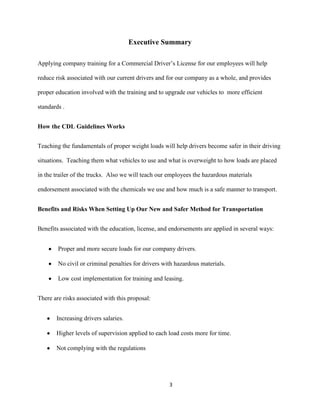
Executive Summary
Applying company training for a Commercial Driver’s License for our employees will help
reduce risk associated with our current drivers and for our company as a whole, and provides
proper education involved with the training and to upgrade our vehicles to more efficient
standards .
How the CDL Guidelines Works
Teaching the fundamentals of proper weight loads will help drivers become safer in their driving
situations. Teaching them what vehicles to use and what is overweight to how loads are placed
in the trailer of the trucks. Also we will teach our employees the hazardous materials
endorsement associated with the chemicals we use and how much is a safe manner to transport.
Benefits and Risks When Setting Up Our New and Safer Method for Transportation
Benefits associated with the education, license, and endorsements are applied in several ways:
Proper and more secure loads for our company drivers.
No civil or criminal penalties for drivers with hazardous materials.
Low cost implementation for training and leasing.
There are risks associated with this proposal:
Increasing drivers salaries.
Higher levels of supervision applied to each load costs more for time.
Not complying with the regulations

3
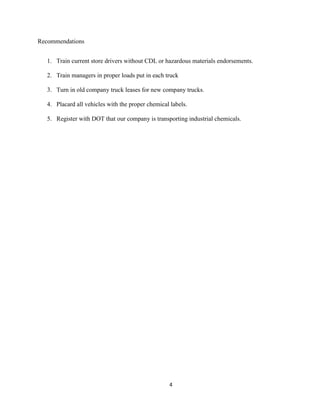
Recommendations
1. Train current store drivers without CDL or hazardous materials endorsements.
2. Train managers in proper loads put in each truck
3. Turn in old company truck leases for new company trucks.
4. Placard all vehicles with the proper chemical labels.
5. Register with DOT that our company is transporting industrial chemicals.

4
Introduction
Department of Transportation has been a staple in highway safety for many years.
Throughout the years the department under went many different changes and more
regulations established for safer and better roads in the United States. Everyday DOT
oversees countless of operations that include but not limited to: Road and Highway
construction, oil pipelines and hazardous waste, aviation, and maritime, as well as pedestrian
and bicycle safety.
As the years progressed more and more causes occurred for DOT to have a reason to regulate
different activities. Such things occurred as chemical spills in high pedestrian environments
to failed logbook assignments for truck drivers. This made the department more than a basic
implication in United States government, and became heavily funded when the highway and
interstate programs became into effect. Research has been granted for the department to
include congested highways and hazardous materials as a main point.
Such situations have come into notice for our company. We have under established our need
for commercial driver’s and commercial driver’s licenses. Utilizing light duty trucks for
heavy transportation needs; we created a dangerous working situation for our employees and
for our community. Also not enforcing commercial driver’s licenses for hazardous materials
could propose a serious issue in fines by DOT. After interviewing different representatives
for DOT and our company, we have all established a need for this proposal to be presented.
The Proposal situates the following:
Explains Gross Vehicle Weight

5
Overview of Hazardous Materials
Benefits and Risks associated with changes
And recommendations for improving our logistics.

Why Should We Establish Commercial Driver’s Licenses in our
Company
Gross Vehicle Weight Rating
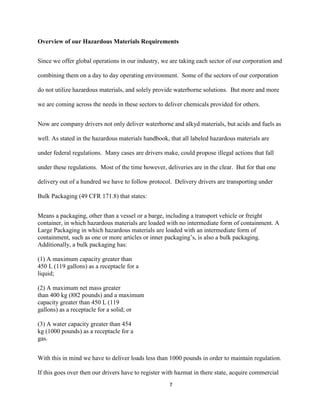
For our company, we use standard F-350 company trucks to perform our regular deliveries
throughout the Pinellas and tri-county area. Many of these jobs associated with our deliveries
are asking for six thousands or more pounds of product on a given day. Not all the stores in the
area are used to producing this amount of product for our clients, but as the numbers continue to
climb we are seeing more overloaded trucks than before. This is where we apply Gross Vehicle
Weight Rating or GVWR to the trucks specs. The F-350 specs go as follows:
Maximum Payload

7,260 lbs (F-350 DRW 4x2 Regular Cab)

Maximum GVWR

14,000 lbs.

Max. Rear GAWR (Gross Axle Weight)

7180 lbs

(Ford 2014)
Showing these results we yield exact payload results and fall slightly under, but these specs are
only for regular cab trucks, since we are utilizing box trucks we are adding 1200 lbs more to our
actual truck weight subtracting the maximum payload of 1200 lbs down to 6060 lbs. Showing
these results we find that our actual payloads easily exceeds what is intended for our deliveries.

6
Overview of our Hazardous Materials Requirements
Since we offer global operations in our industry, we are taking each sector of our corporation and
combining them on a day to day operating environment. Some of the sectors of our corporation
do not utilize hazardous materials, and solely provide waterborne solutions. But more and more
we are coming across the needs in these sectors to deliver chemicals provided for others.
Now are company drivers not only deliver waterborne and alkyd materials, but acids and fuels as
well. As stated in the hazardous materials handbook, that all labeled hazardous materials are
under federal regulations. Many cases are drivers make, could propose illegal actions that fall
under these regulations. Most of the time however, deliveries are in the clear. But for that one
delivery out of a hundred we have to follow protocol. Delivery drivers are transporting under
Bulk Packaging (49 CFR 171.8) that states:
Means a packaging, other than a vessel or a barge, including a transport vehicle or freight
container, in which hazardous materials are loaded with no intermediate form of containment. A
Large Packaging in which hazardous materials are loaded with an intermediate form of
containment, such as one or more articles or inner packaging’s, is also a bulk packaging.
Additionally, a bulk packaging has:
(1) A maximum capacity greater than
450 L (119 gallons) as a receptacle for a
liquid;
(2) A maximum net mass greater
than 400 kg (882 pounds) and a maximum
capacity greater than 450 L (119
gallons) as a receptacle for a solid; or
(3) A water capacity greater than 454
kg (1000 pounds) as a receptacle for a
gas.
With this in mind we have to deliver loads less than 1000 pounds in order to maintain regulation.
If this goes over then our drivers have to register with hazmat in there state, acquire commercial
7
driver’s licenses, and become endorsed. There is some instances when drivers find themselves
with loads greater than what they are allowed to carry.

Benefits and Risks Associated with DOT Regulations
Benefits
After estimating cost associated with what these changes will entail, it comes out
relatively inexpensive. If we are not able to switch over to heavier trucks at the moment,
we can always accommodate with proper supervision on all loads being directed out, and
in the case may being setup our vehicles with placards. The price for all of our trucks in
the state of Florida comes out to being $8047.20, which is $95.80 for each truck.
A rough estimate to rent weekly a commercial straight truck, at 24 to 26 feet from Ryder
is $467.50. This is not applied to a monthly lease and can always be negotiated to the
same level of price we normally go for. Even if we establish our dispatch delivery
system statewide by the end of the year, we can logistically save on the amount of trucks
we lease through all of our stores. These trucks have the proven rating to withstand our
payloads.
Finally, we should focus hiring more CDL drivers with hazmat endorsements. Even if
they do not have a hazmat, they can still drive our non-regulated loads. Our average pay
for store drivers is $10.00 an hour, but since we are accommodating a higher class and
better educated driver, we can apply $1.50 added to the total wage of $11.50; saves the
overall hassle of finding the correct candidates for the job. If wetrain our current drivers
we can still retain their pay, but now they have the added bonus of a higher class of
driving. Better educated drivers means less accidents and more timely maneuvers on
8
trips, gas, mileage, and even properly secured loads saving a decent amount on whatever
civil or criminal penalty applied.
Risks
Even though we could have many factors that apply to our needs as beneficial, there is many
factors that could play a risk when dealing with these regulations. For every proposal there
could be a risk involved that is in plain sight, or there could be many risks involved after we
establish them. In order for us to accumulate these problems, we must brainstorm a solution.
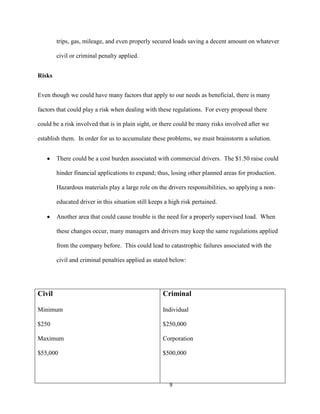
There could be a cost burden associated with commercial drivers. The $1.50 raise could
hinder financial applications to expand; thus, losing other planned areas for production.
Hazardous materials play a large role on the drivers responsibilities, so applying a noneducated driver in this situation still keeps a high risk pertained.
Another area that could cause trouble is the need for a properly supervised load. When
these changes occur, many managers and drivers may keep the same regulations applied
from the company before. This could lead to catastrophic failures associated with the
civil and criminal penalties applied as stated below:

Civil

Criminal

Minimum

Individual

$250

$250,000

Maximum

Corporation

$55,000

$500,000

9
(Federal Motor Carrier Safety Administration 2014)

Recommendations
1. Leasing new trucks:Strategically the most ideal recommendation involves leasing new
company trucks. The overall output we face on day to day assignments with these
vehicles, is becoming highly dangerous, especially in weathered conditions in the United
States. A simple rain fall could easily hydroplane a overloaded F-350. The results are
pretty bad due to hospital bills Workman’s Comp would have to cover.
2. Train drivers: Generally a vehicle that is used to the payloads should be used overall.
These trucks will require CDL drivers; overall, it may seem more of a cost to produce
these drivers, but for safety standards, this should be mandated. Educating are drivers
already and getting them properly licensed should be applied so turnover is not affected.
3. Train managers in proper loads put in each truck:Dealing with the increased salaries
of our drivers could bring more of a cost on the overall spectrum than keeping them as
regular drivers. $1.50 an hour raise on every driver that is part of the 84 stores in the
state of FL could bring an extensive annual cost attributed with the amount of employees
in each store. So another solution could be presented at a lower cost until we are able to
fully change our system. Utilizing managers to regulate each load; many of our
customers even have the ability to pick up their own hazardous materials in the store, so
instead of dealing with burdens of over capacity, utilize customer based for in store
pickup. Each load inspected should fall under weight class requirements, even if it

10
requires two or more trips to make. This eliminates the burden associated with CDL
driving and hazardous material driving.
4. Placard vehicles appropriately: We need to focus on placarding our vehicles with the
correct labels and placards on all four sides, with the proper shipping papers and bill of
ladings
5. Register with DOT: After everything is finally situated, we should register that these
drivers are hauling hazardous materials to the Department of Transportation. Having this
registration will help our drivers in case of them being pulled over, to show the proper
paper work presented.

11
References
Federal Motor Carrier Safety Administration (2014) How to Comply with Federal Hazardous
Materials Regulations. Retrieved from: http://www.fmcsa.dot.gov/safetysecurity/hazmat/complyhmregs.htm
Ford(2014). 2014 Super Duty Specifications. Retrieved from: http://www.ford.com/trucks/
superduty/specifications/payload/
Ryder/Truck Rentals (2014 February 21) Retrieved from: www.ryder.com
SafetySupplyWarehouse.com (2014) Safety placards that comply with DOT. Retrieved from:
http://www.safetysupplywarehouse.com/DOT_Placards_Shipping_Labels_s/76.htm
Shwom, B., Snyder L.G.(2012). Business Communication: Polishing Your Personal Presence.
(St Petersburg College Edition). Boston: Pearson Learning Solutions

12
Appendix
Name: James Brown
Business: C.D.P Architectural Chemicals
Location: St Petersburg, FL
Phone: 727-323-4242
Name: Selena
Business: Department of Transportation
Location: Washington D.C.
Phone: 202-366-4000
Slideshare URL: http://www.slideshare.net/leersmssn/proper-loading-procedures-final-2

13
14

Final project

  • 1.
    Applying Department ofTransportation Regulations for Our Company Drivers Prepared for C.D.P Architectural Chemicals Prepared by Lee Rasmussen Student February 23, 2014
  • 2.
    Table of Contents ExecutiveSummary………………………………………………………………………………3 Introduction……………………………………………………………………………………….5 Why we should establish commercial driver’s licenses in our company………………………....6 Gross Vehicle Weight Rating for our driver’s……………………………...……..6 Overview of Hazardous Materials………………………………………………...7 Benefits and Risks associated with DOT regulations…………………………………………….8 Benefits of DOT regulations……………………………………………………..8 Risks involved without DOT regulations………………………………………...9 Recommendations………………………………………………………………………………..10 References………………………………………………………………………………………..12 Appendix…………………………………………………………………………………………13 2
  • 3.
    Executive Summary Applying companytraining for a Commercial Driver’s License for our employees will help reduce risk associated with our current drivers and for our company as a whole, and provides proper education involved with the training and to upgrade our vehicles to more efficient standards . How the CDL Guidelines Works Teaching the fundamentals of proper weight loads will help drivers become safer in their driving situations. Teaching them what vehicles to use and what is overweight to how loads are placed in the trailer of the trucks. Also we will teach our employees the hazardous materials endorsement associated with the chemicals we use and how much is a safe manner to transport. Benefits and Risks When Setting Up Our New and Safer Method for Transportation Benefits associated with the education, license, and endorsements are applied in several ways: Proper and more secure loads for our company drivers. No civil or criminal penalties for drivers with hazardous materials. Low cost implementation for training and leasing. There are risks associated with this proposal: Increasing drivers salaries. Higher levels of supervision applied to each load costs more for time. Not complying with the regulations 3
  • 4.
    Recommendations 1. Train currentstore drivers without CDL or hazardous materials endorsements. 2. Train managers in proper loads put in each truck 3. Turn in old company truck leases for new company trucks. 4. Placard all vehicles with the proper chemical labels. 5. Register with DOT that our company is transporting industrial chemicals. 4
  • 5.
    Introduction Department of Transportationhas been a staple in highway safety for many years. Throughout the years the department under went many different changes and more regulations established for safer and better roads in the United States. Everyday DOT oversees countless of operations that include but not limited to: Road and Highway construction, oil pipelines and hazardous waste, aviation, and maritime, as well as pedestrian and bicycle safety. As the years progressed more and more causes occurred for DOT to have a reason to regulate different activities. Such things occurred as chemical spills in high pedestrian environments to failed logbook assignments for truck drivers. This made the department more than a basic implication in United States government, and became heavily funded when the highway and interstate programs became into effect. Research has been granted for the department to include congested highways and hazardous materials as a main point. Such situations have come into notice for our company. We have under established our need for commercial driver’s and commercial driver’s licenses. Utilizing light duty trucks for heavy transportation needs; we created a dangerous working situation for our employees and for our community. Also not enforcing commercial driver’s licenses for hazardous materials could propose a serious issue in fines by DOT. After interviewing different representatives for DOT and our company, we have all established a need for this proposal to be presented. The Proposal situates the following: Explains Gross Vehicle Weight 5
  • 6.
    Overview of HazardousMaterials Benefits and Risks associated with changes And recommendations for improving our logistics. Why Should We Establish Commercial Driver’s Licenses in our Company Gross Vehicle Weight Rating For our company, we use standard F-350 company trucks to perform our regular deliveries throughout the Pinellas and tri-county area. Many of these jobs associated with our deliveries are asking for six thousands or more pounds of product on a given day. Not all the stores in the area are used to producing this amount of product for our clients, but as the numbers continue to climb we are seeing more overloaded trucks than before. This is where we apply Gross Vehicle Weight Rating or GVWR to the trucks specs. The F-350 specs go as follows: Maximum Payload 7,260 lbs (F-350 DRW 4x2 Regular Cab) Maximum GVWR 14,000 lbs. Max. Rear GAWR (Gross Axle Weight) 7180 lbs (Ford 2014) Showing these results we yield exact payload results and fall slightly under, but these specs are only for regular cab trucks, since we are utilizing box trucks we are adding 1200 lbs more to our actual truck weight subtracting the maximum payload of 1200 lbs down to 6060 lbs. Showing these results we find that our actual payloads easily exceeds what is intended for our deliveries. 6
  • 7.
    Overview of ourHazardous Materials Requirements Since we offer global operations in our industry, we are taking each sector of our corporation and combining them on a day to day operating environment. Some of the sectors of our corporation do not utilize hazardous materials, and solely provide waterborne solutions. But more and more we are coming across the needs in these sectors to deliver chemicals provided for others. Now are company drivers not only deliver waterborne and alkyd materials, but acids and fuels as well. As stated in the hazardous materials handbook, that all labeled hazardous materials are under federal regulations. Many cases are drivers make, could propose illegal actions that fall under these regulations. Most of the time however, deliveries are in the clear. But for that one delivery out of a hundred we have to follow protocol. Delivery drivers are transporting under Bulk Packaging (49 CFR 171.8) that states: Means a packaging, other than a vessel or a barge, including a transport vehicle or freight container, in which hazardous materials are loaded with no intermediate form of containment. A Large Packaging in which hazardous materials are loaded with an intermediate form of containment, such as one or more articles or inner packaging’s, is also a bulk packaging. Additionally, a bulk packaging has: (1) A maximum capacity greater than 450 L (119 gallons) as a receptacle for a liquid; (2) A maximum net mass greater than 400 kg (882 pounds) and a maximum capacity greater than 450 L (119 gallons) as a receptacle for a solid; or (3) A water capacity greater than 454 kg (1000 pounds) as a receptacle for a gas. With this in mind we have to deliver loads less than 1000 pounds in order to maintain regulation. If this goes over then our drivers have to register with hazmat in there state, acquire commercial 7
  • 8.
    driver’s licenses, andbecome endorsed. There is some instances when drivers find themselves with loads greater than what they are allowed to carry. Benefits and Risks Associated with DOT Regulations Benefits After estimating cost associated with what these changes will entail, it comes out relatively inexpensive. If we are not able to switch over to heavier trucks at the moment, we can always accommodate with proper supervision on all loads being directed out, and in the case may being setup our vehicles with placards. The price for all of our trucks in the state of Florida comes out to being $8047.20, which is $95.80 for each truck. A rough estimate to rent weekly a commercial straight truck, at 24 to 26 feet from Ryder is $467.50. This is not applied to a monthly lease and can always be negotiated to the same level of price we normally go for. Even if we establish our dispatch delivery system statewide by the end of the year, we can logistically save on the amount of trucks we lease through all of our stores. These trucks have the proven rating to withstand our payloads. Finally, we should focus hiring more CDL drivers with hazmat endorsements. Even if they do not have a hazmat, they can still drive our non-regulated loads. Our average pay for store drivers is $10.00 an hour, but since we are accommodating a higher class and better educated driver, we can apply $1.50 added to the total wage of $11.50; saves the overall hassle of finding the correct candidates for the job. If wetrain our current drivers we can still retain their pay, but now they have the added bonus of a higher class of driving. Better educated drivers means less accidents and more timely maneuvers on 8
  • 9.
    trips, gas, mileage,and even properly secured loads saving a decent amount on whatever civil or criminal penalty applied. Risks Even though we could have many factors that apply to our needs as beneficial, there is many factors that could play a risk when dealing with these regulations. For every proposal there could be a risk involved that is in plain sight, or there could be many risks involved after we establish them. In order for us to accumulate these problems, we must brainstorm a solution. There could be a cost burden associated with commercial drivers. The $1.50 raise could hinder financial applications to expand; thus, losing other planned areas for production. Hazardous materials play a large role on the drivers responsibilities, so applying a noneducated driver in this situation still keeps a high risk pertained. Another area that could cause trouble is the need for a properly supervised load. When these changes occur, many managers and drivers may keep the same regulations applied from the company before. This could lead to catastrophic failures associated with the civil and criminal penalties applied as stated below: Civil Criminal Minimum Individual $250 $250,000 Maximum Corporation $55,000 $500,000 9
  • 10.
    (Federal Motor CarrierSafety Administration 2014) Recommendations 1. Leasing new trucks:Strategically the most ideal recommendation involves leasing new company trucks. The overall output we face on day to day assignments with these vehicles, is becoming highly dangerous, especially in weathered conditions in the United States. A simple rain fall could easily hydroplane a overloaded F-350. The results are pretty bad due to hospital bills Workman’s Comp would have to cover. 2. Train drivers: Generally a vehicle that is used to the payloads should be used overall. These trucks will require CDL drivers; overall, it may seem more of a cost to produce these drivers, but for safety standards, this should be mandated. Educating are drivers already and getting them properly licensed should be applied so turnover is not affected. 3. Train managers in proper loads put in each truck:Dealing with the increased salaries of our drivers could bring more of a cost on the overall spectrum than keeping them as regular drivers. $1.50 an hour raise on every driver that is part of the 84 stores in the state of FL could bring an extensive annual cost attributed with the amount of employees in each store. So another solution could be presented at a lower cost until we are able to fully change our system. Utilizing managers to regulate each load; many of our customers even have the ability to pick up their own hazardous materials in the store, so instead of dealing with burdens of over capacity, utilize customer based for in store pickup. Each load inspected should fall under weight class requirements, even if it 10
  • 11.
    requires two ormore trips to make. This eliminates the burden associated with CDL driving and hazardous material driving. 4. Placard vehicles appropriately: We need to focus on placarding our vehicles with the correct labels and placards on all four sides, with the proper shipping papers and bill of ladings 5. Register with DOT: After everything is finally situated, we should register that these drivers are hauling hazardous materials to the Department of Transportation. Having this registration will help our drivers in case of them being pulled over, to show the proper paper work presented. 11
  • 12.
    References Federal Motor CarrierSafety Administration (2014) How to Comply with Federal Hazardous Materials Regulations. Retrieved from: http://www.fmcsa.dot.gov/safetysecurity/hazmat/complyhmregs.htm Ford(2014). 2014 Super Duty Specifications. Retrieved from: http://www.ford.com/trucks/ superduty/specifications/payload/ Ryder/Truck Rentals (2014 February 21) Retrieved from: www.ryder.com SafetySupplyWarehouse.com (2014) Safety placards that comply with DOT. Retrieved from: http://www.safetysupplywarehouse.com/DOT_Placards_Shipping_Labels_s/76.htm Shwom, B., Snyder L.G.(2012). Business Communication: Polishing Your Personal Presence. (St Petersburg College Edition). Boston: Pearson Learning Solutions 12
  • 13.
    Appendix Name: James Brown Business:C.D.P Architectural Chemicals Location: St Petersburg, FL Phone: 727-323-4242 Name: Selena Business: Department of Transportation Location: Washington D.C. Phone: 202-366-4000 Slideshare URL: http://www.slideshare.net/leersmssn/proper-loading-procedures-final-2 13
  • 14.