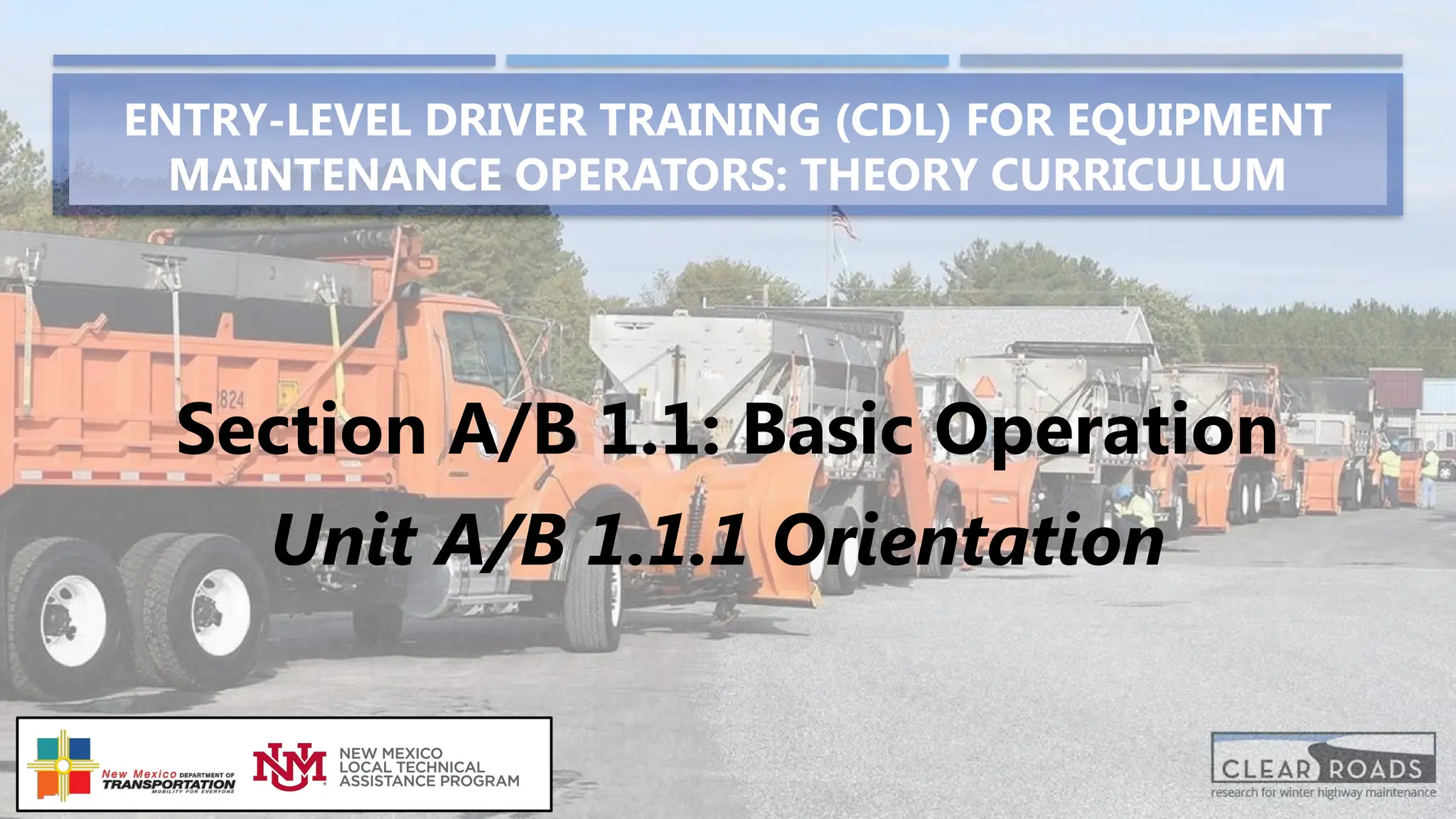
ENTRY-LEVEL DRIVER TRAINING (CDL) FOR EQUIPMENT
MAINTENANCE OPERATORS: THEORY CURRICULUM
Section A/B 1.1: Basic Operation
Unit A/B 1.1.1 Orientation
Insert DOT
Logo Here
OVERVIEW
 Unit Introduction
 Unit Learning Objectives
 Unit Instruction
 Discussion/Questions
 Assessment
Unit A/B 1.1.1 Orientation
Insert DOT
Logo Here
UNIT INTRODUCTION
 Introduction to Class A (or B) commercial driver’s license (CDL) driving curriculum
 Additionally, you will gain a basic understanding of:
 Classifications of and standards for obtaining a CDL
 Safety fundamentals regarding operation of commercial motor vehicles (CMVs)
 Rules and regulations related to operating CMVs
 Professionalism required of CMV operators
 Disqualification regulations
 Learning goal
 Driver-trainees will gain a complete understanding of CDL training and all aspects of what it takes to
obtain and maintain their CDL as well as learn about the history of CMV operations and regulations
Unit A/B 1.1.1 Orientation
Insert DOT
Logo Here
UNIT OBJECTIVES
 Upon completion of this unit, driver-trainees will be able to:
1) Identify driver-trainee rules and expectations
2) Discuss the history of CMVs and CMV regulation through the 21st
century
3) Discuss Federal, State and local laws relating to the safe operation of CMVs
4) Describe the entry-level Class A/B CDL curriculum
5) Identify steps needed to progress towards obtaining a Class A/B CDL
6) Identify, describe, and explain the classifications of a CDL
7) Identify, describe, and explain the qualifications and disqualifications for commercial drivers
8) Identify, define, and discuss professionalism for the CMV driver
Unit A/B 1.1.1 Orientation
Insert DOT
Logo Here
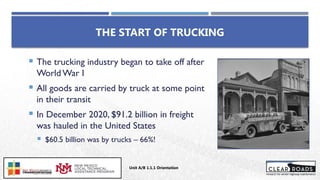
THE START OF TRUCKING
 The trucking industry began to take off after
World War I
 All goods are carried by truck at some point
in their transit
 In December 2020, $91.2 billion in freight
was hauled in the United States
 $60.5 billion was by trucks – 66%!
Unit A/B 1.1.1 Orientation
Insert DOT
Logo Here
 Motor Carrier Act of 1935
 Bureau of Motor Carrier Safety was created within the Interstate Commerce Commission
and received authority to regulate motor carriers
 Commercial MotorVehicle Safety Act of 1986
 Ensured CMV operators were qualified and removed unsafe operators
 Motor Carrier Safety Improvement Act of 1999
 Further improved operator, vehicle, and overall motor carrier safety
 Tightened CDL requirements
TRUCKING BECOMES REGULATED
Unit A/B 1.1.1 Orientation
Insert DOT
Logo Here
 Federal Motor Carrier Safety Administration (FMCSA)
 Agency within U.S. Department ofTransportation
 Established in 2000
 Oversees various programs to ensure motor carrier safety and compliance
 CDL Program
 Federal Motor Carrier Safety Regulations (FMCSR)
 Safety and Fitness Electronic Records System (SAFER)
 Motor Carrier Safety Assistance Program (MCSAP)
 Motor Carrier Safety Identification and Information Systems
 Hazardous Materials Regulations (HMR)
PRIMARY REGULATORY AGENCY
Unit A/B 1.1.1 Orientation
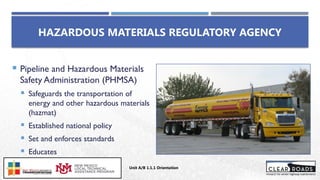
 Pipeline and Hazardous Materials
Safety Administration (PHMSA)
 Safeguards the transportation of
energy and other hazardous materials
(hazmat)
 Established national policy
 Set and enforces standards
 Educates
HAZARDOUS MATERIALS REGULATORY AGENCY
Unit A/B 1.1.1 Orientation
Insert DOT
Logo Here
 Primarily related to hazardous materials
 Environmental Protection Agency (EPA)
 Nuclear Regulatory Commission (NRC)
 National Transportation Safety Board (NTSB)
 Occupational Safety and Health Administration (OSHA)
OTHER PERTINENT AGENCIES
Unit A/B 1.1.1 Orientation
Insert DOT
Logo Here
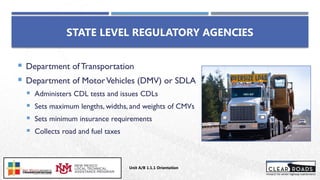
STATE LEVEL REGULATORY AGENCIES
 Department of Transportation
 Department of MotorVehicles (DMV) or SDLA
 Administers CDL tests and issues CDLs
 Sets maximum lengths, widths, and weights of CMVs
 Sets minimum insurance requirements
 Collects road and fuel taxes
Unit A/B 1.1.1 Orientation
Insert DOT
Logo Here
 Describe the history of the trucking
industry.
 What is the primary agency responsible
for motor carrier safety and regulation?
 Describe the other agencies, including
at the state level, that may play a role in
the trucking industry.
ESSENTIAL LEARNING DISCUSSION #1
Unit A/B 1.1.1 Orientation
Insert DOT
Logo Here
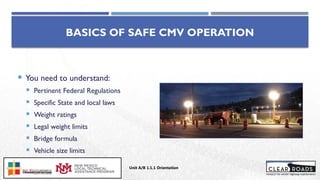
BASICS OF SAFE CMV OPERATION
 You need to understand:
 Pertinent Federal Regulations
 Specific State and local laws
 Weight ratings
 Legal weight limits
 Bridge formula
 Vehicle size limits
 Weigh stations
Unit A/B 1.1.1 Orientation
Insert DOT
Logo Here
PERTINENT FEDERAL REGULATIONS
 The following regulations are covered within this unit:
 Part 380 Special Training Requirements
 Part 383 Commercial Driver’s License Standards; Requirements and Penalties
 Part 391 Qualifications of Drivers and Longer CombinationVehicle Driver
Instructors
 Part 399 Employee Safety and Health Standards
Unit A/B 1.1.1 Orientation
Insert DOT
Logo Here
 The following regulations will be covered in detail in subsequent units
 Part 382 Controlled Substances and Alcohol Use and Testing
 Part 392 Driving of Commercial MotorVehicles
 Part 393 Parts and Accessories Necessary for Safe Operation
 Part 395 Hours-of-Service of Drivers
 Part 396 Inspection Repair and Maintenance
 Part 397 Transportation of Hazardous Materials; Driving and Parking Rules
PERTINENT FEDERAL REGULATIONS (CONT.)
Unit A/B 1.1.1 Orientation
Insert DOT
Logo Here
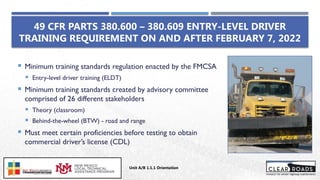
49 CFR PARTS 380.600 – 380.609 ENTRY-LEVEL DRIVER
TRAINING REQUIREMENT ON AND AFTER FEBRUARY 7, 2022
 Minimum training standards regulation enacted by the FMCSA
 Entry-level driver training (ELDT)
 Minimum training standards created by advisory committee
comprised of 26 different stakeholders
 Theory (classroom)
 Behind-the-wheel (BTW) - road and range
 Must meet certain proficiencies before testing to obtain
commercial driver’s license (CDL)
Unit A/B 1.1.1 Orientation
Insert DOT
Logo Here
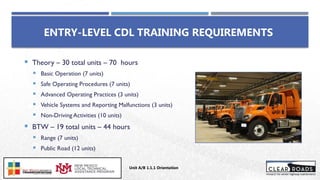
ENTRY-LEVEL CDL TRAINING REQUIREMENTS
 Theory – 30 total units – 70 hours
 Basic Operation (7 units)
 Safe Operating Procedures (7 units)
 Advanced Operating Practices (3 units)
 Vehicle Systems and Reporting Malfunctions (3 units)
 Non-Driving Activities (10 units)
 BTW – 19 total units – 44 hours
 Range (7 units)
 Public Road (12 units)
Unit A/B 1.1.1 Orientation
Insert DOT
Logo Here
 Driver-trainees are required to be assessed and must obtain at least 80%
proficiency on theory training units
 Instructors: Add in if assessments will be conducted at the end of each
unit, each section, or one large assessment at end of all theory
 Driver-trainees must meet minimum proficiencies as deemed by instructor
 Minimum proficiency means being able to repeatedly perform each skill correctly
 i.e., not one and done
ENTRY-LEVEL CDL TRAINING PROFICIENCIES
Unit A/B 1.1.1 Orientation
Insert DOT
Logo Here
1. Obtain Commercial Learner’s Permit (CLP)
2. Obtain DOT Medical Card (if required)
3. Complete ELDT from certified training provider
a) Pass theory with at least 80% proficiency
b) Pass BTW with instructor’s determination of skill proficiency
4. Training provider submits driver-trainee’s completion certificate, hours BTW, and
pertinent information toTraining Provider Registry
5. Driver-trainee schedules CDL test with SLDA or third-party examiner
STEPS TO OBTAIN CDL
Unit A/B 1.1.1 Orientation
Insert DOT
Logo Here
 Describe the CDL training curriculum
and minimum proficiencies required per
Parts 380.600 – 383.609
 Describe the necessary steps to obtain
your CDL.
ESSENTIAL LEARNING DISCUSSION #2
Unit A/B 1.1.1 Orientation
Insert DOT
Logo Here
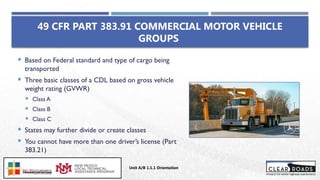
 Based on Federal standard and type of cargo being
transported
 Three basic classes of a CDL based on gross vehicle
weight rating (GVWR)
 Class A
 Class B
 Class C
 States may further divide or create classes
 You cannot have more than one driver’s license (Part
383.21)
49 CFR PART 383.91 COMMERCIAL MOTOR VEHICLE
GROUPS
Unit A/B 1.1.1 Orientation
Insert DOT
Logo Here
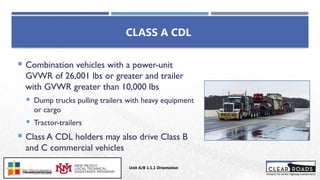
 Combination vehicles with a power-unit
GVWR of 26,001 lbs or greater and trailer
with GVWR greater than 10,000 lbs
 Dump trucks pulling trailers with heavy equipment
or cargo
 Tractor-trailers
 Class A CDL holders may also drive Class B
and C commercial vehicles
CLASS A CDL
Unit A/B 1.1.1 Orientation
Insert DOT
Logo Here
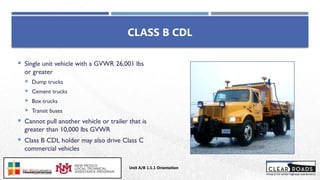
CLASS B CDL
 Single unit vehicle with a GVWR 26,001 lbs
or greater
 Dump trucks
 Cement trucks
 Box trucks
 Transit buses
 Cannot pull another vehicle or trailer that is
greater than 10,000 lbs GVWR
 Class B CDL holder may also drive Class C
commercial vehicles
Unit A/B 1.1.1 Orientation
Insert DOT
Logo Here
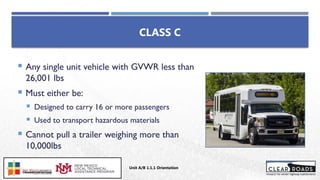
CLASS C
 Any single unit vehicle with GVWR less than
26,001 lbs
 Must either be:
 Designed to carry 16 or more passengers
 Used to transport hazardous materials
 Cannot pull a trailer weighing more than
10,000lbs
Unit A/B 1.1.1 Orientation
Insert DOT
Logo Here
 Certain types of vehicles and cargo require specialized knowledge
 Operators of these vehicles and/or cargo must have an endorsement certifying they
have received this specialized training
 There are six endorsements
 Tank vehicle (N)
 Hazardous materials (H)
 Combination tank vehicle and hazardous materials (X)
 Double and triple trailers (T)
 Passengers (P)
 School bus (S)
49 CFR PART 383.93 ENDORSEMENTS
Unit A/B 1.1.1 Orientation
 Restrictions are another important aspect
to be aware of
 Restrictions are placed on your CDL depending
on the type of vehicle you take the CDL test in
and for medical reasons
 There are 14 different restrictions that may
be placed on your CDL
49 CFR PART 383.95 RESTRICTIONS
Unit A/B 1.1.1 Orientation
Insert DOT
Logo Here
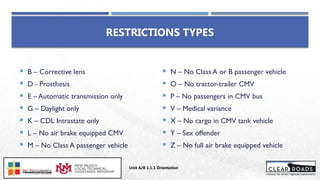
 B – Corrective lens
 D - Prosthesis
 E – Automatic transmission only
 G – Daylight only
 K – CDL Intrastate only
 L – No air brake equipped CMV
 M – No Class A passenger vehicle
Unit A/B 1.1.1 Orientation
Insert DOT
Logo Here
RESTRICTIONS TYPES
 N – No Class A or B passenger vehicle
 O – No tractor-trailer CMV
 P – No passengers in CMV bus
 V – Medical variance
 X – No cargo in CMV tank vehicle
 Y – Sex offender
 Z – No full air brake equipped vehicle
INTRASTATE VERSUS INTERSTATE
 Intrastate means you can only operate a CMV within the state your CDL
was issued
 Minimum age: 18
 Interstate means you can operate a CMV across state lines
 Minimum age: 21
 Describe the different classes of the CDL.
 Describe the six endorsements you can
obtain on your CDL.
 Describe the 14 restrictions that may be
placed on your CDL.
 What is the difference between intrastate
and interstate?
ESSENTIAL LEARNING DISCUSSION #3
Unit A/B 1.1.1 Orientation
Insert DOT
Logo Here
49 CFR PART 391.11 GENERAL QUALIFICATIONS OF
DRIVERS
 At least 21 years of age (except for intrastate only)
 Read and speak English language sufficiently
 Can safely operate a CMV
 Physically qualified
 Holds current CDL from only one State
 Provided employer with list of violations as required by 391.27
 Is not disqualified per 391.15
Unit A/B 1.1.1 Orientation
Insert DOT
Logo Here
 Can, by reason of experience, training, or both, determine whether the
cargo he/she transports (including baggage in a passenger-carrying
commercial motor vehicle) has been properly located, distributed, and
secured in or on the commercial motor vehicle he/she drives
 Is familiar with methods and procedures for securing cargo in or on the
commercial motor vehicle he/she drives.
49 CFR PART 391.13 RESPONSIBILITIES OF DRIVERS
CDL DISQUALIFICATIONS: 49 CFR PARTS
383.51 – 383.53 AND 391.15
 CMV operators can be disqualified and their CDL suspended or revoked for a
variety of violations
 Disqualifications fall into six categories
 Alcohol, leaving the scene of a crash, and commission of a felony
 Serious traffic violations
 Violation of out-of-service orders
 Railroad-highway grade crossing violations
 Hazardous materials endorsement background checks
 Traffic violation in your personal vehicle
Unit A/B 1.1.1 Orientation
Insert DOT
Logo Here
ALCOHOL
 It is illegal to have a blood alcohol content of 0.4% or more while
operating a CMV
 First offense, non-hazardous materials = one-year loss of CDL
 First offense, with hazardous materials = three-year loss of CDL
 Second offense = you will lose your CDL for life
 Alcohol detected under 0.04% = out-of-service for 24 hours
 By operating a CMV, you have automatically consented to alcohol testing
Unit A/B 1.1.1 Orientation
Insert DOT
Logo Here
 Disqualification offenses
 Leaving the scene of a crash involving a CMV
 Committing a felony involving the use of a CMV
 Operating a CMV while CDL is suspended
 Causing a fatality through negligent operation of a CMV
 Keep in mind these offenses along with alcohol offenses count together
 For example, driving under the influence (first violation) and then later operating a CMV with a suspended CDL
(second offense) = loss of CDL for life
 Additionally, you automatically lose your CDL for life if you commit a felony in a CMV involving
controlled substances
LEAVING THE SCENE OF A CRASH AND
COMMISSION OF A FELONY
Unit A/B 1.1.1 Orientation
Insert DOT
Logo Here
SERIOUS TRAFFIC VIOLATIONS
 60-day loss of CDL if two, or 120-day loss if three or more, violations within three years
 Texting while driving
 Use of hand-held mobile device while driving
 Speeding 15mph or more over posted limit
 Reckless driving
 Improper/erratic lane change
 Following too closely
 Traffic violations where a fatality occurs
 Driving without obtaining CDL or CDL not in possession
 Not having proper class of CDL or proper endorsement
Unit A/B 1.1.1 Orientation
Insert DOT
Logo Here
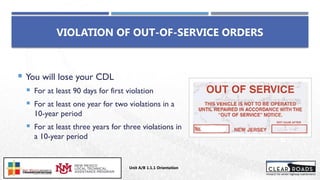
VIOLATION OF OUT-OF-SERVICE ORDERS
 You will lose your CDL
 For at least 90 days for first violation
 For at least one year for two violations in a
10-year period
 For at least three years for three violations in
a 10-year period
Unit A/B 1.1.1 Orientation
Insert DOT
Logo Here
RAILROAD-HIGHWAY GRADE CROSSING VIOLATIONS
 Penalties for violating railroad-highway grade crossing regulations
 At least 60-day loss of CDL for first violation
 At least 120-day loss of CDL for second violation within three-year period
 At least one year loss of CDL for third violation within three-year period
 These penalties include violations of Federal, State, or local regulations
pertaining to six offenses
Unit A/B 1.1.1 Orientation
Insert DOT
Logo Here
 For CMVs not required to always stop
 Failing to stop before reaching the crossing if tracks are not clear
 Failing to slow down and check that the tracks are clear of an approaching train
 For CMVs required to always stop
 Failing to stop before driving onto the crossing
 For all CMVs
 Failing to have sufficient space to drive completely through the crossing without stopping
 Failing to obey a traffic control device or the directions of an enforcement official at a crossing
 Failing to negotiate a crossing because of insufficient undercarriage clearance
RAILROAD-HIGHWAY GRADE CROSSING VIOLATIONS
Unit A/B 1.1.1 Orientation
Insert DOT
Logo Here
 Hazmat endorsement requires submission of fingerprints for background check
 You will be disqualified:
 If you are not a lawful permanent resident of the United States
 If you renounce your United States citizenship
 If you are wanted or under indictment for certain felonies
 If you have a military or civilian conviction for certain felonies
 If you have been diagnosed as lacking mental capacity or been involuntarily committed to a
mental health facility
 If you pose a threat to security as determined by theTransportation Security Administration
HAZARDOUS MATERIALS ENDORSEMENT
BACKGROUND CHECKS
Unit A/B 1.1.1 Orientation
Insert DOT
Logo Here
 The MotorVehicle Safety Improvement Act requires a CDL holder convicted of
certain violations in their personal vehicle to be disqualified from also operating
a CMV
 If your license is suspended or revoked in your personal vehicle
 For violating traffic control laws (other than parking violations) you lose CDL privileges
for same length as personal vehicle
 For alcohol, controlled substances, and felonies you lose CDL privileges for one year
 Second offense in personal vehicle results in loss of CDL privileges for life
 You cannot obtain a hardship waiver to operate a CMV
TRAFFIC VIOLATIONS IN YOUR PERSONAL VEHICLE
Unit A/B 1.1.1 Orientation
Insert DOT
Logo Here
49 CFR PARTS 391.21 – 391.27
BACKGROUND AND CHARACTER
 Employers are required to obtain a copy of employee’s motor vehicle record
for preceding three years within 30 days of the hire date
 Employers are required to obtain a copy of each employee’s motor vehicle
record at least once every 12 months
 Shall be maintained in employee’s driver’s qualification file which is required to be kept
on file
 Employees are required to notify employer within 30 days of any motor
vehicle violation (except for parking) even if personal vehicle (Part 383.31)
49 CFR PART 399.207 TRUCK AND
TRUCK-TRACTOR REQUIREMENTS
 Trucks shall have sufficient steps, handholds, and/or deck plates to allow
users at least three points-of-contact at all times
 This requirement shall be on each side of the vehicle where a seat is
located
 First step from ground level shall be no more than 24 inches
 All steps or deck plates shall provide at least 5 inches of step depth
 All steps and/or deck plates shall be slip resistant
Unit A/B 1.1.1 Orientation
Insert DOT
Logo Here
 Describe the required qualifications in order
to hold a valid CDL.
 Describe your responsibility as it relates to
cargo.
 What are the six categories of driver
disqualifications?
 Describe some of the penalties for
disqualification.
 Explain Parts 391.21 – 391.27.
ESSENTIAL LEARNING DISCUSSION #4
Unit A/B 1.1.1 Orientation
Insert DOT
Logo Here
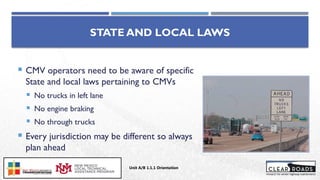
 CMV operators need to be aware of specific
State and local laws pertaining to CMVs
 No trucks in left lane
 No engine braking
 No through trucks
 Every jurisdiction may be different so always
plan ahead
STATE AND LOCAL LAWS
Unit A/B 1.1.1 Orientation
Insert DOT
Logo Here
 Gross vehicle weight rating (GVWR)
 Manufacturer specified maximum loaded weight of a single vehicle
 Gross combination weight rating (GCWR)
 Maximum specified weight of sum of GVWRs of power unit and towed unit
 Axle weight rating
 Weight transferred to the ground by one axle or set of axles
WEIGHT RATINGS
Unit A/B 1.1.1 Orientation
Insert DOT
Logo Here
LEGAL WEIGHT LIMITS
 Federal law regulates maximum weight limits on interstate highways
 80,000lbs GCWR
 20,000lbs axle weight rating
 34,000lbs tandem axle (axles spaced between 40” to 96” apart) weight rating
 38,000lbs for tandem axles spaced 97” apart
 42,000lbs for tridem axles with outer most axles spaced 97 apart
 State law regulates non-interstate highways
 Some states allow weights that exceed Federal weight limits
Unit A/B 1.1.1 Orientation
Insert DOT
Logo Here
NEW MEXICO DEPARTMENT OF TRANSPORTATION
Unit A/B 1.1.1 Orientation
Insert DOT
Logo Here
•Single Axle: Generally aligns with federal limits at 20,000 pounds.
•Tandem Axle: Generally aligns with federal limits at 34,000 pounds.
•Gross Vehicle Weight: New Mexico adheres to the federal limit of 80,000 pounds,
but there may be variations or additional restrictions depending on the specific type of vehicle or load.
WHAT IS THE BRIDGE FORMULA?
 Helps prevent bridges and other roads from becoming overloaded
 Determines maximum axle weight that different CMVs can carry
 The closer the axle spacing, the less weight allowed
 If two CMVs have the same weight, does the longer or shorter CMV
cause more stress on bridges?
 The shorter CMV will cause more stress due to the weight being more
concentrated in one area
Unit A/B 1.1.1 Orientation
Insert DOT
Logo Here
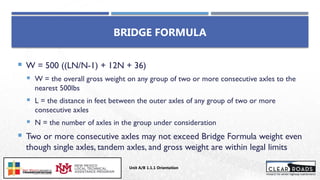
 W = 500 ((LN/N-1) + 12N + 36)
 W = the overall gross weight on any group of two or more consecutive axles to the
nearest 500lbs
 L = the distance in feet between the outer axles of any group of two or more
consecutive axles
 N = the number of axles in the group under consideration
 Two or more consecutive axles may not exceed Bridge Formula weight even
though single axles, tandem axles, and gross weight are within legal limits
BRIDGE FORMULA
Unit A/B 1.1.1 Orientation
Insert DOT
Logo Here
BRIDGE FORMULA EXAMPLE
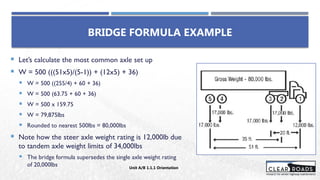
 Let’s calculate the most common axle set up
 W = 500 (((51x5)/(5-1)) + (12x5) + 36)
 W = 500 ((255/4) + 60 + 36)
 W = 500 (63.75 + 60 + 36)
 W = 500 x 159.75
 W = 79,875lbs
 Rounded to nearest 500lbs = 80,000lbs
 Note how the steer axle weight rating is 12,000lb due
to tandem axle weight limits of 34,000lbs
 The bridge formula supersedes the single axle weight rating
of 20,000lbs Unit A/B 1.1.1 Orientation
BRIDGE FORMULA SCENARIO 1
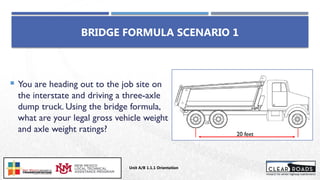
 You are heading out to the job site on
the interstate and driving a three-axle
dump truck. Using the bridge formula,
what are your legal gross vehicle weight
and axle weight ratings? 20 feet
Unit A/B 1.1.1 Orientation
Insert DOT
Logo Here
BRIDGE FORMULA SCENARIO 2
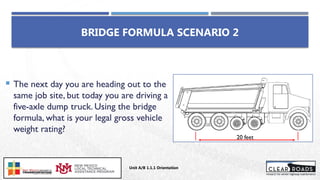
 The next day you are heading out to the
same job site, but today you are driving a
five-axle dump truck. Using the bridge
formula, what is your legal gross vehicle
weight rating?
20 feet
Unit A/B 1.1.1 Orientation
Insert DOT
Logo Here
VEHICLE SIZE LIMITS: FEDERAL REGULATIONS
 Width of CMVs
 Maximum width is 102 inches
 Lengths of trailers and combination vehicles
 Minimum trailer lengths State’s must allow on National Network of Highways and
other reasonable access routes
 State’s may not impose overall length limit on a power unit pulling a single trailer
Unit A/B 1.1.1 Orientation
Insert DOT
Logo Here
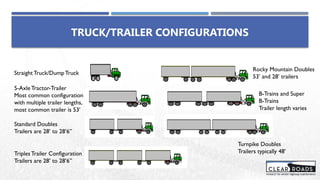
TRUCK/TRAILER CONFIGURATIONS
Straight Truck/DumpTruck
5-Axle Tractor-Trailer
Most common configuration
with multiple trailer lengths,
most common trailer is 53’
Standard Doubles
Trailers are 28’ to 28’6”
Triples Trailer Configuration
Trailers are 28’ to 28’6”
Rocky Mountain Doubles
53’ and 28’ trailers
B-Trains and Super
B-Trains
Trailer length varies
Turnpike Doubles
Trailers typically 48’
 Height requirements
 Each State can set own height requirements
 Straight truck length requirements
 Each State can set own straight truck length requirements
VEHICLE SIZE LIMITS: STATE REGULATIONS
Unit A/B 1.1.1 Orientation
Insert DOT
Logo Here
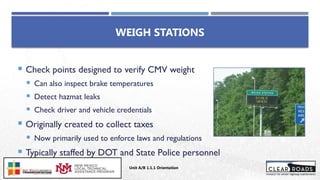
WEIGH STATIONS
 Check points designed to verify CMV weight
 Can also inspect brake temperatures
 Detect hazmat leaks
 Check driver and vehicle credentials
 Originally created to collect taxes
 Now primarily used to enforce laws and regulations
 Typically staffed by DOT and State Police personnel
Unit A/B 1.1.1 Orientation
Insert DOT
Logo Here
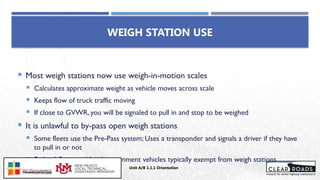
 Most weigh stations now use weigh-in-motion scales
 Calculates approximate weight as vehicle moves across scale
 Keeps flow of truck traffic moving
 If close to GVWR, you will be signaled to pull in and stop to be weighed
 It is unlawful to by-pass open weigh stations
 Some fleets use the Pre-Pass system; Uses a transponder and signals a driver if they have
to pull in or not
 Federal, State, and local government vehicles typically exempt from weigh stations
WEIGH STATION USE
Unit A/B 1.1.1 Orientation
Insert DOT
Logo Here
LIFE AS A CMV OPERATOR
 You are considered a professional driver so make sure you carry yourself
as a professional!
 Professional drivers:
 Strive to meet all safety standards
 Are respectful, courteous, and friendly
 Have above average knowledge of vehicle systems
 Always have efficiency in mind
Unit A/B 1.1.1 Orientation
Insert DOT
Logo Here
SAFETY, SAFETY, SAFETY
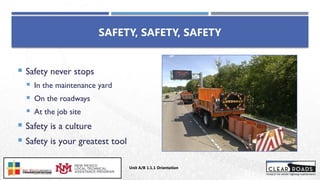
 Safety never stops
 In the maintenance yard
 On the roadways
 At the job site
 Safety is a culture
 Safety is your greatest tool
Unit A/B 1.1.1 Orientation
Insert DOT
Logo Here
WRAP-UP DISCUSSION & QUESTIONS?
Unit A/B 1.1.1 Orientation
Insert DOT
Logo Here
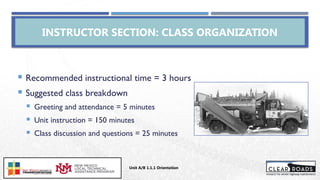
INSTRUCTOR SECTION: CLASS ORGANIZATION
 Recommended instructional time = 3 hours
 Suggested class breakdown
 Greeting and attendance = 5 minutes
 Unit instruction = 150 minutes
 Class discussion and questions = 25 minutes
Unit A/B 1.1.1 Orientation
Insert DOT
Logo Here
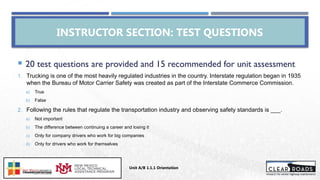
 20 test questions are provided and 15 recommended for unit assessment
1. Trucking is one of the most heavily regulated industries in the country. Interstate regulation began in 1935
when the Bureau of Motor Carrier Safety was created as part of the Interstate Commerce Commission.
a) True
b) False
2. Following the rules that regulate the transportation industry and observing safety standards is ___.
a) Not important
b) The difference between continuing a career and losing it
c) Only for company drivers who work for big companies
d) Only for drivers who work for themselves
INSTRUCTOR SECTION: TEST QUESTIONS
Unit A/B 1.1.1 Orientation
Insert DOT
Logo Here
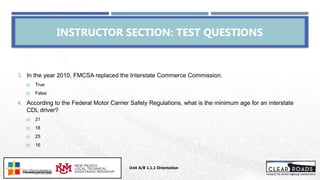
3. In the year 2010, FMCSA replaced the Interstate Commerce Commission.
a) True
b) False
4. According to the Federal Motor Carrier Safety Regulations, what is the minimum age for an interstate
CDL driver?
a) 21
b) 18
c) 25
d) 16
INSTRUCTOR SECTION: TEST QUESTIONS
Unit A/B 1.1.1 Orientation
Insert DOT
Logo Here
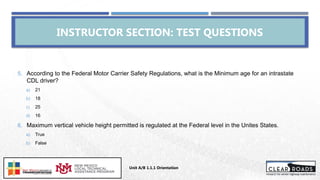
5. According to the Federal Motor Carrier Safety Regulations, what is the Minimum age for an intrastate
CDL driver?
a) 21
b) 18
c) 25
d) 16
6. Maximum vertical vehicle height permitted is regulated at the Federal level in the Unites States.
a) True
b) False
INSTRUCTOR SECTION: TEST QUESTIONS
Unit A/B 1.1.1 Orientation
Insert DOT
Logo Here
7. A Class C is defined as any single, or combination of vehicles that meets neither the definition of Class
A or Class B, and is designed to transport 16 or more passengers (including the driver) or is used to
transport a sufficient amount of hazardous material that would require placards.
a) True
b) False
8. To operate a heavy combination vehicle on the public roadways, a driver must have a CDL Class B.
a) True
b) False
INSTRUCTOR SECTION: TEST QUESTIONS
Unit A/B 1.1.1 Orientation
Insert DOT
Logo Here
9. FMCSA regulates all US motor carriers that operate interstate.
a) True
b) False
10. Interstate transportation is the movement, of property or passengers by a carrier that begins in one
state and ends in another state and is regulated by the federal government.
a) True
b) False
INSTRUCTOR SECTION: TEST QUESTIONS
Unit A/B 1.1.1 Orientation
Insert DOT
Logo Here
INSTRUCTOR SECTION: TEST QUESTIONS
Unit A/B 1.1.1 Orientation
Insert DOT
Logo Here
11. CDL drivers are permitted to have a driver’s license from more than one state or jurisdiction.
a) True
b) False
12. One of the General Qualifications for a CDL driver is for your employer to obtain a current 12-month
motor vehicle record.
a) True
b) False
13. A Driver Qualification File is required by federal regulation every commercial driver a motor carrier
employs.
a) True
b) False
Unit A/B 1.1.1 Orientation
Insert DOT
Logo Here
INSTRUCTOR SECTION: TEST QUESTIONS
14. A CDL driver cannot lose his or her commercial driving privileges for offenses committed in their
personal vehicle.
a) True
b) False
15. Serious traffic violations while operating a CMV can lead to loss of CDL privileges.
a) True
b) False
16. What part of the Federal Motor Carrier Safety Regulations determines Hours-of-Service?
___________________
INSTRUCTOR SECTION: TEST QUESTIONS
17. Single axle weight limits supersede Bridge Formula weight limits.
a) True
b) False
18. Professional drivers should always:
a) Be courteous
b) Meet all safety standards
c) Strive for efficiency
d) All of the above
e) None of the above
Unit A/B 1.1.1 Orientation
Insert DOT
Logo Here
INSTRUCTOR SECTION: TEST QUESTIONS
19. What part of the Federal Motor Carrier Safety Regulations determines driver qualifications?
_____________
20. A Class B CDL driver is also allowed to operate a Class A vehicle.
a) True
b) False
Unit A/B 1.1.1 Orientation
Insert DOT
Logo Here

CDL_ELDT_Unit A_B 1.1.1 Orientation.pptx

  • 1.
    ENTRY-LEVEL DRIVER TRAINING(CDL) FOR EQUIPMENT MAINTENANCE OPERATORS: THEORY CURRICULUM Section A/B 1.1: Basic Operation Unit A/B 1.1.1 Orientation Insert DOT Logo Here
  • 2.
    OVERVIEW  Unit Introduction Unit Learning Objectives  Unit Instruction  Discussion/Questions  Assessment Unit A/B 1.1.1 Orientation Insert DOT Logo Here
  • 3.
    UNIT INTRODUCTION  Introductionto Class A (or B) commercial driver’s license (CDL) driving curriculum  Additionally, you will gain a basic understanding of:  Classifications of and standards for obtaining a CDL  Safety fundamentals regarding operation of commercial motor vehicles (CMVs)  Rules and regulations related to operating CMVs  Professionalism required of CMV operators  Disqualification regulations  Learning goal  Driver-trainees will gain a complete understanding of CDL training and all aspects of what it takes to obtain and maintain their CDL as well as learn about the history of CMV operations and regulations Unit A/B 1.1.1 Orientation Insert DOT Logo Here
  • 4.
    UNIT OBJECTIVES  Uponcompletion of this unit, driver-trainees will be able to: 1) Identify driver-trainee rules and expectations 2) Discuss the history of CMVs and CMV regulation through the 21st century 3) Discuss Federal, State and local laws relating to the safe operation of CMVs 4) Describe the entry-level Class A/B CDL curriculum 5) Identify steps needed to progress towards obtaining a Class A/B CDL 6) Identify, describe, and explain the classifications of a CDL 7) Identify, describe, and explain the qualifications and disqualifications for commercial drivers 8) Identify, define, and discuss professionalism for the CMV driver Unit A/B 1.1.1 Orientation Insert DOT Logo Here
  • 5.
    THE START OFTRUCKING  The trucking industry began to take off after World War I  All goods are carried by truck at some point in their transit  In December 2020, $91.2 billion in freight was hauled in the United States  $60.5 billion was by trucks – 66%! Unit A/B 1.1.1 Orientation Insert DOT Logo Here
  • 6.
     Motor CarrierAct of 1935  Bureau of Motor Carrier Safety was created within the Interstate Commerce Commission and received authority to regulate motor carriers  Commercial MotorVehicle Safety Act of 1986  Ensured CMV operators were qualified and removed unsafe operators  Motor Carrier Safety Improvement Act of 1999  Further improved operator, vehicle, and overall motor carrier safety  Tightened CDL requirements TRUCKING BECOMES REGULATED Unit A/B 1.1.1 Orientation Insert DOT Logo Here
  • 7.
     Federal MotorCarrier Safety Administration (FMCSA)  Agency within U.S. Department ofTransportation  Established in 2000  Oversees various programs to ensure motor carrier safety and compliance  CDL Program  Federal Motor Carrier Safety Regulations (FMCSR)  Safety and Fitness Electronic Records System (SAFER)  Motor Carrier Safety Assistance Program (MCSAP)  Motor Carrier Safety Identification and Information Systems  Hazardous Materials Regulations (HMR) PRIMARY REGULATORY AGENCY Unit A/B 1.1.1 Orientation
  • 8.
     Pipeline andHazardous Materials Safety Administration (PHMSA)  Safeguards the transportation of energy and other hazardous materials (hazmat)  Established national policy  Set and enforces standards  Educates HAZARDOUS MATERIALS REGULATORY AGENCY Unit A/B 1.1.1 Orientation Insert DOT Logo Here
  • 9.
     Primarily relatedto hazardous materials  Environmental Protection Agency (EPA)  Nuclear Regulatory Commission (NRC)  National Transportation Safety Board (NTSB)  Occupational Safety and Health Administration (OSHA) OTHER PERTINENT AGENCIES Unit A/B 1.1.1 Orientation Insert DOT Logo Here
  • 10.
    STATE LEVEL REGULATORYAGENCIES  Department of Transportation  Department of MotorVehicles (DMV) or SDLA  Administers CDL tests and issues CDLs  Sets maximum lengths, widths, and weights of CMVs  Sets minimum insurance requirements  Collects road and fuel taxes Unit A/B 1.1.1 Orientation Insert DOT Logo Here
  • 11.
     Describe thehistory of the trucking industry.  What is the primary agency responsible for motor carrier safety and regulation?  Describe the other agencies, including at the state level, that may play a role in the trucking industry. ESSENTIAL LEARNING DISCUSSION #1 Unit A/B 1.1.1 Orientation Insert DOT Logo Here
  • 12.
    BASICS OF SAFECMV OPERATION  You need to understand:  Pertinent Federal Regulations  Specific State and local laws  Weight ratings  Legal weight limits  Bridge formula  Vehicle size limits  Weigh stations Unit A/B 1.1.1 Orientation Insert DOT Logo Here
  • 13.
    PERTINENT FEDERAL REGULATIONS The following regulations are covered within this unit:  Part 380 Special Training Requirements  Part 383 Commercial Driver’s License Standards; Requirements and Penalties  Part 391 Qualifications of Drivers and Longer CombinationVehicle Driver Instructors  Part 399 Employee Safety and Health Standards Unit A/B 1.1.1 Orientation Insert DOT Logo Here
  • 14.
     The followingregulations will be covered in detail in subsequent units  Part 382 Controlled Substances and Alcohol Use and Testing  Part 392 Driving of Commercial MotorVehicles  Part 393 Parts and Accessories Necessary for Safe Operation  Part 395 Hours-of-Service of Drivers  Part 396 Inspection Repair and Maintenance  Part 397 Transportation of Hazardous Materials; Driving and Parking Rules PERTINENT FEDERAL REGULATIONS (CONT.) Unit A/B 1.1.1 Orientation Insert DOT Logo Here
  • 15.
    49 CFR PARTS380.600 – 380.609 ENTRY-LEVEL DRIVER TRAINING REQUIREMENT ON AND AFTER FEBRUARY 7, 2022  Minimum training standards regulation enacted by the FMCSA  Entry-level driver training (ELDT)  Minimum training standards created by advisory committee comprised of 26 different stakeholders  Theory (classroom)  Behind-the-wheel (BTW) - road and range  Must meet certain proficiencies before testing to obtain commercial driver’s license (CDL) Unit A/B 1.1.1 Orientation Insert DOT Logo Here
  • 16.
    ENTRY-LEVEL CDL TRAININGREQUIREMENTS  Theory – 30 total units – 70 hours  Basic Operation (7 units)  Safe Operating Procedures (7 units)  Advanced Operating Practices (3 units)  Vehicle Systems and Reporting Malfunctions (3 units)  Non-Driving Activities (10 units)  BTW – 19 total units – 44 hours  Range (7 units)  Public Road (12 units) Unit A/B 1.1.1 Orientation Insert DOT Logo Here
  • 17.
     Driver-trainees arerequired to be assessed and must obtain at least 80% proficiency on theory training units  Instructors: Add in if assessments will be conducted at the end of each unit, each section, or one large assessment at end of all theory  Driver-trainees must meet minimum proficiencies as deemed by instructor  Minimum proficiency means being able to repeatedly perform each skill correctly  i.e., not one and done ENTRY-LEVEL CDL TRAINING PROFICIENCIES Unit A/B 1.1.1 Orientation Insert DOT Logo Here
  • 18.
    1. Obtain CommercialLearner’s Permit (CLP) 2. Obtain DOT Medical Card (if required) 3. Complete ELDT from certified training provider a) Pass theory with at least 80% proficiency b) Pass BTW with instructor’s determination of skill proficiency 4. Training provider submits driver-trainee’s completion certificate, hours BTW, and pertinent information toTraining Provider Registry 5. Driver-trainee schedules CDL test with SLDA or third-party examiner STEPS TO OBTAIN CDL Unit A/B 1.1.1 Orientation Insert DOT Logo Here
  • 19.
     Describe theCDL training curriculum and minimum proficiencies required per Parts 380.600 – 383.609  Describe the necessary steps to obtain your CDL. ESSENTIAL LEARNING DISCUSSION #2 Unit A/B 1.1.1 Orientation Insert DOT Logo Here
  • 20.
     Based onFederal standard and type of cargo being transported  Three basic classes of a CDL based on gross vehicle weight rating (GVWR)  Class A  Class B  Class C  States may further divide or create classes  You cannot have more than one driver’s license (Part 383.21) 49 CFR PART 383.91 COMMERCIAL MOTOR VEHICLE GROUPS Unit A/B 1.1.1 Orientation Insert DOT Logo Here
  • 21.
     Combination vehicleswith a power-unit GVWR of 26,001 lbs or greater and trailer with GVWR greater than 10,000 lbs  Dump trucks pulling trailers with heavy equipment or cargo  Tractor-trailers  Class A CDL holders may also drive Class B and C commercial vehicles CLASS A CDL Unit A/B 1.1.1 Orientation Insert DOT Logo Here
  • 22.
    CLASS B CDL Single unit vehicle with a GVWR 26,001 lbs or greater  Dump trucks  Cement trucks  Box trucks  Transit buses  Cannot pull another vehicle or trailer that is greater than 10,000 lbs GVWR  Class B CDL holder may also drive Class C commercial vehicles Unit A/B 1.1.1 Orientation Insert DOT Logo Here
  • 23.
    CLASS C  Anysingle unit vehicle with GVWR less than 26,001 lbs  Must either be:  Designed to carry 16 or more passengers  Used to transport hazardous materials  Cannot pull a trailer weighing more than 10,000lbs Unit A/B 1.1.1 Orientation Insert DOT Logo Here
  • 24.
     Certain typesof vehicles and cargo require specialized knowledge  Operators of these vehicles and/or cargo must have an endorsement certifying they have received this specialized training  There are six endorsements  Tank vehicle (N)  Hazardous materials (H)  Combination tank vehicle and hazardous materials (X)  Double and triple trailers (T)  Passengers (P)  School bus (S) 49 CFR PART 383.93 ENDORSEMENTS Unit A/B 1.1.1 Orientation
  • 25.
     Restrictions areanother important aspect to be aware of  Restrictions are placed on your CDL depending on the type of vehicle you take the CDL test in and for medical reasons  There are 14 different restrictions that may be placed on your CDL 49 CFR PART 383.95 RESTRICTIONS Unit A/B 1.1.1 Orientation Insert DOT Logo Here
  • 26.
     B –Corrective lens  D - Prosthesis  E – Automatic transmission only  G – Daylight only  K – CDL Intrastate only  L – No air brake equipped CMV  M – No Class A passenger vehicle Unit A/B 1.1.1 Orientation Insert DOT Logo Here RESTRICTIONS TYPES  N – No Class A or B passenger vehicle  O – No tractor-trailer CMV  P – No passengers in CMV bus  V – Medical variance  X – No cargo in CMV tank vehicle  Y – Sex offender  Z – No full air brake equipped vehicle
  • 27.
    INTRASTATE VERSUS INTERSTATE Intrastate means you can only operate a CMV within the state your CDL was issued  Minimum age: 18  Interstate means you can operate a CMV across state lines  Minimum age: 21
  • 28.
     Describe thedifferent classes of the CDL.  Describe the six endorsements you can obtain on your CDL.  Describe the 14 restrictions that may be placed on your CDL.  What is the difference between intrastate and interstate? ESSENTIAL LEARNING DISCUSSION #3 Unit A/B 1.1.1 Orientation Insert DOT Logo Here
  • 29.
    49 CFR PART391.11 GENERAL QUALIFICATIONS OF DRIVERS  At least 21 years of age (except for intrastate only)  Read and speak English language sufficiently  Can safely operate a CMV  Physically qualified  Holds current CDL from only one State  Provided employer with list of violations as required by 391.27  Is not disqualified per 391.15 Unit A/B 1.1.1 Orientation Insert DOT Logo Here
  • 30.
     Can, byreason of experience, training, or both, determine whether the cargo he/she transports (including baggage in a passenger-carrying commercial motor vehicle) has been properly located, distributed, and secured in or on the commercial motor vehicle he/she drives  Is familiar with methods and procedures for securing cargo in or on the commercial motor vehicle he/she drives. 49 CFR PART 391.13 RESPONSIBILITIES OF DRIVERS
  • 31.
    CDL DISQUALIFICATIONS: 49CFR PARTS 383.51 – 383.53 AND 391.15  CMV operators can be disqualified and their CDL suspended or revoked for a variety of violations  Disqualifications fall into six categories  Alcohol, leaving the scene of a crash, and commission of a felony  Serious traffic violations  Violation of out-of-service orders  Railroad-highway grade crossing violations  Hazardous materials endorsement background checks  Traffic violation in your personal vehicle Unit A/B 1.1.1 Orientation Insert DOT Logo Here
  • 32.
    ALCOHOL  It isillegal to have a blood alcohol content of 0.4% or more while operating a CMV  First offense, non-hazardous materials = one-year loss of CDL  First offense, with hazardous materials = three-year loss of CDL  Second offense = you will lose your CDL for life  Alcohol detected under 0.04% = out-of-service for 24 hours  By operating a CMV, you have automatically consented to alcohol testing Unit A/B 1.1.1 Orientation Insert DOT Logo Here
  • 33.
     Disqualification offenses Leaving the scene of a crash involving a CMV  Committing a felony involving the use of a CMV  Operating a CMV while CDL is suspended  Causing a fatality through negligent operation of a CMV  Keep in mind these offenses along with alcohol offenses count together  For example, driving under the influence (first violation) and then later operating a CMV with a suspended CDL (second offense) = loss of CDL for life  Additionally, you automatically lose your CDL for life if you commit a felony in a CMV involving controlled substances LEAVING THE SCENE OF A CRASH AND COMMISSION OF A FELONY Unit A/B 1.1.1 Orientation Insert DOT Logo Here
  • 34.
    SERIOUS TRAFFIC VIOLATIONS 60-day loss of CDL if two, or 120-day loss if three or more, violations within three years  Texting while driving  Use of hand-held mobile device while driving  Speeding 15mph or more over posted limit  Reckless driving  Improper/erratic lane change  Following too closely  Traffic violations where a fatality occurs  Driving without obtaining CDL or CDL not in possession  Not having proper class of CDL or proper endorsement Unit A/B 1.1.1 Orientation Insert DOT Logo Here
  • 35.
    VIOLATION OF OUT-OF-SERVICEORDERS  You will lose your CDL  For at least 90 days for first violation  For at least one year for two violations in a 10-year period  For at least three years for three violations in a 10-year period Unit A/B 1.1.1 Orientation Insert DOT Logo Here
  • 36.
    RAILROAD-HIGHWAY GRADE CROSSINGVIOLATIONS  Penalties for violating railroad-highway grade crossing regulations  At least 60-day loss of CDL for first violation  At least 120-day loss of CDL for second violation within three-year period  At least one year loss of CDL for third violation within three-year period  These penalties include violations of Federal, State, or local regulations pertaining to six offenses Unit A/B 1.1.1 Orientation Insert DOT Logo Here
  • 37.
     For CMVsnot required to always stop  Failing to stop before reaching the crossing if tracks are not clear  Failing to slow down and check that the tracks are clear of an approaching train  For CMVs required to always stop  Failing to stop before driving onto the crossing  For all CMVs  Failing to have sufficient space to drive completely through the crossing without stopping  Failing to obey a traffic control device or the directions of an enforcement official at a crossing  Failing to negotiate a crossing because of insufficient undercarriage clearance RAILROAD-HIGHWAY GRADE CROSSING VIOLATIONS Unit A/B 1.1.1 Orientation Insert DOT Logo Here
  • 38.
     Hazmat endorsementrequires submission of fingerprints for background check  You will be disqualified:  If you are not a lawful permanent resident of the United States  If you renounce your United States citizenship  If you are wanted or under indictment for certain felonies  If you have a military or civilian conviction for certain felonies  If you have been diagnosed as lacking mental capacity or been involuntarily committed to a mental health facility  If you pose a threat to security as determined by theTransportation Security Administration HAZARDOUS MATERIALS ENDORSEMENT BACKGROUND CHECKS Unit A/B 1.1.1 Orientation Insert DOT Logo Here
  • 39.
     The MotorVehicleSafety Improvement Act requires a CDL holder convicted of certain violations in their personal vehicle to be disqualified from also operating a CMV  If your license is suspended or revoked in your personal vehicle  For violating traffic control laws (other than parking violations) you lose CDL privileges for same length as personal vehicle  For alcohol, controlled substances, and felonies you lose CDL privileges for one year  Second offense in personal vehicle results in loss of CDL privileges for life  You cannot obtain a hardship waiver to operate a CMV TRAFFIC VIOLATIONS IN YOUR PERSONAL VEHICLE Unit A/B 1.1.1 Orientation Insert DOT Logo Here
  • 40.
    49 CFR PARTS391.21 – 391.27 BACKGROUND AND CHARACTER  Employers are required to obtain a copy of employee’s motor vehicle record for preceding three years within 30 days of the hire date  Employers are required to obtain a copy of each employee’s motor vehicle record at least once every 12 months  Shall be maintained in employee’s driver’s qualification file which is required to be kept on file  Employees are required to notify employer within 30 days of any motor vehicle violation (except for parking) even if personal vehicle (Part 383.31)
  • 41.
    49 CFR PART399.207 TRUCK AND TRUCK-TRACTOR REQUIREMENTS  Trucks shall have sufficient steps, handholds, and/or deck plates to allow users at least three points-of-contact at all times  This requirement shall be on each side of the vehicle where a seat is located  First step from ground level shall be no more than 24 inches  All steps or deck plates shall provide at least 5 inches of step depth  All steps and/or deck plates shall be slip resistant Unit A/B 1.1.1 Orientation Insert DOT Logo Here
  • 42.
     Describe therequired qualifications in order to hold a valid CDL.  Describe your responsibility as it relates to cargo.  What are the six categories of driver disqualifications?  Describe some of the penalties for disqualification.  Explain Parts 391.21 – 391.27. ESSENTIAL LEARNING DISCUSSION #4 Unit A/B 1.1.1 Orientation Insert DOT Logo Here
  • 43.
     CMV operatorsneed to be aware of specific State and local laws pertaining to CMVs  No trucks in left lane  No engine braking  No through trucks  Every jurisdiction may be different so always plan ahead STATE AND LOCAL LAWS Unit A/B 1.1.1 Orientation Insert DOT Logo Here
  • 44.
     Gross vehicleweight rating (GVWR)  Manufacturer specified maximum loaded weight of a single vehicle  Gross combination weight rating (GCWR)  Maximum specified weight of sum of GVWRs of power unit and towed unit  Axle weight rating  Weight transferred to the ground by one axle or set of axles WEIGHT RATINGS Unit A/B 1.1.1 Orientation Insert DOT Logo Here
  • 45.
    LEGAL WEIGHT LIMITS Federal law regulates maximum weight limits on interstate highways  80,000lbs GCWR  20,000lbs axle weight rating  34,000lbs tandem axle (axles spaced between 40” to 96” apart) weight rating  38,000lbs for tandem axles spaced 97” apart  42,000lbs for tridem axles with outer most axles spaced 97 apart  State law regulates non-interstate highways  Some states allow weights that exceed Federal weight limits Unit A/B 1.1.1 Orientation Insert DOT Logo Here
  • 46.
    NEW MEXICO DEPARTMENTOF TRANSPORTATION Unit A/B 1.1.1 Orientation Insert DOT Logo Here •Single Axle: Generally aligns with federal limits at 20,000 pounds. •Tandem Axle: Generally aligns with federal limits at 34,000 pounds. •Gross Vehicle Weight: New Mexico adheres to the federal limit of 80,000 pounds, but there may be variations or additional restrictions depending on the specific type of vehicle or load.
  • 47.
    WHAT IS THEBRIDGE FORMULA?  Helps prevent bridges and other roads from becoming overloaded  Determines maximum axle weight that different CMVs can carry  The closer the axle spacing, the less weight allowed  If two CMVs have the same weight, does the longer or shorter CMV cause more stress on bridges?  The shorter CMV will cause more stress due to the weight being more concentrated in one area Unit A/B 1.1.1 Orientation Insert DOT Logo Here
  • 48.
     W =500 ((LN/N-1) + 12N + 36)  W = the overall gross weight on any group of two or more consecutive axles to the nearest 500lbs  L = the distance in feet between the outer axles of any group of two or more consecutive axles  N = the number of axles in the group under consideration  Two or more consecutive axles may not exceed Bridge Formula weight even though single axles, tandem axles, and gross weight are within legal limits BRIDGE FORMULA Unit A/B 1.1.1 Orientation Insert DOT Logo Here
  • 49.
    BRIDGE FORMULA EXAMPLE Let’s calculate the most common axle set up  W = 500 (((51x5)/(5-1)) + (12x5) + 36)  W = 500 ((255/4) + 60 + 36)  W = 500 (63.75 + 60 + 36)  W = 500 x 159.75  W = 79,875lbs  Rounded to nearest 500lbs = 80,000lbs  Note how the steer axle weight rating is 12,000lb due to tandem axle weight limits of 34,000lbs  The bridge formula supersedes the single axle weight rating of 20,000lbs Unit A/B 1.1.1 Orientation
  • 50.
    BRIDGE FORMULA SCENARIO1  You are heading out to the job site on the interstate and driving a three-axle dump truck. Using the bridge formula, what are your legal gross vehicle weight and axle weight ratings? 20 feet Unit A/B 1.1.1 Orientation Insert DOT Logo Here
  • 51.
    BRIDGE FORMULA SCENARIO2  The next day you are heading out to the same job site, but today you are driving a five-axle dump truck. Using the bridge formula, what is your legal gross vehicle weight rating? 20 feet Unit A/B 1.1.1 Orientation Insert DOT Logo Here
  • 52.
    VEHICLE SIZE LIMITS:FEDERAL REGULATIONS  Width of CMVs  Maximum width is 102 inches  Lengths of trailers and combination vehicles  Minimum trailer lengths State’s must allow on National Network of Highways and other reasonable access routes  State’s may not impose overall length limit on a power unit pulling a single trailer Unit A/B 1.1.1 Orientation Insert DOT Logo Here
  • 53.
    TRUCK/TRAILER CONFIGURATIONS Straight Truck/DumpTruck 5-AxleTractor-Trailer Most common configuration with multiple trailer lengths, most common trailer is 53’ Standard Doubles Trailers are 28’ to 28’6” Triples Trailer Configuration Trailers are 28’ to 28’6” Rocky Mountain Doubles 53’ and 28’ trailers B-Trains and Super B-Trains Trailer length varies Turnpike Doubles Trailers typically 48’
  • 54.
     Height requirements Each State can set own height requirements  Straight truck length requirements  Each State can set own straight truck length requirements VEHICLE SIZE LIMITS: STATE REGULATIONS Unit A/B 1.1.1 Orientation Insert DOT Logo Here
  • 55.
    WEIGH STATIONS  Checkpoints designed to verify CMV weight  Can also inspect brake temperatures  Detect hazmat leaks  Check driver and vehicle credentials  Originally created to collect taxes  Now primarily used to enforce laws and regulations  Typically staffed by DOT and State Police personnel Unit A/B 1.1.1 Orientation Insert DOT Logo Here
  • 56.
     Most weighstations now use weigh-in-motion scales  Calculates approximate weight as vehicle moves across scale  Keeps flow of truck traffic moving  If close to GVWR, you will be signaled to pull in and stop to be weighed  It is unlawful to by-pass open weigh stations  Some fleets use the Pre-Pass system; Uses a transponder and signals a driver if they have to pull in or not  Federal, State, and local government vehicles typically exempt from weigh stations WEIGH STATION USE Unit A/B 1.1.1 Orientation Insert DOT Logo Here
  • 57.
    LIFE AS ACMV OPERATOR  You are considered a professional driver so make sure you carry yourself as a professional!  Professional drivers:  Strive to meet all safety standards  Are respectful, courteous, and friendly  Have above average knowledge of vehicle systems  Always have efficiency in mind Unit A/B 1.1.1 Orientation Insert DOT Logo Here
  • 58.
    SAFETY, SAFETY, SAFETY Safety never stops  In the maintenance yard  On the roadways  At the job site  Safety is a culture  Safety is your greatest tool Unit A/B 1.1.1 Orientation Insert DOT Logo Here
  • 59.
    WRAP-UP DISCUSSION &QUESTIONS? Unit A/B 1.1.1 Orientation Insert DOT Logo Here
  • 60.
    INSTRUCTOR SECTION: CLASSORGANIZATION  Recommended instructional time = 3 hours  Suggested class breakdown  Greeting and attendance = 5 minutes  Unit instruction = 150 minutes  Class discussion and questions = 25 minutes Unit A/B 1.1.1 Orientation Insert DOT Logo Here
  • 61.
     20 testquestions are provided and 15 recommended for unit assessment 1. Trucking is one of the most heavily regulated industries in the country. Interstate regulation began in 1935 when the Bureau of Motor Carrier Safety was created as part of the Interstate Commerce Commission. a) True b) False 2. Following the rules that regulate the transportation industry and observing safety standards is ___. a) Not important b) The difference between continuing a career and losing it c) Only for company drivers who work for big companies d) Only for drivers who work for themselves INSTRUCTOR SECTION: TEST QUESTIONS Unit A/B 1.1.1 Orientation Insert DOT Logo Here
  • 62.
    3. In theyear 2010, FMCSA replaced the Interstate Commerce Commission. a) True b) False 4. According to the Federal Motor Carrier Safety Regulations, what is the minimum age for an interstate CDL driver? a) 21 b) 18 c) 25 d) 16 INSTRUCTOR SECTION: TEST QUESTIONS Unit A/B 1.1.1 Orientation Insert DOT Logo Here
  • 63.
    5. According tothe Federal Motor Carrier Safety Regulations, what is the Minimum age for an intrastate CDL driver? a) 21 b) 18 c) 25 d) 16 6. Maximum vertical vehicle height permitted is regulated at the Federal level in the Unites States. a) True b) False INSTRUCTOR SECTION: TEST QUESTIONS Unit A/B 1.1.1 Orientation Insert DOT Logo Here
  • 64.
    7. A ClassC is defined as any single, or combination of vehicles that meets neither the definition of Class A or Class B, and is designed to transport 16 or more passengers (including the driver) or is used to transport a sufficient amount of hazardous material that would require placards. a) True b) False 8. To operate a heavy combination vehicle on the public roadways, a driver must have a CDL Class B. a) True b) False INSTRUCTOR SECTION: TEST QUESTIONS Unit A/B 1.1.1 Orientation Insert DOT Logo Here
  • 65.
    9. FMCSA regulatesall US motor carriers that operate interstate. a) True b) False 10. Interstate transportation is the movement, of property or passengers by a carrier that begins in one state and ends in another state and is regulated by the federal government. a) True b) False INSTRUCTOR SECTION: TEST QUESTIONS Unit A/B 1.1.1 Orientation Insert DOT Logo Here
  • 66.
    INSTRUCTOR SECTION: TESTQUESTIONS Unit A/B 1.1.1 Orientation Insert DOT Logo Here 11. CDL drivers are permitted to have a driver’s license from more than one state or jurisdiction. a) True b) False 12. One of the General Qualifications for a CDL driver is for your employer to obtain a current 12-month motor vehicle record. a) True b) False 13. A Driver Qualification File is required by federal regulation every commercial driver a motor carrier employs. a) True b) False
  • 67.
    Unit A/B 1.1.1Orientation Insert DOT Logo Here INSTRUCTOR SECTION: TEST QUESTIONS 14. A CDL driver cannot lose his or her commercial driving privileges for offenses committed in their personal vehicle. a) True b) False 15. Serious traffic violations while operating a CMV can lead to loss of CDL privileges. a) True b) False 16. What part of the Federal Motor Carrier Safety Regulations determines Hours-of-Service? ___________________
  • 68.
    INSTRUCTOR SECTION: TESTQUESTIONS 17. Single axle weight limits supersede Bridge Formula weight limits. a) True b) False 18. Professional drivers should always: a) Be courteous b) Meet all safety standards c) Strive for efficiency d) All of the above e) None of the above Unit A/B 1.1.1 Orientation Insert DOT Logo Here
  • 69.
    INSTRUCTOR SECTION: TESTQUESTIONS 19. What part of the Federal Motor Carrier Safety Regulations determines driver qualifications? _____________ 20. A Class B CDL driver is also allowed to operate a Class A vehicle. a) True b) False Unit A/B 1.1.1 Orientation Insert DOT Logo Here

Editor's Notes

  • #1 Image source: Delaware DOT Suggested narration: Good morning/afternoon/evening. Welcome to class and the beginning of your training to obtain your commercial driver’s license. Today we are starting with Section 1.1 Basic Operation and will be covering Unit 1.1.1 Orientation.
  • #2 Image source: Delaware DOT Suggested narration: We will start this unit with a brief introduction and go over the learning objectives before moving into the actual classroom instruction. At the end, we will have time for further discussion and questions.
  • #3 Suggested narration: This unit teaches a general orientation about what it takes to obtain your CDL and be a professional driver operating a CMV. We will start with an overview of the training curriculum and process and then move into learning the different classifications of a CDL and the standards for obtaining them, safety fundamentals regarding the operation of CMVs, rules and regulations related to operating CMVs, the professionalism required of CMV operators, and regulations that disqualify you to operate a CMV. The primary learning goal is for driver-trainees to gain a complete understanding of CDL training and all aspects of what it takes to obtain and maintain their CDL as well as learn about the history of CMV operations and regulations
  • #4 Suggested narration: Driver-trainees completing this unit will be able to: Identify driver-trainee rules and expectations Describe the entry-level Class A/B CDL curriculum Identify steps needed to progress towards obtaining a Class A/B CDL Identify, describe, and explain the classifications of and the standards for obtaining a CDL Discuss the history of CMVs and CMV regulation through the 21st century Discuss Federal, state and local laws relating to the safe operation of CMVs Identify, define, and discuss professionalism for the CMV driver Identify, describe, and explain the qualifications and disqualifications for commercial drivers
  • #5 Instructor’s Note: Add narration in once rules and expectations have been listed
  • #6 Image source: Public domain Suggested narration: After the end of World War I, the trucking industry began to take off. Many soldiers returning from the war were looking for work and there were more and more motorized vehicles. This included many more trucks on the roadways creating new job opportunities. All goods in the United States are carried by truck at some point in their transit. Even if by ship, rail car, or airplane, they still reach their final destination by truck. Jumping to current times, according to the Bureau of Transportation Statistics in December 2020, trucks hauled $60.5 billion worth of goods out of a total of $91.2 billion in this country. That was a whopping 66% of all freight moved. Reference: Bureau of Transportation Statistics, https://www.bts.gov/figure-1-north-american-freight-mode-december-2020 Instructor’s note: Periodically review this statistic and update.
  • #7 Suggested narration: Eventually, the Federal government began regulating the trucking industry. It started with the Motor Carrier Act of 1935. This act gave the Interstate Commerce Commission the authority to regulate truck and bus companies. Collectively truck and bus companies are known as motor carriers. Then, in 1986, the Commercial Motor Vehicle Safety Act was passed which created regulations to ensure CMV operators were qualified, and any unsafe operators are removed from the roadways. Further, in 1999, the Motor Carrier Safety Improvement Act was passed by Congress which strengthen regulations at the time and created new regulations that improved operator and vehicle safety. This included tightening the requirements for CDLs. Trucking is one of the most heavily regulated industries in the country.
  • #8 Suggested narration: The Federal Motor Carrier Safety Administration (FMCSA) is the designated agency responsible for oversight of motor carriers in the United States. The FMCSA falls under the U.S. Department of Transportation and was established in the year 2000. FMCSA oversees various programs to ensure motor carrier safety and compliance including, but not limited to, the CDL program, the Federal Motor Carrier Safety Regulations (FMCSR), the Safety and Fitness Electronic Records Systems (SAFER), the Motor Carrier Safety Assistance Program (MCSAP), the Motor Carrier Safety Identification and Information Systems, and the Hazardous Materials Regulations.
  • #9 Image source: Creative Commons CC BY-SA 2.0 Suggested narration: In addition to FMCSA, the Pipeline and Hazardous Materials Safety Administration (PHMSA) plays a role in the transport of all hazardous materials, including by truck. Their primary mission is to safeguard the transportation of energy products and other hazardous materials. They are responsible for establishing national policies relating to hazardous materials as well as setting and enforcing standards and educating all parties including motor carriers about hazardous materials.
  • #10 Suggested narration: Some other agencies at the Federal level to be aware of are the Environmental Protection Agency (EPA), the Nuclear Regulatory Commission (NRC), the National Transportation Safety Board (NTSB), and the Occupational Safety and Health Administration (OSHA). These agencies operate on the peripheral for motor carriers. The EPA is responsible for protecting human health and the environment. They respond to major hazardous materials spills and leaks to ensure all contamination is cleaned up and remediated. The NRC ensures the safe use of radioactive materials including transport of these materials while protecting people and the environment. While most people think of the NTSB as investigating major crashes across all forms of transportation, they are also responsible for the evaluation of safeguards used in the transportation of hazardous materials. OSHA is responsible for ensuring overall workplace safety of employees.
  • #11 Image source: Connecticut DOT Suggested narration: At the state level, there are a couple of regulatory agencies involved in motor carrier operations and safety. The first is the State Department of Transportation and the second is the Department of Motor Vehicles (DMV), also known as a State Driver’s License Agency (SDLA). DMVs are responsible for administering the CDL test and issuing CDLs. DMVs also work to set the maximum lengths, widths, and weights of CMVs operating on their roadways, set minimum insurance requirements, and collect road and fuel taxes. It should be noted that state agencies are self-insured; therefore, [insert state] DOT is self-insured. Instructor’s note: Please review your State’s specific regulatory agencies regarding CMVs and adjust or add to this slide if needed.
  • #12 Suggested narration: Now let’s take a couple of minutes to review what we have just learned about the history of the trucking industry, the primary agency responsible for motor carrier safety and regulation, and other agencies that play a lesser role in the trucking industry. Instructor’s note: spend a minute or two with class discussion to ensure the driver-trainees fully understand the history of the trucking industry and the agencies responsible for safety and regulation.
  • #13 Image source: CALTRANS Suggested narration: When it comes to the basics of safely operating a CMV, all CDL holders must understand the importance of Federal regulations, any specific State and local laws where they drive, vehicle weight ratings, legal weight limits, the bridge formula, height restrictions, and weigh stations.
  • #14 Suggested narration: There are several Federal regulations that driver-trainees should be aware of and understand. The following regulations will be covered in this training unit: Part 380 Special Training Requirements Part 383 Commercial Driver’s License Standards; Requirements and Penalties Part 390 Federal Motor Carrier Safety Regulations; General Part 391 Qualifications of Drivers and Longer Combination Vehicle Driver Instructors Part 399 Employee Safety and Health Standards
  • #15 Suggested narration: These Federal regulations will be covered in detail in subsequent training units, but you should be aware of them as you start your training: Part 382 Controlled Substances and Alcohol Use and Testing Part 393 Parts and Accessories Necessary for Safe Operation Part 395 Hours-of-Service of Drivers Part 396 Inspection Repair and Maintenance Part 397 Transportation of Hazardous Materials; Driving and Parking Rules
  • #16 Image source: Indiana DOT Suggested narration: The FMCSA has enacted regulations requiring minimum training standards for obtaining your commercial driver’s license (CDL). These minimum training standards were created by an advisory committee comprised of 26 stakeholders. These stakeholders came from the insurance industry, SDLAs, law enforcement, truck and bus fleets, labor unions, and safety advocacy groups. The minimum standards require both theory or classroom instruction as well as behind-the-wheel instruction made up of both public road and range time. All driver-trainees must meet certain proficiencies before they are allowed to test at a SDLA or with a third-part examiner to obtain their CDL.
  • #17 Image Source: Iowa DOT Suggested narration: The minimum training standards discussed on the previous slide are made up of 30 total theory or classroom units that must be taken in order as each unit/section builds upon the previous units. The theory units are comprised of basic operation with seven units, safe operating procedures with seven units, advanced operating procedures with three units, vehicle systems and reporting malfunctions with three units, and non-driving activities with 10 units. It is expected that theory training will take approximately 70 hours. The BTW training units consist of 7 units of range training and teach the different backing maneuvers required of a CMV operator while the public road portion of training consists of 12 units. The theory training can be done first or concurrently with BTW training; however, BTW training cannot come before theory training. In other words, the cart cannot come before the horse. Most driver-trainees complete BTW training in approximately 44 hours.
  • #18 Suggested narration: All CDL driver-trainees must meet minimum proficiencies in order to pass CDL training and be able to test at a SDLA or with a third-party examiner to obtain your CDL. For the theory training, driver-trainees must score a minimum of at least 80% on the units. During your training, you will be assessed [add in when assessments will be administered: after each unit, each section, or one large one at the end of all theory]. For the BTW training, driver-trainees must be deemed proficient by the instructor for each of the skills. This means you must demonstrate good conduct of these skills repeatedly to be deemed proficient. You cannot just perform once and think you are done.
  • #19 Suggested narration: Necessary steps must be followed in order to obtain your CDL: Obtain Commercial Learner’s Permit (CLP) Obtain DOT Medical Card (if required) Complete ELDT from certified training provider Pass theory with at least 80% proficiency Pass BTW with instructor’s determination of skill proficiency Training provider submits driver-trainee’s completion certificate, hours BTW, and pertinent information to Training Provider Registry Driver-trainee schedules CDL test with SLDA or third-party examiner Instructor’s Note: State government entities are exempt from the DOT Medical Card requirement; however, it is understood that some states may still require their drivers to obtain the medical card. If your state still requires the medical card, leave the second bullet. If your state does not require the medical card, then remove the second bullet. Also note, theory training can be conducted prior to obtaining their CLP; however, BTW training cannot take place unless they have their CLP.
  • #20 Suggested narration: Now let’s take a couple of minutes to review what we have just learned about the class rules and expectations required of each driver-trainee throughout CDL training as well as the CDL training curriculum and the minimum proficiencies required of each driver-trainee. We will also discuss the necessary steps to obtain your CDL Instructor’s note: spend a minute or two with class discussion to ensure the driver-trainees fully understand the rules and expectations, CDL training curriculum and minimum proficiencies and the required steps to obtain their CDL.
  • #21 Image source: Wisconsin DOT Suggested narration: There are three Federal classifications of a CDL. These classifications are based on the Federal standards and the type of cargo being transported. The three classes of CDL are determined by the gross vehicle weight rating (GVWR). The GVWR is maximum operating weight of that particular vehicle. The three classes of CDL are Class A, Class B, and Class C. States are given discretion to further divide these classes or create additional classes.
  • #22 Image source: Ohio DOT Suggested narration: A Class A CDL is required when operating combination vehicles with a power-unit GVWR of 26,001 lbs or greater and trailer with GVWR greater than 10,000 lbs. Tractor-trailers are the most common example, however; more relevant to us, would be dump trucks pulling pintle hook trailers to haul heavy equipment or cargo. Class A CDL holders may also drive Class B and C commercial vehicles.
  • #23 Image source: Missouri DOT Suggested narration: A Class B CDL is required when operating a single unit vehicle with a GVWR of 26,001 lbs or greater. These vehicles include dump trucks, cement trucks, box trucks, and transit and school buses. A Class B CDL holder cannot pull another vehicle or trailer that is greater than 10,000 lbs GVWR. Class B CDL holders may also drive Class C commercial vehicles.
  • #24 Image source: Montclair State University Suggested narration: A Class C CDL is required when operating any single unit vehicle with GVWR less than 26,001 lbs and either is designed to carry 16 or more passengers or used to transport hazardous materials. A Class C CDL holder cannot tow a trailer weighing more than 10,000 lbs.
  • #25 Suggested narration: In addition to obtaining your CDL, if you will be pulling certain types of trailers or cargo, then you will be required to have an endorsement that shows you have specialized knowledge of those vehicles and cargo. There are six endorsements: 1) tank vehicles, 2) hazardous materials, 3) combination tank vehicle and hazardous materials, 4) double and triple trailers, 5) passengers, and, 6) school bus. Working for [insert State] DOT, you will typically only need the first three endorsements listed in bold. However, you should be aware of the other three as well.
  • #26 Suggested narration: Not that we have learned about CDL endorsements, we will discuss potential restrictions that may be placed on your CDL. This is another important aspect you should be aware of. Restrictions can be placed on your CDL depending on the type of vehicle that you took the CDL in and for certain medical reasons. There are 14 different restrictions that you may come across. Instructor’s note: States can add additional restrictions. Please verify the number and types of restrictions and adjust this slide and the next slide accordingly.
  • #27 Suggested narration: Now we will discuss each of the restrictions: B restriction is required when need to wear corrective lens to pass the DOT physical D restriction is required if the operator has a prosthesis E restriction is required when the driver-trainee takes the CDL test in an automatic transmission G restriction is required when the operator is only allowed to operate during daylight hours K restriction is required when the operator can only operate a CMV within the state and not cross state lines L restriction is required when the driver-trainee takes the CDL test in a vehicle that is not equipped with air brakes M restriction is required when the passenger endorsement test is taken in a Class B passenger vehicle N restriction is required when the passenger endorsement test is taken in a Class C passenger vehicle O restriction is required when the driver-trainee takes the CDL test in a vehicle with a pintle hook trailer; therefore, they cannot operate any fifth wheel trailers P restriction is issued on a CLP and prohibits passengers V restriction is required when the operator has received a medical variance as granted under the Federal regulations X restriction is issued on a CLP and the driver-trainee from hauling any type of cargo Y restriction is issued on any sex offenders license Z – No full air brake equipped vehicle; this restriction is issued when a driver-trainee takes the test in a vehicle equipped with air over hydraulic brakes The most common restriction for DOT CMV operators will be the O restriction as most operators take the CDL test in a dump truck using a pintle hook trailer.
  • #28 Suggested narration: There are two types of CDL licenses, intrastate and interstate. Intrastate means you can only operate a CMV within the state your CDL was issued and must be at least 18 years of age. Interstate means you can operate a CMV across state lines but must be at least 21 years of age.
  • #29 Suggested narration: Now let’s take a couple of minutes to review what we have just learned about the different classifications of CDLs, the different endorsements, the possible restrictions on your CDL., and the difference between intrastate and interstate CDLs. Instructor’s note: spend a minute or two with class discussion to ensure the driver-trainees fully understand the difference between CDL classes, the types of endorsements and when they are required, the potential restrictions on a CDL and the difference between intrastate and interstate driver.
  • #30 Suggested narration: Part 391.11 General Qualifications of Drivers requires anyone seeking to operate a CMV be at least 21 years of age unless intrastate only and be able to read and speak the English language sufficiently to converse with the general public, understand traffic signs and signals, respond to official inquiries, and be able to make entries on reports and records. It also requires CMV operators to be able to safely operate a CMV, be medically qualified, hold only one valid CDL, has provided their employer with a list of any violations per Part 391.27 and is not disqualified per Part 391.15.
  • #31 Suggested narration: Part 391.13 Responsibilities of Drivers means CDL holders can, by reason of experience, training, or both, determine whether the cargo he/she transports (including baggage in a passenger-carrying commercial motor vehicle) has been properly located, distributed, and secured in or on the commercial motor vehicle he/she drives and is familiar with methods and procedures for securing cargo in or on the commercial motor vehicle he/she drives. Cargo securement will be covered in more detail in a subsequent training unit.
  • #32 Suggested narration: As a CMV operator, it is important to understand Parts 383.51 through 383.53 and Part 391.15 so you know what can lead to you being disqualified as a CMV operator. When you are disqualified, your CDL is suspended or revoked, and this can happen for a variety of violations. These disqualifications fall into six categories: Alcohol, leaving the scene of a crash, and commission of a felony Serious traffic violations Violation of out-of-service orders Railroad-highway grade crossing violations Hazardous materials endorsement background checks Traffic violation in your personal vehicle
  • #33 Suggested narration: When it comes to alcohol, it is illegal to have a blood alcohol content of 0.04% or more while operating a CMV. If you have an alcohol conviction, your first offense while hauling non-hazardous materials is a one-year loss of your CDL, and a first offense while hauling hazardous materials is a three-year loss of your CDL. A second conviction regardless of your cargo results in losing your CDL for life. Additionally, any alcohol detected under 0.04% will result in an out-of-service order for 24 hours. By being a professional driver and operating a CMV, you have automatically consented to drug and alcohol testing. Refusing a blood alcohol test or drug test will also result in loss of your CDL for one year.
  • #34 Suggested narration: Leaving the scene of a crash and commission of a felony disqualification offenses include leaving the scene of a crash, committing a felony involving the use of a CMV, operating a CMV while your CDL is suspended, causing a fatality through negligent operation of a CMV. It is important to understand that the offenses listed on this slide do not count separately from alcohol related offenses. For example, driving under the influence (first violation) and then later operating a CMV with a suspended CDL (second offense) results in the loss of your CDL for life. Additionally, you automatically lose your CDL for life if you commit a felony in a CMV involving controlled substances.
  • #35 Suggested narration: Serious traffic violations will result in a 60-day loss of your CDL if two of these violations occur within three years and will result in a 120-day loss if you have three or more violations within three years. The serious violations include speeding 15 mph or more over posted limit, reckless driving, improper/erratic lane change, following too closely, traffic violations where a fatality occurs, driving without obtaining CDL or CDL not in possession, and not having proper class of CDL or proper endorsement.
  • #36 Image source: New Jersey Motor Vehicle Commission Suggested narration: If you are found to have violated an out-of-service order, you will lose your CDL. The first violation is a loss of your CDL for at least 90 days. If you have two of these violations within a 10-year period, you will lose your CDL for at least two years, and three violations in a 10-year period will result in losing your CDL for at least three years.
  • #37 Suggested narration: Railroad-highway grade crossings is another category of CMV operator disqualifications. Penalties for violating these regulations is at least a 60-day loss of your CDL for the first violation, at least a 120-day loss of your CDL for second violation within three-year period, and at least a one-year loss of your CDL for a third violation within three-year period. These penalties include violations of Federal, State, or local regulations pertaining to the six offenses on next slide.
  • #38 Suggested narration: There are six types of railroad-highway grade crossing disqualification violations. For CMVs not required to always stop: 1) failing to stop before reaching the crossing if tracks are not clear, and, 2) failing to slow down and check that the tracks are clear of an approaching train. For CMVs required to always stop: 3) failing to stop before driving onto the crossing. Finally, for all CMVs: 4) failing to have sufficient space to drive completely through the crossing without stopping, 5) failing to obey a traffic control device or the directions of an enforcement official at a crossing, and, 6) failing to negotiate a crossing because of insufficient undercarriage clearance.
  • #39 Suggested narration: If you plan on hauling hazmat, in addition to passing the specific test, you will be required to submit your fingerprints for a background check. You will be disqualified: If you are not a lawful permanent resident of the United States If you renounce your United States citizenship If you are wanted or under indictment for certain felonies If you have a military or civilian conviction for certain felonies If you have been diagnosed as lacking mental capacity or been involuntarily committed to a mental health facility If you pose a threat to security as determined by the Transportation Security Administration
  • #40 Suggested narration: The last disqualification we will discuss comes from traffic violations you receive when driving your personal vehicle. The Motor Vehicle Safety Improvement Act requires a CDL holder convicted of certain violations in their personal vehicle to be disqualified from also operating a CMV. If your license is suspended or revoked in your personal vehicle: For violating traffic control laws (other than parking violations) you lose CDL privileges for same length as personal vehicle For alcohol, controlled substances, and felonies you lose CDL privileges for one year Second offense in personal vehicle results in loss of CDL privileges for life You cannot obtain a hardship waiver to operate a CMV
  • #41 Suggested narration: Parts 391.21 – 391.27 deal with motor vehicle records. Employers are required to obtain a copy of employee’s motor vehicle record for the preceding three years within 30 days of their hire date. Subsequently, employers are required to obtain a copy of each employee’s motor vehicle record at least every 12 months and shall maintained this record in employee’s driver’s qualification file. Also, every 12 months employee is required to provide a list of all violations and certify it is correct unless they have met the requirements of Part 383.31.
  • #42 Suggested narration: Part 399.207 Truck and Truck-Tractor requirements is intended to help keep drivers safe as they enter and exit the vehicle. The regulation states trucks shall have sufficient steps, handholds, and/or deck plates to allow users at least three points-of-contact at all times. This requirement shall be on each side of the vehicle where a seat is located. The first step from ground level shall be no more than 24 inches in height and all steps or deck plates shall provide at least 5 inches of step depth. Additionally, all steps and/or deck plates shall be slip resistant.
  • #43 Suggested narration: Now let’s take a couple of minutes to review what we have just learned about the required qualifications for a CDL, your responsibility as it relates to cargo, driver disqualifications, and employee safety as it relates to entering and exiting a CMV. Instructor’s note: spend a minute or two with class discussion to ensure the driver-trainees fully understand the qualifications, disqualifications, entering/exiting a CMV, and the importance of cargo safety.
  • #44 Image source: FHWA Suggested narration: CMV operators need to be aware of specific State and local laws pertaining to CMVs. Some examples include no trucks in left lane, no engine braking, and no through trucks. Every jurisdiction may be different so always plan ahead and be prepared to adjust your route if necessary.
  • #45 Suggested narration: There are three weight ratings you must be concerned with as a CMV operator. First, there is the gross vehicle weight rating (GVWR) which is specified by the manufacturer of the vehicle for the maximum loaded weight of a single vehicle. Second is the gross combination weight rating (GCWR) which is the maximum specified combined GVWRs of the power unit and towed unit. Finally, there is the axle weight rating. The axle weight rating is the specified weight transferred to the ground by one axle or set of axles.
  • #46 Suggested narration: Federal law regulates maximum weight limits on interstate highways. The GCWR is 80,000lbs. Single axle weight rating is 20,000lbs and tandem axle weight rating is 34,000lbs. This weight rating is for typical tandem axles that are spaced between 40” to 96” inches apart from center to center. For tandem axles spaced 97” apart, the axle weight rating is 38,000lbs while tridem axle weight rating is 42,000lbs is the outer most two axles are 97” apart. State law regulates non-interstate highways. Some states allow weights that exceed Federal weight limits.
  • #47 Suggested narration: Add weight limits based on State laws
  • #48 Suggested narration: The bridge formula was developed to help bridges and other roads from becoming overloaded and failing. The bridge formula determines maximum axle weight different CMVs can carry. The closer the axle spacing, the less weight allowed. Now think for a moment, if two CMVs have the same weight, does the longer or shorter one cause more stress on bridges? The shorter CMV will cause more stress due to the weight being more concentrated in one area
  • #49 Suggested narration: Let’s break down the Bridge Formula. The W variable equals the overall gross weight on any group of two or more consecutive axles to the nearest 500lbs. The L variable represents the distance in feet between the outer axles of any group of two or more consecutive axles and the N variable is the number of axles in the group under consideration. Keep in mind two or more consecutive axles may not exceed the Bridge Formula weight even though single axles, tandem axles, and gross weight are within legal limits.
  • #50 Image source: FHWA Suggested narration: Now lets practice calculating the bridge formula. Instructor’s note: This example is using all axles in the calculation. Walk through the calculation and answer any questions as you go. Note how the steer axle weight rating is 12,00lbs due to tandem axle weight limits of 34,000lbs. The bridge formula supersedes the single axle weight rating of 20,000lbs.
  • #51 Suggested narration: Please take out a pencil and piece of paper. We will now practice calculating the bridge formula. Remember to use the bridge formula and take your time. Correct answers: Maximum gross vehicle weight is 51,000lbs Tandem drive axles weight rating is 34,000lbs Steer axle weight rating is 17,000lbs
  • #52 Suggested narration: Now let’s take a few minutes to practice calculating another Bridge Formula scenario. Correct answers: Maximum gross vehicle weight is 60,500lbs
  • #53 Suggested narration: Now let’s take a couple of minutes to review what we have just learned about specific State and local CMV regulations, weight ratings, legal weight limits and regulations, and the Bridge Formula. Instructor’s note: spend a minute or two with class discussion to ensure the driver-trainees fully understand the all State and local laws applicable to CMVs, weight ratings and regulation of legal weight limits, and the purpose of the Bridge Formula.
  • #54 Suggested narration: When it comes to CMV size limits, Federal regulations set the maximum width at 102 inches or 8 feet. As for trailer length, Federal regulations state the minimum trailer lengths that State’s must allow on the National Network of Highways and other reasonably accessible routes. Further, State’s may not impose an overall length limit on a power unit pulling a single unit trailer.
  • #55 Image source: FHWA Suggested narration: As an employee of [insert State] Department of Transportation, you will primarily be driving dump trucks with pintle hook trailers. We do operate some road tractors with low boy, tank, and other flat bed trailers; however, as a professional driver it is important to understand the different truck/trailer configurations you may see out on our roadways. Instructor’s note: Briefly go over each of the truck/trailer configurations.
  • #56 Suggested narration: Certain vehicle size limits are only regulated at the State level. These include height restrictions and straight truck length restrictions which are set by each individual State. The State of [insert your State] has a height restriction of XXXXX and straight length restriction of XXXXX.
  • #57 Image source: This Photo by Unknown Author is licensed under CC BY-SA-NC Suggested narration: Weigh stations are check points designed to verify CMV weight. They can also inspect brake temperatures, detect hazmat leaks, and check driver and vehicle credentials. Weigh stations were originally created to collect taxes but are now primarily used to enforce laws and regulations. Weigh stations are typically staffed by DOT and State Police personnel.
  • #58 Suggested narration: Most weigh stations now use weigh-in-motion scales which calculates approximate weight as your vehicle moves across scale. This is done to keep the flow of truck traffic moving. If the weigh-in-motion scale reads close to your GVWR, you will be signaled to pull in and stop to be weighed for an exact weight. It is unlawful to by-pass open weigh stations; however, some fleets use the Pre-Pass system which uses a transponder and signals a driver if they have to pull in or not based on vehicle credentials. Federal, State, and local government vehicles typically exempt from weigh stations.
  • #59 Suggested narration: Now let’s take a couple of minutes to review what we have just learned about CMV size limits, the different trailer configurations found on our roadways, and the purpose and function of weigh stations. Instructor’s note: spend a minute or two with class discussion to ensure the driver-trainees fully understand the all State and local laws applicable to CMVs, weight ratings and regulation of legal weight limits, and the purpose of the Bridge Formula.
  • #60 Suggested narration: Keep in mind that when you have a CDL, you are considered a professional driver so make sure you carry yourself as a professional. As a professional driver, you should always strive to meet all safety standards and always be respectful, courteous, and friendly to others. You should ensure that you know your vehicle and maintain above average knowledge of vehicle systems. And finally, always keep efficiency in mind while also maintaining safety. Remember, you will represent our agency every time you are driving our truck.
  • #61 Image source: Connecticut DOT Suggested narration: Always remember, safety never stops. Whether you are in the maintenance yard, driving on the roadways, or at a job site, you must always be thinking about safety. Safety is culture. It is not just some box to check, you live with safety always on your mind as its your greatest tool.
  • #62 Suggested narration: Now let’s take a couple of minutes to review what we have just learned about being considered a professional driver, safety, and the reasons you may be disqualified as a CMV operator. Instructor’s note: spend a minute or two with class discussion to ensure the driver-trainees fully understand the importance of being a professional driver, the role safety plays on the workplace, and the types of disqualifications for a CMV operator.
  • #63 Image source: Montana DOT Instructor's note: Use the last part of class for wrap-up discussion and any driver-trainee questions.
  • #64 Image source: ADOT
  • #65 Correct answers: A) True B) The difference between continuing a career and losing it
  • #66 Correct answers: A) False A) 21
  • #67 Correct answers: B) 18 B) False
  • #68 Correct answers: 7. A) True 8. B) False
  • #69 Correct answers: 9. A)True A) True
  • #70 Correct answers: 11. B) False 12. A) true 13. a) True
  • #71 Correct answers: 14. B) False 15. A) True 16. Part 395
  • #72 Correct answers: 17. B) False 18. D) All of the above
  • #73 Correct answers: 19. Part 391 20. b) False