INVESTIGATION OF MECHANICAL
PROPERTIES OF NATURAL AND
COMPOSITE WOODS
PRESENTED BY; VIVEK GUPTA
VIVEK KUMAR NISHAD
SHIVA SINGH YADAV
UDAY PRATAP CHAUHAN
Under The Guidance of:-
KUWAR MAUSAM
SHASHANK SRIVASTAVA
Department of Mechanical Engineering
GLA UNIVERSITY,MATHURA
INTRODUCTION …
Wood and wood products are among important construction materials. More
recently, designers have learned to design wood structures in ways that are based on
engineering principles. In doing this, a structural designer must be familiar with the
properties and behavior of the material. The properties and behavior of wood are
unlike those for other materials and much more complex by considering their organic
structure. In this study, compressive, hardness and tensile tests were performed in
order to examine the mechanical behaviors of natural and composite woods. In doing
this, wood is considered as a transversely isotropic fiber composite material. The
direct-stress, Young’s modulus and poisson’s ratio were calculated and examined in
order to show their behavior in different conditions.
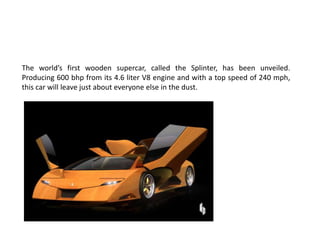
The world’s first wooden supercar, called the Splinter, has been unveiled.
Producing 600 bhp from its 4.6 liter V8 engine and with a top speed of 240 mph,
this car will leave just about everyone else in the dust.
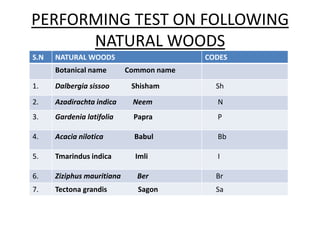
PERFORMING TEST ON FOLLOWING
NATURAL WOODS
S.N NATURAL WOODS CODES
Botanical name Common name
1. Dalbergia sissoo Shisham Sh
2. Azadirachta indica Neem N
3. Gardenia latifolia Papra P
4. Acacia nilotica Babul Bb
5. Tmarindus indica Imli I
6. Ziziphus mauritiana Ber Br
7. Tectona grandis Sagon Sa
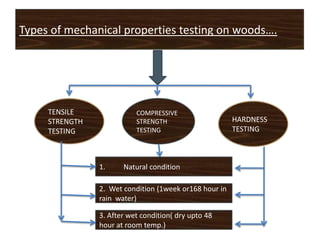
Types of mechanical properties testing on woods….
COMPRESSIVE
STRENGTH
TESTING
HARDNESS
TESTING
TENSILE
STRENGTH
TESTING
2. Wet condition (1week or168 hour in
rain water)
3. After wet condition( dry upto 48
hour at room temp.)
1. Natural condition
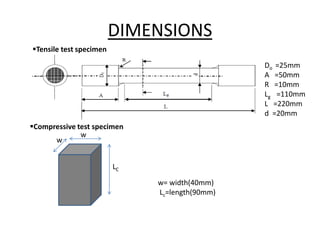
DIMENSIONS
Do =25mm
A =50mm
R =10mm
Lg =110mm
L =220mm
d =20mm
w
w
LC
w= width(40mm)
Lc=length(90mm)
Tensile test specimen
Compressive test specimen
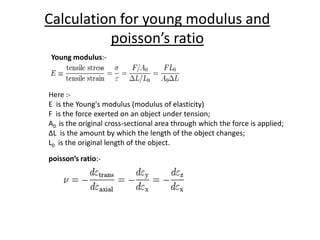
Calculation for young modulus and
poisson’s ratio
Here :-
E is the Young's modulus (modulus of elasticity)
F is the force exerted on an object under tension;
A0 is the original cross-sectional area through which the force is applied;
ΔL is the amount by which the length of the object changes;
L0 is the original length of the object.
Young modulus:-
poisson’s ratio:-
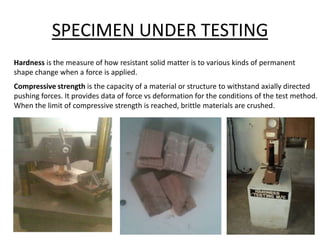
SPECIMEN UNDER TESTING
Hardness is the measure of how resistant solid matter is to various kinds of permanent
shape change when a force is applied.
Compressive strength is the capacity of a material or structure to withstand axially directed
pushing forces. It provides data of force vs deformation for the conditions of the test method.
When the limit of compressive strength is reached, brittle materials are crushed.
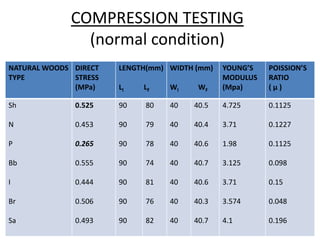
COMPRESSION TESTING
(normal condition)
NATURAL WOODS
TYPE
DIRECT
STRESS
(MPa)
LENGTH(mm)
LI LF
WIDTH (mm)
WI WF
YOUNG’S
MODULUS
(Mpa)
POISSION’S
RATIO
( μ )
Sh
N
P
Bb
I
Br
Sa
0.525
0.453
0.265
0.555
0.444
0.506
0.493
90
90
90
90
90
90
90
80
79
78
74
81
76
82
40
40
40
40
40
40
40
40.5
40.4
40.6
40.7
40.6
40.3
40.7
4.725
3.71
1.98
3.125
3.71
3.574
4.1
0.1125
0.1227
0.1125
0.098
0.15
0.048
0.196
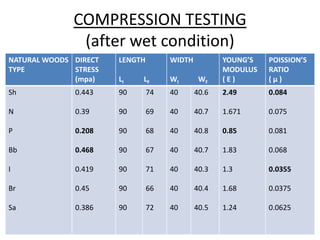
COMPRESSION TESTING
(after wet condition)
NATURAL WOODS
TYPE
DIRECT
STRESS
(mpa)
LENGTH
LI LF
WIDTH
WI WF
YOUNG’S
MODULUS
( E )
POISSION’S
RATIO
( μ )
Sh
N
P
Bb
I
Br
Sa
0.443
0.39
0.208
0.468
0.419
0.45
0.386
90
90
90
90
90
90
90
74
69
68
67
71
66
72
40
40
40
40
40
40
40
40.6
40.7
40.8
40.7
40.3
40.4
40.5
2.49
1.671
0.85
1.83
1.3
1.68
1.24
0.084
0.075
0.081
0.068
0.0355
0.0375
0.0625
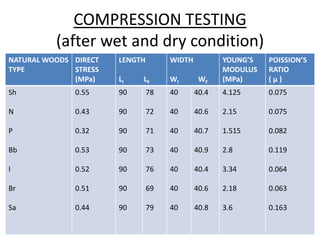
COMPRESSION TESTING
(after wet and dry condition)
NATURAL WOODS
TYPE
DIRECT
STRESS
(MPa)
LENGTH
LI LF
WIDTH
WI WF
YOUNG’S
MODULUS
(MPa)
POISSION’S
RATIO
( μ )
Sh
N
P
Bb
I
Br
Sa
0.55
0.43
0.32
0.53
0.52
0.51
0.44
90
90
90
90
90
90
90
78
72
71
73
76
69
79
40
40
40
40
40
40
40
40.4
40.6
40.7
40.9
40.4
40.6
40.8
4.125
2.15
1.515
2.8
3.34
2.18
3.6
0.075
0.075
0.082
0.119
0.064
0.063
0.163
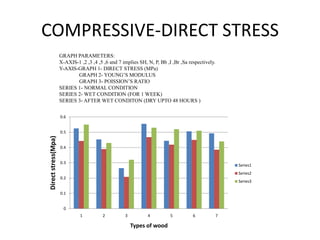
COMPRESSIVE-DIRECT STRESS
0
0.1
0.2
0.3
0.4
0.5
0.6
1 2 3 4 5 6 7
Directstress(Mpa)
Types of wood
Series1
Series2
Series3
GRAPH PARAMETERS:
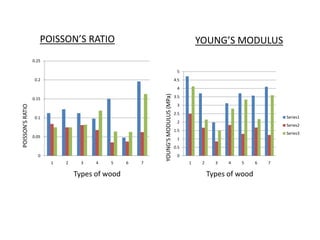
X-AXIS-1 ,2 ,3 ,4 ,5 ,6 and 7 implies SH, N, P, Bb ,I ,Br ,Sa respectively.
Y-AXIS-GRAPH 1- DIRECT STRESS (MPa)
GRAPH 2- YOUNG’S MODULUS
GRAPH 3- POISSION’S RATIO
SERIES 1- NORMAL CONDITION
SERIES 2- WET CONDITION (FOR 1 WEEK)
SERIES 3- AFTER WET CONDITON (DRY UPTO 48 HOURS )
POISSON’S RATIO
0
0.05
0.1
0.15
0.2
0.25
1 2 3 4 5 6 7
POISSON’SRATIO
Types of wood
0
0.5
1
1.5
2
2.5
3
3.5
4
4.5
5
1 2 3 4 5 6 7
YOUNG’SMODULUS(MPa)
Types of wood
Series1
Series2
Series3
YOUNG’S MODULUS
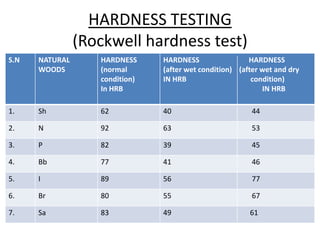
HARDNESS TESTING
(Rockwell hardness test)
S.N NATURAL
WOODS
HARDNESS
(normal
condition)
In HRB
HARDNESS HARDNESS
(after wet condition) (after wet and dry
IN HRB condition)
IN HRB
1. Sh 62 40 44
2. N 92 63 53
3. P 82 39 45
4. Bb 77 41 46
5. I 89 56 77
6. Br 80 55 67
7. Sa 83 49 61
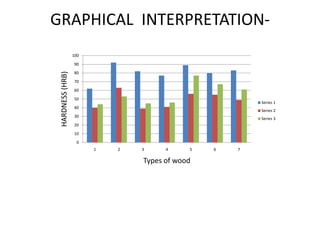
GRAPHICAL INTERPRETATION-
0
10
20
30
40
50
60
70
80
90
100
1 2 3 4 5 6 7
HARDNESS(HRB)
Types of wood
Series 1
Series 2
Series 3
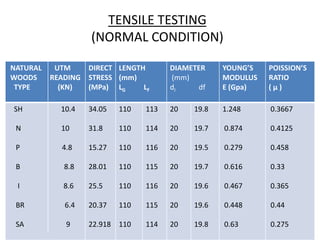
TENSILE TESTING
(NORMAL CONDITION)
NATURAL UTM
WOODS READING
TYPE (KN)
DIRECT
STRESS
(MPa)
LENGTH
(mm)
LG LF
DIAMETER
(mm)
dI df
YOUNG’S
MODULUS
E (Gpa)
POISSION’S
RATIO
( μ )
SH 10.4
N 10
P 4.8
B 8.8
I 8.6
BR 6.4
SA 9
34.05
31.8
15.27
28.01
25.5
20.37
22.918
110
110
110
110
110
110
110
113
114
116
115
116
115
114
20
20
20
20
20
20
20
19.8
19.7
19.5
19.7
19.6
19.6
19.8
1.248
0.874
0.279
0.616
0.467
0.448
0.63
0.3667
0.4125
0.458
0.33
0.365
0.44
0.275
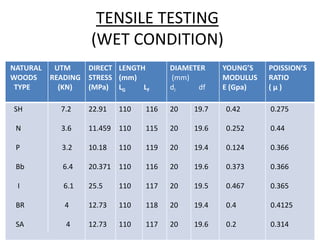
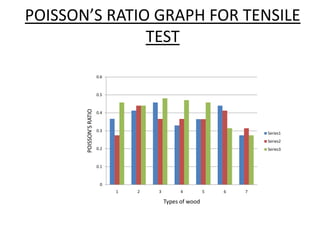
TENSILE TESTING
(WET CONDITION)
NATURAL UTM
WOODS READING
TYPE (KN)
DIRECT
STRESS
(MPa)
LENGTH
(mm)
LG LF
DIAMETER
(mm)
dI df
YOUNG’S
MODULUS
E (Gpa)
POISSION’S
RATIO
( μ )
SH 7.2
N 3.6
P 3.2
Bb 6.4
I 6.1
BR 4
SA 4
22.91
11.459
10.18
20.371
25.5
12.73
12.73
110
110
110
110
110
110
110
116
115
119
116
117
118
117
20
20
20
20
20
20
20
19.7
19.6
19.4
19.6
19.5
19.4
19.6
0.42
0.252
0.124
0.373
0.467
0.4
0.2
0.275
0.44
0.366
0.366
0.365
0.4125
0.314
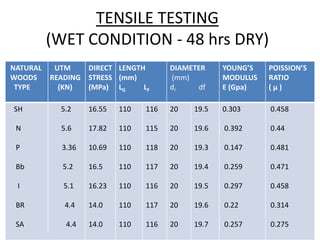
TENSILE TESTING
(WET CONDITION - 48 hrs DRY)
NATURAL UTM
WOODS READING
TYPE (KN)
DIRECT
STRESS
(MPa)
LENGTH
(mm)
LG LF
DIAMETER
(mm)
dI df
YOUNG’S
MODULUS
E (Gpa)
POISSION’S
RATIO
( μ )
SH 5.2
N 5.6
P 3.36
Bb 5.2
I 5.1
BR 4.4
SA 4.4
16.55
17.82
10.69
16.5
16.23
14.0
14.0
110
110
110
110
110
110
110
116
115
118
117
116
117
116
20
20
20
20
20
20
20
19.5
19.6
19.3
19.4
19.5
19.6
19.7
0.303
0.392
0.147
0.259
0.297
0.22
0.257
0.458
0.44
0.481
0.471
0.458
0.314
0.275
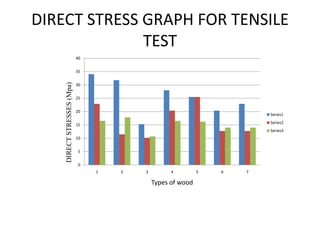
DIRECT STRESS GRAPH FOR TENSILE
TEST
0
5
10
15
20
25
30
35
40
1 2 3 4 5 6 7
DIRECTSTRESSES(Mpa)
Types of wood
Series1
Series2
Series3
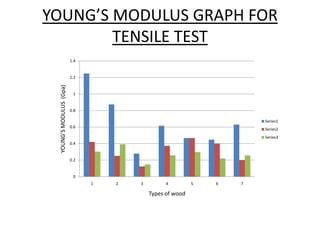
YOUNG’S MODULUS GRAPH FOR
TENSILE TEST
0
0.2
0.4
0.6
0.8
1
1.2
1.4
1 2 3 4 5 6 7
YOUNG’SMODULUS(Gpa)
Types of wood
Series1
Series2
Series3
POISSON’S RATIO GRAPH FOR TENSILE
TEST
0
0.1
0.2
0.3
0.4
0.5
0.6
1 2 3 4 5 6 7
POISSON’SRATIO
Types of wood
Series1
Series2
Series3
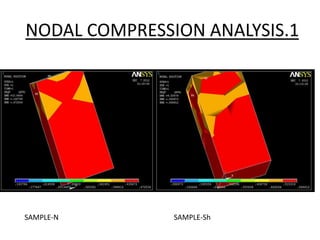
NODAL COMPRESSION ANALYSIS.1
SAMPLE-N SAMPLE-Sh
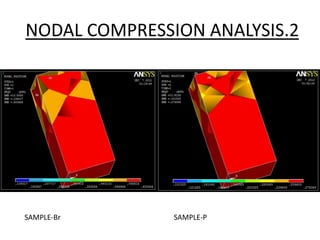
NODAL COMPRESSION ANALYSIS.2
SAMPLE-Br SAMPLE-P
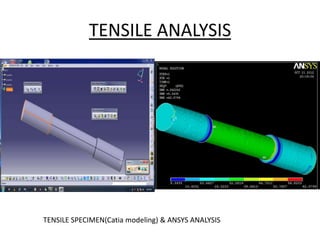
TENSILE ANALYSIS
TENSILE SPECIMEN(Catia modeling) & ANSYS ANALYSIS
Result and discussion for natural wood
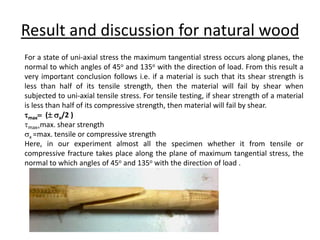
For a state of uni-axial stress the maximum tangential stress occurs along planes, the
normal to which angles of 45o and 135o with the direction of load. From this result a
very important conclusion follows i.e. if a material is such that its shear strength is
less than half of its tensile strength, then the material will fail by shear when
subjected to uni-axial tensile stress. For tensile testing, if shear strength of a material
is less than half of its compressive strength, then material will fail by shear.
max ( x/2 )
max=max. shear strength
x =max. tensile or compressive strength
Here, in our experiment almost all the specimen whether it from tensile or
compressive fracture takes place along the plane of maximum tangential stress, the
normal to which angles of 45o and 135o with the direction of load .
• As, we have seen (from table of tensile testing in normal condition ) the load
sustaining capacity is best for Sh (sheesham wood) among all the natural wood that we
have used in our investigation. Therefore, general perception for strength of
SHEESHAM wood should be right in normal condition loading.
• From the table , wet condition Sh is the best,and P (papri wood ) is the lowest
strength. Therefore, at normal condition SHEESHAM wood generally prefer and PAPRI
wood should be avoided where mechanical application is concern like wood under the
compression load.
• But if we see, table (dried for 48 hours after wet condition )when woods are dried
upto 48 hours at room temperature after wet condition, load sustaining capacity is best
for N ( NEEM ) as compared to Sh.
• Where NEEM was the second best option for tensile loading in normal condition.
• Therefore here we reached a final conclusion which may violate general perception of
peoples. That “SHEESHAM wood is always best among these woods”.
• That’s mean NEEM has good recovery than SHEESHAM wood when dried for some
time after wet condition. So, NEEM should be preferable than SHEESHAM for load
sustaining capacity. Therefore, in highly wet places in India like
CHERRAPUNJEE, SHIMLA, MEGHALAYA where the rain fall level is high NEEM should be
prefer for construction works.
•For furniture ,roof,liners,door works NEEM wood should be preferable.
Here, experimental Study shows NEEM is the maximum hard wood among all the
woods that we have taken. And SHEESHAM wood should be avoided because of
showing minimum hardness.
THEORY OF COMPOSITES
 Composites materials can be defined as engineered materials which exist as a
combination of two or more materials that result in better properties than when the
individual components are used alone.
 Composites consist of a discontinuous phase known as reinforcement and a continuous
phase known as matrix. In practice, most composites consist of a bulk material (the
„matrix‟), and a reinforcement of some kind, added primarily to increase the strength
and stiffness of the matrix.
 Matrix Phase
 Reinforcement
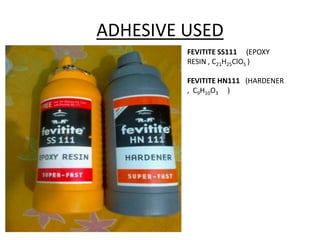
ADHESIVE USED
FEVITITE SS111 (EPOXY
RESIN , C21H25ClO5 )
FEVITITE HN111 (HARDENER
, C9H10O3 )
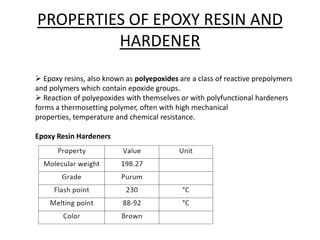
PROPERTIES OF EPOXY RESIN AND
HARDENER
 Epoxy resins, also known as polyepoxides are a class of reactive prepolymers
and polymers which contain epoxide groups.
 Reaction of polyepoxides with themselves or with polyfunctional hardeners
forms a thermosetting polymer, often with high mechanical
properties, temperature and chemical resistance.
Epoxy Resin Hardeners
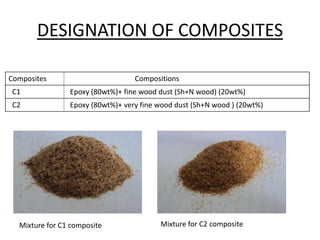
DESIGNATION OF COMPOSITES
Composites Compositions
C1 Epoxy (80wt%)+ fine wood dust (Sh+N wood) (20wt%)
C2 Epoxy (80wt%)+ very fine wood dust (Sh+N wood ) (20wt%)
Mixture for C1 composite Mixture for C2 composite
PROCEDURE
The epoxy resin and the hardener are supplied by PIDILITE INDUSTRIES Ltd. The
fabrication of the composites is carried out through the hand lay-up technique. The low
temperature curing epoxy resin (FEVITITE SS111) and corresponding hardener (HN111)
are mixed in a ratio of 10:1 by weight as recommended.
 Two different types of composites have been fabricated with two different types of
wood dust such as SH and N wood. Each composite consisting of 20wt.% of wood dust
and 80wt % of epoxy resin. The designations of these composites are given in Table
above. The mix is stirred manually to disperse the fibres in the matrix.
 The cast of each composite is cured under a load of about 1KN for 24 hours before it
removed from the mould. Then this cast is post cured in the air for another 24 hours
after removing out of the mould.
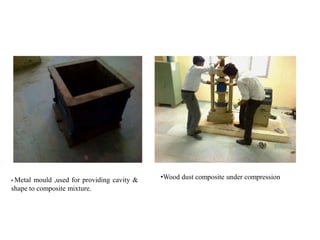
• Metal mould ,used for providing cavity &
shape to composite mixture.
•Wood dust composite under compression
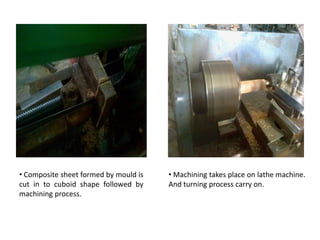
• Composite sheet formed by mould is
cut in to cuboid shape followed by
machining process.
• Machining takes place on lathe machine.
And turning process carry on.
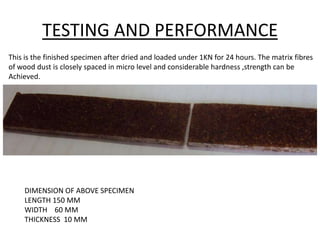
TESTING AND PERFORMANCE
DIMENSION OF ABOVE SPECIMEN
LENGTH 150 MM
WIDTH 60 MM
THICKNESS 10 MM
This is the finished specimen after dried and loaded under 1KN for 24 hours. The matrix fibres
of wood dust is closely spaced in micro level and considerable hardness ,strength can be
Achieved.
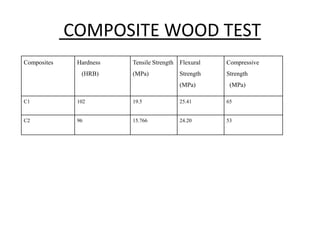
COMPOSITE WOOD TEST
Composites Hardness
(HRB)
Tensile Strength
(MPa)
Flexural
Strength
(MPa)
Compressive
Strength
(MPa)
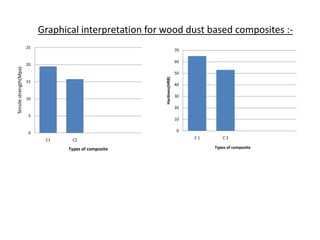
C1 102 19.5 25.41 65
C2 96 15.766 24.20 53
0
5
10
15
20
25
C1 C2
Tensilestrength(Mpa)
Types of composite
0
10
20
30
40
50
60
70
C 1 C 2
Hardness(HRB)
Types of composite
Graphical interpretation for wood dust based composites :-
conclusion
•With the help of experimental data, application of the different natural wood can be
govern in different circumstances. Like dry, wetted, places of country.
•Application like automobile, constructions, fabrication of model
prototype, structures, buildings and trusses can be determined from the data
provided above.
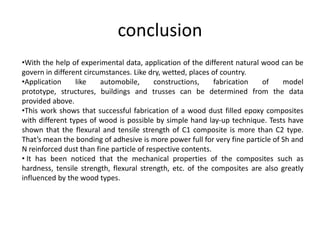
•This work shows that successful fabrication of a wood dust filled epoxy composites
with different types of wood is possible by simple hand lay-up technique. Tests have
shown that the flexural and tensile strength of C1 composite is more than C2 type.
That’s mean the bonding of adhesive is more power full for very fine particle of Sh and
N reinforced dust than fine particle of respective contents.
• It has been noticed that the mechanical properties of the composites such as
hardness, tensile strength, flexural strength, etc. of the composites are also greatly
influenced by the wood types.

INVESTIGATION OF MECHANICAL PROPERTIES OF NATURAL AND COMPOSITE WOODS

  • 1.
    INVESTIGATION OF MECHANICAL PROPERTIESOF NATURAL AND COMPOSITE WOODS PRESENTED BY; VIVEK GUPTA VIVEK KUMAR NISHAD SHIVA SINGH YADAV UDAY PRATAP CHAUHAN Under The Guidance of:- KUWAR MAUSAM SHASHANK SRIVASTAVA Department of Mechanical Engineering GLA UNIVERSITY,MATHURA
  • 2.
    INTRODUCTION … Wood andwood products are among important construction materials. More recently, designers have learned to design wood structures in ways that are based on engineering principles. In doing this, a structural designer must be familiar with the properties and behavior of the material. The properties and behavior of wood are unlike those for other materials and much more complex by considering their organic structure. In this study, compressive, hardness and tensile tests were performed in order to examine the mechanical behaviors of natural and composite woods. In doing this, wood is considered as a transversely isotropic fiber composite material. The direct-stress, Young’s modulus and poisson’s ratio were calculated and examined in order to show their behavior in different conditions.
  • 3.
    The world’s firstwooden supercar, called the Splinter, has been unveiled. Producing 600 bhp from its 4.6 liter V8 engine and with a top speed of 240 mph, this car will leave just about everyone else in the dust.
  • 4.
    PERFORMING TEST ONFOLLOWING NATURAL WOODS S.N NATURAL WOODS CODES Botanical name Common name 1. Dalbergia sissoo Shisham Sh 2. Azadirachta indica Neem N 3. Gardenia latifolia Papra P 4. Acacia nilotica Babul Bb 5. Tmarindus indica Imli I 6. Ziziphus mauritiana Ber Br 7. Tectona grandis Sagon Sa
  • 5.
    Types of mechanicalproperties testing on woods…. COMPRESSIVE STRENGTH TESTING HARDNESS TESTING TENSILE STRENGTH TESTING 2. Wet condition (1week or168 hour in rain water) 3. After wet condition( dry upto 48 hour at room temp.) 1. Natural condition
  • 6.
    DIMENSIONS Do =25mm A =50mm R=10mm Lg =110mm L =220mm d =20mm w w LC w= width(40mm) Lc=length(90mm) Tensile test specimen Compressive test specimen
  • 7.
    Calculation for youngmodulus and poisson’s ratio Here :- E is the Young's modulus (modulus of elasticity) F is the force exerted on an object under tension; A0 is the original cross-sectional area through which the force is applied; ΔL is the amount by which the length of the object changes; L0 is the original length of the object. Young modulus:- poisson’s ratio:-
  • 8.
    SPECIMEN UNDER TESTING Hardnessis the measure of how resistant solid matter is to various kinds of permanent shape change when a force is applied. Compressive strength is the capacity of a material or structure to withstand axially directed pushing forces. It provides data of force vs deformation for the conditions of the test method. When the limit of compressive strength is reached, brittle materials are crushed.
  • 9.
    COMPRESSION TESTING (normal condition) NATURALWOODS TYPE DIRECT STRESS (MPa) LENGTH(mm) LI LF WIDTH (mm) WI WF YOUNG’S MODULUS (Mpa) POISSION’S RATIO ( μ ) Sh N P Bb I Br Sa 0.525 0.453 0.265 0.555 0.444 0.506 0.493 90 90 90 90 90 90 90 80 79 78 74 81 76 82 40 40 40 40 40 40 40 40.5 40.4 40.6 40.7 40.6 40.3 40.7 4.725 3.71 1.98 3.125 3.71 3.574 4.1 0.1125 0.1227 0.1125 0.098 0.15 0.048 0.196
  • 10.
    COMPRESSION TESTING (after wetcondition) NATURAL WOODS TYPE DIRECT STRESS (mpa) LENGTH LI LF WIDTH WI WF YOUNG’S MODULUS ( E ) POISSION’S RATIO ( μ ) Sh N P Bb I Br Sa 0.443 0.39 0.208 0.468 0.419 0.45 0.386 90 90 90 90 90 90 90 74 69 68 67 71 66 72 40 40 40 40 40 40 40 40.6 40.7 40.8 40.7 40.3 40.4 40.5 2.49 1.671 0.85 1.83 1.3 1.68 1.24 0.084 0.075 0.081 0.068 0.0355 0.0375 0.0625
  • 11.
    COMPRESSION TESTING (after wetand dry condition) NATURAL WOODS TYPE DIRECT STRESS (MPa) LENGTH LI LF WIDTH WI WF YOUNG’S MODULUS (MPa) POISSION’S RATIO ( μ ) Sh N P Bb I Br Sa 0.55 0.43 0.32 0.53 0.52 0.51 0.44 90 90 90 90 90 90 90 78 72 71 73 76 69 79 40 40 40 40 40 40 40 40.4 40.6 40.7 40.9 40.4 40.6 40.8 4.125 2.15 1.515 2.8 3.34 2.18 3.6 0.075 0.075 0.082 0.119 0.064 0.063 0.163
  • 12.
    COMPRESSIVE-DIRECT STRESS 0 0.1 0.2 0.3 0.4 0.5 0.6 1 23 4 5 6 7 Directstress(Mpa) Types of wood Series1 Series2 Series3 GRAPH PARAMETERS: X-AXIS-1 ,2 ,3 ,4 ,5 ,6 and 7 implies SH, N, P, Bb ,I ,Br ,Sa respectively. Y-AXIS-GRAPH 1- DIRECT STRESS (MPa) GRAPH 2- YOUNG’S MODULUS GRAPH 3- POISSION’S RATIO SERIES 1- NORMAL CONDITION SERIES 2- WET CONDITION (FOR 1 WEEK) SERIES 3- AFTER WET CONDITON (DRY UPTO 48 HOURS )
  • 13.
    POISSON’S RATIO 0 0.05 0.1 0.15 0.2 0.25 1 23 4 5 6 7 POISSON’SRATIO Types of wood 0 0.5 1 1.5 2 2.5 3 3.5 4 4.5 5 1 2 3 4 5 6 7 YOUNG’SMODULUS(MPa) Types of wood Series1 Series2 Series3 YOUNG’S MODULUS
  • 14.
    HARDNESS TESTING (Rockwell hardnesstest) S.N NATURAL WOODS HARDNESS (normal condition) In HRB HARDNESS HARDNESS (after wet condition) (after wet and dry IN HRB condition) IN HRB 1. Sh 62 40 44 2. N 92 63 53 3. P 82 39 45 4. Bb 77 41 46 5. I 89 56 77 6. Br 80 55 67 7. Sa 83 49 61
  • 15.
    GRAPHICAL INTERPRETATION- 0 10 20 30 40 50 60 70 80 90 100 1 23 4 5 6 7 HARDNESS(HRB) Types of wood Series 1 Series 2 Series 3
  • 16.
    TENSILE TESTING (NORMAL CONDITION) NATURALUTM WOODS READING TYPE (KN) DIRECT STRESS (MPa) LENGTH (mm) LG LF DIAMETER (mm) dI df YOUNG’S MODULUS E (Gpa) POISSION’S RATIO ( μ ) SH 10.4 N 10 P 4.8 B 8.8 I 8.6 BR 6.4 SA 9 34.05 31.8 15.27 28.01 25.5 20.37 22.918 110 110 110 110 110 110 110 113 114 116 115 116 115 114 20 20 20 20 20 20 20 19.8 19.7 19.5 19.7 19.6 19.6 19.8 1.248 0.874 0.279 0.616 0.467 0.448 0.63 0.3667 0.4125 0.458 0.33 0.365 0.44 0.275
  • 17.
    TENSILE TESTING (WET CONDITION) NATURALUTM WOODS READING TYPE (KN) DIRECT STRESS (MPa) LENGTH (mm) LG LF DIAMETER (mm) dI df YOUNG’S MODULUS E (Gpa) POISSION’S RATIO ( μ ) SH 7.2 N 3.6 P 3.2 Bb 6.4 I 6.1 BR 4 SA 4 22.91 11.459 10.18 20.371 25.5 12.73 12.73 110 110 110 110 110 110 110 116 115 119 116 117 118 117 20 20 20 20 20 20 20 19.7 19.6 19.4 19.6 19.5 19.4 19.6 0.42 0.252 0.124 0.373 0.467 0.4 0.2 0.275 0.44 0.366 0.366 0.365 0.4125 0.314
  • 18.
    TENSILE TESTING (WET CONDITION- 48 hrs DRY) NATURAL UTM WOODS READING TYPE (KN) DIRECT STRESS (MPa) LENGTH (mm) LG LF DIAMETER (mm) dI df YOUNG’S MODULUS E (Gpa) POISSION’S RATIO ( μ ) SH 5.2 N 5.6 P 3.36 Bb 5.2 I 5.1 BR 4.4 SA 4.4 16.55 17.82 10.69 16.5 16.23 14.0 14.0 110 110 110 110 110 110 110 116 115 118 117 116 117 116 20 20 20 20 20 20 20 19.5 19.6 19.3 19.4 19.5 19.6 19.7 0.303 0.392 0.147 0.259 0.297 0.22 0.257 0.458 0.44 0.481 0.471 0.458 0.314 0.275
  • 19.
    DIRECT STRESS GRAPHFOR TENSILE TEST 0 5 10 15 20 25 30 35 40 1 2 3 4 5 6 7 DIRECTSTRESSES(Mpa) Types of wood Series1 Series2 Series3
  • 20.
    YOUNG’S MODULUS GRAPHFOR TENSILE TEST 0 0.2 0.4 0.6 0.8 1 1.2 1.4 1 2 3 4 5 6 7 YOUNG’SMODULUS(Gpa) Types of wood Series1 Series2 Series3
  • 21.
    POISSON’S RATIO GRAPHFOR TENSILE TEST 0 0.1 0.2 0.3 0.4 0.5 0.6 1 2 3 4 5 6 7 POISSON’SRATIO Types of wood Series1 Series2 Series3
  • 22.
  • 23.
  • 24.
    TENSILE ANALYSIS TENSILE SPECIMEN(Catiamodeling) & ANSYS ANALYSIS
  • 25.
    Result and discussionfor natural wood For a state of uni-axial stress the maximum tangential stress occurs along planes, the normal to which angles of 45o and 135o with the direction of load. From this result a very important conclusion follows i.e. if a material is such that its shear strength is less than half of its tensile strength, then the material will fail by shear when subjected to uni-axial tensile stress. For tensile testing, if shear strength of a material is less than half of its compressive strength, then material will fail by shear. max ( x/2 ) max=max. shear strength x =max. tensile or compressive strength Here, in our experiment almost all the specimen whether it from tensile or compressive fracture takes place along the plane of maximum tangential stress, the normal to which angles of 45o and 135o with the direction of load .
  • 26.
    • As, wehave seen (from table of tensile testing in normal condition ) the load sustaining capacity is best for Sh (sheesham wood) among all the natural wood that we have used in our investigation. Therefore, general perception for strength of SHEESHAM wood should be right in normal condition loading. • From the table , wet condition Sh is the best,and P (papri wood ) is the lowest strength. Therefore, at normal condition SHEESHAM wood generally prefer and PAPRI wood should be avoided where mechanical application is concern like wood under the compression load. • But if we see, table (dried for 48 hours after wet condition )when woods are dried upto 48 hours at room temperature after wet condition, load sustaining capacity is best for N ( NEEM ) as compared to Sh. • Where NEEM was the second best option for tensile loading in normal condition. • Therefore here we reached a final conclusion which may violate general perception of peoples. That “SHEESHAM wood is always best among these woods”. • That’s mean NEEM has good recovery than SHEESHAM wood when dried for some time after wet condition. So, NEEM should be preferable than SHEESHAM for load sustaining capacity. Therefore, in highly wet places in India like CHERRAPUNJEE, SHIMLA, MEGHALAYA where the rain fall level is high NEEM should be prefer for construction works.
  • 27.
    •For furniture ,roof,liners,doorworks NEEM wood should be preferable. Here, experimental Study shows NEEM is the maximum hard wood among all the woods that we have taken. And SHEESHAM wood should be avoided because of showing minimum hardness.
  • 28.
    THEORY OF COMPOSITES Composites materials can be defined as engineered materials which exist as a combination of two or more materials that result in better properties than when the individual components are used alone.  Composites consist of a discontinuous phase known as reinforcement and a continuous phase known as matrix. In practice, most composites consist of a bulk material (the „matrix‟), and a reinforcement of some kind, added primarily to increase the strength and stiffness of the matrix.  Matrix Phase  Reinforcement
  • 29.
    ADHESIVE USED FEVITITE SS111(EPOXY RESIN , C21H25ClO5 ) FEVITITE HN111 (HARDENER , C9H10O3 )
  • 30.
    PROPERTIES OF EPOXYRESIN AND HARDENER  Epoxy resins, also known as polyepoxides are a class of reactive prepolymers and polymers which contain epoxide groups.  Reaction of polyepoxides with themselves or with polyfunctional hardeners forms a thermosetting polymer, often with high mechanical properties, temperature and chemical resistance. Epoxy Resin Hardeners
  • 31.
    DESIGNATION OF COMPOSITES CompositesCompositions C1 Epoxy (80wt%)+ fine wood dust (Sh+N wood) (20wt%) C2 Epoxy (80wt%)+ very fine wood dust (Sh+N wood ) (20wt%) Mixture for C1 composite Mixture for C2 composite
  • 32.
    PROCEDURE The epoxy resinand the hardener are supplied by PIDILITE INDUSTRIES Ltd. The fabrication of the composites is carried out through the hand lay-up technique. The low temperature curing epoxy resin (FEVITITE SS111) and corresponding hardener (HN111) are mixed in a ratio of 10:1 by weight as recommended.  Two different types of composites have been fabricated with two different types of wood dust such as SH and N wood. Each composite consisting of 20wt.% of wood dust and 80wt % of epoxy resin. The designations of these composites are given in Table above. The mix is stirred manually to disperse the fibres in the matrix.  The cast of each composite is cured under a load of about 1KN for 24 hours before it removed from the mould. Then this cast is post cured in the air for another 24 hours after removing out of the mould.
  • 33.
    • Metal mould,used for providing cavity & shape to composite mixture. •Wood dust composite under compression
  • 34.
    • Composite sheetformed by mould is cut in to cuboid shape followed by machining process. • Machining takes place on lathe machine. And turning process carry on.
  • 35.
    TESTING AND PERFORMANCE DIMENSIONOF ABOVE SPECIMEN LENGTH 150 MM WIDTH 60 MM THICKNESS 10 MM This is the finished specimen after dried and loaded under 1KN for 24 hours. The matrix fibres of wood dust is closely spaced in micro level and considerable hardness ,strength can be Achieved.
  • 36.
    COMPOSITE WOOD TEST CompositesHardness (HRB) Tensile Strength (MPa) Flexural Strength (MPa) Compressive Strength (MPa) C1 102 19.5 25.41 65 C2 96 15.766 24.20 53
  • 37.
    0 5 10 15 20 25 C1 C2 Tensilestrength(Mpa) Types ofcomposite 0 10 20 30 40 50 60 70 C 1 C 2 Hardness(HRB) Types of composite Graphical interpretation for wood dust based composites :-
  • 38.
    conclusion •With the helpof experimental data, application of the different natural wood can be govern in different circumstances. Like dry, wetted, places of country. •Application like automobile, constructions, fabrication of model prototype, structures, buildings and trusses can be determined from the data provided above. •This work shows that successful fabrication of a wood dust filled epoxy composites with different types of wood is possible by simple hand lay-up technique. Tests have shown that the flexural and tensile strength of C1 composite is more than C2 type. That’s mean the bonding of adhesive is more power full for very fine particle of Sh and N reinforced dust than fine particle of respective contents. • It has been noticed that the mechanical properties of the composites such as hardness, tensile strength, flexural strength, etc. of the composites are also greatly influenced by the wood types.