Identity-Based Secure Distributed Data Storage Schemes
PRESENTED BY INTERNAL GUIDE:
VENKATESH DEVAM 1CR10CS112 Ms. MANIMOZHI
Assoc. Professor(CSE)
Department of Computer Science & Engineering
AGENDA
 Abstract
 Introduction
 Existing System
 Objective
 Proposed System
 Literature Survey
 System Requirements
 System Design
 Data flow diagram
 Class diagram
 Sequence diagram
 Testing
 Result and performance evaluation
 Conclusion and future work
 References
ABSTRACT
 Identity-based secure distributed data storage (IBSDDS) schemes is for distributed
data.
 Our schemes can capture the following properties:
 The file owner can decide the access permission independently without the help of the
private key generator (PKG)
 For one query, a receiver can only access one file, instead of all files of the owner
 Our schemes are secure against the collusion attacks, namely even if the receiver can
compromise the proxy servers, he cannot obtain the owner’s secret key.
INTRODUCTION
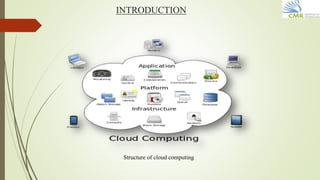
Structure of cloud computing
SERVICES MODELS
 Cloud Computing comprises of three different service models, namely Infrastructure-as-
a-Service (IaaS), Platform-as-a-Service (PaaS), and Software-as-a-Service (SaaS).
 A cloud user can access services on the infrastructure layer, for instance, users can run
their applications and is responsible for the support and maintenance.
 User can access a service on the application layer, these tasks are normally taken care of
by the cloud service provider.
EXISTING SYSTEM
 Cloud computing provides users with a convenient mechanism to manage their personal
files with the notion called database-as-a-service (DAS).
 In DATABASE AS A SERVICE(DAS) schemes, a user can outsource his encrypted files
to untrusted proxy servers.
 Proxy servers can perform some functions on the outsourced ciphertexts without
knowing anything about the original files.
DISADVANTAGES OF EXISTING SYSTEM
 Users are especially concerned on the confidentiality, integrity and query of the outsourced
files.
 Cloud computing is a lot more complicated than the local data storage systems, as the cloud
is managed by an untrusted third party.
 The outsourced files are accessed by the unauthorized users.
OBJECTIVE OF THE PROJECT
 To provide confidentiality for the outsourced data, an efficient IBSDDS scheme should
provide the following properties:
• Unidirectional
• Non-interactive
• Collusion-safe
• Non-transitive
• File based access
PROPOSED SYSTEM
 There are two identity-based secure distributed data storage (IBSDDS) schemes in standard model
where,
 For one query, the receiver can access only one of the owner’s files, instead of all files.
 An access permission (re-encryption key) is bound not only to the identity of the receiver but
also the file.
ADVANTAGES OF PROPOSED SYSTEM
 It has two schemes of security:
 the first scheme is CPA(CHOOSEN PLAINTEXT ATTACK) secure,
 the second scheme achieves CCA (CHOOSEN CYPHERTEXT ATTACK) security.
 It is the first IBSDDS schemes where an access permission is made by the owner for an
exact file.
 Collusion attacks can be protected in the standard model.
LITERATURE SURVEY
 Chip-secured data access: Confidential data on untrusted servers(2011), L. Bouganim and P.
Pucheral
 It provides a solution which enforces data confidentiality and controls personal
privileges.
 How to build a trusted database system on untrusted storage(2009),U. Maheshwari, R.
Vingralek, and W. Shapiro
 The database is encrypted and validated against a collision-resistant hash kept in
trusted storage.
 Efficient and private access to outsourced data,S. D. C. di Vimercati, S. Foresti, S.
Paraboschi, G. Pelosi, P.Samarati(2012)
 A technique for guaranteeing content, access, and pattern confidentiality in the
data outsourcing scenario with limited performance.
HARDWARE REQUIREMENTS
 Processor - Pentium –IV
 Speed - 1.1 Ghz
 RAM - 256 MB(min)
 Hard Disk - 20 GB
 Key Board - Standard Windows Keyboard
 Mouse - Two or Three Button Mouse
 Monitor - SVGA
SOFTWARE REQUIREMENTS
 Operating System : Windows XP
 Programming Language : JAVA
 Java Version : JDK 1.6 & above.
 IDE : NETBEANS
 Database : SQL
SYSTEM DESIGN
ALGORITHM-TRIPLE DES
Triple DES uses a "key bundle" that comprises three DES keys, K1, K2 and K3, each of 56 bits
(excluding parity bits).
The encryption algorithm is:
cipher text = EK3(DK2(EK1(plain text)))
i.e., DES encrypt with K1, DES decrypt with K2, then DES encrypt with K3.
Decryption is the reverse:
plaintext = DK1(EK2(DK3(cipher text)))
I.e., decrypt with K3, encrypt with K2, then decrypt with K1.
Each triple encryption encrypts one block of 64 bits of data.In each case the middle operation is the
reverse of the first and last. This improves the strength of the algorithm when using keying option 2,
and provide backward compatibility with DES with keying option 3..
TRIPLE DES –KEYING OPTION
 The standards define three keying options:
 Keying option 1: All three keys are independent.
 Keying option 2: K1 and K2 are independent, and K3 = K1.
 Keying option 3: All three keys are identical, i.e. K1 = K2 = K3.
 Keying option 1 is the strongest, with 3 × 56 = 168 independent key bits.
 Keying option 2 provides less security, with 2 × 56 = 112 key bits. This option is stronger
than simply DES encrypting twice, e.g. with K1 and K2, because it protects against meet-
in-the-middle attacks.
 Keying option 3 is equivalent to DES, with only 56 key bits. This option provides
backward compatibility with DES, because the first and second DES operations cancel
out.
DATA OWNER
 In this module, first the new data owner registers and then get a valid login credentials.
 After logged in, the data owner has the permission to upload their file into the Cloud Server.
 The data owner encrypts his data and outsources the cipher texts to the proxy servers.
PRIVATE KEY GENERATOR
 In this module, the private key generator (PKG) validates the users’ identities and issues
secret keys to them.
 The key is generated and sent to their respective mail id’s with the file name and the
corresponding key values.
PROXY SERVER
 Proxy servers store the encrypted data and transfer the cipher text from the
owner to the receiver when they obtain access permission (re-encryption key)
from the owner.
 In these systems, proxy servers are assumed to be trusted. They authenticate
receivers and validate access permissions.
RECEIVER MODULE
 The receiver authenticates himself to the owner and decrypts the re-encrypted Cipher text to
obtain the data.
 An end to-end security is provided by cryptographic protocols which are executed by the file
owner to prevent proxy servers and unauthorized users from modifying and accessing the
sensitive files.
 These systems can be divided into two types:
 shared file system and
 non-shared system.
DATA FLOW DIAGRAM
CLASS DIAGRAM
USE CASE DIAGRAM
SEQUENCE DIAGRAM
TEST CASES FOR LOGIN
Test Case Check Item Test case Objective Steps to Execute Test Data / Input Expected Result
TC-001 Log-in Page
Leave all fields as
blank and click Log-
in button
Click Log-in
By leaving all fields as blank and on
click Log-in button then mandatory
symbol ( * ) should appear in front of
Username and Password fields
TC-002 Username
Enter Invalid
Username
NA
By entering invalid Username then an
error message should appear as " Please
Enter Valid Username "
TC-003 Username Enter valid Username NA It should allow the user to proceed
TC-004 Password NA
The password field should display the
encrypted format of the text typed as
(****)
TC-005 Password
Enter wrong
password
NA Password : ***
By entering invalid password then an
error message should appear as " Please
Enter Correct Password "
TC-006 Password
Enter Correct
password
NA Password : ******* It should allow the user to proceed
TC-007 Log-in button Correct Inputs Click Log-in
It should lead the user to the respect
page
TC-008 Forgot Password
Check hyperlink on
Forgot Password label
while mouse over of the label an hand
icon should display
TC-009 Forgot Password
Click Forgot
Password
User can recover the password using
the “Forgot Password” link page
TC-010 Registration
Check hyperlink on
Registration label
while mouse over of the label an hand
icon should display
TC-011 Registration Click Registration
On click " Registration " page should
redirect to the User Registration page
Test Case CheckItem Test case Objective
Steps to Execute Test Data / Input
Expected Result
TC-012 File Upload
Leave upload file
fields as blank and
click submit button
Click submit File not uploaded
TC-013
Enter file name to
download file
Enter Invalid filename NA File name
By entering invalid
filename then an error
message should appear
as " Incorrect
Filename"
TC-014
Enter file name to
download file
Enter valid Filename NA File name
It should allow the user
to proceed
TC-015
Enter secret key to
download file
Enter Invalid secret
key
NA Secret Key
By entering invalid
secret key then an error
message should appear
as " Incorrect Secret
key"
TC-016
Enter secret key to
download file
Enter valid secret
key
NA Secret key
It should allow the user
to download
TC-017 File Upload Upload correct file Click submit File to upload
File uploaded
successfully
Test Case Check Item Test case Objective Steps to Execute Test Data / Input Expected Result
RESULT AND PERFORMANCE EVALUATION
CONCLUSION & FUTURE SCOPE
 Distributed data storage schemes provide the users with convenience to outsource their files to
untrusted proxy servers.
 Identity-based secure distributed data storage (IBSDDS) schemes are a special kind of
distributed data storage schemes.
 In IBSDDS users are identified by their identities and can communicate without the need of
verifying the public key certificates.
 The future of IBSDDS is very good, as it provides data integrity and confidentiality. The owner
have the full access on sharing of file. It also secures the data from unauthorized access and
collusion attacks.
REFERENCES
 [1] H. Hacig¨um¨us, B. R. Iyer, C. Li, and S. Mehrotra, “Executing SQL over encrypted data in the
database-service-provider model,” in Proceedings: SIGMOD Conference - SIGMOD’02 (M. J.
Franklin, B. Moon, and A. Ailamaki, eds.), vol. 2002, (Madison, Wisconsin, USA), pp. 216–227,
ACM, Jun. 2002.
 [2] L. Bouganim and P. Pucheral, “Chip-secured data access: Confidential data on untrusted servers,”
in Proc. International Conference on Very Large Data Bases - VLDB’02, (Hong Kong, China), pp.
131– 142, Morgan Kaufmann, Aug. 2002.
 [3] U. Maheshwari, R. Vingralek, and W. Shapiro, “How to build a trusted database system on
untrusted storage,” in Proc. Symposium on Operating System Design and Implementation - OSDI’00,
(San Diego, California, USA), pp. 135–150, USENIX, Oct. 2000.
 [4] A. Ivan and Y. Dodis, “Proxy cryptography revisited,” in Proc. Network and Distributed System
Security Symposium - NDSS’03, (San Diego, California, USA), pp. 1–20, The Internet Society, Feb.
2003.
THANK YOU

Identity Based Secure Distributed Storage Scheme

  • 1.
    Identity-Based Secure DistributedData Storage Schemes PRESENTED BY INTERNAL GUIDE: VENKATESH DEVAM 1CR10CS112 Ms. MANIMOZHI Assoc. Professor(CSE) Department of Computer Science & Engineering
  • 2.
    AGENDA  Abstract  Introduction Existing System  Objective  Proposed System  Literature Survey  System Requirements  System Design  Data flow diagram  Class diagram  Sequence diagram  Testing  Result and performance evaluation  Conclusion and future work  References
  • 3.
    ABSTRACT  Identity-based securedistributed data storage (IBSDDS) schemes is for distributed data.  Our schemes can capture the following properties:  The file owner can decide the access permission independently without the help of the private key generator (PKG)  For one query, a receiver can only access one file, instead of all files of the owner  Our schemes are secure against the collusion attacks, namely even if the receiver can compromise the proxy servers, he cannot obtain the owner’s secret key.
  • 4.
  • 5.
    SERVICES MODELS  CloudComputing comprises of three different service models, namely Infrastructure-as- a-Service (IaaS), Platform-as-a-Service (PaaS), and Software-as-a-Service (SaaS).  A cloud user can access services on the infrastructure layer, for instance, users can run their applications and is responsible for the support and maintenance.  User can access a service on the application layer, these tasks are normally taken care of by the cloud service provider.
  • 6.
    EXISTING SYSTEM  Cloudcomputing provides users with a convenient mechanism to manage their personal files with the notion called database-as-a-service (DAS).  In DATABASE AS A SERVICE(DAS) schemes, a user can outsource his encrypted files to untrusted proxy servers.  Proxy servers can perform some functions on the outsourced ciphertexts without knowing anything about the original files.
  • 7.
    DISADVANTAGES OF EXISTINGSYSTEM  Users are especially concerned on the confidentiality, integrity and query of the outsourced files.  Cloud computing is a lot more complicated than the local data storage systems, as the cloud is managed by an untrusted third party.  The outsourced files are accessed by the unauthorized users.
  • 8.
    OBJECTIVE OF THEPROJECT  To provide confidentiality for the outsourced data, an efficient IBSDDS scheme should provide the following properties: • Unidirectional • Non-interactive • Collusion-safe • Non-transitive • File based access
  • 9.
    PROPOSED SYSTEM  Thereare two identity-based secure distributed data storage (IBSDDS) schemes in standard model where,  For one query, the receiver can access only one of the owner’s files, instead of all files.  An access permission (re-encryption key) is bound not only to the identity of the receiver but also the file.
  • 10.
    ADVANTAGES OF PROPOSEDSYSTEM  It has two schemes of security:  the first scheme is CPA(CHOOSEN PLAINTEXT ATTACK) secure,  the second scheme achieves CCA (CHOOSEN CYPHERTEXT ATTACK) security.  It is the first IBSDDS schemes where an access permission is made by the owner for an exact file.  Collusion attacks can be protected in the standard model.
  • 11.
    LITERATURE SURVEY  Chip-secureddata access: Confidential data on untrusted servers(2011), L. Bouganim and P. Pucheral  It provides a solution which enforces data confidentiality and controls personal privileges.  How to build a trusted database system on untrusted storage(2009),U. Maheshwari, R. Vingralek, and W. Shapiro  The database is encrypted and validated against a collision-resistant hash kept in trusted storage.  Efficient and private access to outsourced data,S. D. C. di Vimercati, S. Foresti, S. Paraboschi, G. Pelosi, P.Samarati(2012)  A technique for guaranteeing content, access, and pattern confidentiality in the data outsourcing scenario with limited performance.
  • 12.
    HARDWARE REQUIREMENTS  Processor- Pentium –IV  Speed - 1.1 Ghz  RAM - 256 MB(min)  Hard Disk - 20 GB  Key Board - Standard Windows Keyboard  Mouse - Two or Three Button Mouse  Monitor - SVGA
  • 13.
    SOFTWARE REQUIREMENTS  OperatingSystem : Windows XP  Programming Language : JAVA  Java Version : JDK 1.6 & above.  IDE : NETBEANS  Database : SQL
  • 14.
  • 15.
    ALGORITHM-TRIPLE DES Triple DESuses a "key bundle" that comprises three DES keys, K1, K2 and K3, each of 56 bits (excluding parity bits). The encryption algorithm is: cipher text = EK3(DK2(EK1(plain text))) i.e., DES encrypt with K1, DES decrypt with K2, then DES encrypt with K3. Decryption is the reverse: plaintext = DK1(EK2(DK3(cipher text))) I.e., decrypt with K3, encrypt with K2, then decrypt with K1. Each triple encryption encrypts one block of 64 bits of data.In each case the middle operation is the reverse of the first and last. This improves the strength of the algorithm when using keying option 2, and provide backward compatibility with DES with keying option 3..
  • 16.
    TRIPLE DES –KEYINGOPTION  The standards define three keying options:  Keying option 1: All three keys are independent.  Keying option 2: K1 and K2 are independent, and K3 = K1.  Keying option 3: All three keys are identical, i.e. K1 = K2 = K3.  Keying option 1 is the strongest, with 3 × 56 = 168 independent key bits.  Keying option 2 provides less security, with 2 × 56 = 112 key bits. This option is stronger than simply DES encrypting twice, e.g. with K1 and K2, because it protects against meet- in-the-middle attacks.  Keying option 3 is equivalent to DES, with only 56 key bits. This option provides backward compatibility with DES, because the first and second DES operations cancel out.
  • 17.
    DATA OWNER  Inthis module, first the new data owner registers and then get a valid login credentials.  After logged in, the data owner has the permission to upload their file into the Cloud Server.  The data owner encrypts his data and outsources the cipher texts to the proxy servers.
  • 18.
    PRIVATE KEY GENERATOR In this module, the private key generator (PKG) validates the users’ identities and issues secret keys to them.  The key is generated and sent to their respective mail id’s with the file name and the corresponding key values.
  • 19.
    PROXY SERVER  Proxyservers store the encrypted data and transfer the cipher text from the owner to the receiver when they obtain access permission (re-encryption key) from the owner.  In these systems, proxy servers are assumed to be trusted. They authenticate receivers and validate access permissions.
  • 20.
    RECEIVER MODULE  Thereceiver authenticates himself to the owner and decrypts the re-encrypted Cipher text to obtain the data.  An end to-end security is provided by cryptographic protocols which are executed by the file owner to prevent proxy servers and unauthorized users from modifying and accessing the sensitive files.  These systems can be divided into two types:  shared file system and  non-shared system.
  • 21.
  • 22.
  • 23.
  • 24.
  • 25.
    TEST CASES FORLOGIN Test Case Check Item Test case Objective Steps to Execute Test Data / Input Expected Result TC-001 Log-in Page Leave all fields as blank and click Log- in button Click Log-in By leaving all fields as blank and on click Log-in button then mandatory symbol ( * ) should appear in front of Username and Password fields TC-002 Username Enter Invalid Username NA By entering invalid Username then an error message should appear as " Please Enter Valid Username " TC-003 Username Enter valid Username NA It should allow the user to proceed TC-004 Password NA The password field should display the encrypted format of the text typed as (****) TC-005 Password Enter wrong password NA Password : *** By entering invalid password then an error message should appear as " Please Enter Correct Password " TC-006 Password Enter Correct password NA Password : ******* It should allow the user to proceed TC-007 Log-in button Correct Inputs Click Log-in It should lead the user to the respect page TC-008 Forgot Password Check hyperlink on Forgot Password label while mouse over of the label an hand icon should display TC-009 Forgot Password Click Forgot Password User can recover the password using the “Forgot Password” link page TC-010 Registration Check hyperlink on Registration label while mouse over of the label an hand icon should display TC-011 Registration Click Registration On click " Registration " page should redirect to the User Registration page
  • 26.
    Test Case CheckItemTest case Objective Steps to Execute Test Data / Input Expected Result TC-012 File Upload Leave upload file fields as blank and click submit button Click submit File not uploaded TC-013 Enter file name to download file Enter Invalid filename NA File name By entering invalid filename then an error message should appear as " Incorrect Filename" TC-014 Enter file name to download file Enter valid Filename NA File name It should allow the user to proceed TC-015 Enter secret key to download file Enter Invalid secret key NA Secret Key By entering invalid secret key then an error message should appear as " Incorrect Secret key" TC-016 Enter secret key to download file Enter valid secret key NA Secret key It should allow the user to download TC-017 File Upload Upload correct file Click submit File to upload File uploaded successfully Test Case Check Item Test case Objective Steps to Execute Test Data / Input Expected Result
  • 27.
  • 28.
  • 29.
    CONCLUSION & FUTURESCOPE  Distributed data storage schemes provide the users with convenience to outsource their files to untrusted proxy servers.  Identity-based secure distributed data storage (IBSDDS) schemes are a special kind of distributed data storage schemes.  In IBSDDS users are identified by their identities and can communicate without the need of verifying the public key certificates.  The future of IBSDDS is very good, as it provides data integrity and confidentiality. The owner have the full access on sharing of file. It also secures the data from unauthorized access and collusion attacks.
  • 30.
    REFERENCES  [1] H.Hacig¨um¨us, B. R. Iyer, C. Li, and S. Mehrotra, “Executing SQL over encrypted data in the database-service-provider model,” in Proceedings: SIGMOD Conference - SIGMOD’02 (M. J. Franklin, B. Moon, and A. Ailamaki, eds.), vol. 2002, (Madison, Wisconsin, USA), pp. 216–227, ACM, Jun. 2002.  [2] L. Bouganim and P. Pucheral, “Chip-secured data access: Confidential data on untrusted servers,” in Proc. International Conference on Very Large Data Bases - VLDB’02, (Hong Kong, China), pp. 131– 142, Morgan Kaufmann, Aug. 2002.  [3] U. Maheshwari, R. Vingralek, and W. Shapiro, “How to build a trusted database system on untrusted storage,” in Proc. Symposium on Operating System Design and Implementation - OSDI’00, (San Diego, California, USA), pp. 135–150, USENIX, Oct. 2000.  [4] A. Ivan and Y. Dodis, “Proxy cryptography revisited,” in Proc. Network and Distributed System Security Symposium - NDSS’03, (San Diego, California, USA), pp. 1–20, The Internet Society, Feb. 2003.
  • 31.