IDENTITY-BASED DISTRIBUTED PROVABLE DATA 
POSSESSION IN MULTI-CLOUD STORAGE 
ABSTRACT: 
Remote data integrity checking is of crucial importance in cloud 
storage. It can make the clients verify whether their outsourced 
data is kept intact without downloading the whole data. In some 
application scenarios, the clients have to store their data on 
multi-cloud servers. At the same time, the integrity checking 
protocol must be efficient in order to save the verifier’s cost. 
From the two points, we propose a novel remote data integrity 
checking model: ID-DPDP (identity-based distributed provable 
data possession) in multi-cloud storage. The formal system 
model and security model are given. Based on the bilinear 
pairings, a concrete ID-DPDP protocol is designed. The 
proposed ID-DPDP protocol is provably secure under the 
hardness assumption of the standard CDH (computational 
Diffie- Hellman) problem. In addition to the structural
advantage of elimination of certificate management, our ID-DPDP 
protocol is also efficient and flexible. Based on the 
client’s authorization, the proposed ID-DPDP protocol can 
realize private verification, delegated verification and public 
verification. 
EXISTING SYSTEM: 
The foundations of cloud computing lie in the outsourcing of 
computing tasks to the third party. It entails the security risks in 
terms of confidentiality, integrity and availability of data and 
service. The issue to convince the cloud clients that their data 
are kept intact is especially vital since the clients do not store 
these data locally. Remote data integrity checking is a primitive 
to address this issue. For the general case, when the client stores 
his data on multi-cloud servers, the distributed storage and 
integrity checking are indispensable. On the other hand, the 
integrity checking protocol must be efficient in order to make it 
suitable for capacity-limited end devices. Thus, based on 
distributed computation, we will study distributed remote data
integrity checking model and present the corresponding concrete 
protocol in multi-cloud storage. 
DISADVANTAGES OF EXISTING SYSTEM: 
 Data checking in more complex using multi servers. 
 Needed large storage space. 
 In sufficient data loss. 
PROPOSED SYSTEM: 
In identity-based public key cryptography, this paper focuses on 
distributed provable data possession in multi-cloud storage. The 
protocol can be made efficient by eliminating the certificate 
management. We propose the new remote data integrity 
checking model: ID-DPDP. The system model and security 
model are formally proposed. Then, based on the bilinear 
pairings, the concrete ID-DPDP protocol is designed. In the 
random oracle model, our ID-DPDP protocol is provably secure. 
On the other hand, our protocol is more flexible besides the high
efficiency. Based on the client’s authorization, the proposed ID-DPDP 
protocol can realize private verification, delegated 
verification and public verification. 
ADVANTAGES OF PROPOSED SYSTEM: 
It has more significant storage space. 
It provides secure public data’s. 
Using Private Key generation.
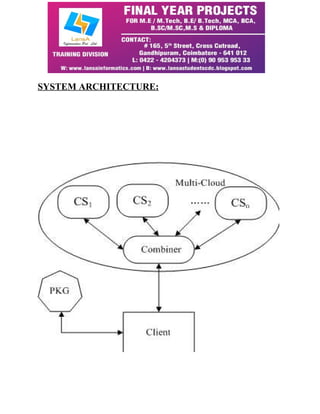
SYSTEM ARCHITECTURE:
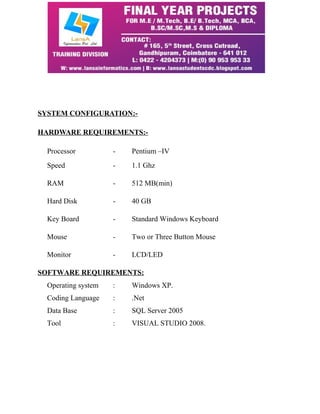
SYSTEM CONFIGURATION:- 
HARDWARE REQUIREMENTS:- 
Processor - Pentium –IV 
Speed - 1.1 Ghz 
RAM - 512 MB(min) 
Hard Disk - 40 GB 
Key Board - Standard Windows Keyboard 
Mouse - Two or Three Button Mouse 
Monitor - LCD/LED 
SOFTWARE REQUIREMENTS: 
Operating system : Windows XP. 
Coding Language : .Net 
Data Base : SQL Server 2005 
Tool : VISUAL STUDIO 2008.
REFERENCE: 
Wang, H., “Identity-Based Distributed Provable Data Possession in Multi- 
Cloud Storage” IEEE TRANSACTIONS ON CLOUD COMPUTING, VOL. PP, 
NO. 99, 11 March 2014

Identity based distributed provable data possession in multi-cloud storage

  • 1.
    IDENTITY-BASED DISTRIBUTED PROVABLEDATA POSSESSION IN MULTI-CLOUD STORAGE ABSTRACT: Remote data integrity checking is of crucial importance in cloud storage. It can make the clients verify whether their outsourced data is kept intact without downloading the whole data. In some application scenarios, the clients have to store their data on multi-cloud servers. At the same time, the integrity checking protocol must be efficient in order to save the verifier’s cost. From the two points, we propose a novel remote data integrity checking model: ID-DPDP (identity-based distributed provable data possession) in multi-cloud storage. The formal system model and security model are given. Based on the bilinear pairings, a concrete ID-DPDP protocol is designed. The proposed ID-DPDP protocol is provably secure under the hardness assumption of the standard CDH (computational Diffie- Hellman) problem. In addition to the structural
  • 2.
    advantage of eliminationof certificate management, our ID-DPDP protocol is also efficient and flexible. Based on the client’s authorization, the proposed ID-DPDP protocol can realize private verification, delegated verification and public verification. EXISTING SYSTEM: The foundations of cloud computing lie in the outsourcing of computing tasks to the third party. It entails the security risks in terms of confidentiality, integrity and availability of data and service. The issue to convince the cloud clients that their data are kept intact is especially vital since the clients do not store these data locally. Remote data integrity checking is a primitive to address this issue. For the general case, when the client stores his data on multi-cloud servers, the distributed storage and integrity checking are indispensable. On the other hand, the integrity checking protocol must be efficient in order to make it suitable for capacity-limited end devices. Thus, based on distributed computation, we will study distributed remote data
  • 3.
    integrity checking modeland present the corresponding concrete protocol in multi-cloud storage. DISADVANTAGES OF EXISTING SYSTEM:  Data checking in more complex using multi servers.  Needed large storage space.  In sufficient data loss. PROPOSED SYSTEM: In identity-based public key cryptography, this paper focuses on distributed provable data possession in multi-cloud storage. The protocol can be made efficient by eliminating the certificate management. We propose the new remote data integrity checking model: ID-DPDP. The system model and security model are formally proposed. Then, based on the bilinear pairings, the concrete ID-DPDP protocol is designed. In the random oracle model, our ID-DPDP protocol is provably secure. On the other hand, our protocol is more flexible besides the high
  • 4.
    efficiency. Based onthe client’s authorization, the proposed ID-DPDP protocol can realize private verification, delegated verification and public verification. ADVANTAGES OF PROPOSED SYSTEM: It has more significant storage space. It provides secure public data’s. Using Private Key generation.
  • 5.
  • 6.
    SYSTEM CONFIGURATION:- HARDWAREREQUIREMENTS:- Processor - Pentium –IV Speed - 1.1 Ghz RAM - 512 MB(min) Hard Disk - 40 GB Key Board - Standard Windows Keyboard Mouse - Two or Three Button Mouse Monitor - LCD/LED SOFTWARE REQUIREMENTS: Operating system : Windows XP. Coding Language : .Net Data Base : SQL Server 2005 Tool : VISUAL STUDIO 2008.
  • 7.
    REFERENCE: Wang, H.,“Identity-Based Distributed Provable Data Possession in Multi- Cloud Storage” IEEE TRANSACTIONS ON CLOUD COMPUTING, VOL. PP, NO. 99, 11 March 2014