Ali Shtarbanov – Electrical Engineering and Physics
Michael Wilson – Electrical Engineering
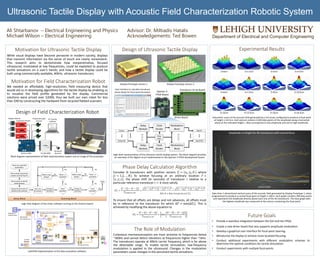
Ultrasonic Tactile Display with Acoustic Field Characterization Robotic System
While visual displays have become pervasive in modern society, displays
that transmit information via the sense of touch are nearly nonexistent.
This research aims to demonstrate how nonpenetrative, focused
ultrasound, modulated at low frequencies, could be exploited to produce
tactile sensations on a user’s hands; and how a tactile display could be
built using commercially available, 40kHz, ultrasonic transducers.
Motivation for Field Characterization Robot
Motivation for Ultrasonic Tactile Display
We needed an affordable, high-resolution, field measuring device that
would aid us in developing algorithms for the tactile display by enabling us
to visualize the field profile generated by the display. Commercial
solutions were priced over $2000, thus we built our own robot for less
than $90 by constructing the hardware from recycled flatbed scanners.
Consider N transducers with position vectors 𝑟𝑖 = 𝑥𝑖, 𝑦𝑖, 0 where
(𝑖 = 1,2, … 𝑁). To achieve focusing at an arbitrary location 𝑟 =
𝑥, 𝑦, 𝑧 , the phase shift (in seconds) of transducer 𝑖 relative to a
particular reference transducer 𝑖 = k must satisfy
Δ𝑇𝑖 =
𝑟 − 𝑟𝑖 − 𝑟 − 𝑟𝑘
𝑉𝑠𝑜𝑢𝑛𝑑 𝑖𝑛 𝑎𝑖𝑟
=
𝑥 − 𝑥𝑖
2 + 𝑦 − 𝑦𝑖
2 + 𝑧2 − 𝑥 − 𝑥 𝑘
2 + 𝑦 − 𝑦 𝑘
2 + 𝑧2
331.4 + 0.6∗Temperature(°𝐶)
To ensure that all offsets are delays and not advances, all offsets must
be in reference to the transducer for which Δ𝑇 = min Δ𝑇𝑖 . This is
achieved by modifying the above equation to
Δ𝑇𝑖 =
𝑟 − 𝑟𝑖 − 𝑟 − 𝑟𝑘
𝑉𝑠𝑜𝑢𝑛𝑑 𝑖𝑛 𝑎𝑖𝑟
+ min
𝑟 − 𝑟𝑖 − 𝑟 − 𝑟𝑘
𝑉𝑠𝑜𝑢𝑛𝑑 𝑖𝑛 𝑎𝑖𝑟
Phase Delay Calculation Algorithm
The Role of Modulation
Cutaneous mechanoreceptors are most sensitive to frequencies below
~300Hz and cannot detect vibrations at frequencies higher than ~1kHz.
The transducers operate at 40kHz carrier frequency, which is far above
the detectable range. To enable tactile stimulation, low-frequency
modulation is applied to the ultrasound. Changes in the modulation
parameters cause changes in the perceived tactile sensations.
Future Goals
• Provide a seamless integration between the GUI and the FPGA.
• Create a new driver board that also supports amplitude modulation.
• Develop a graphical user interface for focal point steering.
• Miniaturize the display to achieve more localized focusing.
• Conduct additional experiments with different modulation schemes to
determine the optimal conditions for tactile stimulation.
• Conduct experiments with multiple focal points.
Design of Ultrasonic Tactile Display
Driver Board
Spartan-3
FPGA Board
Transducer Array BoardUser Interface to calculate transducer
phase dealys for focal point formation
Display Prototype version 1. Display Prototype version 2.
High-level representation of the ultrasonic tactile display system. The block diagram provides
an overview of the digital circuit implemented on the Spartan-3 FPGA development board.
Experimental Results
Volumetric scans of the acoustic field generated by a 3x3 array, configured to produce a focal point
at height z=10.5cm. Each picture contains 2,500 data points of the amplitude along a horizontal
plane at the indicated height z. Blue corresponds to low amplitude and red to high amplitude.
Z=0cm Z=1.5cm Z=3cm Z=4.5cm
Z=6cm Z=7.5cm Z=9cm Z=10.5cm
Z=12cm Z=13.5cm Z=15cm Z=16.5cm
Data from 1-dimentional vertical scans of the acoustic field generated by Display Prototype 1, when
programmed to produce a central focal point at height z=18cm. Each graph contains 290 data points
and represents the amplitude directly above each one of the 36 transducers. The blue graph with
the highest amplitude was measured at the column containing the focal point.
Advisor: Dr. Miltiadis Hatalis
Acknowledgements: Ted Bowen Department of Electrical and Computer Engineering
Stepper Motors
EasyDriver Boards
Photointerruptor
Sensors
Arduino UNO NI USB-6009
Ultrasonic
Receiver
PC running
LabVIew
Design of Field Characterization Robot
Block diagram representation of field characterization system and an image of the prototype.
Logic flow diagram of the driver software running on the Arduino board.
LabVIEW implementation of the data acquisition software.
Setup Block Scanning Block
Read user-specified
parameters.
Move probe to desired
initial position
Sweep 2D perimeter of
volume to be scanned.
Scan one
(Z) column
Move probe toward the
sensors at X=0,Y=0,Z=0. Make a step
along X
Change X
direction
Make a step
along Y
Yend
reached?
Yend – 1
reached?
Change Z
direction
Xend
reached?
Xend – 1
reached?
No
No
Yes
Yes
No
No
Yes
Halt
Yes

Final Poster

  • 1.
    Ali Shtarbanov –Electrical Engineering and Physics Michael Wilson – Electrical Engineering Ultrasonic Tactile Display with Acoustic Field Characterization Robotic System While visual displays have become pervasive in modern society, displays that transmit information via the sense of touch are nearly nonexistent. This research aims to demonstrate how nonpenetrative, focused ultrasound, modulated at low frequencies, could be exploited to produce tactile sensations on a user’s hands; and how a tactile display could be built using commercially available, 40kHz, ultrasonic transducers. Motivation for Field Characterization Robot Motivation for Ultrasonic Tactile Display We needed an affordable, high-resolution, field measuring device that would aid us in developing algorithms for the tactile display by enabling us to visualize the field profile generated by the display. Commercial solutions were priced over $2000, thus we built our own robot for less than $90 by constructing the hardware from recycled flatbed scanners. Consider N transducers with position vectors 𝑟𝑖 = 𝑥𝑖, 𝑦𝑖, 0 where (𝑖 = 1,2, … 𝑁). To achieve focusing at an arbitrary location 𝑟 = 𝑥, 𝑦, 𝑧 , the phase shift (in seconds) of transducer 𝑖 relative to a particular reference transducer 𝑖 = k must satisfy Δ𝑇𝑖 = 𝑟 − 𝑟𝑖 − 𝑟 − 𝑟𝑘 𝑉𝑠𝑜𝑢𝑛𝑑 𝑖𝑛 𝑎𝑖𝑟 = 𝑥 − 𝑥𝑖 2 + 𝑦 − 𝑦𝑖 2 + 𝑧2 − 𝑥 − 𝑥 𝑘 2 + 𝑦 − 𝑦 𝑘 2 + 𝑧2 331.4 + 0.6∗Temperature(°𝐶) To ensure that all offsets are delays and not advances, all offsets must be in reference to the transducer for which Δ𝑇 = min Δ𝑇𝑖 . This is achieved by modifying the above equation to Δ𝑇𝑖 = 𝑟 − 𝑟𝑖 − 𝑟 − 𝑟𝑘 𝑉𝑠𝑜𝑢𝑛𝑑 𝑖𝑛 𝑎𝑖𝑟 + min 𝑟 − 𝑟𝑖 − 𝑟 − 𝑟𝑘 𝑉𝑠𝑜𝑢𝑛𝑑 𝑖𝑛 𝑎𝑖𝑟 Phase Delay Calculation Algorithm The Role of Modulation Cutaneous mechanoreceptors are most sensitive to frequencies below ~300Hz and cannot detect vibrations at frequencies higher than ~1kHz. The transducers operate at 40kHz carrier frequency, which is far above the detectable range. To enable tactile stimulation, low-frequency modulation is applied to the ultrasound. Changes in the modulation parameters cause changes in the perceived tactile sensations. Future Goals • Provide a seamless integration between the GUI and the FPGA. • Create a new driver board that also supports amplitude modulation. • Develop a graphical user interface for focal point steering. • Miniaturize the display to achieve more localized focusing. • Conduct additional experiments with different modulation schemes to determine the optimal conditions for tactile stimulation. • Conduct experiments with multiple focal points. Design of Ultrasonic Tactile Display Driver Board Spartan-3 FPGA Board Transducer Array BoardUser Interface to calculate transducer phase dealys for focal point formation Display Prototype version 1. Display Prototype version 2. High-level representation of the ultrasonic tactile display system. The block diagram provides an overview of the digital circuit implemented on the Spartan-3 FPGA development board. Experimental Results Volumetric scans of the acoustic field generated by a 3x3 array, configured to produce a focal point at height z=10.5cm. Each picture contains 2,500 data points of the amplitude along a horizontal plane at the indicated height z. Blue corresponds to low amplitude and red to high amplitude. Z=0cm Z=1.5cm Z=3cm Z=4.5cm Z=6cm Z=7.5cm Z=9cm Z=10.5cm Z=12cm Z=13.5cm Z=15cm Z=16.5cm Data from 1-dimentional vertical scans of the acoustic field generated by Display Prototype 1, when programmed to produce a central focal point at height z=18cm. Each graph contains 290 data points and represents the amplitude directly above each one of the 36 transducers. The blue graph with the highest amplitude was measured at the column containing the focal point. Advisor: Dr. Miltiadis Hatalis Acknowledgements: Ted Bowen Department of Electrical and Computer Engineering Stepper Motors EasyDriver Boards Photointerruptor Sensors Arduino UNO NI USB-6009 Ultrasonic Receiver PC running LabVIew Design of Field Characterization Robot Block diagram representation of field characterization system and an image of the prototype. Logic flow diagram of the driver software running on the Arduino board. LabVIEW implementation of the data acquisition software. Setup Block Scanning Block Read user-specified parameters. Move probe to desired initial position Sweep 2D perimeter of volume to be scanned. Scan one (Z) column Move probe toward the sensors at X=0,Y=0,Z=0. Make a step along X Change X direction Make a step along Y Yend reached? Yend – 1 reached? Change Z direction Xend reached? Xend – 1 reached? No No Yes Yes No No Yes Halt Yes