GNS Consulting:
       Payless ShoeSource

                      By:
Elizabeth George, Natalie Neal & Shirley Sanchez
Executive Summary

 Founded in 1956 by Louis and Shaoi Pozes
Based in Topeka, Kansas
In October 1997, the first international Payless store
opened in the Toronto area.
By 2000 they expanded to a total of 236 international
stores
Payless Shoe Commercial
Executive Summary

Owned by Collective brands, which also owns Sperry,
Stride Rite, and Keds.
Currently Payless has over 4,000 stores
Payless has had to close over 400 stores to help cut
costs for their struggling business
Stock has dropped from $24 to $12 within the past year
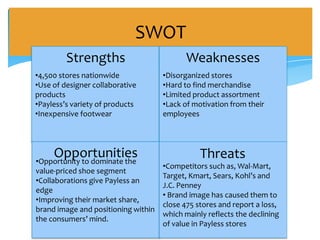
SWOT
         Strengths                          Weaknesses
•4,500 stores nationwide             •Disorganized stores
•Use of designer collaborative       •Hard to find merchandise
products                             •Limited product assortment
•Payless’s variety of products       •Lack of motivation from their
•Inexpensive footwear                employees


    Opportunities
•Opportunity to dominate the
                                                Threats
                                     •Competitors such as, Wal-Mart,
value-priced shoe segment
                                     Target, Kmart, Sears, Kohl’s and
•Collaborations give Payless an
                                     J.C. Penney
edge
                                     • Brand image has caused them to
•Improving their market share,
                                     close 475 stores and report a loss,
brand image and positioning within
                                     which mainly reflects the declining
the consumers’ mind.
                                     of value in Payless stores
Competitor Analysis

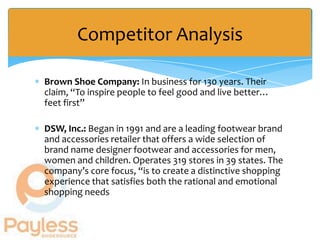
Brown Shoe Company: In business for 130 years. Their
claim, “To inspire people to feel good and live better…
feet first”

DSW, Inc.: Began in 1991 and are a leading footwear brand
and accessories retailer that offers a wide selection of
brand name designer footwear and accessories for men,
women and children. Operates 319 stores in 39 states. The
company’s core focus, “is to create a distinctive shopping
experience that satisfies both the rational and emotional
shopping needs
Competitor Analysis

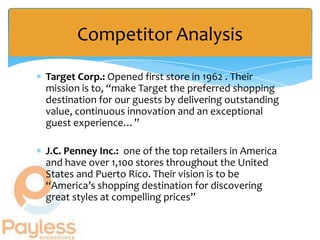
Target Corp.: Opened first store in 1962 . Their
mission is to, “make Target the preferred shopping
destination for our guests by delivering outstanding
value, continuous innovation and an exceptional
guest experience…”

J.C. Penney Inc.: one of the top retailers in America
and have over 1,100 stores throughout the United
States and Puerto Rico. Their vision is to be
“America’s shopping destination for discovering
great styles at compelling prices”
Problem #1: Inefficient Sourcing

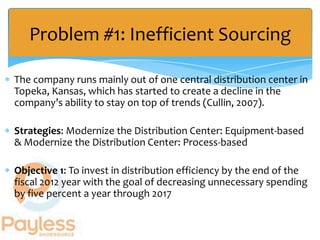
The company runs mainly out of one central distribution center in
Topeka, Kansas, which has started to create a decline in the
company’s ability to stay on top of trends (Cullin, 2007).

Strategies: Modernize the Distribution Center: Equipment-based
& Modernize the Distribution Center: Process-based

Objective 1: To invest in distribution efficiency by the end of the
fiscal 2012 year with the goal of decreasing unnecessary spending
by five percent a year through 2017
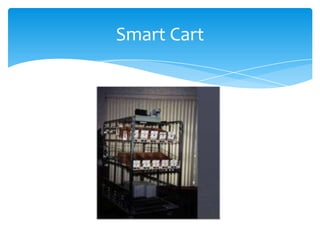
Smart Cart
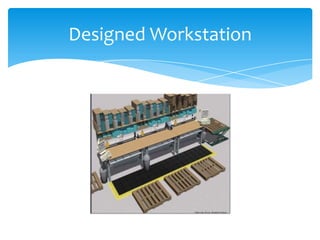
Designed Workstation
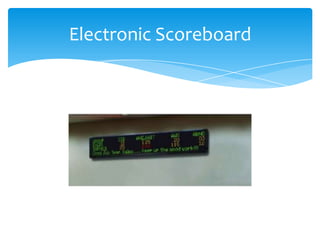
Electronic Scoreboard
Problem #1: Inefficient Sourcing
The company runs mainly out of one central distribution center in
Topeka, Kansas, which has started to create a decline in the
company’s ability to stay on top of trends (Cullin, 2007).

Strategies: Give distribution employees incentives to respond quickly
to regional store’s inventory needs.
To better understand employee happiness versus employee
motivation and implement a distribution environment that will
encourage efficiency.

Objective 2: To reallocate the five percent savings on spending in
the first objective by the end of 2013, and distribute the savings
among distribution center employees as an incentive program.
Problem #2: A broad,
     underperforming brand portfolio
Currently, Payless needs to examine and consolidate their large
brand portfolio to decrease fixed distribution and factory costs
associated with owning this large number of brands, which will
eventually result in an increase in profits.

Strategies: To consolidate underperforming brands in the Payless
portfolio

Objective 2: As an attempt to decrease licensing costs and increase
efficiency, Payless will undergo a strategic portfolio review and
consolidate underperforming brands by the end of the 2012 fiscal
year.
Problem #2: A broad,
     underperforming brand portfolio
Currently, Payless needs to examine and consolidate their large
brand portfolio to decrease fixed distribution and factory costs
associated with owning this large number of brands, which will
eventually result in an increase in profits.

Strategies: To define a position in the market for each brand to
create value in different categories amid the footwear industry.

Objective 2: Realign Payless’ portfolio based on the current
industry trends and analysts’ research to determine a market for
each brand.
Evaluation # 1

Goal is to decrease unnecessary spending by 5%
Payless should be able to increase their response to industry
trends
Payless should be able to distribute the savings among
distribution center employees as an incentive program
A way to measure the success of the employees’ incentive
program is by evaluating the performance of their employees
Evaluation # 2

The first objective is to tailor the list of brands
Second objective is to realign the portfolio based on Payless’
current market position and analysts’ research
To measure this strategy, profit levels will be compared from
previous years
The company will notice a decrease in fixed distribution and
factory costs
Payless will address and solve problems quicker and easier
Conclusion

Payless has over 4,000 stores with a presence in the United
States, South America, Canada and Central America
Payless has the opportunity to dominate the value-priced shoe
segment
They will have to attract and retain consumers by providing
faster distribution of fashionable shoes and building a
relationship with its consumer base
Conclusion

The idea is to rebuild the Payless name of, “democratizing
   fashion and design in footwear and accessories to the
     world and inspiring fun fashion possibilities for the
              family” (Payless Shoesource, 2011)
Check this out!


Bush and Payless
Questions? Comments?


 Thank You for your attention!
References

Antich, M. (2010). To maximize your fleet efficiency, incentivize your fleet manager. Retrieved from Business Fleet http://www.businessfleet.com/Blog/Market-
Trends/Story/2010/05/To-Maximize-Fleet-Efficiency-Incentivize-Your-Fleet-Manager.aspx
Brown Shoe Company reports third quarter 2011 results. (2011). Retrieved from Business wire http://www.businesswire.com/news/home/20111121006451/en/Brown-
Shoe-Company-Reports-Quarter-2011-Results
Chafkin, M. (2009). The zappos way of managing. Retrieved from Inc. magazine http://www.inc.com/magazine/20090501/the-zappos-way-of-managing.html
Funding Universe. (n.d.). Payless Shoe Source, Inc. Retrieved September 26, 2011, from Funding Universe: http://www.fundinguniverse.com/company-
histories/Payless-ShoeSource-Inc-Company-History.html
Hill, S., Ettenson, R., Tyson, D. (2005). Achieving the ideal brand portfolio. Retrieved from MIT sloan management review
http://www.type2consulting.com/articles/Ideal_Brand_Portfolio.pdf
Hooper, M. (2006, December 7). Payless Marketing Earns Award. The Capital Journal. Retrieved from http://cjonline.com/stories/120706/bus_payless.shtml
InvestorGuide. (2011). Collective Brands. Retrieved November 27, 2011, from InvestoryGuide.com: http://www.investorguide.com/stock.php?ticker=PSS
Just-style. (2006, June 28). US: Payless Reveals New Logo. Retrieved from http://www.just-style.com/news/payless=reveals-new-logo_id94167.aspx
Kumar, K. (2011). Brown shoe to license buster brown brand, shutter more stores. Retrieved from St. Louis Today http://www.stltoday.com/business/local/brown-
shoe-to-license-buster-brown-brand-shutter-more-stores/article_f58db492-14a2-11e1-98e1-001a4bcf6878.html
Lachapelle, T. (2011, September 19). Payless Shoes Poised for Buyout at 76%. Retrieved from Bloomberg Business Week: http://www.businessweek.com/news/2011-
09-19/payless-shoes-poised-for-buyout-at-76-sales-discount-real-m-a.html
Liptrot, B. (2007). ’10 ideas for improving your distribution center’s efficiency.’ Retrieved from Boston industrial consulting
http://www.bicinc.com/White_papers/10IdeasforImprovingyourDC.pdf
Payless ShoeSource. (2011). Retrieved from Collective Brands Inc. http://www.collectivebrands.com/brands/all-brands
Reeves, J. (2011, August 26). Sell Payless, Stride Rite Parent PSS as it Closes 475 Retail Stores. Retrieved November 27, 2011, from InvestorPlace.com:
http://www.investorplace.com/2011/08/collective-brands-payless-shoes-store-closing-pss-stock/
Rogel, C. (2010). Employee satisfaction vs. motivation and employee engagement. Retrieved from Decision wise http://www.decision-
wise.com/blog/2010/11/22/employee-satisfaction-vs-motivation-and-employee-engagement/
Sense. Solving the puzzle of complex brand portfolios. (n.d.). Retrieved from Lippincott mercer
http://www.lippincott.com/files/documents/sensemagazine/97/files/assets/downloads/sense97.pdf
Tay, M. (2011). Brown shoe to close stores. Retrieved from wwd.com http://www.wwd.com/footwear-news/business/brown-shoe-to-close-stores-signs-new-
licenses-5383942

Final Payless Presentation

  • 1.
    GNS Consulting: Payless ShoeSource By: Elizabeth George, Natalie Neal & Shirley Sanchez
  • 2.
    Executive Summary Foundedin 1956 by Louis and Shaoi Pozes Based in Topeka, Kansas In October 1997, the first international Payless store opened in the Toronto area. By 2000 they expanded to a total of 236 international stores Payless Shoe Commercial
  • 3.
    Executive Summary Owned byCollective brands, which also owns Sperry, Stride Rite, and Keds. Currently Payless has over 4,000 stores Payless has had to close over 400 stores to help cut costs for their struggling business Stock has dropped from $24 to $12 within the past year
  • 4.
    SWOT Strengths Weaknesses •4,500 stores nationwide •Disorganized stores •Use of designer collaborative •Hard to find merchandise products •Limited product assortment •Payless’s variety of products •Lack of motivation from their •Inexpensive footwear employees Opportunities •Opportunity to dominate the Threats •Competitors such as, Wal-Mart, value-priced shoe segment Target, Kmart, Sears, Kohl’s and •Collaborations give Payless an J.C. Penney edge • Brand image has caused them to •Improving their market share, close 475 stores and report a loss, brand image and positioning within which mainly reflects the declining the consumers’ mind. of value in Payless stores
  • 5.
    Competitor Analysis Brown ShoeCompany: In business for 130 years. Their claim, “To inspire people to feel good and live better… feet first” DSW, Inc.: Began in 1991 and are a leading footwear brand and accessories retailer that offers a wide selection of brand name designer footwear and accessories for men, women and children. Operates 319 stores in 39 states. The company’s core focus, “is to create a distinctive shopping experience that satisfies both the rational and emotional shopping needs
  • 6.
    Competitor Analysis Target Corp.:Opened first store in 1962 . Their mission is to, “make Target the preferred shopping destination for our guests by delivering outstanding value, continuous innovation and an exceptional guest experience…” J.C. Penney Inc.: one of the top retailers in America and have over 1,100 stores throughout the United States and Puerto Rico. Their vision is to be “America’s shopping destination for discovering great styles at compelling prices”
  • 7.
    Problem #1: InefficientSourcing The company runs mainly out of one central distribution center in Topeka, Kansas, which has started to create a decline in the company’s ability to stay on top of trends (Cullin, 2007). Strategies: Modernize the Distribution Center: Equipment-based & Modernize the Distribution Center: Process-based Objective 1: To invest in distribution efficiency by the end of the fiscal 2012 year with the goal of decreasing unnecessary spending by five percent a year through 2017
  • 8.
  • 9.
  • 10.
  • 11.
    Problem #1: InefficientSourcing The company runs mainly out of one central distribution center in Topeka, Kansas, which has started to create a decline in the company’s ability to stay on top of trends (Cullin, 2007). Strategies: Give distribution employees incentives to respond quickly to regional store’s inventory needs. To better understand employee happiness versus employee motivation and implement a distribution environment that will encourage efficiency. Objective 2: To reallocate the five percent savings on spending in the first objective by the end of 2013, and distribute the savings among distribution center employees as an incentive program.
  • 12.
    Problem #2: Abroad, underperforming brand portfolio Currently, Payless needs to examine and consolidate their large brand portfolio to decrease fixed distribution and factory costs associated with owning this large number of brands, which will eventually result in an increase in profits. Strategies: To consolidate underperforming brands in the Payless portfolio Objective 2: As an attempt to decrease licensing costs and increase efficiency, Payless will undergo a strategic portfolio review and consolidate underperforming brands by the end of the 2012 fiscal year.
  • 13.
    Problem #2: Abroad, underperforming brand portfolio Currently, Payless needs to examine and consolidate their large brand portfolio to decrease fixed distribution and factory costs associated with owning this large number of brands, which will eventually result in an increase in profits. Strategies: To define a position in the market for each brand to create value in different categories amid the footwear industry. Objective 2: Realign Payless’ portfolio based on the current industry trends and analysts’ research to determine a market for each brand.
  • 14.
    Evaluation # 1 Goalis to decrease unnecessary spending by 5% Payless should be able to increase their response to industry trends Payless should be able to distribute the savings among distribution center employees as an incentive program A way to measure the success of the employees’ incentive program is by evaluating the performance of their employees
  • 15.
    Evaluation # 2 Thefirst objective is to tailor the list of brands Second objective is to realign the portfolio based on Payless’ current market position and analysts’ research To measure this strategy, profit levels will be compared from previous years The company will notice a decrease in fixed distribution and factory costs Payless will address and solve problems quicker and easier
  • 16.
    Conclusion Payless has over4,000 stores with a presence in the United States, South America, Canada and Central America Payless has the opportunity to dominate the value-priced shoe segment They will have to attract and retain consumers by providing faster distribution of fashionable shoes and building a relationship with its consumer base
  • 17.
    Conclusion The idea isto rebuild the Payless name of, “democratizing fashion and design in footwear and accessories to the world and inspiring fun fashion possibilities for the family” (Payless Shoesource, 2011)
  • 18.
  • 19.
    Questions? Comments? ThankYou for your attention!
  • 20.
    References Antich, M. (2010).To maximize your fleet efficiency, incentivize your fleet manager. Retrieved from Business Fleet http://www.businessfleet.com/Blog/Market- Trends/Story/2010/05/To-Maximize-Fleet-Efficiency-Incentivize-Your-Fleet-Manager.aspx Brown Shoe Company reports third quarter 2011 results. (2011). Retrieved from Business wire http://www.businesswire.com/news/home/20111121006451/en/Brown- Shoe-Company-Reports-Quarter-2011-Results Chafkin, M. (2009). The zappos way of managing. Retrieved from Inc. magazine http://www.inc.com/magazine/20090501/the-zappos-way-of-managing.html Funding Universe. (n.d.). Payless Shoe Source, Inc. Retrieved September 26, 2011, from Funding Universe: http://www.fundinguniverse.com/company- histories/Payless-ShoeSource-Inc-Company-History.html Hill, S., Ettenson, R., Tyson, D. (2005). Achieving the ideal brand portfolio. Retrieved from MIT sloan management review http://www.type2consulting.com/articles/Ideal_Brand_Portfolio.pdf Hooper, M. (2006, December 7). Payless Marketing Earns Award. The Capital Journal. Retrieved from http://cjonline.com/stories/120706/bus_payless.shtml InvestorGuide. (2011). Collective Brands. Retrieved November 27, 2011, from InvestoryGuide.com: http://www.investorguide.com/stock.php?ticker=PSS Just-style. (2006, June 28). US: Payless Reveals New Logo. Retrieved from http://www.just-style.com/news/payless=reveals-new-logo_id94167.aspx Kumar, K. (2011). Brown shoe to license buster brown brand, shutter more stores. Retrieved from St. Louis Today http://www.stltoday.com/business/local/brown- shoe-to-license-buster-brown-brand-shutter-more-stores/article_f58db492-14a2-11e1-98e1-001a4bcf6878.html Lachapelle, T. (2011, September 19). Payless Shoes Poised for Buyout at 76%. Retrieved from Bloomberg Business Week: http://www.businessweek.com/news/2011- 09-19/payless-shoes-poised-for-buyout-at-76-sales-discount-real-m-a.html Liptrot, B. (2007). ’10 ideas for improving your distribution center’s efficiency.’ Retrieved from Boston industrial consulting http://www.bicinc.com/White_papers/10IdeasforImprovingyourDC.pdf Payless ShoeSource. (2011). Retrieved from Collective Brands Inc. http://www.collectivebrands.com/brands/all-brands Reeves, J. (2011, August 26). Sell Payless, Stride Rite Parent PSS as it Closes 475 Retail Stores. Retrieved November 27, 2011, from InvestorPlace.com: http://www.investorplace.com/2011/08/collective-brands-payless-shoes-store-closing-pss-stock/ Rogel, C. (2010). Employee satisfaction vs. motivation and employee engagement. Retrieved from Decision wise http://www.decision- wise.com/blog/2010/11/22/employee-satisfaction-vs-motivation-and-employee-engagement/ Sense. Solving the puzzle of complex brand portfolios. (n.d.). Retrieved from Lippincott mercer http://www.lippincott.com/files/documents/sensemagazine/97/files/assets/downloads/sense97.pdf Tay, M. (2011). Brown shoe to close stores. Retrieved from wwd.com http://www.wwd.com/footwear-news/business/brown-shoe-to-close-stores-signs-new- licenses-5383942

Editor's Notes