World Bank Open Agenda:
               Open Data & Access to
               Information in the
               Development Community
European


           This material is a product of the staff of the International Bank for Reconstruction and Development/The World Bank. The findings, interpretations, and conclusions expressed in this presentation do not necessarily reflect the views of the Executive
           Directors of The World Bank or the governments they represent. The World Bank does not guarantee the accuracy of the data included in this work. This material should not be reproduced or distributed without The World Bank's prior consent.
Open Data
Access to Information
  Open Knowledge
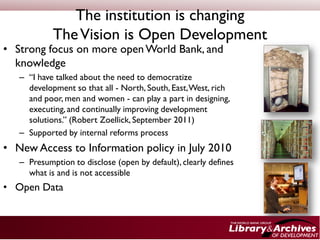
The institution is changing
            The Vision is Open Development
• Strong focus on more open World Bank, and
  knowledge
   – “I have talked about the need to democratize
     development so that all - North, South, East, West, rich
     and poor, men and women - can play a part in designing,
     executing, and continually improving development
     solutions.” (Robert Zoellick, September 2011)
   – Supported by internal reforms process
• New Access to Information policy in July 2010
   – Presumption to disclose (open by default), clearly defines
     what is and is not accessible
• Open Data
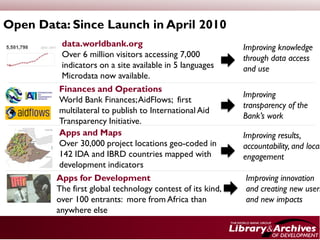
Open Data: Since Launch in April 2010
          data.worldbank.org                               Improving knowledge
          Over 6 million visitors accessing 7,000          through data access
          indicators on a site available in 5 languages    and use
          Microdata now available.
         Finances and Operations
                                                           Improving
         World Bank Finances; AidFlows; first
                                                           transparency of the
         multilateral to publish to International Aid
                                                           Bank’s work
         Transparency Initiative.
         Apps and Maps                                     Improving results,
         Over 30,000 project locations geo-coded in        accountability, and local
         142 IDA and IBRD countries mapped with            engagement
         development indicators
        Apps for Development                               Improving innovation
        The first global technology contest of its kind,   and creating new users
        over 100 entrants: more from Africa than           and new impacts
        anywhere else
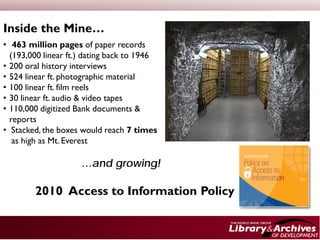
Inside the Mine…
• 463 million pages of paper records
  (193,000 linear ft.) dating back to 1946
• 200 oral history interviews
• 524 linear ft. photographic material
• 100 linear ft. film reels
• 30 linear ft. audio & video tapes
• 110,000 digitized Bank documents &
  reports
• Stacked, the boxes would reach 7 times
   as high as Mt. Everest

                     …and growing!

        2010 Access to Information Policy
Open Knowledge Repository

• The Bank’s ‘Open Access’ repository – launch due 2012
• Collection/curation of Bank research in an ‘Open’ repository:
   – ‘Formal’ publications of the World Bank
   – ‘Informal’ publications of the Bank, e.g. Working Papers, Economic
     Sector Work
   – Externally published Bank research, e.g. Book chapters
• ‘Open’ repository allows the Bank to join growing number of
  Institutional Repositories:
   – Easily discoverable, e.g. Google Scholar,
   – Conforms to Open Access standards for metadata and metadata
       harvesting, e.g. Open Access search engines
   – Provides a site optimized for low bandwidth countries
   – Provides content in a reusable format with liberal reuse conditions
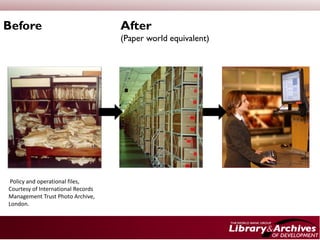
Before                              After
                                    (Paper world equivalent)


 Policy and operational files,
Courtesy of International Records
Management Trust Photo Archive,
London.
Thank you!

                            Elisa Liberatori Prati
                        Chief Archivist, The World Bank Group
                            eliberatoriprati@worldbank.org

        http://www.worldbank.org/WBAccess
European Commission, 2011 Global Forum:"Vision for the Digital Future, Mobilizing Organizations
and People,” Brussels, Nov 7-8, 2011, Session 7: Challenges for Open Innovation

Elisa Liberatori Prati

  • 1.
    World Bank OpenAgenda: Open Data & Access to Information in the Development Community European This material is a product of the staff of the International Bank for Reconstruction and Development/The World Bank. The findings, interpretations, and conclusions expressed in this presentation do not necessarily reflect the views of the Executive Directors of The World Bank or the governments they represent. The World Bank does not guarantee the accuracy of the data included in this work. This material should not be reproduced or distributed without The World Bank's prior consent.
  • 2.
    Open Data Access toInformation Open Knowledge
  • 3.
    The institution ischanging The Vision is Open Development • Strong focus on more open World Bank, and knowledge – “I have talked about the need to democratize development so that all - North, South, East, West, rich and poor, men and women - can play a part in designing, executing, and continually improving development solutions.” (Robert Zoellick, September 2011) – Supported by internal reforms process • New Access to Information policy in July 2010 – Presumption to disclose (open by default), clearly defines what is and is not accessible • Open Data
  • 4.
    Open Data: SinceLaunch in April 2010 data.worldbank.org Improving knowledge Over 6 million visitors accessing 7,000 through data access indicators on a site available in 5 languages and use Microdata now available. Finances and Operations Improving World Bank Finances; AidFlows; first transparency of the multilateral to publish to International Aid Bank’s work Transparency Initiative. Apps and Maps Improving results, Over 30,000 project locations geo-coded in accountability, and local 142 IDA and IBRD countries mapped with engagement development indicators Apps for Development Improving innovation The first global technology contest of its kind, and creating new users over 100 entrants: more from Africa than and new impacts anywhere else
  • 5.
    Inside the Mine… •463 million pages of paper records (193,000 linear ft.) dating back to 1946 • 200 oral history interviews • 524 linear ft. photographic material • 100 linear ft. film reels • 30 linear ft. audio & video tapes • 110,000 digitized Bank documents & reports • Stacked, the boxes would reach 7 times as high as Mt. Everest …and growing! 2010 Access to Information Policy
  • 6.
    Open Knowledge Repository •The Bank’s ‘Open Access’ repository – launch due 2012 • Collection/curation of Bank research in an ‘Open’ repository: – ‘Formal’ publications of the World Bank – ‘Informal’ publications of the Bank, e.g. Working Papers, Economic Sector Work – Externally published Bank research, e.g. Book chapters • ‘Open’ repository allows the Bank to join growing number of Institutional Repositories: – Easily discoverable, e.g. Google Scholar, – Conforms to Open Access standards for metadata and metadata harvesting, e.g. Open Access search engines – Provides a site optimized for low bandwidth countries – Provides content in a reusable format with liberal reuse conditions
  • 7.
    Before After (Paper world equivalent) Policy and operational files, Courtesy of International Records Management Trust Photo Archive, London.
  • 8.
    Thank you! Elisa Liberatori Prati Chief Archivist, The World Bank Group eliberatoriprati@worldbank.org http://www.worldbank.org/WBAccess European Commission, 2011 Global Forum:"Vision for the Digital Future, Mobilizing Organizations and People,” Brussels, Nov 7-8, 2011, Session 7: Challenges for Open Innovation