MELI SSA L. FA LK & SA MA N TH A E. JA CO B
EMPO RI A STATE U N I V ERSI TY
HOMOSEXUAL PARENTING
AND COLLEGE STUDENTS’
ATTITUDES TOWARD
CHILDREN
1
2
3
• Traditional ways of up-bringing children are
changing and homosexual adoptions rising
• Camilleri (2006)
• Children’s sexual orientation does not depend on
caretakers’
• Cameron (2005)
• A child adopted by homosexual parents were less
likely to be heterosexual than a child raised by
heterosexual parents
• (Gato 2013)
• We predicted if participants read a story about a child who
has homosexual parents, gay or lesbian, then the
participants will think the child is more likely to be
homosexual than if the story indicates that the parents are
heterosexual
PARTICIPANTS
• Undergraduate students at Emporia State
University
• Age: M = 19.29, SD = 4.56, N = 24
• 11 Freshman, 9 Sophomores, 3 Juniors, 1 Senior, 0 Other
• 15 Women, 9 Men, 0 Other
• 7 Democratic, 9 Republicans, 2 Liberal, 6 Other
• We obtained our participants via sign-up in the
psychology department research pool in Canvas
• IRB Approval Number: 15085
4
5
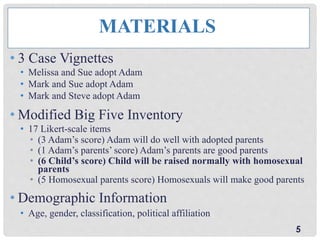
• 3 Case Vignettes
• Melissa and Sue adopt Adam
• Mark and Sue adopt Adam
• Mark and Steve adopt Adam
• Modified Big Five Inventory
• 17 Likert-scale items
• (3 Adam’s score) Adam will do well with adopted parents
• (1 Adam’s parents’ score) Adam’s parents are good parents
• (6 Child’s score) Child will be raised normally with homosexual
parents
• (5 Homosexual parents score) Homosexuals will make good parents
• Demographic Information
• Age, gender, classification, political affiliation
MATERIALS
DESIGN
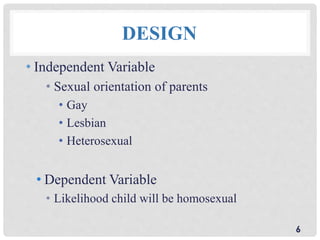
• Independent Variable
• Sexual orientation of parents
• Gay
• Lesbian
• Heterosexual
• Dependent Variable
• Likelihood child will be homosexual
6
PROCEDURE
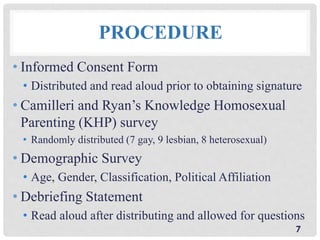
• Informed Consent Form
• Distributed and read aloud prior to obtaining signature
• Camilleri and Ryan’s Knowledge Homosexual
Parenting (KHP) survey
• Randomly distributed (7 gay, 9 lesbian, 8 heterosexual)
• Demographic Survey
• Age, Gender, Classification, Political Affiliation
• Debriefing Statement
• Read aloud after distributing and allowed for questions
7
RESULTS: PARENTAL INFLUENCE
ON CHILD’S SEXUALITY
8
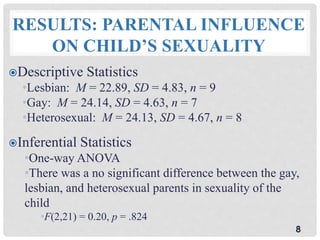
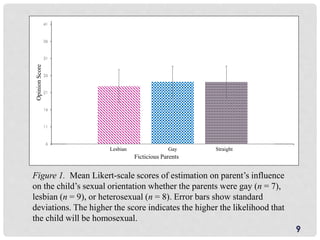
Descriptive Statistics
•Lesbian: M = 22.89, SD = 4.83, n = 9
•Gay: M = 24.14, SD = 4.63, n = 7
•Heterosexual: M = 24.13, SD = 4.67, n = 8
Inferential Statistics
•One-way ANOVA
•There was a no significant difference between the gay,
lesbian, and heterosexual parents in sexuality of the
child
•F(2,21) = 0.20, p = .824
Figure 1. Mean Likert-scale scores of estimation on parent’s influence
on the child’s sexual orientation whether the parents were gay (n = 7),
lesbian (n = 9), or heterosexual (n = 8). Error bars show standard
deviations. The higher the score indicates the higher the likelihood that
the child will be homosexual.
9
6
11
16
21
26
31
36
41
1
OpinionScore
Ficticious Parents
Lesbian Gay Straight
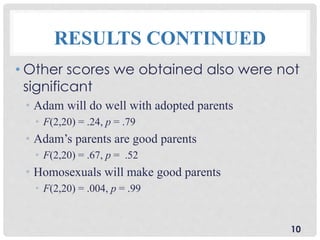
• Other scores we obtained also were not
significant
• Adam will do well with adopted parents
• F(2,20) = .24, p = .79
• Adam’s parents are good parents
• F(2,20) = .67, p = .52
• Homosexuals will make good parents
• F(2,20) = .004, p = .99
10
RESULTS CONTINUED
CONCLUSIONS
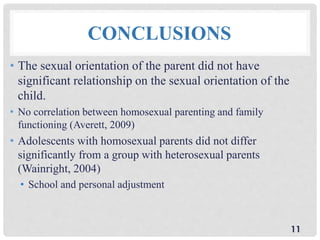
• The sexual orientation of the parent did not have
significant relationship on the sexual orientation of the
child.
• No correlation between homosexual parenting and family
functioning (Averett, 2009)
• Adolescents with homosexual parents did not differ
significantly from a group with heterosexual parents
(Wainright, 2004)
• School and personal adjustment
11
CONCLUSIONS
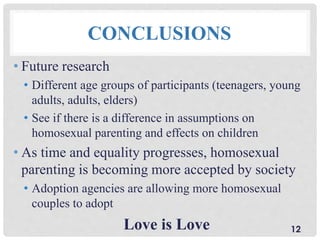
• Future research
• Different age groups of participants (teenagers, young
adults, adults, elders)
• See if there is a difference in assumptions on
homosexual parenting and effects on children
• As time and equality progresses, homosexual
parenting is becoming more accepted by society
• Adoption agencies are allowing more homosexual
couples to adopt
Love is Love 12
REFERENCES
Averett, P., Nalavany, B., & Ryan, S. (2009). An evaluation of gay-lesbian and
heterosexual adoption. Adoption Quarterly, 12(3-4), 129-151.
Cameron, P. (2005). Are Over A Third Of Foster Parent Molestations
Homosexual? Psychological Reports, 96(2), 275-298.
Camilleri, P., & Martin, R. (2006). Social Work Students’Attitudes Toward
Homosexuality and Their Knowledge and Attitudes toward Homosexual
Parenting as an Alternative Family Unit: An Australian Study. Social Work
Education, 25(3), 288-304
Gato, J., & Fontaine, A. M. (2013). Anticipation of the sexual and gender
development of children adopted by same-sex couples. International
Journal of Psychology, 48(3), 244-253.
Wainright, Jennifer L. (2004). Psychosocial Adjustment, School Outcomes,
and Romantic Relationships of Adolescents With Same-Sex Parents. Child
Development, 75(6), 1886-1898.
13
ACKNOWLEDGEMENTS
• Our Participants
• Dr. Grover
14
Questions?
15

FINAL Falk Jacob PP 05052015

  • 1.
    MELI SSA L.FA LK & SA MA N TH A E. JA CO B EMPO RI A STATE U N I V ERSI TY HOMOSEXUAL PARENTING AND COLLEGE STUDENTS’ ATTITUDES TOWARD CHILDREN 1
  • 2.
  • 3.
    3 • Traditional waysof up-bringing children are changing and homosexual adoptions rising • Camilleri (2006) • Children’s sexual orientation does not depend on caretakers’ • Cameron (2005) • A child adopted by homosexual parents were less likely to be heterosexual than a child raised by heterosexual parents • (Gato 2013) • We predicted if participants read a story about a child who has homosexual parents, gay or lesbian, then the participants will think the child is more likely to be homosexual than if the story indicates that the parents are heterosexual
  • 4.
    PARTICIPANTS • Undergraduate studentsat Emporia State University • Age: M = 19.29, SD = 4.56, N = 24 • 11 Freshman, 9 Sophomores, 3 Juniors, 1 Senior, 0 Other • 15 Women, 9 Men, 0 Other • 7 Democratic, 9 Republicans, 2 Liberal, 6 Other • We obtained our participants via sign-up in the psychology department research pool in Canvas • IRB Approval Number: 15085 4
  • 5.
    5 • 3 CaseVignettes • Melissa and Sue adopt Adam • Mark and Sue adopt Adam • Mark and Steve adopt Adam • Modified Big Five Inventory • 17 Likert-scale items • (3 Adam’s score) Adam will do well with adopted parents • (1 Adam’s parents’ score) Adam’s parents are good parents • (6 Child’s score) Child will be raised normally with homosexual parents • (5 Homosexual parents score) Homosexuals will make good parents • Demographic Information • Age, gender, classification, political affiliation MATERIALS
  • 6.
    DESIGN • Independent Variable •Sexual orientation of parents • Gay • Lesbian • Heterosexual • Dependent Variable • Likelihood child will be homosexual 6
  • 7.
    PROCEDURE • Informed ConsentForm • Distributed and read aloud prior to obtaining signature • Camilleri and Ryan’s Knowledge Homosexual Parenting (KHP) survey • Randomly distributed (7 gay, 9 lesbian, 8 heterosexual) • Demographic Survey • Age, Gender, Classification, Political Affiliation • Debriefing Statement • Read aloud after distributing and allowed for questions 7
  • 8.
    RESULTS: PARENTAL INFLUENCE ONCHILD’S SEXUALITY 8 Descriptive Statistics •Lesbian: M = 22.89, SD = 4.83, n = 9 •Gay: M = 24.14, SD = 4.63, n = 7 •Heterosexual: M = 24.13, SD = 4.67, n = 8 Inferential Statistics •One-way ANOVA •There was a no significant difference between the gay, lesbian, and heterosexual parents in sexuality of the child •F(2,21) = 0.20, p = .824
  • 9.
    Figure 1. MeanLikert-scale scores of estimation on parent’s influence on the child’s sexual orientation whether the parents were gay (n = 7), lesbian (n = 9), or heterosexual (n = 8). Error bars show standard deviations. The higher the score indicates the higher the likelihood that the child will be homosexual. 9 6 11 16 21 26 31 36 41 1 OpinionScore Ficticious Parents Lesbian Gay Straight
  • 10.
    • Other scoreswe obtained also were not significant • Adam will do well with adopted parents • F(2,20) = .24, p = .79 • Adam’s parents are good parents • F(2,20) = .67, p = .52 • Homosexuals will make good parents • F(2,20) = .004, p = .99 10 RESULTS CONTINUED
  • 11.
    CONCLUSIONS • The sexualorientation of the parent did not have significant relationship on the sexual orientation of the child. • No correlation between homosexual parenting and family functioning (Averett, 2009) • Adolescents with homosexual parents did not differ significantly from a group with heterosexual parents (Wainright, 2004) • School and personal adjustment 11
  • 12.
    CONCLUSIONS • Future research •Different age groups of participants (teenagers, young adults, adults, elders) • See if there is a difference in assumptions on homosexual parenting and effects on children • As time and equality progresses, homosexual parenting is becoming more accepted by society • Adoption agencies are allowing more homosexual couples to adopt Love is Love 12
  • 13.
    REFERENCES Averett, P., Nalavany,B., & Ryan, S. (2009). An evaluation of gay-lesbian and heterosexual adoption. Adoption Quarterly, 12(3-4), 129-151. Cameron, P. (2005). Are Over A Third Of Foster Parent Molestations Homosexual? Psychological Reports, 96(2), 275-298. Camilleri, P., & Martin, R. (2006). Social Work Students’Attitudes Toward Homosexuality and Their Knowledge and Attitudes toward Homosexual Parenting as an Alternative Family Unit: An Australian Study. Social Work Education, 25(3), 288-304 Gato, J., & Fontaine, A. M. (2013). Anticipation of the sexual and gender development of children adopted by same-sex couples. International Journal of Psychology, 48(3), 244-253. Wainright, Jennifer L. (2004). Psychosocial Adjustment, School Outcomes, and Romantic Relationships of Adolescents With Same-Sex Parents. Child Development, 75(6), 1886-1898. 13
  • 14.
  • 15.