Final
Evaluation
Culture in the Digital Age Draft Four
Evaluation
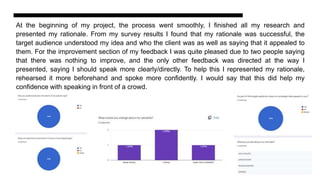
At the beginning of my project, the process went smoothly, I finished all my research and
presented my rationale. From my survey results I found that my rationale was successful, the
target audience understood my idea and who the client was as well as saying that it appealed to
them. For the improvement section of my feedback I was quite pleased due to two people saying
that there was nothing to improve, and the only other feedback was directed at the way I
presented, saying I should speak more clearly/directly. To help this I represented my rationale,
rehearsed it more beforehand and spoke more confidently. I would say that this did help my
confidence with speaking in front of a crowd.
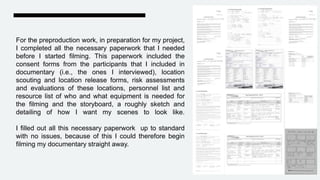
For the preproduction work, in preparation for my project,
I completed all the necessary paperwork that I needed
before I started filming. This paperwork included the
consent forms from the participants that I included in
documentary (i.e., the ones I interviewed), location
scouting and location release forms, risk assessments
and evaluations of these locations, personnel list and
resource list of who and what equipment is needed for
the filming and the storyboard, a roughly sketch and
detailing of how I want my scenes to look like.
I filled out all this necessary paperwork up to standard
with no issues, because of this I could therefore begin
filming my documentary straight away.
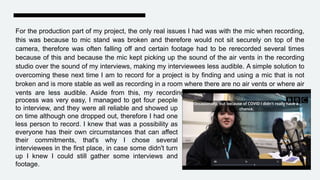
For the production part of my project, the only real issues I had was with the mic when recording,
this was because to mic stand was broken and therefore would not sit securely on top of the
camera, therefore was often falling off and certain footage had to be rerecorded several times
because of this and because the mic kept picking up the sound of the air vents in the recording
studio over the sound of my interviews, making my interviewees less audible. A simple solution to
overcoming these next time I am to record for a project is by finding and using a mic that is not
broken and is more stable as well as recording in a room where there are no air vents or where air
vents are less audible. Aside from this, my recording
process was very easy, I managed to get four people
to interview, and they were all reliable and showed up
on time although one dropped out, therefore I had one
less person to record. I knew that was a possibility as
everyone has their own circumstances that can affect
their commitments, that's why I chose several
interviewees in the first place, in case some didn't turn
up I knew I could still gather some interviews and
footage.
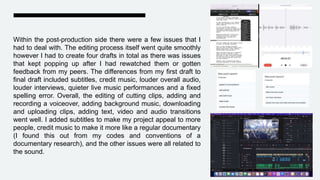
Within the post-production side there were a few issues that I
had to deal with. The editing process itself went quite smoothly
however I had to create four drafts in total as there was issues
that kept popping up after I had rewatched them or gotten
feedback from my peers. The differences from my first draft to
final draft included subtitles, credit music, louder overall audio,
louder interviews, quieter live music performances and a fixed
spelling error. Overall, the editing of cutting clips, adding and
recording a voiceover, adding background music, downloading
and uploading clips, adding text, video and audio transitions
went well. I added subtitles to make my project appeal to more
people, credit music to make it more like a regular documentary
(I found this out from my codes and conventions of a
documentary research), and the other issues were all related to
the sound.
Overall
Evaluation
This project has overall helped me improve my video and sound
editing skills, especially sound as I had not experimented with that
much before this project. The research and pre-production work I
had experience with from my last projects and therefore I would say
were simpler and didn't require much improvement in comparison to
the production and post-production work. Although I did have
experience with production and post-production work, this was a
different type of project therefore the production and post-
production process was quite different (e.g., smile campaign I didn't
have to use a mic as the only audio was the background music
whereas I had to record live music and interviews for my
documentary).
I have also learnt more about video recording with a mic and text
transitions, especially with creating credits which I had
no experience with before. The only aspect that I would change
would be to try and record more of my own clips, instead of just
using downloaded footage from YouTube using Y2Mate.

Final Evaluation

  • 1.
    Final Evaluation Culture in theDigital Age Draft Four Evaluation
  • 2.
    At the beginningof my project, the process went smoothly, I finished all my research and presented my rationale. From my survey results I found that my rationale was successful, the target audience understood my idea and who the client was as well as saying that it appealed to them. For the improvement section of my feedback I was quite pleased due to two people saying that there was nothing to improve, and the only other feedback was directed at the way I presented, saying I should speak more clearly/directly. To help this I represented my rationale, rehearsed it more beforehand and spoke more confidently. I would say that this did help my confidence with speaking in front of a crowd.
  • 3.
    For the preproductionwork, in preparation for my project, I completed all the necessary paperwork that I needed before I started filming. This paperwork included the consent forms from the participants that I included in documentary (i.e., the ones I interviewed), location scouting and location release forms, risk assessments and evaluations of these locations, personnel list and resource list of who and what equipment is needed for the filming and the storyboard, a roughly sketch and detailing of how I want my scenes to look like. I filled out all this necessary paperwork up to standard with no issues, because of this I could therefore begin filming my documentary straight away.
  • 4.
    For the productionpart of my project, the only real issues I had was with the mic when recording, this was because to mic stand was broken and therefore would not sit securely on top of the camera, therefore was often falling off and certain footage had to be rerecorded several times because of this and because the mic kept picking up the sound of the air vents in the recording studio over the sound of my interviews, making my interviewees less audible. A simple solution to overcoming these next time I am to record for a project is by finding and using a mic that is not broken and is more stable as well as recording in a room where there are no air vents or where air vents are less audible. Aside from this, my recording process was very easy, I managed to get four people to interview, and they were all reliable and showed up on time although one dropped out, therefore I had one less person to record. I knew that was a possibility as everyone has their own circumstances that can affect their commitments, that's why I chose several interviewees in the first place, in case some didn't turn up I knew I could still gather some interviews and footage.
  • 5.
    Within the post-productionside there were a few issues that I had to deal with. The editing process itself went quite smoothly however I had to create four drafts in total as there was issues that kept popping up after I had rewatched them or gotten feedback from my peers. The differences from my first draft to final draft included subtitles, credit music, louder overall audio, louder interviews, quieter live music performances and a fixed spelling error. Overall, the editing of cutting clips, adding and recording a voiceover, adding background music, downloading and uploading clips, adding text, video and audio transitions went well. I added subtitles to make my project appeal to more people, credit music to make it more like a regular documentary (I found this out from my codes and conventions of a documentary research), and the other issues were all related to the sound.
  • 6.
    Overall Evaluation This project hasoverall helped me improve my video and sound editing skills, especially sound as I had not experimented with that much before this project. The research and pre-production work I had experience with from my last projects and therefore I would say were simpler and didn't require much improvement in comparison to the production and post-production work. Although I did have experience with production and post-production work, this was a different type of project therefore the production and post- production process was quite different (e.g., smile campaign I didn't have to use a mic as the only audio was the background music whereas I had to record live music and interviews for my documentary). I have also learnt more about video recording with a mic and text transitions, especially with creating credits which I had no experience with before. The only aspect that I would change would be to try and record more of my own clips, instead of just using downloaded footage from YouTube using Y2Mate.