Final Conference Project Assessment28 January 2011Howard Hudson, Editor,European Journalism Centre
LABS recruitmentAcross 3 rounds, RELATE expanded from 3 to 12 institutes: a 4-fold increase in 18 months. Clear ability to attract other laboratories Confirmed as a “a potentially self-sustainable initiative”.
Quality of new institutesVery high. Two examples: i) European Southern Observatory (Germany): “world's most productive astronomical observatory; foremost intergovernmental astronomy organisation in Europe ”ii) INRA (France) “number one agricultural institute in Europe and number two in the world”
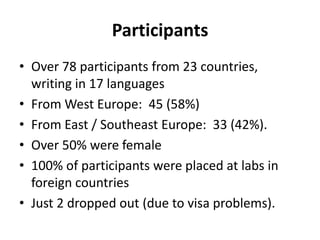
ParticipantsOver 78 participants from 23 countries, writing in 17 languagesFrom West Europe:  45 (58%) From East / Southeast Europe:  33 (42%).Over 50% were female100% of participants were placed at labs in foreign countriesJust 2 dropped out (due to visa problems).
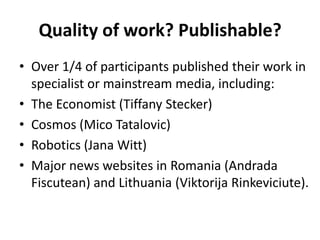
Quality of work? Publishable?Over 1/4 of participants published their work in specialist or mainstream media, including: The Economist (Tiffany Stecker) Cosmos (MicoTatalovic) Robotics (Jana Witt) Major news websites in Romania (AndradaFiscutean) and Lithuania (ViktorijaRinkeviciute).
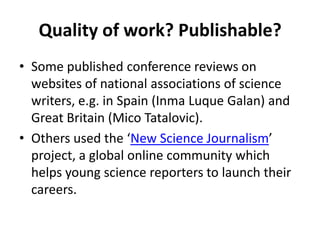
Quality of work? Publishable?Some published conference reviews on websites of national associations of science writers, e.g. in Spain (InmaLuque Galan) and Great Britain (MicoTatalovic). Others used the ‘New Science Journalism’ project, a global online community which helps young science reporters to launch their careers.
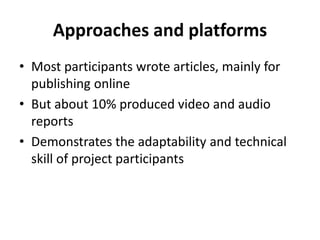
Approaches and platforms Most participants wrote articles, mainly for publishing onlineBut about 10% produced video and audio reportsDemonstrates the adaptability and technical skill of project participants
Skills and opportunitiesAs the 2 winners show, young reporters are capable of publishing not only one but also two or even three articles Despite the general crisis in the economy and industry over the last few years.Entrepreneurialism, persistence, and networking are now key to journalism training, given the fluidity of the market
Training assessmentEJC’s open assessment provides a detailed qualitative analysis Participants’ remarks focus i) on the study tours and ii) the wider relationship between science and journalism. First-hand insights, available on a public websiteare useful for future projects
Training assessmentMajority of participants gave very positive appraisals of the study tours Many acknowledged the clear gap between scientists and journalists in terms of language, approach and interpretation.
Training assessmentMany commented on the benefits of ‘dual track’ networking, with both researchers and other reporters from across Europe.Positive remarks also given on the logistics and guidance HOWEVER…
Training assessmentAt least 2 participants (Frederiksen and Tatalovic) noted a structural problem: the need for greater journalistic support on-siteThey wanted a more balanced approach A one-hour briefing by either EJC or Minerva could never balance with 5 days under the host labs’ rules
Final assessmentAlthough EJC made 10 trips and briefings – they were not enough for some participants Although training materials were sent 2 weeks before leaving (journalism ethics, research and pitching guides) – they were not enough for some participantsAlthough core labs had media professionals  -- there was a perceived lack of balance between scientific and journalism aspects
Final assessmentCurrent project performance: adequateMost participants understood the need to be entrepreneurialBut the balance ‘gap’ became wider as the project grew from 3 to 12 locationsTo improve: need more journalistic support on-siteSpecific recommendations? >>>
RecommendationsAllocate sufficient human and financial resources to enable professional journalists / trainers to guide participants throughout the study tours. Formally integrate the European Journalism Training Association, to work alongside the European Journalism Centre
Future of science journalism?See EJC Magazine: www.ejc.netScience PR: Putting journalists out of the picture (5 July 2010) MYScience meets RELATE: Future-proofing science journalism? (31 May 2010)RELATE visual summary: with links to published articles and press review
Thank you for listening!Howard HudsonEditor, European Journalism Centre (2009-10)Editor and Communications Coordinator, United Nations University-MERIT (2011-)howardrhudson@gmail.com

x.

  • 1.
    Final Conference ProjectAssessment28 January 2011Howard Hudson, Editor,European Journalism Centre
  • 2.
    LABS recruitmentAcross 3rounds, RELATE expanded from 3 to 12 institutes: a 4-fold increase in 18 months. Clear ability to attract other laboratories Confirmed as a “a potentially self-sustainable initiative”.
  • 3.
    Quality of newinstitutesVery high. Two examples: i) European Southern Observatory (Germany): “world's most productive astronomical observatory; foremost intergovernmental astronomy organisation in Europe ”ii) INRA (France) “number one agricultural institute in Europe and number two in the world”
  • 4.
    ParticipantsOver 78 participantsfrom 23 countries, writing in 17 languagesFrom West Europe: 45 (58%) From East / Southeast Europe: 33 (42%).Over 50% were female100% of participants were placed at labs in foreign countriesJust 2 dropped out (due to visa problems).
  • 5.
    Quality of work?Publishable?Over 1/4 of participants published their work in specialist or mainstream media, including: The Economist (Tiffany Stecker) Cosmos (MicoTatalovic) Robotics (Jana Witt) Major news websites in Romania (AndradaFiscutean) and Lithuania (ViktorijaRinkeviciute).
  • 6.
    Quality of work?Publishable?Some published conference reviews on websites of national associations of science writers, e.g. in Spain (InmaLuque Galan) and Great Britain (MicoTatalovic). Others used the ‘New Science Journalism’ project, a global online community which helps young science reporters to launch their careers.
  • 7.
    Approaches and platformsMost participants wrote articles, mainly for publishing onlineBut about 10% produced video and audio reportsDemonstrates the adaptability and technical skill of project participants
  • 8.
    Skills and opportunitiesAsthe 2 winners show, young reporters are capable of publishing not only one but also two or even three articles Despite the general crisis in the economy and industry over the last few years.Entrepreneurialism, persistence, and networking are now key to journalism training, given the fluidity of the market
  • 9.
    Training assessmentEJC’s openassessment provides a detailed qualitative analysis Participants’ remarks focus i) on the study tours and ii) the wider relationship between science and journalism. First-hand insights, available on a public websiteare useful for future projects
  • 10.
    Training assessmentMajority ofparticipants gave very positive appraisals of the study tours Many acknowledged the clear gap between scientists and journalists in terms of language, approach and interpretation.
  • 11.
    Training assessmentMany commentedon the benefits of ‘dual track’ networking, with both researchers and other reporters from across Europe.Positive remarks also given on the logistics and guidance HOWEVER…
  • 12.
    Training assessmentAt least2 participants (Frederiksen and Tatalovic) noted a structural problem: the need for greater journalistic support on-siteThey wanted a more balanced approach A one-hour briefing by either EJC or Minerva could never balance with 5 days under the host labs’ rules
  • 13.
    Final assessmentAlthough EJCmade 10 trips and briefings – they were not enough for some participants Although training materials were sent 2 weeks before leaving (journalism ethics, research and pitching guides) – they were not enough for some participantsAlthough core labs had media professionals -- there was a perceived lack of balance between scientific and journalism aspects
  • 14.
    Final assessmentCurrent projectperformance: adequateMost participants understood the need to be entrepreneurialBut the balance ‘gap’ became wider as the project grew from 3 to 12 locationsTo improve: need more journalistic support on-siteSpecific recommendations? >>>
  • 15.
    RecommendationsAllocate sufficient humanand financial resources to enable professional journalists / trainers to guide participants throughout the study tours. Formally integrate the European Journalism Training Association, to work alongside the European Journalism Centre
  • 16.
    Future of sciencejournalism?See EJC Magazine: www.ejc.netScience PR: Putting journalists out of the picture (5 July 2010) MYScience meets RELATE: Future-proofing science journalism? (31 May 2010)RELATE visual summary: with links to published articles and press review
  • 17.
    Thank you forlistening!Howard HudsonEditor, European Journalism Centre (2009-10)Editor and Communications Coordinator, United Nations University-MERIT (2011-)howardrhudson@gmail.com